Table of Contents
Introduction — Global Production: The Engine of a Connected Global Economy
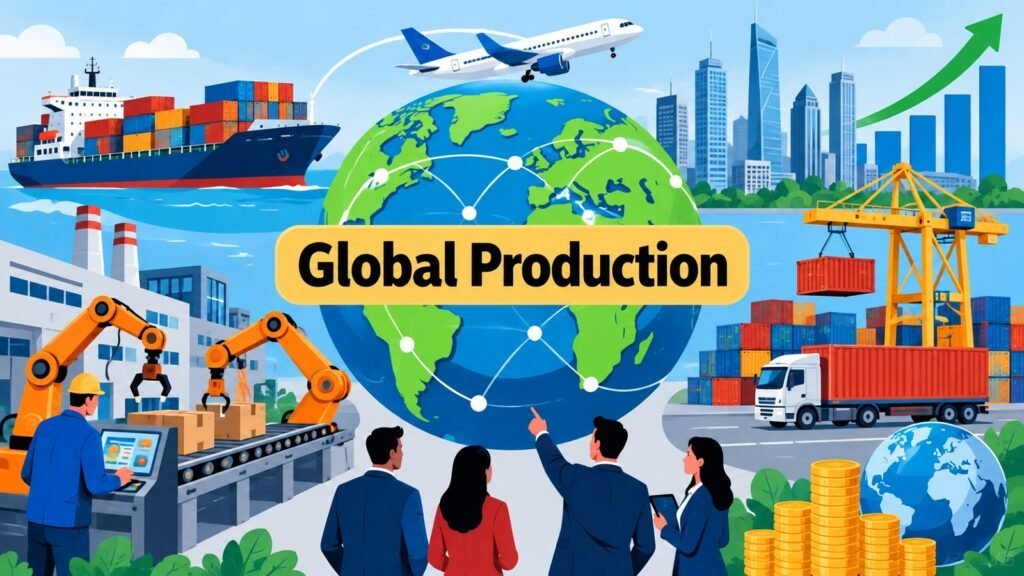
Global Production is an important building block of the global economy — the system through which countries, companies, workers, technologies, resources, and markets combine to create economic value across borders. It encompasses tangible manufactured goods as well as agriculture, natural resources, software, services, research and development, design, and other knowledge-intensive activities. Production today rarely involves a single firm completing a process from start to finish; instead, geographically fragmented activities carried out by many participants in different countries have become the norm.
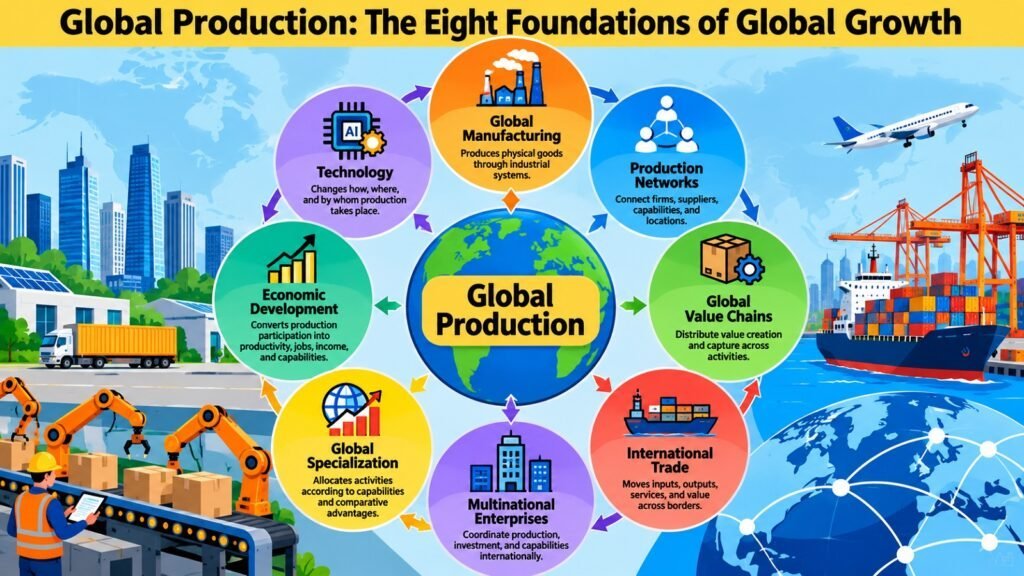
Global Production is related to, but distinct from, several connected concepts. Global Manufacturing refers to the industrial transformation of physical inputs into goods. Global Production Networks describe structural relationships among firms across borders. Global Value Chains analyze where value is created and captured. Global Supply Chains focus on the logistics of moving inputs and outputs. This article examines eight foundations of Global Production — drawing on established research and real-world evidence — to show how manufacturing, networks, value chains, trade, multinationals, specialization, development, and technology interact within this broader system.
Table 1: Global Production — A Roadmap of Eight Foundations
| Foundation | Core Focus |
| Global Manufacturing | Industrial transformation of physical inputs into goods across countries |
| Production Networks | Interconnected firms and activities spanning multiple geographies |
| Global Value Chains | Stages of production and distribution of value creation and capture |
| International Trade | Cross-border flows of goods, components, services, and knowledge |
| Multinational Enterprises | Firms that organize and coordinate production across national borders |
| Global Specialization | Why different economies perform different productive activities |
| Economic Development | How participation in global production shapes growth and capability |
| Technology | How automation, digitization, and innovation reshape production systems |
1. Global Production and Global Manufacturing: Producing the World’s Goods
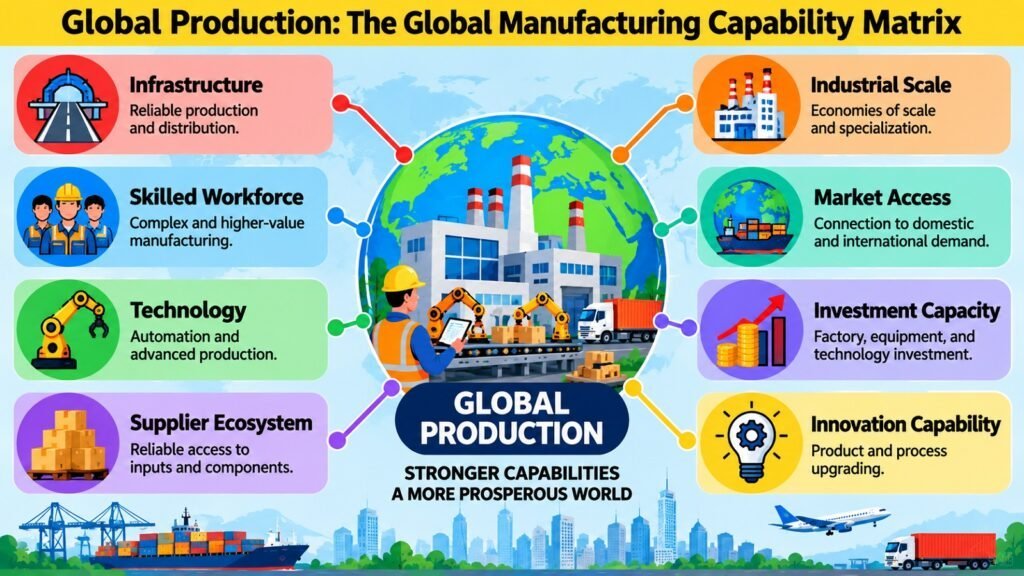
Manufacturing is one of the most visible and historically consequential dimensions of Global Production. While Global Production encompasses many forms of economic activity, Global Manufacturing refers specifically to the industrial process of transforming raw materials and intermediate inputs into physical goods. The distinction matters because manufacturing carries particular characteristics — capital intensity, economies of scale, productivity spillovers, and technology diffusion — that make it a powerful driver of broader economic development.
Comparative advantage explains part of why manufacturing concentrates in specific countries. Countries with abundant labor, developed infrastructure, or accumulated industrial knowledge attract manufacturing investment. But this advantage is not static. South Korea and Taiwan evolved from low-cost assembly operations in the 1960s into sophisticated producers of semiconductors and precision equipment by systematically building skills, supplier ecosystems, and technical standards over decades. Comparative advantage, in other words, can be built rather than simply inherited.
Scale economies are central to understanding why global manufacturing tends to cluster geographically. Large production volumes spread fixed costs across more units, creating competitive advantages that newer producers find difficult to overcome. A modern automobile illustrates how manufacturing stages can still distribute across countries: steel from one, electronics from another, precision parts from a third, and final assembly elsewhere. Each stage requires capabilities that no single country commands across all of them.
Automation and advanced manufacturing are changing traditional assumptions about location attractiveness. When robotics reduce the share of labor in total production costs, the advantage of relocating to lower-wage countries diminishes. Advanced manufacturing also raises skill and infrastructure requirements, making it harder for economies without strong technical capabilities to compete in technology-intensive product segments. Future manufacturing advantages will depend more on productivity, engineering talent, and technology than on labor cost alone.
Table 2: Global Production and Global Manufacturing — Eight Key Dimensions
| Dimension | Evidence or Characteristic |
| Scale economies | Large-scale production lowers unit costs; auto plants typically need 200,000+ units/year for efficiency |
| Comparative advantage | Bangladesh leads in garment exports due to labor cost and accumulated industry knowledge |
| Industrial clustering | China’s Pearl River Delta hosts thousands of electronics manufacturers in close proximity |
| Capability building | South Korea grew semiconductors through decades of R&D investment and technology licensing |
| Supplier ecosystems | Japan’s keiretsu system links manufacturers and suppliers through long-term relationships |
| Automation impact | Industrial robots now perform welding, painting, and assembly formerly done by low-wage workers |
| Infrastructure dependency | Reliable power, ports, and roads are prerequisites for export-oriented manufacturing |
| Technology upgrading | Advanced manufacturing in Germany and Switzerland commands premium prices globally |
2. Global Production and Production Networks: Connecting Production Across Borders
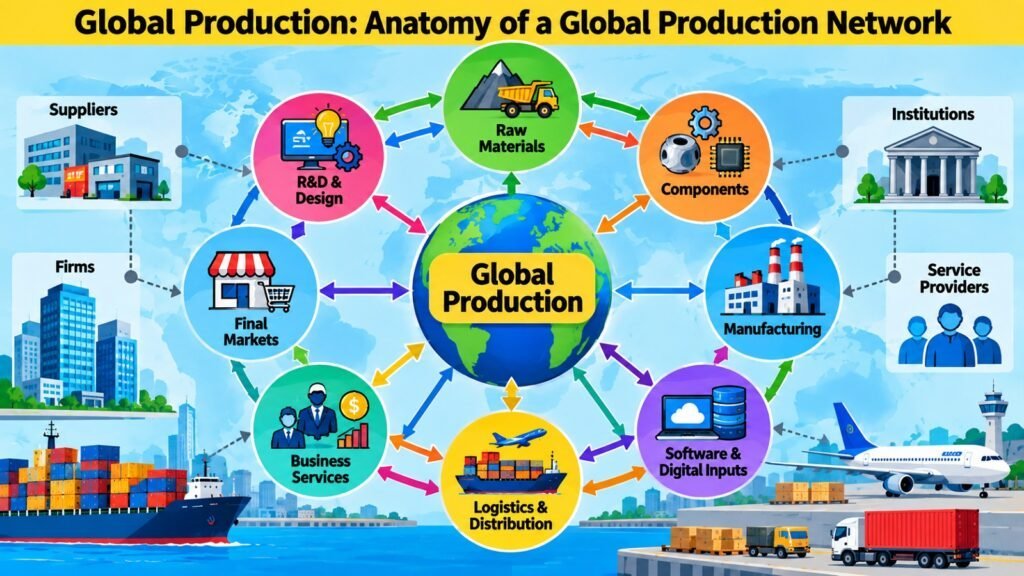
Global Production increasingly operates through interconnected networks of firms, suppliers, service providers, research organizations, and logistics companies, each contributing specialized capabilities from different locations. Economists describe this as geographic fragmentation of production — a single process broken into discrete tasks distributed across multiple countries when the gains from specialization outweigh the costs of cross-border coordination. These production networks define the structural architecture of modern Global Production.
Outsourcing and offshoring are the primary mechanisms through which firms build these networks. Outsourcing contracts a production activity to an external firm; offshoring relocates it to a different country, either within the firm or through a partner. Contract manufacturing organizations — common in electronics and pharmaceuticals — specialize in producing goods for brand companies focused on design and distribution, allowing each party to concentrate on its core competency while accessing complementary capabilities across borders.
The smartphone industry illustrates how these networks operate in practice. A leading brand draws on participants across dozens of countries — processors designed in the United States, displays manufactured in South Korea or Japan, memory produced in Taiwan, cameras assembled in China, and materials from central Africa. Contractual relationships, shared technical standards, and real-time logistics systems connect these participants into a functioning system that no single participant could replicate alone.
Production networks create both efficiency advantages and structural vulnerabilities. Disruptions at any node can propagate through the entire system. The semiconductor shortages between 2020 and 2022 demonstrated how a constraint in one specialized segment could interrupt automobile and electronics production worldwide. Mapping a network effectively requires identifying not only its major participants and relationships but also its critical dependencies, single-source risks, and the points where disruption would cause the greatest harm.
Table 3: Global Production Networks — Eight Mapping Elements
| Network Element | Analytical Description |
| Lead firms | Dominant companies that set standards, coordinate suppliers, and capture brand value |
| Tier-1 suppliers | Primary suppliers delivering major subsystems directly to lead firms |
| Tier-2/3 suppliers | Smaller firms providing materials and components to tier-1 suppliers |
| Service providers | Logistics, finance, testing, and IT firms embedded in production networks |
| Production hubs | Geographic clusters where multiple network participants co-locate |
| Coordination mechanisms | Contracts, standards, digital platforms, and relationship-based governance |
| Critical dependencies | Single-source inputs or locations where disruption halts the whole network |
| Network boundaries | Where a production network ends and a different supply system begins |
3. Global Production and Global Value Chains: Creating and Capturing Value
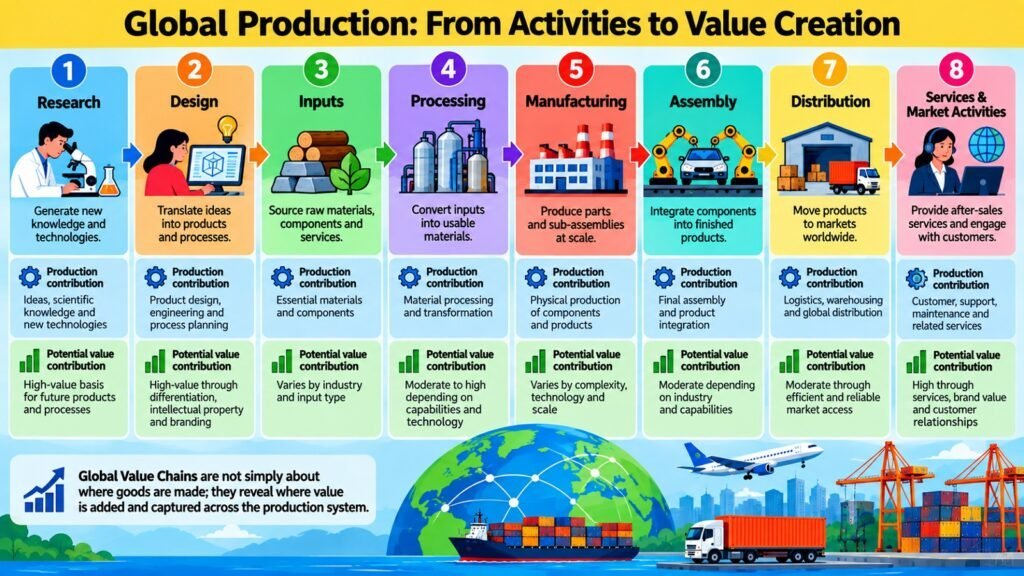
A Global Value Chain is an analytical lens for examining Global Production that focuses on where economic value is created and where it is captured. Participation and value capture are related but not equivalent outcomes — many countries and firms participate in global production without capturing a proportionate share of the economic value that production generates. This distinction has direct consequences for firms, industries, and economies.
Production can be divided into multiple stages: research, design, sourcing, fabrication, assembly, testing, branding, marketing, distribution, and after-sales services. These stages do not generate equal value. Activities requiring proprietary knowledge, patents, strong brands, or specialized engineering capabilities generate substantially more value per unit than activities involving repetitive physical work. Research on value chains in garments, electronics, and footwear shows that brand owners and retailers in high-income countries typically capture much larger shares of the final retail price than the factories that physically produce the goods.
Development economists call the process of moving toward higher-value activities upgrading. This can involve improving product quality, mastering more complex processes, or expanding into more functions within a chain. The challenge is that upgrading requires sustained investment in knowledge, technology, and capabilities, and lead firms in a value chain do not always support or welcome it from their suppliers, since supplier upgrading can reduce the lead firm’s competitive advantage.
Identifying where value is created and captured requires examining where knowledge, intellectual property, branding, and specialized expertise reside within a production system. Firms and economies controlling these assets typically capture larger value shares regardless of where physical manufacturing occurs. This is why some economies prioritize attracting research, design, and innovation activities — not simply manufacturing investment — as their primary strategy for integration into global production systems.
Table 4: Global Production and Global Value Chains — Eight Stages and Value Dimensions
| Stage or Activity | Value Characteristic |
| Research and development | High value; protected by patents and proprietary knowledge |
| Product design | High value; creates differentiation, brand identity, and premium pricing |
| Raw material sourcing | Variable value; commodity inputs yield lower margins than specialized materials |
| Component manufacturing | Moderate value; higher for precision or proprietary components |
| Assembly and production | Lower value when labor-intensive; higher when technology-intensive |
| Branding and marketing | High value; brand equity can account for 30–50% of product price in consumer goods |
| Distribution and logistics | Moderate value; specialized logistics can command premium margins |
| After-sales and services | Growing value; services now represent major revenue in electronics and industrial equipment |
4. Global Production and International Trade: Connecting Production With Global Commerce
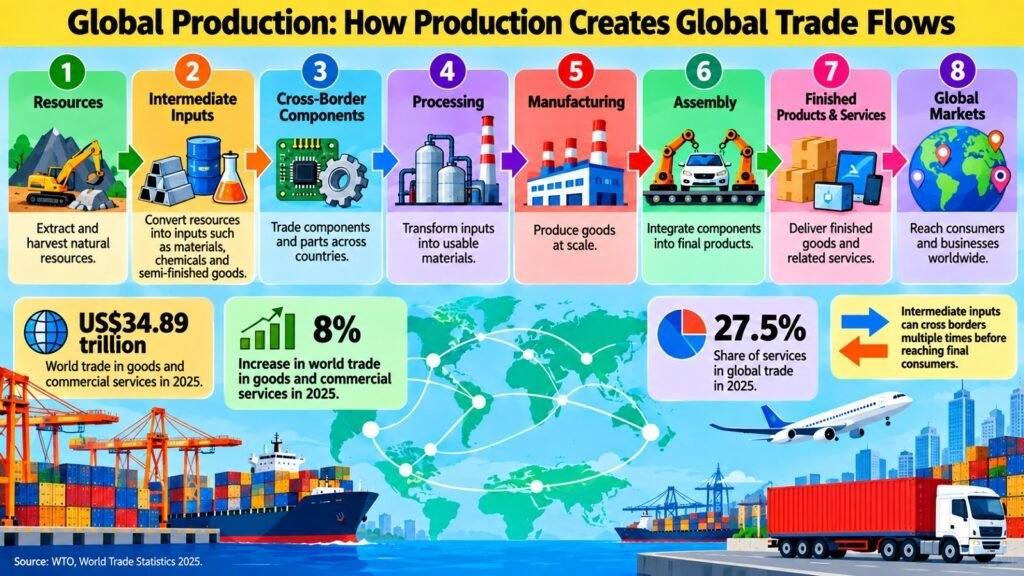
Global Production and international trade are inseparable. When production is geographically distributed, cross-border movement of inputs and outputs becomes an inherent part of the production process. Goods, components, services, and knowledge cross national borders — often multiple times — before a product reaches its final consumer. This reality has fundamentally changed the nature and composition of global commerce compared with the simpler exchange of finished goods that classical trade theory originally described.
Modern trade is dominated by flows of intermediate goods — components, parts, materials, and semi-processed inputs crossing borders as part of ongoing production processes rather than as finished products ready for final consumers. The World Trade Organization and the OECD estimate that intermediate goods account for roughly two-thirds of world goods and services trade. The concept of trade in value added clarifies the picture further by measuring the domestic contribution to each export rather than its gross value, which can count the same input multiple times as it crosses borders.
Trade policy directly influences where production activities locate. Tariffs, quotas, rules of origin, and trade agreements all affect whether it is cost-effective to import components, assemble them domestically, and re-export the finished product. The North American free trade arrangement created conditions that encouraged automotive firms to organize integrated production networks spanning three countries, with components crossing borders multiple times before a vehicle is complete.
Trade disruptions can interrupt production processes in ways that affect industries far from the original point of disruption. When the United States imposed steel and aluminum tariffs in 2018, downstream manufacturers relying on imported metal inputs faced higher costs even if they did not themselves trade in the tariffed materials. This illustrates how trade policy aimed at one point in a production system can propagate effects throughout many others.
Table 5: Global Production and International Trade — Eight Key Interactions
| Trade-Production Interaction | Description |
| Intermediate goods trade | Components and parts cross borders as production inputs before final assembly |
| Trade in value added | Measures domestic value contribution to exports, not gross export volume |
| Rules of origin | Determine which goods qualify for preferential tariff treatment in trade agreements |
| Tariff cascading | Higher tariffs on finished goods than inputs encourage domestic final-stage production |
| Export processing zones | Special zones offer duty-free imports of inputs for re-export as finished products |
| Trade agreements | Reduce barriers to cross-border input flows, enabling integrated production networks |
| Transport costs | Shipping, logistics, and time costs influence which activities can be geographically separated |
| Non-tariff barriers | Technical standards, regulations, and certification requirements affect production location |
5. Global Production and Multinational Enterprises: Organizing Production Worldwide
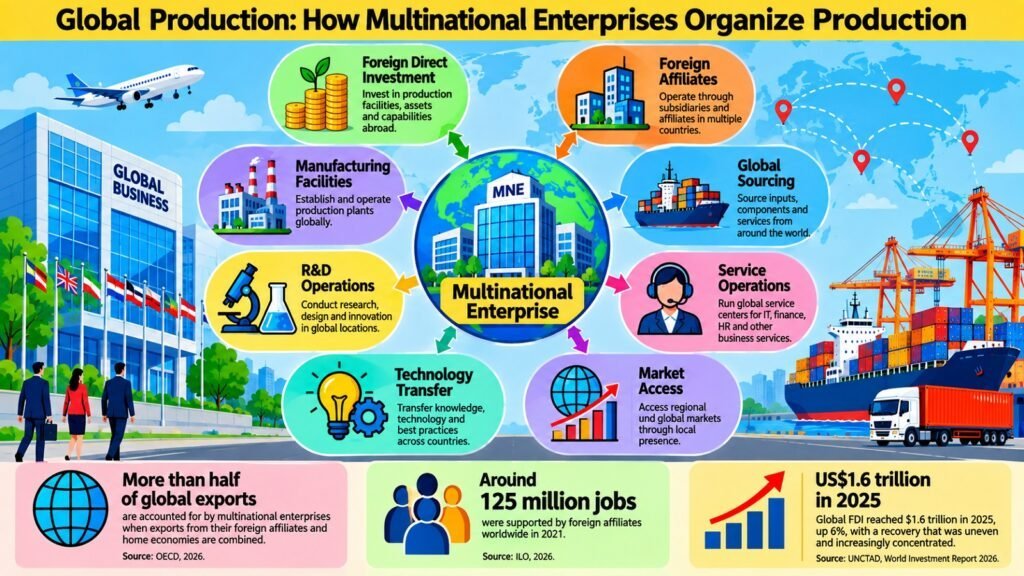
Multinational enterprises are the primary organizational agents of Global Production. They establish production facilities, research centers, procurement operations, service hubs, and distribution networks across many countries, and in doing so they shape the structure, geography, and governance of production systems worldwide. Understanding how multinationals organize cross-border production is essential to understanding how Global Production actually functions at a practical level.
Foreign direct investment is the main mechanism through which multinationals build international production presence. Unlike portfolio investment, FDI involves genuine participation in production through capital, technology, and management commitment. According to UNCTAD, the global stock of FDI exceeded USD 41 trillion by the early 2020s. Economic theory — particularly the framework developed by John Dunning — explains that firms expand internationally when they possess firm-specific advantages, such as proprietary technology or brands, that are more profitable to exploit internally than to license to foreign partners.
Location decisions depend on a complex mix of factors beyond labor cost. Workforce skills, infrastructure quality, proximity to customers or suppliers, regulatory environment, intellectual property protection, and political stability all influence investment decisions. A pharmaceutical firm choosing where to locate a research facility will weight scientific talent and strong IP protection far more heavily than wage levels, because R&D is knowledge-intensive rather than labor-cost-sensitive.
Multinationals also serve as vectors for technology transfer and capability development in host economies. Foreign-owned firms tend to pay higher wages, adopt more advanced technologies, and operate at higher productivity than comparable domestic firms in the same industry. Whether these advantages spill over to local firms and workers depends on the absorptive capacity of the local economy, the nature of linkages between foreign and domestic producers, and the policies governments put in place to maximize local benefits from foreign investment.
Table 6: Global Production and Multinational Enterprises — Eight Organizational Mechanisms
| Mechanism | Role in Global Production |
| Foreign direct investment | Commits capital and technology to productive assets in host countries |
| Vertical integration | Firm controls multiple production stages across countries within one corporate structure |
| Outsourcing to suppliers | Contracts production activities to specialized external firms in different countries |
| Offshoring | Relocates a business function to a foreign country, within the firm or via a partner |
| Joint ventures | Partnerships with local firms to share market access, capabilities, or regulatory compliance |
| Strategic alliances | Non-equity arrangements for technology sharing, co-production, or market access |
| Transfer pricing | Internal pricing of goods and services between affiliates affects profit and tax distribution |
| Technology transfer | Multinationals introduce proprietary technology and practices to production locations |
6. Global Production and Global Specialization: Dividing Production Across Economies
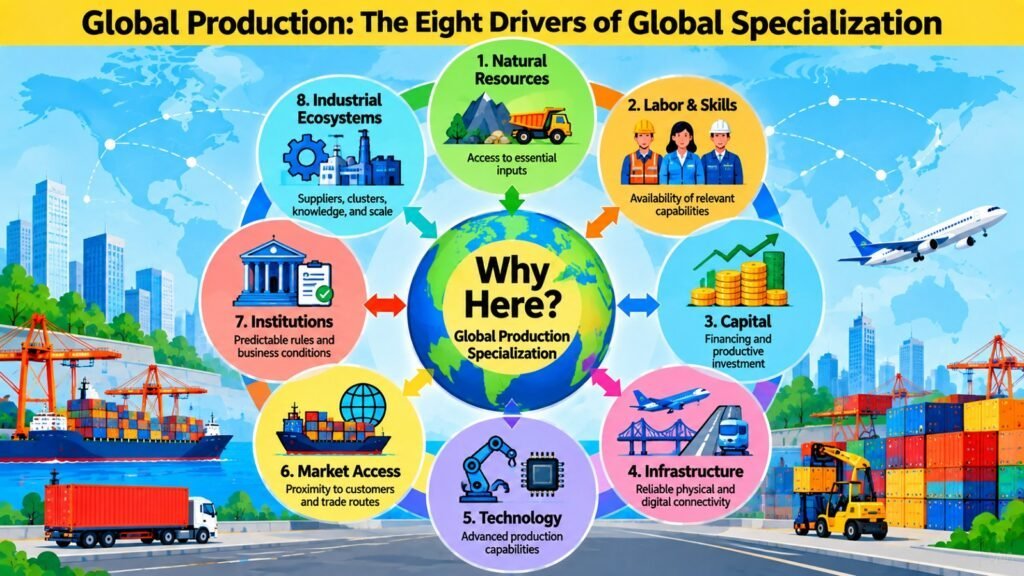
Global Production distributes across countries and regions because different economies are better positioned to perform different productive activities. This geographic division reflects economic, technological, institutional, and historical factors interacting over long periods. Understanding specialization — why certain production activities concentrate in particular places — is central to understanding the structure of Global Production and the competitive position of economies within it.
Comparative advantage, foundational to international trade theory since David Ricardo, explains that countries benefit from specializing in activities where they are relatively most productive. Countries with abundant natural resources concentrate in resource extraction. Those with large lower-cost labor forces have historically attracted labor-intensive manufacturing. Countries with strong scientific and engineering capabilities tend to specialize in high-technology production and innovation. However, static factor endowments tell only part of the story — specialization also emerges from accumulated capabilities, learning effects, industrial clusters, and deliberate policy choices.
Germany’s specialization in precision machinery, chemical engineering, and automotive technology illustrates the point. It is not the result of natural resource endowments but of generations of investment in technical education, engineering culture, industry-university collaboration, and quality-focused manufacturing standards that competitors find difficult to replicate quickly. Specialization based on accumulated capabilities is therefore more durable and harder to displace than specialization based on cheap inputs alone.
Specialization carries both benefits and risks. Productivity gains from concentration are real — specialized firms develop deep expertise, invest in specialized equipment, and move down learning curves that generalist producers cannot match. But concentration also creates vulnerability. South Korea, Taiwan, Singapore, and more recently Vietnam demonstrate that economies can shift from low-value to higher-value specialization through sustained investment in education, technology, infrastructure, and institutions, though the process requires consistent effort over many years.
Table 7: Global Production Specialization — Eight Influencing Factors
| Factor | Influence on Specialization |
| Natural resources | Mineral, agricultural, or energy endowments create early specialization advantages |
| Labor cost and supply | Large, low-cost workforces attract labor-intensive manufacturing at early development stages |
| Human capital | Skilled engineers, scientists, and technicians enable technology-intensive specialization |
| Physical infrastructure | Ports, roads, energy, and telecoms determine which production activities are feasible |
| Industrial clusters | Geographic concentration of related firms builds shared knowledge and supplier depth |
| Institutions | Rule of law, IP protection, and contract enforcement support knowledge-intensive production |
| Industrial policy | Government investment, trade policy, and R&D support can shape specialization trajectories |
| Technology access | Availability of advanced technology through FDI or licensing enables capability upgrading |
7. Global Production and Economic Development: Creating Growth and Opportunity
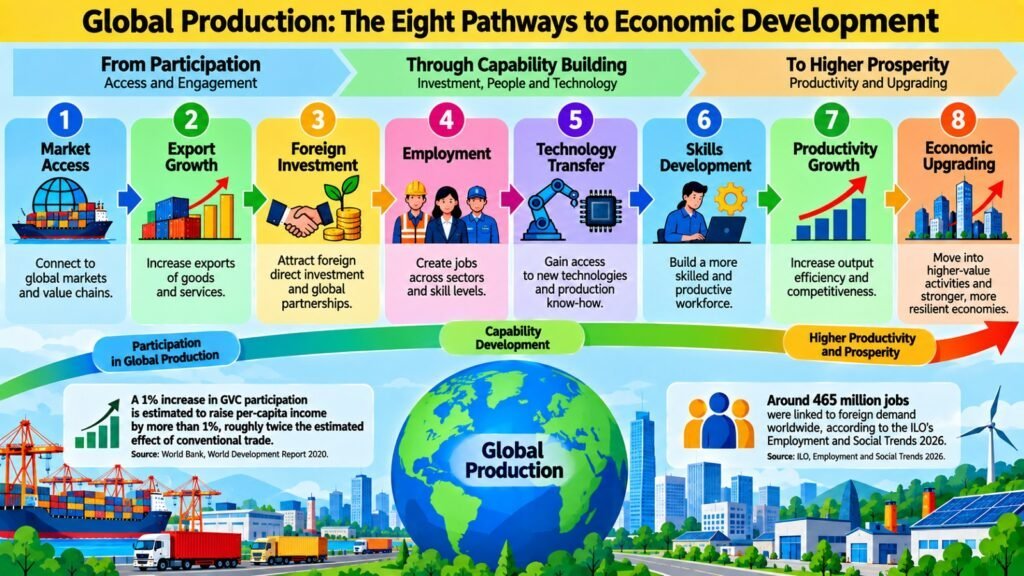
Participation in Global Production can be a powerful driver of economic development, but the outcomes are not automatic. The relationship between global production integration and development is shaped by the nature of a country’s participation, the capabilities it builds along the way, and the conditions that determine whether productive gains translate into improvements in living standards and economic capacity. Participation and developmental benefit are related but not identical outcomes.
Historical experience demonstrates that integration into global production systems can support significant economic transformation. South Korea, Taiwan, and Singapore used export-oriented manufacturing as a platform for rapid industrialization and structural transformation. More recently, Vietnam expanded its manufacturing base by attracting electronics and garment production, with manufactured exports growing to roughly 90 percent of GDP by the early 2020s — a scale that has contributed substantially to income growth and poverty reduction across the country.
Global Production supports development through several mechanisms: exports generate foreign exchange to finance capital goods imports; FDI brings capital, management practices, and market access; participation in production networks exposes domestic firms to international technical standards; and employment in export sectors typically pays higher wages than subsistence agriculture or informal work. Development economists emphasize, however, that these benefits are not automatic. Economies confined to low-value segments may expand exports without building the capabilities needed for sustained productivity growth.
Economies that capture more from Global Production tend to combine strong education systems, physical infrastructure, institutional quality, domestic firms capable of absorbing technology, access to productive finance, and macroeconomic stability. Weak domestic linkages between foreign-owned producers and local firms limit technology diffusion and learning spillovers. Countries that bring these enabling conditions together while deliberately integrating into dynamic production networks have achieved the strongest and most sustained development outcomes.
Table 8: Global Production and Economic Development — Eight Development Channels
| Development Channel | Mechanism |
| Export growth | Manufactured and service exports earn foreign exchange and scale domestic production |
| FDI and capital inflows | Foreign investment finances productive assets, infrastructure, and job creation |
| Technology transfer | Multinational firms introduce advanced production methods and management practices |
| Workforce skills | Participation in demanding global supply chains builds technical and managerial skills |
| Productivity growth | Exposure to international standards and competition raises firm-level productivity |
| Structural transformation | Manufacturing and service growth shifts employment from low-productivity agriculture |
| Domestic linkages | Local supplier development spreads benefits beyond foreign-owned export producers |
| Upgrading potential | Access to global networks provides pathways to higher-value production over time |
8. Global Production and Technology: Transforming the Future of Production
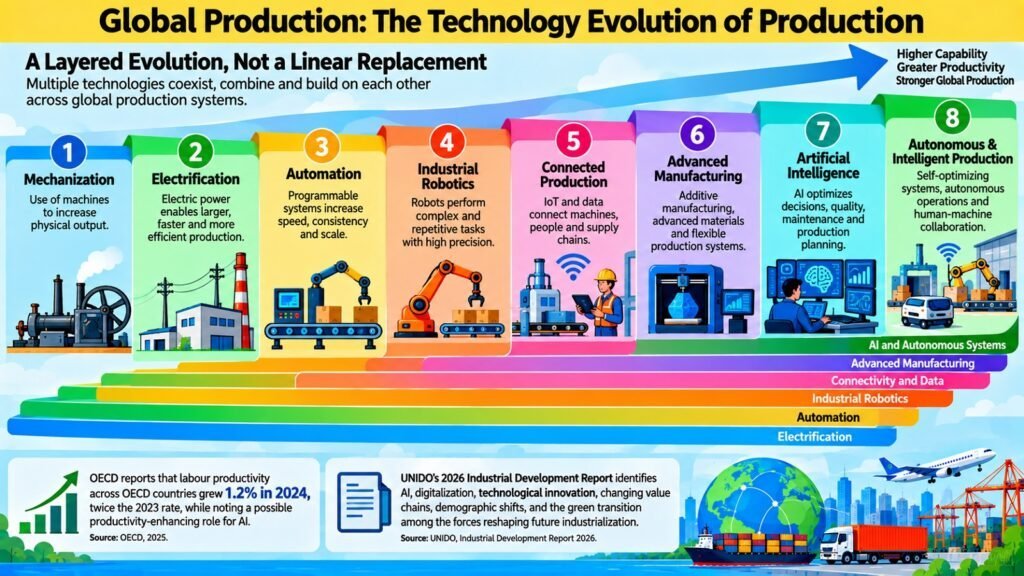
Technology is transforming both the organization and geography of Global Production at an exceptional pace. Automation, robotics, artificial intelligence, industrial Internet of Things, advanced manufacturing, digital platforms, and additive manufacturing are collectively changing what is produced, where it is produced, by whom, and at what cost. These changes are also expanding the definition of Global Production itself by incorporating an increasingly large range of knowledge-intensive activities alongside traditional factory-based work.
Automation and robotics reduce the share of labor in total production costs, which directly affects where manufacturing locates. When labor cost becomes a smaller fraction of total cost, the advantage of relocating to lower-wage countries diminishes. International Federation of Robotics data show that robot density has grown rapidly in South Korea, Singapore, Germany, and Japan — all high-wage economies that have used automation to sustain manufacturing competitiveness despite wage disadvantages relative to lower-income competitors.
Artificial intelligence is shifting the productivity frontier in advanced manufacturing. Machine learning systems optimize production schedules, predict equipment failures, detect quality defects faster than human inspectors, and manage complex logistics networks. Technology is also broadening Global Production beyond physical manufacturing. Software development, digital services, data analytics, and engineering design can be organized internationally without physical goods crossing borders. India’s information technology industry — employing millions of skilled engineers serving clients across North America and Europe — exemplifies how digital production can be distributed globally at scale.
Evaluating how technology will change a specific production system requires asking what share of activities is automatable, what new capabilities technology enables, how it changes the relative importance of different locations and skills, and whether digitization creates new competitive advantages or erodes existing ones. Future leadership in Global Production is likely to go to economies and firms that combine technological capability with strong human capital, world-class infrastructure, and the organizational capacity to adapt continuously to change.
Table 9: Global Production and Technology — Eight Technologies and Their Production Implications
| Technology | Production Implication |
| Industrial robotics | Reduces labor cost share; enables competitive manufacturing in high-wage economies |
| Artificial intelligence | Optimizes scheduling, quality control, and logistics; accelerates process improvement |
| Industrial IoT | Connects machines and sensors to enable real-time monitoring and predictive maintenance |
| Additive manufacturing | 3D printing enables rapid prototyping and small-batch production closer to end markets |
| Digital twins | Virtual replicas of production systems allow simulation and optimization before physical changes |
| Digital platforms | Enable coordination across globally dispersed production participants in real time |
| Advanced materials | New composites and materials enable lighter, stronger, and more efficient products |
| Cloud and data analytics | Centralizes production data for global visibility, planning, and performance management |
Conclusion — Global Production: Building the Foundations of Global Growth
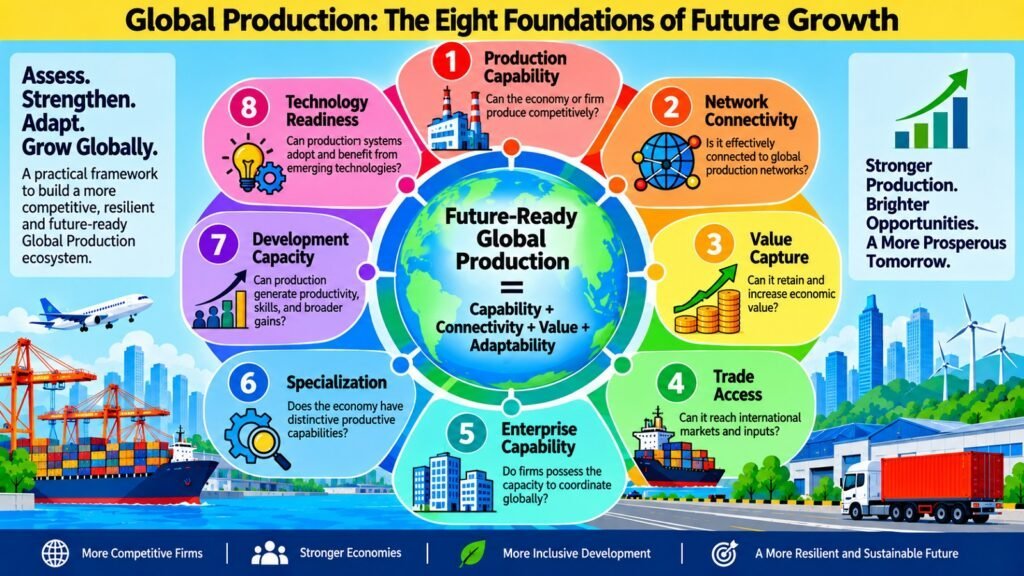
Global Production is not a single activity or system. It is the combined outcome of manufacturing, interconnected networks, value creation and capture, international trade, multinational enterprise strategy, geographic specialization, development pathways, and technological change — all operating simultaneously and interdependently. Manufacturing depends on networks. Networks generate trade. Trade reflects specialization. Specialization shapes development. Technology transforms all of them. Understanding any one foundation in isolation gives only a partial picture of how global production systems actually work.
Global Production is also broader than manufacturing. It encompasses services, software, research, design, data, and knowledge-intensive activities organized internationally, with or without physical goods crossing borders. The analytical framework running through this article offers a set of questions applicable to any production system: What is produced, and through what activities? Where does each activity occur, and why? Who are the key participants? How are activities connected? Where is value created and captured? What are the development outcomes? How might technology and other forces change the system? Future success in Global Production will increasingly depend on productivity, advanced capabilities, resilience, skilled human capital, innovation, and the institutional capacity to adapt.
Table 10: Global Production — Eight Key Takeaways from Eight Foundations
| Foundation | Key Takeaway |
| Global Manufacturing | Manufacturing remains central to Global Production but increasingly requires technology and skills, not just low costs |
| Production Networks | Modern production is organized through interconnected networks of firms spanning multiple countries |
| Global Value Chains | Participation in production differs from capturing value; upgrading requires moving toward knowledge-intensive activities |
| International Trade | Intermediate goods trade accounts for the majority of global commerce, reflecting deep production integration |
| Multinational Enterprises | Multinationals organize cross-border production and are key agents of investment, technology, and capability transfer |
| Global Specialization | Specialization reflects not only natural endowments but accumulated capabilities, institutions, and deliberate policy |
| Economic Development | Sustained development requires building capabilities and linkages, not only increasing production or export volume |
| Technology | Future production advantages will depend on the combination of technology, human capital, innovation, and adaptability |