
Table of Contents
Introduction — Business Leadership: The Human Foundation of Organizational Success
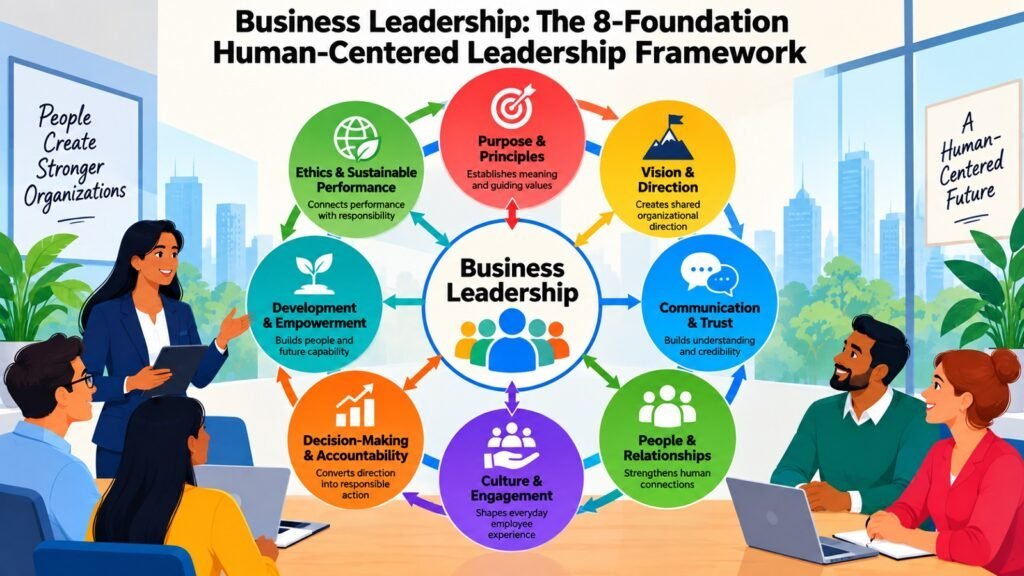
Business Leadership is the discipline through which organizations establish purpose, create direction, influence people, build relationships, shape culture, make decisions, develop organizational capability, and pursue responsible performance. It sits at the intersection of strategy, human behavior, and ethical responsibility — and it cannot be reduced to authority, hierarchy, financial results, or operational control alone.
Business Leadership is an important aspect of Human-Centered Organizations precisely because organizations are built from people, not just processes. When leadership operates only through command, compliance, or short-term metrics, it misses the deeper drivers of engagement, trust, and sustainable performance. Effective Business Leadership connects organizational objectives with human needs, relationships, and long-term health. It creates conditions in which people contribute meaningfully rather than simply comply efficiently.
This article examines eight interconnected foundations that together form a comprehensive leadership system. Purpose and principles establish why an organization exists and how it operates. Vision and direction translate that purpose into a shared future. Communication and trust connect people to that direction. Relationships deepen the human connections that make collaboration possible. Culture and engagement reflect how leadership behavior shapes everyday experience. Decision-making and accountability convert direction into responsible action. Development and empowerment build organizational capability. Ethics and sustainable performance connect conduct with long-term value.
These foundations are not independent modules. They reinforce and depend on each other, forming an integrated leadership architecture. The article draws on established leadership theory, credible organizational research, practical frameworks, and diagnostic perspectives to help readers understand Business Leadership conceptually and reflect on how it operates within real organizations.
Table 1: Business Leadership Foundations — A Quick-Reference Overview
| Business Leadership Foundation | Core Focus |
| Purpose & Principles | Establishing why the organization exists and the values that guide leadership behavior |
| Vision & Direction | Creating a shared future and aligning people toward common organizational objectives |
| Communication & Trust | Building shared understanding, credibility, and psychological safety through dialogue |
| People & Relationships | Strengthening human connections that support collaboration and mutual respect |
| Culture & Engagement | Shaping the everyday experience of work through leadership behavior and expectations |
| Decision-Making & Accountability | Converting purpose and direction into responsible, transparent organizational action |
| Development & Empowerment | Growing people’s capability and preparing the organization for future leadership challenges |
| Ethics & Sustainable Performance | Connecting responsible conduct with long-term organizational value and stakeholder trust |
1. Business Leadership Purpose & Principles: Building Meaningful Direction
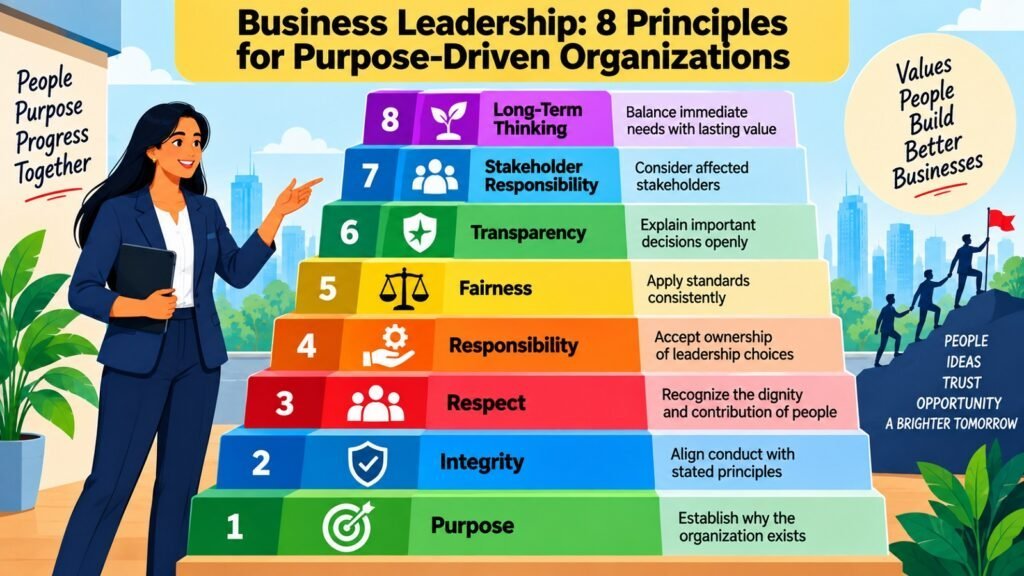
Purpose and principles form the foundational layer of Business Leadership. Purpose addresses why an organization exists beyond generating financial returns, while principles define how leaders behave as they pursue that purpose. Together they provide the conceptual infrastructure on which everything else in Business Leadership depends.
Research in organizational behavior distinguishes purpose from mission statements, targets, and short-term objectives. A genuine organizational purpose articulates the contribution an organization seeks to make to customers, communities, employees, or society. It answers a fundamental question: what would be lost if this organization ceased to exist? Leaders who can answer that question clearly are better positioned to create meaningful direction for the people they lead.
Leadership principles serve a different but equally important function. They govern behavior, particularly when leaders face ambiguity, competing priorities, or difficult decisions where short-term pressures conflict with longer-term responsibilities. Principles like integrity, respect, accountability, and fairness become meaningful only when they are reflected in how leaders actually behave, allocate resources, resolve conflicts, and respond to mistakes. Stated but unenforced, they erode trust rather than build it.
Scholarly work by researchers such as James MacGregor Burns and Robert Greenleaf, as well as institutional research from organizations including Deloitte and McKinsey, has consistently found that employees are more engaged when they perceive their work as meaningful and when leadership behavior aligns with stated values. This does not mean that purpose alone determines performance — structure, resources, market conditions, and capability all play significant roles.
A pragmatic diagnostic approach involves inquiring into the actual allocation of organizational attention and resources. Specifically, one should examine what receives measurement, acknowledgment, and incentivization. Furthermore, observing which behaviors are permitted when they contradict articulated values provides critical insight. These inquiries serve to distinguish whether organizational principles function as authentic operational frameworks or merely represent aspirational rhetoric that leadership fails to rigorously implement.
Table 2: Business Leadership Principles and Their Organizational Implications
| Leadership Principle | Business Leadership Implication |
| Integrity | Leaders act consistently with stated values, even when it is uncomfortable or costly to do so |
| Accountability | Leaders take ownership of outcomes and do not redirect responsibility when results fall short |
| Respect | Leaders treat employees, peers, and stakeholders with consistent dignity regardless of hierarchy |
| Fairness | Leaders apply consistent standards across individuals and teams, avoiding favoritism or arbitrary treatment |
| Transparency | Leaders communicate decisions and reasoning clearly rather than restricting information to control outcomes |
| Courage | Leaders address difficult issues directly rather than avoiding conflict or deferring hard decisions |
| Stewardship | Leaders manage organizational resources, people, and reputation with long-term responsibility in mind |
| Learning | Leaders stay open to feedback, acknowledge mistakes, and adapt based on evidence and experience |
2. Business Leadership Vision & Direction: Creating a Shared Future
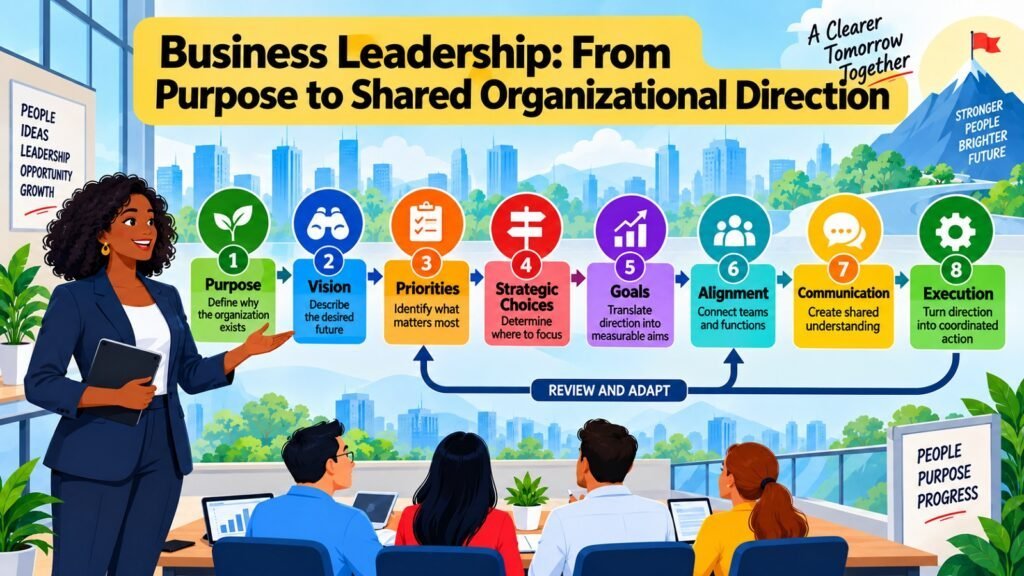
Purpose tells an organization why it exists. Vision tells it where it is going. Business Leadership transforms purpose into a clear organizational direction that employees, teams, and stakeholders can understand, connect with, and work toward. The distinction between these related concepts matters because confusing purpose with vision, or vision with strategy, creates ambiguity that undermines alignment.
Purpose is enduring and foundational. Vision articulates a future state the organization is working toward — one ambitious enough to inspire but grounded enough to be credible. Strategy describes the approach to reach that future state. Goals break strategy into measurable milestones. Operational plans define the activities that deliver those milestones. Business Leadership is responsible for maintaining clarity across all these levels while ensuring that people understand how their work connects to organizational direction.
Research on leadership effectiveness has consistently identified clarity and alignment as critical organizational requirements. When employees cannot connect their daily work to organizational direction, engagement and collaboration suffer. A finding frequently cited in organizational behavior research is that the majority of employees cannot accurately describe their organization’s strategy — a gap between leadership intention and organizational reality that Business Leadership must take seriously.
Effective Business Leadership communicates direction consistently across organizational levels, meaningfully to different functional roles, and stably enough to guide decisions while remaining adaptable to changing circumstances. Leaders who shift direction frequently without explanation create confusion. Those who cling rigidly to a stated vision during significant environmental change can lead organizations into avoidable difficulty.
A practical framework for evaluating directional clarity: ask three questions at different organizational levels. Can senior leaders articulate the vision consistently? Can middle managers explain how their team’s priorities connect to it? Can frontline employees describe how their specific work contributes to the direction? Significant divergence across these levels signals an alignment gap that requires leadership attention.
Table 3: Business Leadership – Direction Elements and Their Organizational Roles
| Direction Element | Business Leadership Role |
| Organizational Vision | Articulating a credible future state that motivates collective effort and provides shared meaning |
| Strategic Priorities | Identifying the key choices that guide the allocation of attention, resources, and capability |
| Goal Alignment | Ensuring team and individual goals connect meaningfully to organizational direction |
| Communication Consistency | Maintaining a clear and coherent message across leadership levels and contexts |
| Adaptive Clarity | Adjusting direction in response to change while preserving core organizational purpose |
| Middle Management Alignment | Ensuring managers can translate organizational direction into team-level priorities |
| Employee Line of Sight | Helping individual employees understand how their work contributes to broader objectives |
| Decision Coherence | Using organizational direction as a filter for evaluating competing options and resource decisions |
3. Business Leadership Communication & Trust: Connecting People and Purpose
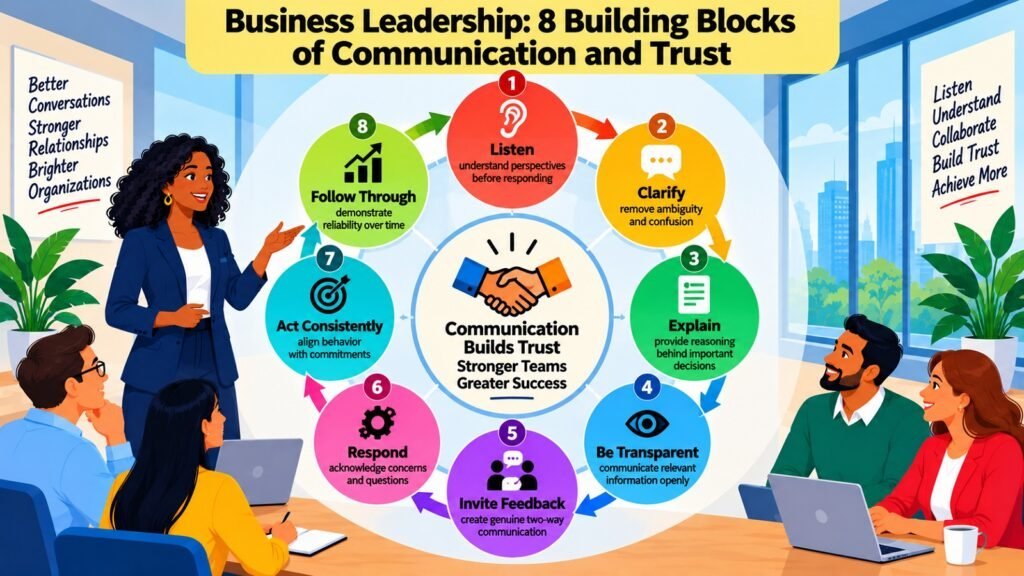
Communication and trust are so closely interconnected in Business Leadership that it is difficult to examine one without the other. Communication is not simply the transmission of information. In organizational settings, it is the process through which leaders create shared understanding, clarify expectations, acknowledge uncertainty, explain reasoning, invite input, and maintain the relationships on which organizational life depends.
Trust develops when employees experience consistency between what leaders say and what they do. A leader can communicate frequently and still erode trust if communication is selectively positive, if difficult information is withheld, or if stated commitments are not honored. Genuine transparency is not the same as providing more information — it means communicating honestly about both successes and difficulties, including the reasoning behind decisions that employees may not welcome.
Research on psychological safety, developed extensively by Amy Edmondson of Harvard Business School, demonstrates that employees who feel safe to speak openly, raise concerns, and acknowledge mistakes perform at higher levels and contribute more effectively to organizational learning. Psychological safety depends heavily on how leaders respond when employees share negative information or challenge decisions. A leader who punishes candor quickly produces a culture of silence and selective reporting.
Active listening is one of the most consistently underemphasized communication practices in Business Leadership. Leaders who listen attentively signal that employee perspectives are valued, which strengthens relationships and surfaces information that leaders might not otherwise access. A useful diagnostic: consider the ratio of information flowing downward from leadership versus information flowing upward from employees. Healthy communication cultures see significant movement in both directions.
Communication alone cannot resolve structural problems, inadequate resources, or poor organizational decisions. Leaders who use communication improvements as a substitute for addressing underlying issues ultimately make the situation worse.
Table 4: Business Leadership – Communication Practices and Their Organizational Value
| Communication Practice | Business Leadership Value |
| Active Listening | Signals genuine respect for employee perspectives and surfaces information leaders might otherwise miss |
| Transparent Reasoning | Explaining the basis for decisions helps employees understand direction and builds credibility |
| Consistent Messaging | Communicating the same core message across different audiences reduces confusion and misalignment |
| Acknowledging Uncertainty | Being honest about what is not yet known builds more trust than projecting false confidence |
| Two-Way Feedback | Creating structured upward feedback opportunities strengthens communication quality and organizational learning |
| Explaining Difficult Decisions | Communicating the reasoning behind unwelcome decisions reduces speculation and maintains respect |
| Psychological Safety Behaviors | Responding to candor and dissent constructively encourages employees to share honest assessments |
| Narrative Clarity | Connecting day-to-day communication to the broader organizational story helps employees see larger context |
4. Business Leadership People & Relationships: Strengthening Human Connections
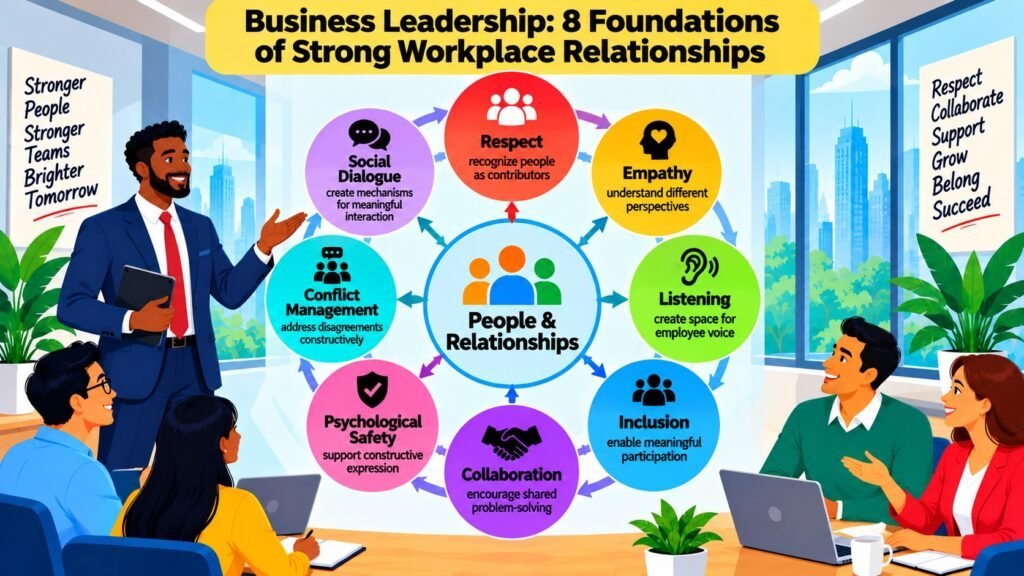
Business Leadership is, at its core, relational. Organizations function through people working together, and the quality of relationships between leaders and employees significantly influences communication, collaboration, trust, and organizational performance. A leader’s relationships are not incidental to their effectiveness — they are central to it.
This is not an argument for informal popularity or indiscriminate agreeableness. Productive leadership relationships are built on respect, empathy, consistency, fairness, and genuine concern for employee development — not on social ease or the avoidance of difficult conversations. Research in organizational psychology distinguishes high-quality leader-member relationships, characterized by mutual trust and reciprocity, from low-quality relationships defined primarily by transactional compliance.
Empathy in Business Leadership means understanding how employees experience their work, what concerns they face, and what enables them to contribute effectively. Leaders who demonstrate interpersonal awareness — who recognize when an employee is struggling and adjust their approach accordingly — build stronger working relationships and are better positioned to support performance. Inclusion matters here because it determines whether all employees experience leadership relationships as respectful, accessible, and fair.
A practical question for leaders: when did you last have a substantive conversation with an employee that was not primarily task-focused? Regular intentional dialogue, focused on the employee’s experience, development, growth and concerns, strengthens the relationship quality that underpins effective leadership. Strong relationships absorb some organizational dysfunction, but they cannot fully compensate for structural problems that prevent employees from doing meaningful work effectively.
Table 5: Business Leadership – Relationship Practices and Their Human Purposes
| Relationship Practice | Business Leadership Purpose |
| Regular One-on-One Dialogue | Creates space for employees to share concerns, receive feedback, and feel genuinely valued |
| Consistent Fairness | Applies standards consistently, preventing perceptions of favoritism or preferential treatment |
| Demonstrating Empathy | Acknowledges the human dimension of employee experience, particularly during difficult periods |
| Constructive Conflict Management | Addresses disagreements directly and respectfully rather than allowing tensions to accumulate |
| Inclusive Engagement | Ensures all employees have equitable access to leadership attention and organizational participation |
| Recognition and Acknowledgment | Validates employee contributions in ways that feel genuine and meaningful rather than formulaic |
| Psychological Availability | Leaders who are mentally present in interactions build deeper trust than those who are merely physically there |
| Interpersonal Accountability | Leaders who acknowledge relationship mistakes model the behavior they expect from others |
5. Business Leadership Culture & Engagement: Shaping the Employee Experience
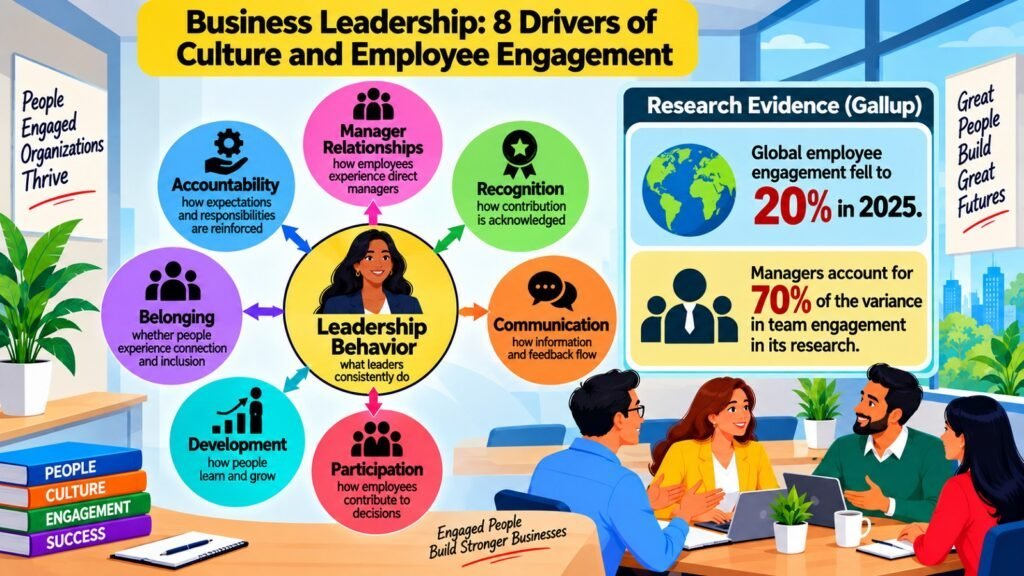
Organizational culture is not created by vision statements or values posters. It is shaped, day after day, by what leaders actually do — the behaviors they model, the expectations they set, the results they recognize, the conduct they tolerate, and the decisions they make when values and short-term pressures conflict. Business Leadership influences culture not primarily through formal programs but through the accumulated pattern of everyday behavior.
Edgar Schein’s foundational research on organizational culture established that what leaders pay attention to, measure, and reward are among the most powerful mechanisms through which culture is reinforced. Employees observe leadership behavior closely and draw conclusions about what the organization actually values, as distinct from what it says it values. When these two things diverge significantly, cynicism develops and engagement declines.
Employee engagement describes the degree to which employees are cognitively, emotionally, and behaviorally invested in their work and in the organization’s success. Gallup’s long-running research on engagement consistently identifies the relationship between employees and their direct manager as one of the strongest predictors of engagement levels. Leadership behavior at the team level shapes whether employees feel their work is meaningful, their contributions are recognized, their development is supported, and their voice matters.
Business Leadership can strengthen engagement through clear expectations, constructive feedback, genuine recognition, development support, and an environment of psychological safety. None of these requires large budgets or complex programs. A useful diagnostic: ask whether the culture employees experience daily matches the culture the organization describes publicly. The gap between these two perceptions reveals where leadership attention is most needed.
Leaders should recognize that culture is difficult to change because it is embedded in systems, structures, norms, and habits that extend beyond any individual leader’s direct influence.
Table 6: Business Leadership Behaviors and Their Cultural or Engagement Effects
| Leadership Behavior | Cultural or Engagement Effect |
| Modeling desired values | Establishes behavioral norms that employees observe and tend to replicate throughout the organization |
| Recognizing contributions meaningfully | Reinforces the behaviors and outcomes the organization wants to see more of, strengthening engagement |
| Tolerating poor conduct | Signals that stated values have limits, which erodes trust and disengages employees who hold those values genuinely |
| Responding constructively to errors | Creates a learning culture in which employees take appropriate risks rather than defaulting to cautious inaction |
| Providing clear expectations | Reduces ambiguity that leads to stress, disengagement, and inconsistent performance |
| Involving employees in decisions | Increases ownership and engagement by giving people a meaningful stake in organizational outcomes |
| Maintaining behavioral consistency | Builds predictability and fairness, which are foundational to a stable and productive organizational culture |
| Communicating organizational purpose | Connects daily work to a larger meaning, which research consistently associates with higher engagement |
6. Business Leadership Decision-Making & Accountability: Turning Responsibility into Action
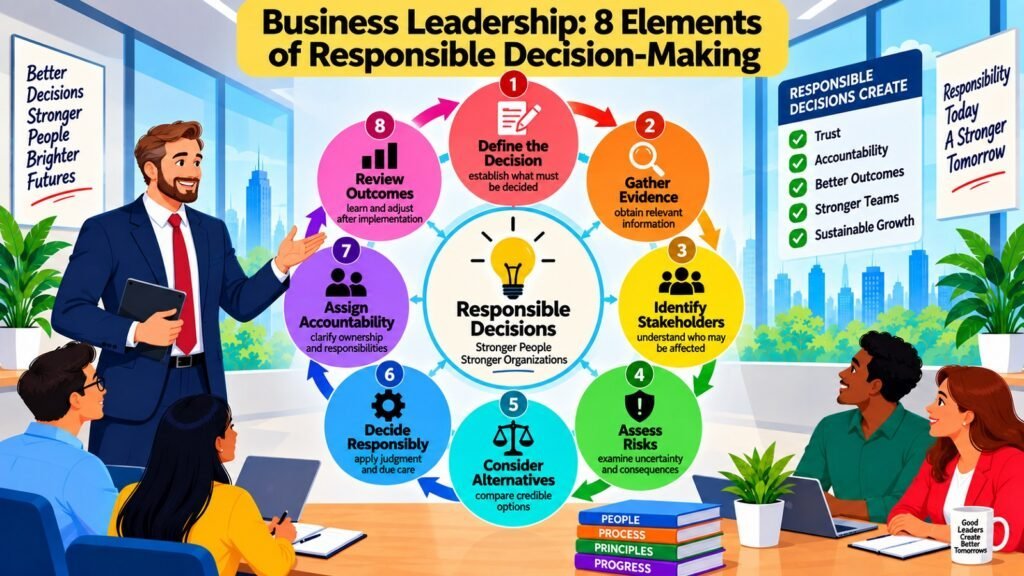
Purpose, vision, and culture establish the conditions for effective Business Leadership. Decision-making converts those conditions into action. Every significant organizational outcome is preceded by a series of decisions, and the quality of those decisions — along with the accountability structures that follow — determines whether leadership translates into real organizational progress.
Business Leadership decision-making involves judgment under uncertainty. Leaders rarely have perfect information, unlimited time, or clear consensus. They must weigh evidence, consider stakeholder interests, assess consequences, and commit to a course of action while remaining open to adjustment as new information emerges. Decisions made with a sound process but poor outcomes differ from decisions made carelessly, and Business Leadership should distinguish between these situations in how it evaluates and learns from results.
Accountability, responsibility, ownership, and blame are related but distinct concepts. Responsibility refers to the obligations associated with a role. Accountability refers to the expectation of answering for how those obligations were fulfilled. Ownership describes the personal commitment a leader brings to fulfilling their responsibilities. Blame, by contrast, is a reactive attribution of fault that discourages honesty, suppresses learning, and damages organizational relationships. Effective Business Leadership builds accountability cultures without defaulting to blame.
Practical decision evaluation involves steps that leaders frequently skip under time pressure: identifying the key stakeholders affected, clarifying assumptions, considering foreseeable consequences, assigning clear implementation responsibility, and establishing follow-up to assess whether the decision achieved its intended outcome. A useful diagnostic: when something goes wrong in your organization, does the response focus on understanding what happened and improving the system, or primarily on identifying who is at fault?
Table 7: Business Leadership – Decision Elements and Their Accountability Implications
| Leadership Element | Accountability Implication |
| Clarifying assumptions | Making the basis of decisions explicit enables learning and correction when circumstances change |
| Stakeholder consideration | Identifying affected parties before deciding reduces unintended consequences and builds trust |
| Delegating with authority | Effective delegation requires that responsibility is accompanied by the authority and resources needed to act |
| Transparent follow-through | Communicating the results of past decisions, including failures, reinforces credibility and organizational learning |
| Distinguishing accountability from blame | Organizations that equate the two suppress candor and make it harder to identify systemic problems |
| Assigning clear ownership | Decisions without clear owners tend to produce diffused responsibility and inconsistent execution |
| Learning from outcomes | Systematic reflection on decision results improves future judgment and builds organizational capability |
| Inclusive decision processes | Decisions incorporating diverse perspectives surface blind spots and generate broader organizational support |
7. Business Leadership Development & Empowerment: Growing People and Future Leaders
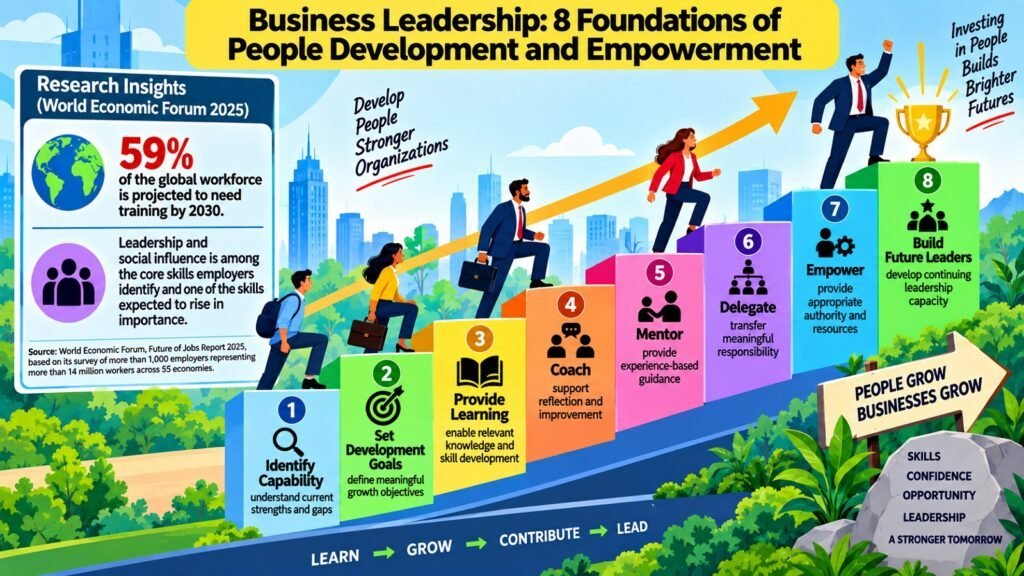
Organizations do not grow beyond the capability of the people within them. Business Leadership that focuses exclusively on current performance without investing in development is optimizing for the short term at the expense of organizational resilience and continuity. Development and empowerment represent the leadership investment that determines an organization’s capacity to perform not just today but through future challenges.
Development encompasses coaching, mentoring, structured feedback, stretch assignments, learning opportunities, career conversations, and succession planning. Coaching supports current performance by helping individuals address specific development needs. Mentoring builds longer-term capability and organizational knowledge. Feedback, delivered consistently and constructively, enables ongoing learning. Stretch assignments accelerate development by placing people in contexts that require new skills.
Empowerment is frequently misunderstood as simply giving people more tasks or removing supervision. Genuine empowerment requires four connected elements: authority to make decisions within a defined scope, access to the information needed to decide well, the capability to act effectively, and accountability for outcomes. Removing one element undermines the whole. Leaders who assign accountability without authority create frustration. Those who grant authority without building underlying capability create risk.
Research from self-determination theory, associated with Edward Deci and Richard Ryan, has demonstrated across diverse organizational contexts that employees who experience genuine autonomy — real ownership over their work rather than supervised execution — report higher engagement, motivation, and job satisfaction. Leadership development must also extend beyond the executive team. Organizations that concentrate leadership capability in a small senior group become vulnerable when those individuals transition. Building capability at multiple levels creates organizational depth and reduces continuity risk.
Table 8: Development Practices and Their Organizational Contributions
| Development Practice | Business Leadership Contribution |
| Structured coaching | Builds specific leadership capabilities through regular, goal-oriented feedback and reflective dialogue |
| Developmental assignments | Accelerates learning by placing people in roles that stretch their existing capabilities |
| Mentoring relationships | Transfers organizational knowledge and builds career perspective through sustained senior guidance |
| Consistent performance feedback | Enables continuous improvement by helping people understand the impact of their behavior |
| Delegating real authority | Develops decision-making capability by giving people genuine ownership rather than supervised task execution |
| Career development conversations | Helps employees see a meaningful future within the organization, strengthening commitment and engagement |
| Succession planning | Builds organizational continuity by identifying and developing people with future leadership potential |
| Learning culture promotion | Creates conditions in which reflection, experimentation, and knowledge-sharing are valued rather than discouraged |
8. Business Leadership Ethics & Sustainable Performance: Leading Responsibly
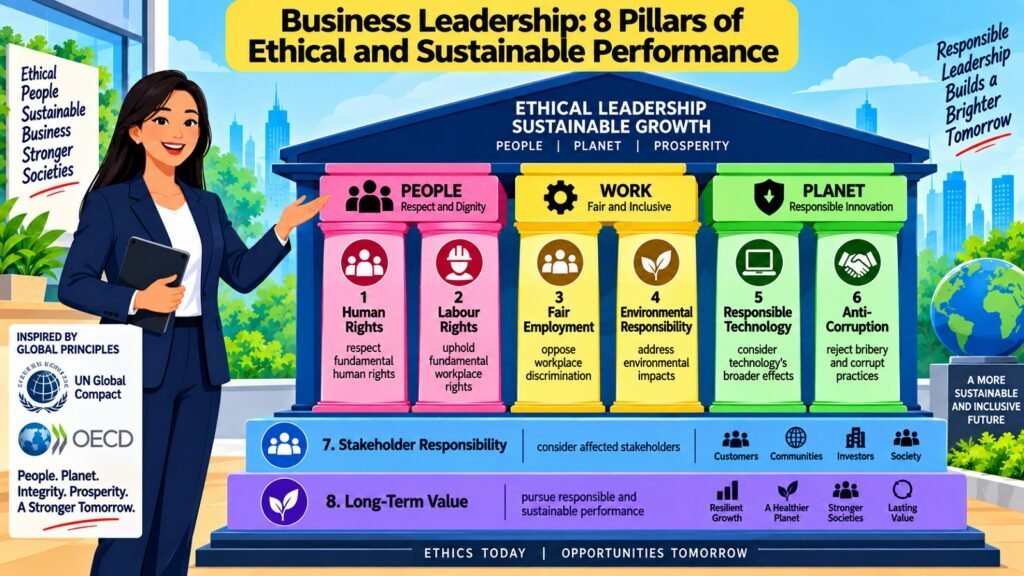
Effective Business Leadership cannot be separated from ethical responsibility. Leaders who pursue performance without ethical grounding may produce short-term results, but they tend to create organizational vulnerabilities — damaged reputations, eroded trust, legal exposure, and cultural deterioration — that undermine sustainable value. Ethics in Business Leadership is not a compliance function. It is embedded in how leaders exercise power, make decisions, treat people, and define what the organization is trying to achieve.
Integrity, fairness, transparency, and responsible use of authority are ethical principles that appear consistently across leadership theory and institutional frameworks, from Carroll’s corporate social responsibility model to the OECD Principles of Corporate Governance. These are not idealistic abstractions. They describe the behavioral standards that leaders must meet to maintain the trust of employees, customers, investors, and the communities in which organizations operate.
Sustainable performance is broader than short-term financial results. It encompasses financial health alongside employee well-being, stakeholder management, environmental responsibility, and organizational reputation. Research from the Harvard Business School’s Impact-Weighted Accounts Initiative suggests that organizations measuring a broader range of performance outcomes — including social and environmental impacts — build stronger long-term stakeholder relationships and more resilient business models.
Ethical leadership involves navigating genuine dilemmas, not simply avoiding clear violations. Leaders regularly encounter situations where legitimate interests conflict or organizational pressures create incentives to compromise stated values. Practical ethical reasoning requires identifying who is affected by a decision, considering foreseeable consequences, and asking whether the decision could be defended transparently to affected parties. Ethical frameworks do not resolve all dilemmas because different traditions reach different conclusions in complex situations. Business Leadership needs judgment to navigate this complexity.
Table 9: Ethical Leadership Principles and Their Practical Applications
| Ethical Leadership Principle | Business Leadership Application |
| Integrity | Behaving consistently with stated organizational values, especially when doing so involves short-term cost |
| Fairness | Applying consistent standards across individuals, groups, and situations rather than making self-serving exceptions |
| Transparency | Communicating honestly about decisions, results, and challenges rather than managing perception selectively |
| Responsible use of power | Exercising leadership authority in ways that respect employee dignity and avoid coercive or exploitative practices |
| Stakeholder responsibility | Considering the interests of employees, customers, communities, and other stakeholders in significant decisions |
| Long-term orientation | Resisting pressure to optimize for short-term results at the expense of organizational resilience and trust |
| Ethical courage | Raising concerns and holding others accountable even when doing so carries personal or organizational risk |
| Sustainable value creation | Defining organizational success to extend beyond financial returns to include broader social and environmental responsibility |
Conclusion — Business Leadership: Bringing Purpose, People, and Performance Together
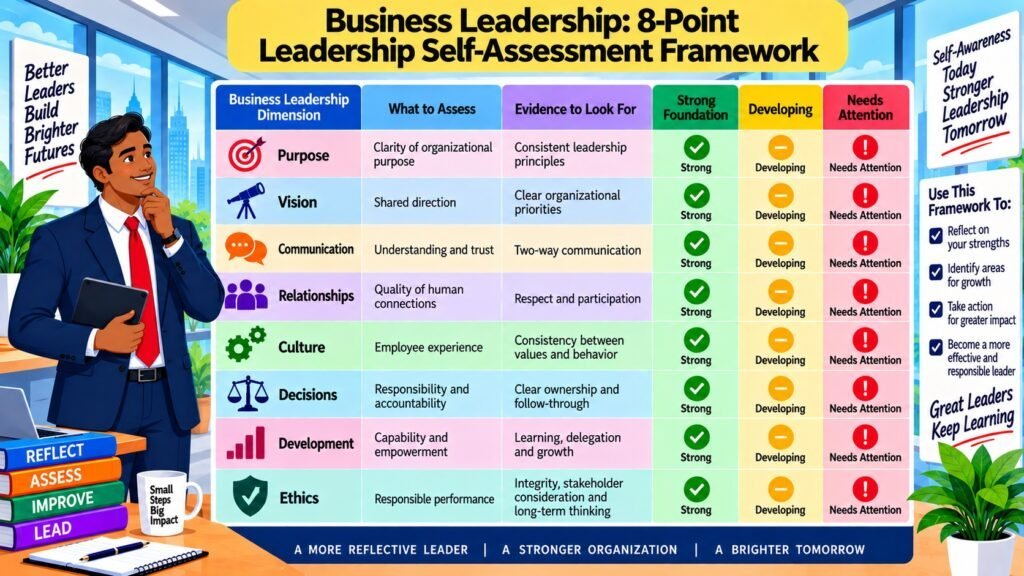
The eight foundations examined in this article are not a checklist or a modular curriculum. They form an integrated Business Leadership system in which each element reinforces the others. Purpose establishes meaning. Vision creates shared direction. Communication builds understanding and trust. Relationships enable collaboration and accountability. Culture shapes the everyday experience through which employees discover what Business Leadership actually values. Decision-making converts direction into action. Development builds future capability. Ethics connects performance ambition with responsible conduct and long-term stakeholder trust.
This framework rests on a human-centered perspective: Business Leadership influences organizational outcomes through people, relationships, decisions, and shared purpose rather than through authority or control alone. A practical self-assessment perspective worth applying: identify one foundation where your organization demonstrates genuine strength, and one where the gap between intention and reality is most significant. That honest assessment is more useful than any generalized prescription because it grounds improvement in the specific conditions and relationships that shape your organizational experience.
Business Leadership continues to matter deeply as organizations navigate technological disruption, economic uncertainty, and social change. In all of these conditions, the quality of leadership — how it connects purpose with people, direction with behavior, and performance with responsibility — remains one of the most consequential determinants of long-term organizational health and success.
Table 10: Business Leadership Foundations — Central Contributions at a Glance
| Business Leadership Foundation | Central Leadership Contribution |
| Purpose & Principles | Provides the foundational meaning and behavioral standards that guide all subsequent leadership action |
| Vision & Direction | Translates purpose into a shared future that aligns individual and collective effort across the organization |
| Communication & Trust | Creates the shared understanding and credibility that connect people to organizational direction |
| People & Relationships | Builds the human connections that enable genuine collaboration, engagement, and mutual accountability |
| Culture & Engagement | Shapes the lived experience of organizational membership through consistent leadership behavior |
| Decision-Making & Accountability | Converts organizational direction into responsible action with clear ownership and follow-through |
| Development & Empowerment | Builds the human capability and organizational depth that sustain performance across leadership generations |
| Ethics & Sustainable Performance | Anchors organizational ambition in responsible conduct and long-term stakeholder trust |