Table of Contents
Introduction: Value Identification as the Foundation of Effective Value Delivery
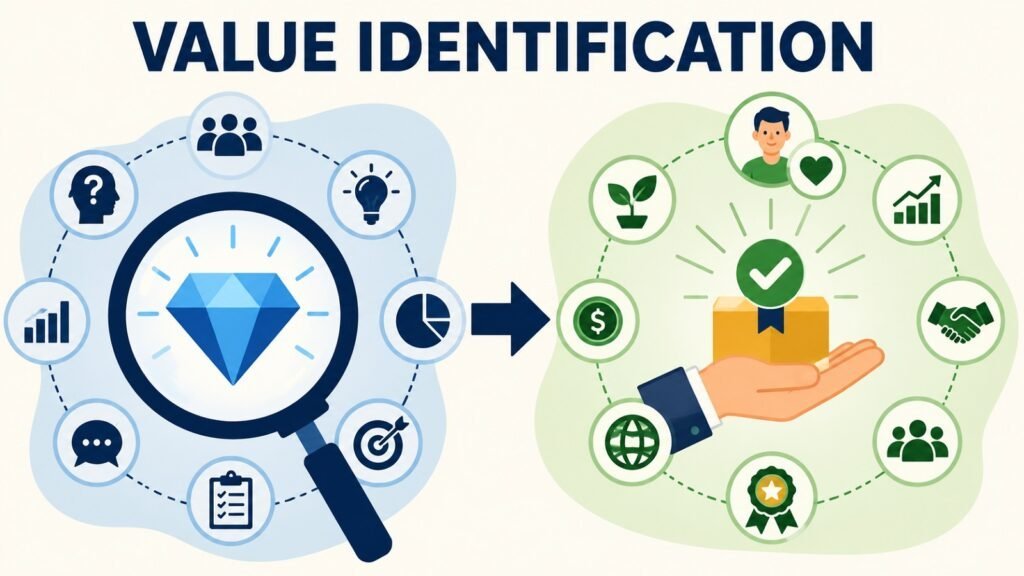
Every year, thousands of new products and services enter the market, yet most of them fail within a short time. The reason is rarely a lack of effort or resources. More often, teams build something before they truly understand what people value. Value Identification solves this problem by helping organizations figure out what customers, employees, investors, and communities genuinely care about before any solution takes shape.
In a business environment characterized by innovation, competition, and evolving customer expectations, Value Identification has emerged as a primary discipline rather than a secondary task. It plays a crucial role in Value Delivery, as effective delivery occurs only when the delivered item holds significance for someone. A meticulously crafted product that addresses the incorrect issue will ultimately fail, regardless of its aesthetic appeal.
Many business failures trace back to this exact gap. Companies pour money into features, campaigns, or expansions without first confirming that the underlying value is real and wanted. Value Identification closes that gap by grounding decisions in evidence rather than assumption, which is why it sits at the heart of sustainable innovation and long-term business success.
This discipline did not appear overnight. It grew from decades of work across strategic management, marketing, product management, design thinking, innovation management, and stakeholder theory. Each field contributed tools and perspectives, from customer interviews to strategic frameworks, that together shape how modern organizations approach Value Identification today.
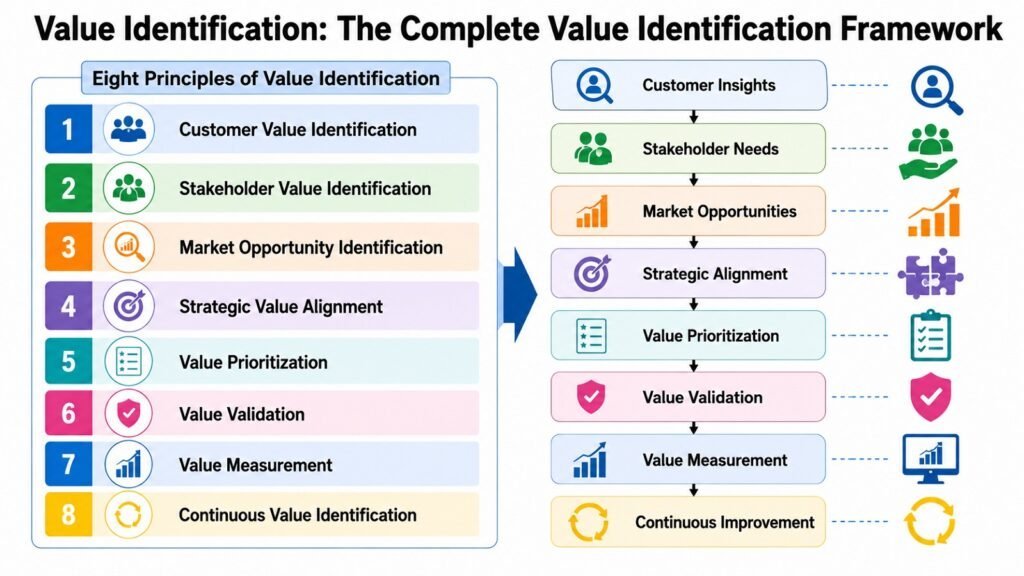
This article walks through eight principles that form a practical framework for Value Identification. These include understanding customers, recognizing stakeholders, spotting market opportunities, aligning with strategy, prioritizing what matters, validating assumptions, measuring outcomes, and treating the whole process as continuous rather than one-time. Together, they give organizations a repeatable way to identify value before they attempt to deliver it.
Table 1: Eight Aspects of Value Identification and Their Primary Objectives
| Value Identification Aspects | Primary Objective |
| Customer Value Identification | Understand what customers genuinely need and prefer |
| Stakeholder Value Identification | Recognize value expectations beyond the customer |
| Market Opportunity Identification | Discover unmet needs and emerging growth areas |
| Strategic Value Alignment | Match identified value with business strategy |
| Value Prioritization | Focus resources on the most impactful opportunities |
| Value Validation | Confirm assumptions with evidence before scaling |
| Value Measurement | Track whether identified value produces real outcomes |
| Continuous Value Identification | Keep identifying new value as conditions change |
1. Customer Value Identification: Understanding What Customers Truly Value
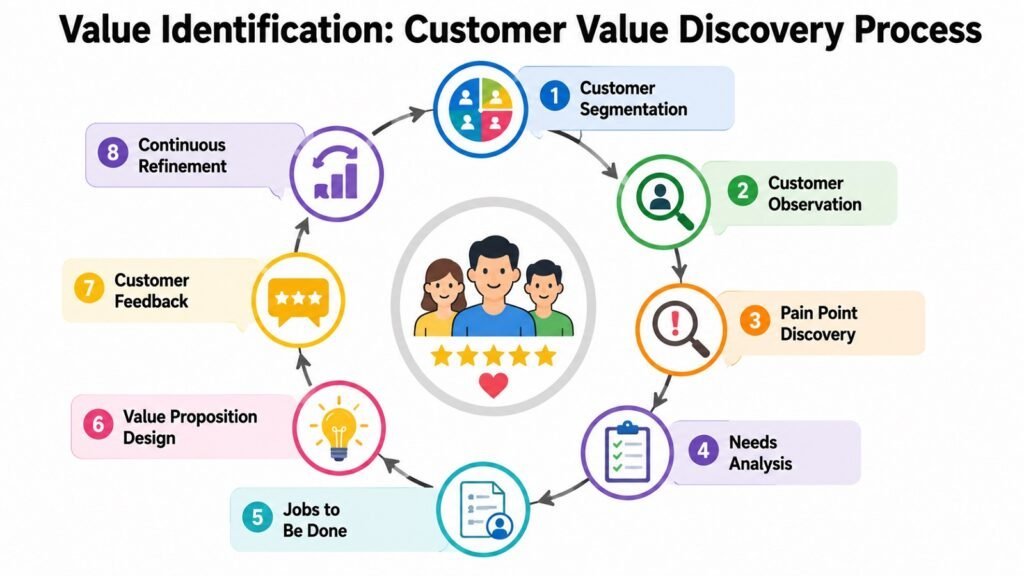
Customer Value Identification is where the whole process usually begins. Before an organization can design anything meaningful, it needs to understand customer needs, expectations, motivations, pain points, and desired outcomes. This is the starting point of Value Identification because customers ultimately decide whether a product or service succeeds.
Customer-centric thinking now sits at the core of modern business strategy, and several theories explain why. The Jobs to Be Done framework, popularized by Clayton Christensen, argues that customers do not simply buy products; they hire them to complete a specific job in their life. This shifts attention away from product features, and toward the underlying outcome a customer is trying to achieve.
Related concepts such as customer experience, value proposition design, and perceived value all reinforce the same idea. A value proposition only works if it reflects something customers actually experience as valuable, not something a company assumes they should want. Perceived value can differ sharply from actual product specifications, which is why organizations cannot rely on internal opinions alone.
To identify this kind of value, companies use customer interviews, behavioral analytics, surveys, direct observation, and structured feedback mechanisms. Amazon, for example, is well known for using customer data and direct feedback loops to refine its offerings continuously, rather than assuming it already knows what shoppers want. Procter & Gamble has long used in-home observation studies to uncover needs customers themselves struggle to articulate.
The benefits of strong Customer Value Identification include fewer failed launches, stronger product-market fit, and higher customer loyalty. Common challenges include relying on small or biased samples, confusing stated preferences with actual behavior, and stopping research too early. Best practice involves triangulating multiple methods, since no single research technique captures the full picture of customer value.
Customer Value Identification, however, is only part of the picture. Customers are important, but they are not the only group whose expectations shape whether an organization creates lasting value, which brings the discussion to stakeholders more broadly.
Table 2: Customer Value Identification Methods and Their Purpose
| Method or Concept | Purpose |
| Jobs to Be Done | Reveals the underlying outcome customers seek |
| Customer interviews | Uncovers motivations and pain points directly |
| Behavioral analytics | Shows actual usage patterns, not stated intent |
| Surveys | Gathers structured feedback at scale |
| Direct observation | Reveals needs customers cannot easily describe |
| Value proposition design | Aligns offerings with real customer priorities |
| Customer experience mapping | Identifies friction points across the journey |
| Perceived value analysis | Measures how customers judge worth subjectively |
2. Stakeholder Value Identification: Expanding Value Identification Beyond Customers
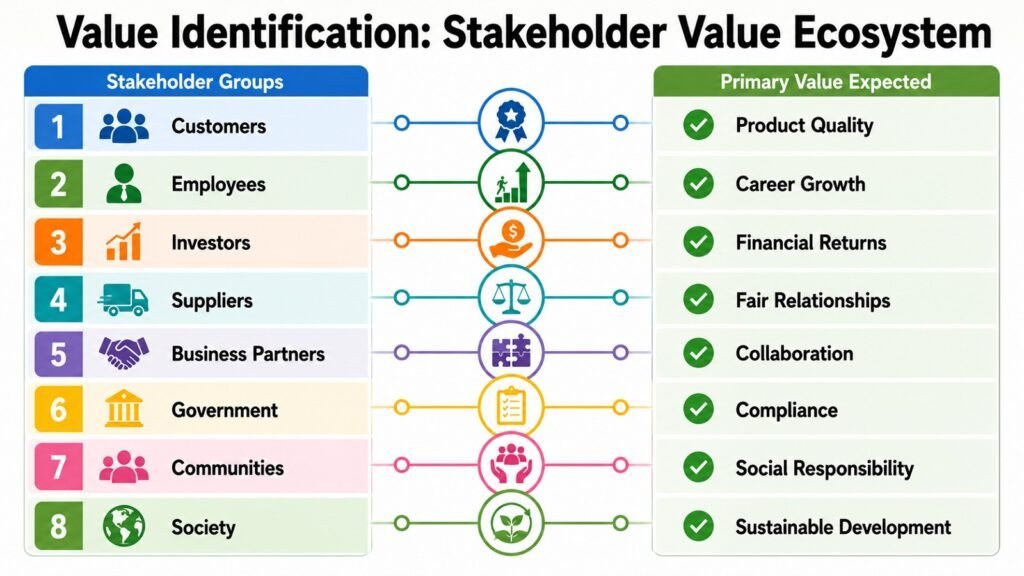
Value Identification does not stop at the customer. Employees, investors, suppliers, business partners, regulators, and communities all hold their own expectations of value, and ignoring them creates risk even when customers are satisfied. Stakeholder theory, developed by R. Edward Freeman, argues that businesses succeed over the long run only when they account for the interests of all groups affected by their decisions.
This idea connects closely to shared value creation, a concept popularized by Michael Porter and Mark Kramer, which suggests that businesses perform best when they generate value for society alongside profit for shareholders. Organizations that identify stakeholder expectations early tend to build more resilient operations, since they anticipate friction rather than reacting to it after problems appear.
Different stakeholder groups define value in different ways. Employees may value fair compensation, growth opportunities, and meaningful work. Investors typically value consistent returns and transparent governance. Suppliers value dependable partnerships and fair terms, while regulators and communities value compliance, safety, and positive local impact.
Unilever’s Sustainable Living Plan is a well documented example of a company trying to balance stakeholder interests, from environmental communities to investors, within a single strategic framework. Balancing these interests is rarely simple, since what benefits one group can create tension with another, such as cost pressures from investors clashing with fair wage expectations from employees.
Patagonia offers another useful reference point. The company has built its reputation partly on identifying environmental stakeholder concerns early and weaving them into product decisions, rather than treating sustainability as an afterthought once customer demand for it grew loud enough to notice.
Conflicts between stakeholder groups are common and rarely have a perfect resolution. A cost-cutting decision that pleases investors might frustrate employees, while a community investment that strengthens local goodwill may reduce short-term profit. Organizations that identify these tensions early can make deliberate trade-offs instead of being caught off guard later.
Practical approaches for identifying stakeholder value include stakeholder mapping, structured engagement sessions, materiality assessments, and regular dialogue with affected groups. These methods help organizations surface conflicting expectations early, which supports better trade-off decisions later.
Once an organization understands both customer and stakeholder value, the next step is looking outward toward the broader market to find where these forms of value intersect with genuine opportunity.
Table 3: Stakeholder Groups and Their Value Expectations in Value Identification
| Stakeholder Group | Typical Value Expectation |
| Employees | Fair pay, growth, and meaningful work |
| Investors | Consistent returns and transparent governance |
| Suppliers | Reliable partnerships and fair contract terms |
| Regulators | Compliance and adherence to legal standards |
| Communities | Positive local impact and shared prosperity |
| Business partners | Mutual benefit and long-term collaboration |
| Customers (as stakeholders) | Consistent quality and honest communication |
| Society at large | Ethical conduct and sustainable practices |
3. Market Opportunity Identification: Discovering Where Value Identification Creates Growth
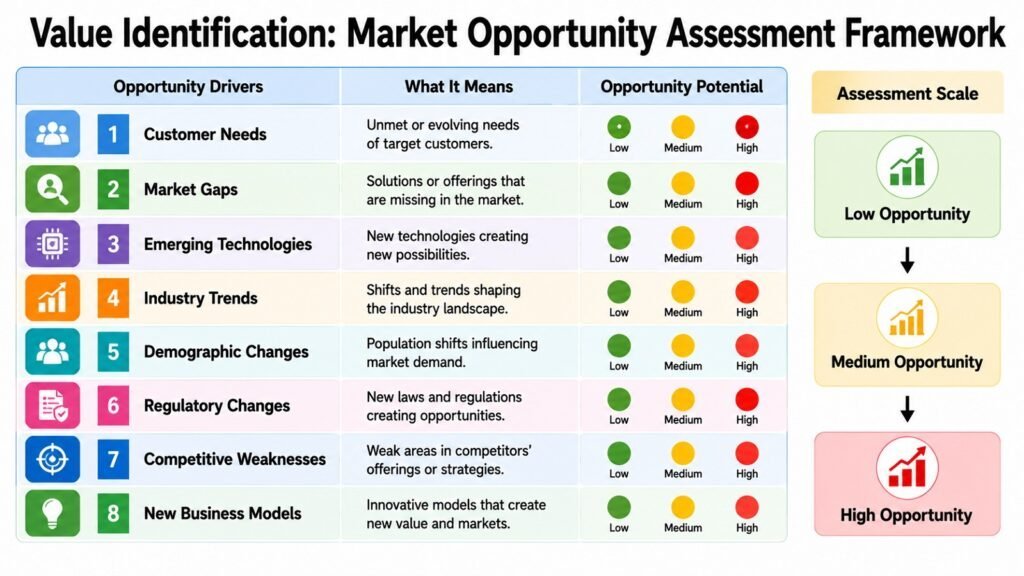
Once an organization understands customer and stakeholder value, it can turn that insight outward to identify genuine market opportunities. This step of Value Identification involves scanning the environment for unmet needs, emerging technologies, industry trends, competitive gaps, and shifts in consumer behavior before committing to a direction.
Strategic market analysis supports long-term growth because it separates fleeting trends from durable shifts. Frameworks such as market segmentation, competitive gap analysis, and trend forecasting help organizations sort through noise and focus on opportunities that are both real and reachable given their capabilities.
Netflix offers a clear historical example. It identified an emerging opportunity in streaming technology and changing viewer habits well before most competitors took the shift seriously, which allowed it to reposition from a DVD rental company into a global streaming leader. Airbnb similarly recognized an unmet need for affordable, flexible lodging that traditional hotels were not addressing.
Common mistakes at this stage include chasing trends without evidence of real demand, overestimating market size, and ignoring competitive responses. Organizations sometimes mistake early hype for a lasting opportunity, which leads to wasted investment when interest fades.
Blockbuster’s slow response to the streaming shift illustrates the opposite failure. The company had access to the same market signals Netflix used, but it underestimated how quickly consumer behavior would move away from physical rentals, which shows that spotting an opportunity is only useful if the organization also acts on it with appropriate urgency.
Practical recommendations include cross-referencing multiple data sources, testing assumptions with small experiments before large investments, and monitoring competitor behavior as a signal of where value pools are forming. Sustainable market opportunities usually show up in more than one type of signal at once, such as customer complaints paired with a visible competitive gap.
Identifying a promising opportunity is not enough on its own. The next challenge is making sure that opportunity actually fits where the organization wants to go strategically.
Table 4: Market Signals Relevant to Value Identification
| Signal or Method | What It Reveals |
| Unmet customer needs | Gaps competitors have not addressed |
| Emerging technology trends | New capabilities that enable fresh value |
| Competitive gap analysis | Weak points in rival offerings |
| Market segmentation | Distinct groups with different value needs |
| Consumer behavior shifts | Changing priorities and purchase habits |
| Industry trend forecasting | Longer-term direction of a sector |
| Small-scale experiments | Early evidence before full investment |
| Competitor behavior monitoring | Signals of where value is forming |
4. Strategic Value Alignment: Aligning Value Identification with Business Strategy
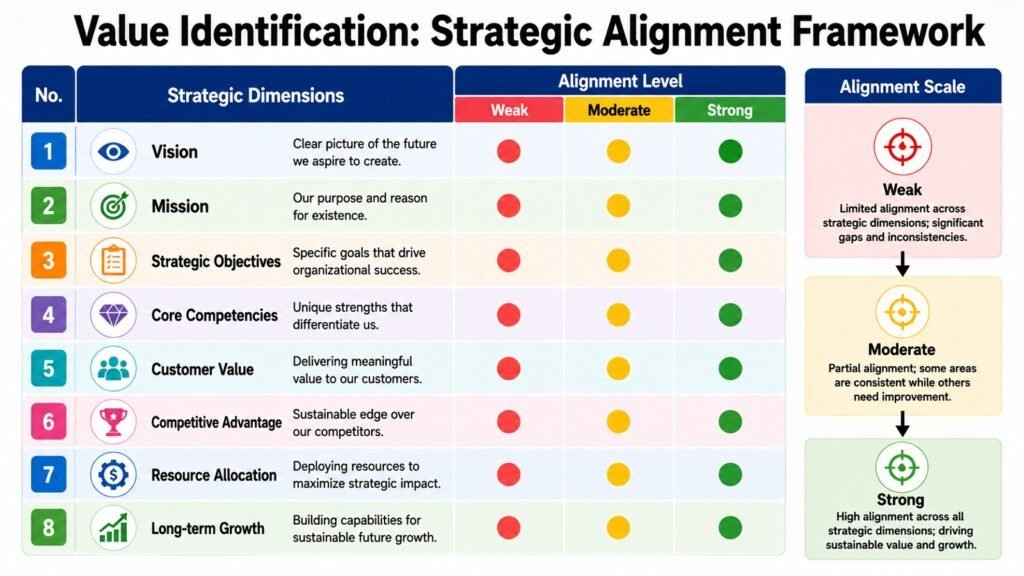
An identified opportunity only becomes useful once it aligns with an organization’s vision, mission, and capabilities. This is where Value Identification connects directly to strategic management. An opportunity that looks attractive in isolation can still be the wrong choice if it pulls a company away from its core competencies or competitive positioning.
Michael Porter’s work on competitive advantage remains central here, since it explains why differentiation and focus matter more than chasing every available opportunity. Resource-based theory adds that sustainable advantage often comes from capabilities that are difficult for competitors to copy, which means opportunities should be judged partly by how well they leverage existing strengths.
Apple provides a useful example of strategic alignment in practice. Rather than expanding into unrelated markets, Apple has largely stayed within adjacent categories that reinforce its design capabilities and ecosystem strategy, from computers to phones to wearables. This discipline has helped it avoid the resource strain that comes from chasing unrelated opportunities.
Organizations run into trouble when they pursue opportunities that look profitable but stretch resources thin or dilute brand identity. This kind of misalignment often shows up years later as underperforming business units or failed acquisitions that never fit the parent company’s core direction.
A commonly cited case is Quibi, the short-form video venture that raised significant funding but shut down within roughly six months of launch. Its struggles are widely attributed to a strategy that did not clearly align with how audiences actually wanted to watch video content, underscoring that capital alone cannot substitute for genuine strategic fit.
Practical guidance includes evaluating every opportunity against core competencies, long-term vision, and resource capacity before committing. A simple strategic fit assessment, even an informal one, can prevent significant wasted investment down the line.
Strategic alignment narrows the field of possibilities, but organizations still face more aligned opportunities than they can pursue at once. This makes prioritization the next necessary step.
Table 5: Strategic Alignment Considerations in Value Identification
| Consideration | Why It Matters |
| Core competencies | Determines if capabilities support the opportunity |
| Competitive positioning | Ensures differentiation is maintained |
| Long-term vision fit | Keeps growth consistent with company direction |
| Resource capacity | Confirms feasibility without overextension |
| Brand identity consistency | Protects existing customer trust |
| Adjacent market logic | Favors expansion that builds on strengths |
| Competitive advantage source | Identifies what is hard for rivals to copy |
| Risk of misalignment | Flags opportunities that dilute focus |
5. Value Prioritization: Focusing Value Identification on What Matters Most
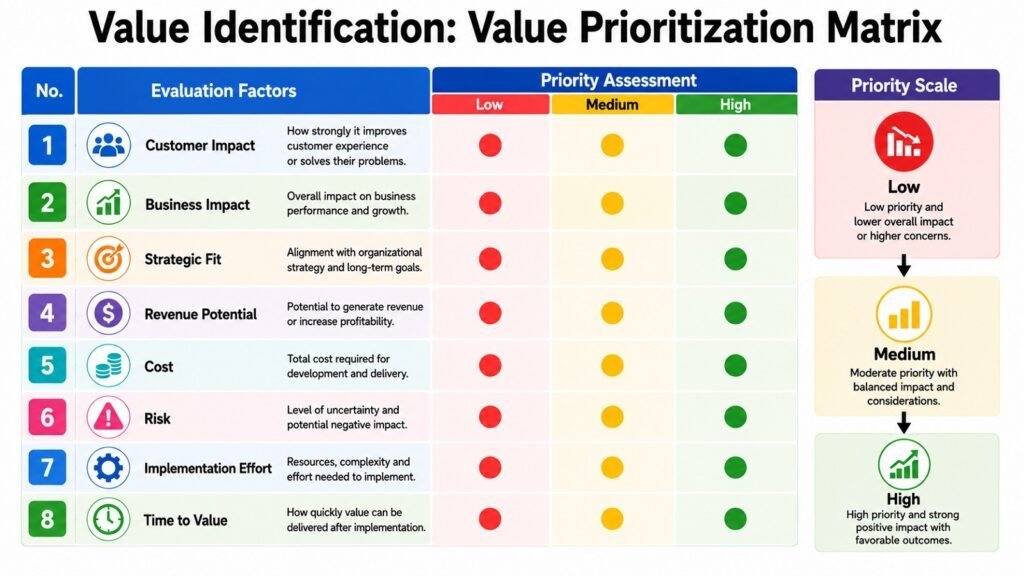
No organization has the resources to pursue every strategically aligned opportunity at once. This is where Value Prioritization becomes essential to Value Identification. Teams need a structured way to rank opportunities based on business impact, customer benefit, feasibility, cost, and risk.
Recognized prioritization approaches include impact versus effort matrices, weighted scoring models, and the RICE framework, which evaluates reach, impact, confidence, and effort together. These tools give teams a shared, transparent language for comparing very different types of opportunities against each other.
Effective prioritization improves focus because it forces explicit trade-offs instead of pursuing everything partially. Spotify has been open about using structured prioritization frameworks within its product teams to decide which features deserve engineering time, rather than treating every idea as equally urgent.
Common mistakes include prioritizing based on internal politics rather than evidence, favoring loud stakeholders over data, and underestimating implementation cost. Organizations also sometimes prioritize easy wins repeatedly while avoiding harder, higher-impact opportunities that require more sustained effort.
This tendency toward easy wins can quietly erode long-term competitiveness. A steady stream of small, low-risk improvements may look productive on a roadmap, yet it can leave a company vulnerable to competitors willing to invest in the harder, higher-impact work that customers eventually notice most.
Practical recommendations include using consistent scoring criteria across all opportunities, revisiting priorities regularly as new information arrives, and involving cross-functional teams so decisions reflect more than one department’s perspective. Prioritization is not a one-time ranking exercise but an ongoing discipline within Value Identification.
Even well-prioritized opportunities carry assumptions that have not yet been tested. Before committing significant resources, organizations need to validate whether the identified value truly exists.
Table 6: Value Prioritization Criteria in Value Identification
| Criterion | Consideration |
| Business impact | Expected effect on revenue or growth |
| Customer benefit | Degree of improvement for end users |
| Feasibility | Practicality given current capabilities |
| Cost | Resources required for implementation |
| Risk level | Likelihood and severity of potential failure |
| Strategic fit | Alignment with long-term company direction |
| Time to value | Speed at which benefits can be realized |
| Cross-functional input | Balanced perspective across departments |
6. Value Validation: Confirming the Accuracy of Value Identification
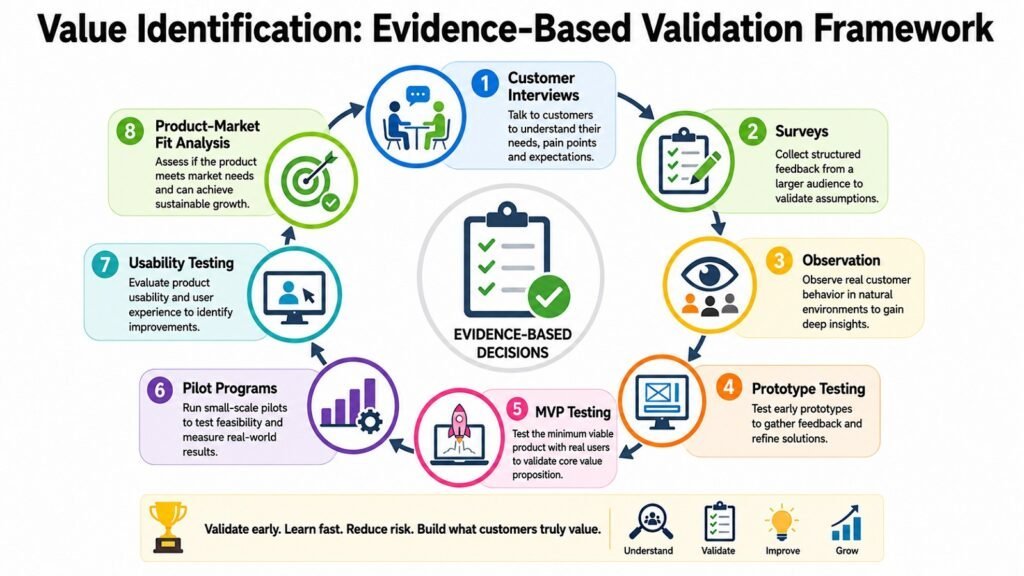
Before committing to major investment, organizations need to test whether their assumptions about value actually hold true. Value Validation exists to reduce this uncertainty, and it represents a critical checkpoint within the broader process of Value Identification.
Established validation methods encompass customer interviews that take place following initial concept testing, clickable prototypes, pilot programs, minimum viable products, and organized experimentation. Eric Ries brought attention to the minimum viable product strategy in his book “The Lean Startup”, contending that businesses ought to evaluate fundamental assumptions with the least amount of investment prior to expanding further.
Dropbox famously validated demand for its product using a simple explainer video before building the full technical product, which confirmed strong interest with minimal upfront cost. This kind of low-cost validation prevents organizations from investing heavily in something nobody actually wants.
Usability testing and structured surveys add further evidence, especially when assessing whether a solution is not just wanted but also usable in practice. Product-market fit, a concept widely associated with Marc Andreessen, describes the point where validated demand becomes strong and consistent enough to justify scaling.
Validation methods each have limitations. Prototypes may not reveal real purchasing behavior, and small pilot programs may not represent the broader market accurately. Combining multiple validation methods produces more reliable conclusions than relying on any single approach alone.
Timing also matters. Validating too early, before a concept is clear enough to react to, can produce confusing feedback, while validating too late means resources are already committed regardless of what customers say. Finding the right moment to test an idea is itself a judgment call that improves with experience.
Validated value only matters if an organization can confirm it continues to produce results after launch, which brings the discussion to measurement.
Table 7: Value Validation Methods in Value Identification
| Validation Method | Practical Application |
| Customer interviews | Tests assumptions directly with real users |
| Minimum viable product | Confirms demand before full development |
| Pilot programs | Tests value at small, controlled scale |
| Clickable prototypes | Gathers reaction before building the product |
| Usability testing | Confirms the solution works as intended |
| Explainer video tests | Measures interest at very low cost |
| Surveys | Adds structured, quantifiable feedback |
| Product-market fit checks | Confirms demand is strong and consistent |
7. Value Measurement: Measuring the Success of Value Identification
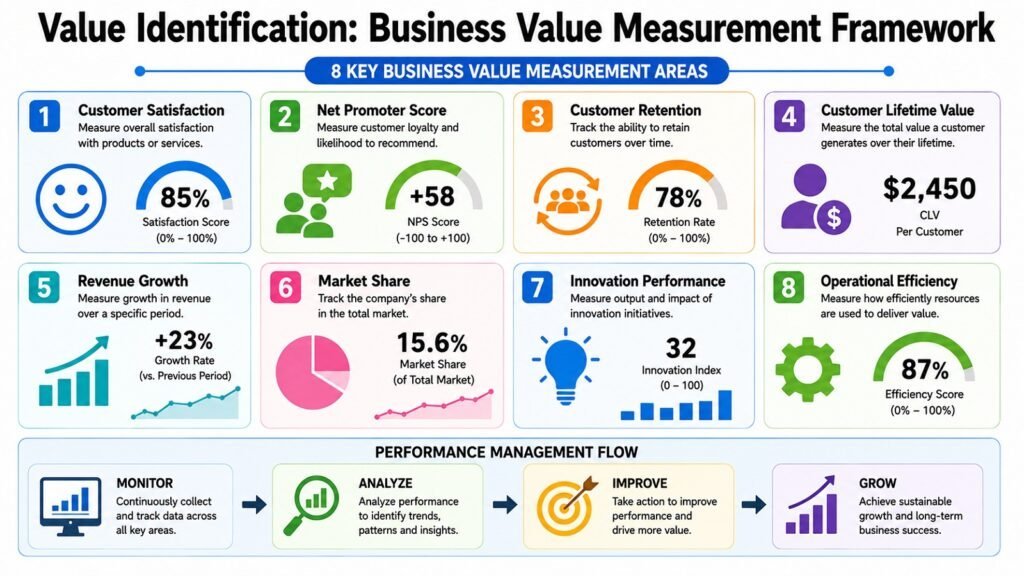
After value has been identified, prioritized, and validated, organizations need to confirm that it actually produces meaningful business outcomes. Value Measurement closes this loop, turning Value Identification from a theoretical exercise into something with measurable results.
Common metrics include customer satisfaction scores, customer lifetime value, retention rates, and Net Promoter Score, a widely used metric developed by Fred Reichheld to gauge customer loyalty through a single, simple survey question. Financial performance indicators, such as revenue growth and profit margin, remain essential complements to these customer-focused metrics.
Operational performance metrics, including cycle time and defect rates, help organizations understand whether internal processes support the value being delivered. Innovation outcome metrics, such as the percentage of revenue from new products, indicate whether Value Identification efforts translate into tangible growth over time.
Companies like Salesforce regularly publish customer success metrics and retention data, using this information to refine both product direction and customer engagement strategy. This kind of transparency allows measurement to directly inform future decision-making rather than sitting isolated in a report.
Measurement supports continuous organizational learning by revealing which assumptions held true and which did not. However, measurement alone accomplishes little without a clear commitment to acting on what the data shows and adjusting course accordingly.
A useful discipline is reviewing metrics on a regular cadence rather than only after a launch. Quarterly or monthly reviews give teams enough data to spot genuine trends while still leaving time to make meaningful adjustments before small problems compound into larger ones.
This need for ongoing adjustment points to a larger truth about Value Identification: it cannot be treated as something an organization finishes once and moves past.
Table 8: Key Metrics for Measuring Value Identification Outcomes
| Metric | What It Measures |
| Customer satisfaction | Immediate perception of delivered value |
| Customer lifetime value | Long-term revenue from a customer relationship |
| Retention rate | Ability to keep customers over time |
| Net Promoter Score | Likelihood customers recommend the company |
| Revenue growth | Overall financial impact of identified value |
| Profit margin | Efficiency of value delivery relative to cost |
| Cycle time | Speed of internal processes supporting value |
| New product revenue share | Impact of innovation on business growth |
8. Continuous Value Identification: Adapting Value Identification for the Future
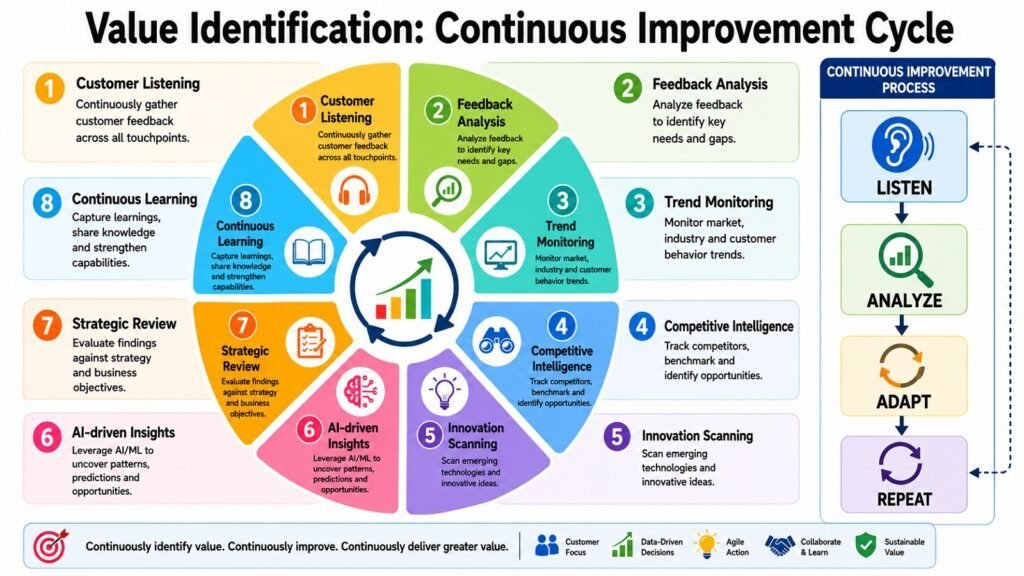
Value Identification should not be treated as a project with a defined end date. Customer expectations shift, technology advances, and competitors adapt, which means organizations need to keep identifying new sources of value on an ongoing basis rather than relying on a single round of research.
Agile thinking and organizational learning theory both support this continuous approach. Agile methods emphasize short cycles of feedback and adjustment, which naturally extend to how organizations approach Value Identification over time. Peter Senge’s work on the learning organization similarly argues that lasting success depends on an organization’s capacity to keep learning rather than relying on past knowledge.
Artificial intelligence and advanced analytics have accelerated this shift, giving organizations access to real-time customer data at a scale that was not possible a decade ago. Companies like Google continuously analyze user behavior across products to refine features, reflecting an ongoing rather than one-time approach to identifying what users value.
Digital transformation more broadly has shortened the feedback loop between identifying value and acting on it, since digital products can be updated far faster than physical ones. This has raised expectations that organizations should treat Value Identification as embedded in daily operations rather than an occasional research project.
Practical approaches to sustaining this continuous capability include regular customer feedback loops, ongoing competitive monitoring, ongoing employee input channels, and periodic reassessment of stakeholder expectations. Building these practices into routine operations, rather than treating them as special initiatives, is what makes the approach genuinely continuous.
Netflix again offers a relevant illustration, since its recommendation algorithms and content strategy are continuously refined based on new viewing data rather than a single research phase conducted years earlier. This ongoing refinement reflects exactly the mindset that continuous Value Identification requires.
This continuous mindset ties directly back into the broader purpose of Value Identification, preparing organizations to keep delivering value effectively as conditions around them keep changing.
Table 9: Continuous Value Identification Practices
| Practice | Future-Oriented Benefit |
| Regular customer feedback loops | Keeps insight current as needs shift |
| Ongoing competitive monitoring | Detects new threats and openings early |
| Employee input channels | Surfaces frontline observations continuously |
| Periodic stakeholder reassessment | Tracks evolving expectations over time |
| Agile iteration cycles | Enables fast adjustment based on evidence |
| Real-time analytics use | Supports quicker, evidence-based decisions |
| Organizational learning culture | Builds lasting capacity to adapt |
| Scenario and trend monitoring | Prepares organizations for future shifts |
Conclusion: Advancing Value Identification for Sustainable Value Delivery
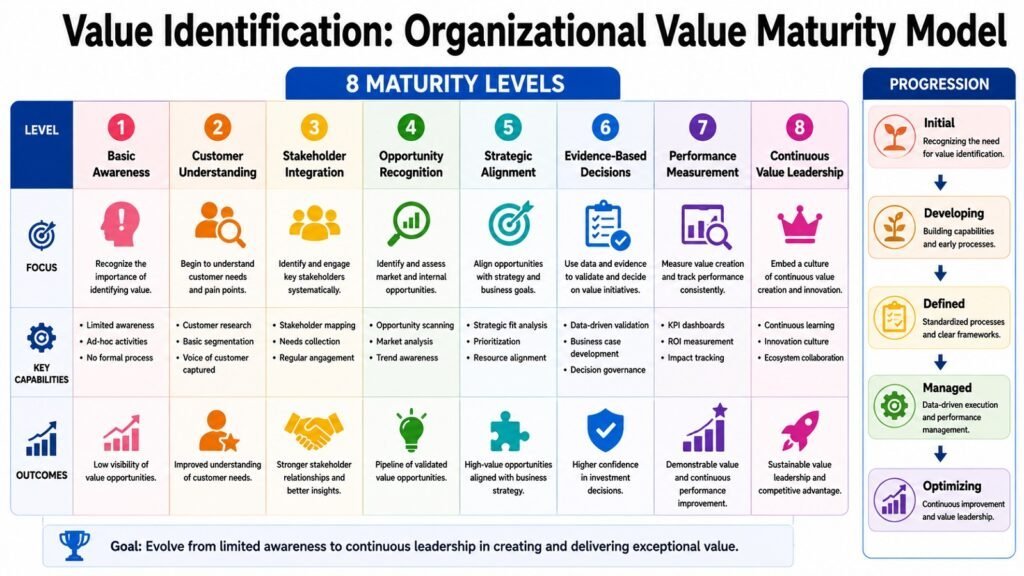
Value Identification is the essential foundation upon which effective Value Delivery is built. Without a clear understanding of what customers, stakeholders, and markets genuinely value, even well-executed delivery efforts struggle to create lasting business success.
The eight principles discussed in this article function collectively as a thorough framework. Customer Value Identification and Stakeholder Value Identification determine the key players and their requirements. Market Opportunity Identification and Strategic Value Alignment link this understanding to tangible growth prospects and the strategic direction of the organization. Value Prioritization and Value Validation guarantee that only the most viable, evidence-supported opportunities are allocated resources. Value Measurement and Continuous Value Identification complete the cycle, verifying results and maintaining the process as circumstances evolve.
Successful organizations do not treat these principles as isolated steps. They combine theoretical understanding with research-backed decision-making, disciplined implementation, and a genuine commitment to continuous learning. This combination is what separates organizations that consistently create value from those that guess and hope for the best.
Looking ahead, emerging technologies, artificial intelligence, and advanced analytics will continue to reshape how organizations approach Value Identification. Real-time data and predictive tools are already making it possible to spot shifting customer needs faster than traditional research methods allowed. As customer expectations keep evolving, the organizations that treat Value Identification as an ongoing capability, rather than a finished task, will be best positioned for sustainable growth and lasting competitive advantage.
Ultimately, the businesses that thrive are the ones willing to keep asking a simple question before every major decision: does this genuinely matter to the people we serve. Answering that question well, again and again, is what Value Identification is really about.
Table 10: Summary of the Eight Value Identification Principles
| Principle | Contribution to Value Identification |
| Customer Value Identification | Reveals genuine customer needs and motivations |
| Stakeholder Value Identification | Balances expectations across all affected groups |
| Market Opportunity Identification | Uncovers where real growth potential exists |
| Strategic Value Alignment | Connects opportunities to organizational direction |
| Value Prioritization | Focuses resources on the highest-impact options |
| Value Validation | Confirms assumptions with real evidence |
| Value Measurement | Tracks whether identified value delivers results |
| Continuous Value Identification | Sustains relevance as conditions keep changing |