Table of Contents
Introduction: Technology and Society as the Foundation of Modern Life
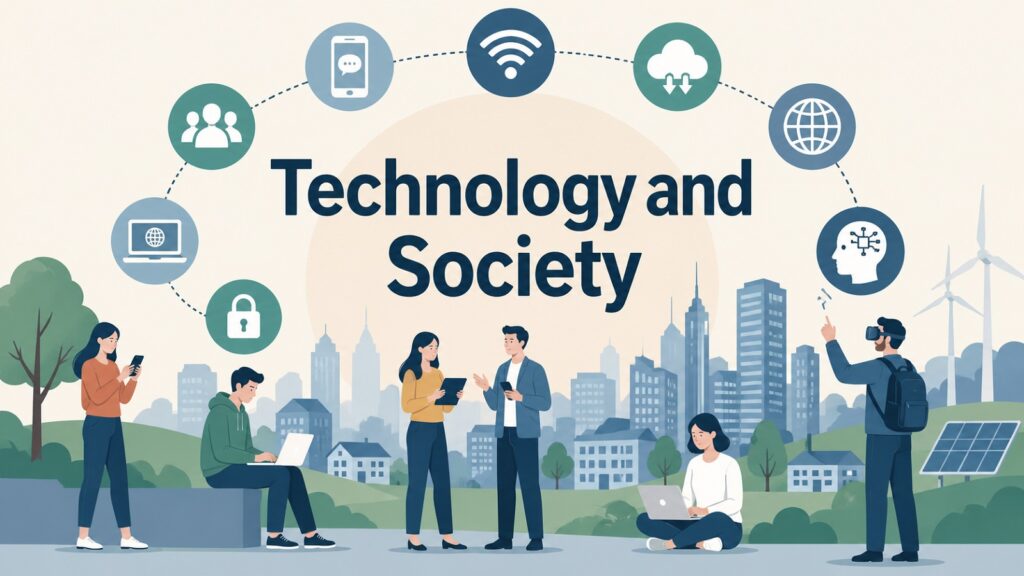
There was a time when technology meant a tool on a workbench or a machine in a factory. Today, it means something much broader. Technology and Society have grown so close together that separating them feels almost impossible. The way people talk, work, learn, buy things, and even think has been shaped by the devices, platforms, and systems that now fill every corner of daily life.
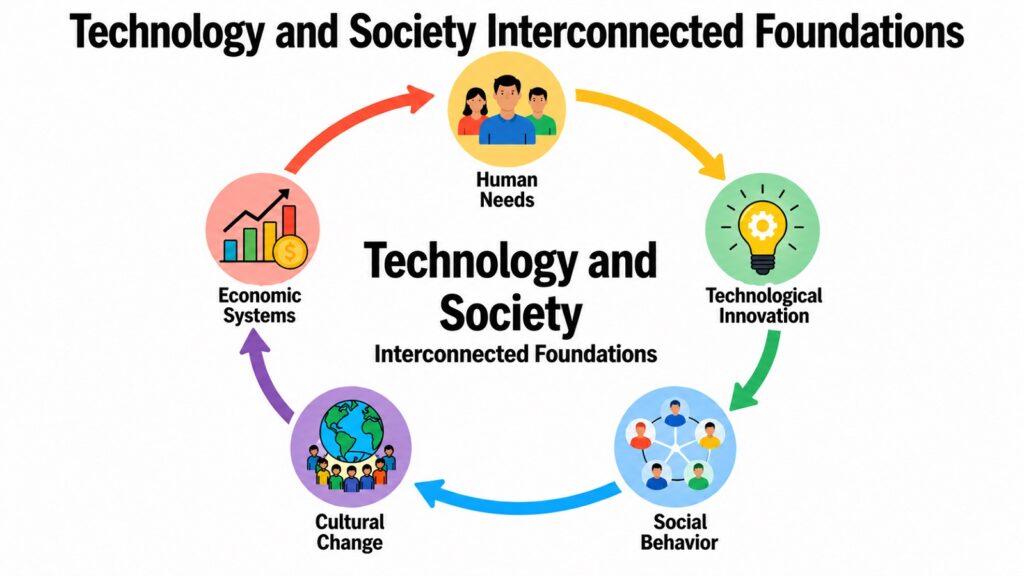
This relationship is not simply about gadgets or software. It is about how human behavior shifts when new tools become available, and how those tools are then shaped by the needs and values of the people who use them. Technology follows society, and society follows technology. They push each other forward in a loop that never really stops.
Societal aspects are not an afterthought in this story. They sit at the very center of how modern technology develops and spreads. A platform becomes powerful not because of its code, but because of how millions of people choose to use it. A policy gets written not because of a technical requirement, but because a community demands protection. The human side of technology is what gives it meaning.
This article looks at eight specific areas where Technology and Society intersect in ways that matter for everyday life. These areas include social media, screen time, remote work, online education, digital literacy, data privacy, artificial intelligence, and the digital economy. Each one tells a different part of the same larger story about how modern life is changing.
Understanding these connections is not just an academic exercise. It helps people make more informed choices, ask better questions, and engage with technology in a way that actually serves their lives rather than the other way around.
Table 1: Technology and Society – Overview of 8 Key Aspects
| Aspect of Technology and Society | Core Significance |
| Social Media | Reshapes how people communicate and form relationships at scale |
| Screen Time | Reflects daily behavioral shifts driven by digital devices |
| Remote Work | Transforms career structures and workplace expectations |
| Online Education | Expands access to learning beyond traditional classrooms |
| Digital Literacy | Determines how effectively people participate in digital life |
| Data Privacy | Addresses rights and risks in the age of personal data collection |
| AI in Society | Influences decisions, jobs, and systems across all sectors |
| Digital Economy | Changes how value is created, exchanged, and distributed |
1. Technology and Society: How Social Media Shapes Human Connection
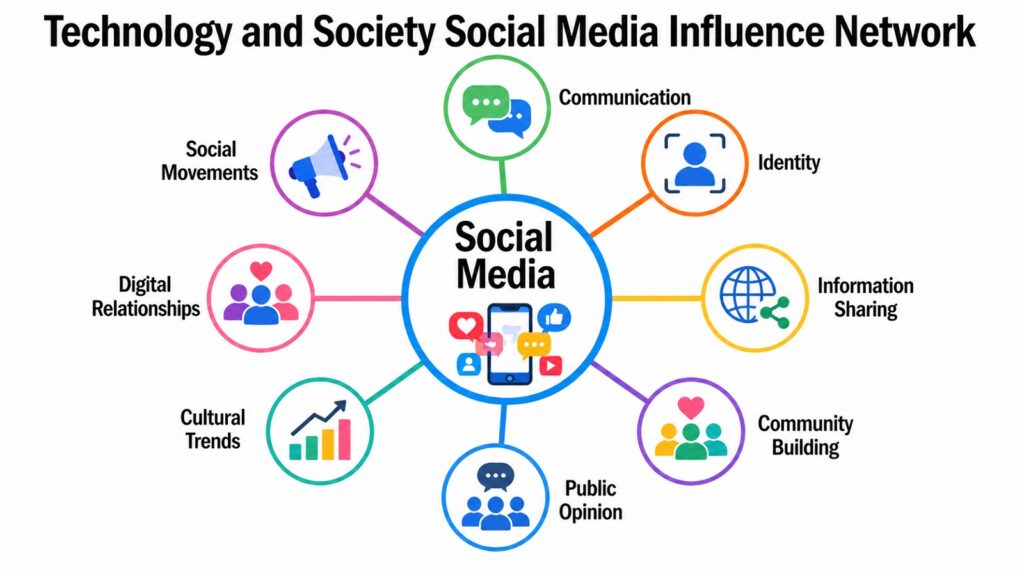
Not long ago, staying in touch with someone meant writing a letter or picking up a phone. Social media changed that equation entirely. Today, platforms like Facebook, Instagram, X (formerly Twitter), and WhatsApp allow billions of people to communicate instantly across borders, time zones, and languages. Within the broader frame of Technology and Society, this shift has redefined what it means to be connected.
The benefits are real and measurable. Social media has given a voice to people who previously had little visibility. Movements have been organized, information has been shared, and communities have formed around shared experiences that would never have found each other otherwise. For isolated individuals, these platforms sometimes offer the only consistent human contact available.
But the picture is more complicated than that. Research from the Pew Research Center has consistently found that while Americans feel more politically informed because of social media, they also feel more exposed to extreme and divisive content. The same platforms that connect people also push them toward outrage and division, partly because those emotions drive engagement, and engagement drives advertising revenue.
Identity is also being reshaped in visible ways. People construct versions of themselves for online audiences, selecting what to show and what to hide. This has created a culture of comparison that psychologists have linked to declining self-esteem, especially among teenagers. A 2023 report from the U.S. Surgeon General specifically highlighted social media’s role in the youth mental health crisis.
Public conversations that once happened in local halls or through newspapers now happen on platforms governed by private companies. Trending topics shape what gets discussed and what gets ignored. This is a significant power shift, and Technology and Society are still working out what it means for democracy, culture, and individual well-being.
Social media is not going away. The task now is learning how to use it in a way that strengthens genuine connection rather than simulating it.
Table 2: Technology and Society – Key Facts About Social Media
| Aspect | Fact or Finding |
| Global Users | Over 5 billion people worldwide use social media as of 2024 |
| Average Daily Use | People spend an average of 2 hours and 23 minutes on social media each day |
| Youth Mental Health | U.S. Surgeon General issued advisory in 2023 on social media and youth mental health |
| Political Influence | 64% of Americans say social media affects their political views, per Pew Research |
| Misinformation Spread | False news spreads six times faster than accurate news on Twitter, per MIT study |
| Identity Shaping | 70% of teens say social media makes them feel more connected but also more anxious |
| Platform Power | Five companies control the majority of global social media traffic |
| Economic Impact | Influencer marketing was a $21 billion industry globally in 2023 |
2. Technology and Society: The Real Impact of Screen Time on Daily Life
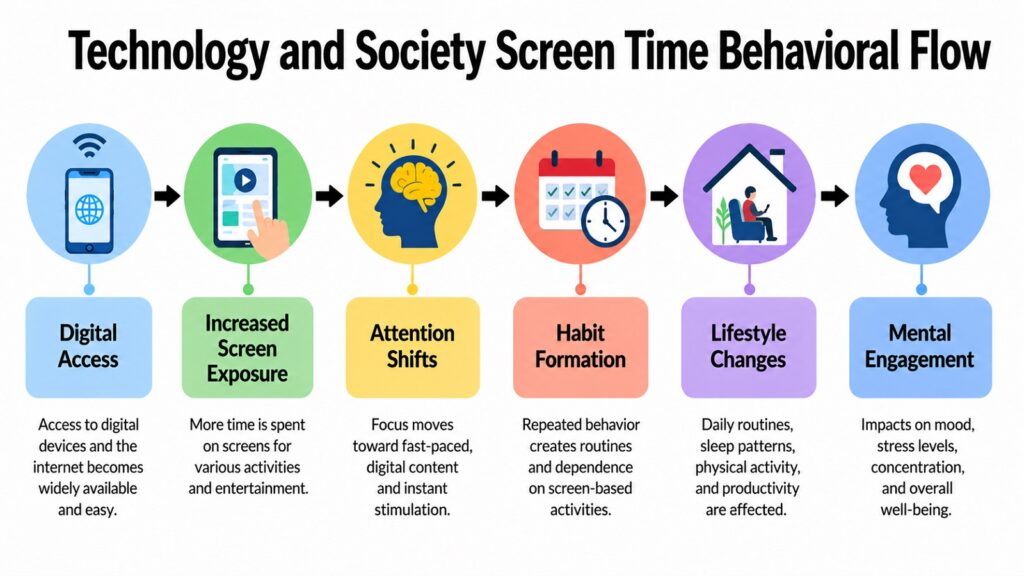
Screen time is now so woven into daily life that most people do not notice how much of it they are consuming. A quick check of the phone in the morning becomes an hour of scrolling. A work video call stretches into an afternoon of back-to-back digital meetings. Within Technology and Society, screen time is not just a health statistic. It is a window into how profoundly digital tools have reorganized how people spend their waking hours.
The average American adult now spends over seven hours a day in front of a screen, according to data from Nielsen and DataReportal. This includes time on smartphones, televisions, computers, and tablets. Children are not far behind. The American Academy of Pediatrics has noted that children between the ages of eight and twelve spend four to six hours daily on screens outside of school.
There is a productivity side to this story as well. Digital tools have made many tasks faster, easier, and more flexible. But they have also introduced what researchers call continuous partial attention, a state where people are never fully present in any one task because a notification or a new tab is always pulling focus. Deep work, the kind that produces real insight or mastery, requires sustained concentration that constant screen engagement tends to erode.
Entertainment and dependency patterns have shifted too. Streaming services use algorithms to serve content that keeps viewers watching longer. Social media platforms are designed to trigger dopamine responses that encourage return visits. The line between leisure and compulsion is not always easy to draw, and Technology and Society are still developing the vocabulary and frameworks to talk about it honestly.
None of this means screens are inherently bad. They have given people access to knowledge, connection, and opportunity that previous generations could not have imagined. The question is whether people are choosing how to use them, or whether the tools are choosing for them.
Table 3: Technology and Society – Screen Time Data and Behavioral Patterns
| Category | Finding or Statistic |
| Adult Daily Screen Time | U.S. adults average over 7 hours of screen time per day in 2023 |
| Children’s Screen Time | Ages 8–12 spend 4–6 hours daily on screens outside of school |
| Sleep Impact | Blue light from screens reduces melatonin production, affecting sleep quality |
| Attention Span | Microsoft research linked heavy digital use to declining sustained attention |
| Streaming Behavior | Netflix users watch an average of 3.2 hours of content per day |
| Work Screen Time | Remote workers report spending 8–10 hours daily in front of screens |
| App Design | Apps use variable reward mechanics similar to slot machines to retain users |
| Screen-Free Time | Studies show 24-hour digital detox improves mood and mental clarity |
3. Technology and Society: How Remote Work Is Redefining Careers
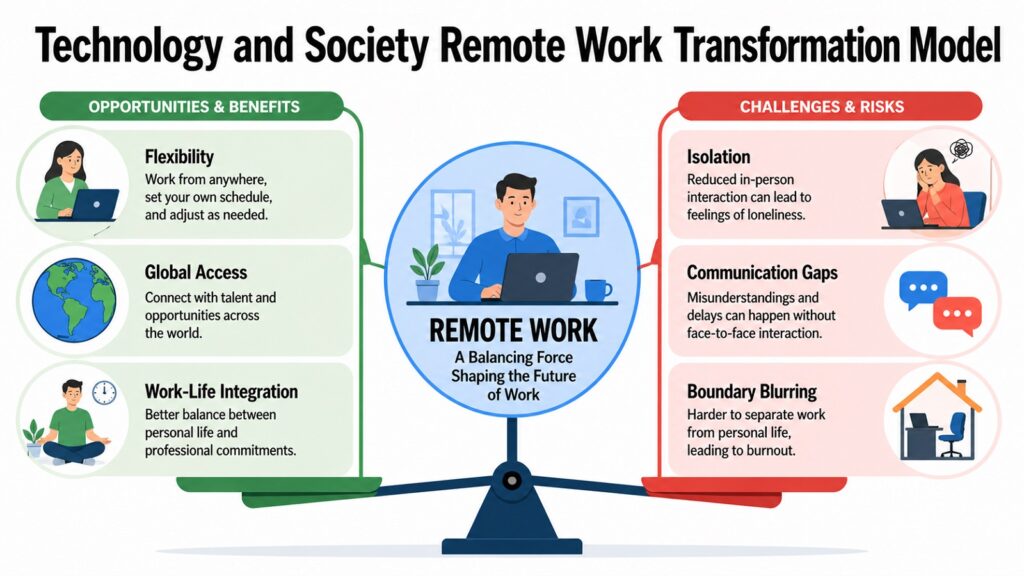
Before the COVID-19 pandemic, remote work was a niche arrangement available to a small percentage of professionals. The lockdowns of 2020 forced organizations around the world to shift their entire operations online almost overnight. What many expected to be a temporary measure turned into a structural transformation. In the context of Technology and Society, remote work represents one of the most visible and lasting changes to come from this era.
The numbers tell a compelling story. A Stanford study led by economist Nicholas Bloom found that about 12% of full-time employees in the United States worked fully remotely as of mid-2023, while roughly 28% worked hybrid schedules. In knowledge-intensive sectors like tech, finance, and consulting, those numbers were significantly higher.
For workers, the shift has brought genuine gains. Commutes have been eliminated for millions of people, returning hours of the week that were previously lost to traffic and transit. Flexibility in scheduling has allowed caregivers, people with disabilities, and those in remote areas to participate in professional life in ways that were previously not available to them. Global hiring has also expanded the talent pools that companies can draw from.
But remote work is not without its costs. The blurring of home and office has made it harder for many people to switch off at the end of the day. Isolation is a real concern, particularly for younger workers who benefit from mentorship, peer learning, and the informal connections that form naturally in shared physical spaces. Team cohesion requires more deliberate effort when people rarely see each other in person.
The deeper lesson from remote work’s rise is that Technology and Society are negotiating new expectations about where value is created, what accountability looks like, and how trust is built without physical presence. These negotiations are still very much in progress.
Table 4: Technology and Society – Remote Work Trends and Realities
| Dimension | Key Insight or Data |
| Remote Work Rate | 12% of U.S. full-time workers were fully remote in mid-2023, per Stanford research |
| Hybrid Adoption | 28% of U.S. workers follow hybrid schedules as of 2023 |
| Productivity Research | Stanford found remote workers are 13% more productive in call-center study |
| Isolation Risk | 55% of remote workers report feeling disconnected from company culture |
| Career Growth Concern | Remote employees are 50% less likely to receive promotions, per Harvard study |
| Global Talent Access | 65% of employers report hiring from wider geographic areas due to remote work |
| Tools Used | Zoom, Slack, and Microsoft Teams collectively serve over 500 million users |
| Work-Life Balance | 47% of remote workers say they work longer hours than before going remote |
4. Technology and Society: The Rise of Online Education and Learning
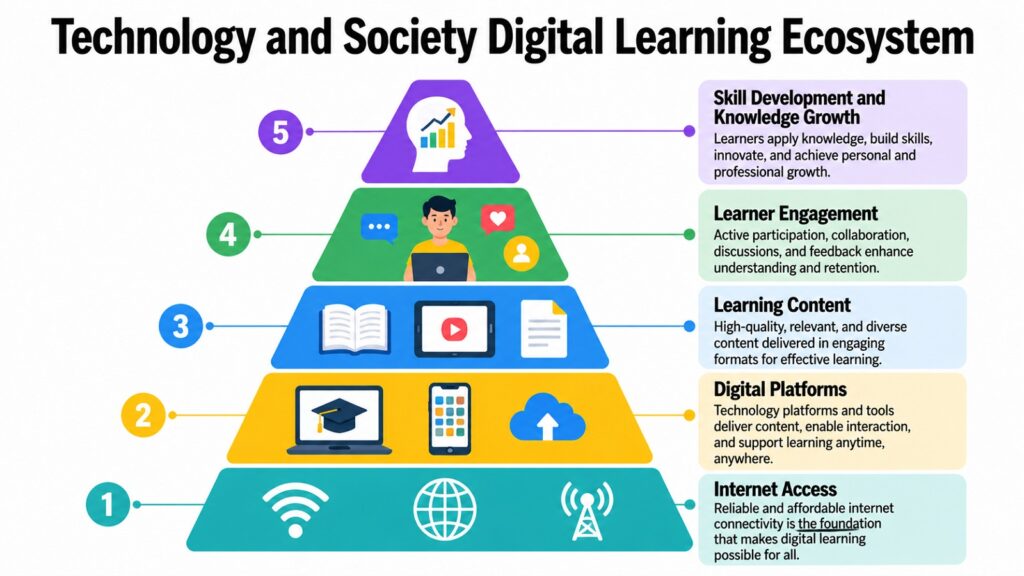
The classroom as most people know it, a fixed physical space with a teacher at the front and students in rows, represents just one way that knowledge can be passed on. Online education has added many more. Platforms like Coursera, edX, Khan Academy, and thousands of institution-specific portals now deliver learning to people who have no access to traditional educational settings. In the story of Technology and Society, this expansion of educational access is genuinely significant.
The scale of adoption is striking. As of 2023, over 220 million people were enrolled in massive open online courses (MOOCs) globally, according to Class Central. The pandemic accelerated this trend dramatically. Schools at every level from primary to university were forced to move online, and many institutions discovered that digital delivery, when done well, could work for a wide range of learners.
Accessibility is the strongest argument in favor of online education. Someone living in a rural district without a good school, or a working adult who cannot attend classes during traditional hours, or a person with mobility challenges now has options that previously did not exist. The knowledge gap between those with access to quality education and those without has the potential to narrow, at least in some dimensions.
At the same time, online education brings real limitations. Self-discipline is required in ways that traditional schooling does not demand. Drop-out rates for MOOCs remain stubbornly high, often above 90% for free courses. The quality of online programs varies enormously, and students without reliable internet access or quiet study spaces are systematically disadvantaged.
Perhaps most importantly, education is not only about information transfer. It is also about socialization, mentorship, and the kind of incidental learning that happens when students share physical space. Technology and Society are learning that digital tools can supplement and expand education, but replacing everything that happens in a room together is harder than it looks.
Table 5: Technology and Society – Online Education Facts and Challenges
| Factor | Key Data or Observation |
| MOOC Enrollment | Over 220 million people enrolled in online courses globally in 2023, per Class Central |
| Pandemic Acceleration | 1.6 billion students were affected by school closures in 2020 |
| Completion Rates | Free MOOC courses have dropout rates exceeding 90% in many studies |
| Platform Growth | Coursera reported 148 million registered learners by end of 2023 |
| Access Disparity | 40% of the global population still lacks reliable internet access |
| Employer Recognition | 57% of employers consider online degrees equivalent to traditional ones, per SHRM |
| Skill-Based Learning | Short online skill courses grew 35% year-over-year from 2021 to 2023 |
| Youth Engagement | Students report lower engagement and motivation in fully online formats |
5. Technology and Society: Why Digital Literacy Matters More Than Ever
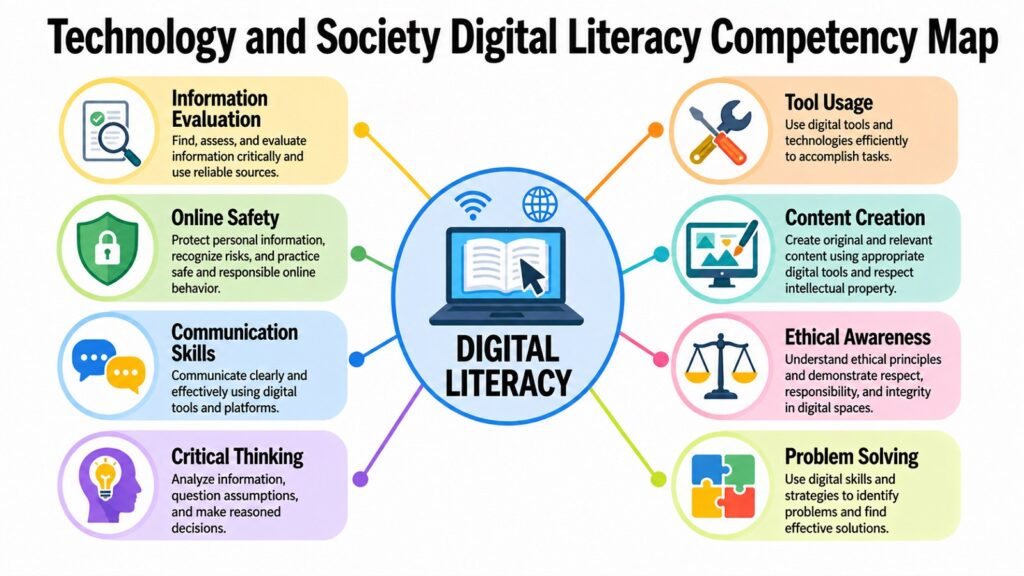
Being able to read and write was the foundational literacy of the industrial age. In the digital age, a different kind of literacy has become just as essential. Digital literacy is the ability to find, evaluate, create, and communicate information using digital tools and platforms. Within Technology and Society, it is the skill that determines whether someone can function effectively and safely in the modern world.
The stakes are real. Misinformation travels faster than ever, and the tools that spread it are sophisticated. A study by MIT in 2018 found that false information on Twitter spread to 1,500 people six times faster than accurate information. Social media platforms, search engines, and email services have become primary information channels, but none of them come with built-in guides on how to evaluate what appears on their screens.
Digital literacy also includes knowing how to protect oneself online. Understanding phishing attacks, recognizing data collection practices, setting up secure passwords, and reading the terms and conditions of digital services are all part of functioning safely in a connected world. Most people never receive any formal instruction in these areas, which leaves them vulnerable to exploitation by both bad actors and commercial systems designed to extract their data.
Unequal access to digital literacy compounds existing inequalities. Older adults, low-income communities, and populations in rural or developing areas often have less exposure to digital education. This means the people who most need guidance navigating online environments are the least likely to receive it.
Governments and educators are beginning to take this seriously. The European Union has adopted digital literacy as part of its educational framework. UNESCO has published guidelines for digital competency. But widespread, equitable digital education remains more aspiration than reality in most parts of the world. Technology and Society will both benefit when that gap closes.
Table 6: Technology and Society – Digital Literacy Realities and Gaps
| Area | Fact or Insight |
| Misinformation Speed | False news spreads to 1,500 people 6x faster than accurate news, per MIT 2018 study |
| Phishing Awareness | 3.4 billion phishing emails are sent daily, making awareness critical |
| Global Digital Literacy | Only 36% of people globally have strong digital skills, per EU Digital Economy Index |
| Age Gap | Adults over 65 are 3x more likely to share false information online, per Princeton study |
| Education Gap | Only 20 countries have digital literacy integrated into national school curricula |
| Password Practices | Over 80% of data breaches involve weak or stolen passwords, per Verizon DBIR |
| EU Framework | EU’s DigComp framework defines 21 digital competencies across 5 areas |
| Economic Impact | Workers with digital skills earn 25–30% more than those without, per OECD data |
6. Technology and Society: The Growing Importance of Data Privacy
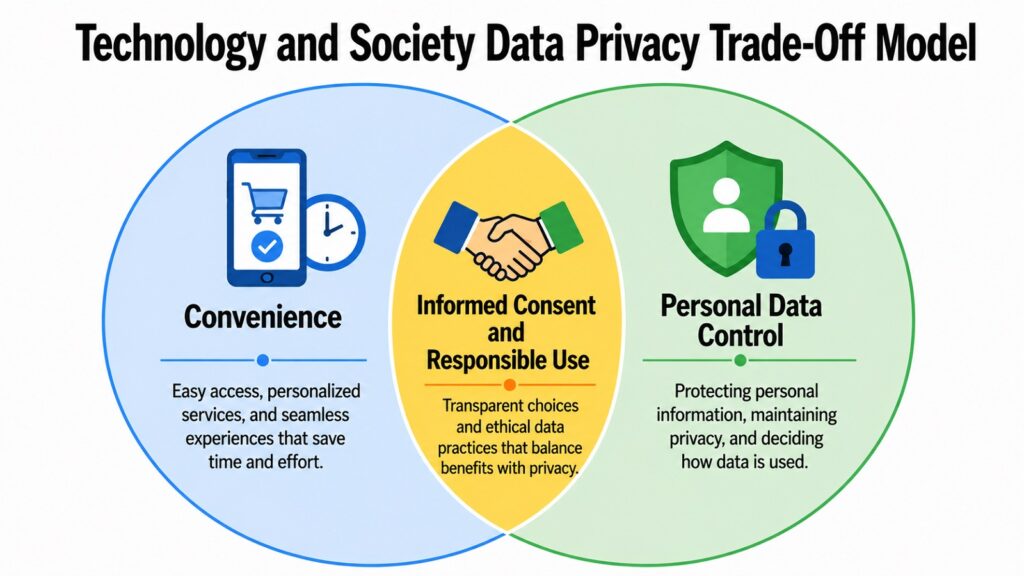
Every time someone searches for something online, clicks on an advertisement, signs up for a service, or uses a navigation app, data is being generated and collected. Most of this happens quietly, in the background, without the user actively noticing. In the context of Technology and Society, data privacy has become one of the central ethical and political questions of the digital era.
The volume of data being collected is staggering. According to IBM, 2.5 quintillion bytes of data are created every day. A significant portion of this data is personal, linked to individuals’ identities, behaviors, preferences, and locations. The companies that collect this data use it to target advertising, personalize services, and, in some cases, sell it to third parties.
The central tension is between convenience and control. People benefit from services that remember their preferences, recommend relevant content, and streamline everyday tasks. But these benefits come at the cost of personal information that, once shared, is difficult or impossible to retrieve. Users often agree to terms of service without reading them, unknowingly granting broad permissions to their data.
Data misuse is not hypothetical. The Cambridge Analytica scandal revealed in 2018 showed how data harvested from Facebook was used to build psychological profiles of millions of voters and target them with political advertising. This was a turning point that made the public much more aware of how personal data could be weaponized.
Regulatory responses have followed. The European Union’s General Data Protection Regulation (GDPR), which took effect in 2018, set a new global standard for data protection. California followed with its own Consumer Privacy Act. These frameworks give people more rights over their data, but enforcement remains uneven and the pace of technological change continues to outstrip the pace of regulation. Technology and Society are navigating this tension in real time.
Table 7: Technology and Society – Data Privacy: Key Facts and Events
| Topic | Key Fact or Development |
| Daily Data Creation | 2.5 quintillion bytes of data are created daily, according to IBM |
| GDPR Enforcement | EU’s GDPR has issued over €4 billion in fines since 2018 |
| Cambridge Analytica | Data from 87 million Facebook users was harvested without consent in 2018 |
| User Awareness | 91% of users accept terms of service without reading them, per Carnegie Mellon study |
| Data Broker Industry | U.S. data broker industry is worth over $200 billion annually |
| Surveillance Concerns | 64% of Americans feel the government monitors their activities online |
| California Privacy Act | CCPA gives California residents rights to access and delete their personal data |
| Third-Party Data Sharing | Apps share data with an average of 6 third parties, per Oxford Internet Institute |
7. Technology and Society: Understanding AI in Society Today
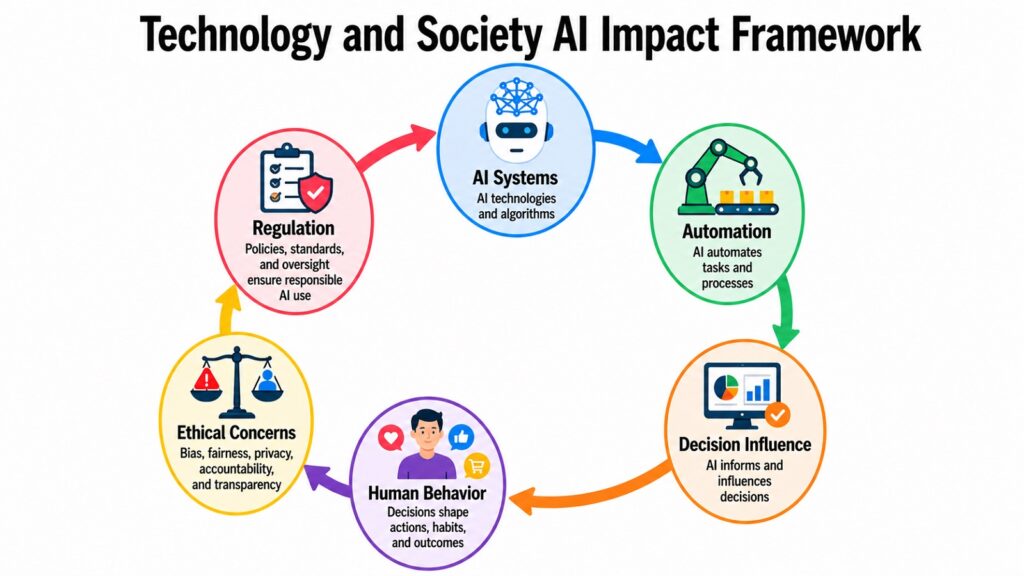
Artificial intelligence has moved out of research labs and into the fabric of daily life. It recommends what people watch on streaming platforms, decides which loan applications get approved, filters job resumes before a human sees them, and generates text that is sometimes difficult to distinguish from what a person would write. In the landscape of Technology and Society, AI is no longer a future concern. It is a present reality.
The economic impact is already visible. McKinsey estimated in 2023 that generative AI alone could add between $2.6 trillion and $4.4 trillion to the global economy annually. Automation driven by AI is already changing employment patterns in manufacturing, finance, legal services, and customer support. Jobs are not simply disappearing; they are changing in structure, requiring workers to adapt to roles where AI handles routine tasks while humans focus on judgment, creativity, and relationships.
Ethical concerns are real and growing. AI systems trained on historical data can inherit and amplify the biases embedded in that data. A facial recognition system trained on mostly light-skinned faces performs worse on darker-skinned faces. A hiring algorithm trained on past promotion data may disadvantage women or minorities if those groups were historically underrepresented in senior roles. These are not hypothetical scenarios. They have been documented in real systems deployed by real organizations.
Accountability is another challenge. When an AI system makes a harmful decision, it is not always clear who is responsible. The company that built the model? The organization that deployed it? The regulator who approved it? Technology and Society are still working out these questions, and the answers will shape how AI develops over the next decade.
The most grounded way to understand AI’s role is not as a replacement for human intelligence but as a system that amplifies both the best and the worst of what human beings have already created. Getting the balance right is one of the defining challenges of this generation.
Table 8: Technology and Society – AI’s Real-World Impact
| AI Application | Impact or Insight |
| Economic Value | Generative AI could add $2.6–4.4 trillion annually to global economy, per McKinsey |
| Job Automation | 300 million jobs globally could be partially automated by AI, per Goldman Sachs |
| Bias in AI | MIT study found facial recognition error rates of 35% for dark-skinned women vs 1% for light-skinned men |
| Healthcare Use | AI diagnoses diabetic retinopathy with over 90% accuracy in clinical trials |
| Content Generation | ChatGPT reached 100 million users in 2 months, the fastest app growth in history |
| Legal Use | AI tools review contracts 60x faster than human lawyers, per LawGeex study |
| Algorithmic Hiring | 83% of U.S. employers use automated tools to screen job applicants |
| Regulation Efforts | EU AI Act, passed in 2024, is the world’s first comprehensive AI regulatory framework |
8. Technology and Society: How the Digital Economy Is Transforming Value
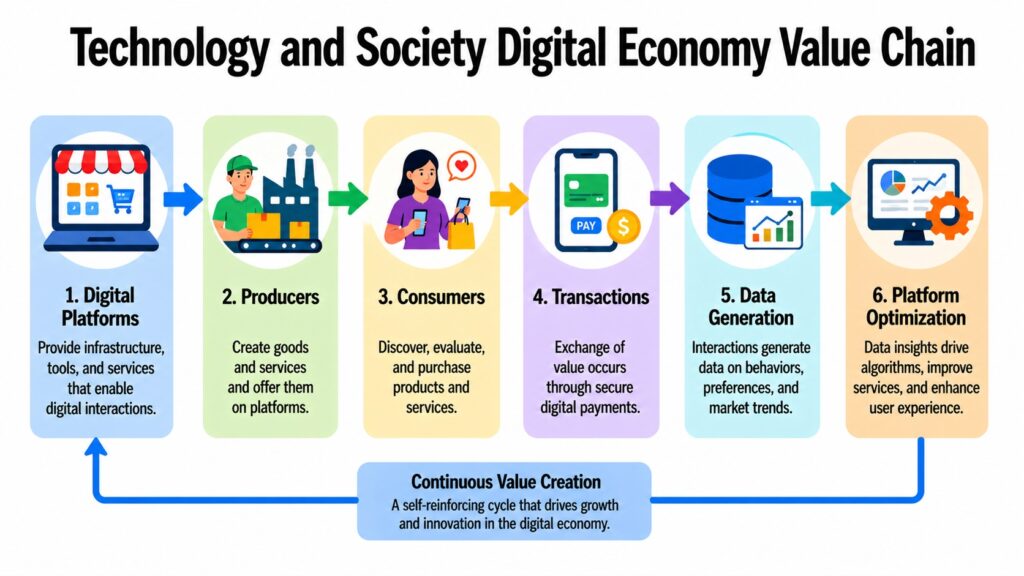
The economy has always been shaped by the tools available to it. The printing press changed the information economy. The steam engine changed manufacturing. The internet, and the digital infrastructure built on top of it, has changed how value itself is created and exchanged. In the relationship between Technology and Society, the digital economy represents one of the most far-reaching transformations of the current era.
Platform-based work is one of the most visible examples. Companies like Uber, DoorDash, Fiverr, and Amazon Mechanical Turk have created massive workforces without traditional employment relationships. The International Labour Organization estimated in 2023 that over 435 million people globally engaged in some form of platform or gig work. These workers gain flexibility but often sacrifice job security, benefits, and legal protections.
E-commerce has reshaped retail at a structural level. Global e-commerce sales exceeded $5.8 trillion in 2023, according to Statista. Traditional brick-and-mortar businesses have had to adapt, and many have not survived the shift. Entire supply chains have been redesigned around the logic of online ordering and fast delivery, changing the geography of warehousing, logistics, and urban planning.
Digital services have created new categories of value that did not exist a generation ago. Streaming subscriptions, software as a service, digital advertising, and data licensing are all massive industries built on assets that have no physical form. The rules that governed tangible goods do not always map onto these new forms of value, creating challenges for taxation, labor law, and consumer protection.
The opportunity side of the digital economy is real. It has allowed individuals in developing countries to sell goods to global markets, given small businesses access to tools that were previously only available to large corporations, and created entirely new categories of employment. But the concentration of wealth in a small number of platform companies raises questions about power, fairness, and who the digital economy ultimately serves. Technology and Society are still working out the answers.
Table 9: Technology and Society – The Digital Economy in Numbers
| Indicator | Key Data or Insight |
| E-commerce Revenue | Global e-commerce sales exceeded $5.8 trillion in 2023, per Statista |
| Gig Workers Globally | Over 435 million people engaged in platform or gig work in 2023, per ILO |
| Digital Ad Spending | Global digital advertising reached $626 billion in 2023 |
| App Economy | The global app economy was valued at $935 billion in 2023 |
| Streaming Market | Global video streaming revenue crossed $100 billion for the first time in 2023 |
| Crypto Market | Global cryptocurrency market capitalization exceeded $1.7 trillion in early 2024 |
| Platform Concentration | Top 5 tech platforms account for over 25% of total U.S. stock market value |
| Financial Inclusion | Mobile banking has brought financial services to 1.4 billion previously unbanked people |
Conclusion: Technology and Society as an Ongoing Human Journey
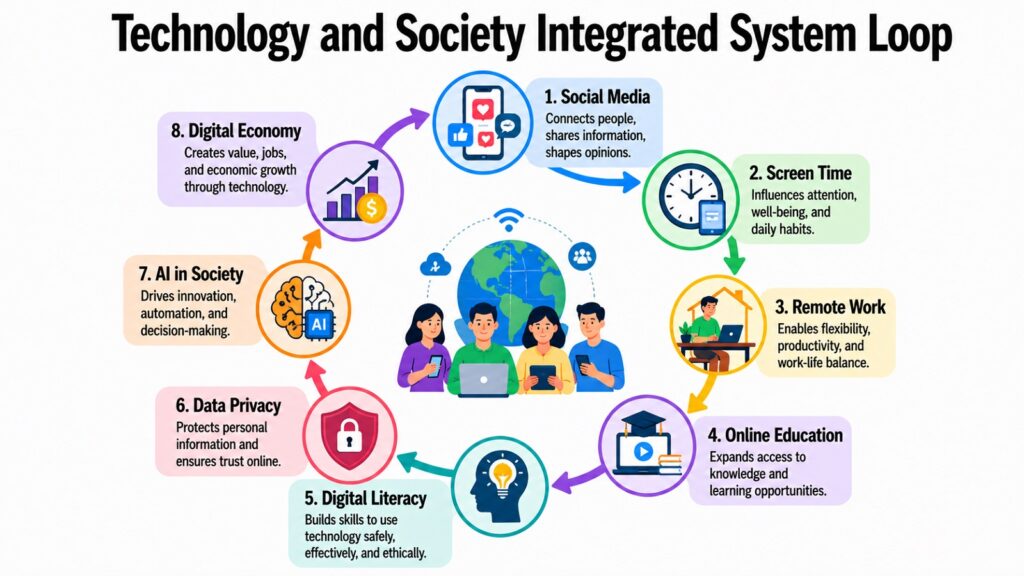
No single chapter in the relationship between Technology and Society is ever really finished. The eight aspects explored in this article, social media, screen time, remote work, online education, digital literacy, data privacy, artificial intelligence, and the digital economy, are all still in motion. Each one is being shaped by decisions made by individuals, companies, governments, and communities every day.
What connects all eight is the simple fact that technology does not determine outcomes by itself. A platform can connect or divide. A digital tool can expand access or deepen inequality. An algorithm can make decisions fairly or reproduce historical biases. The direction these technologies take depends on the choices that people and institutions make about how to build, regulate, and use them.
There is something humbling about that. The pace of change feels overwhelming at times, and the systems involved are complex enough that even experts disagree about what comes next. But the underlying questions are ones that human beings have always faced. How do we build communities that support each other? How do we make knowledge accessible to more people? How do we hold power accountable?
The most useful attitude toward Technology and Society is one that stays curious and grounded at the same time. Curious about what new tools make possible, and grounded enough to ask who benefits, who gets left behind, and what kind of world is being built in the process.
Table 10: Technology and Society – Looking Forward: Key Principles for Navigating Change
| Key Principles of Technology and Society | Why It Matters in Technology and Society |
| Digital Awareness | Understanding how platforms work helps people make more deliberate choices |
| Critical Evaluation | Fact-checking and source evaluation reduce the spread of misinformation |
| Privacy Management | Actively managing data settings reduces exposure and exploitation risk |
| Adaptive Learning | Continuous skill-building keeps individuals relevant in a changing economy |
| Ethical Engagement | Demanding accountability from tech companies shapes better products |
| Inclusive Access | Advocating for equal digital access reduces societal inequality |
| Balanced Use | Setting intentional limits on screen time supports mental and physical well-being |
| Policy Participation | Civic engagement in tech regulation ensures democratic oversight of AI and data |