Table of Contents
Introduction: Why Value Delivery Is a Core Business Essential
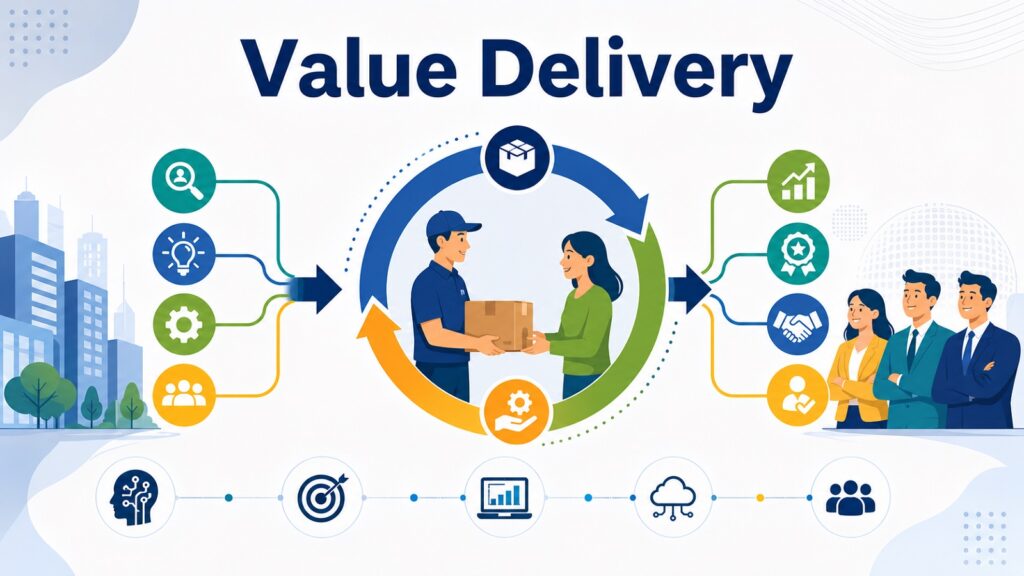
Most businesses think they compete on products, pricing, or branding. But something quieter runs beneath all of that — a system that decides whether any of those things actually reach the people they were built for. That system is value delivery, and it has become one of the most important business essentials in modern organizations.
Value delivery is not simply handing a product to a customer and calling it done. It is the entire architecture that connects what a business promises with what it actually produces. Think of it as the Value Delivery Architecture — a layered system that links strategy, operations, performance, scalability, and long-term competitiveness into a single operational flow.
The concept of Operational Value Flow describes how value moves through a business — from the moment an opportunity is identified to the moment a customer experiences the result. Anywhere that flow gets blocked or slowed, you have what can be called Value Friction. That friction costs businesses time, money, and relevance. Companies like Amazon, Toyota, and Apple are studied not just because they built great things, but because they built remarkable delivery systems — ones that consistently move value from strategy to customer without unnecessary loss along the way.
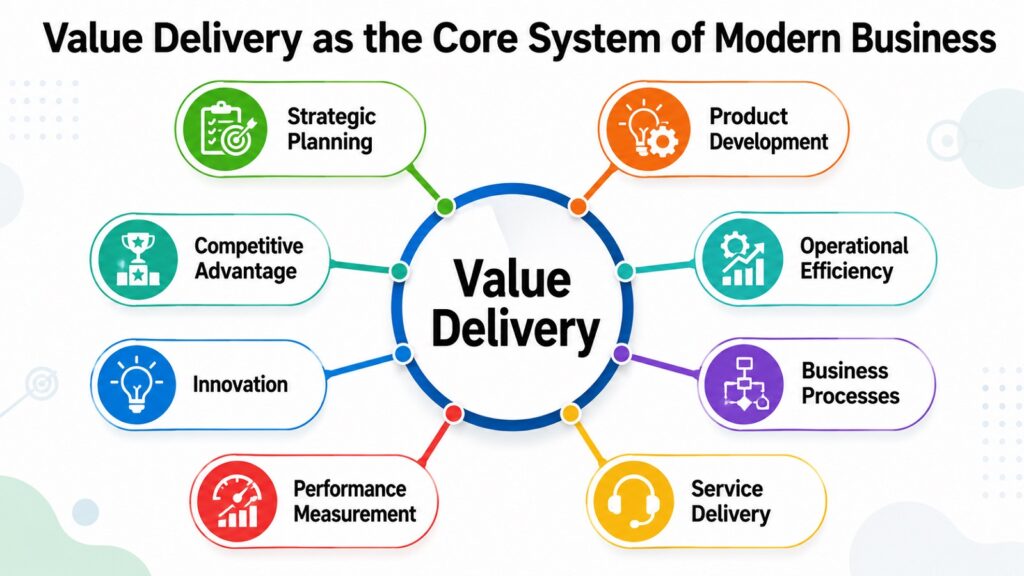
Together, the systems that manage this flow form the Value Delivery Ecosystem — one that successful organizations manage deliberately, not by accident. This article explores the 8 powerful foundations that shape modern value delivery systems and demonstrates how these foundations influence organizational success. Understanding them helps explain how modern businesses actually function beneath the surface.
Value Delivery: 8 Foundations at a Glance
| Foundation | What It Does for Value Delivery |
| Value Identification | Discovers where genuine market opportunities and unmet needs exist |
| Value Proposition Design | Translates identified opportunities into a clear competitive promise |
| Product & Service Optimization | Refines offerings to improve quality, usability, and strategic fit |
| Service Delivery Models | Defines how value is structured, scaled, and delivered operationally |
| Operational Efficiency | Ensures execution is fast, consistent, and free of unnecessary waste |
| Business Process Optimization | Builds reliable workflows that reduce friction and improve output |
| Performance Measurement Systems | Tracks outcomes and guides intelligent operational improvement |
| Continuous Value Improvement | Keeps the delivery system evolving as markets and expectations change |
1. Value Delivery Through Strategic Value Identification
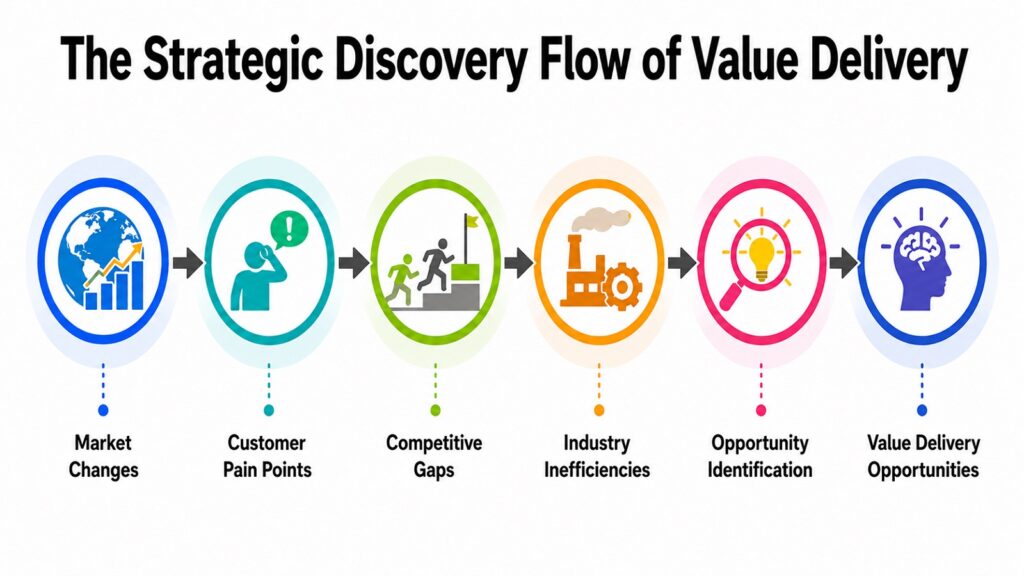
Before a business can deliver anything meaningful, it has to know what meaningful actually looks like in its market. That sounds straightforward, but it is where many organizations quietly fall behind. Value delivery begins not with production or planning but with the ability to identify what industries, customers, and stakeholders genuinely consider worth paying for.
Markets rarely announce their needs directly. They show them through inefficiencies, complaints, workarounds, and missed opportunities. Uber did not emerge because someone invented a new vehicle. It emerged because someone recognized an unfilled gap in the urban transportation experience — one that millions of people had already accepted as normal. Amazon’s entry into cloud computing through AWS followed a similar logic. Its own internal infrastructure challenge turned out to be a widespread industry problem. AWS launched in 2006 and now accounts for a significant share of Amazon’s total revenue.
What makes value identification a strategic discipline rather than a simple research exercise is that it requires looking at emerging trends alongside present inefficiencies. Netflix identified that DVD rentals were becoming a friction-heavy experience for customers who wanted faster access to content. That foresight drove the pivot to streaming long before competitors understood the shift was permanent. Kodak’s story runs in the opposite direction. It understood photography better than almost anyone, but failed to identify that customers would eventually value the convenience of digital over the quality of chemical film.
Organizations that build dedicated market intelligence functions and systematically monitor competitive behavior stay operationally relevant longer than those that treat identification as a one-time exercise during product launch. Strong identification practices give businesses a head start in designing responses that match actual market needs. Weak identification produces offerings that solve yesterday’s problems for customers who have already moved on. The cause-and-effect relationship between identification capability and long-term business relevance is direct and consistent across industries.
Value Delivery Through Strategic Value Identification: Key Examples
| Company / Concept | Value Identification Insight |
| Uber (2009) | Identified unreliability and inefficiency in urban taxi systems as a core gap |
| Amazon AWS (2006) | Recognized that cloud infrastructure needs were widespread across industries |
| Netflix | Saw that physical DVD rental was creating friction in the entertainment experience |
| Toyota | Identified production waste and supply chain delays as destroyers of customer value |
| Airbnb | Found that hotel uniformity was failing travelers who wanted local, flexible options |
| Kodak (failure case) | Failed to identify the shift from chemical photography to digital convenience |
| IKEA | Identified that furniture buyers valued affordability and self-sufficiency over service |
| Slack | Recognized that workplace communication was fragmented and email-heavy |
2. Value Delivery Through Effective Value Proposition Design
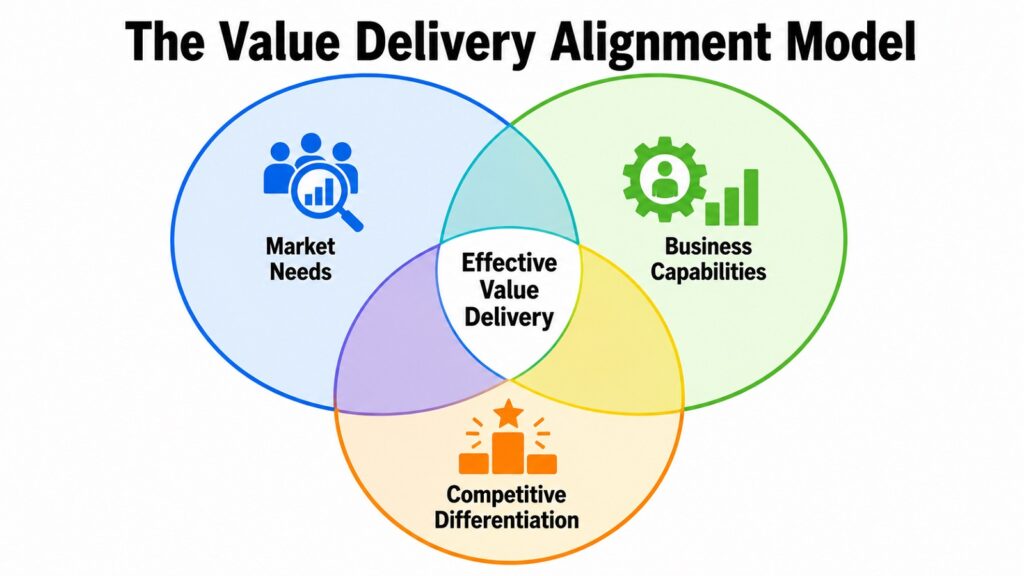
Finding an opportunity is only half the work. The harder part is turning that opportunity into a clear, credible, and competitive promise. That promise is the value proposition, and it sits at the center of how businesses shape their strategic positioning and define what they actually stand for in a market.
A well-designed value proposition does not just describe a product. It explains why the product matters to a specific group of people in a specific situation. Apple’s value proposition has never been built on technical specifications alone. It is built on design simplicity, ecosystem integration, and the emotional experience of products that feel genuinely thought through — and that proposition stays consistent across hardware, software, services, and retail. That consistency is what makes value delivery coherent and powerful at scale.
The concept of Value Alignment describes how organizations connect their operational capabilities with what their market actually demands. When those two things are aligned, value delivery flows naturally. When they are misaligned, you get Value Friction — the operational gap between what a business promises and what it can actually sustain. Southwest Airlines built its proposition around low-cost, reliable point-to-point flights, and every operational decision — single aircraft type, no assigned seating, no meals — was designed to support that promise and eliminate friction before it could develop.
Value proposition design also shapes business model construction. A company promising rapid customization at scale needs a fundamentally different operational structure than one promising standardized quality at low cost. Weak value propositions create ripple effects across organizations — mixed marketing signals, inconsistent sales execution, and product teams building features without clear strategic direction. Strong propositions stay narrow, clear, and operationally grounded. They avoid the common trap of trying to mean everything to everyone, which almost always results in delivering less than expected to the customers who matter most.
Value Delivery Through Value Proposition Design: Real Business Cases
| Business | Core Value Proposition |
| Apple | Seamlessly integrated hardware, software, and services built around design and experience |
| Southwest Airlines | Reliable, low-cost point-to-point air travel without unnecessary complexity |
| IKEA | Stylish, functional furniture at accessible prices through self-assembly efficiency |
| Spotify | Instant access to a vast music library through a simple subscription model |
| Salesforce | Cloud-based CRM that scales with business growth without hardware investment |
| FedEx | Guaranteed overnight delivery backed by real-time shipment tracking |
| Professional networking and career development in one integrated digital platform | |
| Zoom | Simple, reliable video conferencing accessible across devices without technical barriers |
3. Value Delivery Through Value Density-Driven Product & Service Optimization
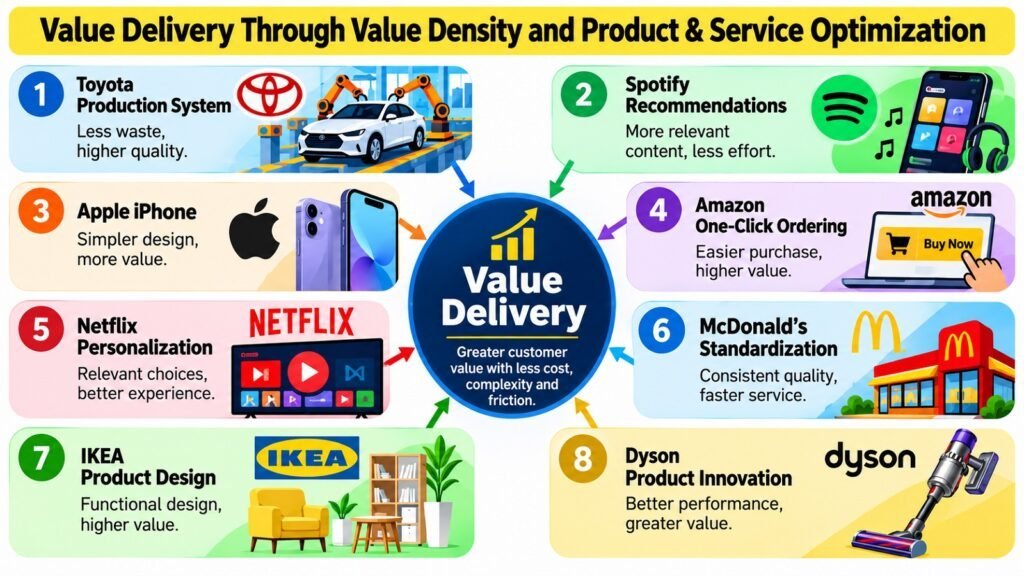
Once a business has defined its value proposition, the next challenge is turning that promise into stronger and more consistent Value Delivery. Products and services are never truly finished. Markets shift, competitors improve, technologies evolve, and customer expectations rise, often without formal warning. Businesses that treat their offerings as complete can gradually lose relevance, while those that continuously improve them can strengthen the value they deliver.
A useful lens for this continuous improvement is Value Density — the amount of meaningful customer value concentrated within a product or service relative to the cost, effort, time, complexity, and friction involved in obtaining it. Higher Value Density means customers can achieve significant benefits without unnecessary expense, effort, confusion, or delay. Product and Service Optimization becomes the practical mechanism for increasing this density. Rather than simply adding features, businesses can remove unnecessary complexity, improve usability, strengthen reliability, reduce friction, and increase the usefulness of what customers already have.
Toyota demonstrates how systematic optimization can strengthen value through better quality, lower waste, greater reliability, and more efficient production. Spotify applies a similar principle digitally by continuously refining recommendations and user experiences using behavioral data. Apple has also demonstrated that optimization can involve subtraction, including the removal of the headphone jack as part of a broader shift toward wireless product architecture.
These examples show that optimization should ultimately be judged by its contribution to Value Delivery. Operational Value Efficiency strengthens this connection by considering how effectively internal resources are converted into meaningful customer value. When businesses continuously improve Value Density while using resources more effectively, Product and Service Optimization becomes more than an operational exercise: it becomes a strategic capability for delivering greater value with less unnecessary cost, complexity, and friction.
Value Delivery Through Value Density and Product & Service Optimization
| Example | Contribution |
|---|---|
| Toyota Production System | Improves Value Delivery by reducing defects, waste, production time, and unnecessary resource use while increasing quality and reliability. |
| Spotify | Strengthens Value Delivery by using behavioral data to improve recommendation relevance, helping users discover more useful content with less search effort. |
| Apple iPhone | Demonstrates how Product and Service Optimization can strengthen Value Delivery by simplifying product architecture, improving usability, and reducing unnecessary complexity. |
| Amazon One-Click Ordering | Increases Value Density by reducing the time and effort required to complete purchases, allowing customers to obtain the desired outcome with minimal friction. |
| Netflix Personalization | Improves Value Delivery by concentrating relevant entertainment choices within the customer experience, reducing search complexity and increasing content discovery. |
| McDonald’s Standardization | Strengthens Value Delivery through consistent product and service experiences while improving operational efficiency, speed, and reliability across locations. |
| IKEA Product Design | Increases Value Density by combining functional product design, affordability, efficient packaging, and customer participation while reducing unnecessary costs. |
| Dyson Product Innovation | Enhances Value Delivery through continuous Product and Service Optimization focused on performance, usability, engineering efficiency, and differentiated customer benefits. |
4. Value Delivery Through Modern Service Delivery Models
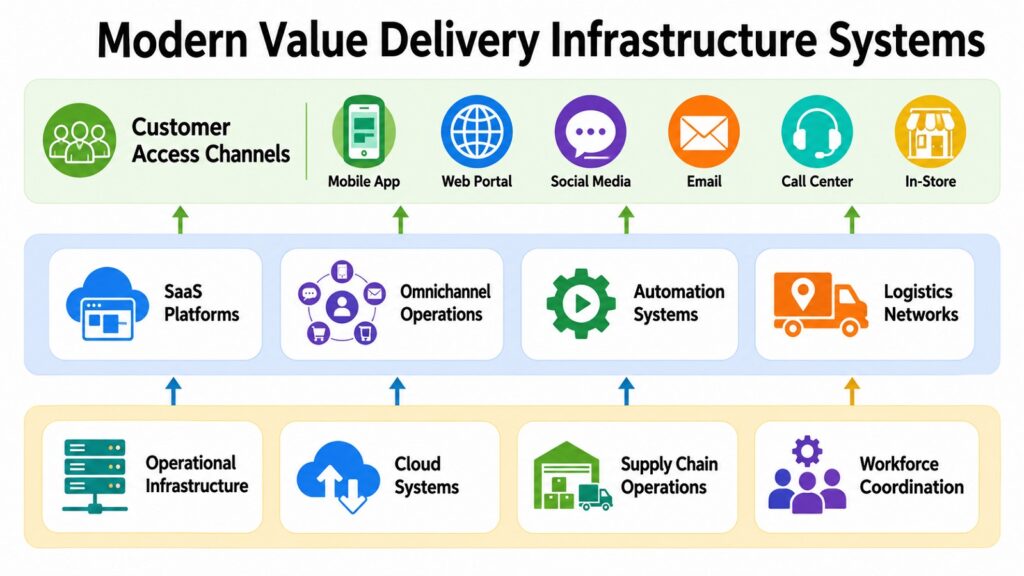
A business can design the perfect product and still fail if its delivery infrastructure cannot get that product to the right people, at the right time, in the right condition. Delivery models are the operational structures that determine whether value creation actually translates into value experienced — shaping speed, consistency, cost structure, and scalability.
Modern businesses have more delivery structure choices than at any previous point in history. Centralized systems offer consistency and cost control. Decentralized systems offer local responsiveness. Digital platforms eliminate physical constraints entirely. SaaS models replace one-time transactions with ongoing service relationships. Each model shapes the Value Delivery Infrastructure differently — the operational systems that connect business output to customer experience — and the choice between them carries lasting strategic consequences.
Zara’s model is one of the most studied in global retail. While most fashion companies design collections months in advance at distant factories, Zara’s vertically integrated system moves a design from concept to store shelf in roughly two weeks. That speed reflects a deliberately designed Operational Delivery Architecture that prioritizes responsiveness over the cost savings of remote production. Airbnb demonstrates a different structural logic — a platform ecosystem that connects supply and demand at massive scale without owning any accommodation inventory. Its entire value delivery depends on the reliability and scalability of that platform architecture.
Automation has become a foundational element of modern delivery. Amazon’s fulfillment centers use thousands of robotic systems to sort, move, and pack orders at a speed that human-only operations could not match at equivalent scale. Omnichannel models have become the standard in retail — but businesses that manage physical stores, apps, and marketplaces as separate systems produce inconsistent customer experiences that erode trust over time. Those that integrate them build delivery systems that feel seamless regardless of how a customer chooses to engage.
Value Delivery Through Modern Service Delivery Models: Examples
| Business / Model | Delivery Approach |
| Zara | Vertically integrated fast-fashion model moving designs from concept to shelf in two weeks |
| Airbnb | Platform ecosystem connecting accommodation supply and demand without owning inventory |
| Amazon Fulfillment | Robotic warehouse automation enabling consistent delivery at massive scale |
| Netflix | Cloud-based streaming infrastructure delivering content directly to any internet-connected device |
| McDonald’s | Standardized delivery backed by digital ordering and third-party delivery integration |
| Shopify | SaaS platform enabling merchants to operate full e-commerce delivery systems without infrastructure investment |
| Salesforce | Multi-tenant cloud architecture delivering CRM services to thousands of businesses simultaneously |
| UPS / FedEx | Hub-and-spoke logistics networks optimized for speed and geographic coverage |
5. Value Delivery Through Operational Efficiency
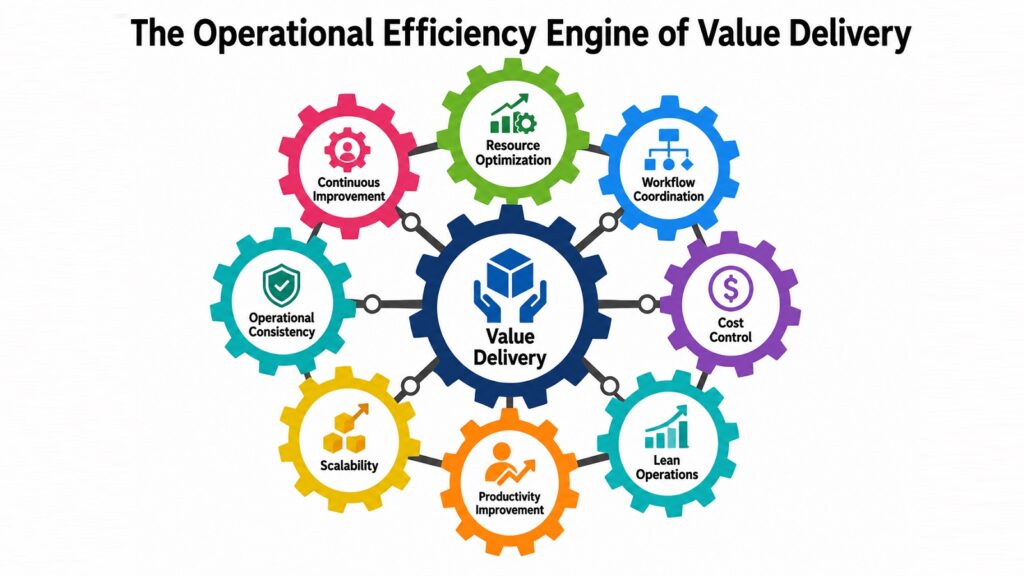
Even a well-designed delivery model will eventually collapse under its own weight if the operations running inside it are slow, inconsistent, or wasteful. Operational efficiency keeps value delivery systems functional at scale — not by cutting corners, but by eliminating the friction and redundancy that drain organizational energy without adding customer value.
The concept of Value Leakage describes what happens when inefficiencies accumulate inside a delivery system. It often appears as small delays, duplicated tasks, unnecessary approval layers, or coordination failures between departments. Each leak seems minor in isolation. Together they erode profitability, slow delivery, and gradually reduce the consistency that customers rely on. The damage is rarely sudden — it builds quietly over time until it becomes visible in declining margins and customer dissatisfaction.
Toyota’s lean manufacturing framework identifies seven categories of waste: overproduction, waiting, transportation, over-processing, inventory excess, unnecessary motion, and defects. Eliminating these systematically improves both cost efficiency and delivery speed. UPS demonstrates a logistics version of this precision — its ORION route optimization system uses algorithmic planning to reduce driver distances. According to UPS, each driver saving just one mile per day across the fleet produces savings of roughly 50 million miles annually, directly supporting competitive delivery pricing.
Operational efficiency also determines scalability. McDonald’s ability to serve millions of customers daily across tens of thousands of locations depends on standardization so precise that the experience is nearly identical across geographies and cultures. But efficiency should not come at the cost of adaptability. Organizations that over-standardize become brittle — efficient under normal conditions but unable to respond when circumstances shift. Strong efficiency practices lower costs, improve customer satisfaction, and build the organizational trust that the next layer of improvement — process optimization — depends on.
Value Delivery Through Operational Efficiency: Real-World Practices
| Company / Practice | Efficiency Approach |
| Toyota Lean System | Seven-category waste elimination framework applied across entire manufacturing operations |
| UPS ORION System | Algorithmic route optimization saving approximately 50 million vehicle miles annually |
| McDonald’s Operations | Standardized processes enabling consistent delivery across 40,000+ global locations |
| Amazon Warehouse Systems | Robotic automation reducing order processing time and error rates significantly |
| Southwest Airlines | Single aircraft type reducing training, maintenance, and parts management costs |
| Dell (original model) | Build-to-order manufacturing eliminating overproduction and inventory excess |
| Walmart Supply Chain | Real-time inventory visibility allowing continuous replenishment with minimal overstock |
| Zara Production Model | Responsive manufacturing reducing unsold inventory through shorter production cycles |
6. Value Delivery Through Business Process Optimization
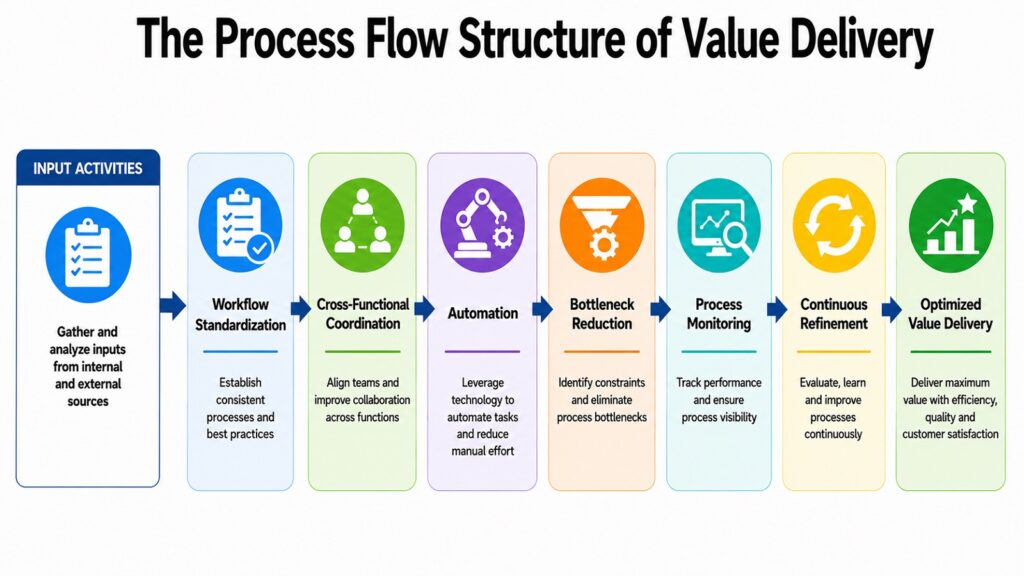
Operational efficiency describes how well a business runs. Business process optimization describes how deliberately a business has designed what it runs. Processes are the structured sequences of activities that produce organizational outputs — from how a product gets manufactured to how a customer complaint gets resolved to how a new employee gets onboarded. When those processes are well-designed, value delivery becomes more reliable, scalable, and consistent across the organization.
The term Operational Value Flow captures what happens when processes are genuinely optimized. Value moves through the organization with minimal interruption, minimal rework, and minimal coordination overhead. Process optimization is not the same as process documentation. Many organizations document their processes without ever examining whether they make sense. Optimization demands harder questions: Where do delays accumulate? Where does rework happen most frequently? Where do handoff failures between departments create avoidable errors?
General Electric’s adoption of Six Sigma in the 1990s remains one of the most significant real-world examples of enterprise process optimization. GE estimated savings of approximately 12 billion dollars over five years through systematic improvement across its divisions. The Theory of Constraints, developed by Eliyahu Goldratt, adds another analytical layer — every system has at least one bottleneck limiting overall throughput, and improving anywhere except that constraint produces limited overall results. Identifying and addressing the actual bottleneck yields disproportionately large performance gains.
Cross-functional coordination remains a continual challenge in Process-Driven Value Delivery. A procurement process that focuses solely on cost optimization may lead to delays in manufacturing. Conversely, a sales process that prioritizes speed may inundate customer service with orders that cannot be fulfilled as promised. While automation is beneficial for high-volume, rule-based tasks — as evidenced by banks and insurance companies reducing processing times from days to hours through workflow automation — it necessitates well-structured processes from the outset. Organizations that possess clear and standardized processes can seamlessly transfer them to new markets or partners without the need to reconstruct operational capabilities from the ground up.
Value Delivery Through Business Process Optimization: Approaches and Examples
| Methodology / Company | Process Optimization Approach |
| GE Six Sigma | Statistical defect reduction saving approximately $12 billion over five years |
| Toyota Kaizen | Continuous incremental improvement culture applied at every level of operations |
| Theory of Constraints | Bottleneck identification and elimination to improve overall system throughput |
| Amazon Fulfillment | End-to-end process integration from order placement to last-mile delivery |
| Insurance Industry Automation | Claims workflow automation reducing processing time from days to hours |
| Motorola (Six Sigma origin) | Defect rate reduction in electronics manufacturing through process discipline |
| Healthcare BPO | Standardized clinical and administrative workflows improving patient throughput and accuracy |
| Agile Software Development | Iterative process cycles reducing development waste and improving release speed |
7. Value Delivery Through Performance Measurement Systems
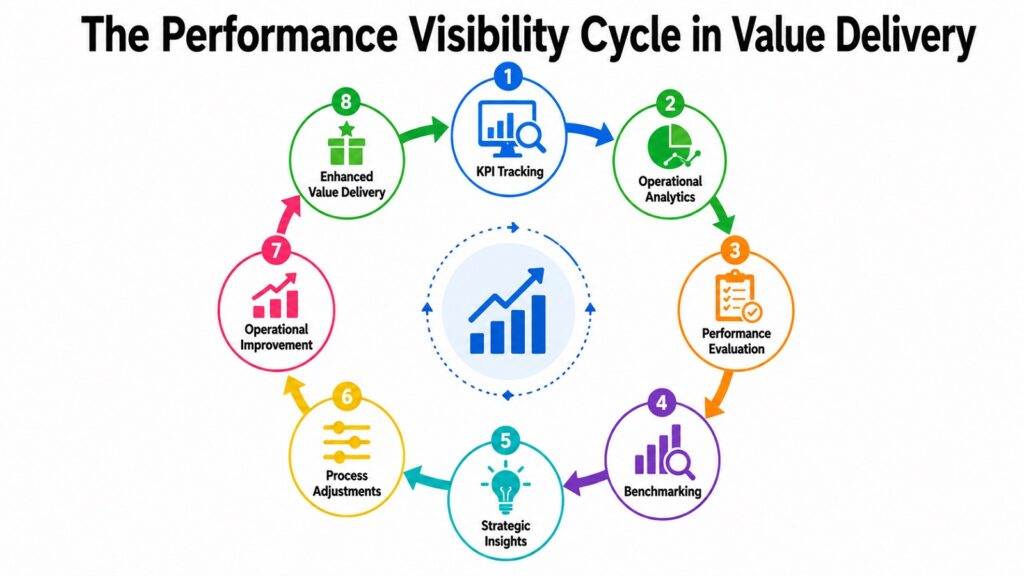
A business that cannot measure its value delivery system cannot reliably improve it. Performance measurement is the mechanism through which organizations see what is actually happening inside their operations, compare it against what should be happening, and identify where action is needed. Without this visibility, strategic decisions rest on assumptions rather than evidence, and improvement efforts target the wrong problems.
The concept of Value Visibility describes the degree to which an organization can see its own operational reality clearly and in real time. High value visibility means decision-makers at every level have access to accurate, timely information. Low value visibility means problems accumulate unseen until they become crises. Key performance indicators are the most widely used tools for structured measurement — logistics tracks on-time delivery rates and order accuracy; customer service measures first-call resolution and satisfaction scores; manufacturing uses overall equipment effectiveness to combine availability, performance, and quality into a single operational metric.
FedEx built its business on a foundation of measurement discipline. The company tracks millions of shipments simultaneously, using real-time data to identify delays before they become missed deliveries. Its early adoption of package tracking technology set a standard that the entire logistics industry eventually followed. Benchmarking adds an external reference point — the International Air Transport Association publishes operational data that airlines use to compare on-time performance, fuel efficiency, and baggage accuracy against global peers, creating a more honest view of where genuine improvement opportunity exists.
Performance-Guided Value Delivery describes a management orientation where measurement data actively shapes decisions rather than simply recording historical outcomes. Operational dashboards — through tools like Tableau or Power BI — have shortened the feedback loop between identifying a problem and responding to it. But measurement systems must be designed carefully. Organizations that measure only what is easy to count often optimize for metrics that do not reflect actual delivery quality. The art of performance measurement lies in choosing indicators that genuinely reflect the health of the value delivery system, not just the aspects that are simplest to quantify.
Value Delivery Through Performance Measurement Systems: Industry Examples
| Industry / Company | Measurement Practice |
| FedEx | Real-time shipment tracking across millions of packages with delay detection systems |
| Manufacturing (OEE) | Overall Equipment Effectiveness combining availability, performance, and quality into one metric |
| Airline Industry (IATA) | Global benchmarking of on-time performance, fuel efficiency, and baggage accuracy |
| Customer Service | First-call resolution rate and customer satisfaction scores measuring service quality |
| Healthcare | Patient wait times, readmission rates, and clinical outcome tracking for quality improvement |
| Retail (NPS) | Net Promoter Score tracking customer loyalty as a proxy for delivery experience quality |
| Software (DevOps) | Deployment frequency and mean time to recovery measuring delivery pipeline health |
| Walmart | Real-time inventory visibility dashboards driving continuous replenishment decisions |
8. Value Delivery Through Continuous Value Improvement
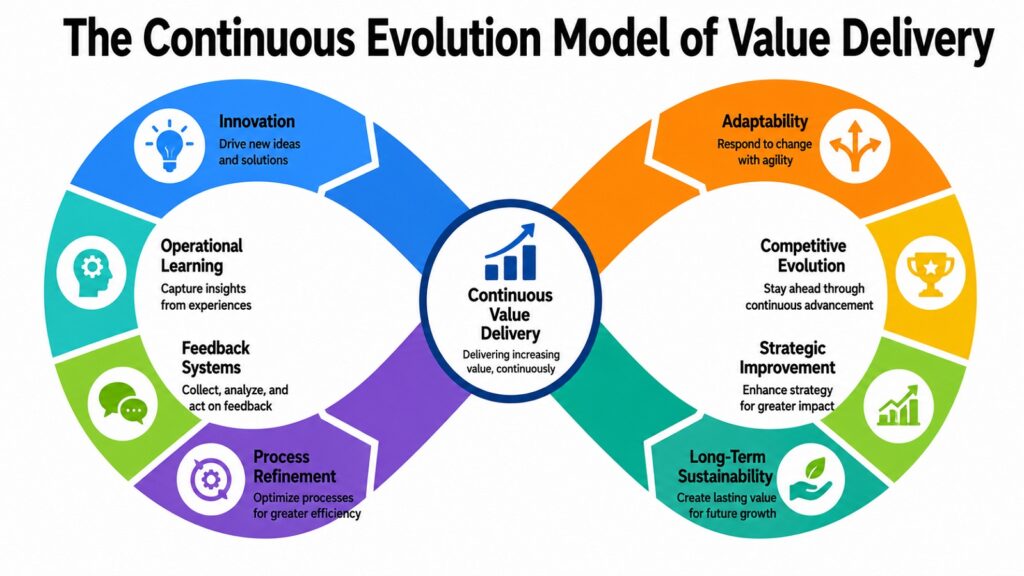
No value delivery system stays optimal on its own. Markets change, technologies evolve, and customer expectations shift — often without formal warning. Organizations that treat their delivery systems as finished structures will find them gradually becoming less effective, even without any visible crisis announcing the decline. The gap between what a business delivers and what its market expects tends to widen slowly and then all at once.
Continuous value improvement treats the delivery system as something that must grow and adapt rather than simply function. The concept of Adaptive Value Delivery describes how competitive organizations build internal systems that continuously generate improvement ideas, test them at small scale, measure their impact, and integrate successful changes into standard operations. Over time this creates Evolutionary Value Systems — delivery architectures that improve incrementally and consistently rather than only during large-scale reinvention.
Toyota’s kaizen philosophy is the most well-known institutional example of this in practice. The principle holds that no process is ever perfect and that every employee has both the ability and the responsibility to identify improvements. Amazon operates a different version at enormous scale — running thousands of simultaneous experiments on everything from warehouse configurations to website recommendation algorithms, using data to continuously refine its delivery operations. The shared insight from both organizations is that iteration speed determines learning speed, and learning speed is what determines the pace of improvement.
Many organizations decline not because they stop creating value, but because they stop evolving how that value is delivered. Blockbuster created genuine value throughout the 1990s but did not evolve its delivery system as streaming technology reshaped customer expectations. Netflix, by contrast, treated each technological shift as an opportunity to improve its delivery architecture — from DVD mail to streaming to original content production. Building organizational learning systems — post-project reviews, customer feedback integration processes, and supplier performance dialogues — is what separates organizations that improve continuously from those that improve only when forced to.
Value Delivery Through Continuous Value Improvement: Organizational Approaches
| Company / Principle | Continuous Improvement Approach |
| Toyota Kaizen | Employee-driven daily improvement culture embedded at every organizational level |
| Amazon Experiments | Thousands of simultaneous operational tests driving data-informed delivery refinement |
| Netflix Evolution | Systematic platform and content delivery upgrades in response to technology shifts |
| Spotify Agile Squads | Small autonomous teams iterating on product features in short, measurable cycles |
| Google DeepMind | AI-driven optimization of data center cooling reducing energy use by approximately 40% |
| Starbucks Digital | Loyalty app data used to continuously refine ordering, personalization, and service speed |
| Blockbuster (failure case) | Static delivery model that did not adapt as streaming technology reshaped customer expectations |
| 3M Innovation System | Dedicated time allocation for employee experimentation producing continuous product improvements |
Conclusion: The Future of Business Depends on Value Delivery
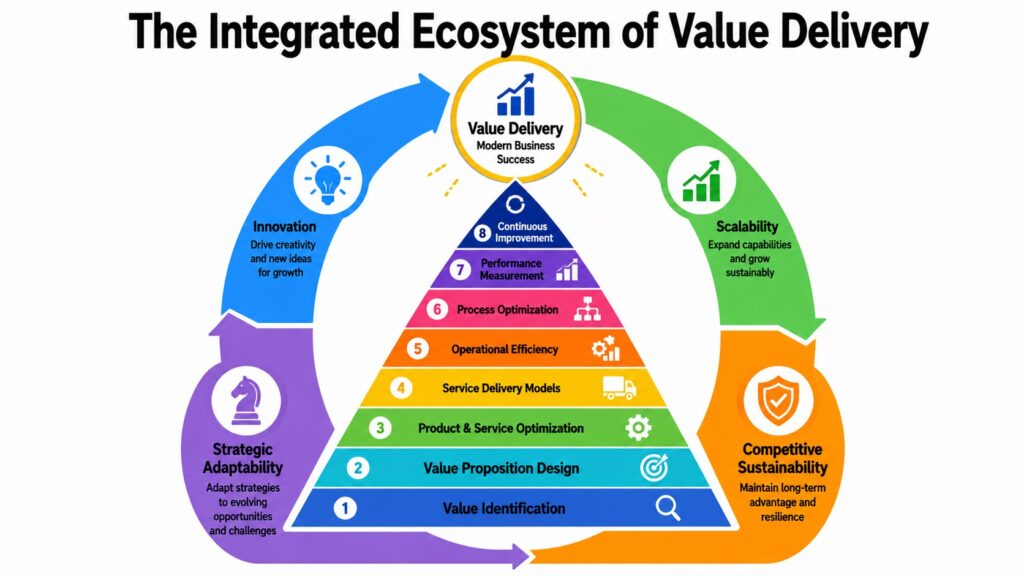
Value delivery is not a department, a function, or a seasonal initiative. It is the entire connected system through which a business turns strategy into experienced reality. The eight foundations explored in this article do not operate in isolation — they form an integrated Value Delivery Architecture that determines how effectively an organization identifies, designs, optimizes, executes, measures, and evolves the value it creates for its markets.
A company that excels in identifying value yet does not enhance its processes will face challenges in scaling. Conversely, a company that establishes efficient operations but overlooks performance metrics will optimize without direction. Additionally, a company that creates attractive value propositions while depending on obsolete delivery methods will see those propositions diminished by the challenges of inadequate execution. Each element is interdependent. Collectively, they constitute a Value Delivery Ecosystem that influences organizational competitiveness significantly more than any single product or pricing strategy.
The future will intensify this dynamic. Digital transformation is making delivery infrastructure more programmable and adaptable. Artificial intelligence is improving the precision of performance measurement and process optimization. Automation is expanding what service delivery models can sustain at scale. And customer expectations continue to rise as experiences that once seemed exceptional become the new baseline for acceptable. Organizations that invest deliberately in their value delivery systems will accumulate advantages that compound over time.
The businesses that thrive in the decades ahead will not simply be those with the best products. They will be those with the strongest, most adaptive, and most intelligently designed value delivery architectures built beneath them — systems capable of identifying opportunity, delivering on promises, measuring outcomes honestly, and continuously improving without waiting for a crisis to justify the effort.
Value Delivery: The 8 Foundations and Their Strategic Impact
| Foundation | Strategic Impact on Business Success |
| Value Identification | Creates competitive foresight by detecting opportunities before they become obvious to competitors |
| Value Proposition Design | Aligns organizational capabilities with market demand and reduces internal strategic confusion |
| Product & Service Optimization | Builds compounding quality advantages that become difficult for competitors to replicate |
| Service Delivery Models | Determines how effectively value reaches customers at scale and under varying market conditions |
| Operational Efficiency | Sustains profitability and delivery consistency as organizations grow and competitive pressure increases |
| Business Process Optimization | Improves reliability, reduces organizational friction, and enables value delivery at greater scale |
| Performance Measurement Systems | Converts operational activity into actionable intelligence that guides strategic and operational decisions |
| Continuous Value Improvement | Keeps the delivery architecture relevant and competitive as markets, technologies, and expectations evolve |