
Table of Contents
Introduction: Competitive Positioning in Modern Business Ecosystems
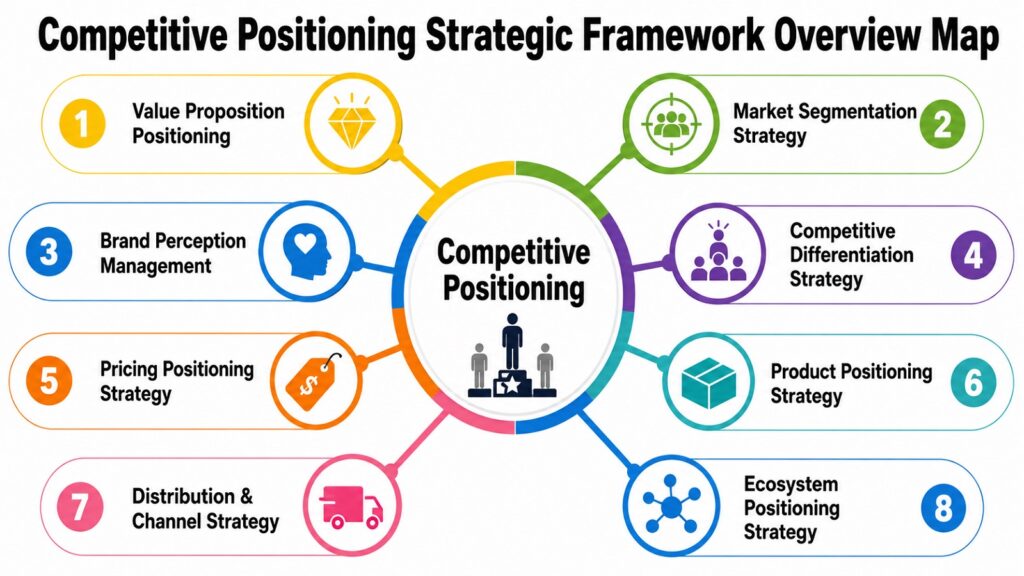
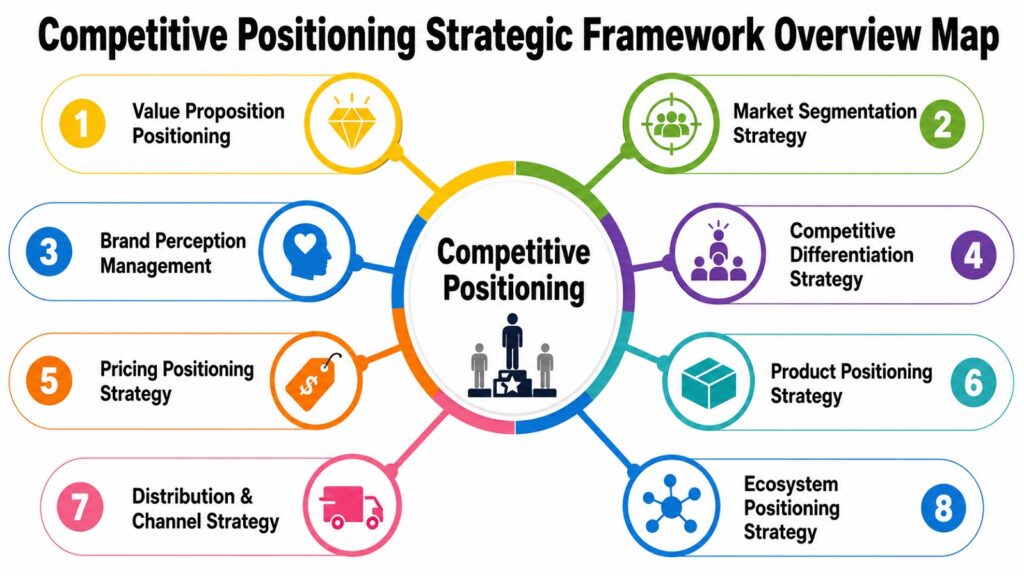
Every business exists inside a web of choices. Some of those choices are visible — the products a company builds, the prices it sets, the markets it enters. But the choices that shape long-term survival tend to be quieter and more structural. Competitive positioning is one of them. It is not a marketing concept or a branding exercise. It is the foundational logic that determines how a business occupies space in a market and why customers choose it over every available alternative. It is one of the most important dimentions of the entire business ecosystem.
Competitive positioning defines the relationship between a business and the competitive forces around it. It answers a deceptively simple question: why should a customer choose you? Answering that question in a way that holds up under real market pressure takes more than a tagline. It requires a clear understanding of what the business does differently, for whom, at what price, through which channels, and with what kind of brand meaning in the customer’s mind.
Markets do not stay still. Consumer expectations shift. New entrants disrupt old categories. Technology reshapes delivery. What worked as a positioning strategy five years ago may now be a liability. This is why competitive positioning must be treated as a living framework rather than a fixed declaration. Companies that reassess and refine their positioning as conditions change tend to sustain advantage longer than those that treat it as a one-time statement.
The consulting firm McKinsey has consistently argued that companies with clear strategic positioning outperform their peers in revenue growth and profitability over multi-year periods. Harvard Business School professor Michael Porter built much of his foundational work on the idea that sustainable competitive advantage comes from making deliberate choices about what to do and, critically, what not to do. These ideas are not academic. They show up in how Apple prices its products, how Amazon controls distribution, how Rolex manages scarcity, and how Shopify defines its category.
Competitive positioning operates across multiple dimensions simultaneously. A business can hold a strong value proposition but fail at brand perception. It can segment its market correctly, but price itself into contradiction. It can differentiate clearly but distribute poorly. This is why competitive positioning must be understood as an interconnected system rather than a single strategic lever. Each dimension reinforces or undermines the others, and managing them together is what separates durable advantage from temporary wins.
This article examines eight strategic dimensions of competitive positioning. Together, they form a complete business intelligence framework — one that can be used repeatedly as markets evolve, competitors shift, and customer expectations change. Think of it less as a guide and more as a reference instrument to return to whenever positioning feels unclear or growth stalls.
Table 1: Eight Competitive Positioning Dimensions and Their Strategic Roles
| Positioning Dimension | Strategic Role in Competitive Positioning |
|---|---|
| Value Proposition Positioning | Defines why customers should choose you over alternatives by articulating specific, differentiated value |
| Market Segmentation & Targeting | Sharpens positioning by concentrating advantage in segments where differentiation is most defensible |
| Brand Perception & Mental Positioning | Shapes how the business lives in consumer memory through trust, association, and emotional recognition |
| Competitive Differentiation Strategy | Creates strategic distance from competitors through uniqueness that is hard to replicate or substitute |
| Pricing Positioning Strategy | Uses price as a signal of value, quality, and market tier rather than just a revenue mechanism |
| Product Positioning in the Market | Aligns product design and features with the perception and competitive slot the business wants to own |
| Distribution & Channel Positioning | Controls access and reach as a competitive lever, making delivery itself a source of advantage |
| Strategic Positioning in Competitive Ecosystems | Extends positioning logic into platform dynamics, partnerships, and systemic network effects |
1. Competitive Positioning Through Value Proposition Positioning
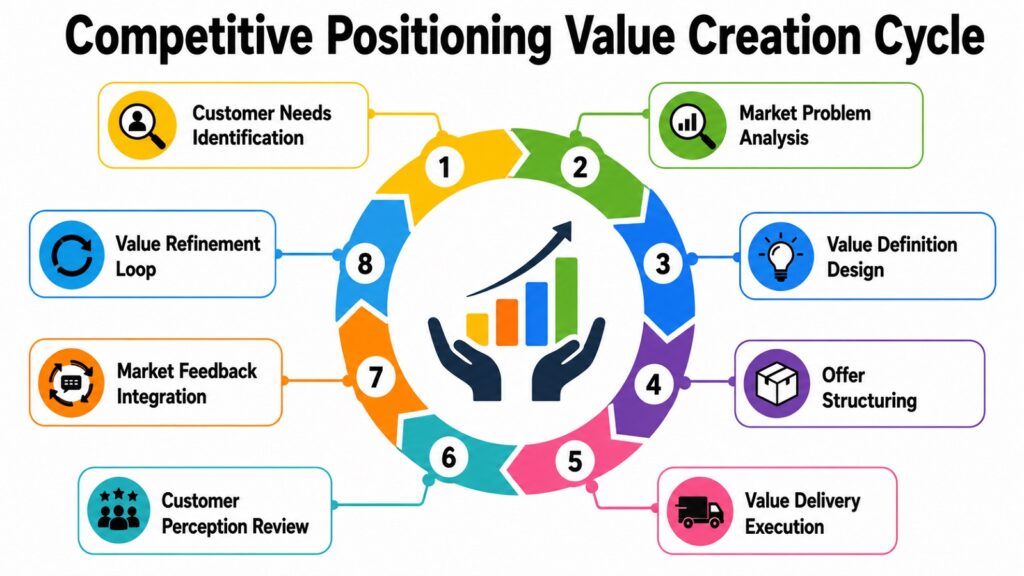
A business that cannot explain what it offers and why that offer matters more than the competition’s is not really competing. It is just showing up. Value proposition positioning is the act of defining the specific benefit a company delivers to a specific group of customers in a way that is clear, meaningful, and distinct. It sits at the heart of all competitive positioning work.
The confusion around value propositions is common. Many businesses confuse features with value. A feature is what a product does. Value is what the customer gains as a result. A software company might offer automated reporting as a feature. The value is that the operations manager saves six hours a week and can focus on decisions rather than data collection. Competitive positioning built on features alone rarely holds up when a competitor adds a similar feature.
Strong value proposition positioning asks three questions consistently. Who exactly is the customer? What problem does the business solve that alternatives do not solve as well? And why should the customer believe the business can actually deliver on that promise? Companies that answer all three with precision tend to build sharper, more defensible market positions than those that answer in broad strokes.
Apple’s value proposition has never really been about hardware specifications. It has been about the intersection of design, privacy, and a seamless product ecosystem. That is a specific claim made for a specific type of customer — one willing to pay a premium for an experience rather than just a device. That positioning has held for decades because it is built on a promise competitors find difficult to replicate without fundamentally changing who they are.
Weak value proposition positioning looks like this: language that could apply to almost any competitor in the category. Words like “quality,” “customer-first,” and “innovative” without specific proof or context are positioning noise. They occupy space without creating differentiation. The market rewards specificity, not generosity of language.
Table 2: Value Proposition Elements and Their Competitive Positioning Implications
| Value Proposition Element | Competitive Positioning Implication |
|---|---|
| Customer problem specificity | Narrower problem definition creates sharper positioning and reduces competitive overlap |
| Functional benefit clarity | Clear functional benefits reduce purchase hesitation and increase perceived switching cost |
| Emotional benefit articulation | Emotional connection deepens loyalty and insulates from price-based competition |
| Proof of delivery (evidence) | Case studies and data convert claims into credible market signals |
| Competitor contrast | Explicit or implied contrast with alternatives strengthens differentiation and recall |
| Target customer alignment | Mismatched value and customer profile fragments positioning and weakens conversion |
| Promise consistency | Consistent delivery of stated value builds trust, which compounds into brand equity |
| Pricing alignment with value | Price that reflects stated value reinforces positioning; misalignment undermines it |
2. Competitive Positioning Through Market Segmentation & Target Positioning Strategy
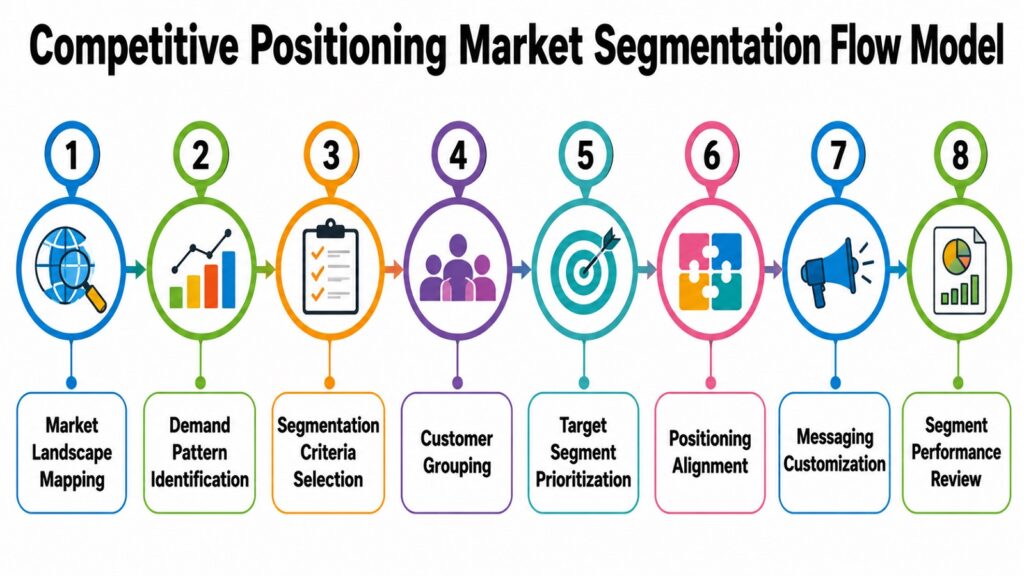
There is a persistent temptation in business to appeal to everyone. The logic seems sound — a larger audience means more potential customers. But competitive positioning does not work that way. When a business tries to serve every customer, it tends to serve none of them particularly well. Segmentation is the discipline of resisting that temptation and choosing, with intention, which customers to pursue and which to let go.
Market segmentation is the process of dividing a broad market into subgroups based on shared characteristics — demographics, behavior, needs, geography, or psychographics. Target positioning strategy is what happens next: deciding which segment to serve, why it represents the best competitive opportunity, and how to align the offering to that segment’s specific expectations. These two acts form a critical pillar of competitive positioning.
When a company identifies the right segment, its positioning sharpens by default. Salesforce built its early business by targeting mid-sized companies that found enterprise CRM software too expensive and too complex. That segmentation choice allowed Salesforce to craft a specific value proposition — cloud-based, affordable, easy to deploy — that resonated powerfully within that segment. It was not trying to compete with Oracle everywhere. It was competing in a specific slot where its positioning was most defensible.
Segmentation failures follow a predictable pattern. A business defines its target too broadly, leaving positioning vague. Or it selects a segment based on size rather than fit, entering a market where its differentiation does not actually matter to the customers it is trying to win. Both paths lead to poor competitive positioning outcomes — high acquisition costs, low loyalty, and a brand that feels invisible in the market.
Table 3: Market Segmentation Approaches and Their Competitive Positioning Effects
| Segmentation Approach | Competitive Positioning Effect |
|---|---|
| Demographic segmentation | Enables age, income, or gender-specific positioning but risks oversimplifying customer needs |
| Behavioral segmentation | Aligns positioning with usage patterns and purchase behavior for stronger relevance |
| Needs-based segmentation | Creates the sharpest value alignment and most defensible competitive positioning |
| Geographic segmentation | Allows localized positioning advantage where distribution or culture matters most |
| Psychographic segmentation | Builds emotional and identity-based positioning that competitors struggle to replicate |
| Firmographic segmentation (B2B) | Targets industry, size, or revenue tiers to sharpen B2B competitive positioning |
| Occasion-based segmentation | Positions around specific use contexts, reducing direct competitive overlap |
| Broad-market targeting | Increases reach but weakens positioning clarity and differentiation depth |
3. Competitive Positioning Through Brand Perception & Mental Positioning in Consumer Minds
Markets extend beyond mere commercial systems; they encompass psychological dimensions as well. A consumer does not select a brand based solely on its features or pricing. Instead, their choice is influenced by the significance of that brand to them — the memories it evokes, the emotions it stirs, and the messages it conveys to those in their vicinity. Consequently, brand perception should not be regarded as a trivial aspect of competitive positioning; it frequently serves as the principal arena of competition.
Mental positioning refers to the space a brand occupies inside the consumer’s mind. Al Ries and Jack Trout formalized the concept in their work on positioning, arguing that the real competition in any market is a competition for mental real estate. A brand that owns a clear, positive mental position has a structural advantage that is difficult to dislodge, even when competitors match it on features or price.
Volvo has owned the mental position of “safety” in the automotive category for decades. That association was not accidental. It was the result of deliberate, consistent messaging, engineering investment, and public safety records that reinforced a single idea over time. When consumers think of car safety, they think of Volvo first. That kind of mental positioning creates a moat because it requires competitors to challenge not just features but deeply held perceptions.
Perception gaps are where competitive positioning either opens up or closes down. A gap exists when how customers see a brand is different from how the brand intends to be seen. A company that considers itself premium but is perceived as mid-market has a positioning problem that no product update alone can fix. Closing perception gaps requires aligned messaging, consistent customer experience, and patience — because minds change slowly.
Table 4: Brand Perception Elements and Their Competitive Positioning Impact
| Brand Perception Element | Competitive Positioning Impact |
|---|---|
| Brand recall strength | High recall reduces the customer’s need to evaluate alternatives, compressing the purchase decision |
| Trust associations | Trust-based positioning reduces price sensitivity and increases repeat purchase rates |
| Category ownership | Owning a category concept (e.g., Kleenex for tissues) creates near-permanent competitive advantage |
| Emotional resonance | Emotionally connected brands command premium pricing and higher loyalty over time |
| Perception gap size | A large gap between intended and actual perception signals a broken positioning strategy |
| Brand consistency across touchpoints | Consistency builds memory structure that compounds into durable competitive positioning |
| Social signal value | Brands that signal identity or status to others benefit from organic advocacy and premium pricing |
| Negative association risk | A single reputational event can fracture mental positioning built over years |
4. Competitive Positioning Through Competitive Differentiation Strategy
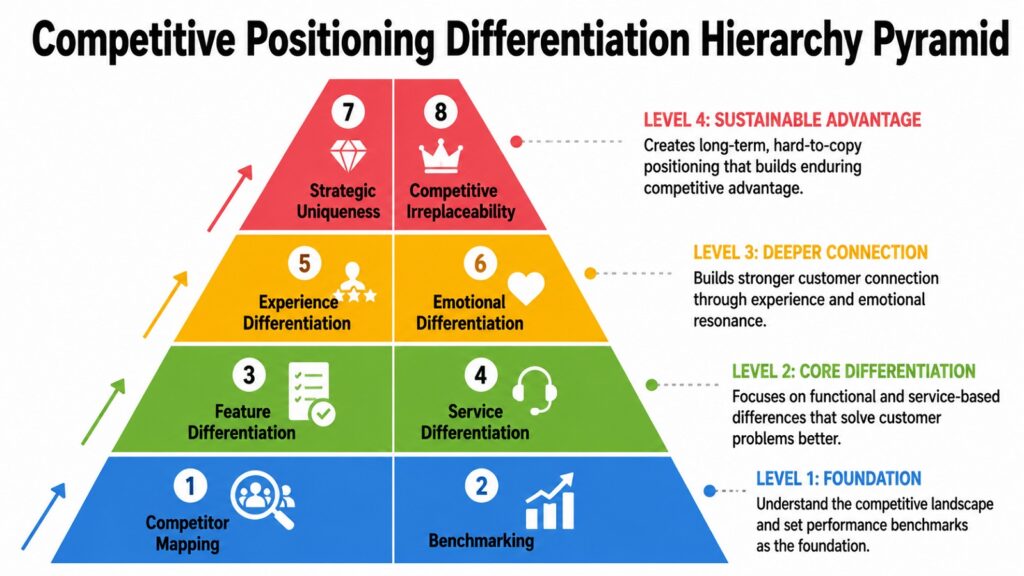
Differentiation is the act of making a business meaningfully different from competitors in ways that matter to customers. Without it, a business competes primarily on price — and price competition is a race that tends to destroy margins for everyone involved. Competitive positioning built on genuine differentiation gives a business the ability to charge more, attract more loyal customers, and create barriers that slow down the competition.
Michael Porter identified differentiation as one of three generic competitive strategies. The core argument is that a business pursuing differentiation invests in products, services, or experiences perceived as unique by the market. That uniqueness must be relevant — differentiation for its own sake creates little value if customers do not want or are not willing to pay for it.
In saturated markets, differentiation is a survival strategy. Netflix differentiated from Blockbuster not just through streaming technology but by eliminating late fees, improving convenience, and eventually producing original content unavailable anywhere else. Each layer of differentiation strengthened its competitive positioning. Businesses that allow differentiation to decay find themselves competing on terms that are not favorable to them.
Strong differentiation strategies share a pattern: they are built on something genuinely hard to replicate. This might be proprietary technology, deeply embedded customer relationships, a unique business model, or an irreplaceable brand-identity. The more defensible the differentiation, the more durable the competitive positioning it creates. Commoditization is always the outcome waiting for businesses that stop investing in what makes them different.
Table 5: Differentiation Strategies and Their Competitive Positioning Outcomes
| Differentiation Strategy | Competitive Positioning Outcome |
|---|---|
| Product feature innovation | Creates short-term advantage that requires continuous investment to sustain |
| Customer experience differentiation | Builds loyalty that is emotionally driven and harder to displace than feature-based loyalty |
| Proprietary technology | Creates a durable moat when IP is protected and difficult to replicate at scale |
| Business model innovation | Disrupts category economics and repositions incumbents as structurally inefficient |
| Brand identity differentiation | Generates premium pricing power and reduces competitive pressure in price-sensitive categories |
| Service quality differentiation | Deepens switching costs through relationship investment and personalized delivery |
| Supply chain or input differentiation | Creates cost or quality advantages that are invisible to customers but decisive in unit economics |
| Network effect differentiation | Builds value through scale, making the product more useful as more users join |
5. Competitive Positioning Through Pricing Positioning Strategy
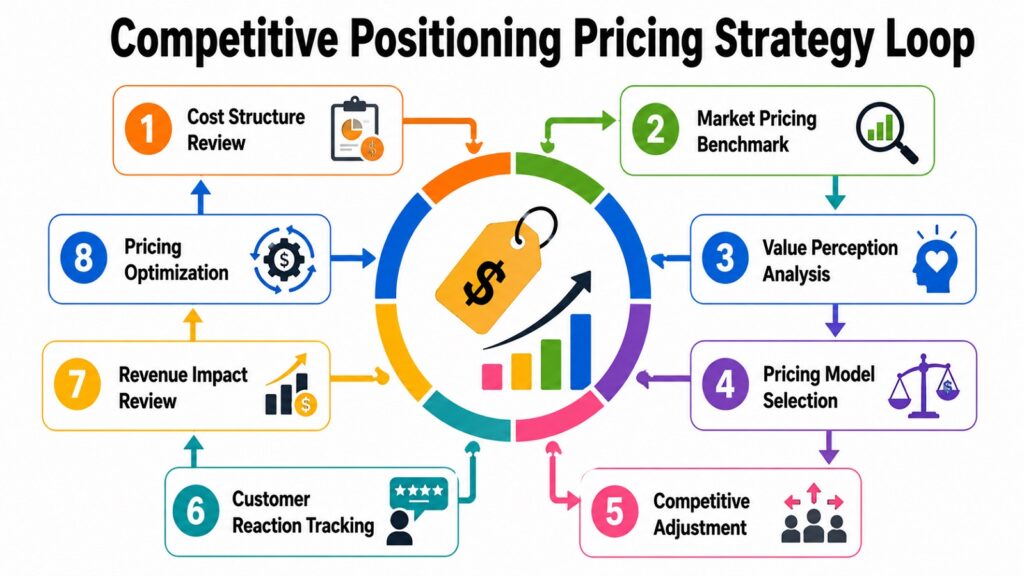
Price is not just a number. It is a message. The price a business sets communicates what it believes about the quality of its product, the type of customer it is trying to attract, and where it sits in the competitive hierarchy. A business that prices too low in a premium market signals it does not belong there. A business that prices too high in a value market signals it does not understand its customers.
The strategic logic of pricing positioning starts with a recognition that price shapes perception before a customer has any experience with the product itself. Research in consumer psychology consistently shows that higher prices tend to increase perceived quality, particularly in categories where customers cannot easily evaluate quality before purchase. This is why luxury goods brands deliberately avoid discounting — a sale on a Hermes bag does not create excitement; it creates confusion and damages the brand’s competitive positioning in the premium segment.
Several pricing strategies anchor competitive positioning. Premium pricing signals quality and exclusivity, as Apple and Rolex do consistently. Penetration pricing sacrifices short-term margin to capture market share rapidly, as Amazon did with early e-commerce and as Spotify did when entering a market dominated by paid music purchases. Value pricing aligns the price with what a defined customer segment perceives as a fair exchange.
Competitive positioning weakens when pricing sends contradictory signals. A brand that claims to be premium but runs constant discounts creates cognitive dissonance. Customers stop believing in the stated price and begin waiting for the sale, which erodes both margins and positioning simultaneously. This pattern is common in retail, where promotional pricing has gradually dismantled the competitive positioning of brands that once held genuine premium status.
Table 6: Pricing Strategies and Their Competitive Positioning Impact
| Pricing Strategy | Competitive Positioning Impact |
|---|---|
| Premium pricing | Reinforces quality perception and restricts competition to brands with similar positioning strength |
| Penetration pricing | Accelerates market share but risks commoditization if not paired with differentiation |
| Value-based pricing | Aligns revenue extraction with customer-perceived worth, strengthening positioning trust |
| Freemium pricing | Lowers adoption barriers while using paid tiers to signal value and capture upsell revenue |
| Psychological pricing | Uses price cues (e.g., $99 vs $100) to influence perceived fairness and purchase intent |
| Competitive reference pricing | Anchors positioning relative to market leaders or challengers, defining the brand’s tier |
| Bundle pricing | Increases perceived value and switching cost while obscuring individual product price sensitivity |
| Discount-heavy pricing | Erodes premium positioning over time and trains customers to wait for promotions |
6. Competitive Positioning Through Product Positioning in the Market
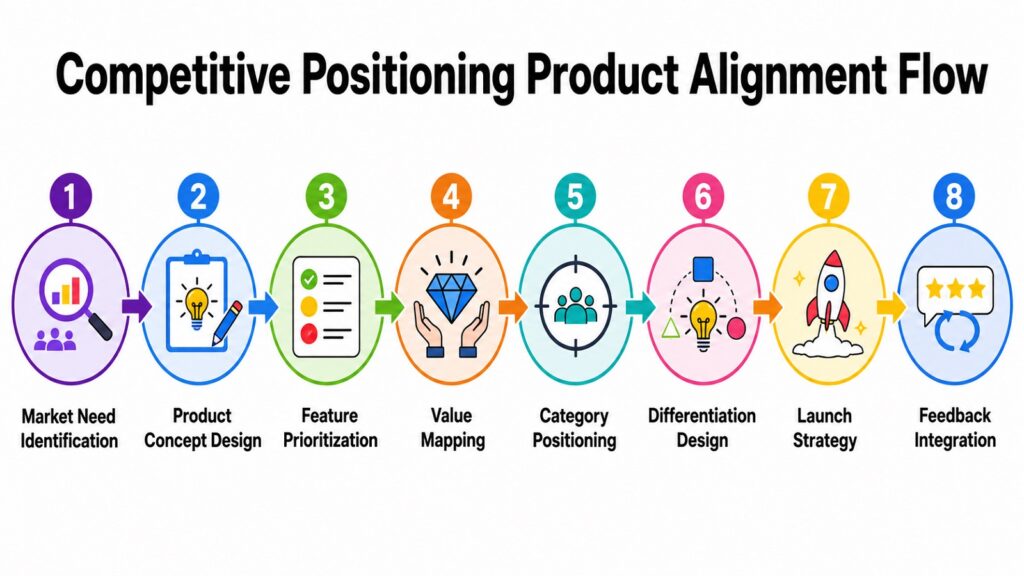
Products do not exist in isolation. They exist inside categories, and those categories shape how customers evaluate, compare, and choose between options. Product positioning is the strategic act of deciding how a product should be perceived within its category — what it stands for, what problem it solves, who it is designed for, and how it compares to alternatives. Done well, product positioning makes competitive positioning tangible and concrete.
Category definition is one of the most powerful moves in product positioning. Cirque du Soleil did not enter the circus market and try to outperform Ringling Bros. It redefined the category entirely — eliminating animals, adding theatrical storytelling, and targeting adult audiences willing to pay premium prices. The result was a product positioned in a competitive space it effectively owned. The company was not competing. It was occupying entirely different terrain.
Feature-benefit alignment is another critical element of product positioning. Customers do not buy features. They buy outcomes. A project management software company that leads with “unlimited integrations” is selling a feature. One that leads with “your team will stop missing deadlines” is selling an outcome. The second framing creates sharper positioning because it speaks directly to what the customer is trying to solve.
Product positioning failures often arise from category confusion. When a product tries to live in two categories at once — attempting to be both a budget option and a premium alternative — it ends up owning neither. The market finds ambiguous products harder to recommend, harder to justify, and harder to trust. Clear product positioning requires trade-offs, and the willingness to make those trade-offs signals strategic maturity.
Table 7: Product Positioning Strategies and Their Competitive Positioning Implications
| Product Positioning Strategy | Competitive Positioning Implication |
|---|---|
| Category creation | Positions the product as the reference point in a new space, making competitors the followers |
| Outcome-led positioning | Aligns product perception with customer goals, reducing the need for feature comparison |
| Feature superiority positioning | Works in early market phases but requires continuous innovation to avoid commoditization |
| Use-case specificity | Narrows the competitive field by owning a defined scenario more completely than alternatives |
| Design and aesthetic positioning | Creates emotional and identity-based differentiation that commands premium pricing |
| Simplicity positioning | Reduces adoption friction and positions the product as the accessible option in a complex category |
| Category challenger positioning | Defines the product relative to a market leader, borrowing credibility while asserting differentiation |
| Platform positioning | Positions the product as infrastructure for others, creating ecosystem dependency and scale barriers |
7. Competitive Positioning Through Distribution & Channel Positioning Advantage
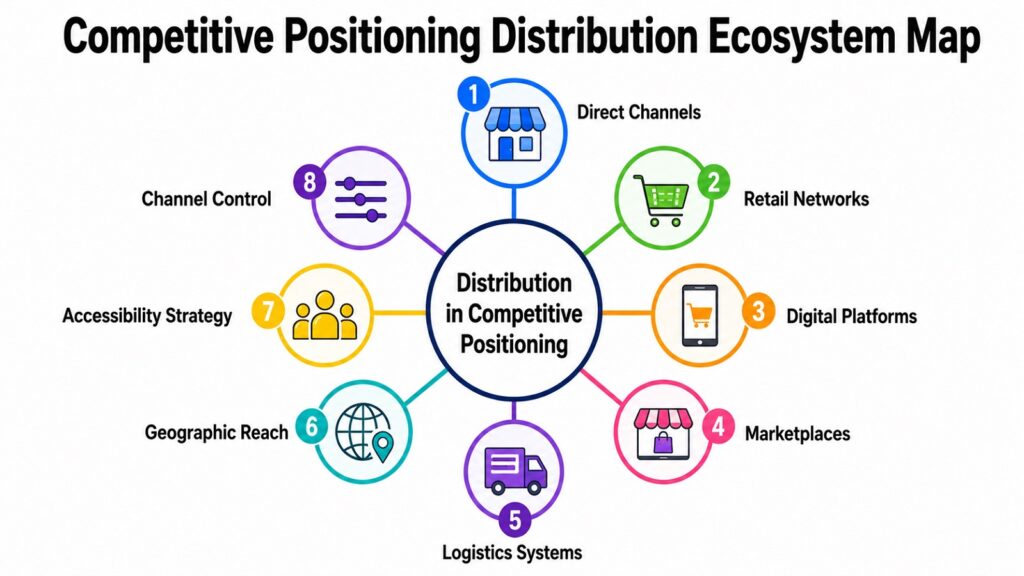
Competitive positioning is not only about what a business offers — it is also about how and where that offering reaches the customer. Distribution strategy is often treated as an operational concern, something to be sorted after strategic decisions are made. But channel access and control are themselves sources of competitive advantage, and businesses that understand this tend to build more resilient positions than those that treat distribution as an afterthought.
Channel positioning refers to the strategic decisions a business makes about how its products reach end customers. These include which channels to use — direct, retail, digital, wholesale, or partner-led — and how much control the business maintains over the customer experience within each channel. The more a business controls its channels, the more it controls its competitive positioning at the point of purchase.
Apple’s decision to build its own retail stores in 2001 was widely criticized at the time. Analysts questioned why a technology company would enter the notoriously low-margin retail business. But Apple understood that controlling the channel meant controlling the experience — and the experience was central to its competitive positioning. Apple Stores became environments designed specifically to make customers feel the brand before they bought the product. That channel investment paid off in ways that extended far beyond retail revenue.
Distribution weaknesses create predictable positioning vulnerabilities. A company that relies entirely on third-party retailers loses control of how its product is presented, priced, and supported at the point of sale. A business with no direct digital channel loses the ability to own the customer relationship entirely. These gaps may feel tolerable in strong markets, but they surface sharply when competitive pressure increases.
Table 8: Distribution Strategies and Their Competitive Positioning Outcomes
| Distribution Strategy | Competitive Positioning Outcome |
|---|---|
| Direct-to-consumer (DTC) | Maximizes margin and data ownership while enabling full control over brand experience |
| Exclusive retail partnerships | Creates access barriers for competitors in premium or specialist channels |
| Omnichannel distribution | Expands reach and reduces friction but requires consistent positioning management across touchpoints |
| Proprietary distribution infrastructure | Creates a durable moat through speed, cost, or reliability advantages competitors cannot easily match |
| Platform distribution (e.g., Amazon, App Store) | Increases reach rapidly but cedes pricing and customer relationship control to the platform owner |
| Selective distribution | Reinforces premium or specialist positioning by restricting availability to curated channels |
| Franchise distribution | Enables rapid geographic scaling while maintaining brand standards through contractual channel control |
| Fragmented or uncontrolled distribution | Weakens positioning consistency and allows channel partners to undermine brand strategy |
8. Competitive Positioning Through Strategic Positioning in Competitive Ecosystems
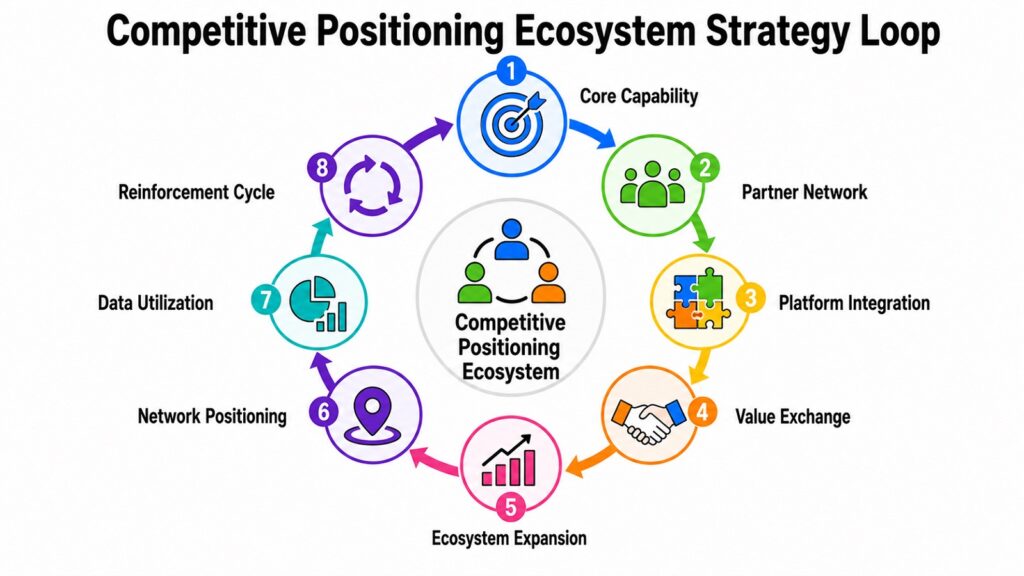
Markets have always been interconnected, but the degree to which businesses now operate inside ecosystems rather than as standalone competitors has grown sharply. An ecosystem in this context is a network of companies, platforms, partners, and customers whose activities are interdependent. Competitive positioning inside an ecosystem requires a different logic than traditional head-to-head competition — it is less about beating rivals directly and more about controlling leverage points within a larger network.
Platform businesses are the clearest example of ecosystem-level competitive positioning. Amazon, Alphabet, Meta, and Apple have each built competitive positions not just by offering better products but by creating platforms that other businesses depend on to reach customers. Once a platform achieves sufficient scale and network effects, its competitive position becomes structurally reinforced — every new user or partner that joins makes the platform more valuable to everyone already in it.
The strategic insight behind ecosystem positioning is that the rules of competitive advantage shift at scale. In a traditional linear business, positioning is built on operational efficiency or product differentiation. In an ecosystem, it is built on orchestration — the ability to attract participants, set standards, and capture value from the flows of activity moving through the network. Salesforce’s AppExchange illustrates this: by encouraging third-party developers to build on its platform, Salesforce deepened its competitive positioning not by developing everything itself but by making switching away from its platform progressively more expensive.
Weak ecosystem integration limits competitive positioning in ways that compound over time. A business that remains isolated from the larger networks in its industry loses access to data, distribution, and partnership opportunities that ecosystem participants enjoy. Microsoft’s strategic shift under Satya Nadella — from a closed, defensive posture to an open, ecosystem-building approach — helped revive the company’s competitive positioning in cloud computing and enterprise software. In fast-moving markets, isolation tends to accelerate competitive disadvantage.
Table 9: Ecosystem Positioning Strategies and Their Competitive Positioning Outcomes
| Ecosystem Positioning Strategy | Competitive Positioning Outcome |
|---|---|
| Platform creation | Establishes a network hub that generates compounding value and switching costs at scale |
| Strategic partnership formation | Extends competitive reach and capability access beyond what internal investment can deliver |
| API and integration openness | Increases ecosystem stickiness by making the business’s infrastructure essential to others’ workflows |
| Data network effects | Accumulates proprietary insights that improve products and deepen competitive positioning over time |
| Complementary product bundling | Strengthens ecosystem lock-in by making the full suite more valuable than any individual product |
| Developer or partner ecosystem building | Outsources innovation to third parties while retaining platform control and margin capture |
| Vertical integration within ecosystem | Increases control over quality, cost, and competitive positioning across the value chain |
| Ecosystem isolation | Limits exposure to external threats short-term but weakens long-term competitive scalability |
Conclusion: Competitive Positioning and Long-Term Business Advantage
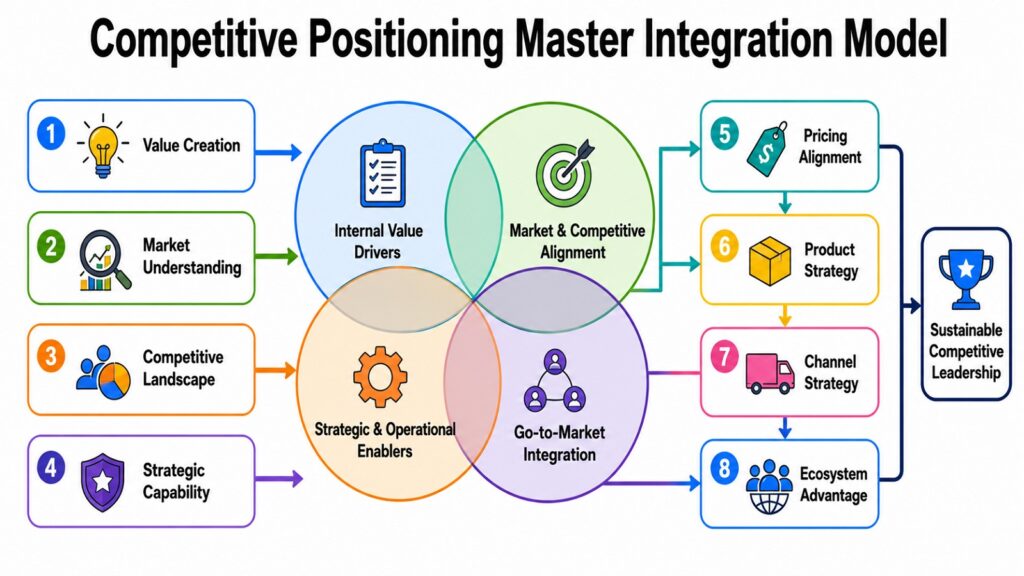
There is a pattern that runs through every business that has built lasting market advantage. They did not win by being better at everything. They won by being clearer about something — clearer about the customer they served, the value they delivered, the price they charged, and the experience they controlled. Competitive positioning is the discipline of making those choices consciously rather than by default.
The eight dimensions discussed in this article are not standalone levers. They are interrelated. A compelling value proposition loses its effectiveness when brand perception is inconsistent. A robust differentiation strategy is compromised when pricing conveys the wrong message. A clearly defined target segment is inadequately served when distribution does not effectively reach it. Competitive positioning functions as a cohesive system, and businesses that manage it in this manner typically outperform those that consider individual dimensions separately.
What makes competitive positioning genuinely difficult is not the analysis — it is the discipline of maintaining coherence across all dimensions as markets shift. Customer expectations evolve. New entrants introduce different models. Technology opens channels that did not exist before. Frameworks that worked in 2015 need significant adjustment by 2025. Competitive positioning must be treated as a continuous strategic practice rather than a one-time declaration made at a planning offsite and then left untouched.
The companies that navigate this best tend to share a few habits. They reassess their positioning deliberately rather than waiting for a crisis to force the question. They treat positioning decisions as cross-functional responsibilities rather than marketing-only concerns. And they build the capacity to recognize early signals — a weakening value proposition, a drifting perception, a channel losing relevance — before those signals become strategic problems.
This framework is designed to be returned to. The dimensions covered here are relevant whether a business is launching a new product, entering a new market, facing a disruptive competitor, or simply trying to understand why growth has flattened. Used as a diagnostic lens, it identifies where positioning is strong and where it is exposed. Competitive positioning is never fully finished. But the businesses that work at it consistently tend to hold better ground, for longer, than those that do not.
Table 10: The Competitive Positioning Framework — A Final Strategic Reference
| Competitive Positioning Dimension | Key Strategic Principle |
|---|---|
| Value Proposition Positioning | Specificity in customer, problem, and proof creates differentiated and defensible positioning |
| Market Segmentation & Targeting | Winning in a chosen segment outperforms trying to win broadly across an undefined market |
| Brand Perception & Mental Positioning | The brand that owns a clear mental space in the customer’s mind holds a structural advantage |
| Competitive Differentiation | Differentiation built on defensible uniqueness creates the most durable competitive positions |
| Pricing Positioning | Price is a strategic signal; inconsistency between price and positioning erodes market trust |
| Product Positioning | Owning a clear category perception reduces evaluation friction and increases recommendation rates |
| Distribution & Channel Positioning | Channel control is a competitive lever; distribution gaps become vulnerabilities under pressure |
| Ecosystem Strategic Positioning | Platform participation and orchestration create compounding advantages unavailable to isolated businesses |