
Table of Contents
Introduction: Understanding Marketing as a Core Driver of Business Growth
Marketing is one of the most important business functions in any organization. It connects what a company offers with what customers actually need. Without that connection, even the best products go unnoticed. It shapes how businesses understand their customers, create value, communicate their offerings, and sustain growth over time.
For a long period, numerous businesses regarded marketing merely as an extension of sales. The primary objective was to promote products and secure orders. However, this perspective has undergone a substantial transformation. In contemporary times, marketing is acknowledged as a strategic function integral to business planning. It encompasses research, customer insights, data analysis, technology, and a focus on long-term objectives.
The evolution has been gradual but significant. Early businesses focused on production efficiency. Then came a selling orientation where companies tried to convince people to buy what they made. The modern approach reversed that logic. It starts with understanding what customers want and then building offerings around those needs. This shift gave organizations a much stronger foundation for long-term competitive success.
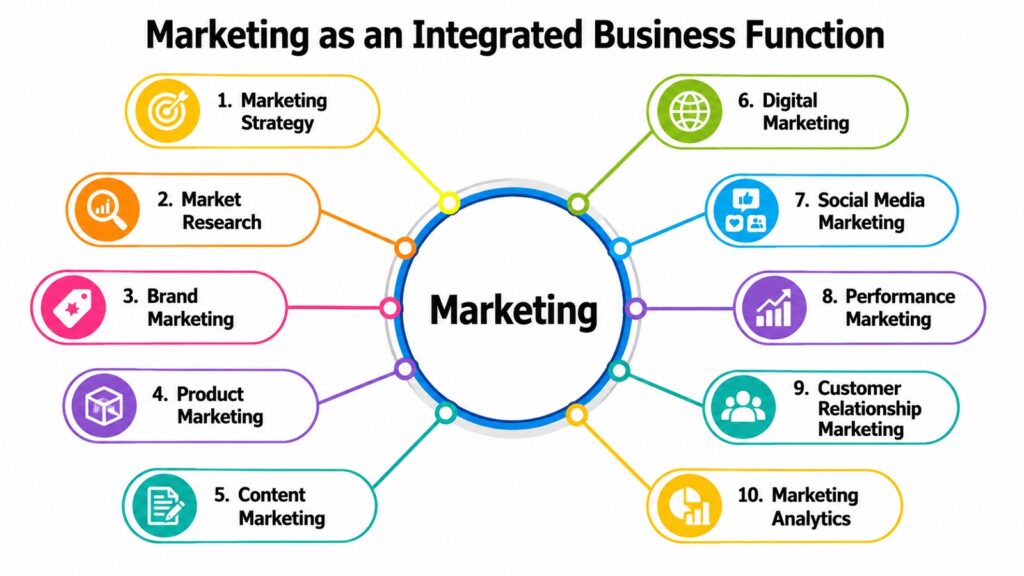
Ten disciplines make up this connected system. Strategy sets the direction. Research provides intelligence. Branding builds recognition and trust. Product work communicates value. Content educates audiences. Digital channels extend reach. Social platforms build communities. Performance campaigns drive measurable results. Customer relationship programs deepen loyalty. Analytics closes the loop by measuring what works.
This article explores all ten disciplines in depth. The goal is to show how they relate to each other and why organizations that integrate them tend to outperform those that rely on just one or two. These are not isolated tactics. They form a unified system with each part reinforcing the others.
Table 1: Marketing Disciplines and Their Primary Purposes
| Marketing Discipline | Primary Purpose |
| Marketing Strategy | Sets the direction, target markets, and competitive approach for all activities |
| Market Research | Gathers customer and competitor intelligence to improve decisions and reduce risk |
| Brand Marketing | Builds awareness, trust, and preference by communicating a consistent brand identity |
| Product Marketing | Connects product features with customer needs to support adoption and positioning |
| Content Marketing | Educates and engages audiences with valuable information to build authority and trust |
| Digital Marketing | Reaches and converts customers across websites, search engines, email, and mobile |
| Social Media Marketing | Builds communities, drives engagement, and strengthens brand visibility on social platforms |
| Performance Marketing | Optimizes campaigns based on measurable outcomes like leads, conversions, and ROI |
| Customer Relationship Marketing | Strengthens long-term customer loyalty, retention, and lifetime value |
| Marketing Analytics | Measures effectiveness and translates data into actionable improvements across disciplines |
1. Marketing Strategy: Building the Foundation of Effective Marketing
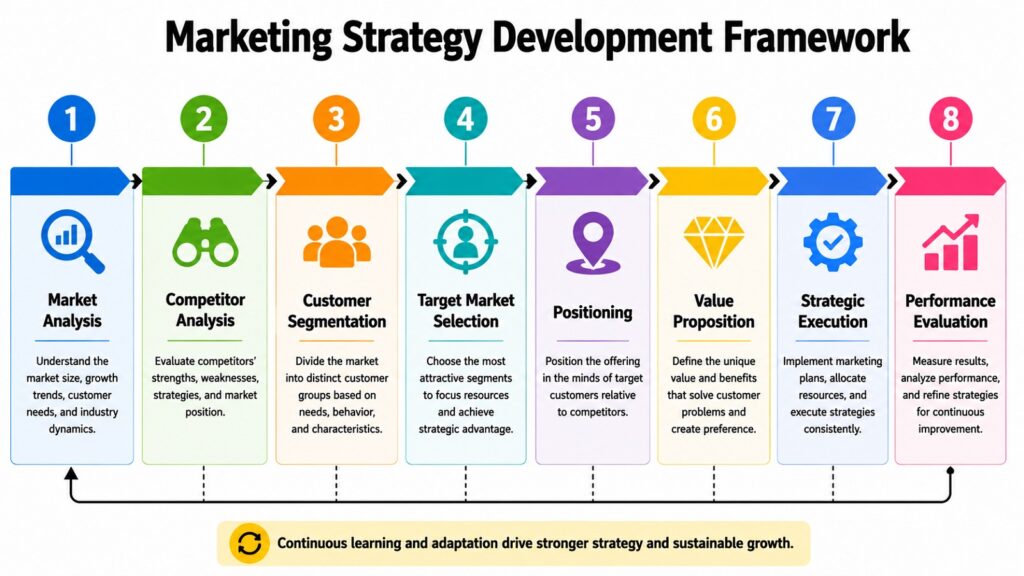
The Marketing Strategy serves as the foundation for all subsequent activities. It addresses three essential questions: where does the business compete, who are its customers, and how does it generate value that is not easily replicated by others. In the absence of a well-defined marketing strategy, efforts tend to diverge in multiple directions, resulting in inconsistent outcomes.
At the core is customer segmentation. Businesses divide their market into distinct groups based on demographics, behavior, needs, or geography. They then select which segments to target and determine how they want to be perceived within those segments. This perception is called positioning, and it shapes how the business speaks to customers across every channel.
Value propositions are closely tied to positioning. A strong value proposition tells customers exactly why they should choose your offering over alternatives. It connects product benefits to real needs in clear and believable language. Organizations that define this well communicate more consistently and convert more effectively.
Apple is a well-studied example of a company that built its direction around design, simplicity, and premium positioning. That strategic choice shaped every other aspect of its activities for decades, from product packaging to retail environments to advertising tone. When strategy is misaligned with business goals, resources get wasted and results fall short.
Frameworks like SWOT analysis, Porter’s Five Forces, and the Ansoff Matrix are commonly used in strategic planning. They provide structured ways to evaluate markets, assess competition, and identify growth paths. These tools are most useful when applied to real business situations with genuine data. Marketing Strategy gives every other discipline in this article its direction and purpose.
Table 2: Marketing Strategy Concepts and Their Practical Applications
| Strategy Concept / Framework | Practical Application |
| Customer Segmentation | Divides markets into addressable groups to focus resources on the most valuable customer types |
| Target Market Selection | Identifies which segments offer the best opportunity based on size, fit, and competitive conditions |
| Positioning | Defines how a brand should be perceived relative to competitors in the minds of customers |
| Value Proposition | Articulates the specific benefits customers receive and why they matter compared to alternatives |
| SWOT Analysis | Evaluates internal strengths and weaknesses alongside external opportunities and threats |
| Competitive Advantage | Identifies the capabilities that allow a business to outperform competitors consistently |
| Ansoff Matrix | Maps growth options across existing and new products in existing and new markets |
| Strategic Alignment | Ensures goals directly support the broader objectives of the business |
Another important aspect of marketing strategy is understanding how different business models shape marketing decisions. Common models include B2B (Business-to-Business), B2C (Business-to-Consumer), D2C (Direct-to-Consumer), B2G (Business-to-Government), C2C (Consumer-to-Consumer), and B2B2C (Business-to-Business-to-Consumer). Although these are business models, each requires a distinct marketing model and strategy based on its target audience, value proposition, marketing channels, and customer engagement strategy. Adapting marketing to the appropriate business model enables organizations to meet customer needs better and achieve sustainable growth.
Table 2A: Business Models and Their Marketing Decisions
| Business Models | Marketing Aspects |
|---|---|
| B2B (Business-to-Business) Marketing Model | Businesses market and sell products or services to other businesses. |
| B2C (Business-to-Consumer) Marketing Model | Businesses market and sell directly to individual consumers. |
| D2C (Direct-to-Consumer) Marketing Model | Brands sell directly to consumers without using wholesalers or retailers. |
| B2G (Business-to-Government) Marketing Model | Businesses provide products or services to government organizations and public agencies. |
| C2C (Consumer-to-Consumer) Marketing Model | Consumers buy, sell, or exchange products and services with other consumers through marketplaces. |
| B2B2C (Business-to-Business-to-Consumer) Marketing Model | A business reaches end consumers by partnering with another business that delivers the final product or service. |
2. Market Research: Understanding Customers Through Marketing Intelligence
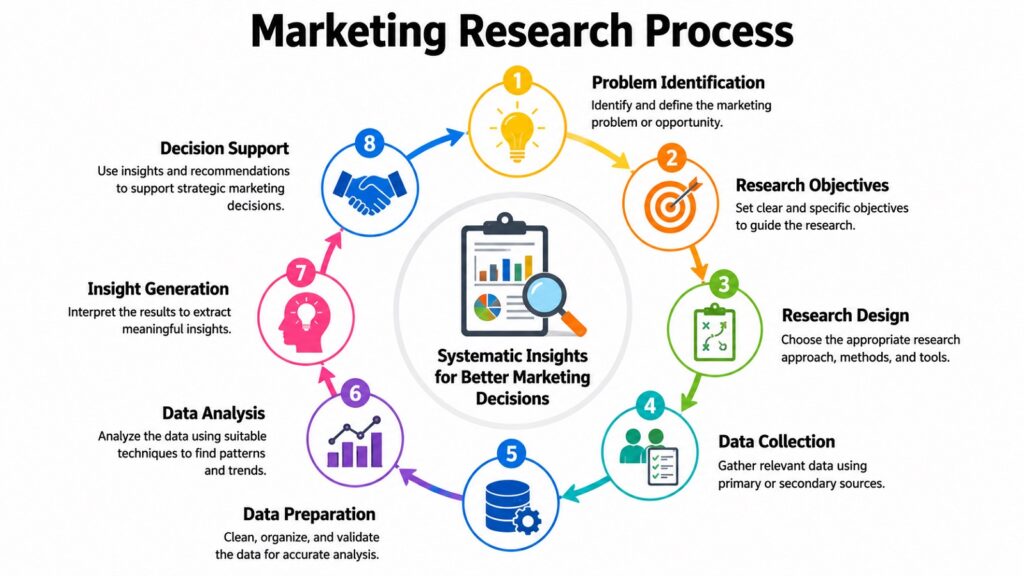
Good decisions are grounded in evidence. Market Research provides that evidence by gathering information about customers, competitors, and the broader environment. It reduces uncertainty and helps organizations invest their resources where they are most likely to produce results.
Customer insight is the most valuable output. Understanding why people buy, what frustrates them, how they make decisions, and what they value most allows businesses to craft more relevant messages and build more useful products. This insight comes from surveys, interviews, focus groups, and direct observation.
Competitor analysis is another key dimension. Organizations examine how rivals position themselves, what channels they use, what messages they emphasize, and where gaps in the market remain. This intelligence helps businesses identify opportunities and avoid entering crowded spaces without a distinct advantage.
Secondary research draws on existing data from industry reports, government sources, and academic publications. Organizations like Nielsen, McKinsey, and Statista regularly publish studies on consumer behavior, market size, and industry trends. These sources offer a fast and cost-effective way to build context before conducting original research.
Before expanding into new markets, Starbucks conducts extensive local research to understand consumer preferences, purchasing habits, and competitive conditions. This helps the company adapt its offerings and store formats to local tastes while preserving its global brand identity. Evidence-based decisions do not eliminate risk, but they make risks far more manageable.
Table 3: Market Research Methods in Marketing and Their Business Applications
| Research Method | Primary Business Application |
| Customer Surveys | Measures satisfaction, preferences, and attitudes at scale across customer segments |
| In-depth Interviews | Reveals motivations, decision-making processes, and unmet needs through direct conversation |
| Focus Groups | Explores reactions to new concepts, messages, or products in a moderated group discussion |
| Competitor Analysis | Identifies rival positioning, channel strategies, pricing, and messaging to find market gaps |
| Secondary Research | Uses existing industry reports and academic data to build market context efficiently |
| Ethnographic Research | Observes customers in real environments to understand behavior in natural settings |
| Customer Journey Mapping | Documents the stages customers pass through from awareness to purchase and beyond |
| A/B Testing | Compares two versions of a message, offer, or design to determine which performs better |
3. Brand Marketing: Strengthening Marketing Through Brand Value
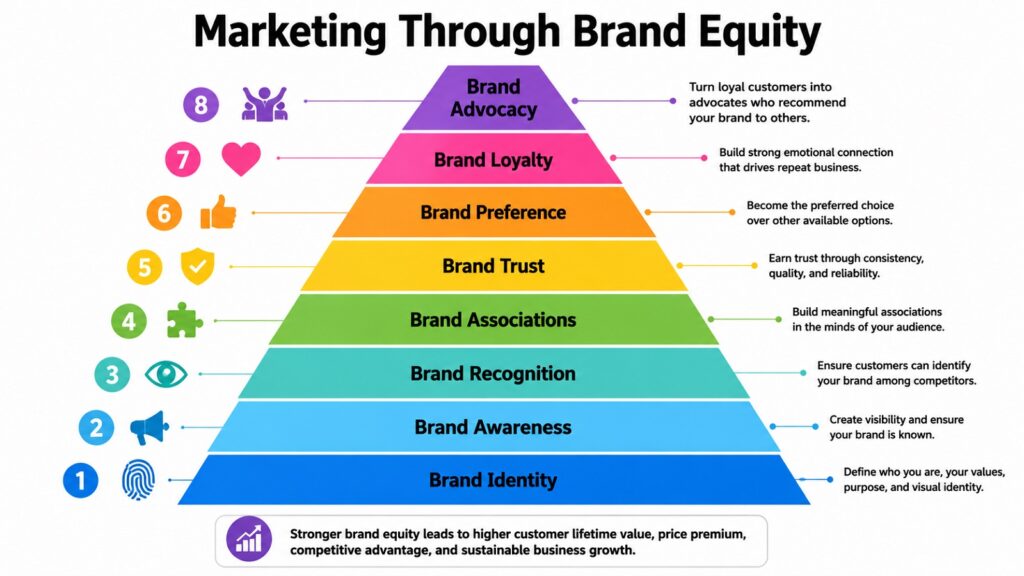
Brand Marketing refers to the identity of a business, including its name, visual design, tone of voice, and values. it is the active effort to promote that identity in ways that build awareness, trust, and preference among target audiences. The two work together, but the latter is what takes a brand into the world.
Effective brand development fosters an emotional bond between a business and its customers. Purchases are seldom made solely on logical grounds. Consumers gravitate towards brands that resonate with them, align with their values, or evoke respected associations. This emotional aspect constitutes one of the most enduring competitive advantages a business can cultivate.
Brand equity is the commercial value that comes from strong recognition and positive associations. High brand equity allows organizations to charge premium prices, enter new markets more easily, and recover faster from setbacks. It is built over time through consistency, quality, and meaningful customer experiences.
Nike built its brand around athletic achievement, determination, and personal excellence. Its campaigns rarely focus on product specifications. Instead, they tell stories about human effort and ambition. This approach has created extraordinary loyalty and made it one of the most valuable brands in the world.
Consistency across customer touchpoints is essential. Every interaction a customer has with a business, whether through an advertisement, a product package, a service call, or a social post, should feel like it comes from the same source. When that consistency breaks down, trust erodes and brand equity declines.
Table 4: Brand Marketing Elements and Their Business Significance
| Brand Marketing Element | Business Significance |
| Brand Identity | Establishes the visual and verbal characteristics that make a brand recognizable across all channels |
| Brand Positioning | Defines the place a brand occupies in the customer’s mind relative to competitors |
| Brand Equity | Represents the commercial value derived from strong recognition and positive customer associations |
| Emotional Connection | Builds loyalty and preference by aligning the brand with customer values and aspirations |
| Brand Storytelling | Communicates brand purpose through narratives that engage audiences more deeply than product claims |
| Consistency | Ensures all customer touchpoints reinforce the same brand promise and identity over time |
| Brand Extensions | Leverages existing equity to enter new product categories or markets with lower risk |
| Customer Perception | Reflects how target audiences experience and interpret the brand through accumulated interactions |
4. Product Marketing: Connecting Products and Marketing Success
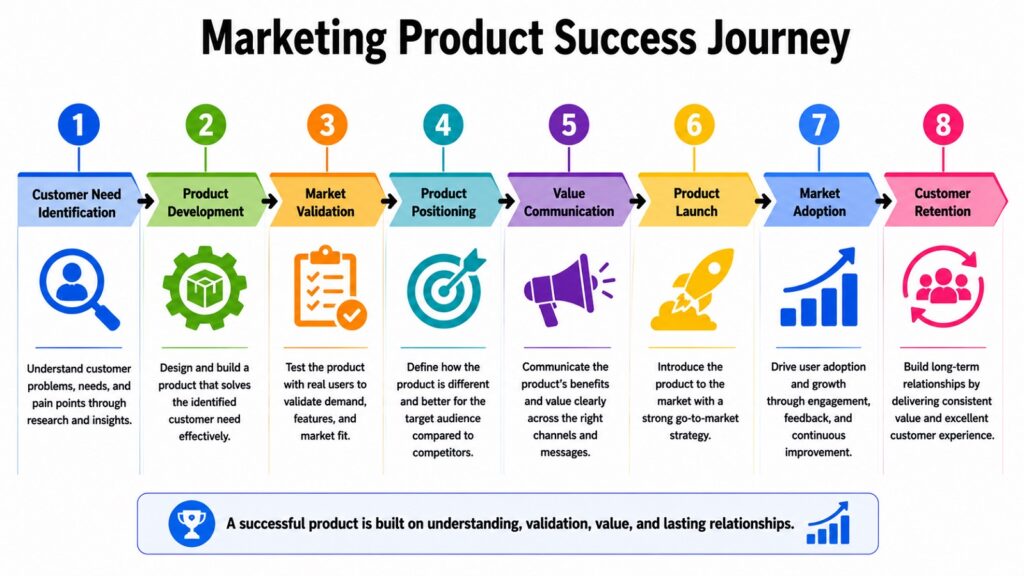
Product Marketing bridges the gap between what a company builds and what the market actually needs. It is responsible for understanding customers deeply, translating product features into customer benefits, and making sure the product reaches its intended audience with the right message at the right time.
Positioning is central here. It defines how a product should be understood in the context of competing alternatives. A product can have many features, but its positioning should focus on the ones that matter most to target customers and that competitors cannot easily match.
Go-to-market execution is another key responsibility. Product Marketers plan how a product will be launched, which channels it will use, what pricing supports the positioning, and how the sales team will communicate its value. A well-executed launch can mean the difference between rapid adoption and a slow, expensive struggle for visibility.
Microsoft’s launch of Teams in 2017 offers a relevant example. Facing strong competition from Slack, Microsoft positioned Teams as a deeply integrated workplace platform rather than just a chat tool. By connecting it with Office 365, Microsoft created a compelling value proposition for organizations already invested in its ecosystem. Within two years, Teams surpassed Slack in daily active users.
Product Marketers must also continuously monitor the competitive landscape and refine how products are communicated to maintain relevance. Markets change, competitors improve, and customer expectations evolve. Ongoing differentiation is as important as the initial launch strategy.
Table 5: Product Marketing Activities and Their Primary Objectives
| Product Marketing Activity | Primary Objective |
| Product Positioning | Defines how the product should be perceived relative to competitors in the target market |
| Customer Value Proposition | Communicates the specific benefits the product delivers and why they matter to buyers |
| Go-to-Market Planning | Coordinates the launch strategy, channel selection, pricing, and messaging for product introduction |
| Competitive Differentiation | Identifies and communicates the features or benefits that separate the product from rivals |
| Sales Enablement | Equips sales teams with the tools, content, and messaging needed to communicate product value |
| Product Launch Execution | Manages the coordinated activities required to introduce a product successfully to the market |
| Audience Research | Deepens understanding of target customer needs, preferences, and buying behaviors |
| Feedback Loop Management | Collects post-launch market feedback to refine positioning and messaging over time |
5. Content Marketing: Educating Audiences Through Valuable Marketing Content
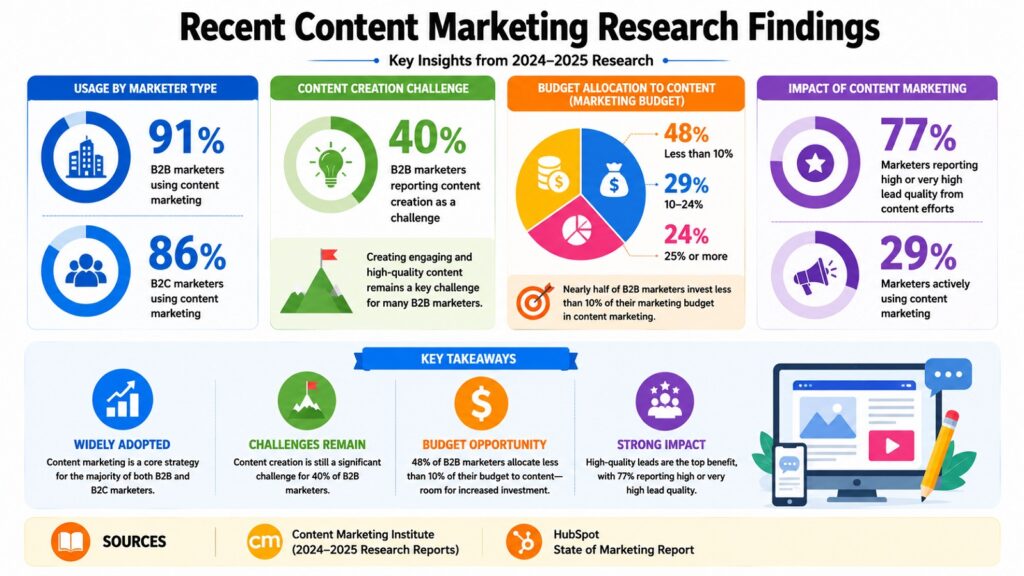
Content Marketing is the practice of creating and distributing information that helps target audiences solve problems, learn something useful, or make better decisions. Unlike traditional advertising, it does not interrupt people. It attracts them by offering genuine value.
The formats used are broad. Articles, white papers, video tutorials, email newsletters, case studies, podcasts, and infographics all serve different audiences and stages of the customer journey. The most effective programs use a combination of formats to reach customers wherever they are and provide what they need at each stage.
Authority and trust serve as the true currencies in this context. Organizations that produce valuable content regularly establish themselves as credible sources within their respective industries. This established reputation helps to shorten the sales cycle, as potential customers approach already informed and predisposed to trust the organization responsible for the content.
HubSpot is frequently cited as a company that transformed its business through this approach. Starting around 2006, HubSpot built an enormous library of free educational content about sales and customer service. This attracted millions of visitors to its website and converted a significant share of them into paying customers. Teaching can be one of the most effective forms of promotion.
Success in Content Marketing depends on strategy and discipline. Organizations must identify the topics their audiences care about, produce content consistently, optimize for search visibility, and measure engagement. The payoff is gradual but durable. Strong content builds an audience that keeps growing long after the original investment was made.
Table 6: Content Marketing Formats and Their Primary Business Benefits
| Content Format | Primary Business Benefit |
| Blog Articles | Improves search visibility and establishes thought leadership on relevant topics |
| White Papers and Guides | Demonstrates deep expertise and supports lead generation by offering substantive value |
| Video Content | Increases engagement and conveys complex information in formats that audiences prefer and share |
| Email Newsletters | Maintains ongoing relationships with subscribers by delivering curated insights directly |
| Case Studies | Builds credibility by showing how real customers achieved results using the organization’s offerings |
| Podcasts | Reaches engaged audiences during moments when other content formats are less accessible |
| Webinars | Creates interactive educational experiences that deepen understanding and generate qualified leads |
| Infographics | Simplifies complex data into visual formats that are easy to consume and more likely to be shared |
6. Digital Marketing: Expanding Marketing Reach in the Digital Era
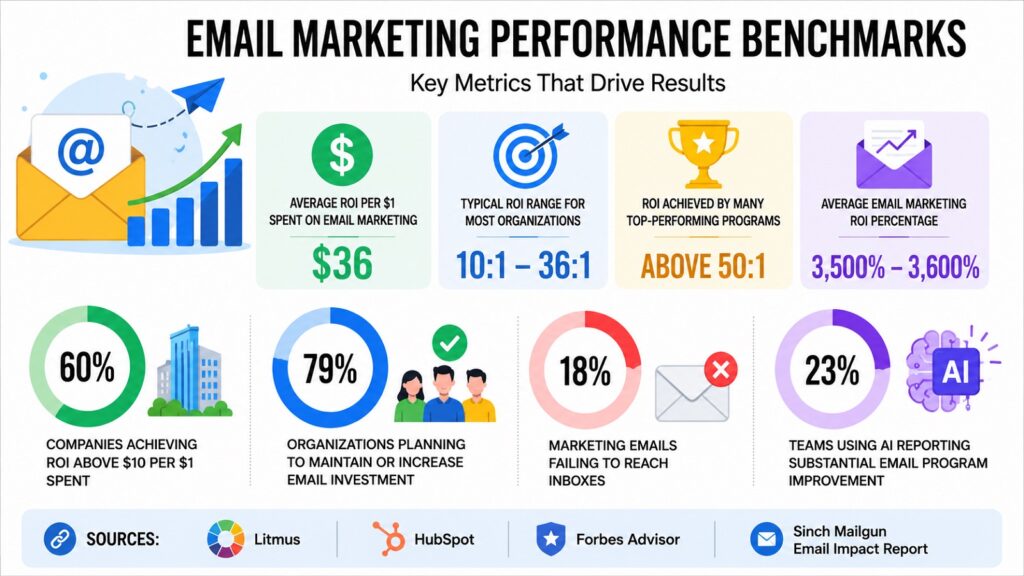
Digital Marketing encompasses the methods organizations use to reach, engage, and convert customers through online channels. These include websites, search engines, email, mobile applications, and a growing range of digital platforms. For most businesses today, these channels represent the primary way customers discover and evaluate offerings.
A business website is the foundation. It is where most customer journeys begin or conclude. Organizations invest significantly in website design, speed, usability, and content because the experience a visitor has on the site directly affects whether they take the next step.
Search engine optimization, or SEO, improves a website’s visibility in unpaid search results. When people search for solutions to problems, they typically click on results that appear near the top. Organizations that rank well for relevant search terms receive consistent, high-quality traffic without paying for each visit.
Email remains one of the highest-return digital channels. The Direct Marketing Association has estimated that email generates significant returns per dollar invested compared to most alternatives. This is partly because it reaches people who have already expressed interest, and partly because personalized content can be extremely relevant to individual recipients.
The mobile experience has become an essential element of digital outreach. A substantial portion of web traffic now originates from smartphones and tablets. Organizations that neglect to optimize for mobile risk losing significant segments of their potential audience. In addition to mobile-friendly websites, many businesses are also investing in applications, SMS campaigns, and content tailored specifically for mobile devices.
Table 7: Digital Marketing Channels and Their Primary Purposes
| Digital Marketing Channel | Primary Purpose |
| Website | Serves as the central destination for customer information, product discovery, and conversion |
| Search Engine Optimization | Improves organic search rankings to attract consistent, relevant traffic without direct media spend |
| Email Marketing | Delivers personalized messages to interested subscribers to nurture relationships and drive conversions |
| Pay-Per-Click Advertising | Reaches target audiences through paid search and display placements with measurable cost per result |
| Mobile Marketing | Engages customers through smartphone-optimized websites, apps, SMS, and push notifications |
| Affiliate Marketing | Leverages third-party publishers to promote products in exchange for a commission on resulting sales |
| Online PR and Media | Builds brand credibility through digital media coverage, reviews, and third-party endorsements |
| Marketing Automation | Uses technology to deliver timely, personalized communications at scale based on customer behavior |
7. Social Media Marketing: Enhancing Marketing Through Online Communities
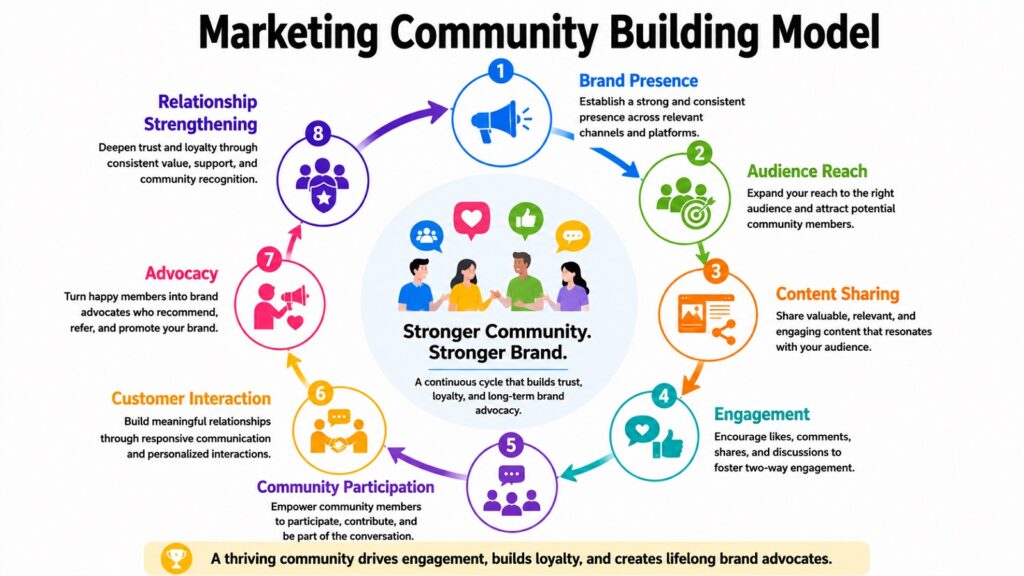
Social Media Marketing uses platforms like LinkedIn, Instagram, Facebook, X, and YouTube to build audiences, foster engagement, and strengthen brand relationships. Unlike most digital channels, social media is inherently conversational. It invites participation and creates space for communities to form around shared interests.
Visibility is one of the primary benefits. Regular posting, thoughtful engagement, and well-designed content increases the frequency with which audiences encounter a brand. This repeated exposure builds familiarity, and familiarity is one of the foundations of trust.
User-generated content is a particularly valuable dimension. When customers share their own experiences with a brand, they create credibility that paid advertising struggles to match. People tend to trust recommendations from other customers more than messages from companies. Encouraging and amplifying such content can significantly extend a brand’s reach with minimal additional cost.
Dove’s Real Beauty campaign is a widely studied example of this done well. Dove encouraged women to share their own stories and redefine conventional beauty standards. The campaign generated extensive engagement across social platforms and created a strong emotional connection between the brand and its audience. Sales and brand perception both improved substantially.
Social media also has real limitations. Algorithms change frequently, organic reach has declined on many platforms, and negative conversations can spread rapidly. Organizations that treat these channels as broadcast tools rather than spaces for genuine dialogue often find limited returns. Effective programs prioritize community building over content volume.
Table 8: Social Media Marketing Activities and Their Business Value
| Social Media Activity | Business Value |
| Content Publishing | Maintains brand visibility and provides audiences with consistent value through regular posts |
| Community Management | Builds relationships by responding to comments and fostering genuine interaction with followers |
| Influencer Partnerships | Extends brand reach by leveraging the credibility and audience of relevant industry voices |
| User-Generated Content Programs | Amplifies authentic customer experiences to build trust and reduce content creation costs |
| Social Listening | Monitors brand mentions and industry conversations to inform strategy and manage reputation |
| Paid Social Advertising | Targets specific audiences with precision using platform demographic and behavioral data |
| Live Video and Events | Creates real-time engagement opportunities that build community and increase content visibility |
| Campaign Hashtag Strategies | Organizes audience participation around brand themes to increase discoverability and engagement |
8. Performance Marketing: Driving Measurable Marketing Results
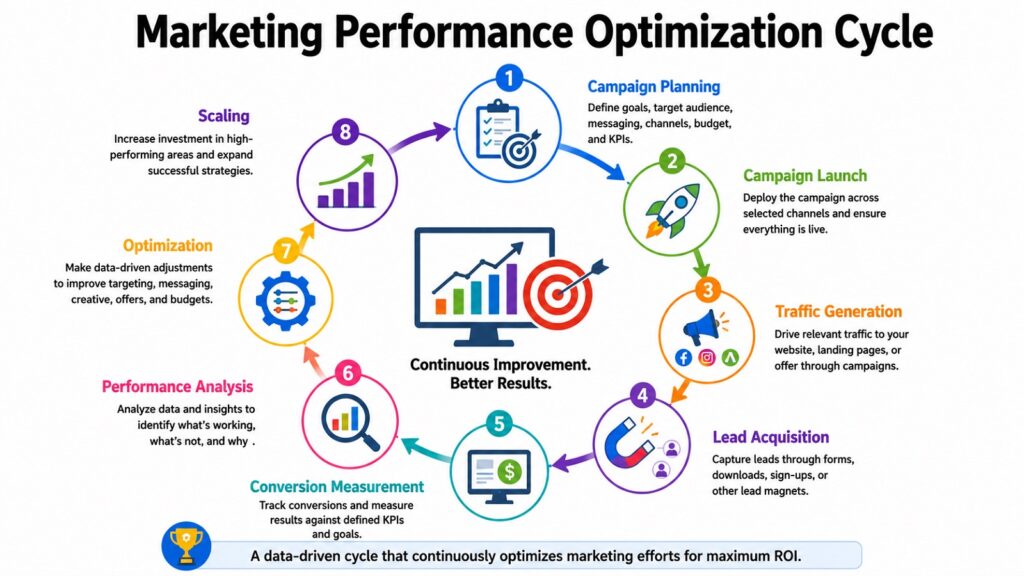
Performance Marketing is centered on achieving specific and measurable results. These results encompass lead generation, customer acquisition, conversion rates, and return on investment. The essence of this approach lies in accountability. Each campaign is evaluated against well-defined objectives, with budgets aligned to outcomes rather than mere assumptions.
The foundation is data. Organizations track which channels are generating which results, how much each acquisition costs, and how changes to creative, targeting, or budget allocation affect performance. This creates a continuous loop of testing, measurement, and optimization.
Attribution stands out as one of the most critical and contentious subjects within this field. It pertains to the process of identifying which activities merit recognition for a particular result. For instance, a customer may encounter a social media advertisement, read a blog entry, receive an email, and ultimately convert through a search result. Gaining insight into which interactions genuinely influenced the decision enables organizations to allocate their budgets more efficiently.
Amazon’s advertising platform exemplifies this concept on a large scale. Brands utilize sponsored product listings that appear in search results within their marketplaces. An advertiser incurs costs only when a user clicks on an ad, and the platform offers comprehensive data regarding which keywords and products generate the highest sales. Brands leverage this information to continuously refine their campaigns and enhance their return on advertising expenditure.
Performance-focused campaigns are most effective when balanced with brand-building activities. Short-term conversion campaigns can harvest demand, but they cannot create it on their own. Organizations that invest exclusively in performance often find that audiences shrink over time because they have not done the work of building awareness and preference upstream.
Table 9: Performance Marketing Metrics and What They Measure
| Performance Metric | What It Measures |
| Cost Per Acquisition (CPA) | The total cost required to acquire a single new customer |
| Return on Ad Spend (ROAS) | Revenue generated for each dollar spent on advertising |
| Conversion Rate | The percentage of visitors or leads that complete a desired action |
| Click-Through Rate (CTR) | The proportion of people who click on a link or ad after seeing it |
| Cost Per Lead (CPL) | The cost incurred to generate each qualified sales lead from a campaign |
| Customer Lifetime Value (CLV) | The projected total revenue a customer generates across their entire relationship with the business |
| Attribution Score | Measures the contribution of individual touchpoints to final conversion outcomes |
| Return on Investment (ROI) | Compares net profit generated by a campaign against its total cost to assess efficiency |
9. Customer Relationship Marketing: Building Lasting Marketing Relationships
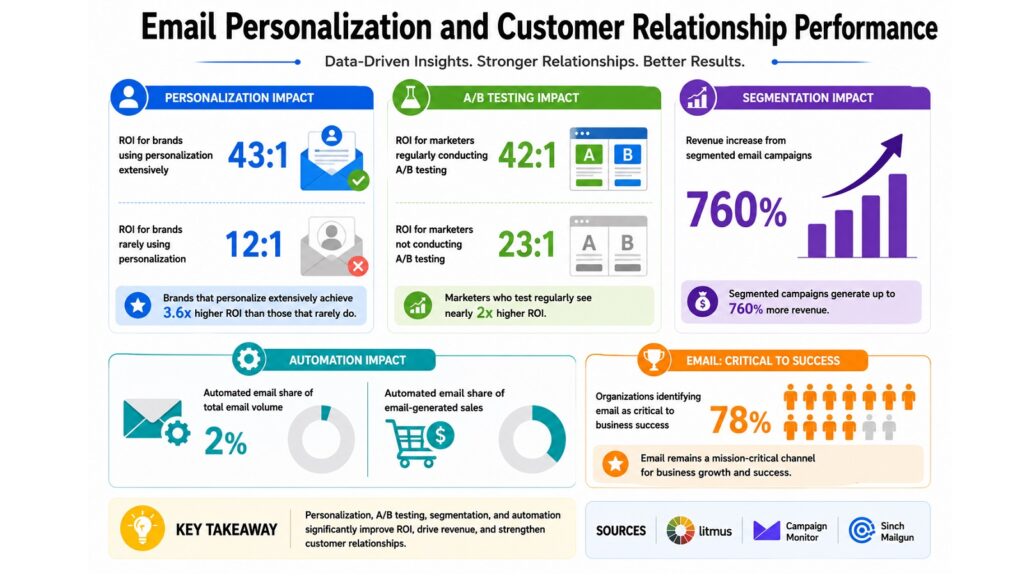
Customer Relationship Marketing focuses on building and maintaining long-term relationships with existing customers. The underlying premise is straightforward: keeping a current customer costs significantly less than acquiring a new one, and loyal customers tend to spend more, refer others, and be more forgiving when things go wrong.
Research from Bain and Company has found that increasing customer retention rates by five percent can increase profits by twenty-five to ninety-five percent, depending on the industry. This wide range reflects how valuable long-term relationships can be and why investing in retention often produces better returns than focusing exclusively on acquisition.
Personalization is one of the most powerful tools in this area. When customers feel that a business understands their individual preferences and communicates accordingly, they respond with higher engagement and stronger loyalty. This is why data management and CRM technology have become so important. They allow organizations to deliver relevant experiences at scale.
Loyalty programs are widely used in this discipline. Airlines, retailers, hotels, and financial services companies have invested heavily in programs that reward repeat customers with benefits, discounts, or exclusive experiences. Done well, these programs create switching costs that make it harder for competitors to attract established customers away.
Amazon Prime is perhaps the most studied example in the digital age. By bundling shipping, content, and exclusive deals into a single membership, Amazon created a relationship that makes customers deeply embedded in its ecosystem. Prime members spend substantially more per year than non-members, and their retention rates are significantly higher.
Table 10: CRM Concepts in Marketing and Their Practical Business Significance
| CRM Concept | Practical Business Significance |
| Customer Retention | Reduces the ongoing cost of growth by keeping existing customers engaged and purchasing over time |
| Loyalty Programs | Rewards repeat behavior to create switching costs and deepen customer commitment to the brand |
| Personalization | Delivers individually relevant messages and experiences that increase engagement and purchase frequency |
| Customer Lifetime Value | Guides investment decisions by estimating the long-term revenue potential of each customer relationship |
| Churn Reduction | Identifies at-risk customers and applies targeted interventions to prevent loss of revenue |
| Post-Purchase Engagement | Maintains relationships after the sale through follow-up, support, and added value |
| Net Promoter Score | Measures customer willingness to recommend the brand, serving as a proxy for relationship strength |
| Customer Segmentation for CRM | Groups customers by behavior or value to enable more precise and efficient relationship management |
10. Marketing Analytics: Improving Marketing Through Data and Insights
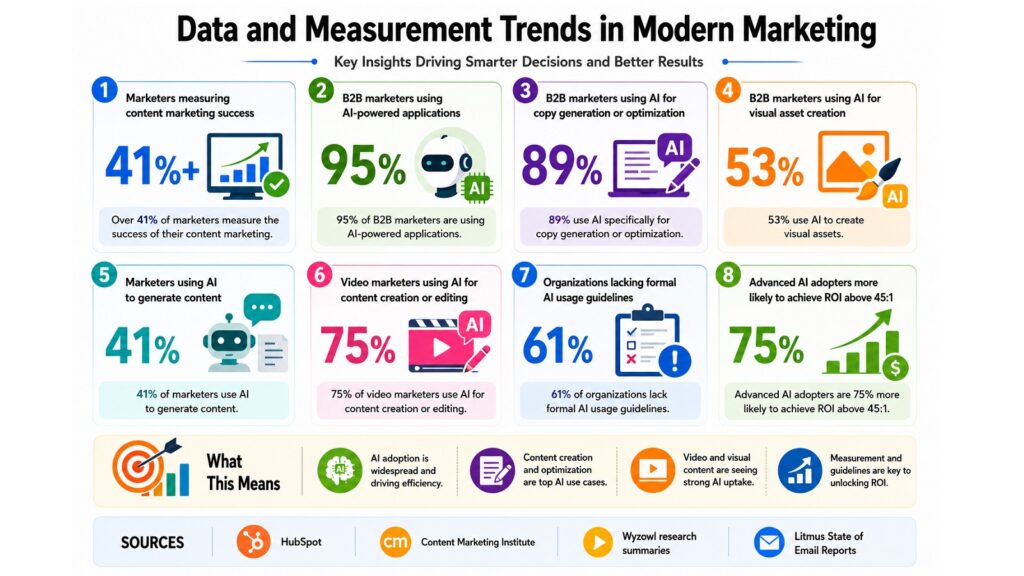
Marketing Analytics is the practice of measuring, managing, and analyzing performance data to improve decisions and achieve better outcomes. It turns raw numbers into actionable understanding. Without it, organizations are essentially guessing about what works and hoping their instincts are correct.
Key performance indicators, or KPIs, form the backbone of this discipline. These are the specific metrics that organizations track to assess whether their activities are producing the intended results. Common KPIs include website traffic, conversion rates, cost per acquisition, customer retention, and revenue contribution from campaigns.
Attribution modeling represents an advanced area that seeks to allocate credit to various touchpoints throughout the customer journey. Multi-touch models acknowledge that most conversions are the result of multiple interactions across different channels. By understanding which of these interactions were most impactful, organizations can invest more confidently in the strategies that truly yield results.
Netflix provides a compelling example. The company uses detailed viewer data not only to recommend content but to inform decisions about which shows to create, how to promote them, and which audiences to target. This deeply data-driven approach has given Netflix a sustained competitive edge in content investment and audience engagement.
Forecasting is another valuable application. By examining historical patterns alongside current market conditions, organizations can project future demand, anticipate seasonal shifts, and plan campaigns accordingly. This reduces waste and improves resource allocation across the entire function. The most important principle is that data has no value unless it leads to better decisions. The real goal is to close the loop between measurement and improvement.
Table 11: Marketing Analytics Measures and Their Business Relevance
| Analytics Measure | Business Relevance |
| Website Traffic Analysis | Reveals which sources, pages, and content attract the most visitors and drive the most engagement |
| Conversion Rate Optimization | Identifies where customers drop off and tests improvements to increase completions |
| Customer Acquisition Cost | Tracks the investment required to gain each new customer, enabling smarter budget allocation |
| Marketing ROI | Compares total investment against revenue generated to assess overall program efficiency |
| Campaign Attribution | Assigns appropriate credit to touchpoints to clarify which activities drive outcomes |
| Customer Behavior Analysis | Examines how customers interact with content to improve targeting and message relevance |
| Cohort Analysis | Groups customers by acquisition period to compare long-term behavior and evaluate channel quality |
| Predictive Forecasting | Uses historical data and trends to project future demand and plan resource allocation |
Conclusion: Bringing Marketing Disciplines Together for Sustainable Business Growth
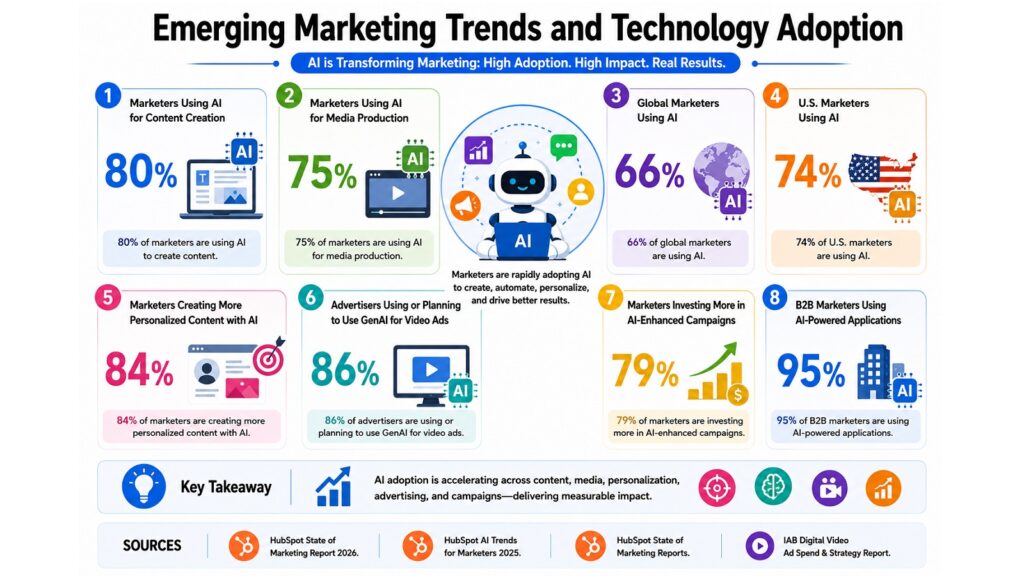
Marketing is not one thing. It is a system composed of interconnected disciplines, each serving a distinct function while contributing to a larger whole. This article has explored ten of those disciplines: Strategy, Market Research, Brand, Product, Content, Digital, Social Media, Performance, Customer Relationship, and Analytics.
Each discipline matters on its own. Strategy without research produces direction without grounding. Content without analytics produces effort without learning. Performance campaigns without branding produce short-term wins that erode over time. The real power emerges when all ten operate together, each one informed by and reinforcing the others.
The most important lesson is that integration drives results. Organizations that silo their functions, separating brand from performance or content from analytics, typically produce fragmented customer experiences and inconsistent results. The businesses that consistently grow are those that connect these disciplines into a coherent strategy supported by research, technology, and genuine customer understanding.
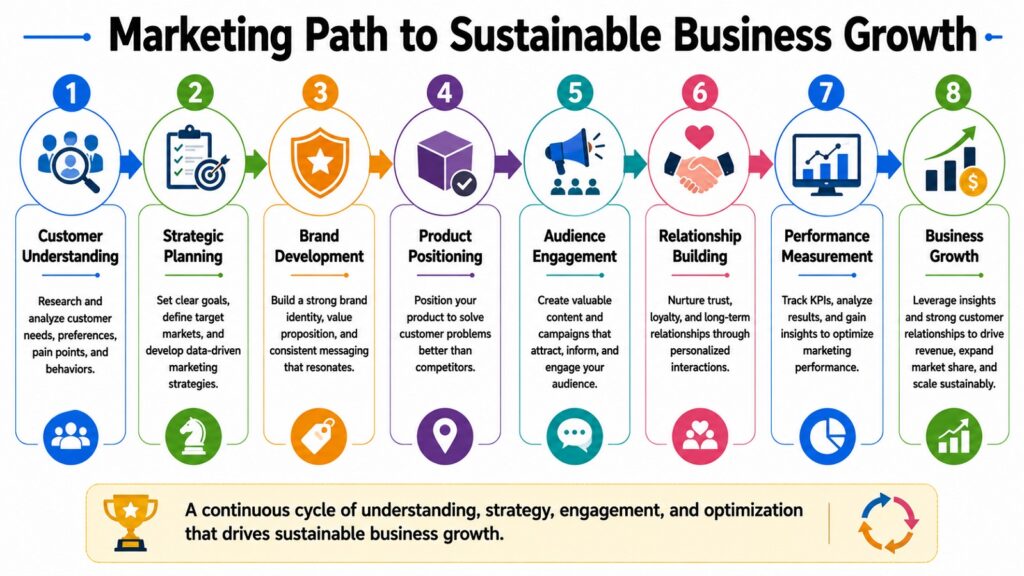
Another key theme is the centrality of the customer. Every discipline in this article exists to serve customers better. Research helps organizations understand them. Strategy focuses efforts on serving them well. Branding builds the trust they need to choose confidently. Analytics ensures the experience keeps improving. Any approach that loses sight of the customer tends to become self-referential and ineffective over time.
Looking forward, the discipline will only grow more complex and more important. Data volumes are increasing. Customer expectations are rising. Competition across most industries is intensifying. Businesses that develop strong capabilities across these ten areas, and that keep learning and adapting, will be best positioned to create lasting value in an increasingly demanding market environment.
Table 12: Marketing Disciplines Grouped by Theme and Their Contribution to Business Growth
| Thematic Group | Contribution to Business Growth |
| Strategic Foundation (Strategy, Market Research) | Sets competitive direction and grounds decisions in customer and market intelligence |
| Brand and Product (Brand Marketing, Product Marketing) | Builds recognition, trust, and clear positioning that accelerates customer adoption |
| Content and Digital (Content Marketing, Digital Marketing) | Attracts, educates, and converts audiences through valuable content and online channel reach |
| Community and Engagement (Social Media Marketing) | Builds loyal communities and word-of-mouth amplification that reduce long-term acquisition costs |
| Performance and Accountability (Performance Marketing) | Drives measurable results and ensures investment produces quantifiable business outcomes |
| Retention and Loyalty (Customer Relationship Marketing) | Increases customer lifetime value and reduces churn to sustain revenue growth over time |
| Intelligence and Optimization (Marketing Analytics) | Transforms data into insights that improve every other discipline and sharpen strategic decisions |
| Integrated System (All Ten Disciplines) | Delivers superior business results when all functions operate cohesively as a unified whole |