Table of Contents
Introduction: Why Smart Devices Power Modern Technology
Smart devices are among the most important dimensions of modern technology. They have changed the way people work, learn, communicate, and spend their time in ways that were difficult to imagine even a generation ago. From the moment you wake up and check your phone to the time you fall asleep with an e-reader in your hands, smart devices frame the boundaries of daily experience. They are not simply gadgets. They are tools that carry computing power, software intelligence, network connectivity, and thoughtful design into the practical rhythms of real life.
Contemporary existence is influenced by the necessity to remain connected and informed continuously. Individuals operate from various locations, access information as needed, track their health, and enjoy entertainment at their convenience. Intelligent devices facilitate these activities by transforming abstract digital functionalities into concrete, practical experiences. For instance, a smartphone can instantly translate a foreign language. A laptop can link a freelancer with clients located across the globe. A fitness tracker can detect an irregular heartbeat prior to a doctor’s diagnosis. These advancements are significant. They signify a subtle revolution in the capabilities of everyday technology.
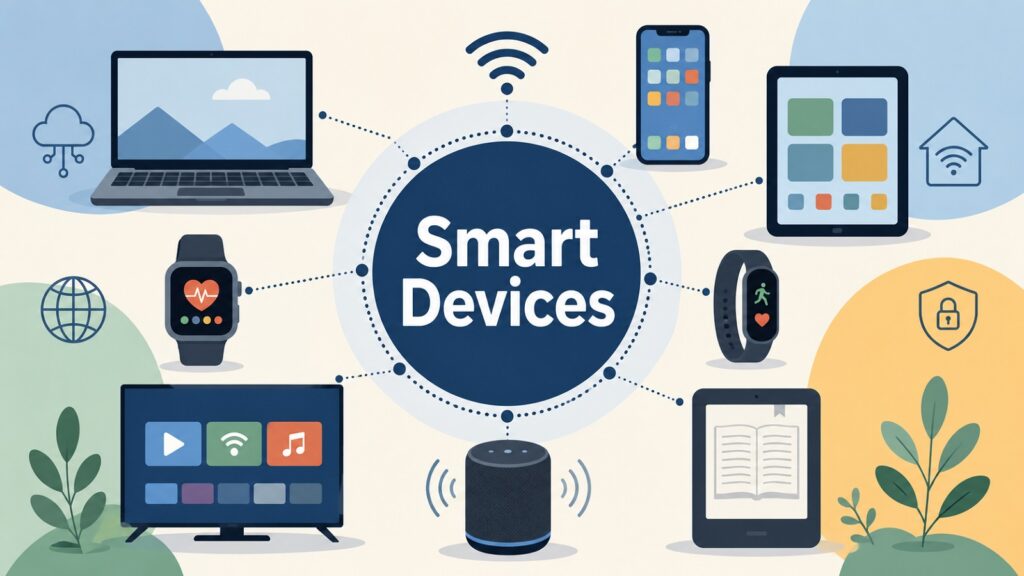
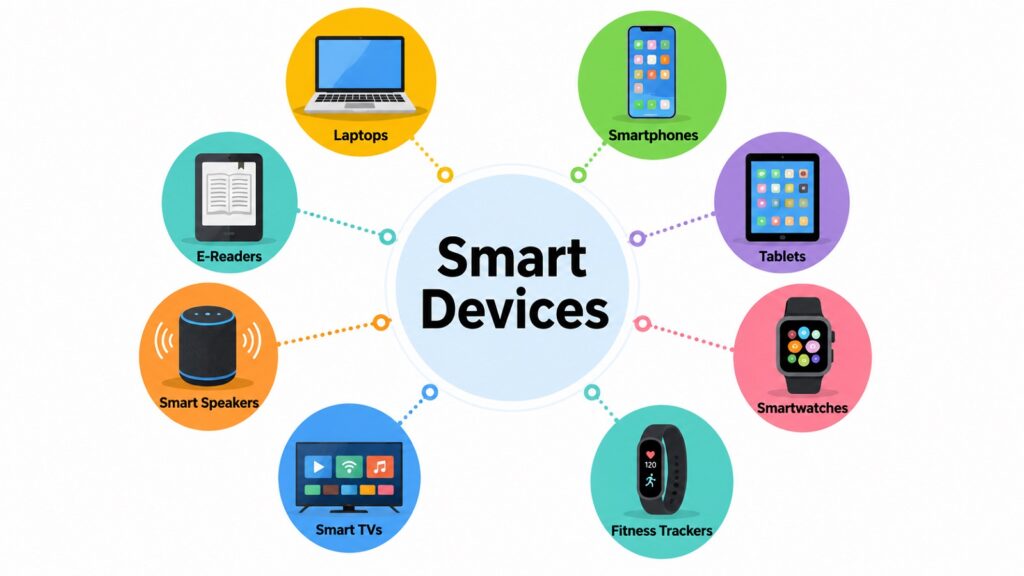
What makes smart devices particularly compelling is the way they function together. No single device operates in isolation. Laptops sync with smartphones. Smartwatches pull data from fitness trackers. Smart TVs connect to streaming platforms that remember your preferences. Smart speakers talk to everything from lights to calendars. This interconnected quality is what separates smart devices from earlier consumer electronics. They do not just perform tasks in isolation. They form an ecosystem, a living network of tools that supports almost every dimension of how people experience the world.
This article examines eight categories of smart devices. Each one contributes something distinct to the broader technology landscape. Laptops and smartphones anchor productivity and communication. Tablets extend versatility without sacrificing portability. Smartwatches and fitness trackers bring technology into personal health. Smart TVs reshape entertainment at home. Smart speakers change how people interact with their surroundings using voice. E-readers offer a quieter, more focused space for reading and learning. Together, they represent the full range of what smart devices can offer, and why their role in modern life continues to grow.
Table 1: Smart Devices and Their Primary Role in Modern Life
| Smart Devices | Primary Role of Smart Devices in Modern Life |
| Laptop | Supports portable computing, remote work, and digital productivity |
| Smartphone | Serves as the central hub for communication, internet access, and daily services |
| Tablet | Bridges the gap between smartphone portability and laptop functionality |
| Smartwatch | Delivers notifications, health monitoring, and quick interactions from the wrist |
| Fitness Tracker | Monitors physical activity, sleep, and health metrics for personal wellness |
| Smart TV | Connects the television to streaming platforms, apps, and home networks |
| Smart Speaker | Enables voice-controlled access to information, music, and smart home systems |
| E-Reader | Provides a comfortable, portable platform for reading digital books and documents |
1. Smart Devices and Laptops: The Portable Powerhouses of Productivity
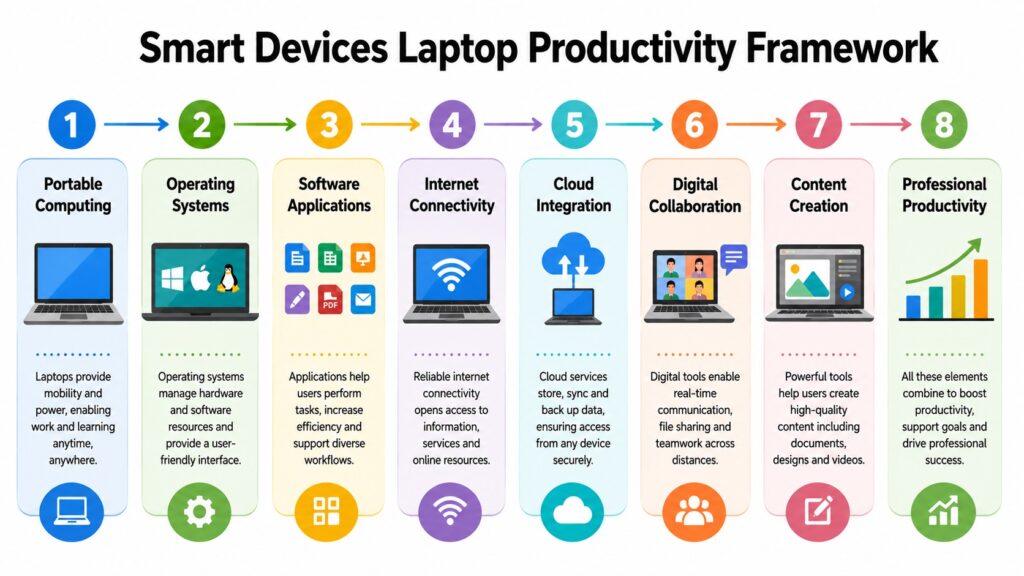
Before laptops existed, computing was tethered to a desk. People needed large machines, fixed power supplies, and dedicated workspaces just to get things done. Then portable computing arrived, and everything shifted. Laptops became the devices that freed professionals, students, and creatives from the constraints of physical location. That freedom turned out to be enormously valuable, and it explains why laptops remain one of the most foundational smart devices in use today.
A modern laptop brings together several technologies that make it genuinely powerful. The processor handles complex tasks at high speed. The operating system, whether Windows, macOS, or a Linux variant, coordinates software applications and manages hardware resources. Wireless networking connects the machine to the internet and to other devices without a single cable. Battery technology has improved to the point where a single charge can last a full workday. These elements combine to create a machine that is capable, portable, and practical in ways that older computers simply were not.
Cloud integration has deepened what laptops can do. Files no longer need to be stored only on the device itself. Services like Google Drive, Microsoft OneDrive, and Dropbox allow users to access documents from any location on any connected device. This makes laptops even more effective tools for remote work, collaboration, and education. A student can begin writing a paper on a school laptop and continue on a home machine without losing a single word. A team of colleagues spread across three time zones can work on the same document simultaneously. Laptops make this kind of coordination almost effortless.
Laptops also interact naturally with other smart devices. Notifications from a smartphone can appear on a laptop screen. Files can be shared wirelessly between devices. Some laptop models can even serve as hubs for charging and connecting other gadgets. This connectivity reinforces the idea that laptops do not operate alone. They are central nodes in a network of tools that people use together throughout the day.
Looking ahead, the future of laptops is being shaped by artificial intelligence and cloud-based workflows. AI-powered features like real-time transcription, intelligent search, and automated editing are already appearing in mainstream operating systems. Cloud computing continues to reduce the importance of raw processing power on the device itself, allowing thinner, lighter machines to handle demanding tasks. These changes suggest that laptops will remain important smart devices for years to come, even as their form and function keep evolving.
Table 2: Smart Devices: Key Capabilities and Technologies of Laptop
| Capability / Technology | Purpose and Relevance |
| Multi-core processors | Handle complex computing tasks quickly and efficiently |
| Wireless networking (Wi-Fi) | Enable internet access and device communication without cables |
| Cloud storage integration | Allow file access and collaboration across multiple devices and locations |
| Operating system | Manages hardware resources and software applications on the device |
| Solid-state drives (SSD) | Provide fast, reliable storage with no moving parts |
| Video conferencing software | Support remote meetings, online learning, and virtual collaboration |
| Battery optimization technology | Extend usage time to support work outside traditional office settings |
| AI-assisted productivity tools | Automate repetitive tasks and improve writing, search, and scheduling |
2. Smart Devices and Smartphones: The Digital Hub of Everyday Life
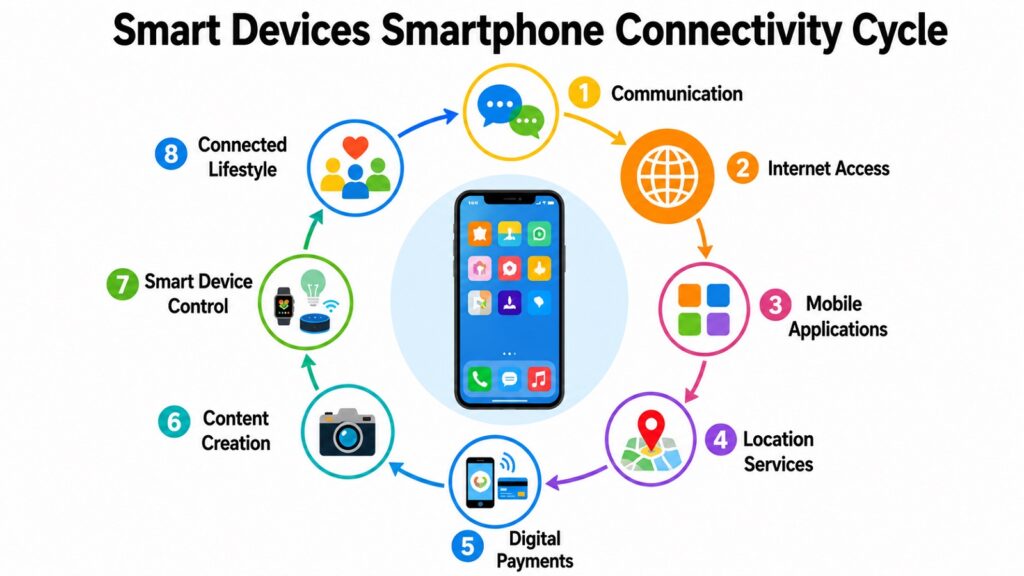
The smartphone is one of the most widely used smart devices on earth. Billions of people carry one, and for most of them, it is the first thing they reach for in the morning and the last thing they put down at night. This level of integration into daily life did not happen by accident. It happened because smartphones became so capable, so versatile, and so deeply connected to the services that people rely on that separating from them started to feel genuinely difficult.
At the heart of a smartphone is a mobile operating system, either Android or iOS, that coordinates an enormous range of functions. Sensors inside the device detect motion, orientation, light levels, and proximity. Cameras have become sophisticated enough to rival dedicated photography equipment. GPS systems provide real-time navigation. Wireless technologies, including cellular networks, Wi-Fi, and Bluetooth, allow constant connectivity. The combination of all these elements within a single pocket-sized device is what makes smartphones so indispensable.
Smartphones frequently function as the central control point for other smart devices. A fitness tracker sends its data to a smartphone app. A smartwatch mirrors notifications from the phone. A smart speaker can be configured using a smartphone interface. Even smart home systems, from thermostats to security cameras, are typically managed through smartphone applications. This central role reinforces why smartphones sit at the core of the ecosystem of smart devices.
The practical examples of what smartphones enable are nearly limitless. A nurse can use a smartphone to access patient records at the bedside. A small business owner can process payments, manage inventory, and communicate with customers all from the same device. A student can attend a virtual class, take notes, and submit an assignment without ever opening a laptop. The productivity value is real and measurable, and it extends across almost every profession and stage of life.
There are also honest limitations to acknowledge. Heavy smartphone use has raised legitimate concerns about attention span, sleep quality, and privacy. The data collected by smartphone applications is extensive, and users do not always have full visibility into how it is used. Future innovations in smartphone technology, including advances in privacy protection, augmented reality, and satellite connectivity, will need to address these concerns while continuing to expand what the devices can do.
Table 3: Smart Device: Major Functions and Technologies of Smartphones
| Function / Technology | Practical Purpose |
| Mobile operating system | Coordinates hardware, apps, and connectivity on the device |
| GPS and navigation | Provides real-time location tracking and turn-by-turn directions |
| Mobile camera system | Captures photos, videos, and documents with high-quality sensors |
| Cellular and Wi-Fi connectivity | Enables internet access, calls, and messaging from almost anywhere |
| App ecosystem | Delivers software tools for productivity, health, finance, entertainment, and more |
| Mobile payment systems | Allows contactless transactions via NFC technology and digital wallets |
| Biometric security | Protects device access using fingerprint or facial recognition technology |
| Bluetooth connectivity | Links the smartphone to wearables, speakers, and other smart devices |
3. Smart Devices and Tablets: Bridging Mobility and Versatility
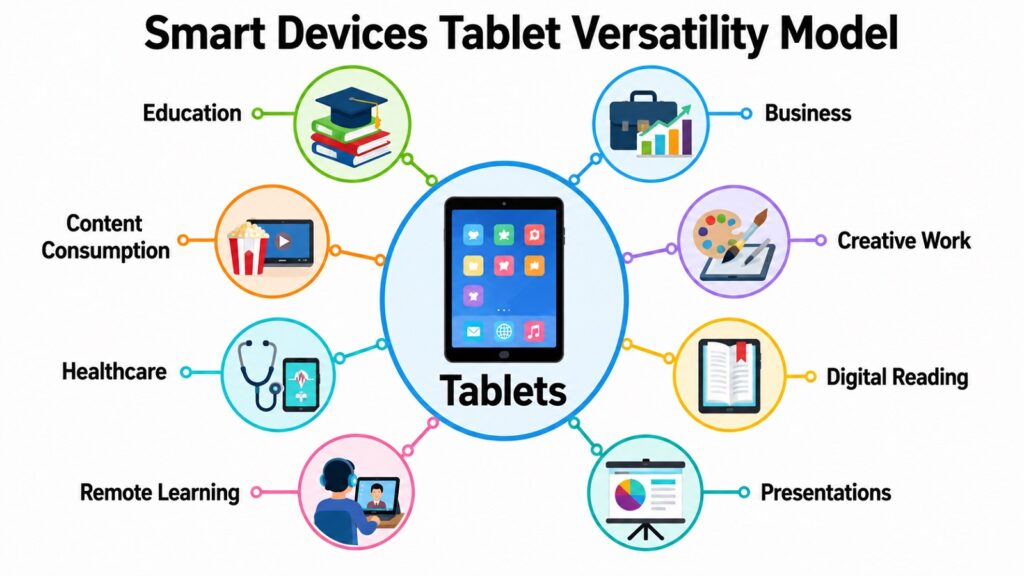
Tablets occupy a unique space in the ecosystem of smart devices. Tablets are neither smartphones nor laptops. They are larger than phones, which makes them better suited for reading, drawing, watching content, and working on visual tasks. They are lighter and more casual than laptops, which makes them easier to carry and use in relaxed settings. This middle position is not a compromise. For many users, it is exactly what they need.
The tablet’s touch interface is central to its appeal. Without a physical keyboard in the way, the screen becomes the entire workspace. Artists can sketch directly on the glass surface using a stylus. Students can annotate PDF documents as naturally as they would mark up a printed page. Retail workers can show product catalogs to customers without awkward screen angles. The directness of touch interaction creates a different kind of user experience, one that feels more immediate and intuitive for certain tasks.
In education, tablets have become genuinely useful tools. Schools in many countries distribute tablets to students as primary learning devices. Educational apps offer interactive lessons, adaptive quizzes, and multimedia content that static textbooks cannot match. In healthcare, tablets are used for patient intake, electronic health records, and clinical reference tools that clinicians can carry into exam rooms. In creative fields, they support illustration, music production, video editing, and animation in ways that were previously only possible on expensive desktop workstations.
Tablets do not aim to substitute other smart devices; rather, they serve to enhance their functionality. An individual may utilize a smartphone for brief communications during the day and then transition to a tablet for activities such as reading, engaging in creative tasks, or viewing a movie in the evening. With advancements in keyboard accessories, stylus compatibility, and cloud connectivity, tablets are evolving into more effective productivity tools while still retaining the casual and portable characteristics that initially make them appealing.
Table 4: Smart Devices: Common Uses and Features of Tablet
| Use / Feature | Description |
| Touch-based interface | Allows direct interaction with content through gestures and taps |
| Digital stylus support | Enables precise drawing, annotation, and handwriting on screen |
| Educational app ecosystem | Delivers interactive learning tools and course content for students |
| Portable media consumption | Provides a large screen for watching videos and reading digital content |
| Healthcare documentation | Supports patient records, clinical reference, and intake forms |
| Creative and design work | Allows illustration, photo editing, and music production on the go |
| Keyboard accessory compatibility | Expands productivity potential for writing and document work |
| Cloud connectivity | Syncs files, apps, and data across devices for seamless access |
4. Smart Devices and Smartwatches: Bringing Technology to the Wrist
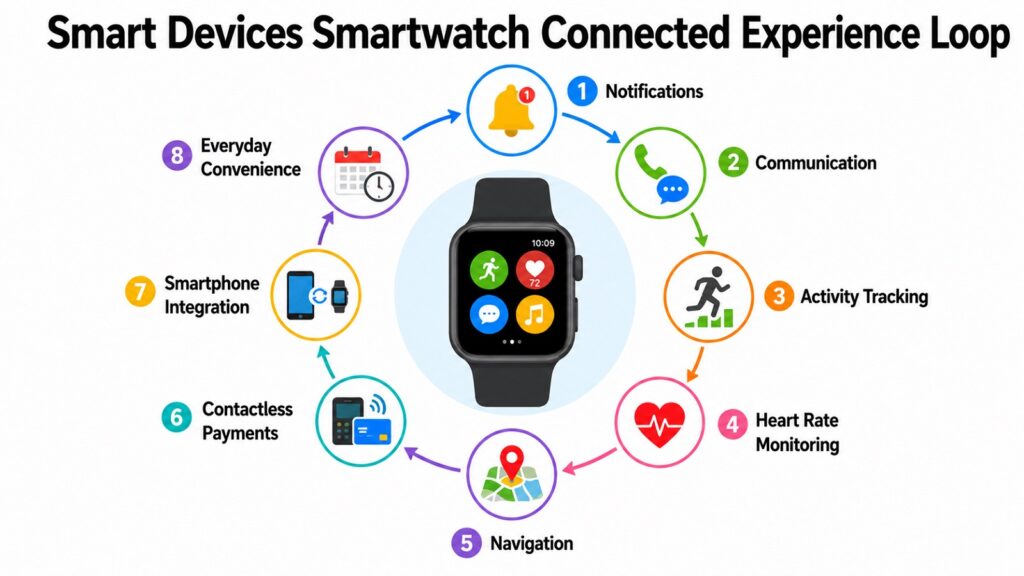
There is something quietly useful about a device that sits on your wrist and knows what is happening around you. Smartwatches arrived at a moment when people were looking for ways to stay connected without the constant pull of a smartphone screen. They offered a different kind of access, faster, smaller, more personal, and closer to the body in every sense. That proximity turned out to matter quite a lot.
A smartwatch works by maintaining a wireless link to a paired smartphone, typically via Bluetooth. Notifications arrive on the watch face, allowing the wearer to see incoming messages, calls, or calendar reminders without pulling out their phone. Many models include an independent GPS, which makes them useful for navigation and outdoor activity tracking without any phone dependency. The sensors embedded in modern smartwatches can detect heart rate, blood oxygen levels, skin temperature, and movement patterns, turning the device into a continuous health monitoring tool.
The health monitoring capabilities of smartwatches have become one of their most valued features. Heart rate sensors provide continuous cardiovascular data throughout the day. Some models now include electrocardiogram functionality that can detect irregular heart rhythms. Sleep tracking algorithms analyze movement and heart rate data overnight to estimate sleep quality and duration. Fall detection features can automatically alert emergency contacts if the wearer takes a hard fall. These capabilities make smartwatches meaningful health tools, not just convenient notification screens.
Smartwatches also integrate naturally with the ecosystem of smart devices. They receive data from fitness trackers and share it with health apps on smartphones. They work with smart home systems, allowing users to control lights or thermostats with a gesture or voice command. Their role is not to replace the smartphone but to extend its reach in moments when reaching for a phone would be inconvenient or disruptive. As health-focused sensors continue to improve, smartwatches seem likely to become even more important tools for preventive wellness in the years ahead.
Table 5: Smart Devices: Key Capabilities and Technologies of Smartwatches
| Capability / Technology | Purpose |
| Heart rate monitoring | Tracks cardiovascular activity continuously throughout the day |
| GPS tracking | Records location and route data for navigation and fitness activities |
| Electrocardiogram (ECG) | Detects irregular heart rhythms that may indicate cardiac conditions |
| Bluetooth synchronization | Connects the watch to a smartphone for notifications and data sharing |
| Sleep tracking | Analyzes movement and biometric data to assess sleep quality |
| Fall detection | Identifies sudden impacts and alerts emergency contacts automatically |
| Contactless payments | Enables NFC-based transactions directly from the wrist |
| Blood oxygen measurement | Monitors SpO2 levels to indicate breathing and circulation health |
5. Smart Devices and Fitness Trackers: Supporting Data-Driven Wellness
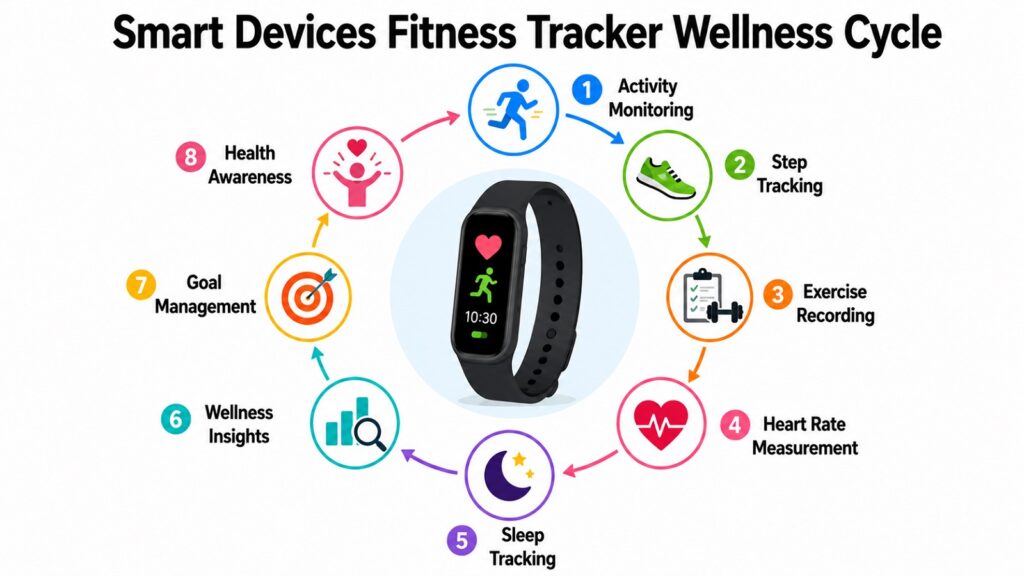
Fitness trackers emerged from a simple idea. If you can measure something about your body, you can understand it better, and if you understand it better, you can improve it. That logic resonated with millions of people who were already paying more attention to health, exercise, and the quality of their daily habits. Fitness trackers turned that interest into something concrete, giving people a steady stream of data about how their bodies were actually performing.
The core technology inside a fitness tracker is a set of sensors. Accelerometers detect movement and translate it into step counts, distance estimates, and activity levels. Heart rate sensors use optical technology to measure blood flow through the skin. Gyroscopes track orientation and detect specific movement patterns like running, cycling, or swimming. These raw signals are processed by algorithms that convert them into readable health metrics and daily summaries that users can review in an app on their smartphone.
The value of fitness trackers comes not just from the data they collect but from the insights that data generates over time. A single night of poor sleep tells you little. A month of sleep data can reveal patterns, showing whether a late evening workout is disrupting rest, whether stress-related sleep fragmentation is a recurring issue, or whether a particular lifestyle change is having a measurable effect. This longitudinal perspective is what turns raw numbers into actionable personal health information.
There are real limitations to be honest about. Fitness trackers are not medical devices, and their measurements carry some degree of error. Heart rate estimates can vary with skin tone, wrist placement, and device quality. Calorie calculations are approximations. Sleep staging algorithms differ across brands. Users should treat fitness tracker data as useful guidance rather than clinical precision. Despite these caveats, these devices have helped many people become more physically active, more aware of their sleep habits, and more engaged with their own health in ways that have real value.
Table 6: Smart Devices: Health Metrics and Tracking Features of Fitness Tracker
| Health Metric / Feature | Description |
| Step counting | Measures daily steps using an accelerometer to estimate activity levels |
| Heart rate monitoring | Tracks beats per minute continuously using optical sensor technology |
| Sleep tracking | Records sleep duration and patterns through movement and heart rate data |
| Calorie estimation | Calculates approximate energy expenditure based on activity and biometric data |
| Blood oxygen (SpO2) monitoring | Measures oxygen saturation in the bloodstream during rest and activity |
| Stress level detection | Uses heart rate variability to estimate physiological stress levels |
| Workout recognition | Automatically identifies activity types such as running, cycling, or swimming |
| Menstrual cycle tracking | Logs cycle data to identify patterns and predict upcoming phases |
6. Smart Devices and Smart TVs: Transforming the Home Entertainment Experience
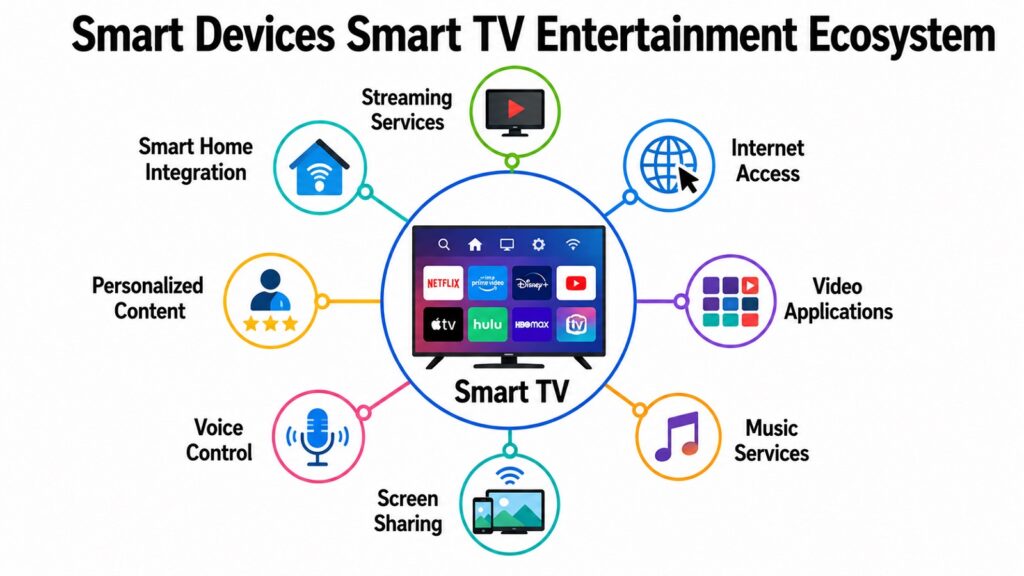
Television itself has not changed that much. You still sit down, look at a screen, and watch content. But the nature of that content, how you find it, how you control it, and what the television itself is capable of, has changed almost completely. The smart TV represents the convergence of traditional broadcast media and the connected digital world, and it has transformed what it means to watch something at home.
A smart TV is essentially a television with a built-in computer. It runs an operating system, connects to the internet via Wi-Fi or ethernet, and supports a range of applications including streaming services, social media platforms, gaming, and smart home management tools. The operating systems most commonly used include Android TV, Tizen from Samsung, and webOS from LG. These platforms manage the interface, handle application updates, and process content recommendations based on viewing history.
The shift toward streaming has been the dominant force reshaping smart TV usage. Services like Netflix, Amazon Prime Video, Disney+, and YouTube have collectively moved hundreds of millions of viewers away from traditional scheduled broadcasting. Smart TVs make these services immediately accessible from the main menu. Content discovery algorithms on these platforms surface new films and series based on previous viewing patterns, creating a personalized entertainment experience that traditional TV could never offer.
Smart TVs also serve as integration points within connected home environments. They can display camera feeds from smart doorbells, mirror content from smartphones and tablets, and respond to voice commands delivered through built-in microphones or linked smart speakers. Some models connect directly to smart home automation systems, allowing the television to serve as a control center for other devices in the home. As display technology, processing power, and software ecosystems continue to evolve, smart TVs will remain one of the most visible and widely used smart devices in modern households.
Table 7: Smart Devices: Key Features and Technologies of Smart TV
| Feature / Technology | Description |
| Built-in streaming apps | Provides direct access to Netflix, YouTube, Prime Video, and similar services |
| Internet connectivity | Connects via Wi-Fi or ethernet to access online content and services |
| TV operating system | Manages the interface, apps, and updates on platforms like Tizen and webOS |
| Voice control support | Responds to spoken commands for search, volume, and content selection |
| Screen mirroring | Displays content from a smartphone or tablet on the larger TV screen |
| 4K and HDR display | Delivers high-resolution visuals with enhanced contrast and color depth |
| Smart home integration | Connects with home automation systems and compatible IoT devices |
| Personalized content recommendations | Uses viewing history to suggest relevant shows and films |
7. Smart Devices and Smart Speakers: The Rise of Voice-Controlled Technology
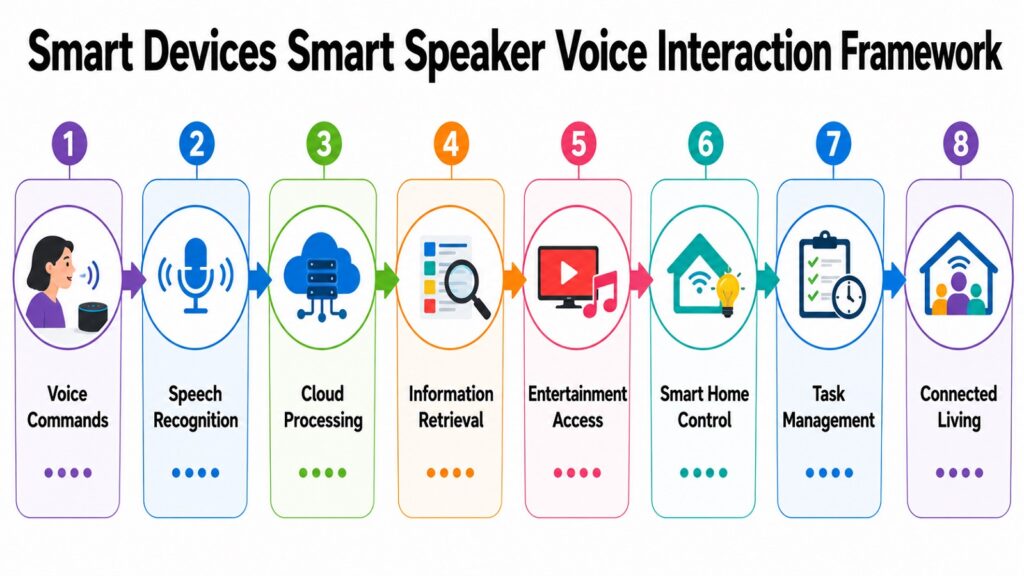
Voice has always been the most natural way for people to communicate. Using it to interact with technology, however, required something that did not exist for most of computing history: a machine that could understand what you were actually saying and respond in a useful way. Smart speakers delivered that capability in an accessible consumer package, and the effect was significant. Suddenly, interacting with a device did not require looking at a screen or touching anything at all.
The technology behind smart speakers depends on voice recognition, natural language processing, and cloud computing. When someone speaks to a smart speaker, the device captures the audio and sends it to remote servers, where the speech is converted to text and analyzed for intent. The virtual assistant, whether Amazon Alexa, Google Assistant, or Apple’s Siri, interprets the request and retrieves the appropriate response, whether that is a weather forecast, a timer, a song, or a command sent to another smart device. The entire cycle typically completes in under two seconds.
Smart speakers have become practical household tools in ways that go beyond novelty. They answer factual questions without requiring anyone to type. They set reminders and alarms by voice during moments when hands are occupied. They play music, podcasts, and radio stations on demand. They control smart home devices like lights, thermostats, and locks through spoken commands. For people with visual impairments or motor difficulties, the hands-free nature of smart speakers represents a meaningful improvement in accessibility.
Privacy remains a genuine concern with smart speakers. These devices are always listening for their wake word, which means the microphone is functionally active in the home environment at all times. Questions about what is recorded, how long audio data is stored, and who can access it are legitimate. Manufacturers have responded with mute buttons and data deletion options, but the issue has not disappeared entirely. Advances in on-device processing, which would allow the speaker to handle voice recognition locally without sending audio to the cloud, represent the most promising direction for addressing this concern.
Table 8: Smart Devices: Functions and Technologies of Smart Speaker
| Function / Technology | Practical Use |
| Voice recognition | Captures and interprets spoken commands to trigger device responses |
| Natural language processing | Understands conversational requests rather than requiring specific commands |
| Virtual assistant integration | Powers services like Alexa, Google Assistant, and Siri for smart interactions |
| Smart home device control | Manages lights, locks, thermostats, and other IoT devices by voice |
| Music and podcast streaming | Plays audio content from connected streaming services on request |
| Real-time information retrieval | Answers questions about weather, news, sports, and general knowledge |
| Reminder and alarm setting | Manages schedules and time-based alerts through spoken instructions |
| Multi-room audio support | Links multiple speakers to distribute audio across different spaces |
8. Smart Devices and E-Readers: Reinventing the Digital Reading Experience
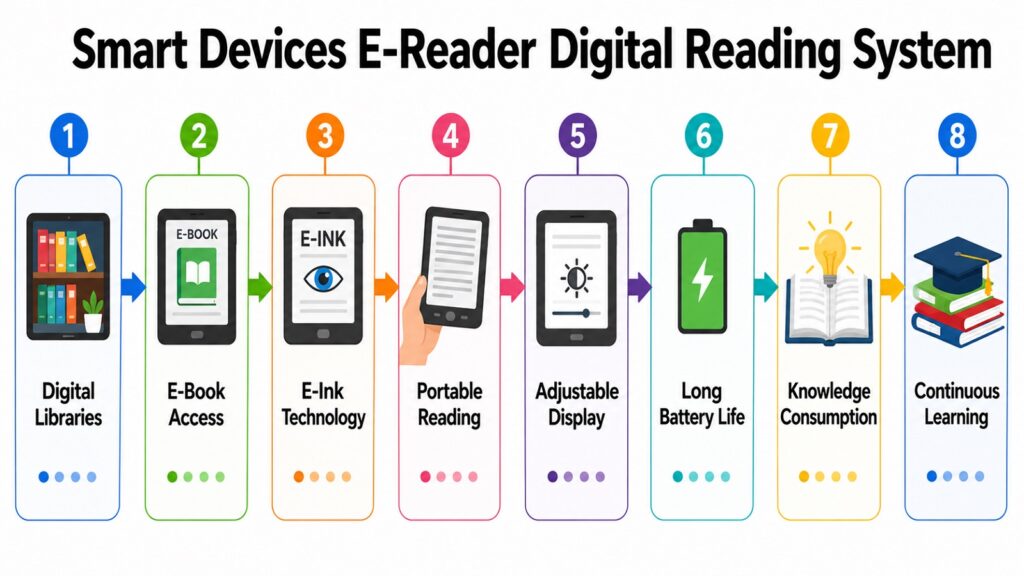
Reading on a glowing screen has always carried a small cost. The backlight strains the eyes. The blue light interferes with sleep. The same device that holds your books also holds your social media, your email, and everything else fighting for your attention. E-readers were designed to solve these problems. They created a reading environment that feels different from other screens, calmer, gentler, and more focused on the text itself.
The key technology that makes e-readers distinctive is the electronic ink display, commonly called e-ink. Unlike LCD or OLED screens, e-ink displays work by rearranging small charged particles rather than emitting light. This means the screen reflects ambient light the way a printed page does, which is much easier on the eyes during extended reading sessions. Battery life benefits from the same principle. Because the display only uses power when the image changes, an e-reader can last weeks on a single charge rather than hours.
E-readers have transformed access to books and knowledge in practical ways. A single device can carry thousands of titles, making them ideal for travel, commuting, and situations where carrying physical books would be impractical. Digital libraries allow users to borrow e-books for free through services connected to public library systems. Accessibility features built into most e-readers, including adjustable font sizes, customizable line spacing, and built-in dictionaries, make them especially useful for older readers, people with dyslexia, and those learning a second language.
E-readers exist in their own quiet corner of the ecosystem of smart devices. They do not try to do everything. They do not push notifications or demand attention. This restraint is part of what makes them effective reading tools. Students use them to carry entire syllabuses without backpack weight. Professionals use them to work through long reports and technical documents without screen fatigue. Curious readers use them to explore subjects at their own pace, building knowledge that no algorithm has decided they should have. As display technology and digital library infrastructure continue to improve, e-readers seem likely to remain a meaningful part of how people engage with written knowledge.
Table 9: Smart Devices: Features and Benefits of E-Reader
| Feature / Technology | Reader Benefit |
| Electronic ink (e-ink) display | Reduces eye strain by mimicking the appearance of a printed page |
| Extended battery life | Provides weeks of reading from a single charge due to low power consumption |
| Adjustable font and spacing | Allows readers to customize text for comfort and accessibility |
| Built-in dictionary | Lets readers look up unfamiliar words instantly without leaving the page |
| Large digital library capacity | Stores thousands of books in a lightweight, portable device |
| Digital library borrowing | Connects with public library systems for free e-book access |
| Waterproof design (select models) | Enables reading in environments like baths, beaches, and poolsides |
| Blue light filter or warm tone mode | Reduces light-related sleep disruption during evening reading |
Conclusion: How Smart Devices Continue to Shape Modern Life
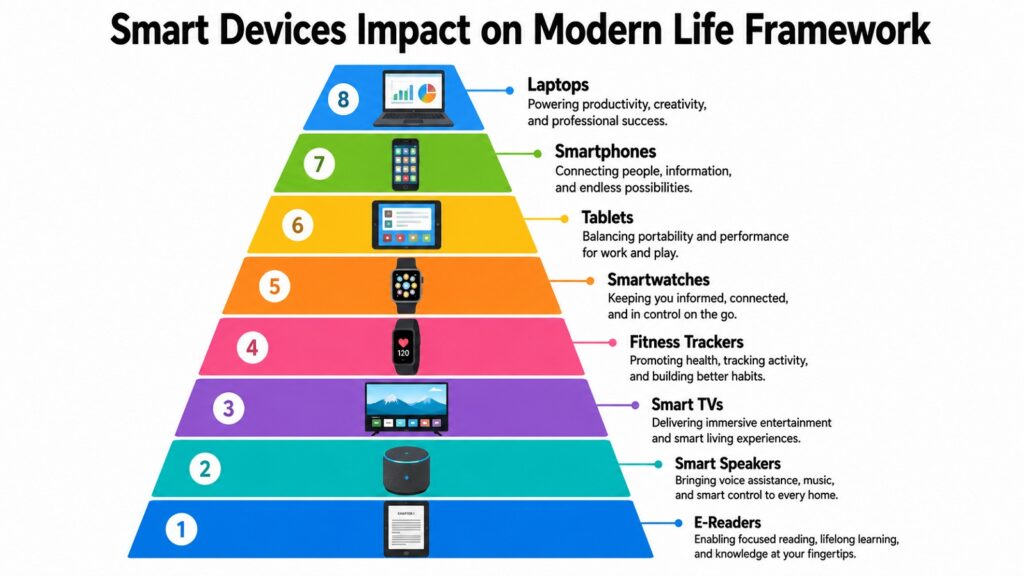
Smart devices are important dimensions of modern technology, not because they are flashy or new, but because they have become genuinely woven into the way people live, work, learn, and connect. Eight smart devices examined in this article contribute something distinct, and together they form a technology landscape that would have seemed remarkable even two decades ago.
Laptops gave people the freedom to work from anywhere without sacrificing computing power. Smartphones became the central nervous system of modern communication, putting an almost unlimited range of services into a single pocket-sized package. Tablets found their place between these two poles, offering a large-screen, touch-driven experience that is well-suited to creative work, education, and media consumption. Smartwatches moved technology closer to the body, making health data continuous and accessible in ways that earlier monitoring tools could not match. Fitness trackers deepened this health-focused potential by turning daily physical activity into structured, meaningful data that people can actually use to make better decisions.
Smart TVs brought the internet into the living room and redefined what it means to watch something. Smart speakers changed the human-device relationship by making voice the primary interface, removing the screen from everyday interactions, and making technology accessible in entirely new ways. E-readers, often overlooked in conversations about smart devices, quietly created a better environment for reading, one that respects the act of sustained attention in a world that rarely does.
What connects all of these smart devices is not just their technical sophistication. It is the way they function together as parts of a shared ecosystem. They share data, synchronize states, and reinforce each other’s capabilities. Using one tends to make others more useful. This interconnected quality is what gives these smart devices their particular strength. It is also what makes their future so compelling to think about.
Table 10: Smart Devices and Their Key Contributions to Modern Life
| Smart Devices | Key Contributions of Smart Devices to Modern Life |
| Laptop | Enables portable, powerful computing for work, education, and creativity |
| Smartphone | Serves as the primary hub for communication, services, and device integration |
| Tablet | Offers a versatile, touch-driven platform for learning, creativity, and media |
| Smartwatch | Delivers continuous health monitoring and quick access from the wrist |
| Fitness Tracker | Transforms physical activity and wellness data into actionable health insights |
| Smart TV | Connects home-entertainment to streaming, apps, and smart home ecosystems |
| Smart Speaker | Enables voice-controlled interaction with information and connected devices |
| E-Reader | Provides a focused, comfortable, and portable digital reading experience |