Table of Contents
Introduction: AI Foundations and the Journey Toward Machine Intelligence
Credit: iken3
Artificial intelligence is one of the most consequential developments of our time, yet how an AI system actually becomes intelligent remains poorly understood beyond specialist circles. Popular accounts focus on impressive outputs or broad definitions, while the deeper question of what must be in place before a machine can behave intelligently rarely receives careful attention. AI Foundations addresses exactly that question.
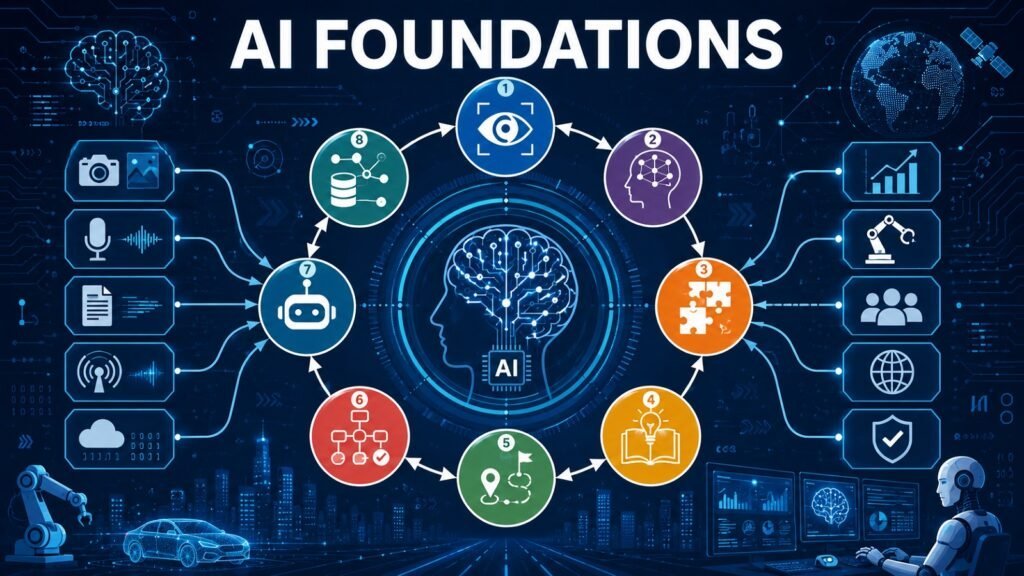
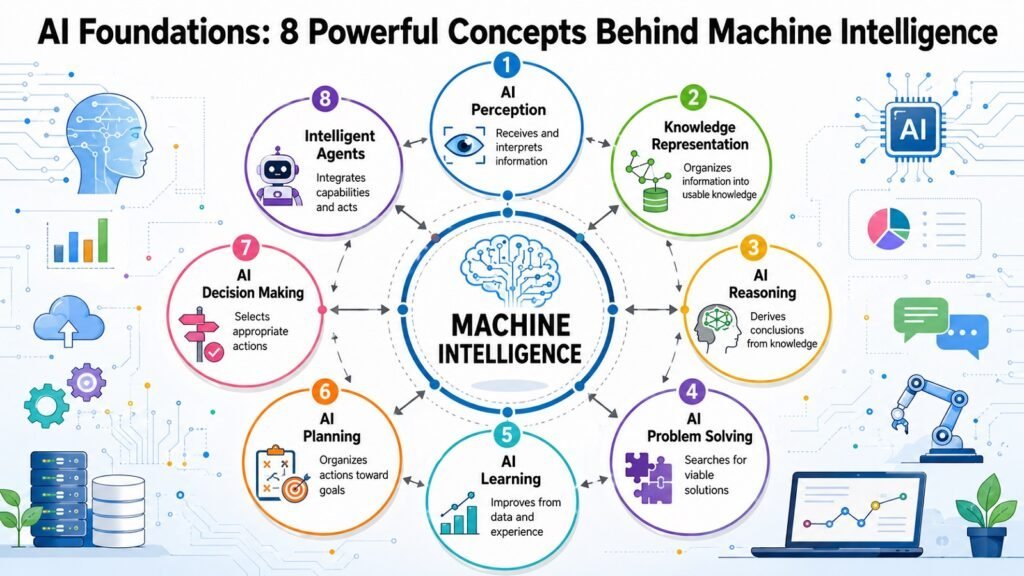
The central argument is straightforward: machine intelligence does not arise from a single algorithm, dataset, or model. It emerges from the interaction of multiple capabilities, each playing a distinct role. An intelligent system must perceive information from its environment, organize that information into usable knowledge, reason about what it implies, search for solutions, learn from experience, plan courses of action, make decisions among alternatives, and act in ways that affect its environment. Remove any one of these AI foundations and the system becomes noticeably less capable across varied situations.
This article takes a foundational perspective rather than defining Artificial Intelligence in general terms, listing applications, or surveying history. Eight foundations discussed here are interconnected, not strictly sequential. A real AI system rarely perceives, then represents, then reasons in a clean pipeline — these capabilities operate together and improve through interaction. A consistent analytical lens runs throughout: what the system receives, how it organizes information, how it processes and adapts that information, how it selects actions, and how it interacts with its environment.
AI Foundations: A Roadmap of the Eight Core Concepts
| AI Foundations | Role in Machine Intelligence |
| Perception | Enables the system to receive and interpret information from its environment |
| Knowledge Representation | Organizes information into structured forms that support reasoning and learning |
| Reasoning | Allows the system to derive conclusions, evaluate relationships, and handle uncertainty |
| Problem Solving | Provides strategies for moving from a current state toward a desired goal |
| Learning | Allows the system to improve performance and adapt based on data or experience |
| Planning | Determines sequences of actions needed to achieve defined objectives |
| Decision Making | Selects the most appropriate action from available alternatives under defined objectives |
| Intelligent Agents | Integrates all foundations into a unified system that perceives, reasons, and acts |
1. AI Foundations: How AI Perception Enables Intelligent Understanding
Credit: iken3
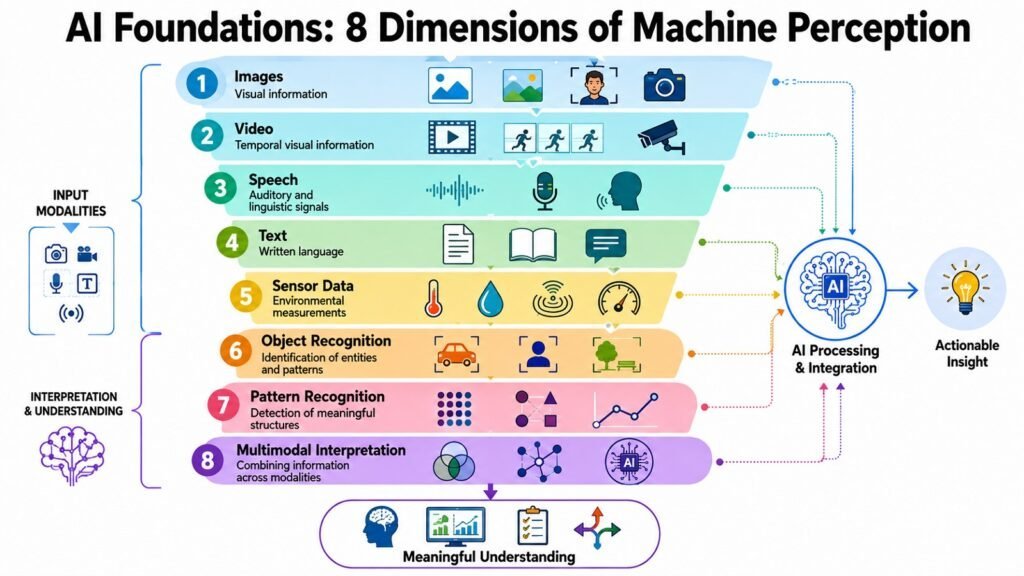
Every intelligent system begins with input. Before an AI system can reason, represent knowledge, or make a decision, it must first receive information from the world. Perception is the foundation that makes this possible, transforming raw input signals into meaningful representations that support further processing. The distinction between raw input and meaningful interpretation is critical and often underappreciated.
A digital camera captures pixel values. Recognizing that those pixels form a human face, identifying whose face it is, and inferring that the person appears distressed requires perception. The gap between raw data and interpretation involves feature extraction, pattern recognition, contextual analysis, and in modern systems, representation learning. These processes allow an AI system to move from signal to meaning, which is precisely what perception contributes to machine intelligence.
Modern AI systems perceive through many modalities: computer vision analyzes visual scenes and tracks motion; speech recognition converts acoustic signals into linguistic content; natural language processing interprets text and extracts intent; sensor-based robotic systems interpret touch, depth, and spatial relationships. Multimodal systems integrate several input types simultaneously.
A landmark development was the 2012 ImageNet competition, where AlexNet dramatically outperformed all prior approaches by learning visual features directly from image data rather than relying on manually engineered features. Despite this progress, perception is not infallible. Distribution shifts, adversarial perturbations, and ambiguous inputs can all cause confident misclassification, illustrating how machine perception can diverge from human perception in unexpected ways. Once information is perceived and interpreted, the next challenge is organizing it into a form the system can work with — the role of knowledge representation.
AI Foundations: Key Perception Modalities and Their Roles
| Modality or Approach | What It Enables an AI System to Interpret |
| Computer Vision | Visual scenes, objects, faces, spatial relationships, and motion in images or video |
| Speech Recognition | Acoustic signals converted into words, sentences, and speaker identity |
| Natural Language Processing | Written text including meaning, intent, sentiment, and linguistic structure |
| Tactile and Haptic Sensing | Physical contact, pressure, texture, and surface properties in robotic systems |
| LiDAR and Depth Sensing | Three-dimensional spatial structure, distances, and environmental geometry |
| Multimodal Perception | Integrated signals from text, image, audio, and video processed together |
| Time-Series Signal Processing | Sequential sensor data such as physiological signals, financial data, or industrial readings |
| Representation Learning | Compact internal features extracted automatically from raw input through training |
2. AI Foundations: How Knowledge Representation Gives AI Structure
Credit: iken3
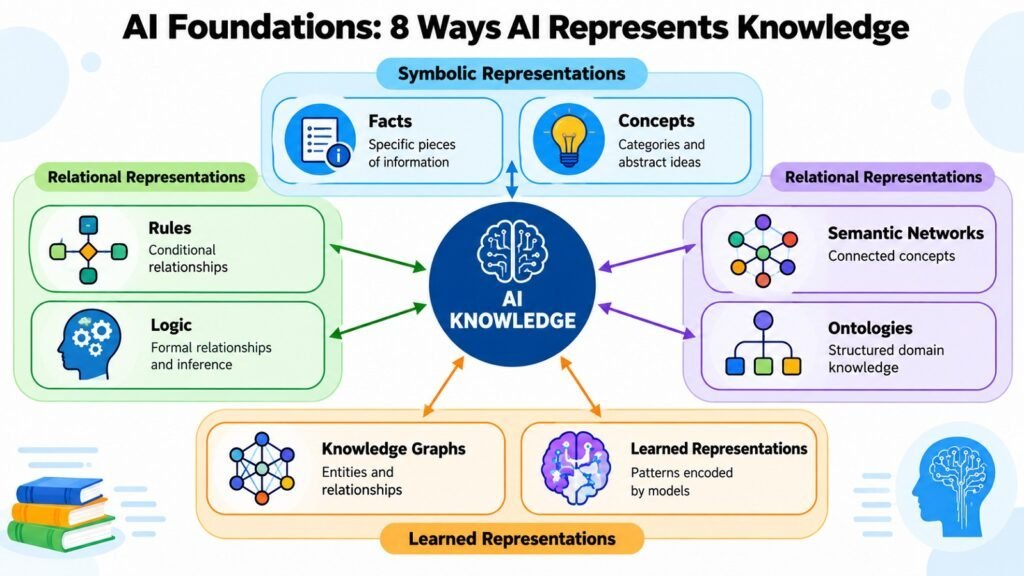
Perceiving information is not the same as possessing usable knowledge. A system that classifies an image as a hospital room has perceived something, but it does not yet know anything about hospitals, their purposes, or the significance of what it identified. Transforming perceived information into organized, usable knowledge is the task of knowledge representation — the internal structure an AI system needs to relate pieces of information, support reasoning, enable learning, and guide decision-making.
Early AI researchers built systems using explicit symbolic representations: entities and relationships encoded in logical rules or semantic networks. Expert systems, influential from the 1970s through the 1990s, stored domain knowledge as rule sets and drew conclusions via inference engines. These approaches worked well within narrow domains but struggled with scale, ambiguity, and real-world complexity. Knowledge graphs addressed some of these limitations by representing entities and their relationships in structured, queryable forms.
Contemporary AI relies increasingly on learned representations, where internal structure emerges from training on large datasets. Neural networks encode knowledge across millions of parameter values rather than identifiable rules. Google Knowledge Graph combines structured symbolic information with statistical learning to support reasoning across billions of facts, demonstrating that symbolic and statistical representations can complement each other.
Every representational approach faces limitations. Symbolic systems become brittle outside their defined scope. Learned representations can encode social biases present in training data. Knowledge bases grow outdated when real-world conditions change faster than they are updated. These limitations matter because the quality and structure of a system’s internal knowledge directly shape the quality of any reasoning, planning, or decision-making that follows.
AI Foundations: Knowledge Representation Approaches and Their Roles
| Representation Approach | What It Represents or Enables |
| Propositional Logic | Boolean relationships among facts, enabling formal deductive inference |
| First-Order Predicate Logic | Entities, their properties, and quantified relationships for expressive formal reasoning |
| Semantic Networks | Conceptual associations and hierarchical relationships among entities |
| Ontologies | Formal definitions of concepts, categories, and relationships within a domain |
| Knowledge Graphs | Large-scale structured facts as entity-relationship triples queryable at scale |
| Frames and Schemas | Structured templates capturing typical attributes and default values for concepts |
| Probabilistic Graphical Models | Uncertain relationships among variables represented as Bayesian or Markov networks |
| Distributed Neural Representations | Knowledge encoded implicitly across network weights learned from large datasets |
3. AI Foundations: How AI Reasoning Turns Knowledge Into Intelligence
Credit: iken3
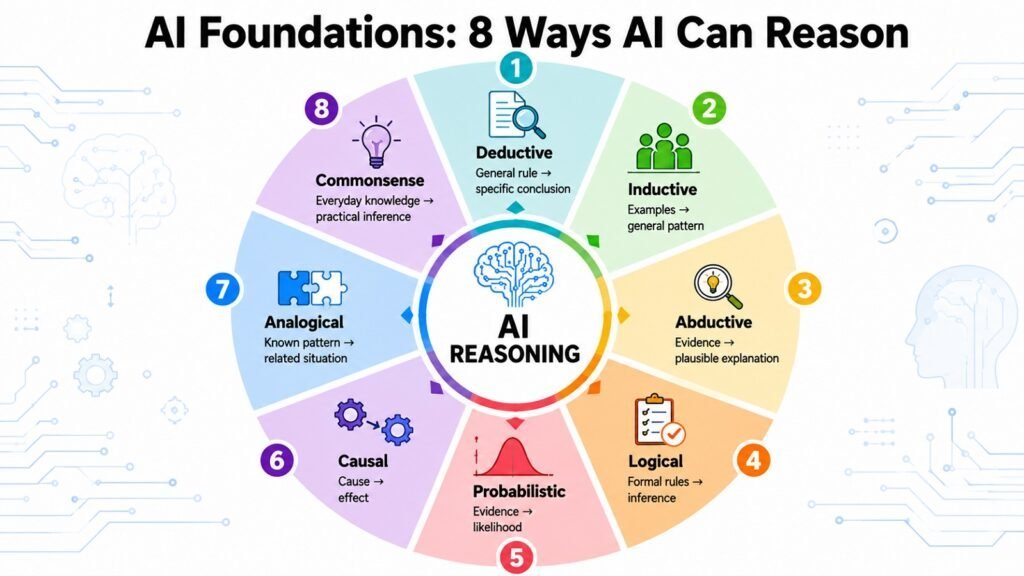
Knowledge without reasoning is inert. An AI system may hold an extensive representation of the world, yet if it cannot use that representation to evaluate what follows, what is likely, or what is possible, it contributes little to intelligent behavior. Reasoning is the foundation that allows a system to draw inferences, evaluate relationships, estimate probabilities, and handle situations where the answer is not immediately obvious. It is important to keep reasoning distinct from learning: learning concerns acquiring or improving knowledge and patterns, while reasoning concerns using available knowledge to reach conclusions.
Classical AI research developed formal reasoning systems based on logical inference. Deductive reasoning derives conclusions that follow necessarily from established premises. Inductive reasoning generalizes from observed examples to broader patterns. Abductive reasoning infers the most plausible explanation for an observed outcome. Expert systems such as MYCIN, developed at Stanford in the 1970s for medical diagnosis, demonstrated that rule-based deductive reasoning could achieve clinically useful performance within a well-defined domain. Contemporary AI has extended reasoning into probabilistic territory: Bayesian inference provides a principled framework for updating probability estimates as new evidence arrives, while causal reasoning concerns what would happen if a condition changed, going beyond mere correlation.
Modern large language models exhibit behavior that resembles reasoning in many contexts, but researchers debate whether this constitutes genuine logical inference or statistically plausible output without underlying logical structure. A system that produces a plausible-sounding answer does not automatically demonstrate sound reasoning, particularly when premises are flawed or the situation departs from the training distribution. Reasoning failures propagate into problem solving, planning, and decision-making — understanding where reasoning is reliable and where it breaks down is a practical concern for anyone deploying AI systems.
AI Foundations: Established Reasoning Approaches and Their Roles
| Reasoning Approach | Role in AI Systems |
| Deductive Reasoning | Derives logically necessary conclusions from established premises and rules |
| Inductive Reasoning | Generalizes patterns from observed examples to broader conclusions |
| Abductive Reasoning | Infers the most plausible explanation for an observed fact or outcome |
| Probabilistic Reasoning | Evaluates likelihoods and updates beliefs under uncertainty using probability theory |
| Bayesian Inference | Updates prior probability estimates systematically as new evidence becomes available |
| Causal Reasoning | Evaluates what would happen if conditions changed, going beyond correlation |
| Analogical Reasoning | Applies structures or solutions from familiar cases to new but similar problems |
| Commonsense Reasoning | Applies implicit everyday knowledge about the physical and social world to novel situations |
4. AI Foundations: How AI Problem Solving Finds Paths to Solutions
Credit: iken3
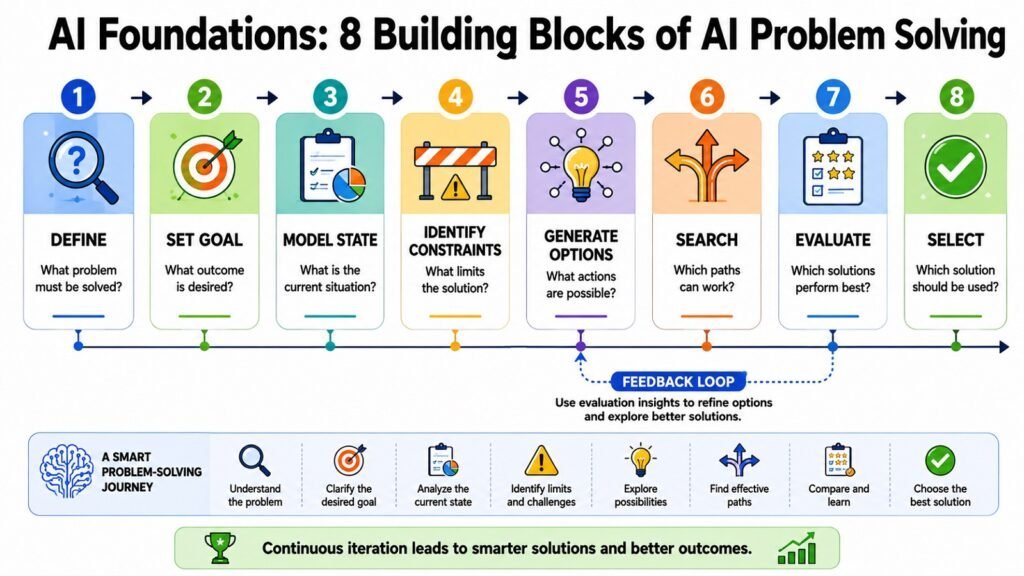
Reasoning tells a system what follows from what it knows. Problem solving takes the next step: given a defined objective and a set of available actions, finding a course of action that moves from a current state to a desired goal. Reasoning evaluates relationships and infers conclusions; problem solving searches, evaluates, and selects among possible courses of action. Both foundations are necessary and work together, but they address different aspects of intelligent behavior.
AI problem solving begins with problem formulation: representing the current state, defining the goal, enumerating available actions, and understanding how each action changes the current state. This general structure applies across route planning, scheduling, game playing, and resource allocation. Classical AI developed a rich toolkit of search methods for navigating these spaces. A* search uses a heuristic function to guide exploration more efficiently than uninformed methods; designing effective heuristics is itself a substantive challenge, as overestimates can cause A* to miss optimal solutions while underestimates lead to unnecessary exploration. Constraint satisfaction, linear programming, and evolutionary algorithms handle problems requiring solutions that satisfy multiple conditions or maximize an objective across a large possibility space.
Real problems are rarely clean. Information may be incomplete, environments may shift during search, and objectives may conflict. Computational complexity is a fundamental barrier: some problem spaces are so large that finding an exact optimal solution is not tractable. In these cases, AI systems often pursue satisficing solutions — good enough rather than perfectly optimal — a concept Herbert Simon called bounded rationality. This perspective is practically important because it shifts the evaluation criterion from perfection to adequacy under realistic constraints, which is a more honest measure of intelligent problem solving.
AI Foundations: Problem-Solving Approaches and Their Roles
| Approach or Concept | Purpose or Role in AI Problem Solving |
| State Space Search | Represents all possible configurations of a problem and searches for a path to the goal |
| Heuristic Search (A*) | Uses an estimated cost function to guide search more efficiently toward the goal |
| Constraint Satisfaction | Finds assignments of values to variables that satisfy a defined set of constraints |
| Optimization | Identifies solutions that maximize or minimize an objective function across a solution space |
| Simulated Annealing | Probabilistic method for escaping local optima in large, complex search spaces |
| Genetic Algorithms | Evolve candidate solutions through selection, crossover, and mutation operators |
| Satisficing | Accepts a solution that is good enough under constraints rather than requiring optimality |
| Game Tree Search (Minimax) | Evaluates sequences of moves in adversarial settings by exploring possible outcomes |
5. AI Foundations: How AI Learning Builds Intelligence From Experience
Credit: iken3
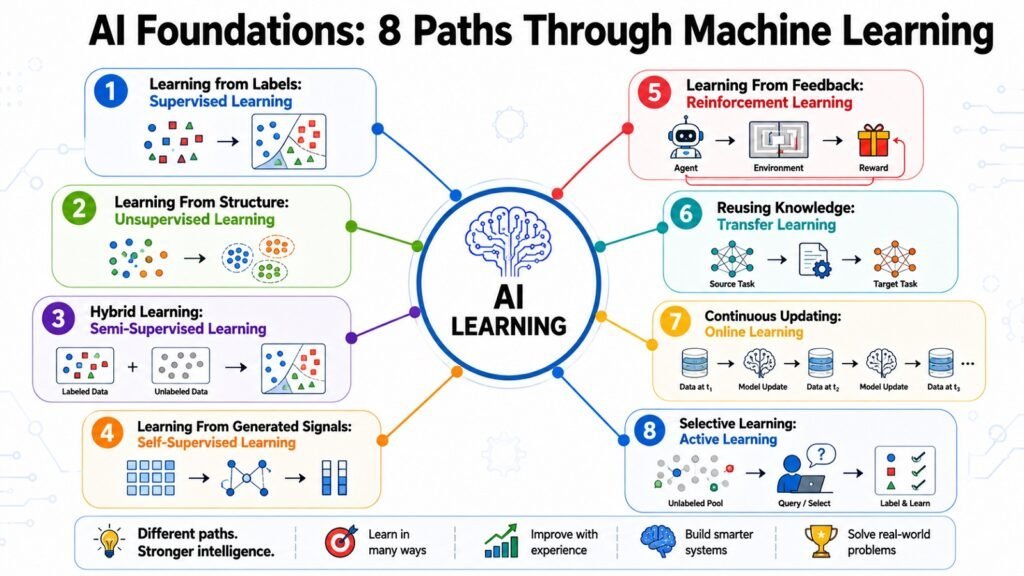
A fixed system can only do what it was explicitly designed to do. Learning is the foundation that allows AI systems to improve performance through experience, adapt to new data, and extend their capabilities to situations not individually anticipated at design time. Artificial intelligence and machine learning are related but not interchangeable. AI is the broader field concerned with building systems that exhibit intelligent behavior; machine learning is a major approach within AI that focuses on learning patterns from data.
Not every AI system learns — classical expert systems, planners, and search algorithms can exhibit useful behavior without data-driven learning — but machine learning has become the dominant paradigm in modern AI because it allows systems to discover patterns in complex data that would be impossible to encode through hand-written rules.
Learning takes several principal forms. Supervised learning trains a model on labeled input-output pairs to predict correct outputs for new inputs. Unsupervised learning identifies structure in data without predefined labels. Self-supervised learning generates its own supervisory signal from data structure — an approach used extensively in training large language models. Reinforcement learning trains agents through environmental interaction, using reward signals to guide behavior. AlphaGo, reported in Nature in 2016, demonstrated that reinforcement learning combining deep neural networks with Monte Carlo tree search could defeat the best human Go players, a result previously considered decades away.
Learning interacts with every other AI foundation: learned representations improve perception, learned models enable more effective reasoning, and feedback from experience refines planning and decision-making. But learning also inherits limitations. Biased training data produces biased outputs. Overfitting causes a model to fail on new data. Distribution shifts during deployment can significantly degrade performance. Successful learning on a benchmark does not guarantee appropriate behavior in real environments with different characteristics or higher stakes.
AI Foundations: Core Learning Concepts and Their Roles
| Learning Concept | Role or Distinguishing Characteristic |
| Supervised Learning | Trains a model on labeled examples to predict correct outputs for new inputs |
| Unsupervised Learning | Discovers structure, clusters, or patterns in data without predefined labels |
| Reinforcement Learning | Learns through interaction with an environment guided by reward and penalty signals |
| Semi-Supervised Learning | Combines a small labeled dataset with a larger unlabeled dataset during training |
| Self-Supervised Learning | Generates training signals from the structure of the data rather than external labels |
| Transfer Learning | Applies knowledge acquired in one domain or task to improve performance in another |
| Generalization | Ability to perform well on new, unseen data beyond the training distribution |
| Overfitting | A model learns training data too closely and performs poorly on new inputs |
6. AI Foundations: How AI Planning Converts Goals Into Action
Credit: iken3
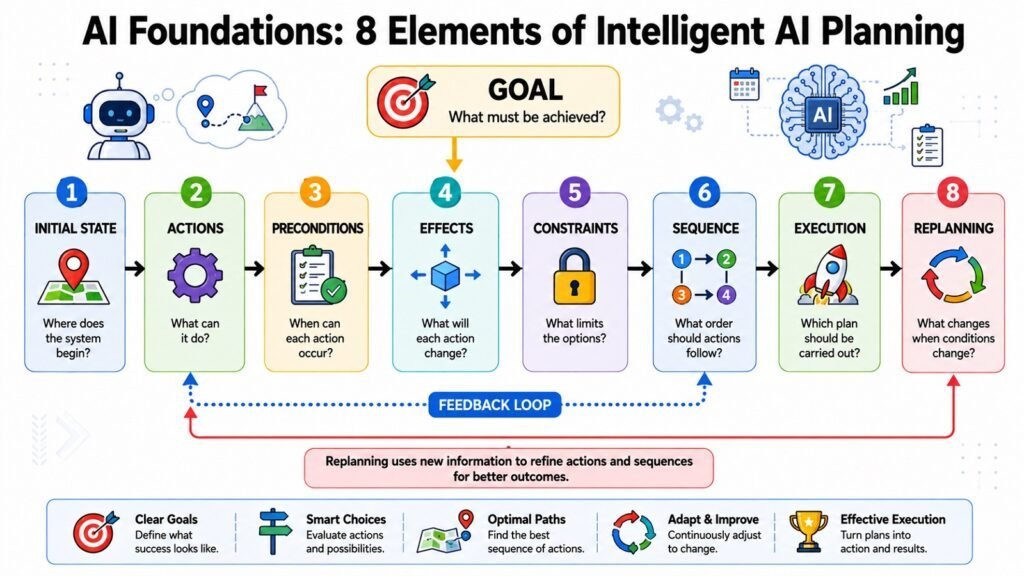
Knowing what a goal is and what actions are available does not automatically tell a system how to reach that goal. Planning is the foundation that bridges the gap between a desired outcome and an organized course of action. It asks a more structured question than problem solving: given what the system knows, what sequence or strategy of actions should it pursue to reach its objective, accounting for dependencies, constraints, resources, and conditions that may change along the way?
Classical AI planning, developed in the STRIPS system at SRI International in the early 1970s, represented the world as a set of facts, defined actions as operators with preconditions and effects, and produced plans as action sequences achieving a specified goal. Real-world planning extends this structure to address temporal constraints, resource limitations, concurrent actions, and hierarchical task decomposition, where complex goals are broken into subgoals and sub-plans.
In dynamic environments, a plan that was optimal when created may quickly become suboptimal or impossible as conditions change — autonomous robots must re-plan when they encounter unexpected obstacles, and supply chain management systems must revise schedules when materials are delayed. This need for continuous monitoring and revision reflects the reality that planning and execution are interleaved processes in genuinely intelligent systems.
Planning determines what a system will try to do, organizing actions into a strategy. Decision-making then determines which option is actually selected when alternatives are present. Limitations in planning include computational complexity, uncertainty about outcomes, conflicting objectives, and incomplete information about the environment.
AI Foundations: Planning Concepts and Their Roles
| Planning Concept | Role in AI Planning |
| Goal State | The desired outcome that the planning system aims to achieve |
| Initial State | The system’s representation of the current situation before any actions are taken |
| Action Operators | Defined actions with specified preconditions and effects on the world state |
| Plan | A sequence or structure of actions determined to achieve the goal from the initial state |
| Hierarchical Task Network | Decomposes complex goals into subtasks and sub-plans at multiple levels of abstraction |
| Contingency Planning | Prepares alternative action sequences for different possible outcomes or conditions |
| Re-planning | Revises or replaces a plan in response to changes in conditions during execution |
| Temporal Planning | Coordinates actions that have durations, deadlines, and time-based dependencies |
7. AI Foundations: How AI Decision Making Selects Intelligent Actions
Credit: iken3
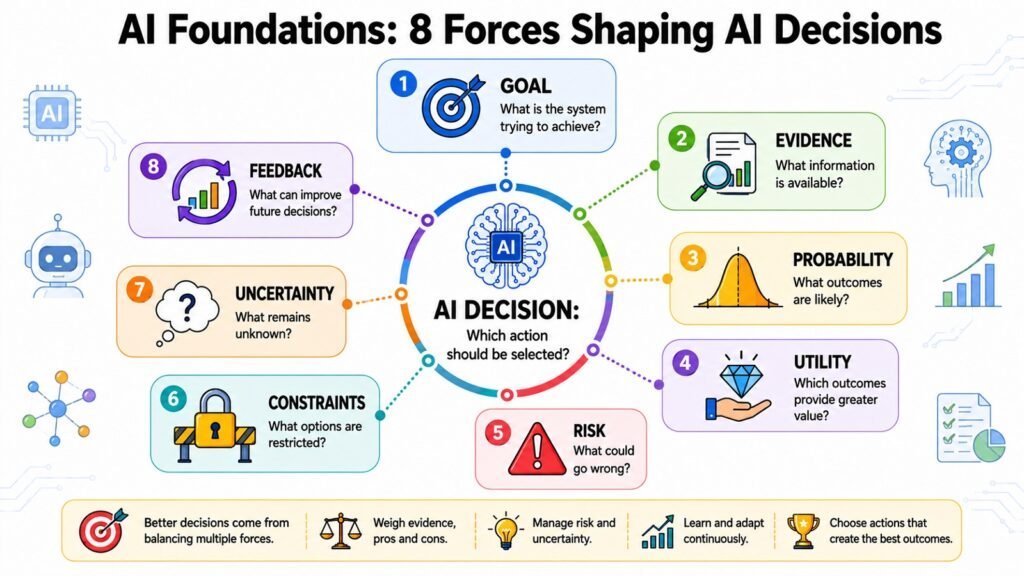
Planning determines what an AI system intends to do. Decision-making determines what it actually does at each choice point. A planning system may generate a detailed strategy, but when the moment arrives to select a specific action from available alternatives, decision-making governs that selection. It brings together the system’s objectives, its assessment of likely outcomes, its evaluation of risk, and its understanding of constraints to produce a specific choice.
The theoretical framework underlying rational decision-making in AI draws from expected utility theory, developed in economics and decision science. A rational agent selects the action that maximizes expected utility given its objectives and probability estimates over possible outcomes. This formalization is clean in theory but challenging in practice: objectives must be precisely defined and may conflict, probabilities must be estimated from available evidence, and consequences may be uncertain or delayed. Real-world decision-making rarely provides the clean conditions assumed by idealized rational choice models.
Practical examples of AI decision-making span many domains. Recommendation systems select content based on inferred preferences. Fraud detection systems decide whether to flag, block, or approve transactions. Autonomous navigation systems evaluate possible maneuvers and balance progress with collision avoidance. Where decisions affect people’s safety or welfare, human oversight is essential — clinical decision support systems recommend rather than mandate treatment choices because clinical context often exceeds the system’s information. Limitations include sensitivity to data quality, difficulty specifying objectives comprehensively, and the risk that optimizing for one objective produces unintended consequences on dimensions not explicitly measured.
AI Foundations: Decision-Making Concepts and Their Roles
| Decision-Making Concept | Role in Selecting or Evaluating Actions |
| Utility Function | Quantifies the desirability of outcomes to enable systematic comparison of alternatives |
| Expected Utility Maximization | Selects the action whose probable outcomes yield the highest expected value |
| Markov Decision Process | Models sequential decisions under uncertainty with states, actions, and rewards |
| Multi-Criteria Decision Analysis | Evaluates alternatives across multiple objectives with different weights or priorities |
| Risk Assessment | Evaluates the likelihood and severity of adverse outcomes before committing to an action |
| Game-Theoretic Decision Making | Selects actions in competitive settings by modeling the choices of other agents |
| Human-in-the-Loop | Incorporates human judgment at critical decision points to manage high-stakes choices |
| Satisficing Decision Making | Selects the first available option that meets a defined threshold rather than optimizing |
8. AI Foundations: How Intelligent Agents Bring Machine Intelligence Together
Credit: iken3
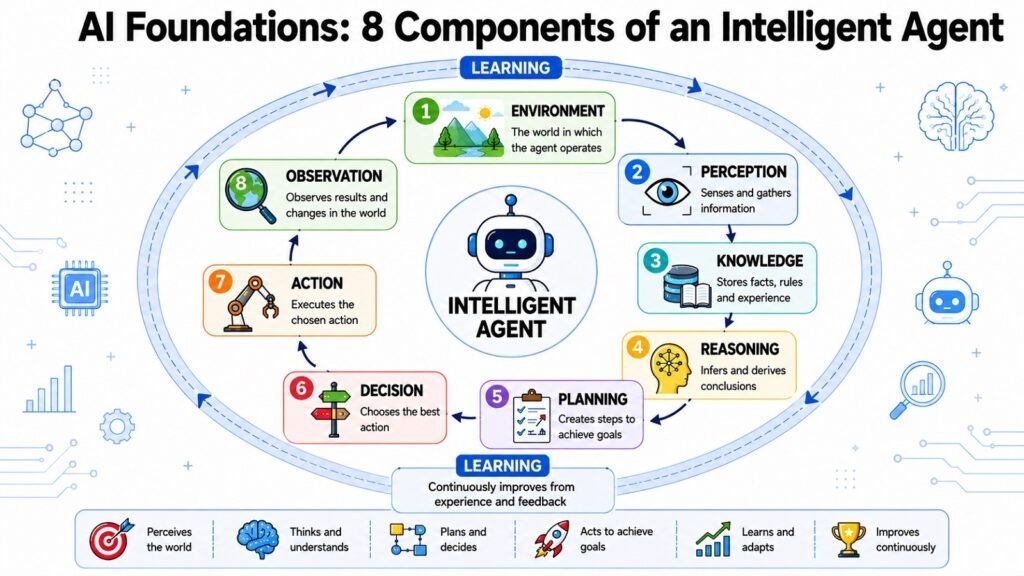
The first seven AI Foundations describe distinct capabilities: perceiving information, organizing it into knowledge, reasoning about it, solving problems, learning from experience, planning courses of action, and making decisions. An intelligent agent is the concept that holds all of these together, allowing them to operate as a unified, goal-directed system interacting with an environment. The agent concept, central to AI theory since at least the early 1990s, provides a theoretically rigorous lens for understanding how machine intelligence actually operates.
An intelligent agent receives information from its environment through sensors or inputs, processes it using internal capabilities, selects actions through decision-making, and affects the environment through actuators or outputs. Perception supplies the information the agent needs to understand its situation. Knowledge representation organizes that information into usable internal structure. Reasoning evaluates what that structure implies. Problem solving identifies paths toward objectives. Learning improves the agent’s capabilities over time. Planning organizes intended actions. Decision-making selects which action the agent actually takes — each foundation in service of the agent’s overall objective.
Real AI systems illustrate this integration across domains. An autonomous vehicle perceives road conditions through cameras, radar, and LiDAR, represents environmental features, reasons about other vehicles, solves routing problems, learns from operational data, plans maneuvers, and makes real-time driving decisions. Autonomy is always constrained by the objectives embedded in design, the quality of available data, and the scope of the environment the agent was built for. Safety, alignment between objectives and real-world consequences, and the possibility of unintended actions remain active concerns in AI research — reminders that machine intelligence is always situated within specific contexts and dependent on the quality of the foundations supporting it.
AI Foundations: Components of an Intelligent-Agent Model
| Agent Component | Function in the Intelligent Agent |
| Sensors / Inputs | Receive raw information from the environment for subsequent processing |
| Perception Module | Interprets sensor signals and extracts meaningful information from raw input |
| Knowledge Base | Stores organized information about the environment, domain, and agent history |
| Reasoning Engine | Evaluates available knowledge to draw inferences and assess possible actions |
| Learning Component | Updates the agent’s knowledge or models based on experience and feedback |
| Planning Module | Generates sequences of actions intended to achieve defined goals |
| Decision-Making Component | Selects the specific action to execute given the current state and objectives |
| Actuators / Outputs | Execute selected actions and produce effects in the environment |
Conclusion: AI Foundations and the Emergence of Machine Intelligence
Credit: iken3
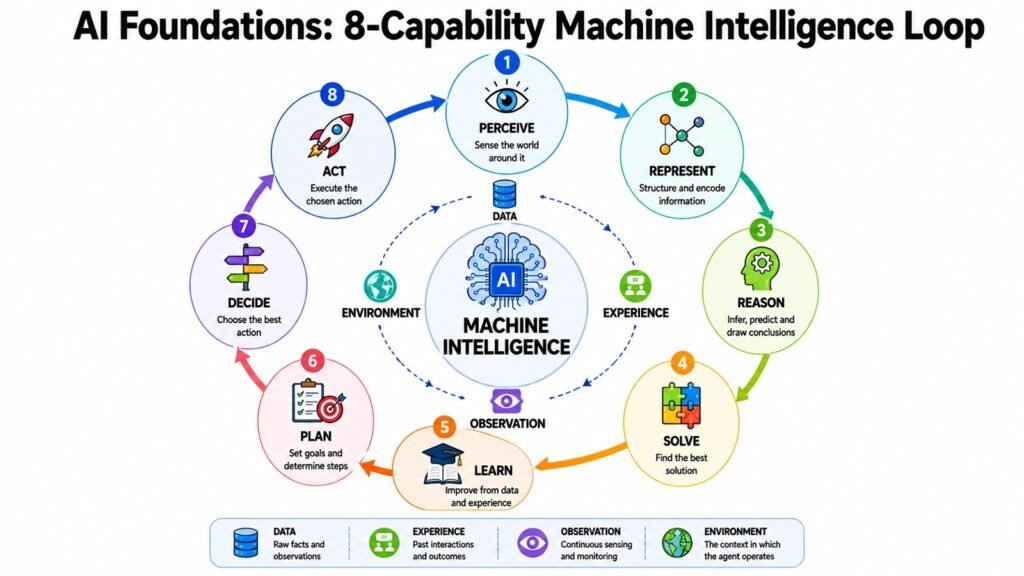
Machine intelligence is not a single capability. It is an outcome that emerges when multiple foundations are in place and operating together effectively. This article has examined eight of them, each contributing something specific to the overall picture. Perception gives a system access to information. Knowledge representation gives that information usable structure. Reasoning allows the system to work actively with what it knows. Problem solving identifies paths toward objectives. Learning enables the system to improve and adapt. Planning organizes intended action. Decision-making selects what the system does. Intelligent agency integrates all of these into a coherent, goal-directed system.
The distinction between artificial intelligence and machine intelligence carries practical weight. AI is the field, the discipline, the collection of technologies and methods. Machine intelligence is what a system can actually do when these foundations are sufficiently developed and well integrated. A system can deploy sophisticated machine learning without exhibiting the broader range of capabilities that characterize machine intelligence, and recognizing this distinction discourages both excessive enthusiasm and excessive skepticism about specific AI systems.
Contemporary advances in machine learning, generative AI, multimodal systems, and autonomous agents are expanding what these foundations can achieve. These advances are genuine and significant, but they do not change the underlying structure: machine intelligence still depends on how a system perceives, represents, reasons, learns, plans, decides, and acts.
When evaluating an unfamiliar AI system, the framework offers concrete questions: What does it perceive, and what does it miss? How does it represent knowledge, and what biases might that introduce? What kind of reasoning does it perform, and where might that fail? What does it optimize for, and who defined those objectives? These questions cut through marketing language to reveal where real capabilities and real limitations lie — the most durable takeaway this framework offers.
AI Foundations: Contributions to Machine Intelligence
| AI Foundations | Contribution to Machine Intelligence |
| Perception | Provides access to meaningful information from the environment or input domain |
| Knowledge Representation | Organizes information into structured forms that support intelligent processing |
| Reasoning | Enables the system to draw inferences, evaluate relationships, and handle uncertainty |
| Problem Solving | Identifies and evaluates paths from a current state to a desired goal |
| Learning | Allows the system to improve performance and adapt through data and experience |
| Planning | Organizes sequences of action to pursue objectives under real-world constraints |
| Decision Making | Translates analysis and objectives into specific, appropriate action choices |
| Intelligent Agents | Integrates all foundations into a unified system capable of goal-directed behavior |