Table of Contents
Introduction — Circular Economy Technologies: The Foundation of Circular Innovation
Credit: iken3
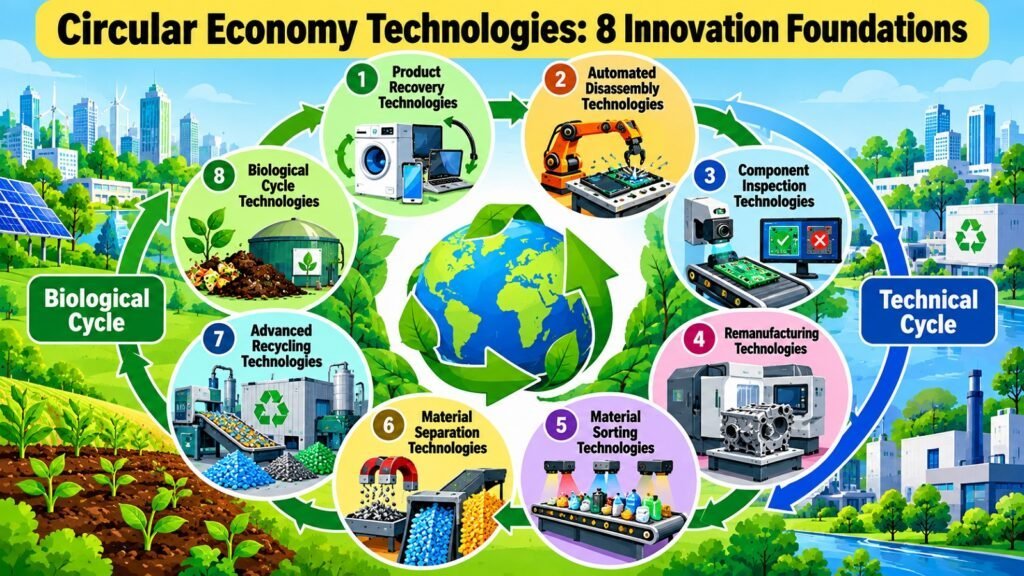
Sustainable technology covers many approaches, from renewable energy to smart infrastructure, but few areas are as structurally important as Circular Economy Technologies. These are the specialized capabilities that make it possible to recover, restore, reprocess, and regenerate products, components, materials and biological resources so that their value can be retained and returned to productive use. Without them, circular economy principles remain aspirational rather than operational. Circular Economy Technologies are some of the most important building blocks of Sustainable Technology.
The dominant model of industrial production has historically followed a linear path: extract raw materials, manufacture products, use them, and discard them. This take-make-use-dispose sequence consumes resources continuously while generating growing volumes of waste. A circular system challenges that logic by designing processes that retain resource value within the economy for as long as technically practical. The Ellen MacArthur Foundation describes the circular economy as restorative and regenerative by design — but that design cannot function without the right technologies.
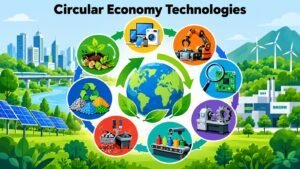
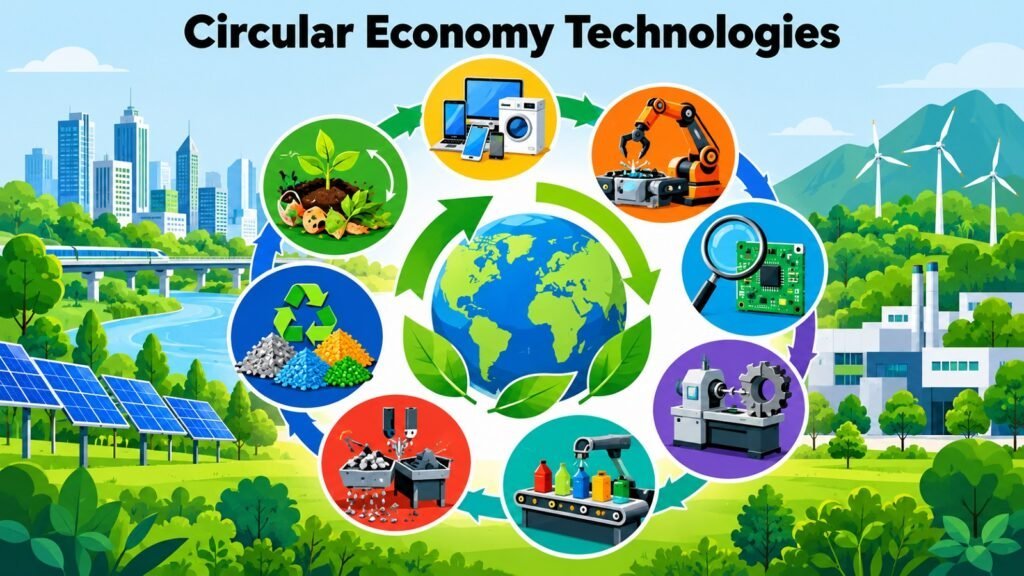
Circular Economy Technologies can be understood through two complementary cycles. The technical cycle encompasses technologies that recover and restore manufactured products, components and materials. The biological cycle encompasses technologies that return organic materials and nutrients to natural systems. Together, they form the technological architecture of a functioning circular economy.
A useful way to think about these technologies is as a progression from the highest level of retained value toward more fundamental material recovery. Product recovery aims to return a complete product to use. If that is not possible, disassembly and inspection determine what can be salvaged. Remanufacturing restores usable components. When component recovery is no longer feasible, sorting and separation classify and isolate recoverable materials. Advanced recycling converts difficult materials into secondary feedstocks. Biological cycle technologies close the loop for organic resources.
This article examines eight technological categories within that progression from a technology perspective. The central principle throughout is consistent: the objective of circular technologies is not simply to handle waste but to retain useful value for as long as technically achievable.
Table: Circular Economy Technologies — Eight Technological Aspects at a Glance
| Technological Aspects | Circular Role |
| Product Recovery Technologies | Identifies and recovers complete products or assemblies for direct reuse |
| Automated Disassembly Technologies | Systematically takes products apart to recover components and materials |
| Component Inspection Technologies | Assesses recovered component condition to guide downstream circular decisions |
| Remanufacturing Technologies | Restores used components or products to a condition suitable for renewed use |
| Material Sorting Technologies | Identifies and classifies materials within mixed streams for appropriate routing |
| Material Separation Technologies | Physically or chemically isolates classified materials into distinct streams |
| Advanced Recycling Technologies | Converts difficult or residual materials into usable secondary feedstocks |
| Biological Cycle Technologies | Returns organic materials and nutrients to productive biological cycles |
1. Circular Economy Technologies and Product Recovery Technologies
Credit: iken3
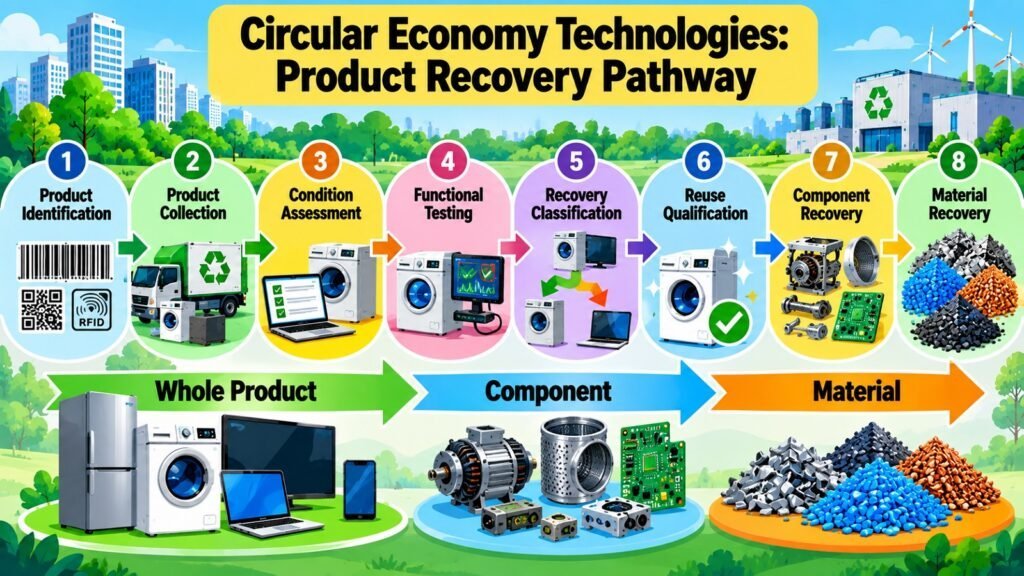
Product Recovery Technologies are the systems and capabilities used to identify, collect, assess, and recover complete products or high-value assemblies after their initial period of use. The underlying principle is straightforward: if a product still has useful life remaining, recovering it intact preserves more value than dismantling it. Reducing a functioning product to components or materials discards value that technology could retain.
The technical logic of product recovery begins with identification. Before a product can be recovered, it must be located and assessed for condition and potential further use. Technologies including barcode systems, radio-frequency identification, digital product passports and condition-monitoring data embedded in connected products allow recovery decisions to be based on reliable information. A product with documented usage history, maintenance records and performance data is far easier to evaluate than one without recorded information.
Condition assessment follows. Automated visual inspection and sensor-based diagnostics can determine whether a product meets the threshold for direct reuse, needs refurbishment, or should be redirected toward component or material recovery. Surface condition, mechanical wear, contamination, functional integrity and remaining service capacity all influence this determination. Product complexity matters too: assessing a simple mechanical part is far more straightforward than evaluating a multifunctional electronic device.
Real-world applications include automotive parts return programs, industrial equipment exchange platforms and electronics take-back systems. The EU Ecodesign for Sustainable Products Regulation increasingly requires that products be designed and documented in ways that facilitate recovery, pushing manufacturers toward more systematic use of identification and tracking technologies.
The limitations are genuine. Product recovery requires reliable reverse logistics, clean return streams and sufficient demand for recovered products. Not every product design supports recovery. When product recovery is no longer possible, the next step is disassembly.
Table: Circular Economy Technologies — Product Recovery Technologies and Their Circular Functions
| Technology / Function | Circular Role |
| RFID and barcode tracking | Identifies and locates products in the reverse supply chain |
| Digital product passports | Provides usage, maintenance and composition data to support recovery decisions |
| IoT-based condition monitoring | Captures real-time performance data to assess remaining service life |
| Automated visual inspection | Evaluates surface and structural condition at scale without manual assessment |
| Reverse logistics platforms | Manages physical collection and transport of used products for recovery |
| Diagnostic software tools | Assesses functional status of electronic and software-dependent products |
| Grading and sorting systems | Classifies recovered products by condition to route them to appropriate pathways |
| Digital marketplaces for recovery | Connects recovered products with buyers, reducing time in the reverse chain |
2. Circular Economy Technologies and Automated Disassembly Technologies
Credit: iken3
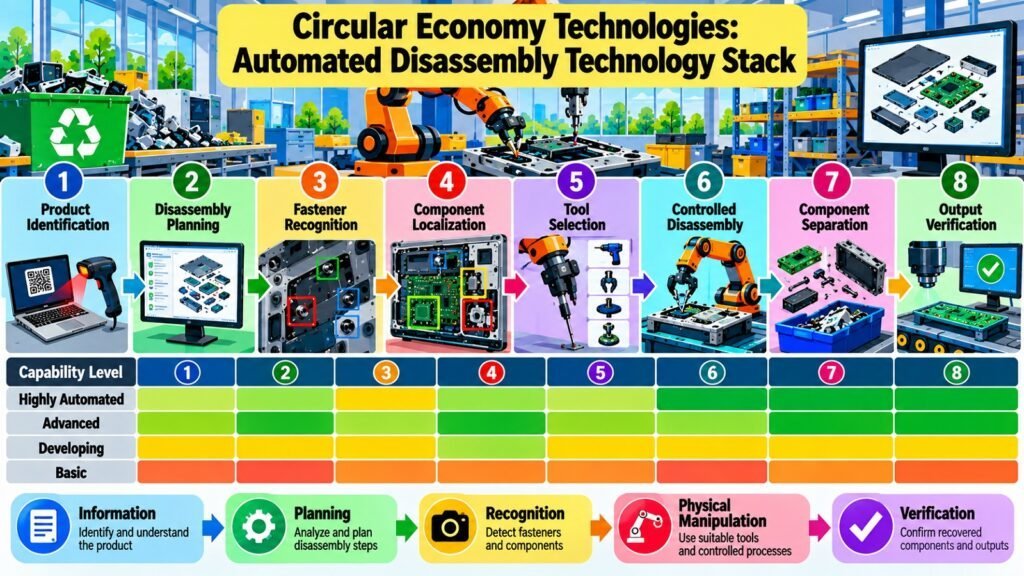
Automated Disassembly Technologies are the systems designed to take apart complex products and assemblies in a systematic, controlled way so that recoverable components and materials can be extracted for further circular processing. Disassembly occupies a critical position in the circular hierarchy: it bridges a product that can no longer be used as a whole and the individual components or materials that can still contribute value in other forms.
The key advantage of disassembly over direct shredding or mechanical fragmentation is that it preserves component integrity. A motor, circuit board or precision bearing removed intact retains its functional identity and most of its manufacturing value. The same component reduced to fragments contributes only to the material recovery stream, losing far more value in the process.
Automated systems rely on several enabling technologies. Machine vision identifies component types, locates fasteners and recognizes product variants. Robotics performs controlled, repeatable actions including unscrewing, unclipping and extracting. Disassembly planning algorithms generate optimized sequences that account for component dependencies, access constraints and recovery priorities.
The most significant technical challenge is variability. Products of the same general type can differ substantially in internal configuration, especially after repair or ageing. Permanent joining methods such as adhesive bonding and welding can prevent non-destructive component removal. Mixed materials and multilayer composites add further complexity. European research has demonstrated robotic disassembly of lithium-ion batteries from electric vehicles, where manual disassembly carries safety risks. Apple’s Daisy robots represent an industrial-scale application of product-specific automated disassembly.
The quality of disassembly directly affects downstream value. Components extracted cleanly are far better candidates for inspection and remanufacturing than those fractured or contaminated during removal, making automated disassembly a leverage point within the circular system.
Table: Circular Economy Technologies — Automated Disassembly Technologies and Their Applications
| Technology / Function | Circular Application |
| Machine vision systems | Identifies components, fasteners and product variants for targeted disassembly |
| Robotic arms with force sensing | Performs controlled removal of components without causing damage |
| Disassembly planning algorithms | Generates optimized sequences to maximize component recovery value |
| Laser cutting systems | Removes bonded or sealed joints where mechanical disassembly is not viable |
| Torque-controlled unscrewing tools | Extracts screwed fasteners without stripping threads or damaging housings |
| Battery disassembly robots | Safely dismantles EV and consumer battery packs for cell and material recovery |
| Adhesive debonding systems | Uses heat, ultrasound or solvents to release adhesively bonded components |
| 3D scanning and mapping | Creates a spatial model of a product to guide disassembly sequences |
3. Circular Economy Technologies and Component Inspection Technologies
Credit: iken3
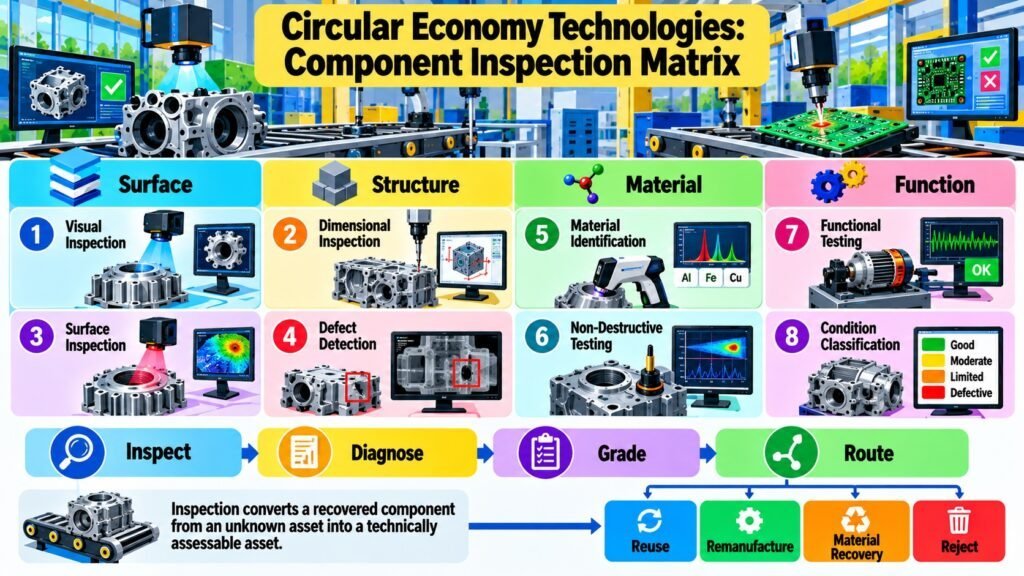
Component Inspection Technologies are the systems and methods used to determine the condition, integrity, dimensional accuracy and potential future usability of recovered components. They occupy a critical position between disassembly and remanufacturing. A recovered component cannot be efficiently returned to use or confidently redirected toward material recovery without first knowing its condition. Inspection provides that knowledge.
The distinction between identifying a component and assessing its condition is important. Identification confirms what a component is; inspection establishes how it is. A bearing that looks intact may have subsurface fatigue cracks that would cause early failure. A metal housing may have dimensional deviations outside the tolerances required for fit and function. Inspection technologies reveal these conditions before downstream decisions are made.
Relevant technologies span a broad range. Dimensional measurement systems and structured-light scanners verify whether a component meets its original geometric specifications. Machine vision detects surface defects, corrosion and physical damage. Non-destructive testing methods — including ultrasonic testing, X-ray imaging and eddy-current inspection — detect internal defects not visible on the surface. Spectroscopic methods such as X-ray fluorescence verify material identity and contamination. Functional test benches assess whether an electronic component performs as expected under operating conditions.
The limitations are real. Some degradation mechanisms, such as metal fatigue, do not always produce detectable changes until failure is imminent. Inspection speed, throughput and cost constrain what is economically practical to test. Despite these constraints, inspection quality is a key determinant of downstream circular value, determining which components enter remanufacturing with a reliable baseline condition assessment.
Table: Circular Economy Technologies — Component Inspection Technologies and What They Determine
| Technology / Method | What It Helps Determine |
| Coordinate measuring machines | Verifies dimensional accuracy and geometric conformance |
| Structured-light 3D scanning | Detects surface deviations and shape changes without contact |
| Machine vision systems | Identifies surface defects, contamination and physical damage |
| Ultrasonic testing | Detects internal cracks, voids and structural discontinuities |
| X-ray and CT imaging | Reveals internal geometry, defects and assembly conditions |
| Eddy-current inspection | Identifies surface and near-surface defects in conductive materials |
| X-ray fluorescence spectroscopy | Verifies material composition and detects substitution or contamination |
| Functional test benches | Assesses electrical or mechanical performance under controlled conditions |
4. Circular Economy Technologies and Remanufacturing Technologies
Credit: iken3
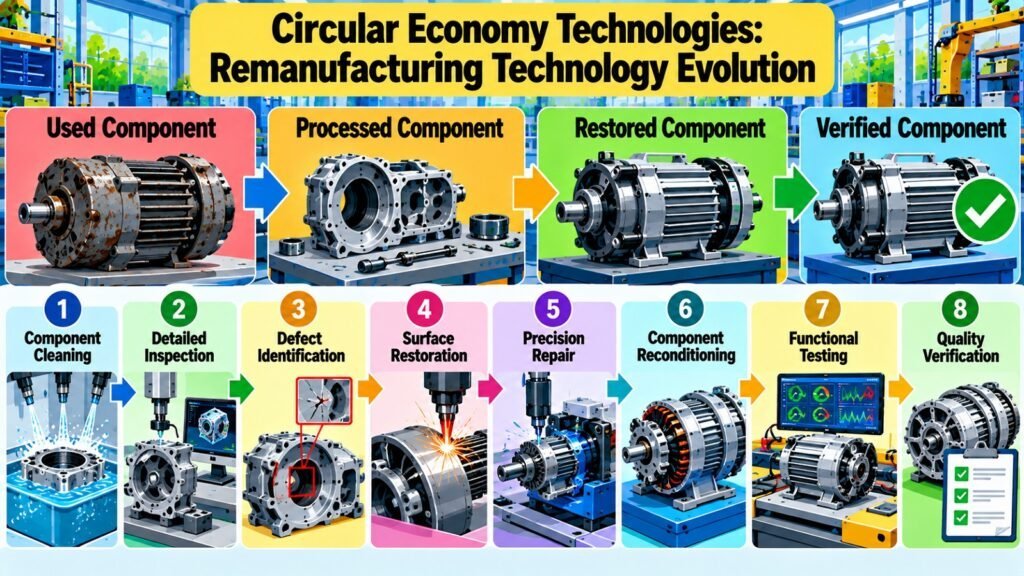
Remanufacturing Technologies are the processes, equipment and technical capabilities used to restore used or recovered components and products to a condition that meets defined performance and quality standards, making them suitable for renewed use. The focus here is on specific technical processes that restore value, distinct from the business context of a remanufacturing operation.
Remanufacturing follows a general technical sequence, though specific steps vary by product and component. After inspection confirms a component as a viable candidate, thorough cleaning removes contamination and residues that would interfere with subsequent processing. Precision machining returns worn surfaces to their specified geometry. Thermal and surface treatment processes — including heat treatment, electroplating, thermal spraying and laser cladding — restore material properties, surface hardness and wear resistance.
Advanced surface restoration technologies have expanded what can be practically remanufactured. Cold spray deposits metal onto worn surfaces at low temperatures, restoring material without the heat-affected zones from conventional welding. Laser metal deposition rebuilds complex geometries where machining alone is insufficient. After restoration, functional testing must verify that the component performs to the required standard before it is returned to use.
Technical requirements are demanding. Components must retain sufficient base material to support restoration without compromising structural integrity. Tolerance specifications must match the original. Peer-reviewed engineering literature confirms that remanufactured components can match original performance specifications in many applications, particularly in automotive, aerospace and industrial power systems.
Some components are technically unsuitable because the base material has degraded beyond recovery, or because the required restoration technology does not exist. When remanufacturing is not viable, materials enter the sorting and separation stage.
Table: Circular Economy Technologies — Remanufacturing Technologies and Their Value-Restoration Roles
| Technology / Process | Value-Restoration Role |
| Industrial cleaning systems | Removes contamination to prepare components for assessment and restoration |
| CNC precision machining | Restores worn surfaces and geometries to original dimensional specifications |
| Laser metal deposition | Rebuilds material on worn or damaged areas with high precision |
| Cold spray technology | Deposits metal coating to restore surface material at low thermal input |
| Thermal spraying | Applies wear-resistant coatings to restore and protect functional surfaces |
| Electroplating and electrochemical processes | Restores surface finish, corrosion resistance and dimensional accuracy |
| Heat treatment systems | Restores mechanical properties such as hardness and toughness in metal components |
| Functional test and verification equipment | Confirms that restored components meet performance specifications before reuse |
5. Circular Economy Technologies and Material Sorting Technologies
Credit: iken3
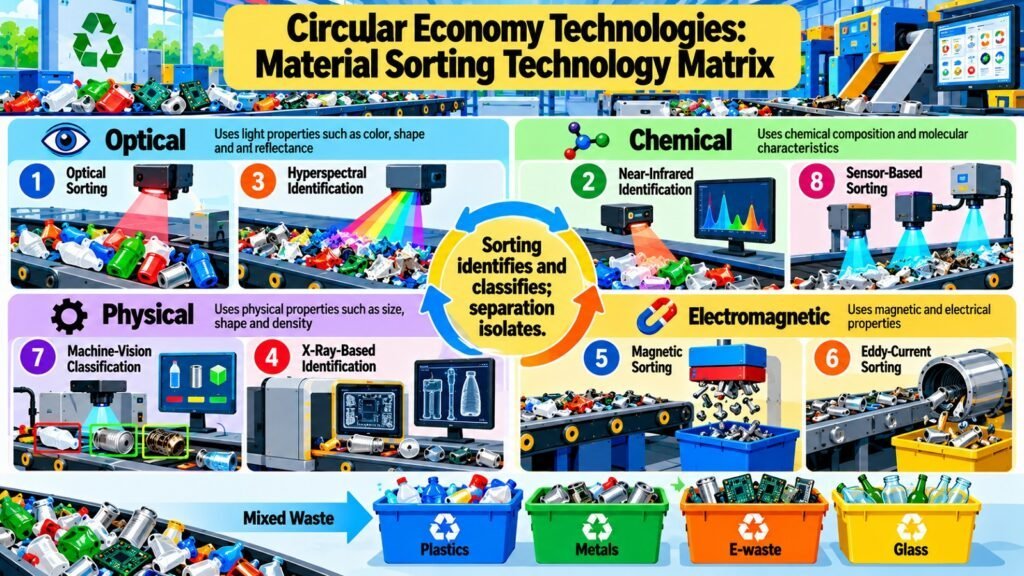
Material Sorting Technologies are the systems that identify and classify different materials within mixed product or waste streams so that they can be directed toward appropriate recovery pathways. Sorting is the necessary precursor to separation and recycling: you cannot effectively process a material you have not accurately identified. The quality of sorting decisions at this stage directly influences every subsequent step in the circular chain.
A conceptual distinction is worth establishing. Sorting determines or classifies what a material is, while separation subsequently isolates it into a distinct stream. In practice these functions can overlap, but keeping the distinction in mind clarifies the specific challenge that sorting technologies address.
Different sorting technologies exploit different physical or chemical properties. Near-infrared spectroscopy identifies polymer types by their molecular absorption signatures, making it standard in plastics sorting. X-ray fluorescence detects heavy metals and material composition at levels not visible to surface scanning. Magnetic sensors identify ferrous materials; eddy-current detectors identify non-ferrous conductive metals. Optical systems assess surface color and reflectance. Machine learning has improved classification accuracy for materials with similar signatures, though contamination, composite constructions and high throughput requirements still create practical limits.
Applications span municipal solid waste, electronic waste and construction and demolition streams. However, improved identification does not automatically guarantee successful recovery. A material correctly identified as recyclable still needs to be physically separated, cleaned and processed to yield an output suitable for its intended application. Sorting creates the routing basis for that work; the downstream steps must also succeed.
Table: Circular Economy Technologies — Material Sorting Technologies and Their Circular Roles
| Technology / Detection Approach | Material Characteristic or Circular Role |
| Near-infrared spectroscopy | Identifies polymer types by molecular absorption signature |
| X-ray transmission sorting | Detects density and composition differences in mixed material streams |
| X-ray fluorescence analysis | Identifies heavy metals and elemental material composition |
| Optical color sorting | Classifies materials by surface color and reflectance |
| Eddy-current detection | Identifies non-ferrous conductive metals in mixed streams |
| Magnetic separation sensors | Detects and routes ferrous metals from mixed waste streams |
| Laser-induced breakdown spectroscopy | Provides elemental composition data for material classification |
| AI-enhanced machine vision | Improves classification accuracy for visually similar or contaminated materials |
6. Circular Economy Technologies and Material Separation Technologies
Credit: iken3
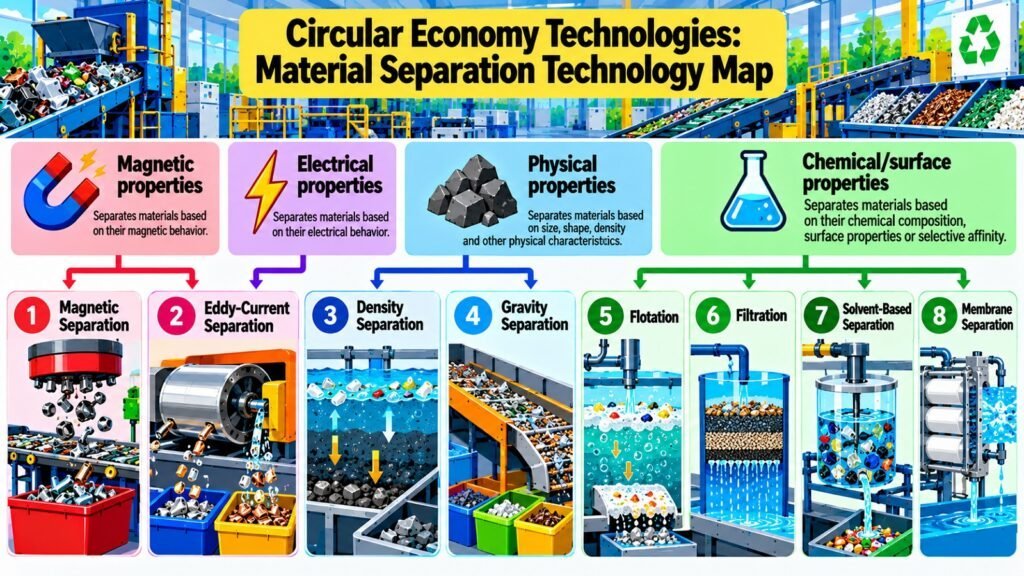
Material Separation Technologies are the systems and processes that physically or chemically isolate specific materials from mixed streams after sorting has identified and classified what is present. Where sorting produces knowledge about a stream’s composition, separation produces the distinct, enriched fractions that can be passed to recycling or reprocessing. The purity of those fractions determines how useful they will be downstream.
The distinction from sorting is meaningful: sorting is an information and routing function, while separation is a physical or chemical isolation function. Some systems perform both within a single integrated process, but understanding the distinction clarifies what any given technology contributes.
Different technologies operate on fundamentally different principles. Magnetic separation exploits the magnetic susceptibility of ferrous materials to extract them without any chemical processing. Eddy-current separators induce eddy currents in non-ferrous metals, generating a force that propels them away from the main stream. Both are well-established, high-throughput methods for metals. Density-based approaches — air classification, jig separation and sink-float processing — exploit differences in density to classify materials by whether they float or sink. Froth flotation uses differential surface chemistry to attach air bubbles selectively to certain particles.
For composites, multilayer films and materials with similar physical properties, chemical approaches become relevant. Solvent-based separation can selectively dissolve specific polymer layers, enabling individual polymer types to be recovered — though these methods are more demanding and energy-intensive than mechanical approaches.
Practical performance depends on feedstock consistency, contamination and throughput requirements. Output purity is critical because recycling systems typically require inputs that meet defined quality thresholds.
Table: Circular Economy Technologies — Material Separation Technologies and the Principles They Exploit
| Technology / Method | Principle or Material Distinction Exploited |
| Magnetic drum separation | Magnetic susceptibility of ferrous metals |
| Eddy-current separation | Electrical conductivity of non-ferrous metals in a magnetic field |
| Air classification | Density and aerodynamic drag differences between material fractions |
| Sink-float separation | Density differences in liquid media between polymer types |
| Froth flotation | Differential surface chemistry for particle attachment to air bubbles |
| Filtration and screening | Particle size differences to isolate fine from coarse fractions |
| Solvent-based polymer separation | Selective solubility of polymers in specific solvent systems |
| Electrostatic separation | Triboelectric charge differences between insulating materials |
7. Circular Economy Technologies and Advanced Recycling Technologies
Credit: iken3
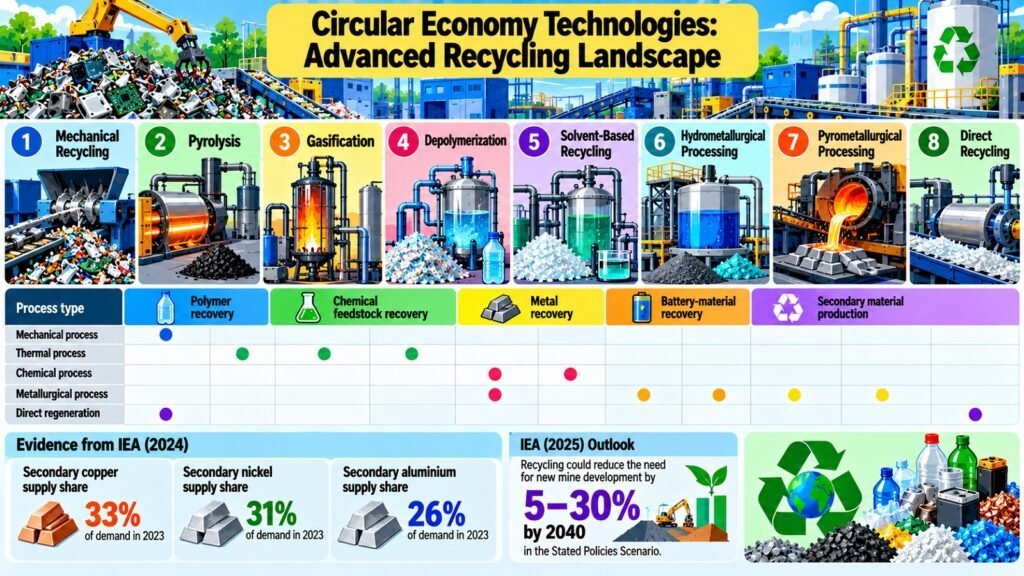
Advanced Recycling Technologies are the processes that convert recovered or residual materials into usable secondary materials or feedstocks when simpler forms of recovery are no longer technically suitable. Precision matters here: not all advanced recycling technologies are equally mature, equally proven at industrial scale, or equally appropriate for every material type.
Conventional mechanical recycling — cleaning, grinding, melting and reforming — works well for materials that retain their properties through repeated processing, such as metals and glass. But it has clear limits. Polymers degrade over multiple cycles, losing molecular weight and mechanical properties. Multilayer or contaminated materials may not be processable mechanically into useful outputs. Advanced recycling addresses some of these limitations through chemical, thermal or biological processes at the molecular level.
Chemical depolymerization breaks polymers back to their monomer building blocks, which can then be re-polymerized into virgin-equivalent material. Glycolysis and hydrolysis are established examples for PET, and research bodies including WRAP and the Ellen MacArthur Foundation document the growing but still limited scale of industrial deployment. Pyrolysis thermally decomposes plastics or organics in the absence of oxygen, producing oils, gases and char. Output quality depends heavily on feedstock composition and process control, and the technology’s real-world yield and energy balance in mixed plastic applications remain subject to ongoing evaluation.
Solvent-based purification — dissolving a target polymer, filtering out contaminants and precipitating the purified polymer — represents a category closer to physical purification than chemical conversion, and has been piloted by several European companies.
The critical point for all these technologies is that feedstock quality matters enormously. Contamination and mixed compositions reduce yields and can degrade output quality to a point where the recovered material cannot substitute for its intended primary application.
Table: Circular Economy Technologies — Advanced Recycling Technologies and Their Primary Roles
| Technology / Process | Primary Technical Role |
| Mechanical recycling | Cleans, melts and reforms thermoplastics into secondary material |
| Chemical depolymerization | Breaks polymers to monomers for re-polymerization to virgin-equivalent material |
| Glycolysis | Depolymerizes PET to monomers using glycol-based solvent systems |
| Pyrolysis | Thermally converts plastics and organics to oils, gases and char |
| Solvent-based purification | Dissolves and re-precipitates target polymers to remove contaminants |
| Hydrometallurgy | Uses aqueous chemistry to extract metals from electronic waste and batteries |
| Pyrometallurgy | Uses high-temperature smelting to recover metals from complex material streams |
| Black mass processing | Recovers lithium, cobalt and other battery metals from end-of-life cells |
8. Circular Economy Technologies and Biological Cycle Technologies
Credit: iken3
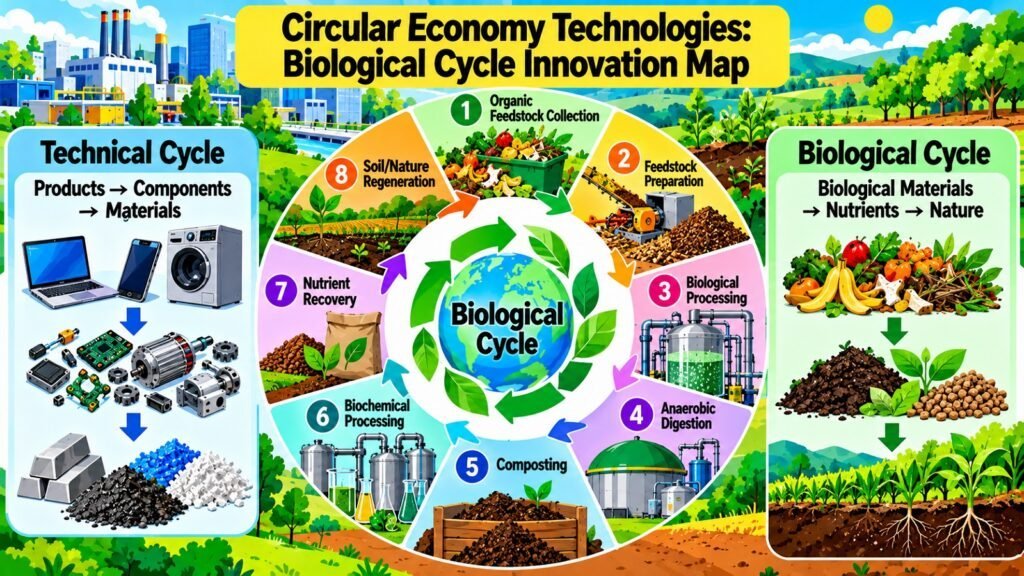
Biological Cycle Technologies are the systems and processes that manage organic materials so that nutrients, energy and biological resources can return to productive biological cycles rather than being diverted to landfill or incineration. A complete understanding of Circular Economy Technologies must include this biological dimension, because a significant portion of materials flowing through modern economies is biological in origin: food, agricultural products, organic residues, forestry materials and bio-based packaging.
The biological cycle differs fundamentally from the technical cycle. Technical-cycle technologies aim to preserve the properties of manufactured materials — metals, polymers, glass — through processing and recirculation. Biological-cycle technologies work with materials whose value lies in nutrients, organic matter or energy content, and whose destiny is transformation rather than preservation. A composting system transforms food residues into a soil amendment that returns nutrients to agricultural land; it does not try to maintain the molecular identity of the original material.
Anaerobic digestion is one of the most technically established biological-cycle processes. It uses microbial communities in oxygen-free conditions to decompose organic materials, generating biogas — primarily methane — for electricity or heat, and producing a nutrient-rich digestate suitable for agricultural land application. Composting transforms organic materials through aerobic microbial activity into a stabilized soil amendment. It handles a broader feedstock range than anaerobic digestion and produces a product directly useful for soil improvement, though feedstock quality strongly affects the agronomic value of the finished compost.
Nutrient recovery technologies address more targeted circular goals. Struvite precipitation recovers phosphorus and nitrogen from wastewater as a slow-release fertilizer — significant because phosphorus is a finite and geographically concentrated resource.
Contamination is a persistent technical challenge across all biological-cycle processes. Plastics, heavy metals and persistent organic pollutants in organic waste streams can compromise the quality and safety of compost, digestate and recovered nutrients, restricting their agricultural use. Feedstock quality management is therefore as important as the processing technology itself.
Table: Circular Economy Technologies — Biological Cycle Technologies and Their Circular Functions
| Technology / Process | Circular Function |
| Anaerobic digestion | Converts organic waste to biogas and nutrient-rich digestate |
| Industrial composting | Transforms organic materials into stabilized soil amendments |
| Struvite precipitation | Recovers phosphorus and nitrogen from wastewater as slow-release fertilizer |
| Biorefinery processing | Extracts multiple value streams including biochemicals and bioenergy from biomass |
| Aerobic fermentation | Produces biochemicals, enzymes and bio-based materials from organic feedstocks |
| Algae cultivation systems | Converts wastewater nutrients and CO2 into biomass for food, fuel or fertilizer |
| Hydrothermal carbonization | Converts wet organic waste to hydrochar for soil improvement or energy use |
| Insect bioconversion | Uses larvae such as black soldier fly to convert organic residues into protein and compost |
Conclusion — Circular Economy Technologies: Powering a Circular Future
Credit: iken3
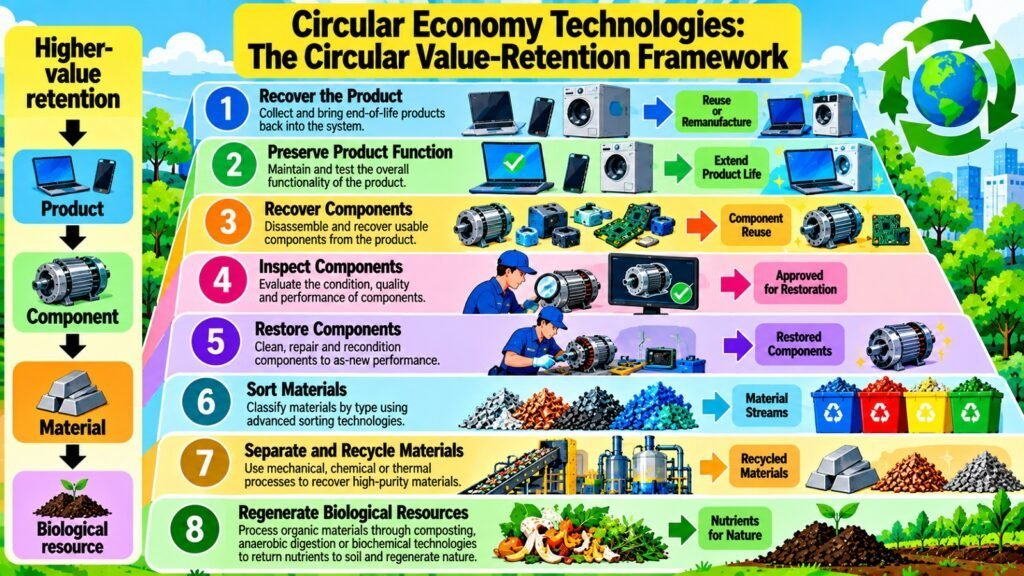
Circular Economy Technologies collectively represent a technological foundation for moving beyond linear resource consumption toward systems in which products, components, materials and biological resources are retained at their highest practical value for as long as technically feasible. The eight categories examined in this article form a coherent progression extending from product recovery to the return of biological resources to natural cycles.
That progression has a clear internal logic. Product Recovery Technologies aim to return value in its most complete form, avoiding the resource and energy cost of reproduction. When a complete product cannot be recovered, Automated Disassembly Technologies preserve component integrity so that the next level of value can be captured. Component Inspection Technologies provide the technical knowledge needed to decide what each recovered component can contribute. Remanufacturing Technologies restore that value through precision processes. Where component recovery reaches its technical limit, Material Sorting Technologies classify what remains, and Material Separation Technologies isolate it into processable streams. Advanced Recycling Technologies convert difficult or residual materials into secondary feedstocks. Biological Cycle Technologies ensure that organic resources complete their own regenerative circuit.
Enabling technologies — artificial intelligence, robotics, sensors, process control and digital data platforms — appear throughout this progression. They strengthen detection accuracy, improve process control and enable decisions that would otherwise require intensive manual effort. But they work within and alongside circular processes; they do not replace the specific technical functions that each category performs.
Several practical principles emerge from examining these eight categories together. Value retention diminishes at each stage of the circular hierarchy, so the highest-value outcome always requires the least transformation. The quality of outputs at any stage depends significantly on decisions made at earlier stages. Limitations are real: no technology currently enables complete, zero-loss circularity for all materials in all conditions. And the connections between stages matter as much as the individual technologies themselves.
This framework — from product recovery to biological cycling, guided by technological capability and constrained by honest technical limits — offers a practical mental model for evaluating circular technologies as they continue to develop.
Table: Circular Economy Technologies — Eight Aspects and Their Value-Retention Roles
| Technological Aspects of Circular Economy Technologies | Circular Value-Retention Role |
| Product Recovery Technologies | Retains maximum value by returning complete products to use without reprocessing |
| Automated Disassembly Technologies | Preserves component value by dismantling products systematically rather than fragmenting them |
| Component Inspection Technologies | Provides the technical basis for confident circular routing decisions |
| Remanufacturing Technologies | Restores component value to meet performance standards for renewed productive use |
| Material Sorting Technologies | Enables accurate classification that determines the quality of all downstream recovery |
| Material Separation Technologies | Produces isolated, purified material fractions suitable for reprocessing |
| Advanced Recycling Technologies | Converts residual and difficult materials into secondary feedstocks for productive reuse |
| Biological Cycle Technologies | Returns nutrients and organic resources to biological systems for regenerative reuse |