Table of Contents
Introduction: Audio Streaming and the Transformation of Modern Listening
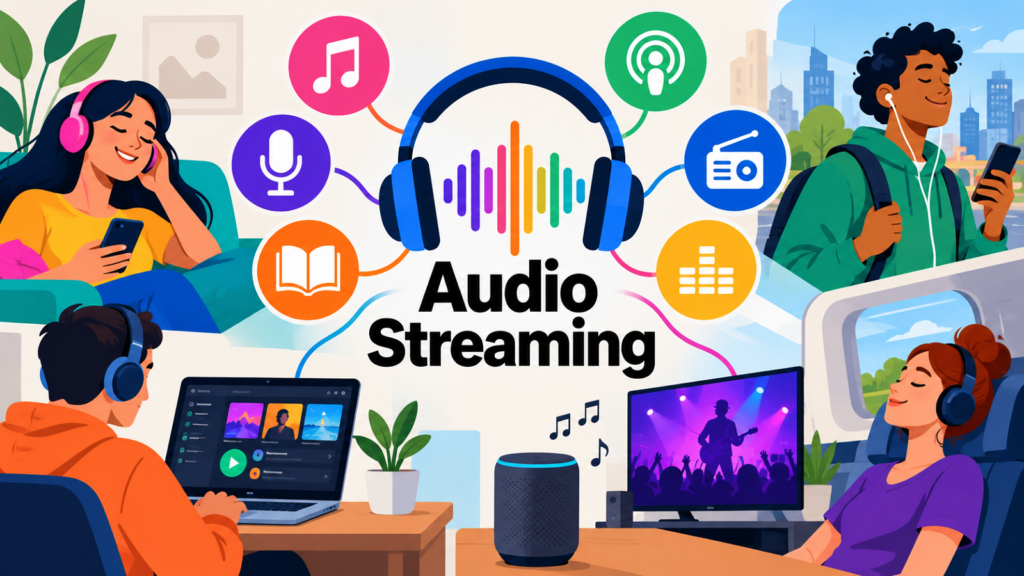
Audio streaming is one of the defining forces in modern digital entertainment. It has changed not just how people play music, but how they access, discover, and experience audio across every connected device. Where listening once depended on physical ownership and scheduled broadcasts, it now operates around instant availability, personalized recommendations, and on-demand access.
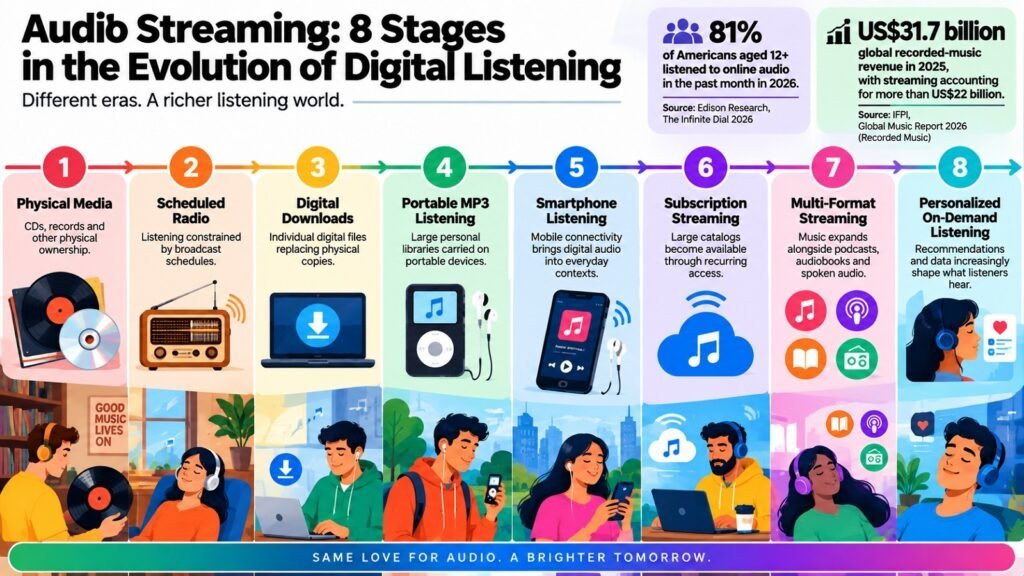
The journey toward streaming began with vinyl and cassette tapes, continued through CDs and digital downloads, and arrived at the subscription-based, cloud-delivered model that exists today. Each stage improved some combination of access, portability, or cost. Streaming consolidated those gains and introduced something genuinely different: a model where listeners pay for continuous access to enormous catalogs rather than purchasing individual titles.
Music streaming is a significant part of audio streaming, but not the whole picture. Audio streaming also encompasses podcasts, audiobooks, internet radio, news programs, meditation guides, and educational content. These formats share the same infrastructure and platforms, making audio streaming one of the broadest categories in digital entertainment.
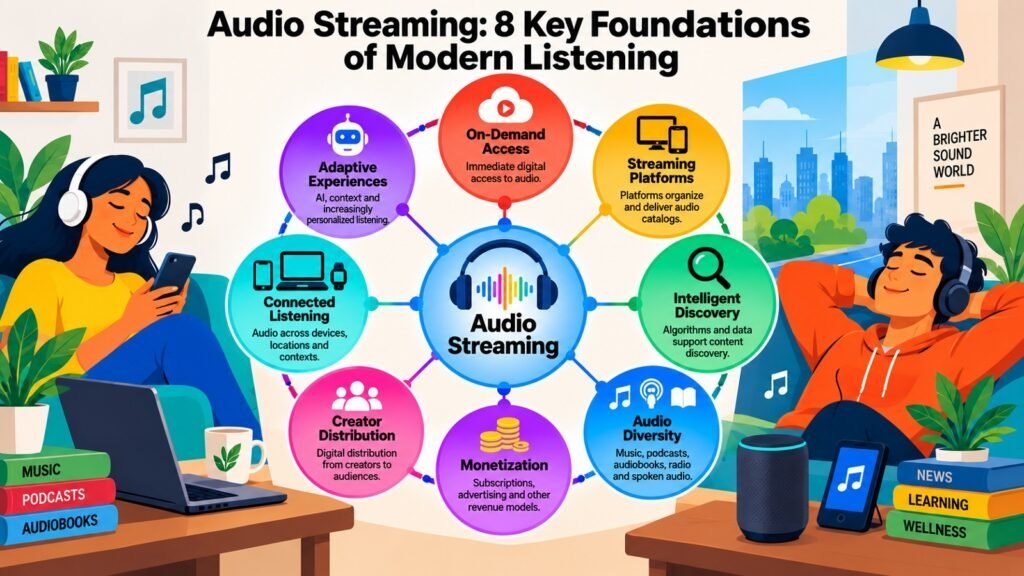
The changes have extended across every relationship in the ecosystem — among listeners, creators, platforms, rights holders, advertisers, and distributors. Monetization has shifted from unit sales to subscriptions. Discovery has moved from radio airplay to algorithmic recommendations. Distribution has transitioned from retail to platform-based delivery. This article examines eight interconnected dimensions, from on-demand access through platforms, personalization, content diversity, economics, creator distribution, connected devices, and future development.
Audio Streaming: Eight Aspects at a Glance
| Audio Streaming Aspect | What It Explains |
| On-Demand Access | How streaming replaced ownership with instant, cloud-based listening |
| Music Platforms and Ecosystems | How platforms structure, license, and deliver large audio catalogs |
| Personalization and Discovery | How algorithms and data help listeners navigate enormous catalogs |
| Beyond Music: Diverse Audio Formats | How podcasts, audiobooks, and spoken audio expanded streaming |
| Monetization and Economics | How subscriptions, advertising, and royalties sustain the ecosystem |
| Creator and Distribution Ecosystem | How streaming changed distribution reach for artists and creators |
| Connected Devices and Experiences | How listening moved across smart speakers, cars, and wearables |
| Future of Audio Streaming | How AI and adaptive audio may reshape discovery and interaction |
1. Audio Streaming Through On-Demand Access and Digital Consumption
The most fundamental change audio streaming introduced was the move from ownership to access. For most of recorded music history, listening required owning a physical object — a vinyl record, a cassette, a CD — or tuning into a scheduled broadcast. Even digital downloads, which removed the physical element, still tied listeners to files on a specific device. Streaming ended that dependency by providing instant access to enormous catalogs from any connected device.
Three converging conditions made this possible. Broadband internet reached enough households by the mid-2000s to make reliable audio delivery practical. Cloud storage allowed platforms to host and serve millions of tracks efficiently. Smartphones provided always-connected, portable devices suited to on-demand media. Spotify’s 2008 European launch demonstrated that listeners would accept a catalog-rental model when access was broad, the experience smooth, and the price competitive with buying albums.
The theoretical concept underlying this shift is access-based consumption — a term from consumer behavior research describing models where people pay for continuous access rather than ownership. The distinction matters because it changes what the listener controls. Ownership means content remains available regardless of what a platform does. Access means continued availability depends on the platform’s licensing relationships and operational continuity. Streaming listeners trade the certainty of ownership for breadth, immediacy, and portability.
On-demand access also transformed listening expectations. The ability to hear any track immediately, repeat it without limit, skip freely, and carry the full catalog across devices changed how audio integrates into everyday routines. Commuting, exercising, and working became natural streaming contexts once the model removed friction from every stage of the listening process. Evaluating whether a service truly delivers on-demand access means examining catalog depth, search responsiveness, offline availability, and cross-device synchronization.
Audio Streaming Consumption: Eight Stages of Evolution
| Consumption Stage | Defining Characteristic |
| Physical Media Era | Listening required owning a physical object such as a vinyl record or cassette |
| Broadcast Radio | Content was scheduled and broadcast; listeners could not choose timing or track |
| CD and Digital Audio | Digital encoding improved quality but retained individual ownership of files |
| MP3 and Portable Players | Compressed files enabled portability but required manual collection management |
| Digital Download Stores | Individual tracks and albums purchased digitally, tied to specific device libraries |
| Early Streaming Services | On-demand access introduced; catalogs were smaller and connectivity was limited |
| Subscription Streaming | Large catalogs accessed via monthly subscription without file ownership |
| Multi-Device and Cloud Streaming | Listening synchronized across smartphones, speakers, cars, and wearables |
2. Audio Streaming Through Music Platforms and Streaming Ecosystems
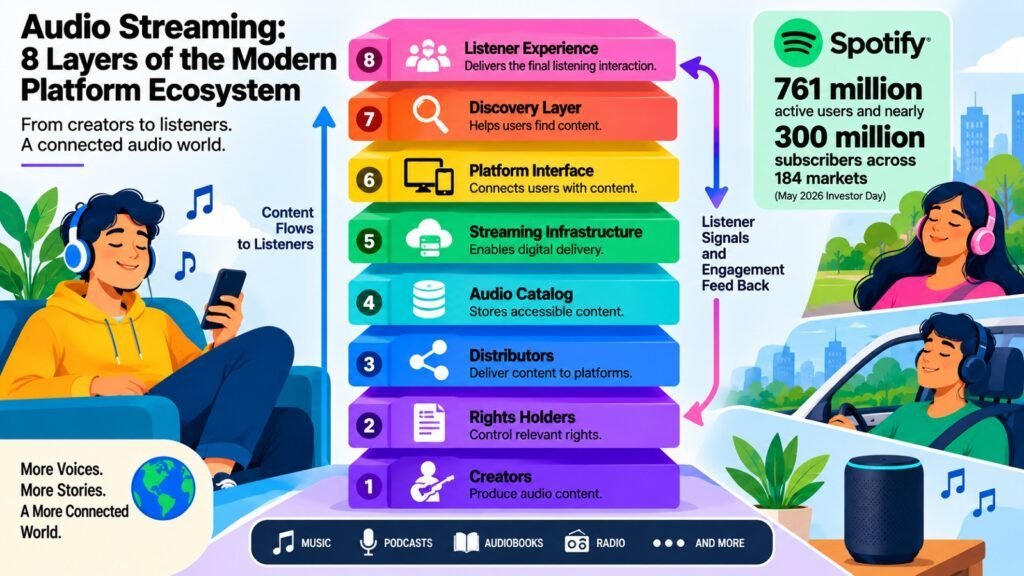
Audio streaming platforms did not simply move music online — they created interconnected systems linking listeners, creators, rights holders, advertisers, and technology providers within shared digital environments. Understanding how these ecosystems work is essential to understanding why audio streaming operates differently from earlier distribution models and why the platform has become the central unit of the listening experience.
Services such as Spotify, Apple Music, Amazon Music, and YouTube Music each approach streaming differently, but share common structural features: licensed catalogs, search and discovery interfaces, playlist support, and delivery across multiple devices. They differ in how they balance advertising-supported access against paid subscriptions, how deeply they integrate with device ecosystems, and how aggressively they pursue exclusive content. These differences reflect strategic choices rather than technical capability.
A streaming platform is not simply an application — it is a set of relationships among content, technology, distribution, licensing, and listener behavior. The value it creates depends on catalog breadth, discovery quality, interface design, cross-device compatibility, and the strength of licensing relationships with labels, publishers, and independent distributors. Listeners benefit not just from the catalog itself but from all the infrastructure connecting it to their listening context.
Traditional music distribution relied on physical manufacturing, wholesale, retail, and shelf space — concentrating power among a small number of gatekeepers. Platform-based distribution replaces that chain with a digital one where licensing agreements and algorithmic visibility serve similar gatekeeping functions. The medium changes; the structural role of distribution infrastructure does not. Music streaming is a large component of audio streaming, but not synonymous with it, and a platform’s ecosystem strength should be assessed across catalog breadth, discovery quality, and format diversity — not music alone.
Audio Streaming Platform Ecosystem: Eight Key Components
| Ecosystem Component | Role in Audio Streaming |
| Licensed Catalog | Provides the content library that defines what listeners can access |
| Search and Browse Interface | Allows listeners to find specific content within a large catalog |
| Recommendation Engine | Surfaces relevant content based on listening behavior and preferences |
| Subscription and Billing System | Manages access tiers, payments, and free-versus-paid differentiation |
| Cross-Device Compatibility | Allows listening to continue across smartphones, speakers, and computers |
| Creator and Label Partnerships | Establishes the licensing relationships that make catalog access possible |
| Advertising Infrastructure | Delivers and monetizes ad-supported listening for non-paying users |
| Podcast and Spoken Audio Integration | Expands platform value beyond music into broader audio categories |
3. Audio Streaming Through Personalization and Intelligent Discovery
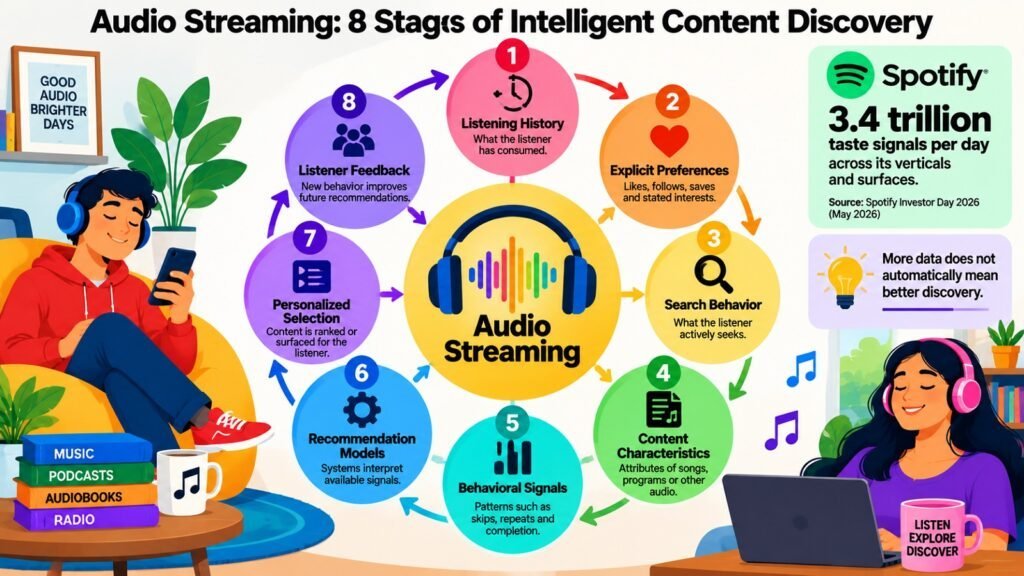
Access to tens of millions of tracks creates a problem as much as an opportunity. Without effective discovery tools, the sheer volume of available content makes choosing what to hear cognitively difficult. Audio streaming platforms recognized this early and invested heavily in recommendation systems designed to surface relevant content without requiring listeners to search manually. Personalization has become one of the defining competitive features of modern streaming.
Recommendation systems generally combine two main approaches. Collaborative filtering identifies patterns across many listeners — if users who share your listening history consistently play a particular artist, the system infers you may find it relevant. Content-based recommendation analyzes the musical characteristics of tracks you already enjoy and searches the catalog for audio with similar properties, such as tempo, key, and energy. Most systems blend both approaches with editorial input and behavioral signals from search queries and skip patterns.
Spotify’s Discover Weekly, launched in 2015, became one of the best-known examples of algorithm-driven discovery at scale. The underlying principle is that behavioral signals from millions of listeners, processed collectively, can reliably surface content that individuals would not have found by browsing — a meaningful improvement over radio or physical retail, where discovery depended on limited broadcast programming or a single store’s inventory.
Personalization carries real trade-offs. Systems optimized for relevance tend to reinforce existing preferences rather than expand them, narrowing exposure to unfamiliar artists and genres. Algorithmic visibility also concentrates reach among content that recommendation engines favor, leaving material outside established behavioral patterns largely undiscovered. Evaluating a recommendation experience means asking whether it accounts for listening context, introduces unfamiliar content alongside familiar material, and supports listener control over the suggestions it makes.
Audio Streaming Personalization: Eight Discovery Mechanisms
| Personalization Element | How It Supports Discovery |
| Listening History Analysis | Identifies patterns in past behavior to predict future preferences |
| Collaborative Filtering | Recommends content based on habits of listeners with similar tastes |
| Content-Based Analysis | Matches audio features such as tempo and key to listener preferences |
| Explicit User Preferences | Uses genre, artist, or mood selections made directly by the listener |
| Search Query Signals | Infers interests from words and phrases used in catalog searches |
| Playlist Curation Behavior | Treats what a listener adds to or removes from playlists as preference data |
| Skip and Replay Patterns | Uses track skipping or repetition as implicit approval or rejection signals |
| Contextual and Temporal Data | Adjusts recommendations based on time, location, or activity context |
4. Audio Streaming Beyond Music: Podcasts, Audiobooks, and Spoken Audio
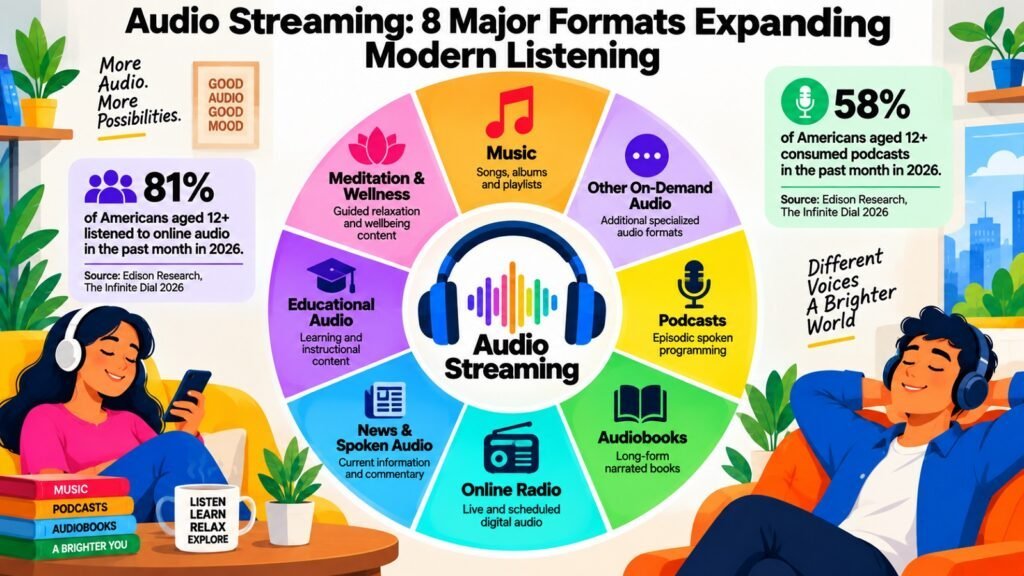
One of the clearest demonstrations that audio streaming is broader than music streaming is the rapid diversification of what people listen to. Podcasts, audiobooks, internet radio, news briefings, meditation programs, educational lectures, and spoken-word content have all moved into the streaming model, often using the same infrastructure, platforms, and devices as music. The result is an ecosystem where different formats serve different purposes and compete for the same listening time.
The distribution logic is consistent across formats. Streaming infrastructure reduces the cost and complexity of reaching audiences. A podcast that previously required listeners to manage RSS feeds can now be discovered and played within a streaming interface. An audiobook that required purchase or library checkout can be accessed through a subscription catalog on demand. Internet radio stations previously limited by broadcast geography now reach global audiences through the same delivery networks that serve music.
Different formats create different listening occasions. Music provides an emotional backdrop for other activities. Podcasts offer companionship and information during commutes or exercise. Audiobooks fill long-form engagement time when reading is impractical. News briefings compress the morning update into a few minutes of audio. Each format has different requirements for attention and duration, and streaming platforms have adapted their interfaces accordingly.
The expansion of formats also affects how platforms compete. A service offering only music competes on catalog size and recommendation quality. A service incorporating podcasts, audiobooks, and other audio competes additionally on format breadth and its ability to serve a listener’s full audio day — a strategic reality that has driven significant acquisitions, exclusive content deals, and platform expansion across the industry. A service integrating multiple formats within a single discovery experience provides fundamentally more value than one treating them as separate products.
Audio Streaming: Eight Major Audio Formats and Their Listening Purposes
| Audio Format | Typical Listening Purpose |
| Music | Entertainment, mood management, and emotional engagement during daily activities |
| Podcasts | Information, storytelling, and companionship during commutes or exercise |
| Audiobooks | Long-form narrative or educational engagement when reading is impractical |
| Internet Radio | Curated or genre-based listening without requiring active track selection |
| News Briefings | Condensed daily news updates in a short, structured audio format |
| Meditation and Wellness Audio | Guided relaxation, breathing exercises, and mindfulness practice |
| Educational Programming | Learning through lectures, language courses, and instructional content |
| Spoken-Word and Comedy | Entertainment through stand-up, storytelling, and dramatic readings |
5. Audio Streaming Through Monetization, Subscriptions, and Advertising
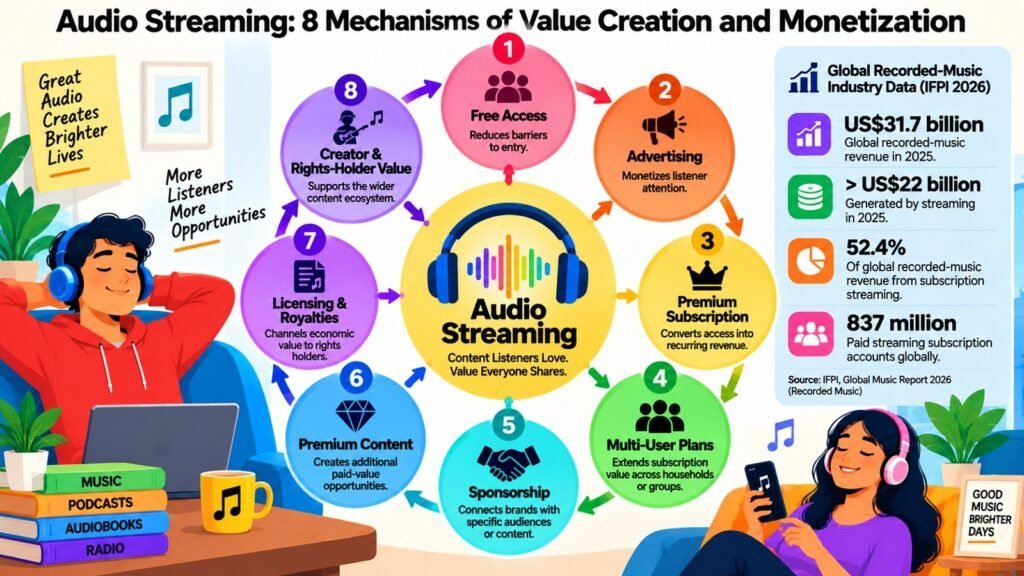
Audio streaming platforms require sustainable revenue to license content, maintain infrastructure, and compensate creators and rights holders. The monetization models they use shape nearly everything else about the ecosystem: what content is available, how it is priced, and how value flows to those who create it. Understanding these economic foundations is necessary to understanding why the ecosystem operates as it does.
The dominant approach combines a freemium structure with paid subscription tiers. Listeners who do not pay receive limited catalog access supported by audio advertisements. Subscribers pay a monthly fee for ad-free listening, full catalog access, and offline playback. This structure serves a dual purpose: the free tier attracts users and generates advertising revenue, while paid subscriptions produce recurring income at higher margins.
Advertising revenue within streaming operates similarly to digital advertising elsewhere. Platforms sell inventory in the form of audio spots inserted into free-tier sessions, and listener behavioral data makes this inventory more valuable. Targeting can be refined by listening context, time of day, device type, and inferred interest categories — an advantage that helps streaming platforms command higher rates than traditional broadcast audio advertising.
How revenue flows to creators and rights holders remains the most debated aspect of streaming economics. The predominant royalty model distributes a share of total platform revenue across rights holders proportional to each piece of content’s stream count relative to total streams. Critics argue this concentrates revenue among the most-streamed content and returns very small amounts to artists with smaller but genuine audiences. Some platforms have tested user-centric payment models, which allocate each subscriber’s fee proportionally to the artists they actually listened to, producing a more direct connection between listening behavior and creator compensation.
Audio Streaming Monetization: Eight Economic Models
| Economic Model | How Value Is Captured |
| Paid Subscription | Listeners pay a recurring fee for ad-free, full-catalog access |
| Freemium Tier | Free access supported by audio advertisements targets broad user acquisition |
| Audio Advertising | Revenue earned by inserting ads into free-tier listening sessions |
| Family and Group Plans | Higher-priced bundled subscriptions covering multiple accounts per household |
| Per-Stream Royalties | Rights holders receive a share of revenue based on proportional stream counts |
| Exclusive Content Licensing | Platforms pay for exclusive access to attract and retain subscribers |
| Podcast Sponsorship and Ads | Branded advertising embedded in podcast episodes monetizes spoken-word content |
| Bundled Platform Subscriptions | Audio streaming included within broader device or service subscription packages |
6. Audio Streaming and the Global Creator and Distribution Ecosystem
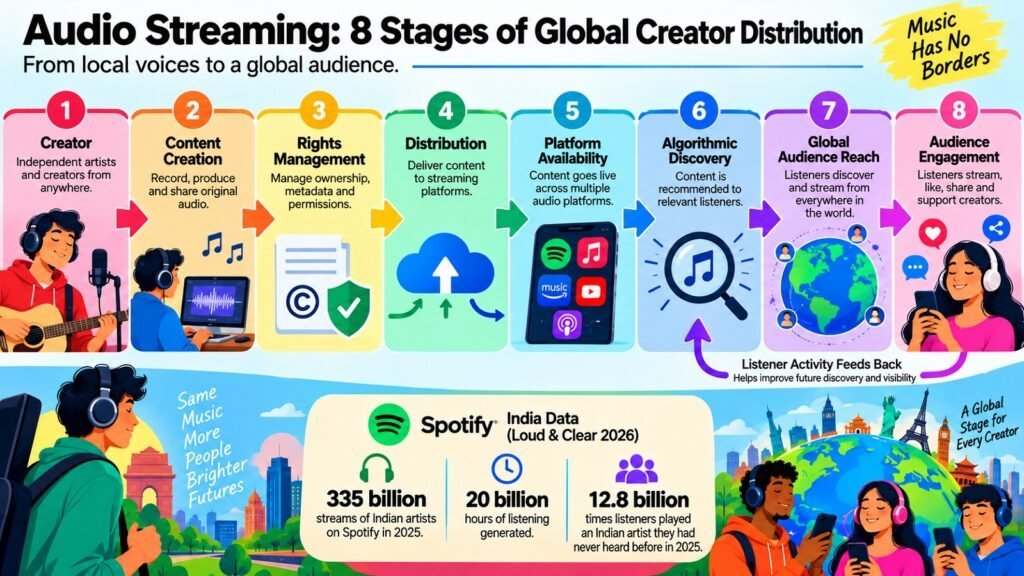
Audio streaming has fundamentally changed how creators reach audiences. Before streaming, getting music in front of listeners required physical distribution through labels and retailers, or broadcast placement through radio. Both channels were controlled by a small number of gatekeepers who determined which artists received distribution and therefore had a realistic chance of building an audience. Streaming distributed gatekeeping across different actors and mechanisms, without eliminating it entirely.
The most visible change is geographic reach. A musician recording independently in Lagos, Seoul, or São Paulo can now make their work available on every major streaming platform through a digital distributor, reaching potential listeners in any country simultaneously. That was practically impossible through physical distribution for most artists at any career stage. The cloud-based infrastructure of streaming provides global distribution access that previously required significant industry relationships and financial investment.
The shift to platform-based distribution changed relationships among creators, labels, publishers, aggregators, and platforms. Independent artists can now distribute through aggregators such as DistroKid, TuneCore, or CD Baby without label involvement. Labels retain value in marketing, production financing, and promotional reach, but are no longer the only pathway to distribution. This structural change lowered barriers to entry while creating new dependencies on platform policies, algorithmic visibility, and catalog rules that creators must navigate carefully.
Discoverability remains a significant challenge despite democratized distribution. Having a track available on every platform does not guarantee listeners will hear it. Algorithmic recommendations and editorial playlist placements remain concentrated in ways that favor established artists. Evaluating an audio streaming distribution strategy means examining reach, discoverability tools, platform policy transparency, and flexibility to distribute across multiple services simultaneously — because global technical availability and genuine audience engagement are very different outcomes.
Audio Streaming Creator Distribution: Eight Key Elements
| Distribution Element | Importance to Creators |
| Digital Distributors and Aggregators | Provide the technical pathway from creator to major streaming platforms |
| Catalog Availability | Ensures tracks are searchable and accessible across global streaming libraries |
| Algorithmic Discoverability | Determines whether a track surfaces in recommendations for relevant listeners |
| Editorial Playlist Consideration | Offers significant visibility when a track is selected for curated playlists |
| Geographic Reach | Enables simultaneous global availability without physical distribution infrastructure |
| Release Metadata Accuracy | Correct genre, artist, and track data supports accurate catalog placement |
| Platform Policy Compliance | Meeting each platform’s content and formatting rules prevents catalog rejection |
| Cross-Platform Distribution | Distributing across multiple services reduces dependence on any single platform |
7. Audio Streaming Across Connected Devices and Immersive Experiences
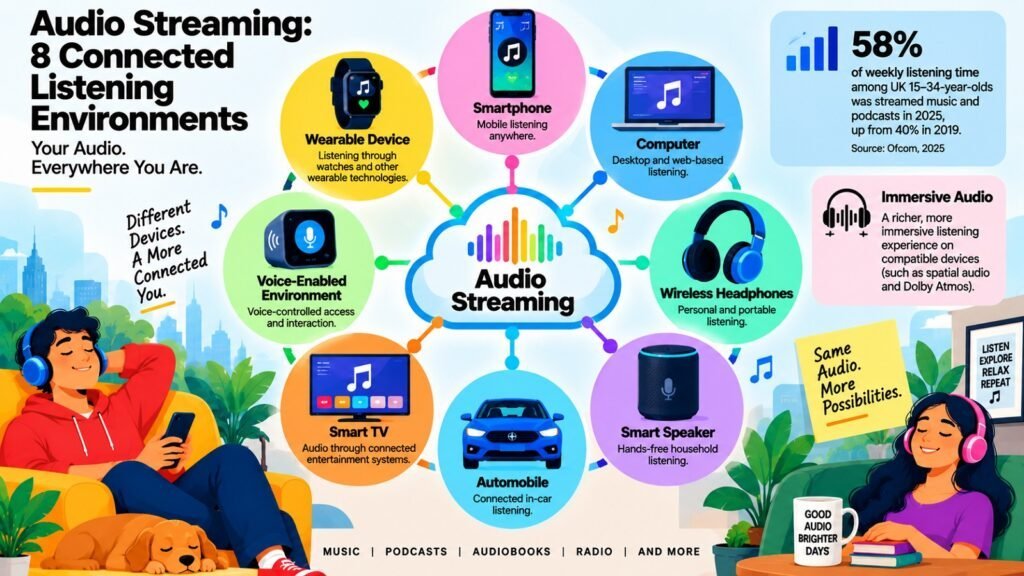
Audio streaming began primarily as a browser and smartphone experience, but it has expanded into a connected environment spanning dozens of device categories and everyday contexts. Smart speakers, automobiles, smart televisions, wireless headphones, wearables, and voice-enabled home devices all participate in the ecosystem today. Listening has become ambient — integrated into physical environments where people spend their time rather than remaining a discrete activity performed on one dedicated device.
Cloud-based delivery makes device portability practical. Because catalogs and listener preferences are stored remotely, listening experiences can follow a person across contexts. A playlist that begins on a smartphone during a morning commute can continue on a smart speaker at home, resume in a car during an afternoon drive, and finish through wireless headphones on an evening walk — without any manual handoff. That kind of continuity was impossible in any earlier audio distribution model.
Voice control and hands-free interaction have become particularly important where visual attention and manual input are unavailable, such as driving or cooking. Integration with voice assistants — Alexa, Google Assistant, Siri — allows listeners to browse, play, skip, and adjust volume through spoken commands. The interaction model shifts from a visual, touch-based experience toward one that can operate through conversation, extending streaming into contexts where screen use is impractical.
Spatial audio represents an established development that major platforms now support. Using signal processing to simulate three-dimensional sound fields through standard headphones or speakers, it creates depth and environmental positioning that standard stereo does not provide. Apple Music, Amazon Music, and Tidal have offered spatial audio tracks in Dolby Atmos, expanding what streaming delivers beyond stereo fidelity. Evaluating a connected streaming experience means assessing continuity across device transitions, reliability of hands-free interaction, and audio quality consistency across different environments.
Audio Streaming: Eight Connected Listening Environments
| Connected Environment | Audio Streaming Role |
| Smartphones | Primary portable device for on-demand streaming across most listening contexts |
| Smart Speakers | Enables hands-free, room-based ambient listening via voice commands |
| Automobiles | Integrates streaming into commuting and travel through in-car audio systems |
| Wireless Headphones | Provides personal, portable high-quality audio in mobile and transit settings |
| Smart Televisions | Extends streaming to living room listening and multi-room audio setups |
| Wearables and Smartwatches | Supports standalone playback and control during exercise and outdoor activity |
| Gaming Consoles | Delivers background music during gameplay through integrated streaming apps |
| Voice-Enabled Devices | Allows spoken-command control of streaming within smart home environments |
8. The Future of Audio Streaming: AI, Adaptive Audio, and Personalized Experiences
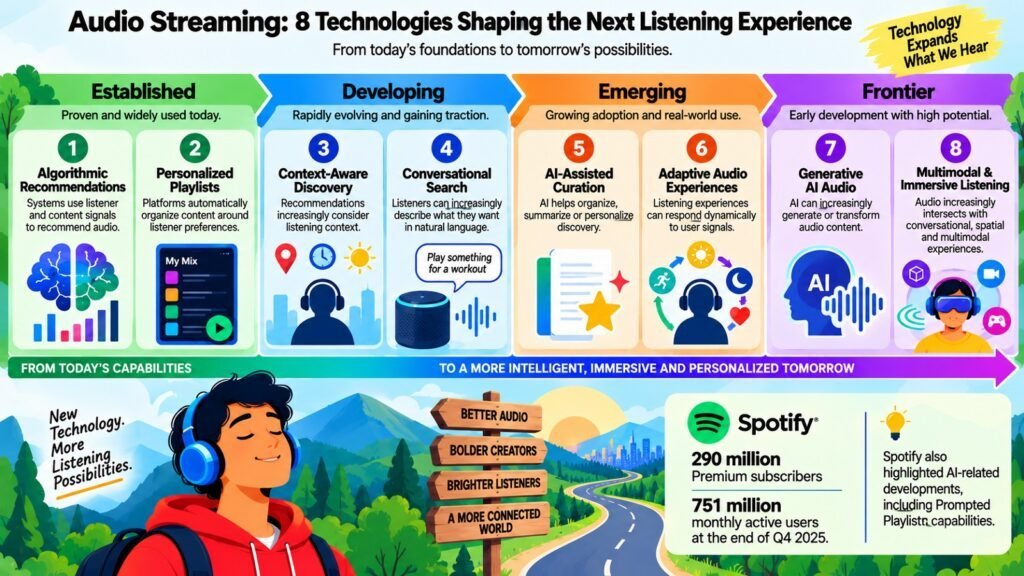
Artificial intelligence is not new to audio streaming — recommendation engines have relied on machine learning for years. What is changing is the scope and sophistication of what AI can do within the listening experience. Systems that once analyzed listening history to suggest similar content are evolving toward models that understand context, intent, and conversational instruction in qualitatively different ways.
Conversational search is one of the most significant near-term developments. Rather than typing a genre or artist into a search field, a listener may describe what they want in natural language — something energetic for a morning run, or ambient for late-night focus work — and receive a context-aware response. Some platforms have introduced early versions through voice interfaces and AI-powered playlist generation. The underlying capability is more sophisticated language understanding applied to the audio discovery problem, and it is likely to deepen as language models improve.
Adaptive playlists that respond to behavioral signals in real time represent a related development. A system aware that a listener is skipping faster than usual, or that the context has shifted from a mobile device to a car stereo, could adjust content selection accordingly without requiring manual mode changes. The experience shifts from explicitly choosing what to play toward a system that responds continuously to what seems contextually appropriate.
AI-generated audio introduces complex questions about the relationship between synthetic and human creative work, the application of copyright to generated content, transparency when AI-generated tracks appear in discovery systems, and implications for creator compensation. These questions are being actively examined by regulators, platforms, and rights holders. Evaluating any future audio streaming development means asking whether it improves genuine usefulness for listeners, preserves meaningful user control, treats creator participation as a core value, and serves actual listener needs rather than only platform engagement metrics.
Audio Streaming: Eight Emerging and Established Technological Developments
| Development | Potential Impact |
| AI-Powered Recommendation | Established; improves discovery precision using behavioral and contextual signals |
| Conversational Search | Emerging; allows natural-language queries to replace keyword-based catalog search |
| Adaptive Real-Time Playlists | Emerging; adjusts content selection continuously based on listener behavior signals |
| Spatial and Immersive Audio | Established on select platforms; enhances listening depth beyond standard stereo |
| AI-Generated Music | Emerging; raises questions about rights, authenticity, and creator compensation |
| Voice-Controlled Discovery | Established; allows hands-free navigation through smart speakers and assistants |
| Context-Aware Recommendations | Emerging; tailors audio selection to location, activity, and time-of-day signals |
| On-Device AI Processing | Emerging; enables faster, privacy-preserving personalization without cloud dependency |
Conclusion: Audio Streaming and the Evolution of Digital Listening
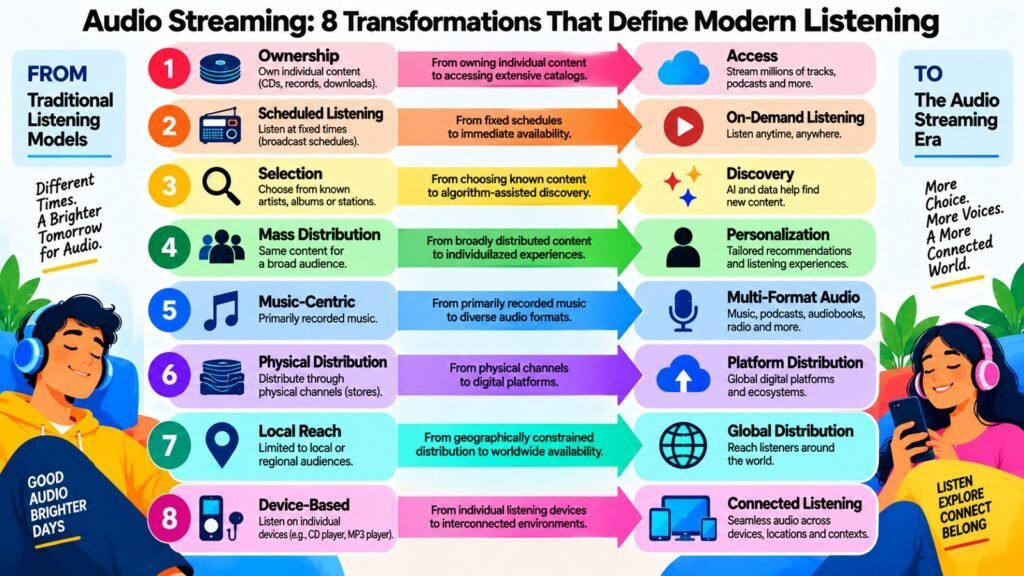
Audio streaming represents a structural transformation in how people access, discover, distribute, and experience audio — not simply a more convenient way to play music. The eight dimensions examined in this article are interconnected. On-demand access created the behavioral foundation. Platform ecosystems built the infrastructure on top of it. Personalization made enormous catalogs navigable. Content diversification expanded what the infrastructure carries. Monetization established the economic relationships sustaining the ecosystem. Global creator distribution changed who can reach an audience and how. Connected devices extended listening into every environment. And emerging AI capabilities are beginning to change how discovery and interaction themselves function.
The distinction between music streaming and audio streaming matters as a practical analytical point. Music streaming is a major component, but treating the two as synonymous misses the diversification defining audio streaming’s current scope. Podcasts, audiobooks, and educational programming are equal participants in the on-demand ecosystem, subject to the same platform logic, discovery mechanisms, and economic relationships as music.
The most durable principles from this framework will outlast any specific platform, pricing model, or technology. Ownership versus access captures a behavioral and economic shift that remains relevant as new models emerge. Selection versus discovery captures a cognitive shift any future recommendation system must address. Platform versus physical distribution captures a structural change in who controls audience access. These distinctions provide a stable vocabulary for analyzing any new audio streaming product, business, or development.
Audio Streaming Transformation: Eight Core Takeaways
| Transformations | Core Takeaway |
| Ownership to On-Demand Access | Streaming replaced file ownership with subscription-based catalog access |
| Broadcast to Algorithm-Driven Discovery | Personalized recommendations replaced scheduled programming and browsing |
| Physical to Platform Distribution | Digital platforms replaced retail and physical supply chains as gatekeepers |
| Music to Multi-Format Audio | Streaming infrastructure now carries podcasts, audiobooks, and spoken content |
| Unit Sales to Recurring Revenue | Subscriptions and advertising replaced per-track and per-album purchases |
| Local to Global Creator Reach | Digital distribution gave independent creators access to worldwide audiences |
| Single-Device to Connected Listening | Streaming extended across speakers, cars, wearables, and smart devices |
| Explicit Selection to Adaptive Discovery | AI-driven systems are beginning to respond to context rather than manual choice |