Table of Contents
Types of AI: Understanding How Artificial Intelligence Is Classified
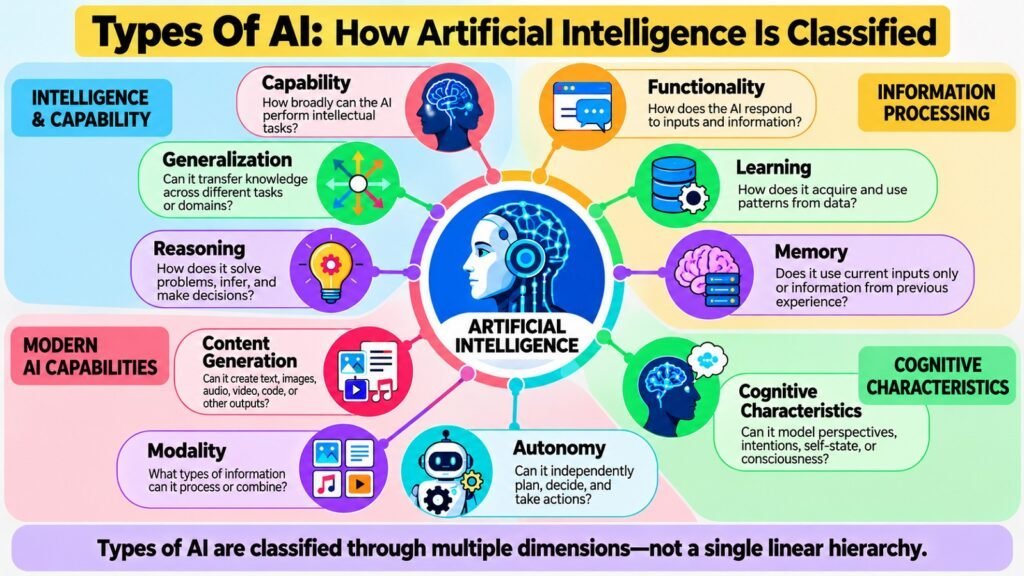
Artificial intelligence is one of the most consequential technologies of this era, yet few topics are more frequently misunderstood. Part of the confusion comes from a fundamental problem: Artificial Intelligence is not organized into one universally accepted hierarchy where each type is simply more advanced than the last. Different classifications describe different dimensions of the technology, and a single system can belong to multiple categories simultaneously.
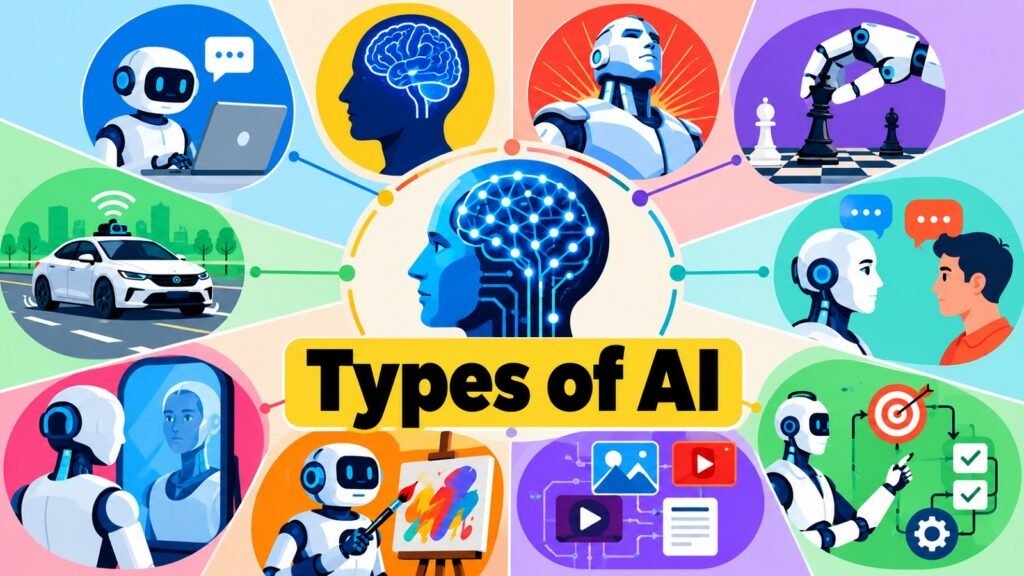
The ten types of AI discussed in this article fall into three broad dimensions. The first concerns intelligence capability: Narrow AI, Artificial General Intelligence, and Artificial Superintelligence describe how broad or restricted a system’s intelligence is. The second is functional: Reactive Machines, Limited Memory AI, Theory of Mind AI, and Self-Aware AI describe how a system processes information and whether it models the mental states of others or itself. The third captures modern operating characteristics: Generative AI, Multimodal AI, and Agentic AI describe what a system produces, what input types it handles, and how independently it operates.
Some of these types describe systems in use by millions of people daily. Others are aspirational frameworks describing capabilities that no existing system has demonstrated. Knowing the difference prevents the overstated claims that have repeatedly misled public and organizational understanding of AI. This article combines theoretical knowledge, research-based understanding, and practical tools for evaluating AI systems, making it equally useful whether you are approaching classification for the first time or refining a working understanding.
Types of AI: Quick-Reference Classification Map
| Types of AI | Primary Classifications of Types of AI |
| Narrow AI (Weak AI) | Capability — task-specific intelligence |
| General AI (AGI) | Capability — broad general intelligence (hypothetical) |
| Artificial Superintelligence | Capability — intelligence exceeding humans (theoretical) |
| Reactive Machines | Functional — responds to inputs without memory |
| Limited Memory AI | Functional — uses historical data for decisions |
| Theory of Mind AI | Functional — models beliefs and mental states (theoretical) |
| Self-Aware AI | Functional — possesses subjective consciousness (theoretical) |
| Generative AI | Operating dimension — produces new content |
| Multimodal AI | Operating dimension — processes multiple input types |
| Agentic AI | Operating dimension — pursues goals autonomously |
1. Types of AI: Narrow AI (Weak AI) – Foundational AI
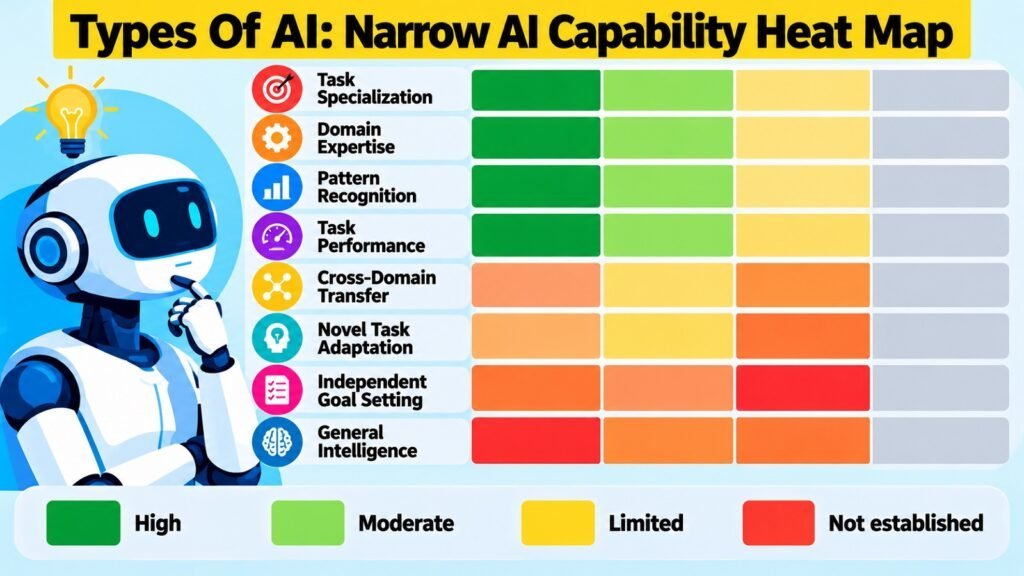
Narrow AI, often called Weak AI, is one of the most dominant types of AI that is in use today. Every commercial AI system currently in existence falls within this category. The defining characteristic is specialization: a system is designed to perform particular tasks or operate within defined domains rather than demonstrating the broad, transferable intelligence that characterizes human cognition. The common misconception that narrow means unintelligent deserves direct correction.
A fraud detection system that processes millions of transactions per second identifies patterns a team of human analysts would take weeks to find. A recommendation engine infers viewer preferences from behavioral signals with remarkable accuracy. A computer vision system distinguishes between thousands of object categories in milliseconds. None of these systems can perform the other’s task. Their intelligence is genuine within a defined scope, and that scope is exactly what makes them narrow.
Search engines, speech recognition, navigation applications, medical imaging tools, language translation, and autonomous-driving assistance all operate as Narrow AI. Modern large language models also belong here. Broad performance on prompted tasks is not the same as demonstrated general intelligence. A model that discusses virtually any subject from its training distribution is still operating within the constraints of that distribution, not reasoning across genuinely unfamiliar domains.
The practical test for identifying Narrow AI is to ask whether a system’s capabilities are tied to a specific task family or training scope. If yes, the system is narrow regardless of how sophisticated its outputs appear. This distinction matters for evaluating vendor claims, interpreting research findings, and making sound technology decisions.
Types of AI: Narrow AI Applications and Functions
| Application | Typical AI Function |
| Search engines | Rank and retrieve relevant content from large indexes |
| Recommendation systems | Predict user preferences from behavioral patterns |
| Fraud detection | Identify anomalous patterns in transaction data |
| Speech recognition | Convert spoken language to text with high accuracy |
| Computer vision | Classify, detect, or segment visual content in images |
| Navigation systems | Calculate optimal routes using real-time and map data |
| Medical imaging AI | Detect diagnostic patterns in scans and pathology images |
| Language translation | Convert text or speech across languages automatically |
2. General AI (AGI): The Broadest Vision in Types of AI
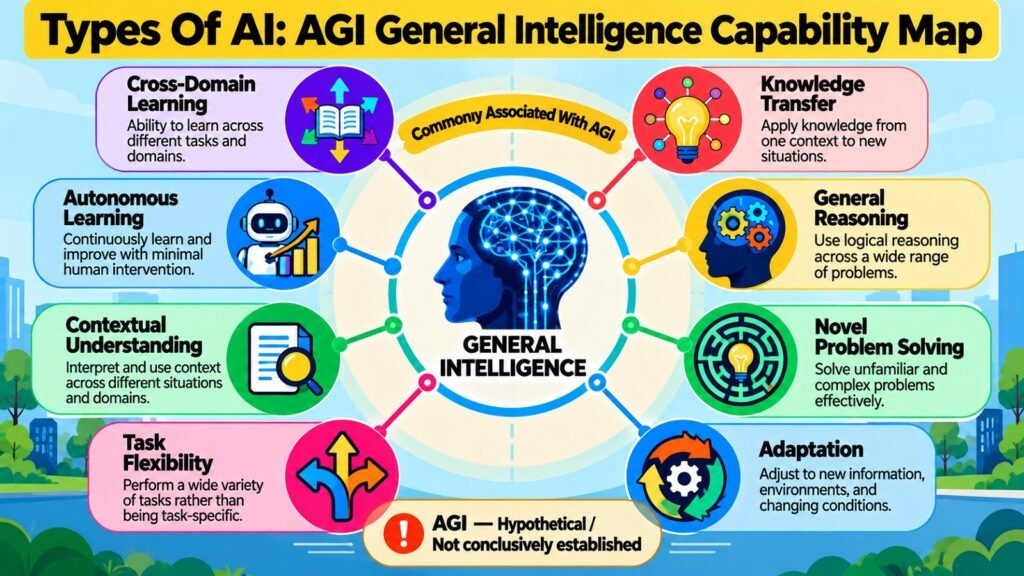
Artificial General Intelligence occupies a unique position within different Types of AI: it is the most widely discussed capability milestone that no existing system has credibly reached. AGI describes a hypothetical form of AI capable of applying intelligence flexibly across a broad range of tasks, including tasks it has never encountered before. The defining characteristic is generality — the ability to transfer learning, reasoning, and problem-solving across domains rather than excelling within any single one.
The capabilities typically associated with AGI include learning from limited examples, reasoning about novel situations, solving problems in unfamiliar domains, adapting strategies based on feedback, and transferring knowledge across contexts. Current AI systems do not reliably demonstrate these at a human-equivalent level across arbitrary domains. Systems that perform impressively on wide benchmarks frequently fail in ways that reveal task-specific pattern matching rather than genuine generalization.
There is no single universally accepted test that would conclusively establish AGI. The Turing Test, reasoning benchmarks, and multi-task evaluations all capture useful signals, but none constitutes a definitive threshold. Claims about AGI should therefore be evaluated carefully, with particular attention to whether a system demonstrates broad, transferable competence or exceptional performance on a curated set of tasks. These look similar in a press release but represent fundamentally different phenomena.
The potential significance of AGI for knowledge work, scientific research, and economic productivity is worth taking seriously as a research question, while remaining clear that it describes theoretical expectations rather than properties of any available system. AGI should not be confused with Generative AI, which concerns content output, or Agentic AI, which concerns autonomous task execution.
Types of AI: AGI Characteristics and Implications
| AGI Characteristic | What It Implies |
| General learning ability | Acquires new skills from limited examples across domains |
| Cross-domain reasoning | Applies logical inference to unfamiliar problem types |
| Knowledge transfer | Uses understanding from one context in an unrelated one |
| Adaptive problem-solving | Adjusts strategies when initial approaches fail |
| Open-ended task performance | Handles tasks outside its explicit training scope |
| Goal interpretation | Understands objectives from high-level natural instructions |
| Self-directed learning | Seeks out information needed to complete novel tasks |
| Robust generalization | Maintains performance under distribution shifts and new contexts |
3. Types of AI: Artificial Superintelligence – Theoretical AI Beyond Human Intelligence
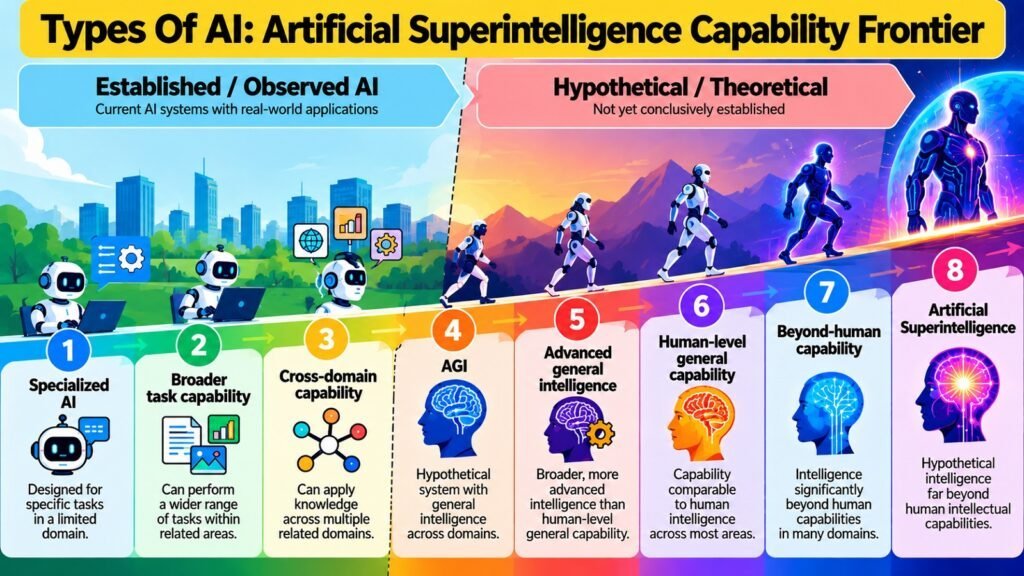
Artificial Superintelligence, or ASI, represents the most extreme theoretical category within Types of AI. It describes a system whose intellectual capabilities would surpass human performance across essentially every relevant cognitive domain, including scientific reasoning, strategic planning, and learning speed. The critical distinction between AGI and ASI is one of degree. AGI concerns parity with human general intelligence; ASI concerns capabilities that would comprehensively exceed it.
Capabilities most commonly associated with ASI include generating scientific insights beyond current human reach, planning across complex systems with high-dimensional consequences, and optimizing solutions in domains that currently require years of specialized training. None of these have been demonstrated by any existing system. They are theoretical expectations informing research directions and policy discussions, not descriptions of current technology. Maintaining this distinction clearly is essential for avoiding misleading claims about AI capability.
The relationship between ASI and AI safety research is direct. If a system could operate with cognitive capabilities beyond human oversight capacity, questions about alignment, control mechanisms, value specification, and governance would become critical engineering challenges rather than abstract philosophy. This is why ASI occupies a central position in long-term AI development discussions despite remaining purely theoretical. ASI also differs fundamentally from Agentic AI, which describes autonomous action capability independent of intelligence level.
Types of AI: Artificial Superintelligence Research Dimensions
| Dimension | Relevance to ASI |
| Intelligence level | Would exceed human capability across all major cognitive domains |
| Scientific discovery | Theorized ability to generate insights beyond human reach |
| AI alignment | Research into ensuring ASI goals remain beneficial to humanity |
| Control mechanisms | Designing oversight systems that work at superhuman capability |
| Value specification | Formally encoding human values into a system that exceeds human reasoning |
| Governance frameworks | Policy and legal structures for managing ASI development risk |
| Existential risk research | Studying long-term societal impacts of systems beyond human control |
| Timeline uncertainty | Expert disagreement on whether or when ASI could emerge |
4. Types of AI: Reactive Machines – Foundational Functional AI
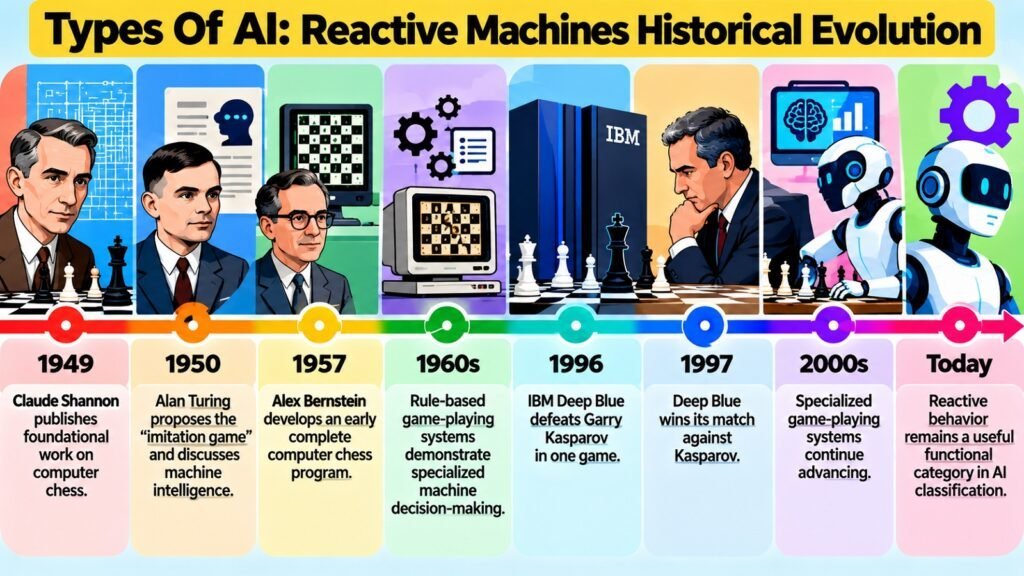
Reactive Machines represent a foundational functional category within Types of AI. Unlike capability-based classifications that ask how broadly a system can reason, this classification focuses on how a system uses information and whether it retains meaningful memory of previous interactions. A reactive machine operates entirely in the present: it receives an input, evaluates it against a defined framework, and produces a response without drawing on accumulated experience.
The conceptual importance of memory here is significant. The distinction between Reactive Machines and Limited Memory AI is not about processing power or complexity; it is about whether past observations shape future behavior. IBM’s Deep Blue, which defeated world chess champion Garry Kasparov in 1997, is the most widely cited example. It evaluated millions of positions per second using a fixed evaluation function, but it did not learn from the games it played and could not apply its chess knowledge to any other domain.
Reactive systems offer practical advantages in certain contexts. Their behavior is defined and predictable, which matters in environments where reliability outweighs adaptability. They are also resistant to failure modes associated with learning systems, such as distributional shift. A reactive machine is typically also Narrow AI, but the two descriptions capture different properties: Narrow AI describes capability scope, while reactive describes information architecture.
Types of AI: Reactive Machine Characteristics
| Aspect | Reactive AI Characteristic |
| Memory use | Operates entirely on current inputs without retaining past interactions |
| Learning | Does not update behavior based on previous experience |
| Predictability | Produces consistent responses for identical inputs |
| Example system | Deep Blue chess engine evaluating positions without learning |
| Application context | Suitable for well-defined tasks with stable rules and environments |
| World modeling | Does not build an internal model of the environment over time |
| Adaptation | Cannot adjust to changing conditions based on accumulated observations |
| Scope overlap | Typically also classified as Narrow AI in terms of capability breadth |
5. Types of AI: Limited Memory AI – Learning From Data
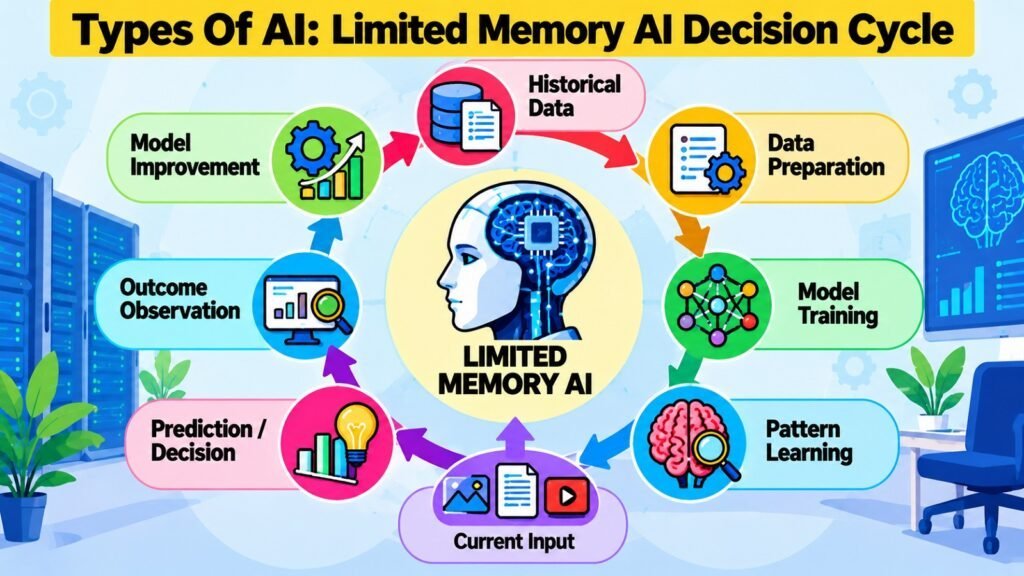
Limited Memory AI represents the functional category within Types of AI that encompasses the vast majority of modern machine-learning systems. In this classification, a system uses historical observations or learned patterns to inform current predictions, decisions, or responses. The word limited matters: it indicates that the system draws on accumulated training data or recent interaction history rather than maintaining an unlimited, dynamically updated model of the world.
The practical distinction from purely reactive systems lies in how information is used. A Limited Memory AI is trained on historical data, extracts statistical patterns, and applies those patterns to new inputs. A recommendation system learns viewing patterns across millions of users and adjusts suggestions based on individual history. Fraud detection learns what legitimate transactions look like and flags deviations. Autonomous-driving assistance applies patterns from thousands of training hours to respond to pedestrians, lane markings, and traffic in real time.
The term memory in this classification does not imply human-like episodic recall or conscious recollection; it describes the retention and application of statistical information. A large language model trained on text has learned from an enormous historical corpus, and that learning shapes every response, even though the model does not store a persistent log of prior conversations. This also illustrates how a single system can belong to multiple types: a generative language model is Limited Memory AI in functional terms, Narrow AI in capability terms, and potentially Agentic AI in deployment terms.
Types of AI: Limited Memory AI Applications
| Application | Role of Historical Data |
| Recommendation engines | Predict preferences from past behavior and similar user patterns |
| Fraud detection | Identify deviations from historical transaction norms |
| Autonomous driving | Apply learned patterns from training data to real-time navigation |
| Weather forecasting | Use historical climate data to model atmospheric conditions |
| Language models | Generate responses based on patterns learned from text corpora |
| Predictive maintenance | Forecast equipment failure from sensor and failure history |
| Medical diagnosis AI | Recognize conditions based on patterns from annotated clinical data |
| Financial forecasting | Model price movements using historical market and economic data |
6. Types of AI: Theory of Mind AI – A Future Frontier
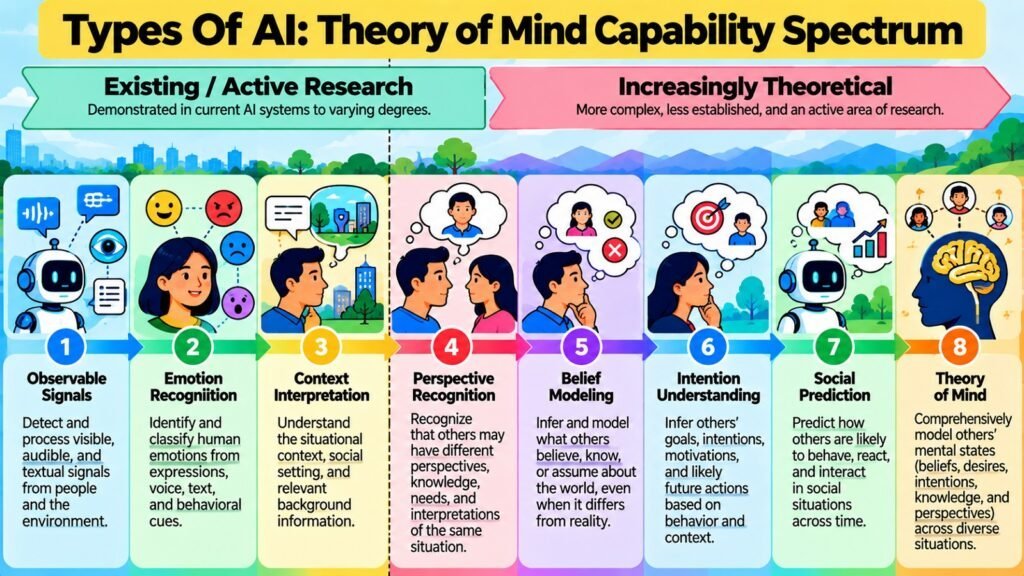
Theory of Mind AI describes a theoretical category within Types of AI involving the capacity to understand and respond appropriately to the beliefs, intentions, perspectives, emotions, and mental states of other entities. The term originates in developmental psychology, where it refers to attributing mental states to others and using that attribution to explain and predict their behavior. Genuine Theory of Mind AI would require modeling what another person knows, believes, wants, or intends — not simply pattern-matching on surface signals.
This distinction matters because many current AI systems produce responses that appear emotionally perceptive without possessing genuine Theory of Mind. A conversational AI that recognizes the word frustrated and replies empathetically is detecting a linguistic pattern. Genuine Theory of Mind would require understanding the specific belief behind that frustration and addressing it directly, even when the person does not state it explicitly. These capabilities are very different, and conflating them leads to inflated assessments of what current AI can actually do.
Research relevant to this area spans cognitive science, affective computing, human-robot interaction, and social intelligence modeling. Each field contributes partial building blocks — emotion recognition, perspective-taking models, social norm inference — but the gap between these components and a robust Theory of Mind capability remains substantial. Theory of Mind AI is also distinct from Self-Aware AI, which concerns an AI’s understanding of its own existence rather than its capacity to model the minds of others.
Types of AI: Theory of Mind Research Concepts
| Concept | AI Relevance |
| Theory of mind | Attributing beliefs, desires, and intentions to other agents |
| Affective computing | Recognizing and responding to emotional signals in inputs |
| Perspective-taking | Modeling another agent’s viewpoint for context-sensitive responses |
| Intent modeling | Inferring what a user or agent is trying to accomplish |
| Social norm inference | Understanding implicit expectations governing behavior |
| Emotion recognition | Detecting emotional states from facial, vocal, or textual cues |
| Mental state representation | Maintaining internal models of another agent’s knowledge state |
| Human-robot interaction | Research into socially intelligent responses in collaborative contexts |
7. Types of AI: Self-Aware AI – Theoretical Consciousness
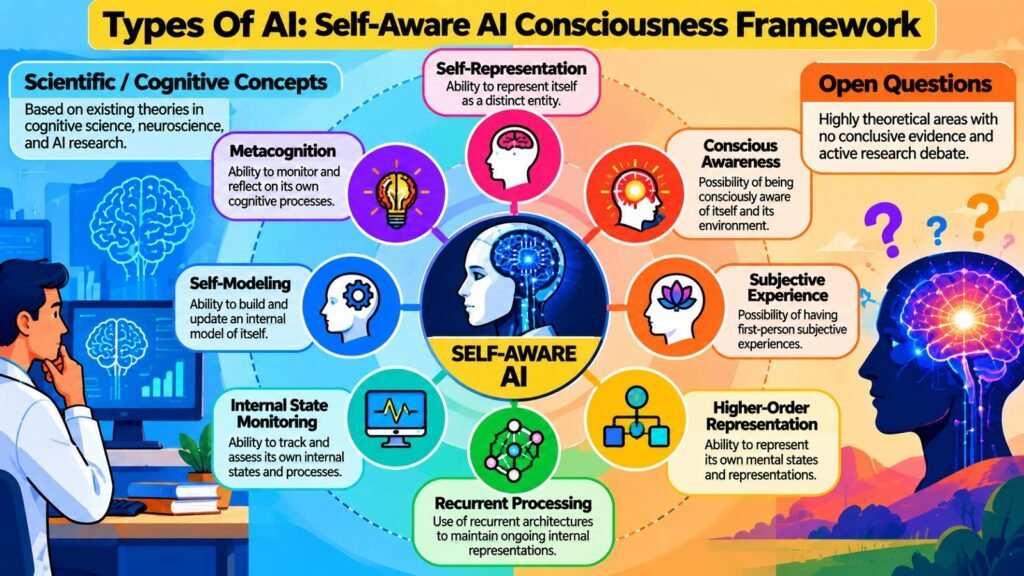
Self-Aware AI represents the most theoretically complex and philosophically challenging category within Types of AI. It describes a hypothetical system that possesses genuine self-awareness, subjective consciousness, or an internal understanding of its own existence and mental states. The key word is genuine, because it marks the boundary between systems that can describe their own operation and systems that would actually experience it in a meaningful sense.
Distinguishing self-awareness from self-reference is essential. A large language model can describe its architecture, explain its training data, and generate statements about its capabilities. None of this constitutes self-awareness. Self-reference is a computational property; self-awareness implies subjective experience. Philosophy of mind describes this through phenomenal consciousness, which asks whether there is something it is like to be a particular system from the inside. That question has no agreed scientific answer for any AI system currently in existence.
Relevant theoretical frameworks include integrated information theory, global workspace theory, and higher-order theories of consciousness. None has produced scientific consensus when applied to AI systems. Claims about machine consciousness therefore require exceptional care, regardless of how compelling a system’s conversational behavior appears. Self-Aware AI is distinct from Generative AI and Agentic AI, which describe output production and autonomous action without making any claim about subjective experience.
Types of AI: Self-Aware AI Concepts and Meanings
| Concept | Meaning for Self-Aware AI |
| Subjective consciousness | Genuine inner experience, not just behavioral self-description |
| Self-reference | Ability to describe own architecture — not the same as self-awareness |
| Phenomenal consciousness | Whether there is subjective experience from the system’s perspective |
| Metacognition | Reasoning about one’s own reasoning — partial analog in current AI |
| Global workspace theory | Cognitive science model of how consciousness integrates information |
| Integrated information theory | Mathematical framework proposing consciousness arises from information integration |
| Hard problem of consciousness | Philosophical question of why physical processes produce subjective experience |
| Self-modeling | Internal representation of one’s own state, distinct from subjective awareness |
8. Types of AI: Generative AI – Content Creation as a Modern AI
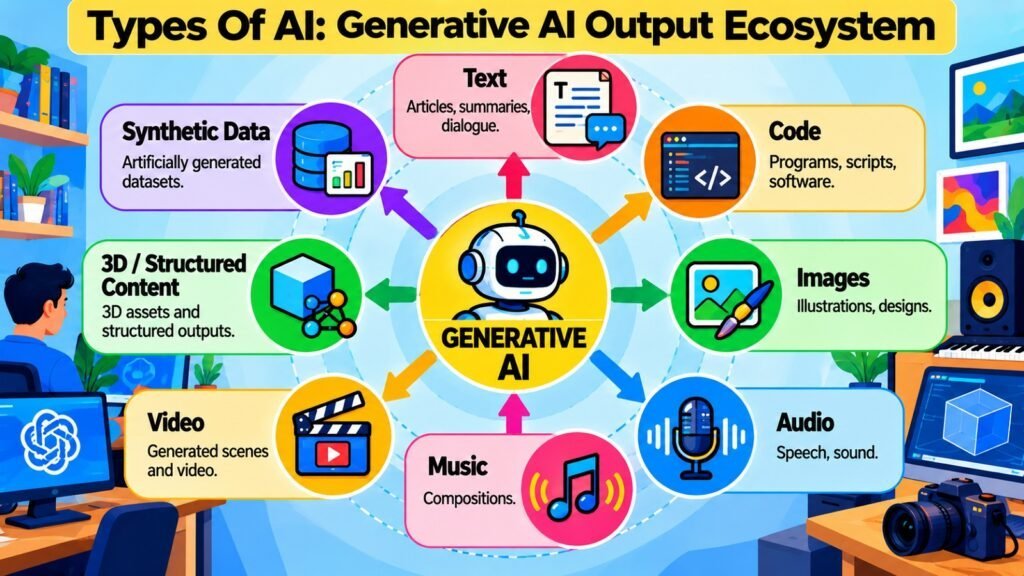
Generative AI has become one of the most widely discussed dimensions within various Types of AI. Where earlier systems primarily classified, predicted, or responded in fixed formats, generative models learn representations from large datasets and use those representations to produce new outputs. Depending on the architecture and training data, outputs can include text, images, audio, video, software code, and other media.
At a conceptual level, generative systems learn the statistical structure of their training data well enough to produce novel examples that resemble that structure. Large language models learn syntactic and semantic patterns and use them to generate coherent, contextually appropriate text. Diffusion-based image models learn the relationship between noise and structured visual content and generate images from prompts. Code generation systems learn programming syntax and common problem-solving patterns and produce functional code from natural-language descriptions.
One of the most important distinctions is between content generation capability and general intelligence. A system that generates sophisticated text or realistic images is demonstrating pattern generation ability, not AGI. The two are regularly confused, and that confusion affects how organizations evaluate what these systems can reliably do. A single system can simultaneously be Narrow AI in capability terms, Limited Memory AI in functional terms, Multimodal AI in input handling, and Agentic AI in deployment terms.
Business applications span marketing, software development, customer interaction, research, education, and design. Limitations are equally important. Hallucination — the generation of plausible but factually incorrect outputs — is a well-documented failure mode. Reliability, bias, copyright concerns, and the provenance of generated content all require consideration. Human oversight remains essential wherever a confident but incorrect output can cause real harm.
Types of AI: Generative AI Use Cases and Outputs
| Generative AI Use | Typical Output |
| Text generation | Articles, summaries, reports, dialogue, creative writing |
| Image synthesis | Photorealistic or stylized images from text descriptions |
| Code generation | Functional scripts, functions, or applications from natural language |
| Audio synthesis | Music, speech, sound effects, voice cloning |
| Video generation | Short video clips from text or image prompts |
| Document drafting | Contracts, proposals, emails, structured business documents |
| Data augmentation | Synthetic training data for other machine-learning models |
| Design generation | Logos, layouts, visual concepts, and UI prototypes |
9. Types of AI: Multimodal AI – Connecting Different Inputs
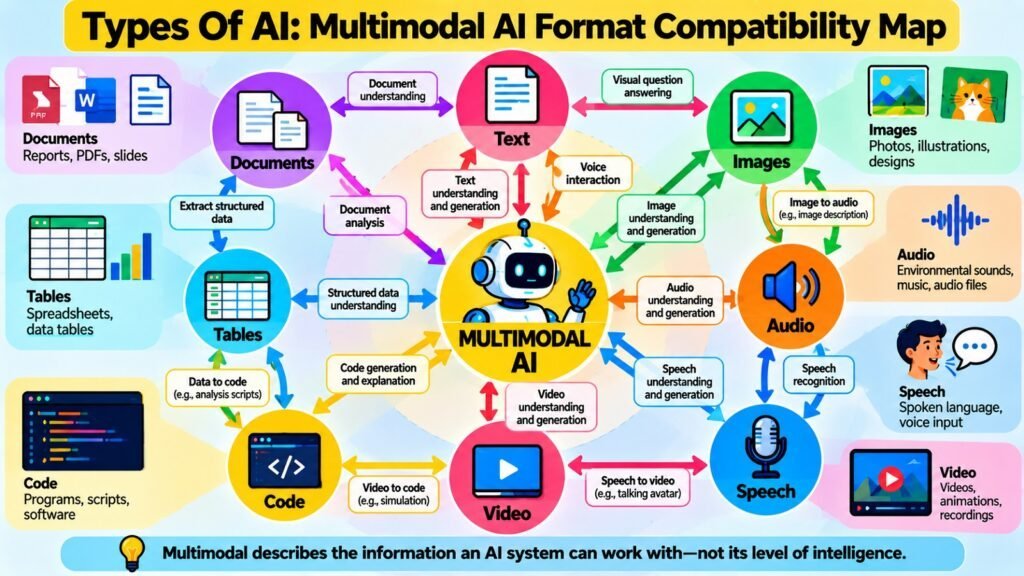
Multimodal AI describes a modern dimension within Types of AI in which systems can process, interpret, combine, or generate information across multiple input or output types called modalities. Text, images, audio, video, and structured data are among the most widely used. Understanding this category requires distinguishing three related capabilities: processing inputs across modalities, understanding and relating information across them, and generating outputs in multiple modalities. Not every multimodal system combines all three.
The practical value of combining modalities lies in richer contextual understanding. A medical system that analyzes both clinical notes and diagnostic imaging integrates information that would be less useful in isolation. A customer service system that processes voice, screen content, and chat handles a broader range of situations more accurately. Image search tools that accept uploaded photographs, voice assistants that process ambient sound, and document systems that interpret both text and layout all demonstrate what multimodal capability enables.
Multimodality should not be confused with general intelligence. A system that handles many input types within a defined task domain remains Narrow AI. The breadth of modalities processed says nothing about whether the system generalizes across domains, which is the distinguishing criterion for AGI. Practical limitations also matter: modality-specific errors, inconsistent information across input channels, and higher computational requirements are real considerations in designing and deploying multimodal systems.
Types of AI: Multimodal AI Capabilities and Applications
| Modality or Application | AI Capability |
| Text and image understanding | Answer questions about visual content using language |
| Speech and language | Convert spoken input to structured text and responses |
| Document analysis | Extract information from images and embedded text together |
| Video understanding | Interpret motion, objects, and audio content in video |
| Visual question answering | Respond to natural-language queries about image content |
| Multimodal search | Retrieve results using image, voice, or combined text and image queries |
| Audio and text generation | Produce synchronized spoken narration with written content |
| Sensor fusion | Combine data from multiple sensor types for perception and navigation |
10. Types of AI: Agentic AI – Autonomous Actions
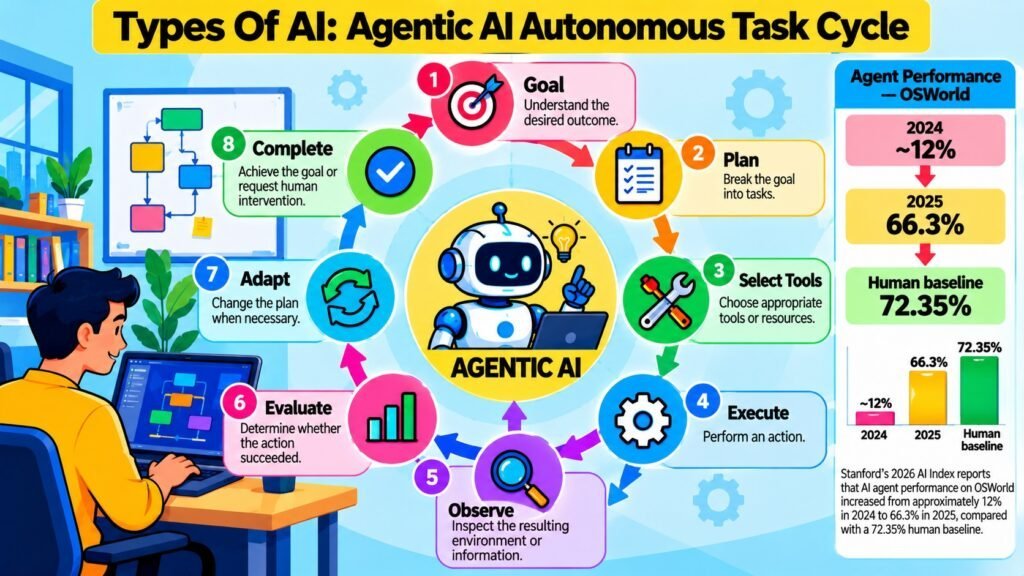
Agentic AI represents one of the most consequential emerging dimensions within Types of AI. Where a conventional AI system responds to a prompt with a single output, an agentic system pursues a goal through a sequence of actions that include planning, tool use, execution, observation, evaluation, and adaptation. The difference is not merely one of complexity; it is a difference in operating mode. Agentic AI operates in loops rather than isolated input-output pairs, continuing to act until a goal is reached or a stopping condition is met.
The agentic loop operates in several stages. The system interprets a goal from a high-level instruction, plans a sequence of actions, executes the first, observes the result, evaluates progress, adapts the plan as needed, and continues until the goal is achieved. Actions can include searching the web, writing and executing code, reading and writing files, calling APIs, controlling browser sessions, and coordinating other AI systems. This enables autonomous research, software development, and business process execution that would otherwise require significant human effort.
The most important distinction is between Agentic AI and AGI. Agentic behavior describes how autonomously a system acts, not how broadly it reasons. A system can execute sophisticated multi-step workflows with minimal human intervention while remaining firmly Narrow AI. The agentic dimension describes autonomy and execution; the capability dimension describes intelligence breadth. A single system can simultaneously be Narrow, Generative, Multimodal, and Agentic depending on its architecture and deployment context.
Practical benefits include significant workflow automation and productivity gains where tasks involve many steps and diverse tools. Risks are equally real. Agentic systems require careful attention to reliability, permission scope, unintended side effects, security vulnerabilities, and accountability. A system that autonomously executes business processes can also make autonomous errors at scale. Human oversight mechanisms and clear permission boundaries are essential for responsible deployment.
Types of AI: Agentic AI Capabilities and Functions
| Agentic Capabilities | Role in Autonomous Task Execution |
| Goal interpretation | Translates high-level instructions into actionable objectives |
| Multi-step planning | Sequences actions to achieve a goal across many decision points |
| Tool use | Calls external APIs, browsers, code interpreters, and data sources |
| Observation and feedback | Evaluates results of actions to determine next steps |
| Adaptive replanning | Adjusts strategies when earlier actions produce unexpected results |
| Workflow automation | Executes multi-stage business or research processes autonomously |
| Error handling | Detects failures and attempts recovery or escalation as configured |
| Human oversight integration | Pauses for review at defined checkpoints in sensitive workflows |
Conclusion — Types of AI: Understanding the Future of Artificial Intelligence
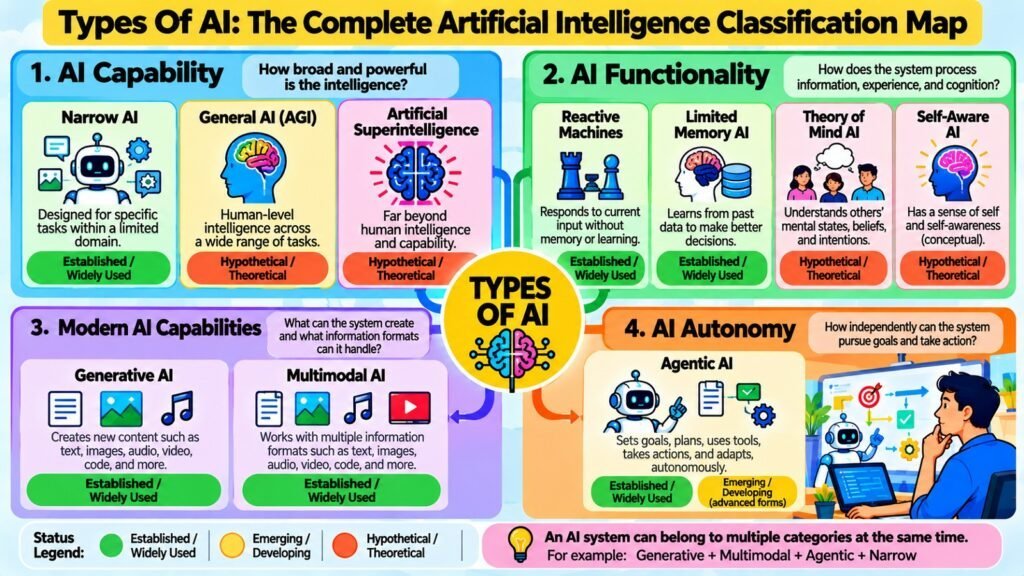
The ten types of AI explored in this article reveal something important: AI classification is not a single ladder from simple to advanced, but a multi-dimensional framework describing different properties of the same technology. Capability-based categories describe the scope of intelligence. Functional categories describe information architecture and memory use. Modern operating dimensions describe what a system produces, what it processes, and how independently it acts. Accurate evaluation of any AI system draws on all three dimensions together.
Some types described here correspond to real systems in active use. Narrow AI and Limited Memory AI cover the vast majority of deployed technology. Generative AI and Multimodal AI have reshaped what AI can produce and perceive. Agentic AI is emerging rapidly and will define how AI interacts with complex workflows. Others, including AGI, Artificial Superintelligence, Theory of Mind AI, and Self-Aware AI, describe theoretical frameworks valuable for evaluating claims and understanding research directions, even though no existing system has demonstrated those capabilities.
The practical value of this framework lies in the questions it enables: What tasks can this system perform? How does it use information? What input types does it process? How independently does it operate? How broadly can it reason? These questions, grounded in Types of AI, support more accurate interpretation of capability claims and clearer thinking about the difference between what AI can do today and what the field is genuinely working toward.
Types of AI: Final Classification Reference
| Types of AI | Core Classification Ideas of Types of AI |
|---|---|
| Narrow AI (Weak AI) | Highly capable within a defined domain; cannot generalize beyond it effectively elsewhere |
| General AI (AGI) | Hypothetical broad intelligence transferable across any domain |
| Artificial Superintelligence | Theoretical intelligence surpassing human capability at all levels |
| Reactive Machines | Responds to current inputs without using accumulated memory from experiences |
| Limited Memory AI | Uses historical data or training to inform current decisions and predictions |
| Theory of Mind AI | Theoretical capacity to model beliefs and intentions of other agents socially and contextually |
| Self-Aware AI | Theoretical subjective consciousness of one’s own existence and states through self-reflection |
| Generative AI | Produces new content by learning patterns from large datasets across various modalities |
| Multimodal AI | Processes and generates information across multiple input-output types within unified systems |
| Agentic AI | Pursues goals autonomously through multi-step planning and tool use toward desired outcomes |