Table of Contents
Introduction: Automation Systems as the Foundation of Modern Automation
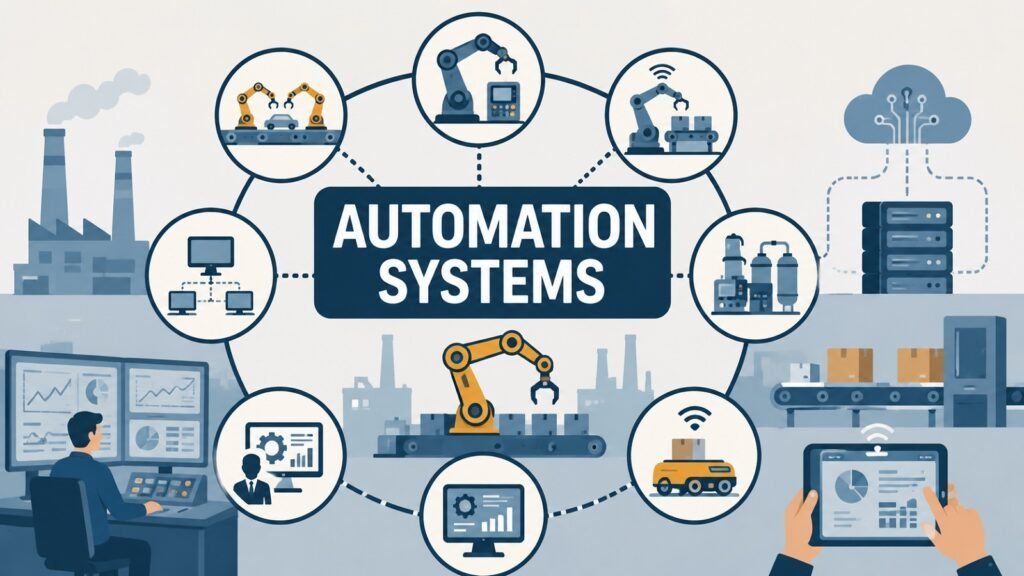
Automation Systems are one of the most important aspects of Modern Automation. They bring together machines, control systems, software, communication networks, and intelligent technologies into coordinated environments that automate industrial and business operations. These systems form the practical backbone of how automation is deployed across factories, processing plants, logistics networks, and enterprise organizations around the world.
Automation is often discussed as a single concept, as though every industry uses the same approach. In practice, Automation Systems represent the real-world implementation of automation across very different environments, each designed to solve specific operational challenges. A bottling plant, a pharmaceutical facility, and a financial services firm all use automation, but the systems they rely on are built around entirely different requirements.
Understanding the major categories of Automation Systems is essential for making the right choices. Selecting an automation solution should be driven by production requirements, operational flexibility, business objectives, scalability, and long-term strategy rather than simply following the newest technology trends. Many organizations struggle with automation investments because they adopt advanced solutions without understanding whether those solutions match their actual operational conditions.
The history of Automation Systems reflects how industrial and business needs have changed over time. Early automation focused on dedicated mechanical production lines designed for maximum output. Over decades, systems evolved to support programming, reconfiguration, and process integration. Today, Automation Systems have advanced into intelligent, AI-enabled ecosystems that support digital transformation, real-time decision-making, and adaptive operations across industries.
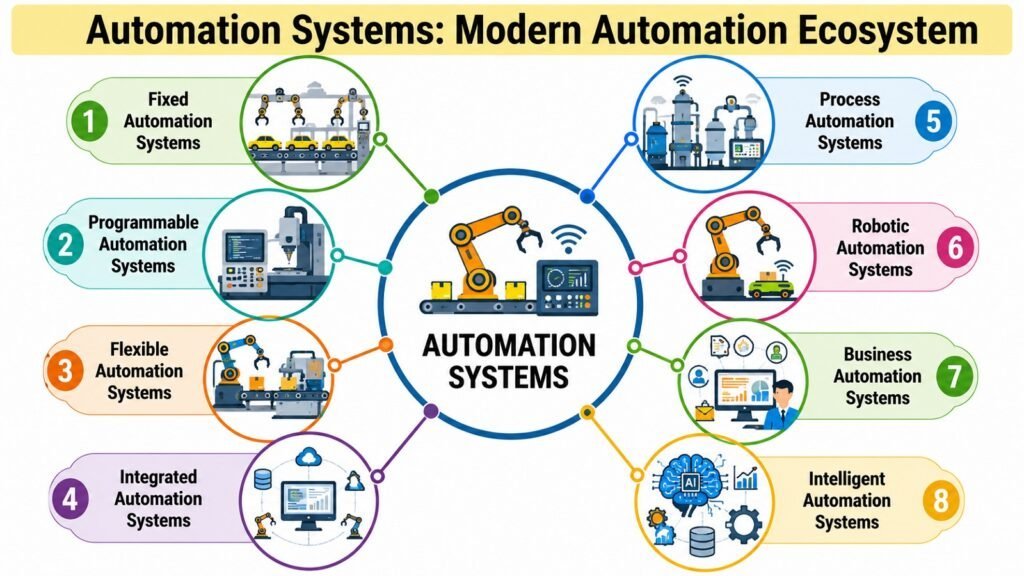
This article explains eight major categories of Automation Systems: Fixed, Programmable, Flexible, Integrated, Process, Robotic, Business, and Intelligent. Together, they cover the full range of automation technologies and strategies used in modern industry and enterprise operations. Understanding all eight provides a solid foundation for evaluating automation options from both strategic and practical perspectives.
Table 1: Automation Systems — Eight Categories at a Glance
| Category | Core Purpose |
| Fixed Automation Systems | High-volume, high-speed production with minimal variation |
| Programmable Automation Systems | Batch manufacturing with reconfigurable production sequences |
| Flexible Automation Systems | Rapid adaptation to changing products and schedules |
| Integrated Automation Systems | Unified connectivity across machines, software, and data |
| Process Automation Systems | Continuous industrial process monitoring and control |
| Robotic Automation Systems | Physical task execution using programmable robots |
| Business Automation Systems | Streamlining enterprise workflows and administrative processes |
| Intelligent Automation Systems | AI-powered, data-driven adaptive automation |
1. Fixed Automation Systems: High-Speed Solutions for Repetitive Production
Fixed Automation Systems are among the earliest and most established categories of Automation Systems. They are built around a predetermined production sequence that rarely changes. Equipment is designed specifically for one product or one set of operations, and this dedication is what makes these systems so effective. When the production task is fixed, the system can be optimized in detail, delivering exceptional speed, precision, and consistency.
These systems achieve their performance advantages because there is no overhead required for reconfiguration, reprogramming, or product switching. Every component in the production line serves a defined function in a repeating sequence. Research from the International Federation of Robotics and manufacturing engineering studies consistently shows that high-volume production environments benefit from fixed automation because output per unit of time is maximized when equipment operates without changeover delays.
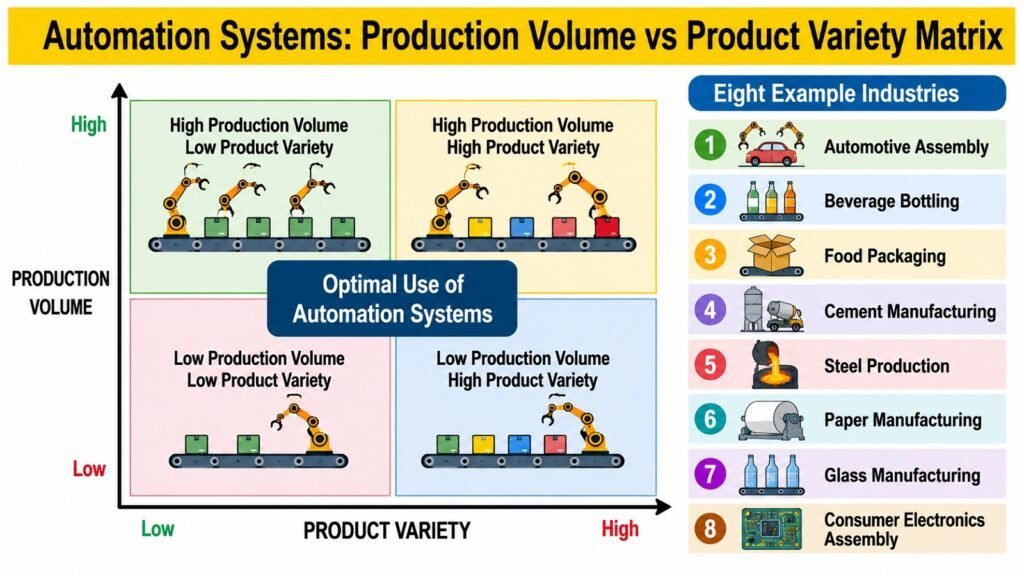
Fixed Automation Systems are widely used in the automotive industry, where engine components and body panels are produced in enormous quantities with identical specifications. Beverage bottling operations rely on fixed automation to fill, cap, label, and package thousands of units per hour. Consumer goods manufacturers use similar systems for packaging, household products, and food items. In each case, business conditions involve large production volumes, stable product designs, and long production runs.
The main trade-off is clear. These systems are highly efficient but not adaptable. Changing the product design or production sequence requires significant equipment modifications, which is expensive and time-consuming. This makes them a strong choice for industries where product specifications remain stable over long periods, but a poor fit for businesses that require frequent product changes or short production runs.
Fixed Automation Systems remain relevant because many high-volume manufacturing environments do not need flexibility. When production volume is high enough and product design is stable enough, the cost savings from fixed automation outweigh the benefits of adaptability. The decision should be based on a careful analysis of production volume, product stability, and expected equipment lifespan rather than on what competing facilities are investing in.
Table 2: Fixed Automation Systems — Key Characteristics and Insights
| Aspect | Details |
| Primary design principle | Dedicated equipment for a single, repeating production sequence |
| Speed and output | Highest throughput among automation categories when conditions are stable |
| Common industries | Automotive, bottling, packaging, consumer goods, food manufacturing |
| Key advantage | Low unit cost at high volume due to uninterrupted production cycles |
| Main limitation | Very limited adaptability; product changes require major equipment redesign |
| Investment consideration | High upfront capital cost justified by long production runs and volume |
| Best conditions for use | Stable product specifications, high production volumes, long operational life |
| Strategic insight | Choose fixed automation when volume and stability outweigh the need for flexibility |
2. Programmable Automation Systems: Reconfigurable Manufacturing for Batch Production
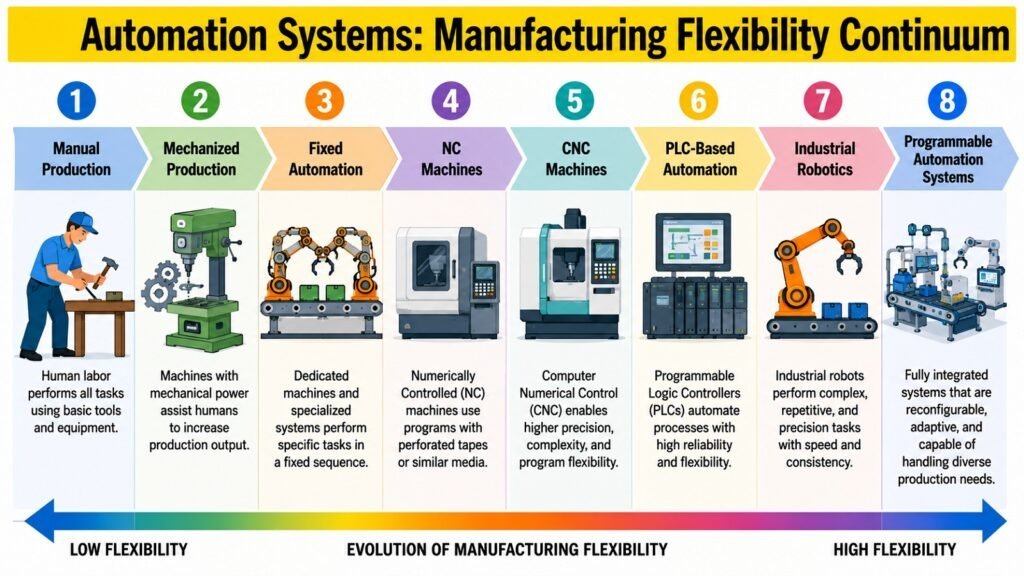
Programmable Automation Systems are designed to support changing production requirements through software or programming rather than permanent mechanical redesign. This fundamental difference from fixed automation changes what these systems are suited for. Instead of building equipment around one product, manufacturers program the system to handle different products by adjusting operational instructions without dismantling and rebuilding physical components.
The foundation of this approach lies in programmable logic controllers, CNC machines, industrial robots, and software-driven production systems that can receive updated instructions and execute different operational sequences. Manufacturers producing batches of different products can reprogram their systems between production runs, changing parameters such as dimensions, speeds, and assembly sequences to match each product’s requirements.
Batch manufacturing is the most natural application. A manufacturer producing multiple product variations in separate production runs can achieve a balance between automation efficiency and operational flexibility that would be impossible with fixed systems. Research from manufacturing engineering studies shows that batch manufacturers benefit significantly from programmable automation because it allows them to automate repetitive operations while still serving a range of product requirements.
The practical trade-off involves time. Reprogramming and reconfiguring a system between batches takes time, which reduces throughput compared to fixed automation. This downtime is known as changeover or setup time, and managing it effectively is a critical operational challenge. Many facilities invest in setup reduction techniques and standardized tooling to minimize this gap.
The choice between Fixed and Programmable Automation Systems often comes down to production volume and product variety. When volume is very high and variety is very low, fixed automation wins. When volume is moderate and the manufacturer handles several different products, programmable automation provides the better balance. This makes it a common choice in machine tool manufacturing, electronics assembly, plastics processing, and general engineering production.
Table 3: Programmable Automation Systems — Operational Characteristics
| Aspect | Details |
| Design principle | Software-driven reconfiguration without permanent mechanical changes |
| Core technology | PLCs, CNC machines, industrial robots, programmable controllers |
| Production model | Batch manufacturing with changeover between product runs |
| Common industries | Machine tools, electronics, plastics, general engineering |
| Key advantage | Flexibility across product variants without full equipment replacement |
| Main limitation | Changeover and reprogramming time reduces throughput between batches |
| Best conditions for use | Moderate volume, multiple product types, periodic production runs |
| Strategic insight | Balances automation efficiency with the flexibility needed for product variation |
3. Flexible Automation Systems: Adapting Automation to Dynamic Manufacturing
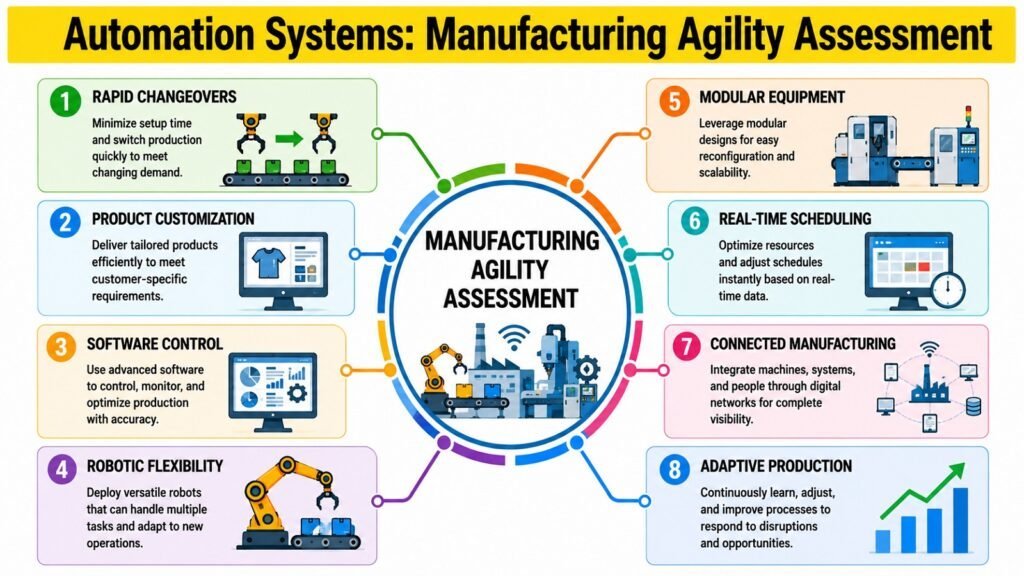
Flexible Automation Systems take adaptability further than programmable systems by enabling rapid product changes with minimal downtime between production runs. Where programmable systems require deliberate reprogramming between batches, flexible systems are designed to switch between different products quickly, sometimes within seconds or minutes. This is achieved through software-driven control, intelligent production planning, robotic integration, and automated material handling working together.
The core principle is the ability to handle product variety as a routine operating condition rather than an exception. In modern manufacturing environments characterized by customization, shorter product life cycles, and increasing demand variability, the ability to adapt quickly has become a genuine competitive advantage. Research from manufacturing technology organizations consistently shows that companies investing in flexible manufacturing systems report improvements in responsiveness to customer demand and reductions in the cost of managing multiple product lines.
Flexible Automation Systems typically include multi-axis robotic arms, automated guided vehicles, conveyor networks, computer-aided manufacturing software, and centralized production management systems. These systems can receive updated production schedules and adjust machine assignments, tooling changes, and material routing automatically. This level of coordination requires robust software infrastructure as much as advanced hardware.
The implementation challenges are significant. Flexible systems are considerably more complex and expensive than fixed or programmable alternatives. They require sophisticated software platforms, skilled integration engineers, and ongoing investment in programming and maintenance. The return on investment depends heavily on whether production conditions actually require frequent product changes, because a flexible system running the same product continuously provides no meaningful advantage over a simpler solution.
Industries such as aerospace component manufacturing, automotive parts supply, and medical device production benefit most from flexible automation because their environments combine moderate volume with high product variety. The practical insight is that flexibility creates genuine value when market conditions demand it. Adding flexibility for its own sake increases cost without delivering proportional returns.
Table 4: Flexible Automation Systems — Operational Features and Considerations
| Aspect | Details |
| Design principle | Rapid product changeover with minimal downtime using integrated control |
| Core technology | Robotic arms, AGVs, CNC, CAM software, centralized production management |
| Production model | Mixed-model manufacturing with frequent product and schedule changes |
| Common industries | Aerospace, automotive supply, medical devices, custom electronics |
| Key advantage | Fast adaptation to demand changes without major production interruptions |
| Main limitation | Higher complexity, cost, and integration requirements than simpler alternatives |
| Best conditions for use | High product variety, short life cycles, variable demand environments |
| Strategic insight | Flexibility adds value when market conditions demand it, not as a default choice |
4. Integrated Automation Systems: Connecting Industrial Operations into One Intelligent Ecosystem
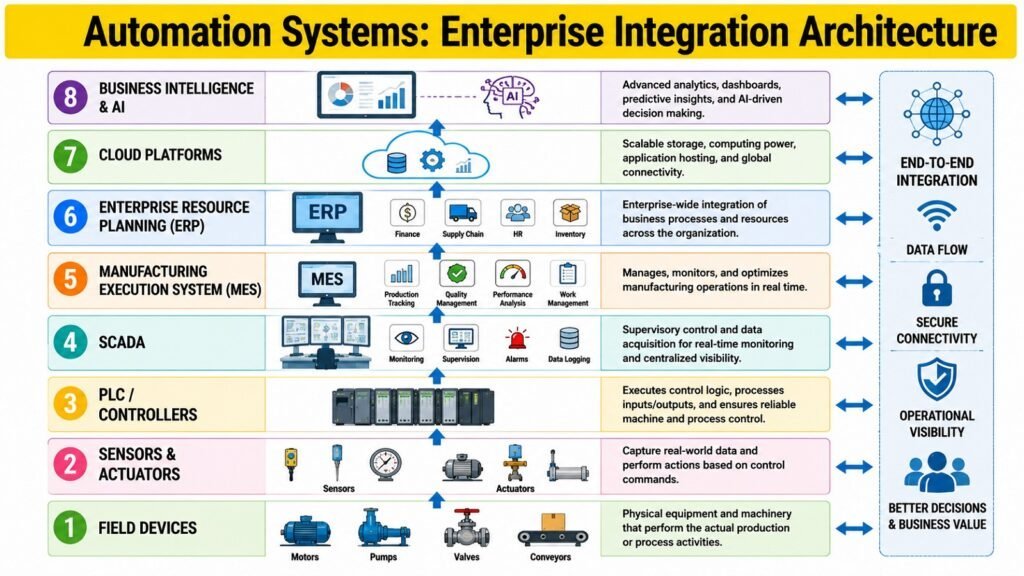
Integrated Automation Systems connect machines, industrial controllers, enterprise software, communication networks, operational databases, and monitoring platforms into a unified operational environment. The defining characteristic of integration is that individual automation components no longer operate in isolation. Instead, they share data, coordinate actions, and contribute to a single view of operational performance spanning the entire facility or organization.
This degree of connectivity revolutionizes the management of industrial operations. When a manufacturing execution system interacts directly with production machinery, enterprise resource planning software, quality management systems, and maintenance platforms, decision-makers gain access to real-time information that would typically be disjointed. Studies in industrial automation and frameworks like the ISA-95 standard consistently emphasize that enhanced visibility and coordination are among the most significant benefits of integrated automation.
Industrial communication protocols make integration work. Standards such as OPC-UA, MQTT, and PROFINET enable different equipment and software from different manufacturers to exchange data reliably. Without these communication layers, achieving genuine integration would require custom interfaces between every system, making the solution fragile and expensive to maintain over time.
Integrated Automation Systems have become essential for Industry 4.0 and digital transformation initiatives. Smart manufacturing depends on data flowing freely between shop-floor equipment and business management layers, enabling predictive maintenance, real-time scheduling, automated quality control, and supply chain coordination. Organizations that maintain isolated automation islands—where machines produce output but cannot share data with surrounding systems—are increasingly at a competitive disadvantage.
The core lesson is that successful Automation Systems depend not only on individual technologies but also on how effectively those technologies communicate and work together. Even the most advanced machine is limited in value if its operational data remains invisible to the systems managing production, maintenance, and business performance.
Table 5: Integrated Automation Systems — Components and Benefits
| Aspect | Details |
| Core principle | Unified connectivity across machines, software, and enterprise systems |
| Key technologies | OPC-UA, MQTT, MES, ERP integration, SCADA, industrial IoT platforms |
| Operational benefit | Real-time visibility across production, quality, maintenance, and logistics |
| Industry 4.0 role | Enables smart manufacturing and digital transformation at scale |
| Communication standards | ISA-95, OPC-UA, PROFINET support cross-platform data exchange |
| Integration challenge | Requires middleware, skilled engineers, and standardized data architectures |
| Common industries | Automotive, aerospace, process industries, consumer goods, logistics |
| Strategic insight | Automation value multiplies when systems share data rather than operate in silos |
5. Process Automation Systems: Controlling Continuous Industrial Operations
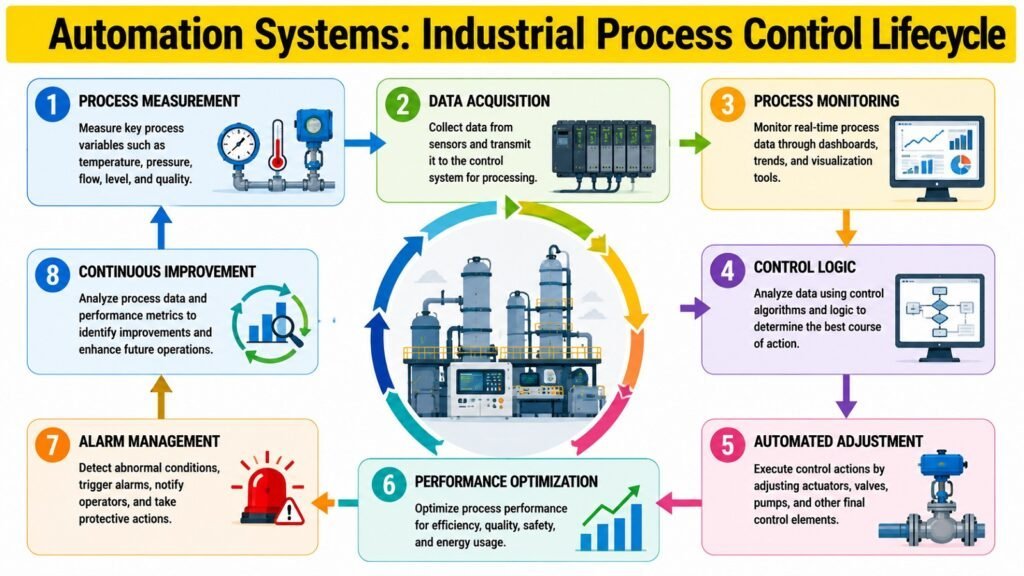
Process Automation Systems are designed to monitor, control, and optimize continuous or batch industrial processes where consistency, safety, and operational stability are the primary objectives. Unlike manufacturing automation that produces discrete items such as parts or assemblies, process automation manages flowing materials, chemical reactions, temperature changes, pressure levels, and other conditions that must remain within precise operational limits.
Industries such as oil and gas, chemicals, pharmaceuticals, food processing, water treatment, utilities, and power generation depend on Process Automation Systems as their operational backbone. In a refinery, automated process control manages the distillation of crude oil into multiple products simultaneously, maintaining temperatures, flow rates, and pressures across hundreds of control loops working in parallel. Without automation, managing this complexity safely at industrial scale would be impossible.
The control architecture typically includes distributed control systems, programmable logic controllers, sensors, actuators, and instrumentation that measure process variables and send feedback to control algorithms. These algorithms calculate required adjustments and send correction signals to valves, pumps, and heaters automatically. Research from the International Society of Automation shows that closed-loop automated control significantly reduces variability, improves product quality, and lowers energy consumption compared to manual operation.
Regulatory compliance is another area where Process Automation Systems deliver significant value. Pharmaceutical manufacturers must demonstrate that every batch was produced within validated parameters. Food processors must maintain documented evidence of temperature control. Automated process records provide this compliance documentation automatically, reducing administrative burden while improving audit readiness.
Uninterrupted process control remains one of the most valuable applications of Automation Systems because consequences of process upsets in chemicals, power generation, or pharmaceuticals extend beyond production losses to include safety risks, environmental impacts, and regulatory penalties. Reliable, continuous automated control is not a convenience in these industries; it is a fundamental operational requirement.
Table 6: Process Automation Systems — Characteristics and Applications
| Aspect | Details |
| Core principle | Automated monitoring and control of continuous or batch industrial processes |
| Key technologies | DCS, PLC, SCADA, sensors, actuators, control loops, instrumentation |
| Primary industries | Oil and gas, chemicals, pharmaceuticals, food processing, utilities |
| Safety role | Maintains process variables within safe limits to prevent incidents |
| Compliance benefit | Automated records support regulatory audits and validated production proof |
| Key advantage | Reduces variability, improves quality, and lowers energy consumption |
| Main challenge | High complexity; requires specialized engineering and ongoing calibration |
| Strategic insight | Continuous process control is a fundamental requirement, not an optional upgrade |
6. Robotic Automation Systems: Intelligent Machines for Modern Operations
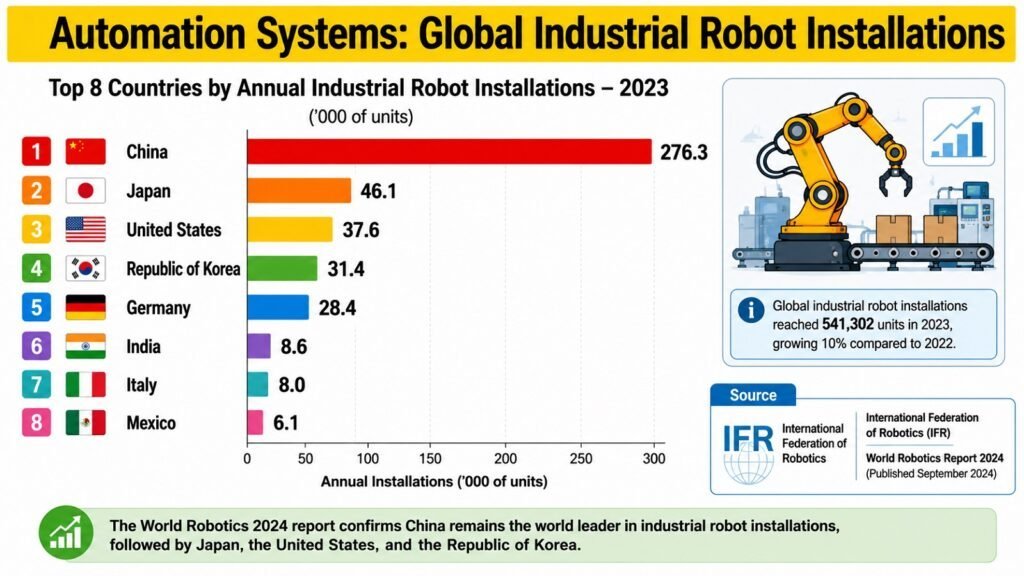
Robotic Automation Systems perform physical tasks using programmable robots that combine mechanical precision with software-driven intelligence. These systems deliver speed, precision, repeatability, and adaptability across a wide range of tasks while operating safely in environments that may be hazardous to human workers. Robotics has evolved far beyond the welding and painting robots of early automotive factories to become a broad category of automation spanning many industries and application types.
Industrial robots remain the largest segment of the robotic automation market. According to the International Federation of Robotics, global robot installations have grown consistently over the past decade, with automotive, electronics, and metal fabrication industries leading adoption. These robots perform welding, assembly, material handling, palletizing, and inspection tasks with a level of consistency that human operators simply cannot match across extended production shifts.
Collaborative robots, commonly called cobots, represent a significant development in robotic automation. Unlike traditional industrial robots that operate in fenced-off cells, cobots are designed to work alongside human workers safely. They are lighter, easier to program, and more flexible in their deployment, making robotics accessible to smaller manufacturers who previously could not justify the cost and complexity of traditional industrial systems.
Autonomous mobile robots have transformed warehouse and logistics automation by enabling goods-to-person fulfillment models that improve throughput and reduce physical demands on workers. Companies including Amazon, DHL, and Ocado have deployed large fleets of autonomous mobile robots in distribution centers, demonstrating how robotic automation can reshape logistics operations at scale. Healthcare has seen growing robotic adoption in surgical assistance, pharmacy dispensing, and hospital logistics as well.
The practical challenge is matching the right robotic solution to the right operational requirement. Robots deliver strong returns when tasks are well-defined, repetitive, physically demanding, or safety-critical. They are less suitable for tasks requiring high levels of human judgment or complex social interaction. Robotic automation performs best as part of an integrated approach rather than as a standalone investment.
Table 7: Robotic Automation Systems — Categories and Applications
| Aspect | Details |
| Industrial robots | Welding, assembly, painting, palletizing, and inspection in manufacturing |
| Collaborative robots | Lightweight, safe robots working alongside humans in flexible settings |
| Autonomous mobile robots | Warehouse navigation, goods transport, and fulfillment automation |
| Surgical robots | Precision-assisted surgery and minimally invasive medical procedures |
| Key advantages | Speed, precision, repeatability, and safe operation in hazardous conditions |
| Common challenge | High upfront cost, complex programming, and maintenance expertise required |
| Best applications | Repetitive, physically demanding, precision-critical, or safety-sensitive tasks |
| Strategic insight | Robotic systems deliver best returns when matched to appropriate task requirements |
7. Business Automation Systems: Transforming Enterprise Operations
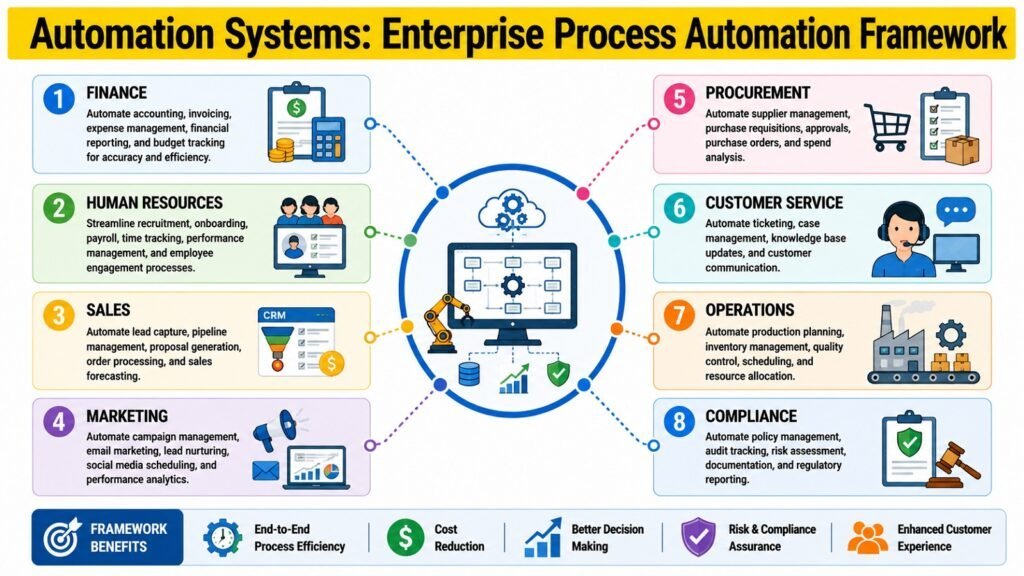
Business Automation Systems improve organizational efficiency by automating administrative, financial, customer-facing, and operational business processes. While industrial Automation Systems focus on physical production and process control, Business Automation Systems target the information flows, decision processes, and workflows that run an organization. The goal is to reduce manual effort, eliminate errors, improve consistency, and free employees to focus on work that requires judgment and creativity.
Workflow automation, document management systems, enterprise resource planning platforms, customer relationship management systems, and robotic process automation tools all fall within this category. Robotic process automation has emerged as particularly significant, enabling software robots to perform repetitive digital tasks such as data entry, form processing, and system-to-system data transfer without human involvement. Research from McKinsey Global Institute and Gartner studies consistently identifies business process automation as one of the highest-return areas of enterprise technology investment.
The difference between Business Automation Systems and industrial automation is worth understanding. Industrial systems automate physical operations with predictable inputs. Business automation deals with information, documents, and decisions that vary in structure and content. This variability makes business automation both more accessible to a wider range of organizations and more complex to implement well, because automating judgment-intensive processes requires careful process design and exception handling.
Practical applications span nearly every business function. Finance departments use automation for invoice processing, accounts payable, financial reporting, and compliance checks. Human resources teams automate onboarding, leave management, and payroll processing. Customer service operations use automated response systems and case routing. Supply chain management benefits from automated procurement, inventory monitoring, and logistics coordination.
The most important implementation principle is alignment between automation and business strategy. Organizations that automate poorly designed processes simply produce errors faster. Successful Business Automation Systems require clear process documentation, stakeholder engagement, and a willingness to redesign workflows before applying automation tools. Technology alone does not deliver organizational improvement without thoughtful process management as the foundation.
Table 8: Business Automation Systems — Functions and Benefits
| Aspect | Details |
| Core applications | Invoice processing, onboarding, CRM, ERP, document management, RPA |
| Workflow automation | Streamlines approval chains, task routing, and cross-department processes |
| Customer-facing benefit | Faster service response, consistent communication, and self-service options |
| Finance automation | Accelerates accounts payable, payroll, reporting, and compliance tasks |
| HR automation | Manages onboarding, leave, benefits administration, and workforce data |
| Key advantage | Reduces errors, manual effort, and processing time at enterprise scale |
| Main challenge | Poorly designed processes produce errors faster when automated |
| Strategic insight | Align automation with business goals and redesign processes before applying tools |
8. Intelligent Automation Systems: AI-Powered Automation for the Future
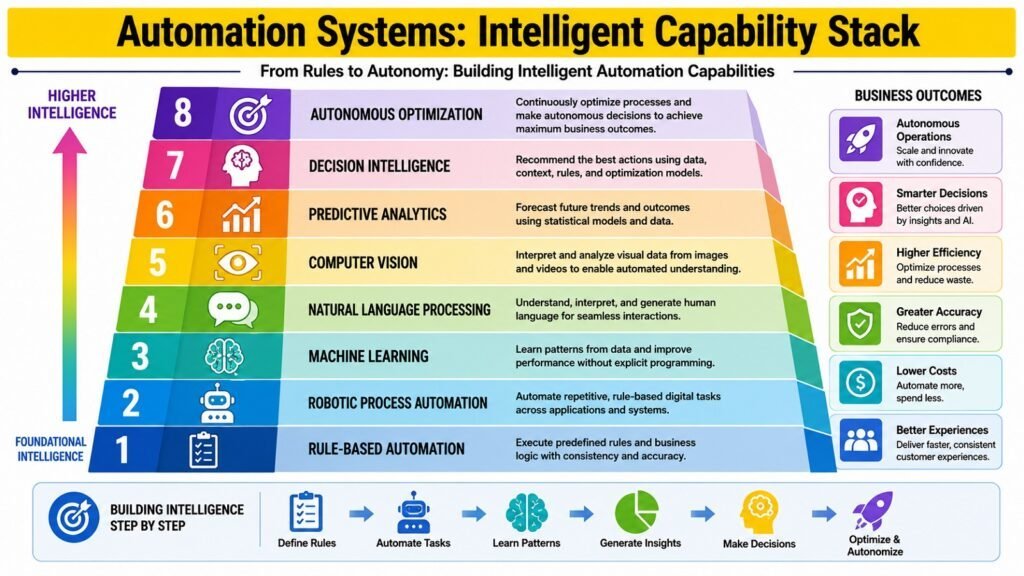
Intelligent Automation Systems represent the most advanced category of Automation Systems currently in practice. They combine automation with artificial intelligence, machine learning, natural language processing, computer vision, predictive analytics, and robotic process automation to create systems that adapt, learn, and make decisions rather than simply executing predefined instructions. This ability to respond to new situations without explicit reprogramming distinguishes intelligent automation from every other category.
Traditional Automation Systems follow rules. An intelligent system recognizes patterns, draws inferences from data, and adjusts its behavior based on what it has learned. Predictive maintenance is a well-established example. Rather than scheduling maintenance at fixed intervals, an intelligent system monitors sensor data continuously, identifies patterns associated with developing faults, and triggers maintenance before failures occur. Research from Deloitte and the McKinsey Global Institute shows that predictive maintenance programs enabled by machine learning deliver meaningful reductions in unplanned downtime and maintenance cost compared to traditional time-based approaches.
Computer vision systems embedded in manufacturing operations can inspect products at speeds and accuracies that exceed human inspection capabilities. These systems learn from labeled examples of acceptable and defective products, improving their detection accuracy over time. Natural language processing enables intelligent automation in customer service, document analysis, contract review, and knowledge management, handling unstructured text with comprehension that rule-based systems cannot match.
The implementation challenges are significant. Intelligent Automation Systems require substantial volumes of high-quality training data, skilled engineering teams, robust model governance, and ongoing monitoring to detect when AI models begin producing degraded results due to changing real-world conditions. Ethical considerations around transparency, bias, and accountability are also important, particularly in applications affecting hiring decisions, credit assessments, or safety-critical operations.
Rather than replacing every other category, Intelligent Automation Systems work most effectively when they complement existing automation infrastructure. An AI-powered scheduling system adds value when operating alongside a Flexible Automation System. Intelligent quality inspection adds value when integrated with an existing manufacturing execution system. As AI capabilities mature and data infrastructure improves, Intelligent Automation Systems will progressively enhance every other category, making the boundary between traditional and intelligent automation increasingly difficult to distinguish.
Table 9: Intelligent Automation System — AI Capabilities and Applications
| Aspect | Details |
| Core technologies | AI, ML, NLP, computer vision, predictive analytics, intelligent RPA |
| Predictive maintenance | Sensor-driven fault prediction reduces unplanned downtime and repair cost |
| Computer vision | Automated visual inspection with accuracy exceeding human performance |
| NLP applications | Document analysis, contract review, customer interaction, knowledge retrieval |
| Key advantage | Adapts to new data and situations without full reprogramming |
| Implementation challenge | Requires quality training data, skilled teams, and ongoing model governance |
| Ethical consideration | Transparency, bias management, and accountability in AI decision-making |
| Strategic insight | Intelligent automation complements existing systems rather than replacing them |
Conclusion: Automation Systems as the Driving Force Behind Modern Automation
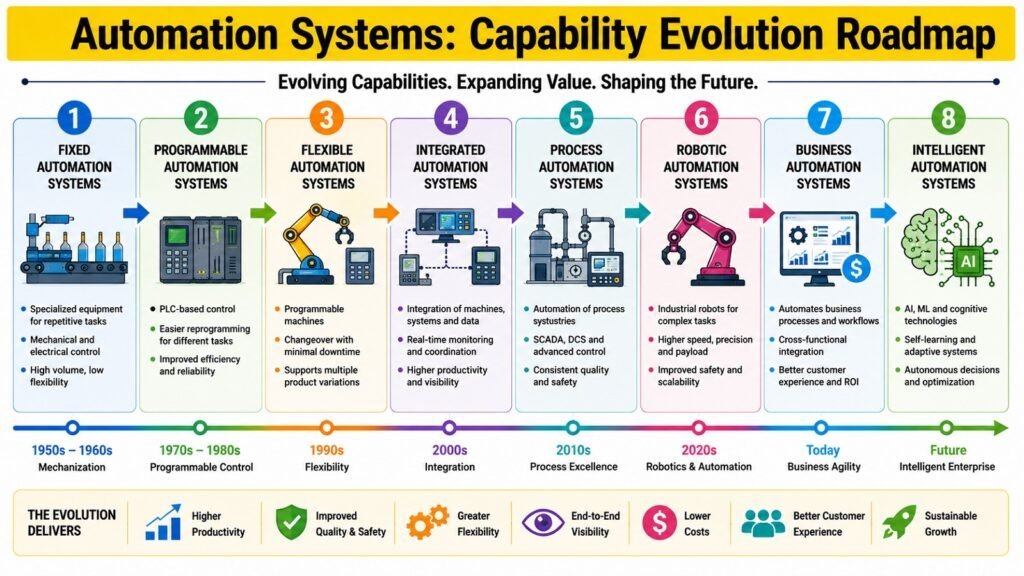
Automation Systems are fundamental to Modern Automation because different categories address different operational challenges rather than competing with one another. Fixed and Programmable systems serve high-volume manufacturing. Flexible systems respond to market variability. Integrated systems create operational visibility. Process systems maintain safety and continuity. Robotic systems execute precision physical tasks. Business systems streamline enterprise operations. And Intelligent systems introduce adaptive, data-driven decision-making across all of the above.
Selecting the right Automation Systems requires understanding business objectives, production requirements, operational complexity, scalability, and long-term strategy before making technology decisions. Many organizations invest in advanced technology without evaluating whether it matches their actual operational conditions. A fixed automation line is not inferior to an intelligent system; it is simply designed for a different set of requirements. The right choice depends entirely on the problem being solved.
The progression from traditional manufacturing systems to intelligent, AI-enabled Automation Systems reflects how production and market conditions have changed over time. Each category emerged in response to real operational needs, and each continues to deliver value in the right context. Understanding this progression helps organizations avoid two common mistakes: over-investing in advanced systems before conditions justify them, and under-investing in foundational automation that would deliver clear and immediate returns.
Looking ahead, Automation Systems will continue to evolve as AI capabilities deepen, communication technologies improve, and data infrastructure becomes more sophisticated. The organizations that benefit most will be those that evaluate automation decisions from both strategic and practical perspectives, understanding not only what each category can do but also when and why each category delivers the greatest value for their specific operational environment.
Table 10: Automation Systems — Key Takeaways from Each Category
| Category | Key Takeaway |
| Fixed Automation Systems | Best for stable, high-volume production where efficiency outweighs flexibility |
| Programmable Automation Systems | Ideal for batch production requiring periodic product or sequence changes |
| Flexible Automation Systems | Creates value when product variety and demand variability are high |
| Integrated Automation Systems | Unlocks full automation value by connecting systems into one operational view |
| Process Automation Systems | Essential for continuous industries where safety and stability are non-negotiable |
| Robotic Automation Systems | Delivers precision and repeatability in physical tasks at scale |
| Business Automation Systems | Improves enterprise efficiency when aligned with clear process strategy |
| Intelligent Automation Systems | Extends automation with adaptive, AI-driven decision-making capabilities |