Table of Contents
Introduction: Automation Technology and the Foundations of Modern Automation
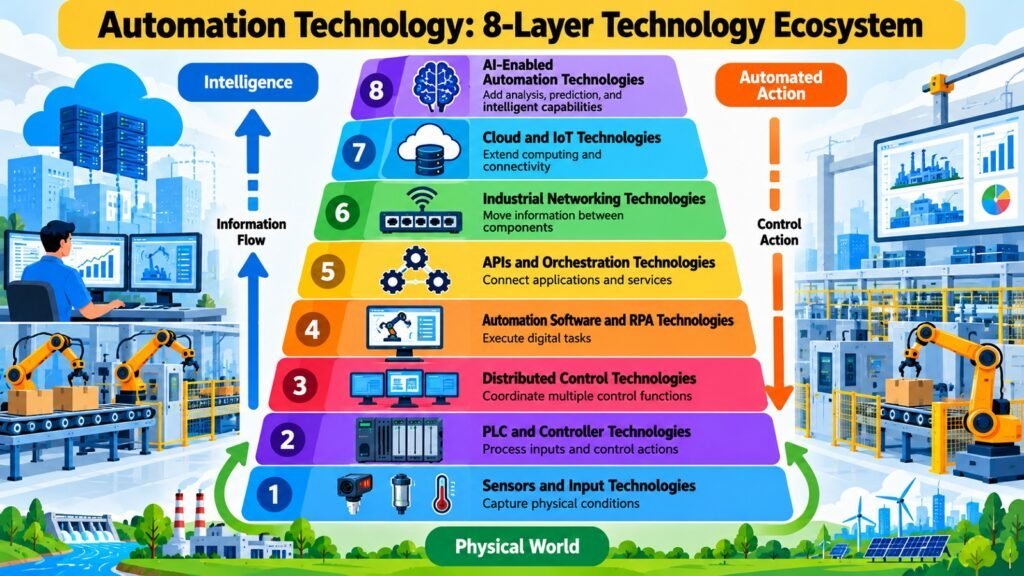
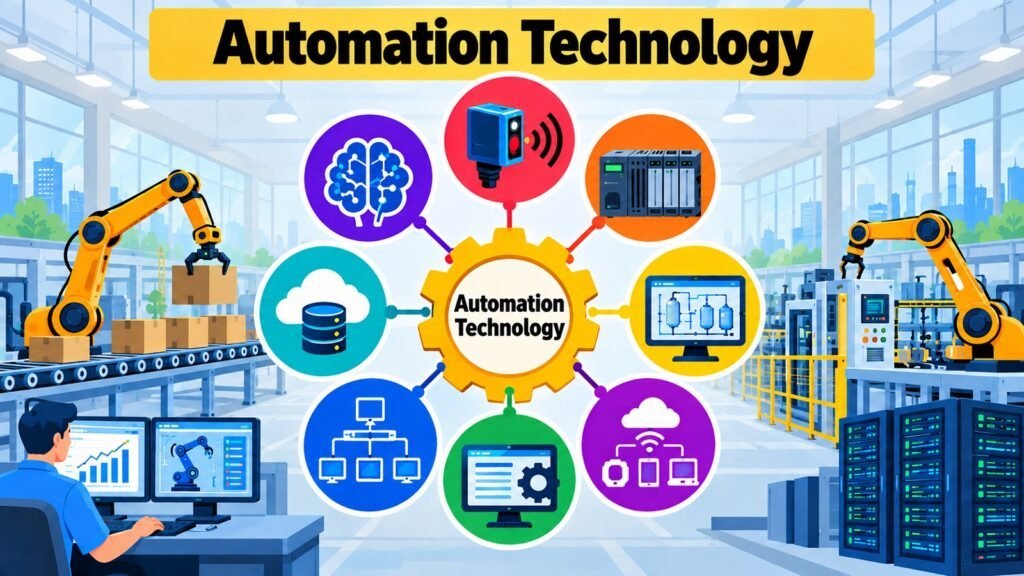
Automation Technology is an important aspect of Automation. It forms the technical foundation that makes automated systems possible, and understanding it requires recognizing why modern automation depends on a connected collection of technologies rather than any single isolated tool. An automated system senses conditions, processes information, controls equipment, executes digital tasks, exchanges data, connects distributed components, uses computing resources, and applies intelligence. Together, these capabilities form what practitioners describe as an Automation Technology stack.
The central idea is that these capabilities are interconnected. Sensing alone does not produce automation. Control logic without reliable input produces poor decisions. Software without integration cannot move information between systems. The value of any single layer depends on how well it connects with the others, which is why interoperability, reliability, scalability, real-time performance, data quality, and integration are consistent themes across the field.
A simple manufacturing example illustrates how these layers work together. A temperature sensor detects excessive heat in a production machine. That signal travels across an industrial network to a programmable controller, which triggers a cooling response. A cloud monitoring platform logs the event, an AI analytics service flags it as a developing fault, and an API sends an automated alert to the maintenance system. Eight technology layers converted one physical reading into coordinated automated action.
This article covers eight foundational aspects of Automation Technology: Sensors and Input Technologies, PLC and Controller Technologies, Distributed Control Technologies, Automation Software and RPA Technologies, APIs and Orchestration Technologies, Industrial Networking Technologies, Cloud and IoT Technologies, and AI-Enabled Automation Technologies. Each section examines the technology, its role within the wider stack, and the practical considerations that influence performance.
Automation Technology At a Glance: Eight Foundational Areas
| Automation Technology Foundation | Primary Role |
| Sensors and Input Technologies | Capture physical conditions as digital data for processing |
| PLC and Controller Technologies | Execute programmed logic to control field devices and equipment |
| Distributed Control Technologies | Coordinate multiple control functions across complex facilities |
| Automation Software and RPA Technologies | Perform repetitive digital tasks within software applications |
| APIs and Orchestration Technologies | Enable programmatic data exchange and workflow coordination |
| Industrial Networking Technologies | Transport information between devices, controllers, and systems |
| Cloud and IoT Technologies | Extend automation with remote computing and connected devices |
| AI-Enabled Automation Technologies | Add learning, prediction, and pattern recognition to automation |
1. Automation Technology and Sensors: Capturing Real-World Data
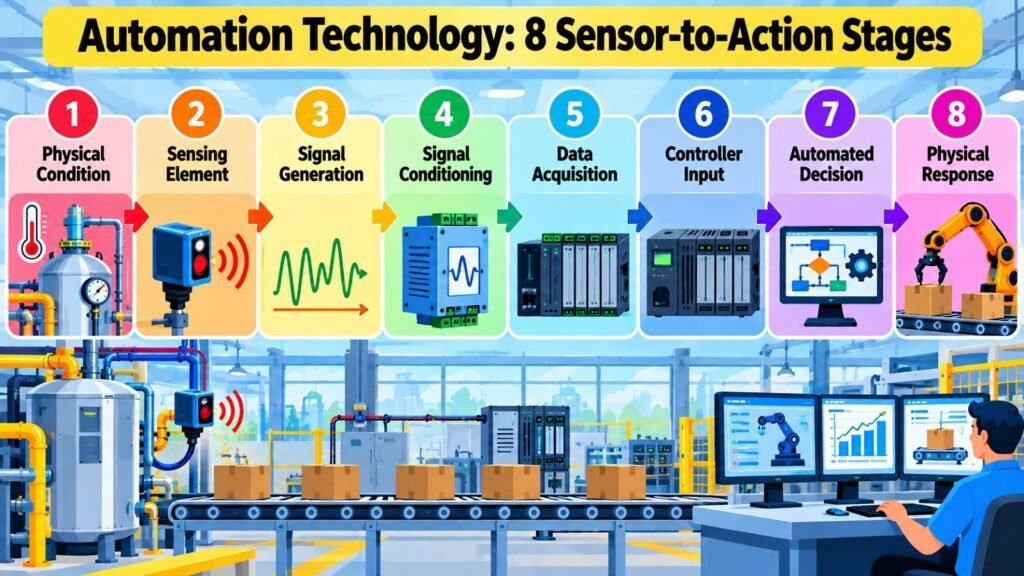
Sensors and Input Technologies form the perception foundation of Automation Technology. Before any automated system can take reliable action, it needs accurate information about physical conditions. Sensors provide that information by converting physical states into signals or digital data that controllers and software can use.
The range of sensor technologies in automation is wide. Temperature sensors measure thermal conditions in processes and equipment. Pressure sensors monitor fluid or gas pressure in pipelines and vessels. Proximity sensors detect object presence without physical contact. Position encoders track displacement and orientation. Level sensors measure material height in containers. Flow sensors quantify fluid movement through pipes. Machine vision systems use cameras and image-processing software to inspect and classify objects. Each technology converts a specific physical condition into a signal that a downstream layer can interpret.
The information flow from physical condition to automated response involves several steps. A sensor detects a condition, converts it into a signal, and transmits that signal to an acquisition system. Signal conditioning removes noise and scales the output to a usable range. The conditioned signal is then sampled, digitized where necessary, and passed to a processing layer that determines what action is required. The quality of this chain depends on sensor accuracy, calibration, response time, placement, and environmental suitability.
A sensor operating outside its calibrated range, placed near electromagnetic interference, or sampling too slowly for a fast-changing process introduces errors that propagate through every downstream layer. The IEC 61131 family of standards addresses control system architecture within which sensor data flows, and various industry guidelines cover installation and calibration practices. Sensor outputs connect to input modules on programmable controllers or to remote I/O units that transmit data across the automation network.
Practical evaluation criteria include measurement range, accuracy class, response time, ingress protection rating, power requirements, communication interface compatibility, and long-term stability. No amount of sophisticated control logic or AI capability can compensate reliably for missing or inaccurate physical data. Sensor quality sets the upper limit of what every downstream automation layer can achieve.
Automation Technology and Sensors: Eight Input Technologies and Their Roles
| Sensor Technology | Typical Automation Role |
| Temperature sensor | Monitors process or equipment thermal conditions |
| Pressure sensor | Measures fluid or gas pressure in pipes and vessels |
| Proximity sensor | Detects object presence without physical contact |
| Flow sensor | Quantifies fluid or gas volume moving through a system |
| Level sensor | Measures material height in tanks or storage containers |
| Position encoder | Tracks rotational or linear displacement of moving parts |
| Machine vision system | Inspects, classifies, or measures objects using camera imaging |
| Vibration sensor | Detects abnormal mechanical vibration for condition monitoring |
2. Automation Technology and PLCs: Controlling Automated Operations
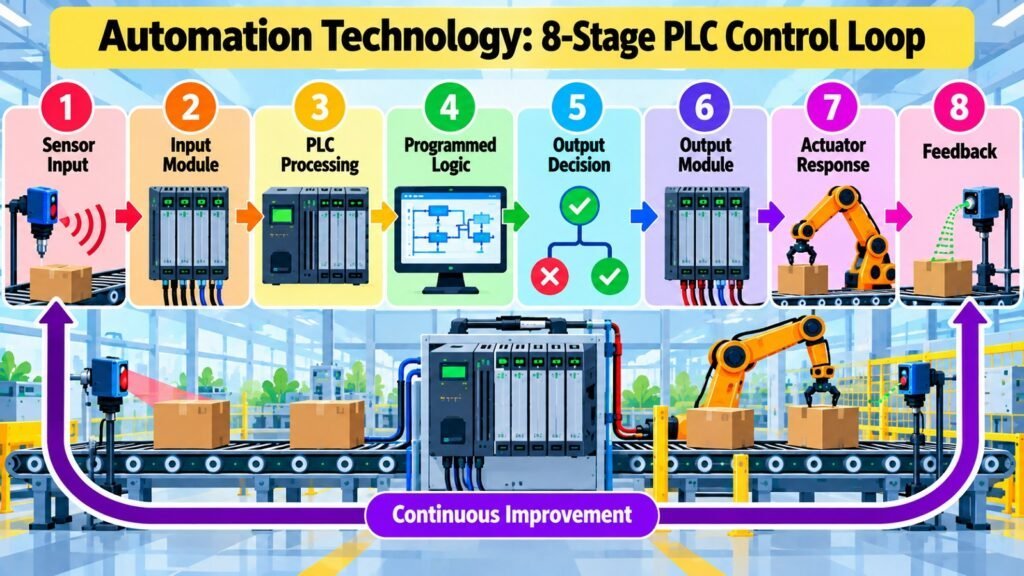
PLC and Controller Technologies form the control foundation of Automation Technology. A programmable logic controller receives signals from input devices, executes stored logic, and produces output signals that drive actuators, motors, valves, and other field devices. This sequence of input, processing, and output represents the fundamental control loop that makes automated operation possible.
A PLC typically consists of a central processing unit, a power supply, and input/output modules. The CPU executes a program stored in memory by scanning through it continuously. During each scan cycle, the CPU reads all input states, executes the program logic, updates output states, and repeats. This deterministic behavior, where the same inputs produce the same outputs within a predictable time window, is one of the primary reasons PLCs have remained central to industrial automation since their development in the late 1960s. The IEC 61131-3 standard defines five programming languages for programmable controllers: ladder diagram, function block diagram, structured text, instruction list, and sequential function chart.
Ladder diagram remains widely used in manufacturing because it visually resembles relay panel wiring, making it intuitive for technicians who maintain such systems. Structured text suits complex arithmetic and data-processing tasks. The availability of multiple standardized languages gives engineers flexibility to choose the approach that best matches both the application and the team’s experience.
Contemporary controllers include communication ports supporting industrial Ethernet protocols, fieldbus connections, and wireless interfaces. Many PLCs exchange data with supervisory systems, human-machine interfaces, manufacturing execution systems, and cloud platforms. This connectivity has extended the controller’s role beyond local machine control and made it a data-producing node within a broader automation architecture.
Important considerations when specifying controller technologies include I/O point count and type, communication protocol compatibility, scan cycle time relative to process speed, programming environment availability, environmental ratings for temperature and humidity, redundancy requirements for critical systems, and long-term parts and vendor support. PLCs are engineered for environments that expose equipment to vibration, dust, temperature extremes, and electrical noise.
Automation Technology and PLCs: Eight Controller Capabilities and Their Automation Roles
| Controller Capability | Role in Automation |
| Deterministic scan cycle | Ensures predictable, repeatable input-process-output timing |
| Ladder diagram programming | Provides a relay-logic interface familiar to technicians |
| Analog and digital I/O | Accepts sensor signals and drives field devices and actuators |
| Industrial Ethernet port | Connects the controller to networks, SCADA, and cloud systems |
| Diagnostic self-reporting | Identifies faults in hardware and I/O modules during operation |
| High-speed counter input | Reads pulse-based position or speed signals from encoders |
| Redundant CPU option | Maintains operation if the primary processor fails |
| IEC 61131-3 compliance | Supports standardized programming languages across vendors |
3. Automation Technology and Distributed Control: Coordinating Complex Operations
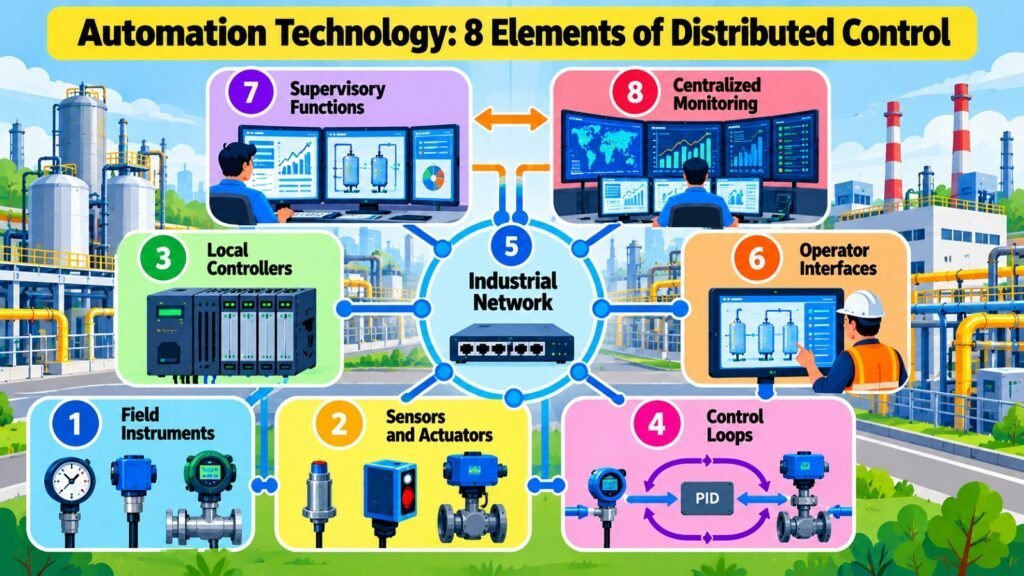
Distributed Control Technologies address a different scale of automation challenge. When a facility contains hundreds or thousands of measurement and control points spread across a large area, a single local controller is insufficient. Distributed Control Systems provide the architecture for managing numerous control functions while maintaining coordinated monitoring, operation, and response across an entire facility.
The architectural idea behind a Distributed Control System is the separation of control functions while maintaining communication and supervision through a shared network and centralized operator interface. Control responsibilities are distributed across multiple field controllers, each managing a defined area or process unit. These controllers communicate with each other and with supervisory workstations over a high-reliability network, allowing operators to monitor and adjust the entire facility from one location without physical proximity to individual control devices.
Distributed control is particularly relevant to continuous operations such as oil and gas processing, chemical manufacturing, power generation, water treatment, and pharmaceutical production. In a refinery, separate control functions might manage feedstock preheating, distillation, heat exchanger networks, and utilities. Each function operates with its own control loops but feeds information to a common supervisory layer that provides plant-wide visibility and supports coordinated decision-making. This architecture enables reliable control of processes that a single controller could not manage effectively.
Core elements of a distributed control architecture include field controllers or remote I/O units placed near process equipment, a high-speed control network, operator workstations, engineering workstations, a process historian for logging data over time, and alarm management systems. The ISA-18.2 standard provides widely referenced guidance for alarm management in process control environments. Key technical considerations include network reliability and redundancy, communication latency relative to process dynamics, and the maintainability of components spread across a large physical area.
Automation Technology and Distributed Control: Eight Elements and Their Primary Roles
| Distributed Control Element | Primary Role |
| Field controller | Executes local control loops close to process equipment |
| Control network | Transports process data between field controllers and servers |
| Operator workstation | Provides centralized monitoring and manual intervention capability |
| Process historian | Stores time-series process data for analysis and compliance |
| Engineering workstation | Supports configuration, tuning, and testing of control logic |
| Alarm management system | Notifies operators of abnormal process or equipment conditions |
| Redundant communication | Maintains connectivity if a primary network path fails |
| Control loop | Continuously adjusts an output to maintain a desired process value |
4. Automation Technology and RPA: Automating Digital Tasks
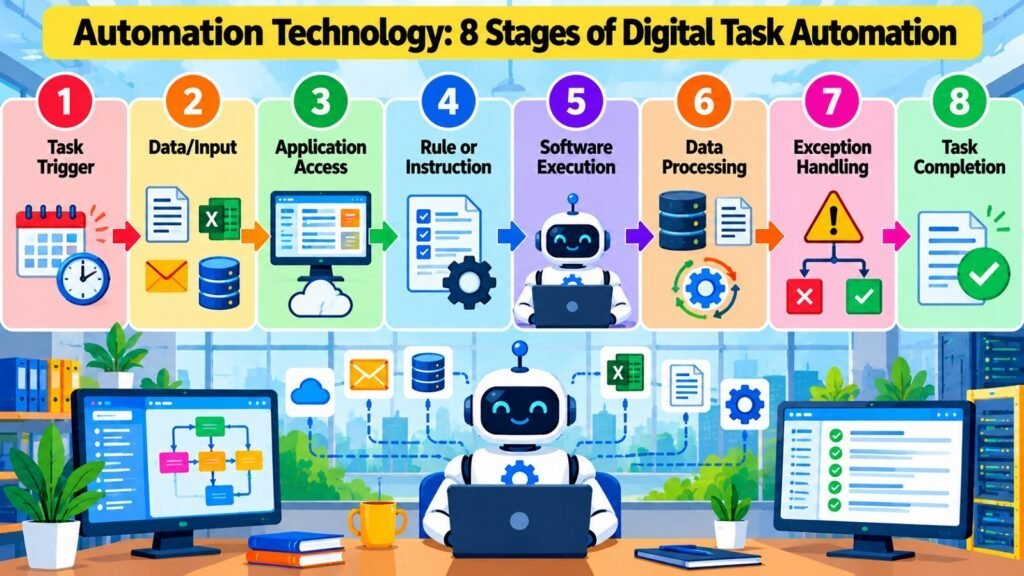
Automation Software and RPA Technologies represent the software-execution layer of Automation Technology. While sensors, controllers, and distributed systems address physical processes, Robotic Process Automation and related software technologies address repetitive digital tasks within computer applications, databases, and information systems. The core idea is that software can perform many of the same actions a person performs at a computer, executing those actions faster, more consistently, and without the fatigue that affects human workers during repetitive work.
RPA software interacts with application interfaces much as a human user would. A software bot can open applications, read data from screens or documents, enter information into forms, copy content between systems, query databases, generate reports, and trigger workflows. This interaction model allows RPA to work with existing applications without requiring changes to those applications or access to their underlying code, making it particularly useful for automating tasks in legacy systems that lack modern integration capabilities.
Automation approaches are generally divided into attended and unattended categories. Attended automation involves a bot working alongside a human user, executing defined steps when triggered during an active session. Unattended automation runs independently on a schedule or in response to a triggering event. Platforms such as UiPath, Automation Anywhere, and Microsoft Power Automate are established enterprise RPA tools offering bot development, deployment, monitoring, and management capabilities.
RPA fits within the Automation Technology architecture as a software-layer component that typically connects through an application’s presentation layer rather than a formal API. This provides flexibility when APIs are unavailable but creates dependencies on screen layout and application behavior that may require maintenance when those applications change. Where an API exists, it generally provides a more robust integration; RPA offers a practical alternative when one does not. Important limitations include sensitivity to interface changes, the need for robust exception-handling logic, governance requirements for managing bot fleets, and the complexity of coordinating multiple bots across related tasks.
Automation Technology and RPA: Eight Software Capabilities and Their Automation Roles
| Software Capability | Automation Role |
| Screen and UI interaction | Reads and operates application interfaces as a human user would |
| Document data extraction | Reads structured data from forms, invoices, or reports |
| Application data entry | Inputs records into databases, ERP systems, or web forms |
| Scheduled task execution | Runs automated workflows at defined times without user action |
| Exception handling | Detects and routes unexpected inputs to human review queues |
| Process orchestration | Coordinates sequences of bot actions across multiple applications |
| Activity monitoring | Tracks bot performance, errors, and execution logs for governance |
| Legacy system interaction | Automates tasks in applications that lack modern API support |
5. Automation Technology and APIs: Connecting Automated Applications
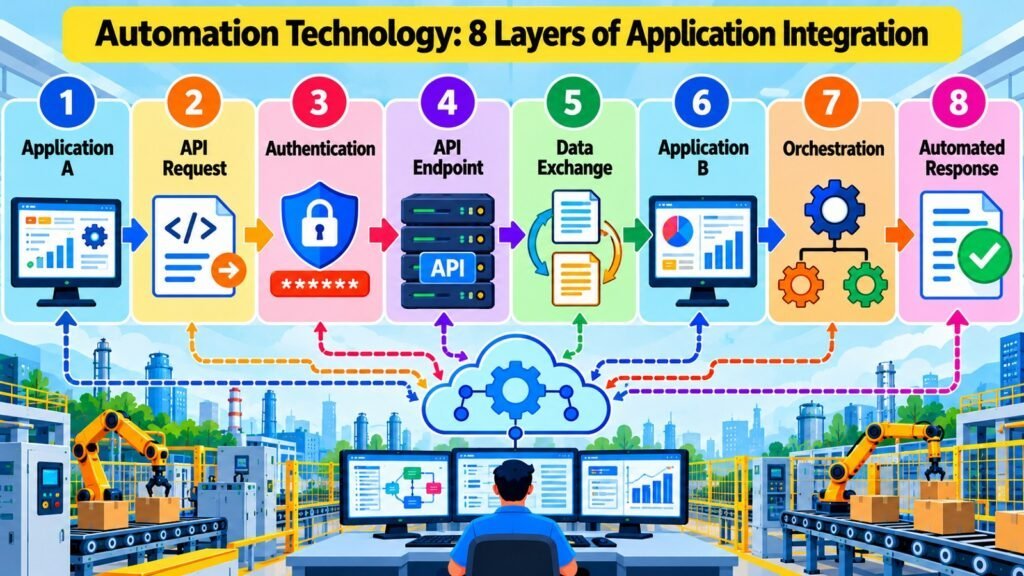
APIs and Orchestration Technologies function as the integration layer of Automation Technology. An application programming interface defines a structured way for two software systems to communicate, allowing one to request information or trigger actions in the other without understanding its internal workings. This capability transforms otherwise isolated applications into interconnected participants within a broader automation architecture.
The basic interaction model for a REST API involves a client sending an HTTP request to a defined endpoint, the server processing the request, and returning a structured response, typically in JSON format. When a manufacturing system needs to update an inventory record, notify a procurement application, and log an event to a monitoring dashboard simultaneously, APIs allow each action to occur programmatically without manual data entry. This makes them a foundational integration mechanism in modern automation environments.
Webhooks extend this model by reversing the initiation direction. Rather than one system repeatedly checking another for updates, a webhook allows a source system to notify a receiving system automatically when a relevant event occurs. This event-driven approach reduces unnecessary communication and allows automation workflows to respond in near real time. Apache Airflow, an open-source orchestration platform, illustrates how orchestration tools coordinate task sequences and dependencies across multiple services using directed acyclic graphs.
APIs connect the different layers of the Automation Technology stack in practical ways. A cloud monitoring platform may expose APIs that local controller systems call to push operational data. An RPA bot may interact with an application through its API where one exists, in preference to a screen-based approach. An industrial network gateway may offer an API for querying live sensor readings from external applications. Practical considerations include API versioning, authentication mechanisms such as OAuth 2.0, error handling and retry logic, rate limiting, data format consistency, and documentation quality.
Automation Technology and APIs: Eight Integration Concepts and Their Automation Functions
| Technology Concept | Automation Function |
| REST API | Enables structured data exchange between software systems over HTTP |
| Webhook | Triggers an action in one system when an event occurs in another |
| API gateway | Manages authentication, routing, and traffic for multiple APIs |
| Message broker | Decouples systems by queuing and distributing messages asynchronously |
| Workflow orchestration | Coordinates task sequences and dependencies across services |
| OAuth 2.0 | Provides delegated authorization for secure API access |
| Data serialization (JSON) | Structures information for consistent exchange between applications |
| Service endpoint | Exposes a defined function or resource for programmatic access |
6. Automation Technology and Industrial Networks: Connecting Machines
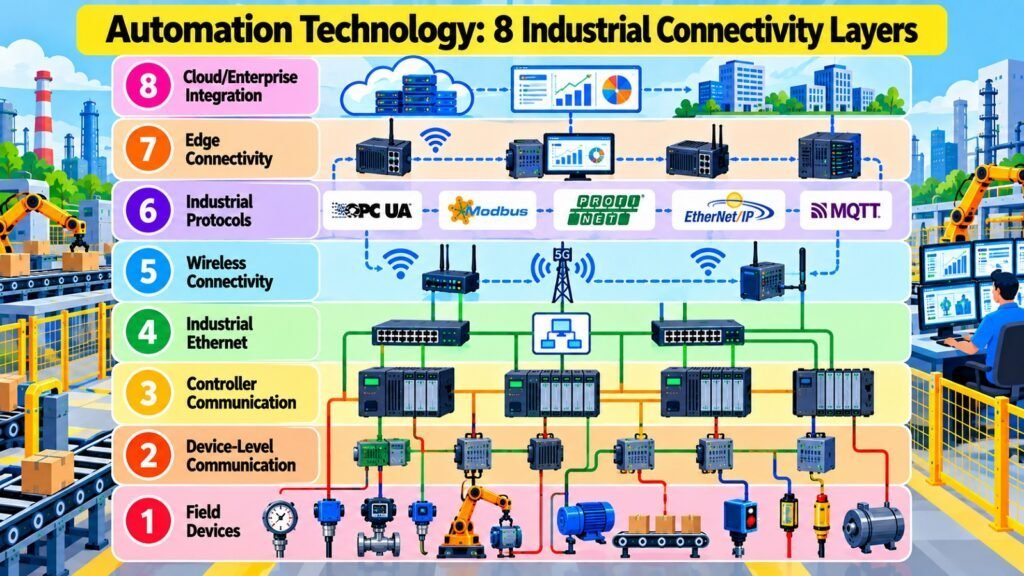
Industrial Networking Technologies form the communication foundation of Automation Technology. Information produced by sensors, controllers, software, and field devices has no practical value unless it can be transported reliably and quickly to wherever it is needed. The industrial network is the infrastructure that enables that transport, and its characteristics directly determine what kinds of automation are achievable.
Industrial Ethernet has become the dominant wired network technology in modern automation environments. Based on the IEEE 802.3 standard but extended with protocols designed for industrial requirements, it supports higher bandwidth, ruggedized connectors, and longer cable runs than commercial office networking equipment. Protocols built on Industrial Ethernet include PROFINET, EtherNet/IP, EtherCAT, and Modbus TCP, each with different characteristics for real-time performance, device compatibility, and application domain. OPC UA, developed by the OPC Foundation, provides a platform-independent communication framework addressing data transport, information modeling, security, and interoperability between devices from different manufacturers. MQTT, a lightweight publish-subscribe protocol, suits scenarios where many devices report data to a central broker with minimal overhead.
Wireless technologies play an increasing role in automation. Wi-Fi provides network access for mobile equipment and areas where cabling is impractical. 5G cellular networks, with higher bandwidth and lower latency relative to earlier wireless standards, are attracting interest for factory automation, logistics, and remote monitoring, particularly for private network deployments where industrial operators manage their own wireless infrastructure. Time-Sensitive Networking, defined by IEEE 802.1 standards, extends Ethernet with time synchronization and traffic scheduling mechanisms, allowing time-critical control data and non-critical monitoring data to coexist on the same physical network.
Wired networks generally offer more predictable latency and resistance to interference. Wireless networks provide mobility and lower installation costs where cabling is impractical. Neither approach is universally superior, and the appropriate choice depends on the latency, reliability, mobility, and environmental requirements of each specific application. A highly capable controller or sensor can still provide limited value if the communication layer cannot reliably transfer the required information at the required speed.
Automation Technology and Industrial Networks: Eight Networking Technologies and Their Uses
| Networking Technology | Typical Automation Use |
| Industrial Ethernet | High-speed wired backbone for factory and process automation |
| PROFINET | Real-time Ethernet protocol for motion, I/O, and controller communication |
| EtherCAT | High-speed synchronized protocol for motion control applications |
| OPC UA | Platform-independent, secure data exchange across vendor systems |
| MQTT | Lightweight publish-subscribe messaging for IoT and remote devices |
| Wi-Fi (IEEE 802.11) | Wireless access for mobile equipment, tablets, and portable terminals |
| 5G private network | High-bandwidth, low-latency wireless for factory and logistics sites |
| Time-Sensitive Networking | Deterministic Ethernet for time-critical control data transport |
7. Automation Technology and Cloud & IoT: Extending Connected Automation
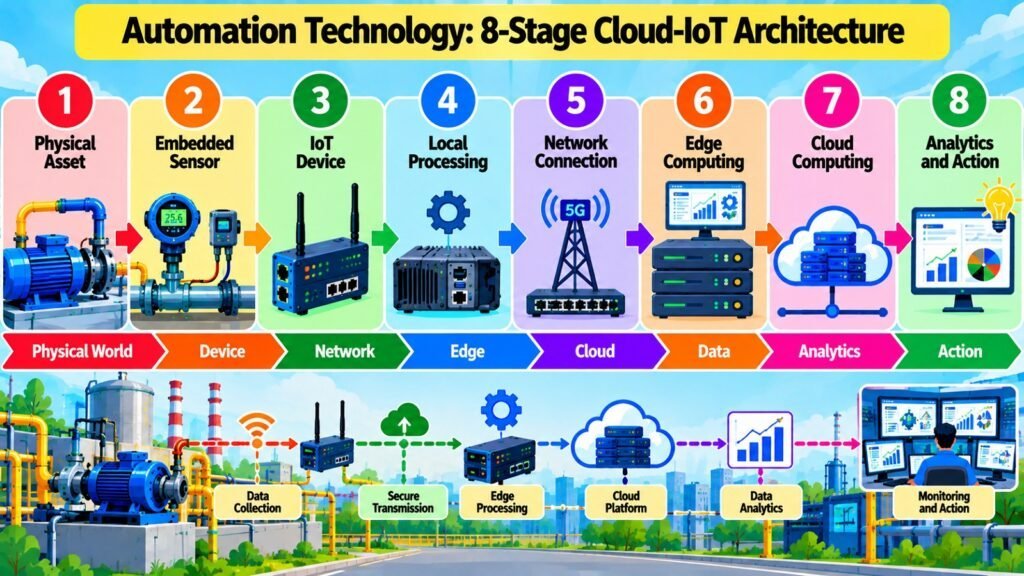
Cloud and IoT Technologies extend Automation Technology beyond individual machines and local control environments. The Internet of Things describes physical devices embedded with sensors, communication hardware, and software that allow them to collect and exchange data over networks. Cloud computing provides the scalable infrastructure, platforms, and services that process, store, and analyze the data those devices generate.
The architecture connecting IoT devices to cloud services involves several layers. At the device layer, sensors, actuators, and embedded computing hardware collect data from physical processes or environments. At the edge layer, local computing resources process some data close to its source, reducing the volume that must travel to remote infrastructure and enabling faster local responses. Network infrastructure carries data between the edge and cloud layers. At the cloud layer, scalable computing services provide storage, analytics, application hosting, and management capabilities that would be impractical to replicate locally at every site.
Practical applications include remote monitoring of distributed equipment, condition monitoring of asset health indicators, predictive maintenance that identifies developing faults before failure occurs, asset tracking in logistics environments, connected building systems that manage energy consumption, and centralized management of distributed automation infrastructure. These applications share a common pattern: data collected at the device layer becomes progressively more useful as it reaches analytic and management services higher in the architecture.
Edge computing is a complementary approach to cloud computing rather than a competing one. When decisions must occur within milliseconds, sending data to a remote cloud service introduces latency that control applications cannot tolerate. Edge computing keeps time-critical decisions local while directing less time-sensitive analytics and management tasks to cloud resources. The combination of edge and cloud processing is common in sophisticated IoT deployments. Connectivity reliability, data governance requirements, interoperability between device hardware and cloud platforms, and total operational cost are important considerations when extending automation through cloud and IoT technologies.
Automation Technology and Cloud and IoT: Eight Technologies and Their Automation Roles
| Technology or Concept | Automation Role |
| IoT platform | Manages device registration, data ingestion, and routing |
| Edge computing node | Processes data locally to reduce latency and cloud dependency |
| Cloud data storage | Retains operational data volumes for analysis and compliance |
| Remote monitoring service | Provides visibility into equipment spread across many locations |
| Digital twin | Models physical asset behavior using real-time and historical data |
| OTA firmware update | Delivers software changes to connected devices remotely |
| Cloud analytics service | Applies statistical and ML analysis to aggregated operational data |
| Device management platform | Configures, monitors, and secures fleets of connected IoT devices |
8. Automation Technology and AI: Enabling Intelligent Automation
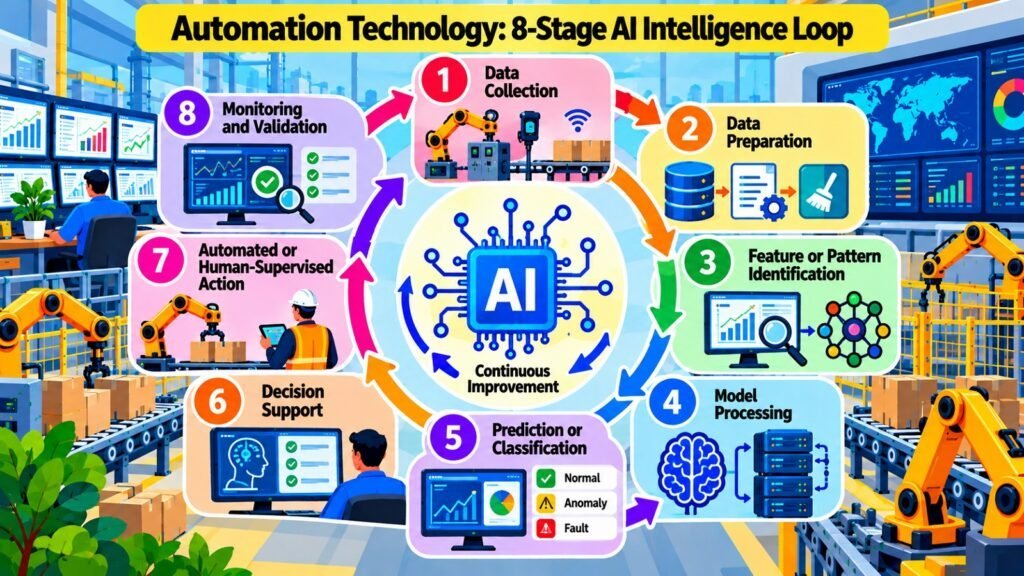
AI-Enabled Automation Technologies represent the intelligence-enhancement layer of Automation Technology. Conventional automation relies on explicitly programmed rules: if condition A occurs, perform action B. This approach works well for well-defined, repetitive tasks in stable environments but becomes limited when the range of possible conditions is too large to enumerate, when patterns are too subtle for programmers to specify explicitly, or when a system needs to improve over time based on experience. AI technologies address these limitations by enabling systems to learn from data, recognize patterns, make predictions, and classify inputs in ways that extend what rule-based logic can achieve.
Machine learning is the most broadly applied AI discipline in automation. Supervised learning algorithms train on labeled datasets to produce models that classify new inputs or predict outcomes. Unsupervised algorithms identify patterns without predefined labels. These techniques underpin visual inspection systems that learn to identify manufacturing defects, predictive maintenance systems that learn from historical sensor data to recognize conditions preceding failure, and demand forecasting systems that learn seasonal patterns from transactional records.
Computer vision applies machine learning to image and video data. Visual inspection systems using trained neural networks detect surface defects, dimensional variations, and assembly errors at speeds that are difficult to sustain through manual inspection. Anomaly detection systems monitor operational data streams and flag readings outside expected patterns, providing early warning of developing problems without requiring explicit rules for every possible fault condition. Predictive analytics uses statistical models and machine learning to forecast future states, enabling maintenance teams to schedule interventions before failures occur.
Natural language processing enables automation systems to extract information from documents, logs, and reports, supporting classification, data extraction, and conversational data queries. Important limitations include dependence on high-quality training data, the risk of model degradation as operating conditions change, challenges in explaining model decisions in regulated environments, computational resource requirements, and the need for appropriate human oversight in critical applications. AI enhances automation; it does not automatically improve systems that lack adequate data quality or sound engineering foundations.
Automation Technology and AI: Eight AI Capabilities and Their Automation Applications
| AI Technology or Capability | Automation Application |
| Supervised machine learning | Classifies inputs or predicts outcomes from labeled training data |
| Computer vision | Inspects products, reads labels, or tracks objects using images |
| Anomaly detection | Flags unusual patterns in sensor streams that may signal faults |
| Predictive analytics | Forecasts equipment failure or demand from historical data patterns |
| Natural language processing | Extracts information from documents, logs, or conversational inputs |
| Reinforcement learning | Optimizes sequential decisions through reward-based feedback |
| Time-series forecasting | Predicts future values in continuous operational data streams |
| Explainable AI (XAI) | Provides interpretable reasons for model outputs in critical decisions |
Conclusion: Automation Technology and the Future of Connected Automation
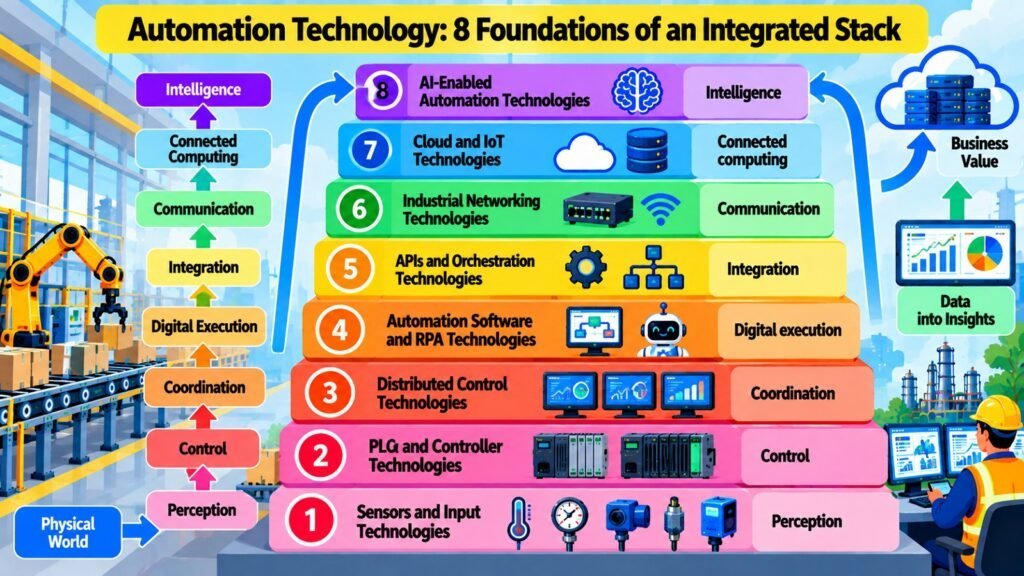
The eight foundations covered in this article are interconnected layers of a technical stack, and the value of each layer depends on how well it connects with the others. Sensors produce data of limited use if it cannot reach a controller reliably. Controllers execute logic effectively only when their inputs are accurate. Software automation and APIs extend automation into digital processes and enterprise systems. Industrial networking carries the information that makes coordination possible. Cloud and IoT technologies extend the architecture beyond local environments. AI enhances every other layer by enabling systems to handle more complex patterns and nuanced decisions than rule-based logic alone can address.
A useful distinction reinforces the article’s scope. Automation Technology describes the technical capabilities and components that enable automation: sensors, controllers, software, networks, computing infrastructure, and AI tools. Automation Systems describe how those capabilities are organized and deployed as functioning automated solutions across manufacturing, process control, logistics, or building management. Understanding the technology layer is foundational to evaluating, designing, or studying any automation environment.
When assessing an automation environment, the relevant questions concern not just which technologies are present, but whether they communicate reliably, whether data quality is adequate at the sensing layer, whether integration mechanisms connect the right systems, whether the network meets latency and reliability requirements, and whether the intelligence layer has sufficient data governance to operate safely. These questions apply across industries and scales.
Automation Technology continues to evolve as networking standards, computing infrastructure, AI capabilities, and integration tools develop. What remains constant is the importance of the relationships between layers. Integrated, interoperable, scalable, and increasingly intelligent technologies will continue to define the capability and reliability of automated systems.
Automation Technology Foundations: Eight Layers and Their Architecture Contributions
| Automation Technology Foundation | Architecture Layer |
| Sensors and Input Technologies | Perception — physical data acquisition |
| PLC and Controller Technologies | Control — deterministic logic execution |
| Distributed Control Technologies | Coordination — multi-function supervision |
| Automation Software and RPA Technologies | Execution — digital task automation |
| APIs and Orchestration Technologies | Integration — application interconnection |
| Industrial Networking Technologies | Communication — data transport infrastructure |
| Cloud and IoT Technologies | Extension — remote computing and connectivity |
| AI-Enabled Automation Technologies | Intelligence — learning and pattern recognition |