Table of Contents
Introduction: Energy Efficiency Technologies and Green Technology
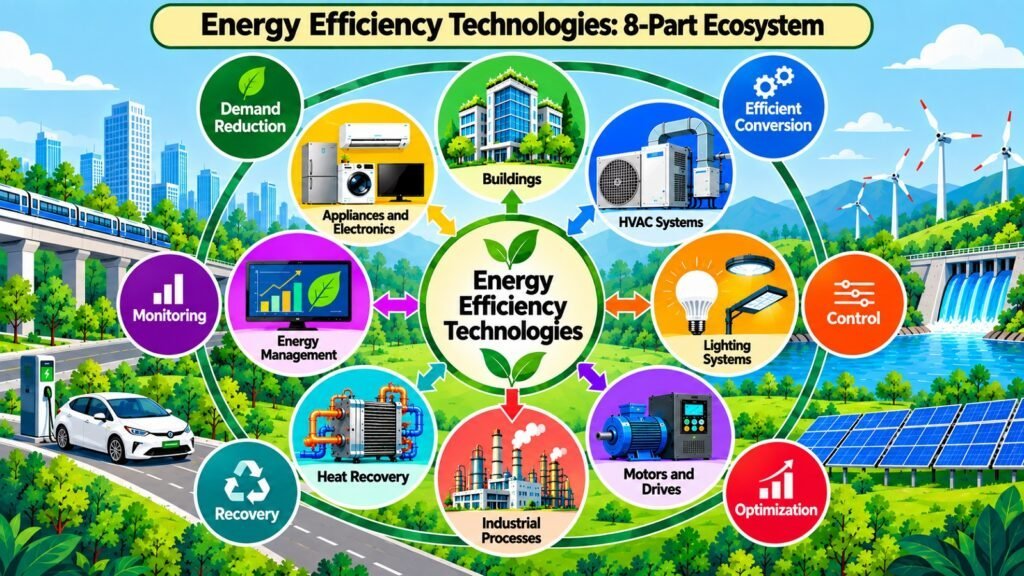
Energy Efficiency Technologies are important building blocks of Green Technology. While renewable energy addresses how energy is produced, energy efficiency addresses how effectively it is used. The distinction matters: energy efficiency is not simply about using less energy, but about achieving the same or greater useful output from less energy input. Arbitrary reductions in consumption can compromise productivity and comfort, whereas genuine efficiency improvements deliver the same results with fewer resources.
A system becomes more energy efficient when it reduces losses, improves conversion, recovers wasted energy, or matches supply precisely to demand. Modern Energy Efficiency Technologies increasingly incorporate sensors, automation, data analytics, and intelligent controls—capabilities that allow systems to respond dynamically to changing conditions rather than operating at fixed settings. This shift from static to adaptive operation represents a meaningful advance in what efficiency technologies can achieve.
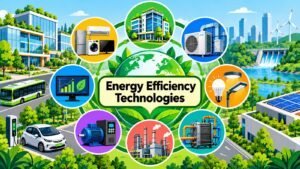
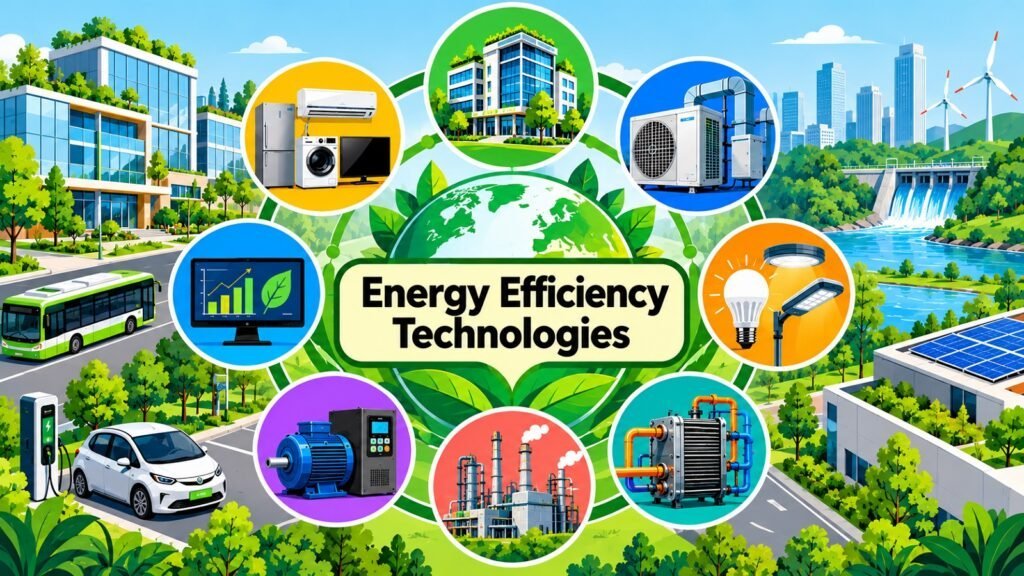
Energy efficiency operates across five broad functions: reducing demand before it arises, improving conversion from input to useful output, minimizing losses, recovering otherwise wasted thermal or electrical energy, and optimizing consumption through measurement and control. These functions are not mutually exclusive; the most effective strategies often combine several simultaneously. This article examines eight technology areas—Buildings, HVAC Systems, Lighting Systems, Motors and Drives, Industrial Processes, Heat Recovery, Energy Management, and Appliances and Electronics—as a foundational guide that combines technological principles, practical applications, and implementation considerations.
Table 1: Overview of Energy Efficiency Technologies Covered in This Article
| Areas of Energy Efficiency Technologies | Primary Focus |
| Buildings | Envelope performance, controls, and integrated energy management |
| HVAC Systems | Heating, cooling, ventilation efficiency, and load matching |
| Lighting Systems | Efficient light sources, controls, and occupancy-based operation |
| Motors and Drives | Variable-speed operation, motor selection, and system optimization |
| Industrial Processes | Process optimization, automation, and specific energy consumption |
| Heat Recovery | Capturing and reusing thermal energy otherwise lost or rejected |
| Energy Management | Measurement, monitoring, analysis, and continuous optimization |
| Appliances and Electronics | Component and system-level efficiency in everyday devices |
1. Energy Efficiency Technologies in Buildings
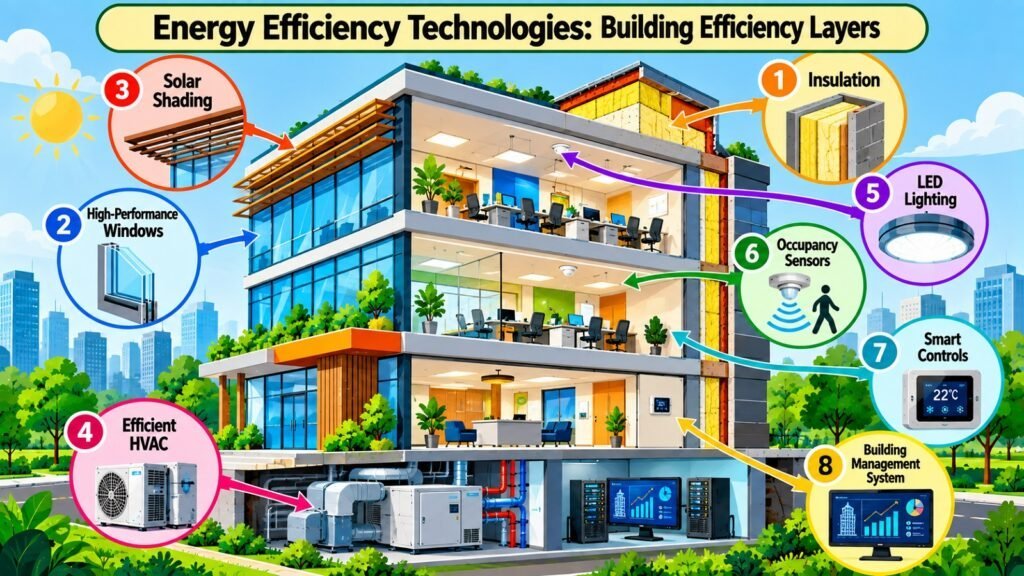
Buildings account for a substantial share of global energy consumption, making them a central application area for Energy Efficiency Technologies. Energy performance depends on physical characteristics, mechanical systems, controls, occupancy, and climate. Heat flows through walls, roofs, floors, and windows; solar radiation enters through glazing; and occupants, lighting, and equipment generate internal heat. The combined effect determines how much heating or cooling a building requires, which drives a large portion of its total energy use.
Insulation reduces the rate of heat flow between interior and exterior by increasing thermal resistance in walls, roofs, and floors. High-performance glazing manages heat transfer and solar gain simultaneously. In cold climates, south-facing glazing reduces heating demand; in hot climates, shading systems and low-solar-gain coatings limit unwanted heat entry. Controls and automation extend these gains. Smart thermostats optimize heating and cooling schedules based on occupancy, while Building Management Systems integrate HVAC, lighting, and other loads into a coordinated platform. Research by the U.S. Department of Energy indicates that well-configured building controls can reduce commercial energy use meaningfully.
Energy performance is best evaluated by energy intensity—energy consumed per unit of floor area—rather than individual component specifications. A building with excellent insulation but a poorly configured management system can underperform one with standard construction but well-optimized controls. For facility managers, an energy audit that measures actual consumption, identifies major end uses, and benchmarks performance against relevant standards is the most reliable starting point for identifying and prioritizing efficiency opportunities.
Table 2: Building Energy Efficiency Technologies and Their Primary Functions
| Technology | Primary Efficiency Function |
| Wall and roof insulation | Reduces conductive heat transfer through the building envelope |
| High-performance glazing | Limits thermal loss while managing solar gain through windows |
| Shading systems | Reduces unwanted solar heat gain in warm climates or seasons |
| Smart thermostat | Adjusts temperature setpoints based on occupancy and schedule |
| Occupancy sensors | Turns off or reduces HVAC and lighting in unoccupied spaces |
| Air sealing | Reduces uncontrolled heat loss and gain through infiltration |
| Building Management System | Integrates and optimizes building energy systems centrally |
| Passive solar design | Uses orientation and glazing to reduce heating demand naturally |
2. Energy Efficiency Technologies in HVAC Systems
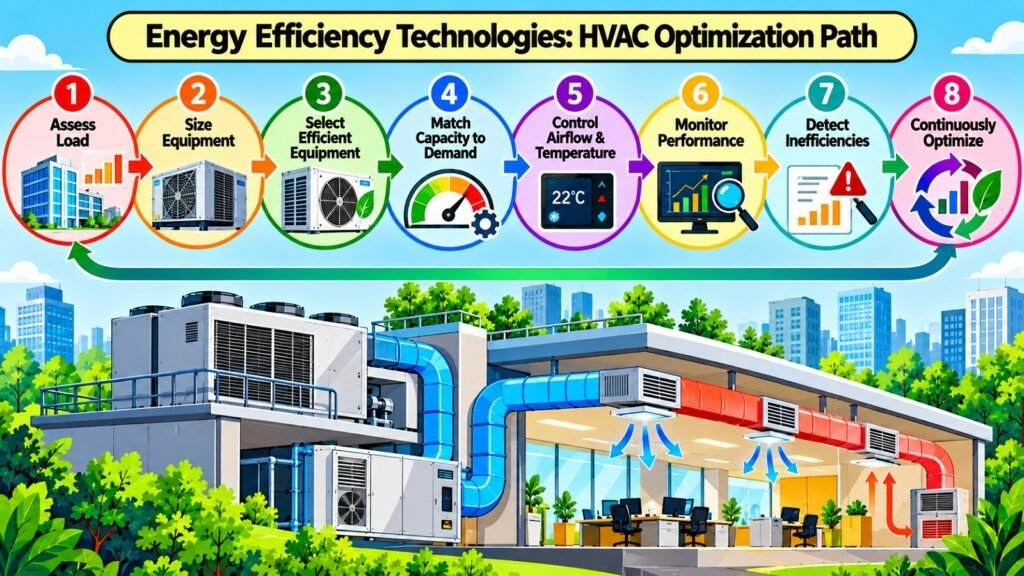
HVAC systems are among the largest energy consumers in buildings, and Energy Efficiency Technologies in this domain can significantly reduce overall energy use while maintaining occupant comfort. Performance depends on the interaction between equipment, building load, operating conditions, and controls—not on equipment specification alone. A system operates most efficiently when correctly sized, running near its rated conditions, and adjusting output to match the varying demand that occurs throughout the day and across seasons.
High-efficiency HVAC equipment uses improved compressors, heat exchangers, and refrigerants to deliver more heat transfer per unit of input. Heat pumps transfer heat rather than generating it, which allows them to deliver more useful output per unit of energy than combustion-based alternatives where climate and load profiles make them suitable. Variable-speed drives on compressors, fans, and pumps enable continuous output adjustment rather than fixed-speed operation, reducing energy consumption substantially at partial loads. Zoning conditions different areas independently, and demand-controlled ventilation adjusts fresh-air delivery based on measured occupancy rather than maximum rates continuously.
Coefficient of performance and seasonal efficiency metrics are more useful than peak-load ratings because real systems spend most of their time at partial loads. Replacing a single component—such as a compressor—without considering system integration, sizing, controls, and maintenance rarely achieves the efficiency gains possible through whole-system optimization. HVAC efficiency depends on what the system achieves across its entire operating range, not only at design conditions.
Table 3: HVAC Energy Efficiency Technologies and Their Efficiency Contributions
| HVAC Technology | Efficiency Contribution |
| Variable-speed compressor | Adjusts refrigeration capacity to match actual load continuously |
| Variable-speed fan and pump drives | Reduces energy at partial load by matching airflow to demand |
| High-efficiency heat exchanger | Transfers more heat per unit area, improving thermal performance |
| Heat pump system | Transfers heat rather than generating it, improving energy ratios |
| Demand-controlled ventilation | Adjusts fresh air supply based on actual occupancy measurements |
| Zoning and zone controls | Conditions different spaces according to their individual needs |
| Smart thermostat and scheduler | Optimizes setpoints and operating times based on occupancy |
| Economizer cycle | Uses outdoor air for cooling when conditions allow, reducing load |
3. Energy Efficiency Technologies in Lighting Systems
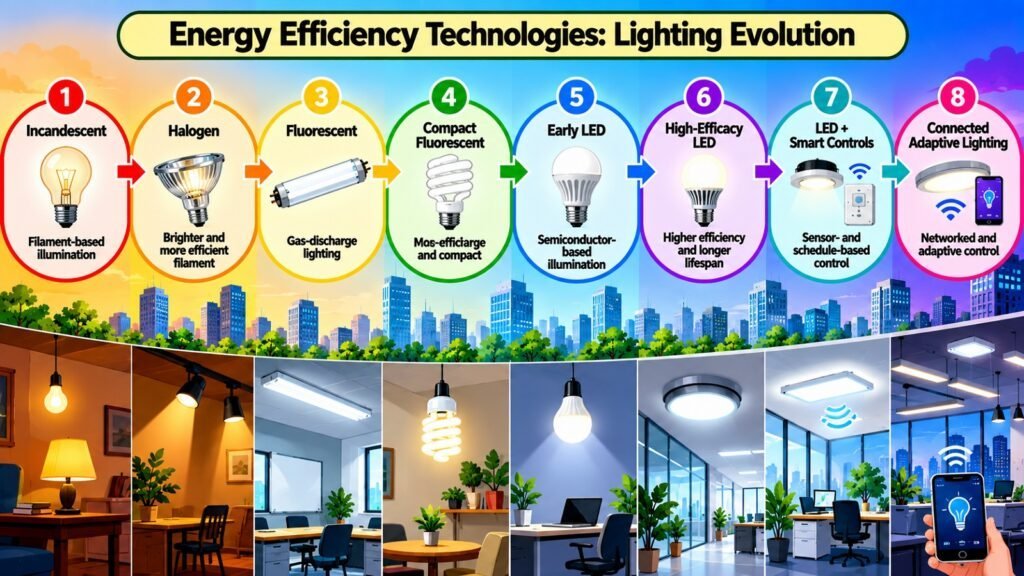
Lighting accounts for a significant share of building electricity consumption, and Energy Efficiency Technologies have transformed it from a relatively fixed cost into a highly controllable system. Luminous efficacy—light output per watt of electrical input—is the primary measure of source efficiency. Incandescent lamps convert only a small fraction of their input into visible light, with most becoming heat. LED technology advances this substantially, and modern LED systems outperform previous generations by a wide margin.
The light source alone does not determine system-level efficiency. A high-efficacy LED in a luminaire with poor optics loses significant output before light reaches its target surface. Luminaire design, reflector quality, and optical distribution all affect delivered illumination. Controls then determine how much of that capacity is used unnecessarily. Occupancy sensors switch or dim lights when spaces are empty; daylight harvesting dims electric lighting when natural light is sufficient; dimming controls match output to task requirements; and automated scheduling turns systems off during reliably unoccupied periods.
Lighting power density—watts installed per floor area—provides a useful design metric, and reducing it through efficient equipment and controls directly reduces electricity consumption. Lighting also contributes to internal heat gains, so improving lighting efficiency has a secondary effect on HVAC energy use. A high-efficiency lamp that runs unnecessarily or lacks appropriate controls remains part of an inefficient system; component efficiency and system-level efficiency are distinct and both matter.
Table 4: Lighting Energy Efficiency Technologies and Their Primary Roles
| Lighting Technology | Primary Efficiency Role |
| LED light source | Produces more lumens per watt than previous lighting technologies |
| High-efficiency luminaire | Directs light output effectively to minimize optical losses |
| Occupancy sensor | Switches or dims lighting when spaces are unoccupied |
| Daylight harvesting system | Reduces electric light levels when natural light is sufficient |
| Dimming control | Adjusts light output to match actual task and occupancy requirements |
| Automated scheduling | Turns off lighting during reliably unoccupied time periods |
| Adaptive lighting control | Adjusts light levels based on time, task, and occupancy conditions |
| Connected lighting network | Enables centralized monitoring and control of lighting systems |
4. Energy Efficiency Technologies in Motors and Drives
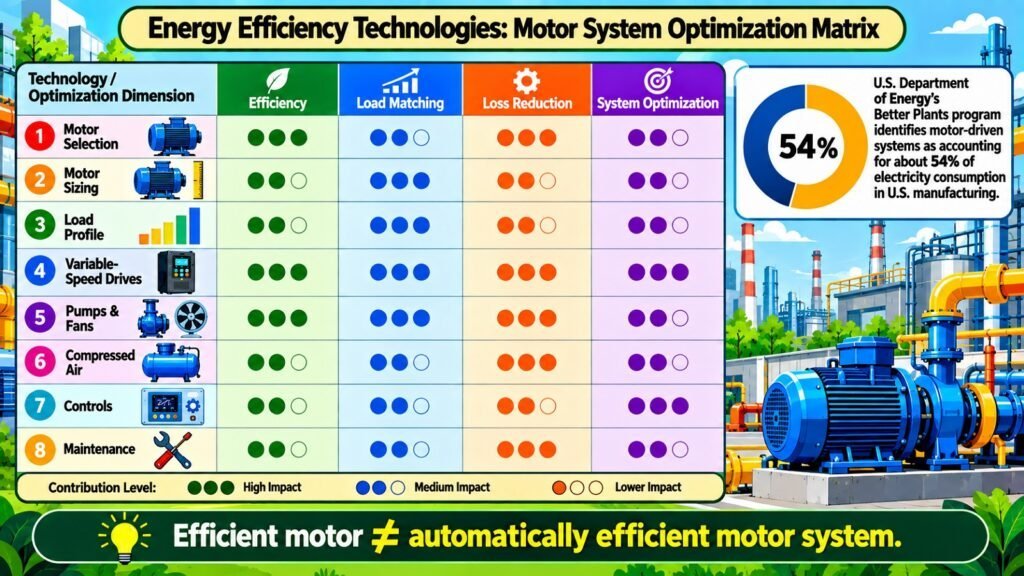
Electric motors and motor-driven systems—pumps, fans, compressors, conveyors—represent one of the largest categories of electrical energy consumption across buildings, industry, water supply, and infrastructure. Energy Efficiency Technologies at the motor and drive level can therefore reduce electrical demand across many sectors simultaneously. Motor efficiency is the ratio of mechanical output to electrical input, and high-efficiency motors reduce losses through improved materials, winding design, and optimized magnetic circuits. Standards bodies such as the International Electrotechnical Commission define IE3 and IE4 efficiency classes as performance benchmarks.
Motor efficiency is only part of the picture. Many motors operate at fixed speed despite varying loads, wasting energy when demand is lower than capacity. Variable-speed drives—also called variable-frequency drives—adjust the electrical frequency supplied to the motor, matching speed and output to actual requirements. Because power consumption in fans and pumps follows a cubic relationship with speed, small speed reductions produce large energy savings. A correctly sized pump controlled by a variable-speed drive consistently outperforms a high-efficiency motor driving an oversized pump through a throttling valve.
System efficiency encompasses the complete driven system: motor selection, drive sizing, equipment sizing, piping or ductwork design, and control strategy. Optimizing the system as a whole delivers greater gains than replacing a motor in isolation. Automated controls that start and stop motors based on actual demand eliminate energy waste during idle periods. Regular maintenance—lubricated bearings, clean windings, tight connections—prevents efficiency degradation and helps actual performance remain close to rated performance.
Table 5: Motor and Drive Energy Efficiency Technologies and Their Functions
| Motor or Drive Technology | Efficiency Function |
| High-efficiency motor (IE3/IE4) | Reduces electrical losses through improved materials and design |
| Variable-speed drive | Adjusts motor speed to match actual load, reducing part-load energy |
| Correctly sized motor | Avoids efficiency losses from persistent operation under light load |
| Efficient pump design | Reduces hydraulic losses at the design operating point |
| Efficient fan design | Improves aerodynamic performance and reduces wasted airflow energy |
| Motor control system | Starts, stops, and adjusts motors based on actual demand signals |
| Power factor correction | Reduces reactive power demand, improving electrical supply efficiency |
| Condition monitoring system | Detects degradation before it causes significant efficiency losses |
5. Energy Efficiency Technologies in Industrial Processes
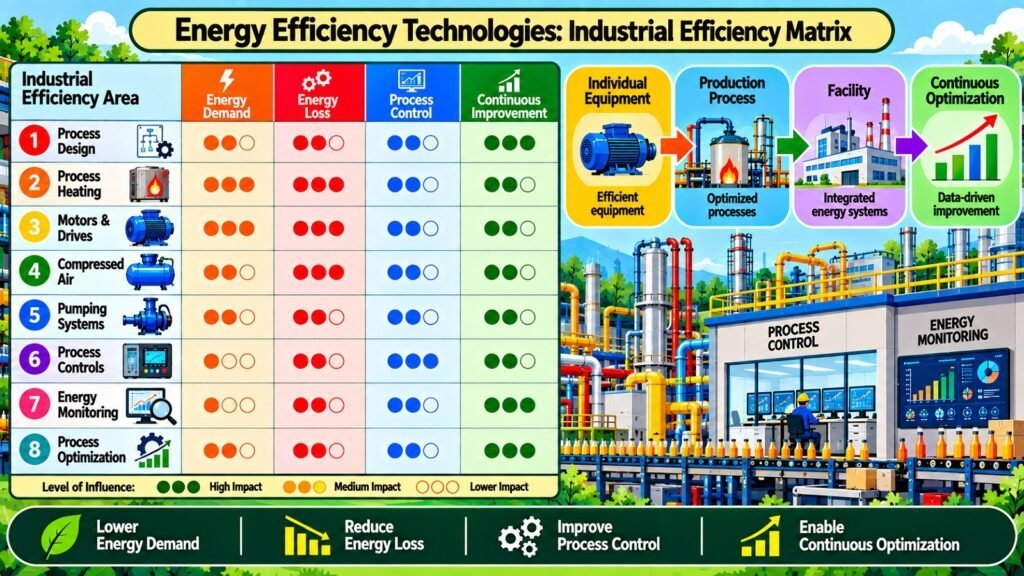
Industrial operations consume a large share of global energy, and Energy Efficiency Technologies at the process level address complete production systems rather than isolated equipment. Energy intensity—energy required per unit of useful output—is more meaningful than total consumption alone, because total use can change simply due to production volume. Process optimization identifies losses across interconnected operations and reduces them without compromising output, quality, or safety.
Advanced process controls use sensors, data acquisition, and control algorithms to maintain processes at optimal operating points continuously. Deviations from optimal conditions—excess temperature, unnecessary pressure, inefficient flow—translate directly into energy waste that automation can detect and correct faster and more consistently than manual supervision. Compressed air systems are a commonly cited source of industrial inefficiency: leaks, inappropriate uses, and oversized compressors can waste a large fraction of the electrical energy invested in compressed air generation. Systematic leak detection, pressure optimization, and variable-speed drives on compressor motors address these losses effectively.
Energy monitoring within production facilities reveals where energy is consumed, when peak demand occurs, and how use relates to output. This measurement capability is the foundation for identifying inefficiencies and verifying that improvements produce real results. The measurement and verification framework—systematically confirming that implemented changes deliver their expected savings—is especially important in industrial settings, where process complexity can make it difficult to isolate the effect of individual improvements from changes in production volume or operating conditions.
Table 6: Industrial Energy Efficiency Technologies and Their Applications
| Industrial Efficiency Technology | Primary Application |
| Advanced process control | Maintains process variables at optimal points to minimize waste |
| Variable-speed drives on compressors | Adjusts compressed air output to match actual demand |
| Waste heat recovery system | Captures process heat for reuse in preheating or other uses |
| Energy monitoring and metering | Measures consumption by process area to identify inefficiencies |
| Production scheduling optimization | Reduces peak demand by coordinating equipment operating times |
| Efficient electric furnace design | Improves thermal efficiency of high-temperature heating |
| Pump and fan system optimization | Reduces energy in fluid-handling systems through design and controls |
| Automated leak detection | Identifies losses in compressed air and steam systems |
6. Energy Efficiency Technologies in Heat Recovery
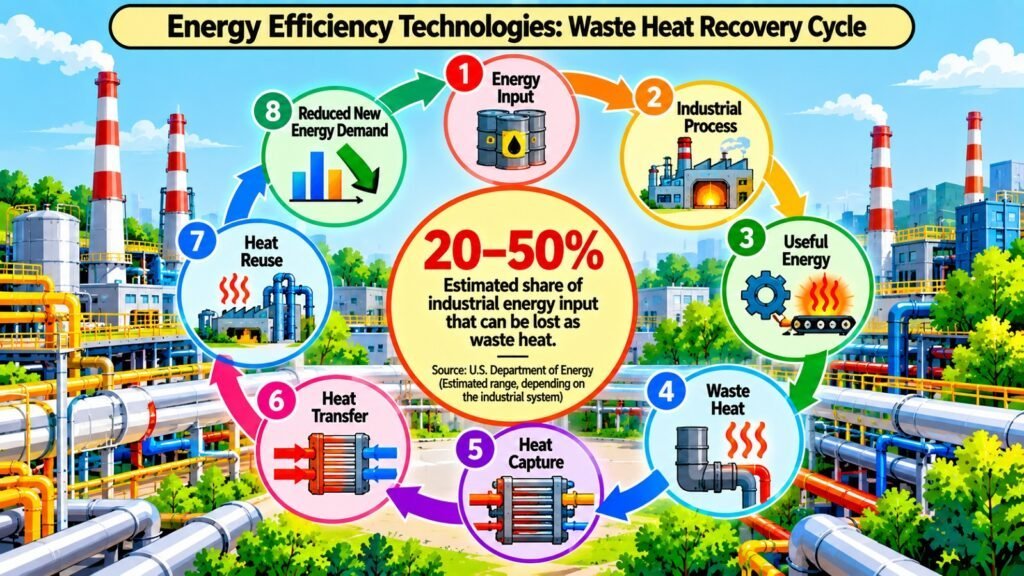
Heat recovery addresses one of the most fundamental inefficiencies in energy systems: the rejection of usable thermal energy as waste. Industrial processes, combustion systems, HVAC systems, and data centers all generate heat that is released without being reused. Energy Efficiency Technologies focused on heat recovery capture that thermal energy and redirect it to useful applications, reducing the total energy input needed to meet a given set of demands. Heat recovery does not create new energy; it increases the useful utilization of energy that has already entered a system.
Heat exchangers transfer thermal energy from a hot fluid to a cooler one without direct contact. Recuperators and regenerators preheat incoming combustion air or process streams using exhaust heat in furnaces and industrial systems. Economizers recover heat from boiler flue gases to preheat feedwater, improving the thermal efficiency of steam generation. Waste-heat boilers generate steam from high-temperature industrial exhaust for process or heating use. In buildings, heat-recovery ventilators transfer heat from exhaust air to incoming fresh air, substantially reducing the energy needed to condition ventilation air in cold climates.
Temperature compatibility between the heat source and the intended heat sink determines whether recovery is technically and economically useful. High-grade waste heat at temperatures suitable for process reuse is more versatile than low-grade heat limited to space heating applications. The economic case for heat recovery depends on heat quality, consistency of supply, the cost of the displaced energy source, and the capital and operating costs of the recovery equipment. Maintenance of heat transfer surfaces is essential, as fouling progressively reduces effectiveness over time.
Table 7: Heat Recovery Energy Efficiency Technologies and Their Applications
| Heat Recovery Technology | Typical Recovery Application |
| Plate heat exchanger | Transfers heat between process streams without direct contact |
| Recuperator | Preheats combustion air using exhaust gas heat in furnace systems |
| Regenerator | Alternately stores and releases heat to preheat process air streams |
| Economizer | Recovers flue gas heat to preheat boiler feedwater |
| Waste-heat boiler | Generates steam from high-temperature industrial exhaust gases |
| Heat-recovery ventilator | Transfers heat from exhaust air to incoming ventilation air |
| Run-around coil system | Recovers heat between separate ventilation air streams |
| Condensate recovery system | Returns hot condensate to the boiler to recover heat and water |
7. Energy Efficiency Technologies in Energy Management
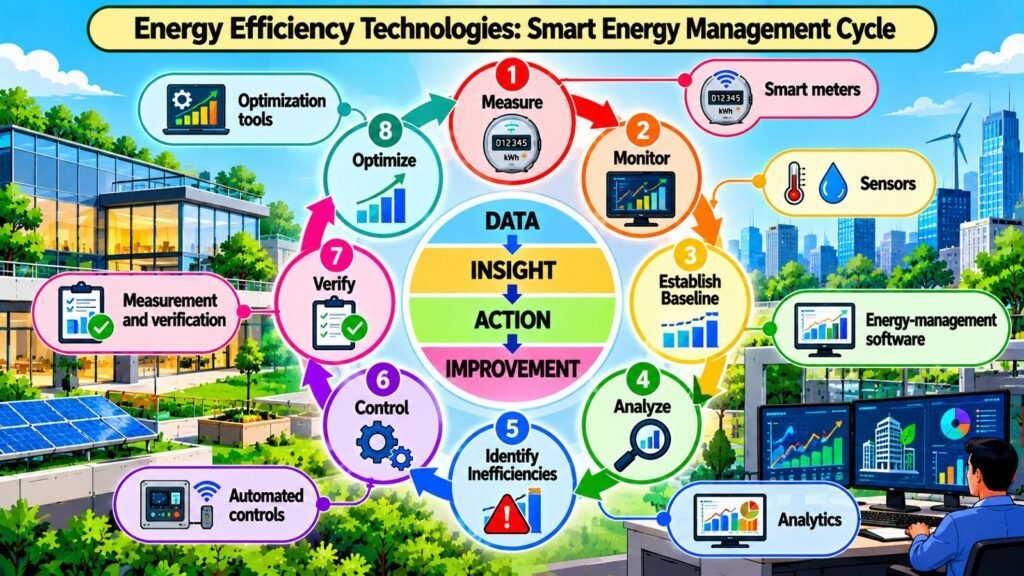
Effective energy management is a critical enabler of Energy Efficiency Technologies across buildings, industrial facilities, and organizations. The foundational principle is that energy performance cannot be improved systematically when consumption, demand patterns, losses, and operating conditions are not adequately measured. Smart meters measure electricity consumption at intervals fine enough to reveal demand patterns and unusual events. Submetering extends this visibility to individual zones, systems, or processes, allowing managers to understand where energy is consumed rather than seeing only a facility-level total.
Energy Management Systems integrate monitoring data with control functions. They automate responses to efficiency opportunities—shedding non-critical loads during peak demand, adjusting setpoints based on weather forecasts, shutting down equipment during unoccupied periods. Analytics transform raw consumption data into actionable insights. Anomaly detection identifies deviations from expected patterns that can indicate equipment malfunction, control errors, or occupancy changes. Benchmarking compares performance across time periods, facilities, or industry standards. Energy intensity tracking relates consumption to output or occupancy, separating genuine efficiency changes from the effect of varying activity levels.
Measurement and verification provide a rigorous framework for confirming that efficiency improvements deliver expected results. Without systematic verification, investments may appear successful when actual performance has diverged due to maintenance issues, occupant behavior, or changed operating patterns. Continuous improvement depends on the full cycle of measurement, analysis, intervention, and verification. Energy management should be distinguished from smart-grid infrastructure: the focus here is the optimization of consumption within buildings, facilities, and organizations rather than electricity-grid operation.
Table 8: Energy Efficiency Technologies: Energy Management Technologies and Their Primary Functions
| Energy Management Technology | Primary Function |
| Smart meter | Measures interval electricity demand and cumulative consumption |
| Submeter | Monitors energy consumption in individual zones or systems |
| Energy monitoring platform | Aggregates and displays consumption data from multiple sources |
| Building Management System | Integrates building systems and automates efficiency controls |
| Analytics and anomaly detection | Identifies unusual consumption patterns and efficiency deviations |
| Demand response system | Reduces or shifts consumption during peak grid demand periods |
| Energy performance dashboard | Displays real-time and historical performance for decisions |
| Measurement and verification tool | Confirms actual savings delivered by efficiency improvements |
8. Energy Efficiency Technologies in Appliances and Electronics
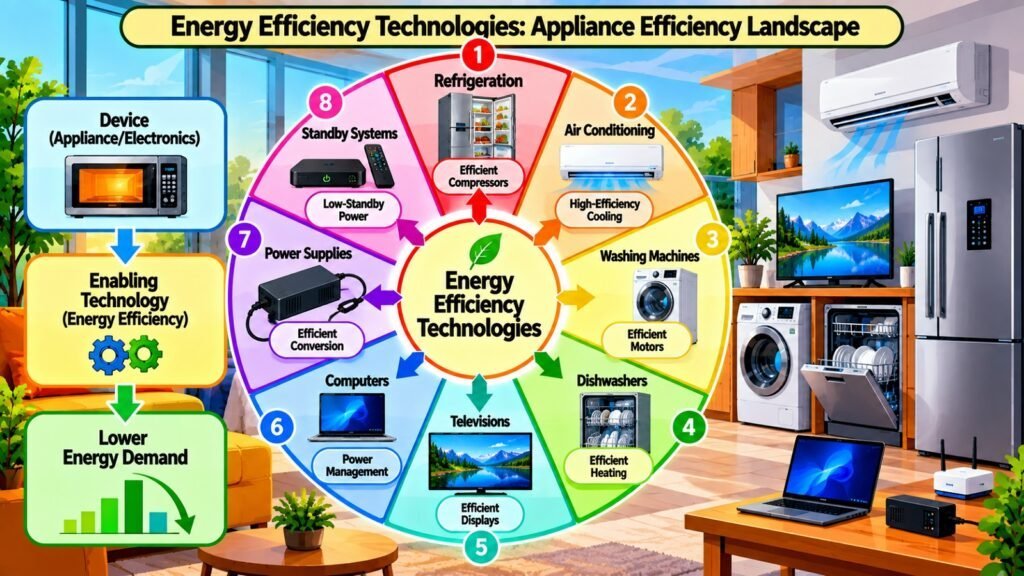
Appliances and electronic devices collectively consume a significant share of electrical energy in households, offices, and data centers. Energy Efficiency Technologies in this domain operate at multiple levels: component efficiency, power conversion, software power management, thermal management, standby behavior, and adaptive operation. Performing the same useful function—refrigerating food, computing, displaying information—with less electrical input is the core principle. This improvement can occur at different levels simultaneously within the same device.
More efficient compressors reduce the electrical energy required for refrigeration. Better insulation reduces how often the compressor must run. Improved motors in washing machines reduce mechanical losses. High-efficiency power supplies reduce conversion losses between mains alternating current and the direct current used internally—an important factor given that every mains-powered electronic device undergoes this conversion. In computing equipment, advances in processor design have reduced energy consumed per unit of computation substantially while processing performance has continued to increase.
Standby power — consumption while devices are off or idle but still connected—represents a persistent source of unnecessary energy use, and modern standards in many markets now limit it across a range of products. Processor power management reduces frequency and voltage when full performance is not needed, lowering consumption during idle periods. Energy performance standards and labeling programs give consumers a consistent basis for comparing products, and have driven substantial improvements across many categories over time. A device’s rated efficiency does not always predict field performance precisely, since usage patterns, settings, load, and ambient temperature all affect actual consumption.
Table 9: Energy Efficiency Technologies: Appliance and Electronics Energy Efficiency Technologies
| Appliance or Electronics Technology | Energy Efficiency Function |
| High-efficiency compressor | Reduces electrical energy for refrigeration or heat pump use |
| Inverter-driven motor | Adjusts motor speed to load, reducing part-load energy waste |
| Efficient power supply unit | Reduces conversion losses between mains and internal DC supply |
| Processor power management | Scales frequency and voltage to match computational load |
| Standby power reduction circuit | Limits energy consumption when devices are in low-power modes |
| LED display backlight | Reduces power in screens compared with fluorescent backlights |
| Improved thermal insulation | Reduces heat ingress into refrigerated compartments |
| Smart power management software | Coordinates device components to minimize overall energy use |
Conclusion: Energy Efficiency Technologies for a Smarter Future
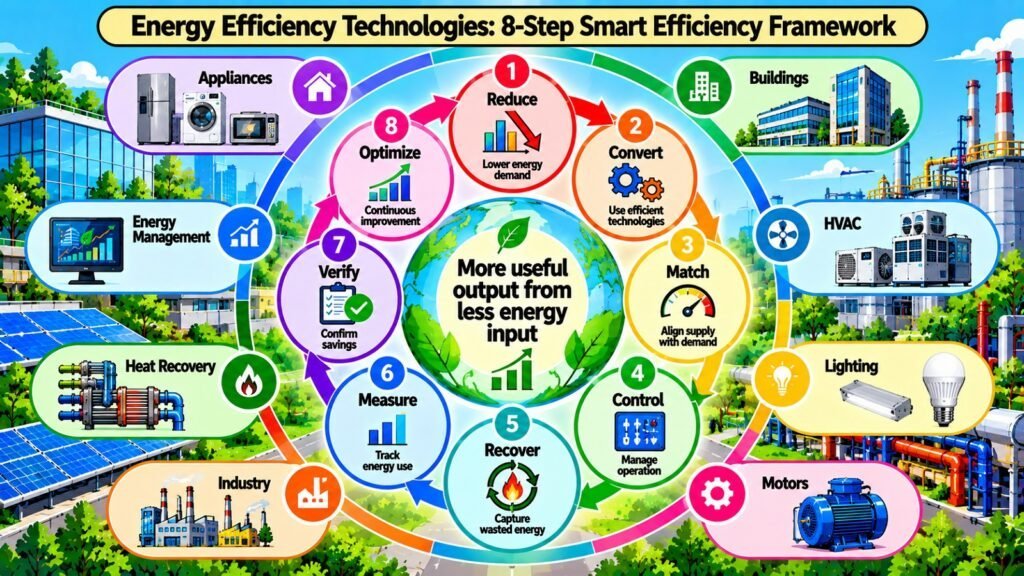
Energy Efficiency Technologies are foundational to Green Technology because sustainable energy progress depends on two advances simultaneously: producing energy from cleaner sources and using it more effectively. Neither is sufficient alone. Renewable energy generation without efficiency improvement supports wasteful consumption. Efficiency without cleaner generation still draws on resources with environmental costs. The eight technology domains examined in this article collectively address energy across its full lifecycle—demand, conversion, loss, recovery, and management.
A consistent theme across all eight domains is the distinction between component efficiency and system efficiency. A high-efficiency motor in a poorly designed system, an efficient boiler with uninsulated pipework, and an efficient light source in a luminaire with poor optics all illustrate the same point: individual component performance does not automatically translate into system-level efficiency gains. Effective deployment requires attention to how technologies function in context, how they interact with other systems, and how they are controlled, maintained, and measured over time.
The direction of Energy Efficiency Technologies points toward greater connectivity, more sophisticated sensing, more capable analytics, and more intelligent automation—capabilities that allow systems to adapt continuously to changing conditions. These capabilities also enable verification at a level of detail that was previously impractical, strengthening the evidence base for efficiency investments. Energy efficiency is not a one-time upgrade or a single technology choice; it is an ongoing approach to achieving more useful output from available energy resources through informed selection, system design, operational practice, and continuous measurement and improvement.
Table 10: Energy Efficiency Technologies: Core Energy Efficiency Principles and Their Long-Term Importance
| Energy Efficiency Principle | Long-Term Importance |
| System over component | Whole-system optimization delivers gains that component upgrades cannot |
| Measurement as foundation | Effective management requires accurate and continuous data |
| Controls and automation | Adaptive operation sustains efficiency across varying conditions |
| Heat recovery | Recovering existing energy reduces demand for primary energy input |
| Load matching | Supplying only the energy actually needed avoids inherent waste |
| Verification of results | Confirms that improvements deliver real and sustained performance |
| Technology integration | Combined technologies produce greater gains than isolated installations |
| Continuous improvement | Efficiency is an ongoing process, not a fixed, one-time outcome |