Table of Contents
Introduction: Robotic Perception and the Foundation of Robot Intelligence
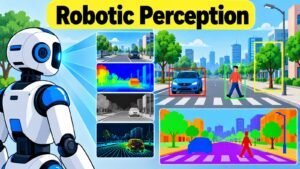
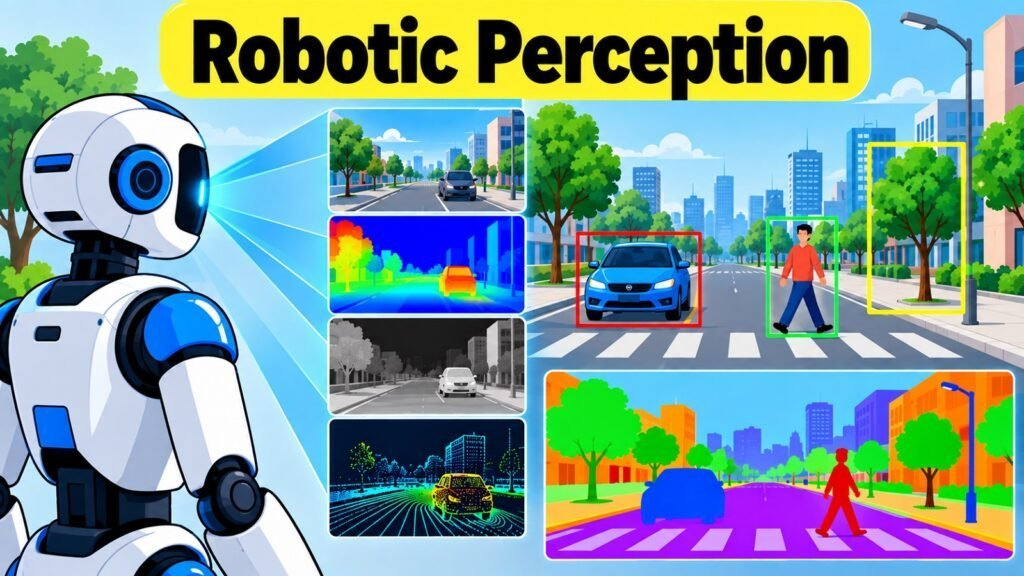
Robotic Perception is one of the most important aspects of modern robotics. Sensors capture raw physical data — light intensity, distance values, pressure readings — but raw measurements alone cannot tell a robot what it is looking at, how far away something is, or what is moving in its environment. Robotic Perception is the computational process that transforms those measurements into structured, meaningful representations: objects, scene structures, three-dimensional geometry, spatial positions, motion trajectories, and uncertainty estimates. Without it, even the most capable sensor suite produces data but no understanding.
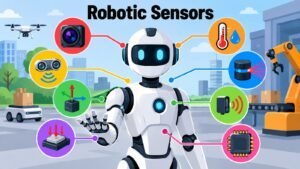
The distinction between sensing and perception is foundational. Sensing acquires physical quantities. Robotic Perception interprets those quantities and constructs the environmental knowledge that supports intelligent action. Perception is also distinct from control, actuation, communication, and higher-level decision-making. Control determines how the robot moves. Decision-making determines what it should do. Perception determines what the robot currently understands about its environment. Conflating these layers produces a distorted picture of where robotic intelligence comes from and where perceptual limitations actually matter.
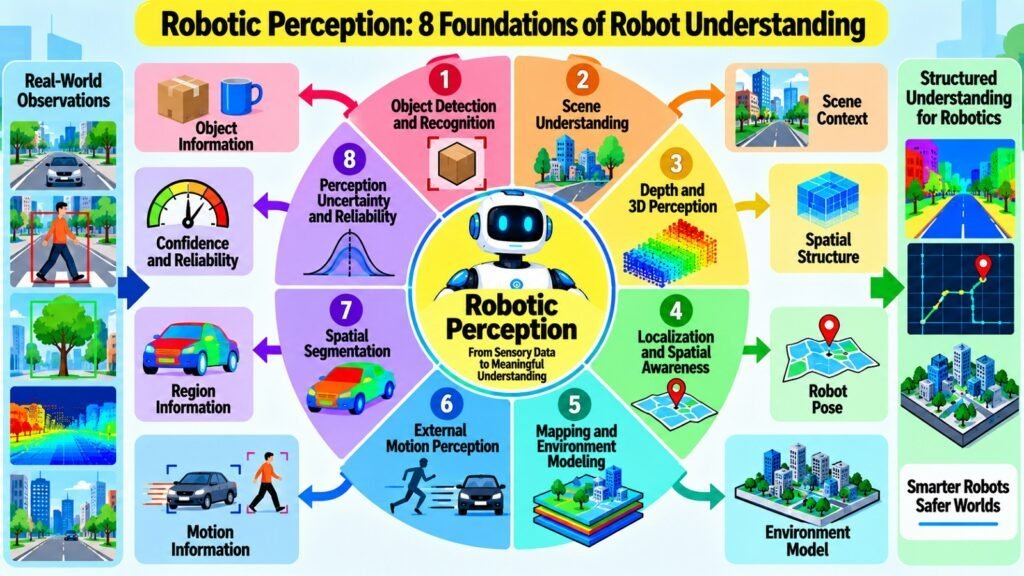
This article is organized as a reference-oriented guide covering eight foundational aspects of Robotic Perception: detecting and recognizing objects, understanding scenes, perceiving depth and three-dimensional structure, estimating spatial position, modeling environments, interpreting external motion, segmenting spatial regions, and evaluating perceptual uncertainty. Each aspect builds on the preceding ones, together forming a framework for understanding what robots perceive, how perceptual information is represented, why perception fails, and how its quality can be assessed.
Table: Robotic Perception — Conceptual Roadmap of Eight Core Aspects
| Aspect | Core Perceptual Role |
| Object Detection and Recognition | Locating and identifying meaningful entities in sensor observations |
| Scene Understanding | Interpreting environmental structure, context, and spatial relationships |
| Depth and 3D Perception | Deriving geometric structure and spatial distances from sensor observations |
| Localization and Spatial Awareness | Estimating the robot’s own pose within its environment |
| Mapping and Environment Modeling | Building structured representations of surrounding physical space |
| External Motion Perception | Detecting and interpreting movement of environmental objects and elements |
| Spatial Segmentation | Dividing observations into meaningful object, surface, and region boundaries |
| Perception Uncertainty and Reliability | Evaluating confidence and trustworthiness of perceptual conclusions |
1. Robotic Perception: Object Detection and Recognition
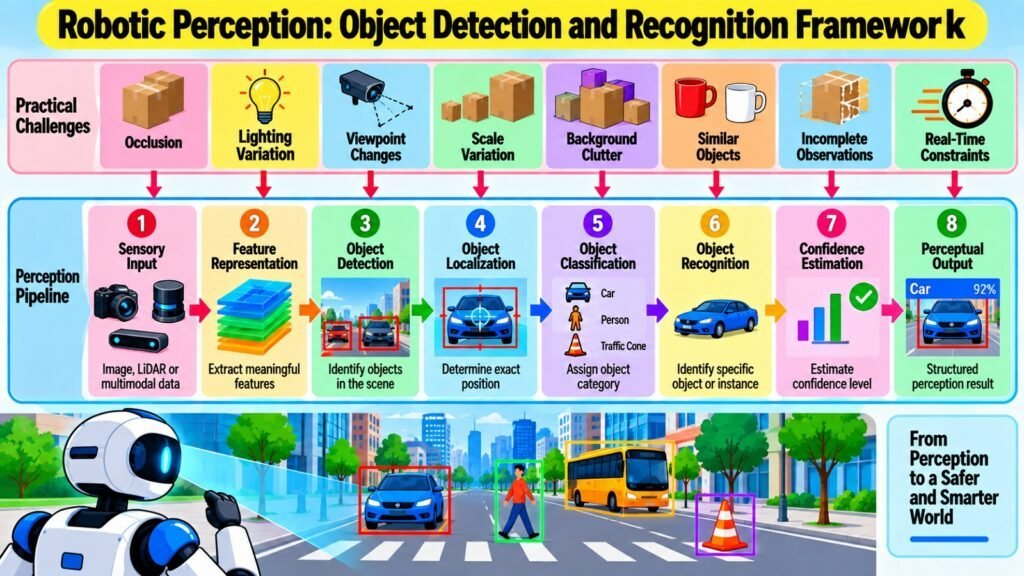
Object detection and recognition are the first major interpretive capabilities in Robotic Perception. Detection locates relevant objects or regions within sensor data, answering whether something of interest is present and where it is. Recognition identifies what that something is — its category, identity, or functional attributes. The two capabilities are related but distinct, and treating them as a single process obscures important differences in representation, failure modes, and computational demands.
Classical computer vision described objects through engineered descriptors capturing edges, textures, and gradient patterns. Deep learning architectures, particularly convolutional neural networks, have demonstrated strong ability to learn object representations directly from training examples. Multimodal perception extends this further by combining camera, lidar, and other sensor data to improve robustness. Each approach reflects a different philosophy about whether perceptual knowledge should be predefined, learned from data, or fused from multiple sources.
Practical challenges are considerable. Occlusion reduces available information about partially hidden objects. Lighting changes alter visual appearance in ways that degrade classifier performance. Viewpoint variation means the same object looks substantially different from different angles. Cluttered scenes and visually similar objects create ambiguity that simple methods cannot reliably resolve. These challenges explain why perceptual results should not be treated as verified facts. A robot detecting a rectangular obstacle in a corridor may recognize it as a laundry cart near a service elevator — a recognition that unlocks contextual reasoning and changes how the robot interprets the surrounding scene.
Evaluation concepts include precision, which measures how many detections are correct; recall, which measures how many actual objects are found; confidence scores, which reflect internal certainty rather than verified accuracy; and localization quality metrics that assess how closely detected regions match actual object boundaries. Balancing perceptual accuracy against computational cost is a persistent challenge, particularly under real-time constraints.
Table: Robotic Perception — Object Detection and Recognition Reference Concepts
| Concept / Method | Explanation |
| Object Detection | Locating objects or regions of interest within sensor observations |
| Object Recognition | Identifying the category, type, or identity of a detected object |
| Visual Feature Representation | Encoding object properties such as edges, textures, and shape for classification |
| Occlusion Handling | Managing partial visibility where one object hides another from the sensor |
| Confidence Score | A numerical estimate of the detection or recognition system’s certainty in its output |
| Precision | Proportion of system detections that correspond to actual target objects |
| Recall | Proportion of actual target objects that the system successfully detects |
| Multimodal Perception | Combining information from multiple sensor types to improve detection robustness |
2. Robotic Perception: Scene Understanding
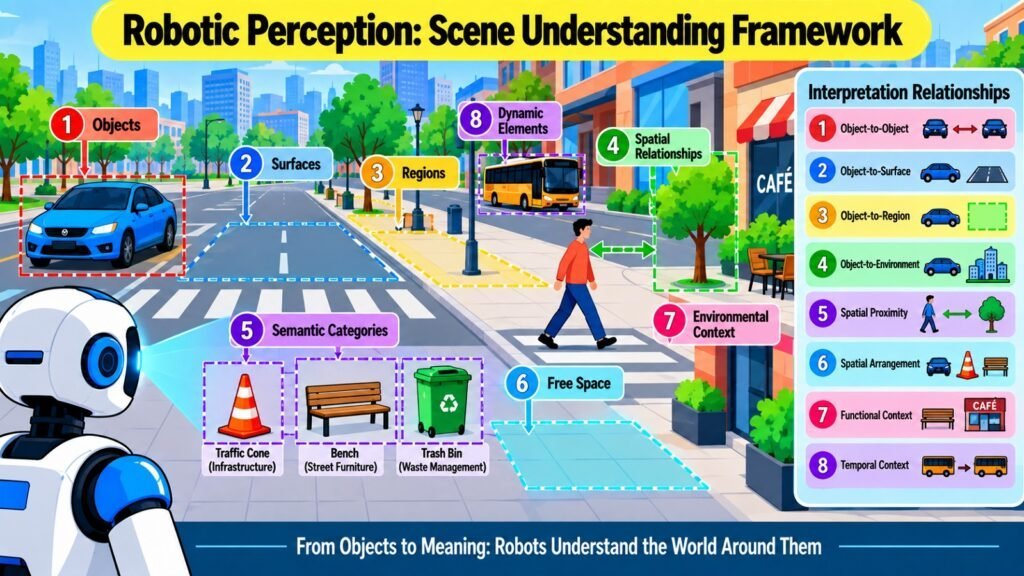
Scene understanding is where Robotic Perception moves beyond cataloguing individual objects and begins interpreting the environment as a whole. A robot that recognizes a desk, a chair, and a keyboard has three labels — but not a workstation. Scene understanding constructs richer representations that include spatial relationships between objects, surface layouts, free space, semantic context, and the structural organization of the environment. This transformation from individual recognition to scene-level interpretation is what enables a robot to reason about where to navigate, what actions are possible, and what the environment implies.
The distinction from object recognition is important. Recognition assigns labels to individual entities. Scene understanding encodes relationships, co-occurrence patterns, and contextual structure. Research approaches have included semantic segmentation, scene graph representations, and context-aware models trained on large real-world datasets. Concepts such as semantic context, spatial relationships, free-space representations, and dynamic scene modeling each address a different layer of the interpretation challenge. An illustrative example: a robot detecting a bed, a lamp, and a side table separately has three object labels. Interpreting their arrangement — lamp on table, table beside bed, bed facing a window — produces a navigable bedroom with specific spatial and functional constraints.
Practical challenges include clutter, occlusion, dynamic objects that alter scene composition over time, unfamiliar environments that differ from training data, and ambiguous contextual signals. Trade-offs between representational detail and robustness are inherent. Richer scene representations capture more useful information but are more sensitive to errors in any single component. Simpler representations sacrifice inferential power for computational tractability. Finding the appropriate representation for a given robotic task requires balancing these competing pressures against the operational requirements of the system.
Table: Robotic Perception — Scene Understanding Reference Concepts
| Concept | Core Role in Scene Understanding |
| Semantic Context | Using object co-occurrence and environmental patterns to interpret scene meaning |
| Spatial Relationship | Encoding positional and geometric relationships between objects or regions |
| Free Space | Representing navigable or unoccupied areas within the scene |
| Scene Graph | A structured representation linking objects, their attributes, and spatial relationships |
| Semantic Segmentation | Assigning category labels to regions to reveal scene structure at pixel level |
| Region Representation | Grouping scene areas by shared semantic or geometric properties |
| Contextual Interpretation | Using environmental patterns to resolve ambiguities in object identity or arrangement |
| Dynamic Scene Modeling | Updating representations to account for objects that move or change over time |
3. Robotic Perception: Depth and 3D Perception
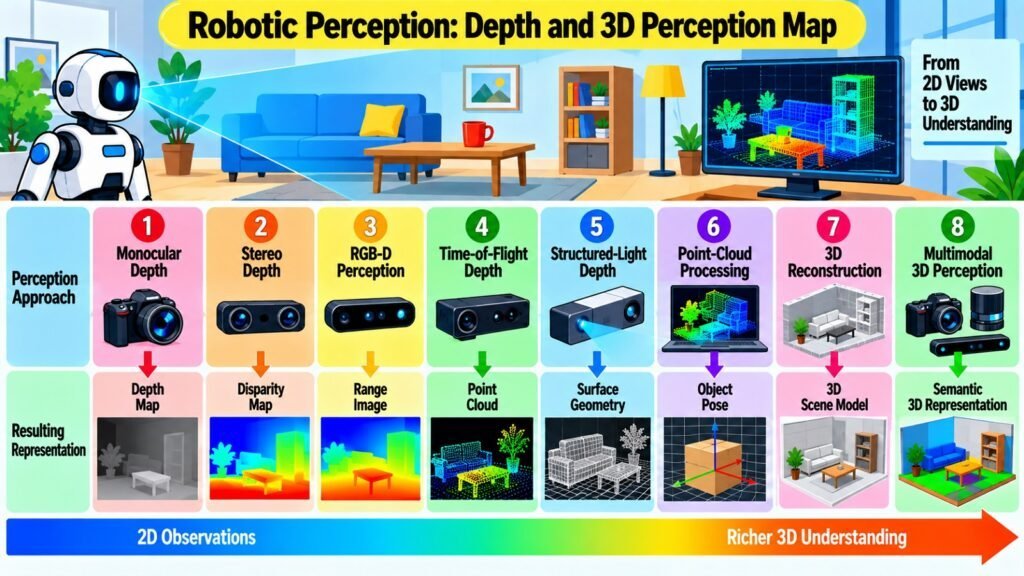
Two-dimensional images are informationally rich yet fundamentally lack direct information about distance. A camera projects a three-dimensional scene onto a flat plane, collapsing depth into brightness values. Depth and 3D Perception is the capability within Robotic Perception that recovers this missing dimension, enabling robots to understand how far objects are, what shape they have in three-dimensional space, and how they are oriented relative to the robot and to each other.
Several computational approaches address depth estimation. Stereo vision uses two cameras with a known separation to compute disparity — the apparent positional difference of a point between two images — from which depth is derived geometrically. Time-of-flight methods measure signal round-trip time to produce direct distance values. Structured-light systems project known patterns and analyze surface deformation. Monocular depth estimation uses a single camera and learned statistical relationships between image content and typical depth, offering flexibility at some cost to precision. Outputs differ accordingly: depth maps assign distance values to image pixels; point clouds represent scenes as three-dimensional coordinate sets; reconstruction methods produce complete geometric models from multiple observations.
Distinctive challenges include reflective surfaces that scatter structured light, transparent objects that transmit rather than reflect signals, weak visual texture that provides few features for stereo matching, and monocular performance degradation in unfamiliar environments. Consider a robot arm reaching for a bottle: two-dimensional images identify it, but the arm needs its distance, orientation, and spatial shape to plan a grasp. Three-dimensional perception enables that transition from identification to actionable spatial understanding. This capability remains distinct from mapping, which organizes spatial observations into persistent environmental representations across time.
Table: Robotic Perception — Depth and 3D Perception Reference Concepts
| Concept / Approach | Description |
| Depth Map | An image where each pixel encodes estimated distance from the sensor to a surface point |
| Disparity | The apparent positional difference of a point between two stereo images, used to compute depth |
| Point Cloud | A set of three-dimensional coordinate points representing surface geometry |
| Stereo Vision | Depth estimation using two cameras with a known spatial separation |
| Monocular Depth Estimation | Inferring depth from a single camera using learned statistical relationships |
| Structured Light | Projecting known patterns and analyzing surface deformation to recover geometry |
| Time-of-Flight | Measuring signal round-trip time to determine distances to surfaces directly |
| 3D Reconstruction | Building a complete geometric model of a scene from multiple observations |
4. Robotic Perception: Localization and Spatial Awareness
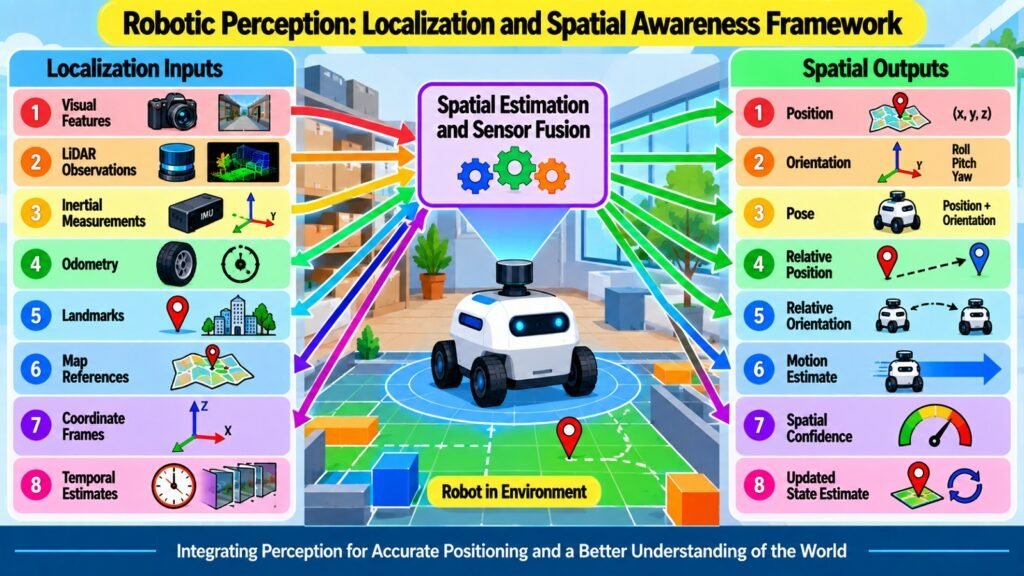
A robot that detects objects and understands scenes still faces a fundamental perceptual gap if it does not know where it is. Localization and Spatial Awareness is the Robotic Perception capability through which a robot estimates its own position, orientation, and spatial relationship with its surroundings. Without it, a robot cannot interpret the spatial significance of its observations, plan meaningful paths, or build consistent environmental representations across time.
Localization and mapping are related but distinct. Localization asks where the robot is. Mapping asks what the environment looks like. Simultaneous Localization and Mapping, known as SLAM, addresses both challenges together and is among the most studied problems in robotics research. Theoretical foundations include robot pose estimation, coordinate frames, landmark identification, probabilistic filtering, and odometry-supported motion integration. Probabilistic methods such as particle filters and Kalman filters represent pose as a probability distribution rather than a committed point estimate, explicitly acknowledging that localization produces estimates rather than verified facts. Landmark-based approaches use distinctive environmental features — a wall junction, a visual marker — as spatial reference points for position inference.
Practical challenges are significant. Accumulated error, or drift, grows as a robot integrates motion estimates over time. Repetitive visual environments make one location appear identical to another, creating ambiguity that simple matching cannot resolve. Dynamic environments change available landmarks. A robot navigating a large office building may match its current visual observations against a reference map and infer that it is near the elevator lobby on the third floor — an estimate with uncertainty, not a certainty. Treating pose estimates as established facts leads to cascading navigation errors, which connects directly to the article’s later discussion of perception uncertainty and reliability.
Table: Robotic Perception — Localization and Spatial Awareness Reference Concepts
| Concept | Core Role or Distinguishing Characteristic |
| Robot Pose | The combined estimate of a robot’s position and orientation in a reference coordinate frame |
| Landmark | A distinctive environmental feature used as a spatial reference point for localization |
| Odometry | Estimating position by integrating measured or estimated motion over time |
| Visual Localization | Using camera observations to match the current scene with a known reference map |
| Particle Filter | A probabilistic method representing pose uncertainty as a weighted distribution of hypotheses |
| Coordinate Frame | A reference system that defines how positions and orientations are measured and expressed |
| Drift | Accumulated localization error that grows as a robot relies on motion integration over time |
| Probabilistic Localization | Representing robot pose as a probability distribution to explicitly encode estimation uncertainty |
5. Robotic Perception: Mapping and Environment Modeling
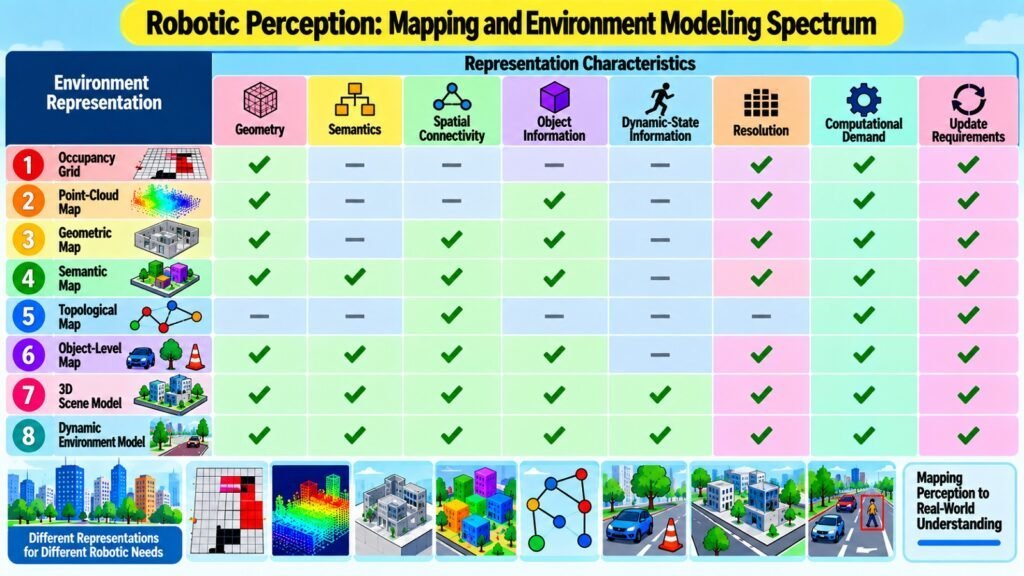
Where localization concerns the robot’s own position, mapping and environment modeling concern the world around it. Mapping is the Robotic Perception process through which a robot transforms its observations into persistent, structured representations of the surrounding environment. These representations allow a robot to reason about space beyond its immediate sensor range, remember where structures and objects are, and plan actions that extend across the environment rather than responding only to immediate stimuli.
Environmental representations take several forms depending on what the map needs to support. Occupancy grid maps divide space into cells marked as occupied, free, or unknown — efficient for navigation and obstacle avoidance but lacking semantic content. Semantic maps augment geometry with object labels, enabling location-based reasoning about object types. Topological maps represent environments as graphs of connected locations, offering compact representations that scale well to large spaces. Point cloud maps preserve geometric surface detail for precise spatial tasks. The same physical environment can support all of these simultaneously: a warehouse robot might use a geometric map for navigation, a semantic map for locating products, and a topological map for high-level path planning between zones.
Practical challenges include incomplete observations leaving parts of the map unknown, accumulated localization errors distorting spatial layout, computational and memory costs of maintaining detailed maps, and the difficulty of updating representations when environments change. Trade-offs between map detail and robustness are inherent. Dynamic environment models address the additional challenge that spaces change over time, requiring representations that can incorporate new observations while preserving reliable prior knowledge. Choosing an appropriate environmental representation is a consequential design decision that shapes robotic capability at every operational level.
Table: Robotic Perception — Mapping and Environment Modeling Reference Concepts
| Concept | Description |
| Occupancy Grid | A grid-based map encoding each cell as occupied, free, or unknown based on observations |
| Point Cloud Map | A dense three-dimensional map preserving geometric detail of surfaces and objects |
| Semantic Map | A map augmenting geometric information with object labels and category information |
| Topological Map | A graph-based representation connecting locations by navigable paths without dense geometry |
| SLAM | Simultaneous Localization and Mapping — building a map while estimating the robot’s own position |
| Dynamic Environment Model | A representation that accounts for objects or features that move or change over time |
| Map Update | Revising an existing map to reflect changes detected through new observations |
| Map Uncertainty | Encoding probabilistic confidence in the accuracy of different parts of the environmental map |
6. Robotic Perception: External Motion Perception
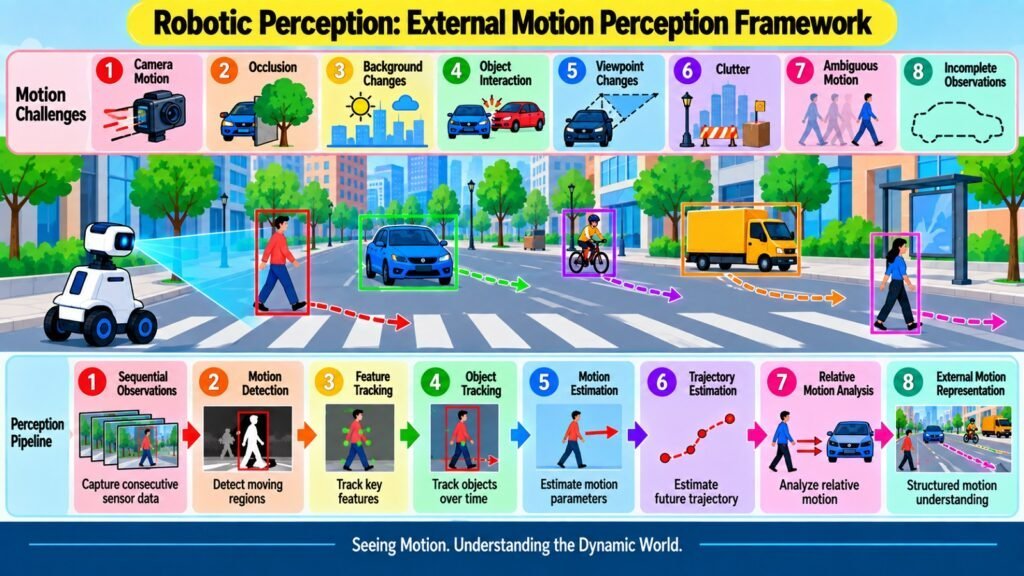
A robot operating alongside people, vehicles, or other robots faces a harder perceptual task than one working in a static environment. External Motion Perception is the Robotic Perception capability concerned with detecting and interpreting movement occurring in the robot’s surrounding environment. It is distinct from sensor hardware that measures physical velocity or acceleration, and distinct from Motion and Control Systems, which manage the robot’s own movement. External motion perception interprets what external objects and environmental elements are doing — not what the robot’s actuators produce.
Core theoretical concepts include motion detection, optical flow, object tracking, trajectory estimation, and temporal consistency. Optical flow describes the apparent motion of image regions between consecutive frames, providing a dense representation of visual movement. Object tracking maintains persistent identity for detected objects across time, enabling a robot to follow the same person across multiple observations despite appearance changes. Trajectory estimation uses motion history to predict near-future positions of moving objects, which is essential for safe navigation. A robot traversing a busy public space must separate its own viewpoint-induced apparent motion from actual external movement. Failure to do so causes stationary objects to appear to be moving — a fundamental error that degrades scene understanding and navigation.
Practical challenges include background motion from wind or lighting that mimics object movement, occlusion breaking the visual continuity of tracked objects, cluttered scenes where multiple moving objects overlap, and the real-time computational demands of simultaneous tracking. Trade-offs involving temporal resolution, computational cost, and tracking stability are inherent. A system attempting to track every moving point may be too slow for deployment; a system tracking only prominent objects may miss relevant environmental changes. Defining the appropriate scope and computational budget is a context-dependent design decision.
Table: Robotic Perception — External Motion Perception Reference Concepts
| Concept / Technique | Description |
| Motion Detection | Identifying that movement has occurred within sensor observations |
| Optical Flow | Estimating the apparent velocity of image regions between consecutive frames |
| Object Tracking | Maintaining persistent identity and state for detected objects across multiple observations |
| Trajectory Estimation | Predicting the future path of a moving object based on its observed motion history |
| Background Subtraction | Separating moving foreground objects from a relatively static scene background |
| Egomotion Compensation | Accounting for the robot’s own movement when interpreting external object motion |
| Temporal Consistency | Ensuring that motion interpretations remain stable and coherent across successive observations |
| Dynamic Object | An environmental element that moves or changes position over time and requires active tracking |
7. Robotic Perception: Spatial Segmentation
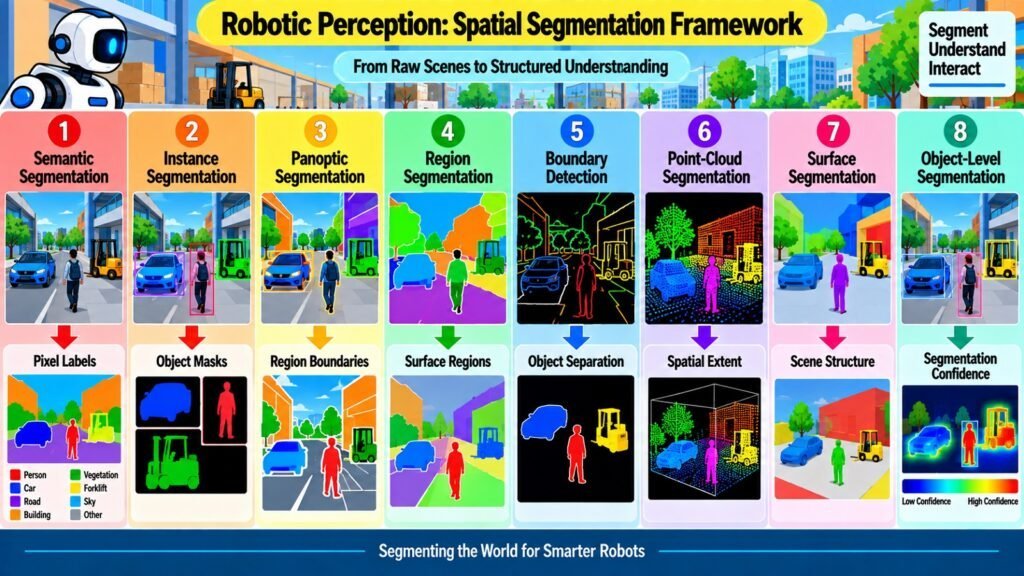
Knowing that an object exists and knowing exactly where it occupies space are different perceptual achievements. Spatial Segmentation is the Robotic Perception process of dividing sensory representations — images, point clouds, or other spatial data — into meaningful objects, surfaces, regions, or spatial components. Detection can locate an object and assign it a label; segmentation determines which specific pixels, points, or spatial regions actually belong to that object. This difference matters considerably when robots need precise spatial knowledge rather than approximate localization.
Segmentation takes several forms. Semantic segmentation assigns a category label to every pixel or point in an observation, producing a dense spatial map. Instance segmentation goes further, distinguishing individual objects of the same category — identifying not just the presence of three cups in a scene, but which pixels belong to each specific cup. Region segmentation groups areas by shared appearance or geometric properties without requiring semantic labels. Point cloud segmentation applies equivalent principles to three-dimensional data, grouping points belonging to the same surface or object. Each form suits different robotic applications depending on whether the requirement is scene-level categorization, individual object delineation, or geometric surface parsing.
A robot arm reaching for a bottle on a cluttered counter illustrates the practical need for segmentation. Detection identifies the bottle’s location and category. Segmentation determines the precise three-dimensional extent of the bottle — which surface regions belong to it, which to the cap, and which to neighboring objects. Without this spatial precision, grasp planning becomes substantially harder. Practical challenges include ambiguous boundaries between adjacent objects, occlusion, irregular shapes, and sparse sensor data. Evaluation uses metrics such as Intersection over Union, which measures the spatial overlap between predicted and true regions at the pixel or point level — a finer assessment than bounding-box metrics, reflecting the higher geometric demands of segmentation tasks.
Table: Robotic Perception — Spatial Segmentation Reference Concepts
| Concept / Method | Explanation |
| Semantic Segmentation | Assigning a category label to every pixel or point in a spatial observation |
| Instance Segmentation | Separately identifying and delineating each individual object instance of a category |
| Region Segmentation | Grouping areas by shared appearance or geometric properties without semantic labels |
| Point Cloud Segmentation | Dividing three-dimensional point data into distinct surface or object groups |
| Boundary Detection | Identifying the spatial edges or transitions between distinct objects or regions |
| Intersection over Union (IoU) | A metric measuring spatial overlap between a predicted segmentation and the true region |
| Occlusion in Segmentation | The challenge of correctly delineating objects whose spatial extent is partially hidden |
| Instance Identity | The ability to distinguish separate objects of the same category as spatially distinct entities |
8. Robotic Perception: Perception Uncertainty and Reliability
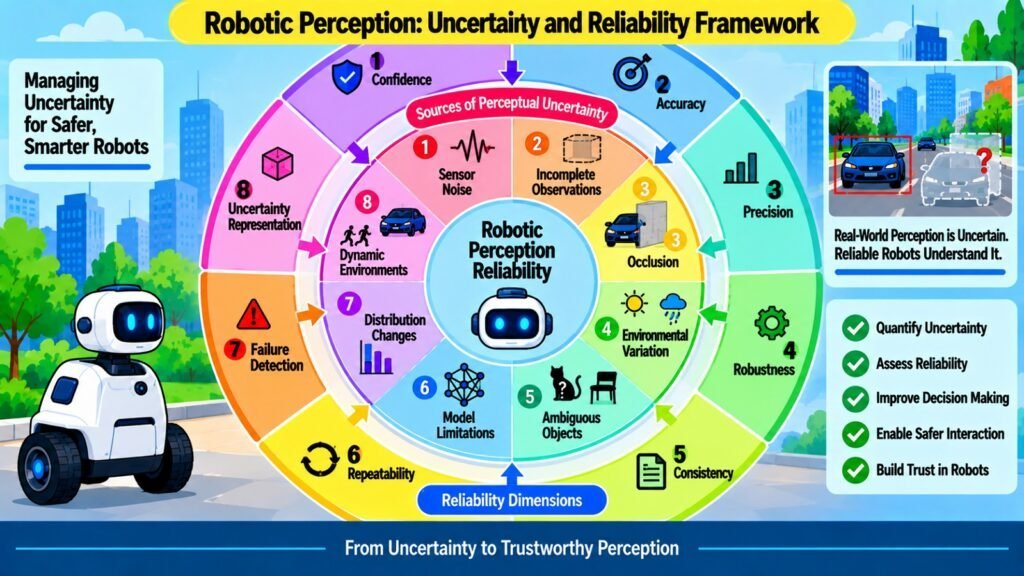
Every perceptual conclusion a robot reaches is, fundamentally, an estimate. Robotic Perception operates under incomplete data, sensor noise, environmental variability, model limitations, and computational approximation. Even a sophisticated system — one capable of detecting objects, understanding scenes, estimating depth, localizing, mapping, tracking motion, and segmenting space — will sometimes produce incorrect results. Perception Uncertainty and Reliability is the conceptual foundation for understanding how trustworthy any perceptual conclusion is, and why acknowledging uncertainty is as important as achieving accurate perception under favorable conditions.
Several related concepts must be kept distinct. Uncertainty describes the degree of doubt in a perceptual estimate relative to the true value. Confidence is the system’s internal estimate of its own certainty, which may not reflect actual accuracy. Robustness describes how consistently performance holds across varying conditions. Reliability describes overall trustworthiness across a wide operational range. False positives occur when the system detects something absent; false negatives occur when something present goes undetected. Ambiguity arises when observations support multiple conflicting conclusions. Distribution shift — when deployment conditions differ from training conditions — is among the most common causes of unexpected performance degradation.
Uncertainty appears across every perceptual layer. Object recognition produces confidence scores reflecting statistical likelihoods, not identities. Scene understanding can be misled by unfamiliar environments. Depth estimates degrade for distant, reflective, or textureless surfaces. Localization accumulates error over time. Maps contain regions of low confidence. Probabilistic representations provide a principled framework for handling pervasive uncertainty: rather than committing to a single answer, they represent the range of plausible conclusions and their relative likelihoods. A robot uncertain about an object’s identity should behave differently from one with a high-confidence recognition result — uncertainty should propagate into downstream decisions rather than being silently discarded. This makes perception uncertainty the natural bridge between Robotic Perception and higher-level robotic intelligence.
Table: Robotic Perception — Perception Uncertainty and Reliability Reference Concepts
| Concept | Explanation |
| Uncertainty | The degree of doubt or variability in a perceptual estimate relative to the true value |
| Confidence Score | The system’s internal estimate of its own certainty, not a verified measure of accuracy |
| Robustness | Consistency of perception performance across varying and challenging environmental conditions |
| False Positive | A perception output reporting the presence of something that is not actually present |
| False Negative | Failing to detect or recognize something that is actually present in the environment |
| Ambiguity | A situation where observations support multiple conflicting perceptual conclusions equally |
| Distribution Shift | A change in conditions that causes performance to degrade from training to deployment |
| Probabilistic Representation | Encoding perceptual conclusions as probability distributions rather than single committed values |
Conclusion: Robotic Perception and the Future of Robot Intelligence
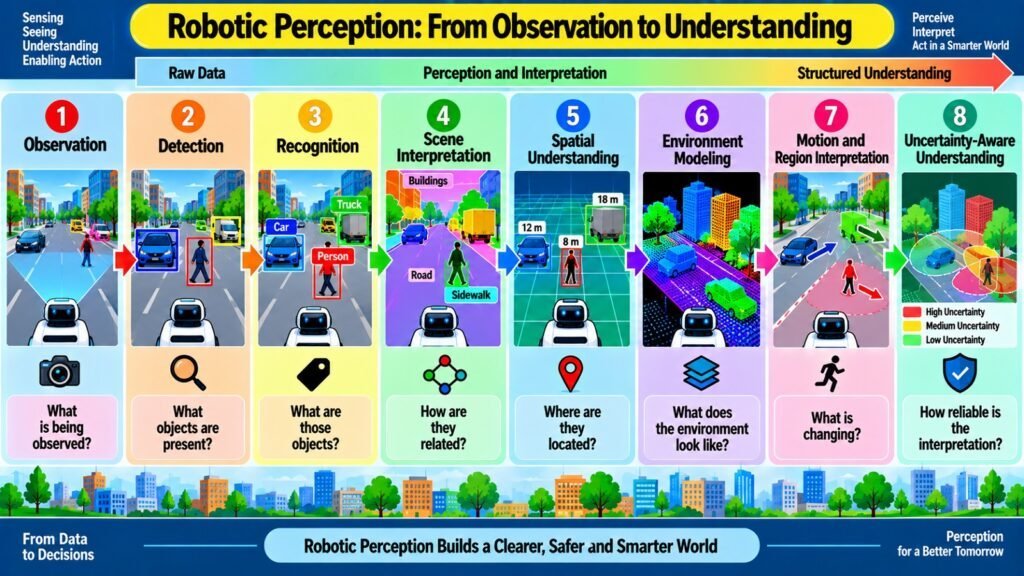
Robotic Perception is a layered framework of interpretive processes, each converting raw observations into progressively richer representations. The eight aspects examined in this article form a coherent progression: detecting and recognizing objects, interpreting those objects within broader scene contexts, recovering three-dimensional spatial structure, estimating the robot’s own position, building persistent environmental models, perceiving external movement, segmenting space into precise regions, and evaluating how much confidence those conclusions deserve. Understanding each layer, and how they build on one another, is essential to understanding what robotic intelligence actually requires.
Throughout this progression, the fundamental distinction holds: sensors provide measurements, and Robotic Perception constructs meaning. A lidar returns a distance array. A camera returns a light intensity matrix. Robotic Perception transforms those streams into representations of objects, environments, positions, motion patterns, and uncertainty estimates. Understanding Robotic Perception also means understanding failure — systems degrade under occlusion, changing lighting, distribution shift, and model limitations. A robot that knows what it does not know, and communicates that uncertainty honestly, is safer and more adaptable than one that acts on uncertain conclusions as established facts.
Future directions in Robotic Perception are shaped by enduring research challenges: multimodal fusion for greater robustness, richer spatial representations combining geometry and semantics, improved three-dimensional understanding under difficult conditions, uncertainty-aware systems that reason about the reliability of their own conclusions, and stronger generalization across diverse and changing environments. These themes reflect the fundamental difficulty of interpreting a complex physical world from imperfect observations. Understanding Robotic Perception is understanding a foundational layer of robot intelligence — the layer where the physical world becomes knowledge, and knowledge makes meaningful action possible.
Table: Robotic Perception — Final Framework Reference Summary
| Aspect | Role in the Robotic Perception Framework |
| Object Detection and Recognition | Identifying and categorizing meaningful entities within sensor observations |
| Scene Understanding | Constructing representations of environmental structure, context, and object relationships |
| Depth and 3D Perception | Recovering spatial distances and three-dimensional geometric structure from observations |
| Localization and Spatial Awareness | Estimating the robot’s own pose and spatial relationship with its environment |
| Mapping and Environment Modeling | Building persistent, structured representations of surrounding physical space |
| External Motion Perception | Detecting and interpreting movement of objects and elements in the environment |
| Spatial Segmentation | Dividing observations into precise object, surface, and region boundaries |
| Perception Uncertainty and Reliability | Evaluating and communicating the confidence and trustworthiness of perceptual conclusions |