Table of Contents
Introduction: Business Functions As Essential Foundations of Modern Companies
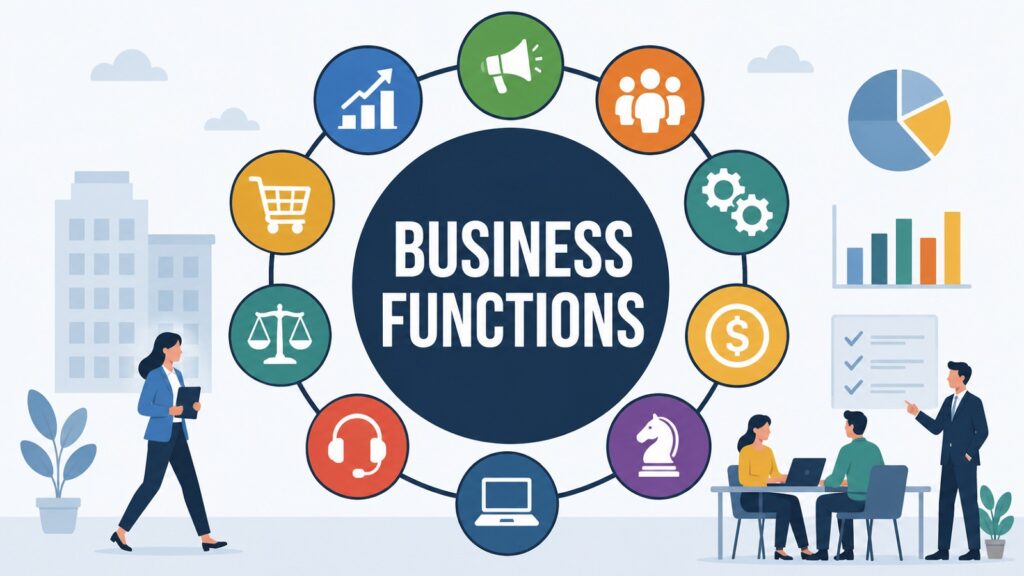
Every organization that survives long enough to matter has something working beneath the surface. There are systems in motion, decisions being made, and resources moving from one place to another. What holds this activity together is a set of business functions. These are not abstract ideas or management buzzwords. Business functions are the specific operational areas that allow a company to do what it was built to do. They are important business essentials without which any organization would quickly lose its footing.
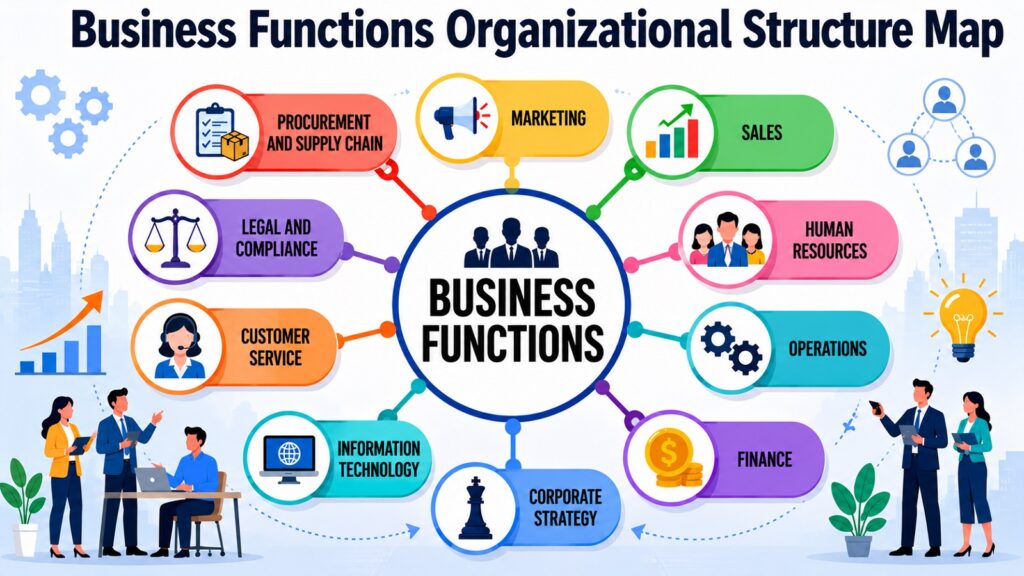
Business functions are specific areas of activity that play different roles in the overall operation of an organization. Marketing generates interest. Sales transforms that interest into revenue. Human resources recruits and retains the individuals who perform the tasks. Operations ensures that the work is executed effectively. Finance maintains the financial health of the organization. Corporate strategy determines the future direction of the organization. Information technology ensures the systems are operational. Customer service fosters relationships with buyers. Legal and compliance safeguards the organization against risks. Procurement and supply chain guarantee that the necessary materials and services are delivered punctually.
These ten business functions are not sealed off from each other. They work more like organs in a living body. When one struggles, the effects ripple outward into the others. When they work together well, the organization becomes capable of things no single department could achieve on its own. A company of five people and a company of fifty thousand people both depend on these same functions, even if the scale and structure look completely different.
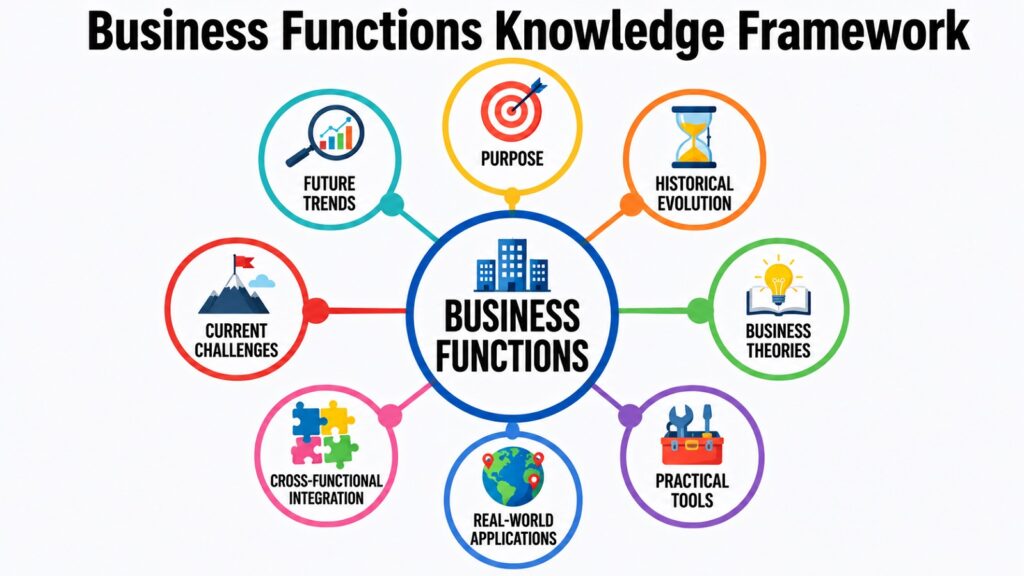
Modern organizations are complex systems that must respond to shifting markets, changing customer expectations, new technologies, and pressure from competitors. The ten business functions covered in this article are the mechanisms through which organizations navigate all of that. This article draws on established business theories, industry practices, real organizational examples, and current challenges facing each area. It also looks ahead at the trends shaping how these functions will operate in the coming years.
Overview of 10 Business Functions Covered in This Article
| Business Functions | Core Organizational Role |
| Marketing | Builds brand visibility and generates market demand. |
| Sales | Converts leads and opportunities into revenue. |
| Human Resources | Recruits, develops, and retains organizational talent. |
| Operations | Transforms inputs into products and services efficiently. |
| Finance | Manages budgets, investments, and financial health. |
| Corporate Strategy | Sets long-term direction and aligns all functions. |
| Information Technology | Enables digital operations and data-driven decisions. |
| Customer Service | Builds and maintains customer relationships. |
| Legal and Compliance | Protects the organization through risk and regulation management. |
| Procurement and Supply Chain | Manages sourcing and the flow of goods and services. |
1. Business Functions: Marketing – Building Brand Visibility and Market Demand
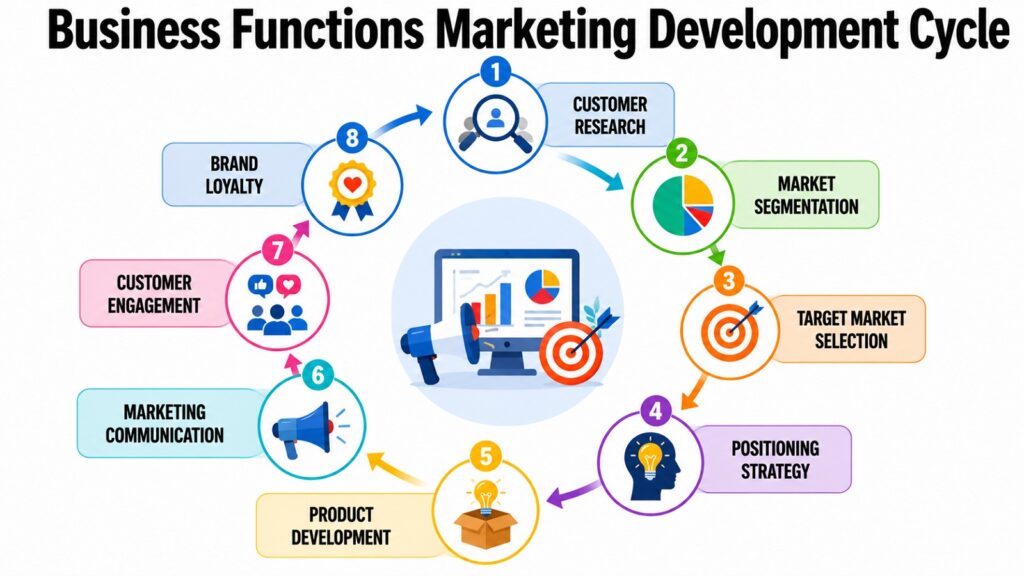
Marketing is one of the most visible business functions in any organization. Its core purpose is to help a company understand who its customers are and communicate the value it offers. Without effective marketing, even the best product sits unknown on a shelf. With it, a company can build a presence that outlasts any single transaction.
The history of marketing as a formal business function stretches back to the early twentieth century, when mass production created the need for mass communication. Traditional advertising through print, radio, and television became the primary channel. Over time, the rise of digital networks transformed the field. Today, marketing is data-driven, channel-diverse, and often personalized at the individual level.
Philip Kotler introduced the concept of the four ‘P’: product, price, place, and promotion. Market segmentation, targeting, and positioning, grouped as STP marketing, gave companies a structured way to identify their ideal customer. Modern marketing teams also use customer relationship management systems, search engine optimization, social media platforms, and analytics tools to reach and measure audiences effectively.
Companies like Apple, Nike, and Coca-Cola are cited for strong marketing capability. Marketing works closely with sales on customer targeting, with customer service to understand post-purchase experience, and with IT to deliver and measure campaigns. Current challenges include data privacy regulations, consumer skepticism, and competition for digital attention. The future points toward AI-driven personalization and first-party data strategies.
Key Business Functions in Marketing: Recognized Concepts and Applications
| Marketing Concept / Tool | Application |
| STP Framework | Segmentation, targeting, and positioning to identify and reach ideal customers. |
| Marketing Mix (4 Ps) | Product, price, place, and promotion as core go-to-market levers. |
| Content Marketing | Distributing valuable content to attract and retain a defined audience. |
| Search Engine Optimization | Improving website visibility on search engines to attract organic traffic. |
| CRM Systems | Storing and managing customer data to improve engagement. |
| Marketing Automation | Automating repetitive tasks such as email campaigns and lead nurturing. |
| Brand Positioning | Establishing a distinctive place for a brand in the customer’s mind. |
| Data Analytics | Using behavioral data to guide campaign decisions and measure results. |
2. Business Functions: Sales – Converting Opportunities into Revenue
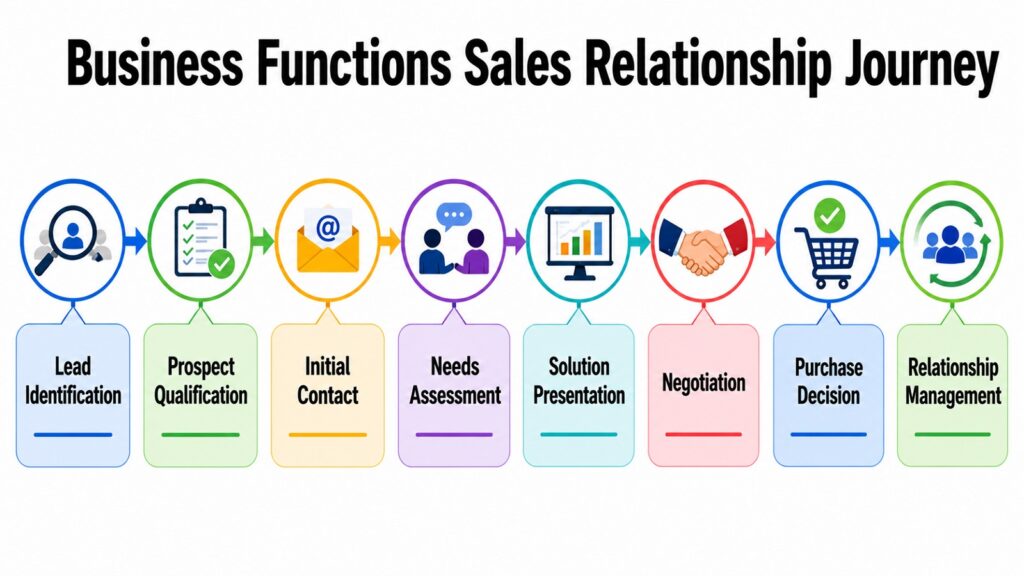
If marketing brings people to the door, sales is what makes the deal happen. Sales is one of the primary revenue-generating business functions in any commercial organization. Its purpose is to identify potential customers, understand their needs, present a suitable solution, and guide them through a process that ends in a transaction.
Early sales approaches were transactional and product-focused. Over time, research and experience revealed that customers who felt pressured rarely returned. This led to consultative selling, where representatives invest time in understanding the customer’s situation before presenting solutions. Neil Rackham’s SPIN selling framework, built around Situation, Problem, Implication, and Need-Payoff questions, formalized this shift. Relationship selling adopts a comparable perspective, emphasizing the importance of long-term trust rather than immediate outcomes.
Modern sales teams rely on CRM platforms like Salesforce to track leads and manage pipelines. Sales enablement tools provide representatives with the right content at each stage of the buyer journey. Lead scoring systems help teams prioritize the prospects most likely to convert. Salesforce, IBM, and Cisco are recognized for building high-performing sales organizations through investment in training, process design, and technology.
Sales depends on marketing for qualified leads, on customer service to support buyers after purchase, and on finance to structure pricing. Current challenges include well-informed buyers, longer purchase cycles, and margin pressure. The future of sales points toward AI-assisted buyer behavior analysis, greater digital self-service, and team-based selling models for complex deals.
Key Business Functions in Sales: Recognized Practices and Methodologies
| Sales Practice or Methodology | Application |
| Consultative Selling | Diagnosing customer needs before presenting solutions. |
| SPIN Selling | Questions built around Situation, Problem, Implication, and Need-Payoff. |
| Relationship Selling | Prioritizing long-term customer trust over individual transaction outcomes. |
| CRM Platforms | Tracking leads, managing pipelines, and centralizing customer data. |
| Sales Funnel Management | Structuring the buyer journey from awareness through to closed deal. |
| Lead Scoring | Ranking prospects by likelihood to convert based on behavior and fit. |
| Sales Enablement | Equipping teams with content and training for each stage of the sale. |
| Account-Based Selling | Targeting high-value accounts with tailored, cross-functional outreach. |
3. Business Functions: Human Resources – Managing and Developing Talent
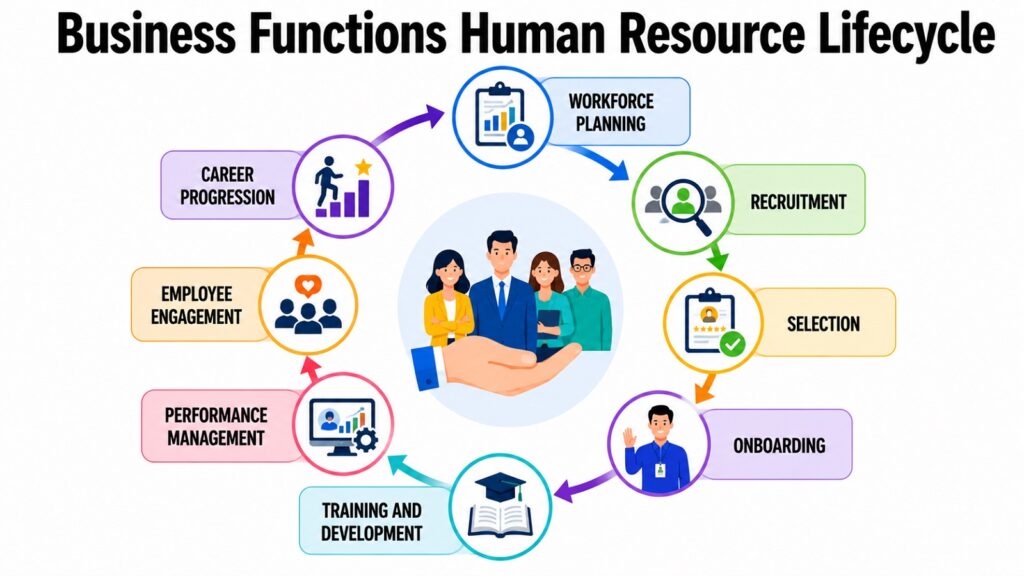
An organization is only as capable as the people within it. Human resources is the business function responsible for attracting those people, developing their abilities, keeping them engaged, and building a workplace culture where productive work is possible. Its effects ripple outward into every other area of the organization.
Early personnel management was primarily administrative: payroll, paperwork, and employment contracts. The shift toward something more strategic began as research in organizational behavior demonstrated clear links between employee engagement and business outcomes. By the 1990s, human resource management had replaced personnel management in most professional contexts, signaling a broader orientation. Abraham Maslow’s hierarchy of needs, Frederick Herzberg’s two-factor theory, and Dave Ulrich’s strategic HR partner concept all shaped how the field defines its value.
Human Resources professionals utilize applicant tracking systems to oversee recruitment processes, learning management systems for the advancement of employees, and performance management platforms to facilitate continuous feedback. People analytics tools enable teams to uncover patterns in retention and engagement that might otherwise go unnoticed. Organizations such as Google, Microsoft, and Unilever are acknowledged for their robust people practices, which range from data-informed hiring to leadership development initiatives.
HR supports all other business functions by ensuring each department has the talent it needs. Current challenges include managing remote and hybrid workforces, accommodating generational diversity in expectations, and sustaining culture across dispersed teams. The future involves more automation of administrative tasks, AI in recruiting and workforce planning, and greater emphasis on employee wellbeing as a measurable organizational priority.
Key Business Functions in Human Resources: Recognized Practices and Approaches
| HR Practice or Concept | Application |
| Strategic HR Management | Aligning people practices with overall business strategy and goals. |
| Talent Acquisition | Structured processes for sourcing and hiring candidates who fit role and culture. |
| Performance Management | Ongoing goal-setting, feedback, and evaluation of employee contributions. |
| Learning and Development | Planned programs for building skills and preparing people for greater responsibility. |
| Employee Engagement | Practices that build commitment and reduce disengagement and turnover. |
| Succession Planning | Identifying and developing future leaders for critical organizational roles. |
| HR Analytics | Using workforce data to inform decisions on hiring, retention, and performance. |
| Organizational Culture Management | Shaping the values and behaviors that define how work gets done. |
4. Business Functions: Operations – Delivering Products and Services Efficiently
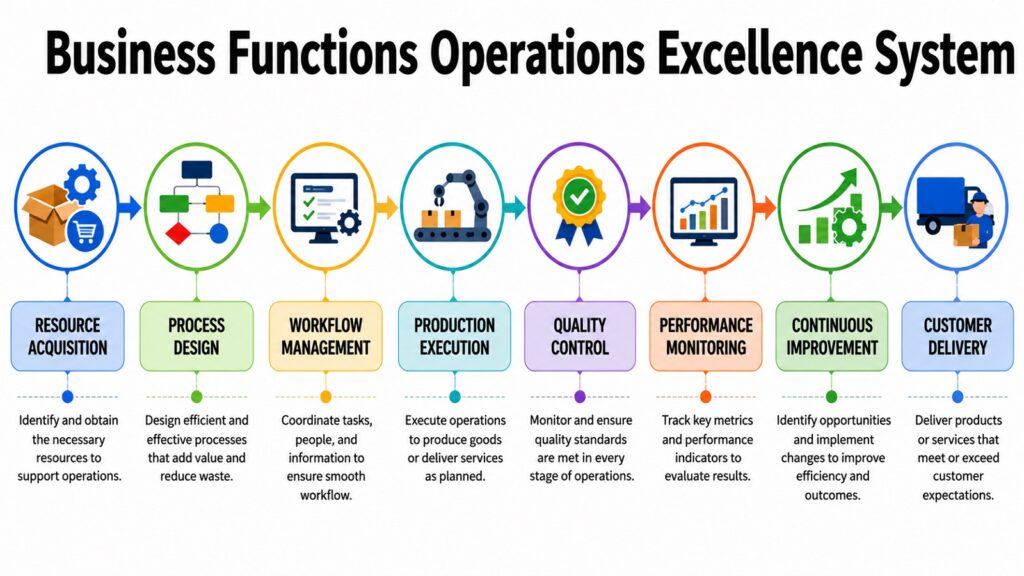
Operations is the business function that turns plans and resources into actual products and services. While marketing and sales focus on the customer relationship and finance manages the money, operations is concerned with the work itself: how it is organized, how efficiently it runs, and how consistently it delivers what customers expect.
The formal study of operations management has deep historical roots. Frederick Winslow Taylor’s scientific management introduced the idea of systematizing work to reduce waste. Henry Ford’s moving assembly line, introduced in 1913, applied these ideas at industrial scale. W. Edwards Deming’s work on quality management, applied in postwar Japan, added a focus on continuous improvement and customer-defined quality that challenged earlier production-first thinking.
Lean operations, developed at Toyota, focus on eliminating waste from the production process. Six Sigma, developed at Motorola in the 1980s, provides statistical tools for reducing defects. Total Quality Management offers a broader philosophy of improvement involving every employee. Organizations use enterprise resource planning systems, workflow management software, and capacity planning tools to manage their operational work in practice.
Toyota, Amazon, and McDonald’s are frequently cited for operational excellence. Operations relies on procurement to ensure materials arrive on time, on finance for cost management, on IT for systems support, and on customer service to understand where delivery falls short. Key challenges include supply chain disruptions, volatile demand, and workforce automation. The future involves AI in process optimization, greater robotics use, and sustainable production practices.
Key Business Functions in Operations: Recognized Practices and Efficiency Methods
| Operational Practice or Concept | Application |
| Lean Operations | Eliminating waste and non-value-adding activity to improve efficiency. |
| Six Sigma | Data-driven reduction of defects and variation in business processes. |
| Total Quality Management | Organization-wide philosophy of continuous improvement involving all employees. |
| Process Mapping | Visually documenting workflows to identify bottlenecks and improvement areas. |
| Enterprise Resource Planning | Integrated software managing data across production, inventory, and finance. |
| Capacity Planning | Matching organizational resources to expected production or service demand. |
| Kaizen | Continuous incremental improvement applied by all members of the organization. |
| Just-In-Time Production | Producing exactly when needed to reduce inventory costs and waste. |
5. Business Functions: Finance – Managing Resources and Financial Stability
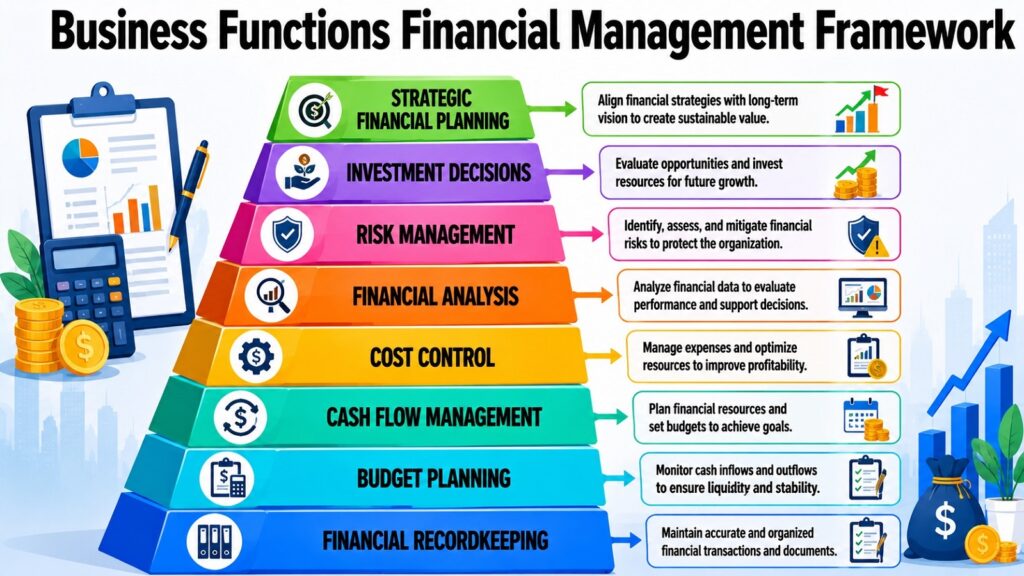
Finance is the business function that keeps an organization financially healthy and directs resources toward activities most likely to create long-term value. All other business functions depend on finance in some form, whether to receive a budget for hiring, fund a marketing campaign, invest in technology, or evaluate whether a new market is worth entering.
Early financial management was primarily concerned with record-keeping and reporting. As capital markets matured and ownership became increasingly separated from management, finance took on a more strategic character. Harry Markowitz’s modern portfolio theory in the 1950s and the capital asset pricing model gave financial managers more rigorous tools for evaluating risk and return.
Core concepts include budgeting, capital budgeting using net present value and internal rate of return, risk management, and financial planning and analysis. Organizations use financial modeling software, enterprise resource planning systems, and treasury management tools to manage cash flow, currency exposure, and short-term investment decisions. Financial dashboards give leaders real-time visibility into key performance metrics.
Berkshire Hathaway’s capital allocation discipline, JPMorgan Chase’s risk management, and Apple’s cash management are recognized examples at scale. Finance supports operations through cost efficiency, HR through headcount budgets, and procurement through supplier payment terms. Current challenges include economic uncertainty, evolving tax regulations, and ESG reporting obligations. The future involves greater automation, predictive analytics, and real-time reporting.
Key Business Functions in Finance: Recognized Concepts and Management Approaches
| Finance Concept or Tool | Application |
| Budgeting | Allocating financial resources across business functions for a defined planning period. |
| Capital Budgeting | Evaluating long-term investments using net present value and internal rate of return. |
| Financial Planning and Analysis | Integrating forecasts and historical data to guide leadership decisions. |
| Risk Management | Identifying financial exposures and implementing measures to limit their impact. |
| Cash Flow Management | Monitoring inflows and outflows to ensure liquidity and avoid disruption. |
| Financial Modeling | Building scenario-based projections of revenues, costs, and profitability. |
| Treasury Management | Managing cash reserves, currency exposure, and short-term investments. |
| ESG Reporting | Incorporating environmental and governance data into financial disclosures. |
6. Business Functions: Corporate Strategy – Guiding Long-Term Business Direction
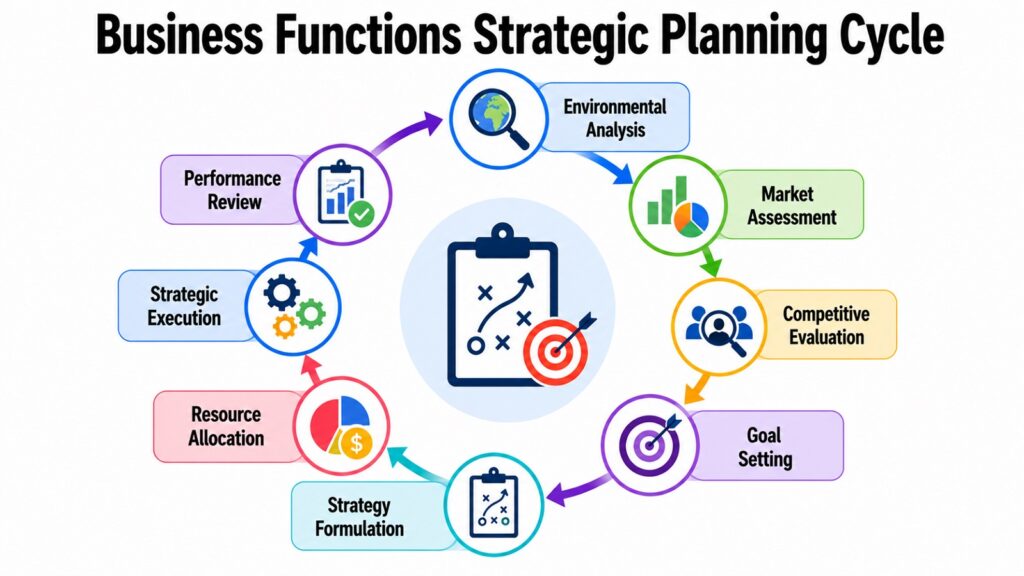
Corporate strategy is the business function that determines where an organization is going and how it intends to get there. While all other business functions focus on executing work within their defined area, corporate strategy is concerned with the bigger picture: which markets to compete in, how to allocate resources, and what kind of competitive advantage the company is building. It gives the other nine functions their sense of direction.
Strategic management as a formal discipline emerged most visibly in the latter half of the twentieth century. Igor Ansoff’s work in the 1960s gave managers one of the first structured frameworks for growth and diversification. Michael Porter’s research in the 1980s introduced the five forces model and the concept of generic competitive strategies: cost leadership, differentiation, and focus. The resource-based view, developed by Birger Wernerfelt and Jay Barney, argues that sustainable advantage comes from unique internal capabilities rather than market positioning alone.
In practice, corporate strategy involves environmental scanning, goal-setting, resource allocation, and performance review. Organizations use SWOT analysis, strategic roadmaps, and balanced scorecards to translate high-level direction into measurable objectives. Blue ocean strategy encourages creating new market spaces rather than competing in crowded ones. Scenario planning prepares organizations for multiple possible futures.
Amazon’s expansion into cloud computing and logistics, and Apple’s integrated hardware-software ecosystem, reflect deliberate strategic choices rather than accidents of luck. The primary challenge today is navigating environments that change faster than traditional planning cycles allow. The future of corporate strategy involves more sophisticated data use, sustainability integration, and attention to geopolitical risk as global markets become more fragmented.
Key Business Functions in Corporate Strategy: Recognized Frameworks and Approaches
| Strategy Framework or Concept | Application |
| Porter’s Five Forces | Analyzes competitive intensity using five structural forces. |
| Generic Competitive Strategies | Cost leadership, differentiation, and focus as paths to advantage. |
| Resource-Based View | Sustainable advantage derived from unique internal capabilities. |
| SWOT Analysis | Assessing organizational strengths, weaknesses, opportunities, and threats. |
| Blue Ocean Strategy | Creating uncontested market space rather than competing in existing markets. |
| Balanced Scorecard | Translating strategy into measurable financial and non-financial objectives. |
| Scenario Planning | Preparing for multiple possible futures to reduce the impact of uncertainty. |
| Ansoff Matrix | Evaluating growth options across existing and new products and markets. |
7. Business Functions: Information Technology – Enabling Digital Transformation
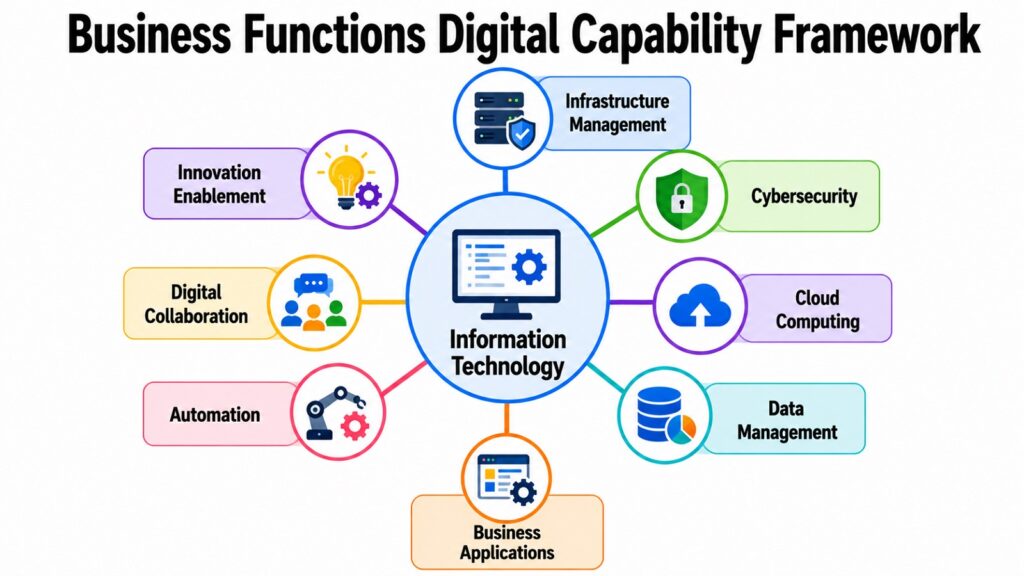
Information technology has moved from a background support function to one of the most strategically significant business functions in modern organizations. Its purpose is to ensure that the systems, data, and digital infrastructure that organizations depend on are reliable, secure, and aligned with business needs. In an era where most commercial activity touches a digital system at some point, IT is a core driver of capability and competitive differentiation.
The evolution of IT mirrors the history of computing itself. In the 1960s and 1970s, computers were expensive tools used primarily for financial calculation. As personal computing became widespread in the 1980s and the internet reshaped commerce in the 1990s, the scope of IT departments expanded dramatically. Cloud computing, artificial intelligence, and cybersecurity now define the function. Providers like Amazon Web Services, Microsoft Azure, and Google Cloud have shifted infrastructure from physical ownership to consumed services.
Digital transformation refers to integrating digital technologies into all areas of a business to change how it operates and delivers value. IT service management frameworks like ITIL provide structured approaches for delivering support. Agile and DevOps methodologies help technology teams deliver software changes faster. Data warehouse and business intelligence platforms aggregate organizational information to support decision-making.
IT enables HR to deliver online training, allows finance to produce real-time reporting, powers marketing analytics, and gives customer service agents the systems to resolve issues quickly. Current challenges include managing cybersecurity risks, governing AI responsibly, and closing the growing skills gap. The future involves deeper AI integration into infrastructure management, further cloud migration, and greater attention to data sovereignty and digital ethics.
Key Business Functions in Information Technology: Recognized Systems and Practices
| IT Concept or System | Application |
| Cloud Computing | Delivering computing services over the internet to replace on-premise infrastructure. |
| Cybersecurity Management | Protecting systems, networks, and data from unauthorized access and threats. |
| Digital Transformation | Integrating digital technologies to change how an organization operates. |
| DevOps | Combining development and operations to deliver software changes faster. |
| IT Service Management (ITIL) | Structured framework for delivering and supporting IT services. |
| Business Intelligence | Tools that aggregate and analyze organizational data to support decisions. |
| Data Governance | Policies for managing data quality, access, and compliance. |
| Enterprise Resource Planning | Integrated software connecting financial, operational, and people data. |
8. Business Functions: Customer Service – Strengthening Customer Relationships
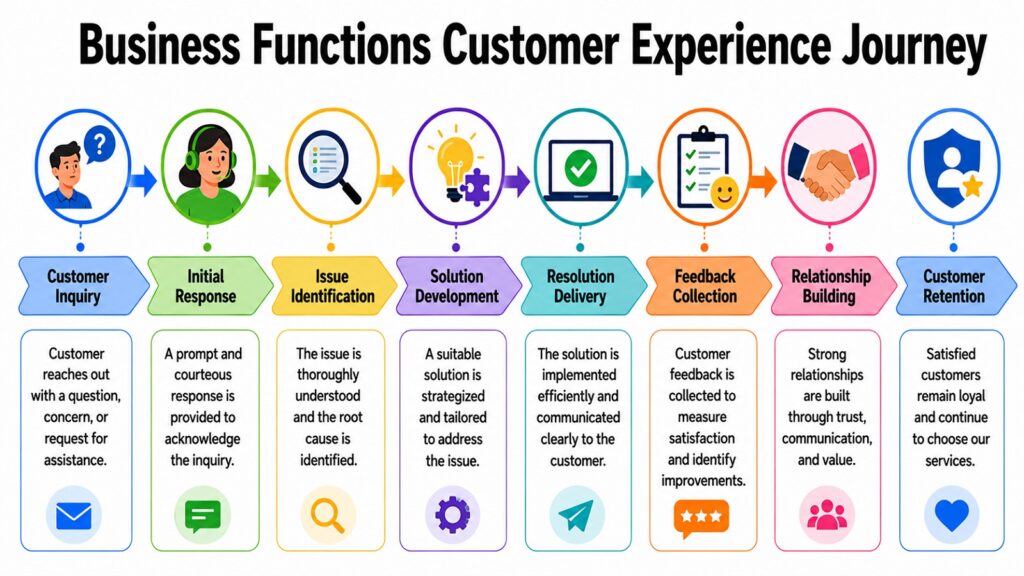
Customer service is the business function most directly concerned with what happens after a sale. Its purpose is to support customers when they have questions or problems related to what they have purchased. Done well, it builds loyalty and turns satisfied buyers into repeat customers. Done poorly, it accelerates churn and damages the reputation that marketing works hard to build.
Early customer service was largely face-to-face and informal. As companies grew, telephone-based call centers became dominant. The rise of the internet opened new channels: email, live chat, social media, and self-service portals. Today, customers expect consistent, fast responses across multiple channels simultaneously. The SERVQUAL model, developed by Zeithaml, Parasuraman, and Berry, measures service quality across reliability, assurance, tangibles, empathy, and responsiveness. Fred Reichheld’s net promoter score gave organizations a simple way to measure customer loyalty.
Organizations use CRM platforms, helpdesk software, customer feedback systems, and self-service knowledge bases to support delivery. Companies like Zappos, Ritz-Carlton, and Amazon are cited for service excellence. Zappos accepted returns for up to a year. Ritz-Carlton empowered employees to spend a defined amount per guest to resolve issues without managerial approval. These approaches reflect a deep organizational commitment that goes beyond scripted responses.
Customer service connects back to marketing by providing intelligence on what customers like and dislike. It supports sales by reassuring buyers that they will be cared for after purchase. Current challenges include rising expectations, high contact volumes, and balancing automation with human interaction. The future points toward AI-assisted responses, proactive outreach before issues arise, and better integration of service data across all business functions.
Key Business Functions in Customer Service: Recognized Practices and Experience Approaches
| Customer Service Concept | Application |
| SERVQUAL Model | Measures service quality across reliability, assurance, empathy, and responsiveness. |
| Net Promoter Score | A metric indicating how likely customers are to recommend the organization. |
| Customer Experience Management | Designing and managing every touchpoint across the full customer journey. |
| Omnichannel Support | Consistent service across phone, email, chat, social, and self-service channels. |
| Helpdesk Software | Ticket-based systems managing customer requests across multiple channels. |
| Self-Service Portals | Knowledge bases allowing customers to resolve issues without agent involvement. |
| Customer Feedback Management | Structured collection and analysis of satisfaction data to drive improvements. |
| Proactive Customer Service | Reaching out to customers with relevant information before they need to ask. |
9. Business Functions: Legal and Compliance – Protecting Organizational Integrity
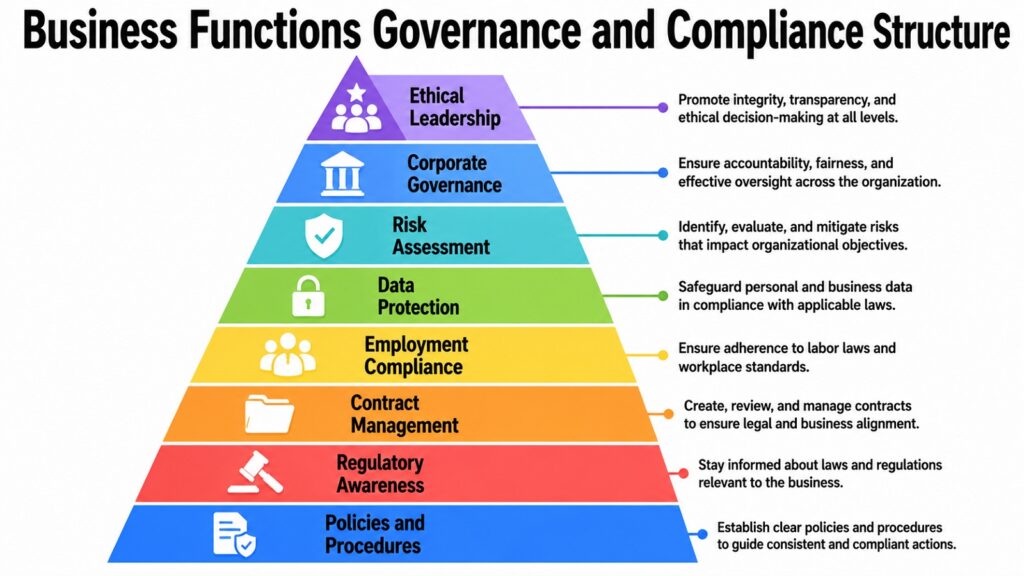
Legal and compliance is the business function that protects an organization from the full range of risks that come with operating in regulated and competitive environments. It covers contract drafting, regulatory obligation management, intellectual property protection, and employment law requirements. Most of the time its most important work is invisible. When legal and compliance works well, nothing bad happens. When it fails, the consequences can be severe.
The importance of this function has grown significantly over recent decades. The Enron and WorldCom accounting scandals led to the Sarbanes-Oxley Act, which imposed significant new compliance requirements on public companies. The 2008 financial crisis triggered regulatory reform in the financial sector. The European Union’s General Data Protection Regulation imposed new obligations on organizations handling personal information. Each of these events expanded what organizations are legally required to do and document.
Key concepts include corporate governance, legal risk management, compliance program management, intellectual property protection, and contract lifecycle management. Organizations use compliance management software, legal case management systems, contract lifecycle platforms, and ethics hotlines to manage their obligations. Highly regulated industries such as pharmaceuticals, financial services, and healthcare invest the most heavily in compliance infrastructure.
Johnson and Johnson’s recall of thirty-one million bottles of Tylenol in 1982, at significant cost, remains a model of how organizational integrity can be protected through decisive action guided by clear values. Legal and compliance advises HR on employment law, guides marketing on advertising standards, works with finance on tax obligations, and protects operations from product liability exposure. Future challenges include AI regulation, cross-border compliance complexity, and environmental due diligence requirements.
Key Business Functions in Legal and Compliance: Recognized Governance and Risk Practices
| Legal or Compliance Concept | Application |
| Corporate Governance | Systems by which organizations are directed, controlled, and held accountable. |
| Legal Risk Management | Identifying legal exposures and implementing measures to reduce their impact. |
| Compliance Management | Building policies and training programs to meet regulatory requirements consistently. |
| Contract Lifecycle Management | Organizing the full process from contract creation through renewal and termination. |
| Intellectual Property Protection | Securing patents, trademarks, and copyrights to protect organizational assets. |
| Data Privacy Compliance | Meeting legal obligations related to the collection and protection of personal data. |
| Employment Law Adherence | Ensuring HR practices comply with applicable labor regulations. |
| Ethics and Conduct Programs | Policies and reporting systems to encourage ethical behavior and address misconduct. |
10. Business Functions: Procurement and Supply Chain – Managing Business Resources and Flow
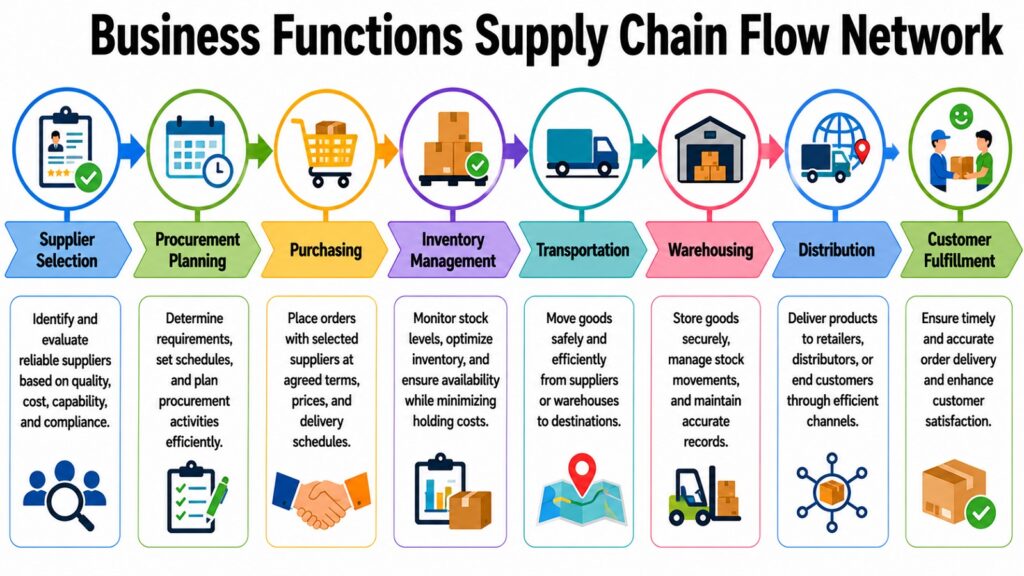
Procurement and supply chain is the business function responsible for acquiring the goods, services, and materials that an organization needs to operate and deliver its products to customers. It spans supplier identification and evaluation, contract negotiation, inventory management, logistics coordination, and ensuring resources are available at the right time. Without this function, even a well-designed product cannot reach the people who want to buy it.
Early procurement was largely transactional, focused on obtaining materials at the lowest available price. The growth of global manufacturing in the latter twentieth century changed this dramatically. Companies began sourcing components from multiple countries, creating complex supply networks. Supply chain management emerged as an integrated discipline connecting procurement, logistics, inventory, and demand planning. Organizations recognized that competitiveness depended on the performance of the entire supply network, not just internal operations.
Key concepts include supplier relationship management, inventory management, logistics coordination, and supply chain resilience. Resilience refers to an organization’s ability to anticipate, absorb, and recover from disruptions caused by natural disasters, geopolitical events, or demand shocks. Organizations use procurement software platforms, inventory management systems, transportation management systems, and supply chain visibility tools to manage these activities.
Apple’s global component sourcing, Walmart’s logistics infrastructure, and Zara’s ability to move a new design from concept to store in as little as two weeks are recognized supply chain achievements. Procurement supports operations through timely material supply, supports finance through cost and payment term management, and supports corporate strategy by identifying sourcing opportunities. Current challenges include geopolitical disruption, sustainability pressure, and multi-tier supplier visibility. AI in demand forecasting and digital procurement adoption define the future.
Key Business Functions in Procurement and Supply Chain: Recognized Practices and Methods
| Procurement or Supply Chain Concept | Application |
| Supplier Relationship Management | Building productive long-term partnerships rather than transactional purchasing. |
| Inventory Control | Balancing the cost of holding stock against the risk of supply shortages. |
| Logistics Coordination | Managing transportation and warehousing to move goods efficiently. |
| Supply Chain Resilience | Building capacity to anticipate and recover from supply network disruptions. |
| Procurement Strategy | Aligning sourcing decisions with cost, quality, and sustainability goals. |
| Transportation Management Systems | Software optimizing carrier selection, routing, and freight costs. |
| Demand Forecasting | Predicting future needs to align procurement and production planning. |
| Supply Chain Visibility | Real-time monitoring of goods movement and supplier status across the network. |
Conclusion: How Business Functions Work Together to Drive Organizational Success
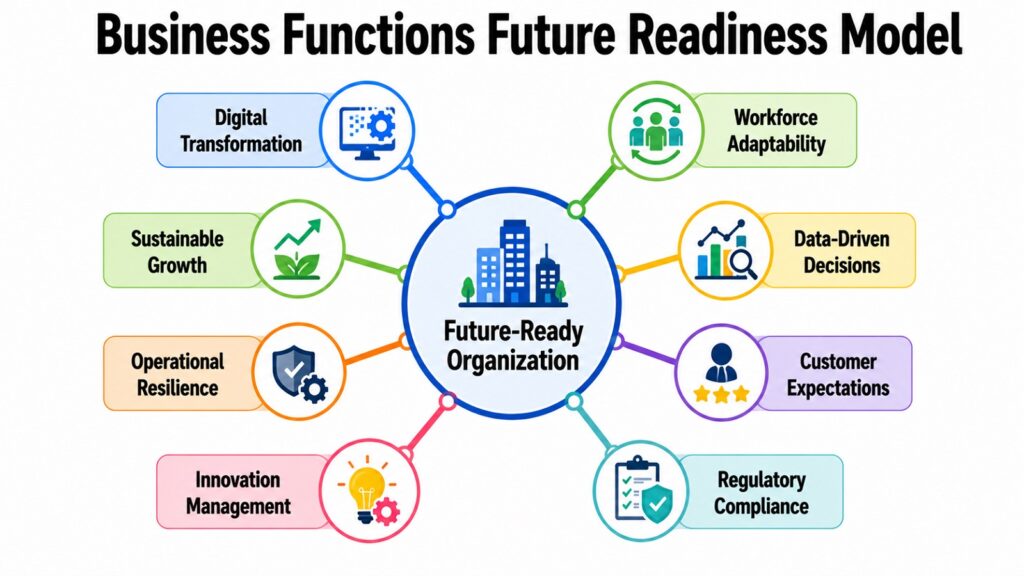
A company is more than the sum of its parts. Ten distinct business functions have been examined in this article, each with its own purpose, history, tools, and challenges. But the real story is not in any single function. It is in what happens when they work together. Organizations that treat each of these areas as isolated departments tend to struggle. Organizations that build genuine integration across them tend to build something far more durable.
The interaction between these business functions is where competitive advantage actually lives. When marketing and sales share a clear picture of the ideal customer, conversion improves and the experience is smoother from the very first touchpoint. When operations and procurement align closely, delivery reliability improves and costs fall. When IT builds systems that serve the real needs of every other function, the whole organization moves faster and wastes less effort on manual workarounds. When legal and compliance is embedded in the decisions made by finance, HR, and strategy rather than consulted only when something goes wrong, the organization avoids many of the mistakes that prove expensive to repair.
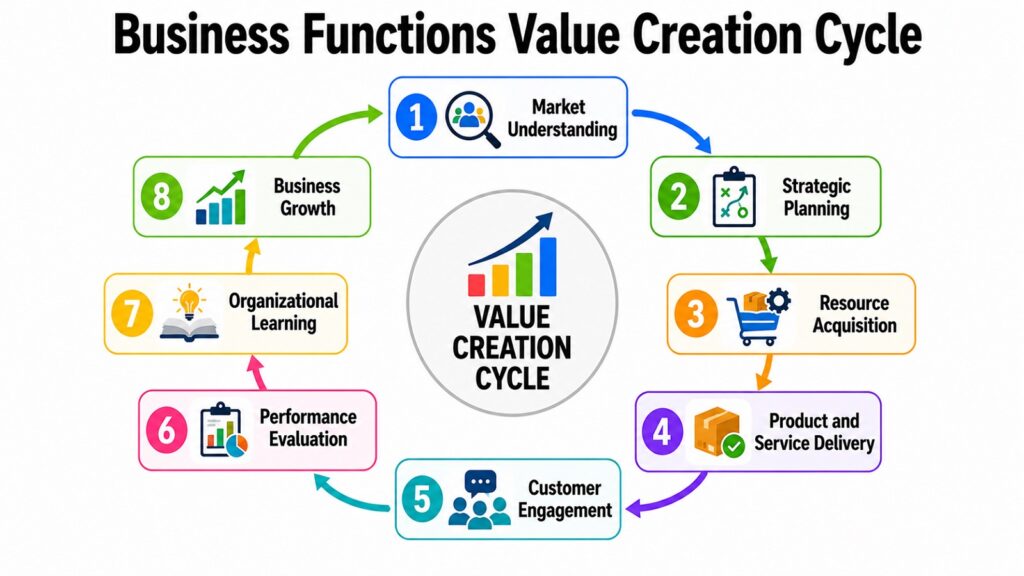
Throughout this article, the historical development of all business functions has been traced from early roots to the current state. A consistent pattern emerges: each function began as a relatively narrow, often administrative activity and expanded over time into something more strategic and interconnected. HR moved from personnel administration to talent strategy. Finance moved from bookkeeping to risk management and capital allocation. IT moved from infrastructure maintenance to digital transformation leadership. Operations moved from simple production management to a discipline that shapes how entire organizations compete.
Looking ahead, artificial intelligence is touching nearly all business functions. Sustainability expectations are reshaping how operations and procurement work. Geopolitical volatility is adding new dimensions to supply chain, legal, and strategic planning. Rising customer expectations continue to pressure marketing, sales, and service. Business functions are important business essentials, and they will remain so as long as organizations exist to create value for customers, employees, and society.
Key Business Functions Insights: Eight Lessons from This Article
| Key Insights of Business Functions | What It Means in Practice |
| Integration creates advantage | Business functions that coordinate produce better outcomes than those operating in silos. |
| All functions evolved strategically | Every function moved from administrative activity toward strategic contribution. |
| Theory and practice connect | Frameworks like lean, SERVQUAL, and Porter’s five forces shape real operational decisions. |
| Technology enables every function | Digital tools amplify capability across all ten business functions. |
| Disruption requires resilience | Supply chains, IT systems, and compliance frameworks all need built-in flexibility. |
| Talent underpins all functions | HR capability directly shapes what all other business functions can achieve. |
| Customer orientation drives alignment | Keeping the customer central improves performance across all functions. |
| Future functions will be AI-assisted | Artificial intelligence is becoming embedded across all ten business functions. |