Table of Contents
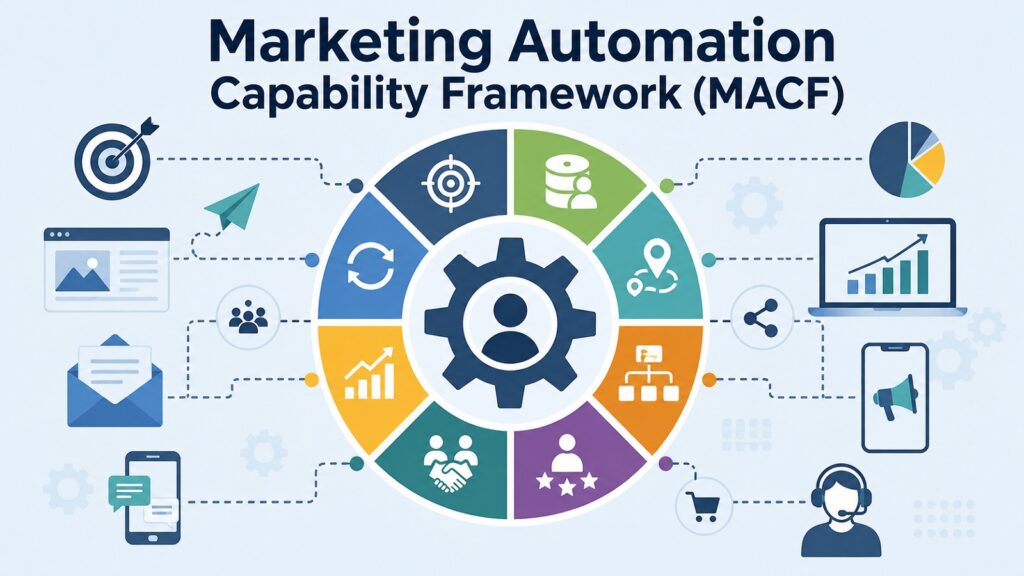
Introduction: Understanding the Marketing Automation Capability Framework (MAFC)
Marketing Automation is one of the most important aspects of marketing technology today. It enables organizations to automate marketing processes, improve customer engagement, personalize communications, and scale marketing operations without proportionally increasing headcount or cost. When done well, it changes the relationship between a business and its customers in ways that feel both efficient and human.
The story of Marketing Automation did not begin with sophisticated platforms. It started with simple email automation — scheduled newsletters, basic drip sequences, list broadcasts. Over time, the field expanded to include CRM systems, customer data platforms, artificial intelligence, omnichannel marketing, behavioral analytics, and workflow automation. What was once a tactical email tool became a strategic business capability.
Yet a gap persists. Technologies have advanced considerably, but many organizations still approach Marketing Automation as a collection of disconnected tools. They adopt platforms without strategy, automate processes without data foundations, and optimize channels without understanding the full customer journey. The result is fragmented automation that creates operational complexity rather than business value.
This article presents the Marketing Automation Capability Framework, referred to as the MACF. It is a synthesized framework built from established knowledge in Marketing Automation, customer relationship management, customer journey management, relationship marketing, business process automation, data-driven marketing, artificial intelligence, and continuous improvement. The framework does not replace existing theories. It integrates them into a practical capability model that organizations of different industries and sizes can use as a reference and implementation guide.
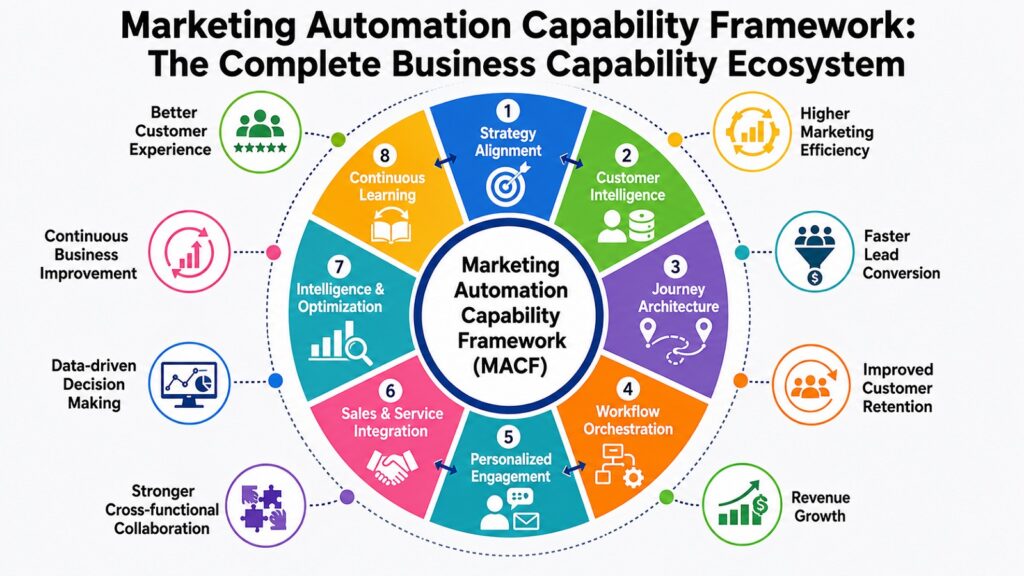
The MACF consists of eight interconnected capabilities. Each capability builds upon the previous one and enables the next, forming a continuous improvement cycle. Strategy Alignment provides the foundation. Customer Intelligence provides the data. Journey Architecture provides the design. Workflow Orchestration provides the execution engine. Personalized Engagement delivers value to customers. Sales and Service Integration extends that value across the organization. Intelligence and Optimization refine performance over time. Continuous Learning ensures the organization evolves alongside its environment. Together, these capabilities form a coherent system rather than a checklist.
Every section in this article combines theoretical foundations, practical business applications, research-backed concepts, implementation perspectives, business value, and future trends. The goal is to help readers understand Marketing Automation as an organizational capability, not simply as software to deploy.
Table 1: Marketing Automation Capability Framework — Eight Core Capabilities
| Capability | Primary Purpose |
| Strategy Alignment | Connects Marketing Automation initiatives to organizational business objectives |
| Customer Intelligence | Builds unified customer data foundations that enable intelligent automation |
| Journey Architecture | Designs customer lifecycle experiences before automation workflows are built |
| Workflow Orchestration | Transforms customer journey designs into automated, scalable business processes |
| Personalized Engagement | Delivers relevant, individualized communications across all customer touchpoints |
| Sales & Service Integration | Aligns marketing automation with sales, service, and operational functions |
| Intelligence & Optimization | Continuously improves automation performance through measurement and analytics |
| Continuous Learning | Evolves organizational capabilities to stay aligned with market and technology change |
1. Marketing Automation Capability Framework: Strategy Alignment
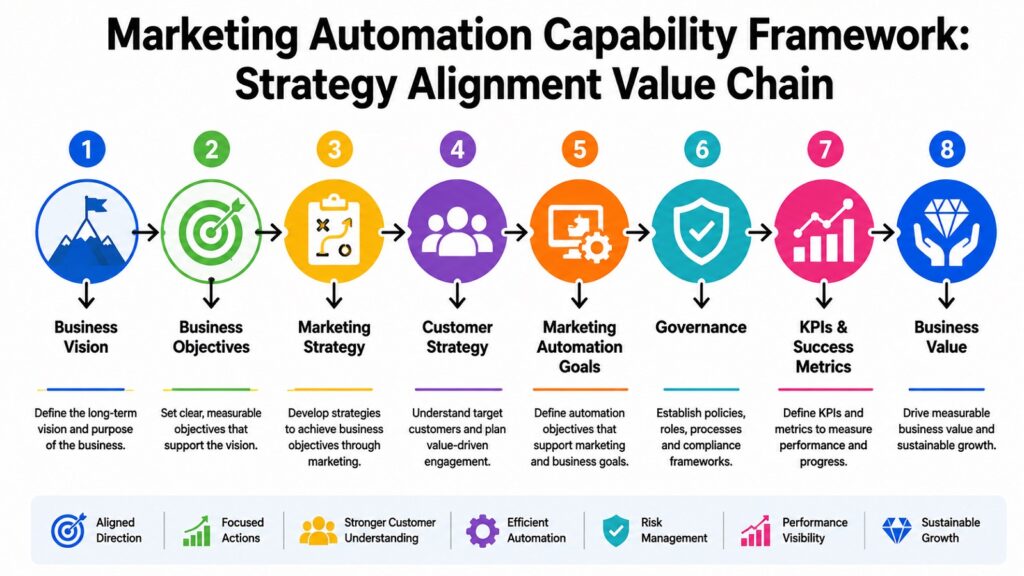
Strategy Alignment forms the foundation of the Marketing Automation Capability Framework because everything else depends on it. Organizations that begin Marketing Automation initiatives by selecting technology before defining objectives tend to build automation that serves the tool rather than the business. The sequence matters enormously.
The existing body of literature regarding Marketing Automation consistently emphasizes that strategic alignment is essential for achieving success. Research on digital transformation, principles of marketing planning, governance frameworks, and theories of strategic management all converge on a singular notion: marketing efforts must be aligned with organizational objectives to produce significant results. The Marketing Automation Capability Framework (MACF) integrates these concepts into a unified foundational capability instead of addressing them as distinct issues.
Marketing Automation should support a range of business objectives depending on the organization. These include customer acquisition, lead generation, customer retention, customer experience improvement, operational efficiency, brand development, revenue growth, and the creation of measurable marketing outcomes. When Marketing Automation is aligned with these goals, it becomes a strategic asset. When it operates independently of them, it becomes a cost center.
Organizations translate strategic objectives into Marketing Automation initiatives through governance structures, executive sponsorship, stakeholder alignment, clearly defined performance metrics, and long-term roadmap planning. A common implementation mistake is delegating Marketing Automation strategy entirely to a marketing operations team without senior leadership involvement. This leads to tactical automation with no connection to business priorities.
The practical value of strategic alignment is that it gives every automation decision a clear reference point. Teams can evaluate workflows, campaigns, and tools against a defined set of business objectives. Emerging technologies such as artificial intelligence further strengthen strategic decision-making by providing scenario analysis, predictive modeling, and resource optimization at a level of speed and scale that manual planning cannot match. Strategy Alignment naturally sets the stage for Customer Intelligence, because you cannot gather the right customer data until you know what business outcomes you are trying to achieve.
Table 2: Marketing Automation Strategy Alignment — Eight Strategic Elements
| Strategic Element | Contribution to Marketing Automation |
| Business Objective Definition | Anchors automation design to measurable organizational outcomes |
| Executive Sponsorship | Ensures organizational support, budget commitment, and cross-functional cooperation |
| Governance Framework | Establishes accountability structures and decision-making authority for automation |
| Stakeholder Alignment | Builds shared understanding of marketing automation goals across departments |
| Performance Metrics | Creates measurable benchmarks for evaluating automation effectiveness and ROI |
| Technology Roadmap | Guides platform selection and integration decisions based on strategic priorities |
| Long-term Planning | Ensures automation investments compound value over time rather than remaining isolated |
| AI-Assisted Strategy | Enhances strategic decisions through predictive analysis and opportunity identification |
2. Marketing Automation Capability Framework: Customer Intelligence
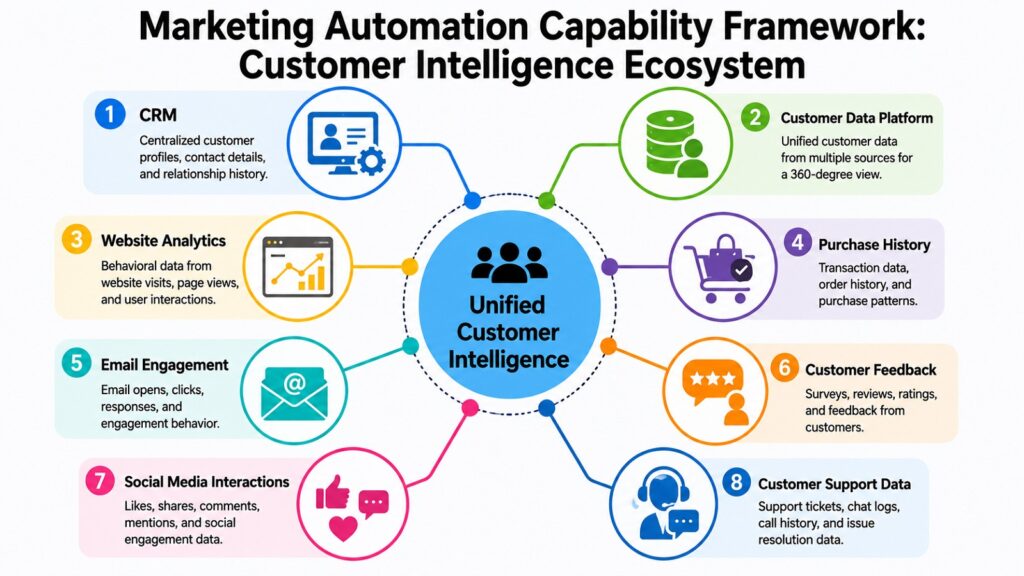
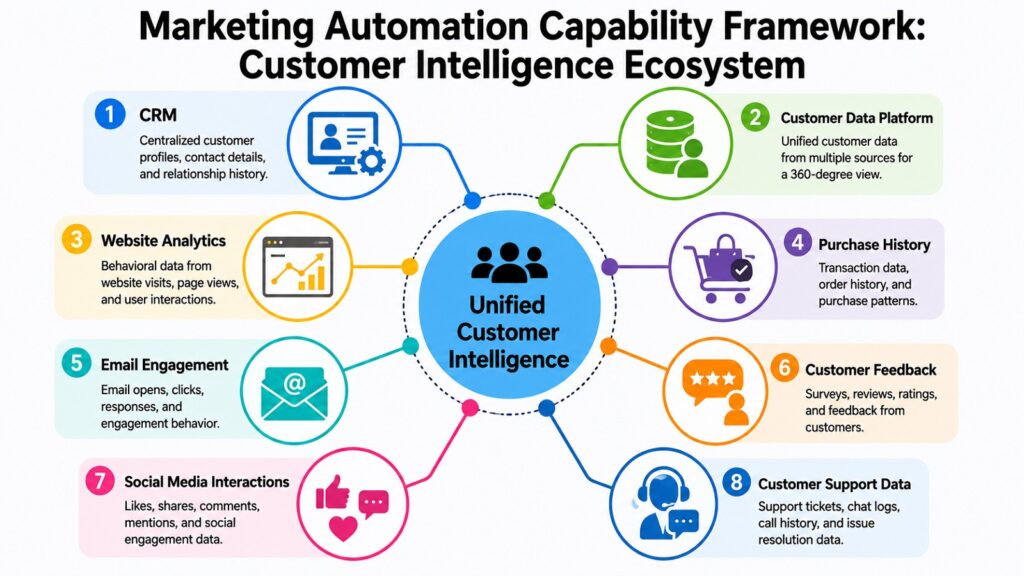
Customer Intelligence serves as the data foundation of Marketing Automation. Without accurate, unified, and actionable customer data, automation cannot personalize, target, qualify, or predict with any reliability. The MACF treats Customer Intelligence as a distinct organizational capability rather than a byproduct of platform implementation.
Research in CRM, customer data platforms, customer analytics, relationship marketing, customer segmentation, and first-party data management all point to the same conclusion: organizations that invest in customer data infrastructure outperform those that do not. The MACF synthesizes these separate disciplines into a unified capability that enables intelligent automation across the full customer lifecycle.
High-quality Customer Intelligence depends on several types of data working together. Behavioral data reveals how customers interact with digital channels. Purchase history reveals buying patterns and preferences. Demographic information supports segmentation and targeting. Preference data enables personalization. Unified customer profiles bring these data types into a single, coherent view that automation systems can act on consistently.
Marketing Automation depends on Customer Intelligence in multiple practical ways. Personalization requires knowing what individual customers prefer. Targeting requires understanding which segments respond to which messages. Lead qualification requires behavioral and engagement signals. Predicting customer behavior requires historical data combined with pattern recognition. Better business decisions require visibility into customer trends, not assumptions.
Common organizational challenges include data silos across departments, inconsistent data quality, poor data governance, and compliance complexity around regulations such as GDPR and privacy laws. The business benefits of addressing these challenges are substantial: higher conversion rates, reduced customer churn, more efficient marketing spend, and stronger customer relationships. AI-driven customer intelligence is accelerating these benefits by enabling real-time analysis, automated segmentation, and predictive insights that scale with the size of the customer base. Customer Intelligence naturally enables Journey Architecture because understanding customers well is what makes it possible to design experiences that actually match their needs.
Table 3: Marketing Automation Customer Intelligence — Key Components
| Intelligence Component | Role in Marketing Automation |
| Behavioral Data | Reveals customer interactions across channels to inform targeting and personalization |
| Purchase History | Identifies buying patterns and preferences for product and offer recommendations |
| Demographic Profiles | Supports audience segmentation and message relevance by customer group |
| Customer Preferences | Enables personalized content delivery aligned with individual interests |
| Unified Customer Record | Consolidates data sources into a single consistent view for automation systems |
| Lead Scoring Data | Prioritizes prospects based on engagement signals and conversion likelihood |
| Predictive Analytics | Anticipates future customer behavior to enable proactive marketing responses |
| Data Governance | Ensures data quality, accuracy, and regulatory compliance across all sources |
3. Marketing Automation Capability Framework: Journey Architecture
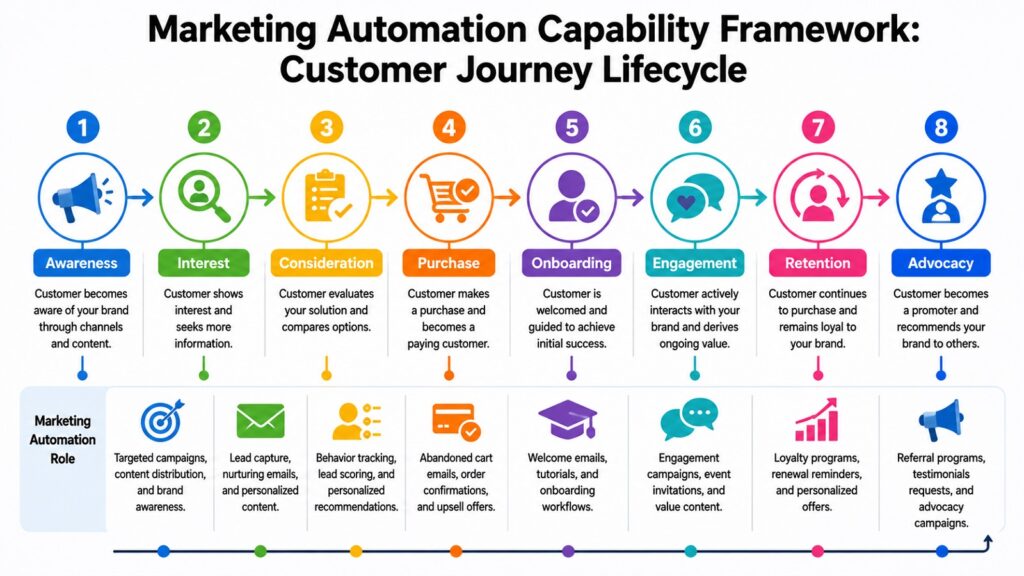
Marketing Automation becomes significantly more effective when organizations design customer journeys before building automation workflows. This sequencing is often reversed in practice, which is why many automation implementations produce technically functional workflows that nevertheless fail to create satisfying customer experiences.
Journey Architecture as a capability draws from established disciplines including customer journey mapping, customer experience management, lifecycle marketing, omnichannel marketing, and service design. Each of these fields contributes something distinct. Journey mapping surfaces the customer perspective. Lifecycle marketing organizes customers by relationship stage. Omnichannel thinking connects experiences across touchpoints. Service design considers emotion and perception alongside process. Together, they make Journey Architecture a rich and practical capability within the MACF.
Organizations implementing Journey Architecture begin by identifying customer lifecycle stages — from initial awareness through consideration, conversion, onboarding, retention, and advocacy. Within each stage, they map customer touchpoints, trigger events, decision points, and engagement opportunities. They consider how the experience feels across channels: email, website, social media, mobile, customer service, and in-person.
Journey Architecture improves consistency because every automated workflow operates within a designed experience rather than a collection of disconnected campaigns. It improves customer satisfaction because the automation reflects how customers actually move through their relationship with a brand. It supports long-term engagement because customers receive communications that match their current lifecycle stage rather than generic outreach.
Common design mistakes include designing journeys from the inside out — based on organizational structure rather than customer perspective — and failing to account for customers who exit and re-enter journeys at different stages. AI is increasing the sophistication of journey optimization by enabling real-time path adjustments based on individual customer behavior signals. Journey Architecture provides the blueprint for Workflow Orchestration because you cannot automate what you have not designed.
Table 4: Marketing Automation Journey Architecture — Customer Lifecycle Stages
| Journey Stage | Marketing Automation Objective |
| Awareness | Capture interest through relevant content and initial engagement triggers |
| Consideration | Nurture prospects with educational content that supports informed decision-making |
| Conversion | Deliver targeted offers and frictionless pathways to purchase or sign-up |
| Onboarding | Guide new customers through initial experiences to accelerate product value realization |
| Retention | Maintain engagement through personalized communications and loyalty recognition |
| Expansion | Identify upsell and cross-sell opportunities based on usage and behavioral signals |
| Advocacy | Activate satisfied customers as referral sources and brand ambassadors |
| Re-engagement | Recover lapsed customers with tailored win-back campaigns and relevant offers |
4. Marketing Automation Capability Framework: Workflow Orchestration
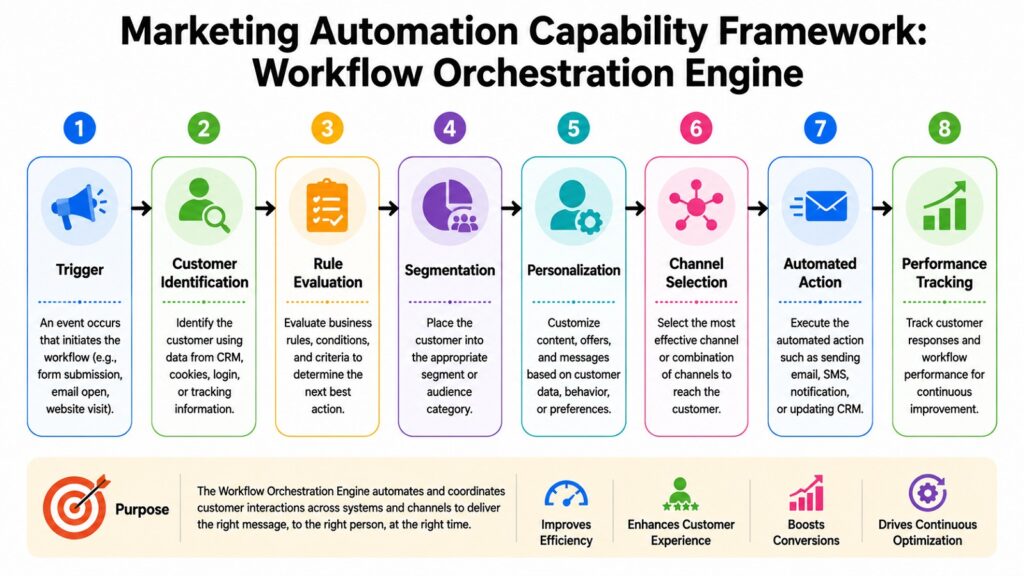
Workflow Orchestration is where Marketing Automation becomes operational. It transforms the customer journey designs developed in the previous capability into automated business processes that execute reliably, at scale, across multiple channels and customer segments.
The theoretical basis for Workflow Orchestration encompasses business process automation, workflow management systems, campaign automation, event-driven architectures, and omnichannel marketing frameworks. Each of these domains plays a role in shaping how organizations approach triggers, sequencing, conditional logic, and coordination. The MACF regards Workflow Orchestration as the operational engine of Marketing Automation — the essential capability that ensures everything functions smoothly.
Effective Workflow Orchestration involves several interconnected components. Triggers initiate workflows based on customer actions, time-based conditions, or data changes. Business rules define how the workflow responds to different customer situations. Conditional logic allows workflows to branch based on customer behavior, segment membership, or engagement history. Scheduling ensures communications arrive at the right time. Lead routing connects qualified prospects to the appropriate sales or service resource. Cross-channel coordination ensures that email, SMS, push notifications, and other channels work together rather than in isolation.
Organizations that build scalable Workflow Orchestration systems design their workflows for reuse and maintainability rather than one-off campaigns. They document workflow logic, version control their automation builds, and establish testing protocols before deploying changes to live customer audiences. This discipline reduces errors and builds operational confidence.
Common workflow challenges include technical debt from undocumented automation, conflicts between overlapping campaigns, and performance degradation as workflow complexity increases. The business benefits of strong orchestration include consistent customer communications, reduced manual workload, faster campaign deployment, and the ability to manage large customer volumes without proportional resource increases. AI is increasingly being used to optimize workflow timing, select the best next action for individual customers, and identify workflow inefficiencies before they affect performance. Well-orchestrated workflows enable the Personalized Engagement that customers actually experience.
Table 5: Marketing Automation Workflow Orchestration — Key Components
| Workflow Component | Business Purpose |
| Event Triggers | Initiate automated sequences based on customer actions or data conditions |
| Business Rules | Define workflow behavior in response to specific customer scenarios |
| Conditional Logic | Branch workflows based on customer attributes, behavior, or engagement level |
| Scheduling | Control communication timing to maximize customer receptivity and engagement |
| Lead Routing | Direct qualified prospects to the appropriate sales or service resource |
| Campaign Coordination | Align multiple automation sequences to prevent message conflicts or fatigue |
| Cross-Channel Orchestration | Synchronize communications across email, SMS, push, and digital channels |
| Workflow Testing | Validate automation logic before deployment to prevent customer experience errors |
5. Marketing Automation Capability Framework: Personalized Engagement
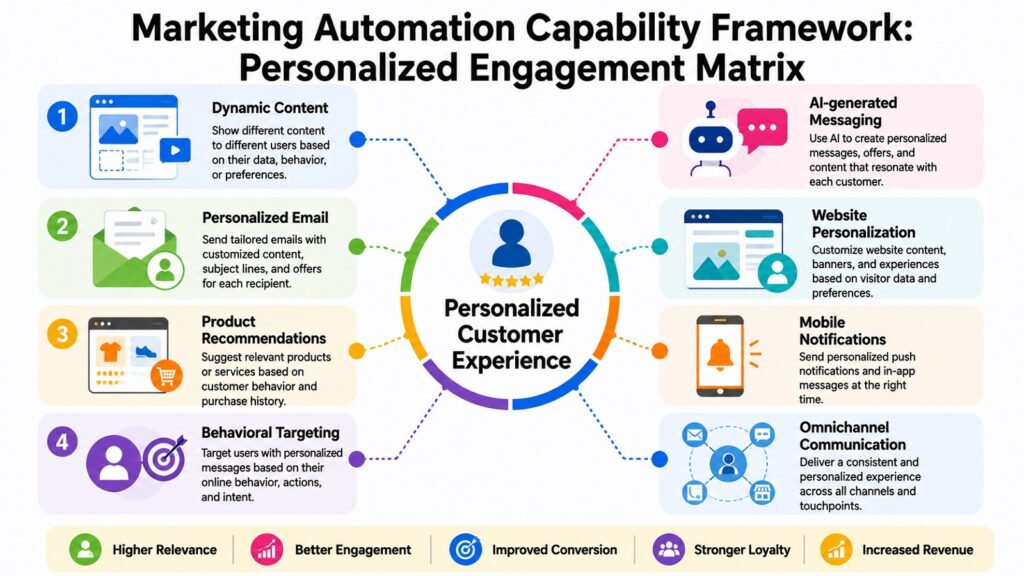
Personalized Engagement is one of the primary reasons organizations invest in Marketing Automation in the first place. Customers expect communications that feel relevant to their individual situation, not broadcast messages that treat every recipient the same way. Meeting this expectation at scale is what makes Marketing Automation a genuinely strategic capability.
The theoretical foundations of this capability include relationship marketing, personalization research, customer experience management, behavioral marketing, and artificial intelligence applications in marketing. Relationship marketing established that long-term customer relationships generate more value than transactional exchanges. Personalization research demonstrated that relevance increases engagement. Behavioral marketing showed that understanding what customers do is as important as knowing who they are. AI extended all of these principles by making individualized personalization scalable in ways that were previously impossible.
Marketing Automation supports Personalized Engagement through several practical mechanisms. Dynamic content changes the message, offer, or imagery shown to a customer based on their profile or behavior. Segmentation groups customers by shared characteristics so that campaigns can be tailored by segment. Behavioral targeting delivers messages based on recent actions such as product page visits or abandoned carts. Recommendation engines suggest relevant products or content based on purchase or browsing history. AI-assisted messaging selects the right content, channel, and timing for individual customers based on pattern analysis. Omnichannel personalization extends these capabilities across every customer touchpoint.
Personalized Marketing Automation improves customer satisfaction by reducing irrelevant communications. It builds trust because customers feel understood rather than marketed at. It increases conversion rates because offers reach customers when they are most likely to respond. It strengthens loyalty because personalized experiences create positive associations with the brand over time.
Common personalization mistakes include over-segmentation that creates too many small audiences to manage, reliance on demographic data alone without behavioral signals, and personalization that feels intrusive rather than helpful. Future developments in AI-powered personalization will enable even more precise individualization, including real-time content generation tailored to individual customers in the moment they engage. Personalized Engagement naturally leads to Sales and Service Integration because the relationships built through personalization need to extend across the entire organization.
Table 6: Marketing Automation Personalized Engagement — Techniques and Benefits
| Personalization Technique | Primary Marketing Automation Benefit |
| Dynamic Content | Adapts message, imagery, and offers based on individual customer data in real time |
| Customer Segmentation | Groups audiences by shared traits to enable more relevant campaign targeting |
| Behavioral Targeting | Delivers messages triggered by specific customer actions and engagement signals |
| Recommendation Engines | Suggests relevant products or content based on purchase and browsing history |
| AI-Assisted Messaging | Selects optimal content, timing, and channel for individual customer interactions |
| Email Personalization | Customizes subject lines, content blocks, and CTAs using customer profile data |
| Lifecycle Messaging | Aligns communication content and tone with the customer’s current journey stage |
| Omnichannel Personalization | Maintains a consistent personalized experience across all digital and physical channels |
6. Marketing Automation Capability Framework: Sales & Service Integration
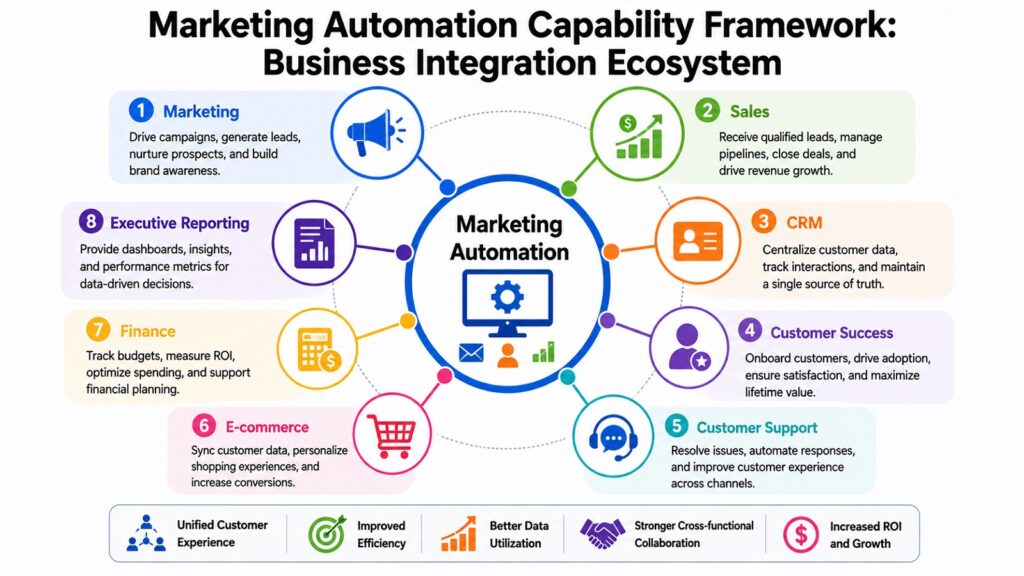
Marketing Automation creates maximum organizational value when it does not operate in isolation. The moment a prospect becomes a customer, or the moment a customer contacts support, the marketing automation system needs to connect with sales, customer service, customer success, and other operational functions. Without this integration, the customer experience breaks down precisely when it matters most.
The theoretical foundation for Sales and Service Integration is derived from research in CRM, relationship marketing, customer lifecycle management, sales enablement theory, and customer success methodologies. CRM research has demonstrated that effective management of customer information enhances both sales performance and customer retention. Relationship marketing has highlighted the importance of the long-term value of customers. Sales enablement has clarified the role of marketing in enhancing sales productivity. Customer success practices have outlined how engagement after the sale is crucial for safeguarding and increasing revenue. The MACF synthesizes these viewpoints into a cohesive organizational capability.
Marketing Automation supports Sales and Service Integration in several practical ways. Lead scoring assigns numerical values to prospect engagement, enabling sales teams to prioritize their outreach. CRM synchronization ensures that customer data is consistent across marketing and sales systems. Sales handoff workflows deliver qualified leads with relevant context rather than raw contact information. Customer onboarding sequences guide new customers through initial experiences without requiring manual sales involvement. Support automation routes customer inquiries, manages common service requests, and surfaces relevant knowledge base content. Account management workflows keep long-term customers engaged and informed.
The organizational benefits of integration are significant. Customer experiences become more consistent because marketing, sales, and service operate from a shared understanding of the customer relationship. Operational efficiency improves because automation handles routine coordination tasks. Organizational alignment strengthens because teams share data, goals, and feedback loops rather than operating in separate systems.
Common integration challenges include technical barriers between platforms, data format inconsistencies, and organizational resistance when different teams have different priorities or incentive structures. AI is expanding the role of integration by enabling intelligent lead routing, predictive account health scoring, and automated service escalation based on customer sentiment signals. Integration generates richer organizational intelligence because data flows from multiple functions, which directly supports the next capability: Intelligence and Optimization.
Table 7: Marketing Automation Sales & Service Integration — Activities and Benefits
| Integration Activity | Organizational Benefit |
| Lead Scoring | Prioritizes sales outreach based on prospect engagement and conversion readiness |
| CRM Synchronization | Maintains consistent customer data across marketing and sales platforms |
| Sales Handoff Workflows | Delivers qualified leads with behavioral context to enable productive sales conversations |
| Customer Onboarding | Automates post-purchase guidance to accelerate time-to-value for new customers |
| Support Automation | Routes inquiries and resolves common service requests without manual intervention |
| Account Management | Keeps existing customers informed and engaged throughout the relationship lifecycle |
| Cross-Functional Feedback | Channels sales and service insights back into marketing strategy and content |
| AI-Driven Routing | Assigns leads and service cases to the best resource based on real-time data signals |
7. Marketing Automation Capability Framework: Intelligence & Optimization
Marketing Automation should never operate as a static system. The workflows, campaigns, and engagement sequences that perform well today may underperform tomorrow as customer behavior changes, competitive contexts shift, and market conditions evolve. Intelligence and Optimization is the capability that prevents Marketing Automation from becoming a set of aging processes running on autopilot.
The fields that contribute to this capability encompass marketing analytics, attribution modeling, A/B testing methodologies, predictive analytics, business intelligence practices, performance measurement frameworks, and research on data-driven decision-making. Each of these domains adds a unique aspect to the optimization process. Analytics uncovers current trends. Attribution modeling clarifies which actions merit recognition for results. Experimentation distinguishes true performance variations from random occurrences. Predictive analytics forecasts potential future events. Business intelligence links marketing data to overall organizational performance.
In practice, Intelligence and Optimization involves campaign measurement across open rates, click rates, conversion rates, and revenue attribution. Conversion analysis identifies where customers drop out of workflows and why. Customer behavior analysis reveals how engagement patterns change over time and across segments. Experimentation through A/B and multivariate testing evaluates content, timing, and offer variations. ROI evaluation connects marketing investment to business outcomes. Dashboard reporting surfaces insights for marketing teams and organizational leadership. Predictive analytics models forecast campaign performance and customer lifetime value. AI-assisted optimization adjusts automation parameters in real time based on performance signals.
A common optimization mistake is measuring activity rather than outcomes — tracking email sends rather than customer conversations, or page visits rather than revenue contribution. Another is running experiments without sufficient statistical rigor, which produces misleading results that lead to poor optimization decisions.
The business benefits of systematic optimization include better marketing ROI, more efficient budget allocation, improved campaign performance over time, and stronger organizational confidence in marketing investments. Future developments in intelligent optimization will include autonomous AI systems that continuously refine Marketing Automation parameters without requiring manual analysis. Intelligence and Optimization naturally builds the organizational knowledge base that feeds Continuous Learning.
Table 8: Marketing Automation Intelligence & Optimization — Techniques and Contributions
| Optimization Technique | Business Contribution |
| Campaign Analytics | Measures performance across key engagement and conversion metrics for each workflow |
| Attribution Modeling | Identifies which marketing activities contribute most to conversion and revenue outcomes |
| A/B Testing | Evaluates content, timing, and offer variations to identify highest-performing options |
| Conversion Analysis | Pinpoints where customers exit workflows to guide targeted improvements |
| Predictive Analytics | Forecasts campaign outcomes and customer behavior to support proactive decision-making |
| ROI Evaluation | Connects marketing spend to measurable business results and financial outcomes |
| Dashboard Reporting | Provides marketing teams and leadership with real-time performance visibility |
| AI-Assisted Optimization | Adjusts automation variables continuously based on live performance data and signals |
8. Marketing Automation Capability Framework: Continuous Learning
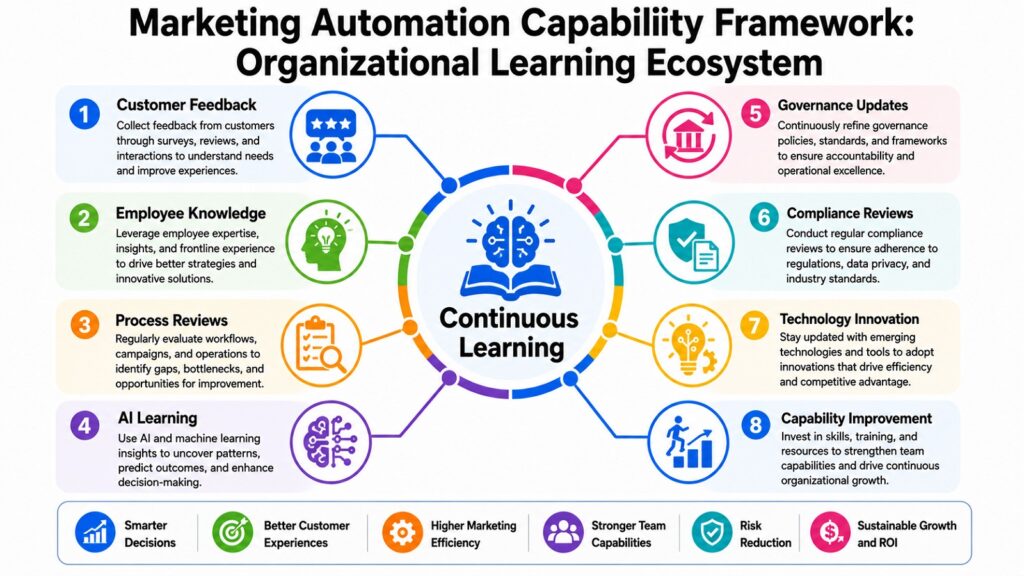
Continuous Learning completes the Marketing Automation Capability Framework. It is the capability that keeps an organization from becoming obsolete in a field that changes as quickly as Marketing Automation does. Customer expectations evolve. Technologies improve. Regulations change. Business models shift. Without deliberate organizational learning, even well-built Marketing Automation capabilities gradually fall out of alignment with the environment they were designed to serve.
The theoretical foundation for Continuous Learning draws from organizational learning theory, continuous improvement methodology, capability maturity models, knowledge management research, innovation management, governance frameworks, and AI model evolution. Organizational learning theory explains how firms build institutional knowledge from experience. Continuous improvement methodology provides structures for iterative refinement. Capability maturity models define progression from ad hoc processes to optimized, repeatable practices. Knowledge management ensures that insights are captured and shared rather than lost when individuals change roles or leave the organization.
In practice, Continuous Learning in Marketing Automation encompasses several interconnected activities. Governance processes ensure that automation complies with evolving data privacy regulations and organizational policies. Customer feedback loops bring customer experience insights back into automation design. Process refinement cycles apply operational learnings to workflow improvements. Knowledge sharing mechanisms distribute automation expertise across teams. AI model improvement activities retrain and update predictive models as new data accumulates. Emerging technology monitoring keeps organizations aware of new capabilities before they become competitive necessities. Capability development programs build the human expertise that Marketing Automation requires to function well.
Common barriers to organizational learning in Marketing Automation include time pressure that prioritizes execution over reflection, knowledge siloed within individual team members, lack of structured retrospective processes, and insufficient investment in training and development. Organizations that overcome these barriers develop an ability to course-correct quickly, adopt new technologies efficiently, and build compounding capability over time.
The business value of Continuous Learning is long-term competitive advantage. Marketing Automation platforms depreciate if the organizational capability operating them does not grow. Organizations that invest in learning adapt faster, make better decisions with emerging technologies, and maintain Marketing Automation performance as their markets evolve. Continuous Learning reconnects with Strategy Alignment to complete the cycle, because what organizations learn shapes the next generation of strategic objectives and automation investments.
Table 9: Marketing Automation Continuous Learning — Practices and Organizational Value
| Learning Practice | Organizational Value |
| Governance Reviews | Keeps automation compliant with evolving regulations and internal policy requirements |
| Customer Feedback Loops | Surfaces real experience insights that improve automation design and relevance |
| Process Refinement | Applies operational learnings to reduce inefficiency and improve workflow performance |
| Knowledge Sharing | Distributes automation expertise to build team-wide capability and organizational resilience |
| AI Model Improvement | Keeps predictive models accurate as customer behavior and data patterns change over time |
| Technology Monitoring | Identifies emerging tools and capabilities before they become competitive gaps |
| Capability Development | Builds human expertise to ensure automation is designed, managed, and optimized well |
| Retrospective Analysis | Converts campaign and project experience into structured organizational knowledge |
Conclusion: Advancing Business Growth with the Marketing Automation Capability Framework
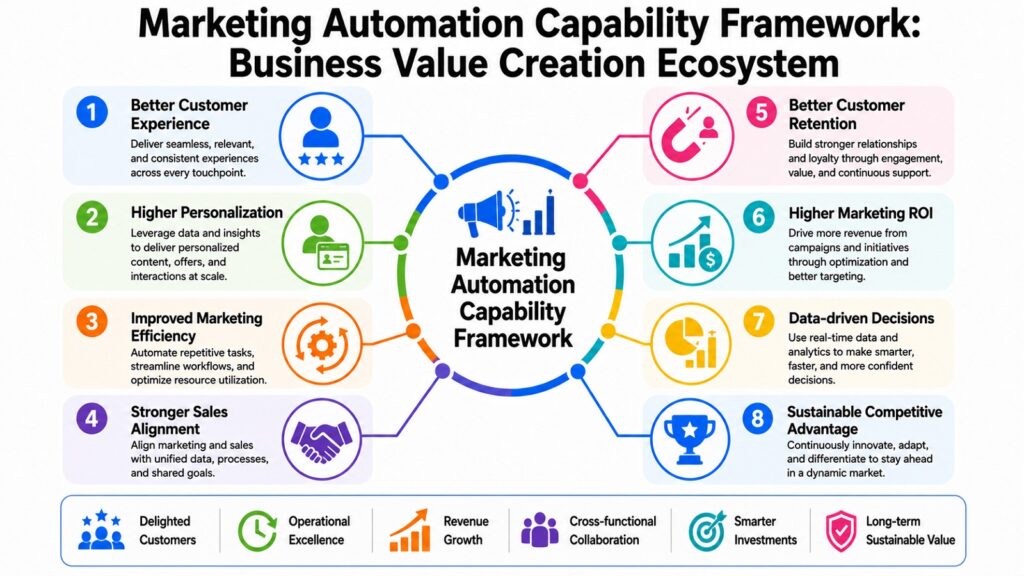
Marketing Automation has evolved well beyond campaign automation and software deployment. It has become a strategic organizational capability that shapes how businesses acquire, serve, and retain customers at scale. The organizations that succeed with it are not necessarily those with the most sophisticated platforms. They are the ones who build the capabilities to use those platforms intelligently, consistently, and with a clear sense of purpose.
The Marketing Automation Capability Framework synthesizes established knowledge in Marketing Automation, customer relationship management, journey design, data management, AI, and continuous improvement into a unified capability model. It is practical by design. Organizations of different sizes, industries, and automation maturity levels can apply it as a reference framework for planning, implementation, and ongoing development.
The eight capabilities do not function as independent initiatives. They form an interconnected system where each capability depends on the ones before it and enables the ones after it. Strategy Alignment provides direction. Customer Intelligence provides the data to act on that direction. Journey Architecture translates data and strategy into designed experiences. Workflow Orchestration executes those experiences. Personalized Engagement delivers value to individual customers. Sales and Service Integration extends that value across the organization. Intelligence and Optimization ensures the system improves over time. Continuous Learning ensures the organization itself keeps pace with change. Implemented together, these eight capabilities create a self-reinforcing cycle of business improvement.
Organizations that approach Marketing Automation as an integrated capability rather than a technology procurement exercise will build something that compounds in value over time. The framework is an invitation to think about Marketing Automation differently — not as a tool to deploy, but as a capability to develop.
Table 10: Marketing Automation Capability Framework — Summary and Key Takeaways
| Capability | Key Takeaway |
| Strategy Alignment | Begin with business objectives, not technology selection, to ensure automation delivers real value |
| Customer Intelligence | Unified, high-quality customer data is the non-negotiable foundation of effective automation |
| Journey Architecture | Design the customer experience first so that automation supports it rather than disrupts it |
| Workflow Orchestration | Scalable, well-documented automation workflows reduce errors and increase operational consistency |
| Personalized Engagement | Relevance at the individual level improves satisfaction, trust, and long-term customer loyalty |
| Sales & Service Integration | Connecting marketing automation with sales and service creates seamless customer experiences |
| Intelligence & Optimization | Continuous measurement and experimentation prevent automation from becoming a static system |
| Continuous Learning | Organizational adaptability ensures Marketing Automation capability grows with the business |