Table of Contents
Introduction — Human-Centered Organization: A Modern Business Essential
Businesses today commit enormous resources to technology, automation, artificial intelligence, and data analytics in search of speed and efficiency. These investments produce genuine returns, yet they have not reduced the fundamental dependence organizations have on people. Strategic decisions require human judgment. Innovations emerge from human creativity. Relationships with customers, partners, and employees depend on communication, empathy, and trust. This tension between technological efficiency and enduring human capability is precisely why Human-Centered Organization has become an important Business Essential rather than an optional management philosophy.
A Human-Centered Organization deliberately integrates human needs, capabilities, experiences, perspectives, and development into how it leads, decides, designs work, and builds culture. This definition separates the concept from organizations that simply offer perks or accommodate employee preferences at every turn. A Human-Centered Organization does not abandon accountability, performance expectations, or commercial discipline. Instead, it recognizes that sustainable performance depends on people who feel engaged, supported, psychologically safe, and capable of contributing their best.
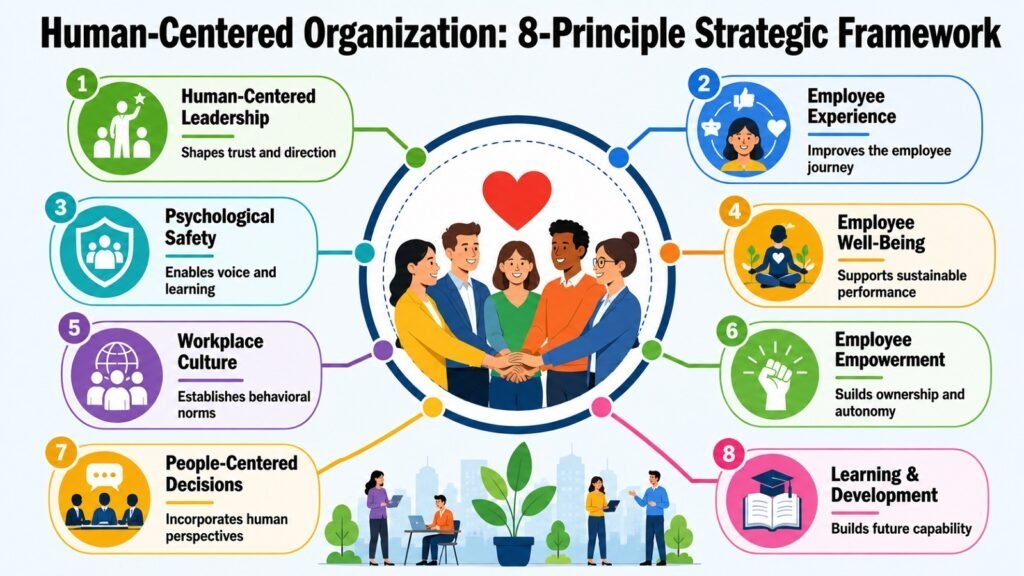
The idea is rooted in decades of research in organizational psychology, management, and workplace science. It stands alongside strategy, operations, finance, and technology as a crucial aspect of contemporary business. Organizations that regard their employees as secondary concerns tend to face higher turnover rates, lower engagement levels, reduced collaboration, and a lack of adaptability. Conversely, those that incorporate human factors into their fundamental practices are more likely to attract top talent, foster innovation, and maintain performance over time. This article explores eight interrelated principles of a Human-Centered Organization, with the table below providing a summary of each principle.
Table 1: Human-Centered Organization — Overview of the 8 Core Principles
| Principle | Organizational Role |
| Human-Centered Leadership | Shapes trust, culture, and engagement through leader behavior |
| Employee Experience | Influences engagement, retention, and commitment across the work journey |
| Psychological Safety | Enables learning, candor, and innovation by reducing interpersonal fear |
| Employee Well-Being | Supports sustainable performance by addressing physical and psychological needs |
| Workplace Culture | Determines whether human-centered values are practiced or merely stated |
| Employee Empowerment & Autonomy | Increases motivation, ownership, and responsiveness to local challenges |
| People-Centered Decision-Making | Integrates human perspectives and consequences into organizational choices |
| Learning, Growth & Development | Builds individual and organizational capability for ongoing adaptability |
1. Human-Centered Organization and Human-Centered Leadership
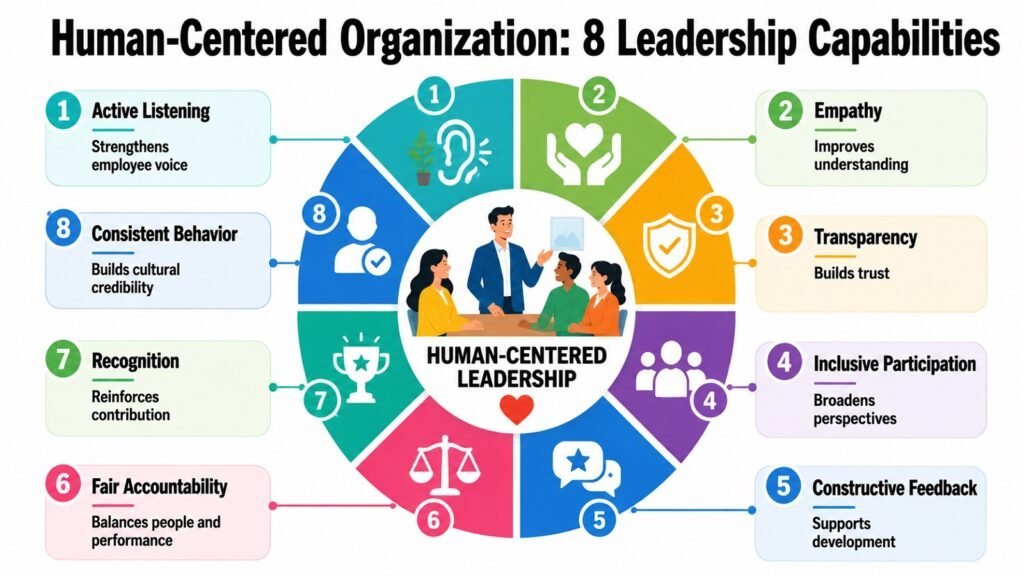
Leadership serves as the most immediate means by which a Human-Centered Organization can be established or dismantled. The actions leaders exhibit daily — including their communication style, responses to errors, management of disagreements, and treatment of their subordinates — establish the culture, trust, and psychological safety within the organization. Thus, Human-Centered Leadership is not merely a collection of desirable personality traits; it represents an organizational capability that influences outcomes through specific, teachable, and quantifiable behaviors.
Research by Zenger and Folkman, published across multiple studies on leadership effectiveness, consistently finds that leaders who demonstrate empathy, active listening, and genuine concern for employee development produce significantly higher levels of engagement and commitment. The mechanism matters here: empathetic leaders create conditions in which employees feel safe raising concerns, sharing ideas, and admitting errors. These conditions improve the quality of information flowing through an organization, reduce delays in surfacing problems, and increase the collective intelligence available for decision-making.
Human-Centered Business Leadership differs from hierarchical or command-and-control approaches in that it creates participation without eliminating authority. The distinction is important. Empathy does not mean agreement, and inclusion does not mean consensus. A human-centered leader can make firm decisions while still listening carefully to dissenting views. The challenge lies in balancing responsiveness with decisiveness — knowing when involving others improves a decision and when it introduces unnecessary delay. Leaders who include employees in minor operational decisions but exclude them from significant ones that directly affect their work tend to erode trust rather than build it.
Organizations can assess their leadership practices practically: Do employees feel comfortable raising problems with their managers? Are feedback conversations genuinely two-directional? Do leaders acknowledge uncertainty openly? These behaviors are observable and can be tracked through engagement surveys and behavioral observation. Human-centered leadership capacity grows through coaching, accountability frameworks, and promotion criteria that visibly reward leaders who demonstrate these behaviors — signaling clearly what the organization values in its people managers.
Table 2: Human-Centered Organization — Key Human-Centered Business Leadership Behaviors and Their Organizational Relevance
| Leadership Behavior | Organizational Relevance |
| Active listening | Improves information quality and signals respect for employee perspectives |
| Empathy in difficult conversations | Reduces defensive responses and encourages honest communication |
| Transparency about decisions | Builds trust and reduces harmful speculation during uncertainty |
| Constructive response to mistakes | Promotes learning and reduces error concealment |
| Inclusive participation | Increases engagement and draws on diverse knowledge |
| Consistent fairness | Strengthens trust and reduces perceptions of favoritism |
| Developmental feedback | Builds capability and signals investment in employee growth |
| Openness to dissent | Reduces groupthink and improves the quality of decisions |
2. Human-Centered Organization and Employee Experience
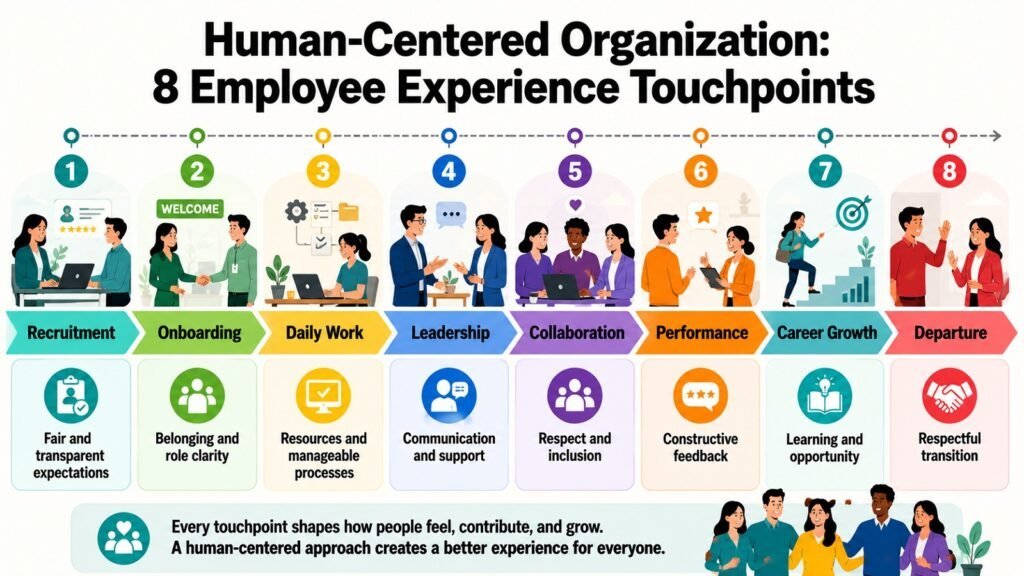
Employee experience describes the totality of perceptions and interactions an employee has throughout their time with an organization. It begins before formal joining — during recruitment and selection — and continues through onboarding, daily work, collaboration, performance conversations, learning opportunities, career development, and eventual departure. A Human-Centered Organization treats this entire journey as an integrated organizational responsibility rather than a series of disconnected HR processes.
Research by Jacob Morgan, drawing on data from hundreds of organizations, identifies three overlapping environments that shape employee experience: the physical workspace, the technological tools employees use to perform work, and the cultural environment created by leadership, relationships, and organizational practices. When these three environments are aligned and supportive, employees tend to report higher engagement, stronger commitment, and greater willingness to contribute discretionary effort. The practical implication is that improving employee experience requires examining systems and conditions — not simply adding benefits.
A common organizational error is to confuse employee experience with satisfaction programs. Providing a comfortable break room or flexible holidays contributes marginally to experience, but these amenities do not address the quality of daily work, the fairness of performance management, the responsiveness of technology, or the support available from managers. Employees form their perceptions of an organization through repeated interactions across all these dimensions. A single positive benefit rarely compensates for persistent friction in the actual work environment.
A practical improvement approach involves identifying the most consequential touchpoints in the employee journey, gathering structured feedback about where friction exists, and then working across functions to address it. This requires collaboration between Human Resources, IT, operations, and leadership — because the touchpoints that matter most are rarely owned by a single department. Organizations that assign employee experience entirely to HR miss its systemic nature and the cross-functional effort that meaningful improvement requires.
Table 3: Human-Centered Organization — Key Employee Experience Touchpoints and Associated Considerations
| Touchpoint | Human-Centered Consideration |
| Recruitment | Clear communication and respectful process signal organizational values early |
| Onboarding | Structured integration reduces early disorientation and builds initial commitment |
| Daily work environment | Access to tools, autonomy, and clarity determine daily engagement |
| Manager relationships | Quality of management interactions is the strongest driver of daily experience |
| Performance management | Fair, consistent processes build trust and support employee growth |
| Recognition | Timely acknowledgment of contribution reinforces motivation and belonging |
| Learning and career development | Visible growth pathways increase commitment and reduce voluntary attrition |
| Departure (offboarding) | Respectful exits preserve relationships and organizational reputation |
3. Human-Centered Organization and Psychological Safety
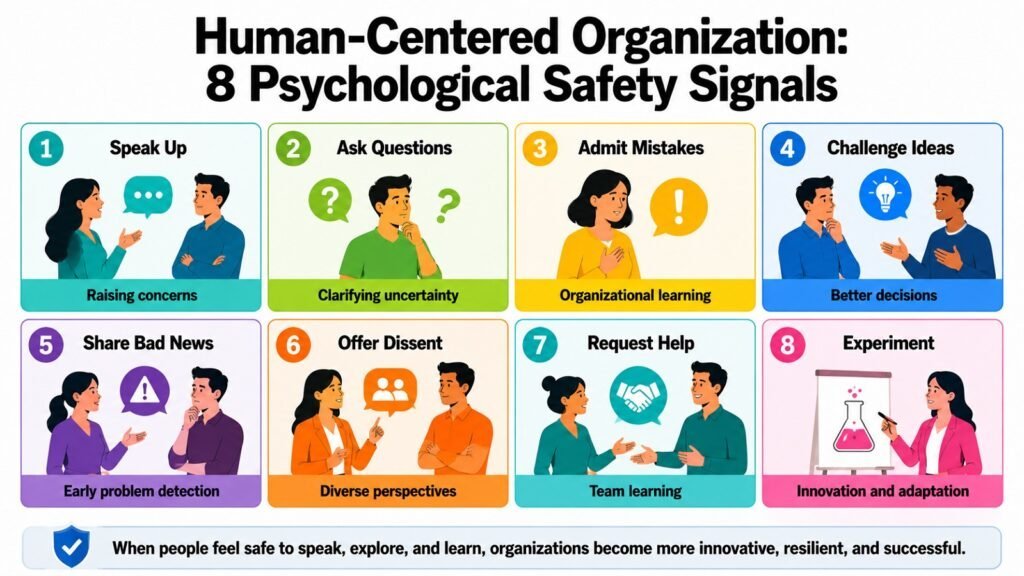
Psychological safety is the belief held by team or organizational members that they can speak up — raise concerns, admit mistakes, offer ideas, challenge assumptions, or disagree — without facing humiliation, rejection, or professional punishment. Amy Edmondson of Harvard Business School, who formalized the concept in organizational research, distinguishes psychological safety from trust, harmony, or the absence of conflict. Psychological safety is specifically about interpersonal risk: whether people believe it is safe to be honest in the presence of others who have power over them.
Edmondson’s research on medical teams, and subsequent studies across many industries, demonstrates that teams with higher psychological safety learn faster, share information more freely, identify errors earlier, and generate more creative solutions. The mechanism is direct: when people believe honesty carries interpersonal risk, they withhold information, conceal mistakes, and avoid raising concerns. Organizations pay for this silence through slower problem identification, lower-quality decisions, and reduced innovation. Psychological safety removes this significant tax on organizational intelligence.
A Human-Centered Organization must maintain a critical distinction: psychological safety does not eliminate accountability, standards, or consequences for misconduct. Edmondson describes the ideal as high accountability combined with high psychological safety — what she calls a learning zone. In this environment, people are expected to meet demanding standards and are also supported in raising concerns and learning from failure. Low accountability with high psychological safety produces complacency. High accountability without psychological safety produces anxiety and the concealment of problems.
Leaders build psychological safety through consistent, observable behaviors: responding to bad news with curiosity rather than blame, acknowledging their own uncertainty, inviting disagreement explicitly rather than merely tolerating it, and never publicly humiliating those who raise problems. A single highly visible punitive response to an honest mistake can erode months of carefully constructed psychological safety. Organizations assessing their own safety levels should examine how frequently concerns reach leadership before becoming crises and whether teams discuss failures openly or quietly move past them.
Table 4: Human-Centered Organization — Organizational Signals of Psychological Safety and What Each Indicates
| Organizational Signal | What It Indicates |
| Employees raise problems before they escalate | People trust that concerns will be received constructively |
| Mistakes are discussed openly in team settings | Learning is prioritized over self-protection |
| Dissenting views appear in meetings | People feel safe offering perspectives that differ from authority |
| Leaders acknowledge their own errors | Honesty is modeled at the top, reducing stigma of mistakes |
| Feedback flows upward, not only downward | Communication is genuinely bidirectional |
| New ideas are tested even when uncertain | Experimentation is supported rather than penalized |
| Bad news reaches leadership promptly | Messengers are not punished for honest reporting |
| Conflict is addressed rather than avoided | Interpersonal risk feels manageable and worth taking |
4. Human-Centered Organization and Employee Well-Being
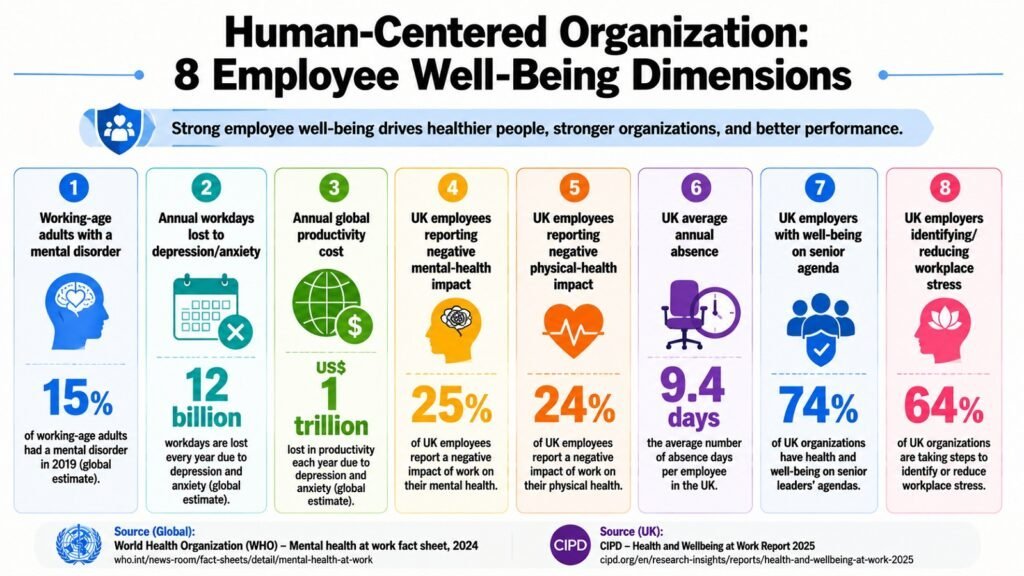
Employee well-being has attracted growing attention in management research and business practice, partly because the organizational costs of neglecting it have become difficult to ignore. Burnout, chronic stress, high absenteeism, and voluntary turnover all carry measurable financial consequences. A Human-Centered Organization treats employee well-being as a strategic responsibility — recognizing that sustainable organizational performance depends on employees who are physically capable, psychologically resilient, and able to sustain effective work over time.
Well-being in workplace settings is multidimensional. The World Health Organization defines health as a state of complete physical, mental, and social well-being — not merely the absence of illness. Applied organizationally, this means well-being encompasses physical working conditions, workload levels, management practices, psychological demands, social relationships, job security, a sense of purpose, and access to adequate recovery time. Organizations that focus on one dimension in isolation — offering mental health apps while maintaining chronically excessive workloads, for example — tend to produce limited results because they address symptoms rather than organizational conditions.
Research by the UK’s Health and Safety Executive identifies work demands, managerial control, supervisory support, role clarity, and interpersonal relationships as primary drivers of workplace stress and psychological harm. This framing is significant because it shifts responsibility from individual employees — typically the target of wellness programs — to organizational systems and management practices. A Human-Centered Organization responds to this evidence by examining whether its workload expectations, management behaviors, and organizational structures contribute to preventable stress.
Sustainable high performance is achievable when well-being is treated as a design challenge rather than a welfare program. Organizations build well-being into their operating model through workload monitoring, realistic goal-setting, managerial accountability for team health, and ensuring employees have access to meaningful support. Demanding performance goals and employee well-being are not inherently in conflict. The conflict emerges when organizations pursue performance through unsustainable pressure rather than through enabling the conditions in which sustained performance becomes possible.
Table 5: Human-Centered Organization — Workplace Well-Being Factors and Their Organizational Significance
| Well-Being Factor | Organizational Significance |
| Workload manageability | Excessive workload is among the most consistent predictors of burnout and attrition |
| Managerial support | Supportive management reduces stress and strengthens organizational resilience |
| Role clarity | Unclear expectations create unnecessary psychological strain |
| Autonomy and control | Having influence over one’s work reduces stress and increases motivation |
| Social connection at work | Positive relationships buffer against stress and increase team cohesion |
| Recovery time | Adequate rest prevents cognitive fatigue from accumulating over time |
| Psychological safety | Reduces the anxiety load associated with interpersonal threat at work |
| Access to development | Growth opportunities contribute to purpose, engagement, and career security |
5. Human-Centered Organization and Workplace Culture
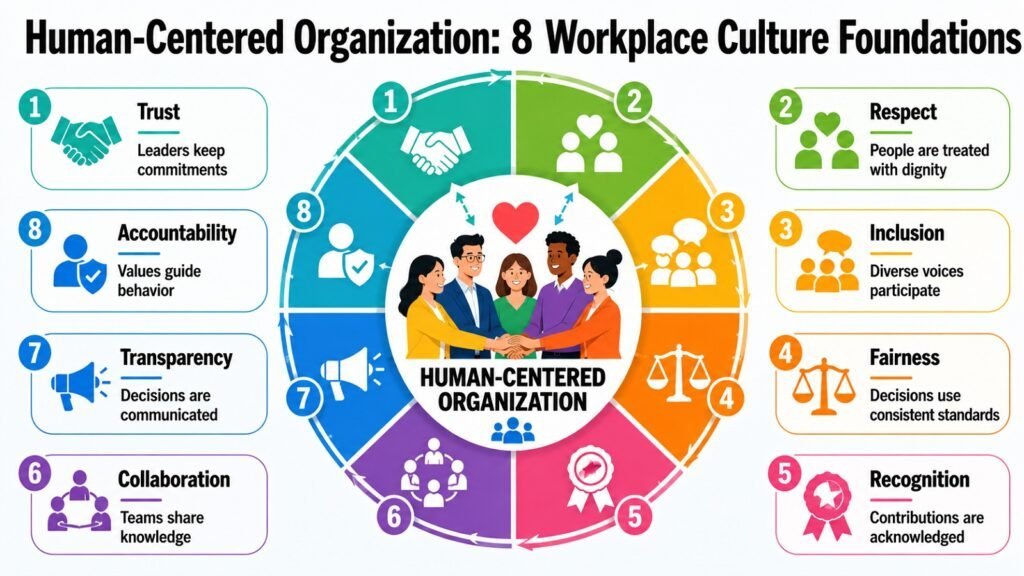
Workplace culture is the system of shared values, assumptions, norms, and behaviors that shapes how people act within an organization — particularly when no rule explicitly applies. Culture is not what an organization says it values; it is what patterns of behavior, decision-making, recognition, and promotion consistently demonstrate. A Human-Centered Organization must address culture as a behavioral reality rather than an aspirational declaration, because culture ultimately determines whether the other seven principles examined here become embedded practices or remain well-intentioned rhetoric.
Edgar Schein’s foundational work on organizational culture identifies three operating levels: visible artifacts and behaviors, espoused values and beliefs, and deep underlying assumptions that are rarely made explicit. The gap between espoused values and underlying assumptions is where organizations most frequently fail. A company may publicly champion inclusion but systematically exclude certain voices from decisions. It may state that it values learning but quietly penalize managers whose teams make visible errors. Closing this gap requires honest examination of actual organizational behavior — not periodic surveys measuring perceptions rather than conduct.
Gallup and related research bodies consistently identify manager behavior as the most powerful cultural force at the team level. Managers communicate cultural priorities through daily choices: whose contributions they acknowledge, whose concerns they take seriously, how they respond under pressure, and whether their private behavior aligns with their public statements. Culture change programs that focus on senior leadership messaging while ignoring middle management behavior tend to produce limited results, because culture is experienced primarily through direct management relationships.
Assessing cultural alignment with Human-Centered Organization principles requires more than employee surveys. Organizations should examine promotion criteria to identify what behaviors actually advance careers, analyze how decisions affecting employees are made and communicated, and observe how conflict and dissatisfaction are handled. Culture is most clearly revealed by how an organization responds when its stated values are expensive or inconvenient to uphold — when accountability, transparency, or inclusion requires real cost rather than comfortable commitment.
Table 6: Human-Centered Organization — Human-Centered Cultural Characteristics and Associated Behaviors
| Cultural Characteristic | Associated Organizational Behavior |
| Trust | Consistent transparency from leadership, even when news is difficult |
| Inclusion | Diverse voices are genuinely sought in decisions, not merely represented |
| Accountability | Standards apply fairly regardless of seniority or organizational standing |
| Collaboration | Cross-functional cooperation is rewarded alongside individual performance |
| Recognition | Contributions are acknowledged specifically and consistently |
| Transparency | Information is shared proactively rather than released under pressure |
| Psychological safety | Honest feedback and open disagreement are culturally acceptable |
| Shared purpose | Strategic objectives are communicated in ways that connect to human meaning |
6. Human-Centered Organization and Employee Empowerment & Autonomy
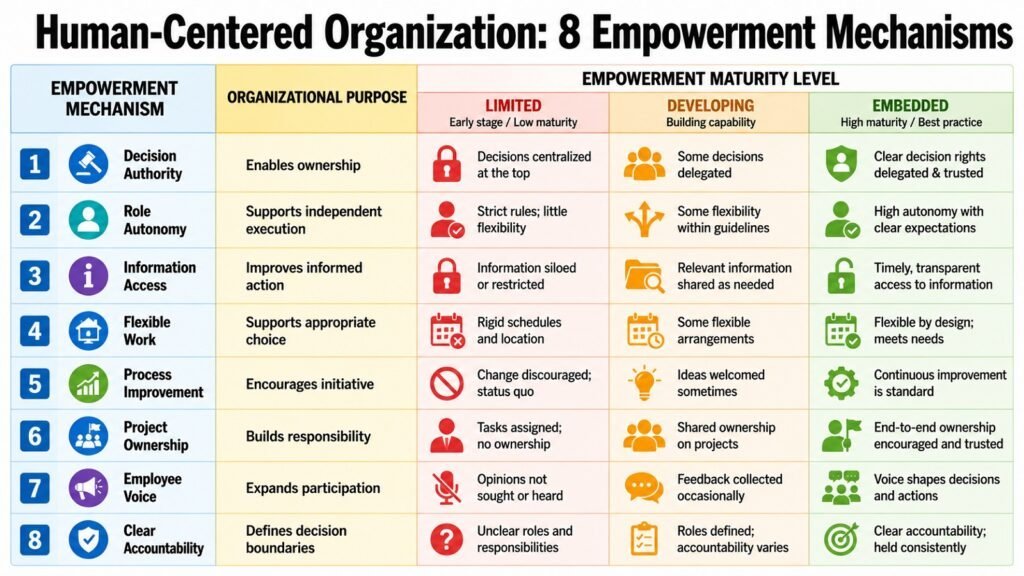
Empowerment in a Human-Centered Organization means giving people genuine authority, information, and resources to make meaningful decisions within their roles. It is distinct from the common organizational experience of employees being told they are empowered while remaining dependent on managerial approval for every consequential action. Genuine empowerment requires clear boundaries, appropriate decision-making authority, access to relevant information, adequate capability, and managerial support when needed. Without these conditions, delegation becomes responsibility without authority — which increases stress rather than motivation.
Self-determination theory, developed by Deci and Ryan, provides a robust theoretical basis for why autonomy matters. The theory identifies autonomy, competence, and relatedness as three universal psychological needs whose satisfaction is associated with intrinsic motivation, sustained effort, and well-being. When employees experience meaningful autonomy — the ability to influence how they work, not merely whether they show up — they tend to be more creative, more engaged in problem-solving, and more committed to outcomes. Autonomy is therefore not simply a perk but a condition that affects the quality of human contribution to organizational goals.
Appropriate autonomy varies significantly by role, capability, organizational risk, and context. High-stakes decisions involving legal, financial, or reputational consequences typically require tighter oversight than operational choices affecting a single team’s daily workflow. A Human-Centered Organization designs its decision architecture thoughtfully rather than applying a uniform empowerment approach. This means clearly defining which decisions employees own, which require consultation, and which require senior approval. Role clarity in this sense is itself an act of empowerment — it removes the ambiguity that prevents people from acting with confidence.
Practical challenges include inconsistent decision quality when employees lack relevant skills or contextual information, coordination failures when autonomous decisions conflict, and accountability diffusion when multiple people have partial ownership of outcomes. Organizations address these challenges by investing in the capability of those they empower, creating feedback mechanisms that surface poor decisions early, and maintaining clear accountability structures. Empowerment without accountability is not a human-centered design; it is an organizational risk that a well-designed system manages from the outset.
Table 7: Human-Centered Organization — Employee Empowerment Mechanisms and Their Organizational Purpose
| Empowerment Mechanism | Organizational Purpose |
| Delegated decision rights | Speeds operational response and increases local ownership |
| Role clarity and defined scope | Removes ambiguity that prevents confident independent action |
| Access to relevant information | Enables informed decisions without requiring managerial intervention |
| Employee participation in goal-setting | Increases commitment to outcomes and surfaces implementation barriers |
| Flexible work arrangements | Recognizes that people often know best how to structure effective work |
| Process improvement ownership | Engages front-line insight for operational problem-solving |
| Project and initiative ownership | Builds accountability and develops broader organizational capability |
| Feedback loops on decisions | Supports learning and prevents errors from compounding silently |
7. Human-Centered Organization and People-Centered Decision-Making
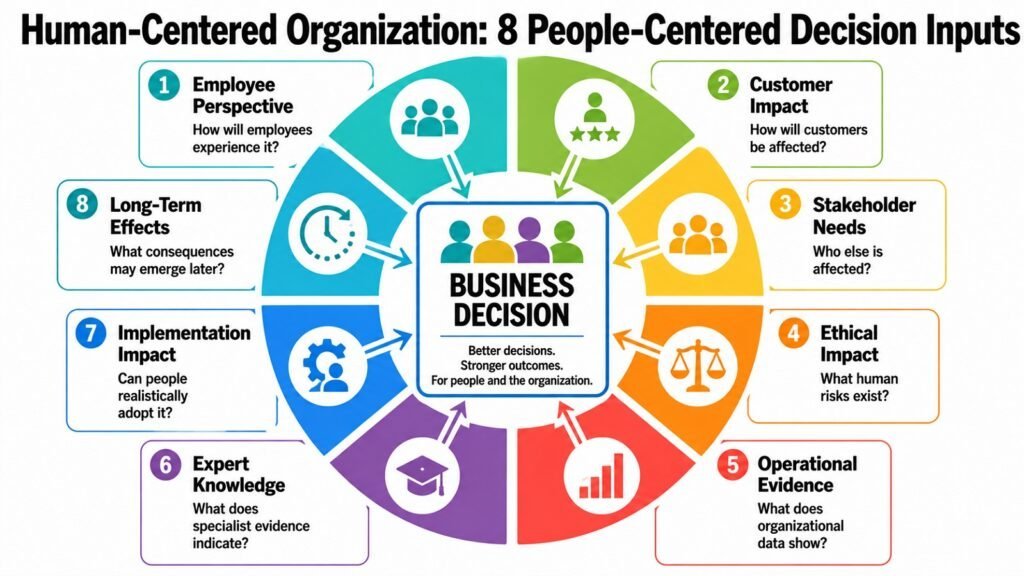
Organizational decisions — whether strategic, operational, technological, or structural — consistently produce human consequences. They affect workloads, roles, working conditions, career trajectories, and job security. A Human-Centered Organization does not treat these consequences as incidental. Instead, it deliberately incorporates human perspectives into how decisions are made: gathering employee input where relevant, considering stakeholder impact, examining ethical implications, and anticipating unintended effects on the people who will implement or be affected by the outcome.
People-centered decision-making is frequently misunderstood as a requirement for consensus or a mechanism for employees to override business requirements based on personal preference. Neither interpretation is accurate. The purpose is to ensure that human knowledge, experience, and concerns are available as inputs to better-informed decisions — not to give individuals veto power over organizational choices. Research in organizational behavior consistently shows that decisions developed with broader input tend to be better understood, more effectively implemented, and more trusted, even when the final decision does not match every individual’s preference.
Practical tools for incorporating human perspectives include structured employee surveys, cross-functional working groups, stakeholder consultations, listening sessions during major changes, and feedback channels that ensure concerns reach people with authority to act. Each carries trade-offs: broad participation takes time; anonymous surveys may lack specificity; focus groups may not represent full organizational diversity. Organizations benefit from selecting the right mechanism for the specific decision at hand rather than applying a single consultation approach universally.
Decisions involving significant workforce impacts — restructuring, technology implementation, major process changes — warrant the most deliberate human consideration. Not because employees should approve such decisions, but because their knowledge of operational realities, implementation barriers, and potential unintended consequences is often essential for effective execution. Organizations that announce major changes without drawing on this intelligence frequently encounter predictable implementation problems. People-centered decision-making is therefore a quality improvement practice as much as it is an expression of organizational values.
Table 8: Human-Centered Organization — Methods for Incorporating Human Perspectives in Decision-Making
| Decision-Making Method | Organizational Purpose |
| Employee surveys | Captures broad input on conditions, concerns, and priorities at scale |
| Cross-functional working groups | Integrates diverse operational knowledge into complex decisions |
| Listening sessions | Creates direct dialogue between leadership and affected employees |
| Stakeholder analysis | Maps human consequences before implementation rather than after |
| Participatory planning | Engages those who implement decisions in the planning process |
| Feedback channels | Ensures concerns are accessible to decision-makers in real time |
| Pilot testing with review | Surfaces implementation problems before full organizational rollout |
| Post-decision review | Identifies lessons from human consequences to improve future decisions |
8. Human-Centered Organization and Learning, Growth & Development
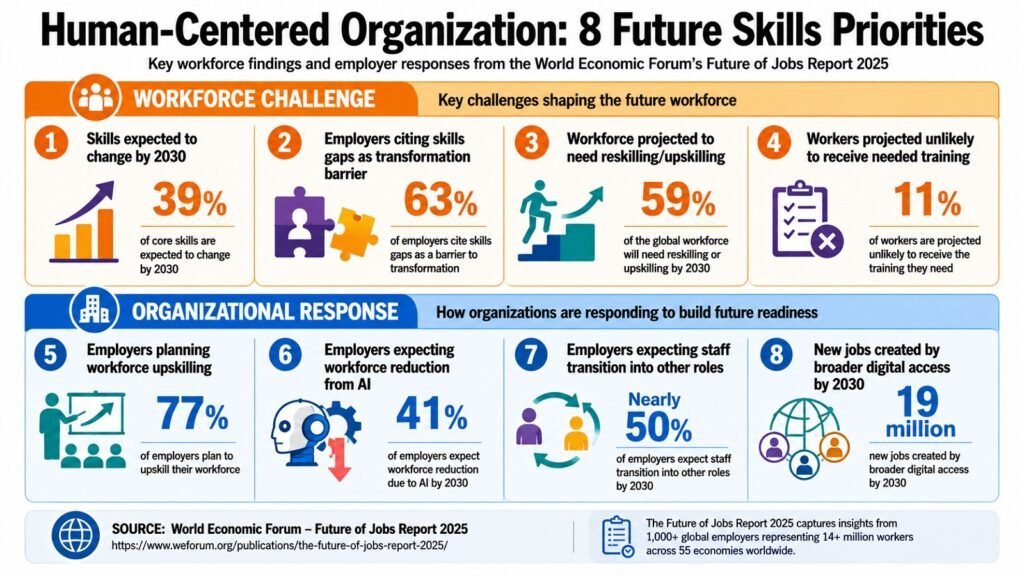
Learning, growth, and development represent the long-term capability-building dimension of a Human-Centered Organization. The ability of an organization to adapt to changing technology, evolving business models, shifting customer expectations, and new competitive conditions depends on whether its people can acquire new skills, apply them effectively, and share knowledge across organizational boundaries. Organizations that invest in employee development are not providing a benefit in isolation; they are building the adaptive capacity that determines resilience and long-term competitiveness.
The urgency of this investment has grown significantly. The World Economic Forum’s Future of Jobs research consistently identifies skills disruption as one of the most consequential organizational challenges of the coming decade, with automation, artificial intelligence, and changing business models expected to make portions of current skill profiles obsolete while creating demand for new capabilities. For a Human-Centered Organization, this creates a clear responsibility: connecting employee development to genuine business capability needs while respecting the personal growth aspirations of the people involved.
Development in a Human-Centered Organization extends beyond formal training. It includes mentoring through which tacit knowledge transfers across experience levels, coaching that builds managerial and professional effectiveness, internal mobility opportunities that allow employees to develop skills in new contexts, and knowledge-sharing practices that convert individual learning into organizational capability. The challenge for many organizations is that these practices are easily identified but inconsistently implemented — particularly when managers under time pressure deprioritize development conversations in favor of immediate operational demands.
Unequal access to development is one of the most significant equity concerns in organizational practice. Research consistently shows that development opportunities disproportionately benefit employees who are already visible, skilled, and operating near organizational power. A Human-Centered Organization addresses this actively by ensuring development investment reaches employees across roles, levels, and locations — not only those already performing strongly. This requires intentional resource allocation, managerial accountability for team development, and organizational systems that track whether learning investment is equitably distributed.
Table 9: Human-Centered Organization — Learning and Development Practices and the Organizational Capabilities They Support
| L&D Practice | Organizational Capability Supported |
| Reskilling and upskilling programs | Maintains workforce relevance as skill requirements evolve |
| Mentoring relationships | Transfers tacit knowledge and accelerates professional judgment |
| Coaching conversations | Builds managerial effectiveness and individual performance |
| Internal mobility | Broadens capability and reduces attrition among high-potential employees |
| Communities of practice | Enables cross-functional knowledge sharing and problem-solving |
| Learning cultures | Normalizes continuous improvement and reduces resistance to change |
| Career development planning | Aligns individual aspirations with organizational capability needs |
| Learning metrics and accountability | Ensures development investment translates into workplace performance |
Conclusion — Human-Centered Organization: Building Sustainable Business Success
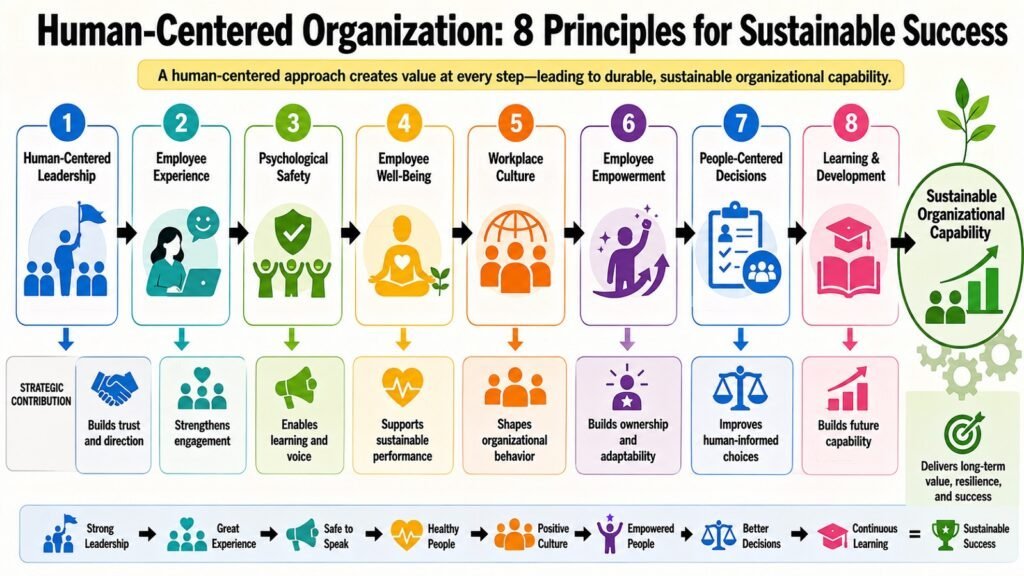
The eight principles examined in this article form an integrated system rather than a menu of independent initiatives. Leadership behavior creates the cultural conditions in which psychological safety either develops or fails to emerge. Culture determines whether employee experience is genuinely supportive or superficial. Well-being sustains the human capacity that makes high performance achievable over time. Empowerment increases the participation and ownership that make people-centered decision-making effective. Learning and development build the adaptive capability that enables organizations to navigate change without discarding the people they depend upon.
A Human-Centered Organization does not remove accountability, eliminate performance expectations, or treat employee preferences as the primary criterion for operational choices. It is an organization that recognizes a fundamental reality: human judgment, creativity, collaboration, and adaptability are irreplaceable sources of organizational value, and the conditions under which people work directly affect their ability to contribute these qualities. Technology and operational efficiency remain important — they work most effectively when supported by people who are engaged, capable, psychologically safe, and genuinely developed.
For organizations seeking a starting point, the eight principles provide a structured diagnostic framework. Assessing leadership practices, employee experience, psychological safety, well-being conditions, cultural alignment, empowerment architecture, decision-making processes, and development investment will reveal where the most consequential gaps exist. Addressing all eight simultaneously is neither realistic nor necessary. Prioritizing the principles where organizational performance is most clearly constrained — and establishing visible leadership accountability for measurable progress — is the more sustainable approach.
As technology continues reshaping what organizations can automate, Human-Centered Organization will matter more, not less. The tasks that remain distinctively human — building relationships, exercising contextual judgment, generating creative solutions, and leading other people effectively — will increasingly determine competitive differentiation. Human-Centered Organization is an important Business Essential precisely because it ensures that technology serves human purpose rather than displacing it.
Table 10: Human-Centered Organization — 8 Principles and Their Primary Organizational Outcomes
| Principle | Primary Organizational Outcome |
| Human-Centered Leadership | Builds the trust and psychological safety that culture depends upon |
| Employee Experience | Increases engagement, retention, and organizational commitment |
| Psychological Safety | Enables learning, innovation, and honest communication |
| Employee Well-Being | Sustains human capacity for high performance over time |
| Workplace Culture | Converts stated values into consistent organizational behavior |
| Employee Empowerment & Autonomy | Increases motivation, responsiveness, and front-line problem-solving |
| People-Centered Decision-Making | Improves decision quality and implementation through human input |
| Learning, Growth & Development | Builds the adaptive capability needed for long-term organizational resilience |