Table of Contents
Introduction: Why Business Model Is an Essential Foundation for Business Growth
What separates a business that thrives from one that merely survives? It is rarely the product. It is rarely the technology. And it is rarely the effort behind the operation. Most businesses that fail had something useful to offer. What they lacked was a clear and coherent way to turn that usefulness into sustained value. That is precisely why the Business Model deserves serious attention from anyone trying to build something that lasts.
Business Model is one of the most important elements of the business ecosystem. It is the fundamental logic that explains how an organization creates value, delivers it to the people who need it, and captures enough of that value to remain viable over time. It is not a marketing plan. It is not a product roadmap. It is the underlying structure that ties every major business decision together. When a Business Model is well designed, it gives the organization direction. When it is poorly constructed, no amount of effort can compensate for the structural weakness underneath.
Business Model and business strategy are related, but they are not the same thing. Strategy describes where a business wants to go and how it intends to compete. A business model describes the system through which a business actually operates. Strategy sets the direction. The Business Model provides the architecture. Without a sound Business Model, even the most ambitious strategy cannot generate consistent growth.
Every major decision a business makes, from pricing to partnerships to hiring, is shaped by its Business Model. A company that serves large enterprises operates differently from one that serves individual consumers. A subscription business thinks about retention in ways that a one-time transaction business does not. The Business Model determines how decisions are framed, what resources are prioritized, and how success is measured. It is the lens through which everything else comes into focus.
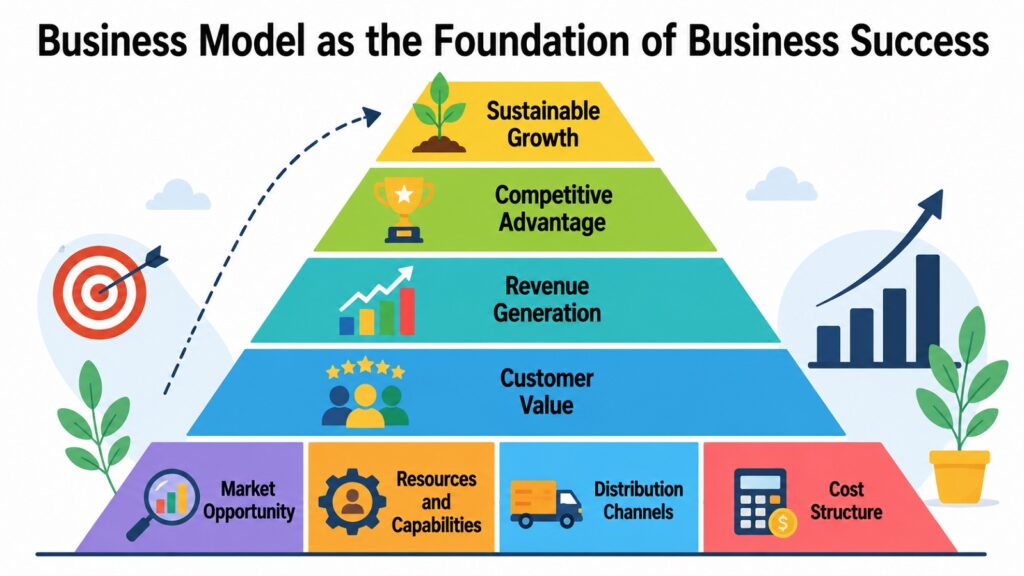
This article explores eight strategic elements that together determine the strength of a Business Model. Each element plays a distinct role, but none operates in isolation. Market opportunity, customer segments, revenue model, cost structure, distribution channels, key resources and capabilities, competitive advantage, and growth and scalability all function as interconnected parts of a larger system. Understanding each one helps build a more complete picture of what makes a Business Model genuinely strong.
Business Model: Eight Strategic Elements and Their Roles
| Strategic Element | Role in Business Model Success |
| Market Opportunity | Determines whether the Business Model has room to generate lasting value |
| Customer Segments | Defines who the Business Model serves and where value creation matters most |
| Revenue Model | Explains how the Business Model converts value into financial sustainability |
| Cost Structure | Shapes the efficiency and resilience of Business Model operations |
| Distribution Channels | Determines how the Business Model delivers value to real customers |
| Key Resources and Capabilities | Enables the Business Model to execute consistently and reliably |
| Competitive Advantage | Protects and strengthens the Business Model against market competition |
| Growth and Scalability | Determines the long-term expansion potential of the Business Model |
1. Business Model and Market Opportunity: Identifying Growth Potential
Is every growing market actually a good market to enter? The honest answer is no. A large market with intense competition, low margins, and dominant incumbents can be far more difficult to succeed in than a smaller market with genuine unmet needs and limited existing solutions. The Business Model does not operate in a vacuum. It operates within a specific opportunity, and the quality of that opportunity shapes everything that follows.
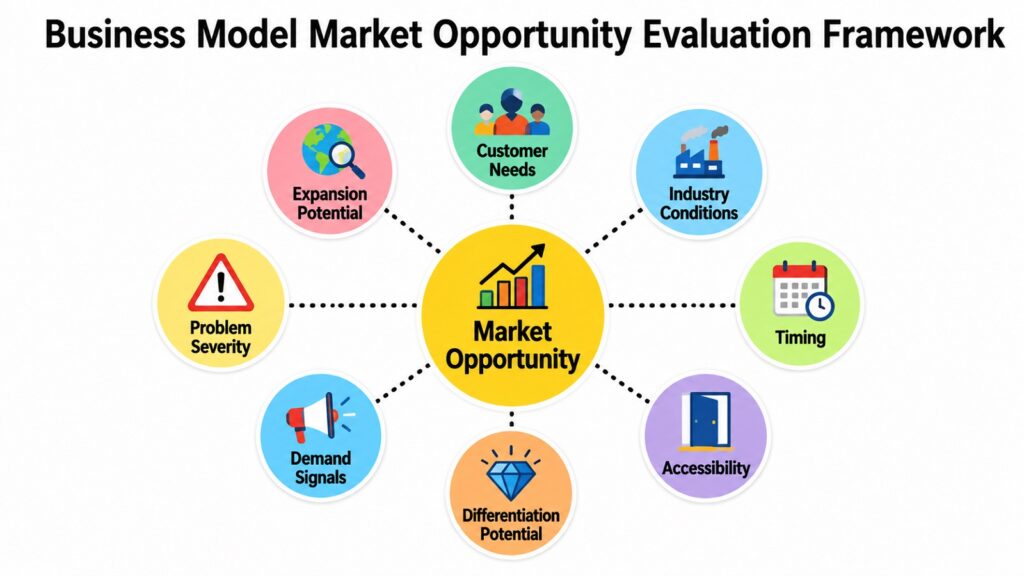
Market opportunity is the space in which a Business Model can realistically generate value. It is not simply about how big an industry is. It is about whether there is real demand, whether that demand is currently being served well, and whether the timing creates favorable conditions for entry and growth. A Business Model built around a genuine gap in the market starts with an inherent advantage. One built around a crowded space with marginal differentiation faces structural resistance from day one.
Demand matters, but so does its nature. Businesses often mistake volume for opportunity. A market with millions of transactions but thin margins and fierce price competition offers different prospects than one with fewer transactions but higher willingness to pay and lower sensitivity to price. The Business Model must match not just the size of an opportunity but its texture, including who the buyers are, how urgently they need what is being offered, and how much they value the difference between a good solution and a poor one.
Timing is a factor that businesses frequently underestimate. A Business Model that arrives too early struggles to find customers who understand what they are being offered. One that arrives too late finds itself competing for the scraps left behind by those who moved first. The best opportunities tend to sit at a point where demand is real but supply is still catching up, where technology or regulation or behavior has shifted in a way that opens space for a new approach to deliver genuine value.
The deliberateness of opportunity selection is what separates strong Business Models from fragile ones. Businesses that pursue opportunities reactively, simply because a market looks large or a trend looks popular, often build models that lack focus and depth. Businesses that evaluate opportunities carefully, looking at unmet needs, competitive dynamics, customer willingness to engage, and their own capacity to serve that opportunity effectively, tend to build models with more durable foundations.
Market Opportunity Indicators and Their Signals
| Opportunity Indicator | What It Signals for a Business Model |
| Unmet customer need | High demand exists that current solutions fail to address adequately |
| Low customer satisfaction with existing options | Structural opening for a better-positioned Business Model |
| Recent regulatory or technology shift | Window of favorable timing before incumbents adapt |
| Growing addressable market | Expanding room for revenue generation over time |
| Low competitive intensity in a niche | Space to build without immediate displacement pressure |
| High willingness to pay for improvement | Opportunity to build a value-focused rather than price-driven model |
| Fragmented supply with no dominant player | Consolidation potential that rewards a focused Business Model |
| Rising frequency of customer pain points | Signal that demand urgency is increasing in the opportunity space |
2. Business Model and Customer Segments: Defining Who Creates Growth
Why do businesses with genuinely useful products sometimes fail to gain any real traction in the market? The product was not the problem. The mismatch between the product and the customer was. A Business Model built around the right offering delivered to the wrong audience is unlikely to generate the kind of growth its creators imagined. Customer segments are not a marketing exercise. They are a foundational Business Model decision.
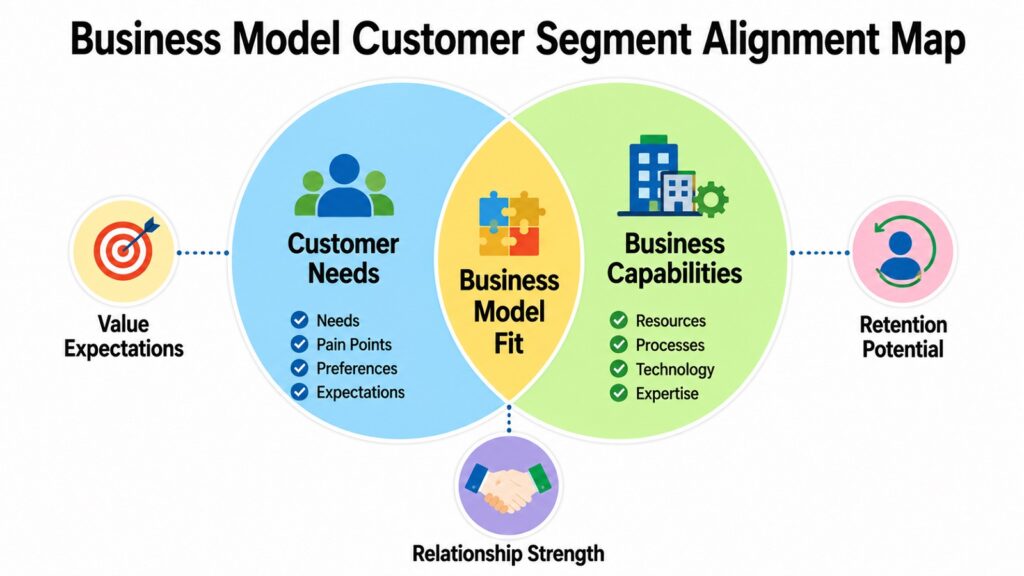
Customer segments define who the Business Model is actually designed to serve. This is more than identifying a broad demographic. It is about understanding which groups of people have specific problems the business can solve, which ones value the proposed solution enough to engage with it, and which ones are reachable and serviceable in ways that make commercial sense. Not every potential customer is a good fit. The Business Model becomes sharper when it focuses on the ones who are.
Segmentation logic matters because different customer groups behave differently, prioritize differently, and respond to value differently. A business that tries to serve everyone often ends up serving no one particularly well. When a Business Model is designed around a clearly defined customer group, it can optimize its offerings, its communication, its pricing, and its delivery to match what that group actually values. The result is stronger alignment between what the business does and what customers are willing to support.
Customer priorities are not static. They shift as markets mature, as alternatives emerge, and as the expectations of buyers evolve over time. The Business Model needs to account for this. Organizations that understand their customer segments deeply are better positioned to adapt when priorities change, to anticipate what customers will want before they articulate it clearly, and to identify when a segment is changing in ways that require a response from the business itself.
Customer understanding is best treated as an ongoing strategic process rather than a one-time exercise. Businesses that revisit their understanding of customer segments regularly, through direct feedback, behavioral data, and market observation, tend to build models that remain relevant longer. The Business Model becomes more resilient when the organization knows not just who it serves today, but how those customers are changing and what that means for the decisions ahead.
Customer Segment Characteristics and Their Implications
| Customer Segment Characteristic | Implication |
| High sensitivity to price | Revenue model must emphasize cost efficiency and volume over premium pricing |
| Strong preference for convenience | Distribution and delivery design becomes a primary competitive factor |
| Low brand loyalty | Retention mechanisms must be built into the Business Model structure |
| Complex or recurring problem to solve | Subscription or ongoing engagement models tend to create more durability |
| Professional buyer with formal evaluation process | Sales and credibility-building require dedicated Business Model investment |
| Highly networked peer community | Referral dynamics and community features can drive organic growth |
| Niche with specialized requirements | Customization and deep expertise become central to value delivery |
| Underserved by existing providers | Lower customer acquisition friction and higher openness to switching |
3. Business Model and Revenue Model: Building Sustainable Value Creation
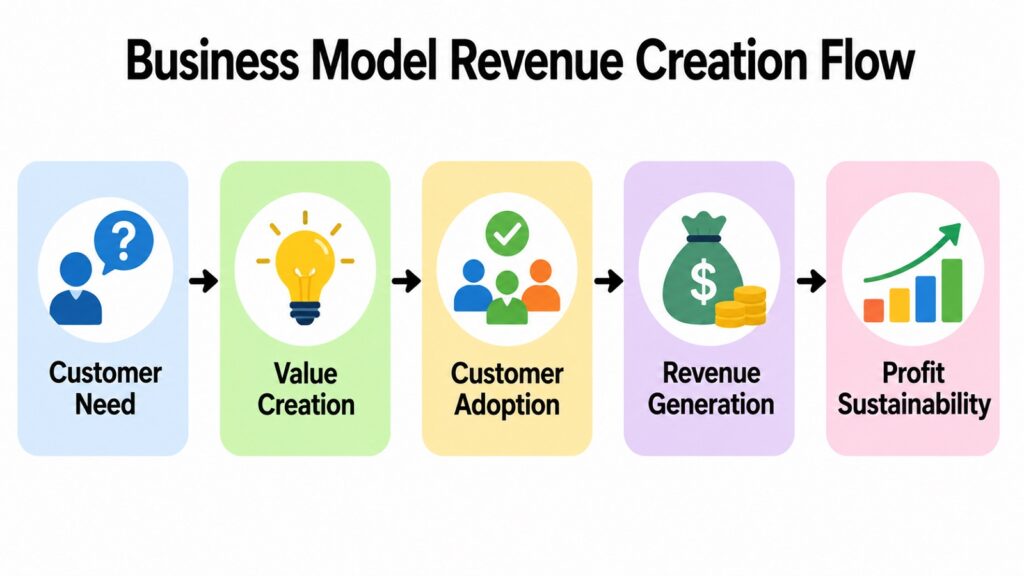
Why does business growth sometimes fail to produce profitability? The answer often lies not in the scale of activity but in the design of the revenue model. A business can grow in revenue and still deteriorate financially if the underlying revenue mechanisms are poorly structured. The Business Model does not just determine how value is created for customers. It also determines how that value translates into financial sustainability for the organization itself.
A revenue model is the specific mechanism through which a business converts the value it creates into financial returns. Pricing logic, payment timing, customer payment behavior, and monetization approach all fall within this domain. Some businesses charge a single price for a discrete product or service. Others charge recurring fees for ongoing access. Others earn revenue through usage, commissions, licensing, or advertising. Each mechanism creates a different financial profile and a different kind of relationship with the customer.
Recurring revenue tends to create more financial stability than transactional revenue because it reduces dependence on continuous new customer acquisition. A business that earns the same customer’s payment month after month or year after year has a more predictable foundation than one that must find a new buyer every time it wants to generate income. This is why subscription-based Business Models, when built on genuine ongoing value delivery, often demonstrate stronger financial resilience than pure transaction models over time.
Pricing logic is a critical but often underexamined part of the revenue model. Pricing communicates value, attracts certain customers, and repels others. A Business Model that underprices its offering may attract high volumes of customers but fail to generate the margins needed to reinvest in growth. One that overprices may generate strong margins on paper, but fail to acquire enough customers to reach sustainability. The goal is not the highest price or the lowest price, but the price that aligns most accurately with the value the customer recognizes.
Revenue quality matters more than revenue quantity in Business Model performance. A large and growing revenue number can obscure serious structural problems if the revenue is unpredictable, concentrated in a small number of customers, or dependent on discounts and incentives that erode margin over time. Strong Business Models generate revenue that is diverse, recurring, and structurally connected to the ongoing delivery of value. That kind of revenue does not just fund operations. It also enables investment in the next stage of development.
Revenue Approaches and Their Effects
| Revenue Approach | Business Model Effect |
| Subscription pricing | Creates predictable income and reduces reliance on constant new customer acquisition |
| Transactional pricing | Generates immediate cash flow but requires sustained high acquisition volume |
| Usage-based pricing | Aligns revenue with customer value received, scaling naturally with engagement |
| Freemium model | Drives adoption broadly but requires effective conversion of free users to paid customers |
| Licensing revenue | Generates income from intellectual assets without repeated service delivery |
| Commission-based revenue | Ties income to transaction facilitation, reducing risk but limiting upside control |
| Bundled pricing | Increases perceived value and makes competitive comparison more difficult |
| Premium tier pricing | Captures higher margins from high-value segments while maintaining broad market access |
4. Business Model and Cost Structure: Strengthening Operational Efficiency
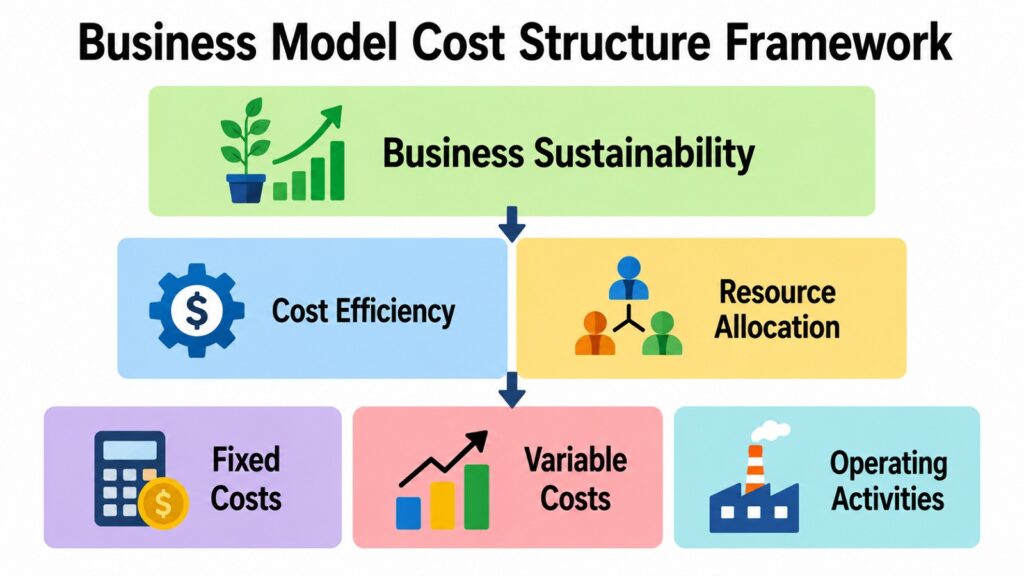
Growth without financial discipline can quietly undermine a Business Model long before the damage becomes visible. A business that expands rapidly without understanding and managing its cost structure often finds that the growth itself becomes a source of financial strain. Cost structure is not simply about spending less. It is about spending in ways that support value creation without eroding the viability of the model that makes that value possible.
Every Business Model carries a set of costs. Some of those costs are fixed, meaning they remain relatively constant regardless of how much output the business produces. Rent, core technology infrastructure, and foundational staffing costs fall into this category. Others are variable, rising and falling with the volume of activity. Raw materials, transaction fees, and delivery costs tend to move with output. Understanding the balance between fixed and variable costs shapes how the Business Model responds to changes in demand.
A Business Model that is heavily weighted toward fixed costs benefits greatly from scale. Once the fixed costs are covered, each additional unit of output generates higher margins. This is why software businesses, which carry high initial development costs but very low costs to deliver each additional copy, tend to show strong margin improvement as they grow. By contrast, a Business Model with predominantly variable costs scales more linearly, offering less margin leverage but also exposing the business to less risk when volume declines.
Resource allocation is where cost structure decisions become most consequential. Businesses must choose where to invest and where to remain lean. Investing in areas that directly strengthen value delivery, customer experience, or competitive positioning is typically well justified. Allowing costs to accumulate in areas that do not contribute meaningfully to those outcomes weakens the Business Model without providing a corresponding benefit. Cost discipline is not about austerity. It is about alignment between spending and value creation.
Scalability of the cost structure is a key determinant of Business Model resilience. A structure that requires costs to grow proportionally with revenue creates a ceiling on profitability. One that allows revenue to grow faster than costs creates the conditions for genuine operational leverage. Building that leverage requires deliberate decisions about which functions to develop internally, which to automate, and which to source through external partnerships that carry their own cost burdens.
Cost Considerations and Their Implications
| Cost Consideration | Business Model Implication |
| High fixed cost base | Requires sufficient volume to reach profitability; benefits significantly from scale |
| High variable cost base | Scales predictably but limits margin improvement as the business grows |
| Technology as a core cost | High upfront investment, but often enables lower cost per unit as scale increases |
| People-intensive delivery | Creates quality depth but constrains margin and scalability without process investment |
| Supplier concentration risk | Single-source dependencies can create cost volatility and supply chain fragility |
| Customer acquisition cost | High acquisition spending without strong retention weakens Business Model economics |
| Automation investment | Reduces variable cost over time and increases operational consistency at scale |
| Overhead growth rate | Overhead rising faster than revenue signals Business Model structural inefficiency |
5. Business Model and Distribution Channels: Delivering Value Effectively
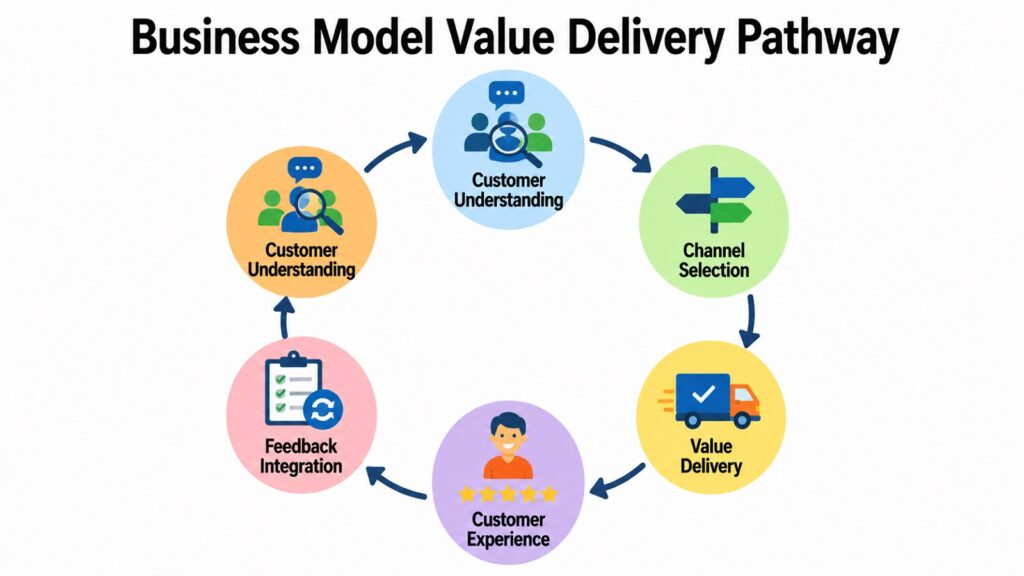
Why do some genuinely strong products fail to find customers? The offering itself was not the problem. The path between the business and the customer was broken. Distribution channels are the mechanisms through which a Business Model moves value from the organization to the people who need it. Without effective channels, even the most compelling value proposition stays theoretical. Channels are where the Business Model becomes real.
Distribution channels determine how customers discover, access, evaluate, purchase, and receive what a business offers. The choice of channel is not just a logistics decision. It reflects the nature of the customer, the type of value being delivered, and the business’s capacity to reach and serve its intended audience efficiently. Direct sales, digital platforms, retail partnerships, resellers, and self-service delivery models each create a different customer experience and a different cost structure within the Business Model.
Channel alignment refers to the extent to which the selected distribution method aligns with the purchasing behavior, expectations, and preferences of the customer segment targeted by the Business Model. For instance, a company offering intricate technical services via a self-service online platform may face challenges if its customers anticipate a consultative approach prior to making a purchase. Conversely, a business that depends on a specialized sales team to market low-margin consumer goods might discover that channel expenses hinder its capacity to stay competitive in terms of pricing. A disconnect between the channel and the customer diminishes both effectiveness and efficiency.
The relationship between channels and growth is direct. A Business Model that reaches customers efficiently, without excessive friction or cost, can acquire and retain customers at a pace that supports expansion. One that relies on channels that are expensive, slow, or poorly suited to its audience will find growth difficult to sustain, even when the underlying value proposition is sound. Channels are not just a delivery mechanism. They are a determinant of how fast and how profitably a Business Model can grow.
Channel decisions also influence the customer experience, shaping reputation and retention. Customers do not always separate the experience of purchasing and receiving from the value of what they received. A difficult buying process, a slow delivery, or a poor post-purchase interaction leaves an impression that affects whether customers return and whether they recommend the business to others. Strong Business Models treat channel design as a core element of value delivery, not an afterthought.
Distribution Approaches and Their Impact
| Distribution Approach | Business Model Impact |
| Direct online sales | Low channel cost, broad reach, but requires strong digital presence and self-service design |
| Dedicated sales team | High engagement and conversion potential, but significant cost per customer acquired |
| Retail partnership | Access to existing customer traffic, but reduces margin and limits brand control |
| Platform marketplace | Quick access to large audiences, but subject to platform fees and policy constraints |
| Reseller or distributor network | Geographic reach without proportional internal investment, but creates alignment challenges |
| Freemium digital access | Broad user base entry, but conversion from free to paid must be carefully designed |
| Community or referral channel | Low cost and high trust, but slow to build and difficult to control at pace |
| Subscription delivery model | Predictable recurring touchpoints, but requires consistent value renewal to sustain |
6. Business Model and Key Resources and Capabilities: Enabling Execution
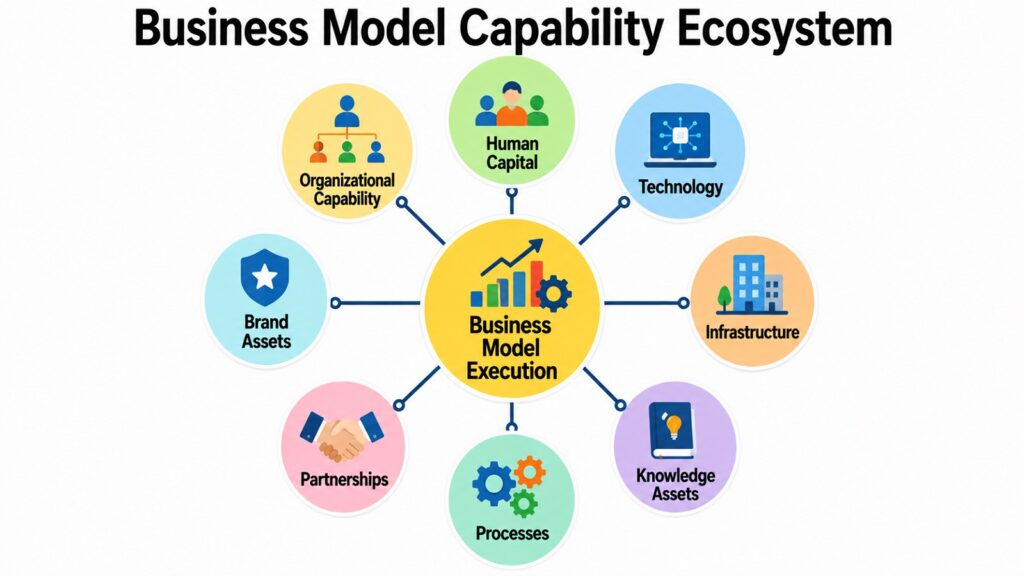
Why do good ideas so rarely translate into lasting business success on their own? The idea establishes direction. But the ability to execute on that idea, day after day, at the standard needed to create genuine value, requires something more tangible. Resources and capabilities are what allow a Business Model to move from intention to consistent delivery. Without them, the design of the model remains disconnected from its actual performance.
Resources are the assets a business draws upon to operate. These include financial capital, physical infrastructure, intellectual property, technology systems, and people. Capabilities are the things a business knows how to do with those assets. An organization might have access to excellent technology, but if it lacks the capability to apply that technology effectively, the resource provides limited competitive value. The Business Model is only as strong as the combination of what it has and what it can do with what it has.
Talent is among the most consequential resources in most Business Models. The people within an organization carry knowledge, judgment, relationships, and craft that cannot always be replicated by process or technology. A Business Model that depends on specialized expertise, whether in engineering, research, client service, or creative work, must invest in attracting, developing, and retaining the talent that carries that expertise. When that talent is strong and stable, execution becomes more consistent. When it is weak or unstable, delivery suffers.
Technology has become a fundamental resource across most modern Business Models, not only in explicitly digital businesses. Systems that manage customer relationships, coordinate operations, process transactions, and generate analytical insight are embedded in how most organizations function today. A Business Model that uses technology well tends to operate with greater efficiency, greater visibility into performance, and greater ability to adapt as conditions change. One that does not can find itself at a structural disadvantage regardless of how good its strategy sounds.
Capability alignment is where many Business Models quietly fail. An organization might have the right market opportunity, the right customer segment, and the right revenue approach, but if its internal capabilities do not match what execution actually requires, the gap creates a persistent drag on performance. Businesses that honestly assess what capabilities they have, what they still need, and how they will build or acquire what is missing tend to build more executable and more durable Business Models over time.
Resources and Capabilities and Their Contribution to Execution
| Resource or Capability | Contribution to Business Model Execution |
| Specialized technical talent | Enables consistent delivery of complex or high-quality products and services |
| Proprietary data assets | Informs better decisions and creates value that competitors cannot easily access |
| Strong brand reputation | Reduces customer acquisition friction and supports premium pricing potential |
| Scalable technology platform | Allows output to increase without proportional increases in operational cost |
| Institutional process knowledge | Maintains execution quality across team changes and organizational growth |
| Strategic partnerships | Extends capability reach without the cost of full internal development |
| Customer relationship depth | Generates retention and referral outcomes that lower long-term acquisition cost |
| Financial reserves and access to capital | Enables investment in growth and provides resilience during periods of disruption |
7. Business Model and Competitive Advantage: Creating Long-Term Differentiation
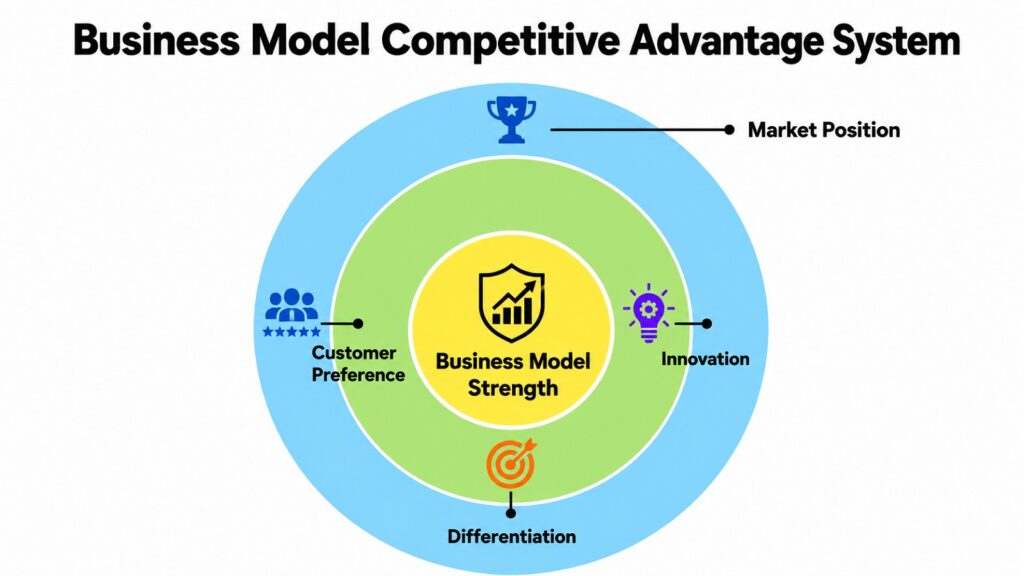
Why do some businesses remain difficult to compete with for years, even decades, while others find their position eroded almost as soon as they establish it? The answer lies in the nature of their competitive advantage. Any business can achieve a moment of success by being first, by offering something novel, or by executing well in a favorable environment. But sustaining that position over time requires something more structural. It requires a Business Model that builds and protects genuine differentiation.
Competitive advantage in the context of a Business Model is the set of factors that allow a business to deliver superior value consistently, in ways that are difficult for others to replicate quickly or cheaply. It is not simply about being better in a given moment. It is about possessing structural characteristics that make the business consistently more attractive to customers than the available alternatives. Those characteristics can take many forms, but they share a common quality: they are durable rather than temporary.
Differentiation is one of the most common sources of competitive advantage. A business that offers something meaningfully distinct from what competitors provide, whether through superior quality, unique design, distinctive experience, or a proprietary approach, creates a reason for customers to choose it rather than switch. The most valuable differentiation is not visible to customers alone. It is embedded in processes, knowledge, relationships, or technology that competitors cannot easily observe or copy without significant time and investment.
Switching costs create a different kind of competitive advantage. When customers have invested time, money, data, or operational integration into a particular business’s offering, the cost of moving to an alternative rises. This makes the relationship stickier and gives the Business Model a natural form of protection against competitive displacement. Enterprise software businesses, financial platforms, and healthcare data systems often benefit from this dynamic because their products become deeply embedded in how their customers operate.
Innovation contributes to competitive advantage when it consistently produces improvements that customers value and that competitors struggle to match. A business that improves its offering continuously, whether through product development, process refinement, or new applications of technology, makes it harder for others to catch up. The Business Model that embeds innovation as an ongoing capability rather than a one-time event tends to build more sustainable competitive positioning over the long term.
Competitive Factors and Their Outcomes
| Competitive Factor | Business Model Outcome |
| Proprietary product or process | Creates a performance gap competitors must close through significant investment |
| Network effects | Business Model value increases with user base, making displacement progressively harder |
| High switching costs for customers | Retention improves structurally as customer integration deepens over time |
| Brand strength and trust | Enables premium pricing and reduces the impact of competitive price pressure |
| Exclusive supplier or distribution relationships | Limits competitor access to the same inputs or channels used by the Business Model |
| Continuous innovation cadence | Keeps the Business Model ahead of imitation and sustains customer preference |
| Cost efficiency at scale | Allows the Business Model to outcompete on price without sacrificing margin health |
| Deep customer knowledge | Enables better product decisions and stronger retention than less informed competitors |
8. Business Model and Growth and Scalability: Expanding for Long-Term Success
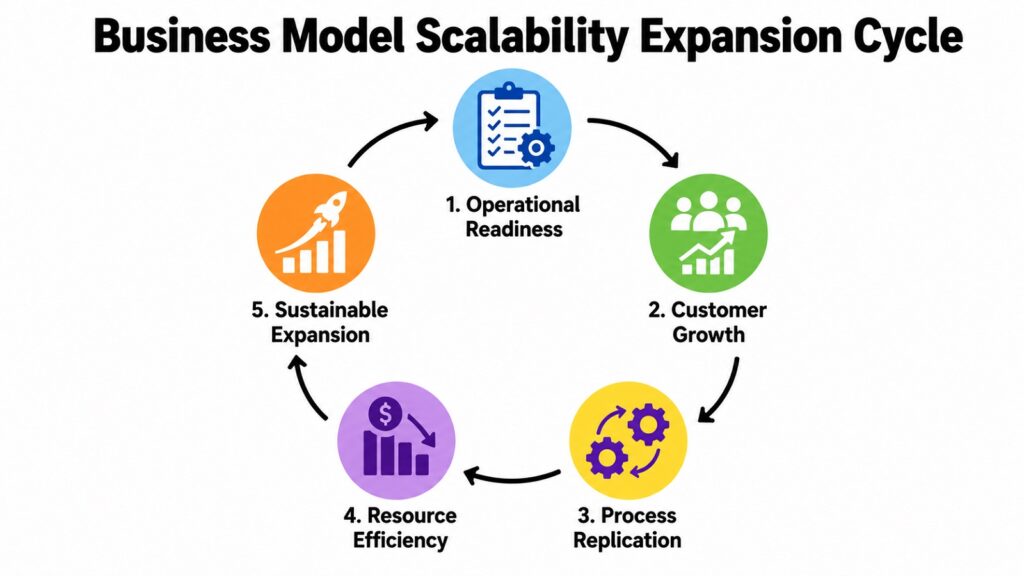
Why do some businesses grow efficiently and maintain the quality of what they offer while others find that expansion creates more problems than it solves? Growth itself is not the answer. How a Business Model is structured to handle growth is what determines whether expansion becomes a source of strength or a source of strain. Scalability is not an outcome that happens automatically. It is a property that must be deliberately built into the design of the Business Model from an early stage.
Scalability refers to the ability of a Business Model to increase its output, reach, or revenue without requiring proportional increases in cost, effort, or complexity. A scalable Business Model can serve more customers, enter new markets, or expand its product offering without breaking down structurally. A model that is not scalable can grow for a time, but that growth tends to create mounting inefficiency, declining service quality, and increasing cost per unit of output as the organization stretches beyond what its current design can support.
Repeatability is a core element of scalability. When a Business Model can deliver its value consistently, through standardized processes, clear service definitions, and well-documented approaches, it becomes possible to replicate that delivery in new contexts without rebuilding from scratch each time. This is how businesses expand into new geographies, customer segments, or product categories without losing the coherence of what they built in their original context. Repeatability is what makes growth transferable rather than fragile.
Operational readiness matters significantly when a Business Model begins to scale. An organization that has the systems, processes, team capacity, and technology infrastructure to absorb a significant increase in volume is in a fundamentally different position from one that is already operating near its limits. Growth that exceeds operational readiness tends to produce customer experience problems, staff burnout, and quality deterioration. These are not signs that growth was wrong. They are signs that the Business Model was not yet ready to handle it.
Sustainable growth is disciplined growth. It is not the fastest possible growth or the largest possible expansion, but the kind of growth that preserves the value creation that made the Business Model worth scaling in the first place. Businesses that grow sustainably tend to maintain their quality standards, their cultural coherence, and their financial discipline even as they expand. They treat scalability not as a destination reached at some future point but as a criterion applied to every design decision made along the way.
Scalability Indicators and Their Meaning
| Scalability Indicator | Business Model Meaning |
| Standardized delivery process | Value can be replicated across new contexts without rebuilding from the ground up |
| Technology infrastructure capacity | Systems can absorb increased volume without proportional investment in new infrastructure |
| Decreasing cost per customer at scale | Business Model generates operational leverage as output expands |
| Replicable customer acquisition process | Growth can be driven consistently without depending on exceptional individual effort |
| Strong unit economics at current scale | Financial foundation is sound enough to support continued expansion investment |
| Modular product or service design | Offerings can be extended or adapted for new segments without complete redesign |
| Low operational complexity per unit | Each additional customer or transaction adds minimal friction to the overall system |
| Cultural and process stability during growth | Organizational coherence is maintained as team size and scope increase |
Conclusion: How Business Model Connects the 8 Strategic Elements for Sustainable Growth
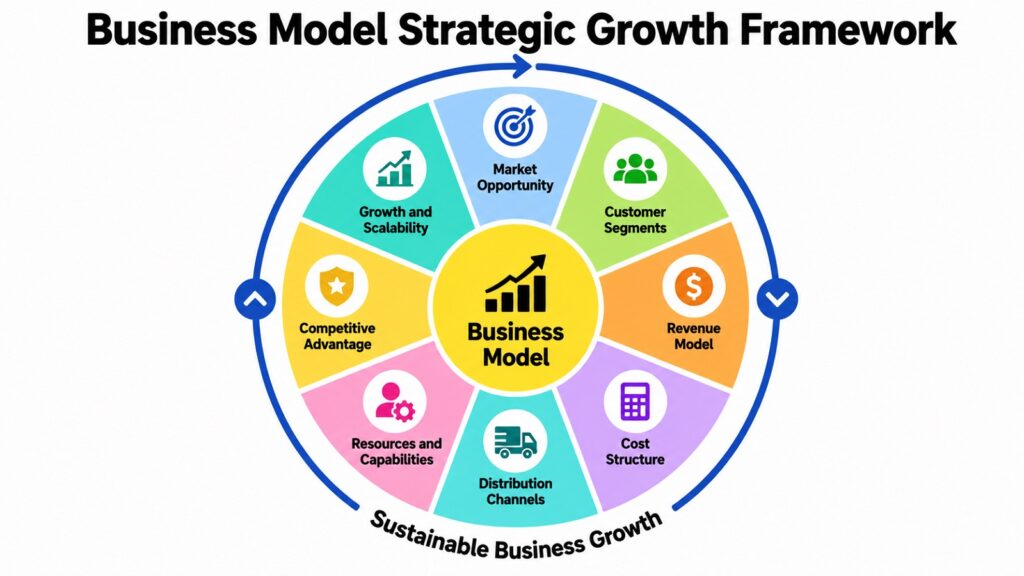
A Business Model is not a single decision. It is a system of decisions that work together to determine how an organization creates, delivers, and sustains value over time. Each of the eight strategic elements explored in this article contributes something distinct to that system. But the real strength of a Business Model comes not from any one element in isolation. It comes from the way these elements fit together, reinforce each other, and create an integrated architecture for sustained performance.
Market opportunity defines the space. Customer segments define who is being served within that space. The revenue model determines how value is converted into financial sustainability. Cost structure shapes how efficiently sustainability is achieved. Distribution channels determine how value reaches customers. Key resources and capabilities enable the execution of everything the model promises. Competitive advantage protects the model from displacement. Growth and scalability determine how far the model can travel without losing what made it strong.
None of these elements exists independently. A well-identified market opportunity means little without the capability to serve it. A strong revenue model built on the wrong customer segment will not generate the results it appears to promise. Distribution channels that are misaligned with customer expectations will fail regardless of what is being delivered through them. The Business Model works when it works as a whole, when every element is aligned, coherent, and mutually reinforcing.
Business Model remains one of the most important aspects of a business ecosystem precisely because of this integrating function. It is the lens through which all major business decisions are shaped and evaluated. Organizations that understand their Business Model deeply are better equipped to make those decisions with clarity and purpose. Those who treat the Business Model as a background assumption rather than an active strategic tool tend to find themselves reacting to problems that better design might have prevented.
This framework is worth revisiting whenever a significant business decision is on the table. Whether the organization is considering a new market, a new customer segment, a pricing change, a distribution partnership, or a growth investment, the Business Model provides the structure for evaluating that decision in context. The goal is not to design a perfect model once and then preserve it unchanged. The goal is to design a coherent model and then improve it deliberately, with a clear understanding of how each element connects to the whole.
Business Model: Key Outcomes and Their Business Impact
| Business Model Outcome | Business Impact |
| Clear market opportunity focus | Reduces resource waste and increases the probability of meaningful traction |
| Well-defined customer segments | Enables sharper decision-making and stronger alignment between offering and demand |
| Sustainable revenue design | Builds financial resilience and reduces dependence on continuous new acquisition |
| Efficient cost structure | Creates operational leverage that supports profitability at increasing scale |
| Effective distribution channels | Ensures value reaches the right customers in the right way at manageable cost |
| Strong resources and capabilities | Enables consistent execution and reduces performance variability over time |
| Durable competitive advantage | Protects the Business Model from rapid displacement and supports long-term positioning |
| Scalable growth architecture | Allows the Business Model to expand without losing the qualities that created its value |