Table of Contents
Introduction: Customer Personalization as an Important Aspect of Customer Experience
Customer experience has always been shaped by how well businesses understand the people they serve. Yet for most of commercial history, that understanding was applied in broad strokes — customers were grouped into segments and addressed through uniform messages designed to appeal to an average that rarely reflected any individual.
Customer Personalization changes that equation. It is the practice of tailoring experiences, content, communications, and interactions to the specific needs, preferences, and circumstances of individual customers rather than treating everyone as a member of an undifferentiated group. Its foundations begin with customer value, relevance, accuracy, timing, context, transparency, control, and trust. These principles determine whether personalization becomes genuinely useful or merely creates the appearance of individualized treatment. As businesses gained access to richer behavioral data and more capable technologies, these foundations became increasingly important for creating experiences that respond to what customers actually need.
Customer expectations have shifted alongside this evolution. Research consistently shows that customers are more likely to engage with, return to, and recommend businesses that demonstrate genuine understanding of their needs. Businesses that personalize effectively can strengthen engagement, satisfaction, and customer value. Those that personalize poorly — inaccurately, intrusively, or irrelevantly — risk damaging the very relationships they aim to strengthen.
The central argument of this article is that effective Customer Personalization is not simply about collecting more purchasing information or showing different content to different people. It is about using customer understanding responsibly to create experiences that are genuinely relevant, useful, timely, and trustworthy — starting with the customer’s needs rather than organizational convenience. This article examines the experience design, personalization data, strategies, experiences, technologies, context, privacy considerations, and measurement practices that together form a practical framework for building and improving personalization as a serious Customer Experience capability.
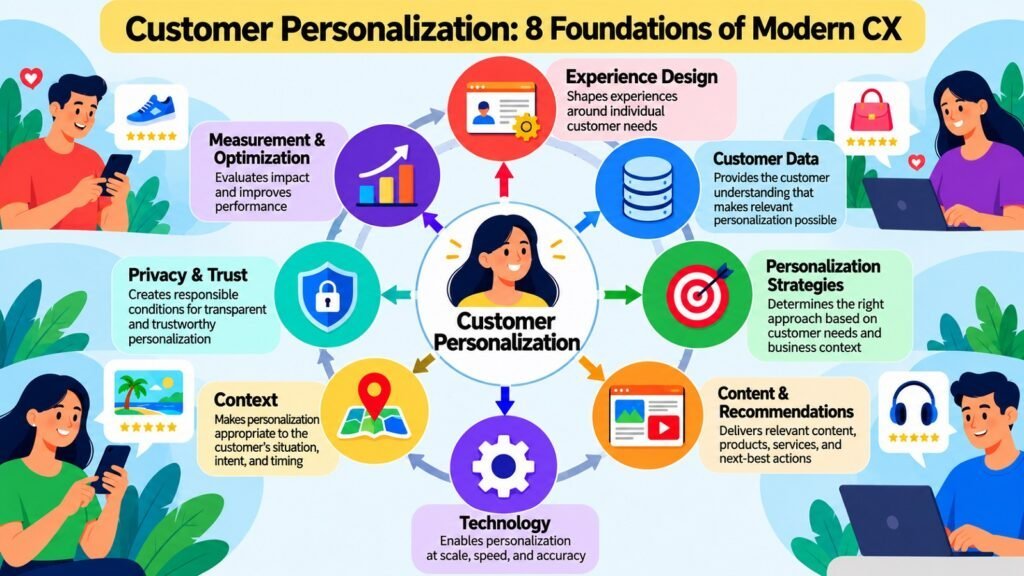
Table 1: Customer Personalization — Eight Foundations at a Glance
| Customer Personalization Foundations | Role in Customer Personalization |
| Experience Design | Shapes personalized experiences around customer needs and value |
| Customer Data | Provides the customer understanding that makes relevant personalization possible |
| Personalization Strategies | Determines the right approach based on customer needs and business context |
| Content and Recommendations | Delivers the personalized value that customers actually experience |
| Technology | Enables personalization at scale, speed, and accuracy |
| Context | Ensures relevance is situationally appropriate and timely |
| Privacy and Trust | Creates the responsible conditions under which customers accept personalization |
| Measurement and Optimization | Determines whether personalization is genuinely improving outcomes |
1. Customer Personalization Experience Design: Designing Relevant Experiences
Customer Personalization Experience Design begins with a simple question: what should change in the experience because a business understands this customer better? The answer should not be “everything.” Effective design identifies moments at important customer interaction points where individual relevance can create meaningful value and determines what should remain consistent for everyone. This makes personalization a design discipline, not simply a targeting technique.
A strong experience design starts with the customer need, desired outcome, and potential friction. Businesses can then decide whether personalization should alter content, recommendations, offers, services, interfaces, or interactions. The degree of personalization also matters. Some situations benefit from subtle relevance, while others justify deeper adaptation. The objective is not maximum variation but appropriate variation that makes the experience easier, more useful, or more meaningful.
Customer Personalization should also preserve simplicity. An experience can become confusing when too many elements change according to individual profiles. Good design therefore balances relevance with consistency, familiarity, transparency, and customer control. This is especially important when personalization influences decisions rather than merely presentation.
A useful design principle is to evaluate every personalization opportunity through three questions: Does it solve a genuine customer problem? Does the customer benefit from the difference? Can the business deliver that difference reliably and responsibly? If any answer is unclear, personalization may add complexity without adding value.
Research on personalized customer experiences indicates that outcomes depend on how personalization is designed, the characteristics of the touchpoint, and the customer’s circumstances. Therefore, businesses should test personalization as part of the experience rather than treating it as an isolated feature.
The strongest designs make personalization feel helpful rather than conspicuous. They use individual understanding to reduce effort, improve discovery, anticipate legitimate needs, and create more relevant interactions while preserving trust and choice.
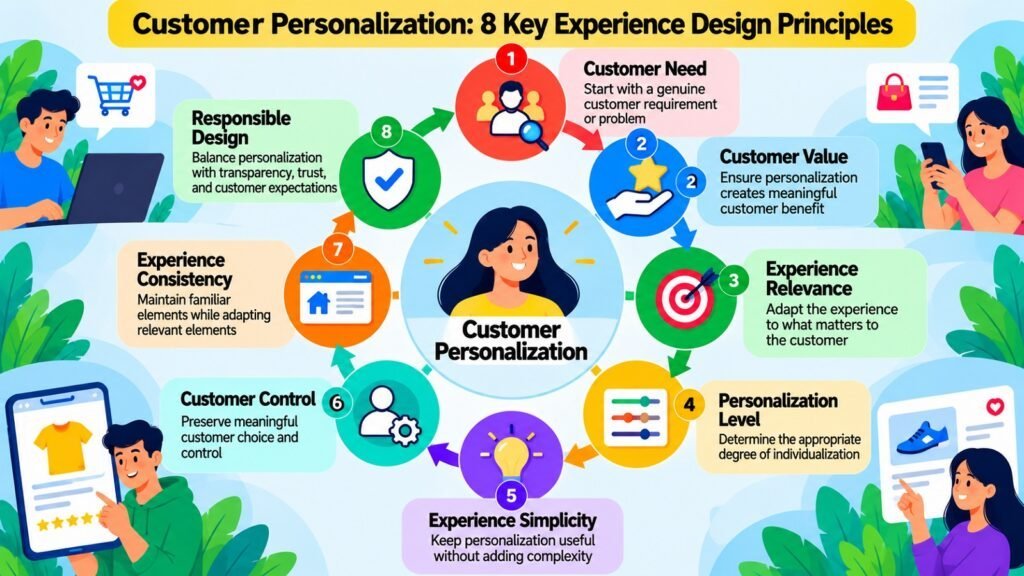
Table 2: Customer Personalization Experience Design: 8 Key Design Considerations
| Design Consideration | Role in Customer Personalization Experience Design |
|---|---|
| Customer Need | Anchors personalization around a genuine customer requirement |
| Customer Value | Ensures personalization creates meaningful benefit for the customer |
| Experience Relevance | Makes the experience appropriate to the customer’s needs and preferences |
| Degree of Personalization | Determines how much the experience should adapt to the individual |
| Experience Simplicity | Prevents personalization from adding unnecessary complexity |
| Customer Control | Gives customers appropriate choices over personalized experiences |
| Consistency | Preserves familiar and essential elements across the experience |
| Responsible Design | Balances personalization benefits with transparency, trust, and customer expectations |
2. Customer Personalization Data: Turning Customer Knowledge into Relevance
Customer information is the raw material of personalization, but information alone does not create relevant experiences. What matters is whether that information is accurate, current, sufficiently complete, and connected to a clear purpose. Businesses that collect large amounts of customer data without understanding how it enables better experiences tend to build complicated data ecosystems without meaningful personalization outcomes.
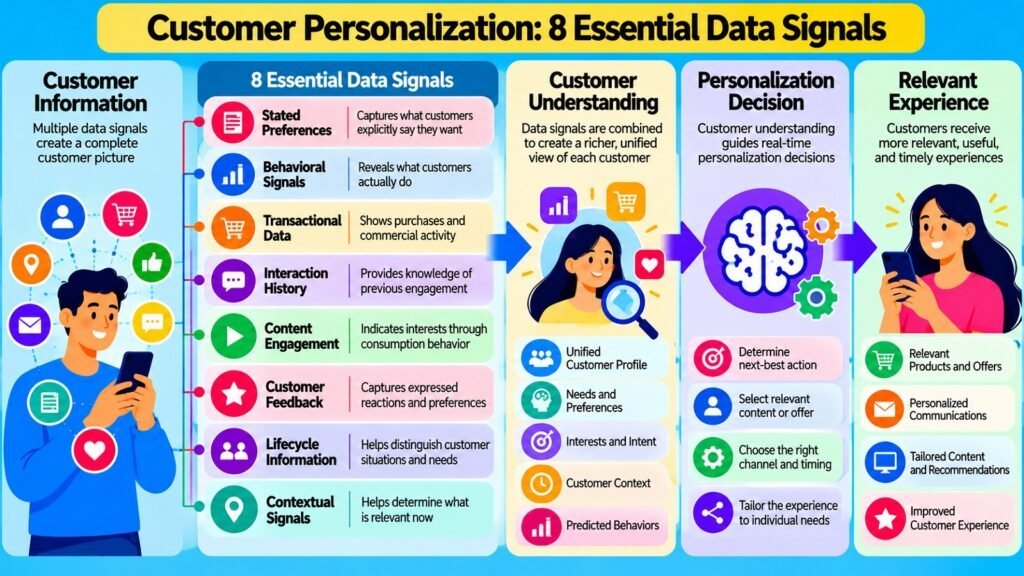
The most valuable categories of customer information share a common characteristic: they reveal something useful about what a customer needs in a way the business can act on. Stated preferences are highly reliable because they reflect the customer’s own expressed needs. Behavioral signals — clicks, searches, and browsing patterns — reveal intent even when no explicit preference has been stated. Transactional information captures what customers have bought and at what frequency, which is useful for predicting future needs. Interaction history, including service contacts, adds important context about pain points and relationship dynamics.
The key distinction is between knowing something about a customer and using that knowledge to create meaningful relevance. A business may know a customer bought a winter coat two years ago, but recommending winter coats indefinitely is recycling, not personalizing. Relevance requires connecting what is known to what is useful now — which demands that information be kept current, properly interpreted, and applied with judgment.
Common weaknesses undermine data-driven personalization: outdated profiles produce recommendations for already-met needs; incomplete data leads to partially accurate inferences; conflicting signals produce confusing experiences; poor data quality causes personalization that clearly misses the mark; and excessive data collection introduces privacy risk without improving relevance. A practical assessment asks whether a given type of information is relevant to a genuine customer need, of sufficient quality, current enough to reflect the customer’s situation, and aligned with reasonable customer expectations about data use.
Table 3: Customer Personalization — Eight Categories of Customer Information
| Information Category | Role in Customer Personalization |
| Stated Preferences | Customer-provided data reflecting explicit needs, interests, or choices |
| Behavioral Signals | Browsing, search, and click patterns that reveal real-time intent |
| Transactional History | Purchase records that indicate category affinity and buying cadence |
| Interaction History | Service contacts and support patterns revealing pain points and needs |
| Content Engagement | Topics, formats, and channels a customer actively consumes |
| Lifecycle Stage | Customer relationship stage that indicates appropriate experience depth |
| Contextual Signals | Session context, device, and timing that shape immediate relevance |
| Feedback and Ratings | Explicit reactions that validate or correct personalization assumptions |
3. Customer Personalization Strategies: Choosing the Right Approach
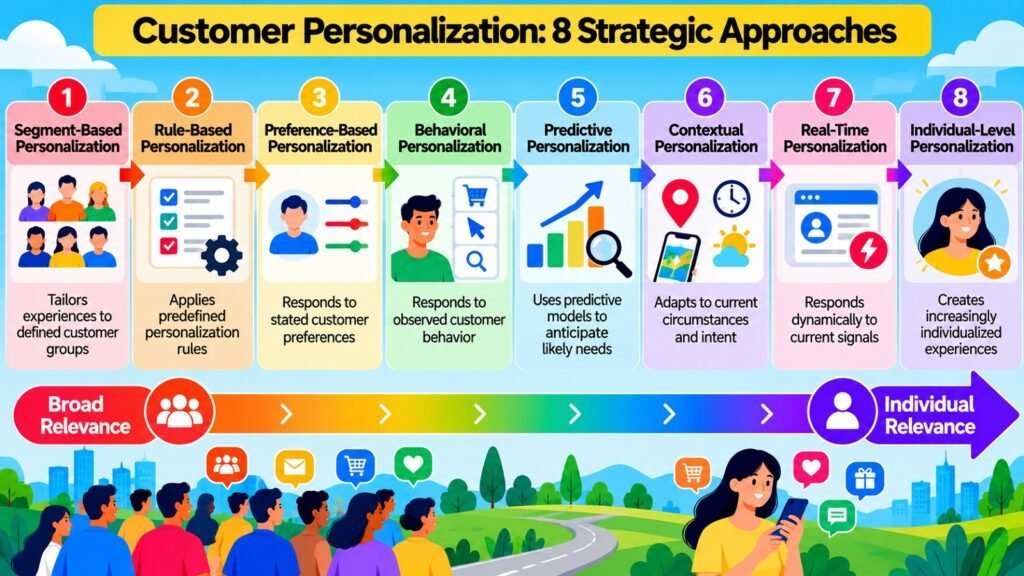
Customer Personalization encompasses a range of strategic approaches, each with a distinctive logic, different requirements, and appropriate applications. Choosing the right one requires clarity about the customer need being addressed, the quality of available signals, and the business value at stake.
Segment-based personalization applies different treatments to defined customer groups based on shared characteristics. It remains valuable when individual data is sparse or the business is not yet ready for more sophisticated methods. Rule-based personalization extends this by defining explicit conditions — if a customer has not purchased in 90 days, trigger a re-engagement message, for example. Rules are transparent and controllable but become difficult to manage as complexity grows. Preference-based personalization uses information customers have directly provided; it is accurate where profiles are current, but depends on customers actively maintaining them. Behavioral personalization infers preferences from observable actions, which makes it scalable but susceptible to misinterpretation.
Predictive personalization uses statistical models to anticipate what a customer is likely to need next. It can generate impressive results with sufficient data but requires careful validation to avoid confidently wrong predictions. Contextual personalization adjusts experiences based on current circumstances — device, time of day, session behavior, or purchase stage — rather than historical patterns. Real-time personalization adapts experiences dynamically within the current session. Individual-level personalization creates highly tailored experiences for each customer, delivering the greatest potential relevance but requiring the most sophisticated data and technology infrastructure.
More sophisticated personalization is not automatically better. A well-executed segment-based strategy will often outperform advanced algorithms applied to poor-quality data. The right starting point is always a clearly defined customer problem, not a technology capability. Personalization maturity is a progression — capability should grow as data quality, organizational understanding, and measurement practices develop together.
Table 4: Customer Personalization — Eight Strategic Approaches
| Approach | Logic and Best Application |
| Segment-Based | Groups customers by shared traits; effective when individual data is limited |
| Rule-Based | Applies explicit if-then conditions; controllable but complex at scale |
| Preference-Based | Uses stated customer preferences; accurate where profiles are current |
| Behavioral | Infers preferences from observed actions; scalable but needs interpretation |
| Predictive | Anticipates future needs using statistical models; powerful but requires data quality |
| Contextual | Responds to current circumstances; improves timeliness and situational fit |
| Real-Time | Adapts dynamically within a session; requires robust data pipelines |
| Individual-Level | Tailors fully to one customer; highest relevance potential, highest complexity |
4. Customer Personalization Content and Recommendations: Delivering Relevant Experiences
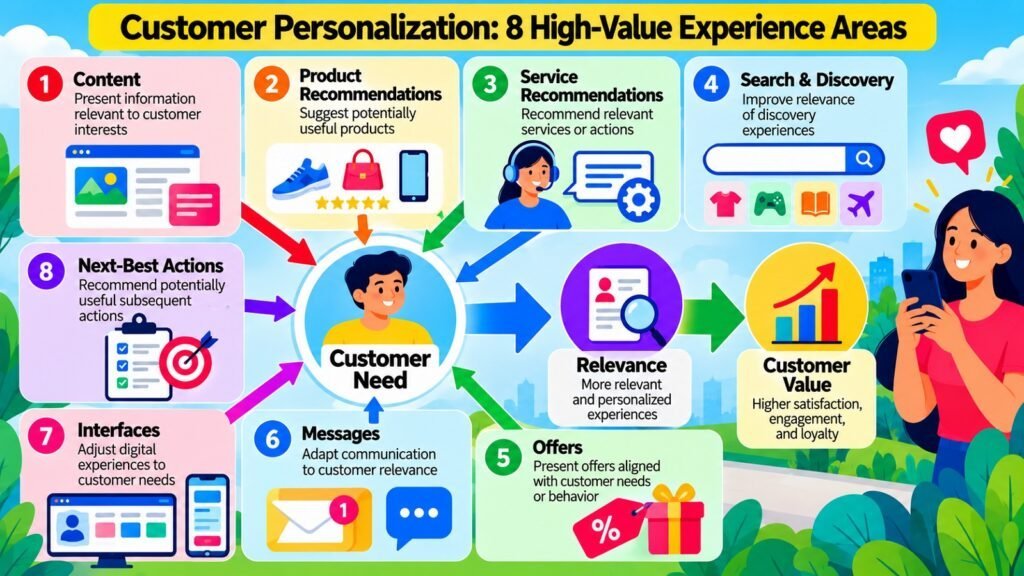
Strategy and data create the conditions for personalization, but what customers actually experience is its content and recommendations — the products shown, the messages delivered, the search results surfaced, the offers presented, and the interfaces adapted. This is where the investment in personalization either creates genuine value or reveals its limitations.
Relevance, usefulness, and timing determine whether personalized content lands well. A product recommendation that appears when a customer is actively looking for that category can be genuinely helpful; the same recommendation sent repeatedly after the need has been met becomes noise. The purpose of personalized content is not to maximize the volume of personalized elements but to improve the quality of the experience — helping customers find what they need, discover what they might not have considered, and make better decisions.
Recommendation systems use collaborative filtering, content-based filtering, or hybrid approaches to identify what a customer is likely to value. Research from McKinsey and public reporting from Netflix both point to significant revenue and engagement gains at businesses that implement recommendation engines well — outcomes that reflect a simple truth: when personalization reduces friction and improves discovery, customers benefit tangibly.
Personalized content also fails in characteristic ways. Repetitive recommendations signal that the system is not adapting to new information. Irrelevant recommendations undermine trust and can feel intrusive. Over-personalization — where the experience becomes so narrowly tailored that customers feel surveilled — reduces satisfaction. And inaccurate recommendations, such as promoting products a customer has already bought or rejected, suggest the system does not genuinely understand them. A useful quality framework asks whether personalized content is useful to this customer at this moment, reflects accurate and current understanding, and adds genuine value rather than simply adding volume.
Table 5: Customer Personalization — Eight Experience Elements and Opportunities
| Experience Element | Personalization Opportunity |
| Product Recommendations | Surface items aligned with purchase history, browsing, and current intent |
| Content and Articles | Prioritize topics and formats matching the customer’s demonstrated interests |
| Search Results | Rank outcomes according to individual preference signals and context |
| Promotional Offers | Tailor offers to purchase stage, category interest, and customer value |
| Email and Messaging | Adapt content, timing, and frequency to individual engagement patterns |
| Interface and Navigation | Adjust layouts, menus, and defaults based on customer behavior |
| Onboarding Experiences | Personalize setup flows based on stated goals and initial behavior |
| Post-Purchase Communications | Align follow-up content with what was purchased and what may be needed next |
5. Customer Personalization Technology: Enabling Smarter Experiences
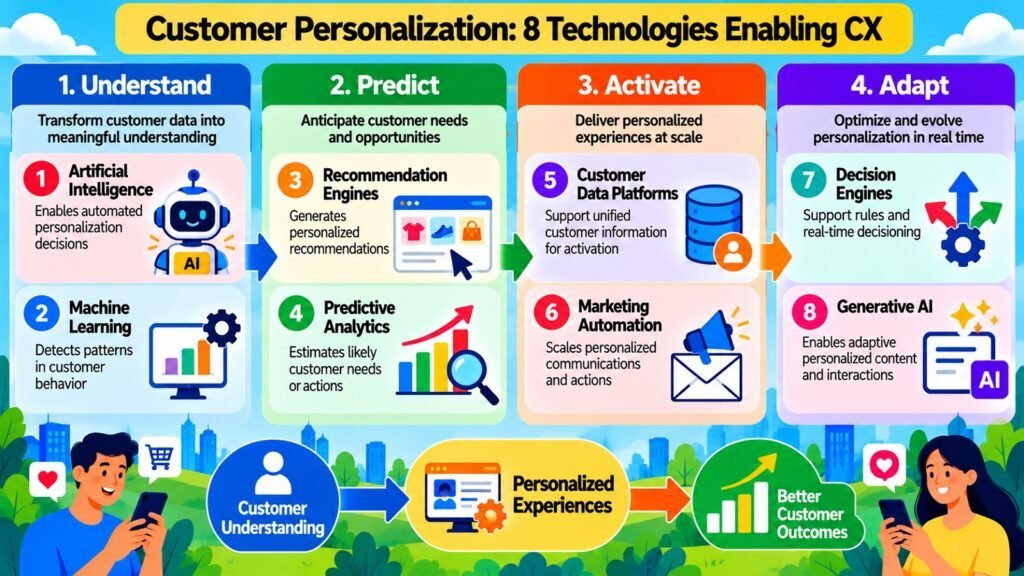
Modern Customer Personalization at scale depends on technology in ways that were simply not possible a generation ago. The volume, speed, and complexity of personalization decisions in a contemporary digital environment exceed what human judgment or rule systems can manage alone. Technology enables businesses to process customer information, identify meaningful patterns, generate relevant recommendations, and deliver individualized experiences in real time.
Artificial intelligence and machine learning form the analytical core of sophisticated personalization systems. Machine learning models identify patterns in customer behavior imperceptible to human analysts and improve over time as more data becomes available. Recommendation engines — using collaborative filtering, content-based methods, or hybrid approaches — are the most visible expression of AI-powered personalization for most customers. Predictive analytics models anticipate future needs based on historical patterns, supporting decisions such as which customers are most likely to churn or which product category they will explore next. Customer Data Platforms consolidate information from multiple sources into unified profiles; without such consolidation, personalization tends to be fragmented — effective in one channel while ignorant of what has happened in others.
Generative AI is an emerging capability, enabling personalized content variations and adapted messaging at scale — though like all personalization technology, its value depends entirely on the quality of the underlying customer understanding and the strategy it serves.
Technology is an enabler, not a substitute for good thinking. Sophisticated algorithms applied to poor-quality data produce confident but wrong personalization. Advanced systems without a clear strategy create complexity without relevance. Automation without human oversight can reinforce biases present in training data. The right framework for technology selection begins with the personalization problem — what does the customer need that they are not currently getting — and identifies what capabilities are needed to solve it responsibly.
Table 6: Customer Personalization — Eight Technology Capabilities and Their Roles
| Technology Capability | Role in Customer Personalization |
| Machine Learning Models | Identify behavioral patterns and predict individual customer preferences |
| Recommendation Engines | Generate relevant product, content, or offer suggestions at scale |
| Predictive Analytics | Anticipate future needs or behaviors based on historical customer data |
| Customer Data Platforms | Unify customer profiles across channels to enable consistent personalization |
| Marketing Automation | Apply personalization logic to communications at scale and appropriate timing |
| Decision Engines | Determine the most appropriate personalization action for each customer moment |
| A/B and Multivariate Testing | Validate which personalization approaches genuinely improve outcomes |
| Generative AI | Create personalized content variations and adaptive messaging at scale |
6. Customer Personalization and Context: Making Relevance Timely
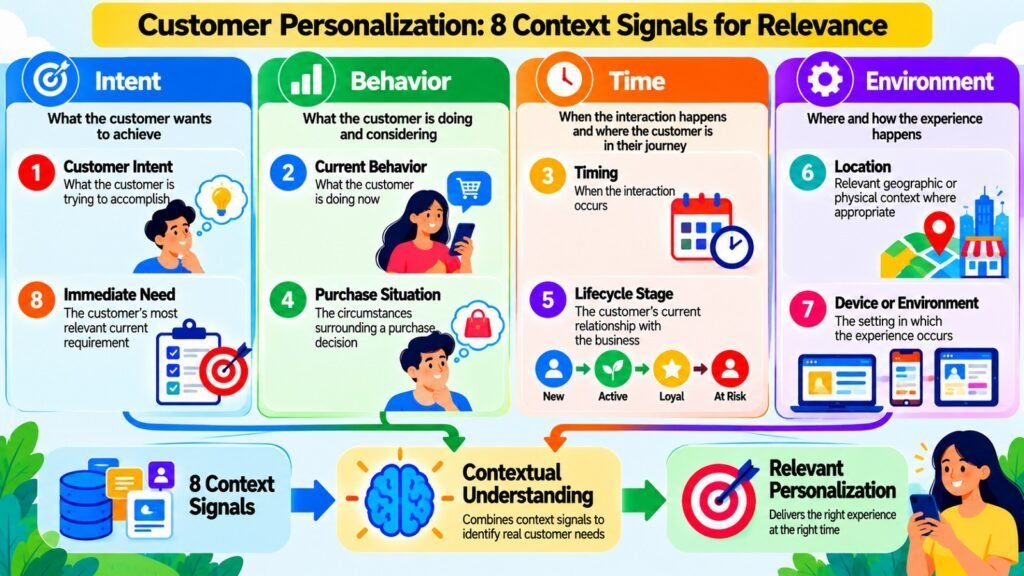
Understanding who a customer is represents only part of the personalization challenge. What is relevant to that customer in a particular situation requires contextual awareness — recognizing the circumstances of an interaction and calibrating the experience accordingly. Context transforms static customer knowledge into situationally appropriate relevance.
The same customer may need meaningfully different experiences at different moments. A customer researching a product category for the first time needs different support than one who has already purchased and is looking for usage guidance. A customer reaching out after a service problem is in a different frame of mind than one browsing casually. Personalization that ignores these contextual differences will often feel irrelevant even when it is built on accurate information about the customer.
Contextual factors fall into several useful categories. Current intent — what a customer is actively searching for or browsing — is one of the most powerful signals because it is immediate and specific. Timing, including time of day and recency of last purchase, shapes what experiences are appropriate. Purchase stage captures where the customer sits in the decision-making process, from initial awareness through active evaluation to post-purchase needs. Device and environment determine which formats and experiences are practical.
Context can also mislead when misread. A customer browsing out of curiosity may receive a promotional push that feels premature. Personalization systems acting on weak, outdated, or poorly understood contextual signals can produce experiences that are worse than no personalization at all. A practical context evaluation framework asks whether the signal is genuine and current, whether the intended personalization fits the customer’s apparent situation, and whether it respects their reasonable expectations for this type of interaction.
Table 7: Customer Personalization — Eight Contextual Factors and Their Influence
| Contextual Factor | Influence on Personalization Decisions |
| Current Intent | Active browsing or search signals what the customer needs right now |
| Timing | Time of day, day of week, and recency shape what experiences are appropriate |
| Purchase Stage | Decision-making stage determines whether to inform, recommend, or reassure |
| Lifecycle Stage | Relationship maturity affects depth, tone, and type of personalization used |
| Recent Interactions | Service contacts or recent purchases add important context to current needs |
| Device and Environment | Device type and usage context affect which formats and experiences are practical |
| Session Behavior | Within-session navigation patterns reveal real-time interest and intent |
| Location | Geographic context can improve relevance for local offers or regional differences |
7. Customer Personalization, Privacy and Trust: Creating Responsible Relevance
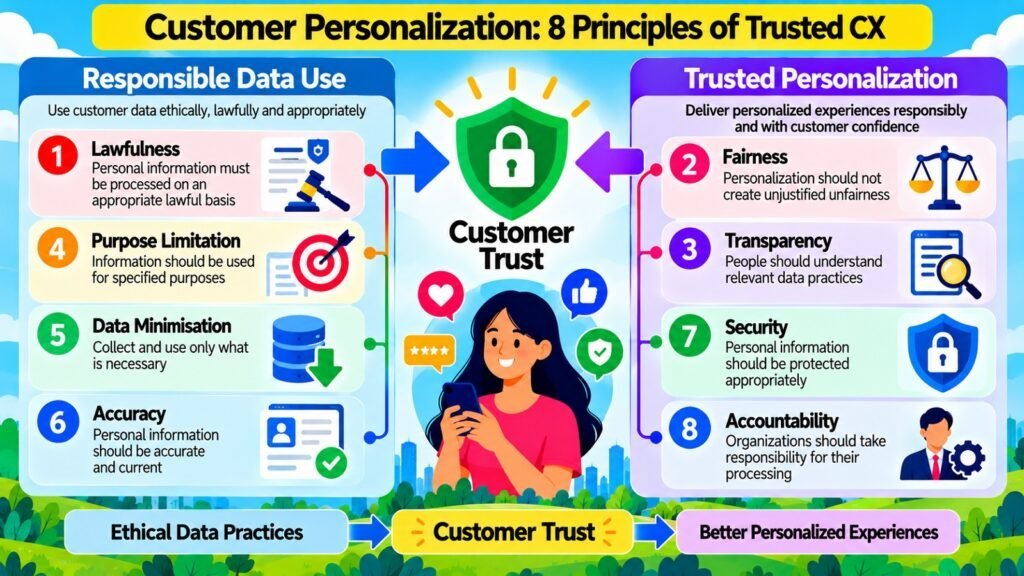
Personalization creates value by using customer information to improve experiences. But the same use of information can make customers feel uncomfortable, surveilled, or manipulated if it exceeds what they consider reasonable. The relationship between personalization and trust is not a secondary concern — it is central to whether customers accept personalization at all.
Research from the Pew Research Center and others has found that while many customers appreciate relevant personalization, a significant proportion are uncomfortable with businesses tracking and analyzing their behavior in detail. This discomfort intensifies when the personalization feels too precise — revealing that a business knows more about a customer than they expected or consented to share. This is sometimes described as the “creepiness threshold,” the point at which personalization shifts from helpful to intrusive.
Managing this threshold requires applying several enduring principles. Consent means customers should have meaningful control over whether and how their information is used for personalization. Transparency means customers should broadly understand what personalization is taking place and why. Proportionality means the depth of personalization should match the relationship — a long-term customer who has actively shared preferences will accept more tailored experiences than a new visitor who has shared nothing. Responsible data use means information should only be used for purposes the customer would reasonably expect. Customer choice means providing meaningful opt-out options without degrading the experience. Security means protecting customer information from misuse and unauthorized access.
A responsible personalization framework asks five questions before deploying any new initiative: Is this useful to the customer? Is it expected given the relationship? Is it transparent? Is it proportionate? And is it respectful of the customer’s autonomy? Personalization that satisfies all five conditions tends to build trust; personalization that violates any of them risks eroding it in ways that are far harder to repair.
Table 8: Customer Personalization — Eight Privacy and Trust Considerations
| Consideration | Why It Matters for Responsible Customer Personalization |
| Consent | Customers should have genuine control over personalization data use |
| Transparency | Customers should broadly understand what is personalized and why |
| Proportionality | Personalization depth should match the relationship and customer expectations |
| Responsible Data Use | Information should only be used for purposes customers would reasonably expect |
| Customer Choice | Meaningful opt-out options should be available without penalizing the experience |
| Data Security | Customer information must be protected from misuse and unauthorized access |
| Personalization Limits | Some uses of sensitive data carry risks that outweigh relevance benefits |
| Creepiness Threshold | Personalization that feels too precise can shift from helpful to intrusive |
8. Customer Personalization Measurement and Optimization: Proving CX Impact
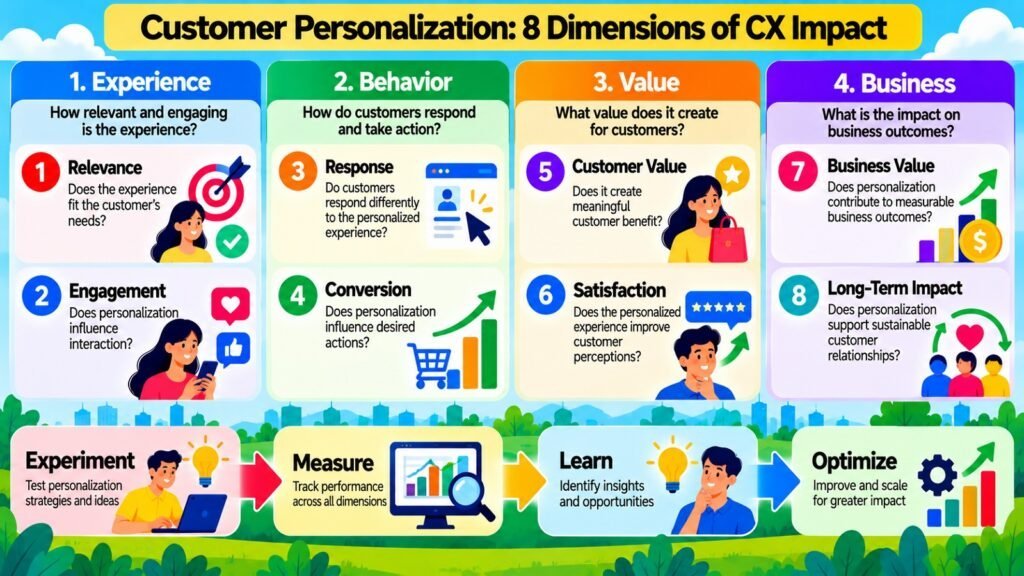
Sustaining investment in personalization requires evidence that it is genuinely improving outcomes. Measurement is not an afterthought — it is what distinguishes organizations that continuously improve from those that simply deploy personalization and assume it is working.
Effective measurement begins by connecting the personalization objective to appropriate indicators. Relevance can be assessed through engagement measures such as click-through rates, time spent, and the proportion of recommendations acted on. Response measures capture whether a personalized message prompted the intended action. Conversion measures track whether personalization influences purchase decisions. Customer value measures examine longer-term effects — whether personalization is associated with higher retention, greater lifetime value, or stronger relationships. Satisfaction and feedback signals, including survey responses and complaints, add a customer perspective that quantitative metrics alone cannot provide.
Experimentation is the most reliable way to determine whether personalization is causing improvements rather than simply correlating with positive trends. A/B testing isolates the effect of specific personalization decisions by comparing personalized experiences against a control group. Without a proper baseline, businesses may attribute improvements to personalization that would have occurred regardless.
Several measurement problems are common and worth anticipating. Measuring only short-term conversion ignores longer-term relationship effects. Confusing correlation with causation leads to misattributing outcomes — highly engaged customers may have been highly motivated independent of personalization. Failing to establish a baseline makes it impossible to judge whether the investment is delivering a genuine return. And ignoring negative customer reactions — opt-outs, complaints, disengagement — means missing signals that personalization may be creating harm alongside benefit. A practical measurement framework connects each initiative to a clear objective, relevant indicators, an experimental design, and a review cycle that generates actionable insights.
Table 9: Customer Personalization — Eight Measurement Dimensions
| Measurement Dimensions of Customer Personalization | What It Helps the Business to Understand |
| Relevance Engagement | Whether customers find personalized content useful enough to interact with |
| Response Rate | Whether personalized communications are prompting intended customer actions |
| Conversion Impact | Whether personalization is influencing purchase or goal-completion decisions |
| Customer Retention | Whether personalization is improving long-term relationship continuation |
| Lifetime Value | Whether personalized customers generate stronger financial outcomes over time |
| Satisfaction Signals | Whether customers perceive personalized experiences as positive and appropriate |
| Opt-Out and Disengagement Rates | Whether any personalization practices are creating negative reactions |
| A/B and Control Group Results | Whether personalization is actually causing improvements versus correlating with them |
Conclusion: Customer Personalization as a Powerful Foundation of CX
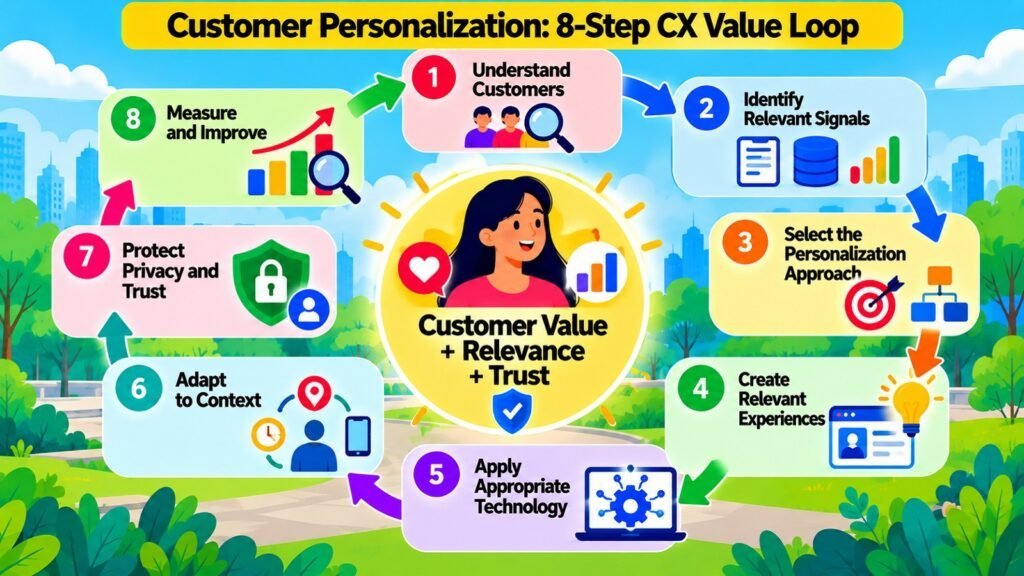
The eight foundations examined in this article are not independent techniques. They form an interconnected system in which each element depends on and reinforces the others. Strong principles ensure personalization serves the customer rather than the organization. Rigorous data practices provide the understanding that makes relevance possible. Strategy choices determine which approach fits a given context. Well-designed content and recommendations translate that strategy into experiences customers actually value. Technology enables scale and adaptability that manual approaches cannot achieve. Contextual judgment ensures relevance is timely. Privacy and trust create the conditions under which customers accept personalization. And measurement provides the evidence needed to improve continuously rather than assume success.
Successful Customer Personalization is not about knowing everything about every customer or deploying the most advanced technology. It is about using sufficient understanding to create experiences that feel genuinely useful, relevant, timely, and respectful. Organizations that focus on these qualities build personalization capabilities that earn trust and deliver durable business value. Those that focus on scale or sophistication without attending to quality and responsibility tend to generate noise rather than relevance.
Important tensions run through all personalization work — relevance versus privacy, automation versus human judgment, short-term response versus long-term customer value — and they do not resolve themselves. They require ongoing organizational attention, clear values, and thoughtful judgment about what personalization should do as well as what it can do.
The principle most worth carrying from this article is this: personalization is not a technology deployment — it is a customer relationship practice. Its long-term success depends on whether customers feel that the experiences they receive are genuinely in their interest. That sense of value and trust is both the goal of effective personalization and its most durable foundation.
Table 10: Customer Personalization — Eight Foundations and Their CX Role
| Customer Personalization Foundations | Central Role in Customer Experience |
| Core Principles | Ensures personalization serves genuine customer needs, not organizational convenience |
| Customer Data | Builds the understanding that makes meaningful relevance possible |
| Personalization Strategies | Matches the personalization approach to the customer need and business context |
| Content and Recommendations | Delivers the visible value that customers actually experience and judge |
| Technology | Enables personalization at the scale and speed that modern CX requires |
| Context | Makes relevance timely and situationally appropriate |
| Privacy and Trust | Creates the responsible conditions for customer acceptance and long-term loyalty |
| Measurement and Optimization | Validates impact and drives continuous improvement in personalization quality |