Table of Contents
Introduction: Customer Journey Mapping as the Foundation of Customer Experience
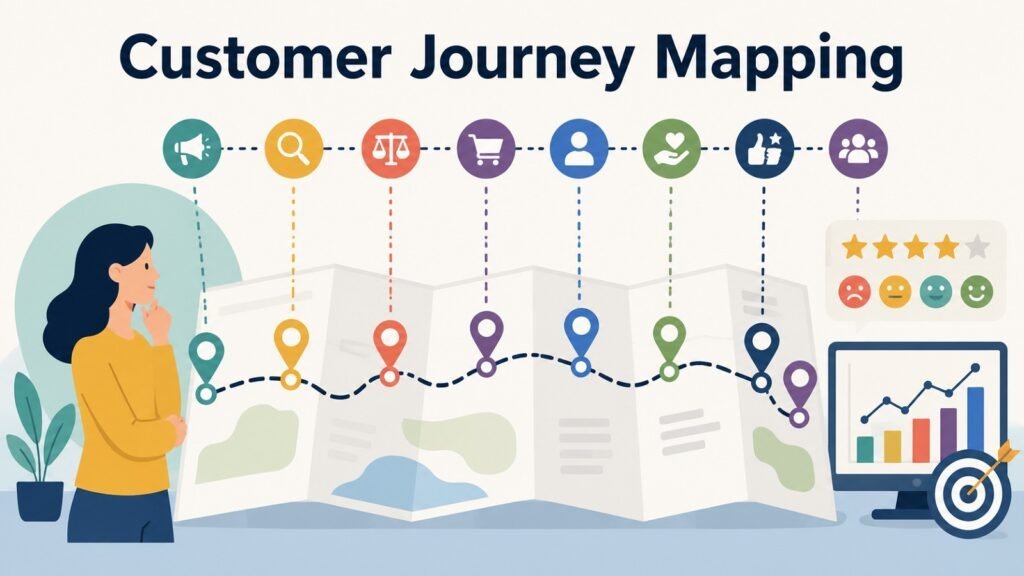
Customer Journey Mapping is one of the most important aspects of Customer Experience, and it deserves that reputation. It gives a business a clear picture of every interaction a customer has, from the first search query to the final purchase and beyond. Without this picture, teams tend to work in isolated pockets, guessing at what customers want instead of watching what they actually do. Customer Journey Mapping closes that gap, turning scattered impressions into a single visual story that marketing, sales, product, and support teams can all read the same way.
At its core, Customer Journey Mapping is the practice of documenting the steps, emotions, and touchpoints a customer moves through while interacting with a brand. It is not a one-time diagram pinned to a wall. It is closer to a living record that gets updated as customer behavior shifts and new channels appear. This distinction matters because customer expectations today are less patient than they were even five years ago. People compare their experience with your business against the smoothest app they have used anywhere, not just against your direct competitors.
Several forces have pushed Customer Journey Mapping from a nice-to-have exercise into a genuine strategic capability. Omnichannel behavior is one of the biggest. Customers now hop between a mobile app, a website, a phone call, and a physical store within a single purchase decision, and they expect consistency across all of them. Industry research backs this up directly. Businesses that map and refine their customer journeys report notably stronger marketing returns than those that do not. They stop wasting effort on touchpoints that do not actually influence the decision, so when a company understands its own journey, it spends its resources where they count.
Data availability has also changed the game. A decade ago, journey mapping relied mostly on interviews and educated guesses. Now, behavioral analytics and customer feedback platforms make it possible to see, with real precision, where people hesitate, where they abandon a process, and where they return. This shift from assumption to evidence is one of the quieter revolutions inside Customer Experience work.
Competitive pressure adds another layer. Markets are crowded, and switching costs for the customer are often low. A single confusing signup step or one unhelpful support call can send a customer to a competitor without much hesitation. Businesses that map their journeys tend to catch these moments before they cost them a customer, rather than after.
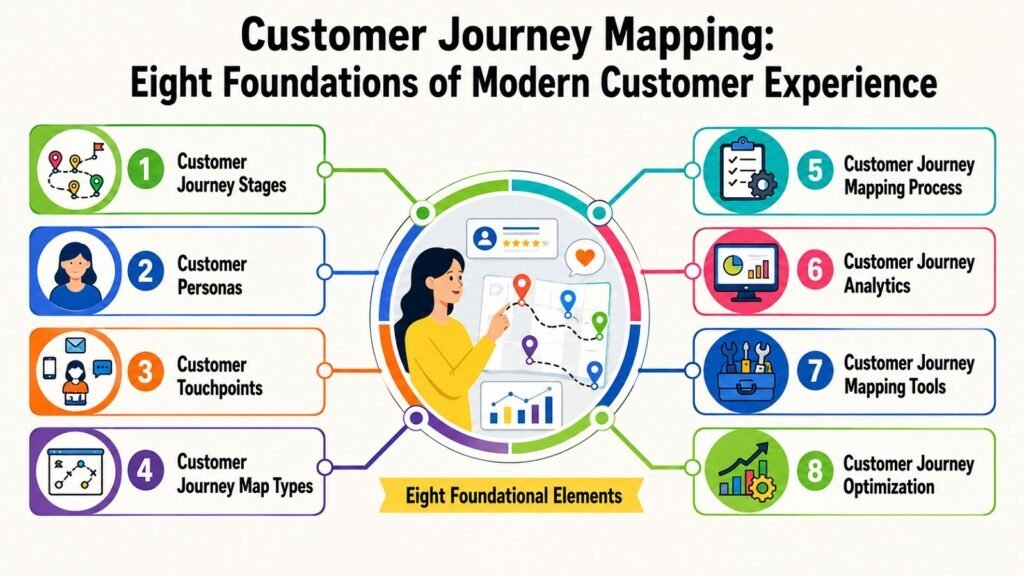
This article walks through eight foundational aspects of Customer Journey Mapping. Together, they form a complete framework: journey stages, customer personas, touchpoints, journey map types, the mapping process, journey analytics, modern tools, and continuous optimization. Each piece supports the others, and by the end you should understand how they fit together to build stronger customer relationships.
Table 1: Customer Journey Mapping — Eight Foundational Aspects Overview
| Aspect | Role in Customer Journey Mapping |
| Customer Journey Stages | Organizes the lifecycle from awareness to advocacy |
| Customer Personas | Adds accuracy by grounding maps in real customer data |
| Customer Touchpoints | Identifies every interaction across channels |
| Journey Map Types | Matches the mapping format to the business objective |
| Mapping Process | Turns research into a structured, repeatable method |
| Journey Analytics | Measures behavior and validates improvements |
| Modern Tools | Supports collaboration, visualization, and automation |
| Continuous Optimization | Keeps journeys improving instead of going stale |
1. Customer Journey Mapping Through Customer Journey Stages
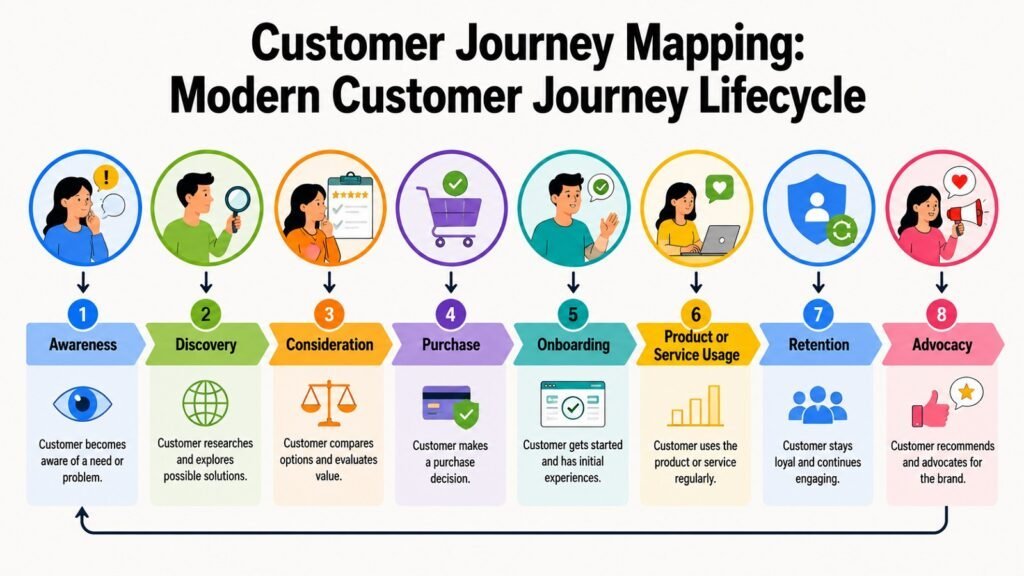
Customer Journey Mapping organizes the entire customer lifecycle into clear, recognizable stages, and this structure is often the first thing a business builds when it starts mapping seriously. Most frameworks describe a path running from awareness, where a person first recognizes a problem, through consideration, decision, onboarding, retention, and eventually advocacy, where a satisfied customer recommends the brand to others. Each stage reflects a different mindset, and a business that treats every stage the same way tends to miss what the customer actually needs.
Customer goals shift noticeably as people move through these stages. Someone in the awareness stage is usually just trying to understand their own problem, so heavy sales messaging feels premature and can push them away. Someone in the decision stage wants specifics: pricing, comparisons, and proof that the product works as promised. Recent research on buyer behavior found that a large share of purchases go to whichever vendor reaches the buyer first with a relevant answer. Timing and stage-awareness, in other words, are genuine competitive advantages, not just nice details.
This is where Customer Journey Mapping earns its keep as an operational tool rather than just a diagram. When marketing, sales, and support teams agree on where a customer sits in the journey, they stop working against each other. A marketing team that keeps blasting decision-stage offers at someone still in the awareness stage is wasting effort and probably annoying the customer.
Consider a common example from software companies. A user who signs up for a free trial is technically a customer, but they are still deep in the decision stage psychologically. Companies that recognize this send onboarding emails focused on quick wins rather than upsell offers, because the priority is proving value fast. This single adjustment, guided entirely by journey-stage awareness, often makes the difference between a trial that converts and one that quietly expires.
Retail businesses use similar logic. A shopper browsing a category page sits in a different stage than one who has already added an item to their cart. Recognizing that difference lets a business apply the right nudge at the right moment.
Understanding customer journey stages, in short, gives Customer Journey Mapping its backbone. It tells a business not just what customers do, but why they do it at each point.
Table 2: Customer Journey Mapping — Major Customer Journey Stages
| Journey Stage | Primary Purpose |
| Awareness | Customer recognizes a problem or need |
| Consideration | Customer researches possible solutions |
| Decision | Customer evaluates options and chooses a provider |
| Onboarding | Customer learns to use the product or service |
| Adoption | Customer builds the habit of regular use |
| Retention | Business works to keep the customer engaged |
| Expansion | Customer explores additional products or upgrades |
| Advocacy | Satisfied customer recommends the brand to others |
2. Customer Journey Mapping with Customer Personas
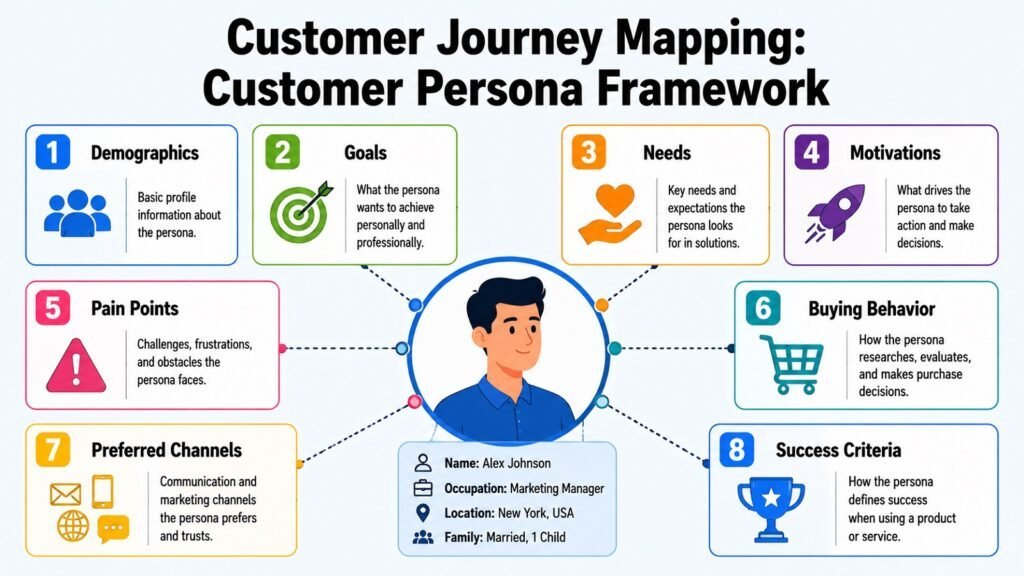
Customer Journey Mapping becomes far more reliable once it is grounded in well-built customer personas. A persona is a semi-fictional profile representing a segment of real customers, built from actual research rather than internal assumptions about who the customer is supposed to be. Teams that skip proper research and simply imagine their customer tend to build maps around a person who does not really exist. The resulting map, however polished, ends up misleading rather than useful.
Good persona development draws from several sources at once. Customer interviews reveal motivations in the customer’s own words. Surveys add scale, letting a business confirm whether an insight from one interview applies broadly. Behavioral analytics show what people actually do, which sometimes contradicts what they say in an interview. Industry guidance consistently emphasizes this point: personas should be built from qualitative and quantitative research rather than guesswork, since assumptions tend to reproduce a company’s own biases rather than the customer’s real experience.
Personas connect directly to how customers make decisions. A price-sensitive small business owner moves through a journey differently than an enterprise buyer weighing a purchase across several stakeholders. The small business owner might decide within days after comparing a few options online, while the enterprise buyer might take months and require detailed documentation before signing anything. A single journey map built for one of these personas would badly misrepresent the other.
This is exactly why organizations with multiple customer segments usually maintain more than one journey map. A software company selling to both individual freelancers and large corporate teams cannot use one map for both. The freelancer cares about speed, while the corporate buyer cares about integrations and long-term support. Mapping both journeys separately, guided by distinct personas, lets the business tailor messaging and support appropriately for each group.
Persona-driven Customer Journey Mapping also tends to produce better outcomes because it forces specificity. A vague map built around a generic average customer invites vague solutions, while a map built around a well-researched persona invites targeted, testable improvements.
In practical terms, this means persona work should happen before a journey map is drafted. Skipping this step is one of the most common reasons Customer Journey Mapping projects stall or produce recommendations nobody trusts.
Table 3: Customer Journey Mapping — Common Persona Attributes and Their Value
| Persona Attribute | Value in Customer Journey Mapping |
| Demographics | Provides basic context for segmentation |
| Goals | Clarifies what the customer is trying to achieve |
| Pain points | Highlights friction the journey map should address |
| Preferred channels | Guides where touchpoints should be prioritized |
| Decision-making role | Shows who influences or approves the purchase |
| Buying triggers | Reveals what prompts the customer to act |
| Technology comfort | Informs how much guidance the journey should include |
| Loyalty drivers | Identifies what keeps the customer engaged long-term |
3. Customer Journey Mapping Across Customer Touchpoints
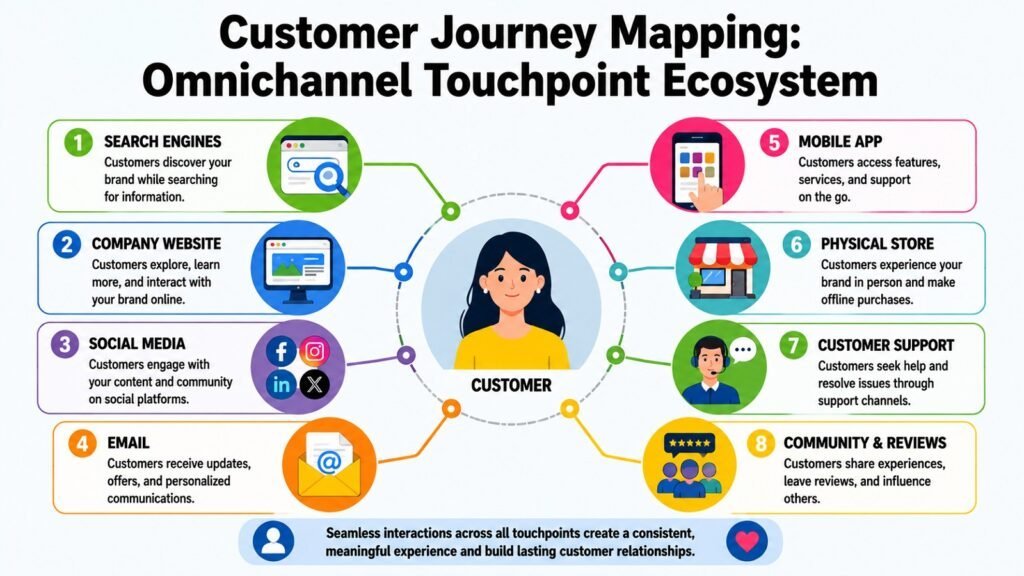
Customer Journey Mapping cannot function without a clear-eyed look at every touchpoint a customer encounters. A touchpoint is any moment of contact between a customer and a brand. These touchpoint moments span far more ground than most companies initially assume. They include obvious channels like a website or a mobile app, but also less obvious ones like a printed receipt or a chatbot reply. Customer Journey Mapping treats all of these as data points worth examining, since customers experience a brand as one continuous relationship, not separate departments.
Consistency across touchpoints is not a minor detail. It is one of the clearest predictors of whether a customer trusts a brand. A polished website paired with a confusing, slow support line creates dissonance, and customers notice that gap quickly. Established Customer Experience theory calls this touchpoint alignment, the idea that every interaction should reinforce the same tone and quality rather than contradicting an earlier one.
Identifying which touchpoints matter most is part science and part judgment. Some are high-frequency but low-stakes, like a routine newsletter. Others are low-frequency but extremely high-stakes, like a billing dispute. Customer Journey Mapping helps a business tell these apart by tracking where customer emotion spikes and which touchpoints most often precede renewal or churn.
A useful real-world pattern shows up in retail banking. Many banks have modernized their mobile apps extensively while leaving their in-branch experience mostly untouched. Customers who move between these two touchpoints notice the contrast immediately, and that inconsistency can quietly damage trust even when each touchpoint, taken alone, seems fine.
Touchpoint analysis also plays a direct role in building smoother omnichannel experiences. Customers often research on a phone, compare prices on a laptop, then buy in a physical store. Understanding that sequence lets a company design each touchpoint to hand off cleanly to the next, instead of forcing the customer to start over.
Managing touchpoints well, in the end, is less about perfecting any single interaction and more about making the full sequence feel like it comes from one trustworthy source.
Table 4: Customer Journey Mapping — Common Customer Touchpoints
| Touchpoint | Primary Purpose |
| Website | Provides information and enables self-service actions |
| Mobile app | Supports on-the-go interactions and transactions |
| Customer support call | Resolves issues through direct conversation |
| Live chat or chatbot | Offers quick, low-effort assistance |
| Email communication | Delivers updates, offers, and confirmations |
| Physical store or branch | Enables in-person service and interaction |
| Social media | Builds engagement and handles public feedback |
| Product packaging or receipt | Reinforces brand impression after purchase |
4. Customer Journey Mapping with Different Journey Map Types
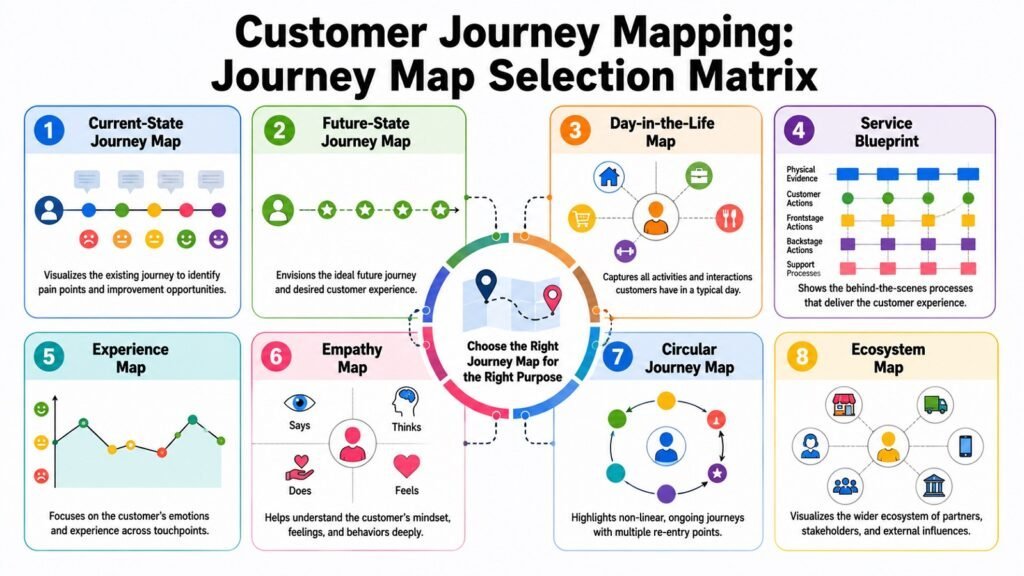
Not every business problem calls for the same kind of journey map, which is why Customer Journey Mapping includes several distinct map types, each suited to a different purpose. A current-state journey map documents how customers experience a business today, warts and all. It is often the most useful starting point because it shows reality rather than intention, and reality is usually where the biggest improvement opportunities hide.
A future-state journey map takes the opposite approach. Instead of documenting what exists, it outlines what a business wants the experience to become after planned improvements are implemented. This works well for aligning internal teams around a shared vision, though it carries a risk: teams sometimes treat the future-state map as already true, leading to premature celebration before implementation actually happens.
A day-in-the-life map broadens the lens even further. Rather than focusing narrowly on interactions with one brand, it captures a customer’s full day, including moments that have nothing to do with the business at all. This is particularly useful for finding new opportunities, since it reveals unmet needs a product could fill.
Service blueprints go a layer deeper than the other types. Where a standard journey map shows what the customer sees, a service blueprint also documents what happens behind the scenes, including internal processes and staff actions supporting each customer-facing step. This makes them especially valuable for operational teams who need to understand what has to happen internally to make an experience possible.
Choosing among these types depends heavily on the business question at hand. A company fixing a specific broken process should start with a current-state map, since it exposes actual failure points. A company planning a major redesign benefits more from a future-state map, while one looking for new product ideas gets more value from a day-in-the-life map.
None of these map types is inherently superior. Customer Journey Mapping works best when a business treats them as different lenses, each revealing something the others cannot, applying the right lens to the right problem.
Table 5: Customer Journey Mapping — Journey Map Types and Applications
| Map Type | Primary Business Application |
| Current-state map | Documents existing customer experience accurately |
| Future-state map | Plans an improved, intended customer experience |
| Day-in-the-life map | Reveals broader customer needs beyond the brand |
| Service blueprint | Connects customer steps to internal operations |
| Empathy map | Captures customer thoughts, feelings, and reactions |
| Journey atlas | Combines multiple journeys into one master view |
| Persona-based map | Tailors the journey to a specific customer segment |
| Channel-specific map | Focuses on one channel’s experience in depth |
5. Customer Journey Mapping Process from Research to Implementation
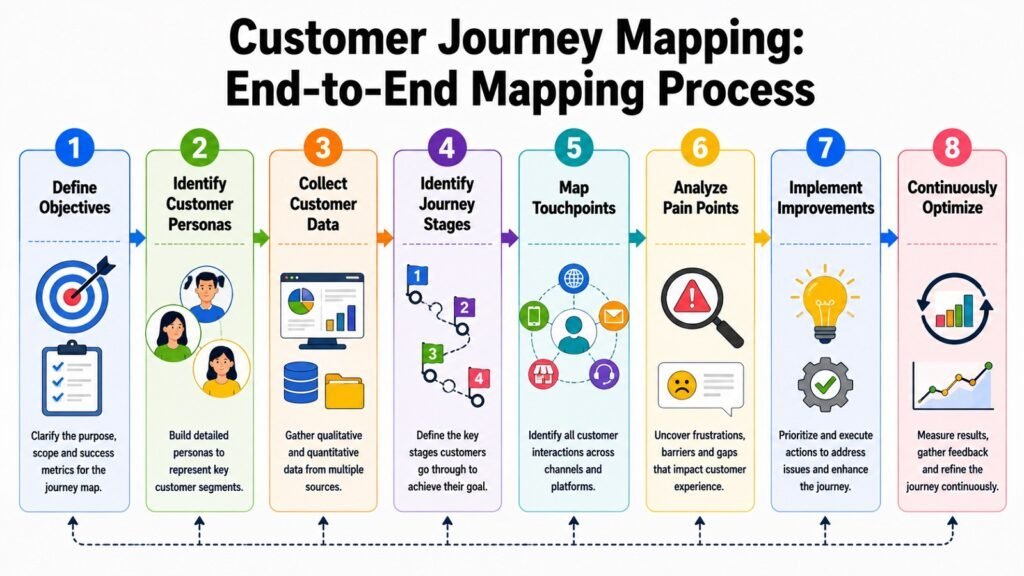
Building a genuinely useful Customer Journey Mapping initiative follows a fairly consistent process, even though the details vary by organization. It typically starts with defining clear business objectives. A team mapping a journey to reduce support calls needs a different focus than one mapping a journey to increase upsell revenue, so getting this objective right shapes everything that follows.
Subsequently, the process transitions to the identification of customer personas and the collection of data through interviews, surveys, analytics, and direct feedback, as opposed to relying on internal conjectures. This research phase frequently requires more time than teams anticipate; however, attempting to expedite it often results in a framework based on assumptions rather than solid evidence.
With research in hand, the team documents journey stages and touchpoints, laying out the sequence a customer follows and every point of contact along the way. This is also where customer emotions get mapped alongside the factual steps. Understanding that a customer feels confident during onboarding but anxious during a billing change tells a business exactly where extra reassurance would help most.
Pain point analysis follows naturally from this emotional mapping. Wherever frustration or drop-off appears, the team flags it for closer investigation. Cross-functional collaboration becomes essential here, since a pain point in the support queue might trace back to a decision made months earlier by the product team.
Validation is a step that gets skipped too often, and skipping it is a mistake. Before implementing changes, effective teams check their draft map against real customer feedback to confirm it reflects reality rather than internal opinion.
Implementation and refinement close the loop. Teams that treat Customer Journey Mapping as a single project rather than an ongoing practice usually see their improvements fade within a year or two, since customer behavior keeps shifting. Organizations that revisit their maps regularly keep pace with those changes far more effectively.
Table 6: Customer Journey Mapping — Process Stages and Objectives
| Process Stage | Primary Objective |
| Define objectives | Sets a clear purpose for the mapping project |
| Identify personas | Grounds the map in real customer segments |
| Collect data | Gathers evidence from research and analytics |
| Document stages | Lays out the customer’s path step by step |
| Map touchpoints | Identifies every point of brand interaction |
| Analyze emotions | Reveals how customers feel at each step |
| Validate findings | Confirms accuracy against real customer input |
| Implement and refine | Turns insights into ongoing improvements |
6. Customer Journey Mapping with Journey Analytics
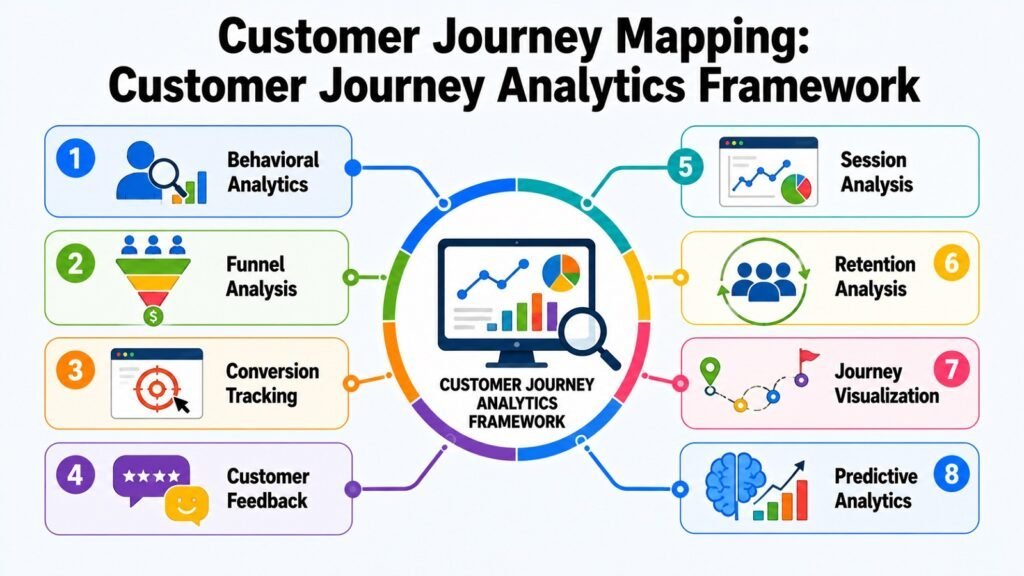
Customer Journey Mapping gains real teeth once it is paired with journey analytics, since analytics turns a visual story into something measurable. Behavioral analytics tracks what customers actually click, scroll past, or abandon, giving a business hard evidence about where a journey works and where it quietly breaks down. This is a meaningful shift from earlier approaches, which often relied on assumption and anecdote.
Conversion analysis and funnel analysis both play central roles here. Funnel analysis shows exactly where customers drop out, whether during checkout, midway through a signup form, or right after a price quote. Pairing this with customer feedback adds context to the numbers. A high drop-off rate alone tells a business something is wrong; feedback often tells them what.
Retention metrics extend this analysis into later stages of the journey. A business might notice strong signups but weak long-term retention, which usually signals the onboarding experience is not delivering on earlier promises. Journey analytics makes this kind of gap visible in a way periodic surveys alone rarely catch.
Journey visualization tools help teams interpret all this data without getting lost in spreadsheets. Instead of scanning rows of numbers, teams see a visual flow showing where customers move smoothly and where they stall, making it easier to communicate findings across departments.
Practical examples often show up in e-commerce. A retailer might discover that a large share of shoppers abandon their cart specifically after seeing shipping costs for the first time. This insight can justify a concrete fix, such as displaying shipping costs earlier. Businesses can then measure whether that fix actually improves conversion.
This evidence-based approach is what separates modern Customer Journey Mapping from its earlier form. Analytics does not replace human judgment, but it grounds that judgment in something more reliable than intuition alone.
Table 7: Customer Journey Mapping — Journey Analytics Techniques and Purpose
| Analytics Technique | Primary Purpose |
| Behavioral analytics | Tracks real customer actions across channels |
| Funnel analysis | Identifies where customers drop out of a process |
| Conversion analysis | Measures how effectively steps drive action |
| Sentiment analysis | Interprets emotional tone in customer feedback |
| Retention metrics | Reveals how well customers are kept engaged |
| Session recordings | Shows exact user behavior on digital platforms |
| Churn analysis | Identifies patterns preceding customer loss |
| Journey visualization | Presents data as an interpretable visual flow |
7. Customer Journey Mapping Using Modern Tools
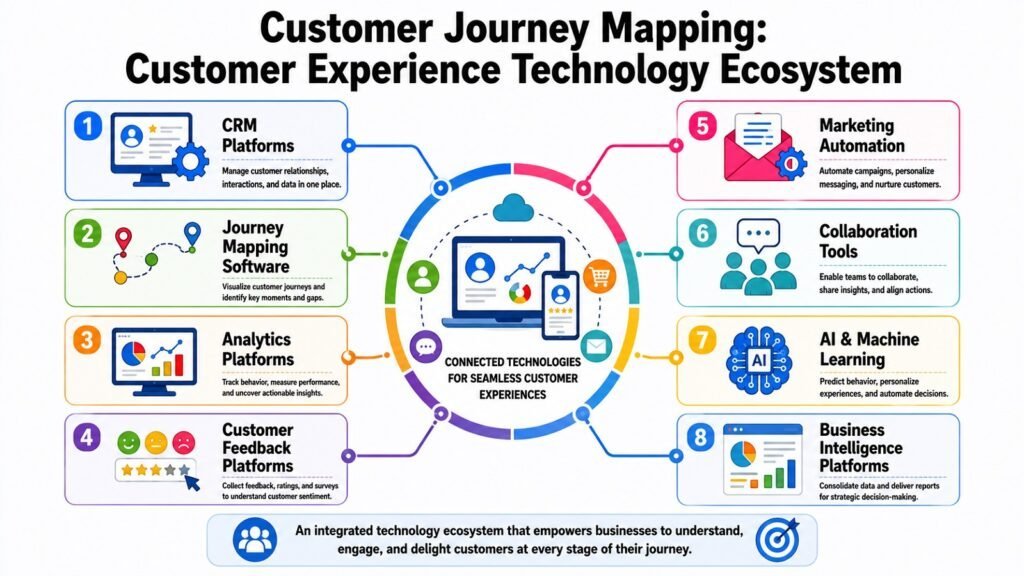
Modern Customer Journey Mapping rarely happens on paper anymore, and a wide range of software now supports nearly every stage of the process. Dedicated journey mapping platforms let teams build, share, and update visual maps collaboratively, replacing the static whiteboard sketches that used to get outdated within weeks.
CRM systems play a supporting role by centralizing customer data that would otherwise sit scattered across departments. When sales, support, and marketing pull from the same customer record, the resulting journey map reflects a more complete picture rather than a fragmented one built from disconnected spreadsheets.
Customer analytics platforms add the measurement layer discussed earlier, feeding real behavioral data directly into the mapping process. This is one of the more significant shifts in recent years: instead of updating a map based on quarterly meetings, teams can now watch customer behavior shift in close to real time.
Visualization tools help translate this complexity into something teams can actually use in a meeting. A journey map cluttered with excessive detail becomes just as unhelpful as one with too little, so good software strikes a balance between depth and clarity.
AI-powered technologies represent the newest layer in this stack. Market research indicates that spending on journey mapping and orchestration software has grown substantially in recent years, driven largely by AI capabilities that predict likely behavior and suggest interventions early. These tools show real promise, but AI predictions are only as good as the data feeding them, and organizations with messy customer data often see disappointing results until that problem gets fixed first.
Choosing the right combination of tools depends on organizational size, budget, and how mature the company’s data practices already are. A smaller business might get by with a simple visualization tool and a well-organized CRM, while a larger enterprise may need a full orchestration platform. The technology should serve the mapping process, not the other way around.
Table 8: Customer Journey Mapping — Tool Categories and Functions
| Tool Category | Primary Function |
| Journey mapping platforms | Builds and updates collaborative visual maps |
| CRM systems | Centralizes customer data across departments |
| Customer analytics platforms | Measures behavior across the full journey |
| Visualization software | Presents journey data in a clear, usable format |
| Survey and feedback tools | Gathers direct customer input at scale |
| AI-powered orchestration | Predicts behavior and suggests interventions |
| Collaboration tools | Enables cross-team input on shared maps |
| Heatmap and session tools | Shows exact interaction patterns on digital pages |
8. Customer Journey Mapping for Continuous Journey Optimization
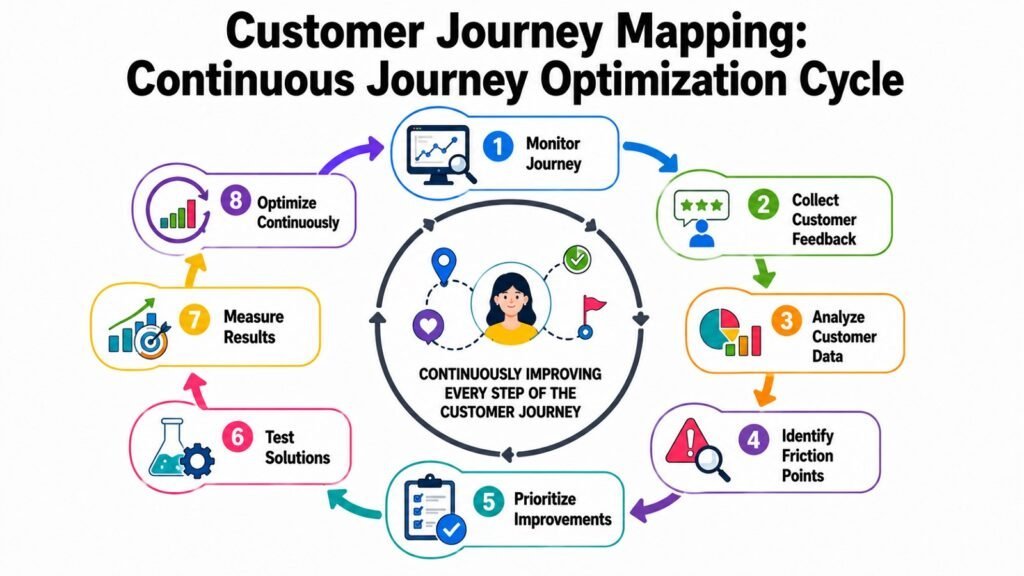
Customer Journey Mapping works best when treated as an ongoing discipline rather than a project with a fixed end date. Customer expectations shift and technology changes what customers consider normal, so a journey map accurate two years ago can quietly become outdated without anyone noticing until metrics start slipping.
Continuous optimization starts with identifying friction points, which extends the analytics work discussed earlier. The difference is one of mindset. Instead of treating friction as a problem to fix once, mature organizations treat it as an ongoing signal to monitor, since new friction can appear even after old friction gets resolved.
Prioritization matters just as much as identification. Not every friction point deserves equal attention, and businesses that try to fix everything at once often end up fixing nothing well. A useful approach ranks issues by how many customers they affect, focusing energy on high-impact fixes first.
Personalization plays an increasingly central role in optimization work. Rather than applying one improvement to every customer, businesses increasingly tailor experiences to individual behavior, informed by the persona and analytics work covered earlier. A returning customer benefits from a faster checkout flow, while a first-time visitor benefits more from added reassurance.
Testing changes before rolling them out broadly protects against well-intentioned fixes that accidentally make things worse. A/B testing applies just as well to journey improvements, letting a business confirm a proposed change actually helps before committing to it fully.
Measuring outcomes closes the loop and feeds directly back into the next round of optimization. This cyclical pattern – measure, prioritize, test, implement, and measure again- is what keeps Customer Journey Mapping relevant over time.
Table 9: Customer Journey Mapping — Continuous Optimization Practices
| Optimization Practice | Primary Objective |
| Friction identification | Monitors the journey for new or recurring problems |
| Impact prioritization | Focuses effort on the highest-value fixes |
| Personalization | Tailors experiences to individual customer needs |
| A/B testing | Confirms changes actually improve outcomes |
| Outcome measurement | Tracks whether optimization efforts are working |
| Feedback loops | Keeps customer input flowing into future updates |
| Cross-team review | Ensures improvements are coordinated, not siloed |
| Ongoing map updates | Keeps the journey map aligned with reality |
Conclusion: Building Better Customer Experiences with Customer Journey Mapping
Customer Journey Mapping earns its place as a foundational capability within Customer Experience. It forces a business to see itself the way a customer actually does, as one continuous relationship rather than separate departments. The eight aspects covered here- stages, personas, touchpoints, map types, process, analytics, tools, and continuous optimization- do not function well in isolation. Stages without personas stay generic. Touchpoints without analytics stay unmeasured.
What ties this together is a shift in mindset from treating the customer relationship as a single transaction to treating it as an evolving journey worth understanding in detail. Businesses that internalize this shift tend to make steadier progress, working from a shared, accurate picture of what customers actually experience.
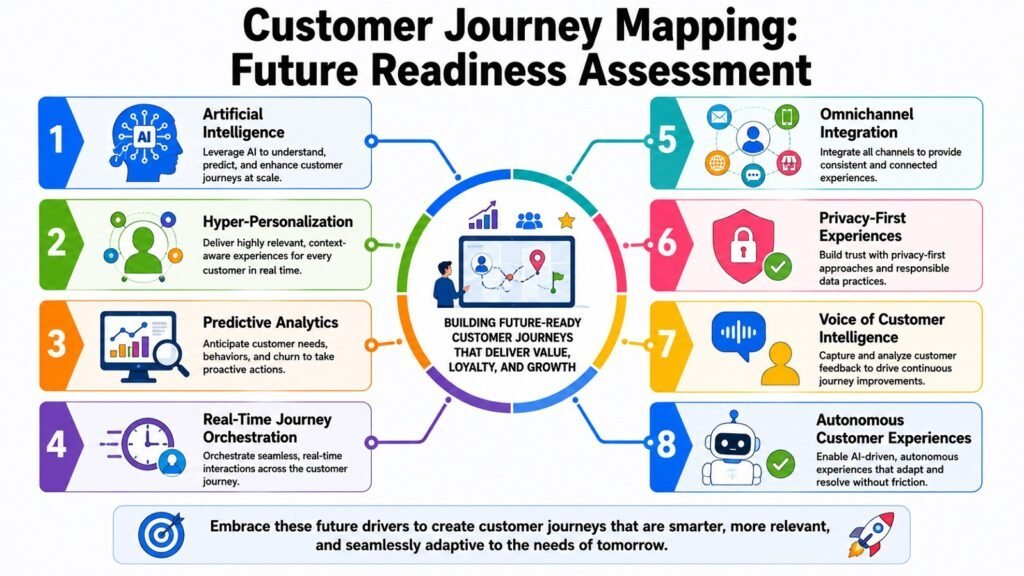
Digital transformation and artificial intelligence are only accelerating how this work gets done, not replacing the underlying principle. AI can predict behavior faster and surface friction sooner. It still depends on the same foundation covered here: clear stages, accurate personas, well-mapped touchpoints, and a genuine commitment to acting on what the data shows.
Customer Journey Mapping, in the end, is not a project to finish and file away. It is closer to a habit, one that keeps a business honest about how its customers actually feel, rather than how the business assumes they feel. Organizations willing to keep revisiting their maps and acting on real evidence tend to build the kind of customer loyalty that compounds over time.
Table 10: Customer Journey Mapping — Summary of Eight Foundational Aspects
| Foundational Aspect | Core Contribution |
| Customer Journey Stages | Structures the lifecycle from awareness to advocacy |
| Customer Personas | Grounds the journey in real customer research |
| Customer Touchpoints | Maps every interaction across channels |
| Journey Map Types | Matches the format to the business question |
| Mapping Process | Converts research into actionable structure |
| Journey Analytics | Measures behavior and validates changes |
| Modern Tools | Enables collaboration and real-time insight |
| Continuous Optimization | Sustain improvement as customer needs evolve |