Table of Contents
Introduction: Cloud Security as a Core Pillar of Modern Cybersecurity
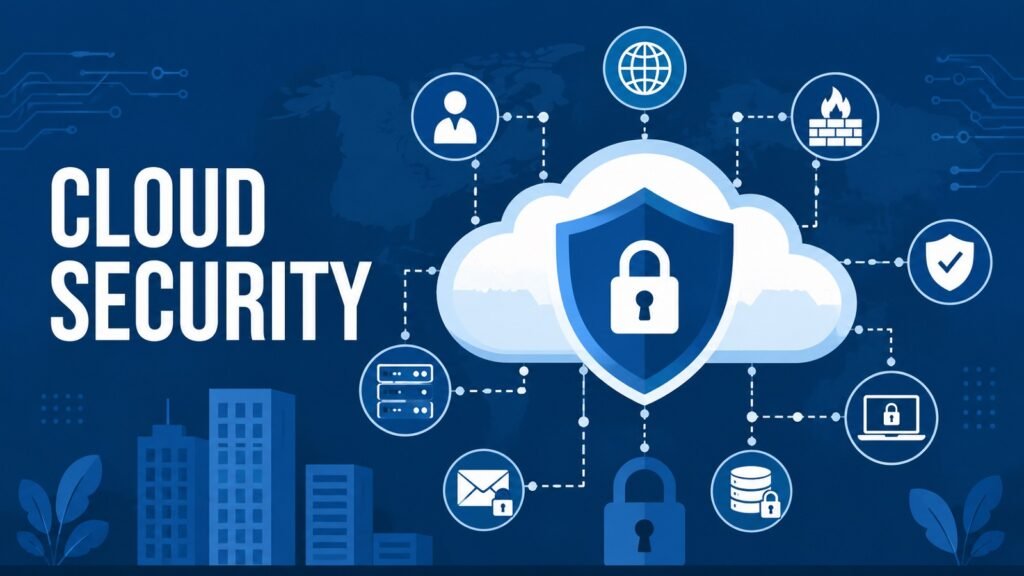
Cloud Security has become one of the most urgent concerns across every industry that depends on digital infrastructure. It covers the policies, technologies, processes, and controls that work together to protect cloud-based infrastructure, applications, services, workloads, and data from threats that keep growing in sophistication. As organizations shift more operations to the cloud, Cloud Security no longer sits at the edge of the Cybersecurity conversation. It now stands at the center.
Organizations in every sector depend on cloud computing to deliver critical services, drive efficiency, and support continuous innovation. Banking, healthcare, logistics, and education all run on cloud platforms in ways that were unimaginable a decade ago, making Cloud Security genuinely essential.
The swift adoption of public, private, hybrid, and multi-cloud environments has significantly broadened the attack surface, surpassing the capabilities of traditional perimeter-based security measures. Threats emerge from various directions simultaneously, data is in constant motion, and users access resources from any location. Each of these factors introduces risks that necessitate focused security considerations.
Cloud Security aims to achieve several critical objectives. Confidentiality guarantees that only authorized individuals can access sensitive data. Integrity ensures that the information remains accurate and unchanged. Availability guarantees that systems are accessible when required. In addition to these fundamental goals, Cloud Security also promotes resilience, business continuity, and adherence to regulatory compliance across the frameworks that dictate how organizations manage data and safeguard privacy.
One concept that shapes the entire approach is the shared responsibility model. It recognizes that cloud providers and their customers each carry distinct security responsibilities. Understanding where those responsibilities begin and end helps organizations avoid dangerous gaps in their protection.
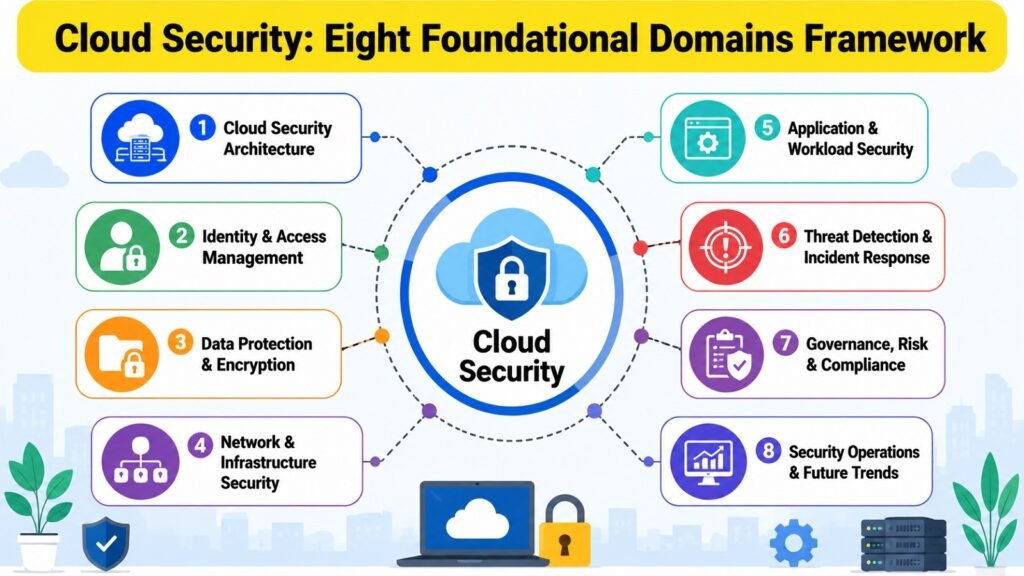
This article explores eight foundational aspects of Cloud Security, covering architecture, identity management, data protection, infrastructure security, application security, threat detection, governance, and security operations. Together, these areas provide a comprehensive view from strategic, technical, operational, and governance perspectives.
Table 1: Cloud Security Foundational Aspects at a Glance
| Cloud Security Foundational Aspects | Primary Purpose |
| Architecture | Provides the structural design framework for secure cloud environments |
| Identity and Access Management | Controls who can access cloud resources and under what conditions |
| Data Protection and Encryption | Safeguards information throughout its entire lifecycle in the cloud |
| Network and Infrastructure Security | Protects cloud connectivity and underlying infrastructure components |
| Application and Workload Security | Secures applications and workloads across development and operational lifecycle |
| Threat Detection and Incident Response | Enables continuous monitoring and coordinated response to cyber threats |
| Governance, Risk, and Compliance | Aligns security with organizational strategy, regulation, and risk management |
| Security Operations and Future Trends | Sustains ongoing security operations and prepares for emerging challenges |
1. Cloud Security Architecture: Building Secure Cloud Foundations
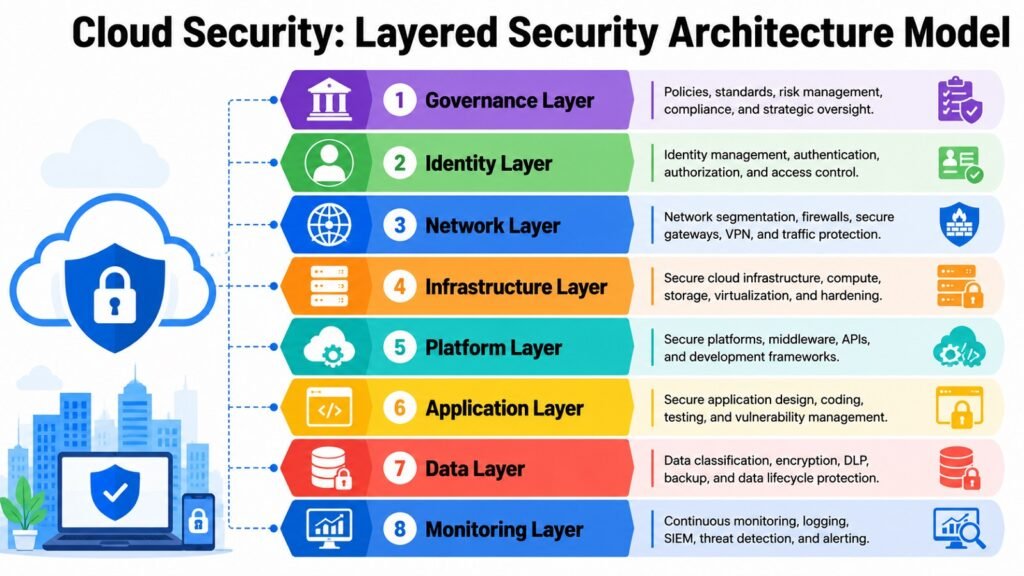
Cloud Security Architecture provides the foundation upon which secure cloud environments are designed, built, and maintained. It shapes how systems connect, how workloads interact, how data flows, and how threats are contained. Without a deliberate architectural foundation, even strong security tools tend to underperform because they operate in environments that were never designed with security in mind.
Security-by-design means embedding security into every architectural decision from the very beginning rather than adding it afterward. Organizations that follow this principle find their security posture more consistent, cost-effective, and easier to sustain. Defense-in-depth adds multiple independent controls across different layers of the cloud environment. When one control fails, others remain in place to limit damage, because no single measure is foolproof.
Workload isolation prevents different applications or user groups from interfering with one another. When one workload is compromised, isolation limits how far that compromise can spread. Network segmentation divides the environment into smaller zones with controlled boundaries, making lateral movement considerably harder for any attacker who manages to break in.
Zero Trust architecture has become one of the most widely accepted approaches to Cloud Security design. Its central principle is simple: no user, device, or system should be trusted by default, regardless of where they are. Every access request must be continuously verified against identity, context, and security posture. This significantly reduces the risk of damage from compromised credentials or insider threats.
Secure configuration sits at the heart of good architecture. Cloud service misconfigurations have contributed to many serious data exposures in recent years. Setting configurations to their most secure state and reviewing them routinely removes risk in ways that few other controls can match.
A well-designed Cloud Security architecture provides the stable foundation from which organizations can grow, adapt, and innovate with confidence.
Table 2: Cloud Security Architecture Components and Their Security Purpose
| Architectural Component | Primary Security Purpose |
| Security-by-Design | Embeds security into system architecture from the earliest planning stages |
| Defense-in-Depth | Creates multiple independent layers of protection to limit attack impact |
| Zero Trust Architecture | Requires continuous verification of every access request regardless of location |
| Workload Isolation | Prevents compromise in one system from spreading to others |
| Network Segmentation | Divides the environment into zones to restrict attacker lateral movement |
| Secure Configuration | Reduces risk by establishing and maintaining hardened baseline settings |
| Identity Perimeter | Replaces the traditional network perimeter with identity as the primary control point |
| Resilience Planning | Designs systems to recover quickly from disruptions while maintaining security |
2. Cloud Security Identity and Access Management (IAM): Controlling Secure Access
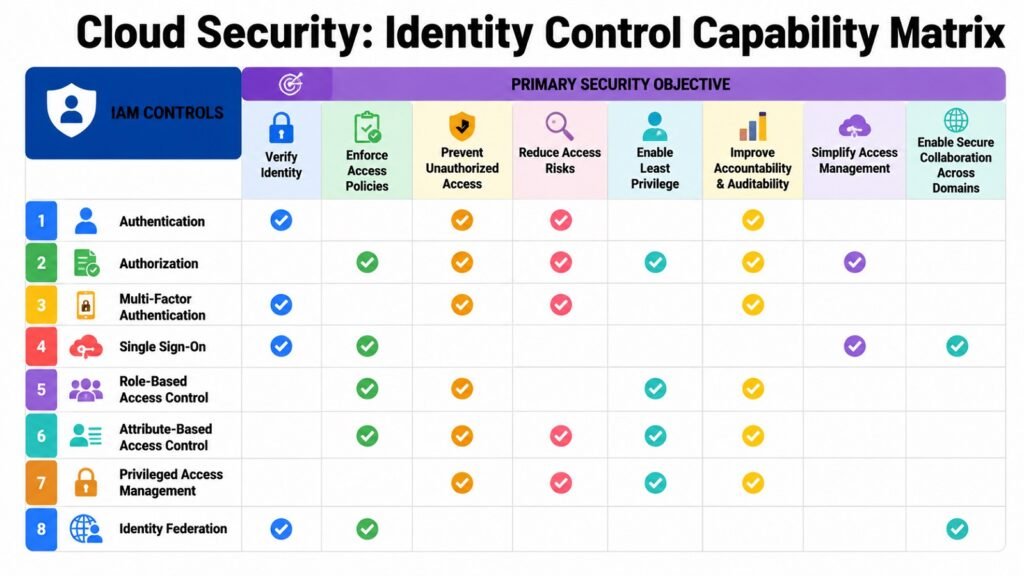
Identity and Access Management has become one of the most critical components of Cloud Security because the cloud fundamentally changed how access works. Traditional IT environments relied on physical network boundaries to control who could reach what. Cloud environments dissolve those boundaries. Identity has become the new security perimeter, and protecting it is now among the most important tasks in any Cloud Security program.
Authentication verifies that someone or something is who they claim to be. Authorization follows and determines what that verified identity is permitted to do. These two processes govern every interaction between users, applications, and cloud resources. Getting them right requires more than passwords. It demands a combination of controls designed to reinforce one another.
Multi-factor authentication requires users to prove their identity through more than one method. Passwords alone are insufficient in environments where credential theft through phishing and brute force attacks is common. Combining something a user knows with something they possess dramatically reduces the effectiveness of these attacks.
Role-based access control assigns permissions based on the roles people hold rather than granting individual access to every resource. Attribute-based access control adds further precision by evaluating attributes such as department, location, or device type before granting permission. Both approaches help implement least privilege, ensuring users and systems access only what they genuinely need.
Privileged access management focuses on protecting accounts with the highest levels of access. When compromised, these accounts give attackers the ability to alter configurations, access all data, and cause severe damage very quickly. Controlling when and how privileged access is granted, monitored, and revoked is among the highest-value activities in Cloud Security.
Identity federation and single sign-on allow users to authenticate once and reach multiple systems without re-entering credentials. Continuous access reviews ensure permissions remain appropriate, because many incidents trace back to access that was never removed.
Table 3: Cloud Security IAM Controls and Their Primary Purpose
| IAM Control | Primary Purpose |
| Multi-Factor Authentication | Requires multiple verification methods to prevent unauthorized access |
| Role-Based Access Control | Assigns permissions based on organizational roles rather than individuals |
| Attribute-Based Access Control | Evaluates contextual attributes before granting access to resources |
| Least Privilege | Limits user and system permissions to only what is necessary |
| Privileged Access Management | Protects and monitors accounts with elevated administrative rights |
| Identity Federation | Enables secure access across multiple systems using a single trusted identity |
| Single Sign-On | Allows one authentication event to provide access across multiple platforms |
| Continuous Access Reviews | Ensures permissions remain appropriate and removes unnecessary access |
3. Cloud Security Data Protection and Encryption: Securing Information Across the Cloud
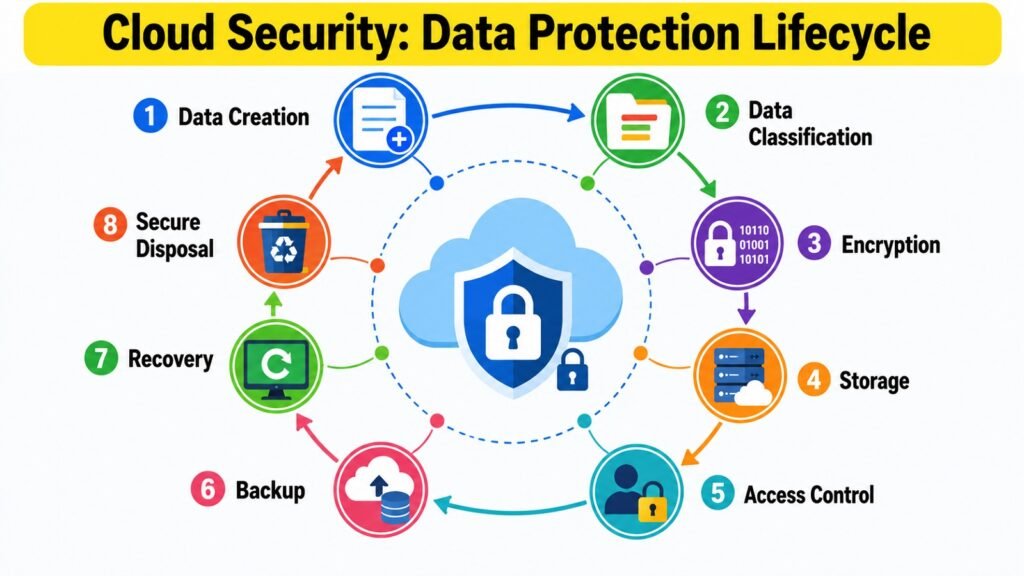
Protecting information throughout its lifecycle represents one of the primary objectives of Cloud Security. Data moves constantly in cloud environments. It is created, processed, transmitted, stored, shared, and eventually deleted. Each stage carries distinct risks, and effective Cloud Security must address all of them coherently.
Data classification is the starting point for meaningful protection. It involves identifying what information exists, how sensitive it is, and what level of protection it requires. Without classification, organizations tend to either over-protect low-value data or under-protect high-value data, both of which carry real costs.
Encryption at rest protects data stored on servers, databases, and storage services by converting it into an unreadable format without the correct key. Even if an attacker gains access to storage media, properly encrypted data remains useless to them. Encryption in transit protects data moving between systems using protocols such as TLS. These two forms address the most common states in which data can be exposed.
Encryption in use protects data while it is actively being processed. Technologies such as confidential computing are making it increasingly practical to perform computations on encrypted data without exposing the underlying information, which matters most in shared or third-party infrastructure environments.
Key management governs how encryption keys are created, stored, rotated, and retired. Strong encryption paired with poor key management is far less effective than it appears. Organizations that lose control of their keys effectively lose control of their data, regardless of how strong their encryption algorithms are.
Tokenization replaces sensitive values with non-sensitive placeholders, which is especially valuable in payment processing and healthcare. Secure backup and disaster recovery ensure data remains available after destructive events such as ransomware. Secure deletion ensures data is truly removed when no longer needed, preventing unauthorized recovery.
Table 4: Cloud Security Data Protection Techniques and Their Primary Benefit
| Data Protection Technique | Primary Security Benefit |
| Data Classification | Identifies sensitivity levels to apply appropriate and proportionate protections |
| Encryption at Rest | Protects stored data from unauthorized access even if storage is compromised |
| Encryption in Transit | Secures data moving between systems against interception and eavesdropping |
| Encryption in Use | Protects data during active processing in shared or third-party environments |
| Key Management | Controls the creation, rotation, and retirement of encryption keys |
| Tokenization | Replaces sensitive values with non-sensitive tokens to reduce exposure |
| Secure Backup and Recovery | Ensures data can be restored after destructive events including ransomware |
| Secure Deletion | Prevents unauthorized recovery of data that is no longer needed |
4. Cloud Security Network and Infrastructure Security: Protecting Cloud Connectivity
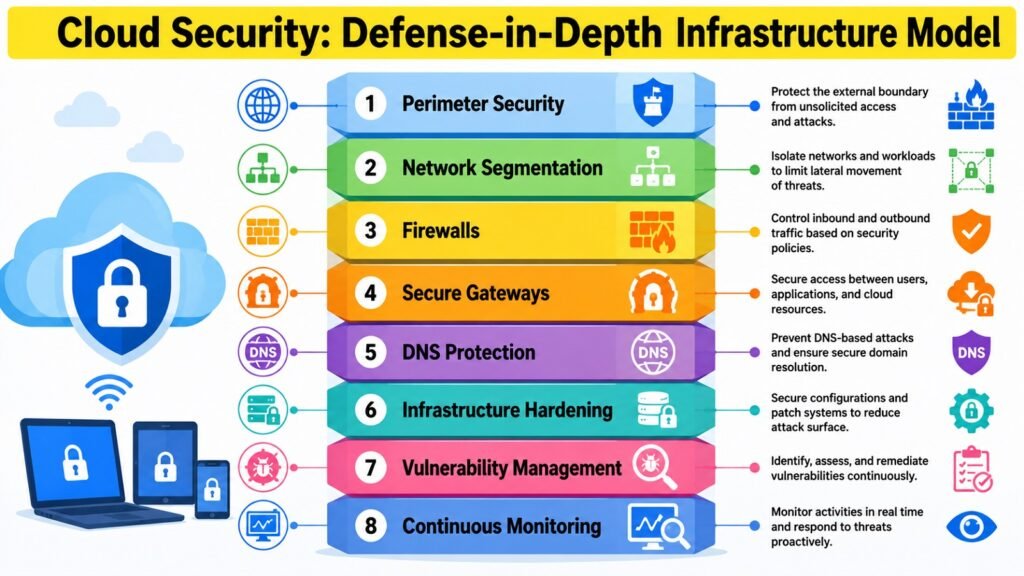
Cloud Security extends beyond applications and data to include the networking components and infrastructure that everything else depends on. The network is the path through which data travels, attacks arrive, and services communicate. Infrastructure is the foundation that all cloud services are built upon. Protecting both is essential to maintaining a resilient cloud environment.
Virtual private clouds allow organizations to create isolated network environments within public cloud platforms. By defining their own network boundaries, routing rules, and access controls, organizations gain considerably more control over how traffic flows, making isolation a fundamental building block of cloud network security.
Network segmentation divides cloud environments into smaller zones with controlled boundaries. When an attacker gains a foothold in one segment, segmentation makes it far harder to reach sensitive systems elsewhere. Firewalls enforce the rules governing what traffic can cross each boundary. Web application firewalls inspect HTTP traffic specifically to detect and block application-layer attacks such as SQL injection and cross-site scripting.
DDoS protection defends cloud environments against attacks designed to overwhelm infrastructure until legitimate services become unavailable. Organizations must configure these protections based on their own traffic patterns and risk profiles.
Infrastructure hardening involves removing unnecessary services, closing unused ports, disabling default credentials, and applying patches consistently. Each action removes a potential entry point or reduces the impact of exploitation if an attack does succeed. DNS security protects against hijacking and cache poisoning attacks that redirect traffic or exfiltrate data through legitimate-looking channels.
Vulnerability management involves continuously scanning for known weaknesses and prioritizing remediation based on actual risk. These controls are most effective when they work together rather than operating in isolation from one another.
Table 5: Cloud Security Infrastructure Controls and Their Primary Function
| Infrastructure Security Control | Primary Function |
| Virtual Private Cloud | Creates isolated network environments with controlled boundaries |
| Network Segmentation | Divides environments into zones to restrict attacker lateral movement |
| Firewall | Enforces access rules to filter traffic entering and leaving network zones |
| Web Application Firewall | Detects and blocks application-layer attacks targeting web services |
| DDoS Protection | Absorbs and mitigates traffic floods to maintain service availability |
| Infrastructure Hardening | Reduces attack surfaces by removing unnecessary services and applying patches |
| DNS Security | Protects against DNS-based attacks that redirect traffic or exfiltrate data |
| Vulnerability Management | Identifies and prioritizes remediation of known weaknesses across infrastructure |
5. Cloud Security Application and Workload Security: Protecting Modern Cloud Applications
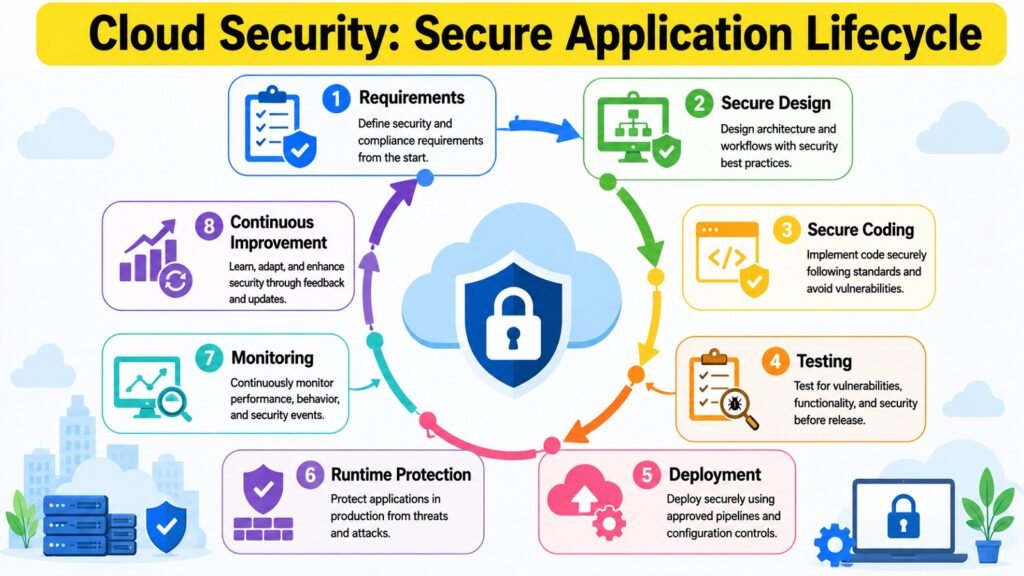
Cloud Security must protect modern applications across their entire lifecycle, from design and development through deployment and ongoing operations. Applications are frequently the primary target of attackers because they are the interface through which data is accessed, processed, and transmitted. Securing them is not a single event but a continuous process that must evolve alongside the applications themselves.
Secure software development integrates security thinking into every phase of the development lifecycle. Teams that identify and address security issues early find that fixing problems costs far less than discovering them after deployment. DevSecOps extends this idea by weaving security practices directly into development and operations workflows, making security a shared ongoing responsibility rather than a final checkpoint before release.
API security has grown in importance as modern cloud applications rely heavily on application programming interfaces to communicate with one another. Poorly protected APIs can expose sensitive data and serve as entry points for attackers. Protecting them requires authentication, authorization, rate limiting, input validation, and continuous monitoring.
Container security addresses the unique risks of containerized applications, which package code and dependencies into portable units that run across different environments. Kubernetes security extends these concerns to the orchestration layer that manages containers at scale. Serverless computing shifts the security focus toward function-level permissions, event source validation, and secure coding practices within individual functions.
Software supply chain security has grown prominent following incidents where attackers compromised widely used components to reach dependent organizations. Verifying the integrity of components and monitoring dependencies for known vulnerabilities is now standard in mature Cloud Security programs.
Runtime protection monitors application behavior during operation and can detect and block anomalous activity before it causes significant damage. Together, these practices protect not just the code but the entire environment in which applications run.
Table 6: Cloud Security Application and Workload Security Practices and Their Primary Benefit
| Security Practice | Primary Benefit |
| Secure Software Development | Identifies and resolves security issues early in the development process |
| DevSecOps | Integrates security into development and operations workflows continuously |
| API Security | Protects application interfaces from unauthorized access and exploitation |
| Container Security | Addresses risks specific to containerized application packaging and runtime |
| Kubernetes Security | Secures container orchestration infrastructure from configuration and access risks |
| Serverless Security | Manages function-level permissions and validates event sources |
| Software Supply Chain Security | Verifies the integrity and safety of software components and dependencies |
| Runtime Protection | Detects and blocks anomalous application behavior during live operations |
6. Cloud Security Threat Detection and Incident Response: Responding to Modern Cyber Threats
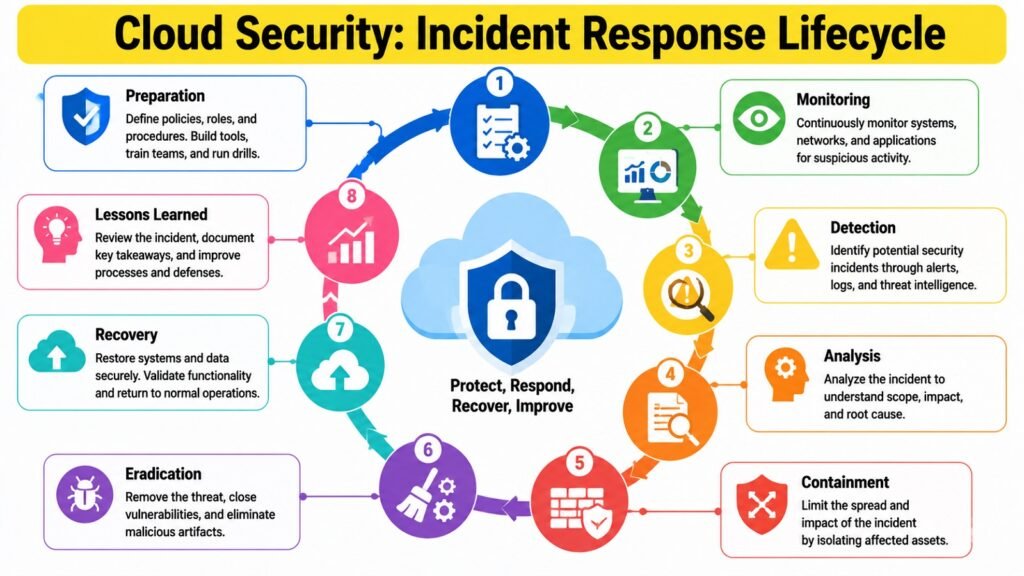
Cloud Security requires more than prevention. Preventing every attack is not realistic in environments as complex as modern cloud platforms. What organizations can realistically achieve is the ability to detect threats quickly, respond effectively, and minimize the impact of incidents. This capability separates organizations that suffer significant damage from those that contain and recover from attacks with limited disruption.
Security monitoring forms the backbone of effective threat detection. Continuous visibility across cloud environments allows security teams to identify unusual activity, investigate suspicious patterns, and respond before attackers cause widespread damage. Centralized logging collects event data from across the environment into a single location where it can be analyzed consistently and at scale.
SIEM systems aggregate and correlate log data from multiple sources to identify patterns that may indicate an attack or policy violation. SOAR platforms extend these capabilities by automating routine response actions so that security teams can handle higher volumes of alerts without being overwhelmed by repetition.
Behavioral analytics applies statistical analysis and machine learning to establish what normal activity looks like and then flags deviations that may indicate a threat. This is particularly valuable for detecting insider threats and sophisticated attackers who operate slowly to avoid triggering rule-based alerts.
Threat intelligence provides context about the tactics, techniques, and procedures used by known threat actors. Organizations that incorporate threat intelligence into their monitoring can often recognize attack patterns earlier and respond more precisely. Cloud-native monitoring tools offer visibility into infrastructure-level activity that complements traditional security systems.
Incident response planning defines in advance how an organization will respond when an incident occurs. Post-incident analysis and continuous improvement transform incidents into organizational learning that makes future responses faster and better coordinated.
Table 7: Cloud Security Threat Detection and Incident Response Capabilities
| Capability | Primary Purpose |
| Security Monitoring | Provides continuous visibility into activity across cloud environments |
| Centralized Logging | Aggregates event data to enable consistent and efficient analysis |
| SIEM | Correlates data from multiple sources to identify threat patterns |
| SOAR | Automates routine response actions to increase team efficiency |
| Behavioral Analytics | Detects deviations from normal patterns that may indicate threats |
| Threat Intelligence | Provides context on attacker tactics to improve detection and response |
| Cloud-Native Monitoring | Offers infrastructure-level visibility through platform-provided tools |
| Incident Response Planning | Defines coordinated processes for containing and recovering from incidents |
7. Cloud Security Governance, Risk, and Compliance (GRC): Strengthening Organizational Security
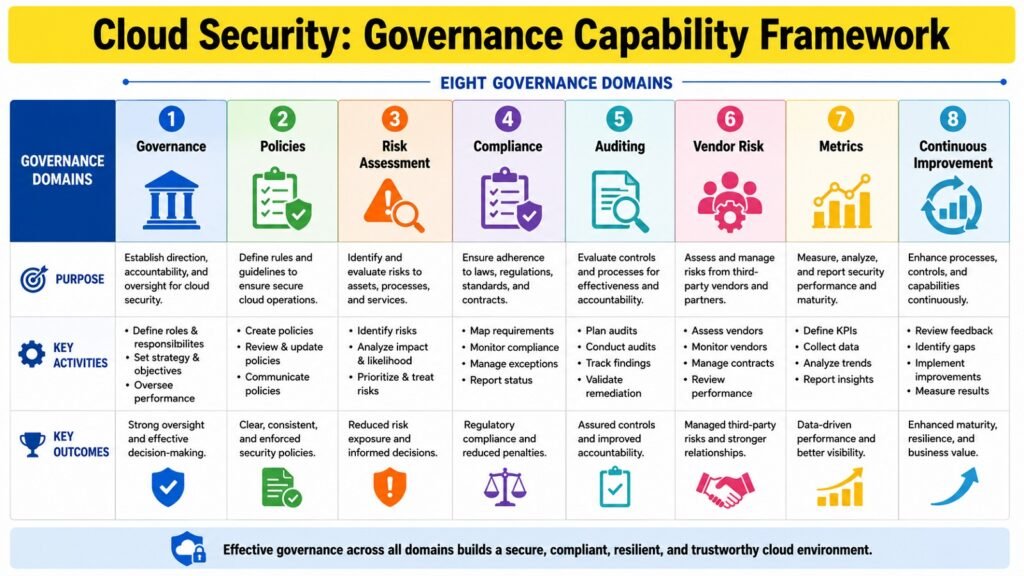
Governance, Risk, and Compliance provides the strategic foundation that aligns Cloud Security with organizational objectives, regulatory requirements, and business risk management. Without governance, security tends to function as a collection of disconnected technical controls rather than a coherent program. Governance gives Cloud Security structure, accountability, and the ability to demonstrate value to organizational leadership.
Governance frameworks define how security decisions are made and how accountability is maintained. Frameworks such as the NIST Cybersecurity Framework, ISO 27001, and the Cloud Security Alliance Cloud Controls Matrix provide widely recognized structures that organizations use to design and assess their Cloud Security programs. They represent accumulated knowledge about what effective security programs require.
Enterprise security policies translate governance objectives into the specific rules governing how cloud resources are used and protected. Policies that exist on paper but are not consistently implemented provide little real protection and can create dangerous false confidence in an organization’s actual security posture.
Risk assessment identifies the threats, vulnerabilities, and potential impacts most relevant to a specific organization’s cloud environment. Effective risk assessment connects technical findings to business impact, helping leadership understand which risks deserve the most attention and investment.
Compliance programs ensure that cloud environments meet requirements imposed by regulations such as GDPR, HIPAA, PCI DSS, and SOC 2, which carry real legal and reputational consequences for organizations that fall short. Continuous compliance monitoring automates the checking of whether configurations remain aligned as environments change.
Third-party risk management focuses on mitigating security risks posed by cloud providers, vendors, and external entities that have access to cloud environments. Security metrics and audit programs offer the necessary evidence to assess if a Cloud Security program is effectively providing the promised protection.
Table 8: Cloud Security Governance, Risk, and Compliance Activities
| GRC Activity | Primary Objective |
| Governance Frameworks | Provides structure and accountability for Cloud Security decision-making |
| Enterprise Security Policies | Translates governance objectives into enforceable operational rules |
| Risk Assessment | Identifies threats and vulnerabilities most relevant to the organization |
| Compliance Programs | Ensures cloud environments meet regulatory and industry requirements |
| Continuous Compliance Monitoring | Automates ongoing verification of compliance across dynamic cloud environments |
| Third-Party Risk Management | Addresses security risks from vendors and external parties with cloud access |
| Security Audits | Provides independent evidence of whether security controls are effective |
| Security Metrics | Measures program performance and drives continuous improvement |
8. Cloud Security Operations and Future Trends: Advancing the Future of Cloud Security
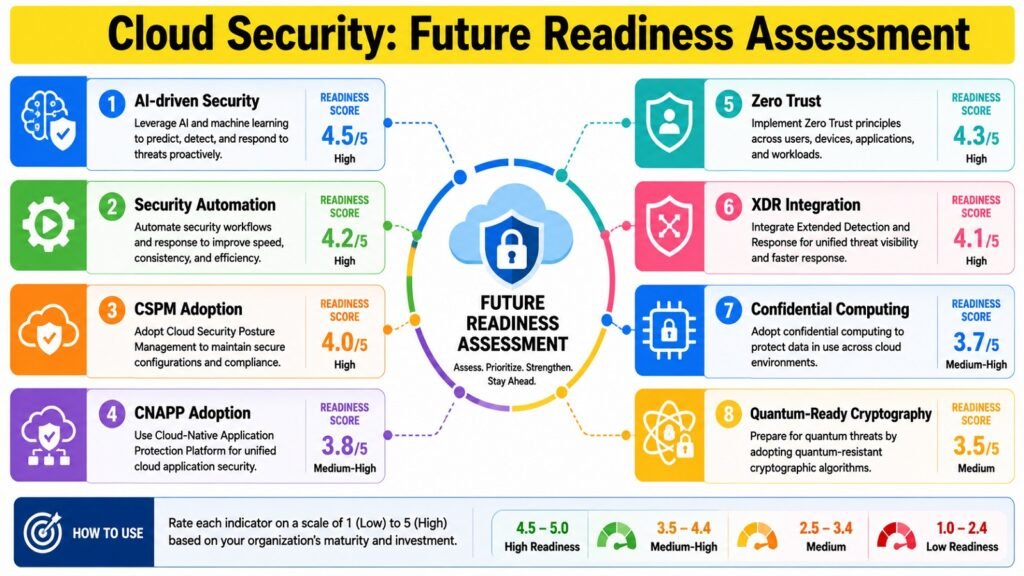
Cloud Security Operations ensure that security remains an active, ongoing process rather than a static state achieved once and then left in place. Cloud environments change constantly. New services are deployed, configurations drift, threats evolve, and business requirements shift. Effective security operations create the processes, tools, and organizational capabilities needed to keep pace with all of these changes.
Security Operations Centers dedicated to cloud environments bring together the people, processes, and technologies needed to monitor, detect, investigate, and respond to threats in real time. These teams combine automated tools with skilled analysts who contextualize alerts, recognize sophisticated attacks, and coordinate response effectively.
Cloud Security Posture Management, or CSPM, continuously evaluates cloud configurations against security best practices and compliance standards. CSPM tools identify misconfigurations, configuration drift, and policy violations before attackers can exploit them. Misconfiguration remains one of the most common causes of cloud security incidents, making CSPM one of the most directly valuable investments in operational security.
Cloud-Native Application Protection Platforms, known as CNAPP, integrate multiple cloud-specific security capabilities into a unified platform across the entire application lifecycle. Extended Detection and Response broadens threat detection by integrating data from endpoints, networks, cloud environments, and applications into one coordinated capability.
Artificial intelligence and machine learning are changing how security operations work at a fundamental level. AI-driven tools analyze enormous quantities of security data faster than human analysts can, identify subtle patterns that suggest an attack, and automate responses to common threats. Predictive security uses these capabilities to anticipate threats before they materialize.
Confidential computing protects data during processing in environments where underlying infrastructure may not be fully trusted. Quantum-resistant cryptography is drawing attention as quantum computing creates the theoretical possibility of breaking today’s encryption. Organizations that evaluate their cryptographic dependencies now will be better positioned to adapt when these threats become practical realities.
Table 9: Cloud Security Emerging Technologies and Future Trends
| Emerging Technology or Trend | Primary Significance |
| Cloud Security Posture Management | Continuously identifies misconfigurations and compliance gaps across cloud environments |
| CNAPP | Integrates cloud-native security capabilities across the full application lifecycle |
| Extended Detection and Response | Unifies threat detection across endpoints, networks, and cloud platforms |
| AI and Machine Learning | Enables faster detection of threats and automation of security responses |
| Predictive Security | Anticipates threats before they materialize using AI-driven behavioral analysis |
| Confidential Computing | Protects data during processing even in untrusted infrastructure environments |
| Zero Trust Evolution | Extends continuous verification principles across all cloud operations and access |
| Quantum-Resistant Cryptography | Prepares cloud encryption for the eventual capabilities of quantum computing |
Conclusion: Cloud Security for a Secure and Resilient Digital Future
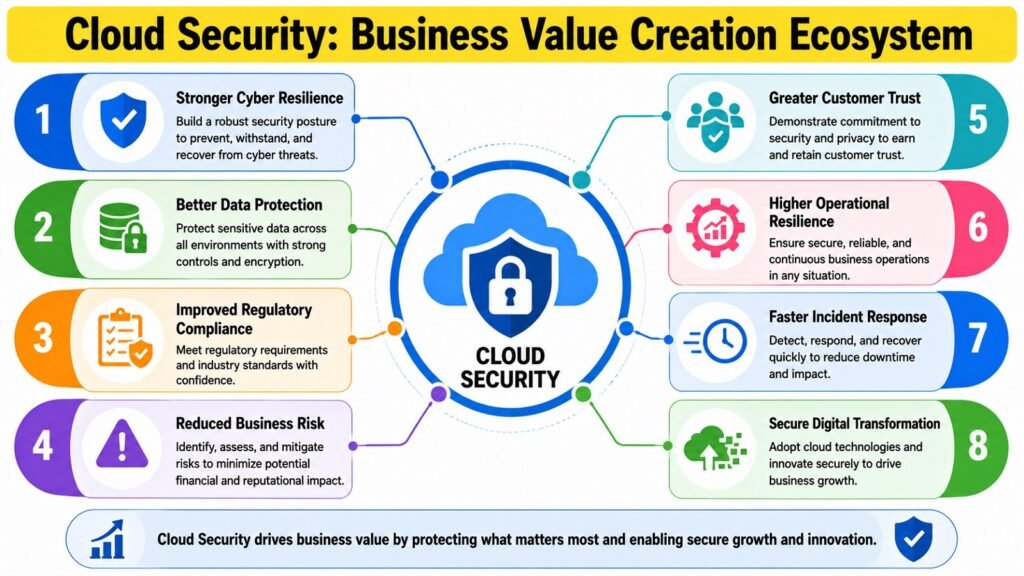
Cloud Security has grown from a specialized technical concern into a fundamental pillar of modern Cybersecurity strategy. It brings together architecture, identity management, data protection, infrastructure security, application security, threat detection, governance, and security operations into a unified approach that addresses the full scope of risk in today’s cloud-driven economy. No single component provides adequate protection alone. The real strength of Cloud Security comes from how these eight foundational areas reinforce one another.
Effective Cloud Security requires deliberate architectural planning, rigorous identity controls, comprehensive data protection, layered defenses, secure application development, continuous threat monitoring, principled governance, and sustained operational commitment. Organizations that treat any area as optional tend to discover their security posture is weaker than assumed.
The stakes are real. Cloud-based systems hold enormous amounts of sensitive personal, financial, healthcare, and operational data. Regulatory frameworks in virtually every major economy impose legal obligations on how that data must be protected. A significant Cloud Security failure carries financial, legal, reputational, and operational consequences that can take years to recover from.
Cloud Security is not primarily about fear. It is about building the trust and resilience that let organizations pursue their goals with confidence. A well-secured cloud environment enables faster innovation, more reliable services, and stronger relationships with customers and partners. Security done well is a competitive advantage.
The future of Cloud Security will be shaped by advances in artificial intelligence, the evolution of Zero Trust, and the growing integration of security into how cloud systems are designed and operated. Organizations that approach Cloud Security with commitment and the willingness to adapt continuously will be best positioned to thrive.
Table 10: Cloud Security Foundational Aspects and Their Contribution to Organizational Security
| Cloud Security Foundational Aspects | Primary Contribution |
| Architecture | Creates the secure structural foundation for all other security controls |
| Identity and Access Management | Controls access to cloud resources and enforces least privilege principles |
| Data Protection and Encryption | Safeguards sensitive information throughout every stage of its lifecycle |
| Network and Infrastructure Security | Protects connectivity and underlying systems from exploitation |
| Application and Workload Security | Secures software and services across development and operational phases |
| Threat Detection and Incident Response | Enables rapid identification and containment of cyber threats |
| Governance, Risk, and Compliance | Aligns security with organizational strategy and regulatory obligations |
| Security Operations and Future Trends | Sustains ongoing protection and prepares for emerging security challenges |