Table of Contents
Introduction: Understanding Market Environment in the Business Ecosystem
Every business operates inside an ecosystem it did not choose and cannot fully control. That ecosystem shapes everything from what customers buy to what a company can charge, from how easily a rival enters the market to how long a business survives a downturn. At the center of that business ecosystem sits the market environment, a broad and restless collection of external forces that leaders must understand if they want their organizations to survive, compete, adapt, and grow.
Many people assume business outcomes are mainly determined by internal factors: smart management, a strong product, or disciplined finances. These things matter. But internal strengths can only carry a company so far when external conditions are stacked against it. Organizations that read the market environment carefully and adjust their strategies have consistently outperformed those that do not. Those who ignored it have often paid dearly.
Think about why some businesses flourish during an economic slowdown while others collapse. Or why certain industries seem immune to new technology while others are upended overnight. The difference is rarely just execution. It is almost always rooted in how well a business understood and responded to its market environment.
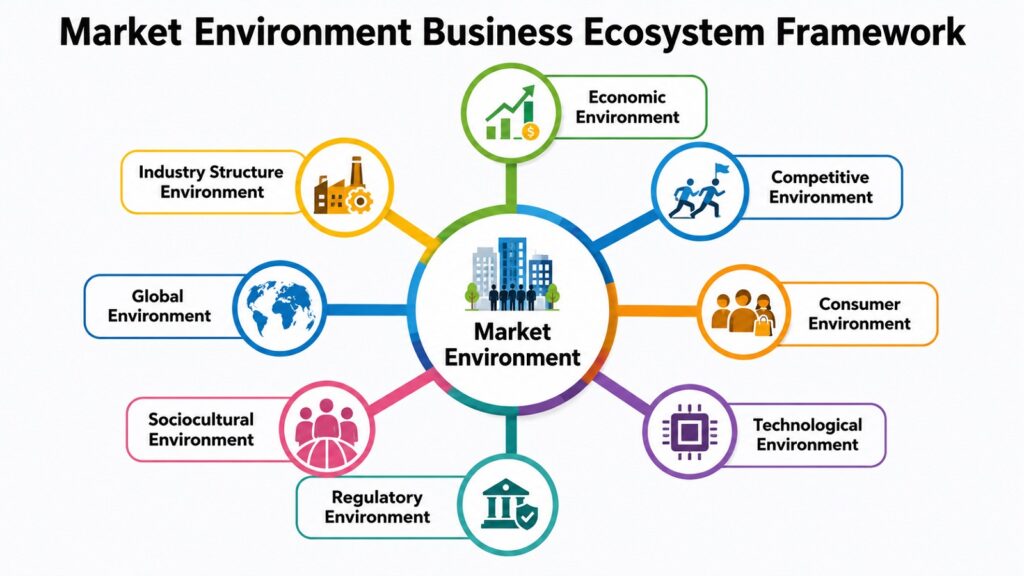
The market environment is not a single thing. It is a layered set of forces pushing and pulling on a business from outside. Economic conditions determine what consumers can afford. Competitive dynamics shape pricing and market share. Consumer behavior defines what people want and how they want to buy it. Technological change disrupts old ways of working while opening new ones. Regulatory shifts rewrite the rules. Sociocultural trends alter what people value. Global forces extend the scope of competition beyond local borders. Industry structure determines how easy or difficult it is to succeed in any particular market.
This article examines all eight of these forces. Each section explains what the force is, why it matters, and how businesses can think about it strategically. None operates in isolation, and a change in one area often triggers changes in several others. Together, they form the market environment that every business must navigate.
Table 1: Market Environment – Eight Forces and Their Business Influence
| Force | How It Shapes the Market Environment |
| Economic Conditions | Influence spending power, investment climate, and demand cycles |
| Competitive Dynamics | Drive pricing behavior, market positioning, and innovation pressure |
| Consumer Behavior | Determine product relevance, brand loyalty, and growth opportunities |
| Technological Change | Create disruption, open new channels, and shift cost structures |
| Regulatory Influence | Define legal boundaries, compliance costs, and market access rules |
| Sociocultural Shifts | Shape customer expectations, workforce values, and brand perception |
| Global Market Forces | Expand competitive scope, affect supply chains, and link distant markets |
| Industry Structure | Determine entry barriers, profit potential, and competitive intensity |
1. Market Environment and the Role of Economic Forces
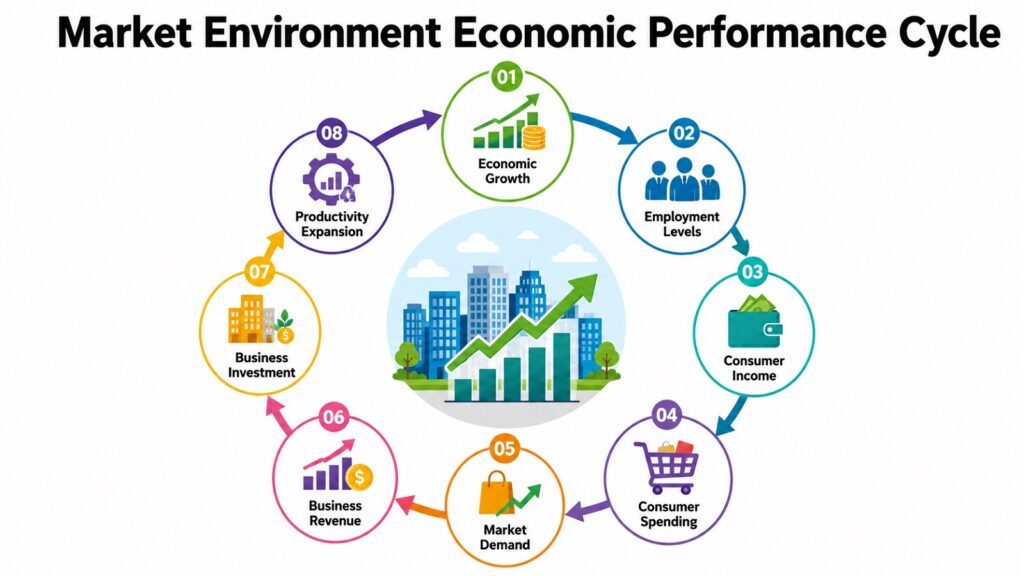
The economic environment is one of the most visible forces within the market environment. It affects virtually every business decision, from whether to expand operations to how to price products. Economic conditions do not stay still, and businesses that treat them as a backdrop rather than an active force tend to get caught off guard.
Economic growth is the clearest indicator. When an economy expands, consumer incomes rise, business confidence improves, and demand across many sectors strengthens. When growth slows or recession arrives, spending contracts, credit tightens, and businesses in discretionary sectors often see revenues fall first and fastest. The 2008 global financial crisis illustrated this clearly, as entire industries from housing to automotive to financial services contracted sharply within months of each other.
Inflation reshapes the market environment in significant ways. When prices rise, input costs for businesses increase. Raw materials, energy, labor, and logistics all become more expensive, compressing profit margins. At the same time, consumers feel the squeeze on purchasing power and cut back on non-essentials. Businesses in food, transport, and retail faced exactly these pressures when inflation surged across major economies in 2022 and 2023.
Interest rates set by central banks have wide-ranging effects. Higher rates raise borrowing costs for businesses and consumers. Companies delay capital investment, mortgage costs rise cooling housing markets, and sectors dependent on financing feel the effects most sharply. Low interest rates, by contrast, encourage borrowing and risk-taking, typically lifting activity across many industries.
Employment levels matter because workers with secure jobs spend with more confidence. High unemployment is a drag on consumer demand, especially for larger purchases. Monitoring leading economic indicators, such as employment figures, retail sales data, and consumer sentiment surveys, gives businesses early signals about where conditions are heading. Companies that incorporate economic scenario planning are better positioned to adjust pricing, manage inventory, and make sound investment decisions across different economic cycles.
Table 2: Market Environment – Economic Factors and Their Business Impact
| Economic Factor | Business Impact |
| GDP Growth Rate | Signals demand strength and investment opportunity across sectors |
| Inflation | Raises input costs and reduces consumer purchasing power |
| Interest Rates | Affects borrowing costs, capital investment, and consumer credit |
| Employment Levels | Shapes consumer confidence and overall spending capacity |
| Consumer Spending | Directly drives revenue for businesses selling to households |
| Exchange Rates | Influences import costs and international revenue conversion |
| Business Confidence | Affects hiring, expansion plans, and capital expenditure timing |
| Commodity Prices | Impacts production costs across manufacturing and energy sectors |
2. Market Environment and Competitive Dynamics
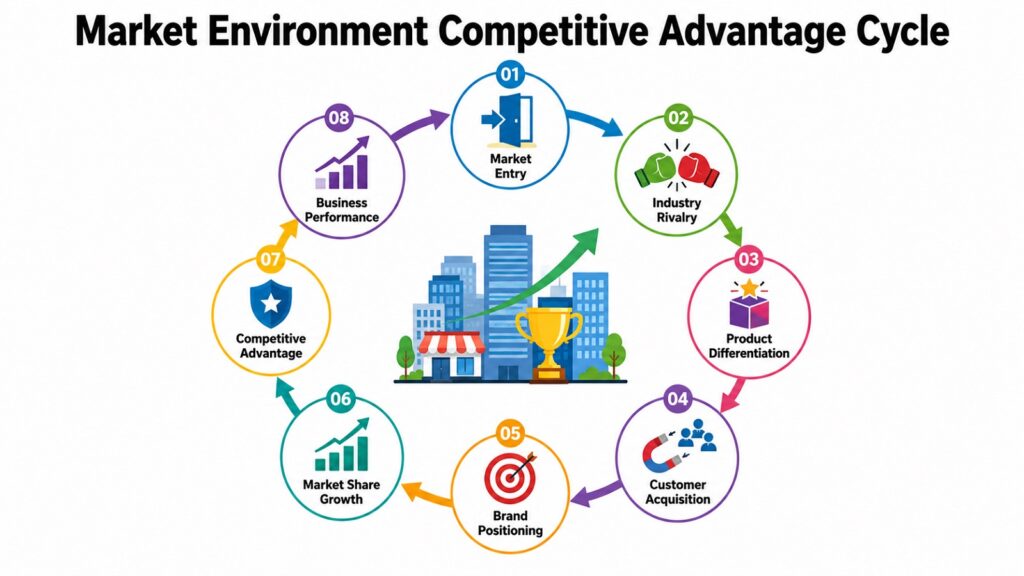
Competition shapes the market environment in ways businesses feel every day. It determines what price a company can reasonably charge, how hard it must work to attract customers, and whether the market it operates in offers breathing room or constant pressure. Understanding competitive dynamics is not simply about knowing the direct rivals. It also involves indirect competitors, substitute products, and potential new entrants.
Direct competitors are the most obvious pressure. Two airlines on the same route, two supermarket chains on the same street, two software firms serving the same client base, they all fight for the same customers. Price competition can be intense, and businesses often pursue differentiation through service quality, product features, or brand reputation rather than cutting prices endlessly.
Indirect competition is subtler but equally important. A restaurant competes not only with other restaurants but with ready meals from supermarkets, food delivery services, and any other way a consumer might spend their leisure budget. Businesses that define competition too narrowly often miss threats building quietly at the edge of their market.
Substitute products carry particular risk within the market environment. The rise of streaming services did not just challenge other streaming platforms. It disrupted physical media, pay television, and cinema attendance simultaneously. Businesses that relied on established formats had to rethink their entire value proposition. Barriers to entry, including high capital requirements, regulatory approvals, or strong brand loyalty, provide some insulation from constant new competition.
Competitive intelligence, the systematic monitoring of rival activity, is an essential practice. Tracking competitor pricing, product launches, hiring patterns, and public statements provides a clearer picture of where the competitive landscape is shifting. Businesses that invest in this kind of ongoing analysis are rarely surprised by competitive moves that more alert observers saw building over time.
Table 3: Market Environment – Competitive Factors and Their Influence on Businesses
| Competitive Factor | Influence on Businesses |
| Direct Rivals | Drive price competition and force continuous product differentiation |
| Indirect Competitors | Expand the competitive threat beyond the core industry boundary |
| Substitute Products | Shift consumer spending and reduce demand for existing offerings |
| Barriers to Entry | Protect existing players from new entrants and market fragmentation |
| Market Rivalry Intensity | Determines how aggressively businesses must compete for share |
| Competitive Advantages | Enable premium pricing, higher margins, or stronger customer loyalty |
| Competitor Innovation | Pressures firms to accelerate product development and service upgrades |
| Market Concentration | Influences pricing power and the balance of competitive control |
3. Market Environment and Consumer Behavior Trends
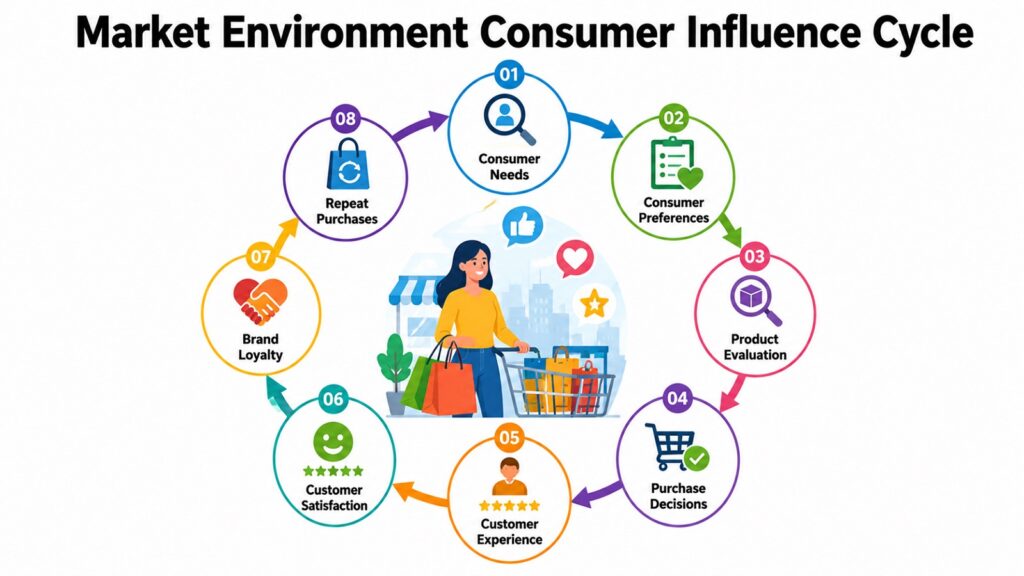
Consumer behavior is central to the market environment. Businesses are established to cater to customers, and if they misinterpret customer desires or purchasing methods, no level of operational efficiency can rescue them. Consumer preferences are not static. They evolve with shifting demographics, economic challenges, cultural trends, and technological advancements, and companies that do not adapt risk becoming irrelevant.
Demographic changes are among the most powerful and predictable drivers of consumer trends. As populations age in developed markets, demand rises for healthcare, retirement services, and convenience products. Younger consumers, particularly millennials and Generation Z, have grown up with digital technology and expect seamless digital experiences, fast delivery, and brands that reflect their values. Businesses that design products and marketing around the dominant demographic groups in their target markets consistently find themselves better positioned.
Purchasing habits have changed dramatically over the past decade. E-commerce has shifted enormous retail spending online, forcing traditional retailers to invest in digital channels. Subscription models changed how consumers think about ownership versus access. Mobile commerce compressed the purchase decision into seconds. Businesses that understood these shifts early, like Amazon in retail or Spotify in music, reshaped their industries. Those that clung to old formats, like Blockbuster in video rental, did not survive.
Brand perception and customer expectations are critical elements within the market environment. Consumers today have access to vast amounts of peer review data, and a poor experience can spread through social media far more quickly than in earlier decades. Gathering customer insights through surveys, social listening, and purchase data gives businesses the intelligence needed to stay aligned with what customers actually want, adapting before a gap in understanding becomes a competitive vulnerability.
Table 4: Market Environment – Consumer Factors and Their Business Implications
| Consumer Factor | Business Implication |
| Demographic Shifts | Change the size and composition of target markets over time |
| Purchasing Habits | Determine preferred channels, formats, and payment methods |
| Brand Perception | Drives loyalty, repeat purchase rates, and price tolerance |
| Customer Expectations | Set the service and quality standards a business must meet |
| Digital Behavior | Shifts demand to online channels and shortens decision cycles |
| Value Consciousness | Increases pressure on pricing and perceived product value |
| Lifestyle Changes | Create new demand categories and reduce relevance of old ones |
| Social Influence | Amplifies word-of-mouth and accelerates brand wins or losses |
4. Market Environment and Technological Change
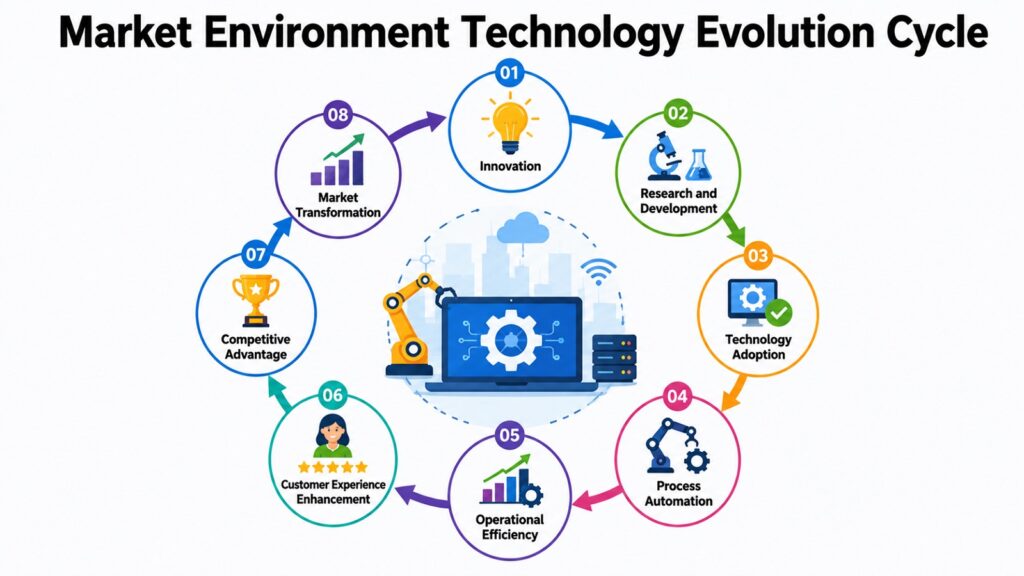
Technological change reshapes the market environment faster than almost any other force. It creates new industries, destroys old ones, and rewrites competition rules within existing ones. Businesses that embrace relevant technologies early gain advantages in efficiency, customer experience, and market reach. Those that move too slowly often find their position eroded by competitors willing to invest before the returns are certain.
Digital transformation has been the defining technological theme of the past two decades. Banks moved significant operations online, reducing branch needs while lowering cost-to-serve ratios. Healthcare providers adopted telemedicine platforms, a shift greatly accelerated by the COVID-19 pandemic. Retailers built sophisticated e-commerce and supply chain systems enabling them to fulfill orders with speed that was unthinkable a generation earlier.
Artificial intelligence and machine learning are increasingly embedded in operations, from customer service automation to predictive inventory systems to personalized recommendations. These technologies allow businesses to analyze large data volumes quickly, identify patterns humans would miss, and automate repetitive tasks. Businesses using AI effectively tend to serve customers better, waste fewer resources, and respond to market changes faster.
Cloud computing has democratized access to sophisticated technology, allowing businesses of all sizes to access scalable computing power on a subscription basis rather than through expensive upfront investment. Automation continues reshaping production lines and logistics networks. Emerging technologies such as advanced robotics, biotechnology, and clean energy systems are opening new market opportunities while threatening incumbents in established industries. Monitoring the technology landscape is a strategic necessity that should directly inform product development plans and long-range planning.
Table 5: Market Environment – Technological Trends and Their Business Impact
| Technology / Trend | Business Impact |
| Digital Transformation | Reshapes operating models, channels, and customer engagement |
| Artificial Intelligence | Improves decision speed, personalization, and cost efficiency |
| Cloud Computing | Lowers infrastructure costs and enables rapid business scaling |
| Automation | Reduces labor intensity and increases production consistency |
| Data Analytics | Provides actionable insight from customer and operational data |
| Mobile Technology | Expands consumer access and accelerates purchase decisions |
| Cybersecurity | Protects business assets and builds essential customer trust |
| Emerging Technologies | Create new market categories and challenge existing business models |
5. Market Environment and Regulatory Influence
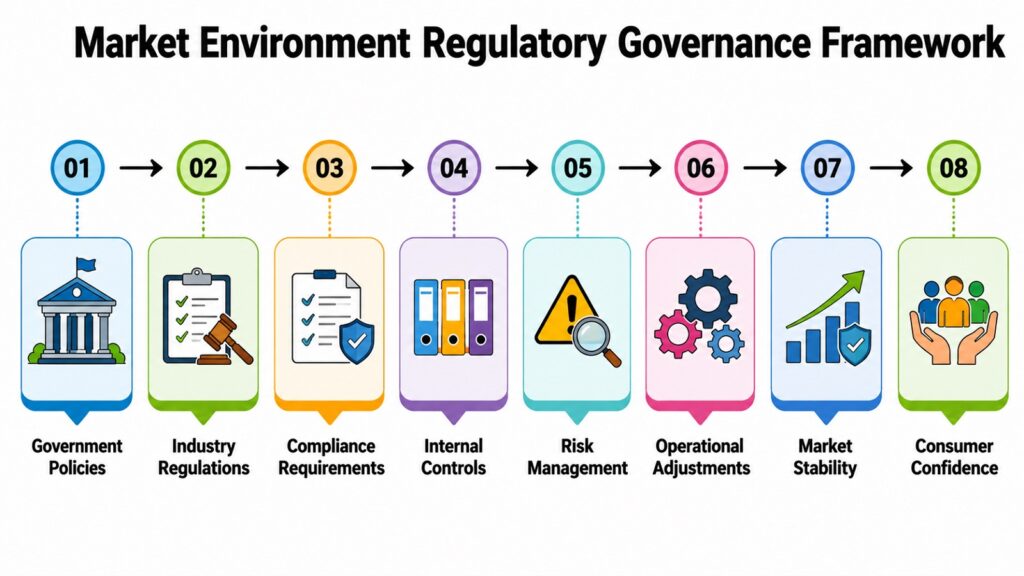
Laws, regulations, and government policies form a significant layer of the market environment. They determine what businesses can do, how they must operate, what they must disclose, and what standards they must meet. Regulation is not simply a cost of doing business. It shapes markets fundamentally, protecting consumers, enabling fair competition, and sometimes creating entirely new demand categories.
Compliance requirements have grown substantially across most industries. The European Union’s General Data Protection Regulation forced companies worldwide to rethink how they collect, store, and use customer data. Financial services firms face extensive oversight of lending practices, capital adequacy, and risk management. Food and pharmaceutical companies must meet stringent safety standards. The compliance burden can be significant, but businesses that manage it well often earn a degree of customer trust that less-regulated competitors cannot match.
Taxation policy directly affects profitability and competitive dynamics. Changes in corporate tax rates, import tariffs, or value-added taxes can shift advantages between domestic and international players. Labor regulations governing minimum wages, working conditions, and employee rights shape operating costs and workforce management. Competition law prevents monopolistic behavior and ensures markets remain open enough for businesses to compete fairly.
Environmental standards are a growing force. Requirements around emissions, waste disposal, packaging, and energy efficiency are becoming stricter in many markets, adding costs for some while opening opportunities for those offering cleaner technologies. Consumer protection rules shape advertising, pricing, and complaints handling. Businesses taking a proactive approach to regulatory compliance rather than simply reacting to enforcement tend to face fewer disruptions, carry less legal risk, and build stronger reputations supporting long-term growth.
Table 6: Market Environment – Regulatory Areas and Their Business Significance
| Regulatory Area | Business Significance |
| Data Protection | Governs how customer data is collected, stored, and processed |
| Environmental Standards | Sets compliance costs and creates demand for sustainable solutions |
| Labor Regulations | Shapes wage costs, workforce management, and employment practices |
| Competition Law | Prevents monopolistic behavior and protects market openness |
| Taxation Policy | Directly affects profitability, pricing, and investment decisions |
| Consumer Protection | Defines advertising standards, product safety, and redress rights |
| Industry-Specific Rules | Imposes sector requirements on finance, healthcare, and food industries |
| Trade Regulations | Determines import duties, export restrictions, and trade access |
6. Market Environment and Sociocultural Shifts
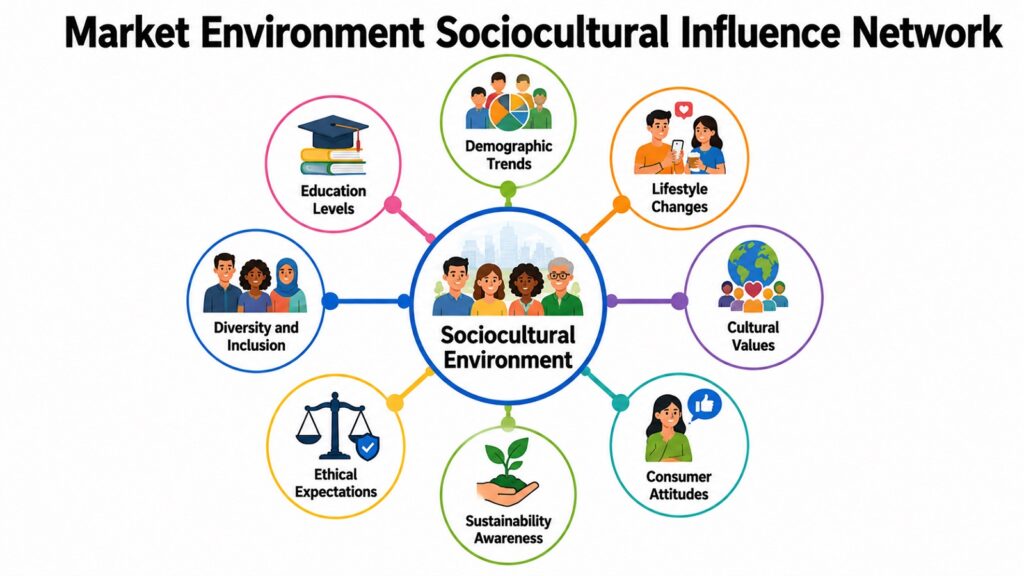
The social and cultural environment is one of the more gradual forces shaping the market environment, but its effects can be profound and lasting. Societal values evolve, norms shift, and what people expect from the businesses they deal with changes over time. Companies that respond thoughtfully often find new opportunities. Companies that ignore these shifts can find themselves on the wrong side of consumer opinion in ways that are very difficult to reverse.
Sustainability has become one of the most significant sociocultural forces in recent years. Consumers across many markets are concerned about climate change, resource depletion, and environmental impact. They pay more attention to where products come from, how they are made, and what happens to them at the end of life. Businesses integrating genuine sustainability commitments into their operations have strengthened their brand positioning and, in some cases, commanded pricing premiums. Unilever and Patagonia are frequently cited as companies that made sustainability central to their identity with positive business outcomes.
Diversity and inclusion have moved from fringe concerns to mainstream expectations. Consumers pay attention to how businesses treat employees, the diversity of leadership, and whether marketing reflects their full customer base. Businesses that lag on these dimensions risk reputational damage, while those that lead often find it easier to attract talent and build loyalty.
Generational differences are reshaping expectations across every industry. Younger consumers favor experiences over possessions, value authenticity over traditional advertising, and tend to research a company’s ethical record before purchasing. Lifestyle changes such as remote working, health consciousness, and shifting food preferences have created new market categories while eroding others. Businesses staying close to social trends through ongoing consumer research are far better positioned to adapt as expectations continue evolving.
Table 7: Market Environment – Sociocultural Factors and Their Impact on Businesses
| Sociocultural Factor | Impact on Businesses |
| Sustainability Expectations | Drive product reformulation, eco-packaging, and ethical sourcing |
| Diversity and Inclusion | Shape hiring practices, marketing content, and brand perception |
| Generational Differences | Alter product preferences, channel usage, and brand values |
| Health Consciousness | Expand demand for wellness products and reformulated offerings |
| Ethical Consumerism | Reward transparent, responsible brands with stronger loyalty |
| Urbanization Trends | Shift demand toward convenience, mobility, and compact living |
| Changing Family Structures | Alter household spending patterns and product category demand |
| Social Media Culture | Accelerates brand exposure and amplifies reputation outcomes |
7. Market Environment and Global Market Forces
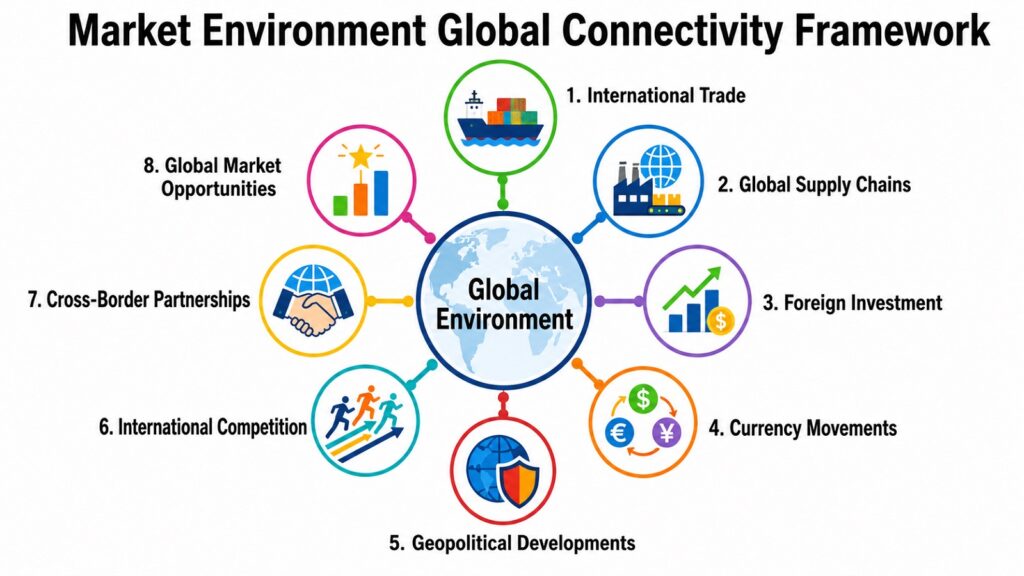
Globalization has extended the reach of the market environment well beyond national borders, and even businesses operating entirely within a single country are affected by what happens in markets around the world. Global supply chains, international trade flows, currency movements, and geopolitical developments create conditions that ripple across industries in ways that can be rapid and difficult to anticipate.
International trade serves as a fundamental component of the global market landscape. Trade agreements facilitate the opening of new export markets and reduce the expenses associated with imported inputs. Conversely, disputes and tariffs increase costs, disrupt supply chains, and compel businesses to seek alternative suppliers or markets. The escalating trade tensions between the United States and China, which began in 2018, have had extensive repercussions on manufacturing supply chains, semiconductor availability, and pricing across numerous industries beyond those that were directly affected.
Global supply chains have provided significant efficiency improvements by enabling businesses to procure inputs from locations where they can be produced at the lowest cost. However, the COVID-19 pandemic revealed the vulnerabilities inherent in these highly optimized systems. Shortages of semiconductors, shipping containers, and essential manufactured goods resulted in disruptions that persisted for years, prompting businesses to reconsider the extent of supply chain concentration risk they were willing to accept. As a result, many companies have since established more diversified and regionally distributed networks.
Currency movements affect both costs and revenues for businesses with international exposure. A strengthening home currency makes exports more expensive in foreign markets; a weakening one raises import costs. Geopolitical developments, including conflicts, elections, sanctions, and diplomatic shifts, can alter conditions with very little warning. Cross-border competition means domestic businesses often face rivals with different cost structures or government support. Staying aware of global developments is no longer optional for businesses seeking to understand the full scope of their market environment.
Table 8: Market Environment – Global Market Factors and Their Business Effects
| Global Market Factor | Business Effect |
| International Trade Policy | Opens or restricts market access and reshapes cost structures |
| Global Supply Chains | Offers cost efficiency but introduces geographic risk exposure |
| Currency Fluctuations | Affects import costs, export competitiveness, and reported earnings |
| Geopolitical Developments | Create sudden market disruptions, trade barriers, or new risks |
| Foreign Direct Investment | Signals where capital is flowing and which markets are expanding |
| Cross-Border Competition | Expands the competitive field beyond domestic rival firms |
| Global Consumer Trends | Spread market shifts quickly across borders and industries |
| International Regulations | Add compliance layers for businesses operating across jurisdictions |
8. Market Environment and Industry Structure Conditions
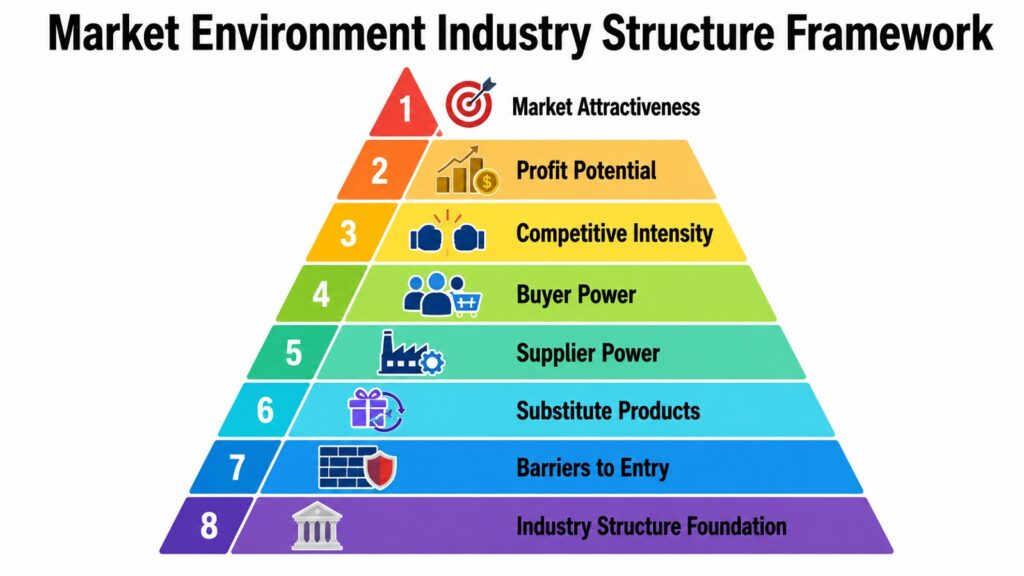
Industry structure describes the underlying architecture of a market, the arrangement of buyers, sellers, competitors, and suppliers that determines how profitable it is to operate there. Understanding industry structure is a foundational part of reading the market environment, because it shapes strategic options and determines whether a particular market is genuinely attractive for investment and growth.
Barriers to entry are among the most important structural features of any industry. High barriers, whether from capital requirements, regulatory approvals, proprietary technology, economies of scale, or strong brand loyalty, protect incumbent businesses from a constant stream of new competition. The pharmaceutical industry is a clear example, where the cost and time required to develop, test, and gain approval for a new drug create barriers most potential entrants cannot overcome. Low barriers allow new competitors to enter easily, compressing margins and intensifying rivalry.
Supplier power and buyer power define how much leverage other parties in a value chain hold over a business. When a business relies on a small number of specialized suppliers for critical inputs, those suppliers can exert significant pricing power. When it sells primarily to a few large buyers, those buyers hold considerable negotiating leverage. Both conditions squeeze margins and reduce strategic flexibility. Substitute products represent an additional structural threat, because even a firm with no direct competitors can see its market undermined if customers find alternative ways to meet the same need.
Market maturity influences both the growth available and the nature of competition. In young, growing markets, competition focuses on gaining customers and establishing a position. In mature markets, growth slows and competition shifts toward cost efficiency and retention. Industry concentration, the extent to which a few large players dominate, affects pricing power, innovation rates, and competitive intensity. Businesses that analyze industry structure carefully before committing to a market are far better positioned to set realistic expectations, allocate resources wisely, and build strategies aligned with the actual structural conditions of their market environment.
Table 9: Market Environment – Industry Structure Factors and Their Significance
| Industry Structure Factor | Significance |
| Barriers to Entry | Protect incumbent firms and determine how often new rivals appear |
| Supplier Power | Affects input cost control and supply chain strategic flexibility |
| Buyer Power | Influences pricing, margins, and product development priorities |
| Substitute Products | Threaten market share even when direct competition is limited |
| Market Rivalry Intensity | Determines how aggressively firms must compete to retain position |
| Industry Concentration | Shapes pricing power and the balance of competitive influence |
| Market Maturity | Signals available growth rates and appropriate competitive strategies |
| Profitability Structure | Determines the long-term attractiveness of operating in a sector |
Conclusion: Building Business Success Through Market Environment Awareness
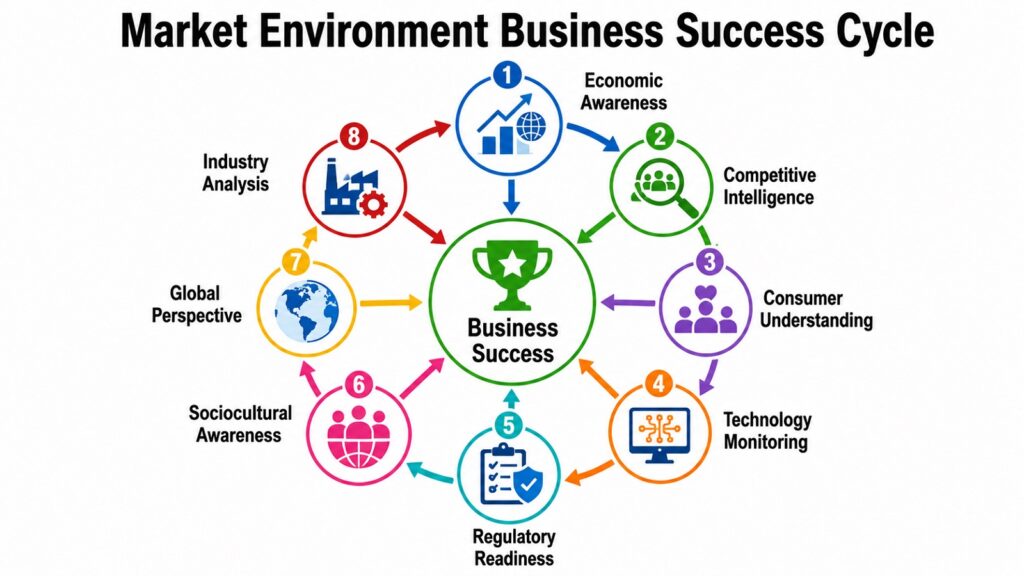
The market environment is not something a business can study once and then set aside. It is a living system, constantly shifting, regularly surprising, and rewarding those who pay close attention while punishing those who assume yesterday’s conditions will hold tomorrow. Every force examined in this article contributes to the overall picture a business must navigate, and that picture is always changing.
What makes the market environment particularly demanding is that none of these forces operates independently. An interest rate increase affects not just the cost of capital but also consumer confidence, housing activity, and investment timelines. A major technological shift can alter consumer behavior, change competitive dynamics, attract regulatory attention, and reshape industry structure at the same time. Sociocultural shifts influence what consumers want, which in turn affects what competitors offer, which drives further technological investment. The forces interact and amplify each other in ways that accelerate change well beyond what any single factor alone would suggest.
This interconnectedness is why businesses monitoring the market environment only occasionally are often caught off guard. A company that tracks economic indicators but ignores sociocultural trends may find a technically sound product failing to connect with consumers whose values have shifted. A company watching competitors closely but underestimating the regulatory environment may face compliance disruptions just as it tries to grow.
The most resilient companies regard awareness of the market environment as a fundamental strategic capability. They establish processes for ongoing environmental scanning, frameworks for integrating external intelligence into their decision-making, and foster cultures that embrace change. They allocate resources to scenario planning, ensuring that their strategies are effective across various potential futures rather than solely under present circumstances. They recognize the necessity of routinely testing the assumptions underlying any strategic plan against an evolving reality.
The eight forces examined here, economic conditions, competitive dynamics, consumer behavior, technological change, regulatory influence, sociocultural shifts, global market forces, and industry structure, collectively define the terrain on which every business competes. Some of that terrain will always be difficult. Some will always be shifting. But businesses that understand it, study it carefully, and build strategies genuinely accounting for it carry a meaningful and durable advantage. In a world where markets change faster than ever before, that advantage may be the most valuable thing any business can develop.
Table 10: Market Environment – Eight Forces and Key Strategic Takeaways
| Market Environment Force | Key Strategic Takeaway |
| Economic Conditions | Monitor economic indicators continuously and plan across multiple scenarios |
| Competitive Dynamics | Invest in competitive intelligence and respond to market shifts early |
| Consumer Behavior | Stay close to customers and adapt offerings as their expectations change |
| Technological Change | Embrace relevant technologies early to gain efficiency and market reach |
| Regulatory Influence | Treat compliance proactively as a trust-building and risk-reducing tool |
| Sociocultural Shifts | Align brand values with evolving social expectations and lifestyle trends |
| Global Market Forces | Diversify supply chains and monitor global developments for early signals |
| Industry Structure | Analyze structural conditions before committing to growth investments |