Table of Contents
Introduction: Cost Leadership — Understanding the Strategy
Few concepts in competitive strategy carry as much explanatory power as Cost Leadership. Michael Porter introduced it as one of three generic competitive strategies in Competitive Strategy (1980). It remains strategically relevant because competition has intensified, margin pressure has grown, and cost advantages have become harder to sustain.
Cost Leadership is one of the most important strategies for attaining a sustained competitive advantage, yet it is frequently misunderstood. It is not about charging the lowest price, and it is not about cutting expenses indiscriminately. Companies that treat cost reduction as a proxy for Cost Leadership often weaken quality, erode supplier relationships, and undermine the customer value that justifies their market position.
Genuine Cost Leadership means creating a structurally favorable cost position relative to competitors. A company in this position delivers comparable value at lower cost than rivals, enabling it to compete on price when needed, protect margins when prices hold, or reinvest savings into capabilities. That advantage emerges from a coherent pattern of strategic choices across the value chain, not from any single initiative.
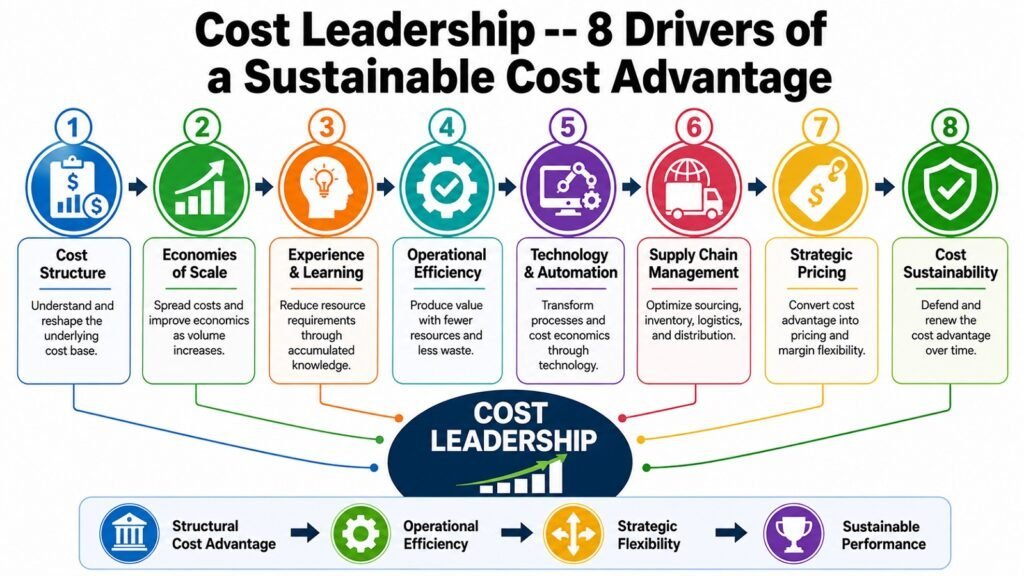
Porter’s value-chain framework establishes that competitive advantage originates in specific activities. Differences in relative cost position trace back to how activities are designed, coordinated, and executed. A company achieves Cost Leadership when its activity system generates lower total costs than rivals while maintaining adequate customer value. This article develops that argument across eight interconnected cost drivers, combining established theory, economic concepts, empirical research, real-world evidence, and practical tools.
Table 1: Cost Leadership — Eight Drivers and Their Strategic Role
| Cost Leadership Driver | Strategic Role |
| Cost Structure | Identifies where costs originate and reveals the foundations of structural cost advantage |
| Economies of Scale | Reduces average unit costs as output increases, strengthening relative cost position |
| Experience and Learning | Lowers resource requirements over time through accumulated knowledge and improvement |
| Operational Efficiency | Converts cost potential into actual performance through productivity and waste reduction |
| Technology and Automation | Alters activity economics by reducing labor, errors, and processing costs at scale |
| Supply Chain Management | Extends cost advantage into procurement, logistics, and distribution networks |
| Strategic Pricing | Translates cost position into market-level competitive advantage and strategic flexibility |
| Cost Sustainability | Determines whether cost advantage is structural, defensible, and capable of adapting over time |
1. Cost Leadership and Cost Structure
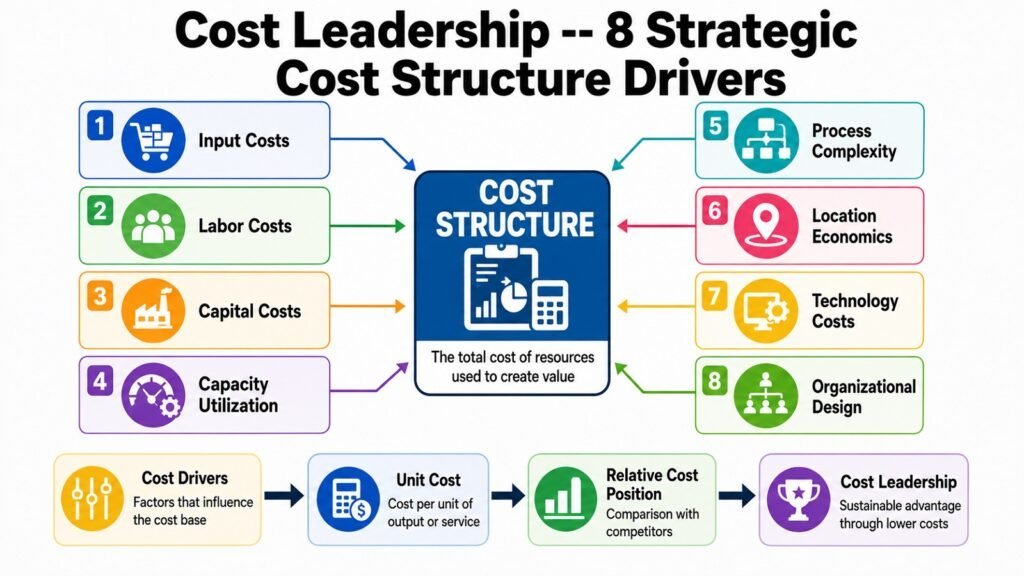
Sustainable cost advantage begins with understanding where costs originate. Cost Structure describes how a company distributes its total cost across activities, assets, inputs, and organizational choices. Without this clarity, cost management becomes reactive, targeting visible expenses rather than the underlying mechanisms that drive cost behavior.
Fixed costs remain constant regardless of volume and create leverage as production grows, spreading that burden across more units. Variable costs move with output and reflect input prices, process efficiency, and material choices. Unit cost captures how efficiently inputs become outputs and is the most direct indicator of cost position. Porter’s value-chain perspective adds a crucial insight: two companies performing identical activities can carry structurally different costs depending on how those activities are designed, integrated, and managed.
Several factors shape cost structure in strategically significant ways. Scale determines fixed-cost absorption. Capacity utilization affects whether installed assets earn their keep. Location influences labor, logistics, and regulatory expenses. Organizational design determines overhead accumulation. Process choices drive throughput and rework costs. Each is a deliberate strategic decision with compounding effects across the value chain.
Walmart illustrates the strategic consequences. Its cost structure reflects decades of aligned choices in real estate, supplier terms, logistics, and technology. Competitors have found it structurally difficult to replicate because the entire system produces simultaneous advantages across multiple cost categories, not because any single element is uncopiable.
A lower cost structure is strategically valuable only when it does not sacrifice quality, capability, or customer value. Managers should map activities by share of total cost, examine how costs behave under different volume scenarios, and determine which differences between their company and competitors are structural rather than temporary.
Table 2: Cost Leadership — Eight Cost-Structure Factors and Their Strategic Relevance
| Cost-Structure Factor | Strategic Relevance to Cost Leadership |
| Fixed vs. variable cost mix | High fixed-cost structures benefit more from volume increases through leverage and dilution effects |
| Capacity utilization rate | Underutilization raises unit fixed costs; optimal utilization strengthens cost position versus rivals |
| Activity-level cost drivers | Identifies which value-chain activities generate disproportionate cost and where intervention matters most |
| Input price exposure | Dependency on volatile inputs increases cost variability and weakens structural stability over time |
| Overhead allocation patterns | Inefficient support functions inflate indirect cost and obscure the true cost of productive activities |
| Process complexity | Higher complexity raises coordination costs, error rates, and indirect overhead across operations |
| Location and geography | Labor, logistics, regulatory, and proximity costs vary significantly and shape structural differences |
| Business-model configuration | Asset-light versus capital-intensive models produce fundamentally different cost structures and margin profiles |
2. Cost Leadership and Economies of Scale
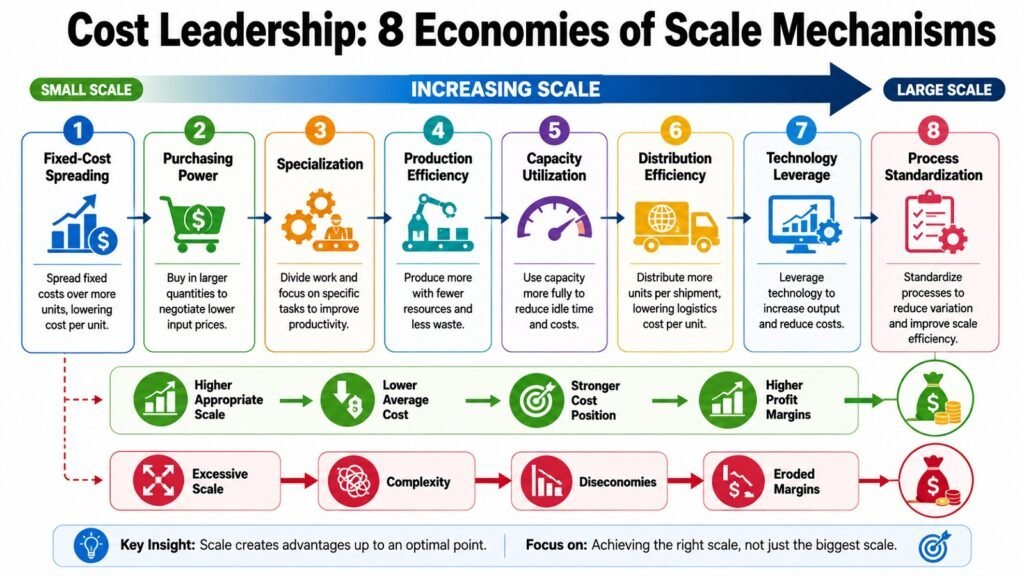
Economies of Scale are among the most powerful mechanisms that can create and reinforce Cost Leadership. The economic principle is that as output increases, fixed costs are distributed over more units, reducing average cost per unit. The strategic implications, however, are considerably more nuanced than this basic relationship suggests.
Scale operates through several distinct mechanisms. Fixed-cost dilution spreads infrastructure and capital investments across higher volumes. Purchasing power allows larger buyers to negotiate lower input prices and better terms. Specialization at higher volumes enables narrower tasks that reduce error rates and improve throughput. Logistics networks, distribution centers, and digital platforms carry high fixed costs but serve incremental volume at low marginal cost, compressing per-unit delivery expenses for larger operators.
Amazon illustrates scale dynamics well. Its fulfillment network and technology infrastructure carry enormous fixed costs that become progressively more efficient as transaction volume grows. Competitors attempting to replicate that infrastructure at smaller scale face a structural cost disadvantage that compounds over time.
An important strategic question arises: does scale create Cost Leadership, or does Cost Leadership enable greater scale? The relationship operates in both directions. A lower cost position supports competitive pricing, which attracts higher volume, which further reduces unit costs. This self-reinforcing dynamic explains why early cost advantages can become entrenched and difficult for later entrants to challenge.
Scale also has limits. Diseconomies of scale emerge when organizations become too large to coordinate efficiently. Management layers multiply, communication slows, and complexity generates costs that erode volume-driven savings. Managers pursuing scale as a cost strategy must verify that specific cost-reduction mechanisms remain active and that organizational capability can match operational expansion without producing offsetting coordination burdens.
Table 3: Cost Leadership — Eight Scale Mechanisms and Their Contribution to Cost Advantage
| Scale Mechanism | Contribution to Cost Leadership |
| Fixed cost dilution | Spreads infrastructure and capital costs across more units, lowering average unit cost directly |
| Purchasing power | Larger volume generates leverage that reduces input prices and improves terms with key suppliers |
| Specialization of labor | High-volume repetition enables task narrowing that raises productivity and reduces error rates |
| Infrastructure utilization | Logistics and technology platforms achieve lower per-unit cost when operating at higher volumes |
| R&D cost amortization | Innovation and development costs spread across a larger revenue base, reducing per-unit burden |
| Marketing cost efficiency | Fixed brand-building and advertising costs become more economical per customer at greater scale |
| Process investment justification | High volumes justify automation or redesign that would be uneconomical at smaller operating scale |
| Diseconomies of scale (risk) | Excessive scale increases coordination costs and complexity that can erode scale efficiency gains |
3. Cost Leadership and Experience and Learning
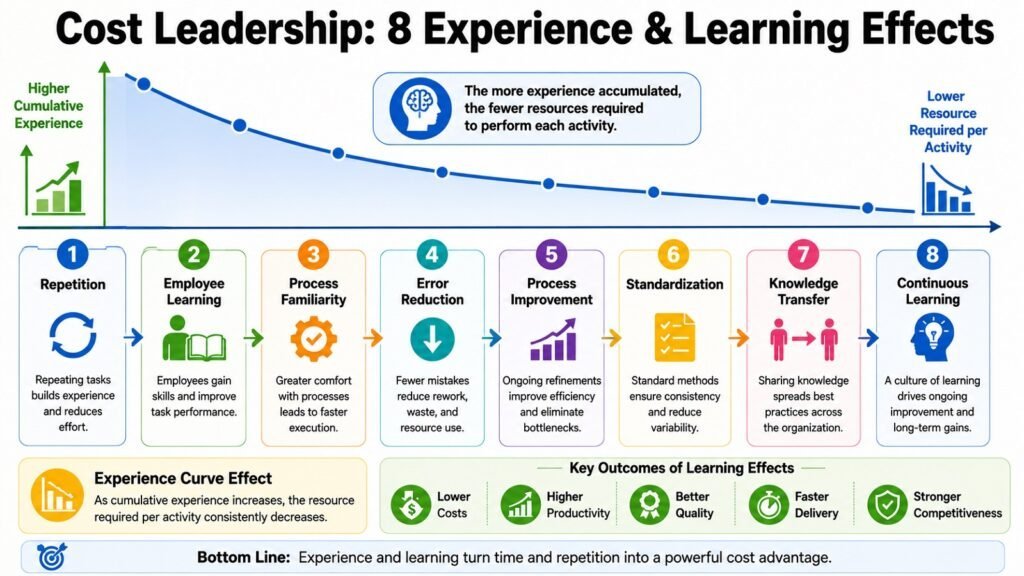
Experience and Learning represent a distinct mechanism through which companies build cost advantage over time. Where Economies of Scale reduce costs through current output volume, experience effects reduce costs through the accumulation of cumulative production history. Companies can build advantages that competitors cannot access simply by expanding capacity.
The experience curve, developed by the Boston Consulting Group in the 1960s, documents a consistent finding: as cumulative production doubles, unit costs decline by a predictable percentage, typically ten to thirty percent depending on industry and activity. Workers become more proficient. Process engineers eliminate bottlenecks. Quality improves as error sources are addressed. Material yields increase as handling methods are refined. The semiconductor industry provides strong evidence: companies that built high cumulative volume early achieved structural cost advantages that persisted for years.
Experience effects must be distinguished clearly from scale effects. Scale reduces costs through current volume; experience reduces them through the accumulated history of performing activities. A mid-sized company with deep learning and strong process documentation can outperform a larger competitor on unit cost in activities where cumulative experience is the primary driver.
These advantages carry real limits. They erode when competitors hire experienced employees, acquire knowledgeable businesses, license process technologies, or access similar expertise. Learning rates also vary considerably: high-repetition, measurable tasks show stronger experience curves than complex, judgment-intensive work.
A deeper tension exists between learning through repetition and the adaptability required when technology or customer preferences shift. Organizations committed deeply to established processes to capture learning benefits can become resistant to change when conditions evolve. Managers should identify activities where learning effects are strongest and build systems that capture and retain accumulated knowledge before it walks out the door.
Table 4: Cost Leadership — Eight Experience and Learning Mechanisms and Their Implications
| Experience or Learning Mechanism | Implication for Cost Leadership |
| Worker task proficiency | Repetition reduces time and errors per unit, directly lowering labor cost per output produced |
| Process bottleneck elimination | Accumulated observation reveals inefficiencies that systematic improvement can reduce or remove |
| Material yield improvement | Experience reduces waste and rework rates, lowering material cost per unit of finished output |
| Quality-defect reduction | Cumulative learning identifies defect root causes, reducing correction and warranty costs over time |
| Organizational memory | Documented processes and institutional knowledge reduce training costs and preserve efficiency gains |
| Scheduling and coordination efficiency | Experience improves sequencing, reduces idle time, and lowers coordination costs across operations |
| Technology adaptation | Experienced teams extract more value from tools and equipment, improving overall asset productivity |
| Knowledge leakage risk | Experience advantages erode when competitors hire skilled employees or access equivalent expertise |
4. Cost Leadership and Operational Efficiency
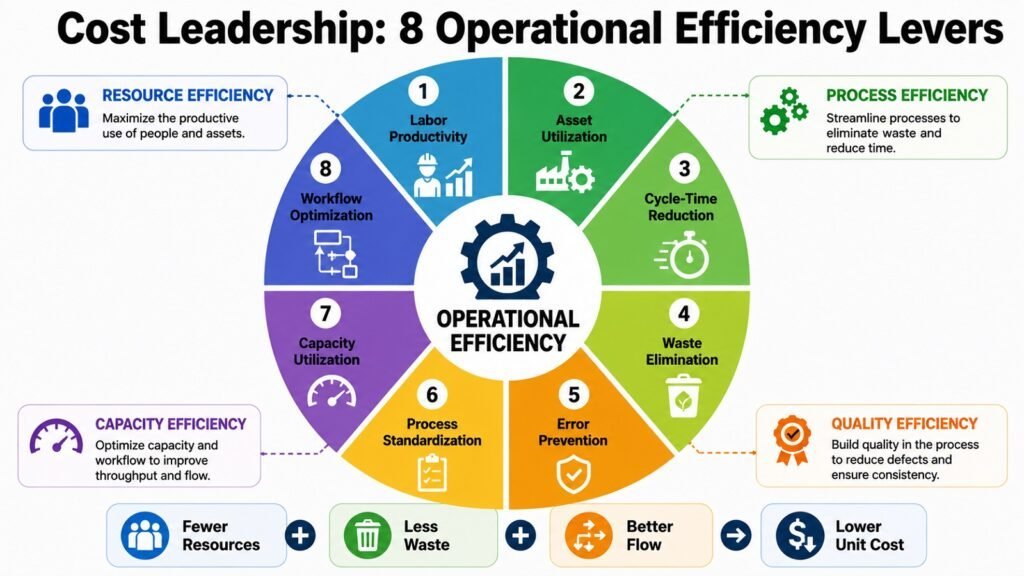
Operational Efficiency converts the potential created by cost structure, scale, and learning into actual performance. A company may have favorable structural conditions and still lose cost advantage through waste, inconsistency, and poor coordination. Operational efficiency is the discipline that translates structural opportunity into the lower unit costs Cost Leadership requires.
Operational efficiency is not the same as cost cutting. Cost cutting reduces spending, sometimes at the expense of quality or future capability. Operational efficiency improves the ratio of outputs to inputs, achieving more with the same resources without degrading customer value. Process design affects handling time and rework costs. Capacity utilization determines whether installed assets justify their fixed-cost burden. Quality management reduces defect rates and service expense. Lean waste elimination removes non-value-adding activities. Asset utilization determines whether physical investments generate adequate returns.
Toyota’s production system illustrates how deeply integrated operational disciplines create structural cost advantages. Toyota’s approach to quality, inventory, supplier coordination, and continuous improvement comprises interlocking practices where each element reinforces the others. Competitors that adopted individual practices without the integrated system rarely achieved equivalent results. Isolated best practices can be imitated; a coherent activity system is far harder to reproduce.
This distinction matters because isolated efficiency gains tend to be temporary: competitors can adopt similar techniques and erase the advantage. Efficiency embedded in an integrated activity system generates compounding advantages that resist imitation, which is why Porter distinguished operational effectiveness from strategic Cost Leadership.
Managers evaluating operational efficiency for Cost Leadership should focus on activities representing the largest share of total cost and determine whether improvements generate durable relative advantages or temporary savings that rivals will quickly close.
Table 5: Cost Leadership — Eight Operational-Efficiency Levers and Their Contribution
| Operational-Efficiency Lever | Contribution to Cost Leadership |
| Process design and flow | Reduces handling time, waiting, and rework by optimizing how work moves through operations |
| Capacity utilization | Absorbs fixed costs more effectively, lowering unit cost when assets operate near optimal throughput |
| Quality management | Reduces defect rates, rework, warranty costs, and the expense of customer service recovery |
| Lean waste elimination | Removes non-value-adding activities from processes, reducing labor and material consumption directly |
| Asset utilization | Improves returns on capital-intensive assets through better scheduling, sequencing, and maintenance |
| Standardization of outputs | Reduces process variability, simplifies training, and lowers per-unit production cost consistently |
| Workforce productivity | Skill development, incentives, and task design increase output per labor hour across operations |
| Continuous improvement culture | Sustains efficiency gains over time by embedding incremental improvement as an organizational norm |
5. Cost Leadership and Technology and Automation
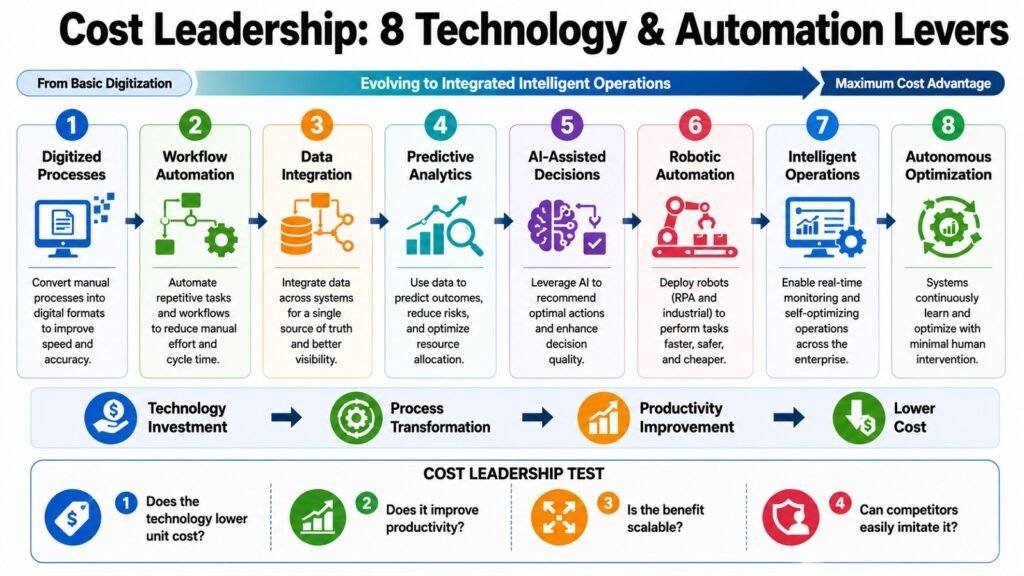
Technology and Automation have become central to Cost Leadership in virtually every industry. Technology can reduce costs, but more precisely, it can alter the economics of activities in ways that create structural cost differences between competitors that are genuinely difficult to close without equivalent investment and organizational capability.
Automation replaces manual labor in repetitive, rule-based tasks, reducing labor cost per unit and eliminating human error. Software integration connects previously separate systems, cutting transaction costs and administrative burden. Artificial intelligence applied to demand forecasting, quality inspection, and logistics routing identifies optimization opportunities at a scale and speed that manual analysis cannot match. Robotics in warehousing improves throughput and capacity utilization. Predictive maintenance systems schedule servicing at optimal points rather than fixed intervals, reducing unplanned downtime and extending asset life.
Amazon’s warehouse robotics allow more orders per square foot at lower labor cost per item. That advantage reflects data systems, operational processes, and organizational capabilities built around those robots — capabilities that competitors cannot replicate quickly by purchasing similar hardware.
Technology investment carries real trade-offs. Capital expenditure is substantial. Poor implementation frequently delivers less than projected savings while creating disruption. Cybersecurity represents a growing ongoing cost. Technological obsolescence can convert today’s advantage into tomorrow’s stranded asset. The most avoidable trap is automating inefficient processes: technology that accelerates a flawed process produces faster failures at lower per-unit cost, which is not an improvement.
Evaluating technology for Cost Leadership requires asking whether it creates a durable relative cost advantage and whether the organization can implement and sustain it effectively. The answer must address competitive impact, not only internal efficiency metrics.
Table 6: Cost Leadership — Eight Technology and Automation Mechanisms and Their Potential
| Technology or Automation Mechanism | Potential Contribution to Cost Leadership |
| Process automation | Replaces manual labor in repetitive tasks, reducing labor cost and error rates per unit produced |
| Enterprise software integration | Connects systems to reduce transaction costs, duplication, and manual administrative burden |
| AI-driven demand forecasting | Reduces inventory carrying costs and stockout losses through more accurate demand prediction |
| Robotics in logistics | Improves throughput and accuracy in warehousing while reducing per-order fulfillment cost |
| Predictive maintenance systems | Reduces unplanned downtime and extends asset life, lowering maintenance cost per operating unit |
| Digital process workflows | Eliminates paper, processing delays, and handoff errors in administrative and operational activities |
| Data analytics for optimization | Identifies cost inefficiencies in real time, enabling faster and more accurate corrective decisions |
| Cybersecurity and obsolescence costs | Technology investment carries ongoing security expense and risk of premature strategic obsolescence |
6. Cost Leadership and Supply Chain Management
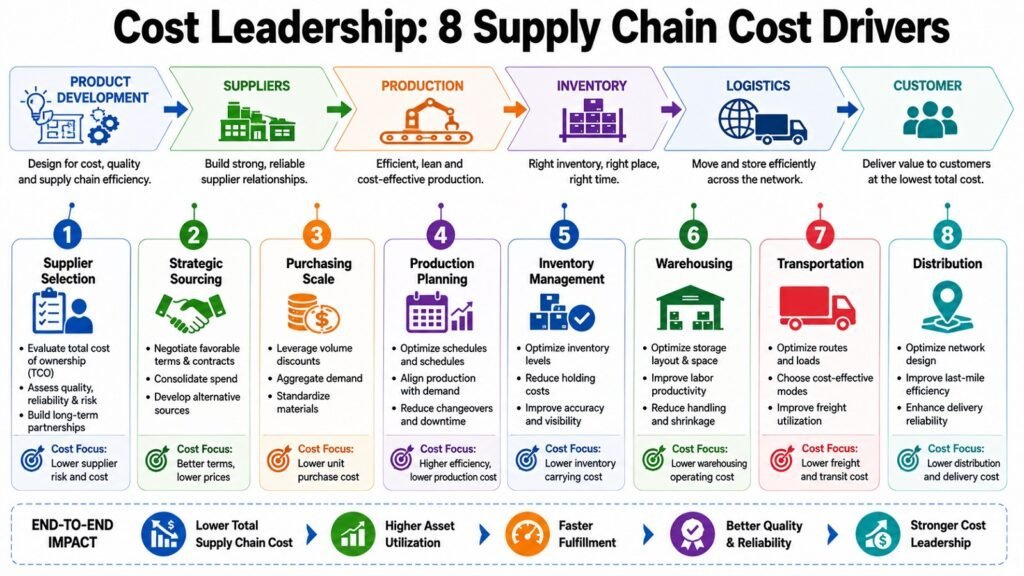
Supply Chain Management extends Cost Leadership beyond the firm’s boundaries into procurement, suppliers, logistics, and distribution. A company that achieves internal efficiency but pays unnecessarily high input prices, carries excessive inventory, or runs an inefficient distribution network leaves significant cost advantage unrealized. Total delivered cost, not factory-floor cost, determines competitive position in most industries.
Supplier selection and purchasing scale generate negotiating leverage that smaller competitors cannot match. Collaborative relationships go further: joint cost-reduction programs improve material yield and delivery reliability in ways that price pressure alone cannot achieve. Inventory management carries a direct structural impact — financing, storage, obsolescence, and handling costs all accumulate for companies with weaker forecasting or looser supply coordination.
Zara demonstrates a different supply chain logic in fashion. Rather than optimizing for lowest input costs through distant manufacturing, Zara designed for speed and responsiveness, running short production cycles closer to markets. This eliminates the markdown costs, overstock losses, and inventory charges that burden competitors with longer supply chains. Total system cost, not purchase price, determines structural cost position.
The tension between supply chain efficiency and resilience deserves explicit attention. Minimizing inventory, consolidating to single suppliers, and optimizing for cost creates efficient but fragile systems. Supply shocks and geopolitical disruptions expose the hidden cost of efficiency-driven fragility. Cost Leadership strategies built on supply chain design must account for disruption risk alongside normal operating cost.
Supply chain integration becomes a genuine barrier to imitation when supplier relationships, logistics capabilities, data systems, and coordination mechanisms cannot be easily reproduced without equivalent investment and time.
Table 7: Cost Leadership — Eight Supply-Chain Cost Drivers and Their Strategic Relevance
| Supply-Chain Cost Driver | Strategic Relevance to Cost Leadership |
| Supplier negotiating leverage | Scale and relationship quality enable lower input prices and better terms than smaller competitors |
| Collaborative supplier relationships | Joint cost-reduction programs yield improvements in yield and quality that price pressure alone cannot |
| Demand forecasting accuracy | Better forecasts reduce excess inventory, stockout costs, and emergency procurement expenses |
| Inventory carrying cost management | Discipline in inventory levels reduces financing, storage, obsolescence, and handling costs directly |
| Logistics network design | Proprietary or optimized distribution infrastructure lowers per-unit delivery cost at scale |
| Transportation and modal optimization | Carrier selection, route planning, and modal choices reduce freight cost per unit delivered to market |
| Vertical integration decisions | Internalizing supply stages can reduce margin extraction but increases fixed-cost commitment and risk |
| Resilience versus efficiency trade-off | Lean supply chains reduce normal costs but increase exposure to disruption-related expenses and loss |
7. Cost Leadership and Strategic Pricing
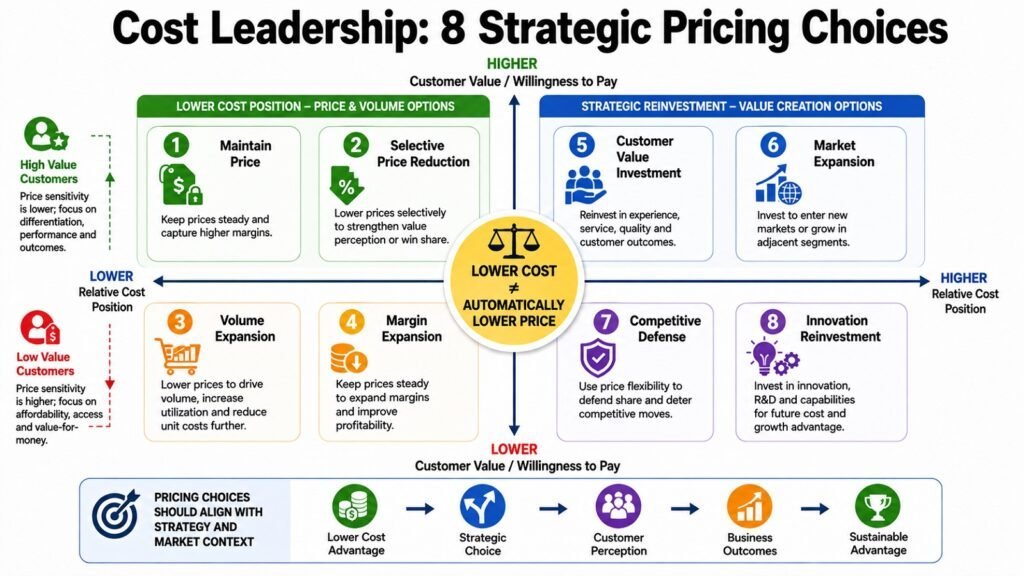
Strategic Pricing converts cost advantage into market-level competitive advantage. Possessing the lowest cost structure does not require, and should not automatically lead to, offering the lowest prices. The relationship between cost position and pricing outcome is a strategic choice, not a predetermined result.
A company with genuine cost advantage faces distinct options. It can maintain prices at the industry level and capture the difference as superior margin. It can selectively lower prices to gain share where rivals are most cost-disadvantaged. Or it can use price flexibility defensively, holding competitors at bay in contested segments while protecting margins elsewhere.
Southwest Airlines illustrates the strategy clearly. Advantages in fleet standardization, aircraft turnaround, and seat utilization enabled prices that stimulated demand from travelers who would otherwise choose alternative transport, expanding the total market. Competitors with higher cost structures could not profitably match those prices on a sustained basis.
Price wars represent the most dangerous misuse of cost advantage. When competitors respond to price reductions with their own, the result is an industry-wide margin collapse that eliminates the economic returns Cost Leadership was designed to create. Initiating a price war is rational only when the cost leader is confident its structural advantage will outlast rivals’ ability to absorb losses, a condition rarely as clear in practice as in theory.
Three questions organize the pricing decision: Where is the cost advantage largest? Which segments are most price-sensitive? What competitive responses are likely, and which approach best protects the long-term cost advantage?
Table 8: Cost Leadership — Eight Strategic-Pricing Considerations and Their Implications
| Strategic-Pricing Consideration | Implication for Cost Leadership |
| Margin retention versus price reduction | Cost advantage can be captured as margin rather than passed entirely to customers as lower prices |
| Price elasticity of demand | High-elasticity segments reward price reductions with volume gains that reinforce scale and experience |
| Competitive response risk | Price reductions invite retaliation; the cost leader must assess whether rivals can sustain lower prices |
| Market share versus profitability trade-off | Aggressive pricing builds volume but may compress margin before scale benefits fully materialize |
| Segment-level pricing flexibility | Cost position enables selective discounting where rivals face the greatest structural cost disadvantage |
| Price war avoidance | Industry-wide price wars destroy the economic returns that Cost Leadership is designed to create |
| Reinvestment of cost savings | Savings can fund capability development or innovation rather than deployment only as price reductions |
| Value-price alignment | Customers evaluate price relative to perceived value; cost leadership does not automatically justify discounting |
8. Cost Leadership and Cost Sustainability
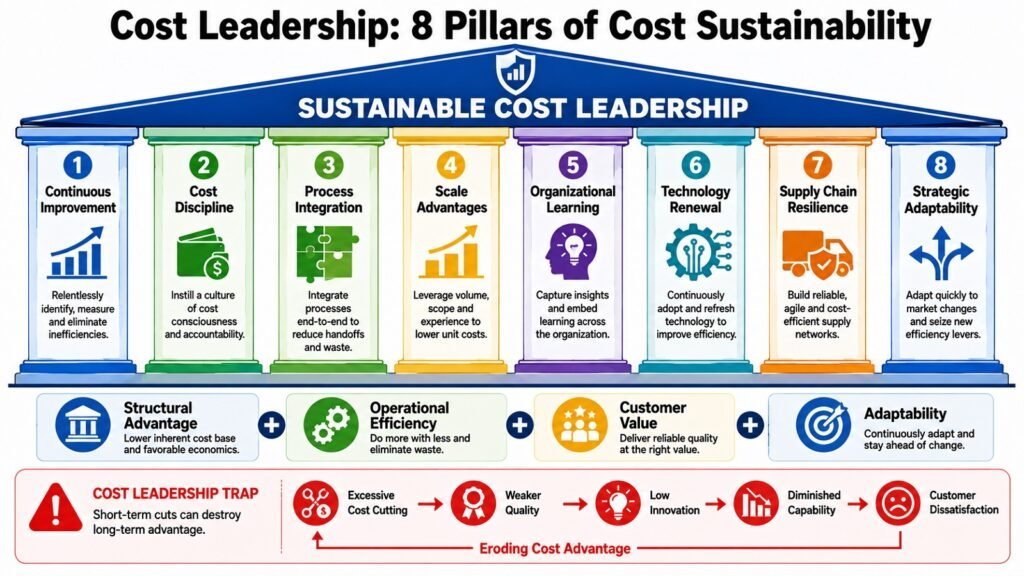
Achieving a lower cost position than competitors at a point in time is a milestone, not a durable achievement. The ultimate test of Cost Leadership is maintaining a favorable relative cost position as competitors adapt, technologies shift, and industry economics change. Cost Sustainability separates temporary advantage from sustained Competitive Advantage.
Understanding distinctions matters. Temporary cost reduction is spending less for a period; it can be reversed quickly. Cost efficiency improves performance without necessarily creating relative advantage if competitors improve at the same pace. Cost advantage means being structurally cheaper than rivals. Sustainable Cost Leadership requires that structural advantage persists against imitation over an extended period. Barney’s resource-based view (1991) establishes that durable advantages require capabilities that are valuable, rare, costly to imitate, and organized to capture value.
Barriers to imitation are central to sustainability. Cost advantages resting on generic practices or accessible technologies erode quickly. Advantages embedded in proprietary data, organizational routines, supplier relationships, and integrated activity systems are considerably harder to reproduce — the more reinforcing elements involved, the harder the system is for competitors to recreate.
The Cost Leadership Trap describes cutting costs so aggressively that the capabilities behind the advantage are weakened. Companies that eliminate training budgets, defer maintenance, or suppress innovation spending achieve temporary savings while degrading quality and workforce capability. Effects are often delayed, making the trap particularly dangerous.
Continuous improvement and reinvestment discipline are the counterweights. The practical sustainability test: Is the advantage structural? Are underlying capabilities difficult to imitate? Does cost position remain aligned with customer value? Can the activity system adapt as conditions change?
Table 9: Cost Leadership — Eight Sustainability Threats and Their Strategic Defensive Considerations
| Threat to Cost Sustainability | Strategic Defensive Consideration |
| Competitor technology adoption | Invest continuously in technology to maintain cost advantage before rivals close the gap |
| Input price increases | Diversify suppliers, hedge key inputs, and invest in substitutes to reduce volatility exposure |
| Regulatory cost increases | Monitor regulatory trends and design operations to comply efficiently rather than reactively |
| Rising customer value expectations | Ensure cost position does not compromise the quality or features that justify market position |
| Imitation of core practices | Build advantage on integrated activity systems rather than isolated practices that rivals can copy |
| The Cost Leadership Trap | Protect investment in quality, innovation, and capability from excessive short-term cost pressure |
| Workforce capability erosion | Maintain skill development and fair compensation to retain the human capital behind efficiency gains |
| Disruptive business model entry | Monitor structural shifts that may render existing cost structures strategically obsolete over time |
Conclusion: Cost Leadership and Sustaining the Cost Advantage
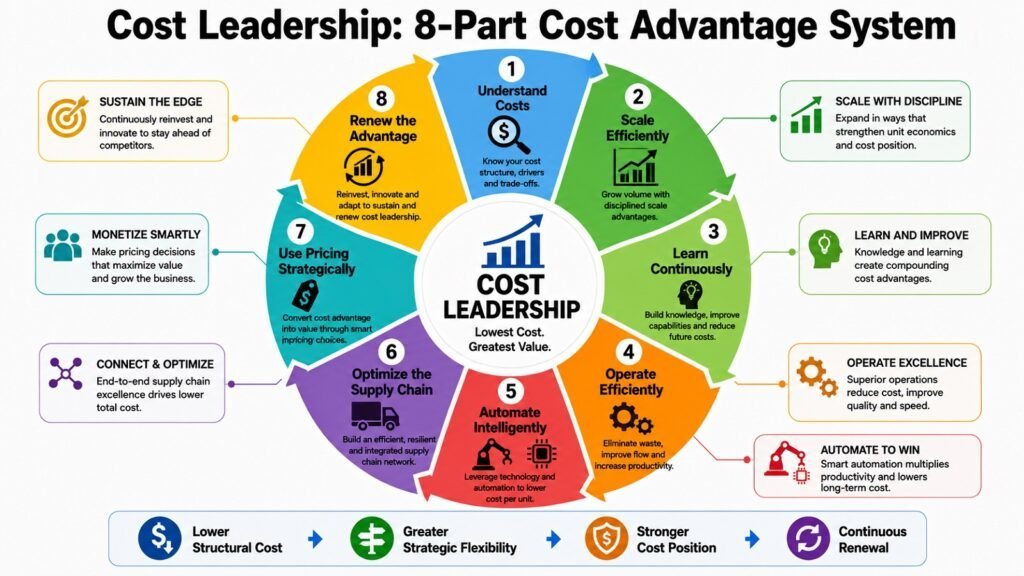
Cost Leadership is one of the most important strategies for building a sustained competitive advantage. It is not a philosophy of minimal spending, but a strategic system for creating and maintaining a structurally favorable cost position while delivering adequate customer value. Companies that reduce it to cost cutting tend to destroy the capabilities that make the advantage real.
These eight Cost Leadership drivers form a coherent progression. Cost Structure and Economies of Scale establish the analytical and economic foundations. Experience and Learning build organizational capability that rivals cannot simply purchase. Operational Efficiency and Technology convert that potential into actual performance. Supply Chain Management extends advantage into the delivery network. Strategic Pricing translates cost position into market-level competitive advantage. Cost Sustainability determines whether all of this persists as conditions evolve.
Three insights define the framework. Theoretically: cost advantage is an activity-system property, not a single decision. Empirically: sustainable advantages require capabilities that are genuinely difficult to imitate. Practically: the four-part sustainability test — structural, imitation-resistant, value-aligned, and adaptive — provides a reliable diagnostic for any cost position.
Artificial intelligence, evolving supply chains, and rising expectations around quality and sustainability will reshape Cost Leadership. Companies that understand it as a dynamic strategic system rather than a static operational target will be best positioned to defend competitive advantage as conditions change.
Table 10: Cost Leadership — Eight Drivers and Their Central Strategic Takeaway
| Cost Leadership Driver | Central Strategic Takeaway |
| Cost Structure | Know where costs originate before deciding how to manage them strategically |
| Economies of Scale | Scale reduces unit cost through multiple mechanisms but creates complexity beyond optimal size |
| Experience and Learning | Cumulative activity builds proprietary cost efficiency that rivals cannot replicate by expanding capacity |
| Operational Efficiency | Integrated efficiency systems outperform isolated best practices in creating durable cost advantage |
| Technology and Automation | Technology creates cost advantage only when embedded in capable processes and organizational systems |
| Supply Chain Management | Total system cost, not production cost alone, determines structural cost position in most industries |
| Strategic Pricing | Cost advantage provides strategic flexibility; converting it to market advantage requires deliberate choices |
| Cost Sustainability | Advantage erodes unless continuously reinforced through reinvestment, adaptation, and imitation barriers |