Table of Contents
Introduction: Decision Context: The Foundation of Better Business Decisions
Every business decision looks simple from the outside. But the real work happens long before anyone picks an option. Leaders often think that better data leads to better choices. Yet data alone rarely tells the full story. Decision Context is the missing piece that turns raw numbers into meaning. It is the mix of circumstances, goals, people, and limits that surrounds a decision. This mix shapes how that decision should be read. Without it, even good data can point leaders the wrong way.
Decision Context sits at the heart of both Business Decision Making and Decision Intelligence. Decision Intelligence blends analytics, business rules, and human judgment. It depends on context to turn insight into action. Studies from McKinsey show that data-driven firms are far more likely to win and keep customers than firms that rely on gut feeling alone. But this edge only shows up when data is read through the right lens. A dashboard full of correct numbers means little if the team misreads the market, the goal, or the people involved.
Companies that skip context often struggle, even with strong tools and skilled analysts. They ask good questions of the wrong data. Or they use the right data at the wrong time. On the other hand, firms that build strong Decision Context tend to show more consistency. They adapt faster to change. They perform more steadily over the long run. This happens because context links information to judgment. It helps people see not just what the numbers say, but what those numbers mean for the business.
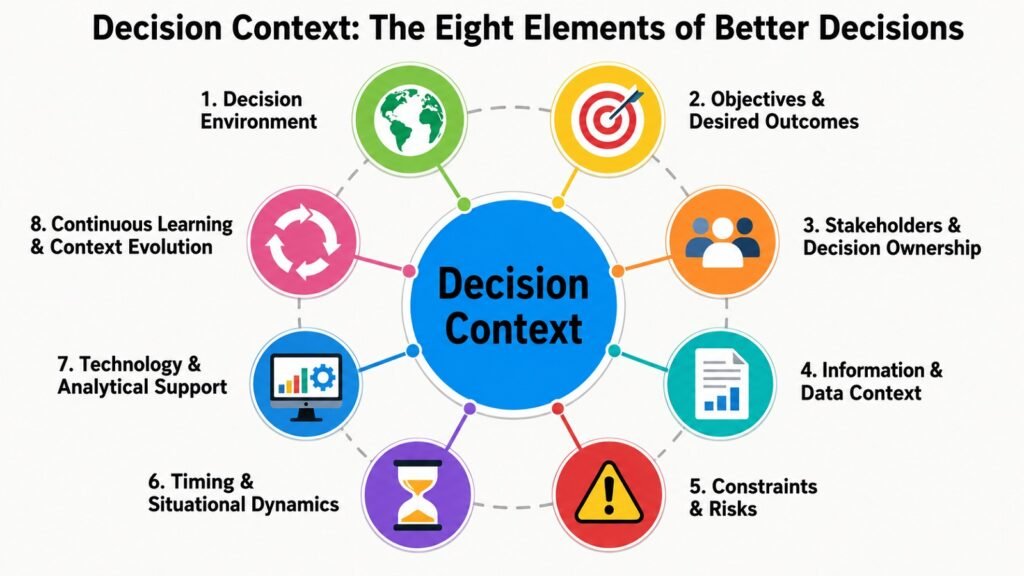
This article breaks Decision Context into eight elements. These elements work together, not alone. Each one strengthens a different part of the decision process. Some shape how we read the environment. Others help us learn from past results. Together, they form a practical guide. Any organization can use this guide to sharpen its Business Decision Making. It can also mature its approach to Decision Intelligence.
Table 1: Decision Context and Its Eight Core Elements
| Decision Context Elements | Role in Decision Context |
| Decision Environment | Sets the backdrop for every choice |
| Objectives and Outcomes | Gives direction and success criteria |
| Stakeholders and Ownership | Shows who is involved and accountable |
| Information and Data | Supplies the evidence behind judgments |
| Constraints and Risks | Frames realistic and safe options |
| Timing and Situational Dynamics | Adjusts decisions to changing conditions |
| Technology and Analytics | Speeds up and deepens understanding |
| Continuous Learning | Refines context using past results |
1. Decision Context and Decision Environment
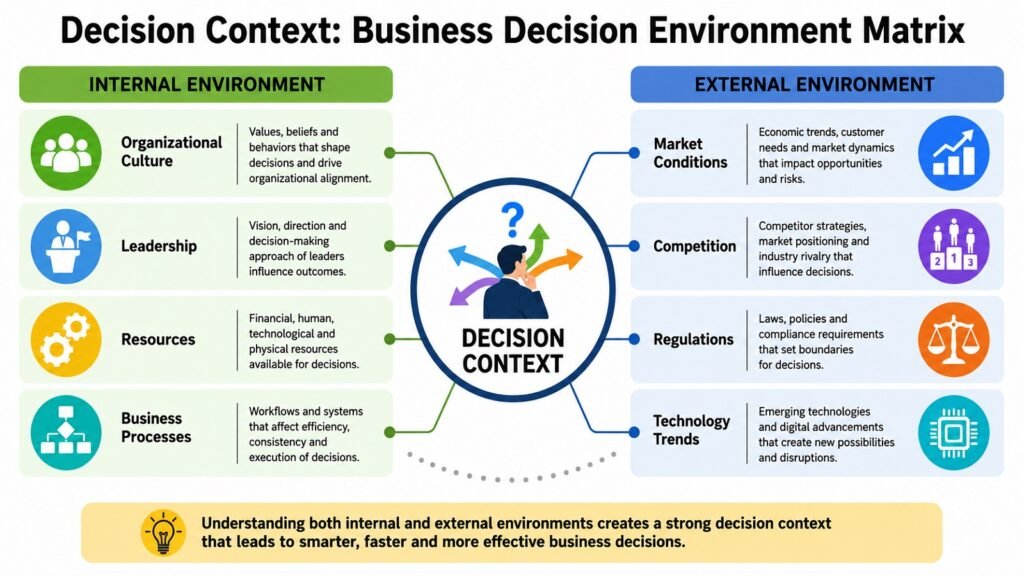
The Decision Environment serves as the foundational level of Decision Context. It encompasses all factors surrounding a business at the time a decision is made. This includes both internal culture and external market dynamics. Each company exists within various layers of influence, which consist of competitor actions, economic trends, regulatory changes, and evolving customer demands. These layers are seldom static. Therefore, continuously monitoring the environment should be a regular practice rather than a singular activity. A decision that may appear prudent in isolation can seem imprudent when considering the broader context.
The inner environment matters just as much as outside forces. A firm’s culture and leadership style shape how fast decisions move. A rigid, top-down firm may read the same market signal in a different way than a flexible rival. Harvard Business Review has long argued that culture shapes the speed and quality of strategic choices. Culture decides who speaks up. It decides who gets heard. It decides how much risk people will take. Two firms can view the same data and walk away with different conclusions, simply because their cultures differ.
Outside forces add another layer that leaders cannot control but must still track. New rules can turn a strong plan into a compliance headache overnight. Shifts in the wider economy can quietly weaken a budget that looked solid months before. Rivals rarely sit still either. Their price cuts or product launches can force a firm to rethink a plan that once seemed settled.
Smart companies build environment checks into their normal routine. They do not save this for once a year. Retailers track shifting buying habits before they plan stock. Tech firms watch rival product launches before they set their own path. This is not about guessing the future with full accuracy. It is about closing blind spots. When leaders grasp the setting around a choice, they read data more clearly. They avoid plans that look great on paper but fail once tested.
Table 2: Decision Context and Environmental Factors
| Environmental Factor | Influence on Decision Context |
| Market conditions | Shapes demand and pricing assumptions |
| Competitive landscape | Reveals threats and openings |
| Regulatory changes | Limits or redirects available choices |
| Economic trends | Affects budgets and risk appetite |
| Organizational culture | Determines speed and openness of decisions |
| Technology shifts | Creates new tools and new pressures |
| Industry dynamics | Signals where the sector is heading |
| Global events | Introduces sudden uncertainty |
2. Decision Context and Objectives and Desired Outcomes
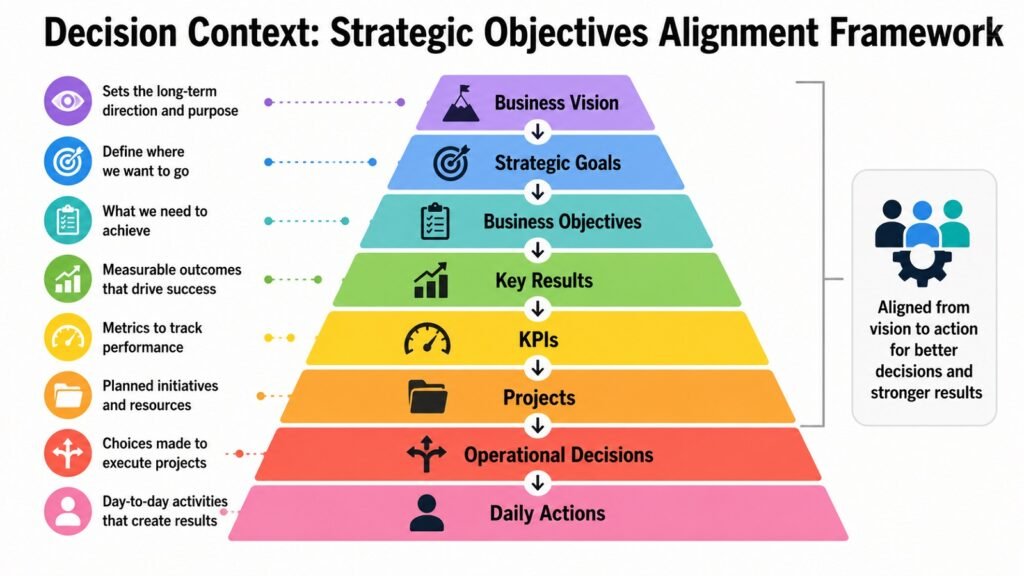
Objectives give Decision Context its sense of direction. Without a clear target, even well-studied choices can drift into busywork. Goals can be strategic, like entering a new market. Or they can be simple, like cutting delivery times. No matter the size of the goal, every choice should be judged against the outcome it serves. It should not be judged by whether it feels productive at the time.
Peter Drucker’s classic writing on management said goals should be clear and easy to measure. This idea still guides tools like OKRs and KPIs today. When goals stay vague, teams read the same facts in different ways. This gap weakens Decision Context across the firm. Clear goals act like a filter. They help leaders sort useful data from noise. They help teams pick options that truly move the business forward. Without that filter, teams often chase whatever looks exciting rather than what truly serves the goal.
Objectives also shape how we judge each option. A firm chasing fast growth will weigh a choice in a different way than one chasing steady profit. This is why the same market chance might get approved at one firm and turned down at another, even with the same facts in hand. The goal decides which facts matter most. It turns a plain set of numbers into a clear signal for action.
Value matters here too, since not every goal carries equal weight for the whole business. A choice that lifts short-term sales but hurts customer trust may hit one target while damaging a bigger one. Strong Decision Context means leaders must check their goals often. A target that made sense a year ago may not fit today’s reality. Clinging to an old target can quietly steer choices in the wrong direction.
Table 3: Decision Context and Objective-Related Components
| Objective Component | Contribution to Decision Context |
| Strategic goals | Sets long-term direction for choices |
| Operational targets | Guides daily and short-term decisions |
| Key performance indicators | Measures progress objectively |
| Value creation focus | Prioritizes decisions with real impact |
| Success criteria | Defines what a good outcome looks like |
| Organizational priorities | Resolves conflicts between competing options |
| Alignment with mission | Keeps decisions consistent with purpose |
| Outcome measurement | Enables learning from past choices |
3. Decision Context and Stakeholders and Decision Ownership
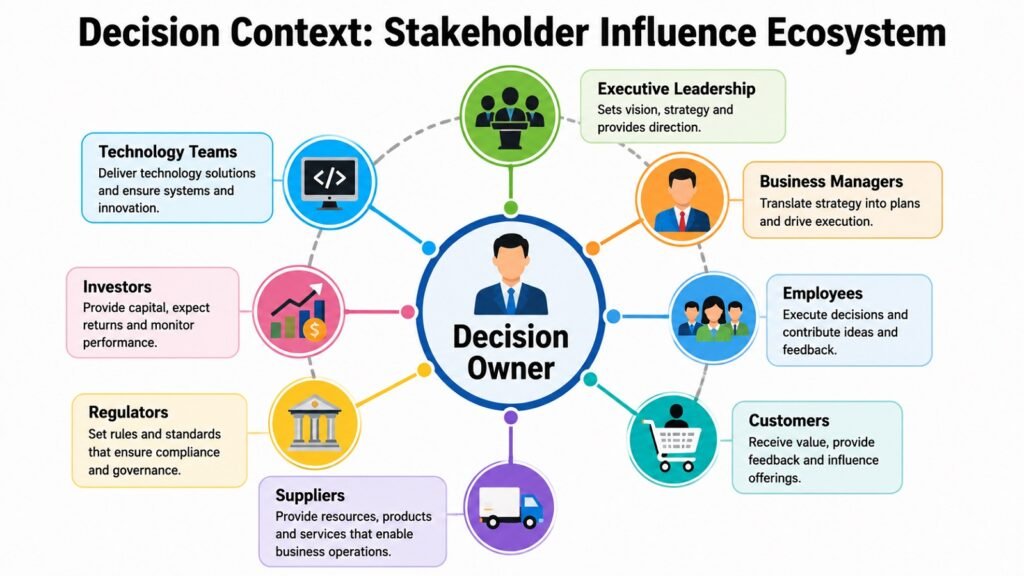
Every decision touches someone. Knowing who that someone is forms another key layer of Decision Context. Stakeholders include staff, customers, investors, partners, and regulators. Each group brings its own hopes and its own level of sway. Naming the right stakeholders early helps leaders plan for pushback. It helps them build support. It helps them avoid costly errors caused by leaving an important voice out of the room. A choice that ignores a key group often gets reworked later. That rework often costs more time than good planning up front.
Decision ownership matters just as much. When no one knows who holds power over a choice, delays follow. Sometimes teams even take clashing actions across departments. Clear ownership does not mean one person acts alone. Most big business choices need input from many teams. Studies on governance show that decisions with clear owners and the right stakeholders move faster. They also gain wider support once made. When ownership stays fuzzy, teams often wait for someone else to act, even when they already have what they need to move.
Backing from the top of the leadership also shapes Decision Context, mostly for big or risky calls. When leaders openly support a choice, it signals priority. It pushes teams to work together instead of pushing the task aside. Teamwork across departments matters here too. A choice that touches sales, operations, and finance rarely works well if only one team shapes it.
Open talk through the whole process, not just at the final reveal, builds trust. It also cuts the friction that often follows big changes at a firm. Stakeholders who grasp why a choice was made, not just what got chosen, tend to back its rollout instead of quietly fighting it.
Table 4: Decision Context and Stakeholder Elements
| Stakeholder Element | Importance in Decision Context |
| Decision ownership | Prevents delays and confusion |
| Executive sponsorship | Signals priority and support |
| Cross-functional input | Improves quality of choices |
| Customer expectations | Keeps decisions market relevant |
| Employee involvement | Builds internal buy-in |
| Regulatory stakeholders | Ensures compliance is considered |
| Investor interests | Aligns decisions with financial goals |
| Communication practices | Reduces resistance and confusion |
4. Decision Context and Information and Data Context
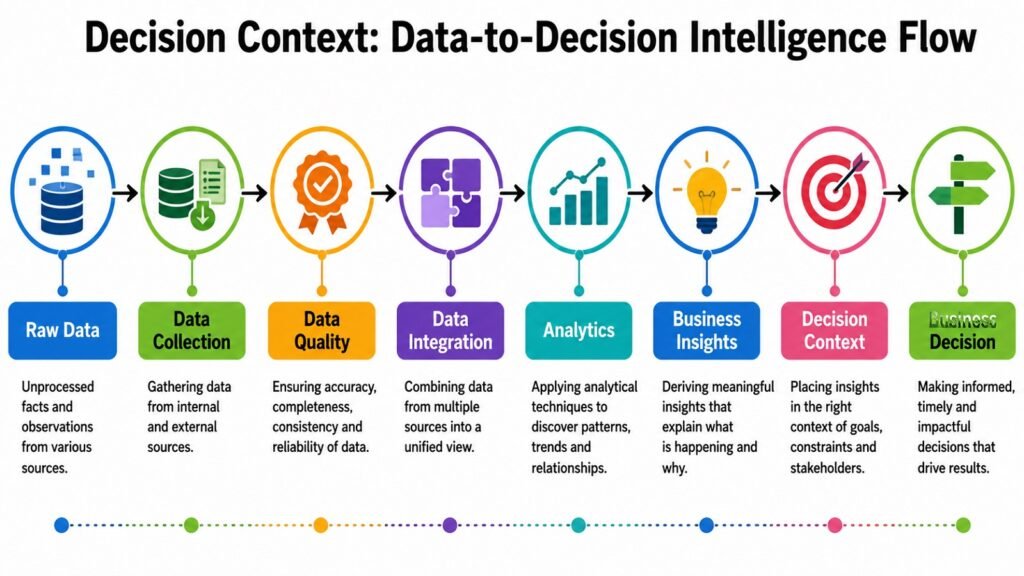
Data only gains value once it sits inside the right context. A number alone tells a thin story. But that same number, read against past trends, business goals, and market shifts, can reveal a clear pattern. This is the core idea behind Information and Data Context. It stands as one of the most useful parts of Decision Context in daily work. A jump in sales might look great until you compare it to a bigger jump across the whole market.
Data quality decides how much trust a leader can place in an insight. Accuracy, completeness, and timing all shape whether data reflects the present or an old snapshot. Gartner has noted that decision intelligence tools win when they blend data, analytics, and business context into one linked view, not scattered reports. This joined-up method avoids the common trap of teams pulling clashing numbers from different systems. It stops teams from arguing over whose figures are right instead of talking about what those figures mean.
Relevance matters just as much as accuracy. A firm can hold huge piles of data and still lack the one fact it needs to answer the question at hand. Cutting out noise and zeroing in on what truly fits the choice often beats simply having more data on file.
Business Intelligence tools help firms picture patterns. But a picture alone does not promise a good choice. Analysts must read dashboards through the lens of the wider Decision Context. They must weigh goals, limits, and stakeholders together. Firms that bridge this gap tend to treat analytics as a starting point for talk, not a final word. This habit leads to more careful, well-rounded business choices.
Table 5: Decision Context and Data Characteristics
| Data Characteristic | Contribution to Decision Context |
| Accuracy | Builds trust in the information used |
| Completeness | Reduces blind spots in analysis |
| Timeliness | Keeps decisions relevant to now |
| Relevance | Filters out unnecessary noise |
| Consistency | Prevents conflicting interpretations |
| Accessibility | Speeds up the decision process |
| Analytical depth | Reveals patterns beyond raw numbers |
| Contextual framing | Turns data into actionable insight |
5. Decision Context and Constraints and Risks
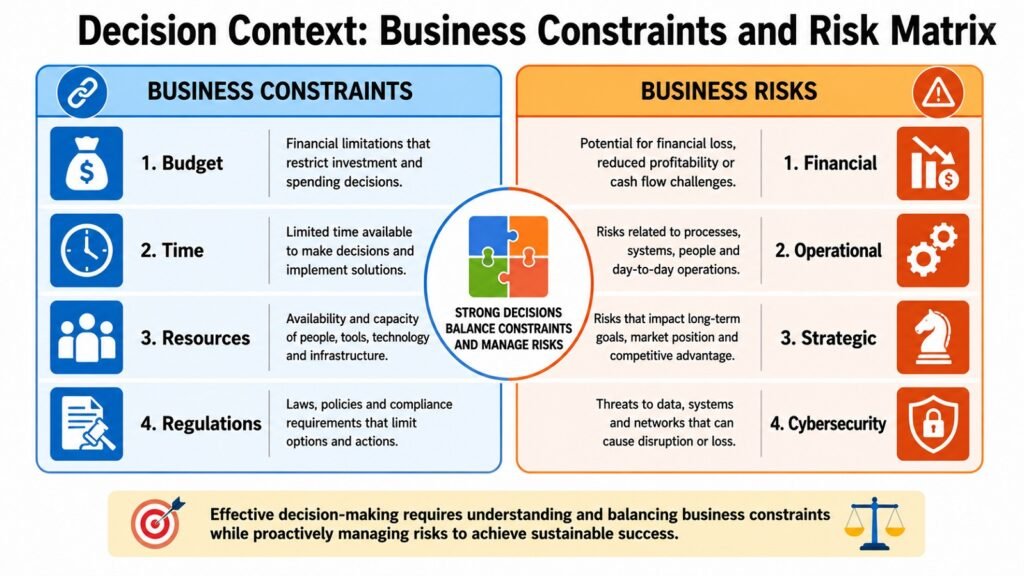
No decision happens in a world of endless choice. Budgets, time, rules, and staff limits all draw a line around what is truly possible. Spotting these limits early is not a block on fresh thinking. It is a way to aim energy at choices that can actually work. This is why limits and risks form a core part of Decision Context, not a note added at the end of the planning stage.
Money limits often shape a choice more than any other factor. Even a strong idea needs proper funding to succeed. Staff and tech limits work the same way. A firm can approve a great plan and still have no one free to carry it out. Rules and compliance add another layer, mostly in fields like finance and health care, where the cost of breaking a rule can threaten the whole business.
Studies on risk show that firms which balance risk with chance tend to outdo those that dodge all risk or ignore it fully. Dodging every risk often means dodging growth too. Ignoring risk invites trouble that modest care could have stopped.
Grasping limits also sharpens priority setting. Once leaders know what truly limits them, they stop chasing choices that look great but cannot work in practice. Instead, they aim resources at options that fit within real limits while still pushing the business forward. This careful stance on Decision Context cuts wasted effort. It lifts the odds of a smooth rollout.
Table 6: Decision Context and Common Constraints or Risks
| Constraint or Risk | Influence on Decision Context |
| Budget limitations | Narrows financially viable options |
| Resource availability | Limits scale and speed of execution |
| Regulatory requirements | Restricts non-compliant choices |
| Market uncertainty | Increases need for flexible planning |
| Operational capacity | Sets realistic execution limits |
| Reputational risk | Encourages cautious evaluation |
| Opportunity cost | Highlights tradeoffs between choices |
| Risk tolerance | Shapes how boldly decisions are made |
6. Decision Context and Timing and Situational Dynamics
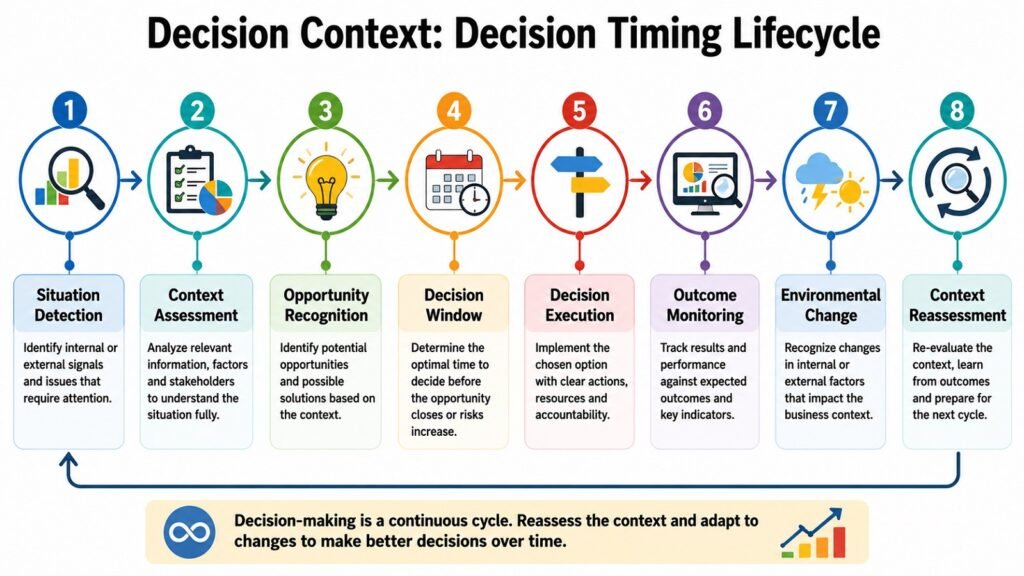
Business conditions rarely sit still for long. Timing often decides whether a choice wins or fails. A plan that made sense six months back may not fit today’s market. This is why Decision Context must be seen as something that grows, not something fixed once and left alone. Firms that check their setting often stand in a far better spot when conditions shift beneath them.
Urgency plays a big role in how choices get made. A time-sensitive chance, like a rival’s slip-up or a sudden shift in demand, calls for faster judgment than a long-range plan. Business cycles, tech shifts, and economic swings all add pressure to rethink old guesses. Studies on strategy show that firms that build in regular check-ins tend to spot new trends sooner than those that lean on yearly planning alone. A full year often proves too long to wait when conditions shift month by month.
Taking too long to decide can be as detrimental as acting too hastily. A decision postponed beyond its appropriate timeframe typically addresses issues from the past rather than those of the present, even if the underlying research was valid. Recognizing when to act swiftly and when to exercise patience is a valuable skill in itself. This ability enhances the Decision Context as time progresses.
Real-time events, from supply chain snags to sudden new rules, can flip what counts as a good choice in an instant. Leaders who treat Decision Context as fixed risk making calls based on stale guesses. Sharp firms instead build feedback loops that keep updating their grasp of the setting. This keeps choices tied to what is truly happening, not to what was true when planning began.
Table 7: Decision Context and Situational Factors
| Situational Factor | Effect on Decision Context |
| Market timing | Determines window of opportunity |
| Competitive moves | Forces reassessment of strategy |
| Business cycles | Shapes appropriate pace of action |
| Technological change | Introduces new options and risks |
| Economic shifts | Alters budgets and risk appetite |
| Emerging trends | Signals future direction early |
| Sudden disruptions | Requires immediate adaptation |
| Real-time events | Keeps decisions grounded in the present |
7. Decision Context and Technology and Analytical Support
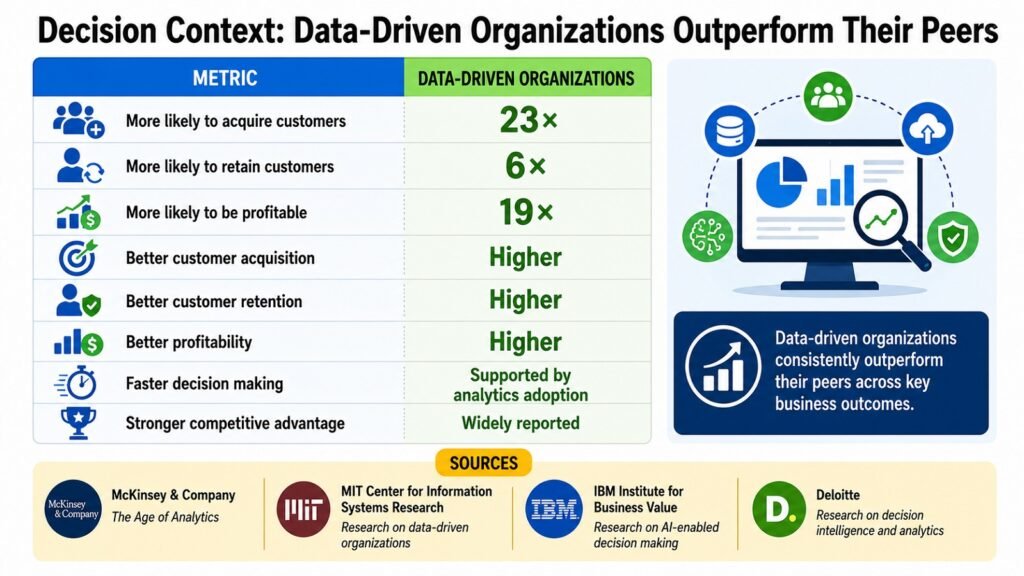
Technology has become one of the strongest boosts to Decision Context in firms today. Tools such as Business Intelligence platforms, forecast models, and Decision Support Systems help teams gather and read data faster than any manual method. Gartner has named Decision Intelligence a major tech trend. It blends classic analytics with newer fields like predictive modeling to give leaders a fuller view before they act, not after the fact.
Dashboards and automation cut the time spent on data collection. This frees leaders to focus on reading and judging what the data shows. Simulation tools let teams test different paths before they commit resources. This lowers risk and builds trust in the final call. A retailer, for one, can test how a price change might sway demand before rolling it out at every store. This step avoids a costly slip at full scale.
Artificial Intelligence adds another layer. It finds patterns across huge sets of data that would be hard for humans to spot alone. Yet these tools work best when paired with human checks, not left to run unwatched. Forecast models can flag early warning signs, like a slowing sales trend, well before that shift shows up in a normal monthly report.
Technology strengthens, but does not replace, human judgment. Decision Intelligence tools are built to support people, not push them out of the process. Firms that blend these tools well treat them as an extra hand on the team. They let automation handle routine calls. They save tough, high-stakes choices for human review backed by strong proof.
Table 8: Decision Context and Analytical Technologies
| Technology or Capability | Strengthens Decision Context By |
| Business Intelligence | Turning raw data into readable reports |
| Predictive analytics | Forecasting likely outcomes |
| Decision Support Systems | Structuring complex choices |
| Dashboards | Giving real-time visibility |
| Automation | Speeding up routine decisions |
| Simulation tools | Testing scenarios before commitment |
| Artificial Intelligence | Detecting patterns humans might miss |
| Digital collaboration platforms | Aligning stakeholders quickly |
8. Decision Context and Continuous Learning and Context Evolution
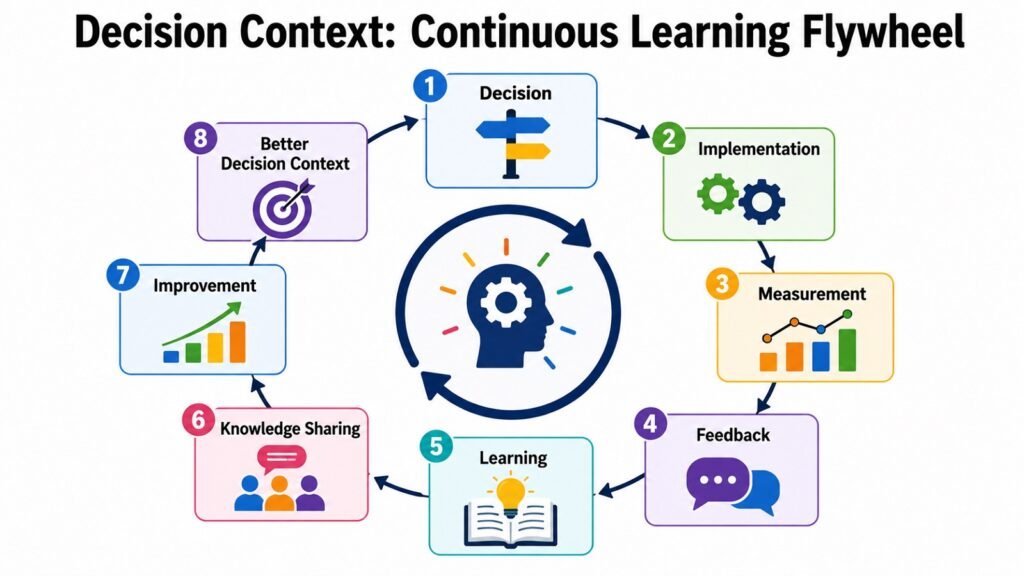
Decision Context does not stay fixed once it is built. It grows stronger through steady learning, feedback, and an honest look back at past choices. Firms that treat every choice as a lesson build sharper judgment over time. Firms that lean only on gut feeling tend to repeat the same errors without even seeing it. Reviews held after a decision are one of the simplest, most overlooked tools for building Decision Context across a firm.
Studies on how firms learn show that growth comes fastest when lessons get saved on purpose, not left scattered in someone’s head. This is often called organizational memory. It helps teams skip relearning the same lesson twice, mostly once the people behind the first choice have moved on. Feedback loops that link results back to the first choice help leaders see what worked, what did not, and why. This sharpens future judgment by a wide margin.
Knowledge systems play a helper role by making these lessons easy to find, rather than buried in an old inbox or a forgotten slide deck. A well-kept record of past choices, with the thinking behind each one, gives future teams a head start instead of forcing them to begin from zero.
Adaptive learning also means seeing that yesterday’s best method might not fit tomorrow’s setting. Firms in fast-moving fields gain by checking their guesses often instead of trusting an old playbook. Decision Intelligence grows through this steady polish. Each reviewed choice adds one more layer of grasp. This lifts the total quality of Decision Context as time moves on.
Table 9: Decision Context and Continuous Learning Practices
| Learning Practice | Contribution to Decision Context Evolution |
| Post-decision reviews | Identifies what worked and what did not |
| Lessons learned documentation | Preserves knowledge for future use |
| Organizational memory | Prevents repeated mistakes |
| Feedback loops | Connects outcomes to original decisions |
| Performance evaluation | Measures real impact over time |
| Knowledge management systems | Makes insights easy to access |
| Adaptive learning practices | Updates assumptions as conditions change |
| Cross-team knowledge sharing | Spreads lessons across the organization |
Conclusion: Decision Context as the Core of Decision Intelligence
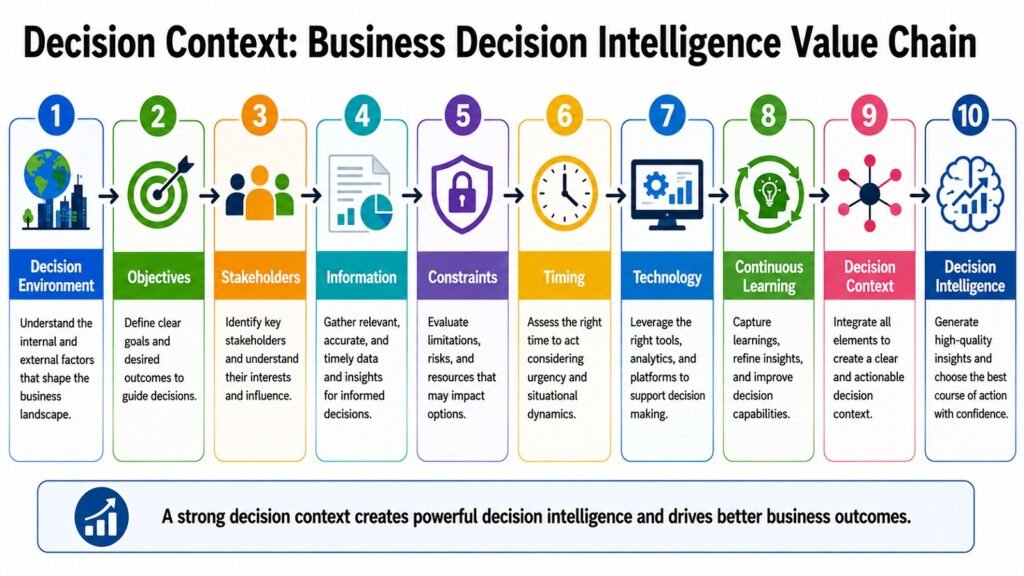
The eight elements in this article do not stand alone. Environment, goals, stakeholders, data, limits, timing, tech, and learning all lean on one another. Together, they form a full Decision Context that backs stronger business outcomes. Leaving out even one piece weakens the whole picture. This is why firms serious about better choices treat context as a linked system, not a checklist.
Decision Context sits at the core of both Business Decision Making and Decision Intelligence. It turns raw data into real action. Data without context leads to guesswork dressed up as proof. Context without data leads to opinions with no real backing. The strongest firms blend both. They use a clear context to guide how data gets read and used at every level of the business.
Building strong Decision Context is not a task you finish once and set aside. It is a live skill that must be revisited as markets shift, goals evolve, and new tools appear. Firms that commit to this skill gain more resilience. They adapt faster. They perform more steadily over the long run. As firms lean more on data and automation, the skill of reading that data within a strong Decision Context will only grow in value. It stands as one of the most vital skills any business can build going forward.
Table 10: Decision Context Summary and Key Takeaways
| Decision Context Elements | Primary Takeaway |
| Decision Environment | Understand surroundings before deciding |
| Objectives and Outcomes | Let clear goals guide every choice |
| Stakeholders and Ownership | Involve the right people early |
| Information and Data | Interpret data within context, not alone |
| Constraints and Risks | Use limits to sharpen priorities |
| Timing and Situational Dynamics | Reassess as conditions change |
| Technology and Analytics | Let tools support, not replace, judgment |
| Continuous Learning | Improve context through honest review |