
Table of Contents
Introduction: Decision Criteria – The Foundation for Better Decisions
Consider a procurement team evaluating five enterprise software platforms. Each option has different pricing, integration requirements, vendor support quality, implementation timelines, and strategic fit with the organization’s technology roadmap. The team has all the information it needs. What it lacks is a clear basis for deciding which factors matter most, which are acceptable trade-offs, and which represent deal-breakers. Having multiple options does not simplify the problem. Without a structured way to compare them, it often makes the decision harder.
This is where Decision Criteria become essential. Decision Criteria are the standards, dimensions, requirements, or conditions used to evaluate alternatives and establish what genuinely matters in a decision. They translate organizational priorities and strategic objectives into a structured evaluation framework that makes comparison possible and defensible.
Decision Criteria is an important aspect of Decision Intelligence, the discipline that applies structured, data-informed, and analytically rigorous approaches to improve how organizations make decisions. Within the broader Decision Intelligence framework, Decision Criteria occupy a distinct and foundational role. Decision Context explains the situation surrounding a decision, including its stakeholders, objectives, and constraints. Decision Models structure the decision itself, representing its variables and relationships. Decision Criteria establish the basis for evaluating alternatives, defining what good looks like across competing options.
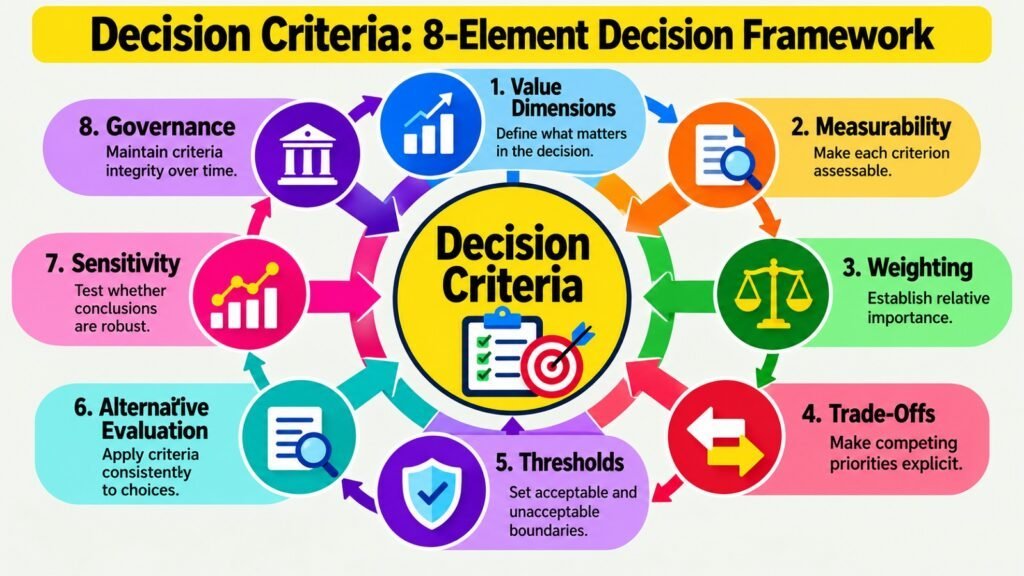
This article offers a foundational exploration of Decision Criteria, drawing on established decision theory, multi-criteria decision analysis, and business application. It examines eight interconnected elements that together form a coherent criteria design system, progressing from defining value to governing the criteria framework over time.
Table 1: Decision Criteria Aspects and What They Address
| Aspects of Decision Criteria | What It Addresses |
| Value Dimensions | Identifies the relevant categories of value against which alternatives should be judged |
| Measurability | Ensures criteria can be assessed consistently and compared across alternatives |
| Weighting | Expresses the relative importance of each criterion within the overall evaluation |
| Trade-Offs | Clarifies where improving one criterion requires accepting a reduction in another |
| Thresholds | Establishes minimum requirements or maximum tolerances that alternatives must meet |
| Alternative Evaluation | Applies criteria systematically to compare options in a structured and transparent way |
| Sensitivity | Tests how changes in criteria weights or measurements affect evaluation outcomes |
| Governance | Maintains consistency, transparency, and accountability in how criteria are managed over time |
1. Decision Criteria and Value Dimensions: Defining What Matters
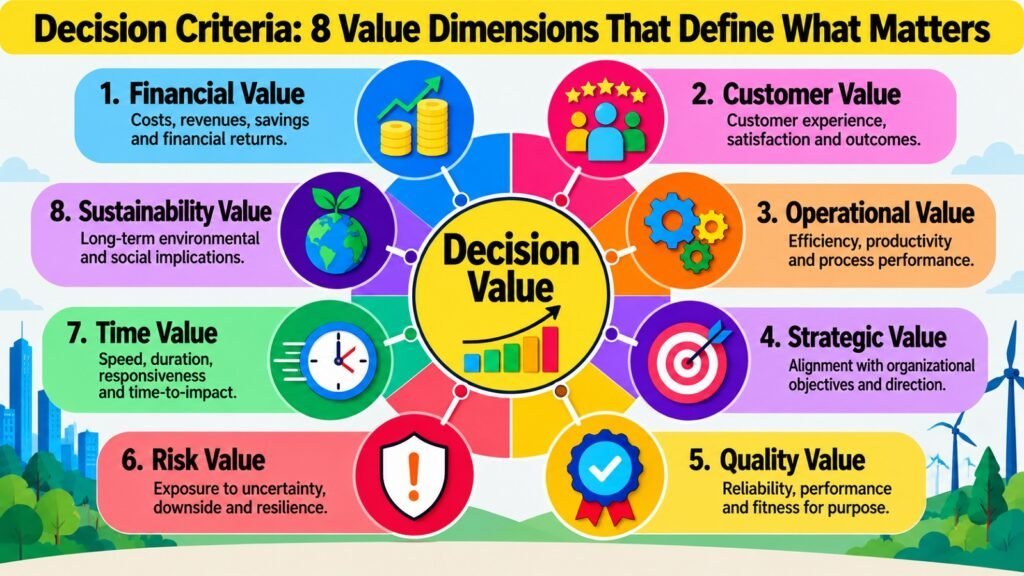
Every decision involves some underlying notion of value. Value dimensions are the categories against which alternatives are evaluated, and they form the conceptual starting point for any set of Decision Criteria. Rather than listing every measurable variable, effective criteria design begins by asking what genuinely matters in this particular decision and why.
Decision theory, particularly multi-criteria decision analysis, recognizes that real-world choices typically involve multiple, sometimes competing, dimensions of value. Financial dimensions address cost, return on investment, and revenue impact. Customer dimensions capture satisfaction, loyalty, and service quality. Operational dimensions reflect efficiency and reliability. Strategic dimensions concern competitive positioning and long-term value creation. Risk dimensions assess exposure and downside potential. Time dimensions measure speed to market or payback period. Quality and sustainability dimensions add accuracy, durability, and environmental responsibility.
The selection of value dimensions is itself a judgment. A hospital selecting a patient management system will evaluate dimensions very differently from a logistics company selecting a fleet platform, even if both decisions involve cost, integration, and vendor support. The relevant dimensions are shaped by the decision’s purpose, not by what is universally important. If a product team evaluates concepts using only financial return, it may select a high-margin product that carries significant regulatory risk. Adding risk as a dimension can change the conclusion entirely.
Objectives and Decision Criteria are related but distinct. An objective describes what the decision-maker wants to achieve. A criterion is a specific dimension that allows alternatives to be evaluated in relation to that objective. Common mistakes include choosing convenient criteria rather than decision-relevant ones, and including overlapping dimensions that inflate the apparent weight of certain concerns. The practical discipline is to ask whether each dimension can reveal a meaningful difference between alternatives. Identifying what matters is the first step, but useful criteria must also be capable of meaningful assessment.
Table 2: Decision Criteria Value Dimensions and Their Decision Relevance
| Value Dimension | Decision Relevance |
| Financial | Evaluates cost, return on investment, revenue impact, and budget alignment |
| Customer | Assesses satisfaction, service quality, loyalty, and experience outcomes |
| Operational | Measures efficiency, reliability, capacity, and process performance |
| Strategic | Considers competitive advantage, market positioning, and long-term value |
| Risk | Examines exposure, vulnerability, probability of failure, and downside potential |
| Time | Captures speed to delivery, implementation duration, and payback horizon |
| Quality | Evaluates accuracy, standards compliance, durability, and output consistency |
| Sustainability | Addresses environmental impact, resource efficiency, and long-term responsibility |
2. Decision Criteria and Measurability: Making Evaluation Possible
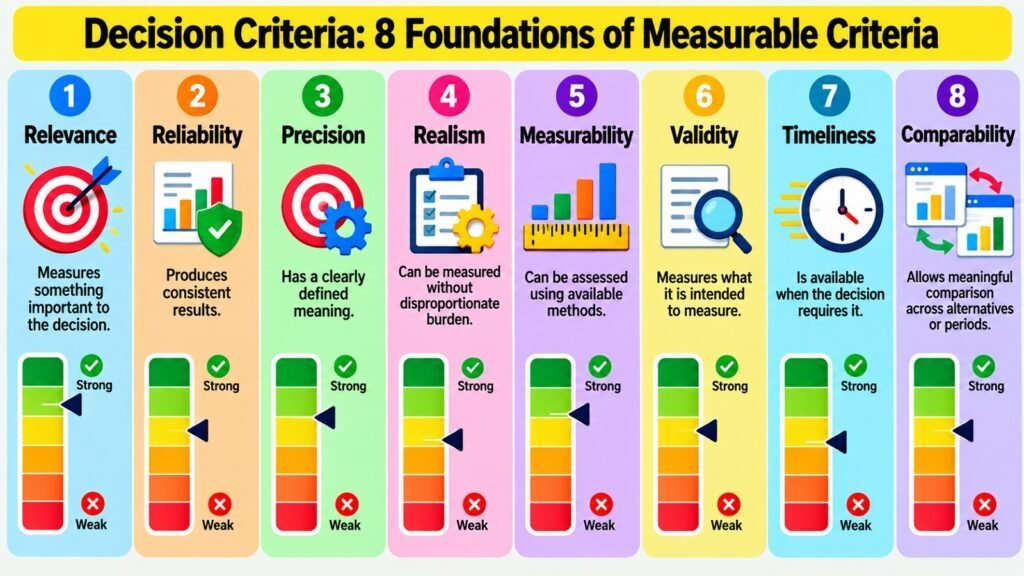
A criterion that cannot be assessed consistently is not a criterion. It is an aspiration. Measurability is what transforms a value dimension into a workable evaluative standard. Without it, different evaluators will interpret the same criterion differently, and resulting scores will reflect personal judgment more than the alternatives themselves.
Measurability does not require that every criterion be expressed as a number. Some of the most important criteria in business decisions, such as cultural fit, regulatory compliance quality, or strategic alignment, resist precise quantification. What measurability requires is that criteria are defined clearly enough to support consistent assessment. A criterion like “strong customer service” becomes assessable when specified as response time within four hours, first-contact resolution above a defined benchmark, or a verified satisfaction rating. The concept remains qualitative, but the evaluation becomes structured and comparable.
Decision analysis draws a distinction between quantitative criteria and qualitative criteria that rely on structured judgments, scales, or categorical assessments. Both can be made measurable. The problem arises when neither type is defined with sufficient clarity. Vague criteria such as “innovative” or “aligned with company values” invite inconsistent interpretation and undermine evaluation reliability. Measurability should not be confused with Data Context, which addresses the broader information environment. Measurability addresses how a particular criterion is evaluated and how comparisons between alternatives can be made reliably.
There is also a risk in excessive quantification. Organizations sometimes design criteria around what can be measured easily rather than what genuinely matters, producing metric displacement, where the measure becomes the goal rather than the underlying outcome. Practical guidance includes defining what evidence would confirm performance on each criterion, establishing common scales for qualitative criteria, and checking that different evaluators applying the same criterion to the same alternative would reach broadly consistent assessments.
Table 3: Decision Criteria Measurability Dimensions and Their Evaluation Applications
| Measurability Dimension | Evaluation Application |
| Quantitative metric | Uses numerical data, such as cost or delivery time, for direct comparison |
| Qualitative scale | Applies structured rating scales such as low, medium, or high to subjective criteria |
| Binary condition | Assesses whether a criterion is met or not, such as regulatory compliance |
| Threshold indicator | Determines whether an alternative meets a minimum or maximum acceptable level |
| Index or composite score | Combines multiple sub-measures into a single assessable criterion value |
| Expert judgment | Uses structured professional assessment when direct measurement is not feasible |
| Observable evidence | Relies on documented outcomes or verified performance records for evaluation |
| Comparative ranking | Orders alternatives relative to each other on a specific criterion dimension |
3. Decision Criteria and Weighting: Establishing Relative Importance
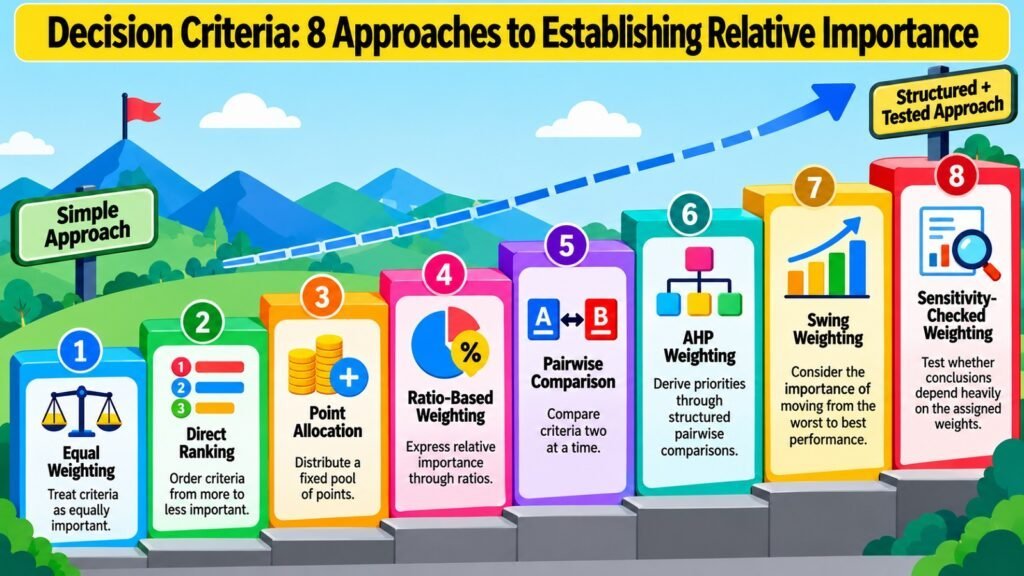
Not all criteria matter equally. In virtually every consequential decision, some dimensions of value are more important than others. Weighting is the mechanism through which Decision Criteria express that relative significance, and it is one of the most influential aspects of structured evaluation.
Multi-criteria decision analysis provides the theoretical foundation for weighting. Decision-makers can express preferences not only about which alternatives perform well but also about how much each criterion should contribute to the final evaluation. Those preferences can be captured through equal weighting, where all criteria are treated as equally important; relative weighting, where criteria reflect their comparative importance; or priority structures, where certain criteria rank above others regardless of the scores achieved.
Weighting is where organizational priorities become visible in structured form. A company that says strategic fit matters more than short-term cost must translate that priority into weights that reflect the claim. If cost receives the highest weight despite stated strategic objectives, the weighting reveals the true priority structure. Consider a company evaluating three supply chain partners on cost, delivery reliability, sustainability, and relationship strength. If cost is weighted at sixty percent, the evaluation will favor the lowest-cost supplier even if its reliability is poor. Shifting the weight toward reliability changes the preferred alternative. The alternatives did not change. The expression of relative importance did.
Weighting carries inherent subjectivity that must be acknowledged. Arbitrary weights undermine evaluation credibility. Double-counting occurs when two criteria measure essentially the same thing, amplifying the weight of that dimension without making it explicit. The practical discipline involves verifying that assigned weights reflect the decision’s true priorities, checking for overlap between criteria, and ensuring the evaluation can withstand stakeholder scrutiny. Weights may need to change as strategies or circumstances evolve.
Table 4: Decision Criteria Weighting Considerations and Their Purpose in Evaluation
| Weighting Consideration | Purpose in Evaluation |
| Equal weighting | Treats all criteria as equally important when no clear priority order exists |
| Relative weighting | Assigns different values to criteria based on their comparative importance |
| Priority structure | Ranks criteria hierarchically when certain dimensions must take precedence |
| Stakeholder alignment | Ensures weights reflect the genuine priorities of key decision-makers and stakeholders |
| Transparency | Makes the basis for weight assignment visible and open to review and challenge |
| Avoiding double-counting | Prevents overlapping criteria from inflating the effective weight of one dimension |
| Weight sensitivity check | Tests whether small changes in weights materially alter which alternative is preferred |
| Strategic consistency | Confirms that weights reflect stated organizational priorities rather than convenience |
4. Decision Criteria and Trade-Offs: Balancing Competing Priorities
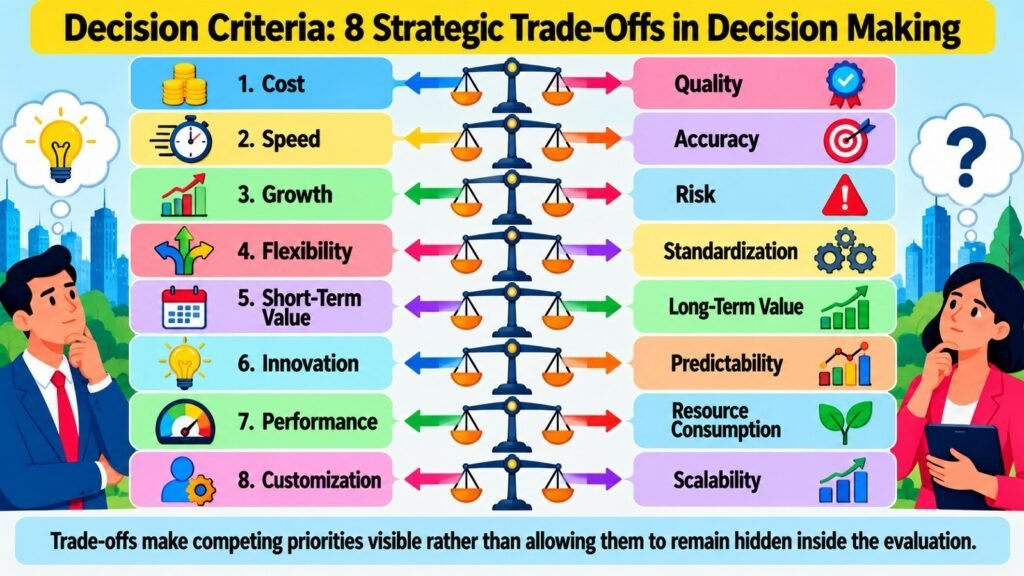
Real decisions rarely allow the luxury of optimizing every criterion simultaneously. Improving performance on one dimension typically requires accepting a reduction on another. This tension between competing priorities is what decision theory calls a trade-off, and understanding it is central to making Decision Criteria work in practice.
Trade-offs arise from the fundamental structure of many decisions. A product designed for the lowest possible cost typically requires simplification that reduces quality. A service model optimized for flexibility sacrifices the efficiency that standardization provides. Growth strategies that expand market share increase risk exposure. These are not accidental conflicts. They reflect genuine constraints in how value can be created across multiple dimensions simultaneously.
Multi-criteria decision analysis and utility theory both provide frameworks for handling trade-offs. A compensatory approach allows strong performance on one criterion to offset weak performance on another. A non-compensatory approach treats certain criteria as absolute requirements where no strength elsewhere can compensate for a failure. Organizations benefit from making important trade-offs explicit before evaluation begins rather than discovering them during deliberation. A technology investment decision might involve a conflict between implementation speed and system reliability. If that conflict is not named and structured in advance, the evaluation tends to reflect whichever dimension the dominant voice in the room prioritizes, rather than a considered organizational judgment.
Practical guidance begins with identifying the most significant conflicts in advance and asking whether the criteria being used are genuinely independent. When important trade-offs are identified, the evaluation should make them visible rather than absorbing them silently into aggregate scores. Transparent trade-off reasoning strengthens decision accountability and makes it easier to revisit conclusions if circumstances change.
Table 5: Common Decision Criteria Trade-Offs and Competing Priorities
| Trade-Off | Competing Priorities |
| Cost versus Quality | Reducing expenditure against maintaining standards and output performance |
| Speed versus Accuracy | Faster delivery against thoroughness and reliability of the outcome |
| Growth versus Risk | Expanding opportunity and market share against increased uncertainty and exposure |
| Flexibility versus Standardization | Adapting to varied needs against achieving efficiency through consistency |
| Short-term versus Long-term | Immediate returns or savings against sustained value and future capability |
| Centralization versus Autonomy | Coordination and control against responsiveness and local decision-making |
| Innovation versus Stability | Pursuing new approaches against preserving proven and reliable processes |
| Scope versus Focus | Addressing multiple objectives broadly against concentrating resources on priorities |
5. Decision Criteria and Thresholds: Establishing Acceptable Boundaries
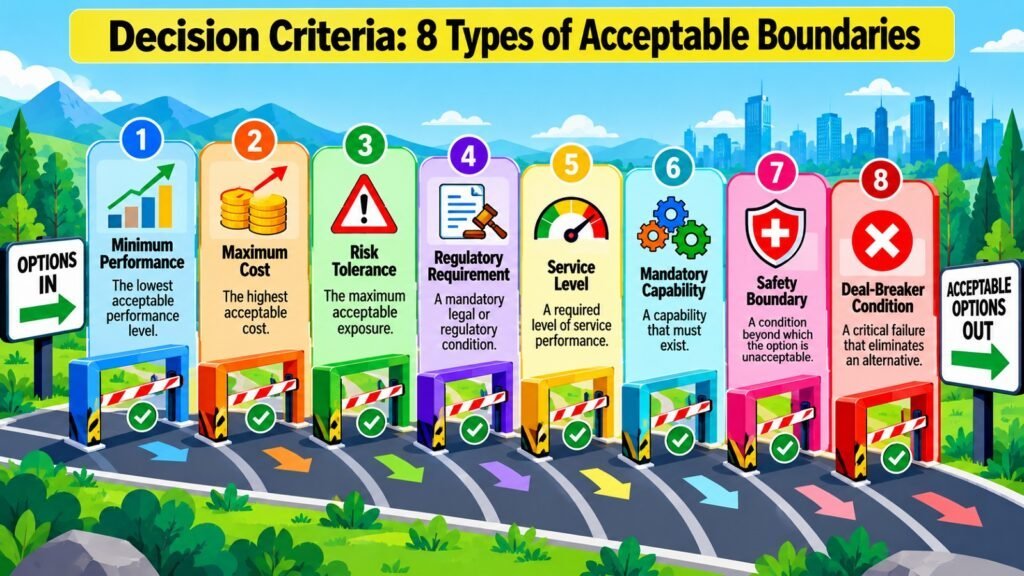
Thresholds add a qualitatively different kind of constraint to Decision Criteria. While weighting establishes relative importance and trade-offs describe tensions between competing priorities, thresholds define what is acceptable. They represent the boundaries within which alternatives must fall before broader evaluation takes place.
A threshold can take several forms. A minimum performance level establishes what an alternative must achieve on a specific criterion to remain viable. A maximum cost limit excludes alternatives that exceed a defined budget ceiling. A regulatory requirement removes any alternative that does not meet mandatory legal, safety, or compliance standards. A risk tolerance level eliminates options that exceed the organization’s willingness to accept exposure. These are not soft preferences. They are hard conditions.
The important distinction between thresholds and weighting is that a threshold prevents compensation. In a compensatory evaluation, poor performance on one criterion can be offset by strong performance elsewhere. A threshold overrides that logic. An alternative that fails to meet a mandatory regulatory requirement cannot earn its way back into consideration through strong performance on other dimensions. Consider a financial institution selecting a third-party data provider. Before applying any scoring, the institution may require that providers hold a specific security certification, maintain minimum service availability, and operate under a compatible regulatory framework. Providers that do not meet these thresholds are not scored. They are excluded.
Setting thresholds too strictly can eliminate viable alternatives unnecessarily. Setting them too loosely allows unacceptable options to remain in the evaluation. The discipline involves identifying which criteria genuinely represent deal-breaker conditions. Practical guidance includes reviewing thresholds for each decision, ensuring they reflect genuine requirements rather than historical defaults, and documenting the rationale so that threshold decisions remain auditable.
Table 6: Decision Criteria Threshold Types and What Each Establishes
| Threshold Type | What It Establishes |
| Minimum performance level | The lowest acceptable result an alternative must achieve on a specific criterion |
| Maximum cost limit | The upper budget boundary beyond which alternatives are excluded from consideration |
| Regulatory requirement | Mandatory legal, safety, or compliance standards that all alternatives must satisfy |
| Risk tolerance limit | The maximum level of exposure or uncertainty the organization is willing to accept |
| Service level requirement | Minimum acceptable standards for availability, response time, or delivery performance |
| Mandatory capability | A required feature, function, or qualification that alternatives must possess |
| Deal-breaker condition | A specific disqualifying factor that automatically removes an alternative from evaluation |
| Environmental or ethical standard | Minimum sustainability or conduct requirements that alternatives must meet |
6. Decision Criteria and Alternative Evaluation: Comparing Choices
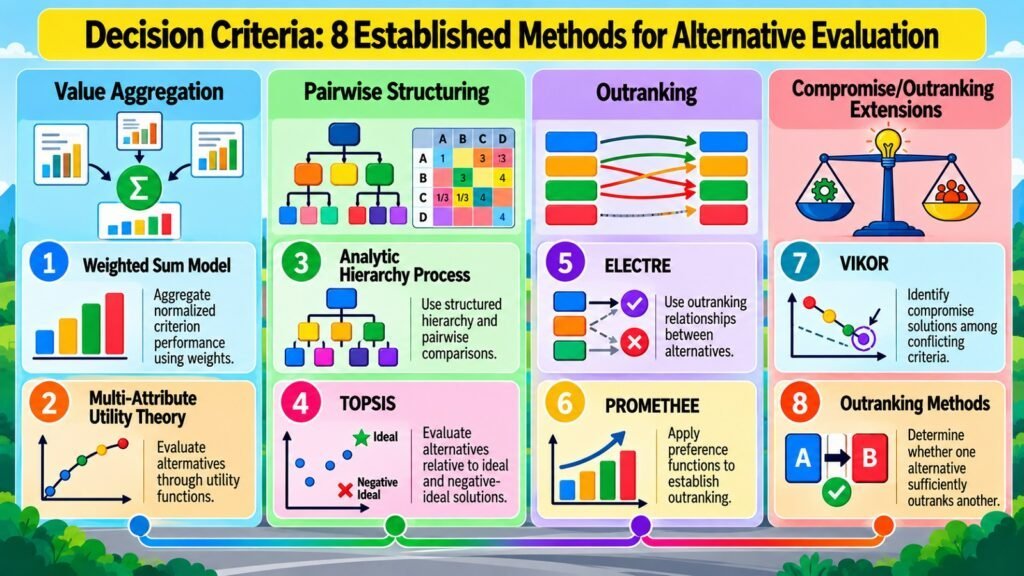
Decision Criteria become operational when applied systematically to alternatives. Evaluation matrices are among the most widely used tools for this purpose. In their basic form, they arrange alternatives as columns and criteria as rows, allowing evaluators to assess each alternative on each criterion. When weights are incorporated, a weighted scoring approach assigns scores to performance levels and multiplies them by criterion weights to produce comparable totals. Multi-criteria decision analysis extends this further with techniques such as the Analytic Hierarchy Process, TOPSIS, ELECTRE, and PROMETHEE, each with different assumptions about how criteria interact and how preferences should be aggregated.
The key distinction between alternative evaluation and prescriptive analytics is important to maintain. Criteria-based evaluation is a human-guided structured comparison that reveals how alternatives perform relative to each other. Prescriptive analytics goes further, using optimization and computational methods to recommend or generate actions. A logistics company evaluating three distribution center locations might score each on proximity to customers, infrastructure quality, regulatory environment, labor availability, and cost. Applying consistent criteria produces a structured comparison, but it does not produce a recommendation automatically. The evaluation must still be interpreted in light of factors that the criteria may not have fully captured.
Common problems in alternative evaluation include inconsistent scoring, where the same performance level receives different scores depending on who is evaluating or when. Double-counting occurs when two criteria capture similar information, amplifying one dimension invisibly. False precision gives an evaluation a misleading appearance of rigor. Changing evaluation standards after seeing results is particularly damaging, as it undermines the integrity of the entire process. Practical guidance includes defining scoring scales clearly before evaluation begins, using structured scoring processes to reduce bias, and maintaining consistent criteria throughout the comparison.
Table 7: Decision Criteria Alternative Evaluation Approaches and Their Primary Use
| Evaluation Approach | Primary Use |
| Weighted scoring matrix | Combines criteria scores and weights to produce comparable totals across alternatives |
| Analytic Hierarchy Process | Uses pairwise comparisons to derive consistent weights and alternative rankings |
| TOPSIS | Identifies alternatives closest to an ideal solution and furthest from a worst case |
| ELECTRE | Applies outranking relationships to compare alternatives without forcing full compensation |
| PROMETHEE | Uses preference functions to rank alternatives across multiple criteria with different scales |
| Qualitative scoring scale | Applies structured categorical ratings when numerical measurement is not feasible |
| Cost-benefit analysis | Compares financial and non-financial returns against investment across alternatives |
| Scenario-based evaluation | Assesses alternative performance under multiple possible future conditions |
7. Decision Criteria and Sensitivity: Testing Evaluation Robustness
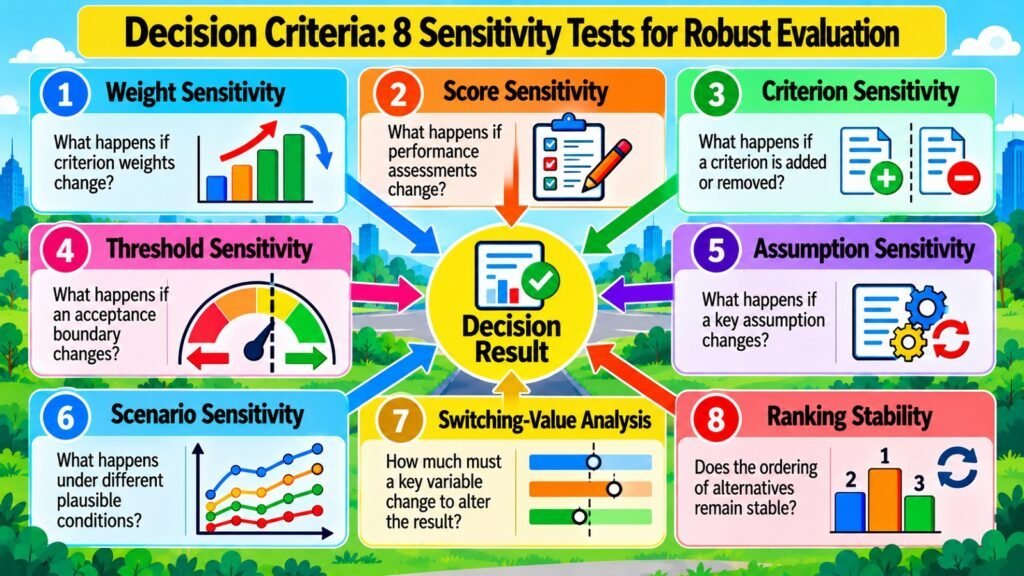
A structured evaluation can produce a clear result and still rest on fragile foundations. Sensitivity analysis tests how changes in criteria weights, measurements, or threshold values affect the evaluation of alternatives. It does not eliminate uncertainty, but it reveals how much the conclusion depends on specific assumptions.
The value of sensitivity analysis lies in what it uncovers. When a preferred alternative changes dramatically in response to a small adjustment in one criterion’s weight, that signals a fragile decision. When the conclusion holds across a wide range of weight variations, it provides stronger grounds for confidence. Decision analysis has long used sensitivity thinking to identify the criteria whose values matter most and to distinguish robust conclusions from those that are highly sensitive to particular inputs.
Sensitivity analysis in a criteria framework addresses a specific question: if this weight were different, or if this criterion were measured on a different scale, would the same alternative still be preferred? A company evaluating two vendors might score the preferred vendor higher on strategic fit and quality but lower on cost. If cost is weighted at thirty percent, the strategic vendor wins. If cost is adjusted to fifty percent, the lower-cost vendor may become preferred. The sensitivity analysis reveals that the decision is cost-weight-sensitive, prompting a closer examination before commitment.
Sensitivity analysis can also reveal hidden assumptions embedded in imprecisely defined criteria. Practical guidance includes identifying the criteria whose weights or scores have the most influence on the final ranking, testing a range of plausible values rather than only the central estimate, and noting where rankings are stable versus where they change. The output is not a new recommendation but a clearer picture of how confident the organization can be in the existing one.
Table 8: Decision Criteria Sensitivity Factors and What Can Change
| Sensitivity Factor | What Can Change |
| Criterion weight | Adjusting the relative importance assigned to a criterion can shift the preferred alternative |
| Measurement scale | Changing how a criterion is scored can alter the magnitude of differences between alternatives |
| Threshold value | Raising or lowering a boundary condition can include or exclude alternatives from evaluation |
| Criterion definition | Refining how a criterion is specified can change how alternatives are assessed against it |
| Number of criteria | Adding or removing a criterion affects the distribution of weight and evaluation emphasis |
| Evaluator judgment | Variation in how different evaluators score the same alternative on a qualitative criterion |
| Data accuracy | Errors or imprecision in the inputs used to assess a criterion affect the evaluation outcome |
| Alternative scope | Adding or removing an alternative can change the relative ranking of remaining options |
8. Decision Criteria and Governance: Maintaining Trust and Consistency
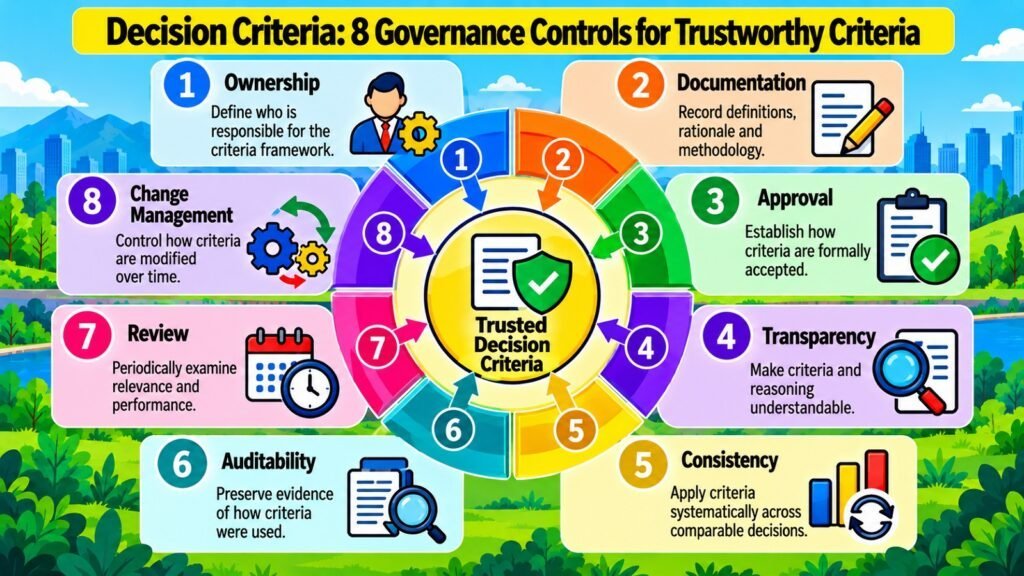
Decision Criteria are not self-maintaining. Without governance, criteria drift, become outdated, or are applied inconsistently across decisions, departments, or time periods. Governance provides the structure that keeps criteria reliable, transparent, and appropriate over time.
Criteria governance begins with ownership and documentation. Someone within the organization should be responsible for maintaining the criteria framework, and that framework should be documented clearly enough that it can be applied consistently by different evaluators. Documentation is what makes criteria auditable, which in turn makes decisions defensible. Transparency connects Decision Criteria to broader questions of fairness and accountability. When criteria are not visible to those affected by a decision, the decision can appear arbitrary even when it is not.
Governance of Decision Criteria is distinct from Decision Ownership as addressed in Decision Context. Decision Ownership concerns who has the authority to make a decision and who is accountable for its outcome. Criteria governance concerns how the criteria themselves are created, documented, approved, reviewed, and updated. A company may have used a vendor evaluation framework developed several years earlier. As markets shift, technologies evolve, and strategic priorities realign, criteria that are never reviewed remain technically consistent while becoming increasingly misaligned with what actually matters. Outdated criteria can produce decisions that are procedurally sound but substantively wrong.
The central tension in criteria governance is between consistency and adaptability. Criteria should be stable enough to support comparable evaluation over time, but responsive enough to accommodate genuine changes in the business environment. Governance structures that require documented justification for criteria changes, rather than preventing changes entirely, strike a more practical balance. Periodic review cycles, approval processes for significant revisions, and change logs that preserve the history of criteria evolution all contribute to a framework that is both disciplined and responsive.
Table 9: Decision Criteria Governance Considerations and Why They Matter
| Governance Consideration | Why It Matters |
| Criteria ownership | Assigns accountability for maintaining, reviewing, and approving the criteria framework |
| Documentation | Creates a clear record that supports consistent application and auditability across decisions |
| Approval process | Ensures criteria changes are deliberate, justified, and aligned with organizational priorities |
| Transparency | Makes criteria visible to relevant stakeholders, supporting fairness and perceived legitimacy |
| Bias review | Identifies and addresses criteria that may systematically disadvantage particular groups or options |
| Change management | Provides a structured process for updating criteria when strategies or environments shift |
| Periodic review cycle | Ensures criteria remain relevant and aligned with current business conditions and objectives |
| Audit trail | Preserves the history of criteria development and revision for accountability and learning |
Conclusion: Decision Criteria – Building a Stronger Decision Intelligence Foundation
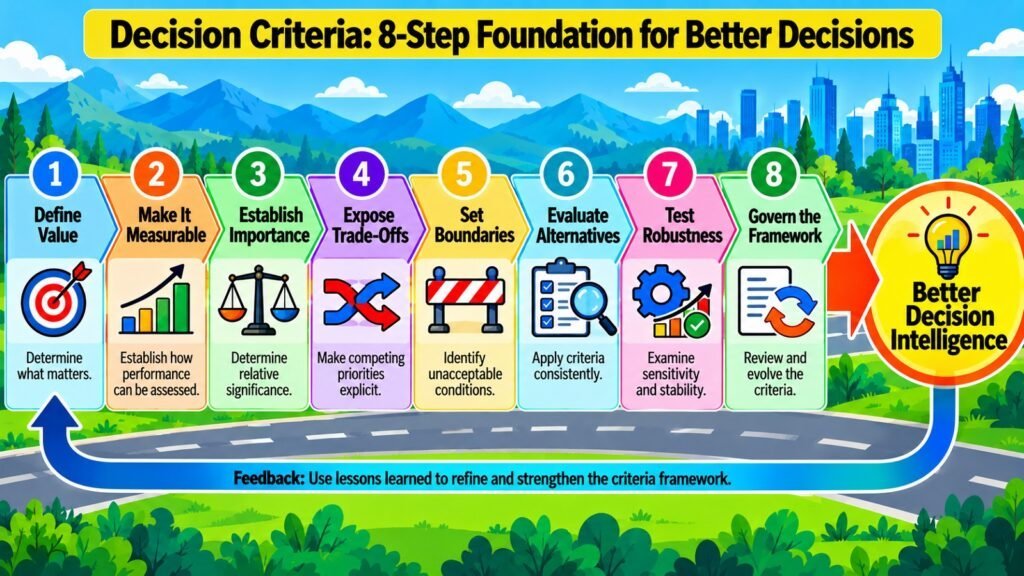
Decision Criteria provide the structured basis for determining what matters when alternatives must be evaluated. Without them, even well-resourced decisions can produce inconsistent, unaccountable, or strategically misaligned outcomes. The eight elements examined in this article form a coherent design system rather than a checklist of independent considerations.
Value dimensions establish what genuinely matters in a decision. Measurability makes those dimensions assessable and comparable. Weighting translates organizational priorities into the relative importance of each criterion. Trade-offs expose where improving one dimension requires accepting costs in another. Thresholds establish the boundaries within which alternatives must fall before broader evaluation begins. Alternative evaluation applies the criteria systematically to produce a structured comparison. Sensitivity analysis tests whether the conclusion holds under different assumptions. Governance maintains the consistency, transparency, and relevance of the criteria framework over time.
Each element depends on the others. Criteria that are well-defined but not weighted cannot produce a prioritized evaluation. Criteria that are weighted but never tested for sensitivity may produce confident-looking results built on fragile foundations. Criteria that are well-designed but never governed will drift out of alignment with organizational reality.
Within the Decision Intelligence framework, Decision Criteria interact directly with Decision Context and Decision Models. As Decision Intelligence capabilities extend further, including Prescriptive Analytics, Decision Automation, Human in the Loop, Decision Platforms, and Decision Feedback, Decision Criteria provide the evaluative foundation that those capabilities rely on. Automated recommendation systems embed criteria implicitly. Making those criteria explicit and well-governed is essential to maintaining trust in automated decisions.
Decision Criteria deserve deliberate design, not last-minute invention. Organizations that treat criteria as a disciplined, documented, and periodically reviewed activity consistently make more defensible decisions and are better positioned to learn from them.
Table 10: Decision Criteria Elements and Their Primary Contribution to Better Decisions
| Elements of Decision Criteria | Primary Contribution |
| Value Dimensions | Identifies the categories of value that define what matters in a decision |
| Measurability | Ensures criteria can be assessed consistently and compared across alternatives |
| Weighting | Expresses the relative importance of each criterion within the overall evaluation |
| Trade-Offs | Makes competing priorities explicit so they can be managed rather than ignored |
| Thresholds | Establishes acceptable boundaries that alternatives must meet before evaluation proceeds |
| Alternative Evaluation | Applies criteria systematically to produce a structured and transparent comparison |
| Sensitivity | Tests the robustness of evaluation conclusions under different weights and assumptions |
| Governance | Maintains consistency, transparency, and accountability in criteria management over time |