Table of Contents
Introduction to Data Cleaning: Building Reliable Data for Analytics
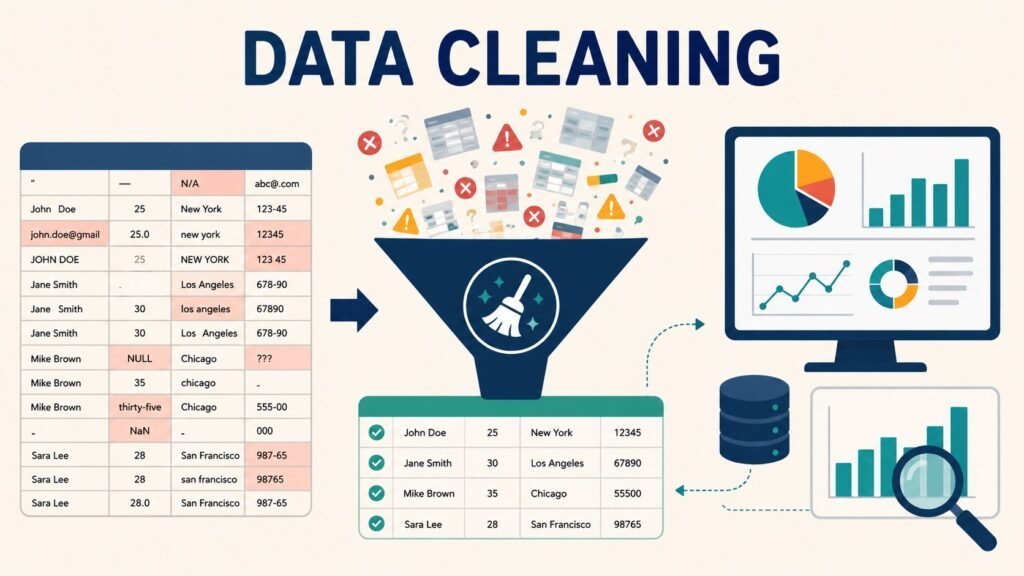
Real-world datasets are rarely clean. They arrive carrying missing values, duplicate entries, inconsistent representations, inaccurate figures, and structurally invalid records. When analysis begins on data that contains these problems, the conclusions it produces inherit them — precise in method but unreliable in result.
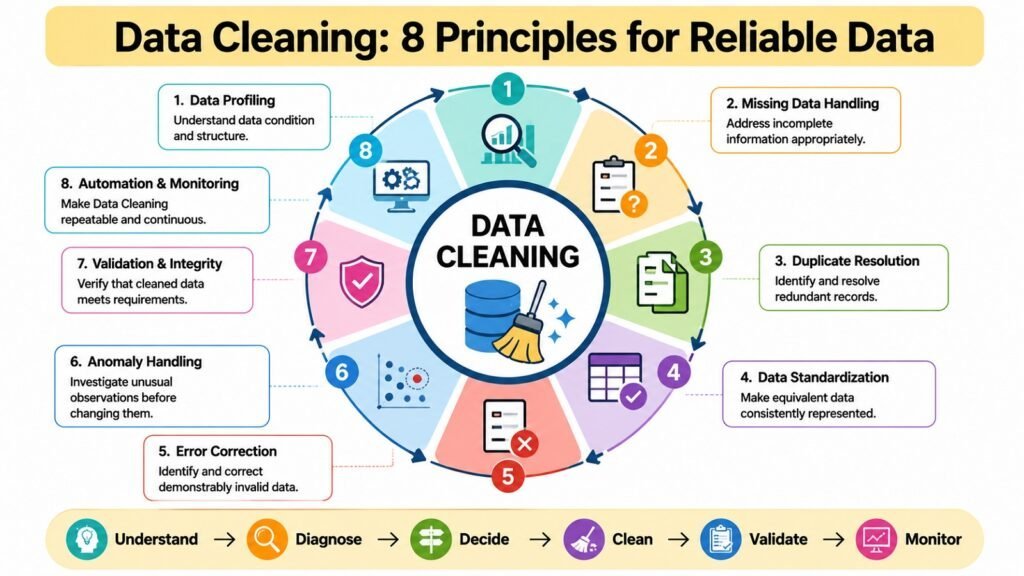
Data Cleaning is the process of detecting, diagnosing, and resolving data problems so the data becomes reliable and fit for its intended analytical purpose. It is an important aspect of Data Analytics because analytical reliability depends substantially on the quality, consistency, validity, and fitness of the underlying data. Importantly, Data Cleaning is not simply the removal of bad records. It is a disciplined process: understand the problem, diagnose its cause, decide what action is justified, apply the correction, and validate the outcome.
Data Cleaning is related to, but distinct from, Data Quality, Data Preparation, Data Transformation, Data Validation, and Data Governance. Each covers broader or adjacent ground; Data Cleaning focuses specifically on making existing data trustworthy for analysis. Effective Data Cleaning requires both technical methods and informed judgment. Some seemingly obvious decisions — deleting missing values, removing duplicates, discarding outliers — can damage analytical results when applied without first understanding why the problem exists.
The eight aspects below form a comprehensive Data Cleaning framework, from establishing a diagnostic baseline to sustaining quality at scale.
Table 1: Data Cleaning Framework — Eight Aspects at a Glance
| Aspect | Role in Data Cleaning |
| Data Profiling | Establishes a diagnostic baseline by revealing structure, completeness, and patterns before cleaning begins |
| Missing Data Handling | Addresses incomplete records through treatment chosen according to the pattern and cause of missingness |
| Duplicate and Redundant Data Resolution | Identifies and resolves repeated or overlapping records to prevent distorted counts and aggregations |
| Data Standardization | Ensures equivalent information is represented consistently without altering its underlying meaning |
| Error and Invalid Data Correction | Detects and resolves demonstrably incorrect, malformed, or rule-violating values using verifiable evidence |
| Outlier and Anomaly Handling | Investigates unusual observations to determine whether they represent errors or legitimate data points |
| Data Validation and Integrity | Verifies that cleaned data satisfies defined rules, relationships, and fitness-for-purpose requirements |
| Automation and Monitoring | Scales Data Cleaning into a repeatable, documented, and continuously maintained process |
1. Data Cleaning Through Data Profiling: Understand Data Before Cleaning
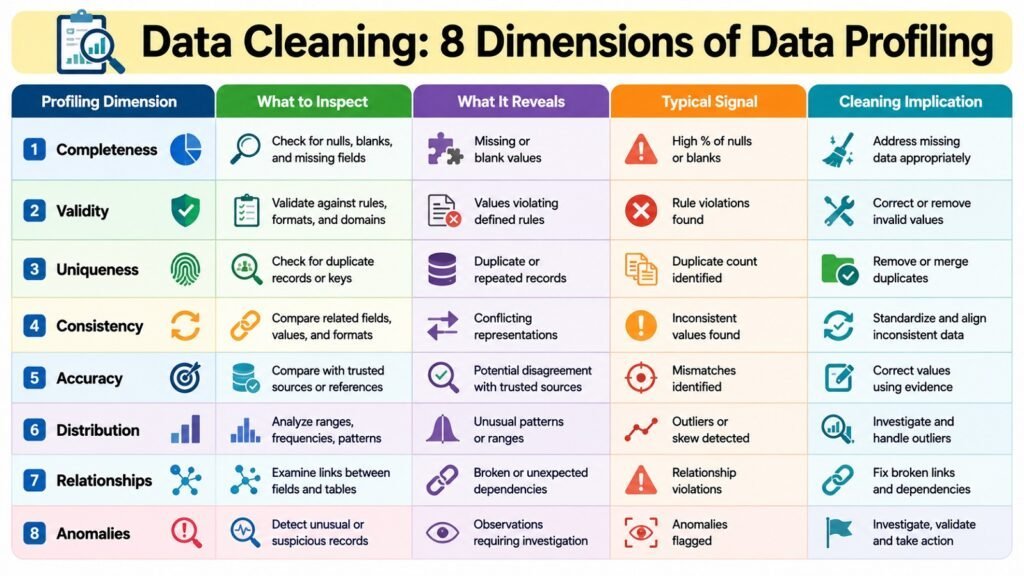
The most common mistake in Data Cleaning is beginning to clean before understanding what the data actually contains. Data Profiling is the systematic examination of a dataset to understand its structure, content, and behaviour. It serves as the diagnostic foundation for every subsequent cleaning decision.
Profiling examines data types, value distributions, missingness patterns, duplicate indicators, value frequencies, ranges, format consistency, and cross-field relationships. The techniques involved — descriptive statistics, frequency analysis, uniqueness checks, range analysis, schema inspection — are tool-agnostic and focused on diagnosis rather than correction. The UCI Machine Learning Repository Adult dataset illustrates this well: an initial profiling step reveals that certain fields use question marks as missing-value codes rather than standard null markers, a detail invisible without examining value frequencies. Treating those records correctly requires first understanding what that code means.
Profiling sets a standard that allows for the evaluation of any subsequent cleaning operation. In its absence, it becomes impossible to determine if an intervention has enhanced the data or simply modified it. A vital understanding provided by profiling is that not all atypical values signify an error. An unforeseen frequency distribution might indicate a true attribute of the population. A biased range could genuinely depict a distorted reality. Profiling uncovers patterns, while domain expertise provides the necessary explanations. The insights gained from profiling guide cleaning choices rather than dictating them outright.
Table 2: Data Cleaning Profiling Dimensions and What They Reveal
| Profiling Dimension | What It Reveals for Data Cleaning |
| Completeness | Which fields have missing values, how many records are affected, and where missingness concentrates |
| Uniqueness | Whether identifier fields contain repeated values indicating redundant or conflicting records |
| Value distribution | The spread and frequency of values, revealing unexpected concentrations or rare categories |
| Data type conformance | Whether field contents match their declared type, such as text in a numeric field |
| Range validity | Whether numeric or date values fall within domain-plausible boundaries |
| Format consistency | Whether values in the same field follow a consistent pattern, such as dates or phone numbers |
| Cross-field relationships | Whether expected dependencies between fields, such as start and end dates, hold consistently |
| Cardinality | The number of distinct values, distinguishing high-variety fields from controlled categories |
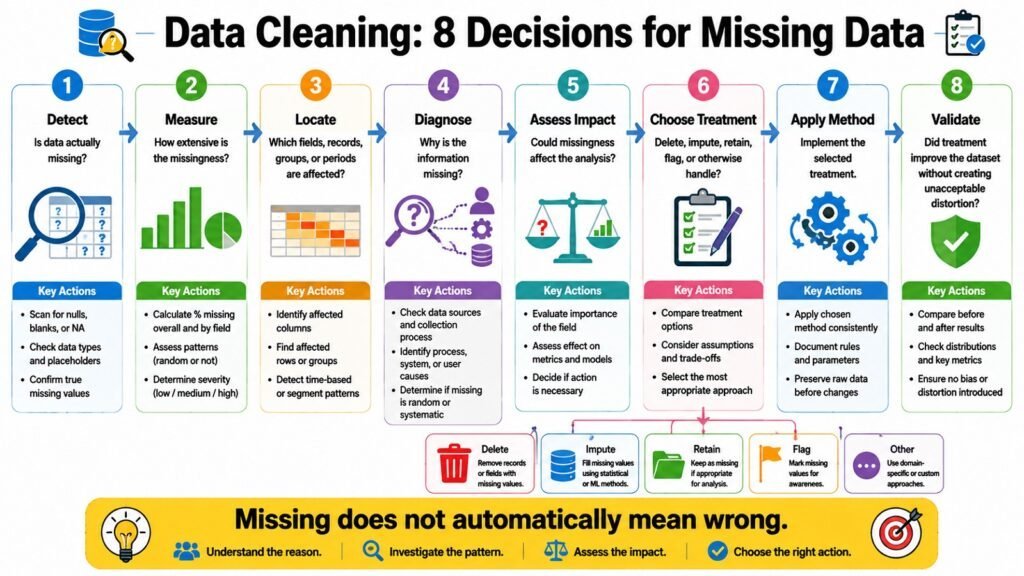
2. Data Cleaning Through Missing Data Handling: Restore Completeness
The most common mistake in Data Cleaning is beginning to clean before understanding what the data actually contains. Data Profiling is the systematic examination of a dataset to understand its structure, content, and behaviour. It serves as the diagnostic foundation for every subsequent cleaning decision.
Profiling examines data types, value distributions, missingness patterns, duplicate indicators, value frequencies, ranges, format consistency, and cross-field relationships. The techniques involved — descriptive statistics, frequency analysis, uniqueness checks, range analysis, schema inspection — are tool-agnostic and focused on diagnosis rather than correction. The UCI Machine Learning Repository Adult dataset illustrates this well: an initial profiling step reveals that certain fields use question marks as missing-value codes rather than standard null markers, a detail invisible without examining value frequencies. Treating those records correctly requires first understanding what that code means.
Profiling establishes a baseline against which any cleaning operation can later be judged. Without it, there is no way to know whether an intervention improved the data or merely altered it. A critical insight profiling delivers is that not every unusual value is an error. An unexpected frequency distribution may reflect a genuine characteristic of the population. A skewed range may accurately represent a skewed reality. Profiling reveals patterns; domain knowledge explains them. Its findings inform cleaning decisions rather than making them automatically.
Table 2: Data Cleaning Profiling Dimensions and What They Reveal
| Missing Data Approach | Key Considerations |
| Complete-case deletion | Appropriate only when missingness is random and the affected proportion is small; risks bias otherwise |
| Mean or median imputation | Reduces variance and distorts distributions; suitable only for low missingness rates in numeric fields |
| Mode imputation | Reinforces the most common category and may over-represent the majority group in the data |
| Model-based imputation | Preserves inter-variable relationships but requires explicit assumptions about the data-generating process |
| Multiple imputation | Accounts for estimation uncertainty by producing multiple completed datasets for comparison |
| K-nearest neighbour imputation | Uses similar records to estimate missing values; sensitive to the choice of similarity measure |
| Interpolation | Appropriate for ordered or temporal data with smooth underlying trends; unsuitable for categorical fields |
| Retaining missingness | Valid when the analysis supports incomplete data or when absence is analytically meaningful |
3. Data Cleaning Through Duplicate and Redundant Data Resolution
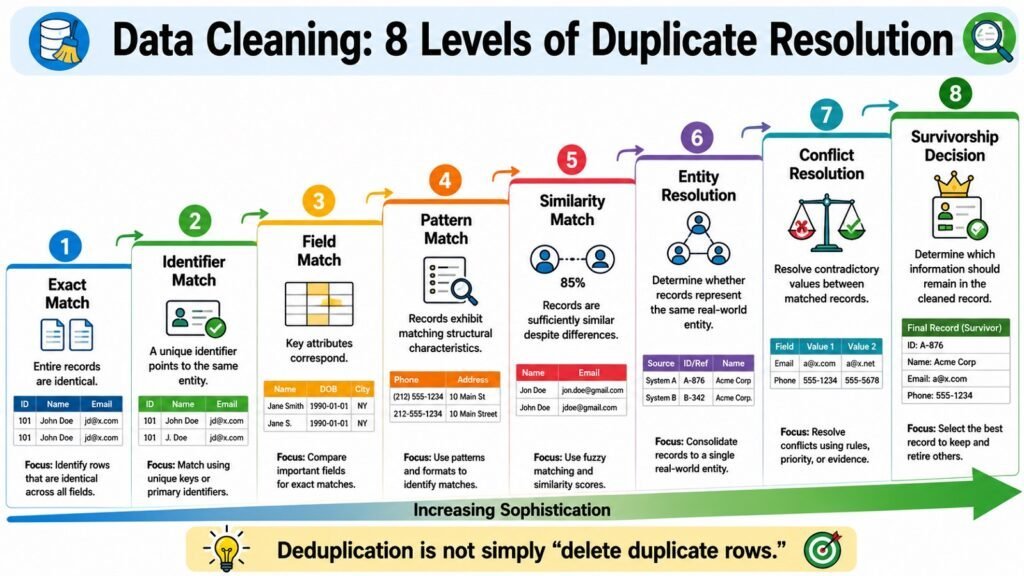
Duplicate and redundant records distort every count, aggregate, and relationship that depends on them. A customer base inflated by unresolved duplicates misleads segmentation. A sales total that double-counts transactions overstates revenue. Resolving these problems requires distinguishing between exact duplicates, partial duplicates, duplicate entities, and legitimate repeated observations such as multiple transactions from the same customer.
Identifying two similar records does not automatically justify deleting one of them. The core challenge is entity resolution: determining whether two records represent the same real-world entity, event, or observation. Practical approaches include exact matching on unique identifiers, rule-based matching using domain logic, and fuzzy matching that computes resemblance across text fields where variation in spelling, abbreviation, or format prevents exact matches from finding genuine overlaps.
Once potential duplicates are identified, a survivorship decision is needed: which record is retained and how conflicting field values are resolved. Business rules, timestamps, or authoritative source designations typically determine this. In some cases, merging complementary values from both records and flagging conflicts for review is the cleanest approach. The risks run in both directions. False matches — merging records that represent different entities — create incorrect composite records that are harder to detect than the original duplication. Missed matches leave redundancy in place. Both errors are more difficult to correct after the fact, making evidence-based duplicate resolution essential.
Table 4: Data Cleaning Considerations for Duplicate and Redundant Data Scenarios
| Duplicate Scenario | Data Cleaning Consideration |
| Exact duplicate record | Safe to remove when all fields match, but verify the repetition is not a system artefact |
| Partial duplicate with conflicting values | Requires investigation of which value is correct before merging or removing either record |
| Same entity, different identifiers | Entity resolution required; matching rules and domain knowledge needed to confirm identity |
| Repeated transaction for same customer | Legitimate repetition; should not be treated as a duplicate without confirming the context |
| Records from merged data sources | Assess whether each source used a compatible identification scheme before assuming overlap |
| Fuzzy name or address match | Similarity alone does not confirm identity; verify using additional corroborating fields |
| Updated record with older copy retained | Use timestamps or version metadata to determine which record reflects current reality |
| Missing identifier field in one record | Partial match without identifier confirmation; flag for manual review rather than auto-merge |
4. Data Cleaning Through Data Standardization: Make Data Consistent
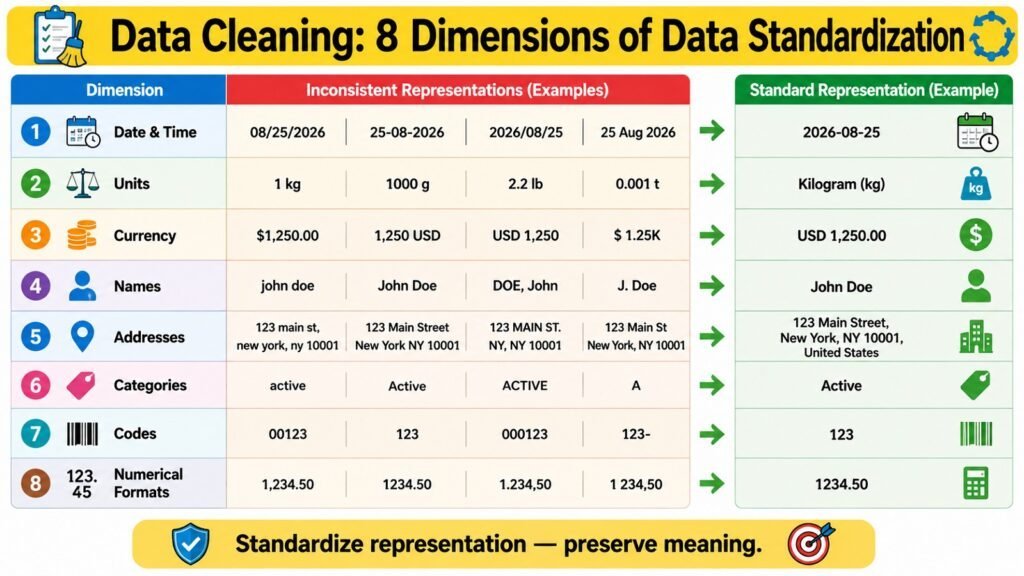
Inconsistency in how the same information is recorded prevents grouping, matching, filtering, and comparison from working correctly. A dataset that records dates as both “01/15/2024” and “15-Jan-2024” cannot aggregate those records without first resolving the difference. Standardization makes equivalent information consistently represented without changing its underlying meaning.
Common inconsistencies involve dates, times, units, currencies, names, addresses, categorical labels, abbreviations, capitalization, codes, and numerical precision. The purpose of standardization is narrower than Data Transformation: it does not reshape or compute new variables; it ensures the same thing is always stored the same way. Converting a date format is standardization. Extracting a year into a new variable is transformation.
The right standard for each field should reflect its meaning and context. Country names may be standardized using ISO 3166 codes. Categorical fields populated through free-text entry often need a controlled vocabulary map, created through frequency analysis, to consolidate variants into canonical forms. A significant risk is standardizing incorrectly because similar values are assumed to be equivalent when they are not. Drug names, city names, and coded categories can appear identical in form while referring to different things. Standardization should therefore be preceded by a clear understanding of each field informed by a data dictionary or domain expertise.
Table 5: Data Cleaning Standardization — Types of Inconsistency and Considerations
| Inconsistency Type | Standardization Consideration |
| Date and time formats | Adopt a single format such as ISO 8601 and convert all entries systematically |
| Units of measurement | Select one unit per field and convert all others using verified conversion factors |
| Currency representation | Record the denomination alongside the value and convert to a common currency if aggregation is needed |
| Capitalization in text fields | Apply a consistent case convention such as title case for names and document the rule |
| Abbreviated versus full categorical labels | Create a controlled vocabulary map and replace all abbreviations with canonical full-form values |
| Country and region codes | Apply an established standard such as ISO 3166 and verify all existing values against it |
| Numeric precision | Align decimal places or significant figures consistently across all records in the same field |
| Categorical synonyms and equivalents | Identify synonymous entries through frequency analysis and consolidate under a single canonical label |
5. Data Cleaning Through Error and Invalid Data Correction
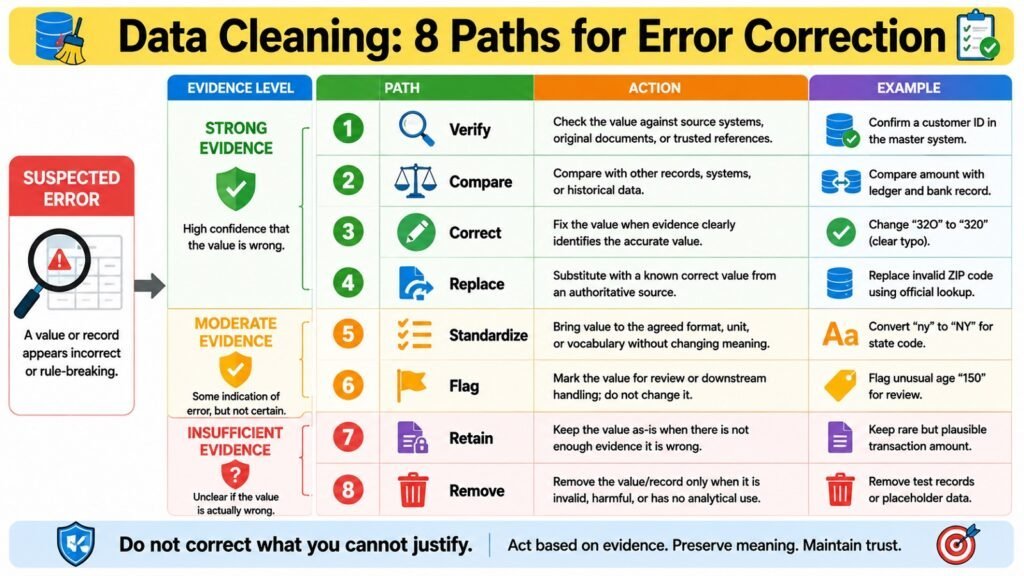
Some values in a dataset are demonstrably wrong. An age field containing negative twelve is invalid. A postal code containing letters where only digits are permitted is malformed. A transaction dated two decades before the organization existed is contextually impossible. These are errors in a meaningful sense: they conflict with established facts, domain rules, or formal constraints, and Data Cleaning must address them.
The critical distinction is between a value that can be established as incorrect with sufficient evidence and one that is merely unusual or uncertain. Data Cleaning should not replace uncertainty with assumption. Every correction must be defensible. Evidence that justifies correction includes source documents, data dictionaries, reference lists of permitted values, domain constraints, and cross-field relationships. Invalid codes can be identified by checking against a controlled list. Malformed entries can be parsed where the intended value is recoverable. Transcription errors can sometimes be resolved through corroborating fields.
Correction is not the only valid response. Flagging a record while retaining the original value is appropriate when the correction is uncertain. Removal is appropriate when the error makes the record analytically unusable. Retaining without change is appropriate when evidence for correction is insufficient. A significant risk is overcorrection: a well-intentioned process that adjusts values based on assumptions rather than evidence introduces new errors that are harder to detect because they conform to the expected pattern. Transparency is therefore essential — significant changes should be logged with their original value, new value, justification, and source.
Table 6: Data Cleaning Error Types and Treatment Considerations
| Error Type | Treatment Consideration for Data Cleaning |
| Invalid range value | Verify domain constraints and correct only if a valid value can be confirmed from a reliable source |
| Malformed entry | Identify the intended format through pattern analysis and correct where the intended value is recoverable |
| Invalid code or category | Compare against a reference list of permitted values; recode or flag records that do not match |
| Transcription error | Corroborate the correct value using a source document, related field, or other authoritative record |
| Inconsistent cross-field relationship | Determine which field holds the correct value using domain rules before altering either field |
| Wrong data type | Parse or convert where the intended value is recoverable; flag or remove where it is uninterpretable |
| Impossible value given context | Use contextual rules to confirm impossibility before treating as an error; document the rule applied |
| Conflicting values across sources | Identify the authoritative source for that field and use it to resolve the conflict, logging the decision |
6. Data Cleaning Through Outlier and Anomaly Handling: Investigate the Unusual
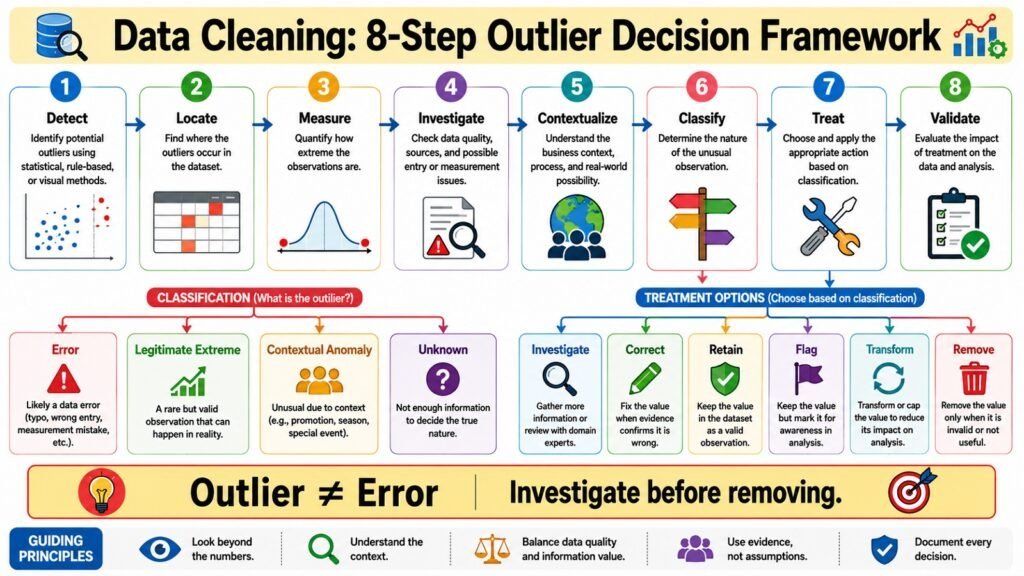
Decisions involving unusual or extreme observations are among the most judgment-intensive in Data Cleaning. The instinct to remove values that fall far from the centre of a distribution is understandable, but the fact that a value is unusual does not make it incorrect. A very high household income may be a data-entry error or an accurate record of a genuine outlier. A transaction amount far above the typical range may be a system glitch or a legitimate large purchase. Removing a real extreme observation is a form of data loss as consequential as any error.
The appropriate response starts with detection, then diagnosis. Detection identifies unusual observations using statistical thresholds such as standard deviation bounds or interquartile range limits, domain rules that define implausible values, or contextual analysis that asks whether a value is unusual given related variables rather than in isolation. Diagnosis is the more substantive step: examining the source of the observation, its consistency with other fields in the record, its frequency in the dataset, and the available evidence for or against a data error.
Possible responses include investigation, correction, retention, flagging for review, transformation to reduce leverage, or removal. Each has trade-offs. Deleting confirmed errors protects the analysis. Retaining real extreme values preserves representativeness. Flagging enables sensitivity analysis — running the analysis with and without the flagged observations to test their influence. Transformation, such as a logarithmic scale, reduces leverage without removing values. The common mistake of removing every observation beyond an arbitrary statistical threshold discards potentially valuable information and distorts the distribution.
Table 7: Data Cleaning Approaches to Outlier and Anomaly Handling
| Detection or Treatment Approach | Data Cleaning Consideration |
| Standard deviation threshold | Useful for roughly normal distributions; inappropriate for highly skewed data without adjustment |
| Interquartile range method | More robust to skewed distributions; the threshold should be calibrated to the domain context |
| Domain rule-based detection | Uses established constraints such as physiological limits or business rules to flag implausible values |
| Contextual detection | Identifies values unusual relative to related variables in the same record rather than in isolation |
| Retention with flagging | Preserves the original value while marking it for awareness; enables sensitivity analysis |
| Correction | Justified only when the source error can be confirmed and the correct value can be established |
| Transformation | Reduces the influence of extreme values without removing them; appropriate when skew is structural |
| Removal | Appropriate only when the observation is a confirmed error and retention would distort the analysis |
7. Data Cleaning Through Data Validation and Integrity: Verify Reliability
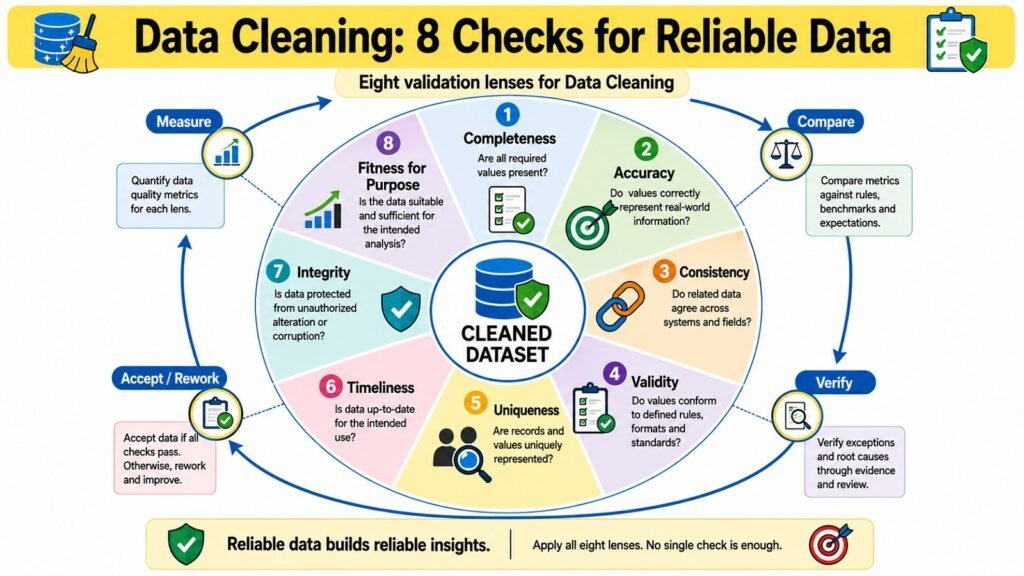
Completing the active cleaning steps does not mean the data is ready for analysis. A deduplication operation may have shifted record counts in unexpected ways. A field that was imputed may now conflict with values in a related field. A cleaning rule applied at scale may have introduced a systematic error. Data Validation is the verification stage that determines whether the cleaned data satisfies defined requirements and whether any new problems were introduced during cleaning.
Validation differs from Data Cleaning in purpose: cleaning addresses problems, validation confirms that problems were adequately resolved. The range of applicable checks is broad. Range checks verify numeric values fall within permitted boundaries. Data-type checks confirm each field contains correctly typed values. Format checks verify fields conform to expected patterns. Allowed-value checks compare categorical entries against a controlled list. Uniqueness checks confirm that identifier fields contain no residual duplicates. Referential integrity checks verify that relationships between linked datasets remain valid. Cross-field checks test whether logical dependencies between fields still hold. Cross-dataset reconciliation compares aggregated counts or totals against a reference source to detect systemic losses.
A useful concept here is fitness for purpose. Perfectly clean data in an absolute sense is not a realistic goal, nor a necessary one. The objective is data that is sufficiently reliable for its intended analytical use. Defining fitness requirements before cleaning begins makes it possible to calibrate validation checks to the actual analytical stakes. Documentation, reproducibility, and auditability are equally important: recording what was changed, how the result was verified, and what rules governed the process allows the work to be reviewed, reproduced, and extended.
Table 8: Data Cleaning Validation Checks and Their Purpose
| Validation Check | Purpose in Data Cleaning |
| Range check | Confirms numeric or date values fall within domain-plausible or rule-defined boundaries |
| Data-type check | Verifies each field contains values consistent with its declared or intended data type |
| Format check | Ensures fields such as dates, postal codes, and identifiers conform to the required pattern |
| Allowed-value check | Compares categorical values against a defined permitted list to detect uncleaned residuals |
| Uniqueness check | Confirms identifier fields contain no repeated values after deduplication |
| Referential integrity check | Verifies that relationships between linked tables remain valid after cleaning operations |
| Cross-field consistency check | Tests whether related fields remain logically consistent with each other after field-level changes |
| Cross-dataset reconciliation | Compares aggregate counts or totals against a reference source to detect systemic losses during cleaning |
8. Data Cleaning Automation and Monitoring: Scale Reliable Data
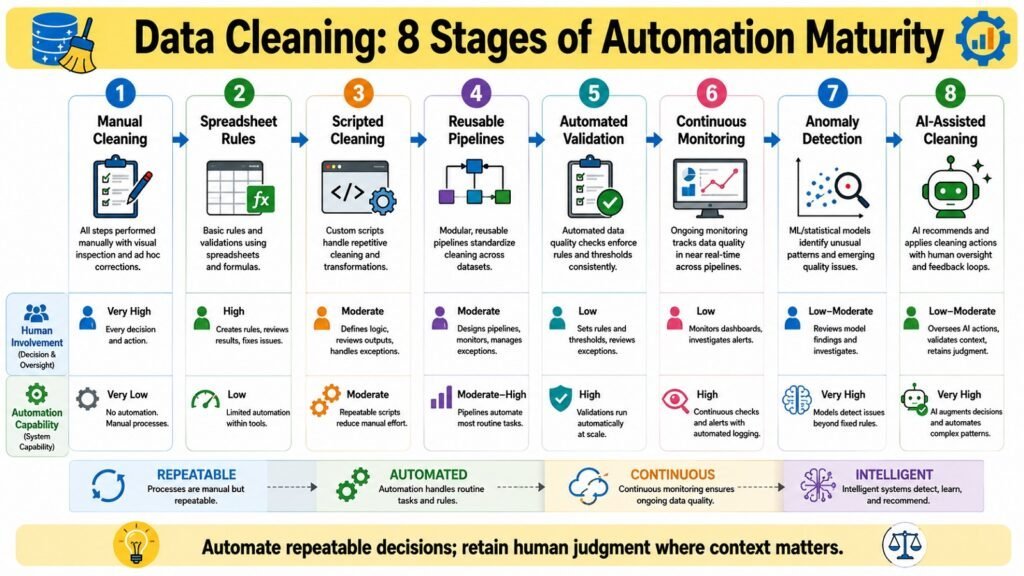
When data arrives continuously from operational systems, external feeds, and partner organizations, manual Data Cleaning is not scalable. New records introduce the same categories of problems that earlier cleaning addressed, and each batch needs to be handled consistently and efficiently. Automation and monitoring are what make clean data a durable asset rather than a temporary achievement.
Rule-based automation encodes Data Cleaning logic into repeatable procedures: convert date formats, flag records missing required identifiers, map categorical variants to canonical forms. These rules can be implemented in SQL, scripting languages, or ETL and ELT pipelines. Automated validation complements cleaning rules by verifying each batch before it enters a downstream system. Anomaly detection can be automated using statistical or rule-based methods to surface records that deviate from historical patterns without requiring manual inspection of every record.
Reproducibility is a foundational principle. Raw data should always be preserved before cleaning is applied so the process can be audited, re-run, or modified. Cleaning rules should be version-controlled so changes are tracked. Processing logs should record which rules were applied, how many records were affected, and what the outcome was. Data lineage — the traceable path from source to analytical dataset — allows downstream findings to be explained. The decisions that benefit most from automation are well-defined and high-volume: format conversions, code mapping, constraint checks. Those requiring human judgment — ambiguous entity matches, contextually unusual values, imputation assumptions — should not be delegated to automated rules without deliberate design and regular review.
Table 9: Data Cleaning Automation and Monitoring Approaches and Their Purpose
| Automation or Monitoring Approach | Primary Purpose in Data Cleaning |
| Rule-based cleaning pipeline | Encodes defined correction and standardisation logic for consistent, repeatable application to new data |
| ETL/ELT data quality gates | Applies validation checks at ingestion to prevent uncleaned records from entering downstream systems |
| Automated anomaly detection | Flags statistically or rule-defined unusual values for review without manual inspection of every record |
| Raw data preservation | Retains the original source data before any cleaning so the process can be audited or re-run |
| Version-controlled cleaning rules | Tracks changes to cleaning logic over time, enabling reproducibility and accountability |
| Processing logs | Records which rules were applied, how many records were affected, and what outcomes were produced |
| Data lineage tracking | Traces the transformation path from source to analytical dataset so findings can be explained |
| Data quality dashboards | Monitors key quality metrics over time to detect upstream shifts that signal data problems |
Conclusion: Data Cleaning for Reliable Analytics and Better Decisions
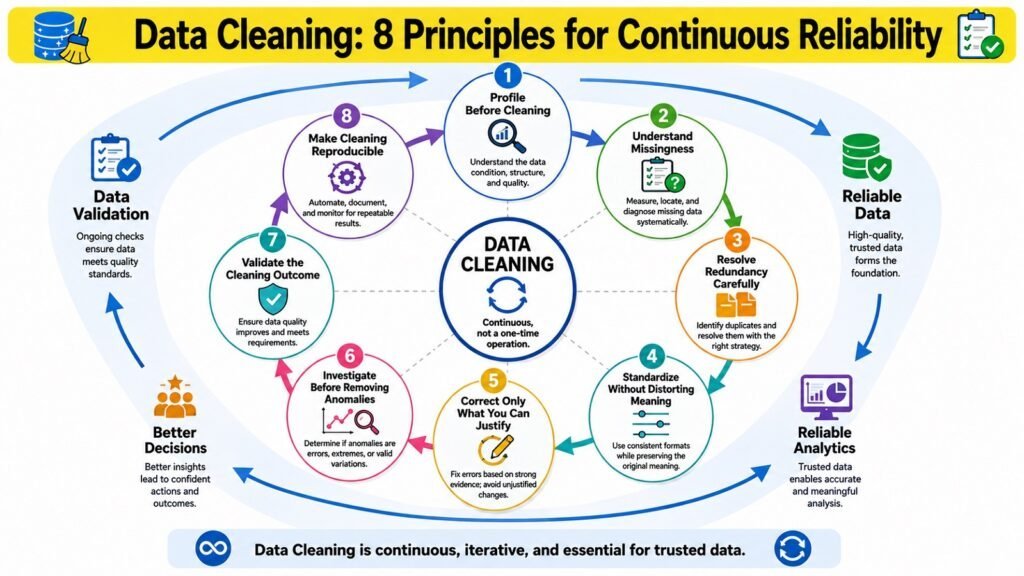
Data Cleaning is not a preliminary chore before real analysis begins. It is a discipline that requires understanding data problems, diagnosing their causes, making defensible decisions, applying evidence-based corrections, and verifying that the result is reliable. The eight aspects in this article form a framework that addresses every meaningful dimension of that work.
Profiling establishes the diagnostic foundation. Missing data handling addresses incompleteness through principled choices that preserve representativeness. Duplicate resolution restores the integrity of counts and relationships. Standardization removes inconsistency that prevents correct comparison and matching. Error correction addresses demonstrably wrong values using verifiable evidence. Anomaly handling protects against inappropriate removal of observations that, despite being extreme, may be the most meaningful in the dataset. Validation verifies that cleaning improved reliability rather than simply changing values. Automation and monitoring extend all of this into a continuous, reproducible operational practice.
These aspects are not isolated steps. They interact: profiling informs every subsequent decision, validation findings drive further cleaning, and automation embeds the logic of every other aspect into a system that applies it consistently at scale. Treating them as a sequence of independent tasks misses the point. Together they form an integrated approach to ensuring data is fit for purpose. Decisions made from data inherit its quality. When Data Cleaning is rigorous and evidence-based, analytical conclusions can be trusted. That distinction matters in every domain where data drives consequential decisions.
Table 10: Data Cleaning Framework — Eight Aspects and Their Contribution to Analytical Reliability
| Data Cleaning Aspect | Contribution to Analytical Reliability |
| Data Profiling | Provides diagnostic evidence so every subsequent cleaning decision is informed rather than assumed |
| Missing Data Handling | Preserves representativeness by basing treatment on the pattern and cause of missingness |
| Duplicate Resolution | Restores accuracy of counts and entity relationships by distinguishing repetition from redundancy |
| Data Standardization | Enables correct grouping, comparison, and matching by ensuring equivalent values are recorded consistently |
| Error Correction | Removes demonstrably incorrect values using verifiable evidence while avoiding unsupported assumptions |
| Outlier and Anomaly Handling | Protects against loss of legitimate extreme observations while identifying genuine measurement errors |
| Data Validation | Confirms cleaning improved reliability and that no new problems were introduced in the process |
| Automation and Monitoring | Sustains data quality over time by making cleaning repeatable, documented, and continuously verified |