Table of Contents
Introduction — Decision Models: The Foundation of Better Choices
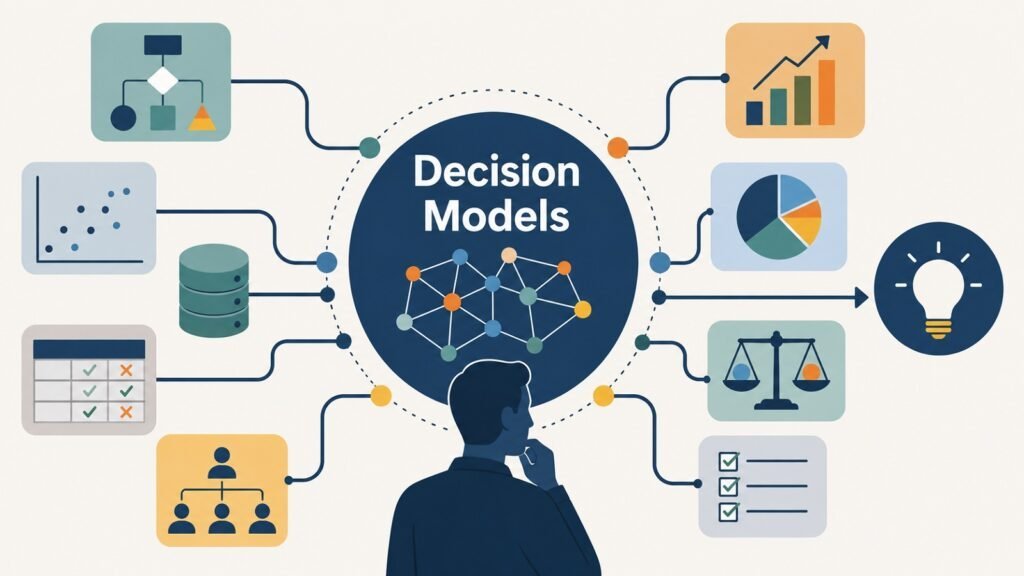
Imagine a hospital network deciding whether to open a new facility in a growing metropolitan region. The choice involves patient demand projections, construction costs, staffing models, regulatory timelines, competing facilities, and insurance reimbursement rates. Change one assumption about demand growth and the entire financial case reverses. This is the ordinary reality of consequential decisions, where variables interact, trade-offs must be weighed, and the future remains genuinely uncertain.
Decision Models address exactly this challenge. A Decision Model is a structured representation of a decision, capturing the relevant variables, the relationships among them, the logic connecting inputs to outcomes, the assumptions that define its boundaries, and the uncertainty embedded within it. Decision Models are important aspects of Decision Intelligence, the discipline that combines analytical frameworks, behavioral insight, and technology to improve how decisions are made at scale.
Decision Models are not the same as Decision Context, which refers to the broader information environment surrounding a choice. They are not Decision Criteria, which govern how alternatives are evaluated. They differ from predictive models and Prescriptive Analytics. Decision Automation executes decisions at scale using a model as its engine. A Decision Model is the structured representation that makes all of these possible.
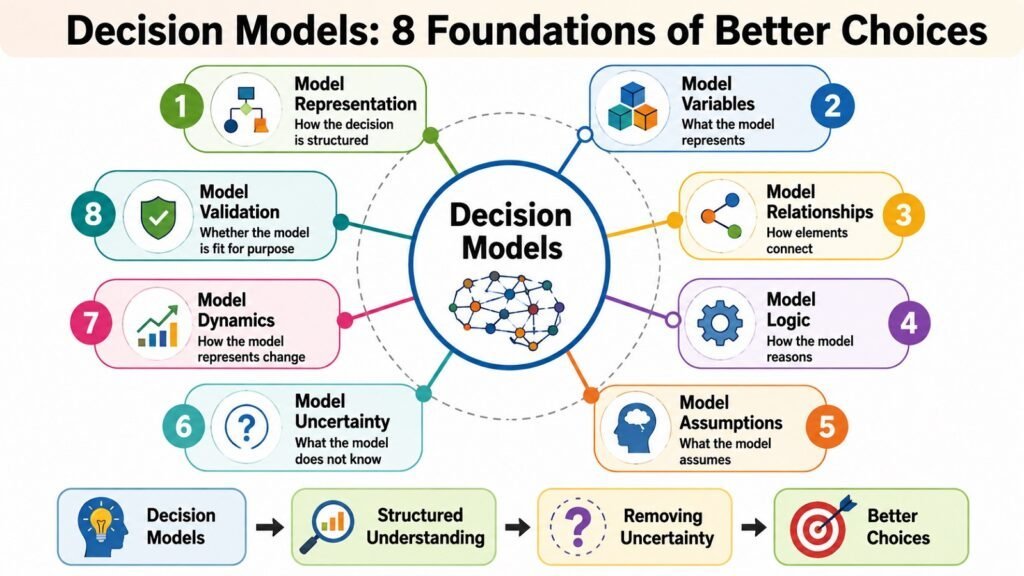
This article examines eight foundations that define how Decision Models work: Model Representation, Model Variables, Model Relationships, Model Logic, Model Assumptions, Model Uncertainty, Model Dynamics, and Model Validation. Together they provide a framework for designing stronger models, diagnosing weaker ones, and applying Decision Models more rigorously across any domain.
Decision Models: Eight Foundations at a Glance
| Foundations of Decision Models | Role in Decision Models |
| Model Representation | Converts the decision into a formal, analyzable structure |
| Model Variables | Defines the elements that drive, shape, and measure the decision |
| Model Relationships | Establishes how variables interact, depend on, or influence each other |
| Model Logic | Governs how the model processes inputs and generates decision implications |
| Model Assumptions | States the conditions and simplifications that make the model workable |
| Model Uncertainty | Represents incomplete knowledge and variable outcomes within the model |
| Model Dynamics | Captures how variables, states, and decisions evolve over time |
| Model Validation | Determines whether the model is fit for its intended decision purpose |
1. Decision Models and Model Representation: Structuring Decisions
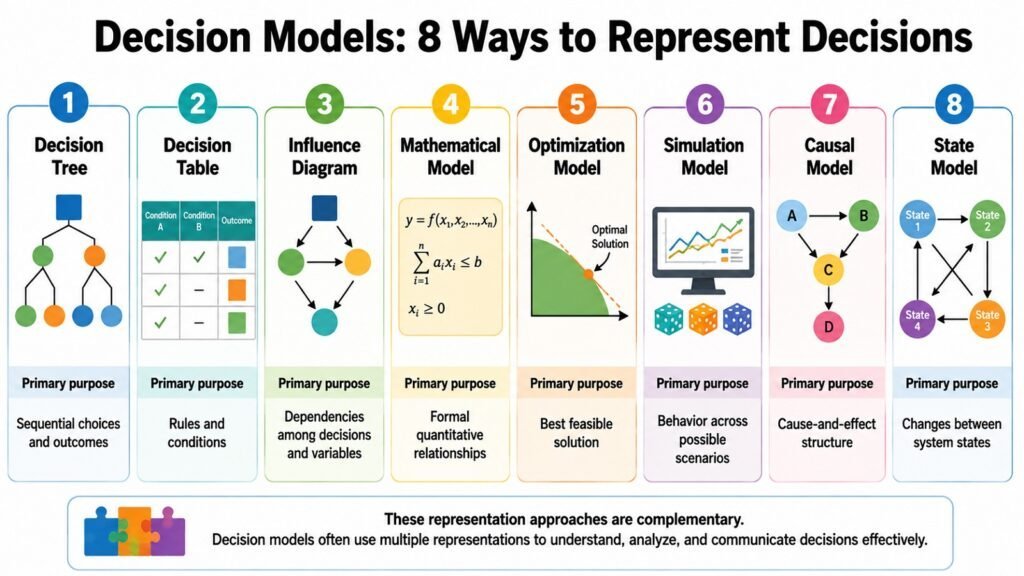
Before a Decision Model can be analyzed, tested, or communicated, it must be given a form. Model Representation is the process of converting a real-world decision into a formal structure that can be examined, shared, and implemented. The choice of representation shapes what the model makes visible and what it leaves unexamined. One form may reveal decision pathways but obscure simultaneous interactions; another may surface trade-offs efficiently but sacrifice interpretability.
Consider a retailer allocating shelf space across product categories. That decision can be represented as a decision tree mapping each option and its consequences, as a mathematical optimization maximizing revenue subject to space constraints, as a simulation of customer behavior across thousands of scenarios, or as an influence diagram capturing causal relationships among product mix, traffic, and margin. Each representation structures the problem differently and surfaces different analytical insights.
This reveals a fundamental principle: every representation is an abstraction of reality. Building a Decision Model always involves choices about what to include, what to simplify, and what lies outside scope. A decision tree that stops at three levels ignores outcomes from longer sequences. A linear optimization model may miss non-linear relationships. The right response is to select the most appropriate form and be explicit about what it does not capture.
No single representation is superior across all problems. Decision trees suit sequential choices with assignable outcome probabilities. Optimization models work well when objectives and constraints are quantifiable. Simulation handles complex systems with stochastic elements. Causal structures are valuable when understanding mechanism matters as much as predicting outcome. Matching representation to the decision, rather than defaulting to a familiar form, is the core practical skill.
Decision Models and Model Representation: Eight Established Forms
| Representation Form | Primary Purpose and Characteristic |
| Decision Tree | Maps sequential choices and probabilistic outcomes in a branching visual structure |
| Influence Diagram | Shows causal and probabilistic relationships among decisions, uncertainties, and outcomes |
| Mathematical Programming | Optimizes an objective function subject to defined constraints using algebraic formulation |
| Simulation Model | Generates many scenario outcomes by sampling from probability distributions across variables |
| Rule-Based Structure | Encodes conditional logic as explicit if-then rules that determine decision outputs |
| Causal Model | Represents cause-and-effect pathways using directed graphs to support intervention analysis |
| State-Based Model | Describes a decision system through defined states and the transitions between them |
| Scoring Model | Aggregates multiple weighted criteria into a single score to rank or select options |
2. Decision Models and Model Variables: Defining What Matters
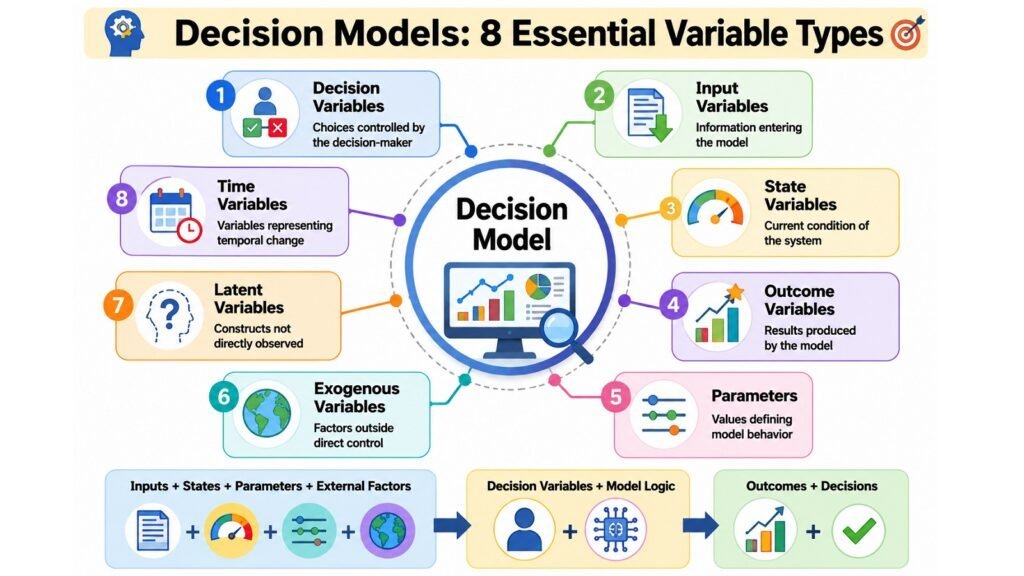
Variables are the fundamental building blocks of Decision Models. They allow the model to represent the factors, choices, conditions, and outcomes relevant to the decision at hand. Selecting the right variables is not simply a matter of gathering available data. It requires determining which elements materially influence the decision and how each should be represented accurately and usefully.
Decision variables represent the choices available to the decision-maker, such as quantity to produce or price to set. Input variables capture external factors shaping the decision environment. State variables describe the system’s condition at a given point, such as current inventory levels. Outcome variables measure the result the decision is intended to influence. Parameters are fixed values set from data, prior analysis, or judgment.
Models also include controllable variables, which the decision-maker can directly adjust, and uncontrollable variables, which influence outcomes but lie outside direct control. Some variables are directly observable, such as recorded sales volumes. Others must be estimated or inferred, such as latent customer preferences. In dynamic settings, certain variables change over time and must be tracked across periods rather than treated as fixed.
Poor variable selection creates serious model weaknesses. Omitting an important variable means its effect is ignored or absorbed into others in a distorted way. Including irrelevant variables adds noise and obscures meaningful signals. A supply chain model that treats supplier capacity as fixed when it varies with demand will misjudge expansion feasibility. Confusing an input with a decision variable produces results that appear consistent but lead to incorrect conclusions.
Decision Models and Model Variables: Eight Important Categories
| Variable Category | Description and Role in Decision Models |
| Decision Variable | Represents a choice available to the decision-maker, such as price, quantity, or allocation |
| Input Variable | Captures external factors that influence the model, such as demand, cost, or regulatory limits |
| State Variable | Describes the current condition of the system, such as inventory level or resource availability |
| Outcome Variable | Measures the result the decision is designed to affect, such as profit or customer satisfaction |
| Parameter | A fixed value set from data or judgment that defines model behavior, such as a cost rate |
| Controllable Variable | A factor the decision-maker can directly adjust within the model |
| Uncontrollable Variable | An external factor that influences outcomes but cannot be directly managed |
| Latent Variable | An unobserved factor inferred from observable indicators, such as underlying brand preference |
3. Decision Models and Model Relationships: Connecting the Elements
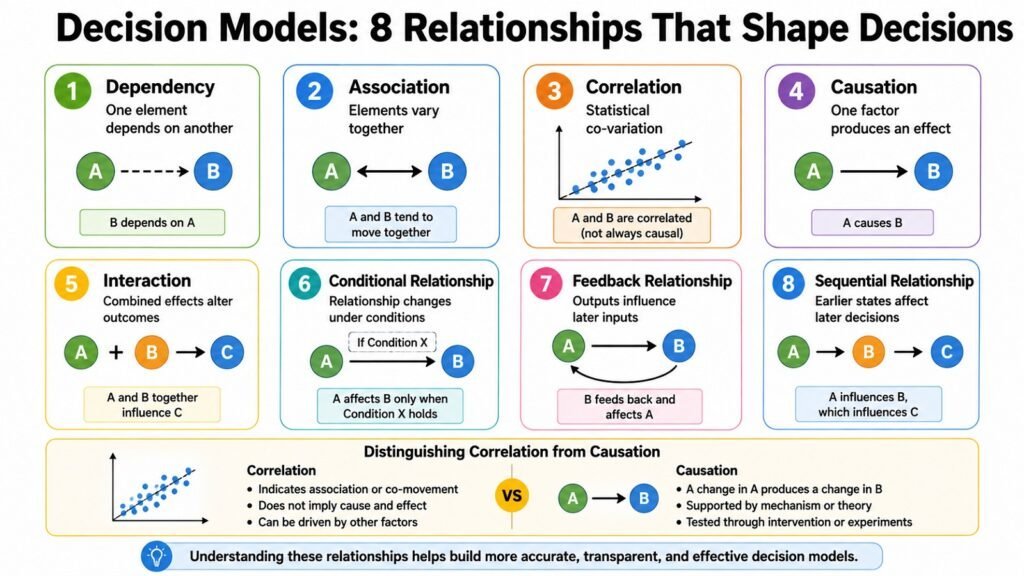
Identifying the right variables is necessary but not sufficient. The model must also capture how those variables interact, depend on one another, and collectively shape outcomes. Model Relationships define those connections, giving the model its explanatory and predictive structure. Without them, a list of variables is a catalog, not a model.
Relationships take several forms. Dependency relationships indicate that one variable’s value is partly determined by another. Interaction effects occur when the combined influence of two variables differs from the sum of their separate effects. Conditional dependence describes situations where the relationship between two variables changes depending on a third. Causal relationships assert that changing one variable produces a change in another, not merely that the two tend to move together.
The distinction between correlation and causation is particularly important in Decision Models. Two variables may be statistically associated without one causing the other. A model that uses a correlational relationship to evaluate an intervention may predict the wrong outcome because the association may not hold once conditions change. A retailer whose sales correlate with a competitor’s promotions cannot assume that cutting those promotions would lift its own sales, since the pattern may reflect shared seasonality rather than a direct causal link.
Incorrect or oversimplified relationships can undermine a model even when the underlying data is sound. A linear relationship imposed on a non-linear system produces reasonable predictions near the center of the data range but fails at the extremes. A model that treats correlated variables as independent will misestimate uncertainty. The quality of those connections ultimately determines how accurately a Decision Model reflects the real decision situation.
Decision Models and Model Relationships: Eight Relationship Types
| Relationship Type | Meaning and Modeling Implication |
| Dependency | One variable’s value is determined by another, establishing a directional link in the model |
| Correlation | Two variables move together statistically without implying that one causes the other |
| Causality | A change in one variable produces a change in another, supporting intervention analysis |
| Interaction Effect | The combined influence of two variables differs from the sum of their separate effects |
| Conditional Dependence | The relationship between two variables changes depending on the value of a third |
| Non-linear Relationship | The effect of one variable on another changes at different values, not following a straight line |
| Feedback Loop | An outcome influences one of its own drivers, creating self-reinforcing or self-correcting behavior |
| Lagged Relationship | A change in one variable affects another with a time delay rather than immediately |
4. Decision Models and Model Logic: Representing Decision Reasoning
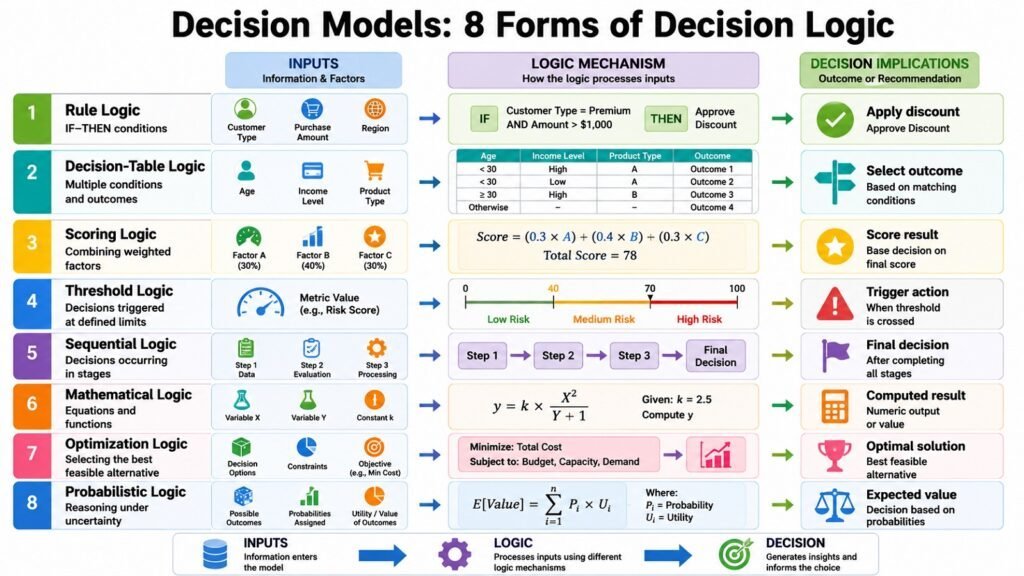
Variables define the elements of a Decision Model and relationships describe how they connect, but logic determines how the model uses those connections to arrive at decision implications. Model Logic is the reasoning mechanism that processes inputs, applies conditions, and produces outputs that inform or support the decision. It is the engine of the model rather than its frame.
Logic in Decision Models takes many forms. Rule-based logic uses conditional statements: if a customer’s credit score falls below a threshold, the model applies a different pricing structure. Mathematical equations translate relationships into computed outputs. Optimization logic searches for the best solution within a defined space. Scoring mechanisms combine multiple inputs through weighted formulas. Sequential logic handles decisions that unfold in stages, where earlier choices constrain or enable later ones.
Changing the logic can alter the result even when variables and relationships remain identical. A credit risk model using a 600 score cutoff classifies a different set of borrowers than one using 650, with the same data. A supply chain model prioritizing delivery speed produces different recommendations than one minimizing cost, regardless of shared inputs. Logic embodies the decision policy, not just the analytical mechanics, which is why two technically correct models can recommend opposite courses of action.
Transparency matters increasingly as Decision Models grow more complex. Simple rule-based systems are highly interpretable: the reasoning can be read directly from the structure. More sophisticated approaches, including machine learning algorithms, can model complex non-linear patterns with high accuracy but produce outputs that are difficult to explain. When a model informs resource allocation or creditworthiness assessments, the ability to explain why a particular output was generated is often as important as the output itself.
Decision Models and Model Logic: Eight Established Forms
| Logic Form | Characteristic and Application in Decision Models |
| Rule-Based Logic | Applies if-then conditions to route inputs toward defined decision outputs |
| Mathematical Equation | Translates quantitative relationships into calculated model outputs |
| Optimization Logic | Searches for the best solution by maximizing or minimizing an objective subject to constraints |
| Scoring Mechanism | Combines multiple weighted inputs into a single aggregate score for ranking or selection |
| Sequential Logic | Handles decisions that unfold in stages where earlier outcomes constrain later choices |
| Probabilistic Inference | Updates beliefs and outputs based on conditional probability distributions across variables |
| Machine Learning Algorithm | Learns patterns from data to generate predictions or classifications with complex non-linear logic |
| Threshold Logic | Triggers a decision or classification when a variable crosses a defined boundary value |
5. Decision Models and Model Assumptions: Exposing What Lies Beneath
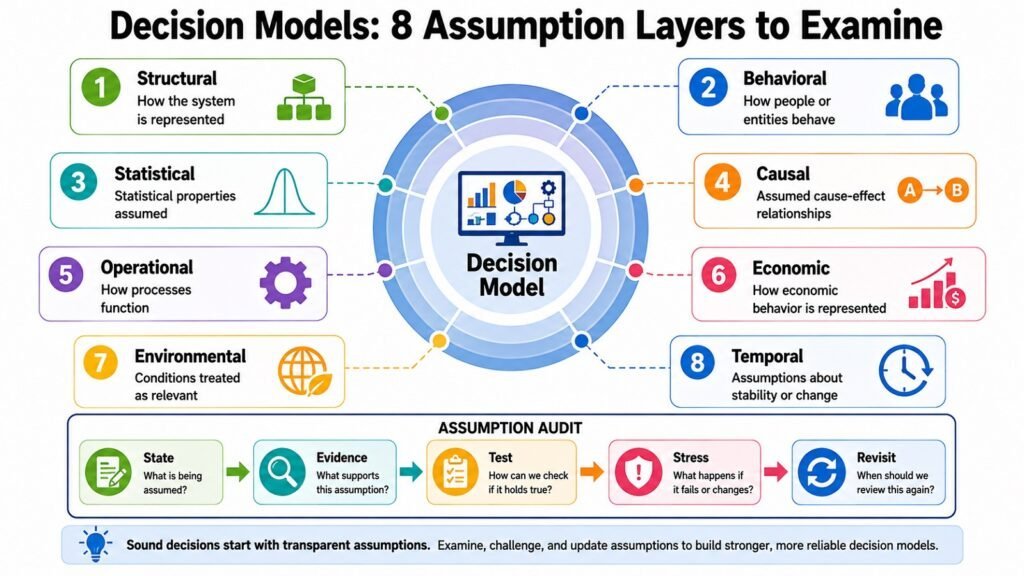
Every Decision Model is built on assumptions — the explicit or implicit beliefs, conditions, and simplifications that allow it to represent complex reality in a manageable form. Without assumptions, a model would need to capture the full complexity of the real world, which is neither practical nor possible. Assumptions make the model workable, but they also define where it begins to diverge from reality.
Assumptions operate across multiple dimensions. Structural assumptions define the form of model relationships, such as treating a cost-volume relationship as linear. Statistical assumptions govern how data is handled, including beliefs about error distributions. Behavioral assumptions reflect expectations about how people or markets will act. Economic assumptions embed beliefs about competitive dynamics. Operational assumptions describe how processes will function in practice.
Assumptions can be as influential as equations in shaping a model’s conclusions, yet they are often less visible. A financial valuation model assuming a stable discount rate produces very different results in a volatile interest rate environment. A demand forecasting model that assumes historical patterns will continue may perform well during stable periods and fail significantly during structural market shifts. When an assumption breaks down, the model can mislead even if its internal calculations are correct.
A useful assumption-audit mindset asks four questions: what exactly is being assumed, why, what evidence supports it, and what would happen to outputs if it proved incorrect. This approach surfaces hidden assumptions, encourages documentation, and identifies which ones create the most model risk. A seemingly minor assumption about market share stability might be the single factor determining whether an expansion project appears financially viable.
Decision Models and Model Assumptions: Eight Important Categories
| Assumption Category | Description and Modeling Implication |
| Structural Assumption | Defines the form of a model relationship, such as linearity between cost and volume |
| Statistical Assumption | Governs data treatment, such as assuming normally distributed errors in regression models |
| Behavioral Assumption | Reflects expected human or organizational responses, such as rational price sensitivity |
| Economic Assumption | Embeds beliefs about market conditions, cost structures, or competitive behavior |
| Operational Assumption | Describes how processes or systems will function, such as stable supplier lead times |
| Stationarity Assumption | Assumes that historical patterns and relationships will persist into the future |
| Independence Assumption | Treats variables or observations as unrelated when in reality they may be correlated |
| Boundary Assumption | Defines what is inside and outside the model’s scope, limiting what it can represent |
6. Decision Models and Model Uncertainty: Representing the Unknown
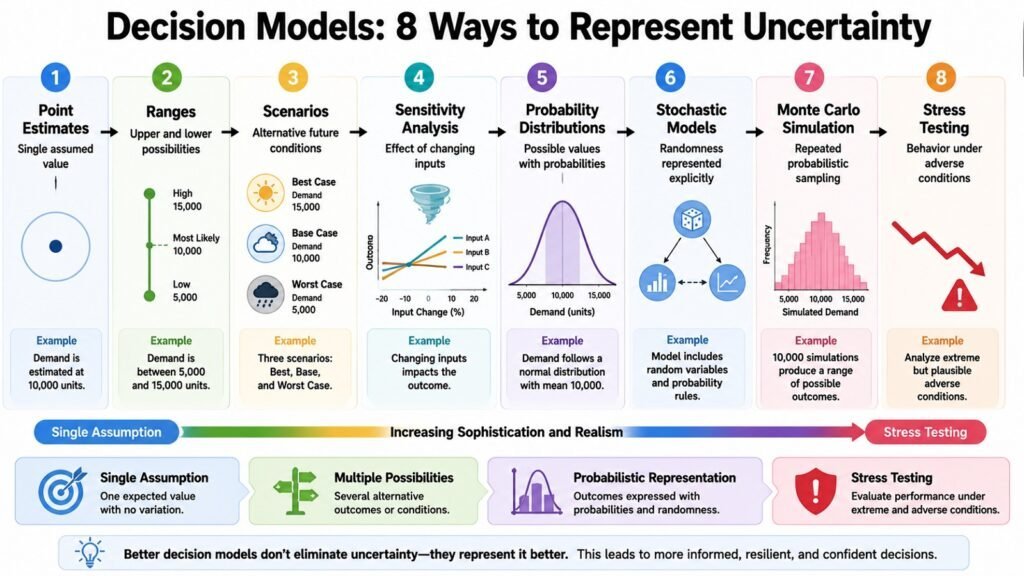
Decision Models rarely operate with complete information. Inputs may be estimated rather than measured, relationships may hold on average but vary in practice, and outcomes depend on future conditions that cannot be known precisely. Model Uncertainty refers to how incomplete knowledge and variable outcomes are represented within the model. The way a model handles uncertainty shapes how honestly it communicates the range of possible results to decision-makers.
A deterministic model assigns a fixed value to every input and produces a single output. Such models are simple to communicate but create false precision when meaningful uncertainty exists. A probabilistic model addresses this by representing inputs or outcomes as probability distributions rather than single values. Monte Carlo simulation samples repeatedly from input distributions to generate a range of possible outcomes, giving decision-makers a picture of likely results alongside low-probability but high-consequence scenarios.
Sensitivity analysis examines how model output changes as individual inputs vary across plausible ranges, identifying which variables drive the most variation in outcomes. Scenario analysis constructs internally consistent combinations of assumptions representing distinct possible futures — base case, optimistic, and adverse — rather than varying one input at a time. Both techniques make sources of uncertainty visible rather than hidden inside a single-point projection.
A model showing a single projected revenue figure without indicating plausible ranges encourages unwarranted confidence. One that exposes uncertainty makes sources of risk visible, allowing decision-makers to consider hedging strategies or build flexibility into their plans. Handling uncertainty well means representing it honestly so decisions reflect a realistic understanding of what is known and what is not.
Decision Models and Model Uncertainty: Eight Established Approaches
| Uncertainty Concept or Approach | Role and Characteristic in Decision Models |
| Deterministic Model | Assigns fixed values to all inputs, producing a single output without representing variability |
| Probability Distribution | Represents an uncertain variable as a range of possible values with associated likelihoods |
| Monte Carlo Simulation | Samples from input distributions across many iterations to generate a distribution of outcomes |
| Sensitivity Analysis | Tests how much the output changes as individual inputs vary across plausible ranges |
| Scenario Analysis | Constructs distinct internally consistent futures to show the range of possible outcomes |
| Confidence Interval | Expresses the range within which the true value is estimated to fall with a stated probability |
| Expected Value | Calculates the probability-weighted average outcome across a distribution of possibilities |
| Stochastic Variable | Represents an input or parameter whose value is drawn from a probability distribution in the model |
7. Decision Models and Model Dynamics: Modeling Change Over Time
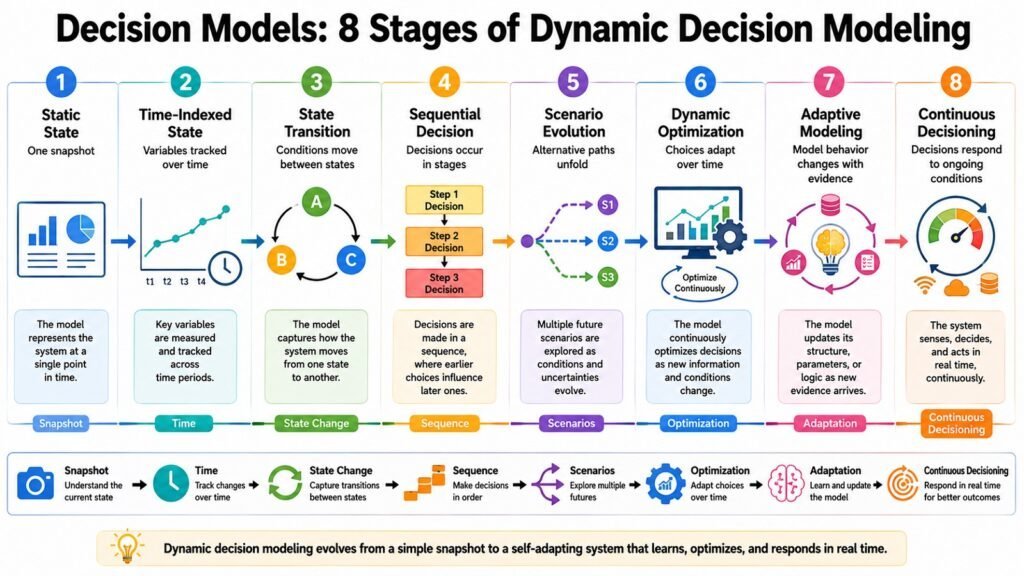
Many decisions are not isolated events but part of a sequence that unfolds over time. A static Decision Model captures a snapshot of a situation, treating variables and relationships as fixed. A dynamic model represents how variables, states, and outcomes change as time progresses and earlier decisions influence later possibilities — a fundamentally different structure, not merely one with dates attached.
Dynamic models take several forms. State-based models represent the decision system as a set of discrete states and define the transitions between them. Time-dependent variable models update input values at each period rather than treating them as fixed. Sequential decision models, such as Markov decision processes, optimize choices across multiple periods while accounting for how current decisions affect future states. Dynamic optimization models, used in revenue management, continuously update recommendations as new information arrives.
Path dependence is a particularly important concept in dynamic Decision Models. It describes situations where the sequence of decisions matters, not just the final set of choices. A firm that enters a market aggressively early may access scale advantages that alter its cost structure in later periods, making an investment-heavy path superior even when total resources are similar. Static models cannot represent this accumulated effect because they evaluate choices without accounting for how earlier decisions reshape conditions for later ones.
Dynamic Decision Models are especially relevant where conditions change continuously: financial portfolio management, supply chain planning, workforce scheduling, and long-term strategic investment. They matter wherever feedback effects exist, meaning outcomes of earlier choices influence inputs available for future decisions. Where timing and trajectory genuinely matter, a static model gives misleading guidance by treating an evolving situation as though it were stable.
Decision Models and Model Dynamics: Eight Characteristics and Applications
| Dynamic Modeling Feature | Characteristic and Application in Decision Models |
| State Transition | Describes how the system moves between defined conditions as time passes or decisions are made |
| Time-Dependent Variable | Represents an input or parameter whose value changes at each period within the model |
| Sequential Decision | Models choices made in stages where each decision affects the available options that follow |
| Markov Decision Process | Optimizes decisions over multiple periods using state-dependent transition probabilities |
| Path Dependence | Reflects how the sequence of earlier decisions shapes the conditions and options in later periods |
| Dynamic Optimization | Updates recommended decisions continuously as new data or changing conditions arrive |
| Feedback Effect | Represents how outcomes from earlier decisions influence the inputs available for future decisions |
| Adaptive Model | Revises its structure or parameters in response to observed outcomes and updated information |
8. Decision Models and Model Validation: Establishing Trust
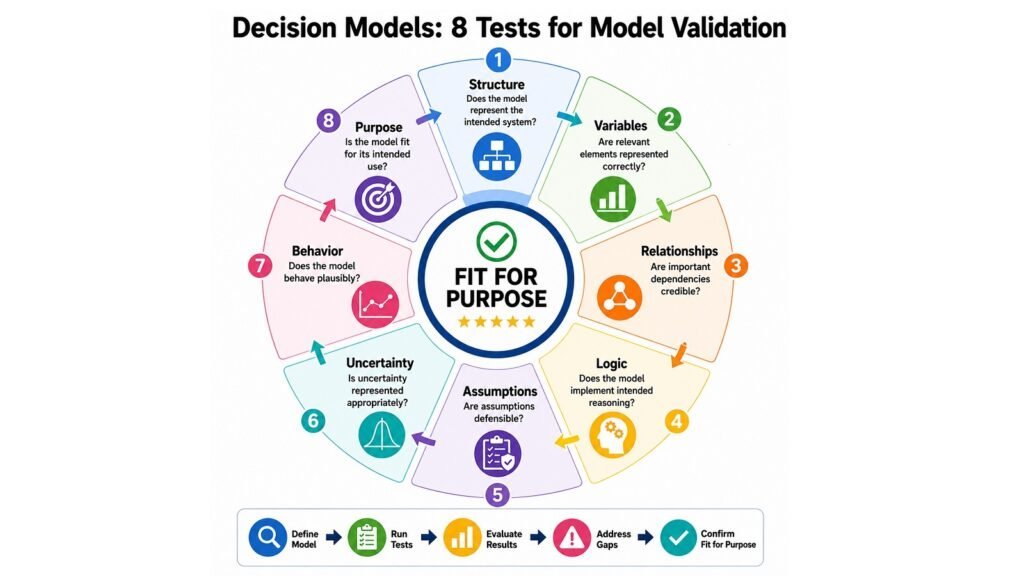
A Decision Model can be technically sound and still be wrong for the decision it is meant to support. Model Validation is the process of determining whether a model is sufficiently accurate, credible, and fit for its intended purpose. A model can implement its logic correctly and still misrepresent the underlying decision because its variables were poorly selected, its relationships were incorrectly specified, or its structure was too simple for the real situation.
A useful distinction separates verification from validation. Verification asks whether the model was built correctly, confirming that code and calculations implement the intended design. Validation asks whether the right model was built — whether its structure and outputs adequately represent the real decision. Passing verification tells you the model does what the designer intended. Passing validation tells you it actually serves the decision well. Failing validation is the more consequential error.
Several established practices contribute to model validation. Backtesting compares outputs against historical outcomes to assess accuracy under known conditions. Sensitivity testing examines whether small input changes produce stable output changes. Stress testing pushes the model beyond its normal range to assess performance under extreme conditions. Scenario testing evaluates outputs against internally consistent combinations of assumptions that challenge the base-case structure. Calibration adjusts parameters to improve correspondence with observed data.
Documenting model limitations is essential and often undervalued. Every Decision Model is designed for a particular range of conditions, and applying it beyond that range produces misleading outputs. A credit scoring model validated on consumer lending data may not perform reliably for small business loans. Responsible validation identifies these boundaries explicitly so practitioners know where the model should and should not be applied.
Decision Models and Model Validation: Eight Methods and Considerations
| Validation Method | What It Tests or Helps Establish |
| Backtesting | Compares model outputs against historical outcomes to assess accuracy under known conditions |
| Sensitivity Testing | Examines whether small input changes produce proportionate and stable output changes |
| Stress Testing | Evaluates model behavior under extreme conditions beyond its normal operating range |
| Scenario Testing | Assesses model outputs across distinct internally consistent combinations of assumptions |
| Calibration | Adjusts model parameters to reduce the gap between model outputs and observed real-world data |
| Structural Validation | Confirms that model relationships and logic reflect established knowledge or domain expertise |
| Out-of-Sample Testing | Tests model performance on data not used during model development or calibration |
| Limitation Documentation | Defines the conditions under which the model should and should not be applied |
Conclusion — Decision Models: Turning Structure Into Better Choices
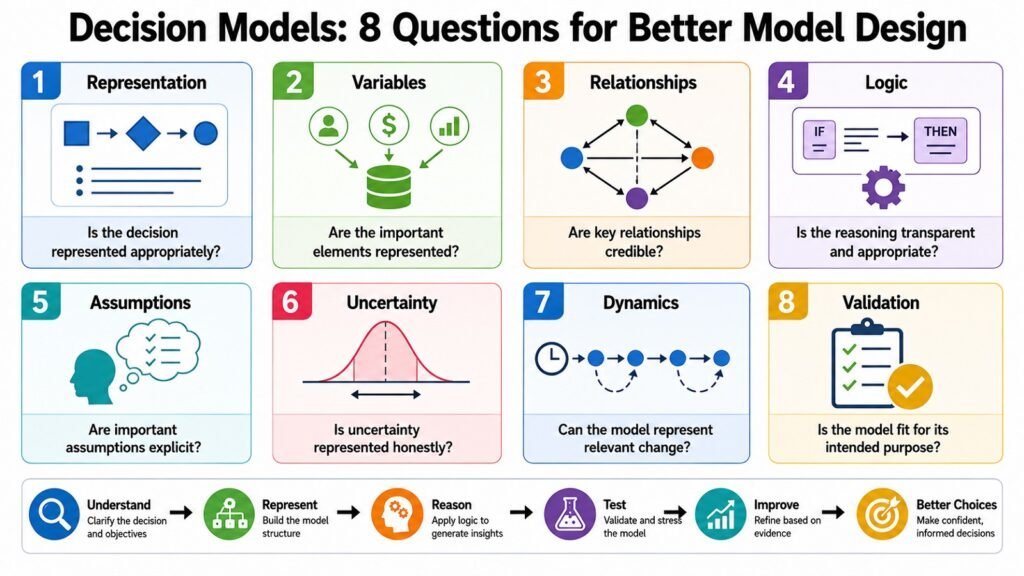
Decision Models are a discipline for representing decisions in a structured way that allows them to be examined, challenged, and improved. The eight foundations in this article work together as an integrated system. Representation establishes the structural form. Variables define what the model contains. Relationships describe how elements connect. Logic governs how the model reasons from inputs to outputs. Assumptions set the boundaries within which that reasoning holds. Uncertainty exposes what is not known. Dynamics capture how the situation evolves. Validation determines whether the model can be trusted.
These foundations do not function as separate checkboxes. A deficiency in one typically impacts the others. Vaguely defined relationships skew the reasoning. Implicit assumptions weaken the validation process. Utilizing a static model in a dynamic context misrepresents uncertainty. Acknowledging these interconnections elevates Decision Models to an intellectually rigorous discipline rather than a mere mechanical procedure.
Decision Models are important aspects of Decision Intelligence precisely because they provide the structural layer between raw data, analytical tools, and actual choices. They translate complex problems into representations that can be examined systematically and improved iteratively. A simple model that captures the right variables, represents relationships accurately, handles uncertainty honestly, and has been properly validated will outperform a complex model with hidden flaws every time.
Use the eight foundations as a review framework. A Decision Model that can answer the questions in the table below is one worth relying on. One that cannot needs work before it can responsibly support a consequential choice.
Decision Models Review Checklist: Eight Foundations and Key Questions
| Foundations of Decision Models | Practical Review Question |
| Model Representation | Does the chosen structure accurately reflect how this decision actually works? |
| Model Variables | Have the right elements been included, and are they clearly and correctly defined? |
| Model Relationships | Are the connections among variables accurate, and are causal claims properly supported? |
| Model Logic | Does the reasoning the model applies match the real decision policy and its intended purpose? |
| Model Assumptions | Are the key assumptions documented, evidence-based, and regularly reviewed? |
| Model Uncertainty | Does the model represent uncertainty honestly rather than projecting false precision? |
| Model Dynamics | If the decision unfolds over time, does the model capture how conditions and states change? |
| Model Validation | Has the model been tested against evidence, and are its limitations clearly documented? |