Table of Contents
Introduction: Data Collection as the Foundation of Business Intelligence
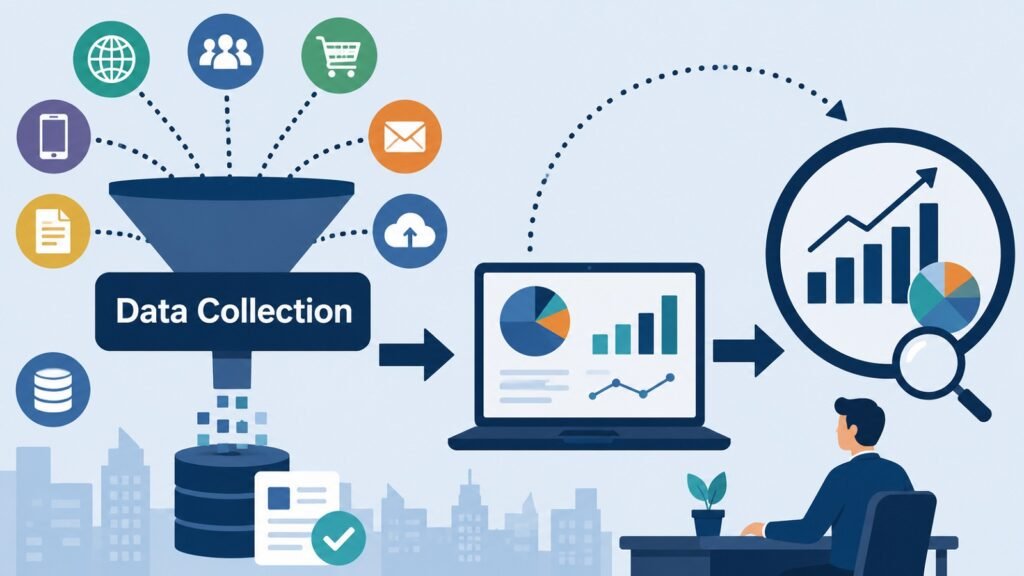
Every business decision rests on information. Without reliable data, even experienced managers are left guessing. Data Collection is the systematic process of gathering, organizing, and preparing information from internal and external sources so that organizations can make sound decisions, improve operations, and plan for the future. It forms the first and most critical step in any analytical journey.
The business environment has changed dramatically over the past two decades. Cloud computing has made storage inexpensive and accessible. Artificial intelligence can now process vast amounts of information at speed. Connected devices collect signals continuously from factories, homes, and supply chains. Digital business models generate transaction records, behavioral signals, and interaction data at a scale that was previously unimaginable. These developments have elevated Data Collection from a routine administrative activity to a genuine strategic capability.
From the perspective of businesses and organizations, Data Collection is an important component of Business Data Analytics. Every analytical model, dashboard, forecast, and business insight depends on the availability of relevant, accurate, and timely information. Organizations that fail at the collection stage will inevitably struggle at every stage that follows, regardless of how sophisticated their analytical tools are.
The connection between data and business performance is profound. Accurate information leads to improved decision-making, enhanced operational efficiency, a more profound understanding of customers, more intelligent innovation, and more effective risk management. Organizations are increasingly competing not only based on the quality of their products or services but also on the quality of their information. A company that possesses a more precise understanding of its customers, market, and operations than its competitors enjoy a structural advantage that accumulates over time.
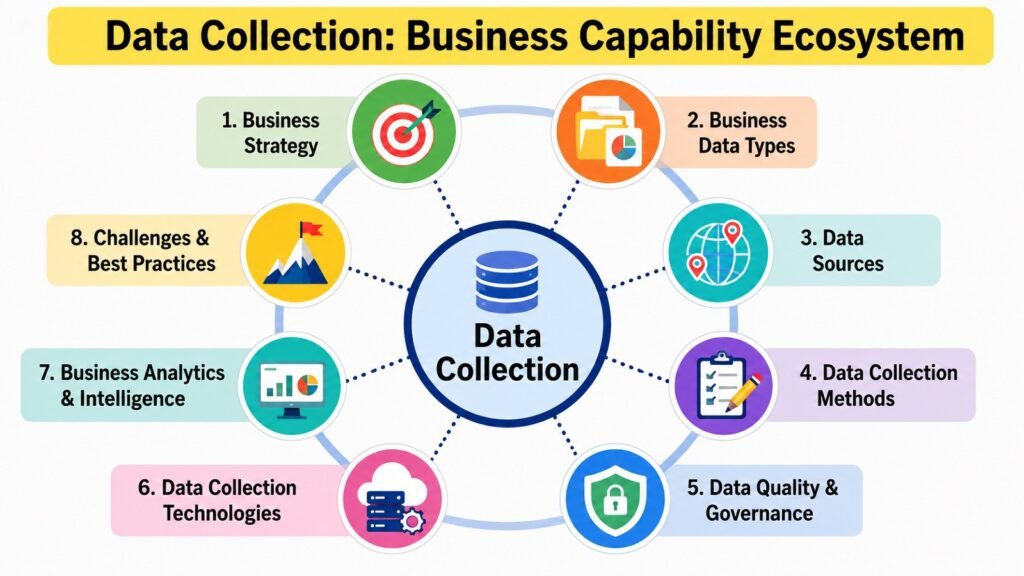
This article explores eight foundational aspects of Data Collection from a business perspective. Together, they provide a comprehensive view of how organizations approach information gathering strategically, operationally, and technically. Readers interested in translating these foundations into a structured plan can explore a dedicated Data Collection Framework, which builds systematically on the concepts introduced here.
Table 1: Data Collection — Eight Foundational Aspects
| Data Collection Foundational Aspects | What It Covers |
| Business Strategy | Aligning data gathering with organizational goals and priorities |
| Business Data Types | Understanding the categories of information businesses collect |
| Internal and External Sources | Identifying credible and relevant sources of information |
| Collection Methods | Selecting appropriate techniques to gather business data |
| Data Quality and Governance | Ensuring accuracy, reliability, and compliant use of data |
| Collection Technologies | Using digital tools to automate and scale information gathering |
| Analytics and Intelligence | Converting collected data into actionable business insights |
| Challenges and Best Practices | Overcoming common obstacles to improve collection capability |
1. Data Collection for Business Strategy
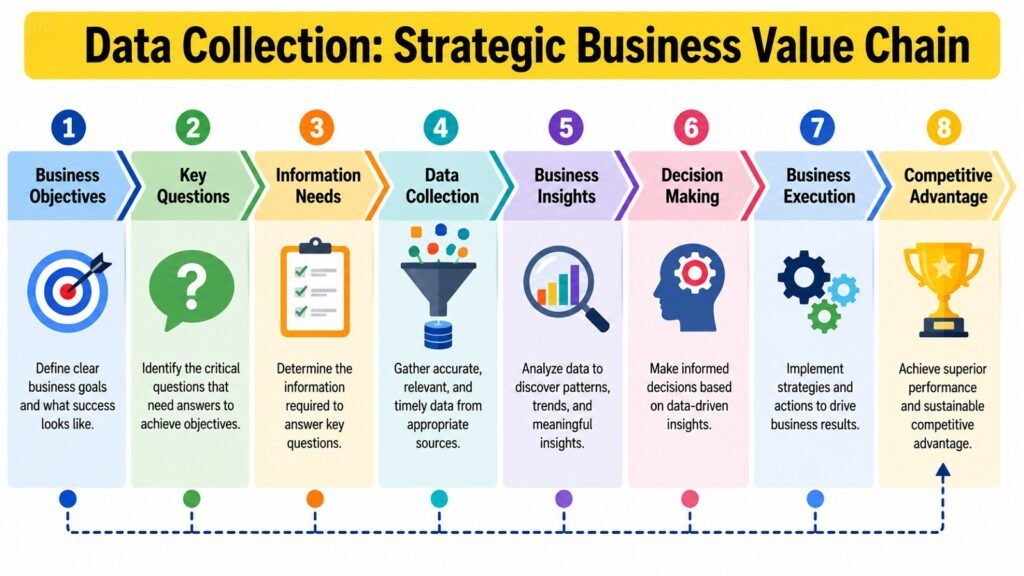
Strategy determines what information is worth collecting. Before investing in systems, tools, or processes, organizations need to clarify what decisions they are trying to support and what outcomes they are working toward. Data Collection becomes strategic when it is shaped by business objectives rather than technical availability or historical habit.
Evidence-Based Management, a well-established approach in organizational research, argues that decisions made with reliable evidence consistently outperform those based solely on intuition or convention. The Resource-Based View of strategic management adds another layer by recognizing that proprietary information can be a durable competitive advantage, particularly when it is difficult for competitors to replicate. The Dynamic Capabilities framework further emphasizes that organizations which continuously update and refine their information assets are better positioned to respond to changing markets.
Real businesses demonstrate this principle constantly. Amazon collects behavioral, transactional, and logistical information that feeds directly into pricing decisions, warehouse planning, and product recommendations. Walmart has long used sales data to optimize supply chain replenishment across thousands of stores. These companies do not collect data randomly. They collect it purposefully, with clear links to business outcomes.
Organizations face genuine trade-offs when defining their data priorities. Collecting more data requires investment in infrastructure, governance, and skilled staff. Over-collection can create compliance burdens and dilute analytical focus. Under-collection leaves gaps in business understanding that can lead to poor decisions. Finding the right balance begins with asking what the organization needs to know, not what it can technically measure.
Effective Data Collection always starts with clear business objectives. Organizations that define their informational needs first and design their collection activities around those needs tend to build stronger, more useful datasets than those that collect indiscriminately and sort out the value later.
Table 2: Data Collection — Strategic Objectives and Business Value
| Strategic Objective | Business Value |
| Market expansion planning | Identifies high-potential markets with lower entry risk |
| Customer segmentation | Enables personalized products and targeted communication |
| Operational improvement | Reveals inefficiencies and reduces unnecessary costs |
| Competitive positioning | Highlights gaps in competitor offerings and market shifts |
| Resource allocation | Directs investment toward highest-impact business activities |
| Risk identification | Surfaces early signals of regulatory, financial, or market threats |
| Product development | Guides innovation based on real customer needs and behaviors |
| Performance measurement | Tracks progress toward strategic goals with factual evidence |
2. Data Collection for Business Data Types
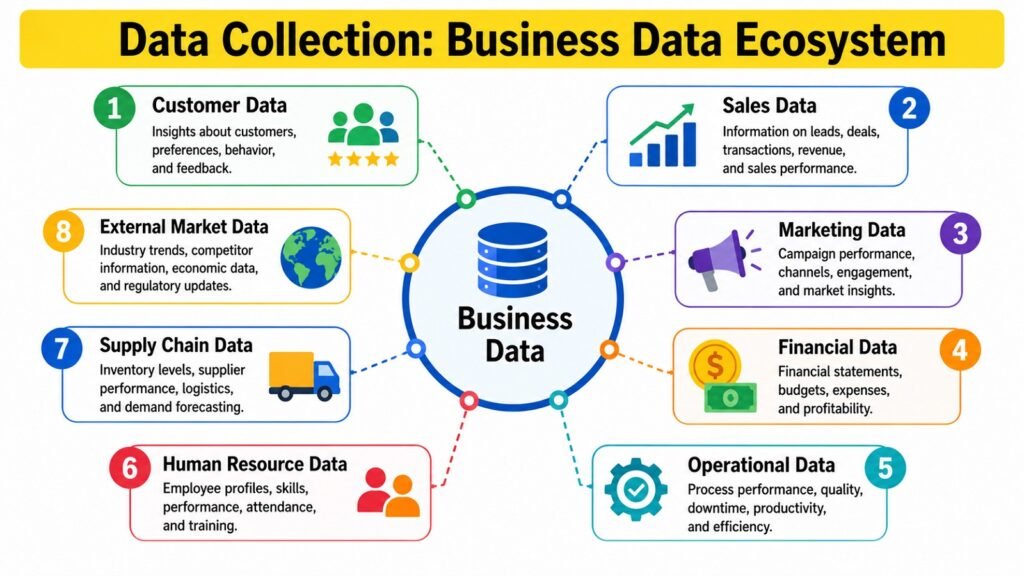
Businesses operate across multiple domains simultaneously. Sales, operations, finance, human resources, marketing, and supply chain all generate distinct kinds of information, and each serves a different analytical purpose. Effective Data Collection requires understanding these categories and selecting the right types for each business objective.
Customer data captures behavior, preferences, demographics, and purchase history. It powers segmentation, personalization, and retention strategies. Operational data tracks production volumes, process efficiency, equipment utilization, and service delivery timelines. Financial data covers revenue, costs, margins, cash flows, and profitability, forming the foundation of planning and reporting. Marketing data measures campaign performance, channel effectiveness, audience reach, and conversion rates.
Sales data records transaction volumes, regional performance, product mix, and pipeline activity. Product data reflects usage patterns, defect rates, feature adoption, and lifecycle performance. Human resource data covers workforce size, skill distribution, hiring activity, turnover, and employee engagement. Supply chain data maps inventory levels, supplier lead times, logistics costs, and fulfillment accuracy.
External market data adds a wider perspective by covering competitor activity, regulatory developments, macroeconomic trends, and industry benchmarks. No single department collects all of these types, but all of them contribute to organization-wide decision-making when integrated properly.
The real value emerges when multiple data types are combined. A retailer that links sales data with customer behavior and supply chain performance can identify not just what is selling but why it is selling and whether it can continue to be delivered profitably. Collecting diverse yet relevant information allows businesses to move from partial understanding to complete organizational insight.
Table 3: Data Collection — Business Data Types and Their Primary Purpose
| Data Type | Primary Business Purpose |
| Customer data | Supports segmentation, personalization, and retention strategies |
| Operational data | Monitors process efficiency and identifies bottlenecks |
| Financial data | Enables budgeting, reporting, and profitability analysis |
| Marketing data | Measures campaign performance and audience engagement |
| Sales data | Tracks revenue performance across products, regions, and channels |
| Product data | Guides development decisions and improves quality management |
| Human resource data | Informs workforce planning and talent management strategies |
| Supply chain data | Optimizes inventory, logistics, and supplier performance |
3. Data Collection Through Internal and External Data Sources
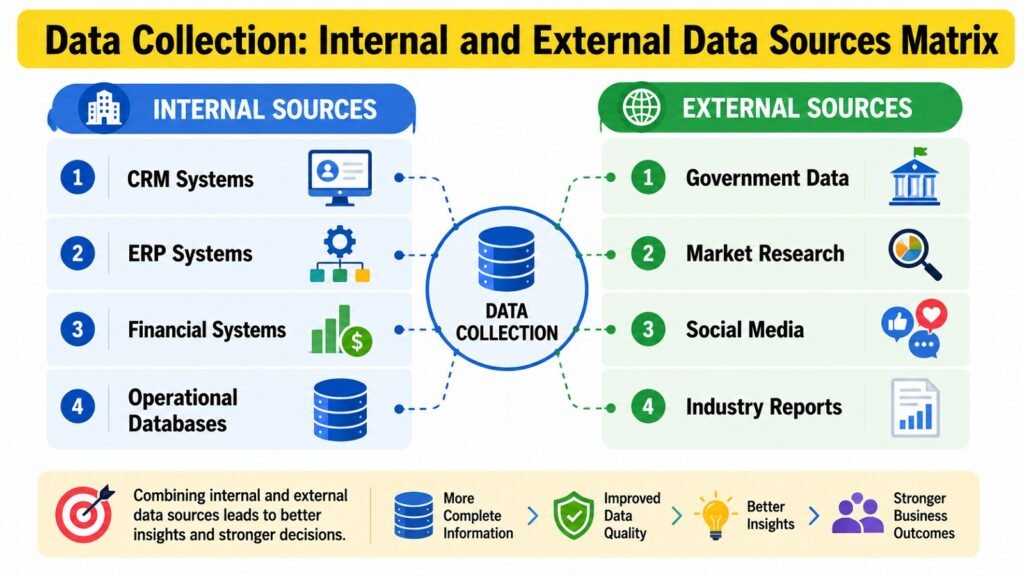
The quality and relevance of any dataset depends heavily on where the information comes from. Organizations draw from both internal and external sources, each with distinct characteristics, strengths, and limitations.
Internal sources include CRM systems, ERP platforms, financial management systems, transactional databases, operational logs, HR information systems, and customer service platforms. These sources are generally reliable, well-structured, and directly relevant to business operations. They reflect what the organization has actually done and experienced. The limitation is that internal data alone cannot tell a business how it compares to competitors or what is happening in the broader market.
External sources include government statistical databases, industry research reports, public datasets, regulatory filings, social media platforms, partner ecosystems, IoT environments, and commercial data providers. These sources expand the organizational view outward, providing context that internal systems cannot generate. The challenge is that external data varies widely in quality, timeliness, and cost. Some sources are freely available and authoritative, such as government economic data, while others require licensing agreements or significant investment to access.
Organizations typically combine both source types to improve decision quality. A consumer goods company might link its internal sales data with external demographic trends and retail market reports to understand shifting demand patterns. A bank might combine its internal credit performance data with macroeconomic indicators and property market information to model loan risk more accurately.
Selecting appropriate sources directly affects the credibility of any analysis. Poor sources introduce noise, bias, and inaccuracy that can distort conclusions regardless of how sophisticated the analytical tools are. The value of Data Collection depends heavily on the credibility and relevance of its information sources.
Table 4: Data Collection — Business Data Sources and Organizational Use
| Data Source | Typical Organizational Use |
| CRM systems | Tracks customer interactions, history, and sales pipeline |
| ERP platforms | Integrates operational, financial, and supply chain information |
| Financial records | Supports reporting, budgeting, and performance analysis |
| Government databases | Provides economic, demographic, and regulatory context |
| Industry reports | Benchmarks performance and tracks sector-wide trends |
| Social media platforms | Captures customer sentiment and brand perception signals |
| IoT environments | Collects real-time data from physical assets and operations |
| Third-party providers | Supplements internal data with licensed commercial datasets |
4. Data Collection Methods for Modern Businesses
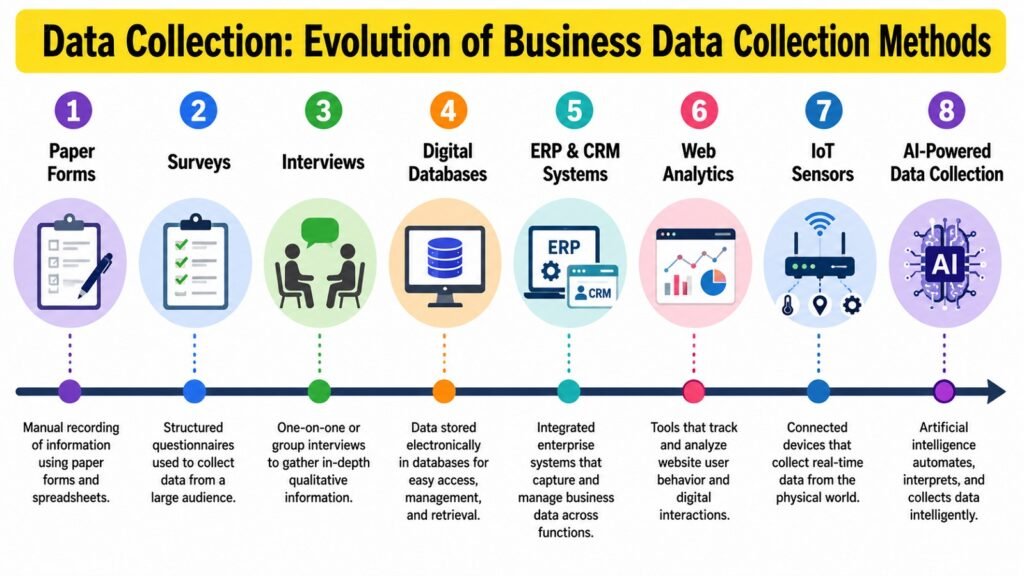
Methods are the practical means through which organizations gather information. Choosing the right approach depends on the type of data needed, the business objective, the available resources, and the required level of accuracy.
Traditional methods remain widely used and relevant. Surveys and questionnaires allow organizations to gather structured feedback from large groups of customers, employees, or market participants. Interviews provide deeper qualitative insight by allowing open-ended conversation. Focus groups generate rich discussion about attitudes, perceptions, and preferences. Direct observation records actual behavior in physical environments, which is particularly valuable in retail, healthcare, and manufacturing settings.
Modern digital methods have broadened the options considerably. Transaction systems automatically record every purchase, return, and payment event without requiring any additional collection effort. Web analytics platforms track how users navigate websites, what content they engage with, and where they drop off. Mobile applications generate behavioral signals from location data, usage patterns, and in-app interactions. APIs connect systems and allow structured data to flow between platforms in real time. IoT devices embedded in machinery, vehicles, and infrastructure collect continuous operational signals. Social listening tools monitor online conversations, mentions, and sentiment across platforms.
No single method is universally superior. Surveys provide breadth but can suffer from response bias. Transaction records are objective and comprehensive but lack context. Interviews generate depth but are expensive to scale. Organizations that combine multiple methods tend to produce more reliable and balanced datasets because the strengths of one approach compensate for the weaknesses of another.
The choice of method should always be driven by what the business needs to understand, the resources available to collect it, and the decisions that the resulting data is expected to support.
Table 5: Data Collection — Methods and Their Suitable Business Application
| Collection Method | Most Suitable Business Application |
| Surveys and questionnaires | Gathering structured customer or employee feedback at scale |
| Interviews | Exploring attitudes and motivations in depth with key stakeholders |
| Focus groups | Testing product concepts and understanding audience perceptions |
| Direct observation | Recording actual behavior in retail, service, or production environments |
| Transaction records | Capturing purchase, payment, and operational event data automatically |
| Web analytics | Tracking user behavior, content engagement, and conversion on digital platforms |
| IoT devices | Monitoring real-time conditions in physical assets and infrastructure |
| APIs | Enabling structured data exchange between connected business systems |
5. Data Collection for Data Quality and Governance
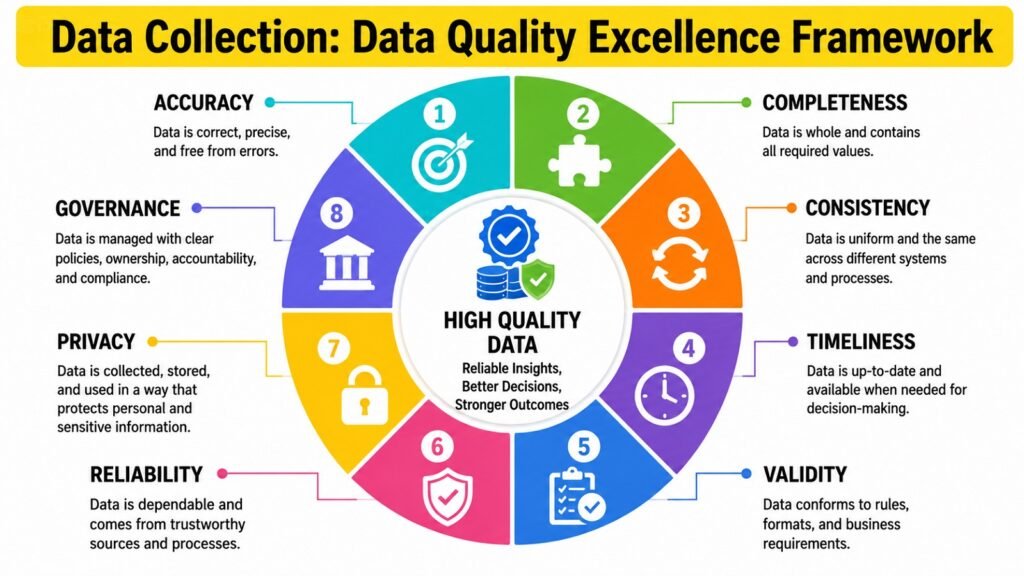
Collecting data is not enough. Collected data must be trustworthy before it can support decisions. Data quality and governance address the standards and practices that organizations use to ensure their information is reliable, appropriate, and responsibly managed.
Data quality rests on several interconnected principles. Accuracy means the information correctly reflects what it is supposed to measure. Completeness means no critical values are missing. Consistency means the same entity is described the same way across all systems. Validity means the data conforms to expected formats and ranges. Timeliness means the information is current enough to be relevant. Reliability means the collection process produces stable results over time. Relevance means the data actually addresses the business question at hand.
Governance provides the organizational framework within which quality standards are applied and maintained. It covers data ownership, stewardship roles, access policies, privacy protections, security controls, ethical guidelines, and regulatory compliance. Organizations subject to regulations such as the General Data Protection Regulation in Europe or the Health Insurance Portability and Accountability Act in the United States must treat governance not as optional best practice but as a legal requirement.
The consequences of poor data quality are well documented. Inaccurate customer records lead to failed communications and damaged relationships. Incomplete financial data distorts reporting and complicates audits. Inconsistent operational data makes performance measurement unreliable. According to research from Gartner, poor data quality costs organizations an average of around twelve million dollars annually, though estimates vary significantly by industry and scale.
Organizations that invest in maintaining high-quality, well-governed datasets build a foundation of trust. Analysts rely more confidently on the data. Managers make decisions with greater certainty. Regulators encounter fewer compliance issues. High-quality Data Collection is essential for building long-term organizational trust and competitive capability.
Table 6: Data Collection — Quality and Governance Principles and Business Significance
| Principle | Business Significance |
| Accuracy | Ensures decisions are based on information that reflects reality |
| Completeness | Prevents gaps that could distort analysis or mislead planning |
| Consistency | Allows reliable comparison and aggregation across systems and periods |
| Timeliness | Keeps information current enough to support responsive decision-making |
| Data ownership | Establishes accountability for quality and appropriate use of data |
| Privacy and security | Protects customer and organizational information from unauthorized access |
| Regulatory compliance | Reduces legal and reputational risk from data handling failures |
| Ethical use | Maintains stakeholder trust and supports responsible business practices |
6. Data Collection Technologies Driving Digital Business
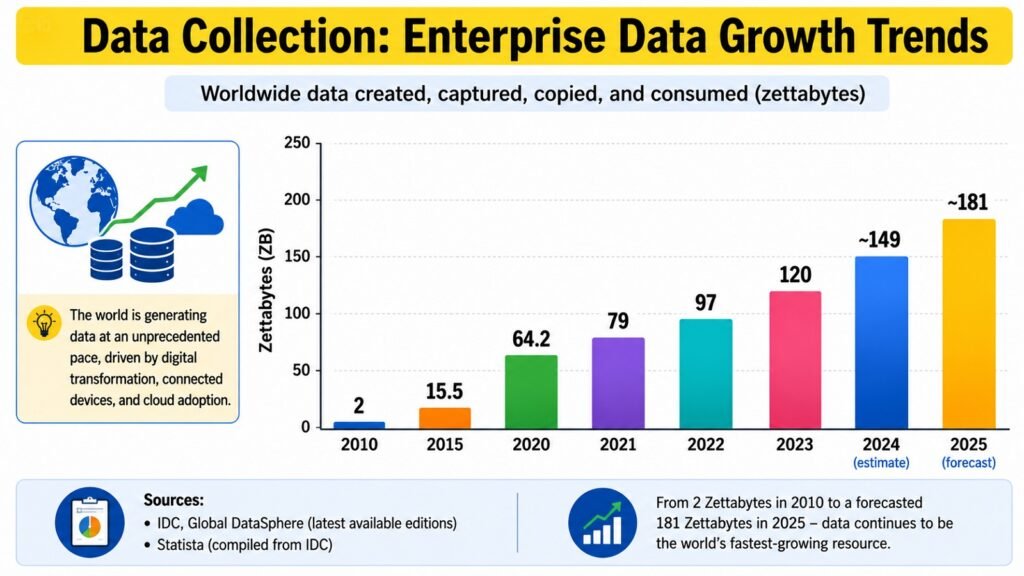
Technology has transformed Data Collection from a manual, periodic activity into an automated, continuous, and scalable organizational capability. The right technologies allow businesses to collect more relevant information, process it faster, and integrate it across systems in ways that were not possible a decade ago.
CRM platforms such as Salesforce capture every customer interaction across sales, service, and marketing channels, creating unified records of customer relationships. ERP systems such as SAP and Oracle consolidate operational, financial, and supply chain data into a single integrated environment. Cloud computing platforms such as Amazon Web Services, Microsoft Azure, and Google Cloud provide the infrastructure to store and process data at virtually any scale without requiring significant upfront capital investment.
Data warehouses and data lakes serve different but complementary roles. Warehouses organize structured data from multiple sources into formats suitable for analysis and reporting. Lakes store large volumes of raw data in its original form, preserving it for future analytical use. APIs allow different systems to exchange structured data in real time, enabling seamless integration across the technology landscape.
IoT devices installed in manufacturing plants, logistics networks, and commercial buildings generate continuous streams of operational data from physical environments. Artificial intelligence and machine learning systems can process these streams at scale, identifying patterns and anomalies that human analysts would be unable to detect manually. Automation platforms remove repetitive manual tasks from the collection process, reducing errors and improving consistency. Edge computing processes data closer to its source, reducing latency in time-sensitive operational environments.
Technology strengthens Data Collection only when it remains aligned with business objectives and governance practices. The most sophisticated platform provides little value if it collects the wrong information, manages it poorly, or sits disconnected from the decisions it is supposed to inform.
Table 7: Data Collection — Technologies and Their Primary Business Contribution
| Technology | Primary Business Contribution |
| CRM platforms | Unifies customer interaction data across sales, service, and marketing |
| ERP systems | Integrates financial, operational, and supply chain information organization-wide |
| Cloud computing | Provides scalable, cost-effective infrastructure for data storage and processing |
| Data warehouses | Organizes structured data from multiple sources for reporting and analysis |
| APIs | Enables real-time data exchange between connected business systems |
| IoT devices | Collects continuous operational data from physical assets and environments |
| AI and machine learning | Automates pattern detection and insight generation from large datasets |
| Edge computing | Processes data near its source to reduce latency in operational systems |
7. Data Collection for Business Analytics and Intelligence
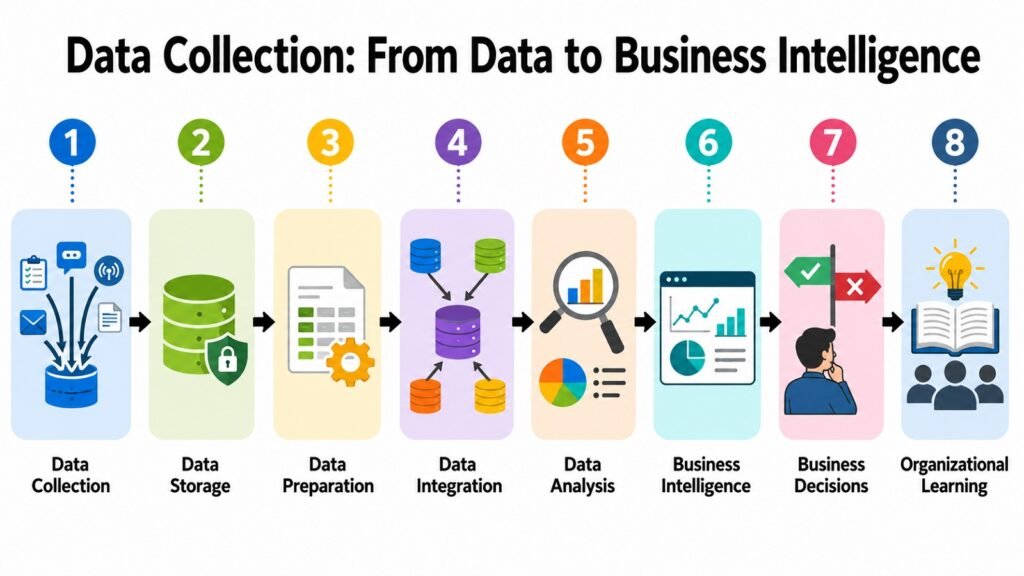
Data collection serves as the backbone of analytics. In the absence of a dependable and ongoing stream of quality information, no analytical system can yield significant outcomes. Both Business Analytics and Business Intelligence are fundamentally reliant on the accessibility, quality, and structuring of the data that has been gathered.
The DIKW hierarchy, a well-established model in information science, describes the progression from raw data to information, from information to knowledge, and from knowledge to wisdom. Data Collection sits at the base of this hierarchy. Every layer above depends on what is gathered at this foundational stage. When collection is weak, every layer above it is compromised.
Business Intelligence systems use collected data to generate dashboards, operational reports, and performance scorecards that help managers understand what is happening across the organization in near real time. Business Analytics goes further, applying statistical methods, forecasting models, and machine learning techniques to answer questions about why things are happening and what is likely to happen next.
Evidence-based decision-making, a core concept in both management science and decision theory, holds that decisions grounded in reliable data produce better outcomes than those based on experience or intuition alone. This principle has become more practical as Data Collection technologies have made relevant information more accessible at lower cost.
Practical examples abound across industries. Retailers use collected transaction and behavioral data to forecast demand and manage inventory. Healthcare providers use patient and operational data to improve clinical outcomes and resource allocation. Financial institutions use transaction and market data to detect fraud and assess credit risk in real time. Advanced analytics can never compensate for weak Data Collection. Reliable information is the true foundation of business intelligence.
Table 8: Data Collection — Business Analytics Applications Enabled by Data
| Analytics Application | Business Outcome Supported |
| Sales forecasting | Improves inventory planning and revenue projection accuracy |
| Customer churn analysis | Identifies at-risk customers and enables proactive retention efforts |
| Operational dashboards | Provides real-time visibility into performance across business functions |
| Demand forecasting | Aligns production and supply chain capacity with anticipated market needs |
| Fraud detection | Identifies anomalous transaction patterns to reduce financial losses |
| Sentiment analysis | Monitors brand perception and customer satisfaction from interaction data |
| Predictive maintenance | Uses equipment data to schedule maintenance before failures occur |
| Risk modeling | Combines internal and external data to assess financial and operational risk |
8. Data Collection Challenges and Best Practices for Businesses
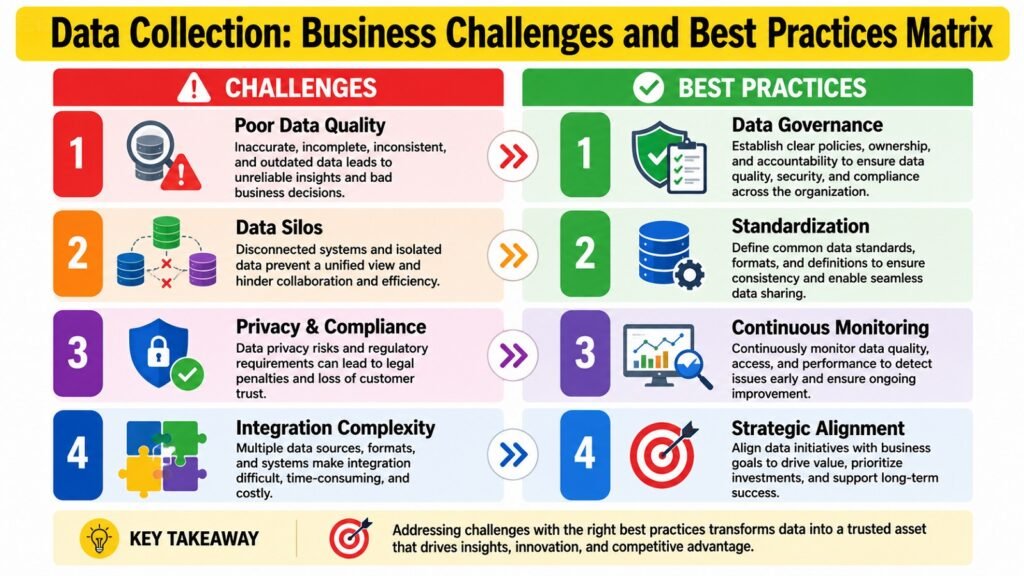
Organizations, even those with strong intentions, face considerable challenges in developing effective Data Collection capabilities. Recognizing these obstacles and the strategies that can mitigate them is crucial for achieving progress.
Poor data quality remains one of the most common and damaging problems. It typically arises from inconsistent input standards, inadequate validation processes, and the absence of clear data ownership. The result is datasets that analysts distrust and managers avoid. Establishing clear quality standards at the point of collection, rather than attempting to clean data after the fact, is consistently more effective.
Data silos occur when different departments or systems collect information independently without sharing it across the organization. This fragmentation makes it difficult to build complete organizational views and often leads to contradictory numbers in different reports. Integration strategies that connect systems through common data models and APIs can help dissolve silos over time.
Privacy concerns and regulatory compliance create real constraints on what data can be collected, how it must be stored, and who can access it. Regulations such as GDPR, CCPA, and various sector-specific laws require organizations to document their data practices, obtain appropriate consents, and respond to subject access requests. Treating compliance as an integral part of the collection design process is far less costly than retrofitting privacy controls after the fact.
Data bias occurs when collection methods systematically over-represent or under-represent certain groups or conditions. Biased data produces biased analysis, which can lead to decisions that harm customers, create legal exposure, or produce poor business outcomes. Designing collection processes with diverse representation in mind and auditing datasets regularly for systematic gaps reduces this risk.
Organizations that achieve lasting improvement in Data Collection typically share several characteristics. They align collection activities with specific business objectives. They establish governance structures that assign clear accountability. They invest in training teams to understand what good data looks like and why it matters. They monitor quality continuously rather than treating it as a one-time project. Most importantly, they recognize that collecting better, more relevant, and well-governed data creates more business value than simply collecting more data.
Table 9: Data Collection — Common Challenges and Best Practices
| Challenge | Best Practice or Recommended Solution |
| Poor data quality | Implement validation rules and quality checks at the point of collection |
| Data silos | Integrate systems through shared data models and cross-functional governance |
| Privacy and compliance risk | Design collection processes around regulatory requirements from the start |
| Data bias | Audit datasets regularly and diversify collection methods to reduce gaps |
| Security vulnerabilities | Apply access controls, encryption, and regular security assessments |
| Inconsistent data standards | Establish organization-wide definitions, formats, and naming conventions |
| Stakeholder misalignment | Link data collection activities to specific business outcomes and decisions |
| Scalability constraints | Use cloud-based and automated platforms that can grow with business needs |
Conclusion: Building Business Success Through Data Collection
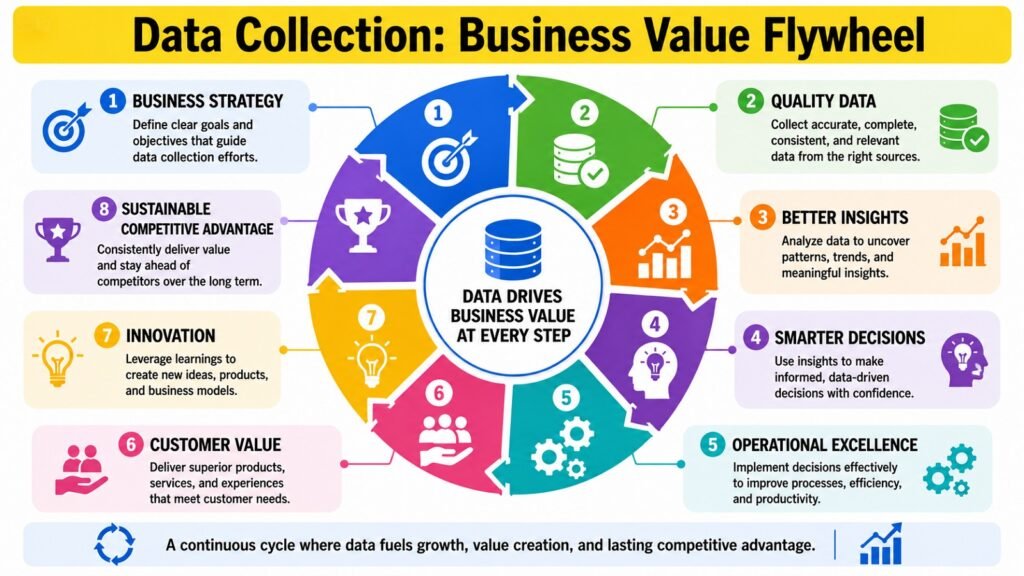
Data Collection touches every dimension of business performance. Strategy depends on it to reduce uncertainty. Operations depend on it to identify inefficiencies. Customer relationships depend on it to deliver relevance. Innovation depends on it to find the right direction. Risk management depends on it to anticipate and respond. Pulling all of these threads together reveals something important: organizations that treat Data Collection as a core business capability rather than a technical afterthought tend to perform better across the board.
The eight foundations explored in this article offer a complete picture of what effective Data Collection looks like in practice. Strategic alignment ensures that collection serves genuine business needs. Understanding data types ensures that the right categories of information are gathered. Source selection ensures that the information is credible and relevant. Method selection ensures that the right tools are applied to the right problems. Governance ensures that the information is trustworthy and responsibly managed. Technology ensures that collection is scalable and continuous. Analytics integration ensures that collected data becomes actionable knowledge. And a clear-eyed understanding of challenges ensures that improvement is sustainable over time.
The future of business competition is increasingly informational. Markets are moving faster. Customer expectations are shifting more rapidly. Regulatory environments are becoming more complex. Organizations that continuously improve their Data Collection capabilities will be better positioned to anticipate these changes rather than simply react to them. The ability to know more, know it sooner, and act on it more confidently is a structural advantage that compounds over years.
Data Collection should be understood not as a project with a completion date but as an ongoing strategic capability that evolves alongside the business. It requires investment, attention, governance, and cultural commitment. The organizations that treat it that way will consistently outperform those that do not. For businesses ready to translate these foundations into a coherent system, a structured Data Collection Framework provides a practical path forward, systematically aligning collection with strategy, governance, technology, and analytics to generate lasting business value.
Table 10: Data Collection — Key Business Takeaways from the Eight Foundational Aspects
| Foundational Aspect | Key Business Takeaway |
| Business Strategy | Start with business objectives, not technology, when defining data needs |
| Business Data Types | Collect diverse and relevant information across all major business domains |
| Internal and External Sources | Combine internal operational data with external market intelligence |
| Collection Methods | Match the method to the business question, not to technological preference |
| Data Quality and Governance | Trustworthy data requires quality standards and clear accountability |
| Collection Technologies | Technology adds value only when aligned with strategy and governance |
| Analytics and Intelligence | Reliable data is the true foundation of every analytical output |
| Challenges and Best Practices | Better and more relevant data creates more value than simply more data |