Table of Contents
Introduction: Competitive Advantage Framework for the AI Era: Rethinking Business Success
Competitive advantage has always been the central question in strategic management. Why do some organizations outperform others over long periods while companies with similar resources and markets struggle? For decades, executives and researchers have answered this through frameworks and theories that shaped how businesses think about strategy, value, and performance.
Something significant has shifted, however. Artificial intelligence, cloud computing, data ecosystems, and automation have altered the conditions under which competitive advantage is created and maintained. These technologies are not simply new tools. They are changing the speed, scale, and nature of competition itself. Customer expectations evolve faster than most organizations can adapt. Digital platforms connect markets that once operated independently. Data has become one of the most valuable assets any organization can hold.
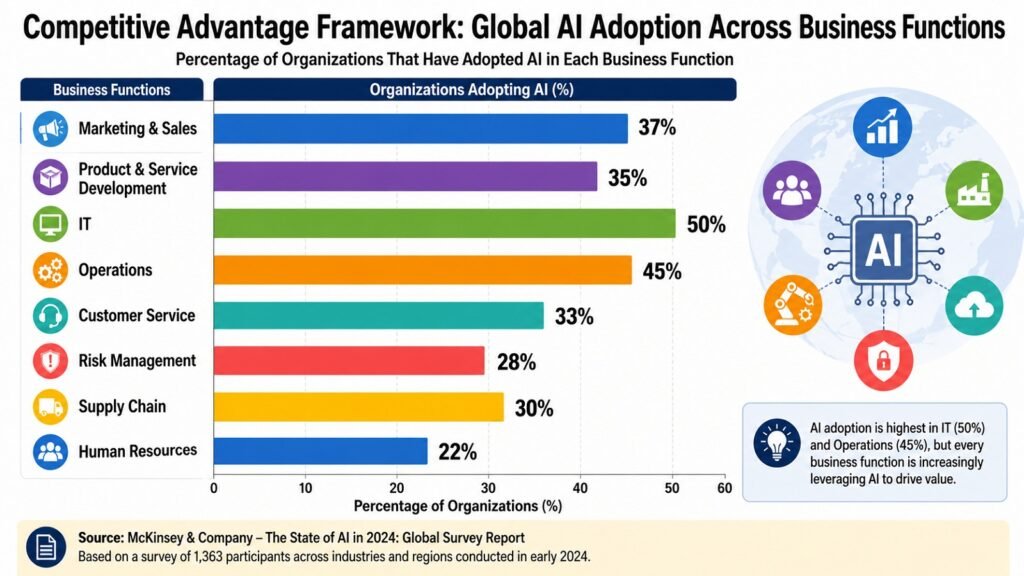
The problem is that many organizations have responded to this shift by investing heavily in AI without first establishing a clear strategic foundation. McKinsey research has consistently found that only a small fraction of organizations successfully scale AI across the enterprise and generate sustained business value from those investments.
Classical strategic theories remain deeply relevant here. Porter’s model explains how cost leadership and differentiation create superior market positions. The Resource-Based View describes how valuable internal capabilities generate above-average returns. The VRIO Framework adds imitability and organizational support as dimensions. Dynamic Capabilities theory explains how firms continuously adapt as markets evolve. Each was developed before today’s AI-driven landscape existed, yet each continues to illuminate fundamental truths about competition.
This article synthesizes established theories with contemporary research on AI strategy, digital transformation, and organizational capability to introduce a Competitive Advantage Framework for the AI Era. The framework does not replace foundational theories. It extends them into a practical management system for organizations navigating a world shaped by artificial intelligence and data.
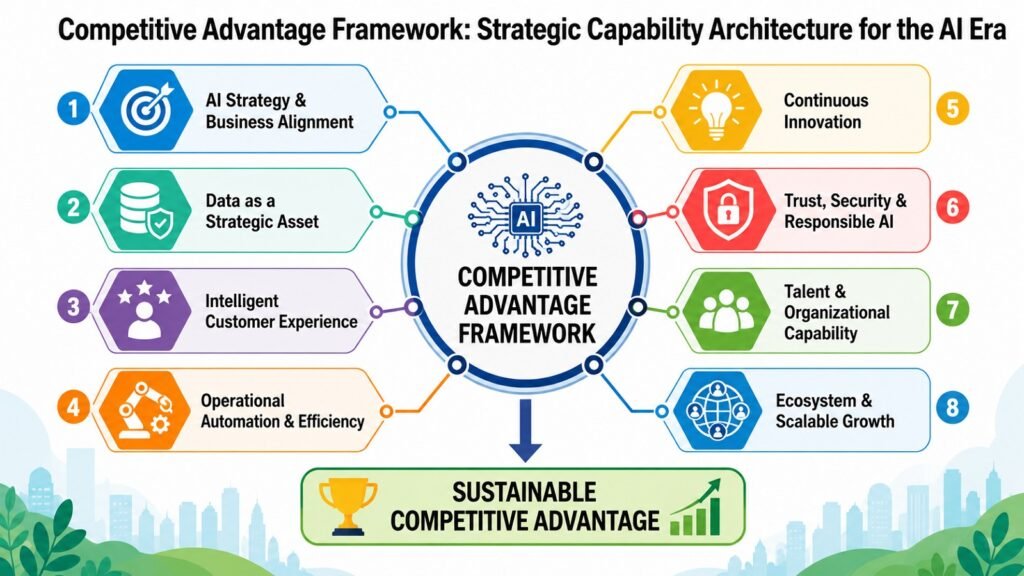
This Competitive Advantage Framework consists of eight interconnected strategic capabilities. True competitive advantage emerges from the interaction between all eight pillars rather than excellence in any single area. Strategic alignment gives the system direction. Data quality provides the foundation for AI decisions. Intelligent customer experience creates loyalty and differentiation. Operational automation expands efficiency and resilience. Continuous innovation keeps organizations responsive. Trust and responsible AI protect long-term relationships. Talent ensures technology serves human judgment. Ecosystem participation extends advantage beyond organizational boundaries.
Competitive Advantage Framework: Eight Strategic Pillars at a Glance
| Strategic Pillars of Competitive Advantage Framework | Core Focus |
| AI Strategy and Business Alignment | AI initiatives tied to defined competitive goals |
| Data as a Strategic Asset | Governed, high-quality data enabling AI decisions |
| Intelligent Customer Experience | AI-powered personalization and relationship depth |
| Operational Automation and Efficiency | AI-enhanced processes, agility, and resilience |
| Continuous Innovation | AI-accelerated sensing, experimentation, and growth |
| Trust, Security, and Responsible AI | Governance, ethics, and stakeholder confidence |
| Talent and Organizational Capability | Human expertise and adaptive learning culture |
| Ecosystem and Scalable Growth | Partnerships, platforms, and network advantage |
1. Competitive Advantage Framework: AI Strategy and Business Alignment
Why do so many AI initiatives fail to deliver meaningful business value? Organizations invest in talent, data infrastructure, and machine learning tools, yet returns often fall short of expectations. The answer lies less in technical execution and more in strategic direction. AI is not a business strategy. It is a strategic capability that either reinforces or undermines an organization’s chosen competitive position depending entirely on how well it is aligned with business objectives.
Porter’s Generic Strategies provide a useful lens here. Organizations compete through cost leadership, differentiation, or focused market positioning. AI can support any of these approaches, but only when deployed in service of a clearly chosen strategy. A company pursuing cost leadership might use AI to optimize supply chain logistics. A company pursuing differentiation might use AI to deepen personalization and create superior customer experiences. The technology is the same in both cases. The strategic intent is entirely different.
When AI investments are disconnected from competitive strategy, they create complexity without value. Resources flow toward technically interesting projects rather than strategically important ones. Governance becomes fragmented. Decision-making authority over AI systems remains unclear. Organizations accumulate a collection of isolated AI tools rather than a coherent capability that strengthens their market position.
Effective strategic alignment requires executive leadership to define where AI can genuinely advance competitive objectives and where it cannot. It requires investment prioritization that connects AI spending to measurable business outcomes. Research from the MIT Sloan Management Review has found that organizations with strong AI governance and senior executive involvement consistently achieve better business outcomes than those that leave AI decisions entirely to technology teams.
Within the Competitive Advantage Framework, strategic alignment functions as the first pillar because it gives every other capability its direction. Without alignment, data governance becomes a technical exercise. Customer experience improvements become feature additions without competitive intent. Operational automation delivers savings that competitors quickly match. AI should accelerate business strategy. It should never be allowed to define it.
Competitive Advantage Framework: AI Strategic Alignment Principles
| Strategic Area | Executive Decision Focus |
| Competitive positioning | AI aligned to cost leadership or differentiation |
| Investment prioritization | Spending directed toward strategic outcomes |
| AI governance | Clear ownership and accountability structures |
| Performance measurement | AI success linked to business KPIs |
| Long-term planning | AI roadmap tied to multi-year business strategy |
| Risk management | Strategic risk considered at AI investment stage |
| Executive sponsorship | Senior leadership engaged in AI strategy decisions |
| Resource allocation | Capabilities matched to competitive priority areas |
2. Competitive Advantage Framework: Data as a Strategic Asset
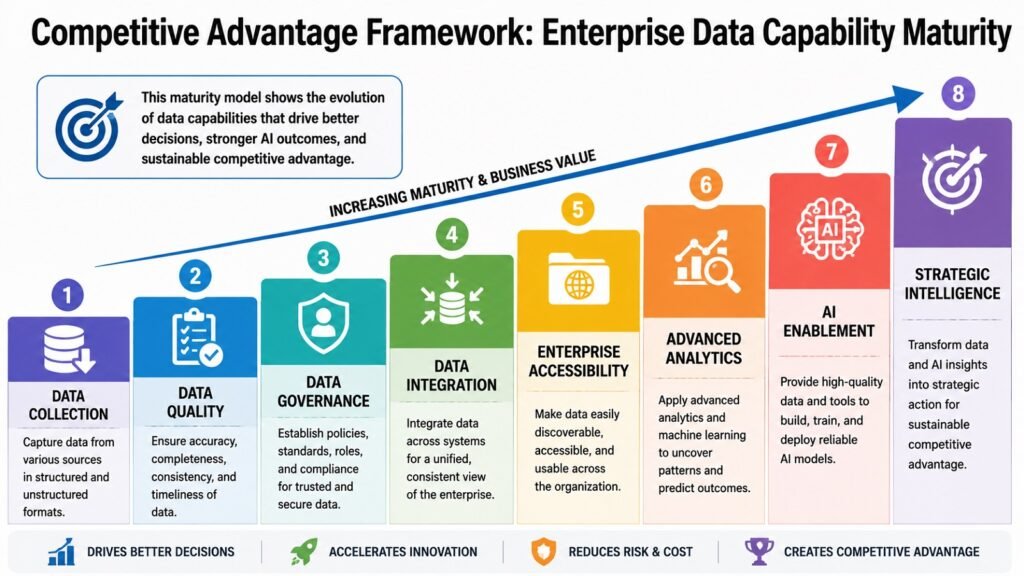
AI systems generate value only when built on reliable, accessible, and well-governed data. This is not a technical observation. It is a strategic one. Organizations that treat data as a core business resource consistently make better decisions, develop stronger products, and build more responsive relationships with customers than those that treat data as a byproduct of operations.
The Resource-Based View offers a useful lens here. Competitive advantage derives from resources that are valuable, rare, difficult to imitate, and supported by structures that allow deployment. These are the exact dimensions that distinguish a strategically managed data asset from a warehouse that goes largely unused. Proprietary data collected from unique customer interactions or operational processes can be extraordinarily difficult for competitors to replicate. The VRIO Framework reinforces this. Data that is valuable but widely available provides no lasting advantage. All four dimensions must be present for data to function as a genuine strategic resource.
In practice, this means investing in governance frameworks that define ownership, quality standards, and access controls. It means ensuring interoperability so that data can move between systems and teams across the organization. It means taking privacy seriously not only as a regulatory requirement but as a trust signal that strengthens customer relationships. IDC research has found that poor data quality costs organizations significant resources annually in wasted operational activity and missed decision opportunities.
Within the Competitive Advantage Framework, data is the foundation that makes every other capability possible. Intelligent customer experiences depend on quality behavioral data. Operational automation depends on reliable process data. Innovation depends on market intelligence. Responsible AI depends on data that is transparent and auditable. When data governance is weak, every other pillar of the framework becomes unreliable. When managed as a strategic asset, data amplifies the impact of all capabilities working together.
Competitive Advantage Framework: Strategic Data Capabilities
| Data Capability | Strategic Significance |
| Data governance frameworks | Ensures consistency, accountability, and quality control |
| Proprietary data collection | Builds assets competitors cannot easily replicate |
| Interoperability standards | Enables cross-functional AI deployment at scale |
| Privacy and compliance programs | Strengthens customer trust and reduces regulatory risk |
| Data quality management | Improves reliability of AI-driven decisions |
| Unified data platforms | Reduces fragmentation and accelerates insight delivery |
| Data literacy programs | Empowers teams to use data in day-to-day decisions |
| Metadata management | Improves data discoverability and long-term usability |
3. Competitive Advantage Framework: Intelligent Customer Experience
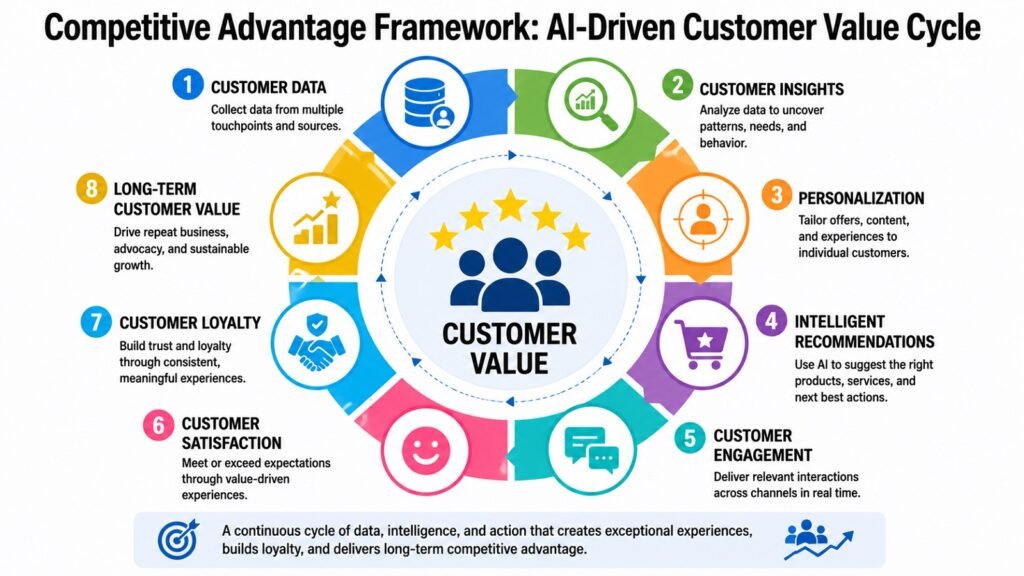
Customer experience has become one of the most powerful sources of differentiation in contemporary markets. Price and product features are matched quickly by competitors. How an organization makes customers feel, how well it anticipates their needs, and how consistently it delivers value across every interaction are far harder to replicate.
AI expands the strategic potential of customer experience in ways that were not previously possible. Personalization is perhaps the most visible application. AI systems can analyze behavioral data, purchase history, and contextual signals to tailor recommendations and communication to individual preferences at a scale no human team could achieve. Amazon’s recommendation engine is frequently cited as one of the most impactful personalization systems ever built, reportedly accounting for a substantial portion of total sales revenue.
Predictive service goes further by anticipating needs before they are expressed. Conversational AI, when implemented thoughtfully, reduces friction from routine interactions and frees human agents for complex situations where personal judgment matters most. AI-powered journey analytics identifies where customers disengage and where service delays damage loyalty. Each of these capabilities works best when designed around genuine customer value rather than technological novelty.
The strategic principle is clear. Technology alone does not generate customer value. AI adds value when it allows organizations to enhance relationships, minimize customer effort, and provide meaningful outcomes for the individuals they serve. A customer who feels acknowledged and well-cared-for is more inclined to stay loyal, increase their spending over time, and recommend others, all of which contribute to lifetime value and sustained competitive success.
Within the Competitive Advantage Framework, intelligent customer experience connects to the data pillar through behavioral intelligence, to the operational pillar through seamless delivery, and to the trust pillar through ethical use of personal information. When managed deliberately, it becomes a competitive advantage that rivals find genuinely difficult to imitate.
Competitive Advantage Framework: AI-Enabled Customer Capabilities
| Customer Capability | Business Value Created |
| Behavioral personalization | Higher engagement, conversion, and retention rates |
| Predictive need identification | Proactive service that reduces customer effort |
| Conversational AI interfaces | Faster resolution and reduced support cost |
| Journey analytics | Identifies friction and improves experience consistency |
| Sentiment analysis | Real-time insight into customer satisfaction signals |
| Dynamic pricing models | Value-aligned pricing that improves margin and loyalty |
| Loyalty and churn prediction | Early intervention to retain high-value customers |
| Omnichannel experience integration | Consistent engagement across platforms and touchpoints |
4. Competitive Advantage Framework: Operational Automation and Efficiency
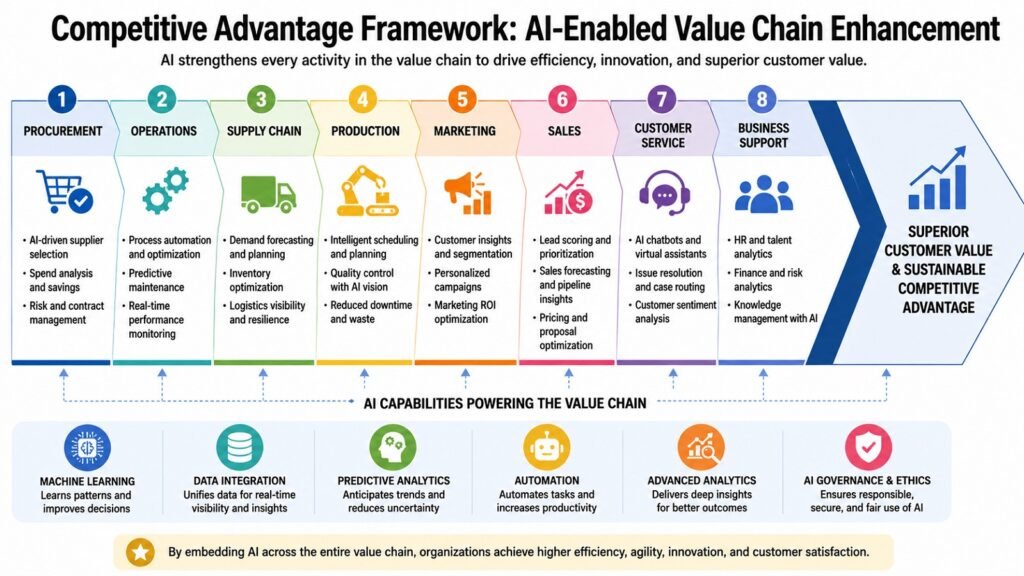
Operational excellence has long been recognized as a source of competitive advantage. Organizations that execute reliably, reduce waste, and deliver consistently tend to outperform those that do not. AI significantly expands the strategic potential of operational capability by enabling automation at a scale and speed that traditional process improvement methods cannot match.
Porter’s Value Chain describes how organizations create value through primary and support activities. Primary activities include logistics, operations, marketing, sales, and service. Support activities include procurement, technology development, and infrastructure. AI can strengthen virtually every one of these categories, but the strategic impact depends on how automation connects to competitive objectives rather than simply to cost reduction.
Predictive maintenance is one of the clearest examples. Manufacturing organizations have used AI-powered sensor data to detect equipment failure before it occurs, reducing unplanned downtime and extending asset life. Supply chain optimization has become another critical application. AI models can process demand signals, weather disruptions, and supplier performance in real time, enabling faster and more reliable procurement decisions. Workflow automation reduces administrative burden on knowledge workers, allowing skilled employees to focus on tasks where human judgment adds the most value.
The deeper strategic point is that operational automation should be evaluated not only through cost savings but also through agility, resilience, scalability, and quality. An organization that can scale rapidly during demand surges, recover from disruptions faster than competitors, and maintain consistent quality across geographies builds a form of competitive advantage that goes well beyond simple efficiency gains.
Within the Competitive Advantage Framework, operational capability reinforces alignment by executing strategy at speed, supports customer experience through reliable service, and provides the stability that makes innovation possible. Organizations that treat operational automation as a strategic capability rather than an IT function consistently build more durable competitive advantages.
Competitive Advantage Framework: Operational Capabilities and Competitive Benefits
| Operational Capability | Competitive Benefit |
| Predictive maintenance systems | Reduced downtime and extended asset lifespan |
| AI-powered supply chain planning | Faster adaptation to demand and supply disruptions |
| Intelligent workflow automation | Higher throughput with lower operational overhead |
| Real-time operational analytics | Faster, more reliable management decisions |
| Quality control automation | Consistent output and reduced defect rates |
| Demand forecasting models | Better inventory management and lower carrying costs |
| Logistics route optimization | Faster delivery and reduced transportation expense |
| Automated compliance monitoring | Lower regulatory risk across operational processes |
5. Competitive Advantage Framework: Continuous Innovation
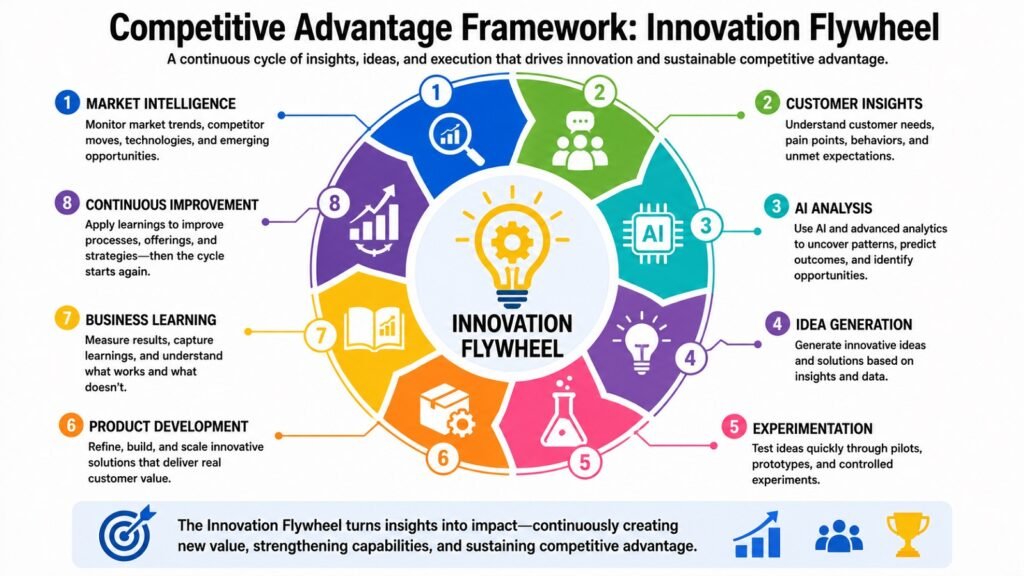
Competitive advantage that cannot evolve will not last. Markets change, customer expectations shift, new technologies emerge, and rivals develop capabilities that close gaps that once provided meaningful differentiation. Organizations that sustain competitive advantage over long periods do so by continuously renewing their strategic capabilities rather than defending what currently exists.
Dynamic Capabilities theory, developed by David Teece and colleagues, describes this process through three organizational activities. Sensing involves scanning markets and technologies for emerging opportunities and threats. Seizing means mobilizing resources to capture those opportunities before competitors do. Transforming refers to continuously reconfiguring assets and processes as conditions evolve. AI accelerates all three in meaningful ways.
In sensing, AI tools can monitor competitor behavior, track emerging research, and surface market signals that human analysts would struggle to process at comparable scale. In seizing, AI shortens the time between identifying an opportunity and deploying a response. In transforming, AI supports faster experimentation and the organizational learning that comes from analyzing results across large datasets. Research in leading management journals has found that firms with strong dynamic capabilities consistently outperform peers during periods of significant technological disruption.
The risk organizations face is treating innovation as an isolated function rather than an embedded capability. When innovation depends on a single research department, it becomes fragile and slow. When it is distributed across functions, supported by AI tools, and connected to real-time market intelligence, it becomes a durable source of strategic renewal.
Within the Competitive Advantage Framework, continuous innovation connects all other pillars by ensuring they keep evolving. Data capabilities improve through ongoing experimentation. Customer experiences are refined through continuous testing. Operational systems are upgraded as new automation opportunities emerge. A framework without an embedded innovation capability will gradually become obsolete regardless of its initial strength.
Competitive Advantage Framework: Innovation Capabilities and Strategic Advantage
| Innovation Capability | Strategic Advantage Supported |
| AI-powered market sensing | Earlier identification of competitive opportunities |
| Rapid prototyping and testing | Faster iteration and lower innovation cost |
| Generative AI for R&D | Accelerated concept development and research cycles |
| Business model experimentation | Ability to enter new markets with lower risk |
| Competitive intelligence tools | Real-time visibility into rival strategies |
| Open innovation programs | Access to external ideas and emerging technologies |
| Innovation governance frameworks | Consistent resource allocation toward strategic priorities |
| Cross-functional idea sharing | Broader participation in innovation across the organization |
6. Competitive Advantage Framework: Trust, Security, and Responsible AI
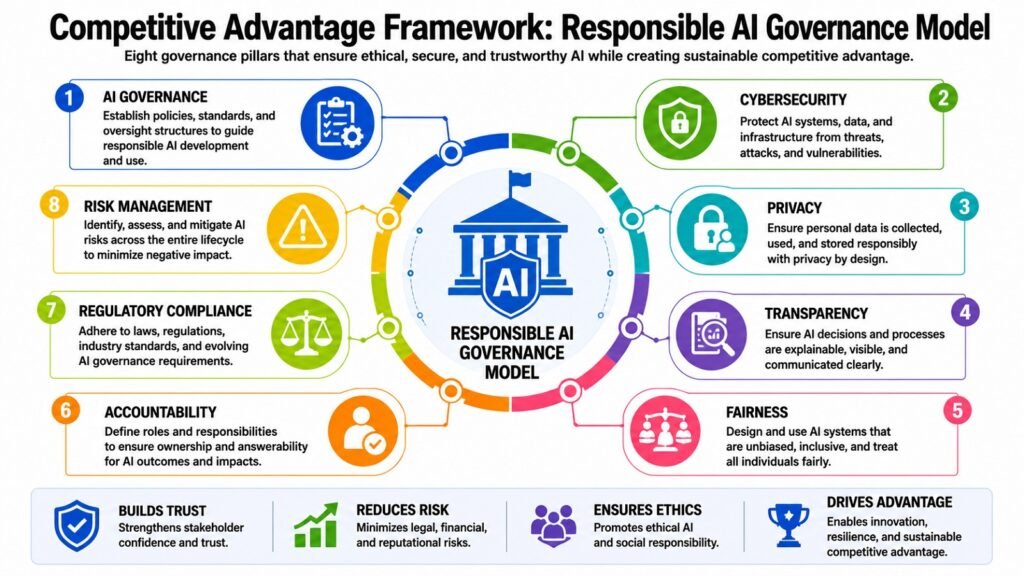
Sustainable competitive advantage in the AI era depends as much on stakeholder trust as on technological capability. Organizations that deploy AI without regard for privacy, fairness, or accountability expose themselves to regulatory penalties and reputational damage. Trust is not a constraint on AI strategy. It is a strategic asset in its own right.
Cybersecurity has emerged as a fundamental necessity for any organization that manages sensitive information or engages with digital partners. Artificial Intelligence has enhanced the complexity of both cyberattacks and defensive measures. Organizations that allocate resources towards AI-driven threat detection and monitoring can mitigate the risks linked to digital operations. However, relying solely on technical security measures is insufficient. Governance frameworks need to establish who possesses authority over AI systems and what oversight mechanisms are in place to guarantee accountability.
Responsible AI extends governance into questions of fairness, transparency, and ethical decision-making. AI trained on biased data can produce discriminatory outcomes that harm customers and violate regulatory requirements. Systems that operate as opaque black boxes undermine the trust of users who cannot understand why a decision was made. Organizations that design for fairness, explainability, and human oversight build systems that are more durable and better aligned with the values of the people they serve.
Regulatory environments are becoming more demanding. The EU’s Artificial Intelligence Act introduced a risk-based classification system with stricter requirements for high-risk use cases in healthcare, employment, and critical infrastructure. Organizations that treat compliance as a minimum threshold will find themselves reacting rather than shaping. Those that embed responsible AI early develop stronger relationships with regulators, customers, and investors.
Within the Competitive Advantage Framework, trust and responsible AI protect the value created by every other pillar. Data used for personalization must be handled ethically. Operational AI must be monitored for safety. Responsible AI is not a separate initiative. It is the governance layer that holds the framework together.
Competitive Advantage Framework: Responsible AI Principles and Strategic Value
| Responsible AI Principle | Strategic Value |
| AI governance frameworks | Clear accountability and reduced organizational risk |
| Fairness and bias audits | Equitable outcomes and lower regulatory exposure |
| Explainability standards | Stronger user trust and better stakeholder acceptance |
| Cybersecurity investment | Protection of digital assets and customer data |
| Privacy by design | Regulatory compliance and customer confidence |
| Human oversight protocols | Error correction and accountability in critical systems |
| Ethical AI review boards | Proactive identification of risk before deployment |
| Transparent AI communication | Stronger brand reputation and investor confidence |
7. Competitive Advantage Framework: Talent and Organizational Capability
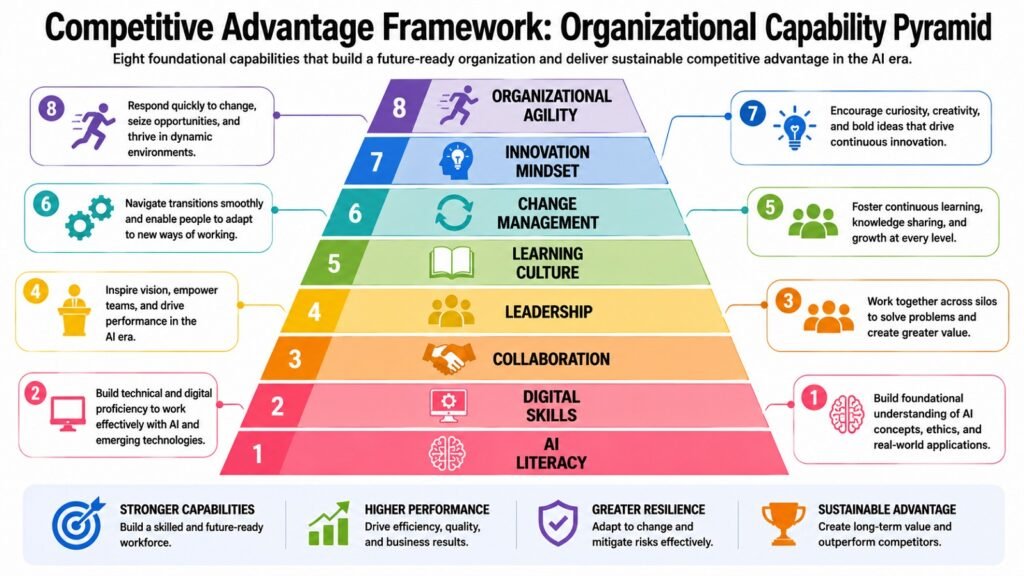
Every AI system that generates competitive advantage was designed, deployed, and improved by people. AI strengthens organizations only when supported by capable people, effective leadership, and a culture that can learn and adapt alongside changing technology.
The Resource-Based View identifies human expertise and organizational knowledge as among the most valuable strategic resources any firm can hold. Unlike physical assets, deep expertise in applying AI to specific business problems is extraordinarily difficult for competitors to replicate quickly. It takes time to build, requires structures that support collaboration and knowledge sharing, and depends on leadership that actively develops talent rather than simply deploying it.
AI literacy is becoming an essential organizational capability rather than a specialist skill. This does not mean every employee needs to understand machine learning algorithms. It means people across functions need to understand how AI tools work well enough to use them effectively, question their outputs critically, and recognize when human judgment should take precedence. Organizations that invest in broad AI literacy identify use cases faster and generate more value from their investments than those that confine AI knowledge to small technical teams.
Workforce transformation is one of the harder challenges associated with AI adoption. Some roles will change substantially. New ones will emerge. Organizations that manage this transition thoughtfully, investing in reskilling and communicating openly about how AI will affect work, tend to maintain higher engagement and lower attrition than those that treat workforce change as a secondary concern.
Within the Competitive Advantage Framework, talent reinforces every other pillar. Aligned AI strategies require leaders who understand enterprise-level AI governance. Data quality depends on teams that appreciate why governance matters. Customer experience depends on people who can design empathetic AI-enabled interactions. Organizations that invest in their people invest in the durability of the entire framework.
Competitive Advantage Framework: Organizational Capabilities and Strategic Contribution
| Organizational Capability | Strategic Contribution |
| AI literacy across functions | Faster adoption and more responsible AI use |
| Leadership development programs | Stronger AI governance and executive accountability |
| Reskilling and upskilling programs | Workforce readiness for AI-integrated roles |
| Cross-functional collaboration | Better AI solutions through diverse expertise |
| Knowledge management systems | Organizational learning captured and reused |
| Change management capability | Smoother adoption of new AI-powered processes |
| Talent acquisition strategies | Access to emerging AI and data science skills |
| Performance incentive alignment | Motivation connected to AI adoption and outcomes |
8. Competitive Advantage Framework: Ecosystem and Scalable Growth
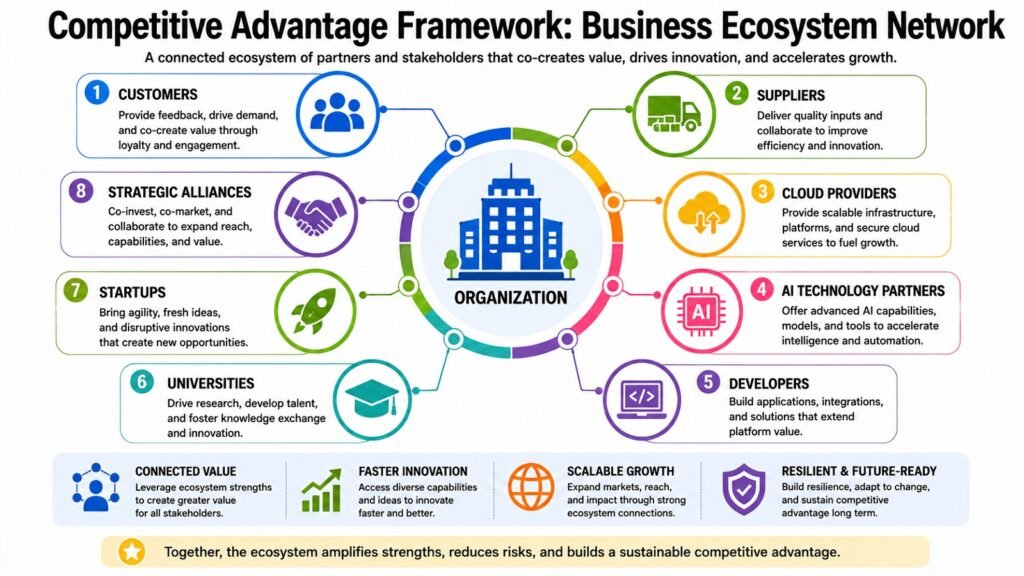
Modern organizations rarely compete as isolated entities. They compete as participants in broader ecosystems of partners, platforms, suppliers, and research institutions that create value no single organization could generate alone. Understanding this shift is essential to building competitive advantage in the AI era.
Ecosystem participation enables organizations to access capabilities, knowledge, and market reach that would be prohibitively expensive to develop internally. Cloud platforms from providers such as Amazon Web Services, Microsoft Azure, and Google Cloud give organizations access to infrastructure and AI services at a scale once available only to the largest enterprises. Open-source AI communities produce foundational research that organizations can build upon. Strategic partnerships with startups, universities, and industry peers create pathways to emerging technologies and new market opportunities.
Network effects are among the most powerful competitive mechanisms within ecosystems. When a platform’s value increases as more participants join, early movers create positions that later entrants find extremely difficult to challenge. This principle has shaped competition across social media, e-commerce, and enterprise software. Organizations that position themselves skillfully within these dynamics gain leverage well beyond their internal capabilities.
Scalable growth emerges when ecosystem relationships combine with the data and AI capabilities developed through earlier pillars. An organization with strong data assets, reliable AI systems, and trusted partner relationships can expand into new markets far more efficiently than one that must build every capability independently. Open innovation programs and co-development agreements represent proven ways to extend strategic resources through collaboration.
This final pillar completes the Competitive Advantage Framework by showing how internal capabilities are amplified through external relationships. The eight pillars work as an integrated management system. Strategic alignment gives it direction. Data provides the foundation. Customer experience and operational excellence create recognizable value. Innovation keeps the system relevant. Trust protects its integrity. Talent sustains it. Ecosystem participation allows it to grow beyond what any single organization can achieve.
Competitive Advantage Framework: Ecosystem Capabilities and Strategic Contribution
| Ecosystem Capability | Strategic Contribution |
| Cloud platform partnerships | Scalable infrastructure without capital-intensive build |
| Open-source AI participation | Access to foundational tools and community innovation |
| Research institution collaboration | Early exposure to emerging scientific advances |
| Startup partnerships | Faster access to novel technologies and niche capabilities |
| Developer community engagement | Broader product ecosystem and platform loyalty |
| Supplier intelligence networks | More resilient and responsive supply chain operations |
| Industry consortium membership | Shared standards and collective regulatory influence |
| Open innovation programs | External ideas integrated into internal innovation pipelines |
Conclusion: Competitive Advantage Framework for the AI Era: Building Sustainable Business Leadership
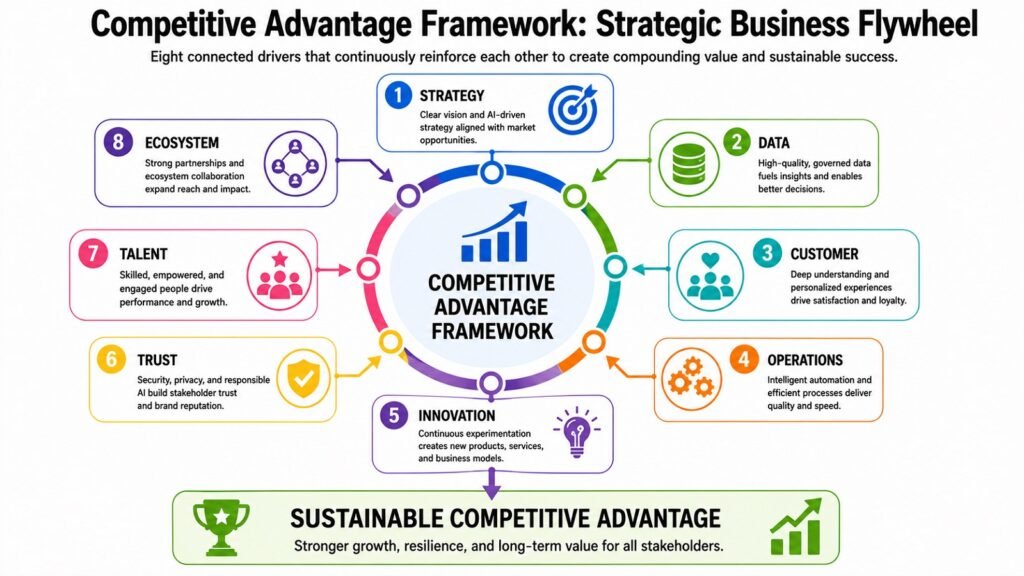
The Competitive Advantage Framework introduced in this article brings together established strategic management theory and contemporary research on artificial intelligence, organizational capability, and digital transformation. It does not displace foundational theories such as Porter’s model of competitive advantage, the Resource-Based View, the VRIO Framework, or Dynamic Capabilities. It extends them into a practical management system suited to the conditions organizations face today.
The most important insight of the Competitive Advantage Framework is that sustainable competitive advantage does not come from any single capability, however impressive. It emerges from the deliberate interaction between strategic alignment, data governance, customer value, operational excellence, continuous innovation, responsible AI, organizational talent, and ecosystem relationships. Strength in one area without strength in the others produces fragile and temporary advantage.
Organizations that benefit most will be those that treat this as a continuous strategic system rather than a one-time checklist. Markets will keep changing. AI capabilities will keep advancing. The framework should evolve alongside these shifts, incorporating new research, new competitive dynamics, and new organizational learning rather than remaining fixed.
AI is an enabling capability. It expands what organizations can do and deepens the insights available to decision-makers at every level. But long-term competitive advantage is created by the deliberate integration of multiple strategic capabilities working together under consistent and thoughtful leadership.
Competitive Advantage Framework: Eight Pillars and Primary Strategic Outcomes
| Strategic Pillars of Competitive Advantage Framework | Primary Strategic Outcome |
| AI Strategy and Business Alignment | AI investments deliver defined competitive returns |
| Data as a Strategic Asset | Reliable data foundation for AI-driven decisions |
| Intelligent Customer Experience | Deeper loyalty, trust, and long-term customer value |
| Operational Automation and Efficiency | Greater agility, resilience, and service reliability |
| Continuous Innovation | Sustained strategic renewal in changing markets |
| Trust, Security, and Responsible AI | Protected reputation and long-term stakeholder trust |
| Talent and Organizational Capability | Human expertise that sustains every AI capability |
| Ecosystem and Scalable Growth | Extended reach and amplified advantage through collaboration |