Table of Contents
Introduction: Global Trade and the Foundation of the Global Economy
Global Trade refers to the transfer of goods, services, capital, technology, and knowledge across national boundaries. It stands as one of the most ancient economic practices in human history, and in contemporary times, it influences almost every facet of how countries develop, compete, and collaborate. From the historic Silk Road to today’s digital marketplaces, the exchange of value between nations has played a crucial role in shaping civilizations and fostering prosperity that domestic economies could not attain on their own.
The reason Global Trade matters so deeply to the Global Economy is that no country can efficiently produce everything it needs. Nations differ in their natural resources, labor pools, technological capabilities, and institutional strengths. Trade allows each economy to concentrate on what it does best, freeing up resources and expanding output beyond what isolated production could generate. This simple principle explains why international commerce has grown so persistently across time.
Historically, Global Trade evolved through distinct phases. Early overland and maritime routes linked Asia, Europe, and Africa in exchanges of spices, silk, and precious metals. The Industrial Revolution collapsed distance through steam power and mass production. The post-World War II period brought the most rapid expansion in Global Trade history, driven by multilateral tariff reductions, the rise of multinational corporations, and the emergence of global supply chains. Today, digital platforms and cross-border data flows have added entirely new dimensions to what trade means.
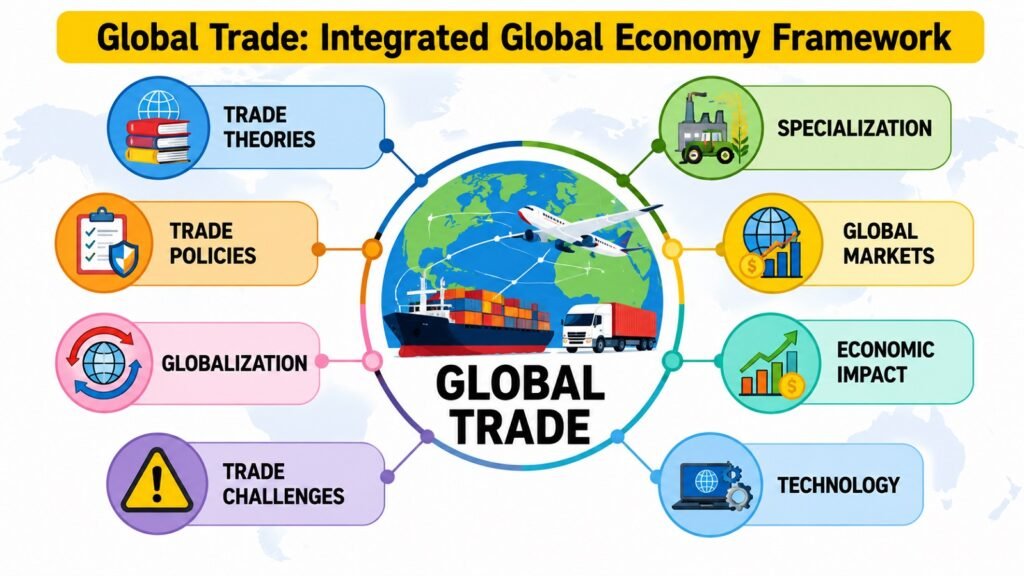
From a business perspective, Global Trade opens markets that no single country could provide. From an economic perspective, it drives specialization, productivity, and long-term growth. From a societal perspective, it influences employment, prices, and the availability of goods that improve living standards. Yet trade also creates tensions and inequalities that economies must manage carefully. This article introduces eight core concepts that together form a complete picture of how Global Trade works, what it produces, and where it is heading.
Table 1: Overview of Eight Core Global Trade Concepts
| Global Trade Concepts | Focus Area |
| Global Trade Theories & Comparative Advantage | Explains why nations trade and how specialization emerges from economic logic |
| Global Trade Patterns & Specialization | Shows how countries position themselves in global production networks |
| Global Trade Policies & Institutions | Covers the rules, agreements, and organizations that govern international commerce |
| Global Trade Markets & Trade Flows | Examines how goods, services, and capital move across borders |
| Economic Impact of Global Trade | Analyzes how trade affects growth, employment, and living standards |
| Globalization & Economic Integration | Explores how trade deepens connections between national economies |
| Global Trade Challenges & Debates | Addresses contemporary disputes and structural tensions in international commerce |
| Technology & the Evolution of Global Trade | Looks at how digital innovation is reshaping cross-border exchange |
1. Global Trade Theories & Comparative Advantage
The question of why nations trade has occupied economists for centuries, and the answers they have produced reveal much about how Global Trade actually functions. Theory does not just explain past behavior. It shapes policy decisions that affect billions of people.
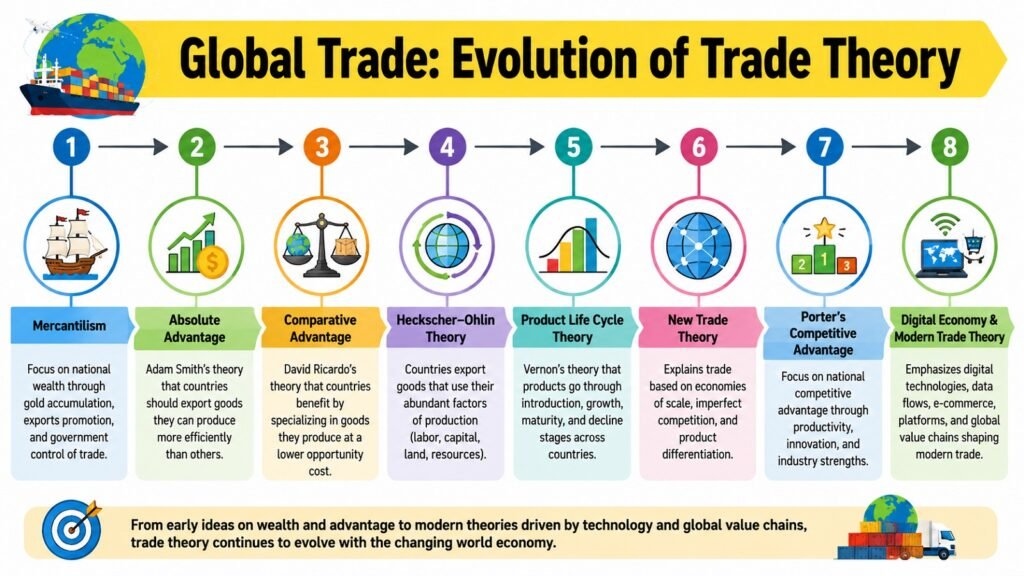
Adam Smith introduced Absolute Advantage in the eighteenth century, arguing that countries should produce goods they make more efficiently than others and trade for the rest. David Ricardo refined this with Comparative Advantage, which remains one of the most influential ideas in economics. A country should specialize in whatever it gives up the least to produce, even if a trading partner is better at producing everything. What matters is relative opportunity cost, not absolute efficiency.
The Heckscher-Ohlin model shifted focus to factor endowments. Countries export goods that use their relatively abundant factors of production, whether land, labor, or capital. A labor-rich economy tends toward labor-intensive exports, while a capital-rich economy leans toward capital-intensive goods. This explained much of twentieth-century trade patterns between developed and developing nations.
New Trade Theory, developed largely by Paul Krugman in the 1970s and 1980s, introduced economies of scale and market structure. Countries can gain from trade even without pre-existing advantages simply because specialization reduces unit costs. This explained why wealthy countries trade intensively with each other in similar products. Porter’s Competitive Advantage of Nations later emphasized firm-level strategies, industrial clusters, and institutional conditions as drivers of sustained trade competitiveness. Together, these theories show that Global Trade reflects a combination of resource differences, scale economies, and institutional quality.
Table 2: Major Global Trade Theories and Their Contributions
| Theory | Primary Contribution to Global Trade Understanding |
| Absolute Advantage (Smith) | Countries should export what they produce most efficiently |
| Comparative Advantage (Ricardo) | Trade based on relative opportunity cost benefits all participants |
| Heckscher-Ohlin Model | Factor endowments determine export patterns between nations |
| Leontief Paradox | Empirically challenged H-O predictions and prompted deeper factor analysis |
| New Trade Theory (Krugman) | Economies of scale justify trade even between similar economies |
| Gravity Model | Trade volumes correlate with economic size and geographic proximity |
| Porter’s Diamond Model | National competitiveness depends on clusters, rivalry, and institutions |
| Product Life Cycle Theory | Trade patterns shift as products mature and production migrates globally |
2. Global Trade Patterns & Specialization
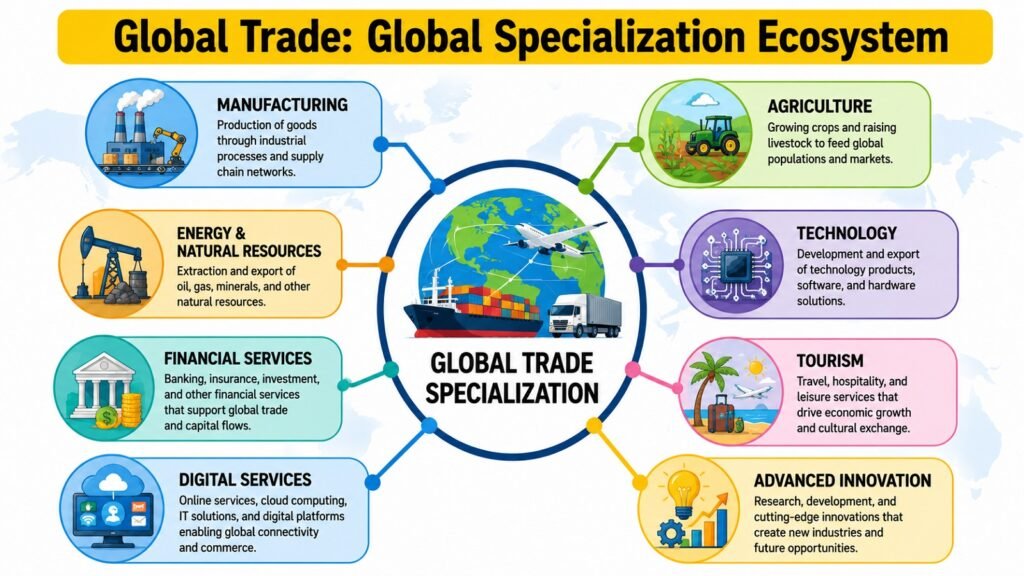
Specialization is the practical expression of trade theory, the point where economic logic becomes visible in what countries actually produce and export. Patterns of specialization in Global Trade reflect history, geography, policy choices, and technology, all layered together in ways that are rarely simple.
Resource-rich economies often anchor their export profiles in commodities. Oil-exporting nations in the Middle East, agricultural exporters in South America, and mineral-rich countries across Southeast Asia all demonstrate how natural endowments shape trade participation. But purely resource-based specialization carries risks, including price volatility and limited diversification.
Labor cost advantages have driven manufacturing specialization across Asia for decades. Bangladesh in garments, Vietnam in electronics assembly, and Cambodia in footwear built export sectors around competitive labor combined with improving infrastructure. As wages rise, specialization often shifts, as it has in China, which has moved steadily toward advanced manufacturing and services.
Global value chains have fundamentally changed how specialization works. A single product may involve design in one country, component production in several others, and assembly in another. Countries now specialize in tasks and processes rather than complete products. East Asia’s electronics industry is the clearest example: Taiwan fabricates semiconductors, South Korea produces displays and memory, China assembles final products, and Japan and Germany supply precision equipment. This interdependence amplifies gains while creating vulnerabilities when supply chains face disruption.
Table 3: Forms of Specialization in Global Trade and Their Economic Significance
| Specialization Type | Economic Significance |
| Resource-based Specialization | Leverages natural endowments for commodity exports; vulnerable to price swings |
| Labor-intensive Manufacturing | Drives early industrialization and export growth in lower-wage economies |
| Capital-intensive Production | Reflects advanced technology and infrastructure investment in mature economies |
| Knowledge and Technology Specialization | Sustains competitive advantage through innovation and research capacity |
| Task-based Specialization (GVCs) | Allows countries to participate in global production at specific process stages |
| Services Specialization | Increasingly important as digital trade expands financial, IT, and professional services |
| Regional Production Hubs | Geographic clustering amplifies scale benefits and reduces logistics costs |
| Agricultural Specialization | Supports food security globally and generates export revenue for agrarian economies |
3. Global Trade Policies & Institutions
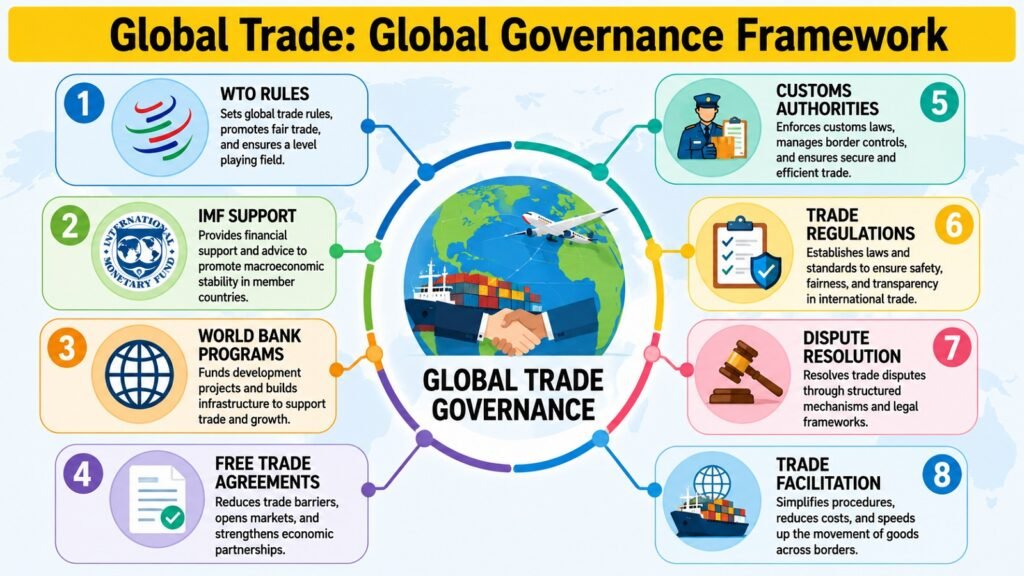
Governing Global Trade requires more than market forces. It requires institutions that set rules, resolve disputes, provide financing, and build the multilateral trust that makes international commerce possible. Policy instruments and institutional frameworks define the environment in which trade either flourishes or stagnates.
Tariffs are the most direct policy tool, raising the cost of imported goods and giving domestic producers a price advantage. While tariffs generate revenue and can protect developing industries, they raise consumer prices and invite retaliation. Average tariff rates globally have declined substantially since the 1940s, but they remain politically sensitive in many economies.
Quotas limit the physical volume of imports without direct price intervention. Non-tariff barriers cover a broader category, including technical standards, sanitary regulations, and licensing requirements that may restrict trade without formal tariffs. These instruments have grown in importance as formal tariffs have declined. Subsidies allow governments to support domestic industries, and agricultural subsidies in wealthy nations have long been a point of contention in global negotiations because they distort commodity prices and disadvantage farmers in developing countries.
Free trade agreements remove or reduce barriers for member countries. Customs unions add a common external tariff. Economic communities like the European Union integrate regulatory frameworks and monetary policy. The World Trade Organization provides the central framework for multilateral trade rules and dispute resolution. The International Monetary Fund addresses balance of payments issues that affect trade sustainability. The World Bank supports trade-related infrastructure and institutional development. Regional bodies like ASEAN and the African Continental Free Trade Area (AfCFTA) play complementary roles in shaping regional trade environments.
Table 4: Major Global Trade Institutions and Policy Instruments
| Institution or Policy | Primary Function in Global Trade |
| World Trade Organization (WTO) | Sets multilateral trade rules and resolves international disputes |
| International Monetary Fund (IMF) | Supports exchange rate stability and addresses trade-linked payment imbalances |
| World Bank | Finances trade infrastructure and institutional development in emerging economies |
| Tariffs | Tax on imports used to protect domestic industries and generate government revenue |
| Quotas | Quantitative limits on imports that restrict market access without direct taxation |
| Free Trade Agreements (FTAs) | Bilateral or multilateral pacts that reduce barriers between member countries |
| Customs Unions | Member nations adopt shared external tariffs for unified trade policy |
| Non-tariff Barriers | Regulatory, technical, or procedural measures that restrict trade flows indirectly |
4. Global Trade Markets & Trade Flows
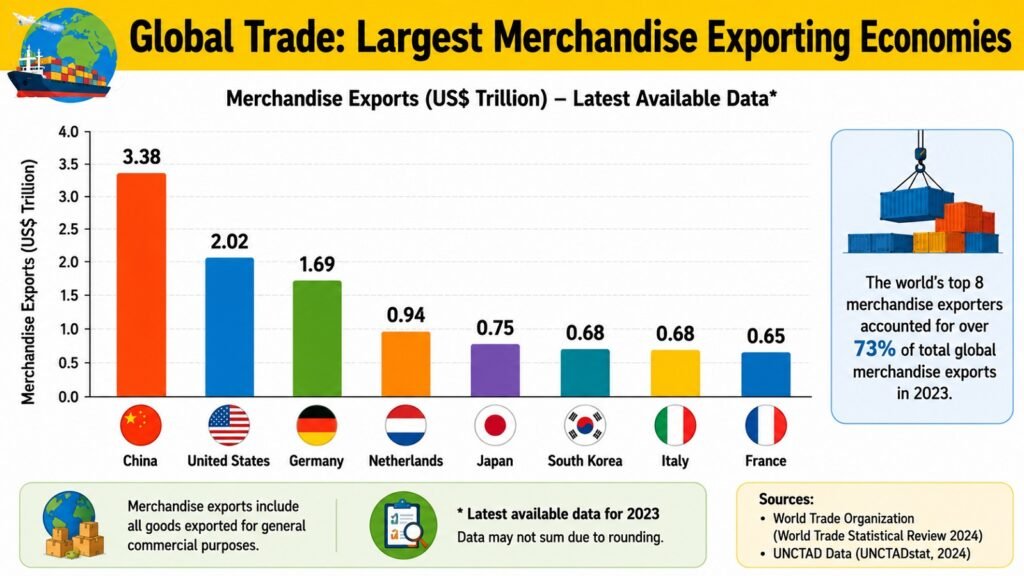
Global Trade does not move uniformly across the world. It concentrates in corridors defined by economic size, geographic proximity, institutional relationships, and historical ties. Understanding trade flows means understanding the forces that pull commerce in particular directions and the conditions that redirect it when circumstances change.
The largest Global Trade flows connect the world’s biggest economies. The United States, China, Germany, Japan, and the United Kingdom consistently rank among the top trading nations in both exports and imports. Despite political tensions, trade between the United States and China remains among the most significant bilateral relationships in the global system because the two economies are deeply embedded in each other’s supply chains and consumer markets.
Europe is home to some of the densest regional trade networks. Intra-European Union trade accounts for a large share of member nations’ total commerce, reflecting the effects of deep regulatory integration and geographic clustering. Asia has emerged as the center of gravity for manufactured goods trade, with intra-Asian production networks linking China, Japan, South Korea, Taiwan, and Southeast Asia in one of the most dynamic trade systems ever assembled.
Exchange rates influence trade competitiveness in real time. A depreciated currency makes exports cheaper for foreign buyers while raising domestic import costs. Infrastructure quality affects the cost of moving goods from production to port. Political stability influences sourcing and investment decisions. Digital commerce has added a new dimension, allowing small and medium enterprises to reach global consumers without physical presence, changing who participates in Global Trade and how value is exchanged.
Table 5: Components Influencing Global Trade Flows and Their Significance
| Component | Significance for Global Trade Flows |
| Economic Size and Income Levels | Larger economies generate higher trade volumes through greater production and consumption capacity |
| Geographic Proximity | Lower transport costs and cultural ties intensify bilateral trade between neighbors |
| Exchange Rates | Currency movements directly affect export competitiveness and import costs |
| Trade Infrastructure | Port quality, logistics networks, and customs efficiency determine trade costs and speed |
| Bilateral and Regional Agreements | Preferential access arrangements concentrate trade flows among member economies |
| Geopolitical Relations | Political alliances and tensions redirect trade toward trusted partners |
| Demand Patterns | Consumer preferences and income growth in importing countries shape what is traded |
| Digital Trade Platforms | E-commerce and digital services expand market access and reduce entry barriers for smaller firms |
5. Economic Impact of Global Trade
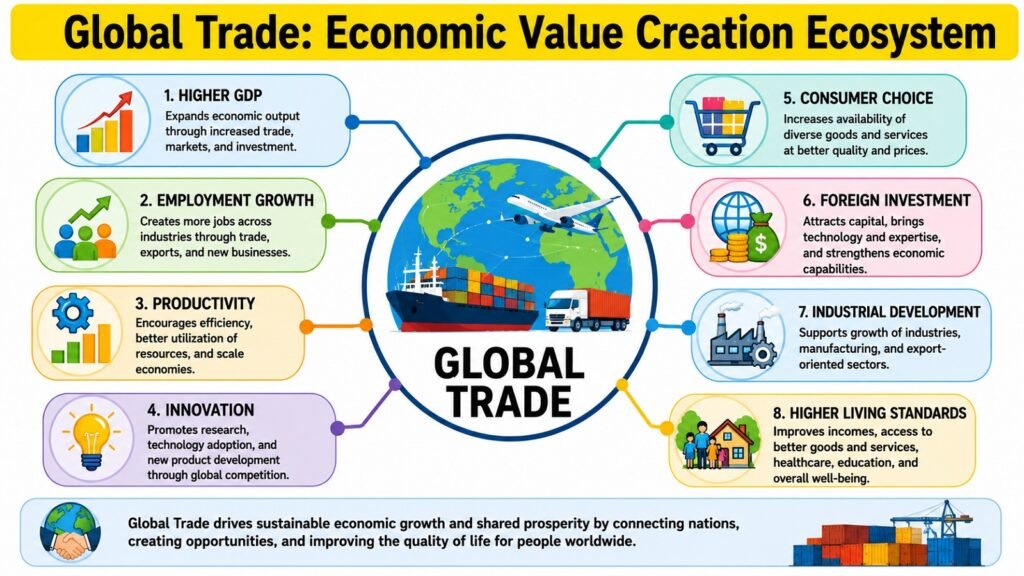
The relationship between Global Trade and economic development is both well-established and genuinely complicated. Trade creates measurable gains, but those gains are distributed unevenly across and within countries, which is why the economic case for open trade coexists with persistent political tension about who benefits and who bears the adjustment costs.
At the aggregate level, the evidence that trade supports economic growth is strong. Countries that opened their economies from the 1980s onward, including China, India, South Korea, and Vietnam, experienced sustained increases in per capita income that domestic-oriented strategies had not delivered. Trade expanded market size, forced competitive discipline on domestic industries, and connected producers to foreign technology and capital.
Productivity is one of the clearest channels through which trade creates economic gains. Exposure to international competition pushes firms to become more efficient. Access to imported inputs, including machinery, components, and software, allows domestic producers to improve quality and reduce costs. Research consistently finds that exporting firms are more productive than non-exporters, partly because international markets demand higher standards.
The limits and complications are equally real. Trade-induced job losses in import-competing industries concentrate among specific communities and workers with fewer retraining options. These adjustments can take longer than theory suggests and require active policy support. Inequality can increase within countries even as aggregate income rises, and the distribution of gains depends heavily on domestic institutions, education systems, and the capacity of governments to implement policies that spread benefits more widely.
Table 6: Key Economic Impacts of Global Trade and Their Broader Significance
| Economic Impact | Broader Significance |
| GDP Growth | Trade expands market size, productivity, and investment, supporting long-term income growth |
| Productivity Gains | Competition and imported inputs push firms toward more efficient production methods |
| Employment Creation | Export-oriented industries generate jobs particularly in labor-abundant economies |
| Foreign Direct Investment | Trade openness attracts capital, technology, and managerial expertise from abroad |
| Consumer Welfare | Trade lowers prices and expands product variety for domestic consumers |
| Industrial Adjustment Costs | Import competition can displace workers and communities in exposed sectors |
| Innovation Spillovers | Access to global markets and foreign knowledge accelerates domestic innovation |
| Income Inequality | Within-country distribution of trade gains depends on institutions and policy design |
6. Global Trade, Globalization & Economic Integration
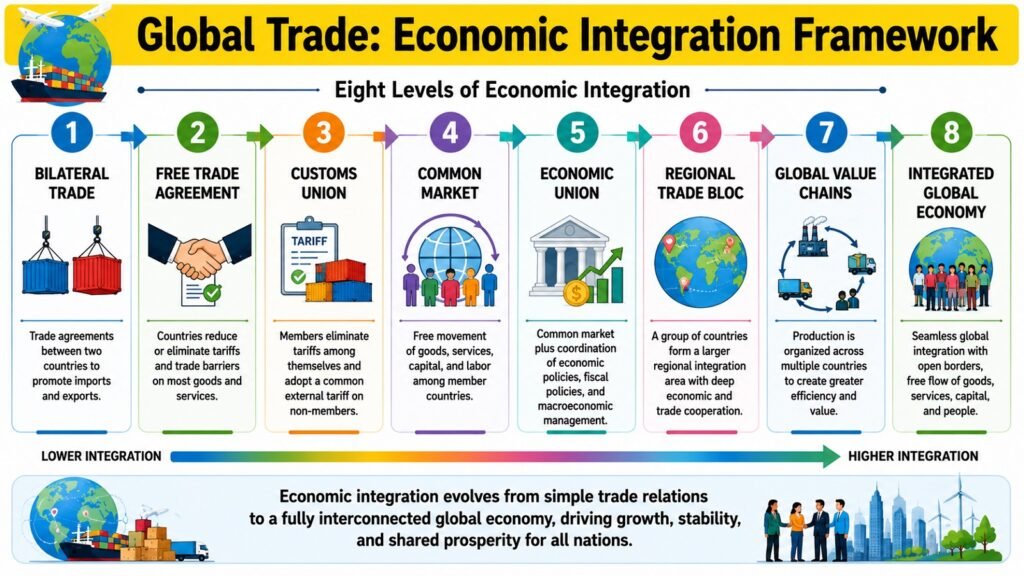
Globalization and Global Trade are deeply connected but not identical. Trade moves goods, services, and capital across borders. Globalization is the broader process through which economies, cultures, and political systems become interconnected. Trade is one of the most powerful engines of globalization, and globalization in turn creates conditions that expand trade further.
Multinational corporations are the most visible institutional expression of this relationship. When a company establishes production in multiple countries, it integrates those economies into a common system of supply, demand, and value creation. Foreign direct investment flows closely alongside Global Trade, and when firms invest in foreign markets, they often create trade in intermediate goods between home and host countries. This investment-trade nexus has been a primary driver of global production network expansion since the 1980s.
Regional trade blocs represent formal attempts to deepen economic integration within geographic groups. The European Union is the most advanced example, having moved from a customs union to a single market. ASEAN, the African Continental Free Trade Area, and USMCA each represent different stages and models of regional integration. Deep integration creates interdependencies that both strengthen and constrain national economic policy. Countries in closely integrated systems gain stable market access but become vulnerable to each other’s economic cycles and financial instabilities.
The relationship between Global Trade and globalization also raises governance questions. As economic activity increasingly crosses borders, the ability of any single government to regulate markets or protect labor and environmental standards faces structural limits that require international cooperation to address.
Table 7: Major Dimensions of Economic Integration within Global Trade
| Integration Dimension | Role in Global Trade System |
| Multinational Corporations | Coordinate cross-border production, investment, and distribution at global scale |
| Foreign Direct Investment | Links national economies through capital flows tied to trade relationships |
| Regional Trade Blocs | Reduce barriers among members and create deeper market access |
| Global Value Chains | Fragment production across countries to capture location-specific advantages |
| Financial Integration | Capital flows support trade financing, investment, and exchange rate stability |
| Labor Mobility | Movement of workers across borders responds to trade-driven demand shifts |
| Digital Integration | Cross-border data flows enable services trade and digital commerce |
| Regulatory Harmonization | Aligned standards reduce compliance costs and facilitate market access |
7. Global Trade Challenges & Debates
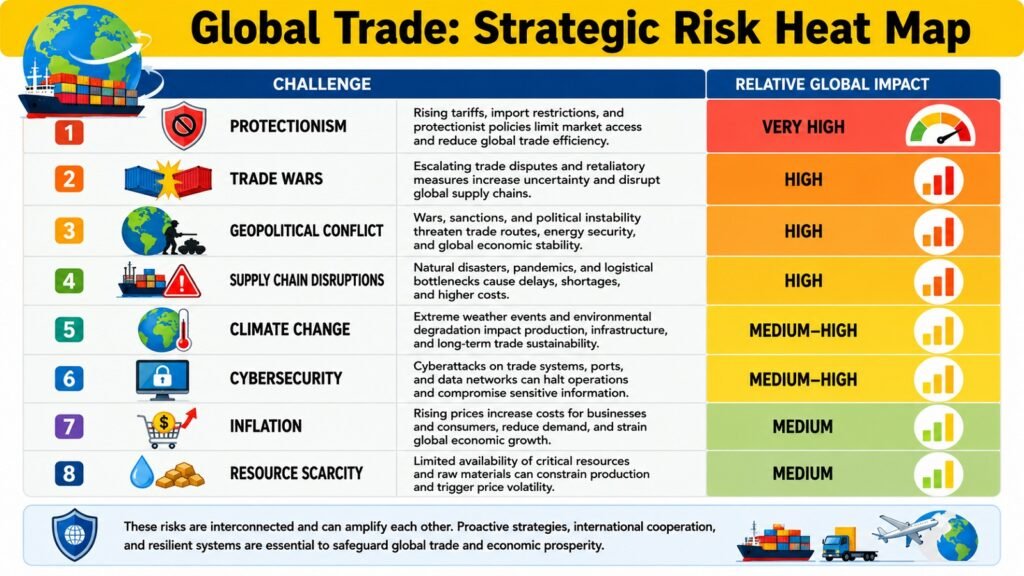
The tensions within the Global Trade system that were somewhat hidden during previous decades of expansion have become evident in the twenty-first century. Factors such as the 2008 financial crisis, the emergence of economic nationalism, the COVID-19 pandemic, and the escalating competition among major economic powers have all played a role in creating a more contentious environment for international trade.
Protectionism has returned as a significant policy choice. The United States imposed substantial tariffs on Chinese goods starting in 2018, and China responded in kind. These measures disrupted supply chains, raised costs for consumers and businesses, and signaled that the decades-long trend toward greater openness could reverse. Trade wars impose costs on both sides, which most economists recognize, yet political calculations often favor visible protection over the diffuse benefits of openness.
Supply chain fragility became undeniable during the pandemic. When factories shut down, components stopped flowing to manufacturers worldwide. When shipping routes became congested, delivery times stretched from weeks to months. When semiconductor production concentrated in a handful of locations faced demand surges, entire industries stalled. These disruptions prompted widespread calls for supply chain diversification and reshoring of critical production.
Environmental sustainability poses one of the most difficult long-term challenges. Trade contributes to carbon emissions through transportation and can encourage production in regions with weaker environmental regulation. The European Union’s Carbon Border Adjustment Mechanism attempts to address this by pricing carbon content in imports. Labor standards present similar tensions, with critics arguing that competition with lower-standard producers puts downward pressure on wages elsewhere. Economic inequality associated with Global Trade has driven political backlash in many democracies, as distributional effects matter as much as aggregate gains in shaping public attitudes toward trade.
Table 8: Major Global Trade Challenges and Their Implications
| Challenge | Implication for Global Trade |
| Protectionism and Trade Wars | Raises costs, disrupts supply chains, and undermines multilateral rule-based systems |
| Supply Chain Disruptions | Reveals fragility in concentrated production networks and drives diversification efforts |
| Geopolitical Tensions | Reshapes trade alliances and accelerates decoupling between competing economies |
| Environmental Sustainability | Requires reconciling trade growth with carbon reduction and ecological responsibility |
| Labor Standards Divergence | Creates competitive imbalances and political pressure against open trade |
| Economic Inequality | Distributional failures reduce public support for open trade and generate political backlash |
| Digital Trade Governance | New rules needed for data flows, intellectual property, and platform regulation across borders |
| WTO Reform and Multilateralism | Stalled negotiations and blocked dispute resolution undermine the global rules framework |
8. Technology & the Evolution of Global Trade
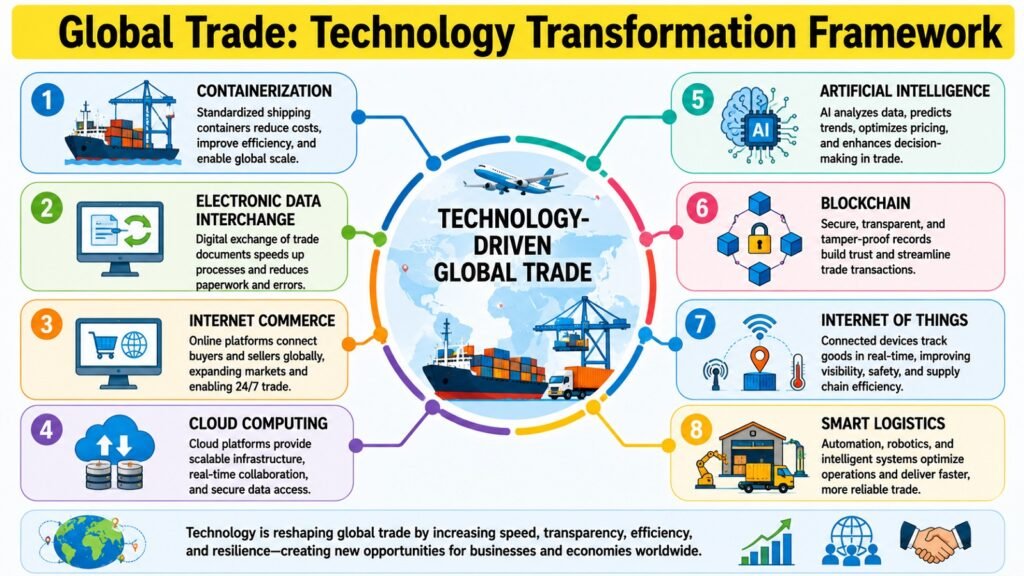
Technology has consistently influenced Global Trade. The creation of ocean-going vessels broadened trade routes. The telegraph lowered the costs of information transmission. The introduction of the shipping container significantly decreased logistics costs in the twentieth century. Currently, a fresh wave of digital and computational technologies is revolutionizing international commerce at a speed that competes with any prior transformation.
Digital trade, the cross-border exchange of digitally delivered products and services, has grown into one of the most dynamic segments of Global Trade. Software, cloud computing services, professional consulting, and financial services cross borders through digital channels with none of the physical logistics of goods trade. E-commerce platforms have opened Global Trade to participants who previously lacked the scale to access international markets. A small manufacturer or craft producer can now reach consumers in distant countries directly, bypassing traditional distribution channels and broadening participation in ways that were unimaginable two decades ago.
Artificial intelligence is beginning to affect trade in ways that will grow considerably over the coming decade. AI optimizes logistics routing, predicts demand patterns, automates customs documentation, and supports real-time pricing decisions in complex supply chains. Blockchain technology offers the potential to improve supply chain transparency and reduce document fraud in international transactions. Automation is reshaping where production occurs as robots reduce the labor cost advantage that lower-wage economies have relied upon, potentially redirecting manufacturing decisions in fundamental ways.
Digital payment systems and real-time currency conversion tools are reducing the cost and complexity of cross-border transactions for businesses of every size. Together, these technologies are not merely improving existing trade processes. They are changing who can participate in Global Trade and on what terms, making international commerce more accessible and more responsive to market conditions.
Table 9: Important Technologies Shaping Global Trade and Their Primary Contribution
| Technology | Primary Contribution to Global Trade |
| E-commerce Platforms | Enable small firms and individual producers to access global markets directly |
| Artificial Intelligence | Optimizes logistics, demand forecasting, and compliance management in real time |
| Blockchain | Enhances supply chain transparency and reduces fraud in trade documentation |
| Automation and Robotics | Reduces production costs and reshapes location decisions in global manufacturing |
| Cloud Computing | Supports cross-border service delivery, data storage, and business operations at scale |
| Digital Payment Systems | Lowers transaction costs and accelerates settlement in international commerce |
| IoT and Smart Logistics | Enables real-time tracking of goods across complex cross-border supply chains |
| Data Analytics Platforms | Provides market intelligence to inform trade strategy and investment decisions |
Conclusion: The Future of Global Trade in a Connected World
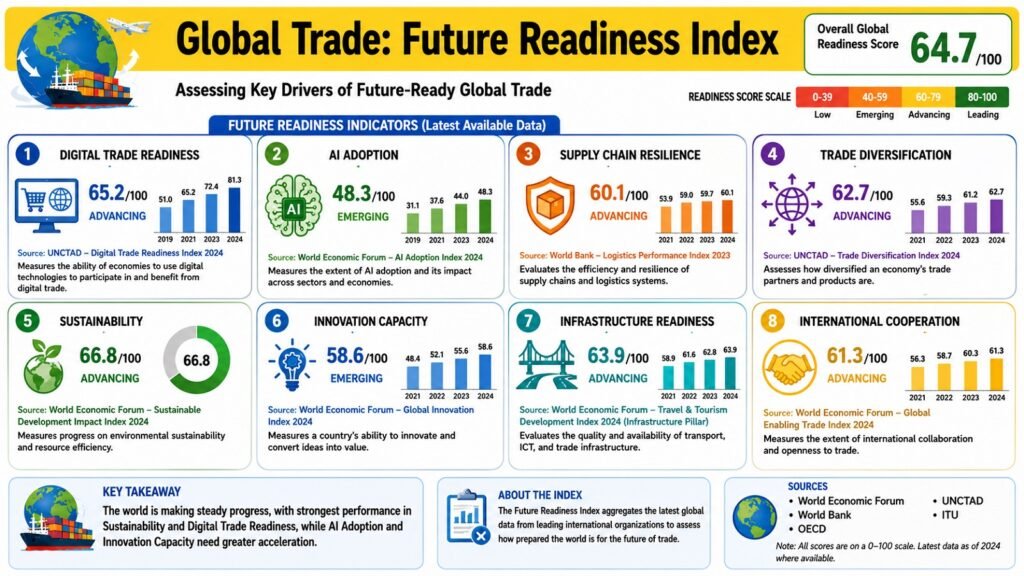
Global Trade has evolved from ancient caravan routes to an interconnected digital system that moves trillions of dollars in value across borders every day. The eight concepts explored in this article- trade theories, specialization patterns, governing institutions, market dynamics, economic impacts, integration with globalization, contemporary challenges, and technological transformation, collectively explain why international commerce remains one of the most powerful forces shaping economic life.
Trade is not a static mechanism. It shifts in response to policy decisions, technological breakthroughs, geopolitical realignments, and environmental pressures. The period ahead will likely bring deeper fragmentation of some supply chains alongside greater integration in others. Digital trade will expand faster than goods trade. Sustainability requirements will add new dimensions to competitiveness. Multilateral governance systems will face ongoing pressure to reform and adapt. What remains constant is the underlying logic that Global Trade exploits: differences in productivity, resources, and capabilities across countries create opportunities for exchange that benefit participants when the conditions are right and when policies support broad sharing of gains.
Table 10: Eight Global Trade Concepts and Their Overall Contribution
| Concept | Overall Contribution to Understanding Global Trade |
| Trade Theories & Comparative Advantage | Provides the economic logic explaining why and how nations specialize and trade |
| Trade Patterns & Specialization | Shows how resource, skill, and technology differences shape national export profiles |
| Trade Policies & Institutions | Defines the rules and organizations that govern international commercial relationships |
| Trade Markets & Trade Flows | Explains how goods, services, and capital move across borders and why flows concentrate |
| Economic Impact of Global Trade | Analyzes how trade generates growth, productivity, and employment with uneven distribution |
| Globalization & Economic Integration | Demonstrates how trade deepens economic interdependence across nations and regions |
| Challenges & Debates | Highlights structural tensions that test the stability and equity of the global trade system |
| Technology & the Evolution | Shows how digital innovation is transforming market access, logistics, and trade participation |