Table of Contents
Introduction: Data Intelligence in the Digital Ecosystem
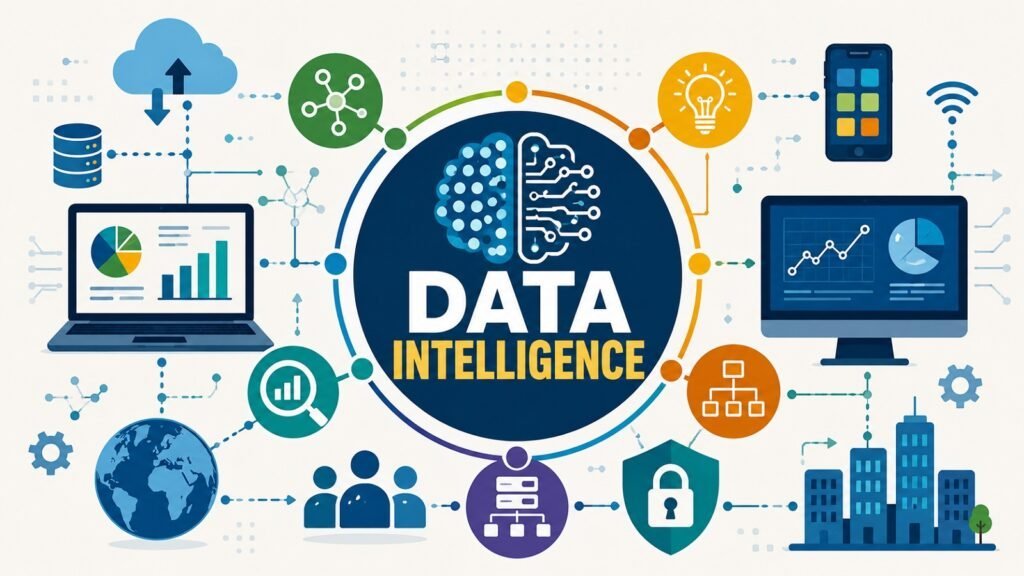
Every organization today generates data continuously — through applications, connected devices, digital platforms, and services — yet volume alone does not produce understanding. Raw data without context or meaning remains inert, regardless of how much of it exists. That gap between data and understanding is precisely where Data Intelligence becomes important.
Data Intelligence is the discipline of enriching data with context, meaning, relationships, and structure so it becomes genuinely usable, discoverable, and interpretable — by people, applications, and AI systems. It is distinct from collecting data, storing it, analyzing it for patterns, or building AI models. Those are all valuable capabilities. Data Intelligence focuses on what data means, how it relates to other information, and how it can be found and used with confidence.
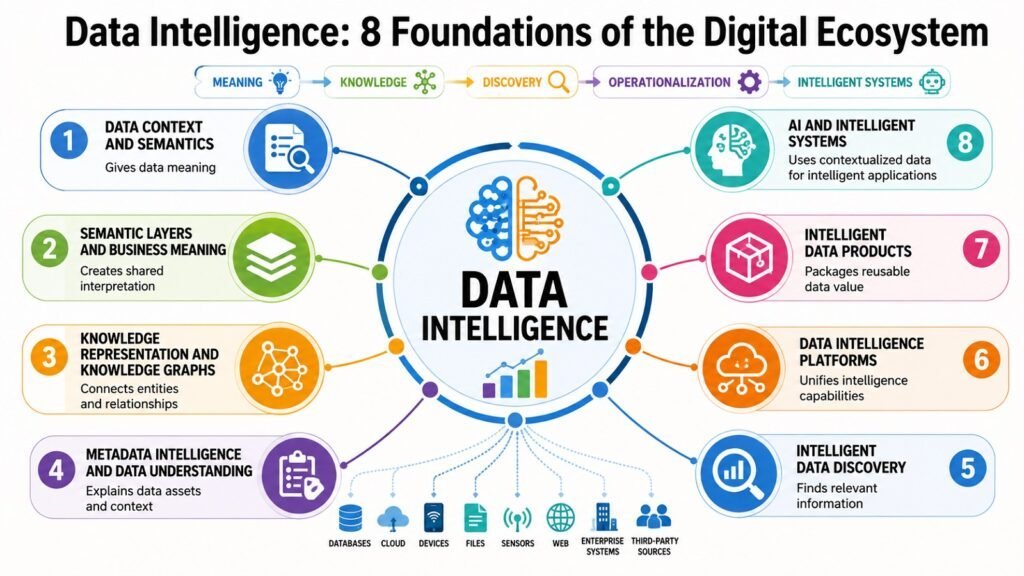
Data Intelligence is an important aspect of the Digital Ecosystem because meaningful, consistent data underpins every other digital capability — Platform Integration, Cloud Infrastructure, System Architecture, Data Governance, Digital Governance, Network Effects, and Digital Innovation all depend on information that is understandable. Data Intelligence is not a single technology but a structured capability encompassing eight foundations: data context and semantics, semantic layers, knowledge representation, metadata intelligence, intelligent discovery, Data Intelligence platforms, intelligent data products, and the relationship between Data Intelligence and AI systems.
Table 1: Data Intelligence — Eight Foundations and Their Primary Contributions
| Foundation | Primary Contribution to Data Intelligence |
| Data Context and Semantics | Gives data meaning by associating it with definitions, relationships, and business context |
| Semantic Layers and Business Meaning | Creates a consistent vocabulary between technical data structures and business users |
| Knowledge Representation and Knowledge Graphs | Models entities and relationships to make connections across heterogeneous data sources |
| Metadata Intelligence and Data Understanding | Uses information about data to support discovery, interpretation, and intelligent use |
| Intelligent Data Discovery | Enables systems and users to find relevant, contextually appropriate information efficiently |
| Data Intelligence Platforms | Integrates semantic, metadata, and discovery capabilities into a coherent operational environment |
| Intelligent Data Products | Packages contextualized data and derived intelligence as reusable, value-delivering products |
| Data Intelligence for AI and Intelligent Systems | Provides AI with structured, contextualized, and machine-readable information environments |
1. Data Intelligence and Data Context and Semantics
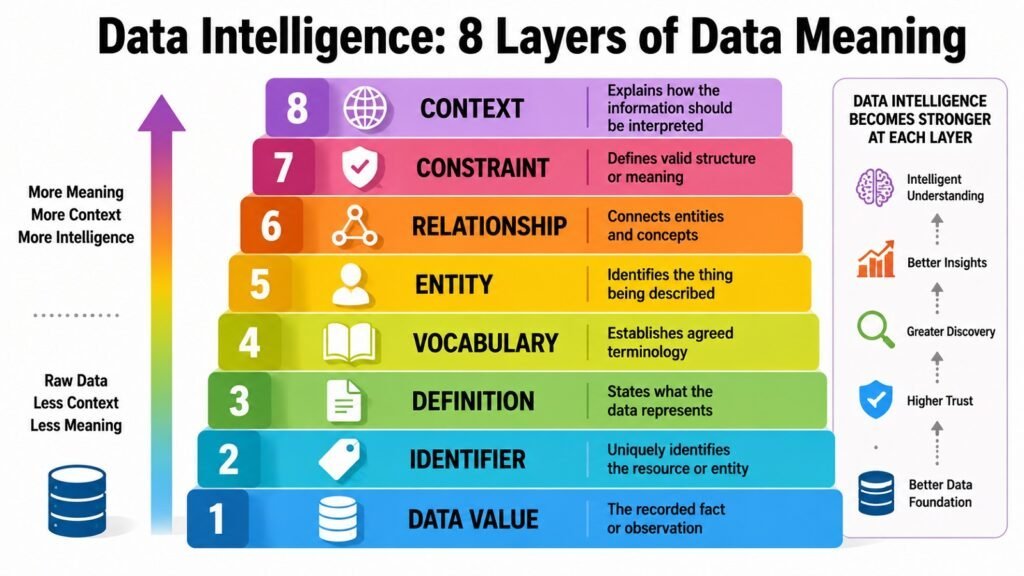
A single number — say, 42 — carries no inherent meaning. It could represent a customer’s age, an invoice total, a product ID, or a temperature reading. Data becomes meaningful only when interpreted within an appropriate context. This distinction between data as a raw value and data as a meaningful piece of information sits at the heart of Data Intelligence.
Semantics, in the context of data, refers to what a data element represents, how it should be defined, and how it relates to other elements. The same term can mean different things in different parts of an organization. A “customer” in a sales system might refer to any organization that has made a purchase, while in a customer success system it might refer only to organizations with active contracts. Without semantic clarity, analyses combining data from both systems produce results that are technically accurate but practically misleading.
Consider a multinational retailer operating separate systems for inventory management, point-of-sale processing, and customer relationship management. Each uses the term “product” differently: the inventory system tracks stock-keeping units, the POS system tracks transaction bundles, and the CRM system tracks marketing categories. When an analyst merges sales and inventory data, inconsistent definitions create discrepancies that are difficult to investigate. This is a common real-world problem that semantic context addresses directly.
Business vocabularies evolve over time, teams develop their own terminologies, and legacy systems often encode meaning invisibly. An organization can begin improving contextual understanding by identifying its most critical data domains — customer, product, financial, and operational — and establishing agreed definitions for core entities and attributes. That foundational work is what makes everything else in Data Intelligence possible.
Table 2: Data Intelligence — Data Context and Semantics: Key Concepts
| Concept / Mechanism | Relevance to Data Intelligence |
| Semantic consistency | Ensures the same data term carries the same meaning across systems and teams |
| Entity definition | Clarifies what a named object (e.g., customer, product) represents in a specific context |
| Business vocabulary | Aligns technical data labels with language that business users understand and use |
| Contextual interpretation | Allows data values to be read correctly within their domain or use case |
| Attribute relationship | Shows how data fields relate to one another within a structured definition |
| Ontology | A formal model specifying concepts, their properties, and the relationships between them |
| Semantic drift | The gradual change in meaning that a data term can undergo as organizations evolve |
| Interoperability of meaning | The ability of systems to exchange data and preserve consistent interpretation across boundaries |
2. Data Intelligence and Semantic Layers and Business Meaning
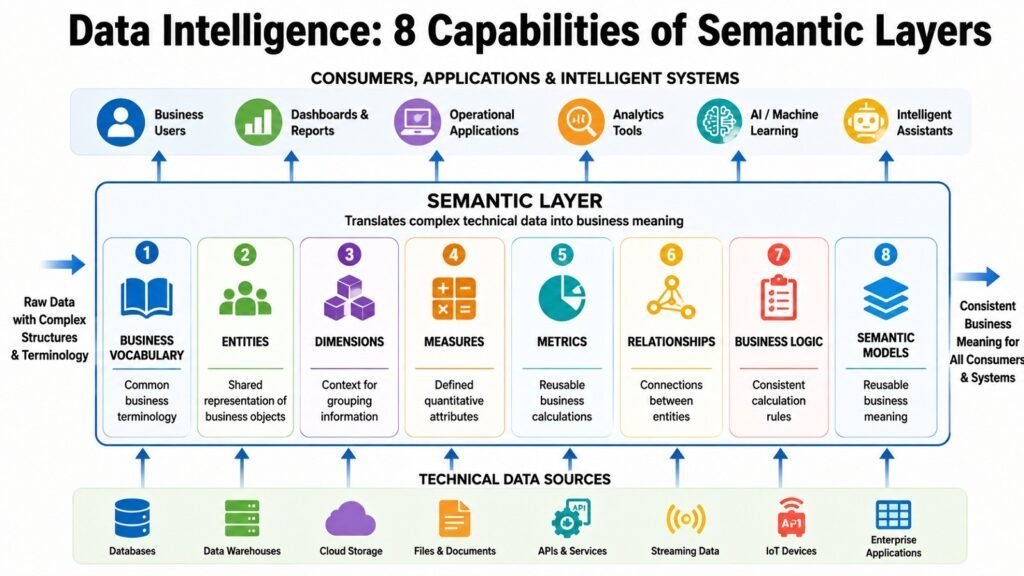
Large organizations rarely operate on a single unified data store. More commonly, they maintain dozens or hundreds of databases, data warehouses, and cloud environments, each with its own technical structure and naming conventions. A semantic layer addresses the specific problem this creates: how do users and applications access and interpret data consistently when the underlying technical structures differ significantly?
A semantic layer sits between the technical data environment and the people or systems consuming information from it. It translates technical structures — table names, column identifiers, complex joins, aggregation logic — into business concepts that users and applications can work with directly. Rather than requiring a financial analyst to write SQL joining seven tables to produce a revenue figure, a semantic layer presents “revenue” as a defined, consistent metric. Without it, different teams may calculate the same metric using different logic, producing conflicting figures that erode trust in data.
Platform Integration manages how systems connect and how data flows between them. A semantic layer does something different: it establishes shared meaning across the information that flows through those connected systems. The two are complementary rather than competing. Looker, developed by Google, introduced a semantic modeling layer called LookML that centralizes metric and dimension definitions so changes propagate automatically across all reports — a practical demonstration of how centralizing meaning reduces inconsistency at scale.
Limitations are real. Maintaining semantic models as business definitions change requires sustained effort, semantic disagreements between departments are common, and reaching consensus demands ongoing collaboration between business and technology teams. Semantic layers improve accessibility and reuse, but they require ongoing investment to remain accurate.
Table 3: Data Intelligence — Semantic Layers and Business Meaning: Key Characteristics
| Characteristic / Function | Description |
| Abstraction | Hides complex technical structures behind simple, user-facing business concepts |
| Metric consistency | Ensures calculations such as revenue or churn are defined once and used uniformly |
| Business vocabulary mapping | Connects technical field names to meaningful business terms and definitions |
| Semantic reuse | Allows defined concepts to be used across multiple reports, applications, and queries |
| Governance support | Provides a controlled, versioned layer where business definitions can be managed and audited |
| LookML (Google Looker) | A widely used semantic modeling language that centralizes metric and dimension definitions |
| dbt semantic layer | An open-source approach to defining and sharing business metrics in a SQL-based environment |
| Interoperability | Enables different tools and applications to consume the same business definitions consistently |
3. Data Intelligence and Knowledge Representation and Knowledge Graphs
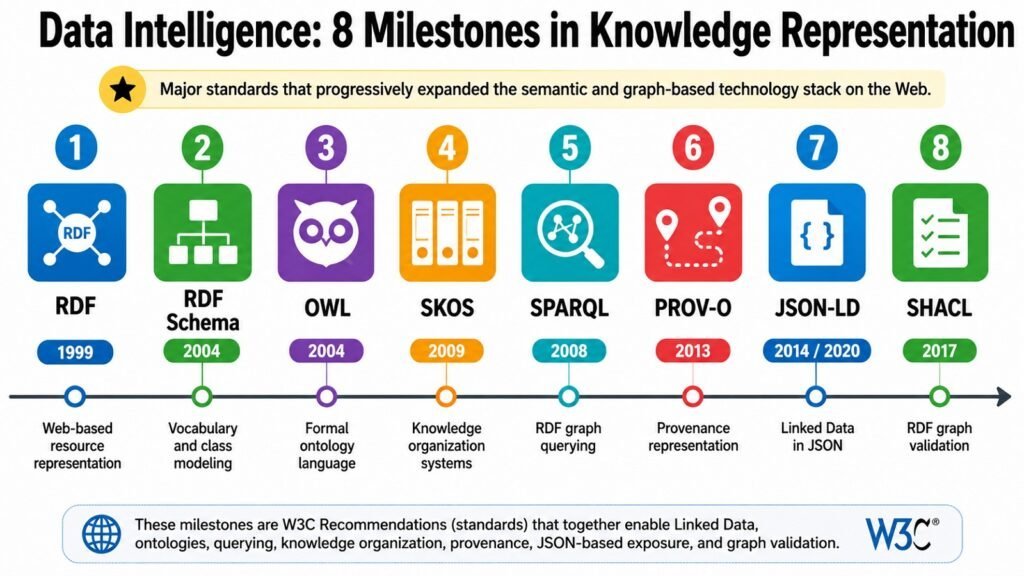
Data Intelligence moves beyond storing and labeling data when it begins to represent the relationships between pieces of information. An isolated fact — that a particular medication belongs to a certain drug class — is useful. Knowing that the same medication interacts with another drug, is prescribed for a condition affecting a specific patient population, and carries particular regulatory requirements constitutes knowledge. Representing that knowledge in a form technology can use is one of the more sophisticated foundations of Data Intelligence.
The relevant structures include taxonomies, which organize concepts hierarchically; ontologies, which define concepts, attributes, and the formal relationships between them; and knowledge graphs, which represent entities and their relationships as interconnected nodes and edges. A relational database stores data in rows and columns and answers queries about what values exist. A knowledge graph stores entities and their connecting relationships, enabling questions about how things relate, what context surrounds an entity, and what can be inferred from known connections. Google’s Knowledge Graph, introduced in 2012, connects people, places, organizations, and concepts so that a search for a public figure returns structured contextual information. Wikidata provides a similar structure at web scale.
For enterprise Data Intelligence, knowledge graphs can link customer records, transaction histories, product catalogs, and support interactions into a unified relational structure. Pharmaceutical companies, financial institutions, and technology firms have used knowledge graphs to support drug discovery, fraud detection, and recommendations. Building and maintaining an ontology requires significant domain expertise and ongoing governance; organizations should assess whether the complexity of relationships in their domain genuinely justifies the investment before proceeding.
Table 4: Data Intelligence — Knowledge Representation and Knowledge Graphs: Key Concepts
| Concept / Structure | Description |
| Taxonomy | A hierarchical classification of concepts, organizing entities into categories and subcategories |
| Ontology | A formal specification of concepts, attributes, and the relationships between them in a domain |
| Knowledge graph | A graph-based structure representing entities as nodes and their relationships as edges |
| RDF (Resource Description Framework) | A W3C standard for representing information as subject-predicate-object triples |
| SPARQL | A query language designed for retrieving and manipulating data stored in RDF format |
| Google Knowledge Graph | A large-scale knowledge graph connecting entities across web-scale information, launched in 2012 |
| Wikidata | A collaboratively maintained open knowledge base linking structured data to Wikipedia and other sources |
| Ontology maintenance | The ongoing process of updating knowledge models as domain concepts, entities, and relationships change |
4. Data Intelligence and Metadata Intelligence and Data Understanding
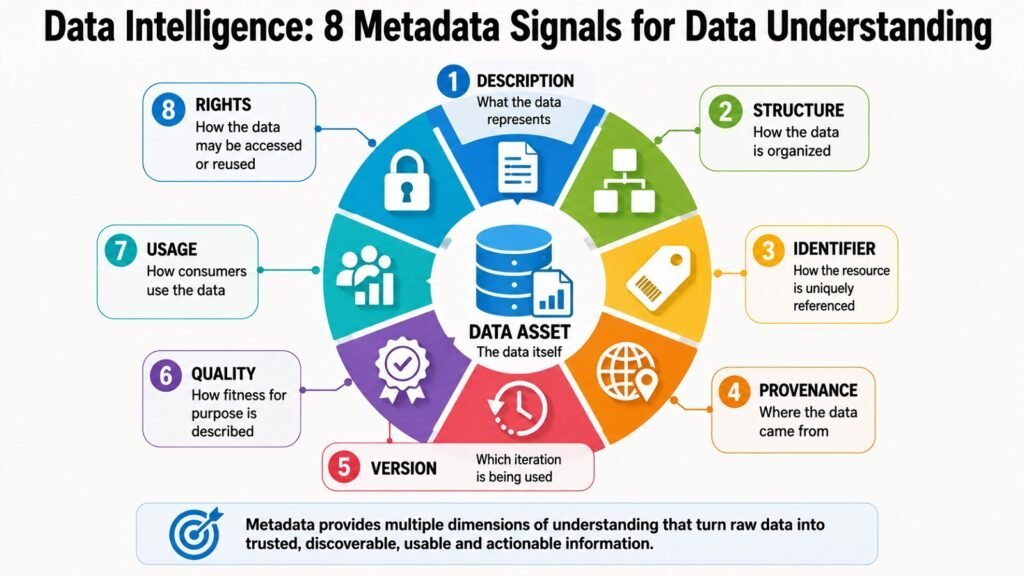
Metadata is often described simply as data about data. At a basic level, it tells you a table’s name, a file’s creation date, or a value’s format. Metadata Intelligence is something more: the capability to use information about data actively — to support discovery, interpretation, and intelligent use rather than simple description.
The categories of metadata relevant to Data Intelligence are varied. Technical metadata describes structure and format. Business metadata provides semantic context: definitions, owners, business terms, and domain classifications. Operational metadata tracks processing history — when data was last updated and which pipelines touched it. Usage metadata records access patterns, revealing which datasets are genuinely valuable and which are rarely used. Lineage metadata maps the origin and transformation history of data assets, supporting traceability and trust.
Data catalog platforms such as Apache Atlas and Alation aggregate metadata from multiple sources and present it in a searchable form. These tools allow data professionals to locate relevant datasets, understand their provenance, and assess their quality — all by interrogating metadata rather than the underlying data. Well-maintained metadata can answer the most important questions about a data asset before a user even opens it. The challenge is that metadata is only as useful as it is complete and accurate, and in most organizations it is neither. Automating metadata collection through pipeline instrumentation helps, but it rarely captures the business context that makes metadata truly intelligent.
Table 5: Data Intelligence — Metadata Intelligence: Types and Functions
| Metadata Type / Function | Contribution to Data Understanding |
| Technical metadata | Describes data structure, format, and schema for system-level interpretation |
| Business metadata | Provides definitions, ownership, and domain classification for user-facing understanding |
| Operational metadata | Records processing history and update frequency to support data trust and lineage assessment |
| Usage metadata | Tracks access patterns to reveal which data assets are most valuable or most frequently used |
| Lineage metadata | Maps the origin and transformation history of data to support traceability and trust |
| Apache Atlas | An open-source metadata management and governance platform used with Apache Hadoop ecosystems |
| Alation | A commercial data catalog that surfaces metadata to support data search, trust, and collaboration |
| Automated metadata capture | Uses pipeline instrumentation and profiling tools to collect metadata without manual entry |
5. Data Intelligence and Intelligent Data Discovery
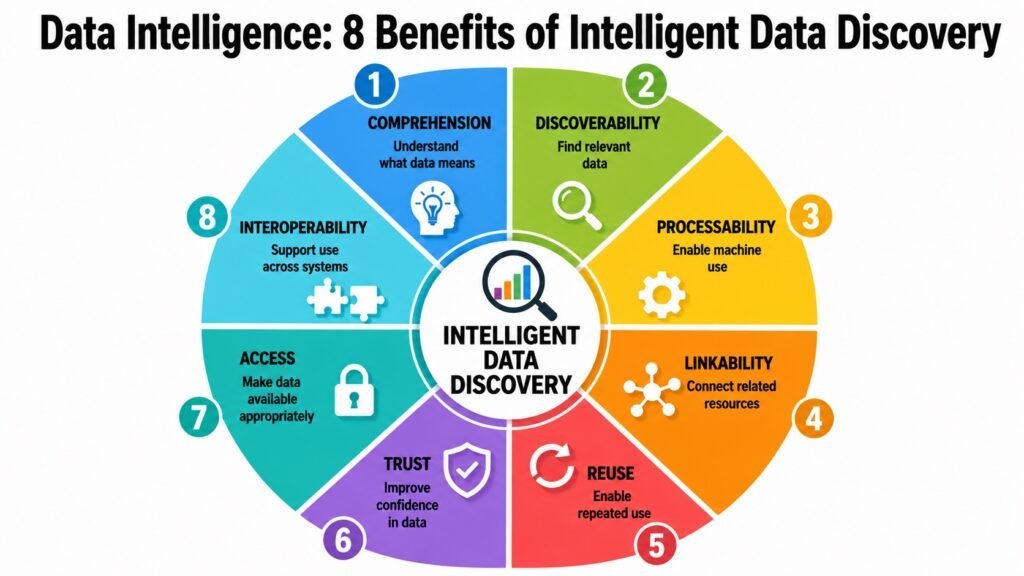
Finding data has always been a challenge for organizations. As data environments grew more complex, location became the easier part of the problem. The harder question became relevance: which of hundreds or thousands of available datasets was appropriate for a specific question, analysis, or application? Intelligent Data Discovery addresses that harder question.
Intelligent Data Discovery uses semantic context, metadata, relationships, and intelligent retrieval to help users and systems find information that is not just technically available but genuinely relevant to a specific need. The foundations already discussed contribute directly: semantic context tells the discovery system what datasets represent, metadata provides details about their content and quality, and knowledge representation connects related datasets even when they are not explicitly linked. Modern data catalog platforms such as Collibra, Informatica, and Microsoft Purview combine metadata management with semantic search and recommendation capabilities to make this possible in practice.
Consider an analyst preparing a customer retention report. Without intelligent discovery, they must already know which systems hold the relevant data and how those tables relate. With intelligent discovery, they can express their need in business language and receive ranked, contextually described results — what each dataset covers, how current it is, who owns it, and how it has been used previously. Limitations remain: discovery depends heavily on metadata quality, and incomplete or inconsistent cataloging surfaces noise alongside signal. An organization can improve discovery incrementally by beginning with its most critical data domains and establishing consistent metadata standards before expanding scope.
Table 6: Data Intelligence — Intelligent Data Discovery: Capabilities and Mechanisms
| Capability / Mechanism | Description |
| Semantic search | Retrieves datasets based on meaning and context rather than keyword matching alone |
| Data catalog | A managed inventory of data assets with metadata, ownership, and classification information |
| Metadata-driven ranking | Orders discovery results by contextual relevance, quality indicators, and usage signals |
| Recommendation engine | Suggests related datasets based on prior usage patterns, relationships, and semantic similarity |
| Lineage-based discovery | Surfaces upstream and downstream data assets related to a known dataset |
| Collibra | An enterprise data intelligence platform offering catalog, governance, and discovery capabilities |
| Microsoft Purview | A Microsoft platform combining data catalog, classification, and discovery across cloud and on-premises sources |
| Natural language search | Allows users to query data catalogs using plain business language rather than technical query syntax |
6. Data Intelligence and Data Intelligence Platforms
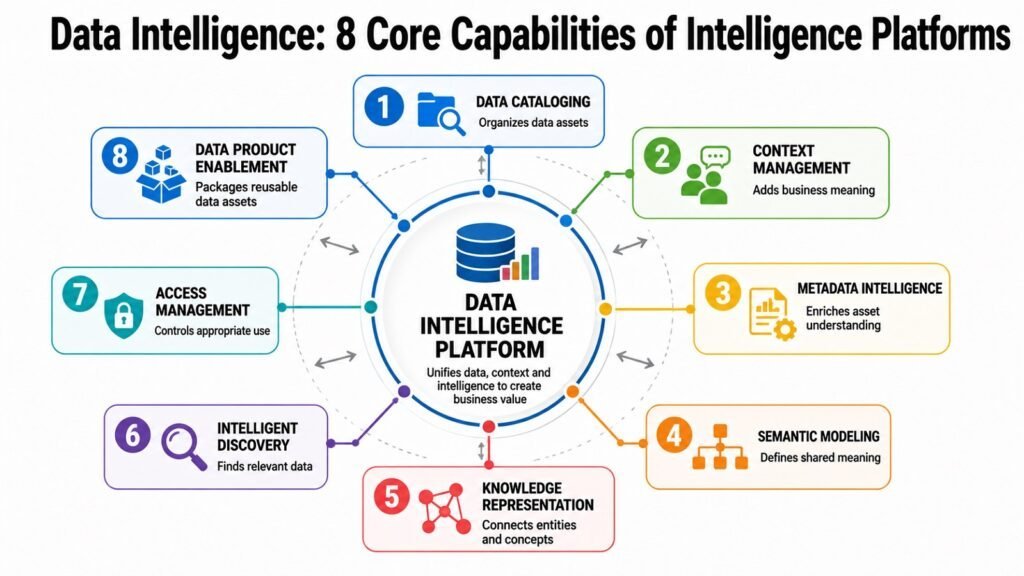
As the foundational capabilities of Data Intelligence have matured, a category of platforms has emerged to operationalize them together. Data Intelligence Platforms help organizations bring semantic modeling, metadata management, knowledge representation, and intelligent discovery into a coherent environment rather than managing each through disconnected tools.
The defining characteristic of a Data Intelligence Platform is that it organizes and contextualizes data at scale. Where a data warehouse stores information and a business intelligence tool analyzes it, a Data Intelligence Platform focuses on making information understandable — tagging it with business context, capturing relationships, recording provenance, and surfacing assets through intelligent discovery. The distinction from Platform Integration matters: integration manages how systems connect and how data flows between them; a Data Intelligence Platform manages how data is understood and made accessible once it exists. Established platforms include Collibra, which combines governance with intelligence; Informatica Intelligent Data Management Cloud; Alation, which emphasizes collaborative discovery; Microsoft Purview, which brings cataloging into the Microsoft ecosystem; and IBM Watson Knowledge Catalog.
Organizations evaluating such platforms should assess integration with existing infrastructure, semantic modeling depth, metadata capability, discovery quality, and scalability. Cost and vendor dependence are real considerations — sophisticated platforms require substantial configuration, and transitioning between vendors once a metadata model is established is not straightforward. Purchasing a platform does not create Data Intelligence; it provides an enabling environment that still requires investment in people, processes, and business engagement.
Table 7: Data Intelligence — Data Intelligence Platforms: Key Capabilities and Evaluation Criteria
| Capability/Criterion | Description |
| Semantic modeling support | Ability to define and manage business terms, metrics, and entity definitions within the platform |
| Metadata management | Captures, stores, and surfaces technical, business, and operational metadata across data assets |
| Intelligent discovery | Provides search and recommendation functions to surface relevant data assets contextually |
| Data lineage | Tracks the origin, movement, and transformation history of data assets across systems |
| Governance compatibility | Supports policy enforcement, access control, and audit requirements alongside intelligence features |
| Collibra | An enterprise platform combining data governance, catalog, and intelligence capabilities |
| Informatica IDMC | A cloud-native platform spanning metadata management, data quality, and intelligent cataloging |
| Scalability | The platform’s ability to maintain performance and accuracy as data asset volumes increase substantially |
7. Data Intelligence and Intelligent Data Products
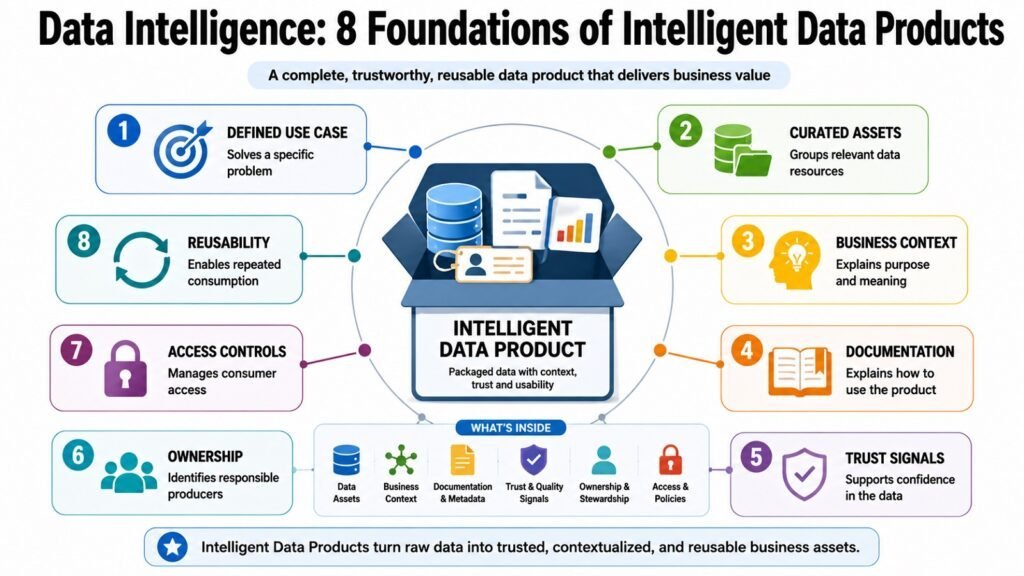
Treating data as a product is a conceptual shift that has gained significant momentum over the past decade. The idea is that data should not simply be a byproduct of operational systems — something that exists incidentally and is used opportunistically. Instead, data can be designed, developed, and delivered as a product with defined consumers, clear purposes, quality standards, and ongoing ownership. When data products incorporate the capabilities of Data Intelligence — context, semantics, metadata, and knowledge — they become genuinely intelligent data products.
An intelligent data product is more than a curated dataset. It delivers contextualized, well-described, and enriched information consistently to its consumers — analysts, automated applications, or AI systems. Examples include a reusable customer analytics dataset carrying semantic definitions, lineage documentation, and quality certifications; a data API delivering product information enriched with category classifications; an embedded analytics module combining data retrieval with domain-specific intelligence; and a knowledge base for a specific business function.
A data product becomes intelligent precisely when it incorporates contextual and semantic capabilities — without those foundations, it is simply a packaged dataset. The data mesh approach, articulated by Zhamak Dehghani since 2019, provides formal architectural expression of this idea, proposing that data be owned and delivered as a product by the domain teams closest to it.
Treating data as a product creates ownership responsibilities that many organizations are not yet equipped to fulfill. Data products require ongoing maintenance as requirements and underlying systems change. What makes a data product genuinely useful is reliable quality, clear semantic context, documented lineage, and a design that reflects the actual needs of its intended consumers.
Table 8: Data Intelligence — Intelligent Data Products: Examples, Characteristics, and Value Drivers
| Example / Characteristic | Description |
| Curated domain dataset | A governed, semantically enriched dataset designed for reuse across a specific business domain |
| Data API | A programmatic interface that delivers contextualized, consistently defined data to consuming applications |
| Semantic enrichment | The inclusion of business definitions, classifications, and relationship metadata within a data product |
| Data lineage documentation | Embedded provenance information that records the origin and processing history of a data product |
| Quality certification | A defined and monitored quality standard applied to a data product to support consumer trust |
| Data mesh principle | An architectural concept proposing domain ownership and product-style delivery of data assets |
| Embedded analytics | Analytics or intelligence capabilities packaged within a data product for direct consumption |
| Domain ownership | Assignment of responsibility for a data product to the team with the most relevant domain knowledge |
8. Data Intelligence and AI and Intelligent Systems
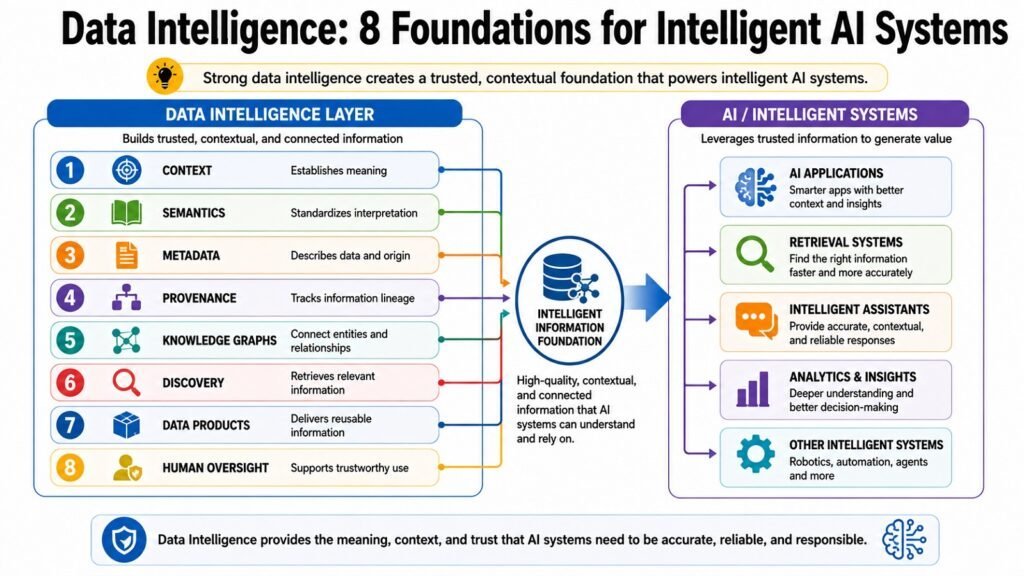
AI systems have become substantially more capable in recent years, yet their performance depends critically on the quality, structure, and context of the information they work with. A language model trained on vast text can generate plausible outputs, but without access to accurate, well-structured, and current information, it cannot reliably answer questions about specific organizational knowledge or specialized domains. This dependency is where Data Intelligence and AI intersect most practically.
Retrieval-Augmented Generation, or RAG, illustrates this relationship clearly. RAG systems combine a generative language model with a retrieval mechanism that locates relevant information from a structured knowledge base and provides it as context for the model’s response. The quality of RAG output depends directly on retrieval quality — and retrieval quality depends on how well the underlying information is organized, described, and indexed. Semantic metadata, knowledge graphs, and well-structured data products all contribute to more accurate retrieval, which translates directly into more reliable AI outputs. Knowledge-based AI systems — including semantic reasoners and knowledge graph-powered applications — are particularly valuable in domains requiring accuracy and explainability, such as healthcare, legal reasoning, and financial compliance.
The limitations deserve honest acknowledgment. Data quality problems are amplified rather than concealed when AI systems use them. Hallucination is exacerbated by knowledge gaps, semantic ambiguity, and outdated information. Knowledge graphs require careful maintenance, and a graph with stale relationships can mislead AI systems subtly. Human oversight remains important. Data Intelligence is not a substitute for AI capability — it is an enabling foundation. A more intelligent data environment produces better inputs, which produce more reliable and more useful AI outputs.
Table 9: Data Intelligence for AI and Intelligent Systems — Technologies and Considerations
| Technology / Consideration | Role in Supporting AI and Intelligent Systems |
| Retrieval-Augmented Generation (RAG) | Uses structured retrieval from a knowledge base to provide context to generative AI models |
| Knowledge graph integration | Supplies AI with formally represented entity relationships for reasoning and inference tasks |
| Semantic metadata | Helps AI systems interpret the meaning and context of information rather than processing raw data |
| Ontology-based reasoning | Enables AI to apply formal domain knowledge and inference rules beyond statistical pattern matching |
| Vector search | Converts text or data into numerical representations to enable semantic similarity retrieval |
| Knowledge freshness | The currency of knowledge base content, which affects the accuracy of AI responses over time |
| Semantic ambiguity | Unclear or conflicting data definitions that can cause AI systems to misinterpret information |
| Human oversight | The continued role of human judgment in verifying AI outputs produced from complex data environments |
Conclusion: Data Intelligence and the Future of Digital Ecosystems
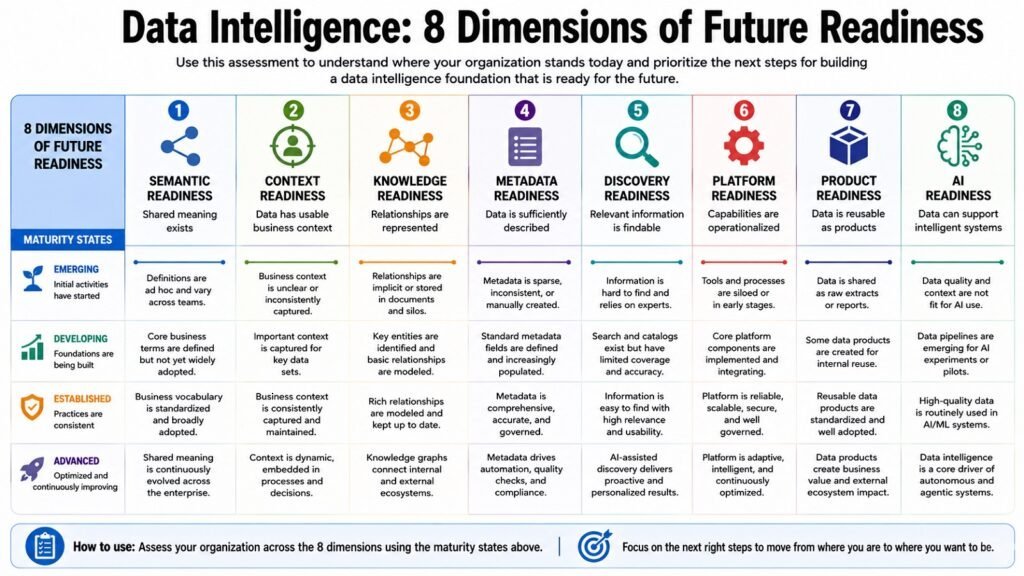
The eight foundations examined in this article collectively describe a capability that is more than the sum of its parts. Data Context and Semantics establishes what data means. Semantic Layers make that meaning consistent and accessible. Knowledge Representation captures how entities and concepts relate. Metadata Intelligence turns information about data into an active contributor to understanding. Intelligent Data Discovery ensures relevant information can be found at scale. Data Intelligence Platforms provide the operational environment for these capabilities to work together. Intelligent Data Products package contextualized information for reuse and delivery. And Data Intelligence for AI ensures intelligent systems operate on structured, accurate, and meaningfully organized information.
These foundations complement rather than compete with Data Management, Data Analytics, Decision Intelligence, Artificial Intelligence, and Platform Integration. Each of those capabilities depends on data that is understandable and discoverable. Data Intelligence is the meaning layer that makes those investments work effectively. Looking ahead, its importance will grow as digital environments become more complex and as AI systems become more deeply embedded in enterprise and consumer applications. Organizations with strong semantic capabilities, well-governed knowledge representations, and intelligent discovery will find that their AI systems perform better and their data delivers more consistent value.
Data Intelligence cannot be acquired by purchasing a single platform. It requires organizational commitment to shared meaning, accurate metadata, knowledge modeling, and product-oriented data design. Each of the eight foundations represents a layer in that capability, and each layer strengthens the others. Building it deliberately, starting with the data domains that matter most, is one of the more consequential investments a digitally ambitious organization can make.
Table 10: Data Intelligence — Eight Major Takeaways and Future Implications
| Takeaway / Principle | Implication for Organizations and Digital Ecosystems |
| Context transforms data into intelligence | Organizations must invest in semantic definitions before advanced analytics or AI will deliver reliable value |
| Semantic layers reduce inconsistency | A shared business vocabulary layer prevents conflicting metrics and interpretations across teams and systems |
| Relationships matter as much as data values | Knowledge graphs enable AI and analytics to reason about connections, not just retrieve isolated facts |
| Metadata drives understanding at scale | Automated and well-governed metadata makes large data environments navigable without requiring expert knowledge |
| Discovery is a prerequisite for data value | Data that cannot be found efficiently cannot contribute to decisions, products, or AI systems reliably |
| Platforms enable but do not create intelligence | Data Intelligence Platforms require business engagement, semantic investment, and governance to deliver their potential |
| Data products require ownership and quality standards | Product thinking shifts data from an operational byproduct to a governed, reusable asset with defined consumers |
| AI performance depends on data intelligence | Richer, more structured, and more contextually accurate data environments produce more reliable intelligent systems |