Table of Contents
Introduction — Database Architecture as a Foundation of Modern Data Infrastructure
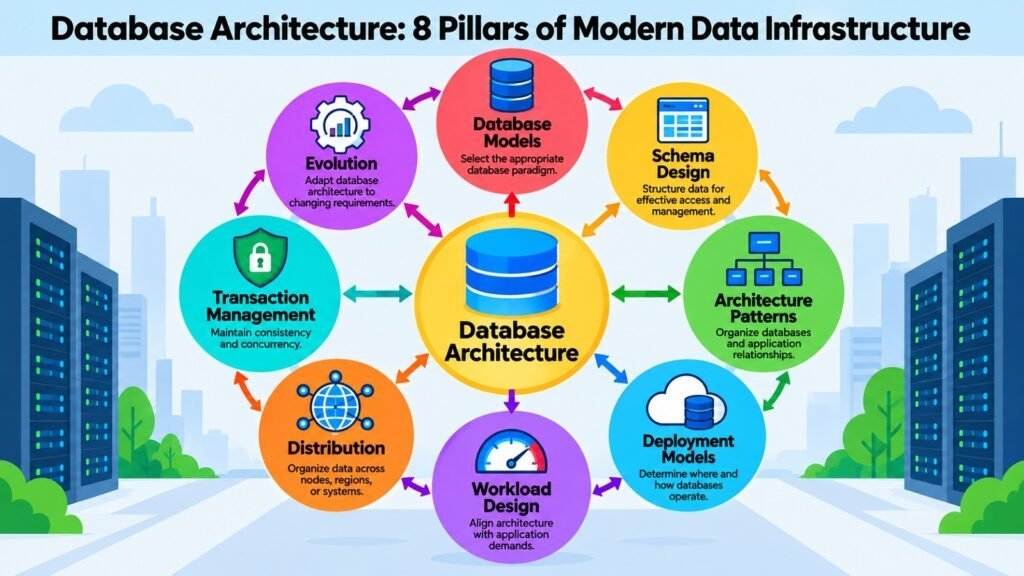
Every database system — whether it stores customer records, processes transactions, or answers analytical queries — rests on structural decisions made long before the first row of data is written. Database Architecture is the discipline that makes those decisions intentional. It covers how database systems are designed and organized to represent data, support access, handle concurrent operations, distribute workloads, and adapt over time. Unlike choosing a database product or configuring storage media, Database Architecture is an act of system design with consequences that reach into every layer of an application.
Database Architecture is an important aspect of Data Infrastructure. Data Infrastructure is the broader set of capabilities an organization builds to acquire, move, store, process, and monitor its data. Within that landscape, each capability serves a distinct purpose. Data Storage concerns how data is protected and retained on physical or cloud media. Data pipelines move data between systems. Data integration reconciles data from multiple sources. Data processing transforms raw inputs into structured results. Real-time systems deliver low-latency event streams, and data observability monitors health across the stack.
Database Architecture is distinct from all of these. Its unique concern is how database systems themselves are structured to organize, access, process, distribute, and evolve data. It is not a single choice of technology but a system of interconnected architectural decisions that collectively determine what a database can do and how reliably it can do it. This article examines eight such foundations, each addressing a different dimension of database system design. Together, they form a practical mental model that readers can use to analyze and evaluate modern database systems.
Table 1: Database Architecture — Eight Foundations at a Glance
| Database Architecture Foundation | What It Addresses |
| Database Models | How database systems represent, structure, and organize data internally |
| Schema Design | How data is organized into structures that applications and queries rely on |
| Architecture Patterns | How database systems relate to applications, services, and infrastructure |
| Deployment Models | Where database systems run and who manages their operational infrastructure |
| Workload Design | How transaction volume, query complexity, and access patterns shape architectural choices |
| Distribution | How data is partitioned, replicated, and coordinated across nodes or regions |
| Transaction Management | How database systems maintain correct and consistent state under concurrent operations |
| Evolution | How database architectures change to meet new requirements without losing data integrity |
1. Database Architecture and Database Models: Choosing the Right Data Foundation
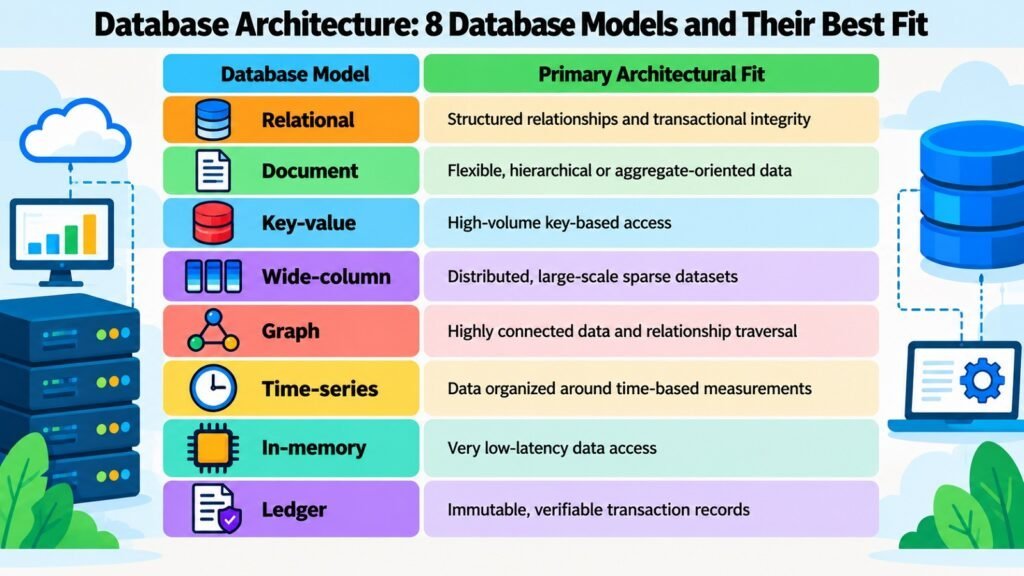
The choice of database model is one of the earliest and most consequential Database Architecture decisions. A database model determines the fundamental way a system represents and manages data — how it stores relationships, what consistency guarantees it can reasonably provide, and what kinds of queries or operations it handles well. Getting this choice wrong creates lasting friction between the database and the applications that rely on it.
The relational model organizes data into tables with defined schemas and enforces relationships through foreign keys, remaining dominant for transactional systems because of its strong consistency guarantees and expressive query language. Document databases store data as self-contained JSON or BSON documents, suiting applications that need flexible schemas and hierarchical data without complex joins. Key-value databases offer a minimal interface — a key maps directly to a value — enabling fast reads and writes at scale, at the cost of query expressiveness.
Graph databases represent data as nodes and edges, making them well-suited to use cases where relationships carry as much meaning as the entities themselves — fraud detection, recommendation engines, and knowledge graphs are representative examples. Column-family databases organize data by columns rather than rows, enabling efficient scans across large datasets. Time-series databases optimize measurements indexed by time, making them natural fits for metrics, sensor readings, and financial price data.
Multimodel databases support more than one model within a single engine, giving architects the flexibility to address different data types without deploying entirely separate systems. No database model is universally superior — the appropriate choice depends on the data, the access patterns, the consistency requirements, and the operational constraints. The model selected at this stage shapes every subsequent architectural decision, from how schemas are structured to how distribution and transactions are handled.
Table 2: Database Architecture and Database Models — Typical Architectural Fit
| Database Model | Typical Architectural Fit |
| Relational | Applications requiring structured data, complex joins, and strong ACID consistency |
| Document | Applications with flexible, hierarchical data structures and variable schemas |
| Key-Value | High-throughput lookup workloads where query simplicity and speed are paramount |
| Graph | Systems where entity relationships are primary, such as social networks or fraud detection |
| Column-Family | Large-scale analytical reads that scan rows sharing common column families |
| Time-Series | Workloads involving sequential, timestamped measurements such as metrics or sensor data |
| Search | Applications requiring full-text search, ranking, and relevance scoring over text fields |
| Multimodel | Architectures that need to handle multiple data types within a single operational system |
2. Database Architecture and Schema Design: Structuring Data for Effective Use
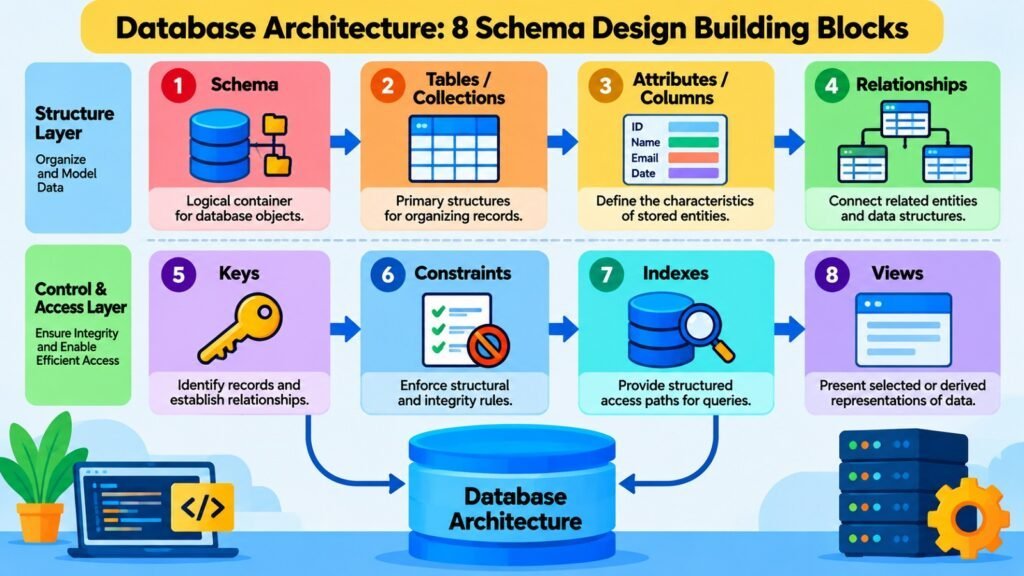
Once a database model has been selected, Database Architecture must translate that model’s capabilities into a concrete structure that applications and workloads can use effectively. That translation is schema design. A schema defines how data is organized — what tables, collections, or structures exist, what fields and data types they hold, and what constraints and relationships govern them. A schema is not merely a technical formality; it encodes assumptions about how data will be accessed, how it will change, and what integrity the database must maintain.
In relational databases, normalization is among the most important schema concerns. It removes redundancy by organizing data into related tables and enforcing dependencies through primary and foreign keys. A highly normalized schema reduces the risk of inconsistent data but may require multiple joins to retrieve a complete record, affecting query performance. Denormalization introduces controlled redundancy to reduce joins and accelerate reads, but requires careful management to keep duplicated fields consistent.
Index design is one of the most immediate ways schema choices influence performance. Indexes accelerate data retrieval but add storage overhead and slow writes. A schema that neglects indexing strategy may perform well in development and poorly under production load, because physical storage and scanning characteristics are inseparable from logical schema decisions.
Schema design interacts with every other dimension of Database Architecture. A schema suited to a single-node relational system may need significant revision when the architecture distributes across nodes. Schemas designed for one workload may limit flexibility as requirements change. Schema design should therefore be treated as an architectural activity, not a later implementation detail.
Table 3: Database Architecture and Schema Design — Key Concepts and Architectural Roles
| Schema Concept | Architectural Role |
| Normalization | Eliminates redundancy by decomposing data into related tables, improving consistency |
| Denormalization | Reintroduces redundancy to reduce joins and improve read performance for targeted queries |
| Primary Key | Uniquely identifies each record and underpins referential integrity across related tables |
| Foreign Key | Enforces relationships between tables, maintaining referential integrity at the database level |
| Index | Accelerates data retrieval by maintaining a sorted reference structure alongside table data |
| Constraint | Enforces data validity rules at the schema level, reducing reliance on application-layer checks |
| Logical Schema | Defines how data is organized conceptually, independent of physical storage structures |
| Physical Schema | Describes how data is stored on disk, including partitioning, file structures, and indexing |
3. Database Architecture and Architecture Patterns: Structuring Database Systems
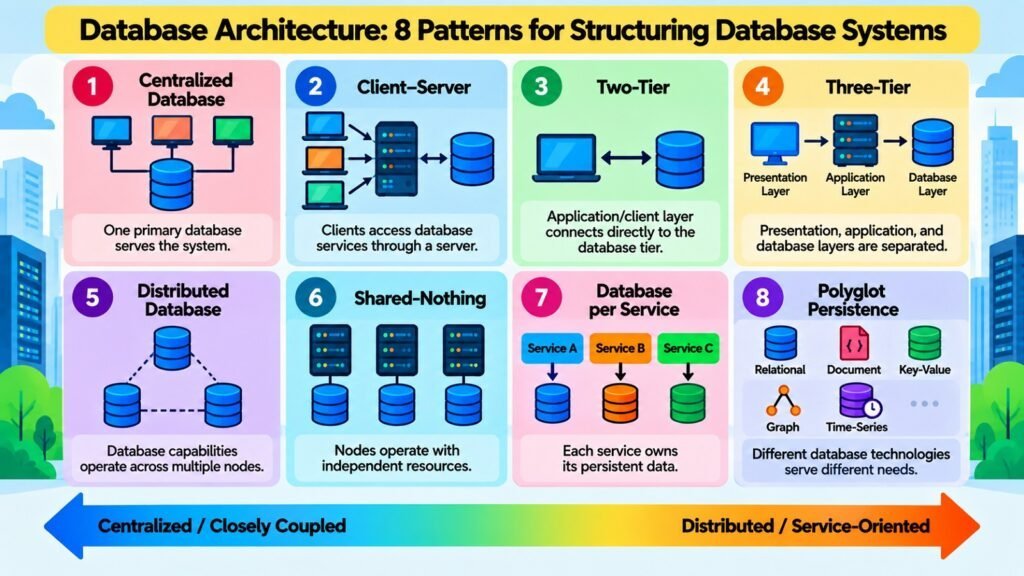
Selecting a database model and designing a schema addresses what the database represents. Architecture patterns address something different: how the database system sits within its broader technical environment — how it relates to applications, services, networks, and other databases. This structural positioning determines coupling, operational independence, coordination overhead, and the overall scalability characteristics of the system.
The client-server pattern, in which applications communicate with a dedicated database server, is the most widely deployed arrangement in enterprise and web contexts. It provides a clear separation between data management and application logic. Three-tier architectures extend this by introducing an application server between client and database, allowing the application tier to scale independently. This is the standard approach in most web applications today.
Distributed architectures spread data and processing across multiple nodes, breaking the single-server assumption. A shared-nothing architecture — in which each node has independent storage and memory — is the dominant approach for horizontally scalable databases because it avoids the contention that shared-disk arrangements introduce at scale. The database-per-service pattern, common in microservices systems, gives each service its own dedicated database, improving independence but complicating cross-service queries and consistency.
Polyglot persistence extends this approach by allowing different services to use different database technologies, each chosen for its specific suitability. This can maximize fit between data characteristics and database capability but increases operational complexity. Every architecture pattern involves trade-offs between independence, coordination, and operational burden. The right pattern depends on system scale, the independence requirements of its components, and the organizational capacity to manage the resulting complexity.
Table 4: Database Architecture Patterns — Defining Characteristics
| Architecture Pattern | Defining Characteristic |
| Centralized | A single database instance serves all applications, simplifying management but creating a scaling boundary |
| Client-Server | Applications communicate with a dedicated database server over a network, separating concerns clearly |
| Three-Tier | An application tier mediates between clients and the database, enabling each layer to scale independently |
| Shared-Nothing | Each node owns its storage and memory, enabling horizontal scaling without shared bottlenecks |
| Shared-Disk | Multiple compute nodes share a common storage layer, simplifying data access at the cost of storage-tier contention |
| Database-per-Service | Each service owns its database, maximizing independence but requiring coordination for cross-service queries |
| Federated Database | A virtual layer unifies access across multiple independent databases without physically consolidating them |
| Polyglot Persistence | Different system components use the database technology best suited to their specific data and access needs |
4. Database Architecture and Deployment Models: Determining Where Databases Operate
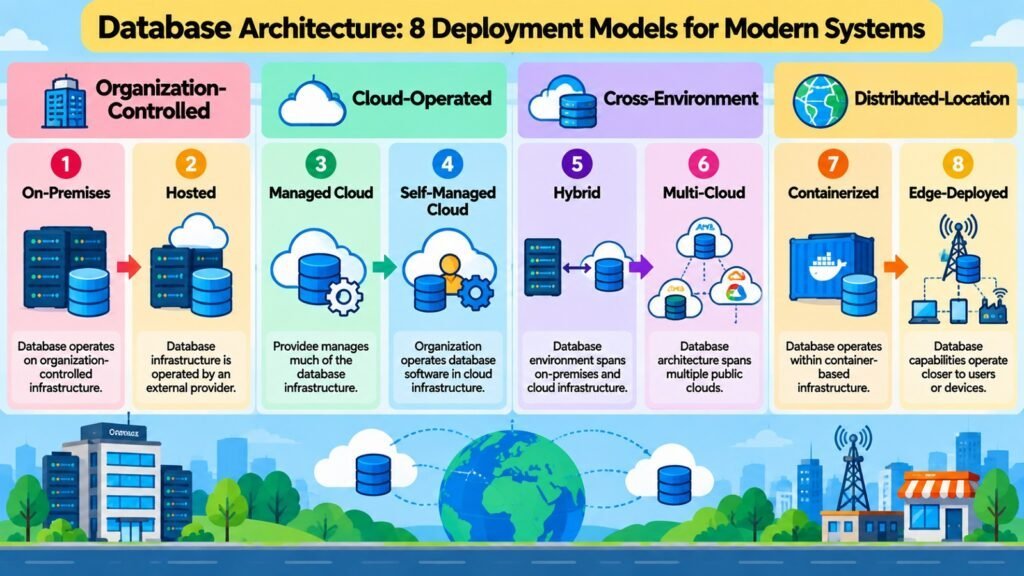
Architecture patterns define how a database system relates to its technical environment. Deployment models define where it runs and who bears responsibility for its infrastructure. This distinction matters because the same database architecture can operate very differently depending on its deployment context. A relational database running on on-premises hardware under direct administrative control behaves differently, in operational terms, from the same engine running as a managed cloud service where the provider handles backups, failover, and patching.
On-premises deployment gives organizations the highest degree of control over hardware, configuration, network topology, and data residency. That control comes with full responsibility for provisioning, maintenance, and disaster recovery. Cloud-hosted databases operated on virtual machines shift hardware management to the cloud provider while leaving database administration to the organization. Managed database services abstract further, with the provider handling engine installation, patching, and replication, leaving the organization to manage data, schemas, and performance.
Containerized database deployments offer portability across environments and tighter integration with application pipelines. Serverless database services scale without operator intervention and charge based on actual consumption. Edge-oriented deployments bring database processing closer to where data is generated, relevant for IoT and latency-sensitive applications. Multi-cloud approaches reduce vendor dependency at the cost of coordination complexity.
Deployment decisions affect architectural flexibility in ways that are easy to underestimate. A managed service may not expose the same configuration options as a self-managed instance of the same engine. A decision made for operational convenience early on can constrain architectural choices later. Understanding deployment not as an infrastructure afterthought but as a genuine dimension of Database Architecture helps organizations make choices that remain manageable as workloads grow and requirements change.
Table 5: Database Architecture and Deployment Models — Key Architectural Characteristics
| Deployment Model | Key Architectural Characteristic |
| On-Premises | Organization controls all hardware, configuration, and operations; highest control, highest responsibility |
| Cloud (Self-Managed VM) | Cloud provider manages hardware; organization manages the database engine and its configuration |
| Managed Database Service | Provider handles engine, patching, and replication; organization manages data and schema |
| Containerized | Database runs in containers, enabling portability across environments and integration with orchestration |
| Serverless Database | Scales automatically with demand; organization manages queries and schema, not infrastructure |
| Hybrid Cloud | On-premises and cloud deployments coexist, balancing control, cost, and data residency needs |
| Multi-Cloud | Database spread across multiple providers, reducing vendor dependency at the cost of coordination complexity |
| Edge Deployment | Database instances run close to data sources or users to reduce latency for time-sensitive operations |
5. Database Architecture and Workload Design: Aligning Systems With Demand
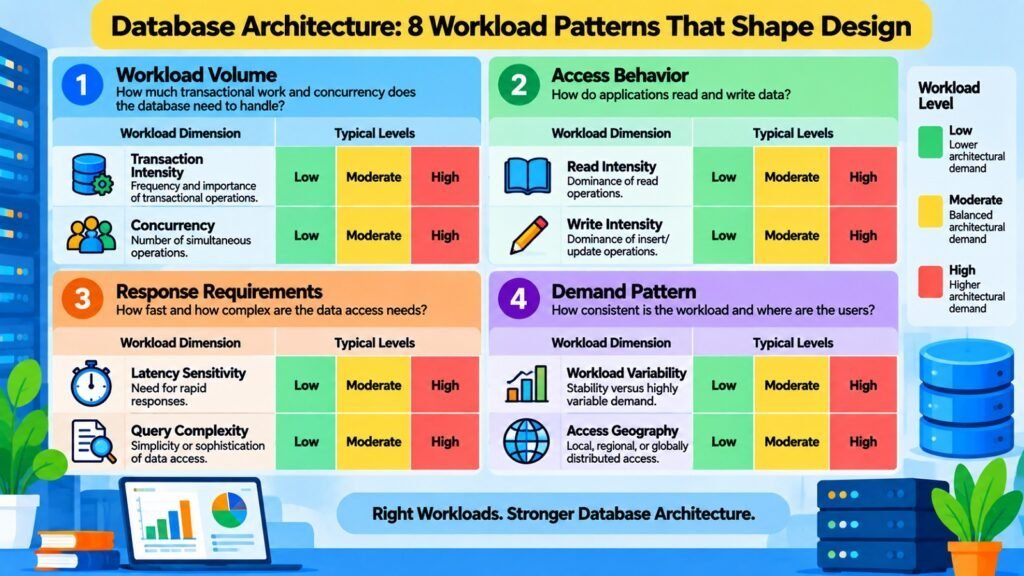
No database architecture can be evaluated in isolation from what the database is expected to do. Workload design is the process of characterizing those expectations and ensuring that the architecture can meet them. A database that performs well under one workload profile can perform poorly under another even if the underlying model and schema remain unchanged. Understanding workload requirements is not preparation for architecture — it is a part of it.
OLTP workloads involve high volumes of short, concurrent transactions — inserting an order, updating a balance, retrieving a customer record — and demand low latency, high concurrency, and strong transactional guarantees. OLAP workloads involve complex queries that read large volumes of data to produce aggregates and reports; they can tolerate higher query latency because they are not serving interactive user requests at the transaction level. HTAP aims to serve both profiles within a single system, which is technically demanding and not always necessary.
Read/write ratios matter considerably. A read-heavy workload permits architectural choices — aggressive caching, read replicas — that would be inappropriate for a write-heavy system where keeping replicas synchronized creates operational burden. Workload variability is equally significant: a system with predictable, steady demand can be sized statically, while one with pronounced peaks requires elastic scaling or graceful degradation under load.
Workload requirements interact with every other architectural dimension. Strict consistency requirements in an OLTP workload influence transaction management choices. Large analytical scans influence distribution and storage decisions. Architects who characterize workloads rigorously before designing systems avoid building an architecture optimized for anticipated demand that diverges significantly from actual use.
Table 6: Database Architecture and Workload Design — Architectural Considerations
| Workload Characteristic | Database Architecture Consideration |
| High Concurrency (OLTP) | Database must handle many simultaneous short transactions with low contention and strong isolation |
| Analytical Query Complexity (OLAP) | Storage layout and indexing should favor columnar access and large sequential scans |
| Read-Intensive | Architecture can leverage read replicas, caching layers, or denormalized structures to reduce read latency |
| Write-Intensive | Write amplification and replication lag must be managed; indexing overhead requires careful calibration |
| Mixed (HTAP) | Separate storage engines or workload routing may be needed to serve both transaction and analytical demands |
| Real-Time / Low Latency | Indexing, caching, and deployment topology must minimize query path length and coordination overhead |
| Batch-Oriented | Architecture can prioritize throughput over latency; off-peak scheduling reduces contention with live traffic |
| Variable / Bursty | Elastic scaling, connection pooling, and queue-based ingestion help absorb demand spikes without degradation |
6. Database Architecture and Distribution: Organizing Data Across Systems
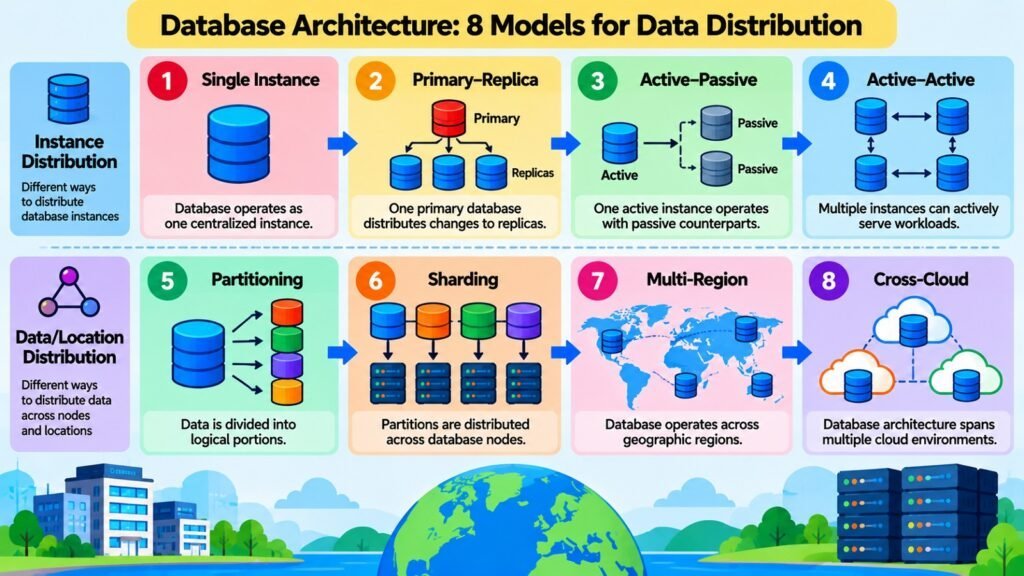
When a single database node cannot meet demands of scale, geographic reach, or availability, Database Architecture must address how data is organized across multiple nodes, instances, or regions. Distribution is not a single technique but a family of approaches, each with distinct effects on consistency, coordination, and operational complexity. Understanding these distinctions is essential to making sound architectural decisions rather than simply deploying more database infrastructure.
Partitioning — sometimes called sharding — divides a dataset into subsets stored on different nodes. Range partitioning assigns rows based on a value range; hash partitioning applies a hash function to distribute rows evenly but makes range queries less efficient. The choice of partition key is consequential: a poor key creates hot spots where one partition receives a disproportionate share of traffic.
Replication maintains copies of data on multiple nodes. Primary-replica replication, in which one node accepts writes and others receive copies synchronously or asynchronously, is the most common arrangement. It provides read scalability and a basis for failover, but asynchronous replication can allow reads that have not yet received the latest writes. Multi-primary replication allows writes on multiple nodes, increasing write availability but requiring conflict resolution when concurrent writes collide.
Geographic distribution places nodes across physical locations, addressing latency and data residency requirements. Distributed transactions introduce consistency challenges well-described in the CAP theorem and its successors in distributed systems research. Architects should weigh the benefits of distribution against the genuine complexity it introduces, and confirm that requirements actually warrant it before committing to a distributed architecture.
Table 7: Database Architecture and Distribution — Approaches and Architectural Purposes
| Distribution Approach | Architectural Purpose |
| Range Partitioning | Splits data by a value range of a key; efficient for range queries but can create uneven partition load |
| Hash Partitioning | Distributes data by hashing a key; produces even distribution but limits efficient range-based access |
| Primary-Replica Replication | One node accepts writes; replicas serve reads and provide a failover target |
| Multi-Primary Replication | Multiple nodes accept writes; increases write availability but requires conflict detection and resolution |
| Synchronous Replication | Writes confirmed only after all replicas acknowledge; strong consistency, higher write latency |
| Asynchronous Replication | Writes confirmed before replicas are updated; lower latency but risk of replica lag and stale reads |
| Geographic Distribution | Data or nodes placed in multiple regions to reduce latency and satisfy data residency requirements |
| Distributed Transactions | Coordinate atomic operations across multiple nodes at the cost of coordination overhead |
7. Database Architecture and Transaction Management: Balancing Consistency and Concurrency
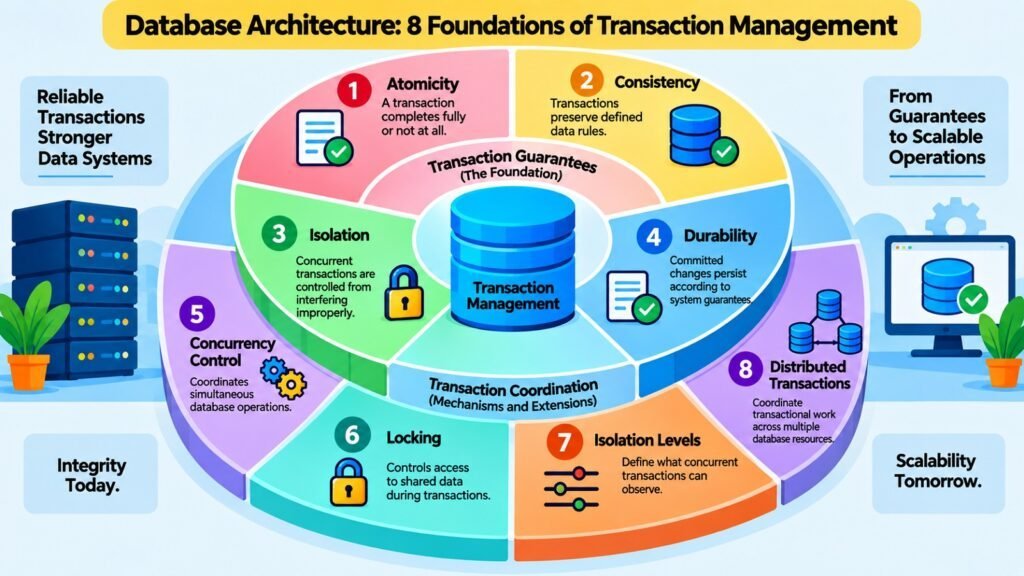
Transaction management is the dimension of Database Architecture that is most distinctly a database concern. It addresses the guarantee that groups of operations can be executed as a single, correct, indivisible unit — even when failures occur or multiple operations compete simultaneously. Virtually every other architectural dimension has parallels in non-database systems. Transaction management, in its full sense, belongs specifically to database systems.
The ACID properties — Atomicity, Consistency, Isolation, and Durability — describe what a transaction management system guarantees. Atomicity ensures that all operations within a transaction succeed together or are all rolled back. Consistency ensures a successful transaction leaves the database in a valid state according to its constraints. Isolation prevents concurrent transactions from seeing each other’s intermediate states, protecting against anomalies such as dirty reads and phantom reads. Durability ensures committed transactions survive system failures, typically through write-ahead logging.
Concurrency control implements isolation in practice. Pessimistic control uses locks to block concurrent access to the same data; optimistic control assumes conflicts are rare, allows concurrent access, and detects conflicts at commit time. Isolation levels, from Read Uncommitted to Serializable, let architects trade consistency guarantees for improved concurrency. The appropriate isolation level is an architectural decision with direct implications for application behavior and system throughput.
In distributed environments, transaction management becomes substantially more complex. The two-phase commit protocol introduces latency and the risk of blocking if a coordinator fails. Many modern distributed databases relax some ACID guarantees in exchange for availability and partition tolerance, using eventual consistency and mechanisms such as conflict-free replicated data types. Understanding these trade-offs is central to designing architectures that behave correctly under real-world conditions.
Table 8: Database Architecture and Transaction Management — Concepts / Architectural Implications
| Transaction Concept | Architectural Implication |
| Atomicity | All operations in a transaction succeed together or are fully rolled back; no partial updates persist |
| Consistency | A committed transaction must leave the database in a state that satisfies all defined constraints |
| Isolation | Concurrent transactions must not expose each other’s intermediate states to prevent read anomalies |
| Durability | Committed results must survive crashes; typically implemented through write-ahead logging |
| Pessimistic Locking | Prevents conflicts by holding locks on data during a transaction; suitable where conflicts are frequent |
| Optimistic Concurrency | Detects conflicts at commit time; effective for low-contention workloads with short transactions |
| Isolation Levels | Configurable trade-off between consistency guarantees and concurrency throughput |
| Two-Phase Commit | Coordinates atomic commits across distributed nodes; provides consistency at the cost of coordination latency |
8. Database Architecture and Evolution: Adapting to Changing Requirements
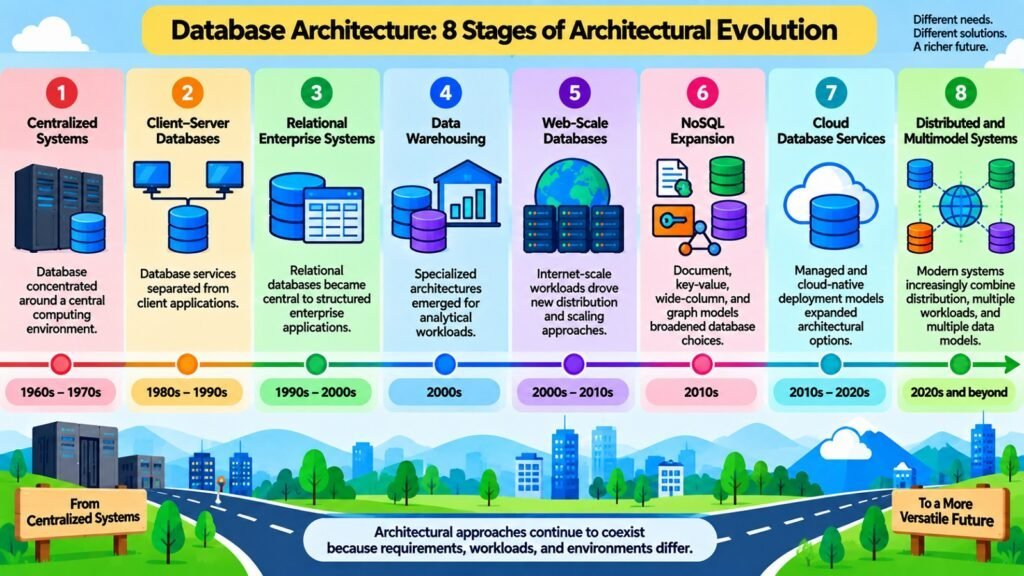
Database Architecture is not a decision made once at the beginning of a system’s life. It is a set of structural choices that must respond to changing application requirements, evolving data volumes, new workload patterns, and shifts in the technology landscape. Treating Database Architecture as static is one of the most common sources of technical debt in data-intensive systems. What was an appropriate design at one scale or stage of organizational maturity can become a genuine constraint as conditions change.
Schema evolution is one of the most immediate forms of architectural change. As application requirements grow, schemas must accommodate new data types, relationships, and constraints without disrupting existing data or applications. Migration tools allow schema changes to be applied in a controlled, reversible sequence. In systems with strict availability requirements, migrations must be designed to run without taking the database offline — requiring techniques such as backward-compatible schema changes and phased rollouts.
At a larger scale, architectural evolution may involve decomposing a monolithic database into smaller databases aligned with service or domain boundaries — improving independence but requiring careful data migration and cross-domain query mechanisms. The reverse, database consolidation, merges multiple databases to simplify operations at the cost of migration complexity. Cloud migration involves not just data movement but schema adaptation, replication strategy revision, and application configuration changes.
Throughout any evolutionary process, the guiding principle is to understand the dependencies and trade-offs of the current architecture before deciding whether to retain, adapt, modernize, decompose, consolidate, or replace it. Evolution without that understanding tends to carry the old architecture’s problems into a new environment in a harder-to-reverse form.
Table 9: Database Architecture Evolution — Common Scenarios and Architectural Responses
| Evolution Scenario | Architectural Response |
| Schema growth | Apply backward-compatible migrations in phases; use versioned schemas to avoid breaking existing consumers |
| Performance degradation at scale | Assess indexing, partitioning, and caching before redesigning; root-cause analysis precedes structural change |
| Monolith decomposition | Identify domain boundaries, migrate data incrementally, and establish cross-service consistency patterns |
| Cloud migration | Audit schema and dependency compatibility, adapt replication strategy, and migrate data with rollback capability |
| Database consolidation | Merge databases where operational complexity outweighs independence benefits; unify schemas with care |
| Technology obsolescence | Evaluate feature parity and migration risk of the replacement engine before committing to a platform change |
| Workload shift | Re-evaluate architecture pattern and deployment when workload characteristics diverge from original assumptions |
| Regulatory change | Assess data residency, encryption, and access control requirements as constraints on deployment and distribution |
Conclusion — Database Architecture as an Evolving Foundation of Modern Data
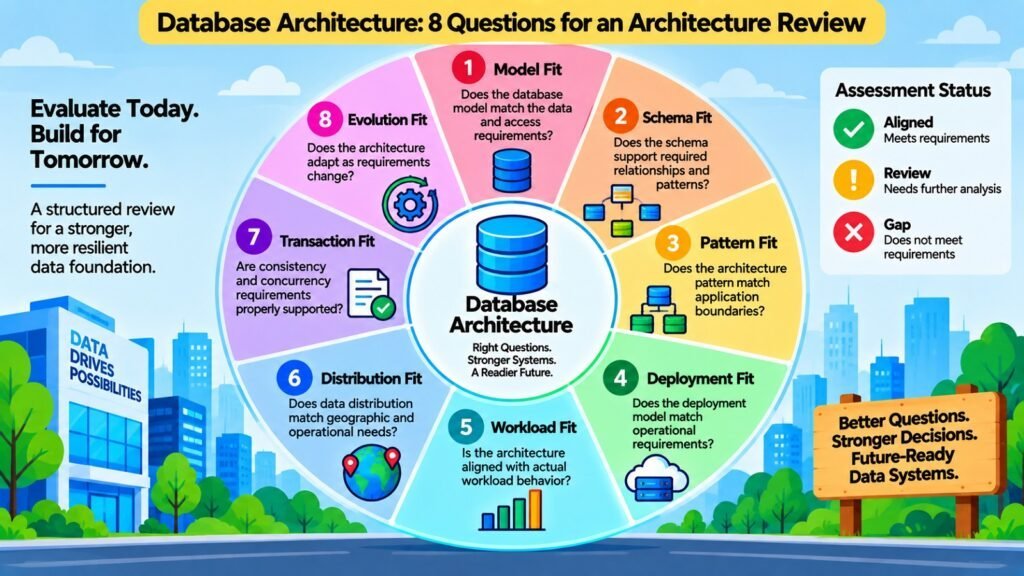
The eight foundations examined in this article are not independent checkboxes. They are interconnected dimensions of a single architectural system. A database model influences what schemas are possible. Schema design shapes how workloads perform. Architecture patterns determine what deployment options are realistic. Distribution choices constrain how transaction management can be implemented. And all of these decisions accumulate into an architecture that either supports or resists the inevitable need for evolution. Seeing these connections clearly is what separates Database Architecture thinking from database administration or product selection.
Database Architecture is an important aspect of Data Infrastructure because it provides the structural foundation through which database systems organize, serve, transact, distribute, and evolve data. Without it, the surrounding capabilities — pipelines, integration, processing, observability — have no reliable surface to build on. A well-designed architecture makes those investments compound; a poorly designed one forces constant remediation.
Strong Database Architecture is not about selecting the most fashionable database technology or the most powerful system available. It is about aligning structural decisions with requirements and understanding the trade-offs those decisions create. As applications grow, workloads shift, and organizations change, database architectures must remain capable of adapting without losing the integrity and reliability that data-dependent systems require. The table below provides a compact review checklist for assessing any Database Architecture against its eight foundations.
Table 10: Database Architecture Review Checklist — Questions and Areas to Evaluate
| Database Architecture Questions | Area to Evaluate |
| Does the database model match the data structure and access patterns? | Database Model Selection |
| Does the schema support current queries without excessive joins or redundancy? | Schema Design and Normalization |
| Does the architecture pattern fit the system’s coupling and independence requirements? | Architecture Pattern |
| Does the deployment model align with operational capability and data residency needs? | Deployment Model |
| Has the architecture been matched to expected transaction volume and query complexity? | Workload Design |
| Is distribution warranted, and if so, is the partitioning key well chosen? | Distribution and Partitioning |
| Do the isolation level and concurrency approach match consistency requirements? | Transaction Management |
| Is the architecture designed to accommodate schema change and workload growth? | Evolution and Adaptability |