
Table of Contents
Introduction: Differentiation as a Foundation of Competitive Advantage
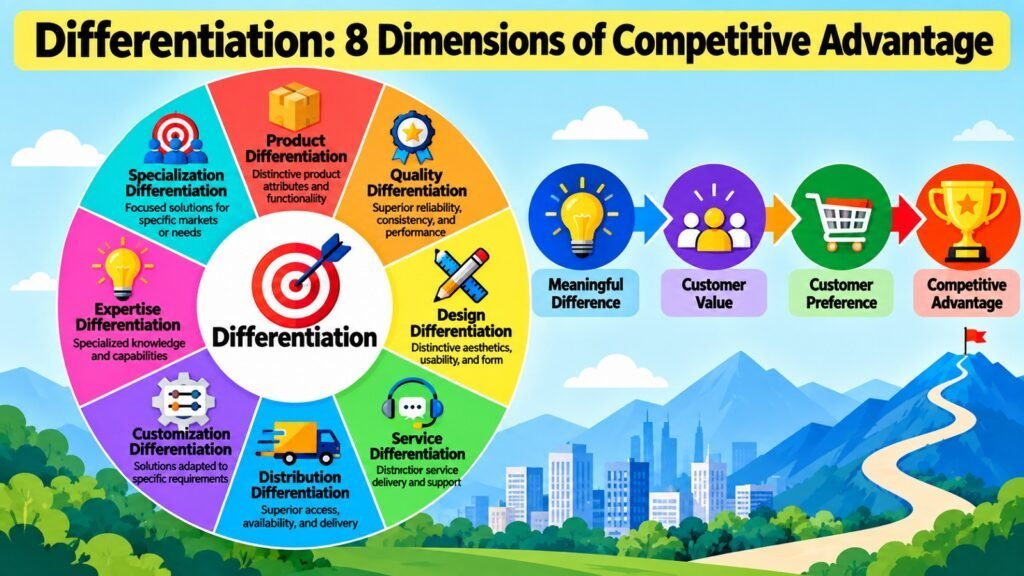
Differentiation is one of the most important aspects of competitive advantage. In markets where customers evaluate multiple alternatives, the ability to create meaningful, recognizable distinction determines whether a business earns preference and premium margins or competes purely on price. Understanding what differentiation requires — and how to achieve it strategically — is therefore central to any serious examination of competitive strategy.
In strategic terms, differentiation is the creation of differences between an offering and its alternatives that customers recognize, value, and consider relevant to their decisions. A business can differ from its competitors in many ways, but most differences are invisible or irrelevant to customers. True differentiation occurs when a difference translates into better outcomes, greater confidence, or improved experience — and when customers understand and respond to it.
Effective differentiation shapes customer preference, willingness to pay, and market position. When customers perceive meaningful, distinctive value that competitors cannot easily match, the business can sustain margins and build loyalty rather than simply matching the lowest price in the market. Differentiation also tends to depend on factors that go beyond visible product features — capabilities, expertise, relationships, design, and service capabilities that are genuinely difficult for competitors to replicate.
This article examines eight core dimensions of differentiation: Product, Quality, Design, Service, Distribution, Customization, Expertise, and Specialization. Each creates customer value through a different mechanism, and each can serve as a genuine foundation for competitive advantage when pursued with the strategic discipline that lasting differentiation requires.
Table 1: Eight Differentiation Aspects and Their Sources of Customer Value
| Aspects | Source of Customer Value or Market Distinction |
| Product Differentiation | Distinctive features, functionality, or configurations that address customer needs more effectively |
| Quality Differentiation | Superior reliability, durability, or precision that customers recognize as meaningfully better |
| Design Differentiation | Aesthetic, functional, or experiential design that improves usability, recognition, and appeal |
| Service Differentiation | Responsive, reliable service delivery that reduces customer effort and uncertainty |
| Distribution Differentiation | Convenient, broad, or flexible access across channels, locations, and delivery models |
| Customization Differentiation | Tailored offerings or solutions that fit individual or segment-specific requirements precisely |
| Expertise Differentiation | Specialized knowledge and professional competence that improve outcomes and build trust |
| Specialization Differentiation | Focused depth in a defined domain or market that generates relevance and credibility |
1. Product Differentiation: Creating Distinctive Offerings
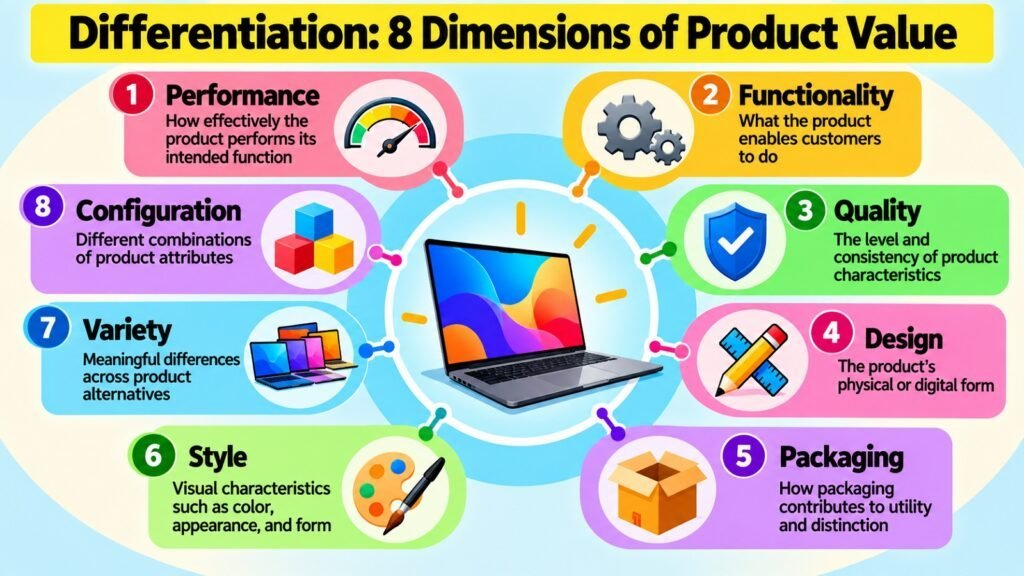
Product differentiation is the creation of meaningful distinction through the characteristics of a product or core offering. It goes beyond adding features to a list. Effective product differentiation occurs when attributes — features, functionality, performance, materials, configurations, or product variety — create differences that customers can perceive and connect to outcomes they genuinely care about. A product with more options than a competitor is not automatically differentiated. One that solves a problem more effectively or fits a particular use case more precisely likely is.
Features and functionality are the most visible forms of product differentiation, but they are also the most vulnerable to imitation. Competitors can observe visible product attributes and attempt to replicate them. This is why businesses that rely purely on feature lists frequently find their advantages eroded as the market catches up. More defensible product differentiation tends to emerge from capabilities, proprietary materials, accumulated engineering knowledge, or deep understanding of a specific customer need that took years to develop.
Performance-based differentiation is especially meaningful in categories where customers can assess differences objectively. Equipment that lasts longer, software that processes data faster, and materials with superior durability can create genuine preference when customers understand and value the gap. However, performance advantages only become differentiation when customers recognize them as worth the potential cost difference.
The most durable product differentiation tends to involve not just what a product does but why it is difficult to replicate. Proprietary processes, embedded design knowledge, supplier relationships, and accumulated learning can make a visible product difference hard to reverse-engineer, protecting the advantage over time.
Table 2: Product Differentiation Mechanisms and Associated Customer Value
| Product Differentiation Mechanism | Customer Value or Competitive Distinction |
| Unique core functionality | Solves a problem that alternatives cannot address as effectively |
| Superior performance specifications | Delivers measurably better output, speed, or efficiency |
| Proprietary materials or components | Provides quality or durability characteristics competitors cannot easily source |
| Specialized product configurations | Matches specific use cases more precisely than standard options |
| Broader product variety | Allows customers to find the best fit within a range rather than compromising |
| Modular or compatible architecture | Enables flexible integration with existing systems or complementary products |
| Innovative product attributes | Introduces characteristics that address unmet needs or reduce accepted trade-offs |
| Embedded IP or proprietary know-how | Creates technical barriers that make direct imitation difficult |
2. Quality Differentiation: Building Superior Customer Value
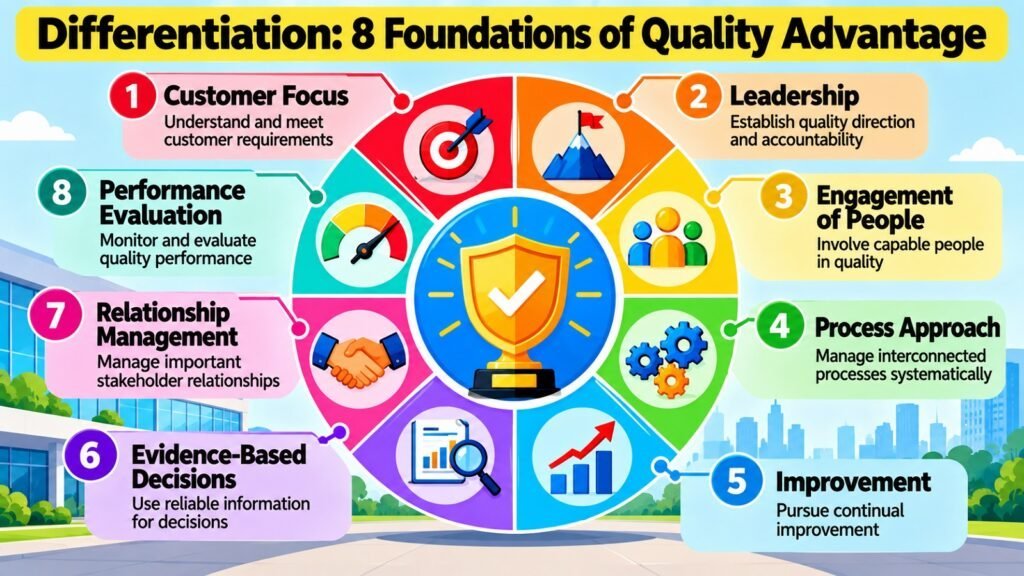
Quality differentiation is a distinct concept from product differentiation. Product differentiation concerns what makes an offering distinctive — its features, configurations, and capabilities. Quality differentiation concerns the level and consistency of what is delivered — the reliability, durability, precision, and overall performance standard that characterizes an offering over time. A product can be unique in what it does and still deliver inconsistently. Quality differentiation addresses how well and how reliably it performs its function.
Reliability is one of the most commercially significant dimensions of quality differentiation. Customers who depend on a product or service for important outcomes assign substantial value to consistent, predictable performance. Failures and inconsistency create switching risks, reputational damage, and increased total cost of ownership. Businesses that demonstrably deliver greater reliability can justify premium positioning and build loyal customers who calculate total value rather than initial price.
Durability and precision are especially relevant in manufacturing, engineering, and professional tools. Customers in these categories often evaluate total cost over the product’s useful life. A more durable product can cost less over time even when its upfront price is higher, making quality differentiation an economic argument as much as a perceptual one.
Proving quality is a distinct challenge from achieving it. Signals such as materials, certifications, third-party endorsements, guarantees, and observable performance allow customers to form judgments before purchase. Building credible quality signals is essential for translating actual quality into recognized market distinction. Sustaining that distinction requires continuous investment because quality that was exceptional a decade ago may today be broadly expected across the category.
Table 3: Quality Differentiation Dimensions and Customer Significance
| Quality Differentiation Dimension | Customer-Facing Significance |
| Reliability | Consistent performance under normal conditions reduces risk and builds confidence |
| Durability | Longer product life lowers total cost of ownership and reduces replacement frequency |
| Precision and accuracy | Higher tolerances improve downstream results in technical or professional applications |
| Craftsmanship and finish | Superior attention to detail signals care and pride in production standards |
| Defect prevention | Lower defect rates reduce inconvenience, returns, and warranty costs |
| Consistency across batches | Uniform quality over time supports predictable customer outcomes |
| Certified standards | Third-party verification provides credible, externally validated quality evidence |
| Performance under stress | Maintaining quality under demanding conditions demonstrates genuine robustness |
3. Design Differentiation: Turning Design Into Market Distinction
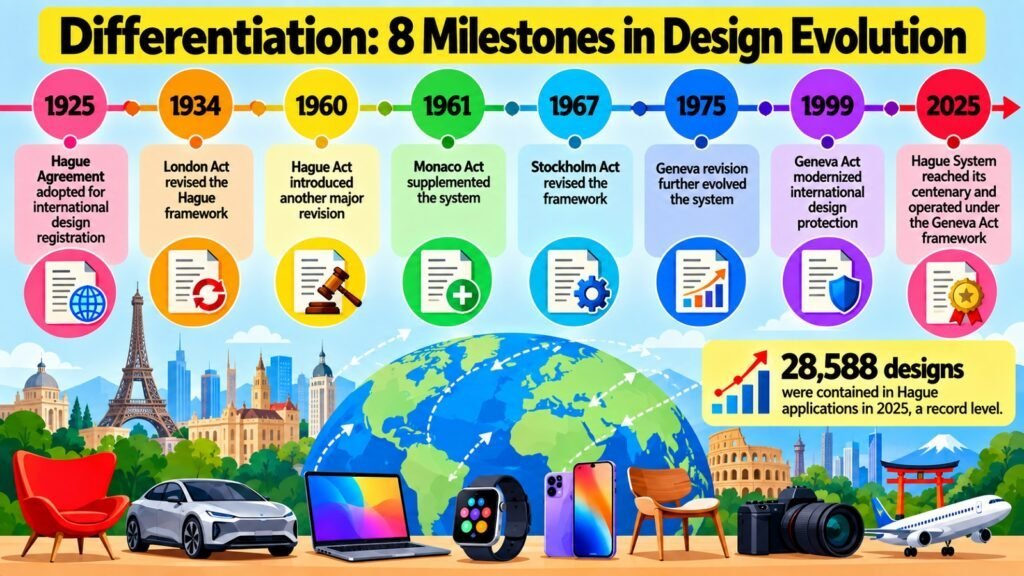
Design differentiation is the use of design to create meaningful and recognizable distinction in products, services, interfaces, and environments. It operates across a wider range than many businesses recognize — encompassing product form, user interfaces, physical spaces, packaging, and visual identity. Design affects how an offering is perceived, how easily it can be used, the emotional response it generates, and how readily customers recognize and remember it in a competitive landscape.
Design differentiation is distinct from product differentiation. Product differentiation concerns what an offering does and the attributes that make it distinctive. Design differentiation concerns how an offering is structured, presented, and made usable — the visual choices, ergonomic decisions, interface logic, and spatial arrangements that shape the experience of encountering or using it. A product can be functionally similar to its competitors while being genuinely differentiated through design.
Aesthetics are the most visible dimension but far from the only one. Ergonomics — the alignment between a product’s form and the human body or task — can create real usability advantages. Interface design determines how intuitively users navigate an offering and how quickly they accomplish their goals. Design consistency across products, communications, and environments reinforces recognition and trust by giving customers a stable mental model of the brand and its offerings.
Attractive design alone does not create sustainable differentiation. Visual trends shift and competitors adapt. More durable design differentiation tends to emerge from design systems, deep user research, proprietary visual language, and organizational capabilities that consistently produce purposeful design over time rather than responding to passing aesthetic trends.
Table 4: Design Differentiation Dimensions and Customer or Market Value
| Design Differentiation Dimension | Customer or Market Value Created |
| Aesthetic distinction | Visual appeal creates recognition, emotional connection, and perceived desirability |
| Ergonomics and physical form | Better fit between product and user reduces effort and error in use |
| Interface and interaction design | Intuitive structure reduces learning time and user frustration |
| Industrial design | Purposeful form integrates function, material, and manufacturing coherently |
| Visual identity consistency | Coherent design language across products builds recognition and trust |
| Environmental design | Spaces designed for purpose improve experience and reinforce brand associations |
| Packaging and presentation design | First impressions signal quality and brand personality before use |
| Accessibility in design | Inclusive design expands usability and demonstrates considered thinking |
4. Service Differentiation: Standing Out Through Service Delivery
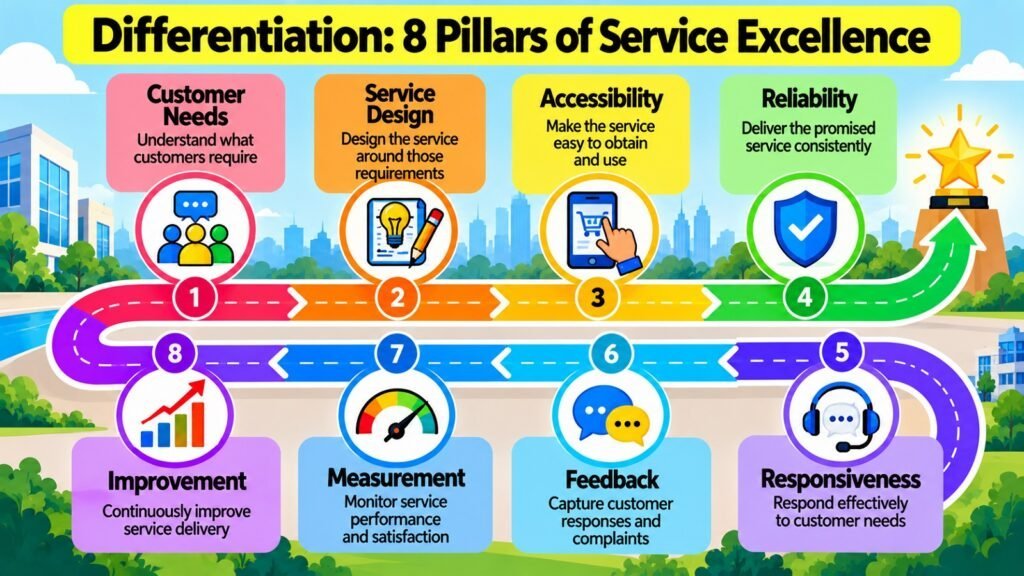
Service differentiation is the creation of competitive distinction through how services are designed and delivered before, during, and after a transaction. While customer experience encompasses the entire journey across every touchpoint, service differentiation focuses on the specific characteristics of the service offering — its responsiveness, reliability, accessibility, and the quality with which it is consistently executed.
Responsiveness is one of the most cited service differentiators. Customers who contact a business with a problem or query assign significant value to fast, accurate, and helpful responses. When responsiveness is genuinely better than competitors provide, it reduces customer uncertainty, supports purchasing confidence, and encourages continued engagement. Speed alone is not sufficient — the quality and usefulness of the response matters as much as how quickly it arrives.
Reliability in service delivery means customers receive what they expect, consistently, across interactions and over time. Service failures — missed commitments, inconsistent quality, or unexplained variation — create dissatisfaction that is difficult to reverse. Organizations that consistently meet service commitments build trust more effectively than those that occasionally deliver exceptionally but frequently fall short. Convenience and accessibility also drive preference in markets where customers have multiple options and limited patience for friction.
Maintaining consistent service differentiation as an organization scales is genuinely difficult. Service quality depends heavily on people, processes, and organizational culture. As teams grow, consistency requires deliberate investment in training, measurement, feedback mechanisms, and service design that embeds quality into the process rather than leaving it to individual effort and judgment.
Table 5: Service Differentiation Dimensions and Customer Value
| Service Differentiation Dimension | Customer Value Created |
| Response speed | Faster resolution of queries and issues reduces customer effort and anxiety |
| Reliability of delivery | Consistent fulfilment of service commitments builds trust and reduces perceived risk |
| Accessibility and availability | Services available when needed through preferred channels reduce friction |
| Expertise of service personnel | Knowledgeable staff provide accurate guidance for complex customer needs |
| After-sales support | Continued assistance post-purchase extends value and reinforces customer confidence |
| Personalized service | Attention to individual context improves fit and strengthens the relationship |
| Proactive communication | Pre-emptive updates reduce uncertainty without requiring customer effort |
| Complaint handling quality | Fair and effective resolution of problems converts poor experiences into loyalty |
5. Distribution Differentiation: Winning Through Market Access
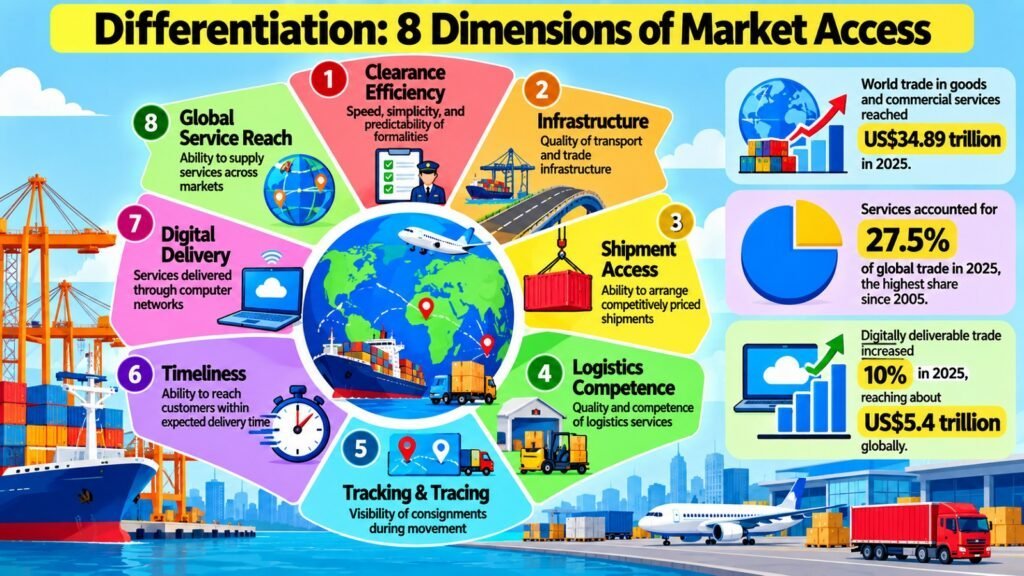
Distribution differentiation is competitive distinction created through how, where, and how conveniently customers can access an offering. While often overshadowed by product and quality advantages, distribution can be a powerful and durable source of differentiation, particularly when customers place significant value on convenience, speed, geographic reach, or purchasing flexibility.
The core logic is that access itself has value. A customer who can purchase a product nearby, receive it within hours, or access it through a preferred channel experiences something useful that a competitor with a superior product but weaker distribution cannot match at that moment. In markets where product parity is high, distribution can become the deciding factor.
Direct-to-consumer distribution has become a significant source of differentiation for businesses that manage it effectively. By owning the full relationship between product and customer, businesses can control pricing, messaging, and experience more precisely while collecting valuable behavioral data. Digital channels expand reach without proportional cost increases, but digital presence is not inherently differentiating. The question is whether it is genuinely better, faster, or more convenient than what competitors provide.
Distribution capabilities become difficult to replicate when they rest on physical infrastructure, geographic coverage, long-standing retail relationships, or accumulated logistical expertise. A business that has built a national network over decades cannot be quickly matched by a competitor beginning to construct similar infrastructure — which is what makes certain forms of distribution differentiation genuinely durable over time.
Table 6: Distribution Differentiation Mechanisms and Customer Access Benefits
| Distribution Mechanism | Customer Access Benefit |
| Direct-to-consumer channels | Eliminates intermediaries, enabling faster delivery and a more controlled experience |
| Broad retail presence | Physical availability in many locations reduces travel and enables immediate purchase |
| Exclusive distribution partnerships | Preferential access through select channels restricts competitor presence in those outlets |
| Digital and e-commerce platforms | Around-the-clock purchasing availability regardless of location |
| Same-day or next-day delivery | Speed of fulfilment addresses urgent needs that slower alternatives cannot satisfy |
| Subscription and auto-replenishment | Recurring delivery removes the effort of repeated purchasing |
| Click-and-collect hybrid models | Combines digital ordering convenience with immediate local collection |
| Geographic expansion into underserved markets | Exclusive access to customers where competitors have not yet entered |
6. Customization Differentiation: Creating Tailored Customer Value
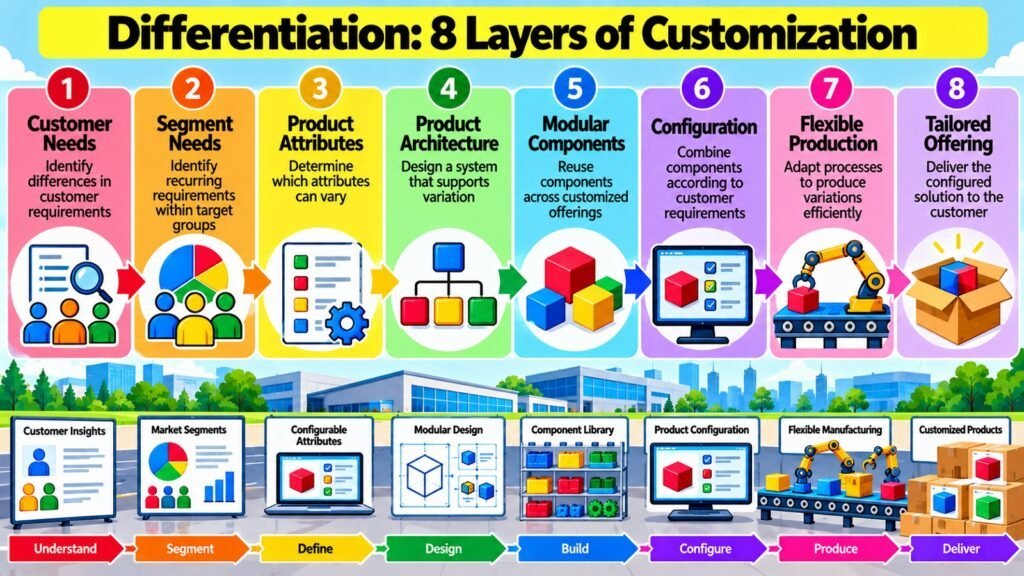
Customization differentiation is the creation of competitive distinction by adapting an offering to the specific requirements of an individual customer, organizational buyer, customer segment, or context. A standardized offering often forces customers to accept a compromise. When a business can reduce that compromise meaningfully, the resulting fit creates value that a standard alternative simply cannot match.
Customization takes many forms. At the product level, it can involve configuration, component selection, sizing, material choices, or functional adjustments. In services, customization may mean adapting delivery schedules, service scope, or engagement formats to fit a client’s operating model. Modular offerings represent a widely applicable form, allowing customers to assemble the combination of components that best suits their needs without requiring fully bespoke production.
Mass customization — delivering individually tailored offerings at the efficiency of scale — has expanded what is possible in many industries. However, it requires significant investment in flexible processes, digital configuration tools, and organizational capability to execute consistently. One of the real strategic risks is customer choice overload, where too many options reduce confidence and satisfaction rather than improving them.
Data, modularity, and accumulated customer knowledge are the primary enablers of defensible customization. When a business develops detailed understanding of individual customer requirements over time, that knowledge becomes a competitive asset. Competitors can observe the output of a customized offering, but they cannot quickly acquire the relational knowledge and process capability that makes it possible to deliver one consistently.
Table 7: Customization Differentiation Forms and Customer Value
| Customization Form | Customer Value Created |
| Product configuration | Customers select feature or component combinations that match their specific use case |
| Modular product architecture | Interchangeable modules allow flexible assembly without fully bespoke production |
| Bespoke professional services | Scope and deliverables are tailored to organizational needs and context |
| Mass customization at scale | Individually adapted outputs delivered with the efficiency of standard production |
| Customer-specific pricing structures | Terms reflecting volume or engagement model reduce friction in purchasing |
| Adaptive digital experiences | Interfaces and content adjust to customer behavior and preferences |
| Configurable delivery and logistics | Scheduling, frequency, and format of delivery match operational requirements |
| Segment-specific product variants | Distinct versions of an offering address the needs of defined customer groups |
7. Expertise Differentiation: Competing Through Specialized Knowledge
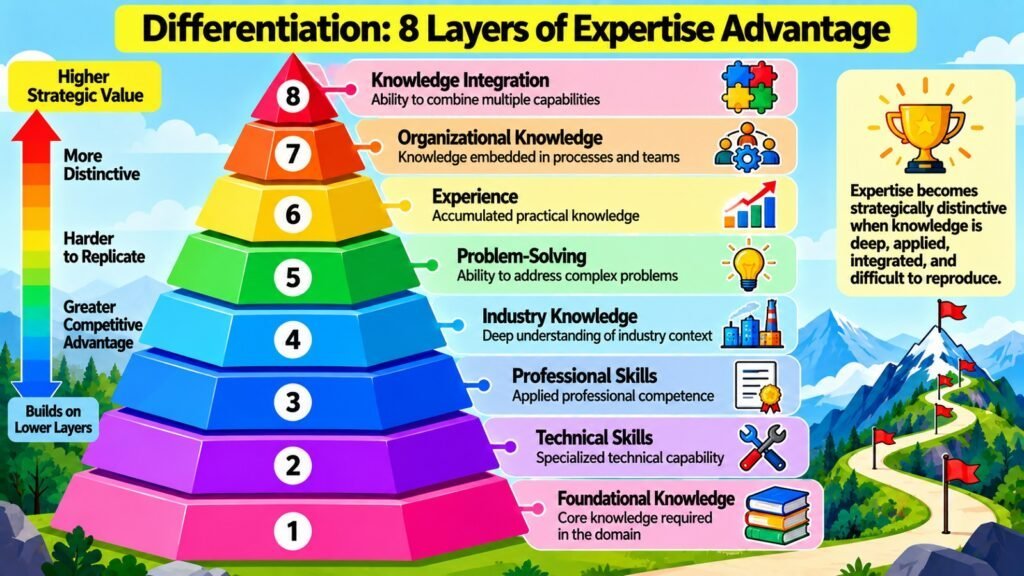
Expertise differentiation is the ability to create competitive distinction through specialized knowledge, technical capability, professional competence, accumulated experience, and proprietary know-how. From a resource-based perspective, knowledge that is valuable, rare, and difficult to imitate can become a lasting source of advantage. Expertise often meets all three criteria, particularly when it has developed through years of practice, client engagement, technical refinement, and organizational learning.
Knowledge creates customer value when it improves outcomes they genuinely care about. In professional services, consulting, engineering, and finance, the quality of expert judgment directly determines what clients receive. A client engaging a specialist is not purchasing visible product specifications. They are purchasing confidence that the professional’s knowledge will produce better, safer, or more efficient outcomes than they could achieve without that expertise.
Expertise also reduces customer uncertainty. In complex, high-stakes, or unfamiliar decisions, access to recognized expertise lowers perceived risk of error. Track record, demonstrated results, and professional reputation serve as proxies for expertise quality when customers cannot directly assess the knowledge itself. This is why credibility is so commercially important in expert markets — it is how customers evaluate a capability they cannot independently verify.
Expertise differentiates clearly from innovation. Innovation concerns creating or implementing new ideas. Expertise concerns depth and quality of existing knowledge — the accumulated understanding that makes an organization reliably better at something than others. Organizational expertise is more durable than individual expertise. When knowledge is embedded in systems, methodologies, documented processes, and institutional memory rather than concentrated in specific individuals, it becomes genuinely hard to replicate.
Table 8: Expertise Differentiation Sources and Customer Value
| Expertise Source | Customer Value Created |
| Deep technical knowledge | Provides accurate analysis and problem-solving in complex or specialized domains |
| Accumulated industry experience | Pattern recognition from past cases improves judgment in familiar situations |
| Proprietary methodologies | Structured approaches produce more consistent and reliable outcomes |
| Specialized credentials and training | Recognized qualifications provide verifiable evidence of competence |
| Domain-specific data and research | Proprietary insights derived from experience create informational advantages |
| Interdisciplinary capability | Cross-domain expertise addresses problems that pure specialists cannot integrate |
| Client-specific knowledge accumulation | Deep familiarity with a client context improves solutions over time |
| Demonstrated track record | Evidence of past results reduces perceived risk and supports purchasing confidence |
8. Specialization Differentiation: Winning Through Focus
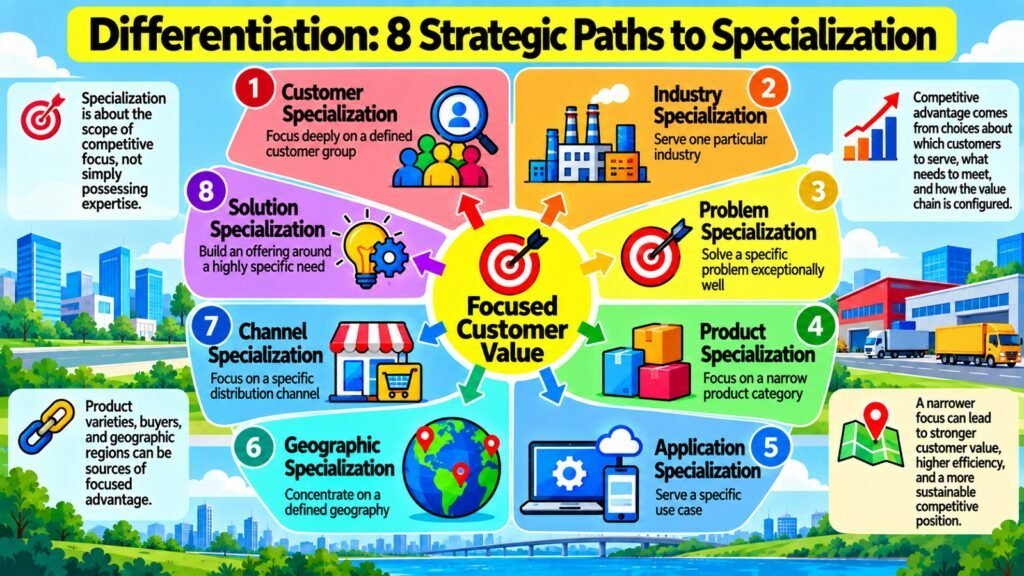
Specialization differentiation is the creation of market distinction through focused capability, offerings, or knowledge directed at a specific industry, customer segment, problem type, product category, geography, or defined need. Rather than competing broadly, a specialized business develops deeper relevance within a defined domain — greater credibility, more tailored solutions, and stronger relationships than a generalist typically provides within the same space.
The strategic logic is closely related to focused market positioning and niche strategy. When a business concentrates its resources and knowledge on a specific area, it develops understanding that generalists cannot replicate without abandoning the breadth that defines their own model. In markets where deep relevance matters more than broad availability, specialization can generate competitive advantage rather than simply representing a limitation of scale.
Specialization differentiates from expertise in an important way. Expertise concerns the depth and quality of knowledge — how much a business knows and how well it applies that knowledge. Specialization concerns where and for whom that capability is directed — the particular market, customer type, or problem around which a business organizes its offerings. A maritime law firm provides something different from a general commercial practice not necessarily because its lawyers are individually more skilled, but because their experience, network, and institutional knowledge are concentrated in ways that produce faster and more reliable outcomes for maritime clients.
Specialization also carries real risks. A narrower addressable market limits revenue potential, and deep dependence on a specific segment creates vulnerability to changes in that segment’s size or requirements. Defensible specialization therefore requires continuous investment in understanding the evolving needs of the chosen domain, not simply maintaining a historical focus while the market changes around it.
Table 9: Specialization Areas and Competitive Focus
| Specialization Area | Focus and Competitive Distinction |
| Industry-vertical specialization | Deep knowledge of a specific sector’s regulations, practices, and buying patterns |
| Customer-segment specialization | Tailored offerings designed for a defined group with shared characteristics or needs |
| Problem-type specialization | Concentrated capability in addressing a specific category of challenge |
| Geographic specialization | In-depth local knowledge, relationships, and presence within a defined region |
| Product-category specialization | Comprehensive depth across variants and applications in a narrow category |
| Technology or platform specialization | Exclusive focus on a specific system or technology stack |
| Channel specialization | Mastery of a particular distribution model or purchasing environment |
| Regulatory or compliance specialization | Expertise in a specific framework that customers must navigate |
Conclusion: Differentiation as a Lasting Competitive Advantage
Differentiation is most valuable when understood as an ongoing strategic capability rather than a one-time effort to appear distinctive. The eight dimensions examined in this article — Product, Quality, Design, Service, Distribution, Customization, Expertise, and Specialization — each provide a distinct path to competitive distinction. They can work independently to reinforce a single clear advantage or in combination, creating multiple layers of perceived value that together make an offering genuinely difficult to replace.
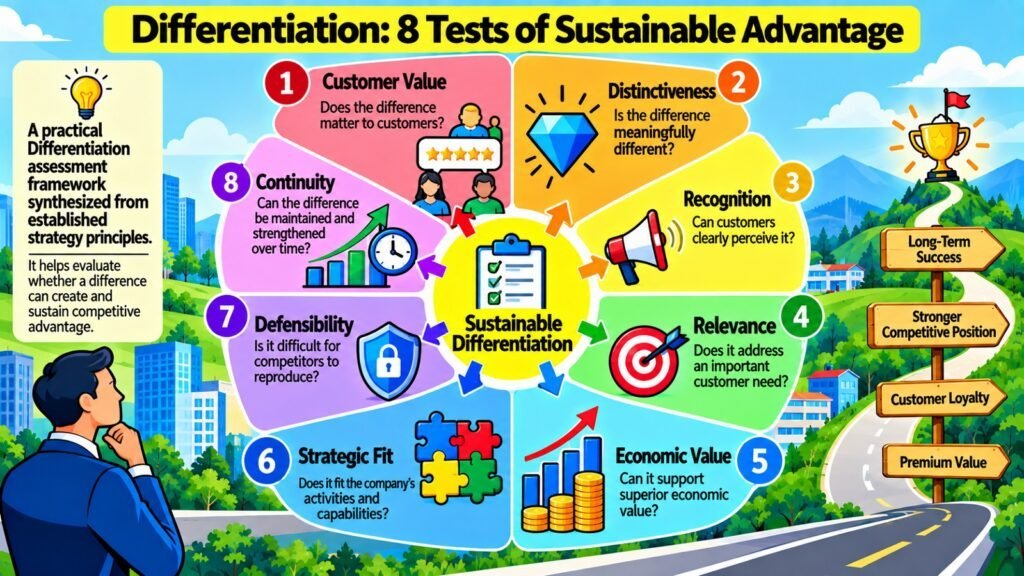
The central principle connecting all eight dimensions is that effective differentiation must be valuable to customers, meaningfully distinctive in the market, recognizable so that customers can identify the difference, defensible against imitation, and economically sustainable over time. A difference that scores well on only one or two of these criteria may produce short-term advantage but rarely creates lasting competitive position.
Evaluating a differentiation opportunity benefits from a structured set of questions: Does this difference matter to the customers we serve? Can they recognize it without lengthy explanation? Can competitors reproduce it quickly and at comparable cost? Can we sustain the capability required to maintain it economically over time? These questions do not guarantee correct answers, but they impose useful discipline on decisions that might otherwise rest on internal enthusiasm rather than external customer relevance.
No single metric proves that differentiation is working. Useful indicators include customer preference rates, retention, perceived uniqueness, willingness to pay, conversion rates, and whether customers cite specific differentiating factors in their buying rationale. Markets shift, customer needs evolve, and competitive dynamics change continuously. Businesses that sustain differentiation treat it as a discipline requiring continuous learning and capability development rather than a positioning statement established once and left unchanged.
Table 10: Differentiation Aspects and Strategic Takeaways
| Aspects | Strategic Takeaway |
| Product Differentiation | Distinct capabilities create value only when customers recognize them as meaningfully relevant |
| Quality Differentiation | Reliable, consistent quality builds trust and justifies premium positioning over time |
| Design Differentiation | Purposeful design in form, function, and identity creates recognition and usability advantages |
| Service Differentiation | Responsive, reliable service reduces customer effort and builds loyalty through consistent execution |
| Distribution Differentiation | Superior access and convenience determine preference when product parity is high |
| Customization Differentiation | Offerings adapted to specific needs create fit-based value that standardized alternatives cannot match |
| Expertise Differentiation | Specialized knowledge reduces uncertainty and improves outcomes in complex decision contexts |
| Specialization Differentiation | Focused depth generates credibility within a defined domain that generalists struggle to replicate |