Table of Contents
Introduction: Understanding DevOps Culture in Modern Software Development
Every conversation about DevOps eventually circles back to tools. CI/CD pipelines, container orchestration, cloud infrastructure, and monitoring dashboards tend to dominate the discussion. That is understandable because tools are visible and measurable. Culture is neither.
DevOps Culture is the organizational foundation that makes sustainable DevOps possible. It shapes how people communicate, how teams share responsibility, how failures are handled, and how knowledge moves across an organization. Without it, even sophisticated automation will eventually stall under the weight of problems it was never designed to solve.
The story of DevOps Culture begins with frustration. Traditional software development separated teams into distinct departments. Developers wrote code and handed it over a wall to operations teams who deployed and maintained it. Each group had its own incentives and its own definition of success. Developers wanted to ship quickly. Operations teams wanted to keep systems stable. Those goals often conflicted, and the resulting friction slowed delivery and eroded reliability.
DevOps emerged from the recognition that silos were not a technical problem but an organizational one. The early DevOps movement, shaped by practitioners like Patrick Debois and informed by Agile and Lean communities, argued that collaboration between development and operations was a prerequisite for high-performing software delivery.
Over time, that conversation expanded. Quality assurance, security, product management, and business stakeholders all entered the picture. DevOps Culture grew into something broader than a development-operations partnership. It became a model for how technology organizations work together to deliver value continuously.
Culture is frequently described as the hardest part of DevOps transformation. Technology changes are reversible. Cultural changes require sustained commitment from every level of an organization, and the results are rarely immediate. Yet research consistently shows that culture is where the greatest long-term gains are made.
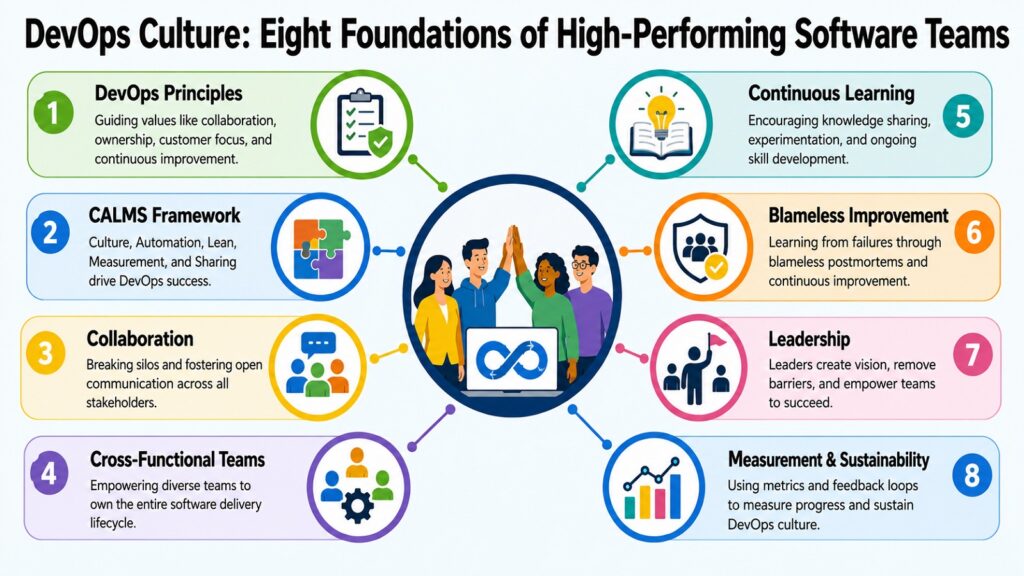
This article explores eight foundational aspects that collectively shape a successful DevOps Culture.
Table 1: DevOps Culture — Eight Foundational Aspects at a Glance
| Aspect | Why It Matters to DevOps Culture |
| Core Principles | Provide the shared values that guide collaborative decision-making across teams |
| CALMS Framework | Offers a structured lens for understanding and assessing cultural maturity |
| Collaboration | Replaces departmental silos with shared ownership and joint accountability |
| Cross-Functional Teamwork | Enables faster delivery by combining diverse expertise within single teams |
| Continuous Learning | Keeps teams adaptive and innovative in fast-changing technology environments |
| Blameless Improvement | Builds psychological safety so failures lead to learning rather than punishment |
| Leadership | Sets the tone, resources, and sustained commitment that culture requires |
| Measurement and Sustainability | Ensures DevOps Culture grows rather than stagnating after initial adoption |
1. DevOps Culture Principles: Building the Foundation for Collaborative Teams
Every successful engineering culture rests on shared principles. DevOps Culture is no different. These principles shape the daily decisions that accumulate into organizational behavior over time. Without them, DevOps initiatives tend to reduce to a collection of tools and processes that lack coherent direction.
The need for DevOps principles grew out of real organizational pain. Teams working in siloed environments made decisions that optimized their own performance at the expense of the broader system. Developers pushed code when it was convenient. Operations teams added deployment gates to protect stability. Neither group was wrong on its own terms, but the combined effect was slow delivery, poor quality, and persistent friction.
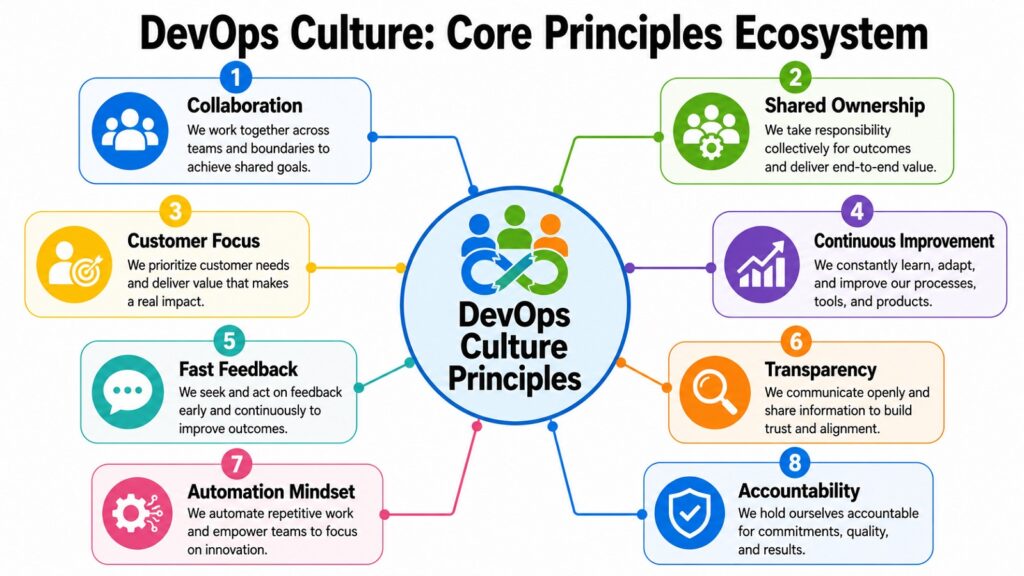
Collaboration is the most fundamental DevOps principle. It holds that development, operations, and every other stakeholder in software delivery should work together rather than in sequence. Shared ownership follows from this. When teams are jointly responsible for outcomes, they stop treating handoffs as endpoints and start treating reliability as a collective responsibility.
Customer focus keeps engineering work grounded in what actually matters. Continuous improvement acknowledges that no process is ever finished and that regular reflection leads to better outcomes. Transparency ensures information flows freely so people can make better decisions with fewer surprises. Accountability and fast feedback complete the picture. Accountability means teams own their outcomes. Fast feedback means information about system performance reaches the people who need it before small problems grow into large ones.
Organizations like Google and Amazon have embedded these principles into their engineering cultures. Amazon’s two-pizza team concept reflects the principle that small, autonomous, and accountable teams outperform large bureaucratic structures. Google’s Site Reliability Engineering model applies shared ownership and fast feedback at massive scale.
These principles draw from Agile values, Lean manufacturing practices, and decades of organizational behavior research. They are not prescriptive. They provide a framework for making better decisions across every stage of software delivery. Principles are the foundation. Everything else in DevOps Culture is built on top of them.
Table 2: DevOps Culture Principles and Their Organizational Value
| DevOps Principle | Organizational Value |
| Collaboration | Aligns teams around shared outcomes rather than departmental boundaries |
| Shared Ownership | Removes the handoff mindset and builds collective responsibility for software quality |
| Customer Focus | Ensures engineering effort connects directly to business and user value |
| Continuous Improvement | Drives ongoing refinement of processes, systems, and team practices |
| Transparency | Enables faster decisions by giving teams access to relevant information |
| Accountability | Builds trust by ensuring teams follow through on their commitments |
| Fast Feedback | Reduces the cost of mistakes by surfacing problems before they compound |
| Psychological Safety | Encourages honest communication and experimentation without fear of blame |
2. DevOps Culture Through the CALMS Framework
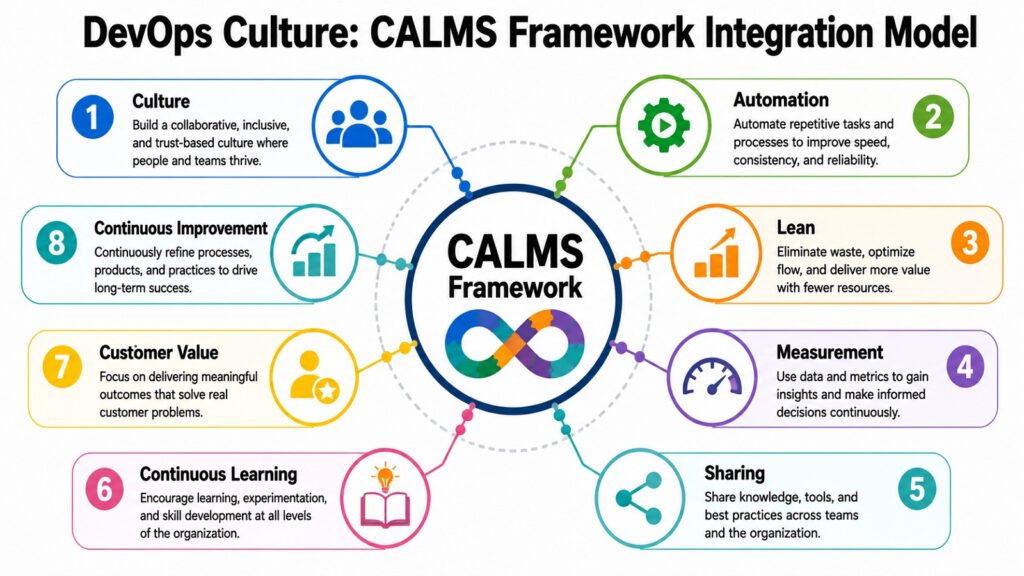
Organizations attempting DevOps transformation often struggle with a consistent question: where do we start? The CALMS Framework was developed to answer that question. It breaks DevOps Culture into five interconnected components — Culture, Automation, Lean, Measurement, and Sharing — and provides a structure for assessing organizational maturity.
The framework emerged from the early DevOps community and was later formalized as a diagnostic tool. It is not a step-by-step methodology. It is a lens for understanding where an organization is strong, where it is weak, and how the dimensions of DevOps Culture relate to one another.
Culture comes first because it determines whether all other efforts will succeed. An organization that automates poorly designed processes simply fails faster. Automation reduces manual effort, eliminates repetitive error-prone tasks, and creates capacity for teams to focus on higher-value work. Lean thinking, borrowed from manufacturing, focuses on reducing waste in software delivery pipelines by eliminating steps that add time without adding value.
Measurement gives organizations the ability to understand how their systems are actually performing, as opposed to how they assume they are. Without measurement, improvement is guesswork. Sharing refers to the open exchange of knowledge, tools, and practices across teams. It prevents duplication of effort and builds resilience by distributing expertise rather than concentrating it.
These five components reinforce each other. Strong automation becomes more valuable when teams share tooling standards. Measurement is more actionable when leadership supports transparency. Lean principles make automation more effective by ensuring only the right processes get automated in the first place.
Spotify’s engineering culture provides a useful example. The company built autonomous squad structures that combine cultural alignment with shared tooling, open retrospectives, and metrics-driven improvement cycles. No single component explained Spotify’s success. The combination did. CALMS continues to resonate because it addresses both the human and technical dimensions of organizational change.
Table 3: DevOps Culture Through the CALMS Framework — Components and Contributions
| CALMS Component | Contribution to DevOps Culture |
| Culture | Establishes the shared values and behaviors that make all other improvements possible |
| Automation | Reduces manual work, eliminates repetitive errors, and frees teams for higher-value tasks |
| Lean | Identifies and removes waste in software delivery to improve flow and reduce cycle time |
| Measurement | Provides objective data on system and process performance to guide improvement |
| Sharing | Distributes knowledge across teams to reduce duplication and build collective capability |
| Continuous Delivery | Applies Lean and Automation together to maintain a releasable software state at all times |
| Feedback Loops | Connects Measurement with Culture by turning data into organizational learning |
| Psychological Safety | Enables Sharing and Learning by removing the fear of contributing openly |
3. DevOps Culture Collaboration: Breaking Down Organizational Silos
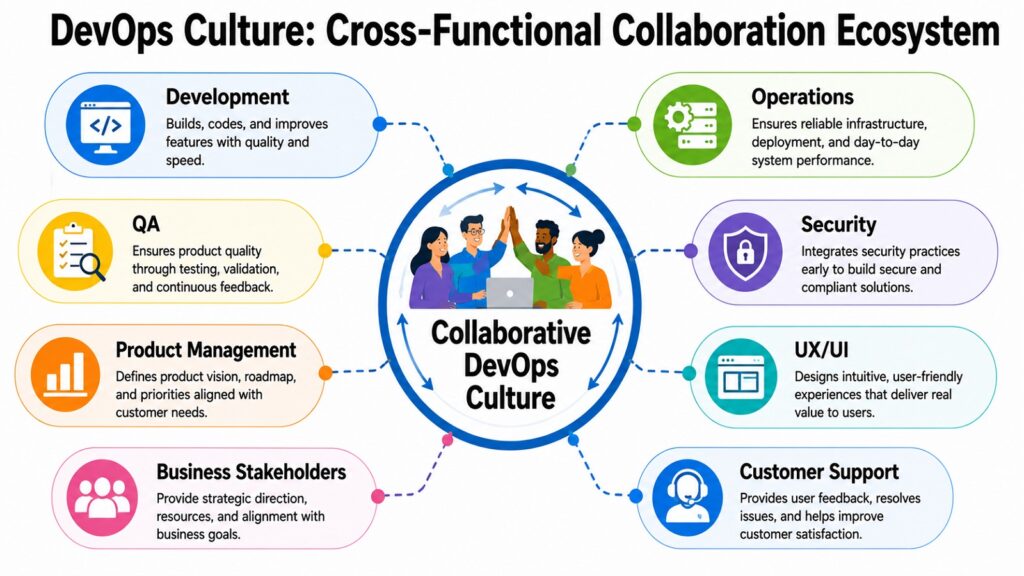
Organizational silos develop for understandable reasons. Groups with specialized expertise naturally form around their skills and responsibilities. The problem is not specialization itself. The problem is when those boundaries harden into walls that block information, delay handoffs, and assign blame across departmental borders.
Research from DORA, the DevOps Research and Assessment group, consistently links collaboration to elite software delivery performance. Organizations where teams work closely across functional boundaries deploy more frequently, recover from failures faster, and maintain higher system reliability than those where departments operate independently.
DevOps Culture addresses silos by redefining ownership. Rather than assigning responsibility to a single team at each stage of the software lifecycle, collaborative DevOps models create shared accountability. Development teams participate in deployment and monitoring. Operations engineers contribute to architectural decisions. Security teams join design reviews rather than auditing finished products.
ING Bank’s DevOps transformation in the mid-2010s illustrates what breaking silos can accomplish. The Dutch bank reorganized around small cross-disciplinary squads that owned products end to end, from development through production support. Deployment frequency improved dramatically, and the time needed to resolve production incidents fell significantly. The organizational restructuring preceded the technical improvements.
The practical challenges of collaboration are real. Teams accustomed to clear handoffs and individual performance metrics can resist the ambiguity that comes with shared ownership. Tool fragmentation across teams makes integration difficult even when people are willing to collaborate. Organizations that succeed treat collaboration as a capability that requires investment in structures, shared rituals, and measurement.
Over time, authentic collaboration transforms the mindset of organizations regarding software delivery. It alters the dialogue from ownership issues to a collective approach to problem-solving. This transition is subtle, progressive, and more impactful than any automation framework.
Table 4: DevOps Culture Collaboration — Silo Practices vs. Collaborative Practices
| Traditional Silo Practice | Collaborative DevOps Culture Practice |
| Developers hand off code to separate QA team | Developers share testing responsibility with embedded quality engineers |
| Operations receive deployment packages without context | Operations collaborate during design to understand deployment requirements early |
| Security audits completed after development | Security engineers join sprint planning and architectural reviews |
| Incident response managed by operations alone | Development and operations jointly own on-call rotations and incident response |
| Documentation owned by a dedicated team | All contributors maintain and update documentation continuously |
| Tool choices made within departmental boundaries | Shared tooling decisions made collaboratively across functional teams |
| Performance goals set per department | Success metrics aligned across development, operations, and business teams |
| Knowledge concentrated in individual experts | Knowledge distributed through documentation, pairing, and communities of practice |
4. DevOps Culture and Cross-Functional Teamwork
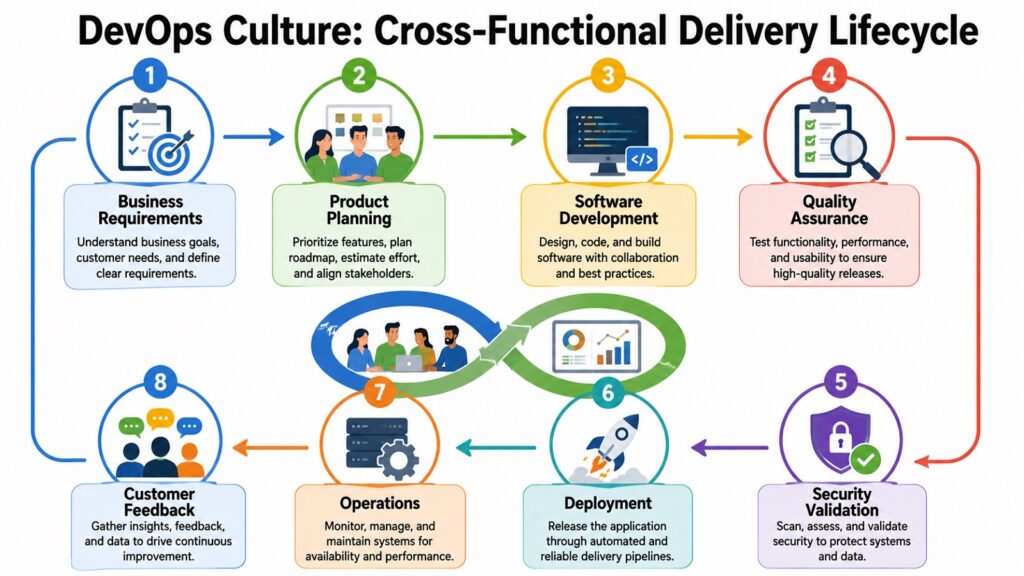
Cross-functional teams are one of the most visible structural expressions of DevOps Culture. Rather than organizing people by technical specialty, cross-functional teams bring together the diverse expertise needed to take a product from conception to production within a single group.
The rationale for cross-functional teams comes from research on coordination costs. Every time work crosses a team boundary, delay accumulates. Handoff meetings get scheduled. Context is lost in translation. Decisions that could have been made locally wait for approval from another department. Cross-functional teams reduce these costs by placing the necessary expertise in the same working group.
Research in organizational effectiveness, including findings from Google’s Project Aristotle, points to team composition and psychological safety as stronger predictors of performance than individual talent. Teams that trust one another, communicate openly, and feel safe taking risks consistently outperform those that do not.
Amazon’s approach to software teams provides a concrete illustration. The company’s two-pizza team model — the idea that a team should be small enough to be fed by two pizzas — reflects a deliberate design choice. Small cross-functional teams own services end to end, make their own decisions, and deploy independently. The result is a delivery model that scales without central coordination bottlenecks.
Building cross-functional teams presents real challenges. Senior specialists may resist reporting structures that place them alongside colleagues from different disciplines. Career paths that reward deep specialization can conflict with team structures that reward generalist contributions. Organizations that navigate these challenges successfully invest in clear team charters, build career paths that reward cross-functional contribution, and accept a period of transition.
Cross-functional teams do not make every decision better. They make the right decisions faster, with more context, and with fewer handoffs. Over time, that efficiency compounds into organizational resilience that departmental structures struggle to match.
Table 5: DevOps Culture and Cross-Functional Team Characteristics and Benefits
| Team Characteristic | Organizational Benefit |
| Diverse technical expertise within one team | Reduces handoffs and keeps delivery moving without waiting for other departments |
| Shared ownership of product lifecycle | Creates accountability for quality from design through production support |
| Embedded security and quality roles | Catches issues earlier when fixes are less costly and complex |
| Autonomous deployment authority | Speeds delivery by removing approval bottlenecks from external teams |
| Shared on-call responsibility | Connects development decisions to operational consequences directly |
| Psychological safety within team | Enables open communication and faster identification of problems |
| Clear team charter and scope | Prevents overlap and confusion about decision-making authority |
| Internal knowledge sharing practices | Reduces single points of failure and builds team-wide resilience |
5. DevOps Culture and Continuous Learning
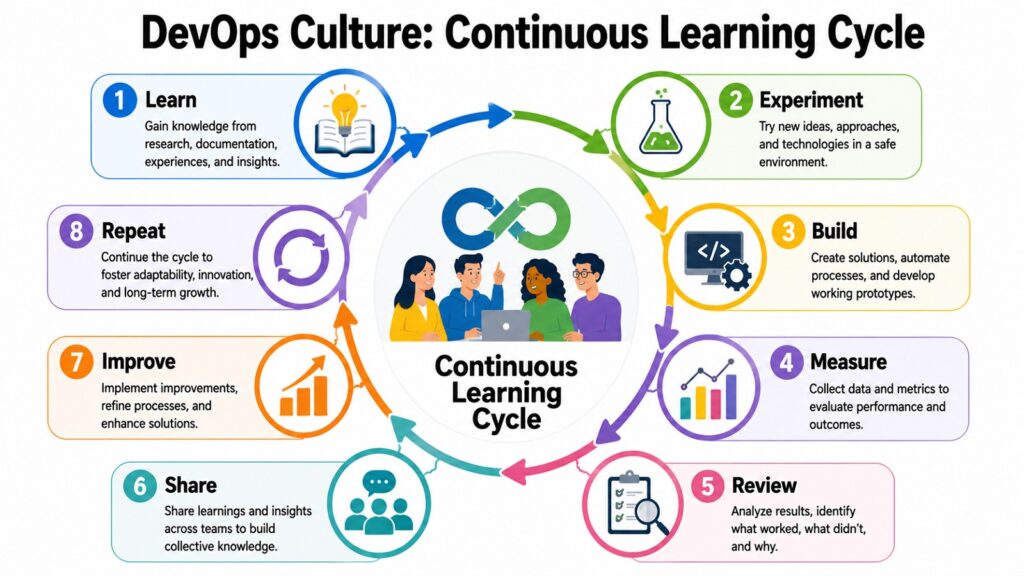
Technology changes fast. The tools, practices, and architectures that define modern software delivery today will look different in three years. Organizations that cannot learn continuously will fall behind those that can. DevOps Culture treats learning not as a training budget line item but as a core operational capability.
Continuous learning in a DevOps context encompasses a wide range of practices. Formal knowledge sharing through documentation and internal wikis. Structured retrospectives where teams reflect on what went well and what needs improvement. Communities of practice where people across an organization share expertise. Mentoring relationships that transfer institutional knowledge from experienced engineers to newer ones.
Studies in organizational learning theory, especially the contributions of Peter Senge on learning organizations, indicate that teams that engage in reflection and develop shared mental models are better equipped to adapt to change. Research in software engineering supports these conclusions. Teams that prioritize knowledge sharing and retrospective practices demonstrate significant enhancements in delivery speed and reductions in defect rates over time.
Netflix provides a well-documented example. The company built chaos engineering as a deliberate practice of introducing failures into production environments to learn how systems behave under stress. Rather than avoiding failure, Netflix engineered it to gain knowledge that could not be acquired any other way. That knowledge then shaped better architectural decisions and more resilient systems.
Barriers to continuous learning are common. Time pressure discourages retrospectives. Knowledge hoarding concentrates expertise in ways that leave organizations fragile. Cultures where mistakes are punished discourage honest reflection. Overcoming these barriers requires deliberate choices. Organizations must protect time for learning activities even when delivery pressure is high. Leaders must model the behavior they want to see by openly discussing what they have learned and where they have fallen short.
Organizations that learn continuously hold a compounding advantage. Every retrospective, every postmortem, every documented lesson becomes an asset that makes the next challenge slightly easier to navigate.
Table 6: DevOps Culture and Continuous Learning Practices and Their Value
| Continuous Learning Practice | Organizational Value |
| Regular retrospectives | Creates structured space for teams to reflect and improve their own processes |
| Blameless postmortems | Converts production incidents into shared organizational learning rather than blame events |
| Internal documentation and wikis | Preserves institutional knowledge and reduces dependency on individual experts |
| Communities of practice | Connects people with shared interests across team boundaries to spread expertise |
| Mentoring and pairing | Transfers knowledge directly between individuals and builds team capability |
| Chaos engineering | Generates learning about system behavior under stress in a controlled way |
| External conference participation | Brings outside perspectives into the organization to challenge assumptions |
| Learning time allocation | Signals organizational commitment to growth by protecting time for development |
6. DevOps Culture and Blameless Improvement
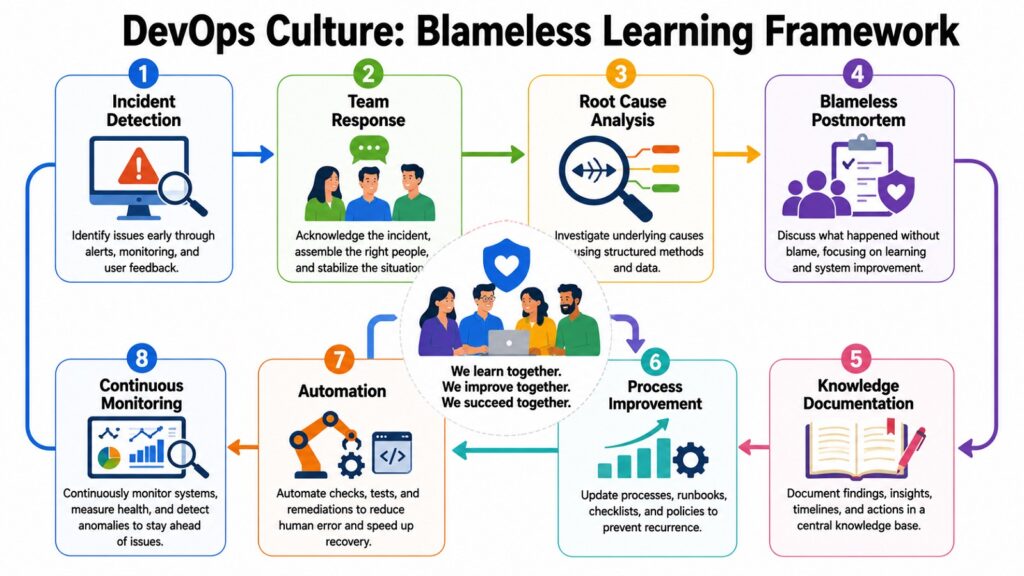
Every complex system fails eventually. Software systems are no exception. How an organization responds to those failures reveals more about its culture than how it responds to success. DevOps Culture holds that the goal of incident response is understanding, not punishment.
The concept of psychological safety, developed by organizational researcher Amy Edmondson at Harvard Business School, explains why this matters. Teams where members feel safe speaking up, raising concerns, and admitting mistakes outperform those where fear of blame dominates. The research is robust across industries and team types. Software engineering is not an exception.
Blameless postmortems are the most widely recognized practice associated with this principle. After a significant incident, teams conduct a structured review focused on understanding the sequence of events and the systemic conditions that allowed the failure to occur. The goal is not to identify the person who made a mistake. The goal is to understand why the system was vulnerable to that kind of mistake in the first place.
Etsy’s engineering team published extensively on their postmortem culture in the early 2010s and played an influential role in spreading blameless practices across the industry. Their approach emphasized that most production failures result from a combination of factors rather than a single individual’s error. Treating incidents as systemic problems rather than personal failures led to better root cause analysis and more durable solutions.
A common objection to blameless culture is that it excuses poor performance or removes individual accountability. This misses an important distinction. Accountability means that people own their commitments and follow through on improvements. Blame means that people are punished for contributing to complex systems that failed in ways no single person could have prevented. Conflating the two produces cultures where people hide problems rather than surface them.
Trust is the real outcome of blameless improvement. When engineers know that raising an issue will lead to a constructive conversation, they raise issues earlier and more honestly. That transparency makes systems more reliable over time. Organizations that practice blameless improvement do not eliminate failure. They extract more value from it.
Table 7: DevOps Culture and Blameless Improvement Practices and Their Purpose
| Blameless Improvement Practice | Organizational Purpose |
| Blameless postmortem | Identifies systemic causes of failures without discouraging transparency |
| Psychological safety | Creates the trust environment necessary for honest reporting and open learning |
| Root cause analysis | Looks beyond immediate triggers to understand structural vulnerabilities |
| Incident timeline documentation | Provides shared context that prevents revisionist accounts of what happened |
| Action item tracking | Ensures postmortem findings lead to measurable improvements rather than forgotten lessons |
| Leadership participation in reviews | Signals that senior leaders are accountable for systemic issues alongside engineers |
| Error budget framework | Balances reliability targets with innovation by making acceptable risk explicit |
| Regular safety culture assessment | Measures whether psychological safety is actually improving across the organization |
7. DevOps Culture Leadership: Driving Organizational Transformation
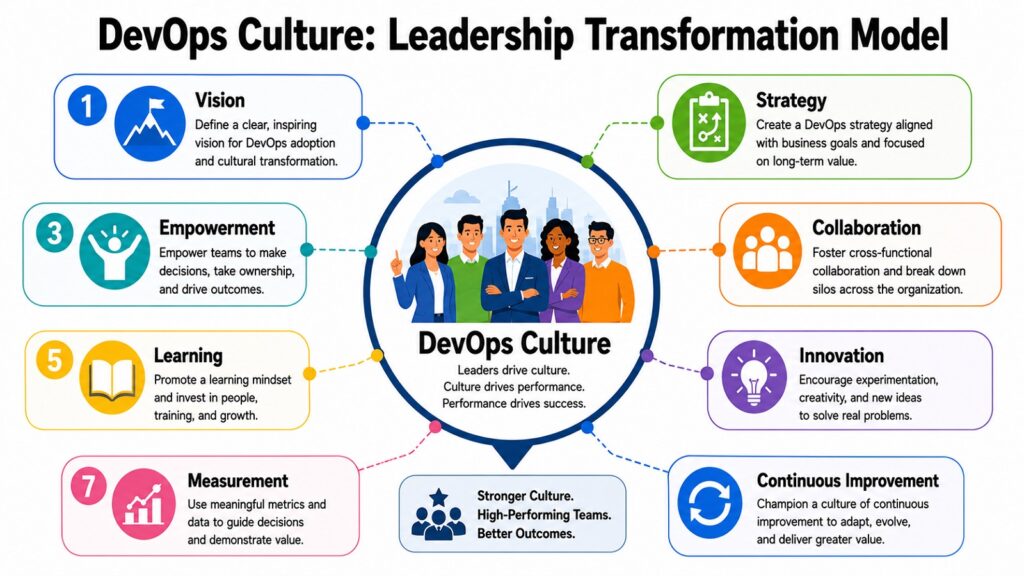
The absence of leadership support during technical transformation is a prevalent cause of DevOps failures. Teams may implement new tools and establish automation pipelines, yet the underlying organizational culture remains static. This issue often stems from leadership perceiving DevOps as merely a tooling initiative instead of a cultural shift.
Leadership shapes culture in ways that policies cannot. The behaviors leaders reward, the questions they ask, the mistakes they tolerate, and the priorities they fund all communicate what the organization actually values. Research in organizational change management, including work by John Kotter on leading transformation, consistently shows that cultural change fails when senior leaders are not visibly committed to it.
In DevOps transformation, leadership responsibilities are specific. Leaders must create the organizational structures that enable cross-functional collaboration by removing departmental walls and aligning incentives. They must fund the learning and tooling investments that culture requires. They must model the behaviors they expect, including transparency, continuous improvement, and shared accountability.
Microsoft’s cultural transformation under CEO Satya Nadella, which began around 2014, demonstrates the scale of change that leadership can drive. Nadella replaced a culture of internal competition with one organized around growth mindset principles. Engineering teams were restructured to enable collaboration, and psychological safety became an explicit organizational value. The transformation preceded and enabled substantial improvements in software delivery and product innovation.
Obstacles posed by leadership in DevOps transformation are consistently observed. Middle management frequently resists transparency, while annual performance evaluation systems that reward individual achievements undermine the concept of shared ownership. The pressure to demonstrate immediate results compels organizations to focus on tooling metrics, often at the expense of cultural investments that yield longer-term benefits.
Effective DevOps leadership requires patience. Cultural change operates on a timeline measured in years. Leaders who treat transformation as a one-time initiative typically see initial gains plateau and then erode as organizational habits reassert themselves. Sustained transformation requires continued reinforcement and willingness to address cultural regressions when they appear.
Table 8: DevOps Culture Leadership Responsibilities and Their Contributions
| Leadership Responsibility | Contribution to DevOps Culture |
| Defining and communicating vision | Provides the shared direction that aligns teams around cultural transformation goals |
| Restructuring organizational boundaries | Removes the structural obstacles that prevent genuine collaboration from forming |
| Aligning incentives with culture | Ensures reward systems reinforce collaboration and shared ownership rather than competition |
| Funding learning investments | Signals organizational commitment to continuous improvement through budget decisions |
| Modeling expected behaviors | Demonstrates that transparency, accountability, and learning apply to all levels equally |
| Protecting psychological safety | Creates the conditions where engineers feel safe raising concerns and learning from mistakes |
| Measuring cultural progress | Treats culture as a manageable and improving organizational capability rather than a fixed trait |
| Sustaining commitment over time | Prevents cultural gains from eroding as initial transformation energy fades |
8. Measuring and Sustaining DevOps Culture for Long-Term Success
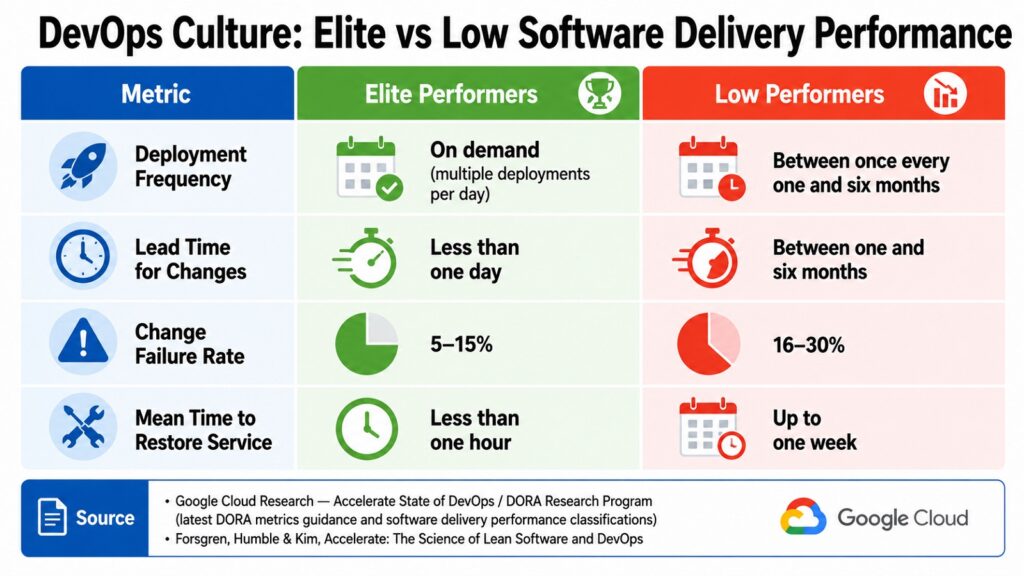
Announcing the completion of a DevOps Culture transformation is a frequent and expensive error. Culture should not be viewed as a project with a definitive end date; rather, it is an organizational capability that necessitates ongoing attention, evaluation, and reinforcement. Organizations that consider their transformation to be complete often witness a decline in their achievements within a few years as habits change and priorities evolve.
Measuring DevOps Culture is harder than measuring deployment frequency or mean time to recovery. Behavioral and attitudinal changes do not appear in system logs. They show up in survey data, in the quality of retrospective conversations, in how quickly teams surface problems, and in how willingly knowledge flows across organizational boundaries. These signals are softer than engineering metrics, but they are no less real.
The DORA research program, now part of Google Cloud, produces the most widely cited body of research on software delivery performance and organizational culture. Their annual State of DevOps reports consistently show that high-performing engineering organizations score differently on cultural measures — particularly psychological safety, information flow quality, and learning orientation — compared to average or low performers.
Capital One’s DevOps journey illustrates the role of measurement in sustaining cultural progress. The financial services company implemented cultural assessment surveys alongside engineering metrics to track transformation progress. When survey data showed that psychological safety scores in certain teams were lower than expected, leadership used that information to investigate and address specific organizational dynamics.
The limitations of cultural measurement are worth acknowledging. Survey data can be gamed when employees fear that honest responses will be used against them. Goodhart’s Law — the principle that a measure ceases to be a good measure once it becomes a target — applies to cultural metrics as directly as to engineering ones. The most effective approach treats measurement as a conversation starter rather than a scorecard.
Sustaining DevOps Culture over the long term requires the same disciplines that building it required. Ongoing investment in learning. Consistent leadership modeling. Regular assessment of whether the organization is actually behaving according to its stated values. Culture does not maintain itself. It either grows or it declines.
Table 9: DevOps Culture Measurement Approaches and the Insights They Provide
| Measurement Approach | Insight Provided |
| Psychological safety surveys | Reveals whether team members feel safe enough to communicate honestly and take risks |
| DORA four key metrics | Measures software delivery performance as a proxy for overall DevOps maturity |
| Team health checks | Provides a regular qualitative assessment of team dynamics, collaboration, and morale |
| Retrospective quality assessment | Evaluates whether improvement conversations are honest, structured, and actionable |
| Knowledge sharing frequency | Tracks whether expertise is moving across team boundaries or remaining concentrated |
| Incident response behavior analysis | Reveals whether blameless practices are being followed or blame culture is persisting |
| Employee engagement scores | Indicates whether engineering teams feel connected to organizational purpose and values |
| Cultural maturity model assessment | Positions the organization on a maturity continuum and identifies the next improvement areas |
Conclusion: The Future of DevOps Culture in Modern Software Engineering
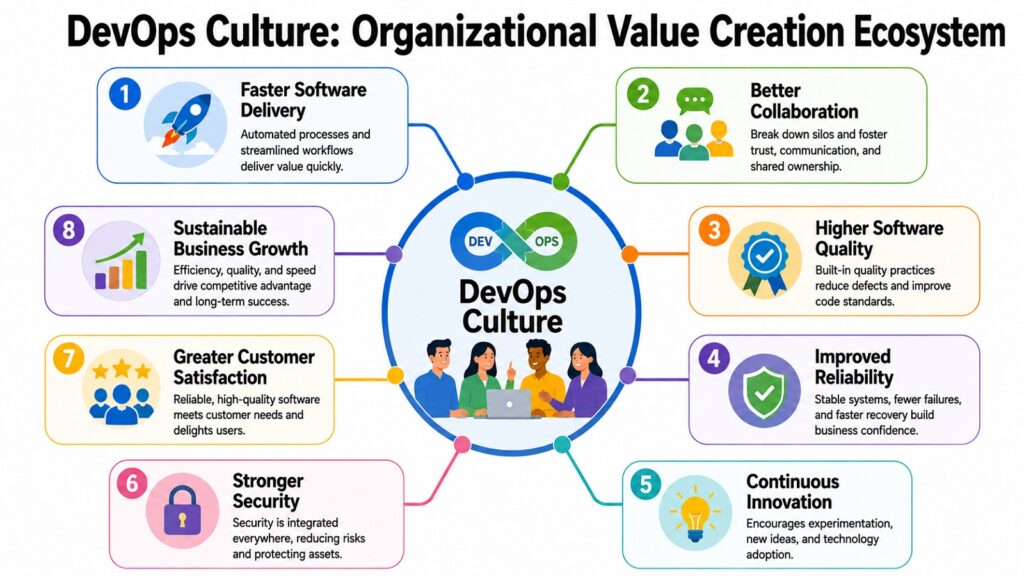
The eight aspects explored in this article do not exist in isolation. They form a system. Principles establish direction. The CALMS Framework provides structure. Collaboration and cross-functional teamwork translate values into organizational design. Continuous learning and blameless improvement ensure the organization grows from experience. Leadership makes it all possible by creating the conditions culture requires. Measurement ensures that progress is real rather than assumed.
DevOps Culture is sometimes described as difficult to define. That assessment is fair in the sense that culture is always easier to observe than to articulate. But the practices, behaviors, and organizational choices described in this article are specific and learnable. Organizations that invest in them consistently outperform those that rely on tools and processes alone.
The future of DevOps Culture will be shaped by forces that are already visible. Artificial intelligence will change how software is written, reviewed, and deployed, but it will not resolve the human coordination problems that DevOps Culture exists to address. Platform engineering will standardize delivery infrastructure, but platforms only work well when the teams using them share knowledge and collaborate across boundaries. The principles and practices described here will remain relevant even as the technologies around them evolve.
DevOps Culture is not a destination. It is an organizational capability that either grows or declines depending on how much attention it receives. The teams that understand this will be the ones that continue to improve as everything else changes around them.
Table 10: DevOps Culture — Eight Aspects and Their Key Takeaways
| Aspect | Key Takeaway |
| Core Principles | Shared values like collaboration, ownership, and fast feedback are the foundation of everything else |
| CALMS Framework | Use it as a diagnostic tool to assess cultural maturity across five interconnected dimensions |
| Collaboration | Replacing silos with shared ownership is an ongoing organizational commitment, not a one-time change |
| Cross-Functional Teamwork | Teams with diverse expertise and shared accountability deliver faster and recover better |
| Continuous Learning | Organizations that invest in reflection and knowledge sharing compound their advantage over time |
| Blameless Improvement | Psychological safety is a measurable organizational asset that directly improves system reliability |
| Leadership | Cultural transformation fails without visible, sustained leadership commitment at every level |
| Measurement and Sustainability | Culture must be assessed and reinforced continuously rather than assumed to be stable once achieved |