Table of Contents
Introduction: Strategic Analysis as the Foundation of Business Strategy
Organizations today collect more information than at any point in history, yet many still struggle to understand the strategic reality they operate in. The challenge is rarely a shortage of data. It is the inability to determine what actually matters, recognize meaningful patterns, understand what those patterns imply, and translate evidence into strategic insight that genuinely informs decisions. This is precisely where Strategic Analysis becomes indispensable.
Strategic Analysis is a disciplined process through which an organization examines both its internal and external realities to develop a coherent, evidence-based understanding of its current strategic position. It answers a fundamental question before any major decision is made: what is actually happening, and what does it mean for this organization?
Within Business Strategy, Strategic Analysis occupies a specific and distinct role. It is not Vision and Mission, which articulate purpose and aspiration. It is not Strategic Planning, which develops objectives and roadmaps. It is not Strategic Execution, Strategic Performance Management, Strategic Governance, or Strategic Innovation. Each of these builds on the understanding that Strategic Analysis produces. Strategic Analysis comes first, grounding subsequent decisions in something more reliable than intuition or assumption.
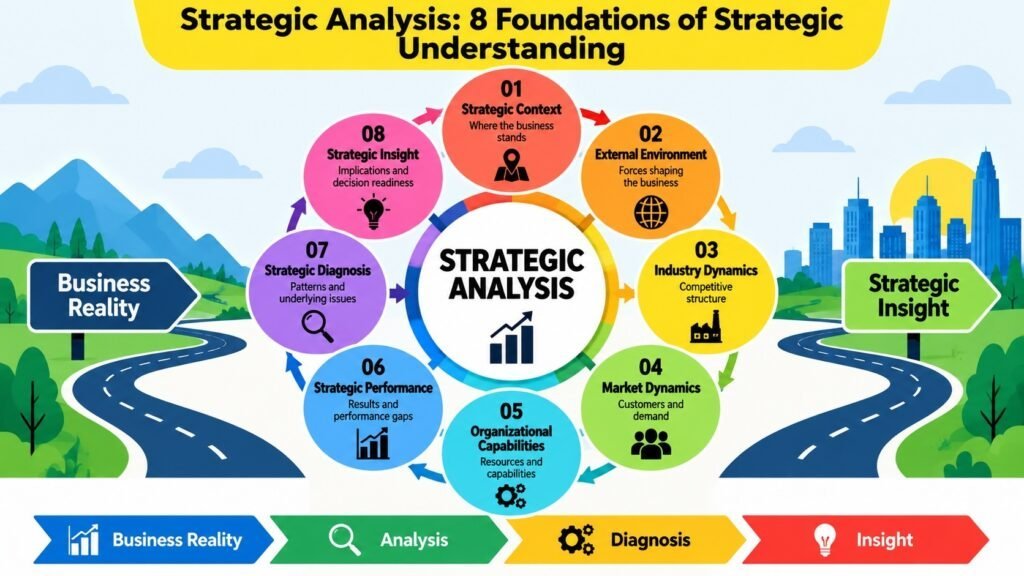
Frameworks such as PESTLE, Porter’s Five Forces, VRIO, Value Chain Analysis, SWOT, and scenario analysis are instruments for organizing evidence and guiding inquiry. They do not produce strategic insight on their own. Insight requires judgment, interpretation, and critical reasoning. Frameworks support that process; they do not replace it. This article examines eight dimensions of Strategic Analysis, showing how each contributes to an integrated understanding of strategic position, moving from strategic context and business position through to strategic insight and decision readiness.
Table 1: Strategic Analysis – Eight Dimensions at a Glance
| Strategic Analysis Aspect | What It Examines |
| Strategic Context and Business Position | Current situation, market standing, assumptions, constraints |
| External Environment | Political, economic, social, technological, legal, environmental forces |
| Industry and Competitive Dynamics | Industry structure, rivalry, barriers, strategic groups |
| Market and Customer Dynamics | Demand patterns, segmentation, customer needs, purchasing behavior |
| Resources and Organizational Capabilities | Internal assets, competencies, capability gaps, dependencies |
| Strategic Performance | Financial and operational results, trends, gaps, strategy alignment |
| Strategic Synthesis and Diagnosis | Integrating findings into patterns, implications, and diagnosis |
| Strategic Insight and Decision Readiness | Key insights, uncertainties, priorities, readiness for choices |
1. Strategic Analysis Through Strategic Context and Business Position
Before examining any specific external or internal factor, Strategic Analysis requires a clear understanding of the organization’s current situation. Strategic context is the lens through which all subsequent findings must be interpreted. Without it, analysis becomes an unfocused collection of observations rather than a coherent examination of strategic reality.
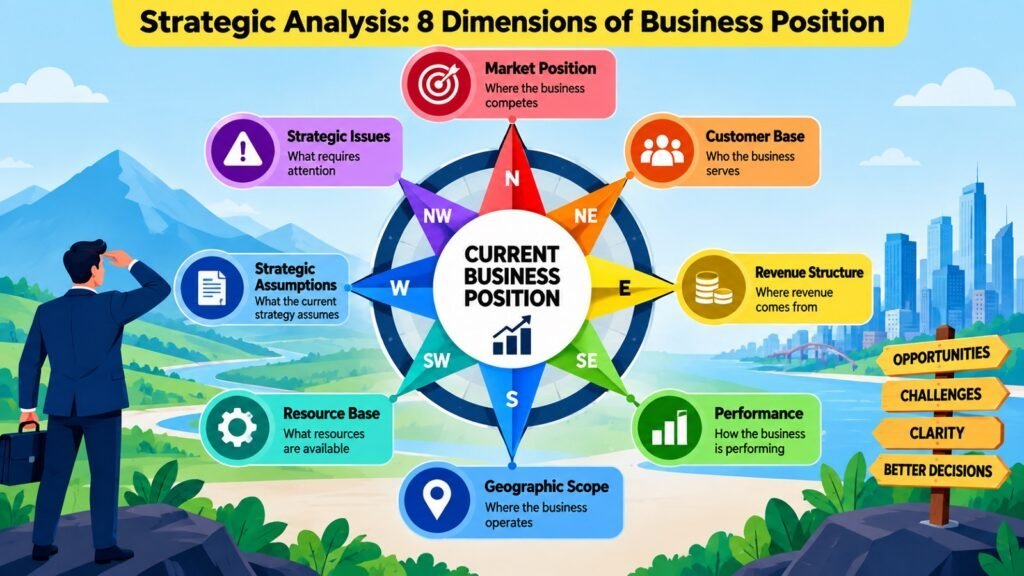
Strategic context encompasses the organization’s current business situation, market standing, recent financial and operational performance, the strategic assumptions on which it has been operating, the constraints and dependencies shaping its choices, and the significant issues it currently faces. These elements define the frame within which analysis takes place. They determine which external forces are genuinely relevant, which internal capabilities are strategically significant, and which performance gaps demand attention.
Business position differs from a simple description of financial results. A company can be profitable in the short term while holding a structurally weakening market position. Conversely, an organization investing heavily and reporting modest returns may occupy a strategically strong position for the future. Understanding the difference requires examining market share trends, customer loyalty, competitive standing, and the durability of existing revenue streams.
An important discipline at this stage is identifying the strategic questions that the analysis is meant to answer. Organizations beginning with indiscriminate data collection often produce extensive reports that lack strategic focus. Framing specific questions about competitive position, growth potential, capability requirements, or emerging risks gives the analysis coherence and separates useful evidence from background noise.
Analysts should distinguish clearly between describing the current state and interpreting what it means strategically. A description tells you where the organization is. An interpretation tells you whether that position is sustainable, improving, or under threat, and why. A poorly defined context produces fragmented analysis because different analysts interpret findings through conflicting assumptions. A well-defined context creates a shared platform and a meaningful baseline for evaluating all subsequent findings.
Table 2: Strategic Analysis – Dimensions of Strategic Context and Business Position
| Context Dimension | What Strategic Analysis Examines |
| Current Business Situation | Revenue, profitability, growth trajectory, recent performance changes |
| Market Position | Relative market share, brand strength, customer perception vs. competitors |
| Strategic Assumptions | Beliefs about markets, customers, and competition underlying strategy |
| Constraints and Dependencies | Financial limits, regulatory boundaries, supply or partner dependencies |
| Significant Strategic Issues | Pressing challenges or decisions requiring near-term attention |
| Performance Context | Whether results reflect execution quality or environmental conditions |
| Competitive Standing | Position relative to rivals across performance and capability dimensions |
| Analytical Questions | Specific strategic questions the analysis is designed to address |
2. Strategic Analysis Through the External Environment
No organization operates in isolation. Every business is embedded in a broader environment shaped by forces that its leaders do not control but cannot afford to ignore. Strategic Analysis examines these external forces not simply to catalog them but to determine which are genuinely significant, how they interact, and what they imply for the organization’s current and future strategic position.
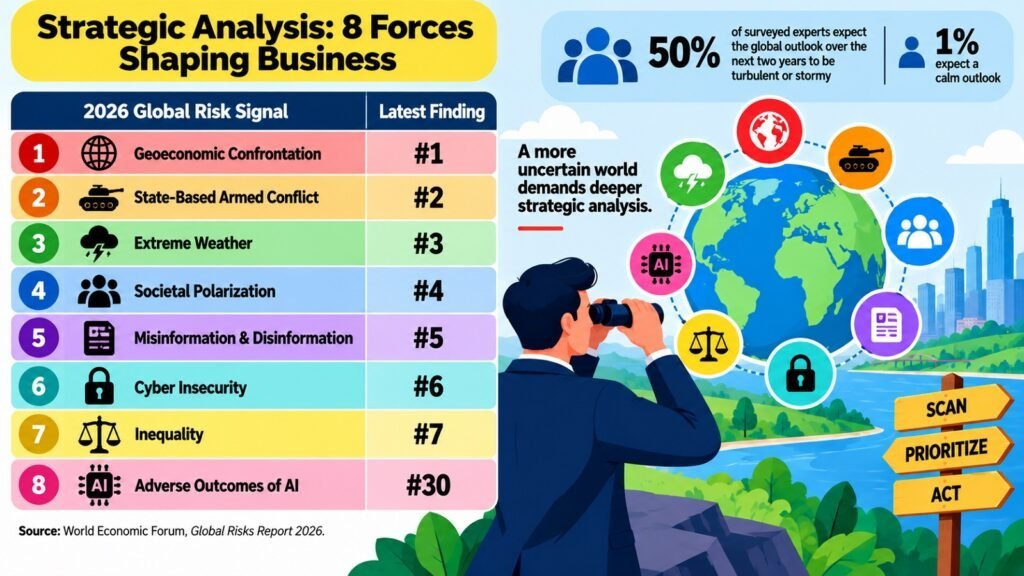
The external environment contains overlapping forces: political dynamics and government policy, macroeconomic conditions, social and demographic trends, technological change, environmental and sustainability pressures, legal and regulatory frameworks, and geopolitical developments. PESTLE provides a useful structure for organizing this examination, ensuring analysts work systematically across the landscape without overlooking important areas.
Using PESTLE as a checklist, however, produces descriptions rather than insights. Strategic value depends on distinguishing isolated events from recurring trends, recognizing structural shifts from temporary fluctuations, identifying weak signals of emerging change, and determining which developments can genuinely alter strategic assumptions. Time horizon matters considerably: forces that appear distant can become strategically critical with surprising speed, while others that seem urgent may fade without lasting impact.
Evidence quality shapes the reliability of environmental analysis. Credible institutional sources such as central banks, government statistical agencies, and established research institutions provide more reliable data than speculative commentary. Where uncertainty is high, scenario analysis is a valuable complement to environmental scanning, allowing organizations to examine how different combinations of external developments might alter strategic conditions.
Throughout this examination, the critical discipline is distinguishing what is significant for this specific organization from what is simply happening in the world. Strategic Analysis filters the external environment through the strategic context established at the outset, selecting developments that can genuinely alter opportunities, threats, constraints, or assumptions relevant to the organization.
Table 3: Strategic Analysis – Major External Forces and Their Strategic Relevance
| External Force | Strategic Relevance |
| Political and Governmental | Trade policy, government stability, public spending, regulatory direction |
| Economic | Growth rates, inflation, interest rates, exchange rates, consumer spending |
| Social and Demographic | Population shifts, workforce trends, changing values, lifestyle patterns |
| Technological | Emerging technologies, digitization, automation, innovation rates |
| Environmental and Ecological | Climate risks, resource constraints, sustainability regulations |
| Legal and Regulatory | Compliance requirements, legal changes, industry-specific regulations |
| Geopolitical | Regional conflicts, supply chain disruptions, shifting trade relationships |
| Demographic | Age structure, urbanization, migration patterns, labor market composition |
3. Strategic Analysis Through Industry and Competitive Dynamics
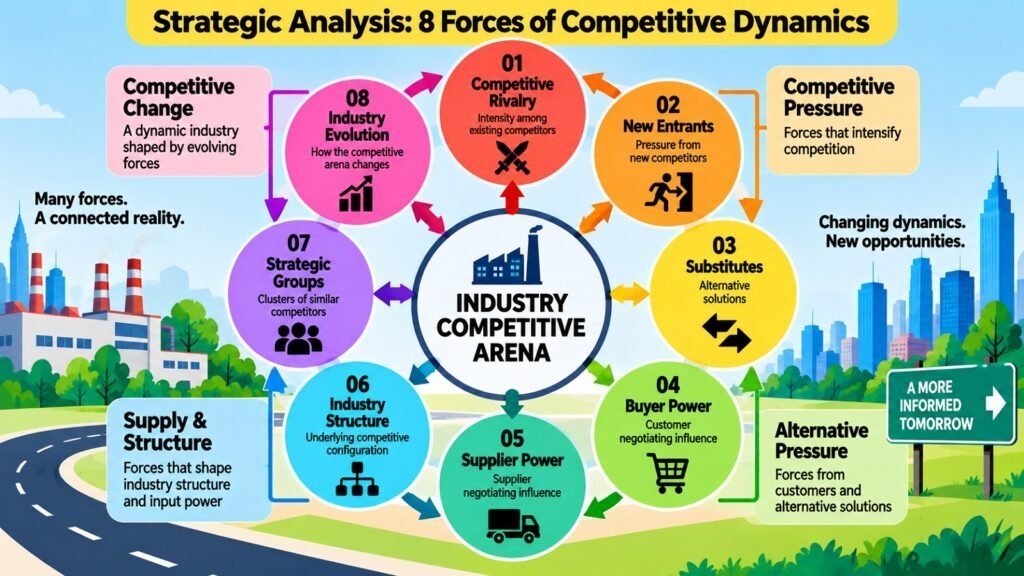
While environmental analysis examines broad forces affecting all businesses, Strategic Analysis must also descend into the specific industry and competitive arena where the organization actually competes. Industry structure and competitive behavior are not neutral backgrounds; they directly influence what is possible, what is profitable, and what risks an organization faces.
Porter’s Five Forces remains one of the most widely used frameworks for examining industry structure. It directs attention to competitive rivalry, the threat of new entrants, supplier power, buyer power, and the threat of substitutes. Each force shapes the balance of power within an industry and influences profitability potential. Industries where all five forces are intense tend to be structurally difficult, while those where most forces are weak can sustain higher margins.
The Five Forces framework is a starting point, not a complete picture. It works best as a diagnostic tool revealing competitive conditions rather than a formula predicting outcomes. Competitive dynamics change as technology shifts industry boundaries, new business models erode established positions, regulation realigns competitive advantages, and new entrants challenge incumbents with different cost structures or customer propositions.
Competitor analysis adds an important dimension by examining individual rivals. This goes beyond benchmarking. It requires understanding competitors’ strategic intentions, the capabilities they possess and are building, the moves they are likely to make, and how they might respond to changes in market conditions or to the organization’s own strategic actions. Strategic groups analysis reveals which companies compete on similar bases and where the most direct competitive pressure originates.
The goal of industry and competitive analysis within Strategic Analysis is clarity about the competitive environment: how it is structured, why it is changing, and what those changes imply. This is distinct from developing competitive advantage, which belongs to strategy formulation. Here, the task is to understand the landscape clearly enough to make informed strategic decisions.
Table 4: Strategic Analysis – Dimensions of Industry and Competitive Analysis
| Competitive Dimension | What Analysis Reveals |
| Competitive Rivalry | Intensity of direct competition, pricing pressure, market concentration |
| Threat of New Entrants | Ease of entry, capital requirements, effectiveness of barriers |
| Supplier Power | Supplier concentration, switching costs, input cost vulnerability |
| Buyer Power | Customer concentration, price sensitivity, backward-integration ability |
| Threat of Substitutes | Alternative products or services that could replace current offerings |
| Industry Life Cycle Stage | Growth, maturity, or decline stage and its strategic implications |
| Strategic Groups | Clusters of competitors on similar strategies and their relative positions |
| Competitive Dynamics and Change | Technology, regulation, or business models reshaping competition |
4. Strategic Analysis Through Market and Customer Dynamics

Competitive analysis examines who the rivals are and how they behave. Market and customer analysis examines something equally important but distinctly different: where demand exists, how it is evolving, and what customers genuinely need and value. These are supply-side and demand-side perspectives, and Strategic Analysis requires both to produce a complete picture of the strategic landscape.
Market analysis begins with size and growth, but headline figures can be misleading. A market growing at 8 percent annually may be expanding in some segments while contracting in others. Demographics may be shifting in ways that alter the long-term demand profile. The quality, composition, and direction of market growth often matter more than the aggregate rate, and analysts relying only on top-line figures risk missing strategically important developments within the market.
Customer analysis examines the needs, behaviors, purchasing criteria, willingness to pay, and switching behavior of the customers the organization serves and seeks to attract. It asks which needs are well satisfied and which remain unmet, how customer expectations are evolving, and whether customer economics are changing in ways that alter purchasing power or decision-making. Unmet needs and underserved segments can represent significant opportunities, but identifying them requires more than surface-level research.
Evidence sources include primary research such as surveys and interviews, behavioral and transaction data, credible industry research, and regulatory filings. Each source has limitations. A survey may reflect stated rather than actual behavior. Transaction data reveals patterns without explaining causes. Combining multiple sources and triangulating findings reduces the risk of misleading conclusions drawn from any single source.
Market and customer findings gain strategic significance when read alongside environmental trends, competitive dynamics, and organizational capabilities. A structural shift in customer behavior becomes strategically urgent when it is occurring in a segment where the organization has concentrated revenue and limited capacity to adapt quickly.
Table 5: Strategic Analysis – Market and Customer Dimensions and Their Strategic Insights
| Market / Customer Dimensions of Strategic Analysis | Strategic Insight |
| Market Size and Growth | Scale of opportunity, growth sustainability, investment attractiveness |
| Market Segmentation | Variation in needs, profitability, and growth across customer groups |
| Customer Needs and Priorities | What customers value most and how priorities are changing |
| Purchasing Criteria | Factors driving supplier selection and switching behavior |
| Willingness to Pay | Pricing ceiling, value perception, revenue and margin implications |
| Unmet Needs | Gaps between current offerings and expectations, representing opportunity |
| Customer Economics | Changes in customer financial conditions affecting demand and spend |
| Demand Trends | Structural versus cyclical demand changes and forecasting implications |
5. Strategic Analysis Through Resources and Organizational Capabilities
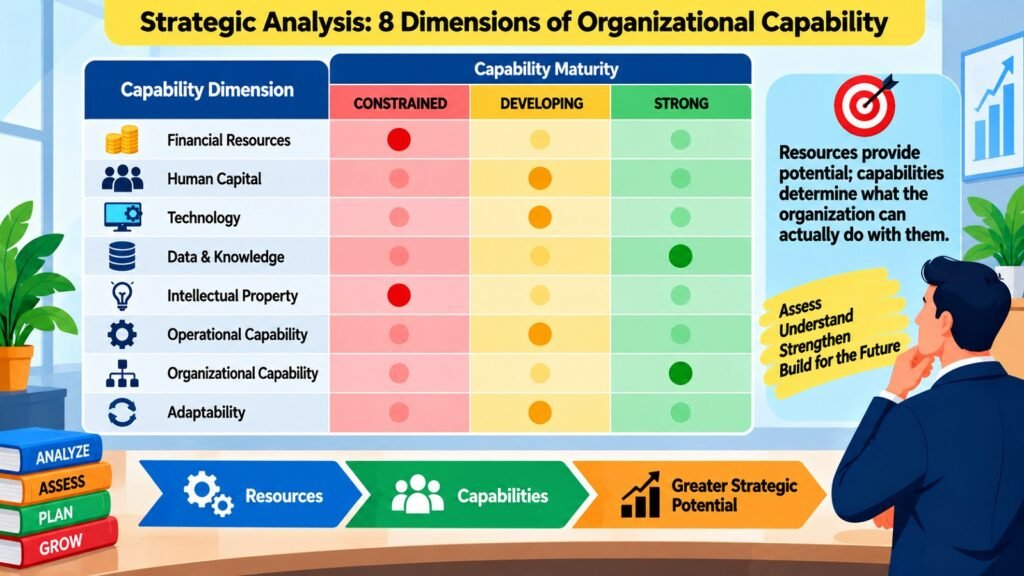
Understanding the external environment is only half of the analytical picture. Strategic Analysis must also turn inward to examine what the organization possesses and what it can genuinely do. Resource and capability analysis determines the internal foundation on which any strategy must be built, and it often reveals significant gaps between what leadership assumes the organization can do and what it can actually deliver.
The Resource-Based View, developed through the work of scholars including Edith Penrose, Birger Wernerfelt, and Jay Barney, argues that sustained competitive performance is rooted in valuable, rare, and difficult-to-imitate resources and capabilities. VRIO analysis evaluates whether a resource is Valuable, Rare, hard to Imitate, and supported by the Organization, providing a structured way to assess which internal assets carry genuine strategic significance. Value Chain Analysis, introduced by Michael Porter, maps value-creating activities and identifies where strengths and inefficiencies reside.
A critical distinction runs through this analysis: owning a resource is not the same as possessing the organizational capability to deploy it effectively. A company may own advanced technology without the talent or processes to exploit it. It may have strong customer relationships in one market without the organizational routines to replicate that performance elsewhere. Resources are inputs; capabilities are the organizational ability to deploy those inputs under competitive conditions.
Strategic Analysis of internal resources should examine tangible assets such as financial strength, physical infrastructure, and technology platforms alongside intangibles including brand equity, intellectual property, proprietary data, knowledge, and culture. Human capital and the quality of organizational processes are often strategically significant but rarely formally analyzed. Capability gaps, resource dependencies, and underutilized assets deserve particular attention because they can constrain strategic choices in ways not immediately visible from financial reports.
Table 6: Strategic Analysis – Resources, Capabilities, and Analytical Focus
| Resource or Capability | Analytical Focus |
| Financial Resources | Capital availability, funding flexibility, ability to sustain investment |
| Human Capital | Talent quality, leadership depth, critical skills vs. competitive requirements |
| Technology and Digital Assets | Technology maturity, proprietary systems, digital operational capability |
| Intellectual Property | Patents, trademarks, proprietary knowledge providing competitive protection |
| Brand and Reputation | Market recognition strength, customer trust, positioning differentiation |
| Operational Processes | Efficiency, scalability, and consistency of core operational routines |
| Organizational Culture | Alignment between culture and strategic requirements; adaptability |
| Data and Analytics Capability | Data asset quality and ability to derive actionable strategic insight |
6. Strategic Analysis Through Strategic Performance
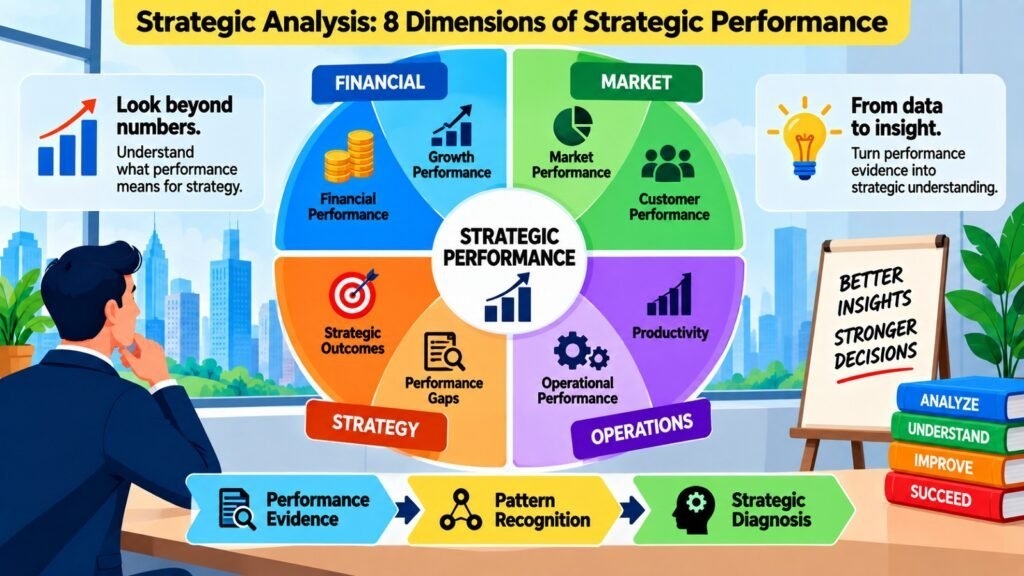
Performance data is among the most direct evidence available for Strategic Analysis. How an organization has actually performed compared with expectations, prior periods, and competitors reveals whether its current strategy is working, where assumptions have proved incorrect, and where emerging risks or opportunities may be developing. Used diagnostically rather than merely descriptively, performance analysis becomes a powerful analytical lens.
A single metric or short time period rarely provides sufficient evidence for strategic diagnosis. An improvement in operating margin may reflect genuine efficiency gains or a temporary reduction in input costs. Revenue growth may indicate strong demand or aggressive discounting that will eventually damage profitability. Strategic Analysis requires examining multiple performance dimensions over appropriate time horizons, looking for patterns and relationships rather than isolated results.
Benchmarking and gap analysis add useful context by comparing performance against competitors, industry norms, or the organization’s own historical trajectory. These comparisons require careful handling. Comparing a regional company against a global leader can produce misleading conclusions, and comparing results against a prior year affected by unusual conditions distorts apparent trends. Context matters as much as the comparison itself.
An important distinction separates Strategic Performance Analysis from Strategic Performance Management. This section concerns the former: using performance as evidence to evaluate whether strategic assumptions are proving correct. Strategic Performance Management, a separate discipline, deals with the systems, processes, and governance practices organizations use to set targets, track progress, and manage performance over time. Strategic Analysis uses performance as evidence; it does not design performance management systems.
Strong performance analysis asks not just what happened, but why it happened and what it means strategically. A company experiencing flat revenue growth in an expanding market faces a very different strategic question from one experiencing the same result in a contracting market. The diagnostic value lies in connecting results to underlying causes and strategic implications.
Table 7: Strategic Analysis – Performance Dimensions and Strategic Evidence
| Performance Dimension | Strategic Evidence |
| Revenue Growth | Demand strength, market share changes, pricing power trends |
| Profitability Trends | Cost structure health, pricing dynamics, value creation efficiency |
| Market Share Movement | Competitive position changes, relative customer preference signals |
| Customer Retention and Loyalty | Strategy effectiveness in meeting needs and sustaining relationships |
| Operational Productivity | Process efficiency, resource utilization, operations scalability |
| Return on Investment | Capital allocation effectiveness, strategic investment decision quality |
| Progress Against Objectives | Alignment between strategic intentions and actual outcomes |
| Actual Versus Expected Outcomes | Reliability of strategic assumptions, forecasting and planning quality |
7. Strategic Analysis Through Strategic Synthesis and Diagnosis
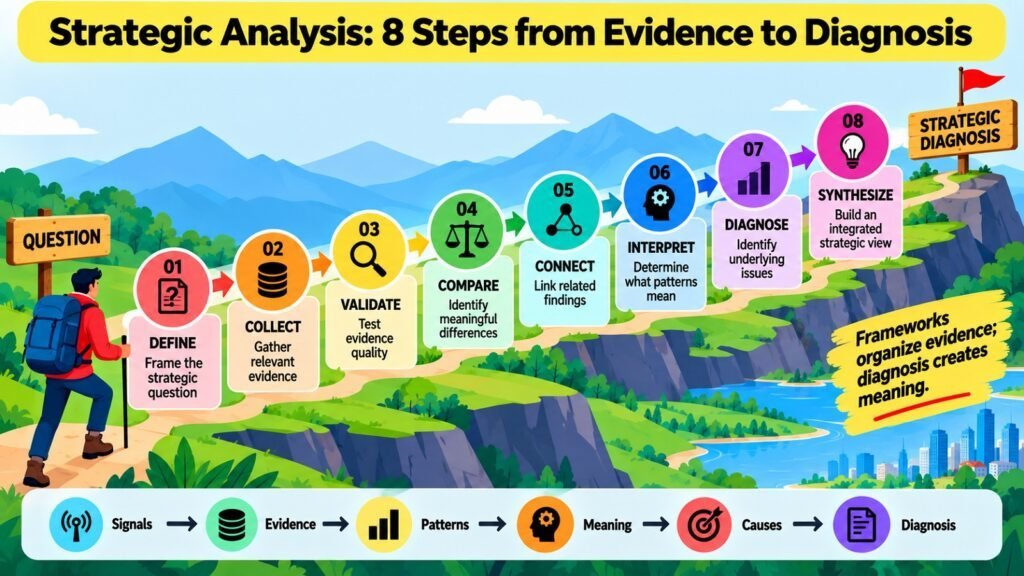
The preceding dimensions of Strategic Analysis generate substantial evidence: environmental data, industry intelligence, market findings, customer research, capability assessments, and performance results. Yet information does not interpret itself. Synthesis and diagnosis are the processes through which separate findings are connected, patterns are identified, and evidence is transformed into genuine strategic understanding.
The distinction between information and insight is significant. A finding tells you that something is true. A pattern reveals that several findings are connected in a meaningful way. An implication tells you what that pattern means for the organization. A diagnosis integrates multiple implications into a coherent account of the strategic situation. This conceptual sequence, from signal to evidence to pattern to implication to diagnosis, represents the progression of analytical reasoning that separates genuine Strategic Analysis from the mere presentation of data.
Several practices support effective synthesis. Triangulation, comparing findings across different evidence sources to test consistency or contradiction, builds analytical confidence. Distinguishing symptoms from underlying causes prevents organizations from developing strategies that address surface problems while leaving deeper structural issues unresolved. Testing assumptions against new evidence can reveal strategic beliefs that once held but have become outdated as markets, technologies, and competitive conditions evolved.
SWOT analysis, used at the synthesis stage rather than as the entirety of Strategic Analysis, provides a useful integrating tool. Its value lies not in listing strengths, weaknesses, opportunities, and threats but in examining interactions between them. TOWS extends this by exploring how strengths can be applied to opportunities, how weaknesses might be addressed before threats materialize, and where dangerous mismatches between internal limitations and external pressures exist. Reliable analysis draws from credible institutional sources, primary research, and company disclosures. Analysts should be explicit about evidence limitations, since false certainty in strategic diagnosis leads to confident decisions built on unreliable foundations.
Table 8: Strategic Analysis – Analytical Stages in the Synthesis and Diagnosis Process
| Analytical Stage | Purpose |
| Evidence Collection | Gather relevant data from credible internal and external sources |
| Pattern Recognition | Identify recurring themes or connections across evidence streams |
| Assumption Testing | Challenge existing strategic beliefs against current evidence |
| Triangulation | Cross-check findings across sources to assess reliability and consistency |
| Implication Development | Determine what identified patterns mean for strategic position |
| Root Cause Analysis | Distinguish underlying strategic causes from visible surface symptoms |
| SWOT and TOWS Synthesis | Integrate findings into strength-weakness-opportunity-threat interactions |
| Strategic Diagnosis | Form a coherent, evidence-based account of the overall strategic situation |
8. Strategic Analysis Through Strategic Insight and Decision Readiness
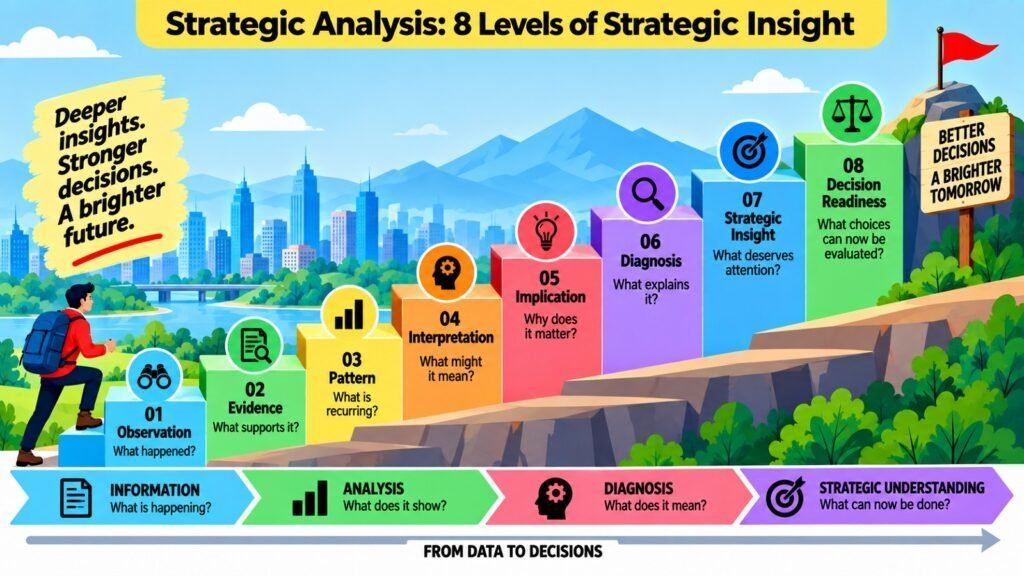
Strategic Analysis reaches its ultimate purpose when it produces genuine strategic insight and equips an organization to evaluate its choices with clarity and confidence. The objective is not simply to complete a set of analytical frameworks. The objective is decision readiness: the state in which leaders understand the strategic situation clearly enough to evaluate alternatives intelligently, identify what they do not yet know, and recognize which questions must be resolved before committing to a direction.
Distinguishing information from insight is essential here. Information tells you what exists. Analysis identifies patterns and relationships. Diagnosis explains what those patterns mean for the organization. Insight captures implications sufficiently significant and clear to genuinely alter strategic thinking. Decision readiness means having enough insight to evaluate strategic alternatives intelligently, understanding the trade-offs and requirements each option involves.
Strong Strategic Analysis produces several types of insight. It identifies strategic opportunities the organization is positioned to pursue. It surfaces emerging threats not yet visible in financial results but developing in the competitive landscape. It reveals capability gaps, clarifies critical assumptions whose validity determines whether strategies succeed, and surfaces strategic tensions, such as the conflict between growth investment and near-term profitability, that leadership must acknowledge and manage.
One of the most valuable contributions of disciplined Strategic Analysis is making uncertainty visible rather than concealing it. It distinguishes what is known with confidence, what is uncertain but can be estimated, and what remains genuinely unknown. This transparency allows leaders to make decisions with an accurate understanding of information quality rather than with false confidence built on incomplete analysis.
Strategic Analysis stops at the boundaries of Strategic Planning. Its role is to produce understanding, insight, and decision readiness, not to develop strategic objectives, initiatives, or implementation roadmaps. It is the bridge between seeing strategic reality clearly and deciding how to respond to it.
Table 9: Strategic Analysis – Outputs of Decision-Ready Analysis and Their Decision Value
| Strategic Insights | Decision Value |
| Identified Strategic Opportunity | Reveals where demand, capability, and competitive conditions align |
| Emerging Competitive Threat | Early warning before threats materialize in financial performance |
| Capability Gap Assessment | Clarifies internal constraints limiting strategic option viability |
| Critical Assumption Identification | Surfaces beliefs whose validity determines strategic success or failure |
| Strategic Tension Recognition | Exposes competing priorities that leadership must actively resolve |
| Uncertainty Mapping | Distinguishes known facts from estimates and genuine unknowns |
| Evidence-Based Strategic Questions | Frames choices requiring leadership evaluation and judgment |
| Decision-Ready Diagnosis | Coherent, evidence-grounded understanding ready for strategy evaluation |
Conclusion: Strategic Analysis for Stronger Business Strategy
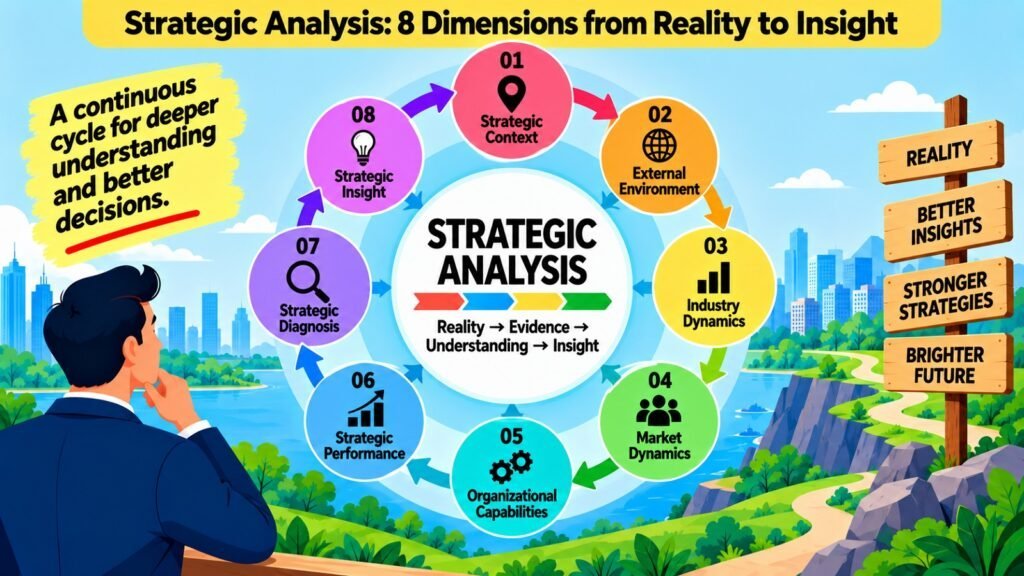
Strategic Analysis is an important aspect of Business Strategy, not because it answers what an organization should do, but because it ensures that question is answered from a position of genuine understanding. The eight dimensions of Strategic Analysis, examined in this article, do not operate as separate exercises. They form an integrated process, each layer building on the one before it and contributing to a progressively clearer picture of strategic reality.
The progression moves from establishing strategic context and business position through the examination of external environmental forces, into the specific competitive dynamics of the industry, and then into the demand-side realities of the market and customers. Analysis turns inward to assess resources and capabilities, determining which strategic options are viable. Performance data is examined as evidence of whether strategic assumptions are holding. Synthesis and diagnosis bring separate findings together into a coherent understanding. Strategic insight and decision readiness then translate that understanding into the clarity needed for serious strategic evaluation.
The real value of Strategic Analysis lies not in data collection or framework completion but in the quality of judgment applied to evidence. Frameworks organize inquiry. Evidence informs judgment. The combination of disciplined inquiry, reliable evidence, critical thinking, and strategic judgment transforms complexity into clarity. Organizations that develop genuine capability in Strategic Analysis build stronger foundations for Strategic Planning because their plans rest on understanding rather than assumption. Strategic Analysis is, at its core, the discipline of seeing business reality clearly before deciding how to respond to it.
Table 10: Strategic Analysis – Eight Dimensions and Their Core Purpose
| Strategic Analysis Dimension | Core Purpose |
| Strategic Context and Business Position | Establish a clear baseline and frame the strategic questions for analysis |
| External Environment | Identify macro-level forces that can alter opportunities, threats, assumptions |
| Industry and Competitive Dynamics | Understand competitive structure, rivalry, and forces shaping outcomes |
| Market and Customer Dynamics | Examine demand patterns, customer needs, and where opportunities exist |
| Resources and Organizational Capabilities | Assess internal strengths, limitations, gaps, and capability requirements |
| Strategic Performance | Interpret results as evidence for evaluating strategic effectiveness |
| Strategic Synthesis and Diagnosis | Integrate findings into coherent patterns, implications, and diagnosis |
| Strategic Insight and Decision Readiness | Translate understanding into insight and readiness for strategy evaluation |