
Table of Contents
Introduction: Innovation Opportunities as a Strategic Growth Foundation
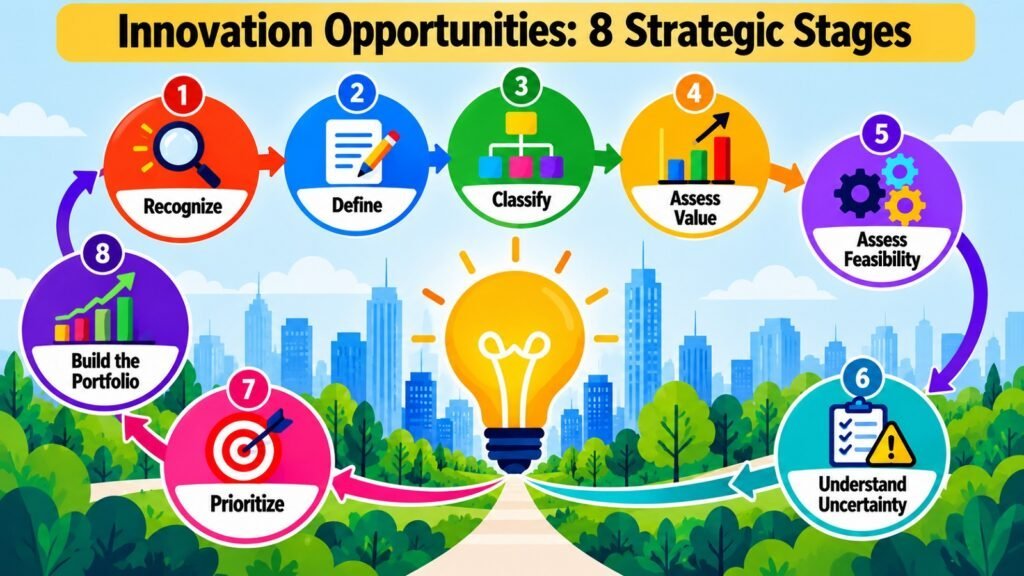
Most organizations assume that innovation begins with generating ideas. That assumption skips a critical step. Before meaningful idea generation can occur, an organization must first understand the opportunity spaces those ideas could address. Innovation Opportunities represent exactly that: the recognized potential spaces where new value could be created, before any specific idea, product, or solution has been proposed. Innovation Opportunities occupy an essential position within overall Innovation Strategy.
An Innovation Opportunity is not a market trend, a customer complaint, a technology development, or a business idea. A trend describes what is changing. A problem describes what is wrong. An idea proposes a specific solution. An Innovation Opportunity occupies the territory between observation and response — it identifies a potential area where new value could be created, without yet specifying how.
This distinction matters because the quality of innovation depends on the quality of the opportunities pursued. McKinsey research has consistently shown that organizations with disciplined, structured opportunity identification generate substantially better long-term returns. The practical question this article addresses is consequential: how can an organization distinguish a genuinely valuable Innovation Opportunity from an interesting idea, trend, problem, or possibility? The eight aspects below provide an integrated framework for answering it.
Innovation Opportunities: Overview of Eight Key Aspects
| Aspects of Innovation Opportunities | What It Explores |
| Opportunity Recognition | How organizations identify meaningful possibility spaces from signals and observations |
| Opportunity Definition | How to articulate an opportunity clearly before assessment or pursuit begins |
| Opportunity Types | How opportunities differ in scope, ambition, uncertainty, and strategic significance |
| Value Potential | How to assess whether an opportunity could create meaningful value across multiple dimensions |
| Feasibility Assessment | How to evaluate whether an opportunity can realistically be pursued under known conditions |
| Uncertainty and Risk | How to identify, understand, and manage the unknowns inherent in every opportunity |
| Evaluation and Prioritization | How to compare and rank opportunities before committing resources or selecting ideas |
| Opportunity Portfolios | How to manage multiple opportunities collectively for strategic balance and long-term value |
1. Innovation Opportunities Through Opportunity Recognition
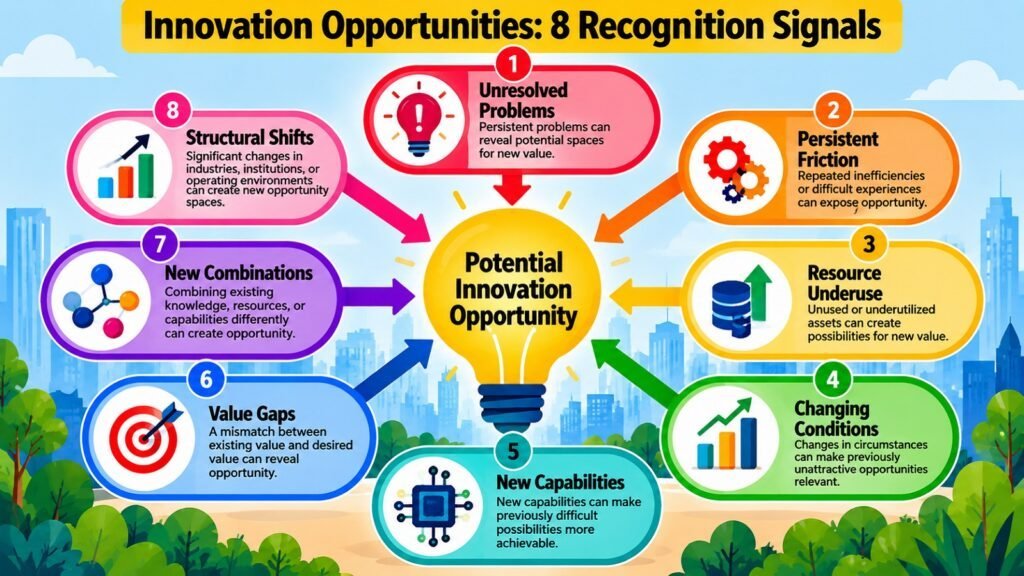
Recognition is the process by which a potential Innovation Opportunity becomes visible to an organization. It is not simply a matter of collecting information or observing trends. An organization can receive the same market signals as a competitor and draw entirely different conclusions. Recognition involves interpretation: taking available observations and determining that a particular situation contains a genuine space for creating new value.
The distinction between related concepts matters here. A signal is a piece of information. An observation is a noticed and recorded signal. A problem is a recognized gap between current and desired states. A possibility is an informal sense that something could be done. An Innovation Opportunity is more structured: a recognized potential space for value creation that an organization has identified and judged worth examining. An idea, by contrast, proposes a specific response within that space.
Research on entrepreneurial alertness, notably Israel Kirzner’s work, argued that entrepreneurs recognize pre-existing possibilities others have overlooked because they possess different knowledge and attention patterns. Organizations operate similarly. Amazon recognized an opportunity in cloud infrastructure partly because it had already built the internal infrastructure for its own retail operations — knowledge competitors in the retail sector did not possess in the same way. Different capabilities and strategic contexts produce different opportunity recognition, even from identical market conditions.
A practical recognition framework asks: Is there meaningful evidence that conditions exist where new value could be created? Does the organization have sufficient knowledge to understand why the opportunity might be real? Is this genuinely an opportunity space rather than a specific idea or widely acted-upon trend? Does it align with the organization’s strategic context? These questions help distinguish structured opportunity identification from informal brainstorming.
Innovation Opportunities: Recognition Signals and Their Meaning
| Recognition Signal | What It May Indicate |
| Unmet customer need persisting across segments | A potential opportunity in value delivery or experience design |
| Emerging technology not yet applied to a known problem | A technical opportunity to enable a new solution space |
| Regulatory change creating new compliance requirements | A service or process opportunity arising from changed external conditions |
| Competitive gap visible in market positioning | A strategic opportunity to offer differentiated value in underserved territory |
| Cost or efficiency pressure in a familiar activity | An operational opportunity for process or resource innovation |
| Behavioral shift in how customers use an existing product | A usage-pattern opportunity revealing new value expectations |
| Industry disruption creating structural instability | A market-entry or repositioning opportunity for prepared organizations |
| Knowledge or capability advantage over current solutions | A resource-based opportunity grounded in internal competence |
2. Innovation Opportunities Through Opportunity Definition
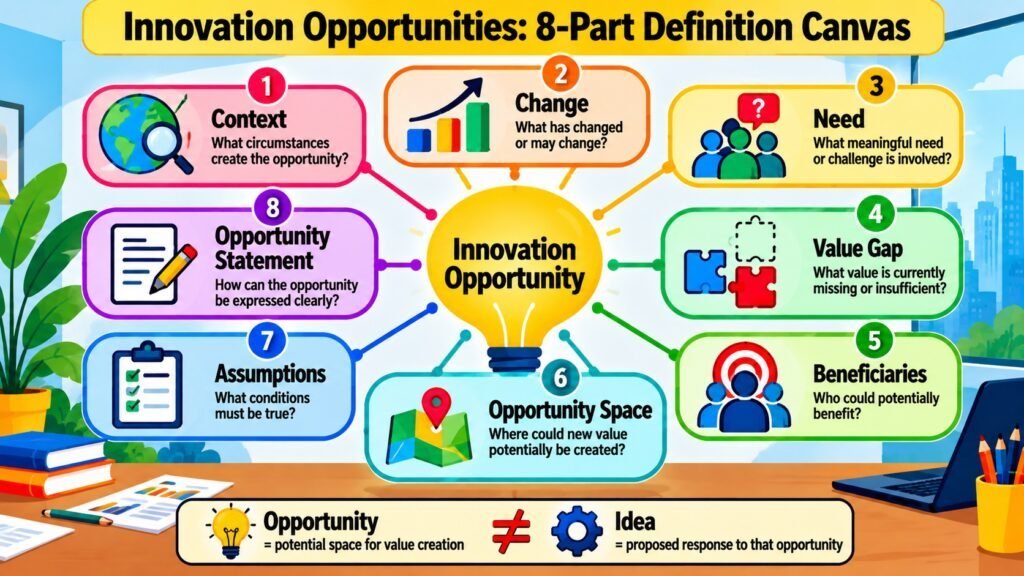
Recognizing a potential Innovation Opportunity is necessary but not sufficient. Before an organization can responsibly assess or pursue an opportunity, it must be clearly described. Opportunity definition is the process of articulating what the opportunity is, why it exists, who it affects, and what kind of value it could create — without yet proposing a specific idea, product, or solution.
The distinction between an opportunity and an idea is critical and frequently overlooked. An Innovation Opportunity describes a potential space for value creation. An idea proposes a specific response within that space. Confusing the two leads organizations to jump prematurely toward a preferred solution before the underlying opportunity has been clearly understood. Teams that begin with the idea rather than the opportunity often discover they have solved the wrong problem, served the wrong audience, or entered less valuable territory than expected.
A well-defined opportunity includes an opportunity statement describing the value-creation space, context explaining why the opportunity exists now, boundaries clarifying scope, affected stakeholders, a conceptual value-creation possibility, and explicit assumptions that can later be tested. Research on opportunity framing consistently shows that how an opportunity is defined materially affects the range of solutions considered. A hospital that defined its opportunity as “reducing emergency department wait times” explored process redesign and technology. One that defined the same situation as “improving patient experience during acute care” opened significantly broader solution territory. Neither definition was wrong; they led to genuinely different innovation pathways.
Innovation Opportunities: Key Elements of Clear Opportunity Definition
| Definition Elements | Key Question |
| Opportunity statement | What potential space for value creation does this opportunity describe? |
| Context and conditions | Why does this opportunity exist now, and what makes it currently relevant? |
| Opportunity boundaries | What is inside the scope of this opportunity and what falls outside it? |
| Affected stakeholders | Who experiences the situation this opportunity addresses? |
| Value-creation possibility | What type of value could a successful innovation deliver here? |
| Underlying assumptions | What beliefs are we treating as true that could later be tested or questioned? |
| Distinction from ideas | Is this an opportunity space or a proposed solution disguised as an opportunity? |
| Strategic relevance | Does this opportunity connect meaningfully to the organization’s goals and capabilities? |
3. Innovation Opportunities Through Opportunity Types
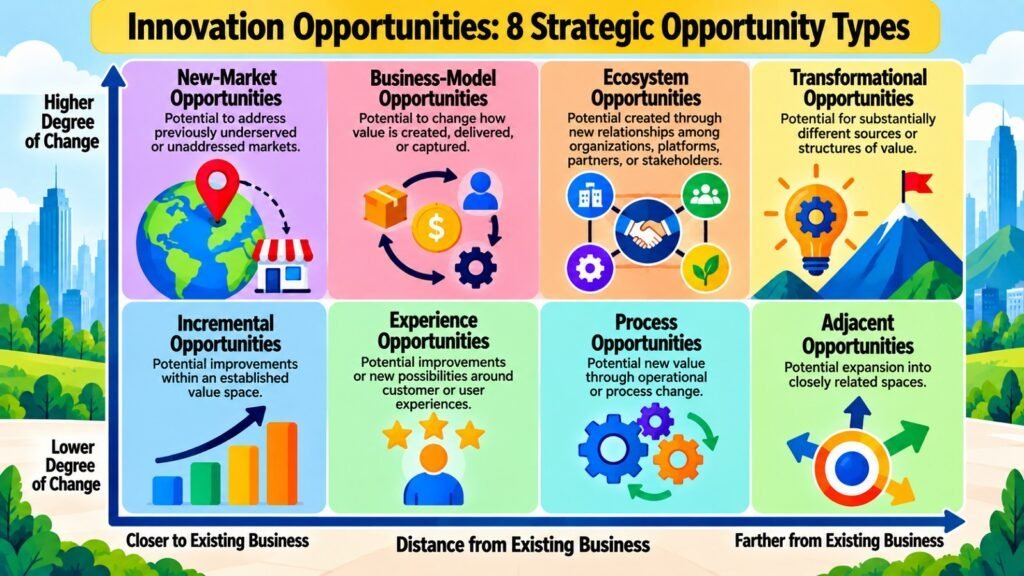
Not all Innovation Opportunities are alike. They differ in scope, ambition, uncertainty, required capabilities, investment horizon, and potential strategic impact. Understanding these differences before pursuing an opportunity helps organizations decide how to approach it, what evidence to gather, how much to invest, and how to govern the process. Classifying opportunity types is not about rigid categories; it is about recognizing that different opportunities call for fundamentally different organizational responses.
Incremental opportunities involve improving or extending existing offerings, processes, or experiences. They carry relatively low uncertainty, require established capabilities, and generate value within short time horizons. Adjacent opportunities involve moving into related markets or value chains that are near but not identical to current operations — requiring some new capability development and carrying moderate uncertainty. Transformational opportunities involve creating entirely new value spaces, often displacing existing solutions. They carry high uncertainty and demand sustained investment, different governance approaches, and longer time horizons.
Beyond these ambition levels, opportunities can be classified by nature. New-market opportunities arise when underserved or entirely new customer segments become accessible. Experience opportunities focus on the end-to-end journey a customer has with a product or organization. Process opportunities address how work is performed internally or across a value chain. Business-model opportunities involve changing how value is created, delivered, and captured. Ecosystem opportunities involve building or participating in partner networks that deliver value no single organization could provide alone. Research by Nagji and Tuff in the Harvard Business Review demonstrated that high-performing innovators deliberately allocated resources across different opportunity types rather than concentrating on one level of ambition.
Innovation Opportunities: Classification by Type and Core Characteristics
| Types of Innovation Opportunities | Core Characteristics |
| Incremental | Improving existing offerings or processes; low uncertainty; short time horizon |
| Adjacent | Entering related markets or capabilities; moderate uncertainty; requires some new skills |
| Transformational | Creating new value spaces; high uncertainty; demands long-term investment and new capabilities |
| New-market | Reaching underserved or entirely new customer segments; may require market-creation effort |
| Experience | Addressing end-to-end customer journey; focuses on perception, ease, and emotional value |
| Process | Improving how work is performed internally or across value chains; often operationally driven |
| Business-model | Changing how value is created, delivered, or captured rather than what is offered |
| Ecosystem | Building or participating in partner networks to deliver collective value beyond individual capacity |
4. Innovation Opportunities Through Value Potential
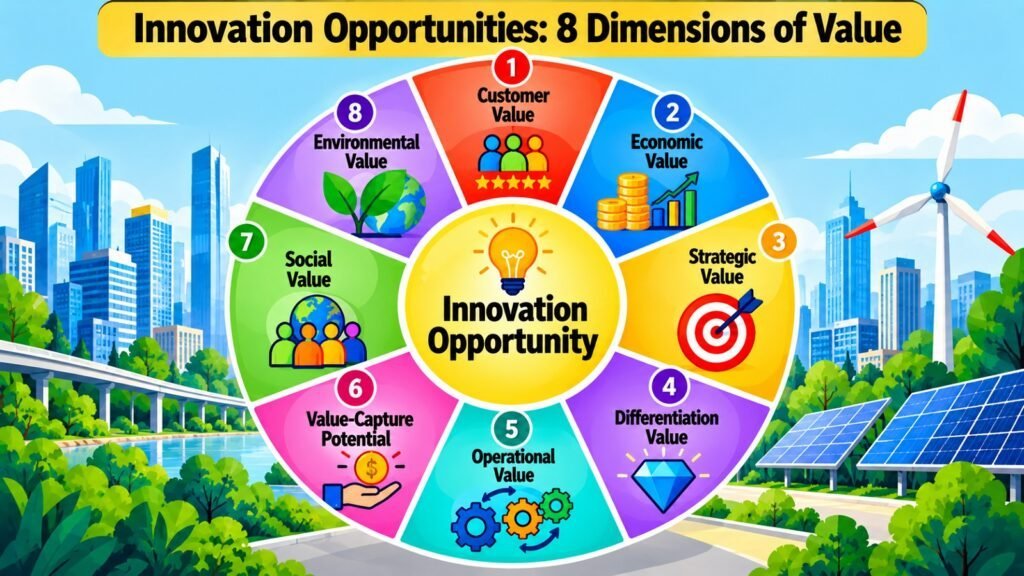
Identifying an Innovation Opportunity does not automatically make it worth pursuing. The central question is whether the opportunity has meaningful potential to create value — and value, in this context, is considerably more than a revenue projection. Organizations that evaluate opportunities purely on financial potential often pursue large markets that prove inaccessible or overlook opportunities with smaller but more achievable returns. Value potential assessment requires examining multiple dimensions before significant resources are committed.
Customer value asks whether the opportunity addresses a genuine need, desire, or problem that real stakeholders experience and care about. Economic value considers whether commercially viable returns are plausible. Strategic value examines whether pursuing the opportunity would strengthen competitive position or advance strategic direction. Operational value considers whether it could improve internal efficiency or resilience. Differentiation potential asks whether a resulting innovation could offer something meaningfully distinct from existing alternatives. Social and environmental value examines outcomes beyond commercial returns — increasingly relevant as organizations manage broader stakeholder expectations.
Organizations should also consider value capture — the portion of created value the organization can actually retain. An opportunity may create substantial social value while offering limited commercial capture potential. Amazon Web Services illustrates this well: when AWS entered cloud infrastructure, the existing market was small. The opportunity’s value potential was visible not in current market size but in the direction of change, the unserved needs of developers and technology teams, and Amazon’s existing infrastructure advantage. A disciplined value-potential analysis distinguishes opportunities with genuine multi-dimensional potential from those that merely appear large or exciting.
Innovation Opportunities: Principal Dimensions of Value Potential
| Innovation Opportunities – Value Dimensions | What to Examine |
| Customer value | Does this address a genuine need, desire, or problem that relevant stakeholders actually experience? |
| Economic value | Could the opportunity generate commercially viable returns within a relevant time horizon? |
| Strategic value | Would pursuing this strengthen competitive position, direction, or organizational capability? |
| Operational value | Could the opportunity improve internal efficiency, resilience, quality, or execution effectiveness? |
| Differentiation potential | Could a resulting innovation offer something meaningfully distinct from existing alternatives? |
| Social value | Could the opportunity generate positive outcomes for broader communities or societal interests? |
| Environmental value | Does the opportunity create possibilities for reducing environmental impact or enabling sustainability? |
| Value-capture potential | What portion of the value created could the organization realistically retain over time? |
5. Innovation Opportunities Through Feasibility Assessment
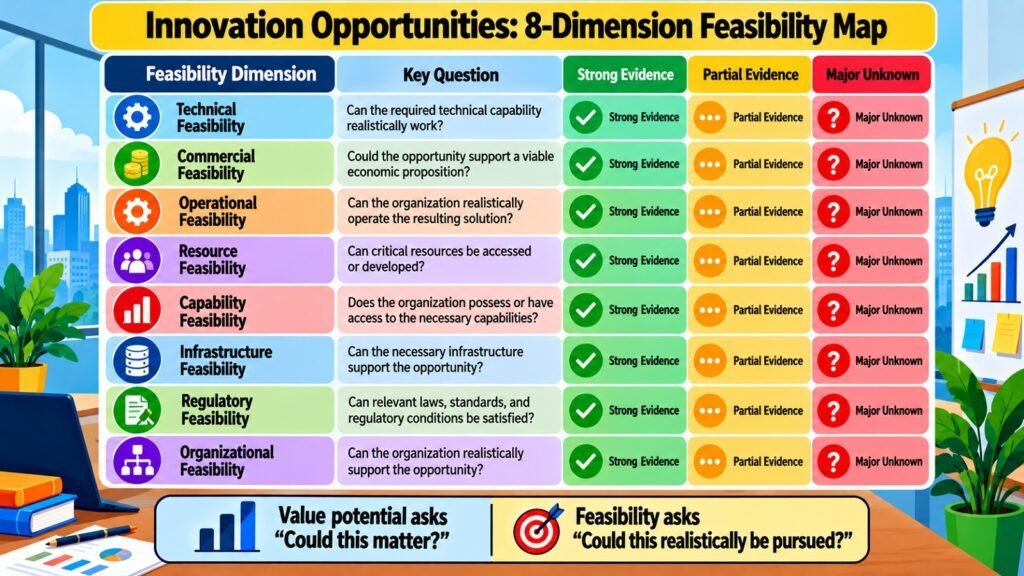
An Innovation Opportunity may have compelling value potential and yet remain impractical because the organization cannot realistically pursue it. Feasibility assessment examines whether an opportunity can actually be acted upon — not whether a specific solution can be built, but whether the conditions necessary to pursue the opportunity meaningfully are accessible. This assessment belongs at the opportunity level, before full development or implementation planning begins.
Technical feasibility asks whether the capabilities, knowledge, tools, or technologies required are available or realistically acquirable. Commercial feasibility examines whether a viable market path and sufficient customer adoption are plausible. Operational feasibility considers whether the organization can support the necessary activities without prohibitive disruption. Resource feasibility evaluates whether the financial, human, and physical resources needed are accessible. Capability feasibility addresses whether the organization has the skills and expertise required to succeed.
Infrastructure feasibility is often overlooked but frequently decisive. An organization may have technical knowledge and financial resources yet lack data infrastructure, distribution channels, regulatory standing, or partner relationships that successful execution requires. Regulatory feasibility is especially important in healthcare, financial services, and other regulated environments. Feasibility assessment is not a binary pass-or-fail judgment — it is a structured examination that helps identify which aspects of an opportunity are clear, which face meaningful challenges, and which require further investigation. Dyson’s documented exit from the electric vehicle market illustrates how feasibility constraints — specifically battery technology economics and manufacturing scale requirements — can ultimately override otherwise attractive opportunity potential.
Innovation Opportunities: Feasibility Assessment Framework
| Innovation Opportunities – Feasibility Dimension | Key Assessment Question |
| Technical feasibility | Are the core technical capabilities, tools, or knowledge required available or acquirable? |
| Commercial feasibility | Is there a plausible path to market with sufficient customer adoption to sustain returns? |
| Operational feasibility | Can the organization support the required activities and processes without prohibitive disruption? |
| Resource feasibility | Are the financial, human, and physical resources needed accessible within relevant constraints? |
| Capability feasibility | Does the organization possess or can it develop the skills and expertise required to succeed? |
| Infrastructure feasibility | Are the data systems, channels, and partner relationships necessary for execution available? |
| Regulatory feasibility | Can the opportunity be pursued within applicable legal, compliance, and regulatory requirements? |
| Organizational feasibility | Does the culture, structure, and governance model support the demands this opportunity would create? |
6. Innovation Opportunities Through Uncertainty and Risk
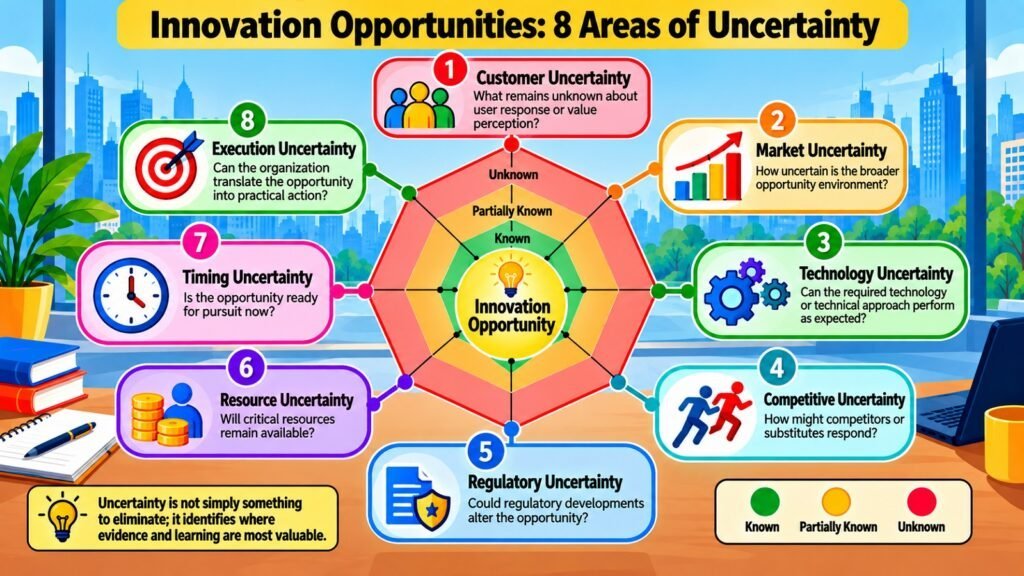
Uncertainty is not a problem to be eliminated from Innovation Opportunities; it is one of their defining characteristics. Every genuine opportunity exists in a space where the future is not fully known, conditions may change, and assumptions about value, feasibility, or market response may prove incorrect. The goal is not to achieve certainty — that is rarely possible — but to identify the most important unknowns, reduce the ones that matter most, and make decisions that acknowledge rather than ignore what is not yet known.
It is worth distinguishing uncertainty from conventional risk. Risk refers to situations where probabilities can be estimated and outcomes modeled with reasonable confidence. Uncertainty, as described by economist Frank Knight, refers to situations where neither outcomes nor their probabilities can be reliably known in advance. Innovation Opportunities typically involve Knightian uncertainty rather than calculable risk, which is why standard risk matrices are often insufficient as primary management tools. Organizations need frameworks designed for exploring unknowns, not simply quantifying known risks.
Key uncertainty dimensions include market uncertainty (whether anticipated demand will materialize), customer uncertainty (whether users will adopt), technology uncertainty (whether the required technical approach will perform reliably), competitive uncertainty (whether rivals will respond in ways that reduce the opportunity’s attractiveness), and timing uncertainty (whether enabling conditions are sufficiently mature). Assumptions testing — deliberately designing small, low-cost experiments to check critical beliefs before major commitments — is a well-documented approach drawn from lean startup methodology. Amazon’s early retail expansion tested consumer willingness to purchase books online before adding further product categories. Staged investment, releasing resources progressively as evidence accumulates, preserves optionality without requiring early overcommitment.
Innovation Opportunities: Key Uncertainty Areas and Evidence Requirements
| Innovation Opportunities and Uncertainty Areas | What to Examine |
| Market uncertainty | Whether anticipated demand patterns, market size, or customer behavior will materialize as expected |
| Customer uncertainty | Whether real users will value, adopt, and continue using an innovation derived from the opportunity |
| Technology uncertainty | Whether the technical approach required will perform reliably at the scale or quality needed |
| Competitive uncertainty | Whether rivals will respond in ways that reduce or change the opportunity’s attractiveness |
| Regulatory uncertainty | Whether applicable rules will evolve in ways that support or constrain the opportunity |
| Resource uncertainty | Whether the financial, human, or organizational resources needed will remain accessible over time |
| Timing uncertainty | Whether market conditions or enabling technologies are sufficiently mature for the opportunity now |
| Execution uncertainty | Whether the organization can develop and deliver a successful response within realistic constraints |
7. Innovation Opportunities Through Evaluation and Prioritization
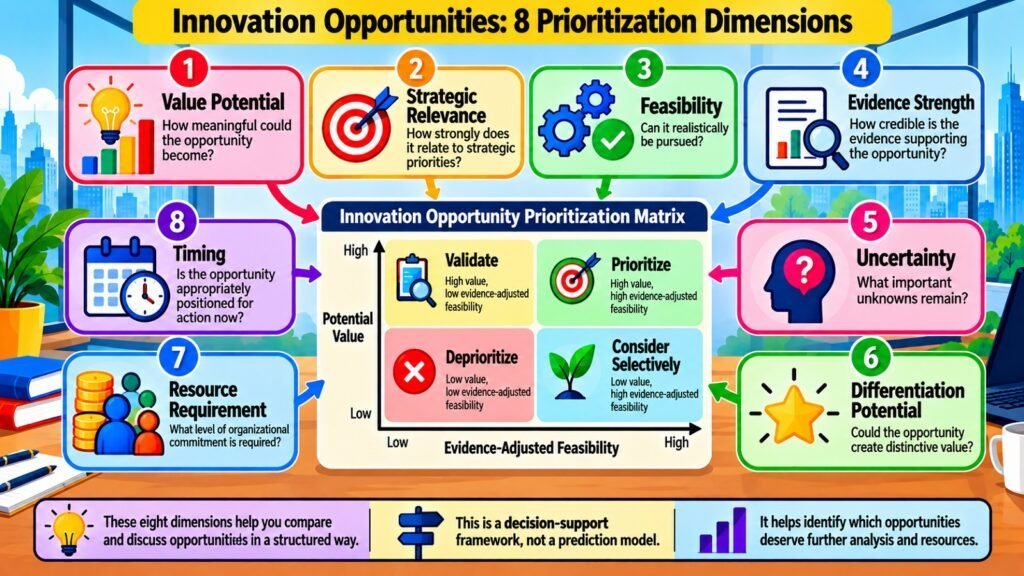
Organizations rarely face a single Innovation Opportunity in isolation. More commonly, they identify multiple potential opportunities across different markets, domains, and time horizons, and must decide which deserve further investigation, experimentation, or resource commitment. Evaluation and prioritization is the structured process by which organizations compare opportunities and make informed decisions about where to focus, knowing that resources, attention, and organizational capacity are finite.
Effective evaluation requires clear criteria applied consistently across opportunities. Value potential, strategic relevance, feasibility, evidence strength, uncertainty level, differentiation potential, resource requirements, timing, and scalability are all legitimate dimensions. The challenge is that no opportunity scores well on every dimension, and different dimensions carry different weights depending on strategic context. An organization in a high-growth phase may weight scalability heavily. One managing resource constraints may prioritize feasibility and evidence strength. These weighting decisions should be made explicitly and transparently.
It is important to distinguish opportunity evaluation from idea evaluation. At this stage, the organization is assessing the potential space for value creation, not comparing specific product concepts or solutions. This distinction preserves flexibility and prevents the common error of selecting the opportunity with the most vocal champion or the most developed attached concept.
Research by Terwiesch and Ulrich on innovation tournament methodology has shown that structured comparative evaluation generally outperforms unstructured deliberation, even with imperfect criteria. Where numerical scoring is used, organizations should treat scores as directional rather than predictive, avoiding the temptation to mask inherently qualitative judgments with quantitative appearance.
Innovation Opportunities: Evaluation and Prioritization Framework
| Evaluation Dimension | What to Consider |
| Value potential | Could the opportunity create meaningful value across customer, economic, and strategic dimensions? |
| Strategic relevance | Does the opportunity align with the organization’s strategic direction, priorities, and goals? |
| Feasibility | Can the opportunity plausibly be pursued given current technical, commercial, and operational conditions? |
| Evidence strength | How much credible evidence exists that the opportunity is real and the assumptions are sound? |
| Uncertainty level | How many critical unknowns remain, and how manageable are they given available tools and resources? |
| Differentiation potential | Could pursuing this opportunity lead to a meaningfully distinct position in the market? |
| Resource requirements | What financial, human, and organizational investment would responsible pursuit require? |
| Timing and scalability | Is the opportunity accessible now, and does it have the potential to grow meaningfully over time? |
8. Innovation Opportunities Through Opportunity Portfolios
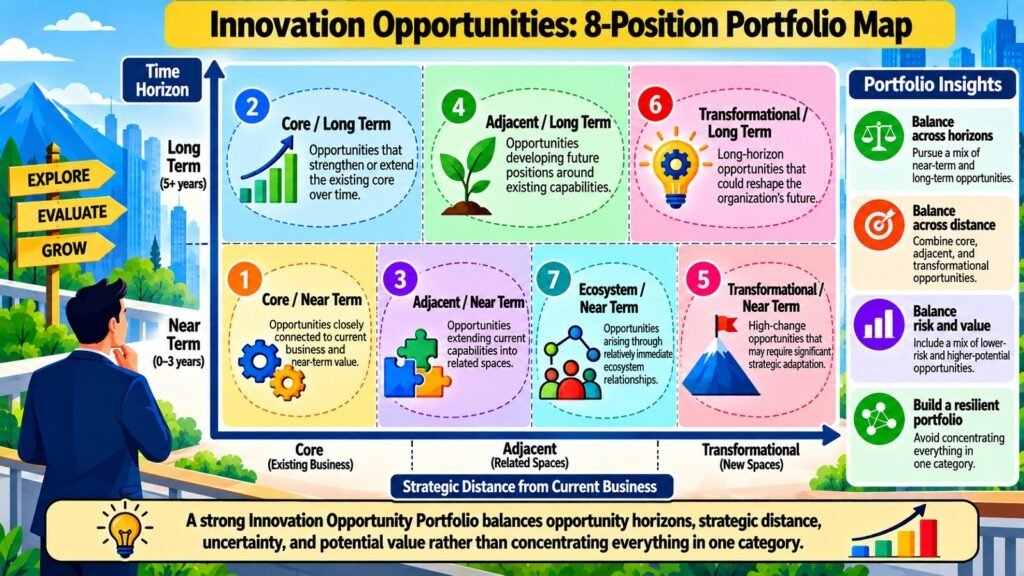
Managing a single Innovation Opportunity well is valuable. Managing a collection of opportunities strategically is a fundamentally different capability that organizations rarely develop with the same intentionality they bring to active project management. An opportunity portfolio is not a backlog of ideas waiting for development; it is a deliberately managed set of recognized potential value-creation spaces at various stages of definition, assessment, and understanding. The goal is not to pursue all opportunities simultaneously but to maintain a strategic spread of options aligned with priorities and risk tolerance.
Portfolio balance involves distributing opportunities across multiple dimensions. The time-horizon dimension asks whether the portfolio includes short-term incremental opportunities alongside medium-term adjacent ones and longer-term transformational possibilities. The ambition dimension ensures the organization is not exclusively focused on defensive low-risk improvements or overcommitted to highly uncertain transformational bets. The domain dimension considers whether opportunities span different markets, customer segments, and capabilities, or whether the portfolio is heavily concentrated in a single direction.
An important conceptual distinction separates an Innovation Opportunity Portfolio from a portfolio of active innovation projects. The opportunity portfolio contains potential spaces the organization has recognized, defined, assessed, and prioritized but not yet committed to developing. The project portfolio contains initiatives already moving into development or execution. Managing the two separately preserves strategic optionality. Research by Nagji and Tuff suggests organizations with high innovation returns typically maintain portfolios spanning multiple ambition levels rather than concentrating on one category. Sequencing — deciding in what order to pursue opportunities as evidence and capabilities develop — adds a temporal dimension that static balance frameworks often overlook.
Innovation Opportunities: Portfolio Management Reference
| Portfolio Dimension | What It Helps Balance |
| Time horizon | Short-term incremental, medium-term adjacent, and long-term transformational opportunities |
| Ambition level | Low-uncertainty improvements alongside higher-uncertainty growth and disruption possibilities |
| Domain coverage | Opportunities across different markets, customer segments, and capability areas |
| Uncertainty spread | Well-evidenced near-term options alongside less certain but potentially high-value possibilities |
| Resource allocation | Investment distribution that avoids overconcentration in any single opportunity type or stage |
| Sequencing | Order in which opportunities are pursued as evidence accumulates and capabilities develop |
| Strategic alignment | Opportunities that collectively advance the organization’s direction rather than pulling in multiple directions |
| Optionality preservation | Maintaining a range of future possibilities without premature commitment to a single path |
Conclusion: Innovation Opportunities for Strategic Growth
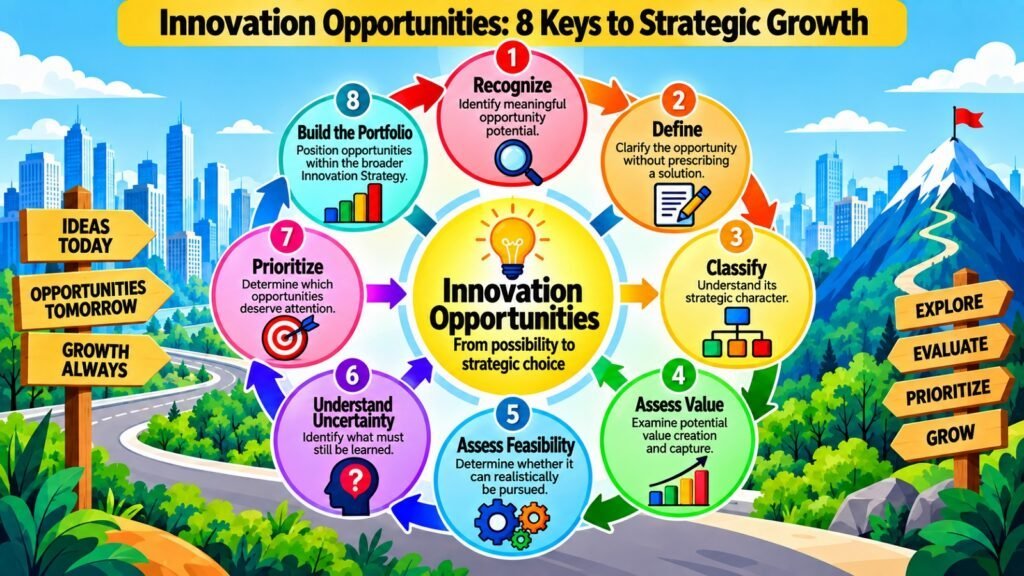
Innovation Opportunities sit between understanding the environment — through market insights, trend analysis, and organizational self-assessment — and deciding where innovation will actually be pursued. Without structured attention to this middle territory, organizations generate ideas disconnected from genuine opportunity, pursue projects without sufficient evidence, and rely on intuition to allocate innovation resources. The eight aspects explored in this article collectively provide a disciplined framework for managing that territory.
The progression matters as an integrated system. Recognition surfaces the potential space. Definition articulates it clearly enough for others to assess. Opportunity type shapes the required response. Value potential distinguishes meaningful opportunities from merely interesting ones. Feasibility reveals whether pursuit is realistic under current conditions. Uncertainty management identifies and progressively reduces the most important unknowns. Evaluation and prioritization enable informed, transparent choices among competing alternatives. Portfolio management ensures the organization maintains a coherent, strategically balanced set of options over time.
Markets evolve, technologies shift, customer expectations change, and competitive conditions rarely ever remain stable. An organization’s ability to sustain growth through innovation depends not only on executing specific projects but also on its ongoing capability to identify, define, assess, and prioritize the opportunities that will eventually become those projects. Strong innovation does not begin with generating ideas. It begins with recognizing and developing the right opportunities for creating meaningful value — with enough discipline, evidence, and strategic awareness to pursue them wisely.
Innovation Opportunities: Complete Framework Reference
| Stages of Innovation Opportunities | Core Question |
| Recognition | Is there a meaningful potential space for value creation visible in the signals we are observing? |
| Definition | Have we articulated what the opportunity is, why it exists, and who it affects without proposing a solution? |
| Opportunity Types | Do we understand the scope, ambition, and uncertainty profile of this opportunity? |
| Value Potential | Could this opportunity create meaningful value across customer, economic, and strategic dimensions? |
| Feasibility Assessment | Can we realistically pursue this opportunity given technical, commercial, and operational conditions? |
| Uncertainty and Risk | Have we identified the key unknowns and established how we will reduce or manage them? |
| Evaluation and Prioritization | How does this opportunity compare with alternatives across the dimensions that matter most to us? |
| Opportunity Portfolio | Does this opportunity fit within a strategically balanced portfolio that preserves future options? |