Table of Contents
Introduction: Emotional Awareness as the Foundation of Human-Centric Business
Why do two companies with similar products, similar budgets, and similar talent pools end up with completely different results? The answer often has little to do with strategy decks or spreadsheets. It has to do with people, and how well an organization understands what its people are feeling. Modern businesses no longer compete only through technology, capital, or operational efficiency. They compete through how well they read and respond to human emotion, inside the company and outside it.
Emotional Awareness is the structured ability to notice, interpret, and respond to emotional signals in a consistent and evidence-based way. It is not guesswork or intuition alone. It draws on patterns that researchers in psychology, neuroscience, and organizational behavior have studied for decades. Emotional Awareness is an important aspect of Human-Centric Business because companies that understand the emotional drivers behind employee performance, customer loyalty, and leadership trust tend to build more durable value over time. Numbers matter, but numbers are shaped by people, and people are shaped by feeling.
It helps to separate Emotional Awareness from Emotional Intelligence, since the two terms get used interchangeably in business writing. Emotional Awareness is the foundation layer: simply noticing that an emotion exists, in yourself or someone else, before judging it or acting on it. Emotional Intelligence builds on top of that foundation, adding skills like regulation, empathy, and social management. Without awareness first, intelligence has nothing to work with.
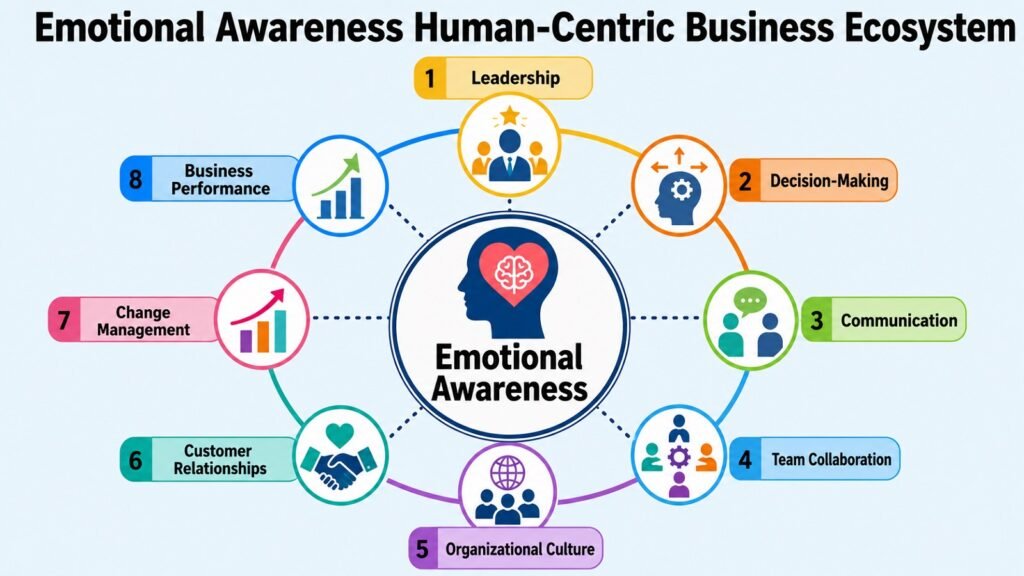
This article approaches the topic as a research-based business analysis, blending findings from psychology, neuroscience, organizational behavior, behavioral economics, leadership research, and management studies with real organizational examples. Eight business areas are explored: leadership, decision-making, communication, team collaboration, organizational culture, customer relationships, change management, and overall business performance. Each section demonstrates a measurable way that Emotional Awareness creates value, not just a feel-good argument for being nicer at work.
Table 1: Emotional Awareness Across Eight Business Areas
| Emotional Awareness Business Areas | Emotional Awareness Contribution |
| Leadership | Helps leaders sense team morale before it affects decisions |
| Decision-Making | Reduces emotional bias that distorts judgment under pressure |
| Communication | Improves how messages are framed and received by others |
| Team Collaboration | Builds the psychological safety teams need to speak up |
| Organizational Culture | Shapes trust, belonging, and ethical behavior at scale |
| Customer Relationships | Drives loyalty that satisfaction scores alone cannot explain |
| Change Management | Identifies fear and resistance before they block adoption |
| Business Performance | Connects people-focused practices to measurable outcomes |
1. Emotional Awareness in Leadership: Building Trust and Strategic Influence
Picture a newly promoted vice president walking into her first major budget meeting. The numbers are solid, but the room feels tense, and two department heads seem unusually quiet. A leader without Emotional Awareness might push through the agenda and miss the signal entirely. A leader with it pauses, asks a direct question, and uncovers a staffing concern that would have derailed the plan within weeks.
Emotionally aware leaders notice signals in themselves and others before committing to a decision. This connects to Daniel Goleman’s long-running research on emotional competencies in the workplace. Goleman’s analysis of competency models across more than two hundred companies found that roughly two-thirds of the difference between star performers and average performers came down to emotional competence rather than technical skill or raw cognitive ability. A separate study of executives across fifteen global companies identified influence, team leadership, organizational awareness, and self-confidence among the traits that separated top performers from the rest, and every one of those traits depends on first noticing emotional context.
Why does this matter in practice? Because executive decisions rarely happen in a vacuum. A leader who senses hesitation in a team before a product launch can address concerns early rather than discovering a morale problem after the launch fails. Research from Yale’s School of Management found that emotions move through work groups almost like a contagion, with leaders having an outsized influence on how the rest of the team feels day to day.
A widely discussed business case involves a global hospitality company whose regional leadership team faced declining guest satisfaction scores despite strong financial performance. Investigation revealed that frontline staff felt unheard by middle management, who in turn felt pressured by aggressive cost targets from above. Leadership addressed the issue with structured listening sessions, training managers to recognize emotional cues in staff feedback rather than dismissing complaints as routine. Satisfaction scores recovered within two quarters, and turnover in the affected region dropped noticeably.
The practical implication for any manager is straightforward: build in moments to check emotional temperature before major decisions, not just after problems appear.
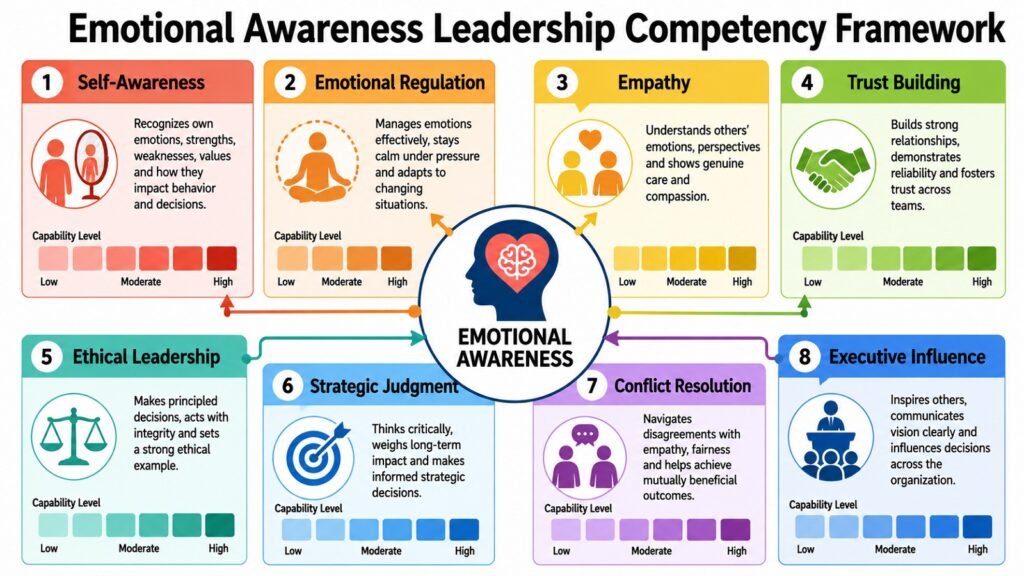
Table 2: Emotional Awareness in Leadership: Research and Applications
| Leadership Factor | Business Application |
| Self-awareness | Leaders notice their own reactions before acting on them |
| Emotional competence | Accounts for roughly two-thirds of star performer advantage |
| Organizational awareness | Distinguishes top executives across global companies |
| Emotional contagion | Leader mood spreads through teams, for better or worse |
| Active listening | Surfaces problems before they escalate into operational issues |
| Influence | Builds support for decisions through trust, not authority alone |
| Self-confidence | Allows leaders to remain steady during uncertainty |
| Structured feedback | Listening sessions reveal issues dashboards miss |
2. Emotional Awareness in Decision-Making: Reducing Bias and Improving Judgment
Consider a finance director deciding whether to continue funding a struggling internal project. The original budget has already been spent, the team is emotionally invested, and walking away feels like admitting failure. Purely rational analysis says cut losses now, but something pulls toward continuing anyway. That pull has a name in behavioral economics: the sunk cost fallacy, and it is driven almost entirely by emotion rather than logic.
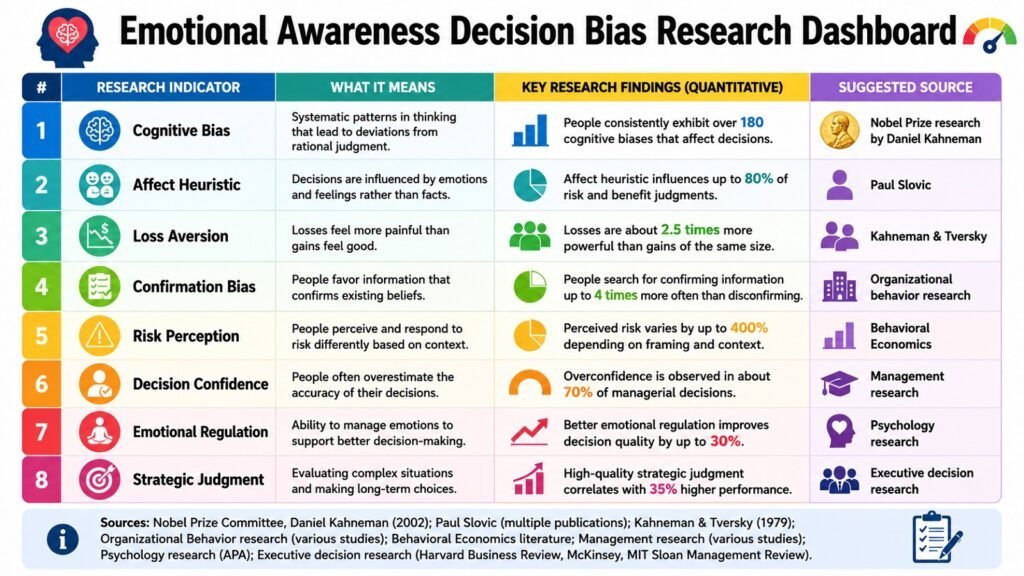
Emotional Awareness helps decision-makers notice these biases before they quietly steer a choice. Daniel Kahneman and Amos Tversky’s research on prospect theory showed decades ago that people do not evaluate decisions through pure rational calculation. Instead, they rely on mental shortcuts, called heuristics, shaped by fear, hope, and social pressure. Loss aversion, one of the most studied effects in this research, shows that people feel the pain of a loss roughly twice as strongly as the pleasure of an equivalent gain. A manager unaware of this tendency might avoid a smart but slightly risky decision simply because the downside feels emotionally louder than the upside.
Neuroscience adds another layer here. Studies of decision-making under uncertainty show that emotional centers of the brain activate before the rational, analytical regions even register the choice consciously. This does not mean emotion is the enemy of good judgment. It means emotion arrives first, and awareness is what allows a decision-maker to notice that early signal and evaluate it rather than be ruled by it blindly.
A frequently cited organizational case involves a major retailer that delayed exiting an underperforming product line for nearly two years, largely because the executive who championed the original launch was reluctant to admit the miscalculation. Internal reviews later found that emotional attachment to the original decision, not market data, was the primary reason for the delay. Once a new analysis process required decision-makers to separate personal investment from outcome data explicitly, the company became measurably faster at cutting underperforming lines in subsequent years.
The same pattern shows up in hiring and promotion decisions, where a manager’s comfort with a familiar candidate can quietly outweigh stronger evidence favoring someone less familiar. The takeaway for any executive is to build a habit of naming the emotional pull in a decision out loud, even briefly, before weighing the actual numbers on their own terms.
Table 3: Emotional Awareness in Decision-Making: Biases and Principles
| Decision Bias / Principle | Business Relevance |
| Loss aversion | Losses feel roughly twice as painful as equivalent gains |
| Sunk cost fallacy | Past investment wrongly influences future choices |
| Affinity bias | Comfort with familiar options can outweigh stronger evidence |
| Framing effects | Identical facts presented differently change perceived risk |
| Anchoring | Initial numbers skew later judgments even when irrelevant |
| Overconfidence | Strong emotion can mask weak supporting evidence |
| Emotional tagging | Brain emotional centers react before conscious analysis |
| Decision journaling | Naming feelings before deciding improves later accuracy |
3. Emotional Awareness in Communication: Strengthening Business Relationships
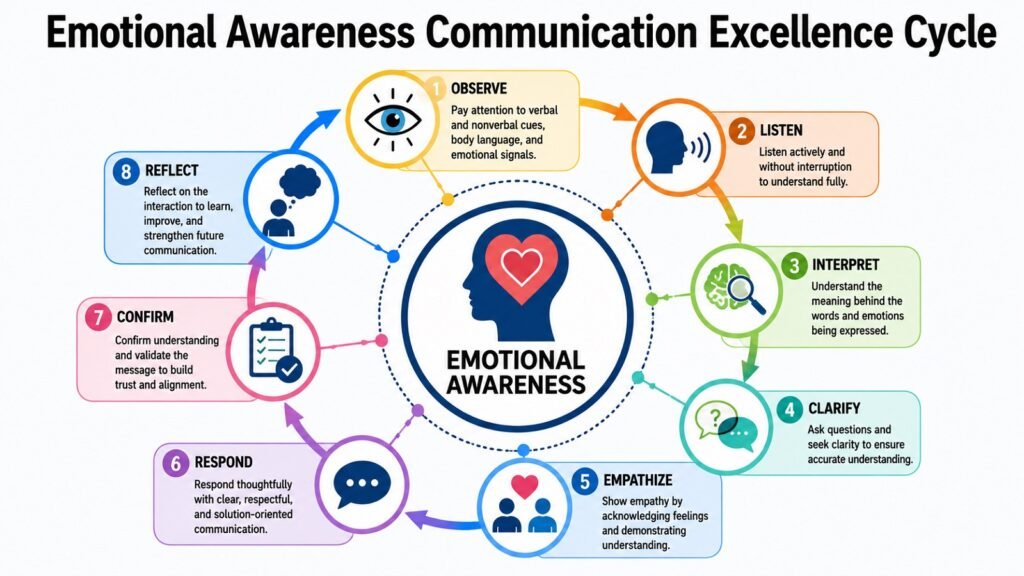
Most organizations have experienced the same communication breakdown in different forms. A manager sends what seems like a clear email outlining new performance expectations, and the team reads it as a threat rather than guidance. The words were accurate, but the emotional tone underneath them got lost or misread entirely. This is one of the most common and costly communication failures in business, and Emotional Awareness is the missing ingredient that prevents it.
Communication research has long shown that people respond more strongly to perceived tone and intent than to literal content. Albert Mehrabian’s early studies on communication, while sometimes oversimplified in business training, pointed to a real and important pattern: when verbal and nonverbal signals conflict, people trust the nonverbal signal more. In a business context, this means a technically correct message delivered with the wrong emotional framing can do more damage than saying nothing at all. Emotional Awareness allows a communicator to check not just what they are saying but how it is likely to land.
A useful real-world example comes from how several airlines have handled flight disruptions over the years. Carriers that train staff to acknowledge passenger frustration directly, before explaining logistics, consistently receive better satisfaction scores than carriers that lead with procedural explanations. The emotional acknowledgment does not solve the delay, but it changes how the explanation is received afterward. Crisis communication research backs this pattern up consistently: audiences need to feel heard before they are ready to process information.
The deeper organizational lesson is that emotionally aware communication is not about being soft or avoiding hard truths. It is about sequencing and framing difficult information in a way that accounts for how the listener will likely feel receiving it. A leader announcing layoffs who acknowledges the fear in the room before moving into logistics will be heard very differently from one who jumps straight to numbers.
This applies just as strongly to written communication, where tone is easier to misjudge since there is no face or voice to soften a message. Many companies now train managers to read a draft email out loud before sending anything sensitive, specifically to catch tone problems that look fine on a screen but land harshly when heard.
Table 4: Emotional Awareness in Communication: Practices That Work
| Communication Practice | Why It Matters |
| Acknowledge emotion first | People process facts better once they feel heard |
| Match tone to message | Mismatched tone undermines even accurate information |
| Read messages aloud | Catches harsh tone invisible on a written page |
| Sequence difficult news | Context before detail reduces defensive reactions |
| Nonverbal awareness | Conflicting signals reduce trust in spoken words |
| Crisis acknowledgment | Naming frustration before explaining logistics improves outcomes |
| Two-way dialogue | Replacing one-way updates with discussion builds trust |
| Consistent follow-through | Words must match later actions to sustain credibility |
4. Emotional Awareness in Team Collaboration: Creating High-Performing Teams
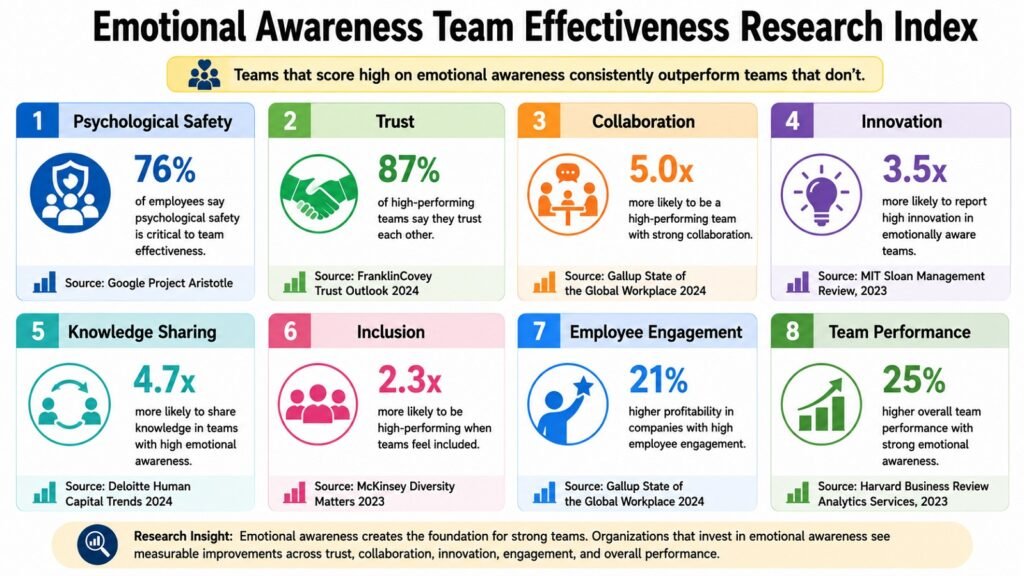
Many managers have inherited a team full of talented individuals that somehow underperforms as a group. Meetings are polite but flat. Good ideas surface rarely, and when they do, nobody pushes back or builds on them. This is one of the clearest signals that a team lacks something more important than raw skill: a sense of safety in speaking up.
Google’s well-known Project Aristotle research set out in 2012 to identify what separated its highest-performing teams from average ones, expecting the answer to involve talent density or team composition. Instead, after studying roughly 180 teams, researchers found that psychological safety, the shared belief that team members will not be punished or embarrassed for speaking up, was the single strongest predictor of team effectiveness. Teams with strong psychological safety showed measurably higher productivity, more innovative output, and lower turnover. This connects to organizational behavior theory developed earlier by Amy Edmondson, whose 1999 work first defined psychological safety and linked it to learning behavior within teams.
Why does Emotional Awareness sit underneath all of this? Because psychological safety cannot exist without team members and leaders first noticing emotional signals like hesitation, defensiveness, or quiet withdrawal. A manager who senses that a normally vocal employee has gone silent in meetings can address it directly rather than assuming everything is fine. One often-cited case involves an engineering team at a mid-size technology company that struggled with stalled product decisions until its manager began opening meetings by briefly checking in on how people were feeling about the project, not just where tasks stood. Within a few months, debate became more open, decisions moved faster, and the team reported feeling more ownership over outcomes.
The practical insight for managers building stronger teams is to treat emotional check-ins as a structural part of teamwork, not an afterthought. Equal participation in conversation, something Project Aristotle also identified as a marker of effective teams, tends to follow naturally once people feel safe enough to speak without fear of embarrassment.
This does not mean removing accountability or lowering standards. Research on high-performing teams consistently shows that psychological safety and high performance reinforce each other rather than trade off, since people who feel safe are more willing to flag risks early before they grow into larger failures.
Table 5: Emotional Awareness in Team Collaboration: Key Principles
| Team Principle | Business Outcome |
| Psychological safety | Strongest predictor of team effectiveness in Project Aristotle |
| Equal participation | All members get comparable opportunity to contribute |
| Comfort admitting mistakes | Speeds learning instead of hiding problems |
| Dependability | Members trust each other to deliver on commitments |
| Clarity of roles | Reduces friction caused by ambiguous expectations |
| Sense of meaning | Connects daily tasks to a larger shared purpose |
| Emotional check-ins | Surface hesitation before it becomes disengagement |
| Constructive conflict | Safety enables debate without damaging relationships |
5. Emotional Awareness in Organizational Culture: Shaping Human-Centric Business
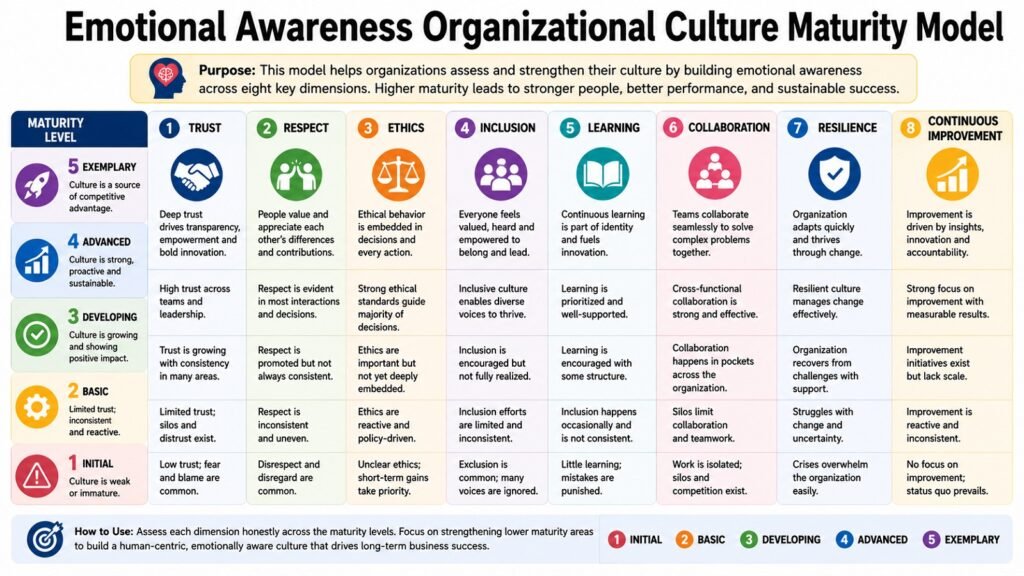
Culture is often described as the personality of an organization, but personality is built moment by moment through how people are treated when things go wrong, not just when things go right. A company can post inspiring values on its website and still have a culture defined by fear, if employees learn through repeated experience that mistakes are punished rather than examined. Emotional Awareness plays a direct role in shaping which version of culture actually takes hold.
Organizational culture research has consistently linked emotional climate to outcomes like trust, ethical behavior, and employee engagement. When leaders consistently notice and respond to how policies and decisions affect people emotionally, employees develop a stronger sense of belonging and are more willing to raise concerns before small problems become large ones. When leaders ignore emotional signals in favor of pure efficiency metrics, organizations tend to develop quieter, more guarded cultures where information flows poorly upward.
A frequently referenced example involves a technology company whose leadership noticed rising anxiety among engineering staff during a period of rapid headcount growth, even though productivity metrics looked healthy on paper. Rather than dismissing the unease, leadership ran structured listening sessions and adjusted onboarding and workload expectations based on what employees described feeling, not just what dashboards showed. Engagement scores in subsequent surveys improved, and voluntary attrition in the affected teams declined.
This is precisely why Human-Centric Business depends on emotionally aware organizational cultures. A culture that systematically notices and responds to emotional signals tends to catch problems earlier, retain talent longer, and build the kind of trust that makes employees willing to give honest feedback rather than silent compliance. The practical insight for any organization is to treat emotional signals from employee surveys and informal conversations with the same seriousness given to financial dashboards, since both are leading indicators of organizational health.
This does not require a complete overhaul of management practice. Often it starts with small habits, such as leaders asking how a change will feel to the people affected before announcing it, or treating exit interviews as a genuine source of insight rather than a formality.
Table 6: Emotional Awareness in Organizational Culture: Core Drivers
| Cultural Driver | Effect on the Organization |
| Trust | Encourages honest feedback instead of silent compliance |
| Belonging | Reduces turnover and strengthens employee engagement |
| Ethical climate | Emotionally aware leadership discourages cover-ups |
| Listening systems | Surveys and conversations reveal issues early |
| Leader responsiveness | Adjusting policy based on feeling, not just metrics |
| Onboarding design | Reduces anxiety during periods of rapid growth |
| Exit interview value | Honest departure feedback improves retention strategy |
| Resilience | Cultures that notice strain recover faster from setbacks |
6. Emotional Awareness in Customer Relationships: Building Trust and Loyalty
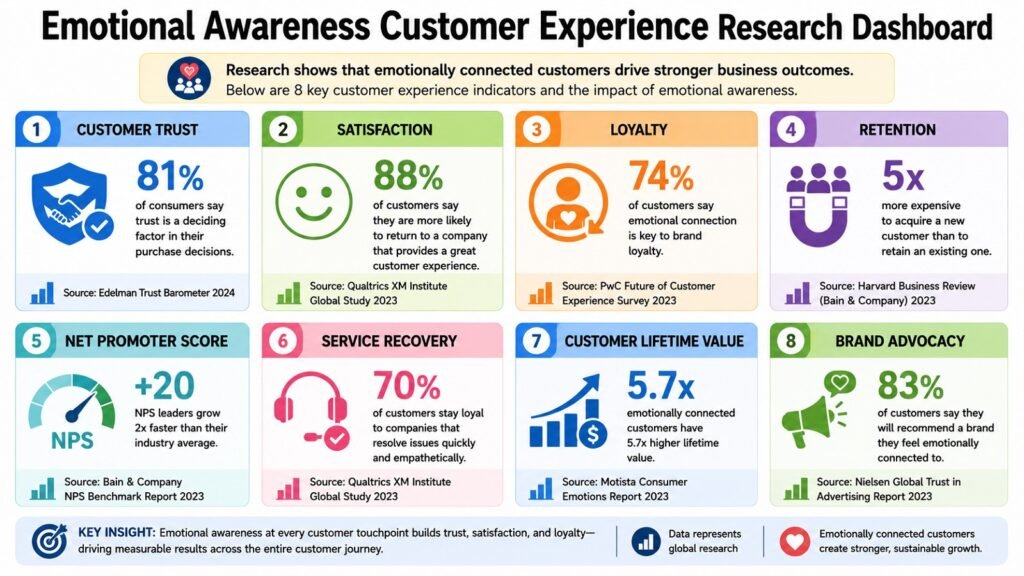
Imagine two customers who both had a delayed shipment resolved within the promised window. One received a generic automated apology. The other received a brief, specific message acknowledging the inconvenience before explaining the resolution. Both customers got the same practical outcome, yet research consistently shows their loyalty afterward will likely differ sharply. This is the core insight behind why Emotional Awareness matters so much in customer relationships.
Consumer behavior research backs this up with hard numbers rather than anecdotes. A widely cited Harvard Business Review study found that emotionally connected customers are 52% more valuable than those who are simply satisfied, since they buy more often, resist switching to competitors, and tend to be less sensitive to price changes. Separate research from the consumer intelligence firm Motista found that fully emotionally connected customers carry substantially higher lifetime value than merely satisfied customers, with effects strong enough that several brands have used the finding to redesign loyalty strategy around emotional connection rather than transactional rewards alone.
A concrete example helps illustrate the mechanism. A major credit card issuer redesigned a product specifically to build emotional resonance with younger customers, rather than simply competing on rewards rates. Usage among that segment rose by 70 percent, and new account growth increased by 40 percent following the change, a result that pure feature competition had not achieved in prior attempts. The lesson is not that emotional appeal replaces product quality. It is that emotional resonance that often determines whether a good product gets chosen and stays chosen over time.
For service teams, the practical application is training staff to notice and acknowledge customer emotion before moving into problem-solving mode, since customers who feel heard process subsequent information more calmly. For marketing and product teams, it means researching the emotional motivators behind purchase decisions rather than assuming price and features tell the whole story.
Organizations that build systematic ways to track and respond to customer sentiment tend to outperform those relying purely on satisfaction scores, since satisfaction measures whether expectations were met while emotional connection measures something deeper and more durable. A satisfied customer might still leave for a slightly cheaper competitor; an emotionally connected one rarely does.
Table 7: Emotional Awareness in Customer Relationships: Behavior Patterns
| Customer Behavior or Principle | Business Impact |
| Emotional connection | Connected customers are 52 percent more valuable |
| Lifetime value gap | Connected customers stay loyal far longer than satisfied ones |
| Price sensitivity | Emotionally connected customers resist switching for lower price |
| Acknowledgment before resolution | Customers process solutions better once heard first |
| Word of mouth | Connected customers advocate for brands unprompted |
| Emotional motivators | Specific feelings drive purchase more than features alone |
| Service training | Staff trained in empathy outperform script-only training |
| Sentiment tracking | Reveals risks satisfaction scores alone tend to miss |
7. Emotional Awareness in Change Management: Leading Through Uncertainty
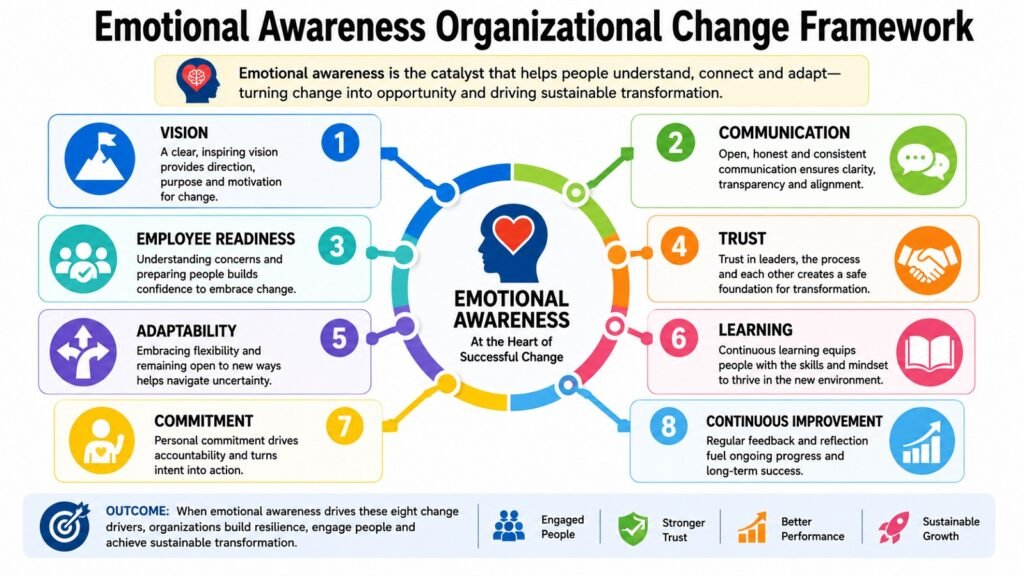
A mid-size manufacturer announces it is replacing a decade-old production system with new software. On paper the business case is airtight: faster processing, fewer errors, lower long-term cost. On the floor, employees hear something different: their hard-won expertise might suddenly count for less, and some quietly worry about their jobs. This gap between the leadership’s rational case and the workforce’s emotional reaction is where most change initiatives quietly start to fail.
Research consistently shows that a large majority of major organizational transformations fail to fully achieve their intended goals, and the most commonly cited reason is employee resistance rather than flawed strategy. John Kotter’s widely used eight-step change model addresses this directly, with early steps focused on building a shared sense of urgency and assembling a coalition before any technical implementation begins. Critically, later refinements to Kotter’s thinking acknowledge that fear-based urgency, sometimes called the burning platform approach, can backfire by creating anxiety and resistance rather than motivation, since people facing high anxiety tend to cling to familiar routines rather than embrace new ones.
A useful organizational case comes from a healthcare company that attempted to digitize a paper-based contract system but only partially applied a structured change framework, focusing on technical rollout while skipping the early steps meant to build urgency and address emotional concerns directly. Employees who did not understand why the change mattered, or who feared it would expose them to blame for past errors, resisted adoption even after formal training was completed. Only after leadership returned to address those emotional concerns directly, rather than simply repeating technical instructions, did adoption rates improve meaningfully.
The practical insight for any manager leading change is to treat resistance as information rather than obstruction. Resistance often signals an unaddressed fear, whether about competence, job security, or loss of control, and naming that fear directly tends to do more to move a transformation forward than additional technical justification ever will.
This reframing matters because most resistance is not stubbornness for its own sake. It is a rational response to uncertainty from people who have not yet been given a reason to feel safe about what comes next.
Table 8: Emotional Awareness in Change Management: Applications
| Change Principle | Organizational Application |
| Sense of urgency | Shared understanding of why change matters reduces resistance |
| Coalition building | Trusted messengers ease emotional uncertainty |
| Resistance as signal | Pushback often reflects fear, not stubbornness |
| Avoiding fear tactics | Burning platform messaging can increase anxiety |
| Addressing job security | Naming concerns directly improves adoption rates |
| Pilot programs | Small-scale trials reduce uncertainty before full rollout |
| Continuous communication | Repetition of purpose reduces lingering doubt |
| Embedding change in culture | Sustains adoption after initial rollout ends |
8. Emotional Awareness in Business Performance: Creating Sustainable Competitive Advantage
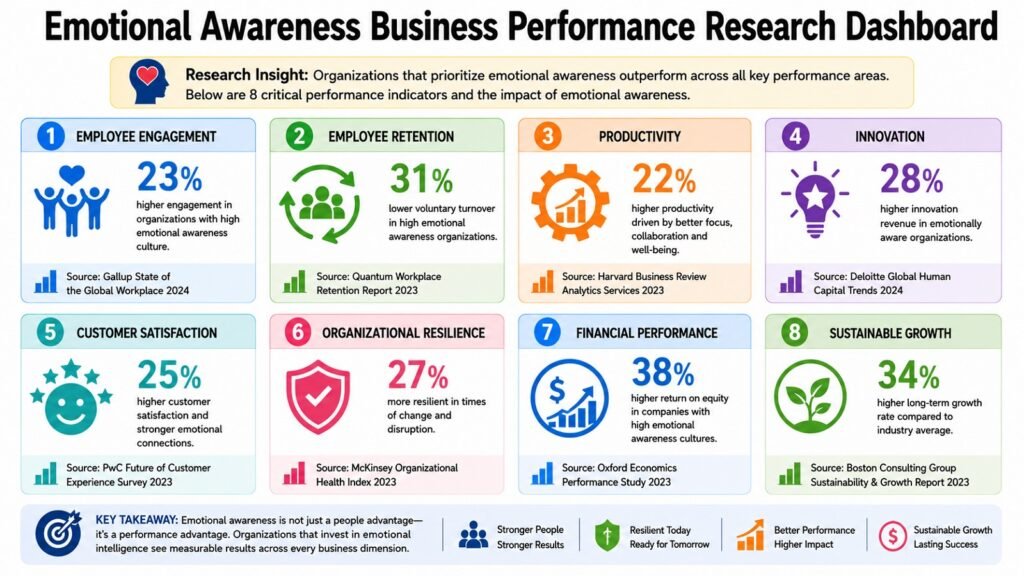
Each of the previous seven areas, leadership, decision-making, communication, teamwork, culture, customer relationships, and change management, might look like separate disciplines on an org chart. In practice, they all draw from the same underlying capability. A company strong in one area but weak in Emotional Awareness generally struggles to sustain performance across the others, since the same blind spots that hurt leadership trust tend to also hurt customer loyalty and change adoption.
Management research increasingly treats this connection as more than a coincidence. Competency studies spanning more than two hundred organizations have found that emotional competence accounts for a larger share of the gap between top and average performers than technical skill does, particularly as job complexity increases. This pattern holds whether the focus is executive leadership, sales performance, or customer-facing roles, suggesting the underlying mechanism, awareness of emotional signals translating into better judgment, applies broadly rather than narrowly.
A clear illustration comes from a household consumer goods company that shifted its market strategy after recognizing it was losing ground despite a technically superior product. Rather than simply cutting prices, the company invested in understanding the emotional motivators behind purchasing decisions in its category and adjusted messaging and product experience accordingly. The shift turned a period of market share losses into double-digit growth within roughly a year, without a corresponding change in the underlying product formulation.
This is why Emotional Awareness deserves to be treated as a strategic organizational capability rather than simply an interpersonal soft skill reserved for HR training sessions. It shows up on balance sheets through retention, customer lifetime value, and faster adaptation to market change, even though it rarely appears as its own line item. Organizations that build systematic attention to emotional signals into leadership development, decision processes, and customer strategy tend to compound these advantages over time, since each function reinforces the others rather than operating in isolation.
Competitors can copy a product feature within months and match a price point within weeks. They cannot as easily copy a culture built on years of emotionally aware leadership, nor a customer base bound by genuine emotional connection rather than convenience alone.
Table 9: Emotional Awareness in Business Performance: Strategic Drivers
| Performance Driver | Strategic Outcome |
| Cross-functional consistency | Same awareness improves leadership, sales, and service alike |
| Retention | Reduces costly turnover linked to disengagement |
| Customer lifetime value | Emotional connection compounds revenue over time |
| Faster adaptation | Awareness shortens reaction time during market shifts |
| Competitive durability | Harder for rivals to copy than product features |
| Talent attraction | Emotionally aware cultures draw stronger candidates |
| Brand resilience | Connected customers and employees buffer reputational risk |
| Compounding advantage | Each function reinforces the others over time |
Conclusion: Emotional Awareness as the Future of Human-Centric Business
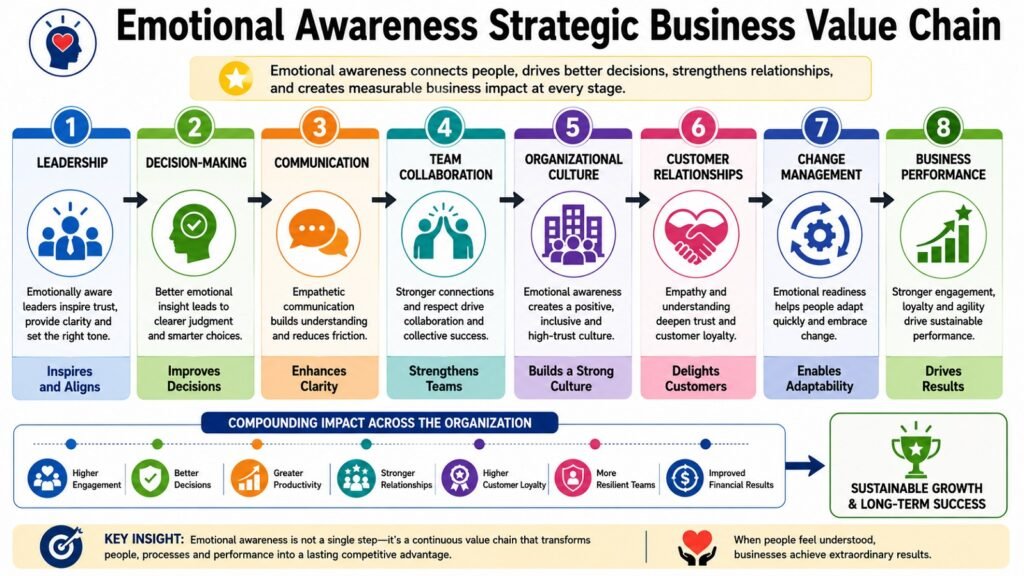
Across all eight areas explored in this article, leadership, decision-making, communication, team collaboration, organizational culture, customer relationships, change management, and overall business performance, one pattern keeps repeating. Organizations that consistently notice and respond to emotional signals make better decisions, build stronger relationships, and adapt faster than those that do not. This is not a coincidence. It reflects a single underlying capability running through every business function that touches people, which is most of them.
Emotional Awareness is not a personality trait some leaders happen to have, and others lack. It is a strategic organizational capability that can be built deliberately, the same way companies build financial discipline or operational efficiency. The research cited throughout this article, from leadership competency studies to customer loyalty research to organizational change frameworks, points toward the same conclusion from different directions: businesses that understand and respond to human emotion systematically outperform those that treat people purely as inputs to a process.
This is also why Emotional Awareness sits at the center of Human-Centric Business as a concept. Sustainable competitive advantage no longer comes only from owning better technology or cheaper capital, since those advantages erode quickly in most industries. It comes increasingly from understanding people, employees, customers, leaders, and stakeholders, as well as how an organization manages its balance sheet. Companies that treat emotional understanding as a long-term investment, woven into hiring, leadership development, customer strategy, and change planning, tend to build advantages that are much harder for competitors to copy than a product feature or a price point.
The organizations that will lead in the coming years are unlikely to be the ones with the most sophisticated technology alone. They will be the ones that combine that technology with a genuine, systematic understanding of the people behind every transaction, every team, and every decision. Emotional Awareness is how that understanding gets built, one signal at a time.
Table 10: Emotional Awareness Strategic Insights and Business Takeaways
| Strategic Insight | Business Takeaway |
| Leadership | Notice signals early to prevent costly surprises |
| Decision-making | Name emotional pulls before trusting a final number |
| Communication | Frame difficult messages with feeling in mind |
| Team collaboration | Safety enables the speed that talent alone cannot |
| Organizational culture | Emotional climate predicts performance before metrics do |
| Customer relationships | Connection drives loyalty more than satisfaction alone |
| Change management | Resistance reveals fear that deserves a direct response |
| Business performance | Treat emotional awareness as a long-term investment |