Table of Contents
Introduction: Entrepreneur Mindset as the Foundation of Entrepreneurial Success
The Entrepreneur Mindset is one of the most important aspects of Entrepreneurship. It shapes how founders observe opportunities, analyze problems, make decisions, respond to uncertainty, and create lasting value. Business knowledge, leadership, creative thinking, and disciplined execution all matter. But these qualities become far more effective when they rest on a strong Entrepreneur Mindset.
Many people associate entrepreneurial success with personality traits such as confidence, passion, or natural talent. Research tells a more interesting story. Studies in cognitive psychology, decision science, and organizational behavior consistently suggest that the way founders think — the mental models they use — often matters more than their industry knowledge or prior experience.
This article explores the entrepreneur mindset through research findings, established business and psychological theories, real-world business examples, and practical insights. It does not offer motivational advice or suggest that great founders are born with special qualities. Instead, it investigates eight distinct mental models that successful founders use and shows how each model contributes to sharper decisions, better resource allocation, and long-term competitive advantage.
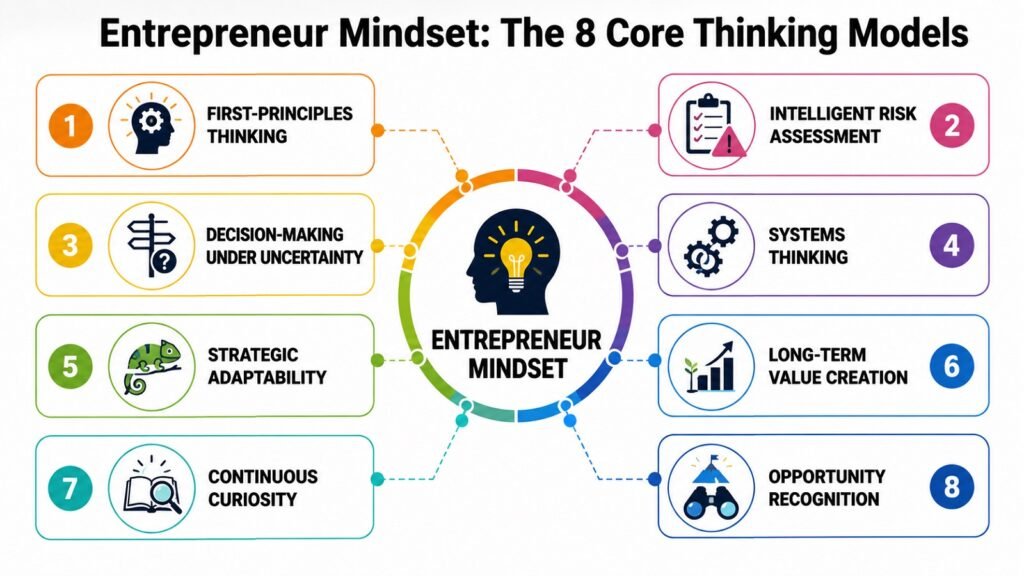
Each of the eight sections examines a separate dimension of entrepreneurial thinking. Together they form a way of thinking that can be deliberately developed over time. Readers who treat this article as a research-based exploration rather than a list of success tips will find it most useful. The eight areas are: first-principles thinking, risk assessment, decision-making under uncertainty, systems thinking, strategic adaptability, long-term value creation, continuous curiosity, and opportunity recognition.
These are not abstract ideas. Every section draws on real companies and real decisions, making the entrepreneur mindset visible and concrete.
Entrepreneur Mindset: Eight Key Aspects and Their Importance
| Entrepreneur Mindset Aspect | Why It Matters |
| First-Principles Thinking | Breaks assumptions to produce original solutions and sustainable competitive advantage |
| Intelligent Risk Assessment | Replaces guesswork with structured evaluation of probabilities and downside exposure |
| Decision-Making Under Uncertainty | Enables timely action even when information is incomplete or conditions are shifting |
| Systems Thinking | Reveals hidden connections between business functions, preventing unintended consequences |
| Strategic Adaptability | Allows founders to evolve strategy as markets, technologies, and customer needs change |
| Long-Term Value Creation | Builds durable competitive advantage by prioritizing trust, quality, and lasting relationships |
| Continuous Curiosity | Drives knowledge acquisition across disciplines, strengthening innovation and opportunity recognition |
| Opportunity Recognition | Develops the ability to spot emerging patterns before they become obvious to the broader market |
1. Entrepreneur Mindset and First-Principles Thinking
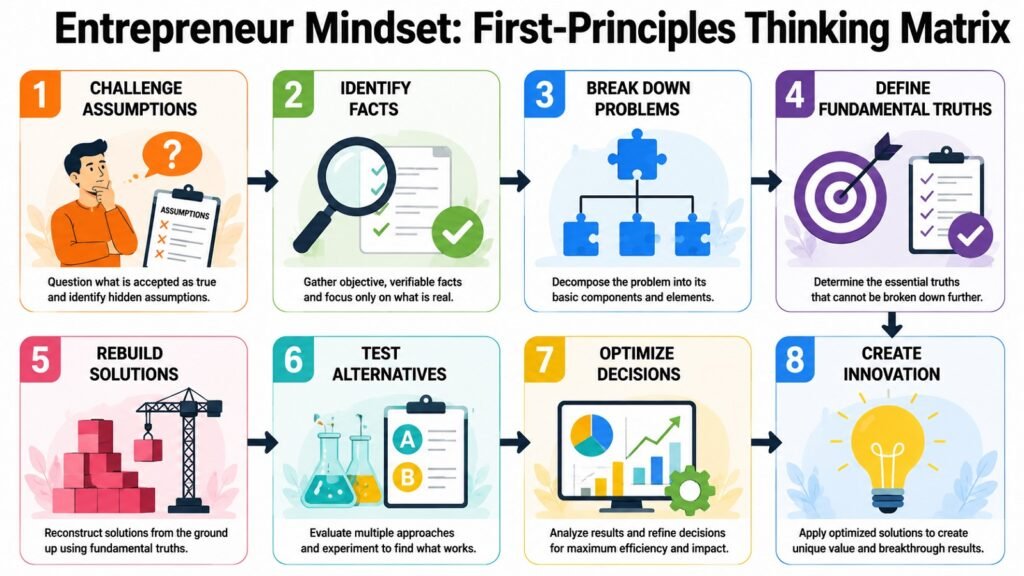
Most people solve problems by reasoning from what already exists. They look at how things are currently done, make modest adjustments, and move forward. This approach works reasonably well in stable environments. But in competitive markets where assumptions get disrupted regularly, it tends to produce incremental results rather than transformational ones. The Entrepreneur Mindset approaches problems differently. First-principles thinking asks a more fundamental question: what is actually true here, and what can we build from that truth?
Research in cognitive science suggests that first-principles reasoning involves breaking a complex problem into its most basic components and rebuilding solutions from there. This process separates what is actually known from what is merely assumed. Elon Musk applied this to battery technology. Rather than accepting industry pricing conventions, he examined raw material costs and found prices could be far lower than the market assumed. This informed Tesla’s long-term investment in battery manufacturing at scale.
Reed Hastings at Netflix applied similar reasoning. Instead of accepting the video rental model, he questioned why customers should pay late fees at all and reimagined the entire customer experience around subscription access. Amazon’s Jeff Bezos asked why retail required physical stores if logistics could deliver comparable convenience at lower cost. These decisions were not accidents. They emerged from a deliberate habit of questioning established assumptions.
In contrast, Blockbuster Video accepted the late-fee model as a structural feature of its business rather than an assumption to be challenged. When Netflix offered a subscription alternative, Blockbuster lacked the strategic flexibility to respond effectively because its leadership had not questioned whether the existing model was actually necessary.
First-principles thinking does not guarantee success. It demands intellectual rigor, a willingness to accept that commonly held beliefs may be wrong, and the patience to rebuild understanding from the foundation up. But the research evidence consistently suggests that this form of reasoning produces more original strategies and stronger competitive positions over time. Founders who challenge assumptions before acting tend to create more defensible business models.
Entrepreneur Mindset: Assumptions Challenged and Business Outcomes Achieved
| Assumption Challenged | Business Innovation or Strategic Outcome |
| Battery costs cannot fall below industry norms | Tesla invested in Gigafactory to manufacture batteries at commodity-level cost |
| Video rental requires physical stores and late fees | Netflix introduced subscription streaming, eliminating penalties entirely |
| Retail requires physical infrastructure | Amazon built logistics-first retail that scaled without traditional store overheads |
| Hotel rooms require property ownership | Airbnb created a marketplace model linking spare capacity with traveler demand |
| Taxis require owned fleets and licensed drivers | Uber built a platform connecting private drivers with riders through dynamic pricing |
| Eyeglasses must be sold in optician boutiques | Warby Parker introduced direct-to-consumer eyewear at a fraction of retail price |
| Payments require banks as intermediaries | PayPal built digital payment infrastructure that bypassed traditional banking processes |
| Software requires physical purchase and installation | Salesforce pioneered cloud-based CRM delivered entirely as a subscription service |
2. Entrepreneur Mindset and Intelligent Risk Assessment
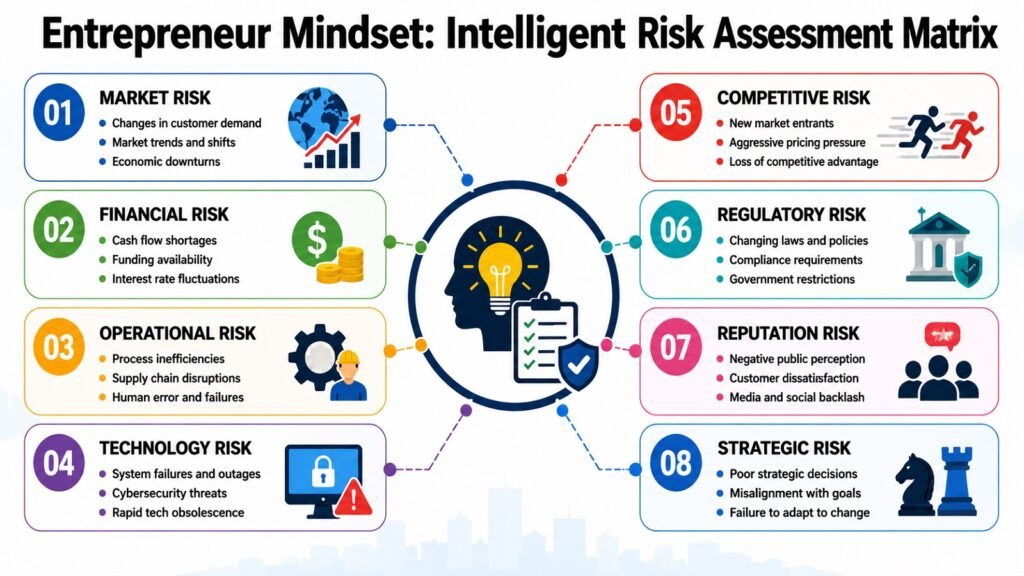
Entrepreneurship is often romanticized as a willingness to take bold risks. The reality is considerably more nuanced. Research from behavioral economics and decision science shows that successful founders do not take bigger risks than others. They take better-understood risks. The Entrepreneur Mindset approaches uncertainty through structured evaluation rather than emotional conviction or optimistic assumption.
Daniel Kahneman’s research on judgment under uncertainty identified systematic cognitive biases that affect how people estimate risk. Overconfidence bias leads founders to underestimate downside exposure. Availability bias causes them to weight recent or memorable outcomes more heavily than statistical probability. Planning fallacy produces unrealistic timelines and cost estimates. Recognizing these biases is the first step toward more accurate risk evaluation.
Jeff Bezos developed a regret minimization framework, asking which decisions he would most regret in the long run. This moved his risk evaluation away from short-term fear toward a longer view of potential consequences. Howard Marks similarly argued that risk management is not about avoiding uncertainty but understanding it well enough to evaluate it accurately.
WeWork offers a cautionary example. Its leadership expanded aggressively into global real estate markets without adequately evaluating the downside risk of long-term fixed lease obligations against volatile short-term revenue. When growth slowed, the mismatch between fixed costs and flexible revenue became catastrophic. In contrast, companies like Berkshire Hathaway and Amazon have historically demonstrated careful evaluation of risk before committing capital at scale.
Intelligent risk assessment does not eliminate uncertainty. No assessment can do that. What it does is replace emotional decision-making with a disciplined evaluation of probabilities, potential outcomes, and the cost of being wrong. Entrepreneurs who develop this capability tend to pursue calculated experiments rather than reckless bets, and they tend to recover more successfully when experiments fail because they planned for that possibility from the beginning.
Entrepreneur Mindset: Entrepreneurial Risks and Practical Management Approaches
| Common Entrepreneurial Risk | Practical Management Approach |
| Market demand uncertainty | Conduct small-scale tests and gather customer evidence before scaling investment |
| Cash flow shortfall | Maintain conservative projections and hold a financial buffer for unexpected delays |
| Overconfidence in growth assumptions | Apply pre-mortem analysis to identify failure scenarios before committing resources |
| Technology execution risk | Build minimum viable products to test core assumptions at low cost and speed |
| Competitive response | Monitor industry signals continuously and prepare contingency strategies in advance |
| Key-person dependency | Document processes and develop multiple team members capable of critical functions |
| Regulatory uncertainty | Engage with legal advisors early and build compliance flexibility into the business model |
| Long-term fixed cost exposure | Match cost commitments to revenue certainty and avoid locking in capacity too far ahead |
3. Entrepreneur Mindset and Decision-Making Under Uncertainty
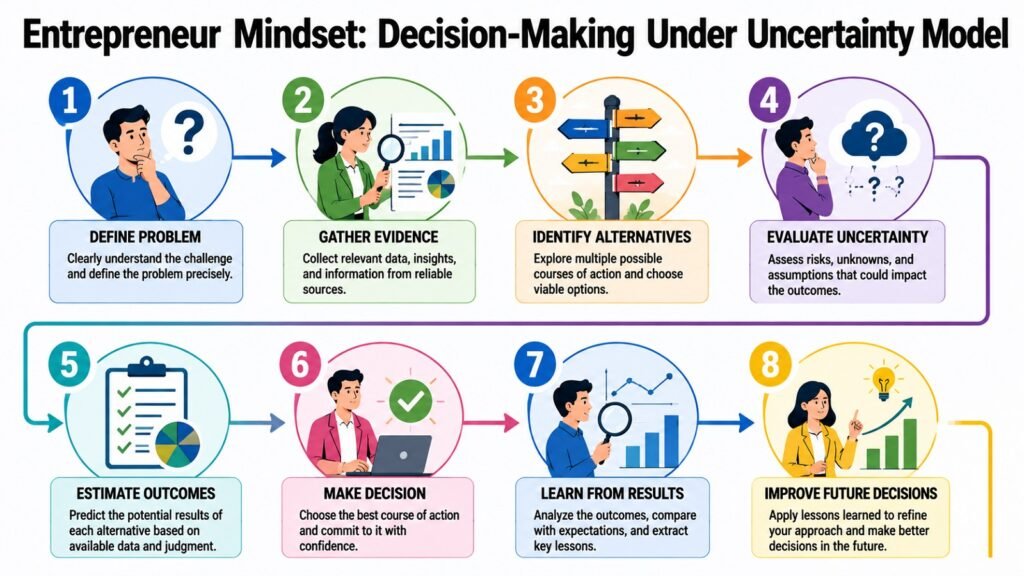
Uncertainty is not a temporary condition that resolves itself before important decisions need to be made. For founders, uncertainty is the permanent environment in which all decisions occur. The Entrepreneur Mindset does not wait for certainty before acting. It develops a disciplined process for making sound decisions with whatever information is available, while remaining open to updating those decisions as new evidence arrives.
Research from organizational psychology and strategic management identifies two common failure modes in entrepreneurial decision-making. The first is paralysis — waiting for complete information before committing, which means missing market windows. The second is overcommitment — locking into an early strategy and refusing to adjust when evidence suggests a change is necessary. Neither extreme produces good outcomes.
Amazon built a formal decision-making framework to address this problem. Jeff Bezos drew a distinction between reversible decisions and irreversible ones. Reversible decisions, which he called Type 2 decisions, should be made quickly and tested. Irreversible ones, which he called Type 1, deserve slower deliberation. This simple distinction has influenced how Amazon’s teams have approached product experimentation for decades.
Polaroid offers a different kind of lesson. Its leadership made early and largely correct observations about the potential of digital photography. But rather than acting on that insight, the company hesitated, prioritizing the protection of its existing film business. By the time Polaroid committed to a digital strategy, Kodak, Sony, and later smartphone manufacturers had moved decisively ahead.
Effective entrepreneurial decision-making under uncertainty involves three consistent habits. First, founders gather whatever evidence is available quickly rather than exhaustively. Second, they decide and act, treating the action as an experiment rather than a final commitment. Third, they monitor outcomes and update their assumptions as new data becomes available. This cycle — observe, decide, act, learn — is more reliable than either waiting or overcommitting. It treats uncertainty as a manageable condition rather than an obstacle.
Entrepreneur Mindset: Uncertainty Situations and Decision-Making Approaches
| Uncertainty Situation | Decision-Making Approach Used by Founders |
| Unclear market demand for new product | Launch a small pilot, collect user feedback, and adjust before full investment |
| Competing technology platforms emerging | Evaluate which platform serves the target customer most effectively at lower risk |
| Ambiguous regulatory environment | Consult legal advisors early and design the business model to remain compliant across scenarios |
| Conflicting signals from early customers | Segment feedback by customer type to identify which group the product serves best |
| Uncertain timing of market readiness | Set milestone triggers that initiate investment only when adoption indicators appear |
| Multiple viable business models available | Run parallel small-scale tests to generate comparative evidence before committing to one |
| Unclear competitive positioning | Define the narrowest possible initial target segment and expand only once established there |
| Insufficient financial runway to wait | Prioritize decisions that reduce burn rate while preserving the most promising growth options |
4. Entrepreneur Mindset and Systems Thinking
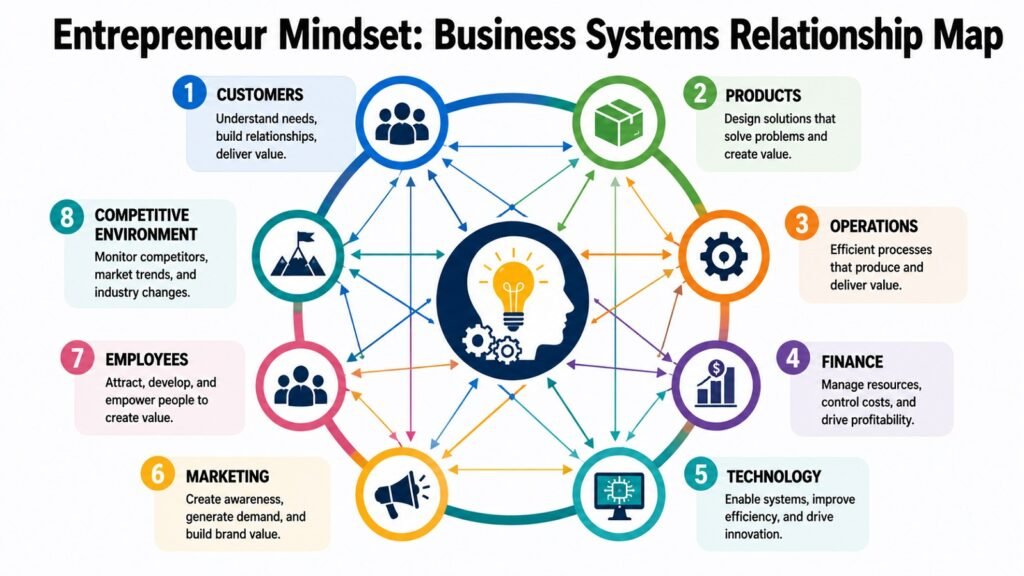
A business is not a collection of isolated departments. It is a system in which every function — customer acquisition, product development, operations, finance, and human resources — affects every other function in ways that are not always immediately visible. The Entrepreneur Mindset applies systems thinking to understand these interconnected relationships before making strategic decisions. Without that understanding, solving one problem often creates two new ones somewhere else in the organization.
Jay Forrester’s research at MIT established the principles of systems dynamics, showing that complex systems produce counterintuitive outcomes when leaders focus only on individual parts. Peter Senge later applied this to organizational strategy, arguing in The Fifth Discipline that the most damaging business decisions often come from local optimization — improving one function while quietly damaging the whole.
Toyota’s production system illustrates systems thinking in practice. Rather than treating manufacturing efficiency, quality control, supplier relationships, and inventory management as separate problems, Toyota integrated them into a single continuous flow. This prevented the buildup of defects, reduced waste, shortened lead times, and improved supplier trust simultaneously. The company’s long-term manufacturing advantage has rested partly on this systems-level view of production.
In contrast, many companies pursue short-term cost reductions by cutting supplier quality standards, reducing employee training, or delaying product investment. These decisions appear financially rational in isolation. But systems thinking reveals the downstream consequences: higher defect rates, slower product cycles, higher customer churn, and eventual erosion of brand reputation. Each of these consequences feeds back into the original problem, making it worse over time.
Founders who think in systems tend to ask second-order questions before committing to decisions. What happens after this decision takes effect? Which other parts of the business will be affected? What feedback loops could amplify or dampen the intended result? These questions add analytical depth to strategic planning and help founders avoid the unintended consequences that often undermine otherwise well-reasoned decisions.
Entrepreneur Mindset: Business Systems and Their Influence on Entrepreneurial Decision-Making
| Business System | Primary Influence on Entrepreneurial Decisions |
| Customer acquisition | Determines which market segments receive investment and shapes long-term growth trajectory |
| Product development | Influences competitive positioning, release timing, and investment in innovation |
| Supply chain and operations | Affects product quality, delivery speed, cost structure, and supplier trust |
| Financial management | Shapes risk capacity, investment priorities, and the ability to sustain growth |
| Human resources | Determines talent quality, organizational culture, and execution capability at scale |
| Technology infrastructure | Enables or constrains product scalability, data utilization, and operational efficiency |
| Marketing and brand | Builds customer perception that influences pricing, loyalty, and competitive differentiation |
| Competitive environment | Sets the external pressures that force adaptation in product, pricing, and positioning |
5. Entrepreneur Mindset and Strategic Adaptability
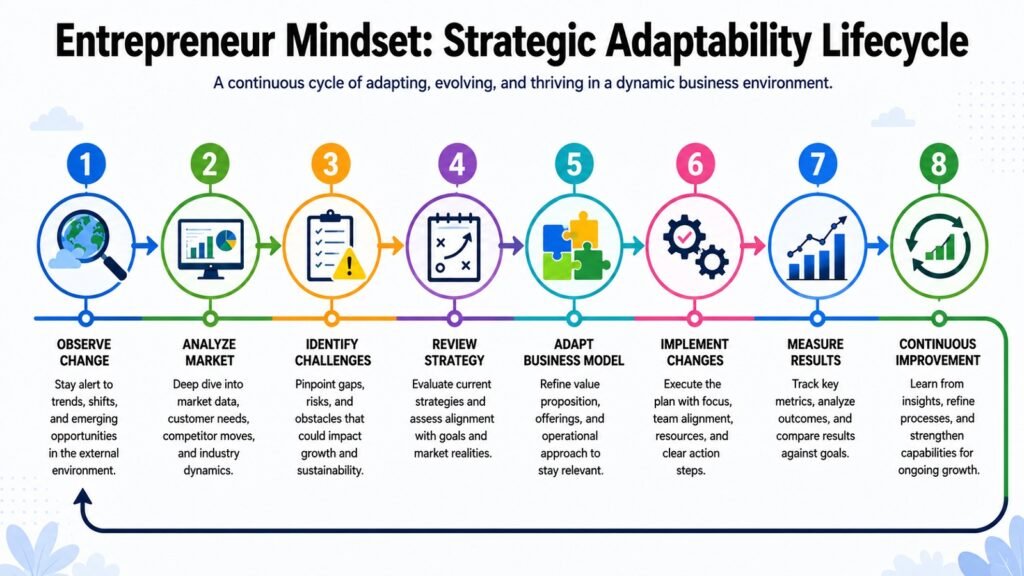
Markets shift. Customer expectations evolve. Competitors emerge from unexpected directions. Technologies that once defined entire industries become obsolete. The Entrepreneur Mindset does not treat these changes as threats to resist. It treats them as conditions to study and respond to with updated strategy. Strategic adaptability is not a sign of weak commitment to an original vision. It is a sign of clear-eyed engagement with evidence.
Research in innovation management and organizational behavior identifies a pattern called the incumbent trap. Established companies tend to defend their current business models even when evidence suggests those models are becoming less competitive. They conflate commitment to strategy with commitment to specific tactics. The distinction matters because successful adaptation almost always requires changing tactics while maintaining core strategic intent.
Netflix illustrates this clearly. The company launched in 1997 as a DVD-by-mail service. By 2007, it had shifted to streaming because the technology had matured and customer expectations had changed. By 2013, it had entered original content production because platform differentiation required exclusive programming. Each transition was an evidence-based response to shifting conditions rather than an abandonment of purpose.
Kodak understood that digital photography would eventually replace film. Its engineers actually invented early digital camera technology. But the company’s leadership chose to protect its film revenue rather than cannibalize it strategically. This decision foreclosed Kodak’s ability to adapt when digital adoption accelerated beyond its projections. Fujifilm, by contrast, recognized the same digital threat and diversified into pharmaceuticals, cosmetics, and office technology — businesses that leveraged its chemical expertise in new markets.
Strategic adaptability requires founders to hold two things simultaneously: a clear sense of the customer problem they are solving and genuine flexibility about which methods, technologies, and business models best solve that problem at any given point. The customer need is the anchor. The methods are the variable. Founders who confuse the two often find themselves protecting methods while losing customers.
Entrepreneur Mindset: Companies and the Strategic Adaptations That Drove Long-Term Success
| Company | Major Strategic Adaptation |
| Netflix | Shifted from DVD rental to streaming, then to original content production |
| Amazon | Expanded from online bookseller to e-commerce platform, then to cloud services |
| Fujifilm | Diversified from photographic film into pharmaceuticals, cosmetics, and office technology |
| Apple | Pivoted from personal computers to consumer electronics and digital services |
| Microsoft | Transitioned from packaged software to cloud computing and subscription services |
| Slack | Evolved from an internal gaming company tool into an enterprise communication platform |
| YouTube | Expanded from video sharing to advertising platform, then to premium subscription content |
| Spotify | Moved from music streaming to podcasting and audiobook distribution |
6. Entrepreneur Mindset and Long-Term Value Creation
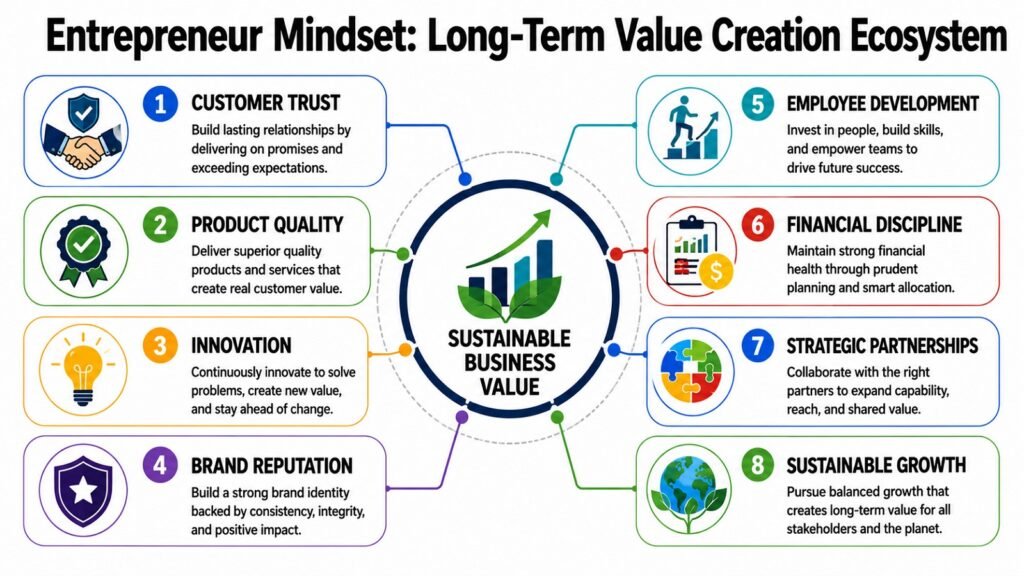
Short-term financial performance is easy to measure and therefore easy to optimize. Long-term value creation is harder to measure but far more important for durable business success. The Entrepreneur Mindset focuses on building things that last — customer trust, product quality, operational excellence, and genuine relationships — rather than maximizing metrics that look impressive on a quarterly report but erode the foundation of the business over time.
Research in competitive strategy and stakeholder theory consistently identifies a pattern: companies that optimize relentlessly for short-term profitability tend to underinvest in the factors that produce long-term advantage. They cut research and development budgets during downturns, reduce customer service quality to save cost, accelerate product releases before they are ready, and sacrifice supplier relationships for short-term margin improvements. Each of these decisions appears rational in isolation and destructive in aggregate.
Warren Buffett has described his investment philosophy as searching for companies with durable competitive advantages — what he calls economic moats. These advantages take the form of strong brand recognition, network effects, cost advantages, or switching costs that prevent customers from leaving. All of these advantages take years to build and can erode quickly if a company begins prioritizing short-term returns over the relationships and investments that sustain them.
Amazon’s long-term orientation is one of the most analyzed in modern business. Jeff Bezos famously wrote that if shareholders were upset about short-term results, they were investing in the wrong company. This enabled Amazon to invest in infrastructure, customer experience, and technology for over a decade before generating consistent profit. The result was a competitive position that proved extremely difficult for rivals to replicate.
In contrast, companies like General Electric under certain management periods pursued financial engineering to meet quarterly targets. These practices inflated short-term results while depleting the operational foundations that had made GE competitive. The consequences included declining market position and investor confidence that took years to recover. Long-term value is not a moral preference. It is simply the more reliable path to sustained competitive advantage.
Entrepreneur Mindset: Companies and Their Primary Long-Term Value Strategies
| Company | Primary Long-Term Value Strategy |
| Amazon | Reinvested profits into customer experience and infrastructure for over a decade before extracting returns |
| Apple | Built a deeply integrated ecosystem that raised customer switching costs and sustained premium pricing |
| Berkshire Hathaway | Acquired businesses with durable competitive advantages and held them for compounding returns |
| Patagonia | Built brand loyalty through environmental commitment and product durability over short-term volume |
| IKEA | Focused on cost efficiency through vertical integration and flat-pack design to sustain value pricing |
| Johnson & Johnson | Prioritized consumer safety and product trust as the foundation of long-term brand equity |
| Toyota | Invested continuously in production quality and supplier relationships to sustain operational excellence |
| Costco | Built membership loyalty through transparent pricing and employee investment rather than margin extraction |
7. Entrepreneur Mindset and Continuous Curiosity
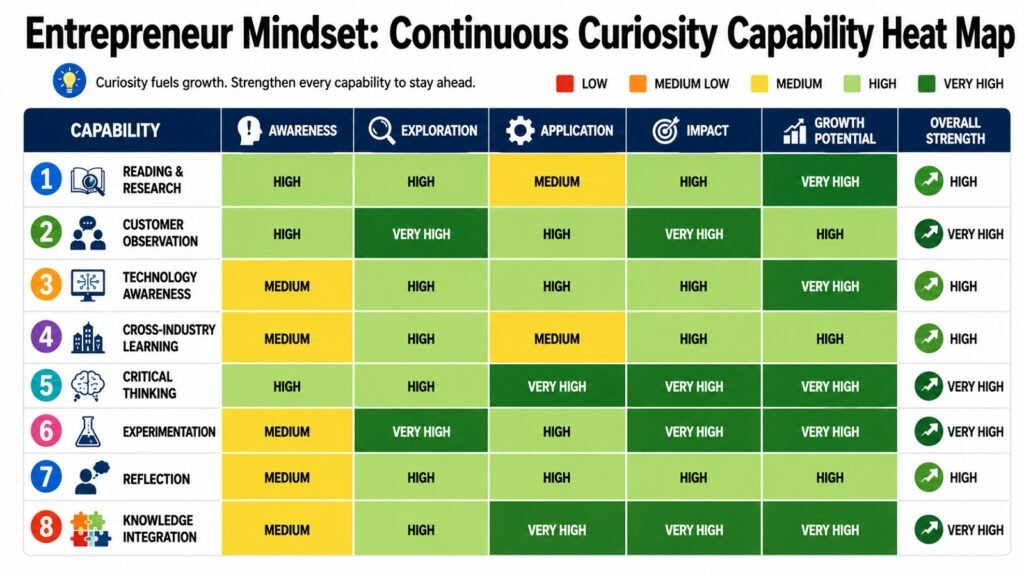
Knowledge ages quickly in competitive markets. Technologies shift, industries converge, and business models that seemed durable a decade ago can become obsolete fast. The Entrepreneur Mindset treats learning not as something that happens before a business launches but as an ongoing strategic activity. Continuous curiosity is not a personality trait. It is a deliberately practiced discipline that directly influences the quality of the entrepreneur mindset.
Research in cognitive psychology consistently links intellectual curiosity with better problem-solving, stronger pattern recognition, and greater creative output. George Loewenstein’s information-gap theory proposes that curiosity is activated when a person perceives a gap between what they know and what they want to know. Entrepreneurs who consistently expose themselves to new ideas, industries, and disciplines tend to recognize connections that others miss — which is one of the foundations of genuine innovation.
Charlie Munger, Warren Buffett’s long-term business partner, described his reading habit as a key driver of investment insight. He attributed his analytical effectiveness to the accumulated knowledge from reading across fields as diverse as mathematics, psychology, biology, history, and physics. This broad base of knowledge — what Munger called a mental models latticework — enabled him and Buffett to evaluate businesses more accurately than analysts who specialized narrowly.
Steve Jobs studied calligraphy at Reed College before dropping out. That exposure later influenced the typographic design of the original Macintosh, which introduced proportional fonts to mainstream computing and contributed to Apple’s early differentiation. Elon Musk has described reading broadly across rocket engineering, battery chemistry, and manufacturing science to develop capabilities that SpaceX and Tesla built internally rather than outsourcing.
Businesses that stop learning tend to stop adapting. Research on organizational decline consistently identifies intellectual complacency as a contributing factor. When leadership teams stop seeking new information, stop questioning their assumptions, and stop engaging with developments outside their immediate industry, they gradually lose the ability to recognize threats and opportunities early enough to respond. Curiosity is the mechanism that keeps the Entrepreneur Mindset sharp over time.
Entrepreneur Mindset: Entrepreneurs and Their Areas of Continuous Learning
| Entrepreneurs with Winning Entrepreneur Mindset | Areas of Continuous Learning |
| Charlie Munger | Studied psychology, biology, mathematics, and history to build a cross-disciplinary investment framework |
| Elon Musk | Read extensively on rocket engineering, battery chemistry, and manufacturing to build SpaceX and Tesla internally |
| Steve Jobs | Studied calligraphy, design, and Zen philosophy, influencing Apple’s approach to product aesthetics |
| Jeff Bezos | Explored logistics, cloud computing, and artificial intelligence to expand Amazon into adjacent markets |
| Bill Gates | Maintained intensive reading habits in science, medicine, and economics to guide philanthropic and business strategy |
| Reed Hastings | Studied business strategy and organizational behavior to develop Netflix’s distinctive management philosophy |
| Arianna Huffington | Researched sleep science and well-being to build Thrive Global after her personal health experience |
| Sara Blakely | Studied sales psychology and consumer behavior from direct sales experience before founding Spanx |
8. Entrepreneur Mindset and Opportunity Recognition
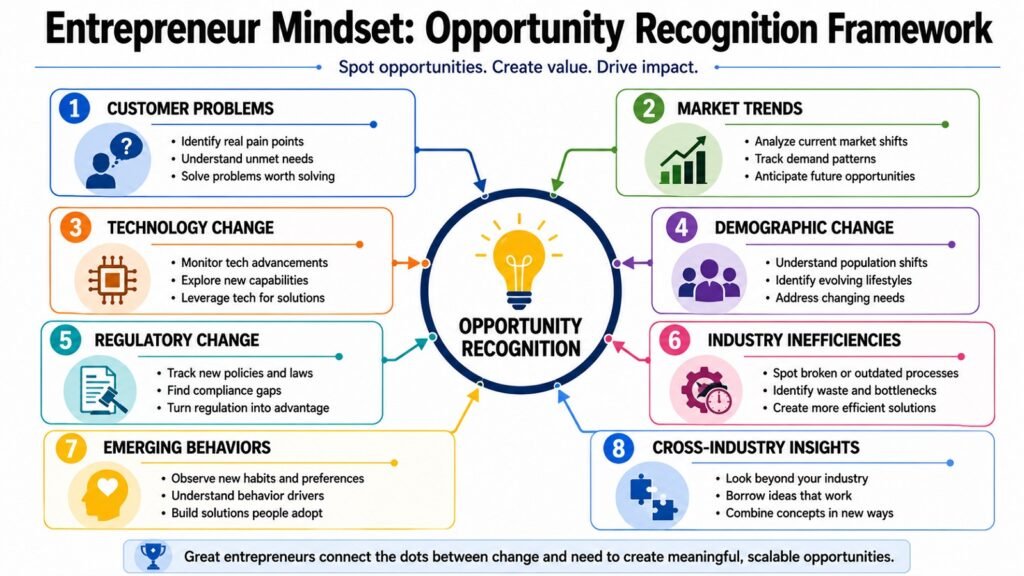
Many important business opportunities are visible in plain sight long before they become mainstream. The technologies exist, the demographic shifts are measurable, and the customer frustrations are documented. What separates founders who act on these signals from those who do not is not superior access to information. It is the Entrepreneur Mindset — the habit of combining observation, research, curiosity, and strategic thinking into a pattern-recognition capability that converts signals into decisions.
Research on entrepreneurial cognition suggests that opportunity recognition is not mainly intuitive. Scott Shane and Sankaran Venkataraman argued in an influential 2000 paper that prior knowledge shapes which opportunities a person can see. Someone with deep knowledge of a specific technology, customer group, or supply chain is more likely to recognize an unmet need in that space. This is why many successful founders spot opportunities in industries they already know.
Howard Schultz recognized the opportunity for Starbucks after visiting espresso bars in Italy in 1983 and observing that Americans had no comparable third-place social experience. The knowledge he needed was available to anyone who traveled. What distinguished his response was the analytical habit of translating an observation about customer experience into a scalable business model.
Reed Hastings observed that Blockbuster’s late-fee revenue was genuinely significant to the company’s profitability — meaning it could not eliminate it without damaging its finances. He recognized this structural constraint as an opportunity. Any competitor willing to eliminate late fees could attract exactly the customers most frustrated by that practice. Opportunity recognition in this case did not require special knowledge. It required a systematic analysis of why a painful practice persisted despite customer dissatisfaction.
Businesses that missed similar opportunities usually failed not because the information was absent but because their leaders were not asking the right questions. Borders Group had access to digital distribution data but did not act decisively. Nokia observed smartphone platforms emerging but underestimated how quickly software would replace hardware as the main competitive advantage. Opportunity recognition depends on disciplined observation, prior knowledge, analytical rigor, and the habit of asking what is changing and why it matters.
Entrepreneur Mindset: Business Opportunities and the Founders Who Recognized Them
| Business Opportunity | Entrepreneur or Company That Recognized and Acted |
| Third-place social experience outside home and work | Howard Schultz built Starbucks into a global coffee and lifestyle brand |
| Subscription model replacing video rental late fees | Reed Hastings launched Netflix and ultimately disrupted television and film distribution |
| Online bookstore as gateway to broad e-commerce | Jeff Bezos founded Amazon and expanded systematically from books into every retail category |
| Spare residential capacity as temporary accommodation | Brian Chesky and Joe Gebbia launched Airbnb to connect travelers with unused living space |
| Search engine quality as a gateway to online advertising | Larry Page and Sergey Brin built Google into the dominant digital advertising platform |
| Mobile payment infrastructure for underserved merchants | Jack Dorsey and Jim McKelvey created Square to enable small businesses to accept card payments |
| Direct-to-consumer eyewear without retail markup | Neil Blumenthal and partners launched Warby Parker after observing optician pricing structures |
| Ride-sharing using private vehicles and dynamic pricing | Travis Kalanick and Garrett Camp founded Uber after struggling to find a cab in Paris |
Conclusion: Entrepreneur Mindset for Lasting Business Success
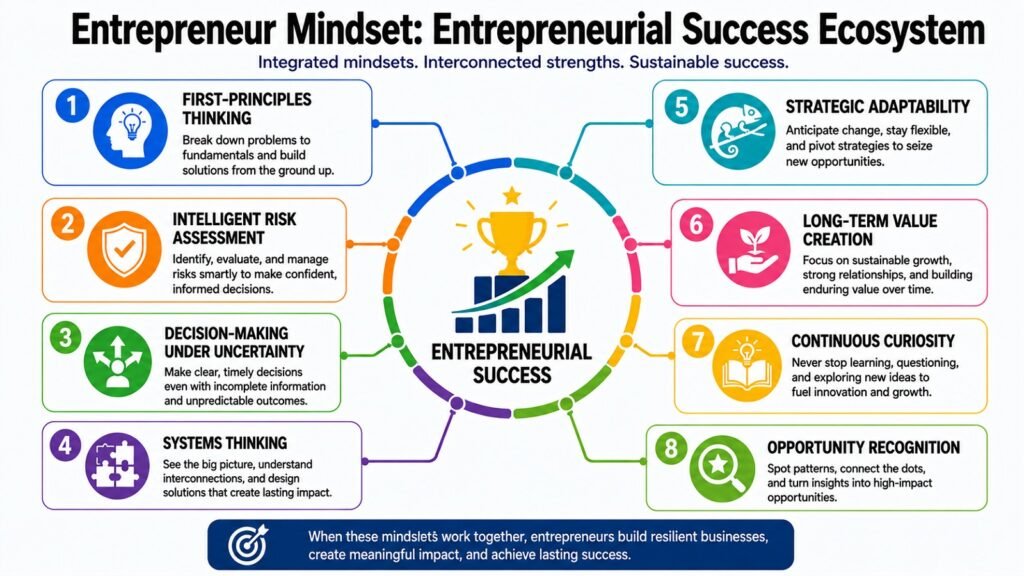
The eight mental models explored in this article do not exist in isolation. First-principles thinking enables more accurate risk assessment. Better risk assessment improves decision-making under uncertainty. Systems thinking reveals consequences that isolated decisions miss. Strategic adaptability depends on the curiosity to seek new information and the willingness to act on it. Long-term value creation requires a patient discipline that opportunity recognition alone cannot sustain. These capabilities reinforce one another, held together by the Entrepreneur Mindset.
The research findings, business theories, real-world examples, and practical insights discussed throughout this article collectively point toward a consistent conclusion: entrepreneur mindset is a discipline that can be deliberately developed. It is not an innate personality trait reserved for charismatic leaders or naturally gifted innovators. It is a collection of mental habits, analytical frameworks, and practiced behaviors that improve with sustained effort and honest self-evaluation.
This matters because it changes how founders and strategic thinkers can approach their own development. Rather than asking what successful entrepreneurs are like as people, a more useful question is what they consistently do when facing uncertainty or opportunity. The answer involves questioning assumptions, evaluating risks carefully, deciding with available evidence, thinking in systems, adapting strategies, building long-term relationships, pursuing knowledge across disciplines, and staying alert to early signals of change.
Revisiting these entrepreneur mindsets at key decision points — when entering a new market, evaluating a major investment, facing a competitive threat, or planning a product strategy — gives them practical utility beyond a single reading. The Entrepreneur Mindset is most valuable not as a concept to understand once but as a reference framework to apply repeatedly as business conditions evolve.
The founders and companies discussed throughout this article were not infallible. They made costly mistakes, missed important opportunities, and sometimes held mistaken assumptions for longer than their evidence warranted. But the mental models they consistently applied — even imperfectly — gave them a structural advantage in environments where most people navigate by habit rather than analysis. That is the most important insight this article can offer.
Entrepreneur Mindset: Eight Principles and Their Practical Takeaways
| Entrepreneur Mindset Principle | Primary Practical Takeaway |
| First-Principles Thinking | Challenge every assumption before accepting it as a fixed constraint on your strategy |
| Intelligent Risk Assessment | Evaluate probabilities and downside exposure before committing resources to uncertain outcomes |
| Decision-Making Under Uncertainty | Act with available evidence, treat decisions as experiments, and update assumptions continuously |
| Systems Thinking | Consider second-order consequences before committing to any significant business decision |
| Strategic Adaptability | Distinguish between the customer need you serve and the methods you use to serve it |
| Long-Term Value Creation | Build trust, quality, and relationships as foundations rather than optimizing only for short-term metrics |
| Continuous Curiosity | Pursue knowledge across disciplines deliberately and treat learning as an ongoing strategic activity |
| Opportunity Recognition | Develop pattern-recognition through observation, prior knowledge, and systematic analysis of change |