
Table of Contents
Introduction — Omnichannel Customer Experience: Connecting Every Customer Touchpoint
Customers today move between channels fluidly. They browse on a smartphone, purchase on a laptop, collect an order in a store, and contact support through a messaging app — often within a single journey. Omnichannel Customer Experience is the discipline of making that collective experience coherent, continuous, and genuinely centered on the customer rather than on any individual channel.
Omnichannel Customer Experience is an important aspect of overall Customer Experience because it determines how connected and consistent the experience is across touchpoints — not just how good each touchpoint is in isolation. As customers move between physical and digital environments with increasing ease, organizations that manage channels separately tend to produce fragmented, inconsistent, and unnecessarily effortful journeys. The strategic importance of omnichannel CX grows directly with the fluidity of customer behavior.
It is worth distinguishing omnichannel from multichannel. Multichannel means providing access through several channels; omnichannel means integrating those channels so the experience is coherent and continuous across all of them. The difference is conceptual as much as technical. Omnichannel CX is defined by continuity, integration, shared context, and the customer’s ability to move between touchpoints without friction or information loss.
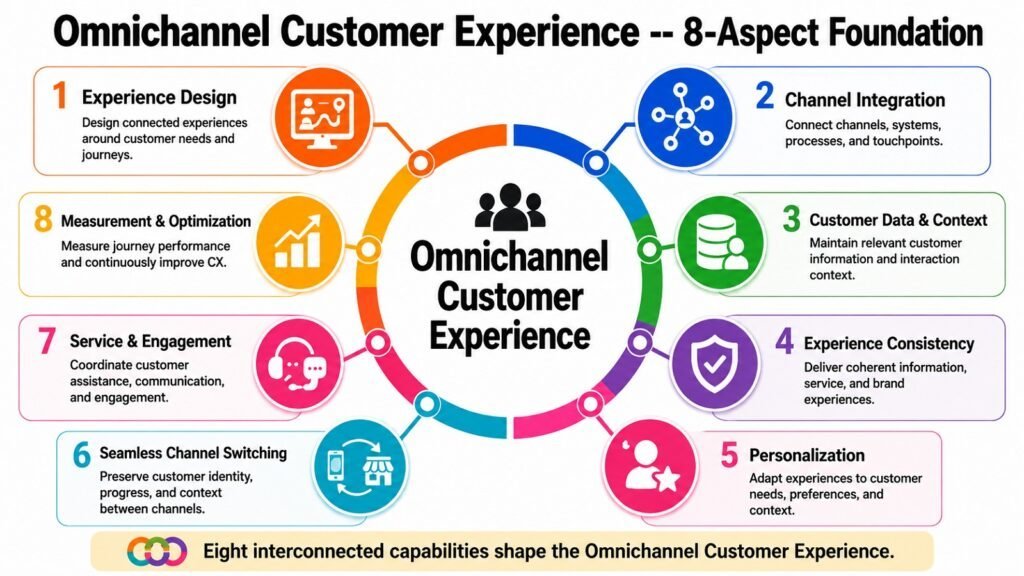
This article examines eight interconnected aspects as a framework for understanding and improving connected CX — from how channels should be designed around customer goals, to how context should travel between touchpoints, to how performance should be measured across journeys rather than within individual channels.
Table 1: Eight Aspects of Omnichannel Customer Experience
| Omnichannel Customer Experience Aspects | Contribution to Omnichannel Customer Experience |
| Experience Design | Establishes connected, journey-oriented experiences built around customer goals across channels |
| Channel Integration | Connects systems, processes, and information flows into a coherent operational foundation |
| Customer Data & Context | Enables recognition, continuity, and relevance by making customer knowledge available across touchpoints |
| Experience Consistency | Ensures customers receive coherent information, policies, and service standards regardless of channel |
| Personalization | Adapts the experience to individual needs, preferences, history, and context across connected channels |
| Seamless Channel Switching | Allows customers to move between touchpoints without losing identity, progress, history, or context |
| Service & Engagement | Coordinates interactions and communication across channels around the customer’s actual need |
| Measurement & Optimization | Creates the feedback loop for evaluating and continuously improving the connected customer journey |
1. Omnichannel Customer Experience and Experience Design
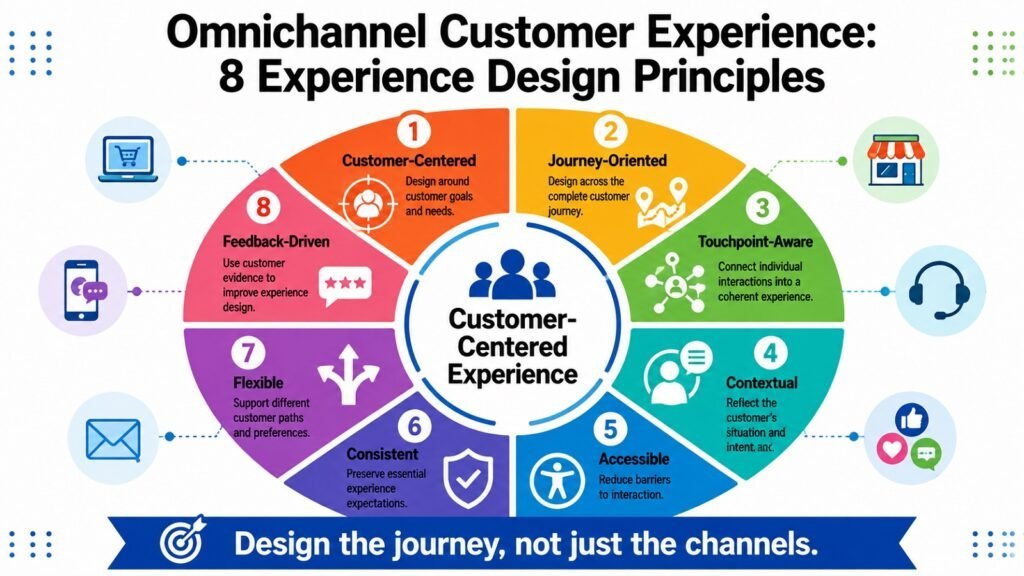
Experience design, in the context of Omnichannel Customer Experience, is the deliberate practice of creating connected experiences by designing around customer goals, needs, and journeys rather than individual channels. It draws from service design, human-centered design, and interaction design — disciplines that share a commitment to organizing the environment around what customers are trying to accomplish.
The theoretical roots reach back to service-dominant logic and customer-centric design, which shifted the design conversation from outputs — the product, the interface, the channel — to outcomes: what does the customer achieve, and how effortful or rewarding is the process? Customer journey mapping, service blueprinting, and usability evaluation all contribute to an omnichannel design practice that treats the entire connected experience as the design object rather than any single touchpoint.
A meaningful tension exists between consistency and channel-specific optimization. Making every channel identical is neither realistic nor desirable. A mobile application can use touch interaction and location awareness in ways a desktop website cannot. A physical store involves sensory engagement and human interaction with no direct digital equivalent. Omnichannel design requires coherence — shared purpose, compatible information, and consistent service standards — while allowing each channel to be genuinely effective at what it does best, rather than uniformity for its own sake.
Research in service design consistently links customer effort — how hard customers must work to complete a task — to satisfaction, trust, and loyalty. Design choices that reduce effort at transitions have a disproportionately large impact on the overall experience. A customer moving from a website to a contact center should not have to restart the conversation. That transition is a design challenge, not only a technical one.
Table 2: Eight Omnichannel Customer Experience Design Dimensions
| Design Dimension | What Effective Omnichannel Design Achieves |
| Journey Orientation | Designs around end-to-end customer goals rather than individual channel interactions |
| Touchpoint Coherence | Ensures each channel contributes meaningfully to the broader connected experience |
| Customer Effort Reduction | Removes unnecessary friction at transitions, task completion, and issue resolution |
| Channel-Specific Fitness | Optimizes each channel for its genuine strengths without sacrificing overall coherence |
| Accessibility | Ensures all channels are usable by customers with varying abilities and contexts |
| Information Continuity | Carries relevant customer context across touchpoints so it does not need to be repeated |
| Service Blueprint Alignment | Connects frontstage customer experience with the backstage processes that enable it |
| Iterative Improvement | Uses customer feedback, behavioral evidence, and testing to refine the experience over time |
2. Omnichannel Customer Experience and Channel Integration
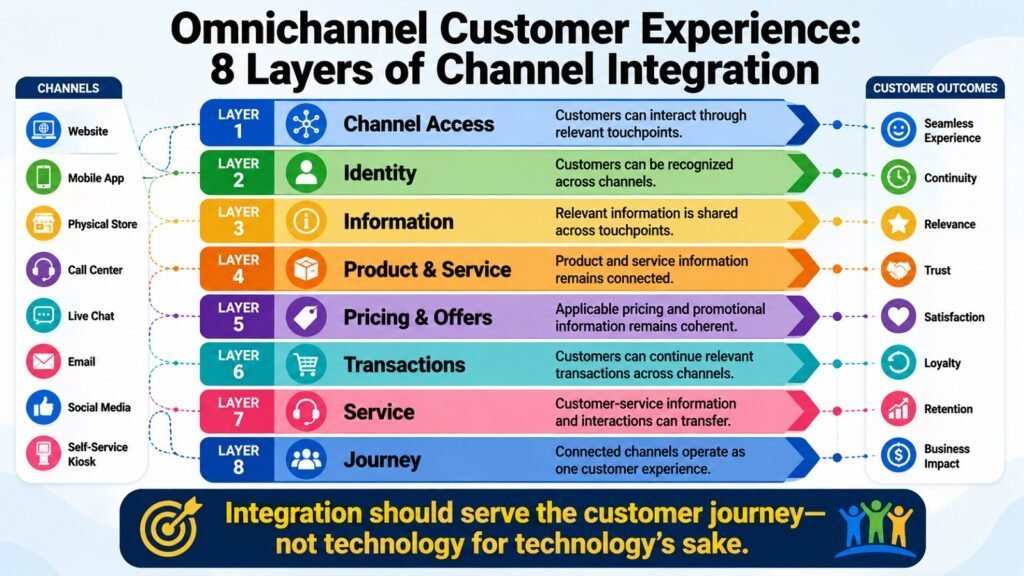
Offering customers access to multiple channels is not the same as integrating those channels. A retailer might operate a website, a mobile application, a physical store, a contact center, and a social presence — yet if each functions independently, the result is a set of parallel experiences rather than an omnichannel one. Channel integration is what converts a collection of channels into a connected customer experience.
Integration operates at several levels simultaneously: systems and technology, processes and workflows, information and data flows, and organizational ownership and incentives. Research in omnichannel retailing treats integration not as a binary state but as a continuum. A contact center that can view a customer’s recent browsing history is more integrated than one that cannot. Purposeful integration focuses on the connections that generate genuine customer value rather than pursuing maximum integration as an end in itself.
The most common barriers are structural rather than technical. Channel silos — organizational units that own and optimize individual channels without adequate coordination — produce fragmented experiences regardless of what the underlying technology enables. Disconnected incentives, incompatible processes, and fragmented ownership prevent even capable systems from delivering coherent experience. Addressing structural barriers is often harder than implementing integration technology, and omitting them from an integration strategy consistently produces disappointing results.
Technology enables integration but does not deliver it. Aligned processes and cross-functional cooperation are what translate technical capability into actual improvements in customer experience. The relevant question is not which systems to connect but which customer-facing connections would most meaningfully reduce effort, increase consistency, and improve outcomes. Integration also creates the infrastructure through which customer context becomes available across touchpoints — the foundation the next aspect depends upon.
Table 3: Eight Omnichannel Customer Experience Channel Integration Dimensions
| Integration Dimension | What Effective Integration Enables |
| Systems | Connected platforms share data and state so each channel operates with current, accurate information |
| Processes | Workflows cross channel boundaries without requiring customers to restart or repeat steps |
| Information Flows | Relevant customer and transaction data is accessible wherever it is needed in the journey |
| Identity | Customers are recognized consistently across channels without unnecessary re-authentication |
| Transactions | Purchases, returns, and service requests can begin in one channel and complete in another |
| Handoffs | Transfers between channels or agents preserve context so customers do not need to repeat themselves |
| Ownership | Cross-functional accountability prevents channel silos from fragmenting the customer experience |
| Visibility | Inventory, order status, and service capacity are visible across relevant channels |
3. Omnichannel Customer Experience and Customer Data & Context
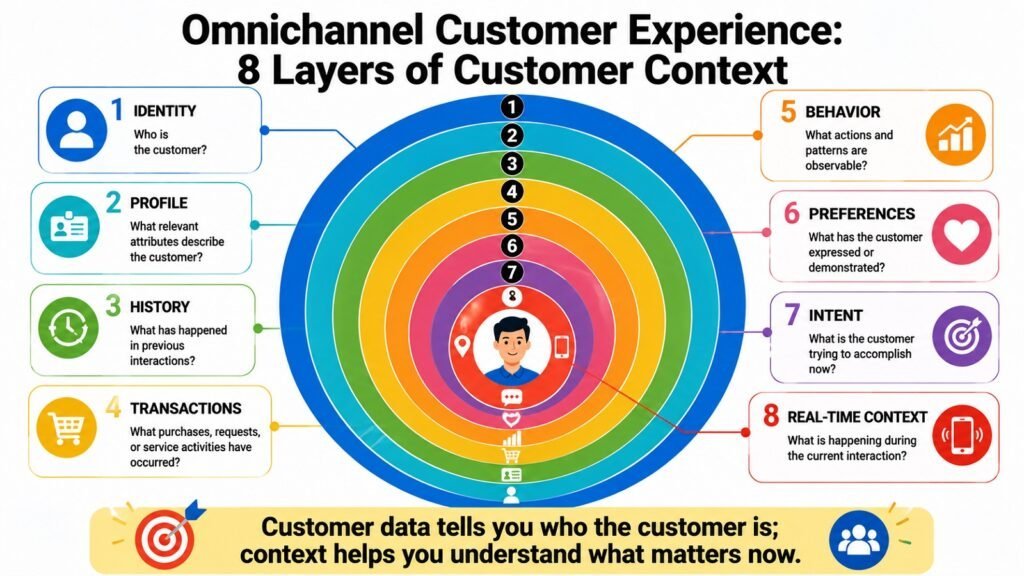
Customer data and context allow an organization to recognize a customer and understand their situation across touchpoints. Data is information collected or stored about the customer: purchase history, contact preferences, account status, and previous interactions. Context is what that information means in the current moment — what the customer is trying to accomplish, what has already happened in this journey, and what is relevant to the interaction taking place. Both are necessary for genuine omnichannel recognition.
Unified customer profiles — sometimes called a customer 360 view — bring together identity information, interaction history, transactional records, behavioral signals, and preferences into a single accessible representation. Research in customer relationship management consistently shows that when agents or systems can access relevant customer history, they reduce repetition, improve resolution rates, and produce a stronger perception of organizational competence. Fragmented, outdated, or inaccessible records undermine those benefits even when the underlying channels are technically connected.
Privacy, consent, and responsible data use are structural constraints on omnichannel CX, not peripheral concerns. Customers increasingly understand that their data is collected and used, and they form expectations about how it will be applied. Data used in ways that feel intrusive or inconsistent with the customer’s consent damages trust. Governance frameworks managing data quality, retention, access, and consent are a necessary part of any customer data strategy.
The practical distinction is between organizations that collect customer data and those that make customer context useful during interactions. The former measure success by data volume. The latter measure success by whether that data enables better outcomes during actual interactions — less effort, greater continuity, faster resolution. Omnichannel CX requires the second perspective: treating data as a capability to activate at the right moment rather than a resource to accumulate.
Table 4: Eight Customer Data and Context Categories in Omnichannel Customer Experience
| Data / Context Category | Role in Omnichannel Customer Experience |
| Identity Data | Enables consistent recognition of the same customer across channels and sessions |
| Interaction History | Provides agents and systems with a record of previous contacts, queries, and resolutions |
| Transactional Data | Supports order management, returns, billing queries, and loyalty across channels |
| Behavioral Signals | Reveals customer intent, interests, and engagement patterns across digital touchpoints |
| Stated Preferences | Reflects communication channel choices, notification settings, and contact options the customer has set |
| Real-Time Context | Captures what the customer is doing now — current session, device, location, and journey stage |
| Consent Records | Documents what the customer has agreed to, governing how their data may be used in interactions |
| Predictive Attributes | Derived signals that help anticipate customer needs based on behavioral and transactional patterns |
4. Omnichannel Customer Experience and Experience Consistency
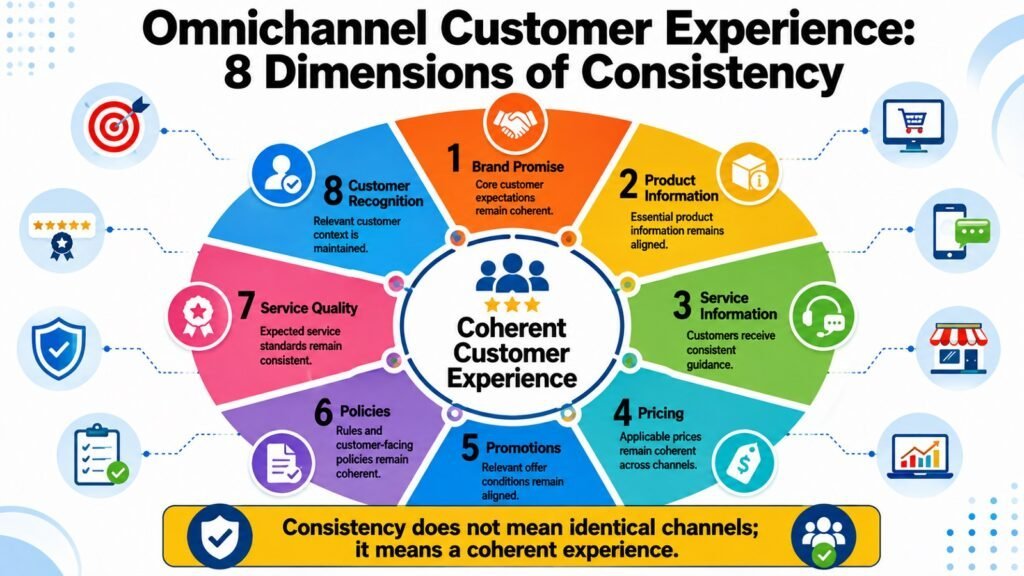
Experience consistency is the ability to deliver a coherent customer experience across channels. It does not mean that every channel looks, feels, and functions identically. It means that customers can trust the information, policies, service standards, and brand promise they encounter in one channel will not contradict what they encounter in another. That trust is the foundation of reliability in omnichannel experience.
Research in service quality consistently shows that contradictions between channels increase customer effort, create confusion, and erode trust. A customer who receives a promotional offer by email but finds it does not apply in-store, or who hears different return policy information depending on the agent they speak to, encounters fragmentation that undermines organizational reliability. Even when individual interactions are competent and courteous, inconsistency across channels produces a cumulative sense of distrust that individual channel performance cannot overcome.
The distinction between consistency and uniformity carries real practical weight. A mobile application may present a streamlined interface that differs significantly from a desktop website. A contact center agent may use conversational language that differs from written product descriptions. These variations are appropriate. What should not vary is core information — specifications, policies, pricing where channel-neutral, and the fundamental nature of the brand’s service commitment. That core is what consistency actually protects.
Organizations establish consistency through governance mechanisms that span channels: centralized content management, shared knowledge bases, product information management systems, and cross-functional service quality standards. A meaningful tension exists between consistency and contextual adaptation: excessive standardization can reduce relevance. Managing this tension requires judgment about which elements must be held constant and which can legitimately be adapted to context without introducing confusion.
Table 5: Eight Consistency Dimensions in Omnichannel Customer Experience
| Consistency Dimension | Desired Outcome for the Customer |
| Product and Service Information | Customers receive the same accurate descriptions, specifications, and availability data across channels |
| Pricing and Promotions | Offers and prices are applied consistently, with channel-specific differences clearly communicated |
| Policies | Return, refund, warranty, and support policies are the same across all customer-facing channels |
| Brand Communication | Tone, values, and messaging reflect the same brand identity regardless of channel or format |
| Service Standards | Response times, resolution expectations, and assistance quality meet consistent benchmarks |
| Organizational Responses | Customers receive aligned answers from agents, digital systems, and self-service resources |
| Journey Commitments | Promises made in one channel — callbacks, follow-ups — are visible and honored across channels |
| Problem Resolution | Service recovery is consistent: similar issues are handled with comparable fairness across channels |
5. Omnichannel Customer Experience and Personalization
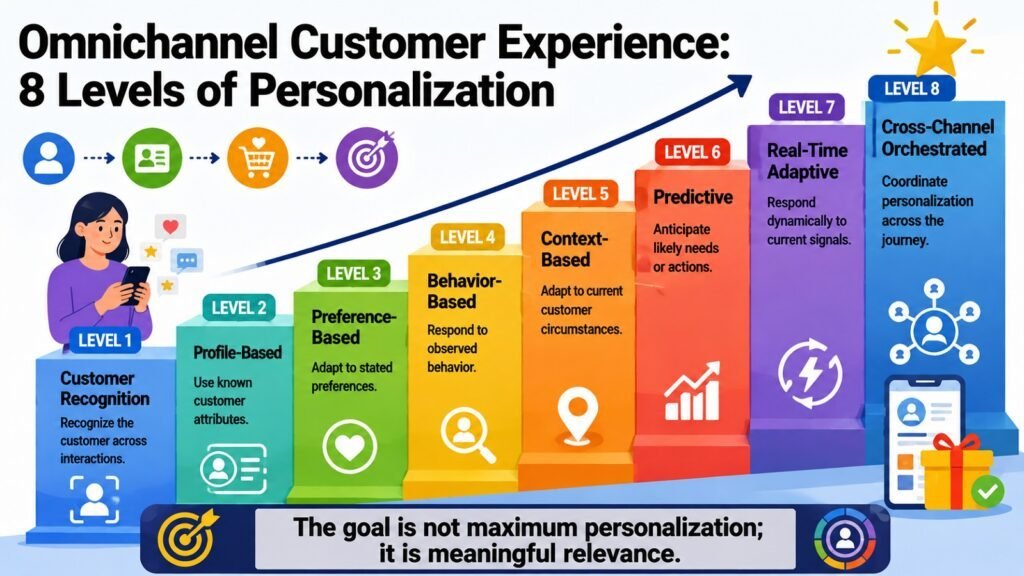
Personalization is the ability to adapt the customer experience based on what an organization knows about individual customer needs, preferences, behavior, history, intent, and context across connected channels. It builds on Customer Data & Context: data provides the foundation, and personalization represents how relevant customer knowledge is translated into an experience that feels appropriate and useful rather than generic.
Research consistently shows that customers respond positively to experiences that reflect their actual situation and preferences. Contextual relevance reduces decision effort and improves satisfaction. However, research also reveals meaningful tensions. The line between relevant and intrusive is drawn differently by different customers and shifts depending on context and the sensitivity of the information applied. A recommendation that feels helpful in one situation can feel surveillance-like in another. Personalization is therefore not inherently positive — its value depends on appropriateness and judgment.
Personalization operates at multiple levels. Contextual personalization adapts content to the customer’s current situation — device, location, and journey stage. Behavioral personalization applies patterns from past interactions to anticipate what the customer may want next. Predictive personalization uses analytical models, increasingly incorporating machine learning, to surface recommendations or proactive assistance. Real-time personalization applies these signals during the active interaction. Each level raises progressively more complex questions about relevance and privacy.
Genuine omnichannel personalization requires that the experience reflects the customer’s current journey: a customer who has already resolved an issue is not offered irrelevant content; a customer mid-way through a purchase is not treated as if browsing for the first time; preferences stated in one channel are respected in others. The principle that distinguishes effective personalization is using appropriate information to create useful customer value — more data does not automatically produce more relevant experiences.
Table 6: Eight Personalization Dimensions in Omnichannel Customer Experience
| Omnichannel Customer Experience Personalization Dimensions | What It Adapts in the Customer Experience |
| Contextual | Tailors content and interactions based on current device, location, time, and journey stage |
| Behavioral | Applies patterns from past browsing, purchases, and interactions to anticipate current needs |
| Predictive | Uses analytical models to surface relevant recommendations or proactive assistance |
| Real-Time | Adjusts the experience dynamically during an active session or interaction |
| Recommendation-Based | Suggests relevant products, content, or services based on individual preferences and history |
| Communication-Based | Adapts message timing, channel, and content to match the customer’s stated or inferred preferences |
| Service-Based | Routes and prioritizes service based on customer history, value, and current situation |
| Journey-Based | Recognizes where a customer is in their journey and adapts the next interaction accordingly |
6. Omnichannel Customer Experience and Seamless Channel Switching
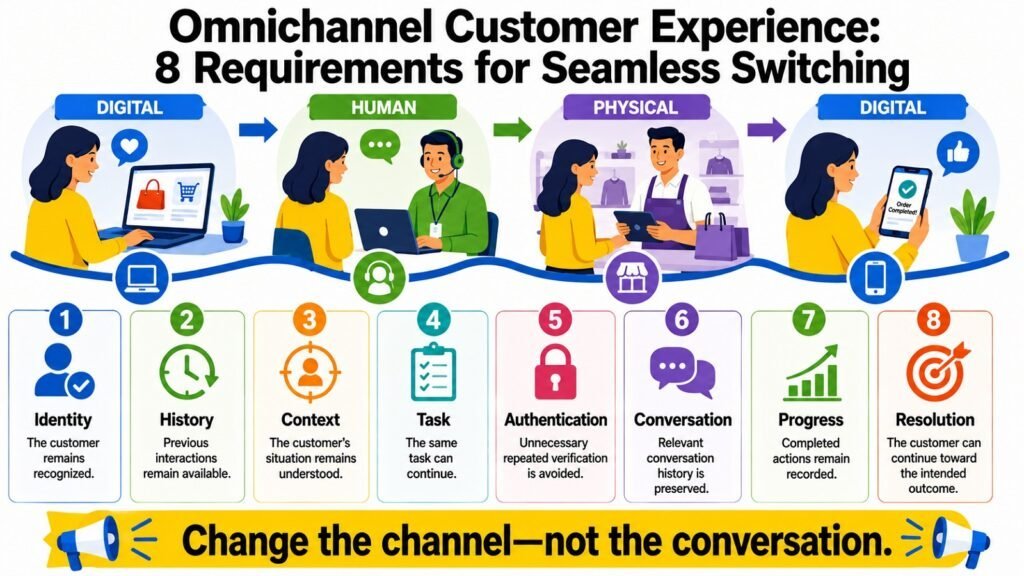
Seamless channel switching is one of the most tangible customer-facing outcomes of Omnichannel Customer Experience: customers should be able to move between channels without losing their identity, progress, history, or context. This differs from Channel Integration, which concerns the underlying systems and organizational connections. Seamless switching concerns what the customer actually experiences during a transition — whether moving channels feels continuous or disruptive.
Research on customer effort consistently identifies forced repetition — requiring customers to re-explain their situation when changing channels — as one of the most significant sources of dissatisfaction in cross-channel customer experience. When a customer contacts a contact center after spending time on a website, they expect the agent to understand the context. When a customer moves from mobile to desktop mid-purchase, they expect the transaction state to have persisted. When a customer visits a store about a delivery problem, they expect staff to have access to the relevant order details.
These transitions — digital-to-human service, website-to-contact-center, online-to-store, self-service-to-assisted — represent the seams in an omnichannel experience. Well-designed seams are nearly invisible. Poorly designed seams are precisely where customers encounter the friction and effort that characterize fragmented experiences. The principle is simple: customers should be able to change channels without restarting the relationship. Achieving this requires conversation history to be accessible, task state to be preserved, commitments to be visible across channels, and intent to carry across at the point of transfer.
Assessing whether switching is genuinely seamless requires measuring the experience at transitions rather than within channels. A contact center may handle calls efficiently while consistently receiving calls from customers who already spent time in self-service — a pattern that reveals a channel switching problem, not a service quality problem within the channel.
Table 7: Eight Channel Switching Continuity Requirements in Omnichannel Customer Experience
| Omnichannel Customer Experience Handoff Requirements | What Should Remain Continuous During Channel Transition |
| Customer Identity | The receiving channel recognizes who the customer is without requiring full re-authentication |
| Interaction History | Previous contacts, queries, and resolutions are accessible in the new channel |
| Task or Session State | Progress made in one channel — such as a partially completed purchase — is preserved |
| Conversation Context | The reason for contact and information already provided carries across the transition |
| Order and Transaction Data | Relevant order details, booking references, or account activity are visible in the receiving channel |
| Commitments and Promises | Callbacks or resolutions promised in one channel are visible and honored in another |
| Preferences | Communication and service preferences established by the customer are respected across channels |
| Journey Stage | The receiving channel understands where the customer is in their journey and responds accordingly |
7. Omnichannel Customer Experience and Service and Engagement
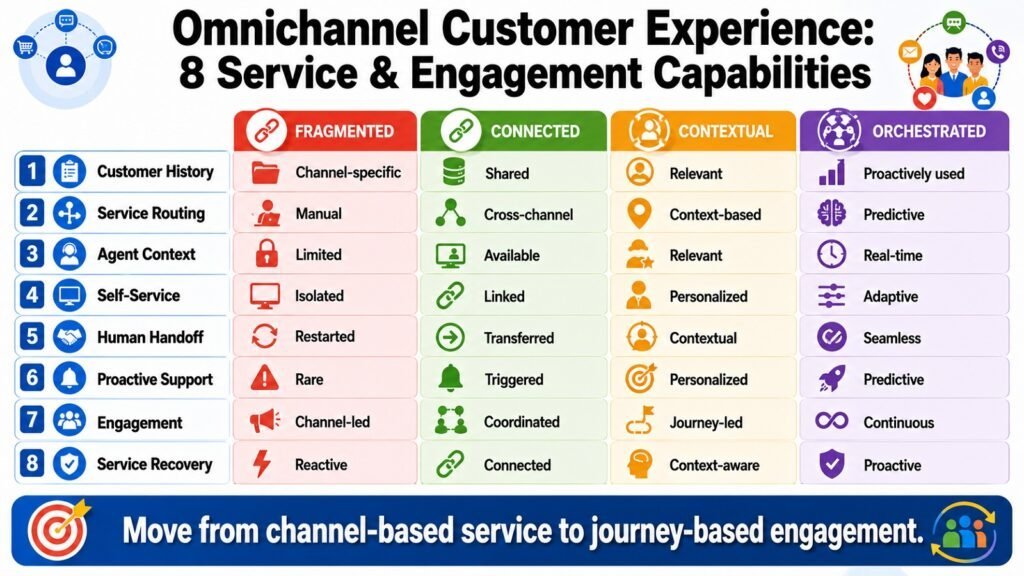
Omnichannel service and engagement is the interaction layer through which organizations assist, communicate with, and build relationships with customers across connected channels. It encompasses contact center interactions, messaging, chat, email, social engagement, self-service, conversational interfaces, and proactive communication. What makes these interactions omnichannel is that they are coordinated around the customer’s need rather than managed as isolated conversations within separate channel systems.
Research in service quality identifies responsiveness, reliability, assurance, and empathy as dimensions that consistently shape customer perceptions. In an omnichannel environment, these dimensions must be maintained across the connected series of interactions that constitute a customer’s service journey — not only within individual contacts. A customer who receives responsive chat support but encounters an uninformed agent when calling the following day experiences a quality gap that individual channel measurement would not reveal.
Agent context — information available to a service agent about the customer’s history, current situation, and previous interactions — is particularly important in omnichannel service. Agents who can access relevant customer history ask fewer unnecessary questions, resolve issues more efficiently, and demonstrate the organizational awareness that customers associate with competence. Routing and escalation — directing customers to the most appropriate resource based on their need and inquiry type — also contribute significantly to connected service quality.
The tension between automation and human assistance is a defining strategic question in omnichannel service. Automated interactions can handle a significant proportion of inquiries efficiently and at scale. Appropriateness depends on task complexity, urgency, emotional context, and customer preference. The challenge is designing a coordinated model where automation and human support complement each other and transitions between them are smooth — preserving context and continuity at each handoff rather than forcing customers to restart.
Table 8: Eight Omnichannel Customer Experience Service and Engagement Capabilities
| Omnichannel Customer Experience Service Capabilities | What It Enables in Omnichannel Customer Experience |
| Agent Context | Provides service agents with customer history and interaction context to reduce repetition and improve resolution |
| Intelligent Routing | Directs customers to the most appropriate resource based on their need, history, and channel preference |
| Conversation Continuity | Preserves the full conversation thread when a customer moves between agents or channels |
| Proactive Communication | Reaches out with relevant information before customers need to contact the organization |
| Self-Service Integration | Connects self-service tools with assisted service so context transfers when escalation is needed |
| Escalation Design | Enables smooth transitions from automated to human assistance without loss of progress or context |
| Social Engagement | Monitors and responds to customer contacts across social channels in a coordinated way |
| Service Recovery | Identifies and resolves service failures consistently across channels with appropriate follow-through |
8. Omnichannel Customer Experience and Measurement & Optimization
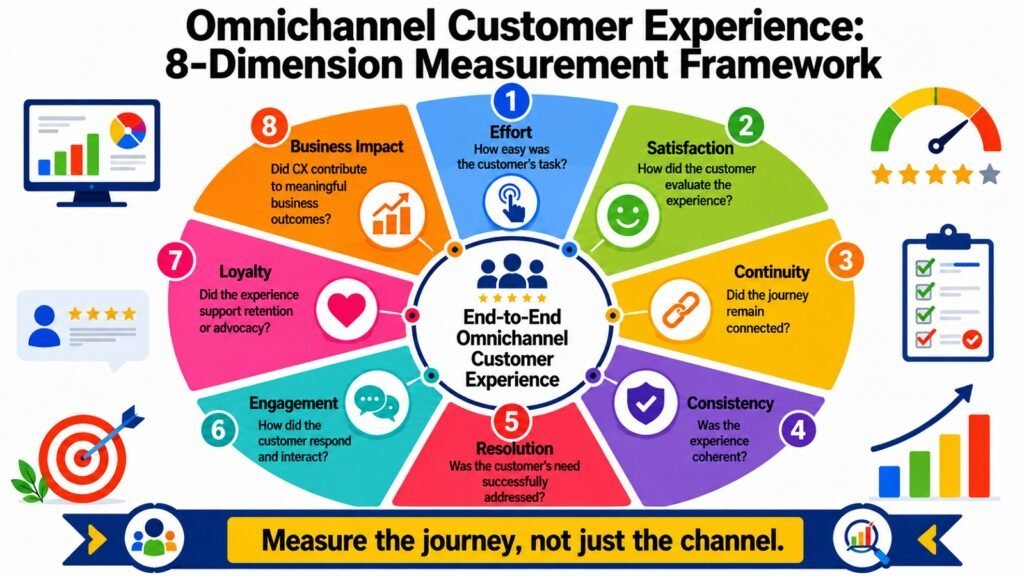
Omnichannel measurement and optimization is the discipline of evaluating and continuously improving the connected customer experience across channels and journeys. Measuring channel performance in isolation produces a misleading picture when customers frequently move between touchpoints. A contact center that handles calls efficiently may still be processing calls caused by preventable failures in digital self-service. A digital channel with high completion rates may be retaining satisfied customers while deflecting frustrated ones to more expensive assisted channels.
Three broad categories of metrics provide a more complete picture. Operational metrics — handle time, resolution rates, response times, and conversion — capture process efficiency. Experience metrics — customer effort scores, satisfaction ratings, and net promoter scores — capture customer perceptions. Business outcome metrics — customer retention, lifetime value, and revenue — connect experience performance to commercial results. Organizations that measure only one category tend to optimize for the wrong things and miss interdependencies that actually drive customer outcomes.
Journey analytics — measuring customer experience across touchpoints over time — is central to omnichannel measurement. A satisfaction score collected at the end of a contact center call tells you something about that call; it tells you relatively little about the forty-five minutes the customer spent searching for answers before calling, or the frustration that followed when a promised follow-up did not arrive. Journey-level analysis surfaces those broader patterns and reveals friction that channel-level metrics cannot detect.
Measurement should function as a continuous learning loop: identify friction in the customer journey, investigate its cause, design and test improvements, evaluate outcomes against meaningful metrics, and refine based on evidence. This loop — applied across journeys rather than within individual channels — distinguishes organizations that continuously improve omnichannel CX from those that optimize channel performance while leaving journey-level problems unresolved.
Table 9: Eight Measurement Dimensions in Omnichannel Customer Experience
| Measurement Dimensions in Omnichannel Customer Experience | What It Helps Organizations Understand |
| Customer Effort Score (CES) | How much effort customers expend to accomplish tasks or resolve issues across channels |
| Journey Completion Rate | The proportion of customers who successfully complete a goal across multi-channel journeys |
| Channel Switching Rate | How frequently customers move between channels, which may signal friction or self-service gaps |
| Cross-Channel Resolution | Whether issues are fully resolved regardless of which channels are involved |
| Customer Satisfaction (CSAT) | Customer perceptions of individual interactions, tracked across channels for comparison |
| Net Promoter Score (NPS) | Likelihood of recommendation, used as an indicator of relationship quality and loyalty |
| Journey-Level Attribution | Which channel interactions contribute to conversion, retention, or churn |
| Experience Consistency Index | The degree to which customers receive comparable information and service quality across channels |
Conclusion — Omnichannel Customer Experience: Building Connected CX
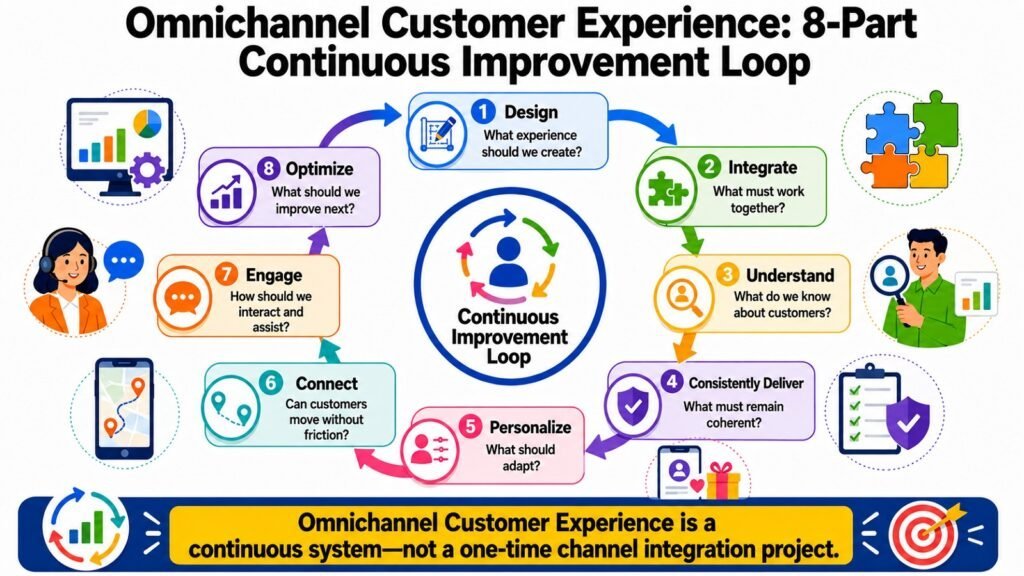
The eight elements discussed in this article constitute a cohesive framework. Experience Design defines the desired interconnected experience. Channel Integration lays the operational groundwork. Customer Data & Context facilitates recognition, continuity, and relevance. Experience Consistency fosters coherence. Personalization tailors the experience to meet individual requirements. Seamless Channel Switching maintains continuity during transitions. Service & Engagement enhance the experience through synchronized, context-sensitive interactions. Measurement & Optimization establishes a feedback loop for ongoing enhancement.
Omnichannel Customer Experience is an important aspect of overall Customer Experience because it is where the coherence and continuity of the customer’s relationship with an organization is determined. Excellence at the individual channel level does not compensate for a journey that feels fragmented, inconsistent, or unnecessarily effortful when viewed as a whole.
The tensions identified throughout — integration versus flexibility, consistency versus contextual adaptation, personalization versus privacy, automation versus human assistance — cannot be resolved by technology alone. They require coordinated design, aligned processes, shared data governance, and cross-functional ownership of the customer journey.
Looking ahead, artificial intelligence, richer connected data, and increasingly fluid physical-digital journeys will continue to reshape what omnichannel CX requires. Organizations best positioned to benefit are those with coherent foundations already in place: deliberate experience design, genuine channel integration, responsible data management, and a measurement culture oriented toward journey performance rather than channel performance.
Table 10: Omnichannel Customer Experience Framework — Eight Aspects and Core Contributions
| Omnichannel Customer Experience Aspects | Core Contribution to Omnichannel Customer Experience |
| Experience Design | Establishes connected experiences built around customer goals and journeys, not channel boundaries |
| Channel Integration | Creates the operational foundation that makes coherent, cross-channel experience possible |
| Customer Data & Context | Enables recognition, continuity, and relevance by activating customer knowledge across touchpoints |
| Experience Consistency | Ensures customers can trust that information, policies, and service standards are coherent across channels |
| Personalization | Adapts the experience to individual needs and context while respecting privacy and relevance |
| Seamless Channel Switching | Preserves customer identity, progress, and context when customers move between touchpoints |
| Service & Engagement | Coordinates interactions and assistance across channels around what the customer actually needs |
| Measurement & Optimization | Provides the feedback loop for continuous learning and improvement across the connected journey |