
Table of Contents
Introduction: Entrepreneurial Leadership – The Foundation of Entrepreneurial Success
Entrepreneurship is a multifaceted discipline, and few aspects of it matter more than Entrepreneurial Leadership. Among all the elements that determine whether a venture succeeds or fails, Entrepreneurial Leadership stands out as one of the most important aspects of entrepreneurship, because it connects opportunity with deliberate action and translates possibility into a functioning venture.
Entrepreneurial Leadership can be defined as the capacity to identify and pursue opportunities, mobilize resources, and lead people and processes through the distinctive conditions of entrepreneurial contexts. It differs meaningfully from conventional business leadership. General leadership often operates within established organizations with known markets, existing revenue, and predictable structures. Entrepreneurial leadership must function when the market is unproven, the product is evolving, the team is small, and the path forward is genuinely uncertain.
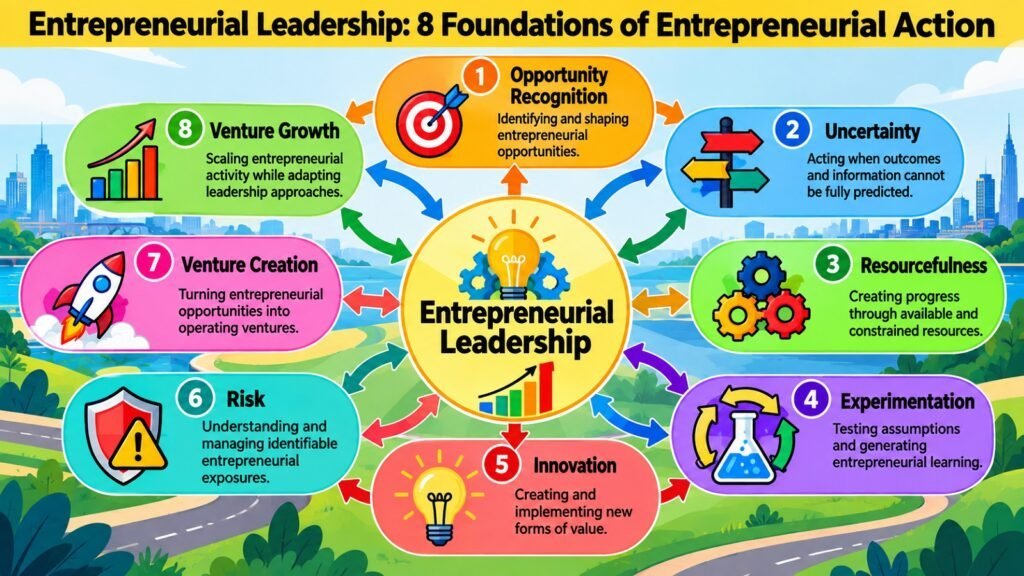
What creates this difference is the nature of entrepreneurial conditions: opportunity recognition, uncertainty, resource constraints, experimentation, innovation, risk, venture creation, and venture growth. Each condition places demands on leaders that conventional management frameworks were not designed to address. Entrepreneurial Leadership is therefore not a collection of generic leadership skills applied to startups. It is a distinctive combination of entrepreneurial thinking, leadership action, resource mobilization, learning, and adaptation.
This article explores eight foundations that together form a comprehensive framework for understanding Entrepreneurial Leadership. The table below introduces each foundation and its core focus.
Table 1: Entrepreneurial Leadership — Eight Foundations at a Glance
| Entrepreneurial Leadership Foundation | Core Focus |
| Opportunity Recognition | Identifying and evaluating market gaps, unmet needs, and emerging possibilities |
| Uncertainty | Acting and learning constructively when outcomes cannot be reliably predicted |
| Resourcefulness | Creating progress with constrained capital, people, knowledge, and networks |
| Experimentation | Testing assumptions to generate evidence and guide entrepreneurial decisions |
| Innovation | Developing and commercializing new products, services, processes, or business models |
| Risk | Identifying, estimating, prioritizing, and managing venture-level exposures |
| Venture Creation | Transforming an opportunity into an operational and viable new venture |
| Venture Growth | Sustaining entrepreneurial orientation as the venture scales in scope and complexity |
1. Entrepreneurial Leadership and Opportunity Recognition
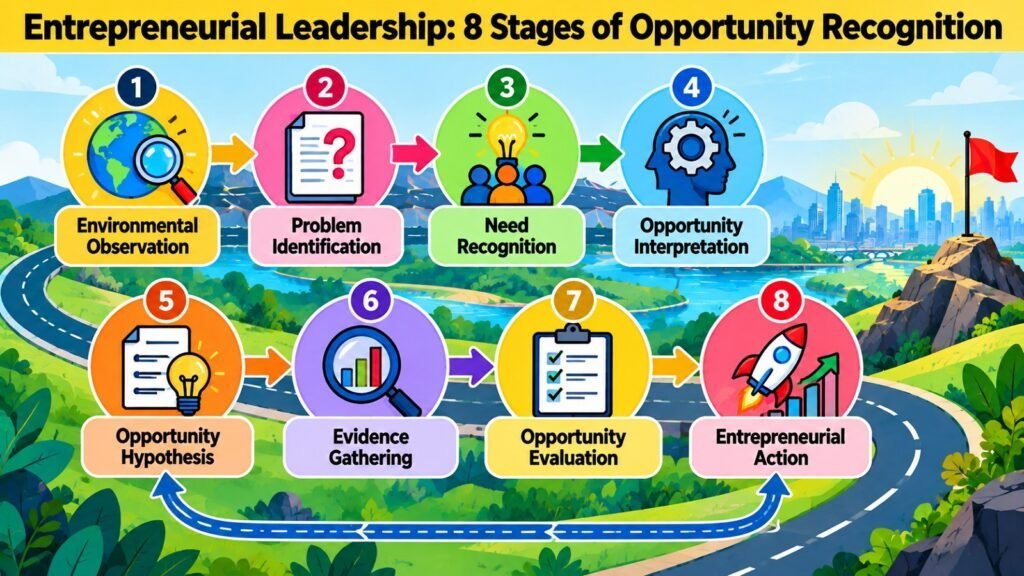
Every venture begins with an observation, a question, or a frustration that signals something worth pursuing. Opportunity recognition is the process through which entrepreneurial leaders identify, evaluate, and decide to act on signals suggesting the possibility of creating new value. It is a foundational dimension of Entrepreneurial Leadership and distinguishes entrepreneurial thinking from conventional strategic planning.
Opportunities can emerge from unmet customer needs, market inefficiencies, technological advances, regulatory changes, and shifting demographic patterns. Research by Venkataraman (1997) and Shane and Venkataraman (2000) established that entrepreneurial opportunities arise at the intersection of prior knowledge and environmental change. Leaders with deeper domain knowledge are often better positioned to notice what others overlook.
Scholars distinguish between opportunity discovery and opportunity creation. Discovery suggests opportunities exist independently and wait to be found. Creation suggests they are constructed through entrepreneurial action, experimentation, and customer interaction. Both mechanisms are real. The practical implication is that entrepreneurial leaders must avoid two equal errors: waiting passively for a perfect opportunity and forcing an idea into an opportunity shape it does not fit.
Netflix illustrates the leadership dimension clearly. Reed Hastings and Marc Randolph initially recognized not that streaming would replace physical media, but that video rental involved unnecessary friction. As technology evolved, the opportunity transformed. This required Entrepreneurial Leadership that could continuously reinterpret a moving target rather than defend an original assumption.
A useful diagnostic asks three questions: Is there genuine evidence of an unmet need, or is this primarily an idea? Who specifically would benefit, and why would they pay? Does timing make this viable today in ways not previously possible? These questions separate compelling ideas from real opportunities and prevent the common error of treating early enthusiasm as market validation.
Table 2: Opportunity Signals and Entrepreneurial Leadership Implications
| Opportunity Signal | Entrepreneurial Leadership Implication |
| Unmet customer need | Investigate whether the gap is large enough and painful enough to justify a new solution |
| Market inefficiency | Assess whether existing solutions are vulnerable to a significantly better alternative |
| Technological advance | Determine whether the technology enables a new category or only improves an existing one |
| Regulatory change | Identify new activities or business models that become viable or legally permissible |
| Demographic shift | Recognize underserved or emerging segments whose needs are not yet well served |
| Prior knowledge advantage | Leverage domain expertise to see connections that general observers may miss |
| Network signal | Use relationships to access early intelligence about emerging customer needs |
| Problem pattern recurrence | Treat a repeatedly observed friction or failure as a signal of structural unmet demand |
2. Entrepreneurial Leadership and Uncertainty
One of the most important distinctions in entrepreneurship research is the difference between risk and uncertainty. Risk involves unknown outcomes where probabilities can be estimated from available data. Uncertainty, by contrast, involves situations where the information needed to assign meaningful probabilities does not exist. Economist Frank Knight formalized this distinction in 1921, and it remains central to understanding why Entrepreneurial Leadership must operate differently from conventional management.
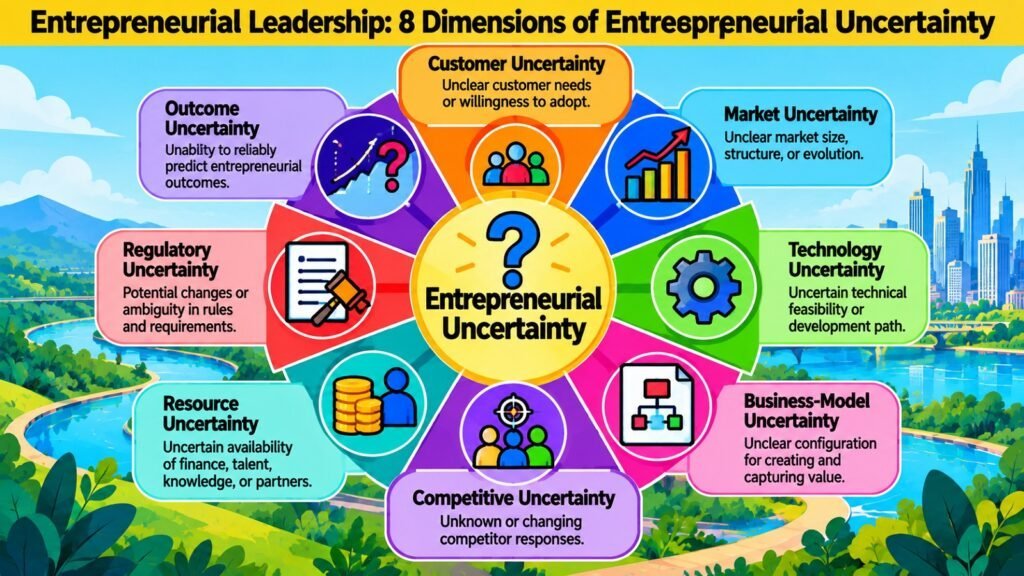
Entrepreneurial ventures routinely face multiple simultaneous uncertainties. Customers may not know what they want until a product exists. Markets may have no historical patterns because they are genuinely new. Technologies may behave differently at scale than in early tests. Each of these conditions makes conventional forecasting and standard planning unreliable tools for entrepreneurial leaders.
Operating under uncertainty does not mean acting recklessly. Entrepreneurial leaders who navigate it well make key assumptions explicit, identify which unknowns matter most, gather evidence through structured experiments, and act on imperfect information rather than waiting for certainty that may never arrive. Dropbox demonstrated this well. Before completing full development, Drew Houston and Arash Ferdowsi released an explainer video to test demand. The response confirmed real interest and justified continued investment.
A practical framework organizes uncertainty into four categories: customer, technology, market-structure, and business-model. For each, leaders can ask what is assumed to be true, what evidence would confirm or disconfirm it, and what minimum experiment would generate that evidence. This approach does not eliminate uncertainty, but it makes uncertainty manageable by converting unexamined assumptions into testable propositions.
Table 3: Types of Entrepreneurial Uncertainty and Leadership Considerations
| Type of Entrepreneurial Uncertainty | Leadership Consideration |
| Customer-need uncertainty | Test whether the target user values the proposed solution before full development |
| Technology-performance uncertainty | Prototype early to determine whether the technology works as expected at scale |
| Market-size uncertainty | Use proxy data and early adoption signals to estimate addressable demand |
| Business-model uncertainty | Experiment with pricing, channels, and revenue structures before committing |
| Competitive-response uncertainty | Monitor incumbent behavior and new entrants rather than assuming the field is static |
| Regulatory uncertainty | Engage early with regulators and legal advisors to identify potential compliance risk |
| Team-capability uncertainty | Assess whether the founding team has the skills the venture requires at each stage |
| Timing uncertainty | Evaluate whether market conditions, technology, and customer readiness align now |
3. Entrepreneurial Leadership and Resourcefulness
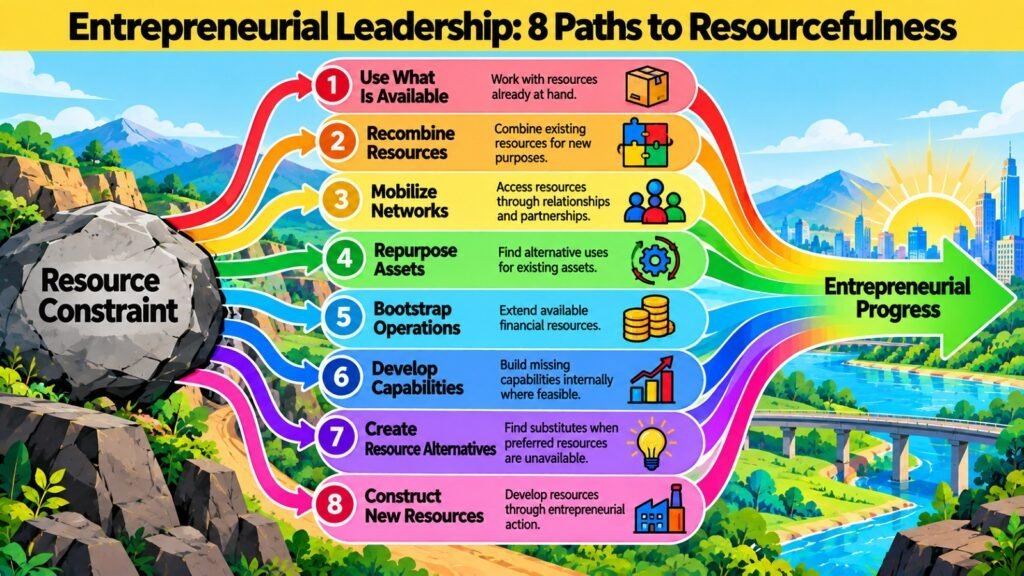
Most entrepreneurial ventures begin with far less than they need. Capital is limited, credibility is absent, and market access is narrow. Resourcefulness is the capacity to make meaningful progress despite these constraints by inventively mobilizing what is available rather than waiting for ideal conditions.
Entrepreneurship theorist Ted Baker developed the concept of bricolage to describe how entrepreneurs create value by combining available resources in novel ways. Related to this is effectuation, a decision logic developed by Saras Sarasvathy through research on expert founders. Rather than working backward from a fixed goal that requires specific missing resources, effectual thinkers start with who they are, what they know, and whom they know, then ask what can be built from those means.
Bootstrapping, building a venture primarily from revenue and personal savings rather than external funding, is a closely related approach. It preserves equity and control, but it has real limits. Undercapitalized ventures may be unable to hire required specialists, invest in key technology, or survive unexpected downturns. Resourcefulness is a genuine asset, but some constraints must eventually be removed with external capital rather than improvised around indefinitely.
Airbnb illustrates entrepreneurial resourcefulness vividly. When Brian Chesky and Joe Gebbia needed capital before their concept had traction, they created limited-edition presidential-election breakfast cereal boxes and sold them at a premium. This creative use of design skills and a timely cultural moment generated enough funding to keep the venture alive. A practical resourcefulness framework inventories available assets, identifies the critical gap, explores whether existing resources can address it, and honestly evaluates whether the solution creates real value or merely delays a necessary investment.
Table 4: Resource Constraints and Entrepreneurial Responses
| Resource Constraint | Entrepreneurial Response |
| Limited startup capital | Bootstrap through early revenue, pre-sales, or creative monetization of existing assets |
| Small founding team | Focus on the highest-value activities and use contractors for non-core tasks |
| Absent brand credibility | Leverage customer testimonials, pilot partnerships, and visible early adopters |
| Weak technology infrastructure | Use off-the-shelf tools and manual processes until volume justifies custom development |
| Narrow market access | Exploit founder networks, niche communities, and strategic partnerships to reach early customers |
| Limited knowledge base | Engage advisors, mentors, and domain experts to fill critical knowledge gaps cost-effectively |
| No physical infrastructure | Use shared workspaces, outsourced logistics, or partner facilities to reduce fixed costs |
| Thin operational capacity | Prioritize activities closest to customer value and defer non-essential internal processes |
4. Entrepreneurial Leadership and Experimentation
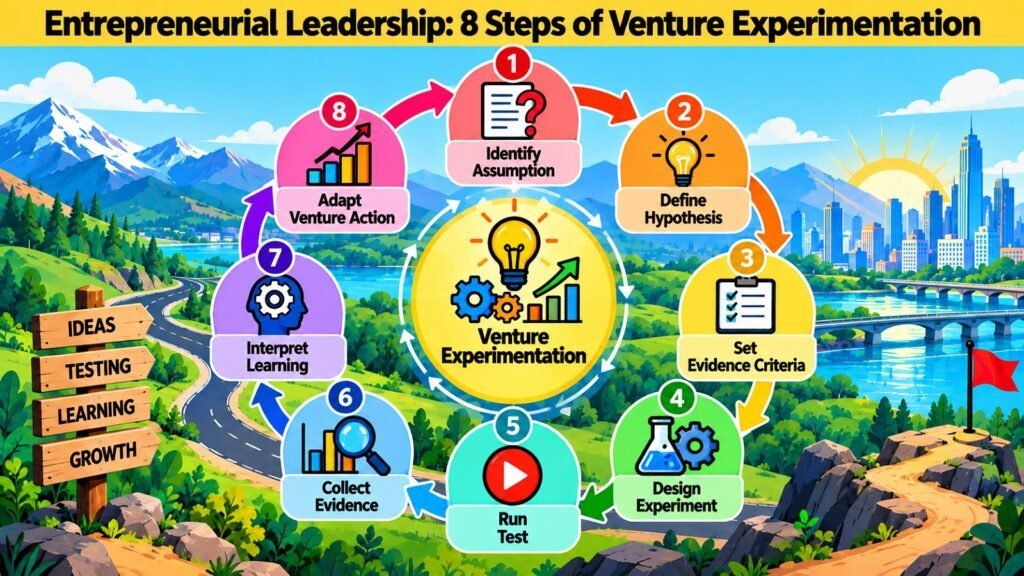
Experimentation is the mechanism through which Entrepreneurial Leadership converts uncertainty into knowledge. When customers are unproven, products are evolving, and business models are untested, assumptions must be treated as hypotheses rather than facts. The leader’s role is to design tests that generate honest evidence about which assumptions hold and which need revision.
Entrepreneurial experimentation is not random trial and error. It involves identifying a specific assumption that matters, designing a test capable of confirming or disconfirming it, running the test with appropriate care, and interpreting results without confirmation bias. The distinction matters because poorly designed experiments can produce misleading conclusions that redirect a venture confidently in the wrong direction.
The Lean Startup framework, developed by Eric Ries, popularized several tools now widely used in entrepreneurial practice. The minimum viable product, or MVP, is a version of a product with just enough capability to generate meaningful learning from real customers. Zappos demonstrated this approach before building any inventory infrastructure. Nick Swinmurn listed shoes from local stores online, bought them at retail when orders arrived, and shipped them at a loss to test whether customers would buy shoes without trying them on first. The experiment validated the core assumption at minimum cost.
A practical framework for evaluating an experiment asks four questions. Is it testing an assumption central to the venture’s survival or growth? Would a negative result meaningfully change the decision to continue or stop? Can results be interpreted clearly? And is the methodology genuine enough to produce reliable evidence rather than superficial validation? This last question addresses a common failure called vanity metrics, where experiments produce positive-looking numbers that do not reflect real customer behavior.
Table 5: Entrepreneurial Leadership — Assumptions and Suitable Experiments
| Assumption or Question | Suitable Experiment |
| Will target customers value this solution? | Run structured interviews and observe whether interviewees would pay or change behavior |
| Is there sufficient demand to justify full development? | Create a landing page and measure sign-up or pre-order conversion rates |
| Can the product be built to the required quality level? | Build a functional prototype and test it with real users under realistic conditions |
| Will customers pay the proposed price? | Offer the product at the intended price in a limited pilot before scaling |
| Does the delivery model work operationally? | Run a concierge version manually to validate the process before automating it |
| Will users return and recommend the product? | Track retention and referral rates among early adopters over a defined period |
| Is the chosen channel effective for customer acquisition? | Test one or two channels with small budgets before committing to a full campaign |
| Does the business model generate unit economics that scale? | Calculate cost per acquisition and lifetime value from early cohort data |
5. Entrepreneurial Leadership and Innovation
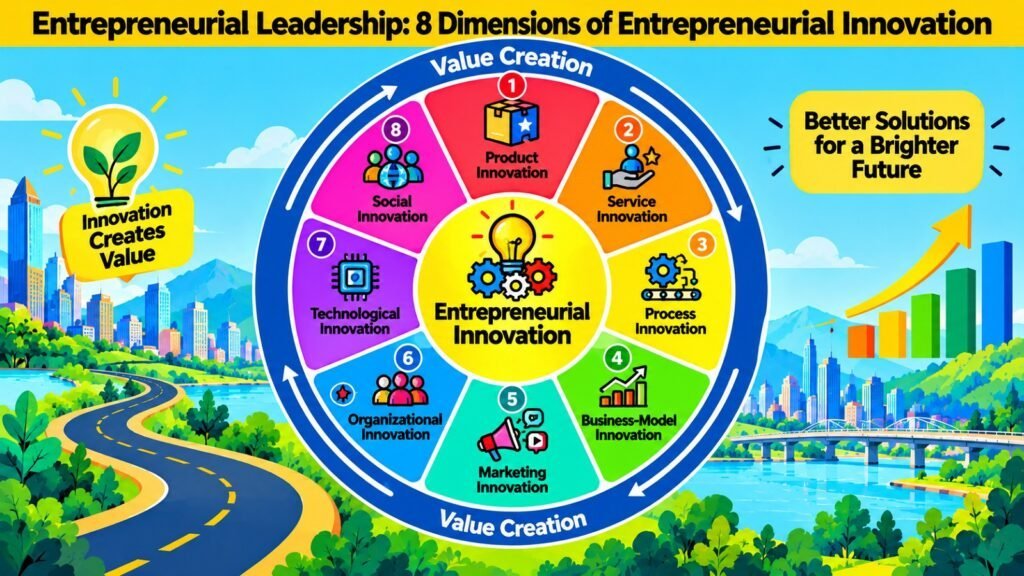
Innovation is not the same as experimentation. Experimentation is a method for learning under uncertainty; innovation is the outcome of developing and implementing new forms of value. Entrepreneurial Leadership drives innovation by connecting customer problems with novel ideas, available resources, and organizational commitment to building something genuinely new.
Joseph Schumpeter’s concept of creative destruction remains the most influential framework for understanding how entrepreneurship and innovation interact. Schumpeter argued that entrepreneurial activity introduces new combinations of products, methods, markets, inputs, and organizational forms, disrupting existing industries while creating new economic value. Entrepreneurial leaders are the agents of this process, and the ability to introduce new combinations rather than refine existing ones is a critical leadership capability.
Innovation takes multiple forms in entrepreneurial contexts. Product innovation creates new solutions that address problems in previously impossible ways. Process innovation changes how value is produced or delivered. Business-model innovation reimagines how a venture creates and captures value, sometimes enabling entirely new markets. Airbnb exemplifies business-model innovation: the core insight was not a new technology but a new arrangement that let individuals monetize idle assets while connecting travelers to accommodation that hotels could not replicate.
A practical framework for evaluating an innovative idea addresses three questions: Does it solve a genuine problem that existing solutions leave unmet? Is there a credible mechanism by which customers could discover and adopt it? And can the venture realistically capture enough of the value it creates to build a sustainable business? Innovations that lack a clear adoption path often fail even when the underlying idea is technically sound. Managing the tension between novelty and usefulness is one of the most consequential tasks of Entrepreneurial Leadership.
Table 6: Innovation Areas and Entrepreneurial Leadership Focus
| Innovation Area | Entrepreneurial Leadership Focus |
| Product innovation | Develop solutions that address unmet needs better than existing alternatives |
| Process innovation | Redesign delivery or production to achieve superior efficiency or reliability |
| Business-model innovation | Rethink how value is created, delivered, and captured in the target market |
| Platform innovation | Build infrastructure that enables other actors to create and exchange value |
| Market-creation innovation | Develop solutions that serve customers who are currently non-consumers |
| Technology-application innovation | Apply existing technologies to new problems where they create new value |
| Customer-experience innovation | Redesign the entire experience around what customers actually need and prefer |
| Supply-chain or input innovation | Introduce new sourcing strategies or partnerships that change cost structure |
6. Entrepreneurial Leadership and Risk
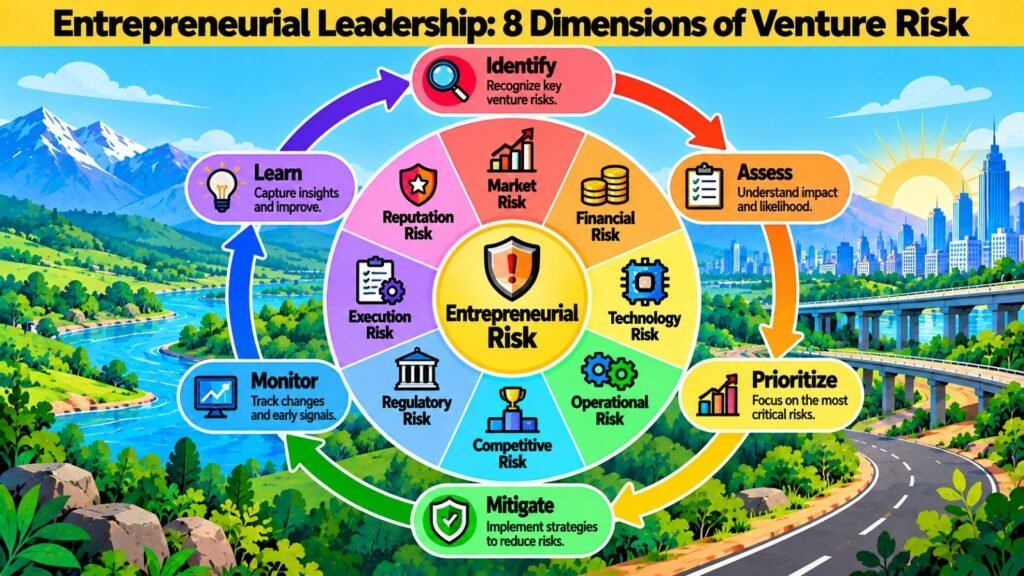
Risk and uncertainty are related but distinct concepts, and keeping them separate matters for rigorous entrepreneurial thinking. Uncertainty describes situations where outcome probabilities cannot be assigned. Risk refers to situations where exposure can be estimated with reasonable accuracy using available data, historical precedent, or analytical tools. Entrepreneurial ventures encounter both, and the leadership challenge is to manage risk deliberately while accepting that genuine uncertainty cannot be fully eliminated.
Research consistently challenges the popular image of successful entrepreneurs as risk lovers. Studies by Busenitz (1999) and others suggest that experienced entrepreneurs accept risk not because they enjoy it but because they assess the opportunity favorably. Calculated risk is a more accurate concept than the stereotyped risk-seeking founder. It involves identifying exposures, estimating probability and impact where possible, developing mitigation strategies, and deciding which risks are acceptable given the potential upside.
Entrepreneurial ventures face distinct risk categories: financial, market, technology, operational, competitive, and regulatory. Stripe provides a useful example of deliberate risk management. When Patrick and John Collison identified that online payments were unnecessarily difficult to implement, they faced significant regulatory and partnership risks alongside the technical challenge. Rather than immediately pursuing a banking license, they partnered with established payment processors. This reduced regulatory risk while allowing them to validate market demand before committing to more difficult and capital-intensive licensing.
A practical framework asks entrepreneurs to list major exposures across the six risk categories and assess each on two dimensions: probability of a negative outcome and potential impact if it occurs. High-probability and high-impact risks require immediate mitigation. Low-probability and low-impact risks can be monitored rather than actively managed. The value is not mathematical precision but structured awareness that prevents leaders from underestimating exposures that seem remote until they are not.
Table 7: Entrepreneurial Risk Categories and Typical Exposures
| Entrepreneurial Risk Category | Typical Exposure |
| Financial risk | Running out of capital before achieving revenue or the next funding milestone |
| Market risk | Customer adoption falling short of projections due to insufficient value or poor fit |
| Technology risk | Product failing to perform reliably or failing to reach required quality at scale |
| Operational risk | Key team member departures, supply chain disruptions, or execution breakdowns |
| Competitive risk | Well-resourced incumbents or new entrants neutralizing the venture’s advantage |
| Regulatory risk | Legal or compliance changes that restrict, delay, or prohibit the intended business model |
| Reputational risk | Early negative customer experiences or public incidents that undermine trust and credibility |
| Execution risk | Failure to translate a sound strategy into consistent, high-quality operational performance |
7. Entrepreneurial Leadership and Venture Creation
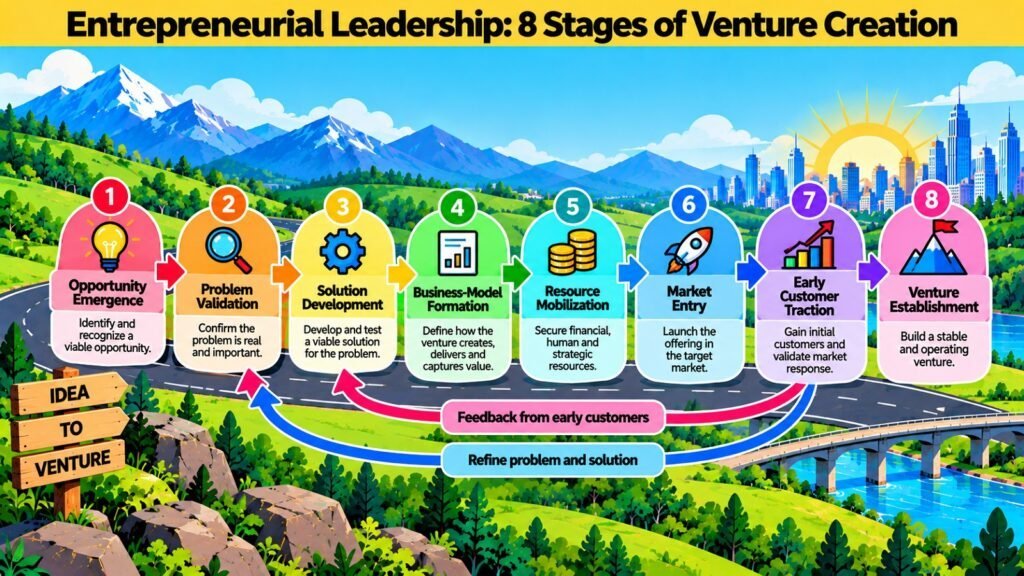
Recognizing an opportunity is necessary but insufficient. The venture must actually be built. Venture creation is the process through which an entrepreneurial leader transforms an opportunity from a hypothesis into an operational organization that delivers value to customers, generates revenue, and sustains itself beyond the founder’s initial effort.
The effectuation perspective describes how founders often begin with available means rather than fixed goals, allowing the venture to take shape through action and interaction. Howard Aldrich’s work reminds us that ventures must also achieve legitimacy in the eyes of customers, partners, and investors, not just technical functionality. The business model is the central artifact of venture creation: it makes explicit how the venture creates value, delivers it through appropriate channels, and captures a sustainable portion of that value.
Warby Parker illustrates deliberate venture creation with clear lessons. Dave Gilboa and Neil Blumenthal identified that dominant pricing in the eyewear industry created both a customer pain point and a real market opportunity. They validated the concept through early customer conversations, designed a home-try-on program to overcome the barrier of purchasing glasses unseen, and launched with storytelling that communicated brand values alongside the product. Each decision was an act of Entrepreneurial Leadership requiring simultaneous resource mobilization, uncertainty management, and commitment building.
Common mistakes in venture creation include premature scaling before the core value proposition is validated, insufficient customer validation before heavy development investment, and confusing early enthusiasm from friends or advisors with genuine evidence of market demand. Entrepreneurial leaders who recognize these traps early are far better positioned to survive the demanding transition from concept to operating venture. The critical discipline is treating every assumption as provisional until evidence from real customers confirms it.
Table 8: Venture Creation Stages and Entrepreneurial Leadership Focus
| Venture Creation Stage | Entrepreneurial Leadership Focus |
| Opportunity validation | Test whether the opportunity is real, large enough, and accessible before committing resources |
| Business model formation | Map how the venture will create, deliver, and capture value and identify key assumptions |
| Team assembly | Recruit founders and early team members whose skills cover the venture’s core needs |
| Resource mobilization | Secure initial capital, partnerships, technology, and infrastructure through creative means |
| Minimum viable product development | Build the simplest version that generates genuine customer evidence and market learning |
| First customer acquisition | Validate that real customers will pay or engage with the solution outside the founder’s network |
| Business model refinement | Revise value proposition, pricing, channels, and delivery based on early market feedback |
| Operational foundation | Establish the processes, systems, and team capabilities needed to deliver consistently at small scale |
8. Entrepreneurial Leadership and Venture Growth
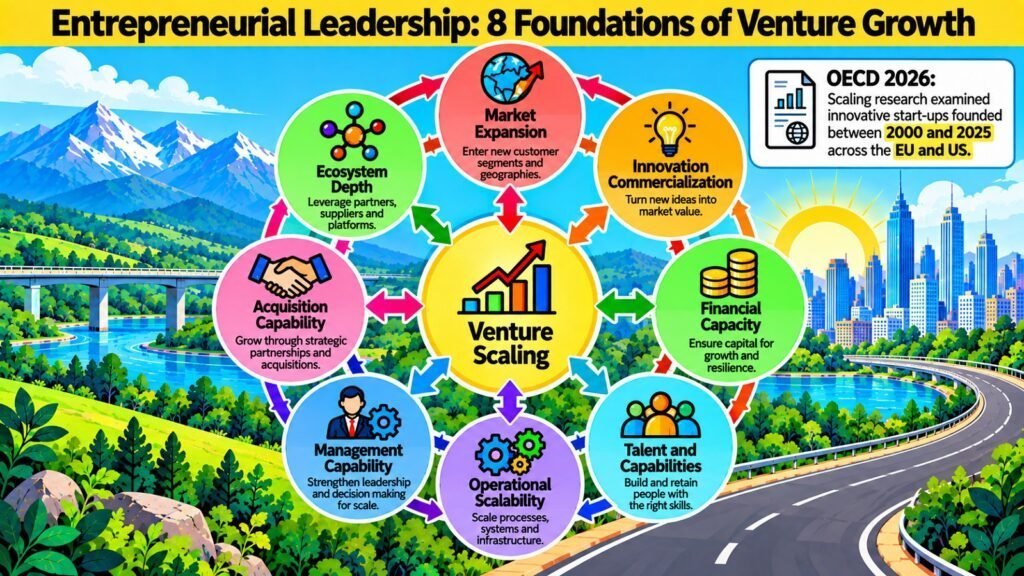
Growth changes everything. A venture that has achieved early traction and established a working business model enters a substantially different leadership phase. Organizational complexity increases, team size expands, capital requirements grow, competitive scrutiny intensifies, and the challenge of maintaining entrepreneurial agility while building operational consistency becomes acute. Entrepreneurial Leadership during growth is not simply more of what worked before; it requires a fundamental evolution in approach.
Entrepreneurship research draws on several relevant frameworks. The resource-based view, associated with Edith Penrose, suggests that sustained growth depends on developing capabilities that are difficult for competitors to imitate. The entrepreneurial orientation literature, developed by Miller (1983) and Lumpkin and Dess (1996), examines how dimensions such as innovativeness, proactiveness, and risk-taking must evolve as organizations scale. A critical tension is that early-stage ventures succeed partly because they can change direction rapidly, experiment freely, and prioritize learning. Growing ventures also need reliability, predictability, and clear decision-making structures.
Ben Silbermann’s leadership of Pinterest during its growth phase illustrates these tensions. The platform scaled from a niche product used by a small community to a global service with hundreds of millions of users. Each significant scaling decision — from infrastructure investment to content moderation policy to international expansion — required balancing entrepreneurial creativity with the operational discipline needed to serve a large, diverse user base reliably. Silbermann has noted publicly that the leadership demands on him changed substantially as the organization grew, requiring deliberate personal development alongside organizational development.
A practical growth-stage framework asks four questions: Does the leadership style match the venture’s current complexity? Does the team have the capabilities needed at this stage, not the previous one? Do the processes being built support both consistency and continued experimentation? And does the entrepreneurial orientation — the willingness to pursue new opportunities, accept calculated risks, and experiment — remain alive within an increasingly structured organization? Growth that eliminates the entrepreneurial orientation it was built on tends to produce incumbents rather than continued innovators.
Table 9: Venture Growth Challenges and Entrepreneurial Leadership Responses
| Venture Growth Challenge | Entrepreneurial Leadership Response |
| Increasing organizational complexity | Build management structures and clear roles without eliminating entrepreneurial decision-making speed |
| Talent and team scaling | Hire for capabilities the venture needs at the next stage, not only the current one |
| Maintaining innovation culture | Protect time and resources for new initiatives alongside the demands of existing operations |
| Capital and financial discipline | Balance growth investment with unit-economics awareness to avoid unsustainable burn rates |
| Competitive intensity | Develop defensible capabilities and customer relationships that deter imitation or displacement |
| Founder-role transition | Shift from direct execution to leadership, strategy, and team development as the organization grows |
| Process formalization | Introduce processes that ensure quality and reliability without creating bureaucratic rigidity |
| Preserving entrepreneurial orientation | Continue to pursue new opportunities, accept calculated risk, and encourage experimentation at scale |
Conclusion: Entrepreneurial Leadership: Building the Future of Entrepreneurship
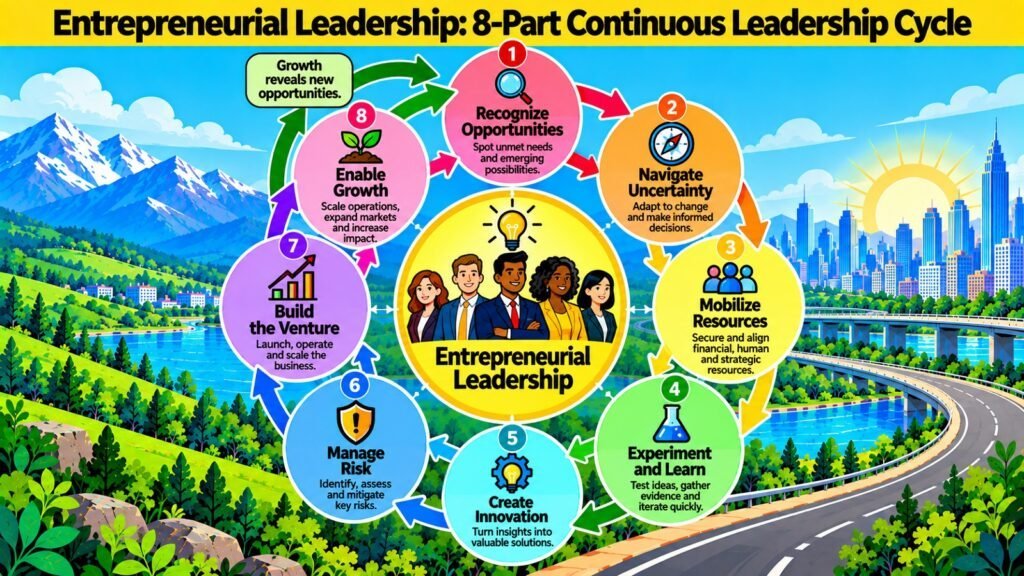
The eight foundations explored in this article do not operate independently. They form an integrated and dynamic framework in which each element shapes the others. Opportunity recognition generates uncertainty about whether the opportunity is real. Uncertainty makes experimentation necessary as a learning method. Experimentation produces knowledge that enables innovation. Resource constraints shape how ventures are created. Venture creation tests the business model under real-world conditions. And growth generates new opportunities and new risks that require all eight foundations to evolve together.
This interconnection distinguishes Entrepreneurial Leadership from conventional Business Leadership, Leadership Decision Making, Leadership Vision, and the broad category of Leadership and Management. Those fields are valuable in their own right, but they were developed for contexts where markets are established, processes are proven, and structures are stable. Entrepreneurial Leadership was built for conditions where none of that is yet true, and that difference gives the framework its distinctive relevance.
Throughout this article, established theories, credible research, and real-world examples have grounded each foundation in verifiable knowledge. Bricolage and effectuation illuminate resourcefulness. Knight’s risk-uncertainty distinction clarifies why uncertainty demands a different response from risk management. Lean Startup tools give practical form to experimentation. Schumpeter’s creative destruction explains why innovation matters beyond product development. These frameworks are not academic decoration; they are tools that help leaders see their situations more accurately and respond more effectively.
Entrepreneurial Leadership is ultimately a continuous process, not a fixed state. Leaders who practice it well keep recognizing new opportunities as they manage existing ventures, keep acting under uncertainty as they accumulate information, and keep experimenting as they develop consistent processes. That ongoing movement — creating possibilities, mobilizing resources, learning from evidence, and evolving the venture — is what Entrepreneurial Leadership looks like in practice, and it is what separates ventures that endure from those that stall.
Table 10: Entrepreneurial Leadership — Core Takeaways from Eight Foundations
| Foundations | Core Leadership Takeaway |
| Opportunity Recognition | Entrepreneurial leaders distinguish genuine market opportunities from compelling but unvalidated ideas |
| Uncertainty | Acting constructively under uncertainty requires explicit assumption mapping and disciplined experimentation |
| Resourcefulness | Creative mobilization of constrained resources can create meaningful progress without ideal conditions |
| Experimentation | Honest experiments that test important assumptions are the primary tool for learning under uncertainty |
| Innovation | Entrepreneurial innovation creates new value by combining customer insight, resources, and novel solutions |
| Risk | Calculated risk management, not risk avoidance or risk appetite, defines effective entrepreneurial leadership |
| Venture Creation | Transforming an opportunity into a viable venture requires validation, resource mobilization, and adaptive leadership |
| Venture Growth | Scaling a venture demands a leadership evolution that preserves entrepreneurial orientation within growing complexity |