
Table of Contents
Introduction — Product-Market Fit and the Path to Startup Growth
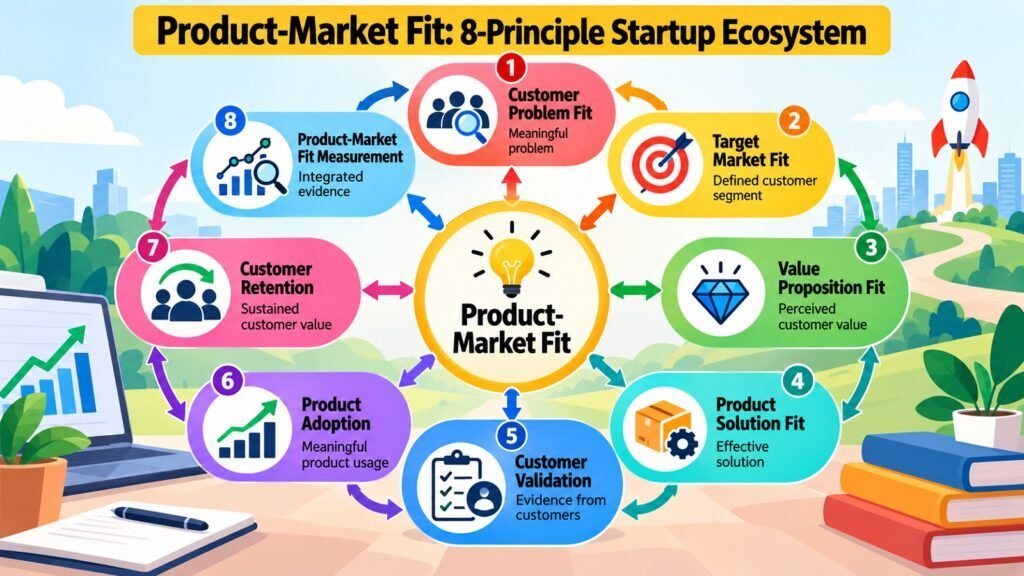
Product-Market Fit describes the strength of the relationship between a meaningful customer problem, a defined target market, a valuable proposition, an effective product solution, and sustained customer behavior. When that relationship is strong, customers adopt a product, continue using it, and often refer others. When it is weak, even capable startups struggle to build lasting traction. Product-Market Fit is also an important aspect of overall Startup Strategy: decisions about resource allocation, product priorities, and growth timing all depend on how clearly a startup understands its current relationship with the market.
A common mistake is treating early interest as evidence of fit. Launching a product, attracting initial users, receiving positive feedback, generating publicity, or securing investor interest does not automatically demonstrate Product-Market Fit. These signals are encouraging, but they do not confirm that customers have adopted the product, continue using it, or value it enough to pay. Genuine fit becomes visible in sustained behavior: customers who return repeatedly and demonstrate that the product solves a problem they consider genuinely important.
The eight interconnected principles examined in this article — Customer Problem Fit, Target Market Fit, Value Proposition Fit, Product Solution Fit, Customer Validation, Product Adoption, Customer Retention, and Product-Market Fit Measurement — form a diagnostic framework rather than a linear checklist. Both qualitative and quantitative evidence matter, because superficial indicators can create misleading confidence. The table below introduces each principle.
Table 1: Product-Market Fit — Overview of the Eight Core Aspects
| Product-Market Fit Aspect | Core Focus |
| Customer Problem Fit | Whether the product addresses a problem customers find genuinely important |
| Target Market Fit | Whether the product creates meaningful value for a well-defined customer segment |
| Value Proposition Fit | Whether customers perceive sufficient value to justify adopting the product |
| Product Solution Fit | Whether the product effectively solves the validated problem in practice |
| Customer Validation | Whether evidence from customers confirms assumptions about problems, value, and solutions |
| Product Adoption | Whether customers progress from initial interest to meaningful, experienced product value |
| Customer Retention | Whether customers continue using the product because it consistently solves their problem |
| Product-Market Fit Measurement | Whether qualitative and quantitative signals converge on a credible picture of market fit |
1. Product-Market Fit Through Customer Problem Fit
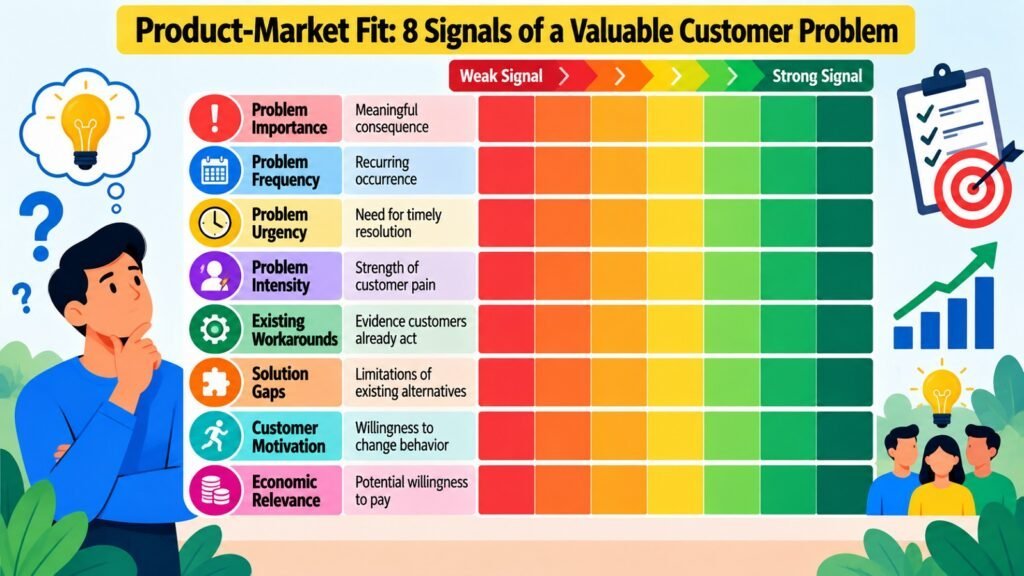
Customer Problem Fit is a foundational condition of Product-Market Fit. A startup must solve a problem customers consider important enough to motivate action. Problem importance exists on a spectrum defined by severity, frequency, urgency, and the degree to which customers have already attempted to resolve it. A problem acknowledged in passing differs from one that drives customers to seek alternatives, spend money, or change established habits. The jobs-to-be-done perspective is useful here: it examines what customers are trying to accomplish and why existing options fall short, revealing needs that direct questioning may miss.
The critical distinction is between problems customers describe and problems that produce observable behavior. When someone consistently uses imperfect workarounds or actively searches for alternatives, that behavior provides meaningful evidence that the pain is real and recurring. Effective customer interviews focus on actual past behavior: how customers handle the problem now, what they have tried, how much they spend on inadequate alternatives, and how frequently the issue arises. Observable evidence generally outweighs stated preferences because customers do not always predict their own behavior accurately.
Weak Customer Problem Fit has direct consequences for Startup Strategy. Resources directed at a low-importance problem are unlikely to generate the growth signals that genuine fit produces. Recognizing this early allows founders to reconsider customer selection or redirect resources toward a more meaningful version of the need.
Table 2: Product-Market Fit — Customer Problem Signals and What They Indicate
| Customer Problem Signal | What It Indicates |
| Customers actively seek solutions unprompted | The problem creates enough discomfort to drive independent action |
| Customers use inefficient workarounds regularly | No adequate solution exists; the problem is real and recurring |
| Customers can describe recent instances in detail | The problem is frequent and salient, not hypothetical |
| Customers spend money on partial or imperfect solutions | The problem carries enough weight to justify financial investment |
| Customers report the problem interrupts important tasks | The problem has meaningful urgency and practical consequences |
| Customers express frustration with existing alternatives | A genuine gap between available solutions and customer needs exists |
| Multiple independent customers describe the same pain | The problem reflects a pattern rather than an isolated preference |
| Customers engage immediately when a solution is mentioned | Strong latent demand exists for a solution to this specific problem |
2. Product-Market Fit Through Target Market Fit
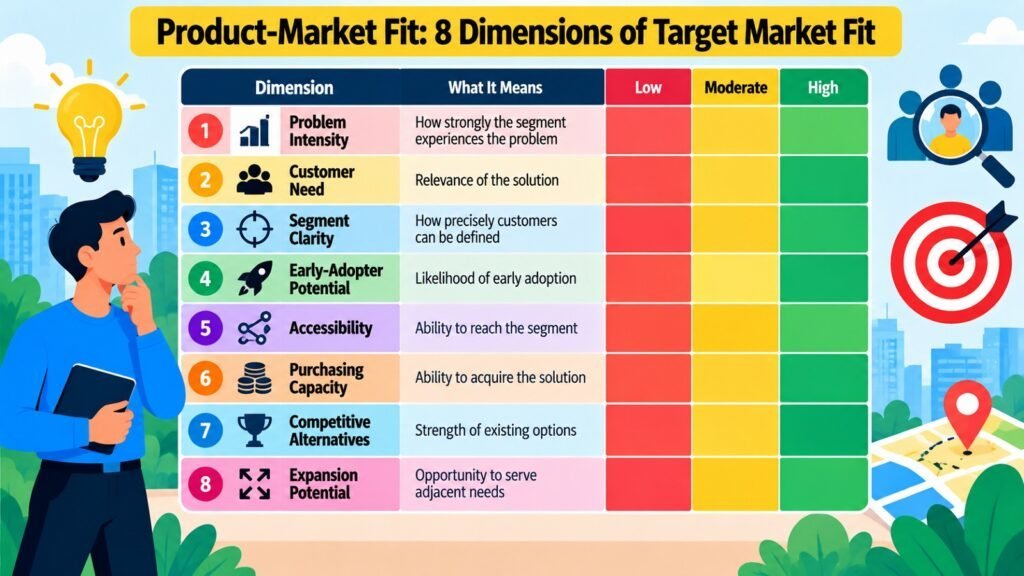
Solving a genuine problem is necessary but not sufficient for Product-Market Fit. The startup must also serve customers who experience that problem with enough intensity and motivation to adopt a solution and continue using it. Target Market Fit describes the relationship between a product and the specific segment for which it creates the clearest value. Different segments can experience the same underlying problem in substantially different ways. Treating a broad group as a single undifferentiated market makes it difficult to identify where genuine fit is emerging.
Early adopters are particularly important because they tolerate imperfect solutions and generate the behavioral signals that help founders understand whether fit is developing. Evaluating target-market suitability requires examining how intensely a segment experiences the problem, whether customers are accessible through realistic channels, and whether their usage patterns align with what the product actually does. A narrowly defined segment can provide clearer learning opportunities than attempting to serve a wide market simultaneously.
Target Market Fit shapes decisions about product priorities, positioning, pricing, acquisition channels, and the pace of growth. A startup with clear fit in a defined segment has a credible foundation for these decisions. One that has not yet identified a coherent segment faces strategic uncertainty that marketing investment or product features alone cannot resolve. Clarifying target-market boundaries is therefore a prerequisite for making confident growth decisions rather than simply a segmentation exercise.
Table 3: Product-Market Fit — Target Market Signals and Their Strategic Meaning
| Target Market Signal | Strategic Meaning |
| Customers in this segment adopt the product faster | Segment-to-product alignment is stronger; a clearer fit is emerging |
| Customers describe their need in specific, consistent terms | The segment has a well-defined and coherent problem profile |
| Customers are reachable through realistic acquisition channels | Acquisition is operationally feasible without disproportionate investment |
| Customers make purchasing decisions without excessive friction | Adoption barriers related to authority or budget are manageable |
| Customers in this segment retain at higher rates | The product creates recurring value that resonates with this specific group |
| Customers in other segments show inconsistent behavior | A single go-to-market approach may not apply across all segments |
| Referrals come from within a recognizable customer profile | Natural word-of-mouth follows segment lines, confirming coherent fit |
| Segment size supports growth without premature market expansion | The opportunity is meaningful without requiring early dilution of focus |
3. Product-Market Fit Through Value Proposition Fit

Product-Market Fit depends on whether customers genuinely value what a product offers, not simply on how many features it includes. Value Proposition Fit describes the relationship between customer needs and the value customers actually perceive in a product. Customers evaluate products against existing alternatives — competitors, workarounds, or simply tolerating an unresolved problem. A product must offer sufficient advantage to justify the transition. The value proposition that matters is the one customers experience, not the one founders describe in materials. A simpler product can sometimes demonstrate stronger fit than a feature-rich alternative when it addresses an important need more directly and reliably.
Examining Value Proposition Fit requires testing whether promised benefits align with what customers actually value. Customer conversations reveal this most clearly when customers describe what the product does for them in their own words, rather than evaluating a prepared pitch. When customers consistently describe the product in terms that diverge from the startup’s intended positioning, that gap signals a value proposition that needs rethinking. Useful diagnostic questions include: Do customers articulate a clear benefit without prompting? Are they willing to pay a price reflecting that value? Would they notice the product’s absence and seek a replacement?
A weak value proposition cannot be resolved by increasing acquisition spend. Conversely, clear differentiation creates natural opportunities for pricing power and customer advocacy. These implications make Value Proposition Fit an important driver of sustainable competitive position and a strategic concern that goes well beyond messaging.
Table 4: Product-Market Fit — Value Proposition Elements and Their Role
| Value Proposition Element | Role in Product-Market Fit |
| Problem relevance | Confirms the product addresses something customers actually care about |
| Outcome clarity | Ensures customers can articulate what the product does for them |
| Perceived superiority over alternatives | Justifies the behavioral or financial cost of switching |
| Ease of value realization | Reduces friction between adoption and the customer experiencing benefit |
| Functional benefit | Delivers a practical improvement in how customers accomplish a task |
| Economic benefit | Reduces cost, time, or risk in ways customers recognize and value |
| Emotional resonance | Creates trust or confidence that reinforces sustained engagement |
| Differentiation from substitutes | Positions the product as the preferred choice within its competitive context |
4. Product-Market Fit Through Product Solution Fit
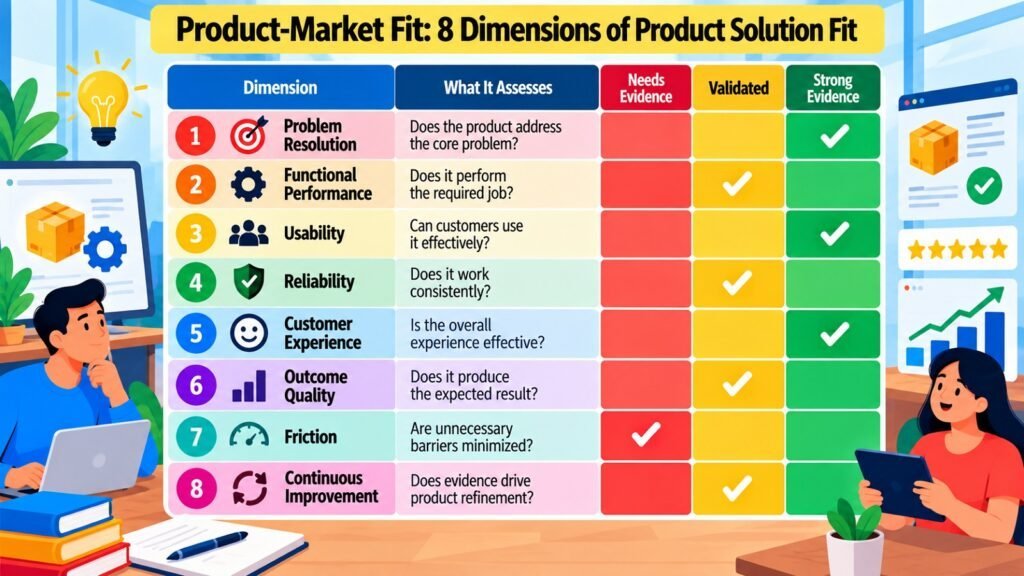
Product Solution Fit addresses the gap between a validated customer problem and the effectiveness of the actual product designed to solve it. Identifying an important problem and selecting an appropriate market do not guarantee that the solution will perform well enough to sustain engagement. A product can be built on accurate problem understanding and still fail to deliver expected value if it falls short in functionality, usability, or reliability. Technical completion is not the same as demonstrated customer value — a feature that works correctly in engineering terms may create friction in practice or solve only part of the intended problem.
Adding features does not necessarily strengthen Product Solution Fit — in many cases, additional complexity obscures core value and introduces new friction. Prototypes and minimum viable products allow founders to observe actual customer interaction before committing to full development. Usability testing and post-use customer interviews reveal expectations the solution did not meet, often surfacing friction that neither the product team nor the customer anticipated. The gap between intended and experienced value becomes visible in behavioral patterns: where customers abandon the product and which tasks they struggle to complete.
Diagnostic questions for evaluating Product Solution Fit include: Do customers complete the core task the product was designed to support? Are there recurring points of confusion or abandonment? Does the product deliver its primary value without significant customer effort? A startup that has not demonstrated solution effectiveness should be cautious about scaling acquisition, because attracting large numbers of customers to an inadequate product accelerates churn and damages reputation.
Table 5: Solution Signals and What They Reveal
| Solution Signal | What It Reveals |
| Customers complete the core task without significant friction | The solution is functional and accessible for the intended use case |
| Customers return to accomplish the same task again | The solution delivers repeatable value rather than a one-time experience |
| Customers report outcomes matching the intended product benefit | Expected and delivered value are sufficiently aligned |
| Customers avoid or ignore specific features consistently | Those features may not address real needs or add unnecessary complexity |
| Customers invent workarounds within the product itself | The solution does not fully address the problem in its current form |
| Usability issues appear across multiple unrelated customer types | The problem is structural rather than an isolated individual preference |
| Support requests cluster around the same product interaction | A specific part of the solution is causing predictable, addressable friction |
| Customers show measurable improvement in the targeted outcome | The solution is creating tangible value that justifies continued use |
5. Product-Market Fit Through Customer Validation

Customer Validation is the evidence-building discipline through which startups examine whether their assumptions about customers, problems, value, and solutions correspond with observable reality. Product-Market Fit cannot be reliably inferred from founder intuition, enthusiastic conversations, or isolated success stories. The core distinction is between collecting opinions and obtaining behavioral evidence. Customers can express genuine enthusiasm about a product concept without ever adopting it, paying for it, or recommending it. A customer who consistently uses a product or refers others provides qualitatively different evidence than one who calls an idea promising. Positive sentiment is easier to generate than behavioral commitment.
Different validation methods generate different types of evidence, and combining them produces a more complete picture. Customer interviews are well suited to understanding problem context. Usability testing reveals how customers interact with an actual or prototype solution. Controlled experiments produce behavioral data that complements qualitative insight. Cohort retention analysis provides longitudinal evidence that individual interactions cannot supply. Confirmation bias presents a meaningful risk throughout: founders naturally favor evidence that supports existing assumptions, which can lead to overweighting positive responses. Deliberately seeking disconfirming evidence surfaces insights that positive-seeking approaches miss.
Customer Validation connects to Startup Strategy by reducing uncertainty about which assumptions are strong enough to act on. Evidence from validation informs decisions about product iteration, customer selection, and resource allocation. It also supports the judgment of whether to continue, adjust, or reconsider a strategic direction entirely. Validating carefully before committing significant resources creates a more efficient foundation for growth investment.
Table 6: Customer Validation Methods and Primary Evidence
| Validation Method | Primary Evidence |
| Customer discovery interviews | Qualitative insight into problem severity, frequency, and current behavior |
| Prototype testing | Early feedback on whether the proposed solution addresses the intended need |
| Minimum viable product deployment | Behavioral data on actual usage, adoption, and initial retention patterns |
| Usability testing | Observation of friction, confusion, and task completion in real interactions |
| Concierge experiments | Direct evidence of whether customers value the outcome enough to return |
| Pre-sales or letters of intent | Demonstrated willingness to pay before the product is fully developed |
| A/B or messaging experiments | Behavioral response to different value propositions or product framings |
| Cohort retention analysis | Longitudinal evidence of whether customers return to the product over time |
6. Product-Market Fit Through Product Adoption
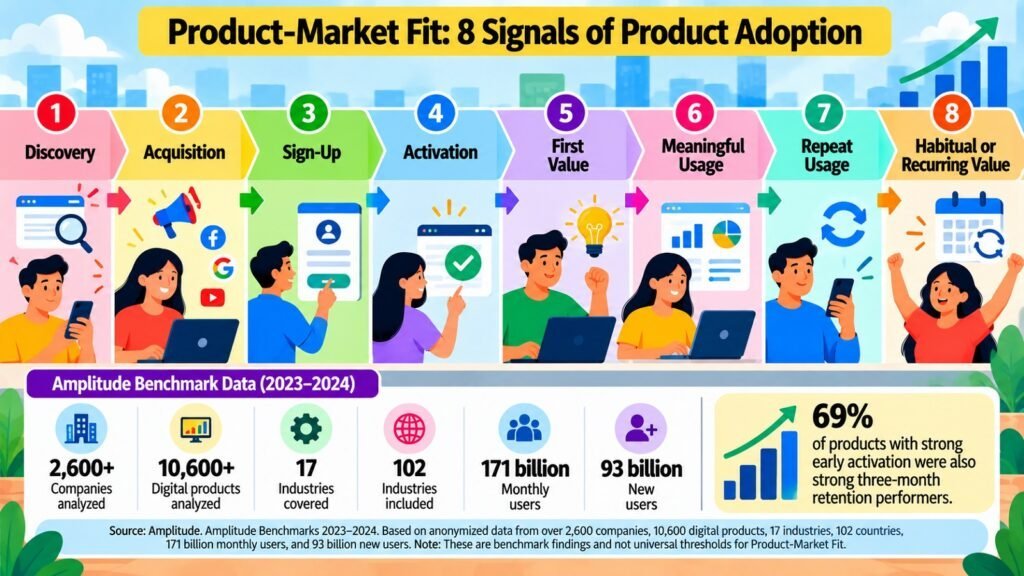
Product-Market Fit requires stronger evidence than registrations, downloads, or initial trials. Product Adoption describes the transition from customer awareness to meaningful product usage and experienced value. A customer who signs up has demonstrated curiosity, not fit. The diagnostic question is whether that customer progresses to the point where the product delivers its promised value — and whether the path from first contact to that experience is clear enough to navigate without excessive effort. Acquisition brings customers into contact with a product; adoption requires them to engage substantively enough to experience its core benefit.
When acquisition rates are strong, but activation rates are weak, the cause is usually a gap between what attracted customers and what the product delivers when they actually engage. Activation — the specific moment when a customer first experiences meaningful product value — is particularly important because products where activation is clearly defined and efficiently delivered tend to show stronger downstream retention. Technology adoption research has long established that early adopters are more tolerant of imperfect solutions than mainstream customers, so early-adopter engagement should not be treated as evidence of broader market fit.
High acquisition combined with weak activation signals that addressing adoption is more productive than investing further in growth. Treating adoption as a product and strategy problem — rather than a marketing metric — produces more durable improvements.
Table 7: Product Adoption Signals and What They Show
| Adoption Signal | What It Shows |
| Customers complete the core onboarding flow without prompting | The activation pathway is clear and achievable for the intended customer |
| Customers reach the first-value moment within a session or two | The product delivers its core benefit quickly enough to sustain engagement |
| Customers return within a short period after first use | The initial experience created sufficient motivation to re-engage |
| Feature engagement concentrates on core functionality | Customers are finding and using the most important parts of the product |
| Customer support requests relate to setup or first use | Adoption friction is present; onboarding may need refinement |
| Activation rates differ significantly across acquisition channels | Different segments respond differently; targeting may need adjustment |
| Customers use the product to complete a real task, not just explore | The product is delivering applied value rather than generating superficial interest |
| Activation rates improve as onboarding is refined iteratively | Adoption barriers are addressable rather than fundamental to the design |
7. Product-Market Fit Through Customer Retention
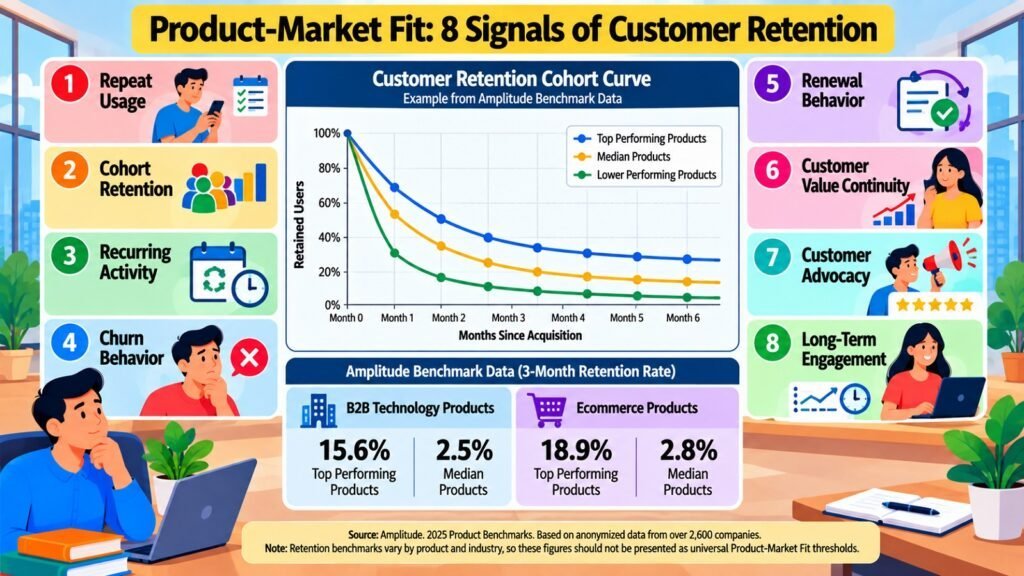
Customer Retention is one of the most revealing behavioral indicators of Product-Market Fit because continued usage suggests customers repeatedly receive meaningful value from a product. Adoption demonstrates that customers experience initial value; retention demonstrates that this value persists over time. A product that attracts customers but cannot hold them has not yet demonstrated the sustained demand that genuine fit requires. Meaningful retention reflects a pattern in which customers continue using a product because it consistently solves an important problem — not because switching is inconvenient or a trial period has not expired.
Retention patterns vary significantly across product categories and business models. A daily-use consumer application and an annual enterprise contract have different expected usage rhythms, so interpreting retention requires understanding what normal re-engagement looks like for a specific product. Cohort analysis is a practical method for examining these patterns: by tracking groups who joined in the same period, founders can observe how usage evolves and where customers disengage. A retention curve that stabilizes rather than declining toward zero is one of the most concrete behavioral signatures of Product-Market Fit. Understanding why customers leave matters as much as measuring churn, because whether the cause is product weakness, poor problem fit, or misaligned expectations determines the appropriate response.
Strong retention improves customer economics and creates the foundation for referral-driven growth. It also makes acquisition investment more efficient, because retaining customers well justifies the cost of acquiring them. Weak retention forces constant replacement acquisition, increasing costs and making sustainable growth considerably harder to achieve.
Table 8: Retention Signals and What They Indicate
| Retention Signal | What It Indicates |
| Cohort retention curves stabilize rather than declining to zero | A meaningful segment is finding consistent, recurring value in the product |
| Customers continue using the product after the novelty period ends | Usage reflects genuine need rather than initial curiosity or trial behavior |
| Churn clusters around a specific usage stage or customer type | Retention weaknesses may be segment-specific or tied to a particular experience point |
| Customers who churn cite unmet needs rather than price alone | Value delivery may be insufficient for this segment, not just competitively priced |
| Long-term customers expand their usage over time | The product continues to reveal value as customers become more familiar with it |
| Net growth masks high underlying customer turnover | Growth may be obscuring a retention problem that will limit sustainable scaling |
| Referred customers retain at higher rates than acquired ones | Word-of-mouth brings customers with pre-aligned expectations, indicating genuine fit |
| Customers express they would actively miss the product if it disappeared | Retention reflects dependency rather than inertia — a strong indicator of meaningful fit |
8. Product-Market Fit Measurement for Startup Growth

Product-Market Fit Measurement is the systematic evaluation of whether sufficient evidence exists to conclude that a product creates meaningful value for a defined market. No single metric can provide this conclusion reliably. Meaningful assessment requires combining qualitative, behavioral, financial, and market-level evidence. The Sean Ellis survey — which asks customers how they would feel if they could no longer use the product — is a widely cited practitioner heuristic, with 40 percent responding “very disappointed” proposed as a possible indicator of meaningful fit. This benchmark originated from observational analysis of growth-stage startups rather than controlled research, so it functions as a diagnostic starting point rather than a universal threshold.
Retention-based measurement provides a different and often more behavioral perspective. Products that demonstrate stable long-term cohort retention — where a meaningful proportion of early users continue engaging over months — show evidence of consistent recurring value. Downloads, registrations, and raw user counts are commonly cited indicators but rarely constitute strong evidence of fit on their own; they reflect acquisition strength, not sustained demand. Combining multiple signals requires examining where evidence converges and where it conflicts. Strong activation combined with high churn suggests the product delivers initial value but fails to sustain it. Strong retention in a small segment with weak broader adoption suggests fit is narrowly concentrated.
Evidence also differs across B2B, B2C, subscription, and transaction-based models. Identifying which specific behaviors reflect genuine recurring value in a given business context is the essential first step in measurement and the foundation for confident decisions about product investment and growth timing.
Table 9: Key Product-Market Fit Signals and What They Measure
| Signals | What It Measures |
| Cohort retention stability over time | Whether a meaningful segment consistently returns beyond the initial period |
| Net Promoter Score and referral behavior | Whether customers value the product enough to recommend it to others |
| Willingness to pay and pricing tolerance | Whether customers perceive sufficient value to justify the financial cost |
| Activation rate from acquisition to first value | Whether customers can reach the core product experience without excessive friction |
| Churn rate and reasons for cancellation | Whether customers leave because of product weaknesses or unmet needs |
| “Very disappointed” survey response rate | How strongly customers would react to losing access to the product |
| Organic or word-of-mouth demand growth | Whether genuine satisfaction drives new customer awareness independently |
| Engagement depth relative to core use case | Whether customers use the product in ways reflecting its intended value delivery |
Conclusion — Product-Market Fit as a Foundation for Startup Growth

The eight principles examined in this article form an interconnected system rather than a linear checklist. Customer Problem Fit establishes whether the problem matters enough to solve. Target Market Fit determines whether the right customers are being served. Value Proposition Fit shapes whether they perceive and experience the product’s benefit. Product Solution Fit establishes whether the product reliably delivers it. Customer Validation builds the evidence base.
Product Adoption reveals whether customers engage deeply enough to experience value. Customer Retention shows whether that value persists. Product-Market Fit Measurement provides the tools to assess all of this together. Weakness in any dimension can undermine the overall relationship — which is why treating fit as a single metric rather than a multi-dimensional relationship produces misdiagnosis.
Genuine Product-Market Fit looks different from product launches, press coverage, or temporary spikes in user counts. It is visible in patterns of sustained customer behavior: a defined group that experiences an important problem, recognizes the product’s value, adopts it, and continues using it because it consistently delivers. Reconnecting these principles to overall Startup Strategy, evidence of market fit should drive decisions about product development, market focus, customer acquisition, resource allocation, and when to pursue growth. Scaling before meaningful fit is established typically amplifies cost without producing the compounding returns that genuine fit enables.
Product-Market Fit is also dynamic — customer expectations evolve, competitors adapt, and markets change. The eight principles in this article function as a reusable diagnostic framework: founders can use them to examine where their evidence is strongest, where uncertainty remains, and which assumptions deserve further investigation before significant commitments are made.
Table 10: Product-Market Fit — Diagnostic Checklist for Startup Founders
| Product-Market Fit Principle | Key Strategic Question |
| Customer Problem Fit | Do customers demonstrate observable behavior showing this problem is important enough to solve? |
| Target Market Fit | Are the customers currently adopting the product a coherent segment for whom it creates consistent value? |
| Value Proposition Fit | Do customers articulate a specific benefit they receive, and does their behavior reflect they value it above alternatives? |
| Product Solution Fit | Does the product deliver its intended outcome reliably, and do customers experience it without significant friction? |
| Customer Validation | Has the startup collected behavioral evidence confirming core assumptions rather than relying on stated preferences? |
| Product Adoption | Are customers progressing from initial contact to meaningful usage through a clear and efficient path? |
| Customer Retention | Do customers continue using the product over time because it consistently solves a problem they care about? |
| Product-Market Fit Measurement | Does the available evidence — qualitative, behavioral, and financial — converge on a credible picture of market fit? |