
Table of Contents
Introduction — Emotional Self-Regulation: A Foundation of Emotional Intelligence in Business
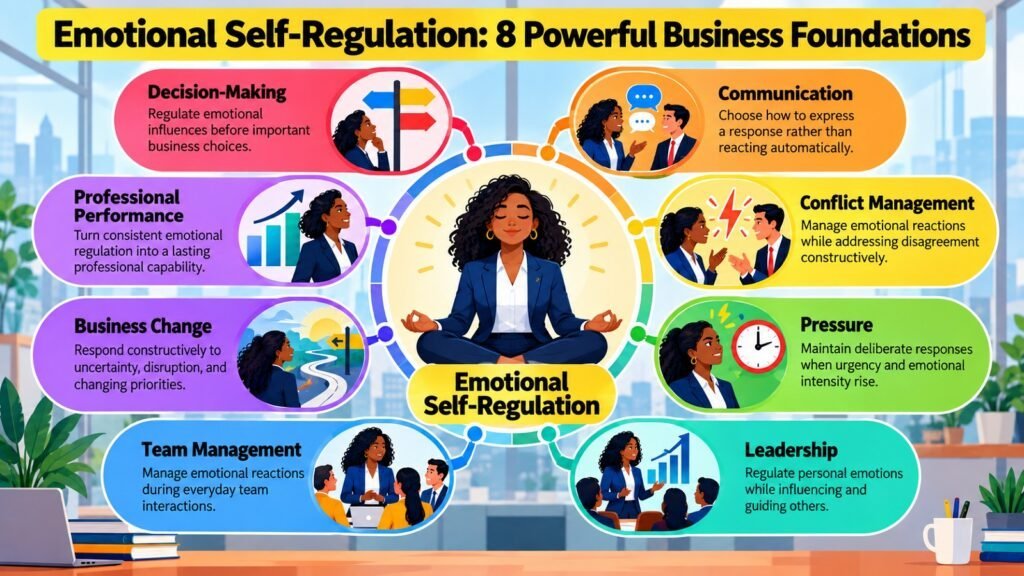
Emotional Self-Regulation is one of the most consequential aspects of Emotional Intelligence in professional life. Where emotional awareness identifies what someone is feeling and why, Emotional Self-Regulation determines what they actually do with that information. It is the capacity to recognize emotional activation, create a deliberate pause, evaluate the situation with some perspective, and choose a response that fits the circumstances rather than simply reflecting emotional intensity.
This distinction separates Emotional Self-Regulation from emotional suppression, emotional avoidance, and merely appearing calm. Suppression pushes feelings aside without processing them. Avoidance withdraws from situations to escape discomfort. Genuine regulation means working with emotional information rather than around it. Emotions carry real information about values, threats, and priorities — the question is whether they should automatically determine professional behavior, or inform it.
The theoretical foundation draws on established concepts in emotion regulation. Deliberate response selection — choosing how to act rather than simply reacting — sits at the center. Cognitive reappraisal, reconsidering how a situation is interpreted, changes the emotional input before a response is made. Constructive expression allows legitimate emotion to be communicated without derailing a conversation. Context-sensitive behavior recognizes that the appropriate response differs by situation, relationship, and stakes.
These dynamics shape outcomes across decision-making, communication, conflict management, pressure, leadership, team management, change, and professional performance. A manager who receives disappointing news and responds deliberately rather than reactively produces different results than one who does not. A professional who pauses before replying to a critical email preserves a relationship that an immediate response might damage. This article examines each context through research-based concepts, practical tools, and realistic business scenarios.
Table 1: Emotional Self-Regulation — Eight Business Contexts at a Glance
| Emotional Self-Regulation Business Context | Core Business Focus |
| Decision-Making | Preventing emotion from becoming the sole driver of judgment |
| Communication | Responding with intention rather than reacting to triggers |
| Conflict Management | Creating space for resolution rather than escalation |
| Performance Under Pressure | Maintaining effectiveness when stakes and intensity rise |
| Leadership | Building trust through deliberate, context-aware behavior |
| Team Management | Preserving accountability and relationships through regulation |
| Organizational Change | Responding constructively to uncertainty and transition |
| Professional Performance | Developing regulation as a consistent professional capability |
1. Emotional Self-Regulation in Decision-Making: Choosing Better Responses

Business decisions rarely happen in emotional vacuums. Fear of failure, frustration, excitement, anxiety, or overconfidence can all become part of the environment in which judgments are made. Emotional Self-Regulation does not mean eliminating those emotions — it means preventing their intensity from automatically becoming the deciding factor.
Research on emotional influences on judgment shows that strong emotional states can narrow the range of options people consider, increase risk aversion or risk-seeking, and make confirmatory information feel more persuasive. Cognitive reappraisal — reconsidering how a situation is interpreted before responding — changes the emotional input before a decision is made, rather than suppressing a feeling afterward.
In practice, regulation in decision-making involves naming the emotional response specifically, separating facts from interpretation, testing assumptions that feel certain, and selecting the option that serves the business situation rather than the emotional pressure of the moment. Consider a manager whose team has just lost an important account. A reactive response assigns blame immediately. A regulated response gathers the facts, acknowledges the frustration privately, and addresses the problem constructively. The lost account is the same in both cases; what changes is the quality of what happens next.
A practical decision-regulation tool involves five questions: What am I feeling? What do I actually know, separate from interpretation? What assumptions could be tested? What are the likely consequences of different responses? What action best serves the situation? The principle is straightforward: emotion is information about the situation, not a mandate for the response.
Table 2: Emotional Self-Regulation in Decision-Making — Situations and Regulated Approaches
| Decision Situation | Regulated Approach |
| Reacting after losing a major client | Pause; gather facts before addressing the team |
| Hiring under pressure to fill a role quickly | Separate urgency from judgment; apply consistent criteria |
| Responding to poor results in a high-stakes meeting | Acknowledge the result; focus on next steps, not blame |
| Responding to a competitor’s unexpected move | Assess actual impact before acting; avoid anxiety-driven reactions |
| Approving a budget under financial pressure | Separate resource anxiety from strategic merit |
| Receiving criticism of a project you championed | Acknowledge the feedback first; identify what is useful |
| Staffing decision after a difficult team conflict | Delay until intensity reduces; seek relevant facts first |
| Expanding after unexpectedly strong results | Test whether the result is durable before committing resources |
2. Emotional Self-Regulation in Communication: Responding with Intention
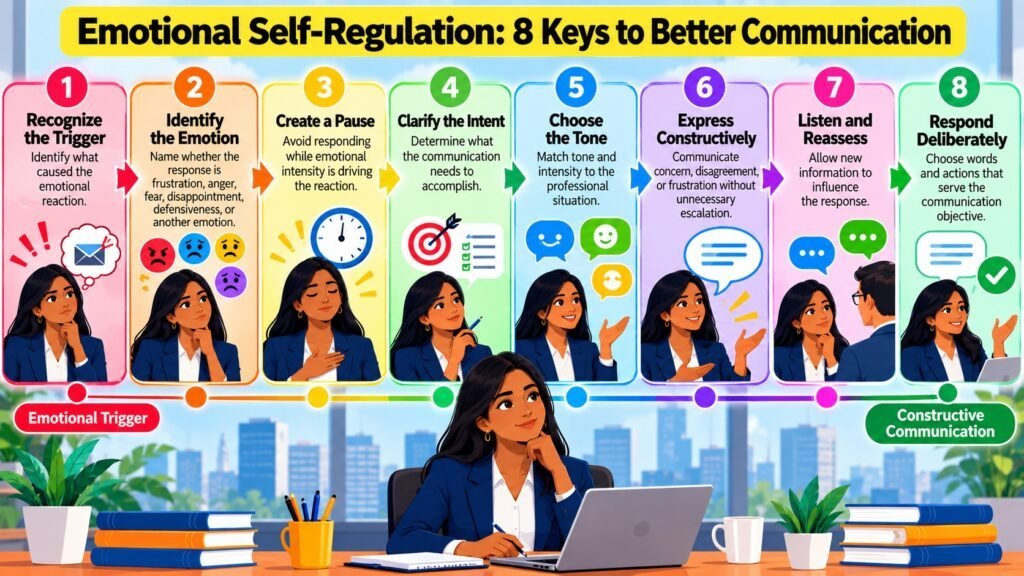
Professional communication is one of the most visible domains where Emotional Self-Regulation either shows up or breaks down. When someone receives criticism, reads a dismissive email, or faces a frustrated customer, the emotional activation is immediate. How that activation influences tone, timing, listening quality, and word choice determines whether the conversation moves forward or deteriorates.
Emotional activation affects more than just the words used — it shapes listening quality, sentence construction, response timing, and whether someone is genuinely processing what the other person is saying. Research on emotional contagion shows that an unregulated response can shift the emotional register of an entire exchange, often escalating the original issue rather than addressing it.
Emotional Self-Regulation in communication is not about suppressing legitimate frustration or performing agreement. It means acknowledging the emotion, clarifying the communication objective, choosing a tone that fits the context, and responding deliberately. A professional who receives a message implying their work was inadequate can send an immediate defensive reply or can pause, identify the trigger, and write something that opens a productive conversation instead.
A practical communication-regulation process: pause before responding, identify the emotional trigger, clarify what the communication needs to accomplish, choose a tone that fits the relationship and context, then respond. This applies across emails, difficult conversations, feedback sessions, and client interactions. The guiding question is simple: will my instinctive response achieve what this conversation actually needs?
Table 3: Emotional Self-Regulation in Communication — Situations and Regulated Responses
| Communication Situation | Regulated Response Example |
| Receiving public criticism in a meeting | Acknowledge the comment; ask a clarifying question before responding |
| Reading a dismissive or accusatory client email | Pause; reply to the concern without mirroring the tone |
| Disagreeing strongly with a colleague’s proposal | State the disagreement specifically and directly, without escalating |
| Responding to a frustrated customer’s complaint | Acknowledge the frustration first; then address the issue clearly |
| Receiving negative feedback on a completed project | Ask for specifics; respond to the content, not the feeling |
| Delivering difficult news to a team or stakeholder | Prepare the message; communicate clearly and without deflection |
| Responding to a passive-aggressive remark | Address the underlying issue in a separate, private conversation |
| Managing a heated exchange in a group setting | Slow the pace; redirect focus to the substantive issue |
3. Emotional Self-Regulation in Conflict Management: Turning Reaction into Resolution
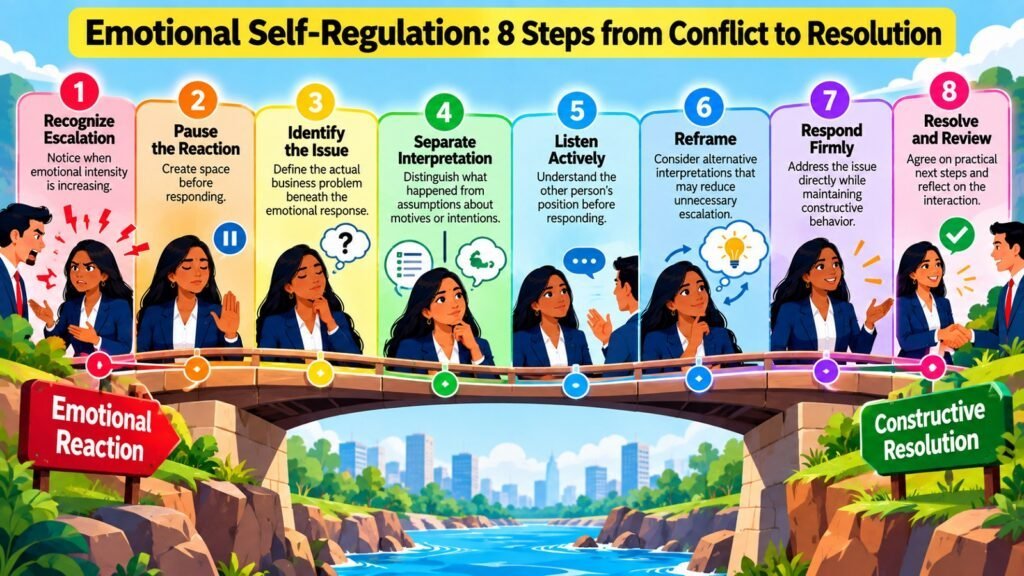
Conflict in professional environments is unavoidable. Disagreements, criticism, perceived unfairness, and defensive responses all create conditions where emotional activation is likely. What separates escalation from resolution is often not the nature of the disagreement but how each person manages their own emotional response within it.
Automatic reactions in conflict tend to follow predictable patterns. A perceived challenge triggers defensiveness. An unfair outcome produces anger. A dismissal of input generates hurt that surfaces as counterattack. These responses are understandable, but acting on them immediately rarely resolves the underlying problem and often creates a secondary one — a damaged relationship or an escalated conflict requiring its own management.
Cognitive reappraisal has direct relevance here. When someone interprets a colleague’s challenge as a personal attack, their response follows from that interpretation. A manager who experiences a team member’s deadline pushback as a challenge to authority illustrates this clearly. A reactive response closes the conversation. A regulated response involves noticing the defensiveness, pausing, and asking a genuine question about what makes the deadline difficult. That conversation is more likely to address the real problem than the one that followed the reactive response.
A practical conflict-regulation framework: pause when emotional intensity rises, name the specific emotion, separate the issue from the personal interpretation of it, identify the desired outcome, and choose a response that moves toward it. A regulated response is not always a soft one — sometimes it is firm and direct. The regulation applies to how the response is chosen and delivered, not to whether it is strong or gentle.
Table 4: Emotional Self-Regulation in Conflict Management — Situations and Regulated Responses
| Conflict Situation | Regulated Response Example |
| A colleague challenges your recommendation publicly | Ask what concern underlies it; address the substance directly |
| A team member misses a deadline and deflects | Ask for their account; reset expectations clearly afterward |
| A peer takes credit for shared work | Raise the issue privately and specifically, without accusation |
| A client expresses strong dissatisfaction | Acknowledge the concern; ask questions before defending |
| A senior colleague dismisses your input | Ask a direct question about the reasoning before responding |
| Two team members in ongoing conflict | Address each separately; focus on work impact and desired outcome |
| A project partner fails a shared commitment | Identify the impact clearly; agree on accountability going forward |
| Feedback in a formal review that feels unfair | Ask for specifics; respond to what is accurate; raise the rest calmly |
4. Emotional Self-Regulation Under Pressure: Staying Effective When Stakes Rise
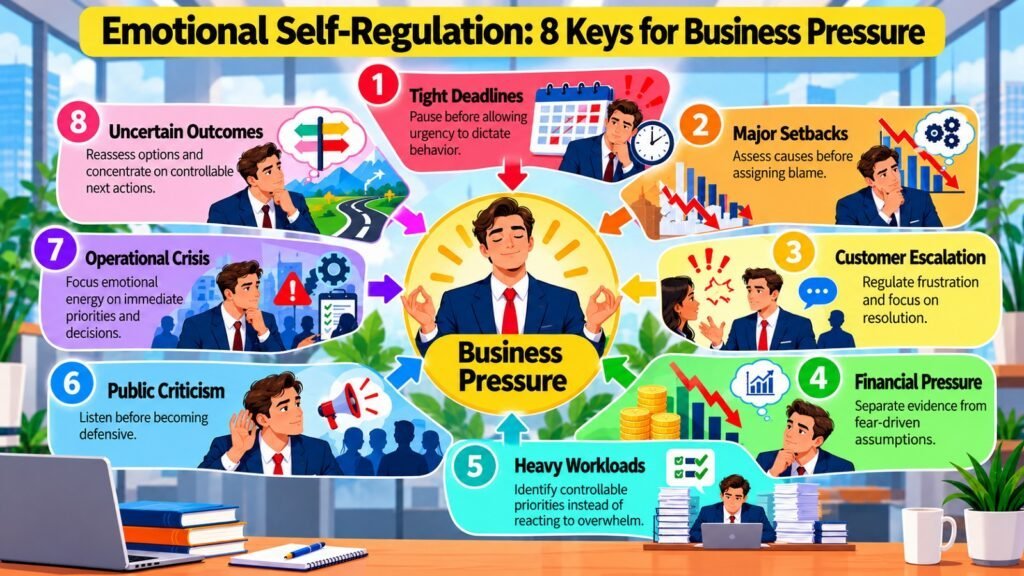
Pressure changes the emotional environment of work. Tight deadlines, financial stakes, crises, and operational failures all create conditions where emotional intensity rises and the gap between reaction and deliberate response narrows. Emotional Self-Regulation under these conditions does not mean eliminating the pressure — it means preventing emotional intensity from narrowing professional judgment to the point where effectiveness deteriorates.
Research on emotion and performance under pressure suggests that high-intensity emotional states produce attentional narrowing — a reduced capacity to consider a wide range of options — and make impulsive responses feel more justified than they otherwise would. The urgency of a situation can make any action feel preferable to deliberate thinking. This is partly why decisions made under pressure often look different in retrospect.
It is important to distinguish genuine regulation from performed composure. A professional can appear calm while making poor decisions because they are suppressing the emotional signal rather than processing it. A sales leader facing a quarter-end shortfall might feel genuine anxiety — acknowledging that honestly while identifying what is controllable is more useful than projecting false confidence. Regulation is about response quality, not surface expression.
A practical pressure-regulation tool involves four moves: name the emotion specifically, identify what is actually known versus assumed, find one thing within your control right now, and choose the next useful action rather than the most urgent-feeling one. Communication is often the first thing that deteriorates under pressure — tone sharpens, listening declines — so deliberately slowing it when everything else is moving quickly is a practical first application.
Table 5: Emotional Self-Regulation Under Pressure — Situations and Regulated Responses
| High-Pressure Situation | Regulated Response Example |
| End-of-quarter shortfall with senior visibility | Name the pressure; assess what is known; identify controllable actions |
| Key supplier fails at a critical delivery point | Focus on alternatives; communicate the situation factually and promptly |
| Project deadline moved up two weeks unexpectedly | Assess scope and resource impact before committing to the new timeline |
| Team member error becomes visible in a client meeting | Address the client calmly; debrief with the team member privately |
| Last-minute technical problem on a product launch | Identify the specific problem; decide on available information, not fear |
| Key client threatens to leave in a difficult conversation | Listen without interrupting; ask what a resolution would look like |
| Multiple urgent priorities arriving simultaneously | Pause to rank by actual impact; communicate realistically on timelines |
| A public-facing mistake creates reputational risk | Respond with factual clarity; avoid defensive or dismissive language |
5. Emotional Self-Regulation in Leadership: Building Trust Through Deliberate Responses
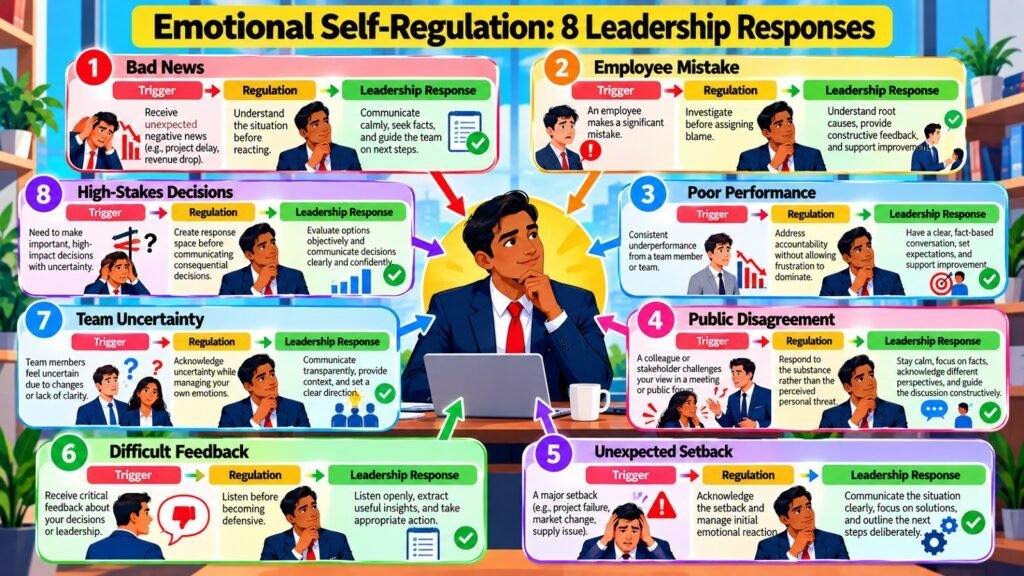
Leadership amplifies the consequences of emotional responses. When a team member makes a significant mistake, when results fall short, or when uncertainty is high, the way a leader responds becomes a reference point for the people around them. It influences whether employees feel safe raising problems, whether trust in the leader’s judgment holds, and whether the team climate supports or inhibits the work.
Effective leadership does not require permanent composure. Expecting leaders to never show frustration or concern can create disconnection — people recognize performed calm. Emotional Self-Regulation means recognizing what is felt, deciding whether and how to express it, and communicating in ways that serve the team rather than simply reflecting emotional intensity. Research consistently shows that leader emotional expressions shape how team members interpret situations and calibrate their own responses.
Consider a leader who learns a major project has exceeded budget significantly. A reactive response expresses frustration in the team meeting where the news surfaces. The seriousness is real — but that manner of responding closes the conversation needed to understand what happened. A regulated response acknowledges the seriousness, pauses before communicating, and opens a focused discussion about causes and what comes next.
A practical leadership self-regulation framework: recognize the trigger and name it internally before responding, pause to consider the consequences of an immediate reaction, assess what the situation requires from a leadership perspective, communicate with intention about content and tone, and review how the response affected the conversation. The objective is not emotional neutrality but the capacity to choose leadership behavior rather than have it determined by the intensity of the moment.
Table 6: Emotional Self-Regulation in Leadership — Situations and Regulated Responses
| Leadership Situation | Regulated Leadership Response |
| A senior project goes significantly over budget | Acknowledge the seriousness; open a fact-finding conversation first |
| A team member consistently underperforms | Address performance privately and directly; separate behavior from character |
| Strong team resistance to a strategic decision | Listen to the concerns fully; respond to the substance, not the resistance |
| Critical feedback about your own leadership style | Acknowledge the feedback; ask for specifics; identify what to act on |
| Team anxiety about uncertain organizational direction | Communicate what is known; acknowledge what is not; stay accessible |
| Two high performers in ongoing conflict | Address each separately; focus on work impact and expected behavior |
| A team member’s mistake has client-facing consequences | Manage the external situation first; debrief constructively afterward |
| Strong personal frustration during a team meeting | Acknowledge the difficulty if appropriate; redirect toward problem-solving |
6. Emotional Self-Regulation in Team Management: Strengthening Productive Relationships
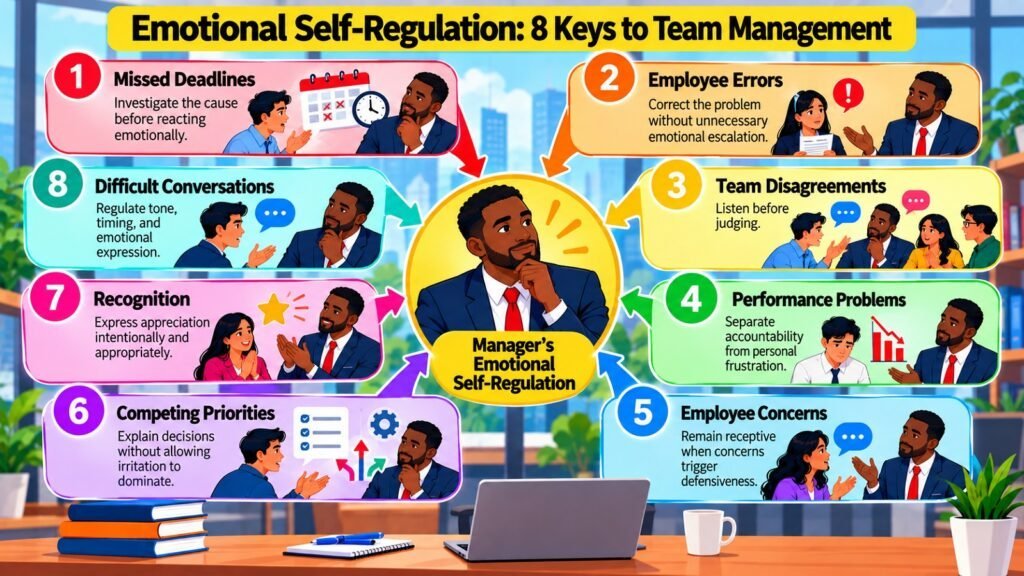
Day-to-day team management involves a continuous series of emotionally significant interactions: giving feedback on work that fell short, handling missed deadlines, addressing performance issues, and managing competing priorities. A manager’s emotional response in each situation shapes the quality of the interaction and the relationship that follows.
Uncontrolled frustration or impatience leaves effects that outlast the immediate exchange. Managers who respond to mistakes with consistent visible frustration create environments where team members hide problems rather than surface them early. Those who communicate impatience in one-on-one conversations reduce the likelihood that employees raise concerns. These patterns develop gradually and are often invisible to the manager who creates them, precisely because the climate they have established discourages honest feedback.
Emotional Self-Regulation here means a manager can feel genuine frustration when work falls short and address it directly — without allowing that frustration to shape the tone or timing in ways that damage the relationship or prevent the message from landing. A manager who discovers a missed deadline can respond sharply in the moment, or can wait for a private conversation, state what happened, and clarify expectations going forward. The message is essentially the same; the regulated version is more likely to be received clearly and acted on.
A practical team-management regulation tool: identify situations that most reliably trigger strong responses — missed deadlines, deflected accountability, repeated mistakes — and develop a deliberate sequence for each. Pause, name the emotion privately, identify what the situation requires, choose a communication approach that fits the relationship, and deliver the message clearly. Effective regulation allows managers to remain appropriately firm without allowing emotional intensity to become the primary signal team members receive.
Table 7: Emotional Self-Regulation in Team Management — Situations and Regulated Responses
| Team Management Situation | Regulated Managerial Response |
| Team member misses a deadline without flagging it | Address privately; ask for their account; reset expectations clearly |
| Repeated small mistakes from the same person | Address the pattern in a structured conversation; focus on behavior and impact |
| A team member deflects accountability on poor results | Stay specific and factual; redirect to what needs to change |
| Recognizing strong performance under difficult conditions | Acknowledge specifically what they did and why it mattered |
| A team member raises workload concerns directly | Listen before problem-solving; acknowledge what is reasonable first |
| Tension between two team members affecting the group | Address each separately; focus on work impact, not personalities |
| A team member questions your decision in front of others | Respond to the substance; address the manner separately if needed |
| Delivering feedback on work that missed the brief | Be specific about what fell short; separate work quality from effort |
7. Emotional Self-Regulation During Change: Responding Constructively to Uncertainty
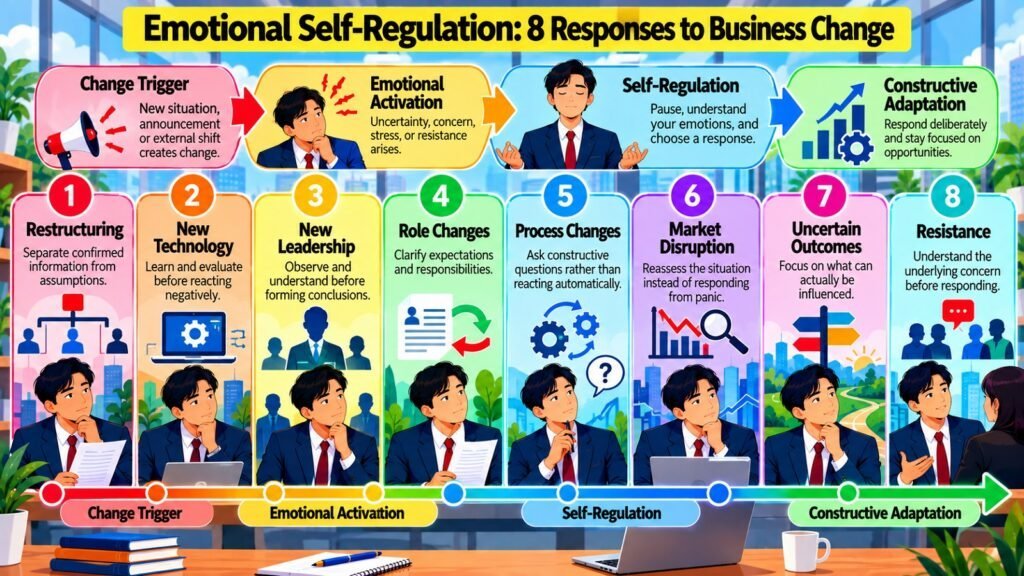
Organizational change consistently activates emotional responses that are understandable and significant. Restructuring, technology adoption, leadership transitions, and strategic pivots all introduce uncertainty — and uncertainty produces responses ranging from cautious concern to active resistance. Emotional Self-Regulation during change is not about encouraging enthusiasm for every transition. It is about ensuring that legitimate emotional responses do not automatically determine behavior in ways that undermine effectiveness or the organization’s capacity to navigate the shift.
When professionals face uncertainty about what a change means for their role or career, information from leadership is often filtered for signs that their concerns have been confirmed. Temporary conditions can feel permanent. Recognizing these patterns is not a judgment — they are natural responses to genuine uncertainty. But recognizing them makes it possible to work with them rather than be driven by them.
Cognitive reappraisal is particularly useful during change because the interpretation of what a change means is often more emotionally significant than the change itself. A reorganization interpreted as a personal signal of failure produces different consequences than the same reorganization interpreted as a response to market conditions. The facts are identical; interpretation shapes the emotion and the behavior that follows. A professional who acknowledges the discomfort, seeks factual information, raises concerns constructively, and identifies where genuine engagement is possible is demonstrating exactly that capacity.
A practical change-regulation process: recognize the emotions being activated, examine the interpretation generating them, pause to let initial intensity reduce, check what is actually known versus assumed, express concerns through appropriate channels, and identify one controllable next action. This enables professionals to engage with change as contributors rather than as passive recipients.
Table 8: Emotional Self-Regulation During Change — Situations and Regulated Responses
| Change Situation | Regulated Response Example |
| A restructure reduces the scope of your previous role | Clarify what the new role involves before drawing conclusions |
| Technology replaces a process you managed manually | Focus on learning it; raise transition concerns through proper channels |
| A merger creates uncertainty about team and reporting lines | Seek factual information; raise concerns formally rather than speculating |
| A new leader with a different style takes over | Give the approach sufficient time; raise specific concerns directly |
| Strategic priorities shift, making previous work less central | Acknowledge the frustration internally; engage with the new priorities |
| Colleagues respond to change with visible anxiety | Avoid adopting the group’s emotional register; focus on what you can influence |
| Change communication from leadership is incomplete | Ask specific factual questions rather than filling gaps with assumption |
| A change you opposed is implemented despite your input | Express disagreement through proper channels; then engage constructively |
8. Emotional Self-Regulation in Professional Performance: Turning Consistency into Advantage
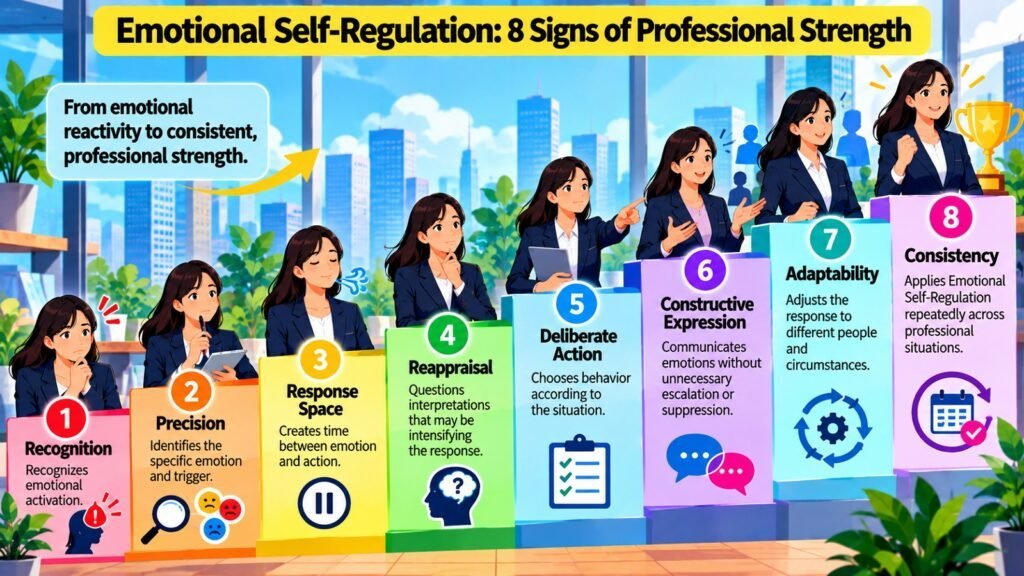
Emotional Self-Regulation becomes most valuable not when applied occasionally in high-stakes moments, but when it develops into a consistent professional capability that shapes how someone approaches their work across a range of everyday situations. At that point, it is no longer a technique for difficult moments — it is a characteristic of how a professional operates.
Developing this capability involves several interlocking practices. Self-observation — noticing emotional responses in real time rather than only in retrospect — is the first requirement. Emotional labeling reduces intensity and creates internal space for regulation. Deliberate pauses allow considered thinking to participate in the response. Cognitive reappraisal, applied consistently rather than only in crisis, changes how situations are interpreted before they generate strong reactions. Seeking feedback about recurring patterns and reflecting on which situations consistently produce reactive behavior accelerates development over time.
A practical self-assessment framework: identify three to five recurring situations that consistently produce strong emotional responses. For each, note the trigger, the typical automatic response, its consequences, and what a more regulated response would look like. A professional with a consistent pattern of defensiveness when challenged in group settings may notice that colleagues eventually stop raising concerns directly. Recognizing that pattern and practicing a more deliberate response in lower-stakes settings gradually shifts it in higher-stakes conversations — not all at once, but incrementally through consistent practice.
A practical model of this development describes a spectrum: reactive (responding from emotional intensity), aware (recognizing the emotion after reacting), pausing (creating space before responding), regulated (consistently choosing responses that serve the situation), and adaptive (applying regulation across contexts with growing ease). These describe a direction of development, not a fixed scale. Consistent Emotional Self-Regulation does not remove appropriate emotional expression — it ensures that expression is chosen rather than reflexive.
Table 9: Emotional Self-Regulation in Professional Performance — Observable Indicators
| Situation or Indicator | What Stronger Regulation Looks Like |
| Receiving unexpected criticism or feedback | Acknowledges feedback before responding; avoids immediate defensiveness |
| Communicating under time pressure | Maintains clarity and appropriate tone even when urgency is high |
| Handling a disagreement with a colleague or client | Addresses the issue without escalating the emotional register |
| Responding to a significant professional setback | Names the emotional response; focuses on what is controllable next |
| Managing a difficult team conversation | Holds the objective clearly; adjusts communication to what the person needs |
| Navigating organizational uncertainty | Seeks facts rather than assumptions; raises concerns constructively |
| Noticing a recurring reactive pattern | Identifies the trigger; begins modifying the response deliberately |
| Expressing disagreement in a group setting | States the position specifically; maintains composure without suppressing substance |
Conclusion — Emotional Self-Regulation: Turning Emotion into Effective Action
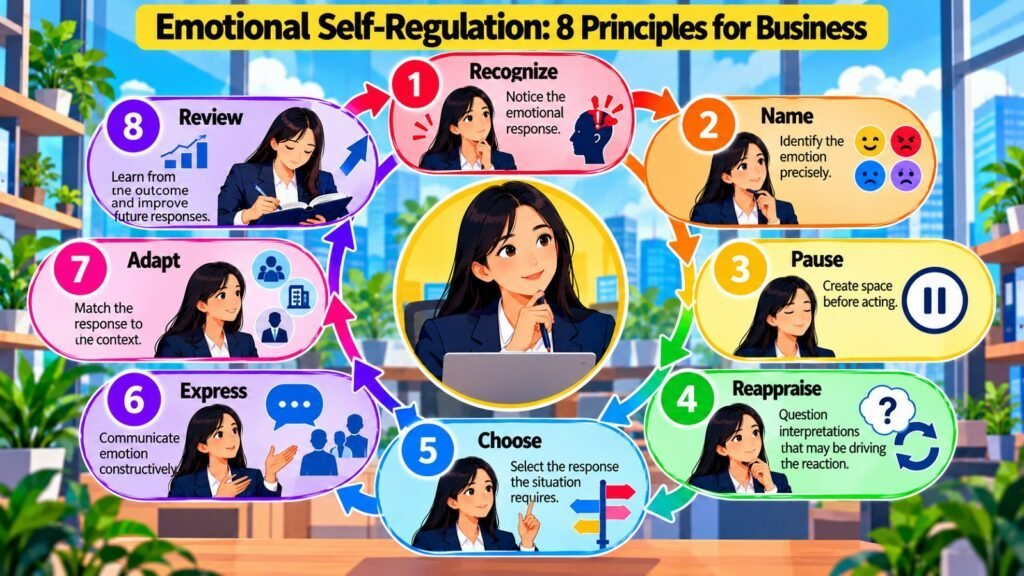
Emotional Self-Regulation and Emotional Awareness operate at different points in the professional response cycle. Awareness identifies what is felt and why. Regulation determines what happens next — whether the emotion informs the response or becomes the response. That distinction is at the heart of what makes Emotional Self-Regulation useful in professional life.
One principle has run through every context examined in this article: emotions carry real information and deserve to be taken seriously, but they are not instructions. The frustration arising during a conflict does not determine how that conflict must be addressed. The anxiety accompanying change does not determine whether it will be engaged with constructively. Regulation creates the space between the emotion and the action — and what happens in that space significantly shapes professional outcomes.
Across all eight contexts examined here, the underlying process remains consistent: recognize the emotional response, pause deliberately, reconsider the interpretation where useful, and choose the response that fits the situation. This is not a one-time technique but a professional capability that develops through deliberate practice, honest self-observation, and repeated application. The principle that synthesizes everything here is direct: treat emotion as information, not as instruction. The emotion tells you something about the situation. The response remains yours to choose.
Table 10: Emotional Self-Regulation — Eight Practical Principles for Professional Reference
| Principle | Practical Application |
| Distinguish awareness from regulation | Awareness identifies the emotion; regulation determines what you do with it |
| Name the emotion specifically | Precise labeling reduces intensity and creates space for a deliberate response |
| Pause before responding | Even a brief pause allows deliberate thinking to participate in the response |
| Separate facts from interpretations | Identify what you actually know versus what you are assuming |
| Use cognitive reappraisal | Reconsidering the interpretation of a situation changes the emotion it generates |
| Express emotion constructively | Choose when and how to express legitimate emotion rather than suppressing it |
| Identify what is controllable | Directing attention to controllable actions improves response quality under pressure |
| Treat emotion as information, not instruction | The emotion signals something about the situation; the response is yours to choose |