Table of Contents
Introduction: GPU and Its Role in Modern Computing
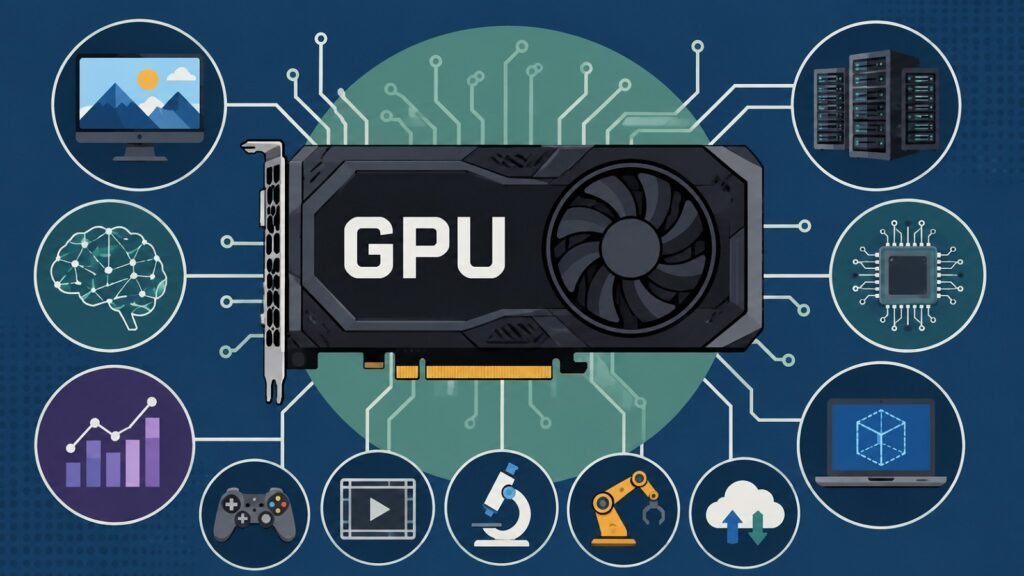
The graphics processing unit, better known as the GPU, is one of the most consequential developments in modern Computing Hardware. Originally built to accelerate pixel-level calculations behind images and video, the GPU has grown into a parallel computing engine underpinning graphics, scientific simulation, artificial intelligence, and high-performance data processing. That evolution followed directly from the architectural strengths that made GPUs valuable for graphics in the first place.
A Graphics Processing Unit organizes thousands of smaller processing cores that work simultaneously on separate portions of a problem, rather than relying on a handful of powerful cores as a CPU does. This design suits workloads where the same operation must be applied to a large dataset in parallel. Image pixels, physics simulations, neural-network training data, and fluid dynamics equations share that structure, explaining why one chip architecture proved relevant across such different fields.
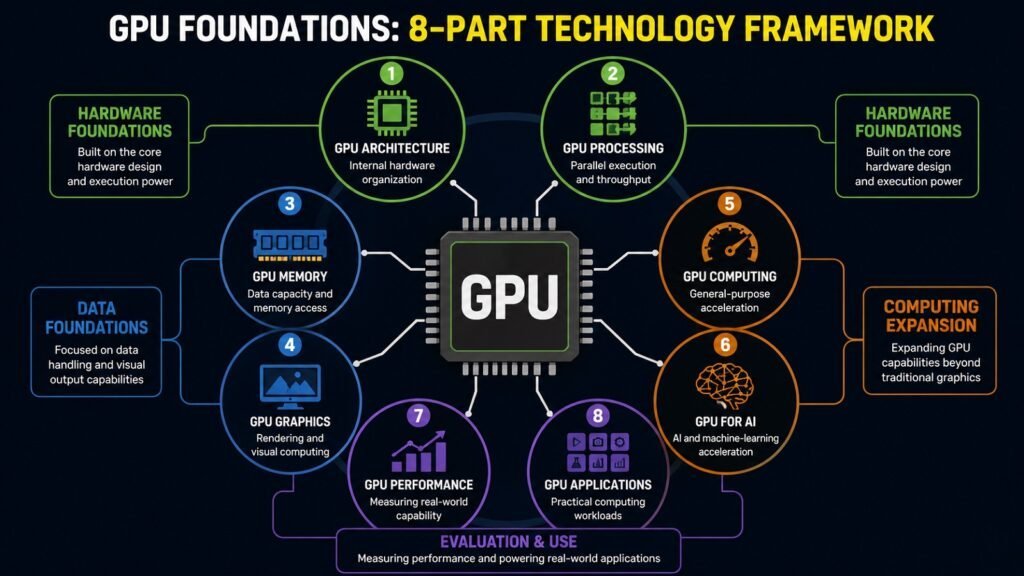
Understanding this technology properly means going beyond its reputation as a gaming component or AI chip. Architecture, processing model, memory design, graphics pipeline, general-purpose computing, AI acceleration, performance evaluation, and applications each represent a distinct dimension, and none tells the full story alone. The eight sections that follow combine technical accuracy with practical interpretation for readers at every level of familiarity with Computing Hardware.
Graphics Processing Unit Overview: 8 Aspects Covered in This Article
| Aspect | What You Will Learn |
| Architecture | How GPUs organize cores, caches, schedulers, and memory controllers for parallel throughput |
| Processing | How threads execute in parallel and why workload structure determines acceleration gains |
| Memory | Why VRAM capacity, bandwidth, and memory hierarchy shape performance more than core count |
| Graphics | How rendering pipelines, shaders, rasterization, and ray tracing remain core GPU functions |
| Computing | How general-purpose GPU computing extended GPU value into science, engineering, and analytics |
| GPU for AI | Why matrix operations in neural networks align with GPU parallelism and power AI workloads |
| Performance | How to evaluate GPU capability across throughput, bandwidth, efficiency, and workload fit |
| Applications | Where GPUs operate across gaming, research, healthcare, cloud computing, and autonomous systems |
1. GPU Architecture: Understanding the Core Design
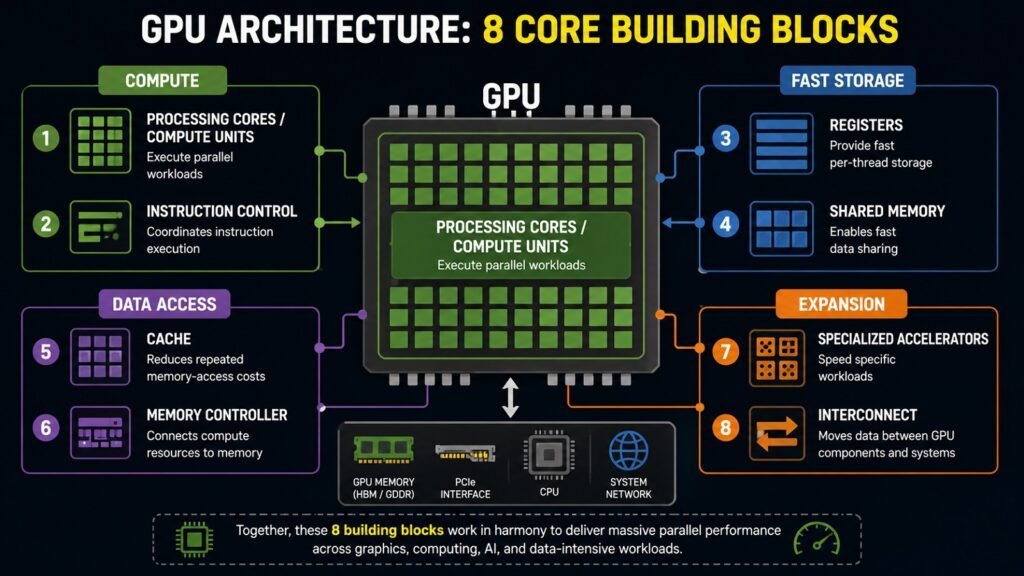
GPU architecture describes the physical and logical organization of a Graphics Processing Unit’s processing resources, memory systems, and control structures. It is the foundation that determines how a Graphics Processing Unit performs across every workload type, and a clear understanding of it is essential before examining processing, memory, or application-specific capabilities in any depth.
The defining characteristic of GPU architecture is its orientation toward parallel throughput. Modern graphics processors contain thousands of processing cores organized into clusters of execution units sharing schedulers, registers, and caches. These cores are individually simpler than CPU cores, but their sheer number operating simultaneously allows a Graphics Processing Unit to complete far more operations per clock cycle than a CPU can. The design philosophy prioritizes doing many things at once rather than completing any single task as quickly as possible.
These architectures also include dedicated memory controllers, large caches, and, in recent designs, specialized hardware units for matrix multiplication and ray tracing. Memory controllers govern data movement between VRAM and the processing cores; their bandwidth capacity is a critical architectural parameter. Cache hierarchies reduce the cost of repeatedly accessing the same data, since a cache hit returns data many times faster than a fetch from VRAM. These layers of on-chip storage are carefully sized to match the memory access patterns of typical GPU workloads.
A common misconception is that a higher core count always produces a faster Graphics Processing Unit. In practice, cache design, memory bandwidth, and the match between architecture and workload determine how effectively those cores deliver useful performance. NVIDIA’s Ampere and Hopper architectures produced significant capability improvements through memory subsystem and tensor unit design, not simply by raising core counts. The scheduler further maximizes core utilization by switching quickly between waiting thread groups, hiding memory latency and keeping cores productive even when individual memory requests take hundreds of clock cycles.
GPU Architecture: Key Components and Their Roles
| Component | Role in GPU Architecture |
| Shader Cores / CUs | Programmable execution units processing vertex, pixel, and compute workloads in parallel |
| Warp / Wavefront | Group of threads scheduled and executed together across shader cores each clock cycle |
| Register File | Fast per-core storage holding thread state and intermediate values during execution |
| L1 / L2 Cache | On-chip memory reducing VRAM latency by caching frequently accessed data near the cores |
| Memory Controller | Manages transfers between VRAM and cores; its bandwidth capacity constrains total throughput |
| Thread Scheduler | Selects which warps execute each cycle and hides latency by switching to ready threads |
| Tensor / Matrix Units | Specialized hardware accelerating mixed-precision matrix operations for AI workloads |
| Ray Tracing Units | Dedicated hardware accelerating bounding-volume-hierarchy traversal for real-time ray tracing |
2. GPU Processing: Powering Parallel Workloads
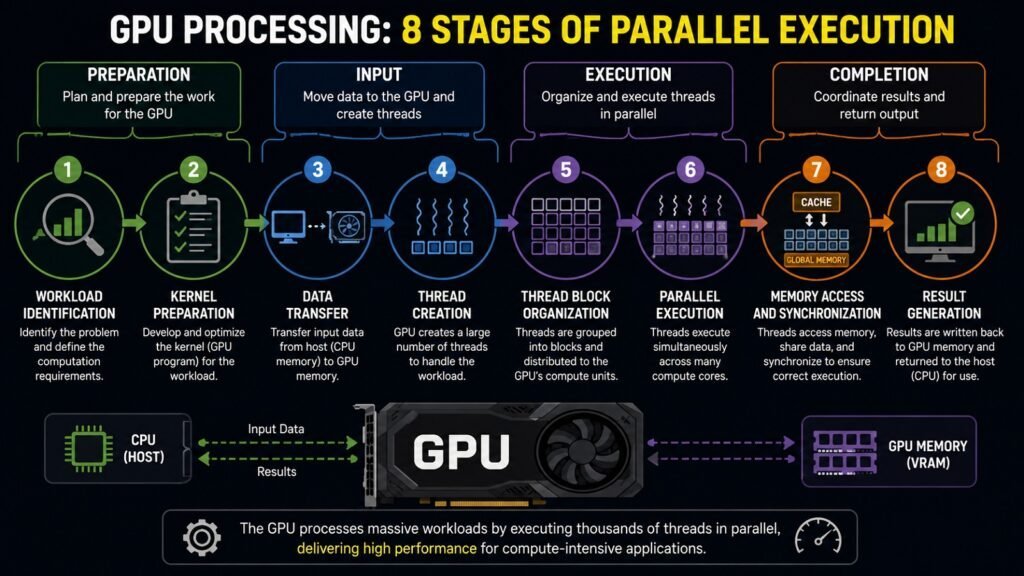
GPU processing is the mechanism through which architectural resources turn into useful parallel computation. Understanding it requires a clear picture of what parallel processing means and how it differs fundamentally from the sequential execution model that defines most everyday computing tasks.
When a CPU executes a program, it typically processes one instruction after another, or a small number simultaneously through out-of-order techniques. This approach works well for tasks with complex branching logic and data dependencies. A graphics processor takes a different path: thousands of threads execute simultaneously, each performing the same operation on a different data element. This single-instruction-multiple-data pattern maps naturally onto workloads requiring the same function applied to many elements at once, which is the structural property that makes GPU acceleration valuable.
Image processing is a clear illustration. Each pixel in a 4K image is an independent element. Applying a color-correction filter requires the same calculation applied to millions of pixels. The processor distributes those calculations across its cores, processing many pixels simultaneously. Scientific simulations and neural-network training exhibit similar data parallelism, explaining why the acceleration value is high in those domains. The hardware scheduler organizes threads into blocks, switches between groups when some stall for memory, and maintains high overall throughput.
A persistent oversimplification claims Graphics Processing Units are universally faster than CPUs. This is inaccurate. Serial workloads with irregular branching, deep data dependencies, or heavy CPU-GPU data transfers may run slower on a Graphics Processing Unit than on a modern multi-core CPU. Graphics processors accelerate data-parallel workloads; CPUs remain superior for low-latency, sequential, or branching-heavy tasks. Effective computing systems use both, assigning each workload to the processor best suited to handle it. Recognizing whether a workload has high data parallelism is the practical skill that determines when GPU acceleration produces real gains.
Graphics Processing Unit Processing: Key Concepts and Their Significance
| Concept | Practical Significance |
| Data Parallelism | The workload property allowing the same operation to be applied to many data elements simultaneously |
| Thread | The smallest unit of parallel GPU work; thousands execute concurrently across shader cores |
| Warp Execution | Cores execute threads in groups; divergence within a group causes some cores to idle |
| SIMD | Single instruction, multiple data: one instruction processes many data elements simultaneously |
| Throughput vs. Latency | These processors maximize throughput across many threads rather than minimizing completion time for one task |
| Occupancy | The ratio of active warps to the maximum possible; higher occupancy improves latency hiding |
| Thread Divergence | When warp threads take different code paths, inactive cores waste execution cycles |
| CPU-GPU Offload | Transferring a data-parallel workload from CPU to GPU to exploit higher parallel throughput |
3. GPU Memory: Understanding VRAM and Bandwidth
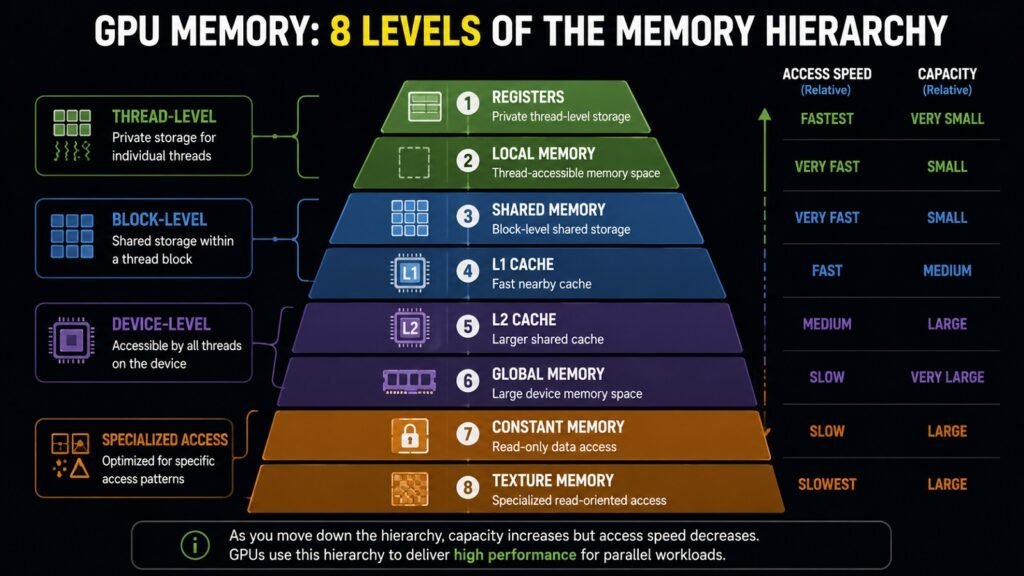
Memory is frequently overshadowed by core counts and clock speeds in hardware evaluations. In practice, the memory subsystem often determines whether the hardware achieves its theoretical potential or falls significantly short of it. Understanding the relationship between computational resources and memory design is one of the most important principles in GPU technology.
VRAM is the dedicated memory pool attached to the processor. It stores textures, frame buffers, intermediate computation results, and AI model weights. Its capacity limits how much data can reside on the GPU at once, but capacity alone does not determine performance. Memory bandwidth, the rate at which data moves between VRAM and the processing cores, is typically the more critical metric. Cores stall when data cannot arrive quickly enough to keep them occupied, regardless of how much VRAM is physically present.
Memory technologies determine the bandwidth available. GDDR6 and GDDR6X are cost-effective types used in most consumer GPUs; GDDR6X adds PAM4 signaling for higher effective transfer rates. HBM stacks memory dies vertically through a very wide data bus, achieving substantially higher bandwidth at greater manufacturing cost. Data-center and AI-oriented chips frequently use HBM because training workloads are particularly bandwidth-sensitive. On-chip cache hierarchies further reduce VRAM access frequency; programs with regular, coalesced memory access patterns benefit most from these caches.
A common specification-reading error is treating VRAM capacity as a speed indicator. Additional capacity does not increase bandwidth or reduce latency. When a workload fits within existing VRAM, extra capacity provides no performance benefit. When a workload exceeds available VRAM, the processor must batch computation or access slower system memory, both of which reduce efficiency substantially. Evaluating GPU memory properly means examining bandwidth, access patterns, and cache behavior alongside raw capacity numbers.
Graphics Processing Unit Memory: Key Concepts and Why They Matter
| Memory Concept | Why It Matters |
| VRAM Capacity | Sets the maximum on-chip data; determines whether large models or textures fit without batching |
| Memory Bandwidth | Rate of transfer between VRAM and cores; often the primary bottleneck in throughput-limited workloads |
| GDDR6 / GDDR6X | High-bandwidth memory for consumer GPUs; GDDR6X uses PAM4 signaling for higher effective speeds |
| HBM2e / HBM3 | Stacked memory with a wide data bus delivering higher bandwidth than GDDR at greater cost |
| L1 / L2 On-Chip Cache | Reduces VRAM access cost by caching frequently reused data close to the execution units |
| Memory Latency | Delay between requesting and receiving data; GPU schedulers hide it by running other thread groups |
| Coalesced Memory Access | Sequential addressing lets hardware combine thread requests into one efficient transaction |
| Memory Bandwidth Bound | Condition where cores idle waiting for data, indicating bandwidth is the limiting factor |
4. GPU Graphics: Transforming Visual Computing
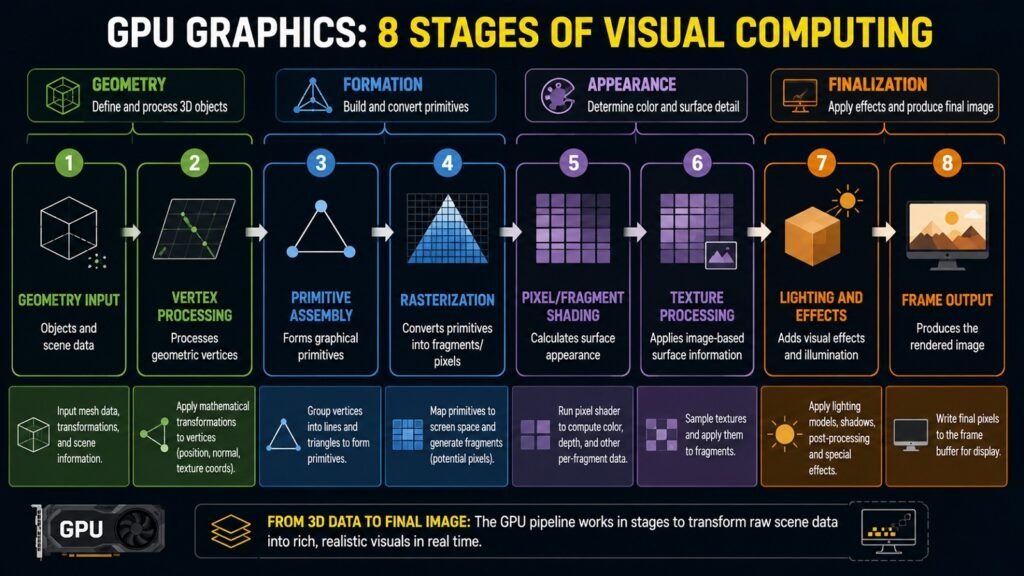
The history of the GPU is, at its origin, a history of graphics. Demands for increasingly complex rendered images drove nearly every major architectural advance from the mid-1990s onward, and the parallel processing infrastructure built for graphics ultimately became the foundation for far broader computing applications. Understanding these graphics capabilities is therefore essential context for how the technology developed into its current form.
Modern graphics processing centers on a rendering pipeline that transforms 3D scene descriptions into 2D images displayed on screen. The pipeline moves data through distinct stages: vertex processing calculates geometry positions, rasterization converts shapes into pixel-sized fragments, fragment shading assigns colors and lighting values, and the final image is assembled for the display. GPUs excel here because each vertex and pixel can be processed independently, producing high natural parallelism across every stage of the pipeline.
Programmable shaders, widely adopted in the early 2000s, transformed fixed hardware stages into flexible execution units. Developers gained control over per-vertex and per-pixel calculations, enabling expressive visual techniques and opening this shader hardware to general computing. Ray tracing simulates light by tracing rays through a scene and computing surface intersections, producing photorealistic images at high computational cost. Modern GPUs include dedicated ray-tracing acceleration units handling ray-triangle intersection in hardware, making real-time ray tracing practical for the first time. Hybrid rasterization-plus-ray-tracing approaches have become common in current applications.
Beyond gaming, these graphics capabilities underpin professional engineering visualization, medical imaging display, digital film production, and scientific data rendering. These applications frequently demand color accuracy and rendering precision that exceed gaming requirements, which drives the development of specialized GPU product lines carrying certified driver stacks, extended color depth support, and professional software validation for use in regulated or mission-critical environments.
GPU Graphics: Key Concepts in Visual Computing
| Graphics Concept | Role in GPU-Based Visual Computing |
| Rendering Pipeline | Sequential process from 3D scene data to a 2D pixel image; each stage parallelized across GPU cores |
| Vertex Shader | Programmable stage transforming 3D geometry coordinates before rasterization |
| Rasterization | Converts vector geometry into discrete pixel fragments for shading and compositing |
| Fragment / Pixel Shader | Calculates the final color and lighting value for each screen pixel during rendering |
| Texture Mapping | Applies pre-computed image data to 3D surfaces to add visual detail without additional geometry |
| Ray Tracing | Simulates light transport by tracing rays; dedicated GPU hardware accelerates intersection tests |
| Anti-Aliasing | Techniques smoothing edge artifacts by sampling or blending neighboring pixel values |
| Frame Buffer | Memory region storing the completed rendered image before transmission to the display |
5. GPU Computing: Beyond Traditional Graphics
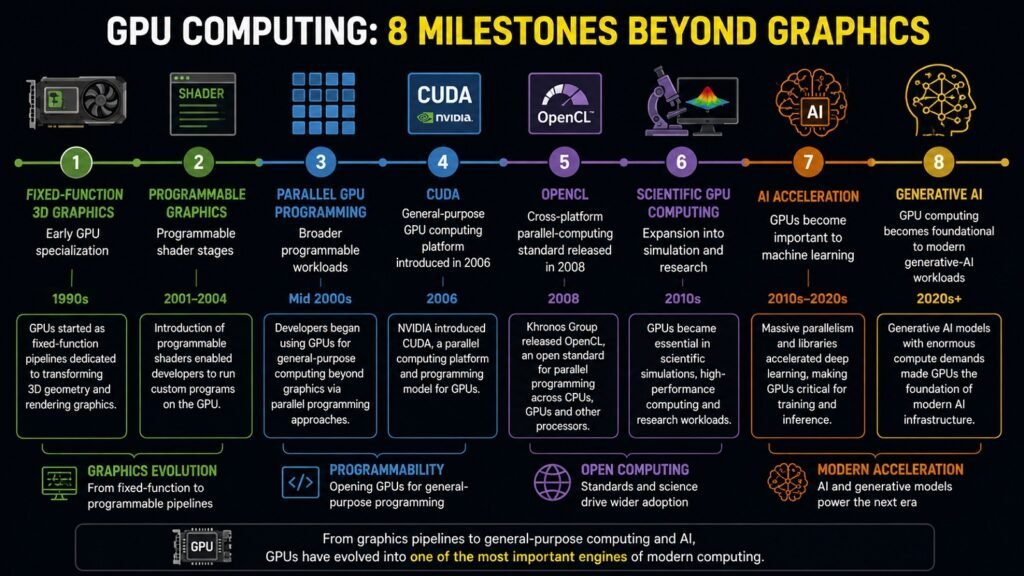
The recognition that shader hardware could perform general mathematical calculations began in academic research in the early 2000s. Researchers observed that floating-point performance on these chips was growing faster than CPU performance and that shader programs could handle non-graphics computation if data was formatted appropriately. This workaround was awkward but established that GPUs held computing potential well beyond image rendering.
Dedicated computing frameworks removed that workaround. NVIDIA’s CUDA, released in 2007, and the open-standard OpenCL, released in 2009, allowed developers to write parallel programs targeting GPU hardware directly in familiar programming languages. This marked the beginning of GPU computing as a recognized discipline, opening acceleration to scientific simulation, fluid dynamics, molecular dynamics, financial modeling, and signal processing wherever data parallelism is high.
Heterogeneous computing serves as the most precise framework for comprehending the role of the Graphics Processing Unit in contemporary system architecture. Instead of supplanting the CPU, the GPU functions as a coprocessor that manages data-intensive parallel segments of a workload, while the CPU oversees control flow, sequential logic, and coordination. Data transfers between CPU memory and graphics VRAM take place through the system bus, and the overall efficiency is contingent upon how effectively the workload is divided between the two types of processors. High-bandwidth interconnects like NVLink and AMD’s Infinity Fabric offer quicker alternatives to PCIe for systems that necessitate swift cross-chip data transfer.
Scientific computing provides some of the clearest examples of parallel computing value. Climate models simulating atmospheric behavior across millions of grid cells, molecular dynamics simulations tracking thousands of atomic interactions, and large-scale seismic data processing all exhibit the large-scale parallelism that Graphics Processing Unit architectures are built to exploit. The key principle is that parallel computing value is always workload-dependent. High data parallelism with regular memory access patterns indicates a strong GPU acceleration candidate, while serial logic, irregular branching, or frequent CPU-GPU transfers often negate the benefit.
GPU Computing: Key Concepts and Contributions
| Computing Concept | Contribution to Accelerated Computing |
| GPGPU | General-purpose computing using Graphics Processing Unit hardware for non-graphics mathematical workloads |
| CUDA | NVIDIA’s parallel computing platform enabling GPU programming in C, C++, Fortran, and Python |
| OpenCL | Open standard for parallel programming across GPUs, CPUs, and accelerators from multiple vendors |
| Heterogeneous Computing | Systems where CPU and GPU each handle task types best matched to their respective architectures |
| Kernel Launch | Dispatching a parallel compute program to execute across many accelerator cores simultaneously |
| Scientific Computing | Numerical simulations exploiting parallel processing for large-scale physical and engineering computation |
| PCIe Bandwidth | Transfer rate between CPU memory and GPU VRAM; a bottleneck for data-transfer-heavy workloads |
| NVLink / Infinity Fabric | High-bandwidth GPU interconnects exceeding PCIe speeds for multi-GPU and CPU-GPU data movement |
6. GPU for AI: Accelerating Intelligent Computing
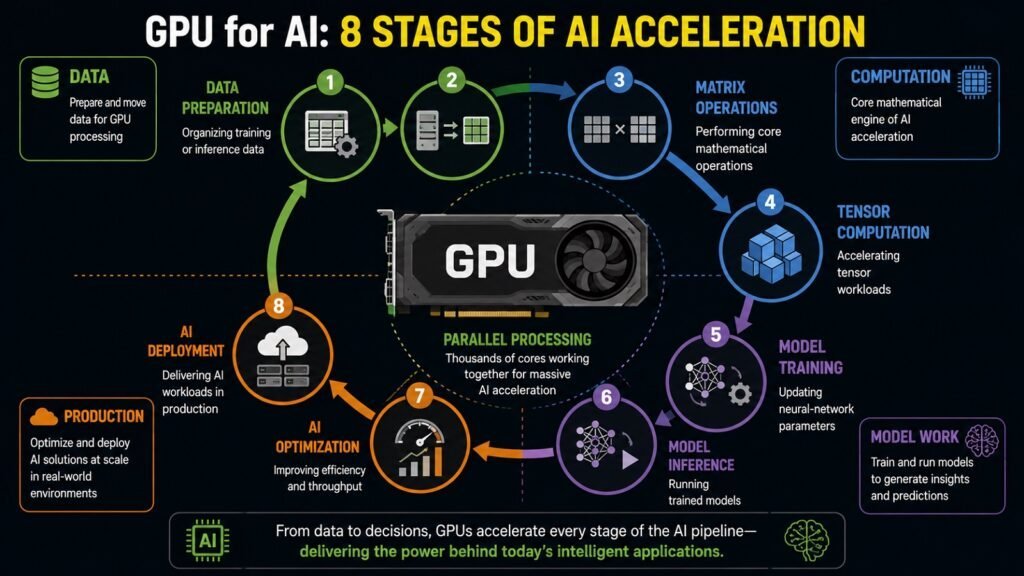
The alignment between Graphics Processing Unit parallel processing and modern artificial intelligence is not coincidental. Neural networks rely on matrix multiplication and vector operations performed repeatedly across large numerical arrays. These operations are structurally identical to calculations GPU hardware was already optimized to perform, which is why these processors became the dominant AI training platform well before purpose-built AI accelerators emerged.
Training a neural network involves adjusting millions or billions of parameters through forward passes and gradient back-propagation across many iterations. Each step involves large matrix multiplications that decompose into thousands of independent dot-product calculations, mapping directly onto GPU parallel execution. Training times on Graphics Processing Units are typically orders of magnitude shorter than on CPUs, a difference that becomes decisive at the scale of modern large language models with hundreds of billions of parameters.
The distinction between training and inference matters practically. Training requires sustained high-throughput computation and substantial VRAM to hold parameters, activations, and gradients simultaneously. Inference, running the trained model on new inputs, is less compute-intensive per operation but may require very low latency, high throughput on small batches, or efficient edge deployment within tight power budgets. Modern AI-oriented GPUs include tensor computation units, such as NVIDIA’s Tensor Cores, that perform mixed-precision matrix operations at substantially higher throughput than general-purpose floating-point cores alone.
Graphics processors are not the only accelerators for AI. Purpose-built circuits such as Google’s TPU achieve high efficiency for specific inference patterns. Graphics Processing Units remain dominant for training because their programmability and software ecosystem, particularly CUDA and libraries like PyTorch and TensorFlow, make them applicable across a wider range of model architectures than purpose-built hardware. Readers who understand this broader landscape can place GPU AI acceleration within a more complete picture of how the AI compute ecosystem is organized.
Graphics Processing Unit for AI: Key Concepts and Their Significance
| AI Concept | Significance for Graphics Processing Unit-Based AI Computing |
| Matrix Multiplication | The fundamental neural-network operation; highly parallelizable and well matched to core design of Graphics Processing Units |
| Tensor Computation | Multi-dimensional array operations used throughout deep learning training and inference |
| Tensor Cores | Dedicated GPU units performing mixed-precision matrix operations at significantly higher throughput |
| Neural Network Training | Iterative weight optimization requiring sustained high-throughput computation across large datasets |
| Inference | Running a trained model on new data; requirements vary by deployment context and latency targets |
| Mixed Precision | Using FP16 or BF16 for computation and FP32 for accumulation; reduces memory use and increases speed |
| Deep Learning Frameworks | Libraries such as PyTorch and TensorFlow that map AI operations onto accelerator hardware automatically |
| Large Language Models | Very large neural networks requiring substantial VRAM and high bandwidth for training and inference |
7. GPU Performance: Measuring Real-World Capability
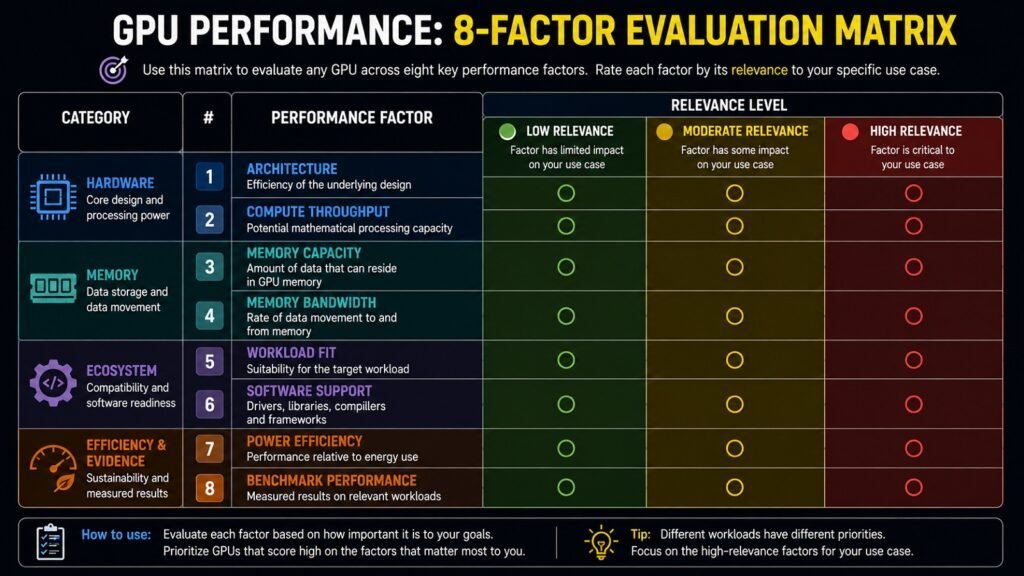
GPU performance is among the most misunderstood areas in hardware evaluation. A single specification, whether teraFLOPS of theoretical throughput, core count, or VRAM capacity, rarely predicts real-world results accurately. Useful evaluation requires examining multiple factors together and matching them against the characteristics of the intended workload.
Theoretical floating-point throughput represents the maximum operations per second under ideal conditions. Real workloads almost never achieve those conditions. Memory bandwidth limits, pipeline stalls, workload branching, data transfer overhead, software inefficiencies, and thermal throttling all cause actual performance to fall below the theoretical ceiling. Two chips with similar TFLOPS ratings can perform very differently on the same task if their memory subsystems, cache sizes, or architecture generations differ. Treating specification parity as performance parity is one of the most common and costly mistakes in GPU evaluation.
Memory bandwidth deserves particular emphasis as a performance factor. Many real workloads are bandwidth-bound rather than compute-bound, meaning the processing cores idle while waiting for data. Adding more compute throughput to bandwidth-limited workloads delivers diminishing returns. A Graphics Processing Unit with moderately lower TFLOPS but significantly higher bandwidth may outperform a higher-TFLOPS competitor on bandwidth-sensitive tasks. This pattern frequently appears when comparing HBM-equipped data-center GPUs to GDDR-based consumer models on large-batch inference or scientific simulation workloads.
Power efficiency has grown increasingly important as thermal design power has reached 300 to 600 watts in high-end products. Performance per watt determines useful computation within thermal and power budget constraints, which is critical for data centers managing large GPU deployments. Workload-specific benchmark results provide more predictive guidance than theoretical specifications, provided the benchmark represents the actual use case. Multi-factor evaluation combining memory subsystem, power envelope, software support, and representative benchmarks produces the most accurate picture of real GPU capability.
Graphics Processing Unit Performance: Key Factors and What They Indicate
| Performance Factor | What It Indicates or Influences |
| TFLOPS (Theoretical) | Maximum floating-point operations per second under ideal conditions; rarely achieved in practice |
| Memory Bandwidth | Data transfer rate between VRAM and cores; often the primary bottleneck in real workloads |
| Compute Utilization | Fraction of shader cores active during execution; low values indicate mismatch or bottleneck |
| Clock Speed | Affects per-thread throughput; must be considered with core count and architecture generation |
| Thermal Design Power | Maximum sustained power draw; constrains performance in thermally limited deployments |
| Performance per Watt | Efficiency metric critical for data centers where power and cooling costs are tightly managed |
| Workload-Specific Benchmarks | Results on target-representative tasks; more predictive than synthetic peak-throughput tests |
| Software Ecosystem | Driver maturity, framework support, and library coverage determine whether hardware potential is reachable |
8. GPU Applications: Powering Diverse Computing Systems
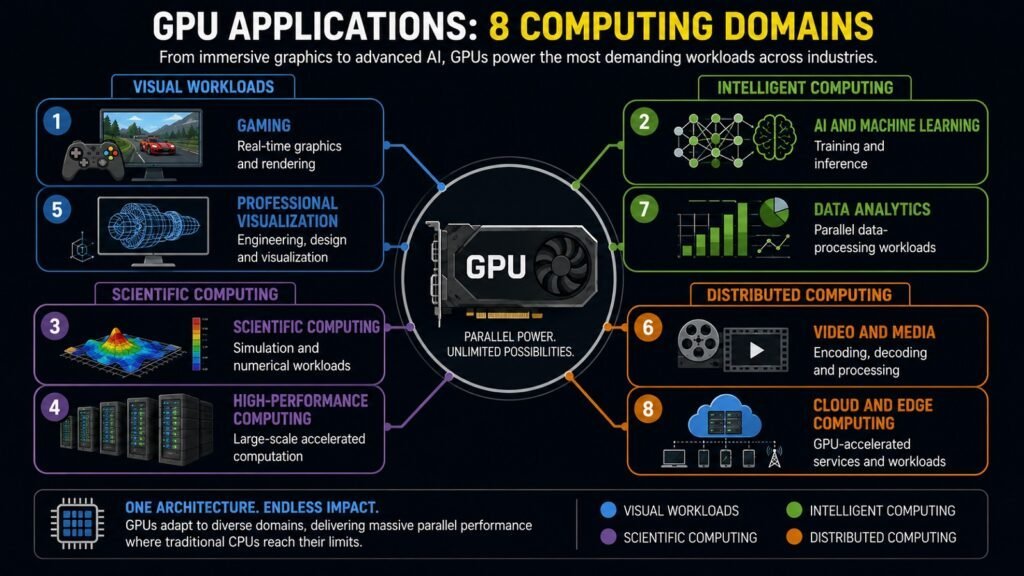
The practical measure of any technology is the breadth of problems it can address effectively. For the Graphics Processing Unit, that range now extends across nearly every computationally demanding area of modern life. Understanding why GPUs are relevant to each application area requires connecting the architectural, processing, memory, and performance principles discussed earlier to the specific demands of each workload.
Gaming remains the largest consumer market for graphics processors by volume. Real-time rendering at high resolutions and frame rates demands sustained throughput across vertex processing, rasterization, shading, and post-processing stages simultaneously. Modern games incorporate ray tracing, AI-driven upscaling such as DLSS and FSR, and physics simulation, placing diverse concurrent demands on Graphics Processing Units’ hardware. Consumer gaming has driven performance improvements in this space for three decades. In artificial intelligence, GPUs handle the majority of model training at enterprise and research levels, with large language models requiring distribution across multiple GPUs through model parallelism and data parallelism techniques.
Scientific computing encompasses climate modeling, computational fluid dynamics, drug discovery, particle physics analysis, and genomics processing. These fields involve millions of independent calculations per time step, and GPU acceleration has made previously impractical computations feasible within research timelines. National laboratory supercomputers routinely deploy large graphics accelerator clusters as primary computational resources. Professional visualization, engineering simulation, and medical imaging each rely on GPU capabilities for different reasons: engineering requires floating-point precision and certified drivers, while medical imaging demands high bandwidth for large volumetric datasets.
Cloud providers offer GPU-enabled virtual machine instances, giving organizations scalable access to accelerated compute without capital hardware investment. Autonomous vehicle development depends on accelerated computing through Graphics Processing Units for sensor data processing, simulation, and perception model training. The expanding application range reflects the Graphics Processing Unit’s transformation into a broader computing platform, where architecture, memory, processing model, and software ecosystem together determine where acceleration applies most effectively.
Graphics Processing Unit Applications: Key Areas and Relevant Workloads
| Application Area | Capability That Makes It Relevant |
| Gaming | Real-time rasterization, ray tracing, and shader processing at high resolution and sustained frame rates |
| AI and Deep Learning | Tensor computation, matrix operations, and high bandwidth for neural network training at scale |
| Scientific Computing | Massive data parallelism in simulations of fluid dynamics, molecular interactions, and climate systems |
| Professional Visualization | High-precision rendering and certified driver stacks for engineering, architecture, and medical imaging |
| Video Production | GPU-accelerated encoding, decoding, and real-time color grading of high-resolution video content |
| Cloud Computing | On-demand GPU instances providing scalable compute for inference, rendering, and analytics workloads |
| Autonomous Systems | Perception model inference, sensor fusion, and simulation for self-driving vehicle development |
| High-Performance Computing | Multi-GPU clusters in supercomputers delivering petaFLOPS-scale throughput for national research programs |
Conclusion: GPU and the Future of Modern Computing
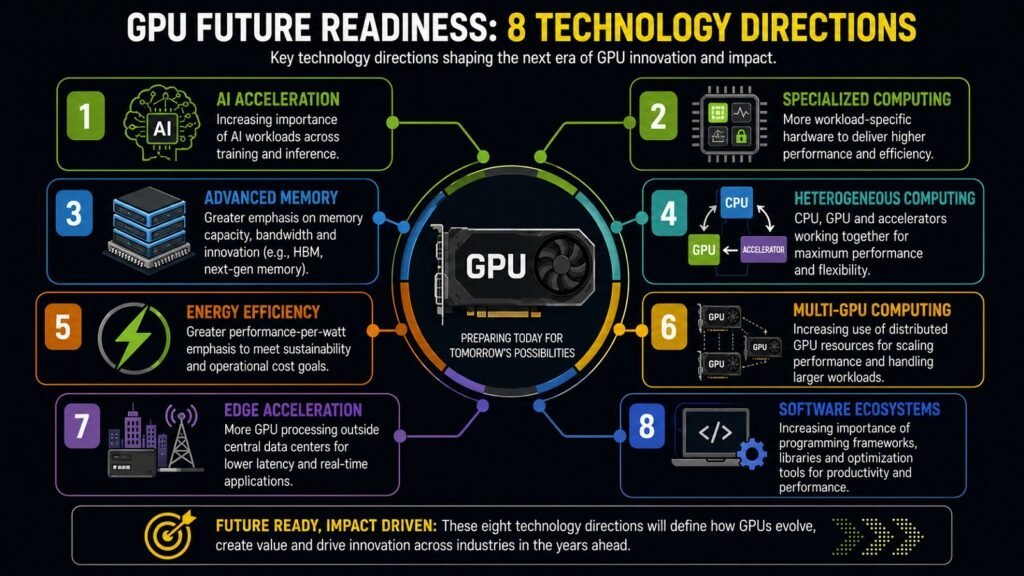
A Graphics Processing Unit is not simply a chip for rendering images or training AI models. It is a parallel computing architecture connecting a wide range of demanding workloads through shared underlying capabilities. One pattern emerges consistently across all eight aspects examined here: GPU value is not located in any single specification but in the interaction between architecture, memory design, processing model, software ecosystem, and workload structure.
Architecture organizes processing resources and memory access. Processing converts parallelism into actual throughput. Memory design determines whether cores receive data quickly enough to stay productive. The graphics pipeline demonstrates how decades of visual computing demands shaped a programmable, parallel platform that general-purpose computing and AI subsequently inherited. The breadth of applications reflects how far that original architecture has traveled into new computing domains.
Energy efficiency increasingly shapes data-center chip design as computational demands grow alongside capability. The Graphics Processing Unit stands today as a central expression of the broader shift toward accelerated, heterogeneous computing, and the multi-dimensional framework developed across these eight sections provides a durable foundation for evaluating future GPU technologies, research, and applications.
Graphics Processing Unit: 8 Key Takeaways and Their Significance
| Principle | Practical or Conceptual Significance |
| Parallel Architecture | Thousands of simultaneous cores underpin every processing capability across all workload types |
| Workload Fit Determines Value | Acceleration benefits only workloads with sufficient data parallelism to exploit the hardware |
| Memory Bandwidth is Critical | Many real workloads are bandwidth-bound; bandwidth often predicts performance better than TFLOPS |
| Graphics Origins Shape the Platform | The rendering pipeline established the programmable, parallel architecture that all other uses depend on |
| GPGPU Extended GPU Reach | CUDA and OpenCL transformed GPUs from graphics chips into general scientific computing accelerators |
| AI and GPU are Structurally Compatible | Neural network matrix operations match GPU parallel execution, making GPU the dominant AI training platform |
| Performance Requires Multi-Factor Evaluation | Memory, efficiency, benchmarks, and software support matter as much as headline TFLOPS figures |
| Heterogeneous Computing is the Future | CPU and GPU working together, each on best-suited tasks, defines modern high-performance system design |