Table of Contents
Introduction — Internet Evolution: From Simple Networks to a Global Web
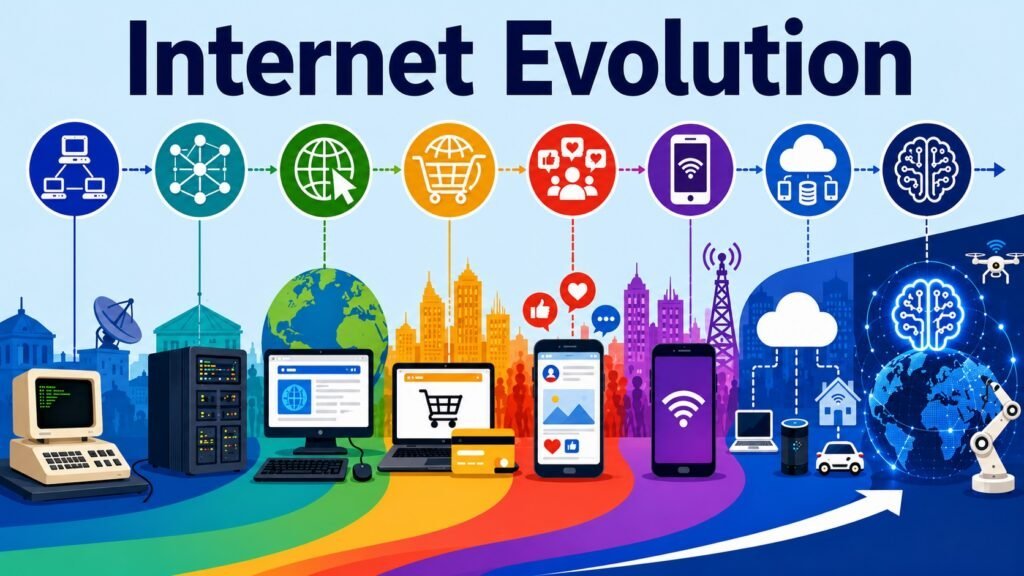
Internet Evolution is not a tidy sequence of inventions. It is a continuous process through which technology, economic pressure, social behavior, and institutional decisions have repeatedly reshaped how the world communicates and organizes information. Each generation of networked systems inherited the achievements of its predecessor while also inheriting its constraints, and those constraints became the starting point for the next wave of innovation.
A foundational distinction belongs at the start: the Internet and the World Wide Web are not the same thing. The Internet is a global infrastructure of interconnected networks that transmit data using shared protocols. The Web is an application layer — a system of linked documents and resources — that runs on top of it. Conflating the two leads to analytical errors that obscure how each evolved independently.
The analytical framework used throughout this article traces each evolutionary stage through a consistent set of questions: what problem or limitation existed, what technological response emerged, what new capability it produced, what trade-offs it introduced, and what pressure it created for the next stage. This lens reveals Internet Evolution as a problem-solving process rather than a story of inevitable progress.
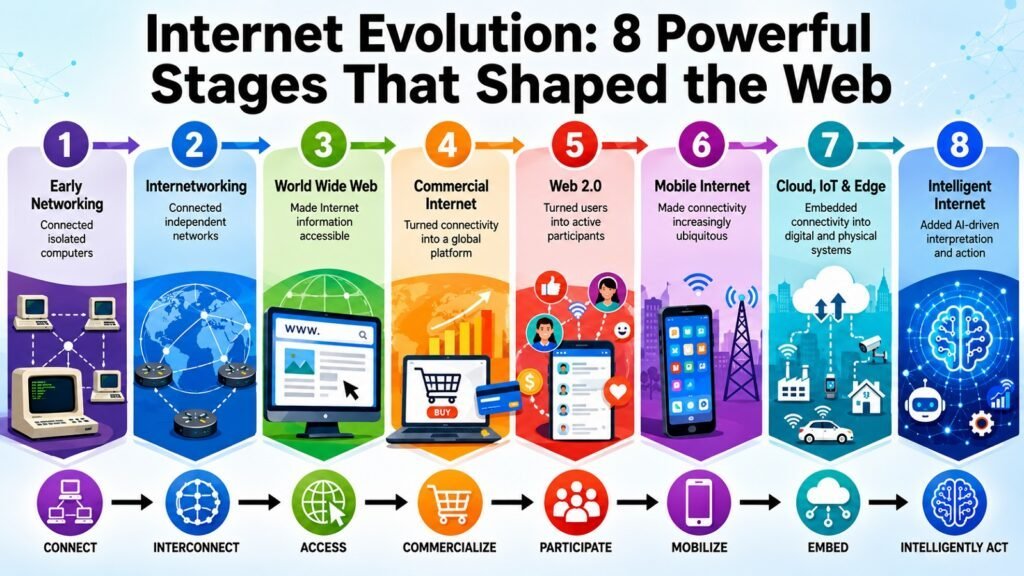
The eight stages examined here follow a clear causal logic: early networking addressed isolated computers; internetworking connected different networks; the Web made information accessible; commercialization scaled connectivity into an economic platform; Web 2.0 turned users into participants; mobile Internet made access continuous; cloud, IoT, and edge embedded connectivity into physical environments; and AI is now adding interpretive and autonomous capabilities.
Internet Evolution: Eight Stages and Their Core Transformations
| Internet Evolution Stages | Core Transformation |
|---|---|
| Early Networking (1960s–1970s) | Packet switching enabled reliable computer communication across distance |
| Internetworking / TCP/IP (1970s–1980s) | Common protocols allowed diverse networks to interoperate at scale |
| World Wide Web (1989–1990s) | Hyperlinked information layer made the Internet accessible to non-specialists |
| Commercial Internet (1990s–2000s) | Connectivity became a global economic platform for commerce and services |
| Web 2.0 / Participatory Web (2000s) | Users shifted from consuming content to creating and sharing it |
| Mobile Internet (2000s–2010s) | Smartphones extended connectivity beyond fixed locations continuously |
| Cloud, IoT, and Edge (2010s–present) | Computing and connectivity embedded into services, devices, and environments |
| Intelligent Internet / AI (2020s–present) | Machine learning added interpretation and autonomy to connected systems |
1. Internet Evolution and ARPANET: The Birth of Connected Computing
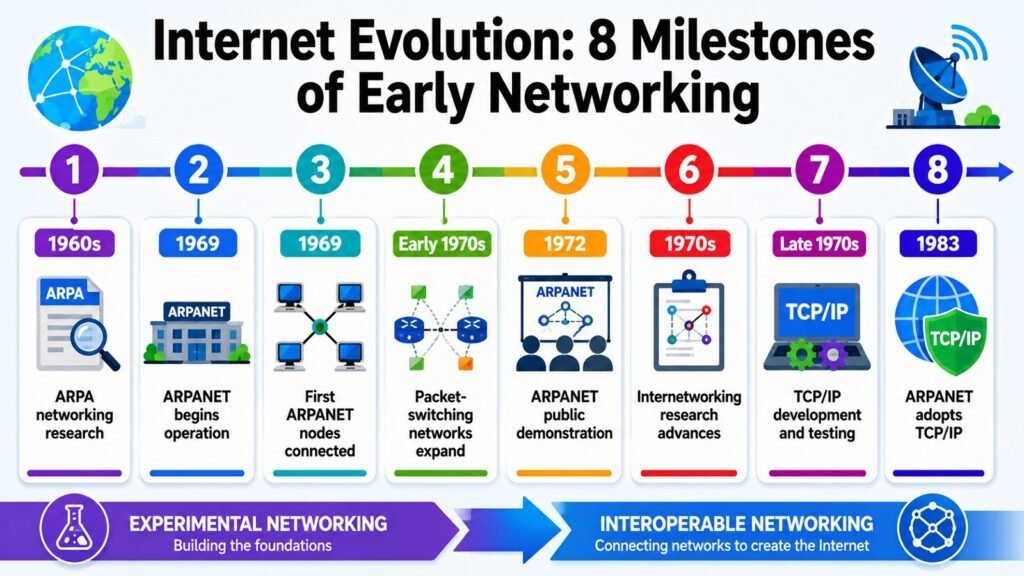
Before networked computing existed, computers were islands. Each machine operated independently, without any reliable mechanism for exchanging information with systems in different locations. This isolation constrained research, scientific collaboration, and the efficient use of expensive computing resources. In the late 1950s and 1960s, researchers began examining whether communication networks could be designed with greater resilience than the circuit-switched telephone infrastructure of the time.
The conceptual breakthrough that defined this stage of Internet Evolution was packet switching. Rather than establishing a dedicated circuit for the duration of a conversation — as telephone networks did — packet switching breaks data into small units that travel independently and reassemble at the destination. This approach uses network capacity more efficiently and allows communication to continue even when individual nodes fail, because packets can be rerouted dynamically.
ARPANET, funded by the U.S. Department of Defense’s Advanced Research Projects Agency and launched in 1969, became the most important experimental implementation of these principles. Its first message was sent on October 29, 1969, between UCLA and the Stanford Research Institute. ARPANET was not the Internet itself — it was a foundational experiment that demonstrated the viability of packet-switched networking and created the environment in which Internet protocols would later develop.
What ARPANET proved was that distributed communication across geographically separated nodes was technically achievable. The Network Control Protocol it used initially worked within a single network but could not support heterogeneous networks operating under different technical conditions. That limitation defined the next evolutionary pressure and set the stage for internetworking protocols.
Internet Evolution: Key Milestones in Early Networking and ARPANET
| Early Networking Milestone | Contribution to Internet Evolution |
|---|---|
| 1957: Sputnik and ARPA creation | U.S. established ARPA to fund research that led to ARPANET |
| 1961: Packet switching theory (Kleinrock) | Mathematical basis for packet-switched networks published |
| 1964: Baran’s distributed network concept | Survivable distributed communications proposed, influencing Internet architecture |
| 1969: ARPANET first message | UCLA and Stanford exchanged the first packet, starting networked computing |
| 1971: 15 nodes on ARPANET | Network expanded to 15 institutions, demonstrating early scalability |
| 1972: Email introduced on ARPANET | Network email established a practical use case for packet networking |
| 1973: International ARPANET connections | UCL and Norway’s NORSAR joined, extending the network beyond the U.S. |
| 1974: NCP limitations identified | Single-network protocol design revealed the need for internetworking |
2. Internet Evolution and TCP/IP: Creating a Network of Networks
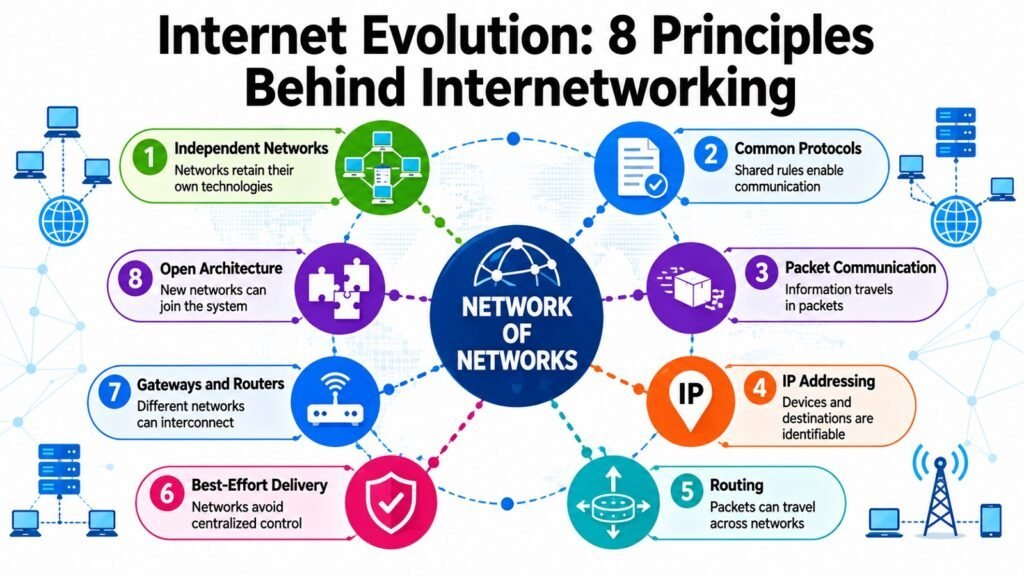
By the early 1970s, packet-switched networking had proved its value, but a new problem had emerged. Multiple independent networks existed — ARPANET, satellite networks, radio packet networks — each using its own protocols. A researcher on one network could not reliably communicate with a colleague on a different one. The challenge was no longer connecting individual computers but connecting entire networks with one another.
Vinton Cerf and Robert Kahn addressed this directly. Their 1974 paper introduced the concept of internetworking and proposed a protocol that would allow different networks to communicate despite their technical differences. The result became TCP/IP. TCP manages reliable data delivery by sequencing packets and handling retransmission. IP handles addressing and routing across interconnected networks, giving every connected device a unique address that routers use to forward data toward its destination.
The significance of TCP/IP in Internet Evolution goes beyond its mechanics. The protocol suite established a design philosophy — the end-to-end principle — in which the network itself remains simple while intelligence resides in the endpoints. New applications could be built on top of IP without changing the underlying infrastructure, and new networks could join simply by adopting the same protocols. This made the Internet both adaptable and scalable.
On January 1, 1983, ARPANET completed its transition from the older Network Control Protocol to TCP/IP. The transition was not merely an upgrade; it was an architectural shift that redefined what the Internet was. TCP/IP established interoperability but not usability for general audiences — the next evolutionary pressure was clear: accessibility needed to match connectivity.
Internet Evolution: TCP/IP Milestones and Internetworking Contributions
| TCP/IP & Internetworking Milestone | Contribution to Internet Evolution |
|---|---|
| 1974: Cerf and Kahn paper | Introduced key internetworking concepts and proposed a TCP-based architecture |
| 1978: TCP/IP split into two protocols | Separated IP-based routing from TCP-based reliable transport |
| 1981: IPv4 specification (RFC 791) | Formalized the 32-bit Internet Protocol addressing system |
| January 1, 1983: ARPANET adopts TCP/IP | Established TCP/IP as the standard protocol suite for ARPANET |
| 1983: Domain Name System proposed | Introduced a scalable way to map domain names to network addresses |
| 1986: NSFNET established | Expanded high-speed academic networking and Internet connectivity |
| 1988: Morris Worm | Demonstrated that expanding connectivity also created new security risks |
| 1989: Global TCP/IP adoption accelerates | Broader adoption strengthened TCP/IP as the foundation for interconnected networks |
3. Internet Evolution and the World Wide Web: Making the Internet Accessible
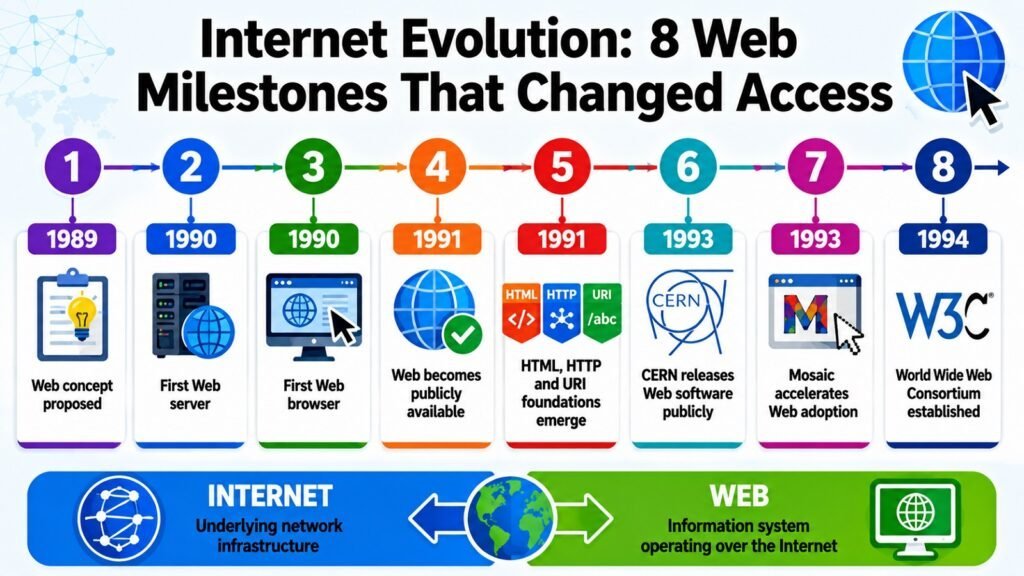
By the late 1980s, the Internet connected a growing number of institutions through a common protocol, but it remained a system for specialists. Finding information required knowing where it was stored, using command-line tools, and navigating systems that offered little guidance to the uninitiated. Connectivity did not automatically produce accessibility — the Internet had infrastructure but lacked a usable information environment.
Tim Berners-Lee, a physicist working at CERN in Geneva, proposed a solution in 1989: a distributed hypertext system through which researchers could share documents and follow references across different computers. The core idea was simple and consequential — documents could contain links to other documents regardless of where those documents were stored. Following a link required no specialized command knowledge. The technical components he developed — HTML, HTTP, and URLs — became the foundational standards of the World Wide Web. The first Web server went live at CERN in 1990.
The development of graphical browsers transformed the Web’s impact. Mosaic, released in 1993 by the National Center for Supercomputing Applications, made the Web navigable through point-and-click interaction and displayed images alongside text. Web traffic grew by several orders of magnitude within two years. Netscape Navigator extended this further into consumer computing environments, and search engines provided the organizational layer that made a growing Web discoverable rather than simply large.
The deeper lesson of this stage of Internet Evolution is that infrastructure is necessary but not sufficient for broad adoption. The Internet had existed for years before the Web, but it was the addition of a usable, open, hyperlinked information layer that brought it into mainstream relevance. Crucially, Berners-Lee and CERN chose not to patent the Web, keeping its standards open and freely implementable — a decision that accelerated adoption in ways proprietary control would not have.
Internet Evolution: World Wide Web Milestones and Accessibility Contributions
| World Wide Web Milestone | Contribution to Internet Evolution |
|---|---|
| 1989: Berners-Lee’s Web proposal at CERN | Established the conceptual foundation for a global hypertext information system |
| 1990: First Web server and browser at CERN | Demonstrated the practical feasibility of the World Wide Web |
| 1991: Web made publicly available | Opened the Web to broader development and experimentation beyond CERN |
| 1993: Mosaic browser released by NCSA | Popularized graphical Web browsing and lowered barriers for non-technical users |
| 1994: W3C established | Created an open forum for developing interoperable Web standards |
| 1994: Netscape Navigator launched | Helped accelerate commercial and mass-market Web adoption |
| 1994–1995: Web search services emerge | Made rapidly expanding online information easier to discover |
| 1993–1995: Rapid Web growth | Demonstrated the accelerating adoption and expanding reach of the Web |
4. Internet Evolution and the Commercial Internet: Turning Connectivity into a Global Platform
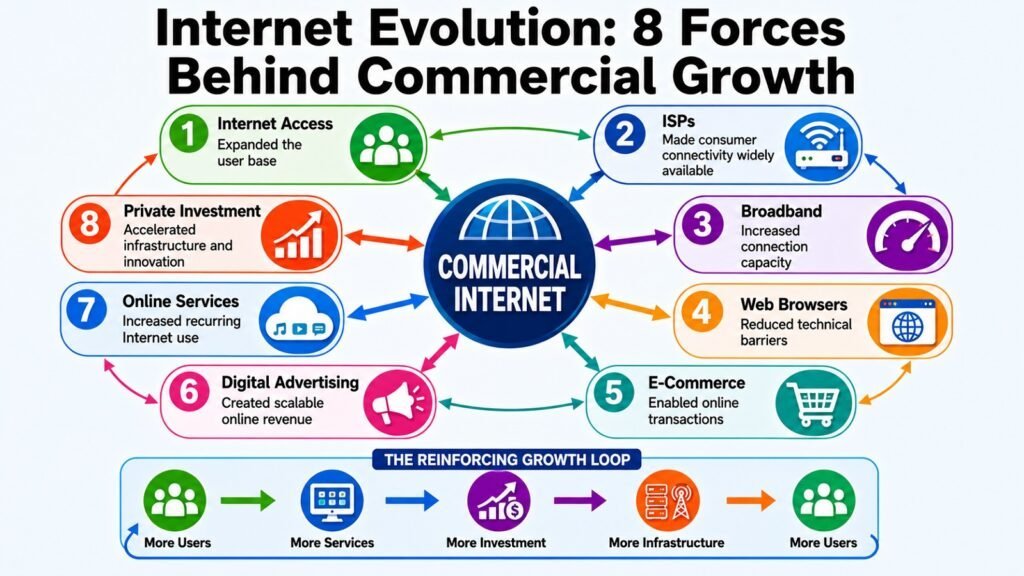
Through the early 1990s, the Internet remained primarily a tool for research institutions and government agencies, and commercial use was explicitly restricted under NSFNet policy. When those restrictions were lifted, and NSFNet was decommissioned in 1995 in favor of commercial backbone providers, Internet Evolution entered a fundamentally different phase — one driven by economic incentives rather than institutional research objectives.
Internet service providers expanded rapidly, and declining access costs created conditions for a powerful feedback loop: more users attracted more online services, more services encouraged adoption, greater adoption justified infrastructure investment, and expanded infrastructure enabled still more applications. This dynamic compressed what might otherwise have been decades of gradual diffusion into roughly ten years of rapid expansion. Amazon and eBay launched in 1995; digital advertising emerged as a major revenue model; and by the early 2000s the Internet had become a genuine commercial infrastructure.
The commercial stage also introduced persistent trade-offs. Internet service became a dependency rather than a convenience, creating vulnerabilities around availability and reliability. Digital advertising aligned business models with attention in ways that contributed to later privacy debates. Network effects concentrated users on a small number of dominant platforms, raising concerns about competition and access. These tensions were structural features of an Internet shaped by market incentives, not incidental side effects.
What this stage ultimately produced was a transformation in the Internet’s identity. From an experimental research network, it became the primary platform through which businesses reached customers and conducted transactions. That platform scale set the conditions for the next evolutionary stage: a Web large enough and connected enough for users to become creators, not just consumers.
Internet Evolution: Commercial Internet Milestones and Platform Developments
| Commercial Internet Milestone | Contribution to Internet Evolution |
|---|---|
| 1991: NSFNET policy change | Opened greater opportunity for commercial use of Internet infrastructure |
| 1994: First banner advertisement | Demonstrated digital advertising as an emerging online business model |
| 1995: Amazon and eBay launch | Helped establish major models for online retail and Internet marketplaces |
| 1995: NSFNET decommissioned | Marked the transition toward commercially operated Internet backbones |
| 1996–2000: Broadband rollout expands | Enabled richer online applications and higher-capacity Internet services |
| 1998: Google founded | Helped transform Web search into a major Internet service and business |
| 1999: Global Internet users approach 280 million | Demonstrated the rapid expansion of Internet adoption worldwide |
| 2000: Dot-com market correction | Exposed weaknesses in speculative Internet business models and reshaped investment |
5. Internet Evolution and Web 2.0: From Consumers to Participants
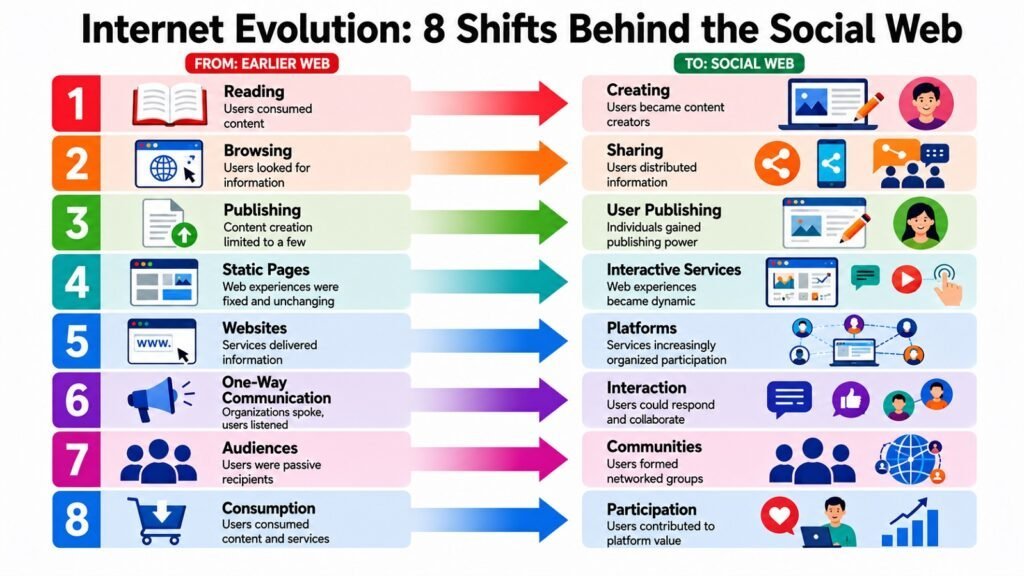
The early commercial Web was primarily a broadcast medium. Organizations created content, and users consumed it. Pages were static or changed only when administrators updated them, and users had no direct mechanism to contribute. This model worked well for distributing information at scale but left the majority of Internet users as passive recipients rather than active participants.
The shift began in the early 2000s as technical improvements and new platform models changed what the Web allowed users to do. Technologies enabling dynamic page updates made websites more responsive. Blogging platforms lowered the barrier to publishing to virtually zero. Wikis allowed collaborative document creation. Social networking sites connected users with one another. Video and photo sharing made multimedia publication accessible to non-specialists. These changes were grouped under the label Web 2.0 — a term that captured a real shift in Internet use even if it did not represent a separate technical version of the Web.
The mechanism driving this stage was network effects operating on participation. Each new contributor made a platform more valuable for existing users, attracting more contributors, generating more content, and drawing still more users. Wikipedia grew from a small experiment in 2001 to one of the world’s largest reference resources within a decade through this dynamic. Social platforms scaled from niche communities to systems connecting hundreds of millions of people through similar loops.
The participatory Internet introduced new capabilities and new problems. Collaborative platforms enabled knowledge sharing and cultural production at unprecedented scale, while the same architecture enabled misinformation, harassment, and algorithmic amplification of divisive content. Platform concentration created business models built on detailed personal data. What the Web 2.0 stage reveals about Internet Evolution is that participation changes the nature of a network qualitatively — an Internet where users contribute is different in kind from one where they only receive.
Internet Evolution: Web 2.0 Milestones and Participatory Internet Developments
| Web 2.0 Milestone | Contribution to Internet Evolution |
|---|---|
| 2001: Wikipedia launched | Demonstrated that collaborative knowledge creation could scale globally |
| 2003: WordPress launched | Lowered barriers to online publishing and user-created websites |
| 2004: Facebook launched; Web 2.0 gained prominence | Accelerated social networking and user-generated interaction |
| 2005: YouTube launched | Expanded large-scale user-generated video creation and sharing |
| 2006: Twitter launched | Enabled rapid public information sharing through short-form posts |
| 2007: Smartphone-era platforms emerge | Extended participatory Internet experiences into mobile environments |
| 2008–2012: API-driven platform ecosystems expand | Enabled third-party applications to connect with platform services and data |
| 2010s: Algorithmic content curation expands | Algorithms increasingly influenced content discovery, visibility, and engagement |
6. Internet Evolution and Mobile Internet: Making Connectivity Ubiquitous
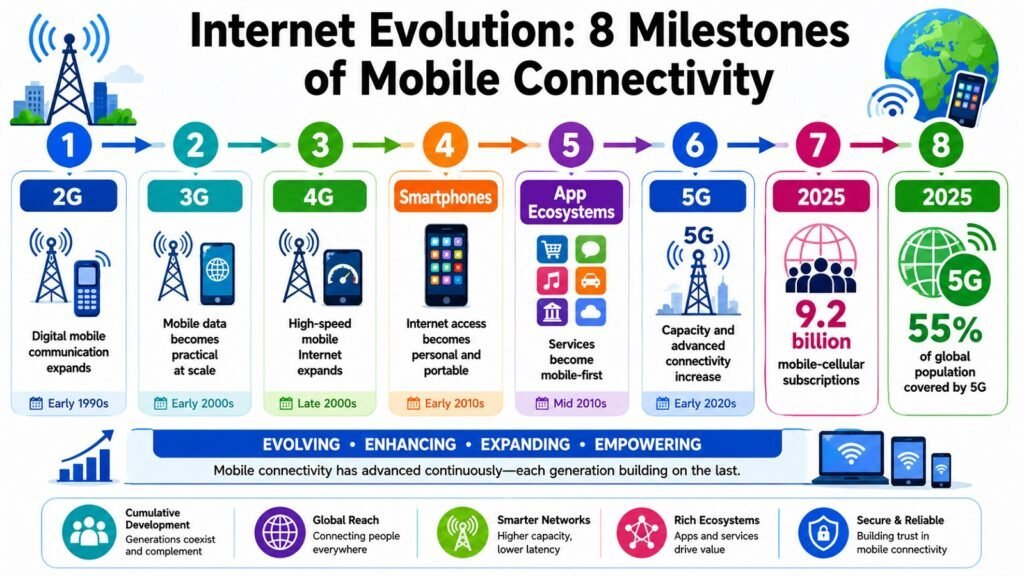
For most of the Internet’s history, connectivity required physical proximity to a fixed device. Going online was a deliberate act involving sitting down, connecting, and navigating a Web designed primarily for static desktop access. Basic wireless data services appeared in the 1990s with protocols like WAP, but those early mobile experiences were slow, expensive, and severely limited in capability.
The transformation accelerated significantly when Apple introduced the iPhone in 2007 with a full Web browser capable of rendering standard websites rather than the stripped-down versions WAP-era phones required. This was not merely a hardware improvement — it was an architectural shift in how mobile devices participated in Internet Evolution. Android devices and a global app ecosystem extended this capability to billions of additional users across a range of price points, and the progression from 3G through 4G LTE provided the bandwidth needed for streaming, navigation, and cloud-connected applications that are now taken for granted.
Mobile connectivity enabled qualitatively new services. Location-aware applications became feasible because devices always knew where they were. Mobile payments and commerce extended economic activity into moments previously disconnected from digital services. Navigation, ride-hailing, food delivery, instant messaging, and streaming media all depend on continuous connectivity in ways that fixed Internet access alone could never support. The International Telecommunication Union estimated that mobile broadband subscriptions exceeded five billion by the early 2020s.
The trade-offs were real and persistent. Mobile connectivity remained unequally distributed, with gaps between urban and rural areas and between higher-income and lower-income countries. Continuous connectivity raised privacy concerns as devices generated detailed location and behavioral records. Security vulnerabilities specific to wireless transmission created new attack surfaces. A world of billions of connected people and devices would require computing infrastructure capable of supporting them at scale — the pressure that led to cloud, IoT, and edge.
Internet Evolution: Mobile Internet Milestones and Ubiquitous Connectivity Developments
| Mobile Internet Milestone | Contribution to Internet Evolution |
|---|---|
| 1991–1997: 2G digital mobile networks | Digital cellular standards enabled SMS and increasingly capable mobile data services |
| 1999–2003: WAP and early mobile Web | Limited Web access on feature phones demonstrated demand for mobile information services |
| 2001–2006: 3G deployment expands | Faster mobile data enabled broader browsing, email, multimedia, and emerging mobile applications |
| 2007: iPhone launched | A touchscreen smartphone with a full Web browser reshaped expectations for mobile Internet access |
| 2008: Android and App Store era begins | Competing smartphone and app ecosystems accelerated mobile service adoption |
| 2009–2016: 4G LTE deployment expands | High-speed mobile broadband enabled richer streaming and real-time services |
| 2020s: 5G rollout accelerates | Higher capacity and lower latency support advanced mobile, IoT, and real-time applications |
| 2022: Mobile Internet adoption surpasses 5 billion users | Demonstrated the enormous global scale of Internet access through mobile devices |
7. Internet Evolution and Cloud, IoT and Edge: Embedding the Internet Everywhere
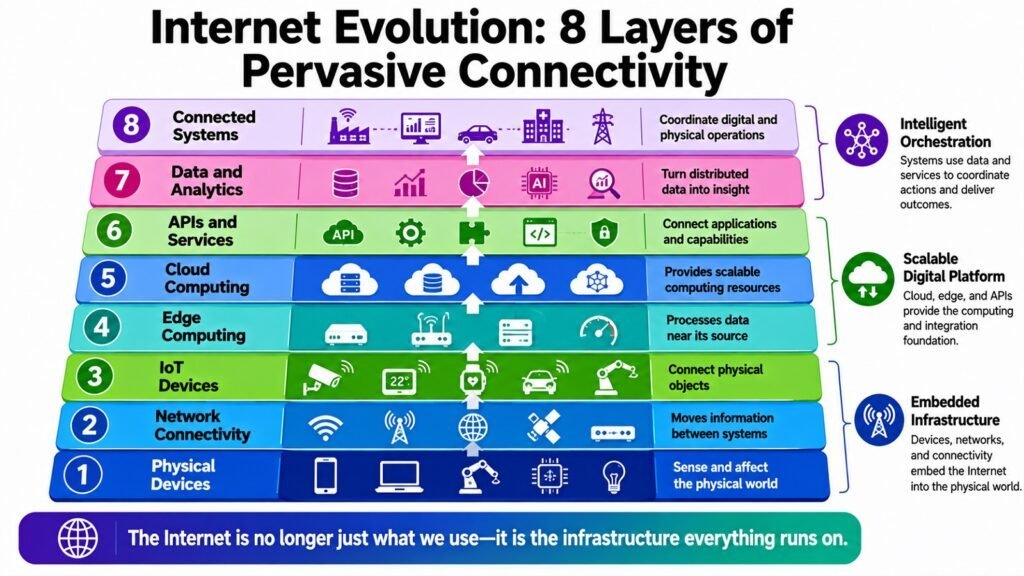
The expansion of mobile Internet created a paradox. Billions of users and devices expected computing resources, storage, and services on demand from any location, but traditional computing — in which applications ran on local hardware — could not scale to meet this economically or technically. A smartphone has limited processing power, yet users expect it to run sophisticated applications and synchronize data across devices instantly. The answer required rethinking where computing happens.
Cloud computing addressed this by concentrating resources into large, managed data centers and delivering them over the Internet as on-demand services. Organizations could rent processing power, storage, and application platforms from providers like Amazon Web Services, which launched its cloud infrastructure services in 2006, and later Microsoft Azure and Google Cloud. The pay-as-you-use model lowered the cost and complexity of deploying digital services, enabling rapid scaling without building physical infrastructure.
The Internet of Things extended Internet Evolution in a different direction — connecting physical objects rather than more people. By embedding network-connected processors into sensors, machines, appliances, vehicles, and industrial equipment, IoT created the possibility of gathering real-time data from the physical world and automating responses to sensor inputs. Edge computing then emerged to address a limitation of cloud-centric design: when devices generate large volumes of data requiring fast processing, sending it to distant data centers introduces latency. Placing processing capacity closer to the data source reduces that latency for applications where delay has real consequences.
What cloud, IoT, and edge share is a common effect on Internet Evolution: they progressively dissolve the boundary between the Internet and the physical world. Together they transformed the Internet from a network people accessed into an infrastructure supporting computing, communication, and physical operations — while introducing serious challenges around cybersecurity, data governance, interoperability, and systemic resilience.
Internet Evolution: Cloud, IoT, and Edge Computing Milestones
| Cloud, IoT & Edge Milestone | Contribution to Internet Evolution |
|---|---|
| 2006: Amazon S3 and EC2 launched | Helped establish cloud computing as a scalable, commercially accessible infrastructure model |
| 2008–2010: Major cloud platforms expand | Growing competition accelerated enterprise adoption of cloud computing |
| 2008: “Internet of Things” gains prominence | Connected physical objects became a major technology and research concept |
| 2010s: Industrial IoT expands | Connected sensors enabled monitoring, analytics, and increasingly automated industrial operations |
| 2014: Amazon Echo launched | Helped bring connected voice-enabled devices into mainstream consumer environments |
| Mid-2010s: Edge computing gains prominence | Distributed architectures addressed latency, bandwidth, and processing requirements closer to data sources |
| 2020s: Smart-city deployments expand | IoT and edge technologies support connected urban infrastructure and services |
| Mid-2020s: Tens of billions of IoT devices | Massive device growth expanded the scale of connected systems and distributed data generation |
8. Internet Evolution and the Intelligent Internet: Toward Autonomous Connectivity
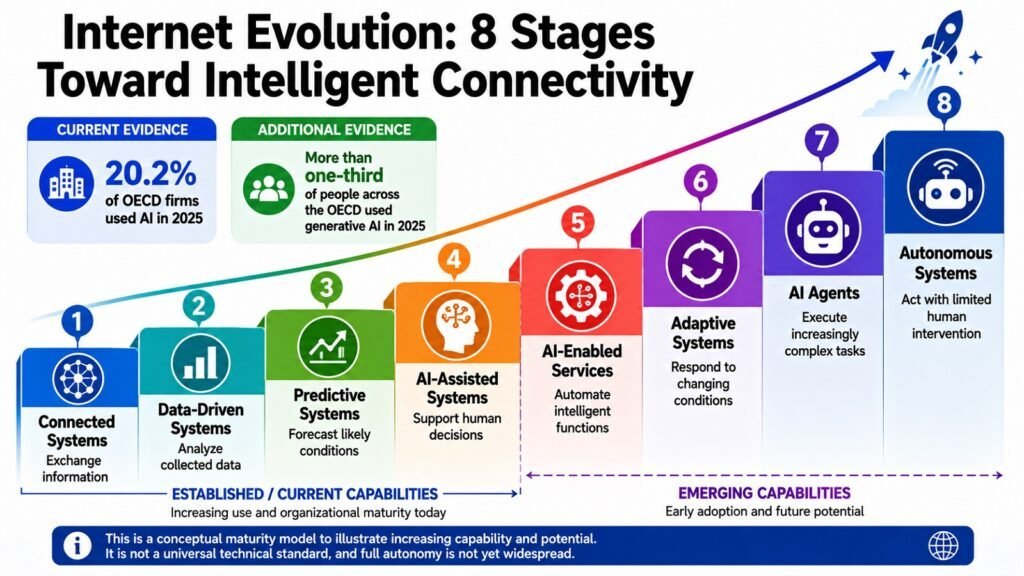
Each previous stage of Internet Evolution added connectivity to something previously unconnected: computers, networks, information, commerce, participation, mobility, physical environments. The current stage adds something qualitatively different — the ability to interpret, predict, decide, and act. AI and machine learning are not simply new applications running on the Internet; they are becoming embedded in its operational fabric, changing how networks are managed, how services are delivered, and how systems respond without direct human instruction.
This transition is already operational in numerous domains. Recommendation systems use machine learning to select what users see based on behavioral data from billions of interactions. Spam filters and fraud detection systems classify and act on data in real time. Network operators deploy AI-based tools to detect anomalies, optimize routing, and predict traffic patterns. Large language models, deployed as cloud services and embedded components, enable systems to process and generate language with a fluency that earlier AI could not achieve. AI agents — systems that pursue multi-step goals with limited supervision by using tools and adapting to intermediate results — are becoming emerging operational realities.
Edge AI brings intelligent processing closer to the data source, enabling decisions without round-trip communication to central servers. Autonomous vehicles use on-device AI to make driving decisions in real time. Industrial systems use edge-deployed models to detect equipment failures before they occur. Medical devices process sensor data locally to identify clinically significant conditions. These applications demonstrate that Internet Evolution is now producing systems that act on the physical world, not only on digital information.
The risks at this stage are correspondingly serious. AI-enabled systems can fail in ways that are difficult to predict or detect. Concentration of AI capability among a small number of organizations raises accountability concerns. Autonomous systems acting on consequential decisions require governance frameworks that do not yet fully exist. Privacy risks multiply when AI can infer sensitive information from behavioral and sensor data at scale. The direction of Internet Evolution is increasingly defined not merely by how many entities are connected, but by what connected systems can understand and do.
Internet Evolution: AI and Intelligent Internet Capabilities and Developments
| AI & Intelligent Internet Milestone in Internet Evolution | Contribution to Internet Evolution |
|---|---|
| 2012: Deep-learning breakthrough on ImageNet | Demonstrated major gains in large-scale visual recognition using deep neural networks |
| 2015–2016: Large-scale recommendation systems expand | Machine learning increasingly influenced content discovery and personalization |
| 2017: Transformer architecture introduced | Established a foundational architecture for modern large language models |
| 2020: GPT-3 released | Demonstrated the growing capability of large-scale language models for text generation |
| 2022: ChatGPT launches | Brought conversational generative AI into mainstream public use |
| 2023–2024: Generative AI expands across digital services | AI became increasingly integrated into search, productivity, cloud, and developer tools |
| 2020s: Edge AI expands | On-device AI enables lower-latency processing in vehicles, devices, and other applications |
| 2020s: AI agents and autonomous systems emerge | Goal-directed systems are developing toward increasingly independent task execution |
Conclusion — Internet Evolution: From Connected Computers to Intelligent Systems
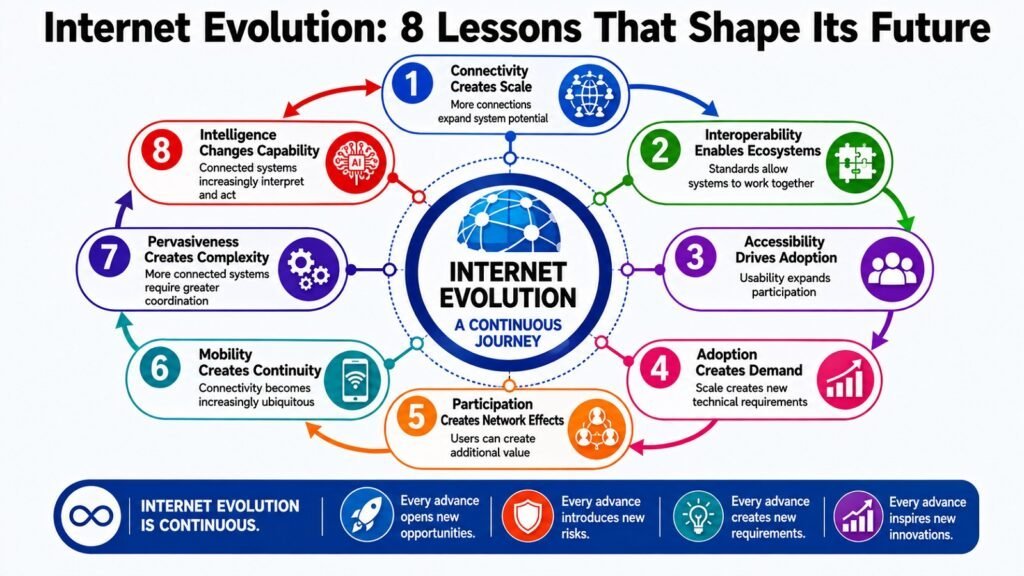
Internet Evolution has followed a consistent internal logic: each stage solved a real limitation of its predecessor while generating new capabilities that created new demands and new problems. Early networking proved that computers could communicate across distance. Internetworking turned individual networks into a coherent system through common protocols. The Web transformed that system into an accessible information environment. Commercialization scaled connectivity into a global economic platform. The participatory Web shifted users from consumers to creators. Mobile Internet extended connectivity from fixed locations to continuous presence. Cloud computing, IoT, and edge-embedded digital infrastructure are entering economic operations and physical environments. And AI is adding interpretive and autonomous capabilities to a network that now reaches into nearly every domain of human activity.
Several broader lessons emerge from this progression. Interoperability matters more than any single technology, because systems that work together grow faster than those that cannot. Standards and openness repeatedly accelerated adoption where proprietary control would have constrained it. Usability is as important as infrastructure — the Web taught this clearly. Scale creates qualitative changes: a billion connected users behave differently from a million, and a network embedded in physical environments operates differently from one accessed through a screen. Every stage also introduces trade-offs that deserve serious attention: extraordinary connectivity has arrived alongside real problems of security, inequality, concentration, privacy, and systemic dependence.
Understanding how the previous stages of the Internet Evolution worked — the pressures they responded to, the solutions they introduced, and the new challenges they created — provides the most reliable foundation for navigating what comes next. The tensions around AI governance, platform accountability, digital equity, and cybersecurity resilience are the next generation of problems this evolutionary process will address. The next stage of Internet Evolution should be understood as a continuation of the same trajectory, not as a departure from it.
Internet Evolution: Eight Stages and Their Enduring Lessons
| Internet Evolution Stages | Enduring Lesson |
|---|---|
| Early Networking (ARPANET) | Distributed architecture can improve resilience and enable scalable communication |
| Internetworking (TCP/IP) | Open standards allow heterogeneous networks and systems to interoperate |
| World Wide Web | Usability and openness can accelerate adoption alongside infrastructure |
| Commercial Internet | Economic incentives accelerate growth while introducing concentration risks |
| Web 2.0 / Participatory Web | User participation can fundamentally change how networks create and distribute value |
| Mobile Internet | Ubiquitous access enables new behaviors while leaving persistent digital divides |
| Cloud, IoT, and Edge | Embedded computing creates scale while increasing governance and security complexity |
| Intelligent Internet / AI | Increasing autonomy requires governance, accountability, and human oversight |