Table of Contents
Introduction: Internet Fundamentals as the Foundation of Internet Connectivity
Credit: iken3
The internet touches nearly every part of modern life. Billions of people use it every day for work, education, entertainment, commerce, and communication. Yet most people understand it only at the surface level. They know how to open a browser or stream a video, but they rarely think about the mechanisms that make those actions possible. That gap in understanding has become a real limitation in a world that runs on digital infrastructure.
Internet Fundamentals are the essential concepts that explain how Internet Connectivity actually works. They are not specific to any single technology. Whether data travels over fiber optics, a 5G mobile network, a satellite link, or a broadband connection, the same foundational principles govern how information is identified, transmitted, routed, delivered, and managed. These principles do not change with the access technology. They apply universally across the entire internet.
Understanding these concepts matters more now than it did a decade ago. Cloud computing has shifted core business operations onto the internet infrastructure. Artificial intelligence platforms depend on massive data transfers across distributed systems. Streaming services now carry a dominant share of global internet traffic. Remote work has made reliable connectivity a daily necessity for millions of professionals. The Internet of Things continues to multiply connected endpoints at a pace that demands stronger foundational knowledge.
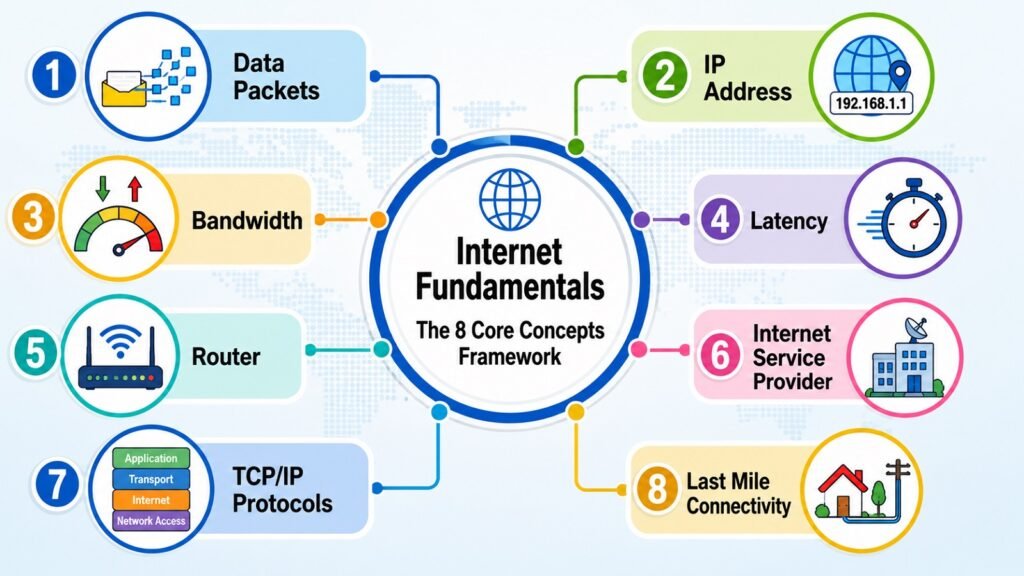
This article introduces eight core Internet Fundamentals that form the intellectual backbone of Internet Connectivity. Data packets explain how information is divided and transmitted. IP addresses explain how devices are identified and located. Bandwidth explains the data-carrying capacity of a network. Latency explains transmission delay. Routers explain how data is directed toward its destination. Internet Service Providers explain who connects users to the global internet. TCP/IP protocols explain the shared rules that allow all devices to communicate. Last mile connectivity explains the final link that reaches homes and businesses. These eight concepts interact continuously to make every internet session possible.
Table: Internet Fundamentals — Eight Concepts at a Glance
| Internet Fundamentals | Role in Internet Connectivity |
| Data Packets | Divide digital information into smaller units for efficient network transmission |
| IP Addresses | Uniquely identify and locate every device connected to a network |
| Bandwidth | Measure the maximum data-carrying capacity of a network connection |
| Latency | Indicate the time delay between sending and receiving data across a network |
| Routers | Direct data packets between networks toward the correct destination |
| Internet Service Providers | Connect users and organizations to the broader global internet |
| TCP/IP Protocols | Provide standardized communication rules for all connected devices |
| Last Mile Connectivity | Deliver internet access from the ISP network to the end user’s location |
1. Internet Fundamentals: Understanding Data Packets
Credit: iken3
The internet does not move information the way a telephone call once did. Early telephone systems required a dedicated circuit between two points for the entire duration of a conversation. That circuit was reserved exclusively for those two callers even when neither was speaking. It was a wasteful approach that could not scale to the demands of a global digital network.
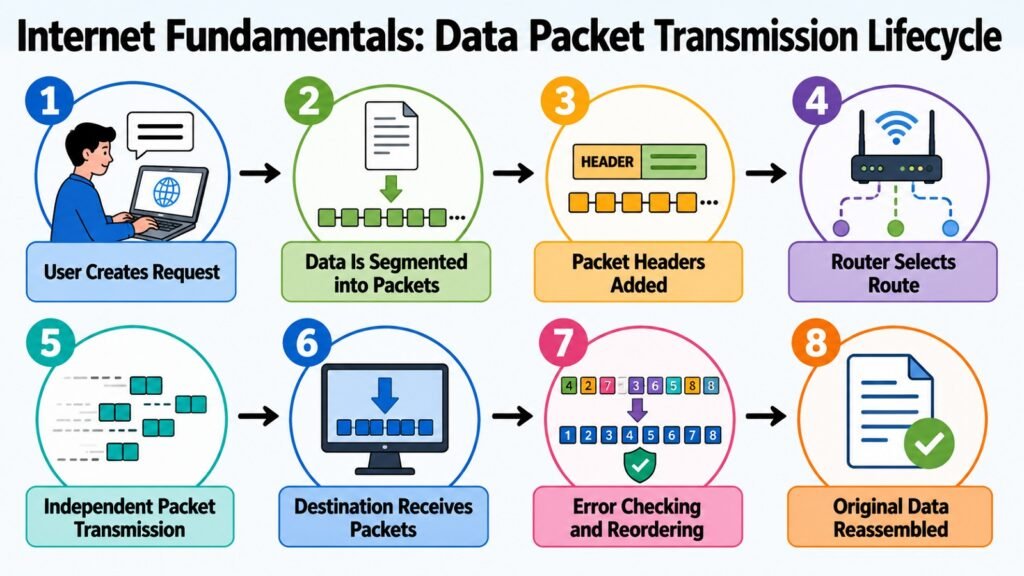
Packet switching changed that entirely. Under this model, data is divided into small units called packets before it travels across a network. Each packet carries a portion of the original information along with a header containing metadata such as the source address, the destination address, the sequence number, and error-checking data. Packets from the same file or message do not need to follow the same path through the network. They can travel different routes, arrive out of order, and then be reassembled into the correct sequence using the information in their headers.
This design was not accidental. Packet switching was developed in the 1960s partly as a way to build a communication system that could survive disruptions to individual network links. If one path was unavailable, packets could simply take another route. The robustness of this approach proved invaluable as the internet grew into a global infrastructure carrying trillions of data exchanges every day.
When a user loads a webpage, the server does not send the entire page as a single block of data. It sends hundreds or thousands of individual packets. Each packet travels independently. A receiving device acknowledges what it receives. If any packets are lost or corrupted during transmission, the sending system retransmits them. This process of error detection and retransmission is what enables reliable data delivery even when networks experience congestion or hardware faults.
Video streaming, cloud applications, and online communication all depend on this same packet-based approach. Data packets remain the fundamental unit of digital communication across the internet regardless of how the underlying access technology evolves.
Table: Internet Fundamentals — Key Characteristics of Data Packets
| Characteristic | Description |
| Basic Unit | The smallest independently routable chunk of digital information on a network |
| Packet Header | Contains source, destination, sequence number, and error-checking fields |
| Variable Routing | Individual packets from one file can travel different network paths |
| Reassembly | The destination device reconstructs the original data from arriving packets |
| Error Detection | Checksums in headers allow corrupt packets to be identified and retransmitted |
| Acknowledgement | Receiving devices confirm packet receipt to ensure reliable delivery |
| Packet Loss | Lost packets are retransmitted, making delivery resilient to network faults |
| Efficiency | Shared network links carry packets from many different data flows simultaneously |
2. Internet Fundamentals: Understanding IP Addresses
Credit: iken3
Every device connected to the internet needs a unique identifier. Without one, there would be no reliable way to send data to the right destination or to receive a response from the correct source. IP addresses serve that purpose. They are the numerical labels assigned to every device participating in a network that uses the Internet Protocol for communication.
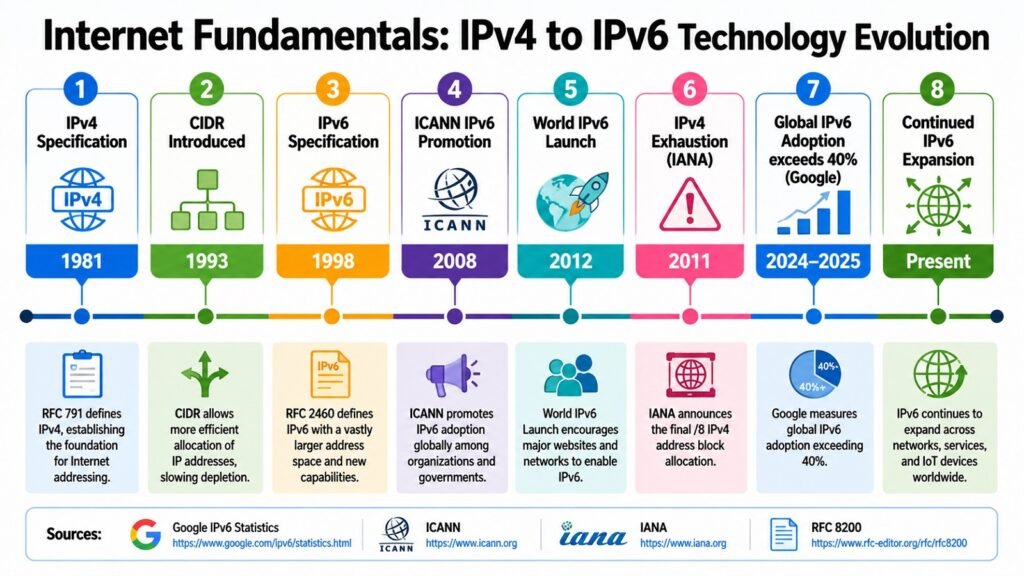
The original version of the Internet Protocol, known as IPv4, uses 32-bit addresses written as four groups of numbers separated by dots. Each group can range from zero to 255. This format creates a theoretical maximum of about 4.3 billion unique addresses. That number seemed sufficient when the protocol was designed in the early 1980s. By the 2010s, the growth of internet-connected devices had exhausted the available pool.
IPv6 was developed as the long-term solution to address exhaustion. It uses 128-bit addresses, which support an astronomically larger number of unique identifiers. Adoption has been gradual because upgrading network infrastructure requires time and investment, but the transition continues to accelerate as connected devices multiply.
IP addresses are divided into public and private categories. Public addresses are assigned by ISPs and are visible across the global internet. Private addresses are used within local networks such as homes or offices and are not directly routable on the internet. Devices on a private network share a single public address through network address translation.
Addresses can also be static or dynamic. Static IP addresses remain fixed and are used by servers and networked infrastructure that need a consistent point of contact. Dynamic addresses are assigned temporarily from a pool managed by the ISP and are common for residential connections. Websites, cloud platforms, mobile applications, and enterprise networks all depend on accurate IP addressing to route traffic correctly.
Table: Internet Fundamentals — Key IP Addressing Concepts
| Concept | Description |
| IPv4 | 32-bit address format supporting approximately 4.3 billion unique addresses |
| IPv6 | 128-bit address format created to replace IPv4 and support far more devices |
| Address Exhaustion | The depletion of available IPv4 addresses due to global internet growth |
| Public IP Address | A globally routable address assigned by an ISP for internet-facing communication |
| Private IP Address | A non-routable address used within a local network for internal communication |
| Static Address | A fixed IP address assigned permanently to a specific device or service |
| Dynamic Address | A temporary IP address assigned from a pool by a DHCP server |
| NAT | Network Address Translation allows multiple private devices to share one public IP |
3. Internet Fundamentals: Understanding Bandwidth
Credit: iken3
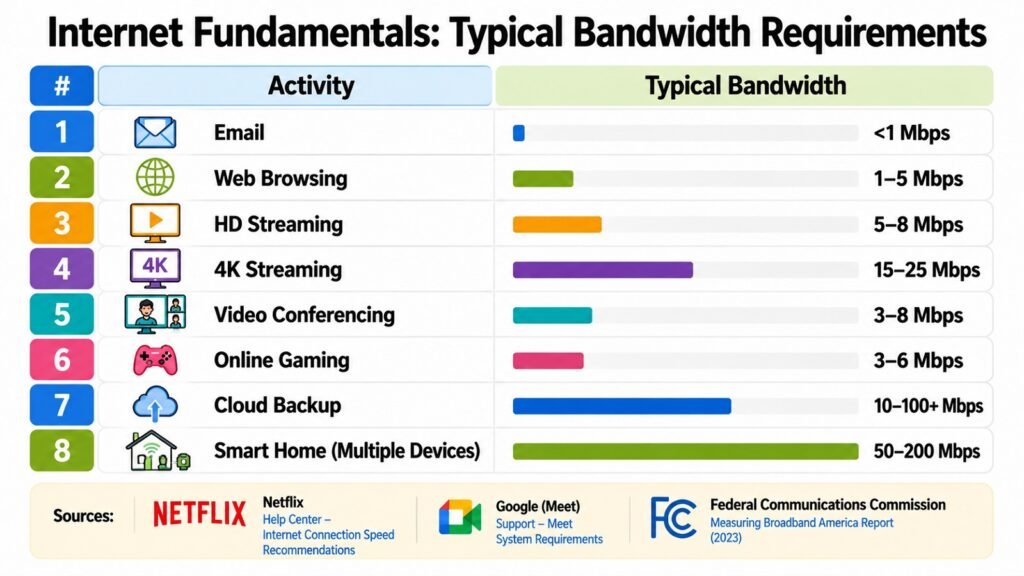
Bandwidth is frequently one of the most misunderstood concepts in networking. Many individuals mistakenly equate it with internet speed, yet these two notions are distinct. Bandwidth refers to the maximum volume of data that a network connection can transmit over a specified duration, usually quantified in megabits or gigabits per second. In contrast, speed, in a practical context, pertains to the rate at which a task, such as downloading a file, is completed. Bandwidth establishes the upper limit of what is theoretically achievable. Actual performance is influenced by numerous additional factors.
A useful analogy is a highway. A road with more lanes can accommodate more vehicles simultaneously, but individual travel time still depends on traffic density, road conditions, and the number of turns along the route. Similarly, higher bandwidth makes it possible to transfer more data at once, but it does not eliminate delays caused by congestion, routing inefficiencies, or hardware limitations at either end of the connection.
Different digital activities have very different bandwidth requirements. Basic web browsing and email need relatively modest capacity. Standard video streaming requires a few megabits per second per stream. High-definition and 4K streaming demand considerably more. Video conferencing, cloud collaboration, and large file transfers all place sustained demands on available bandwidth. Business environments running multiple simultaneous users and real-time data feeds require bandwidth measured in hundreds of megabits or gigabits.
Global internet traffic has grown consistently for decades. The expansion of video streaming, cloud computing, and mobile data consumption has driven demand for higher bandwidth at both the consumer and enterprise level. Network operators have responded by expanding fiber infrastructure, upgrading equipment, and deploying higher-capacity wireless technologies. Understanding bandwidth helps users and organizations make better decisions about their internet plans and performance expectations.
Table: Internet Fundamentals — Key Bandwidth Concepts
| Concept | Description |
| Definition | The maximum data transfer capacity of a network connection per unit of time |
| Measurement Unit | Typically expressed in megabits per second or gigabits per second |
| Bandwidth vs. Speed | Bandwidth is capacity; actual speed depends on conditions at any given moment |
| Shared Bandwidth | Residential connections often share available bandwidth among multiple users |
| Streaming Demand | Video streaming is one of the largest consumers of internet bandwidth globally |
| Business Requirements | Enterprises require higher bandwidth to support multiple simultaneous users |
| Congestion Effect | Bandwidth utilization above network capacity leads to slower performance |
| Capacity Growth | Global bandwidth demand continues to grow with cloud and video consumption |
4. Internet Fundamentals: Understanding Latency
Credit: iken3
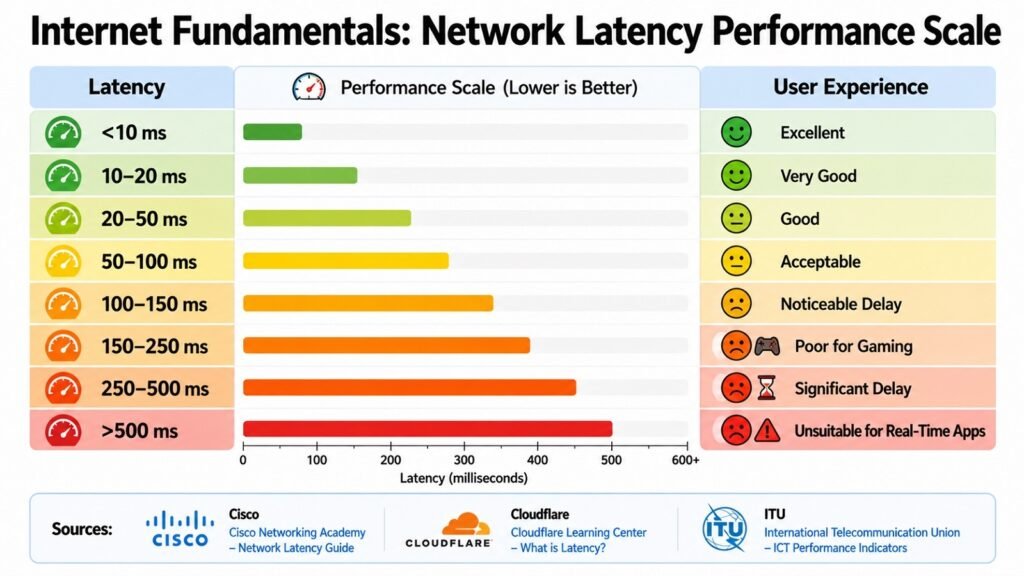
Bandwidth and latency are both indicators of network performance, but they represent very different aspects. Bandwidth indicates the volume of data a connection can handle, while latency measures the time it takes for data to travel from one location to another. A network may possess high bandwidth yet still exhibit sluggishness if latency is elevated, as there will be a noticeable delay between sending a request and receiving a response.
Latency is measured in milliseconds. It accumulates across multiple stages of data transmission. Propagation delay is the time it takes for a signal to cover the physical distance between two points. Processing delay occurs within routers as they examine and forward packets. Queuing delay happens when packets wait at congested network equipment. Transmission delay refers to the time needed to push a packet’s bits onto the network link.
Several factors determine how much latency a connection experiences. Physical distance adds propagation delay in proportion to how far the signal must travel. Poorly optimized routing paths send packets through unnecessary detours. Congested links cause packets to queue, adding unpredictable delay. Wireless connections introduce additional variability because of interference and signal fluctuations.
The importance of low latency has grown with the expansion of modern applications. Online gaming requires fast responses, and even small delays affect gameplay noticeably. Financial trading platforms execute transactions in microseconds, making latency a commercially critical factor. Video conferencing depends on low latency to keep conversation natural. Remote medical systems and autonomous vehicle communication demand near-zero latency for safety reasons. AI services delivered from the cloud need responsive connections to feel seamless. Content delivery networks and edge computing reduce propagation delay by placing servers closer to users.
Table: Internet Fundamentals — Key Latency Concepts
| Concept | Description |
| Definition | The time delay experienced as data travels between a sender and a receiver |
| Measurement | Typically measured in milliseconds using round-trip time as the standard metric |
| Propagation Delay | Time added by the physical distance a signal must travel across the network |
| Processing Delay | Time spent by routers examining and forwarding each packet |
| Queuing Delay | Time packets wait in router buffers during periods of network congestion |
| Satellite Latency | Geostationary satellite links add several hundred milliseconds of delay |
| Low-Latency Applications | Gaming, video calls, trading platforms, and AI services are highly latency-sensitive |
| Edge Computing | Placing compute resources closer to users reduces propagation delay significantly |
5. Internet Fundamentals: Understanding Routers
Credit: iken3
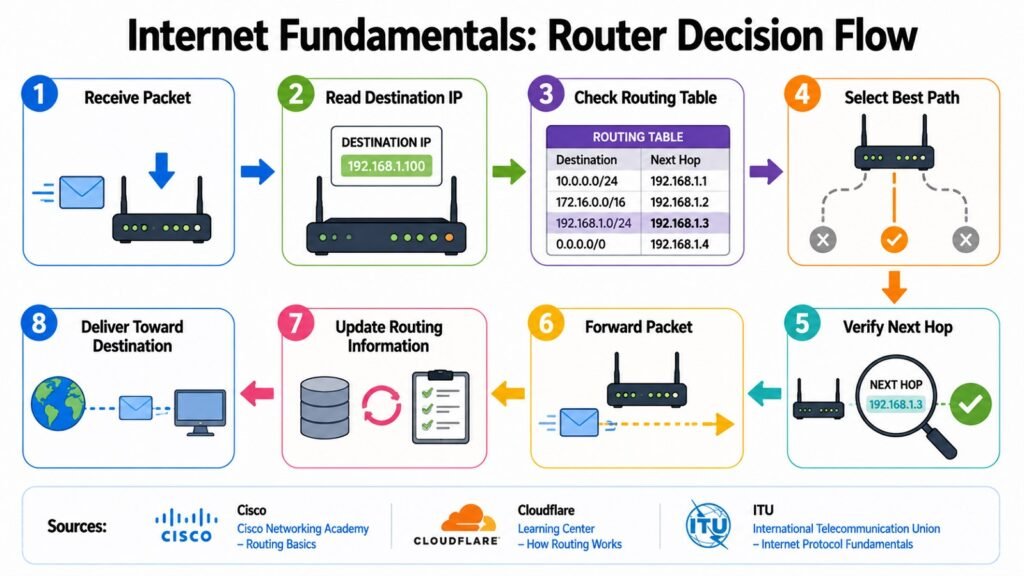
Routers are among the most important devices in any network. Without them, data packets would have no reliable way to navigate the complex web of interconnected networks that makes up the internet. A router’s fundamental job is to examine incoming packets, determine where they need to go, and forward them toward their destination through the most appropriate available path.
Every router maintains a routing table, which is a continuously updated database of known network paths and their associated costs. When a packet arrives, the router looks up the destination address and selects the next hop toward that destination. The packet is then forwarded to the next device in the chain, which might be another router, a switch, or the destination itself. This process repeats at every router along the path until the packet arrives.
Routers communicate with one another through routing protocols. These protocols enable routers to exchange updates regarding network topology, available routes, and link conditions. This dynamic communication ensures that routing tables remain up-to-date, even when links fail or new routes emerge. The capacity of routers to adjust to fluctuating conditions is a key reason why the internet continues to function effectively despite ongoing changes in its physical infrastructure.
In a home network, a single router connects household devices to the internet through the ISP connection. In an enterprise environment, multiple routers manage traffic between internal segments and external networks. At the global level, large routers operated by ISPs and telecommunications companies handle enormous volumes of traffic flowing between continents and across backbone networks.
Modern routers have become more sophisticated than simple forwarding devices. Many incorporate security features, traffic prioritization, and support for virtual private networks. Routing technology continues to evolve as traffic grows and network architectures shift toward cloud and software-defined models. The fundamental role of routers in making Internet Connectivity scalable and reliable remains as important as ever.
Table: Internet Fundamentals — Key Router Functions
| Function | Description |
| Packet Forwarding | Examines destination addresses and sends packets toward the correct next hop |
| Routing Table | Stores known network paths and metrics used to make forwarding decisions |
| Path Selection | Chooses the most efficient available route based on routing protocol data |
| Routing Protocols | Allow routers to share network topology updates with neighboring devices |
| Network Segmentation | Divides large networks into smaller segments to improve management and security |
| Traffic Management | Prioritizes certain traffic types to improve performance for critical applications |
| Internet Gateway | Acts as the boundary device connecting a local network to the global internet |
| Redundancy Support | Reroutes traffic around failed links to maintain connectivity during outages |
6. Internet Fundamentals: Understanding Internet Service Providers
Credit: iken3
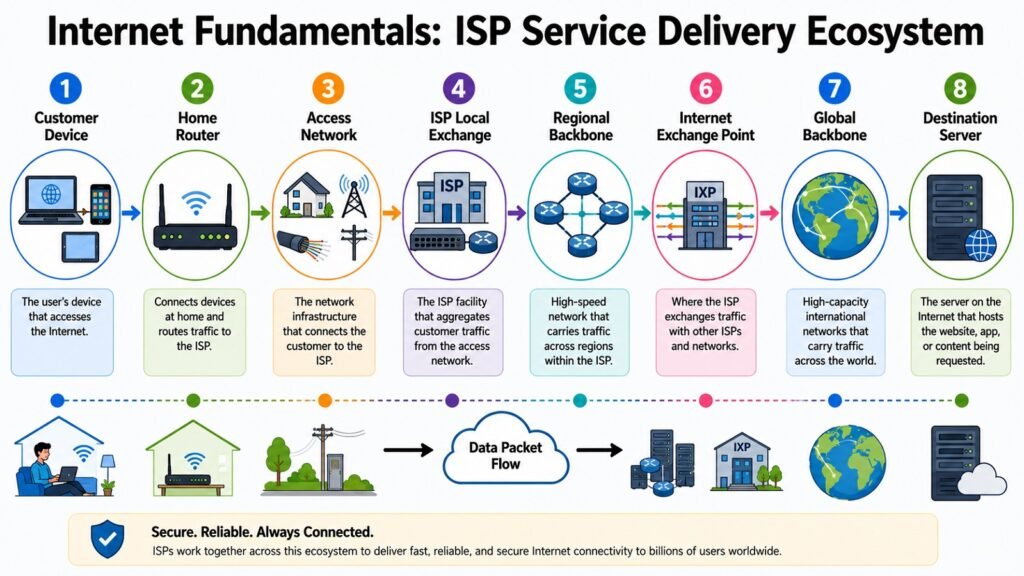
An Internet Service Provider is the organization that connects users and businesses to the broader internet. Without an ISP, an individual device has no pathway to the global network regardless of how capable that device may be. ISPs are the bridge between private users and the world’s interconnected routers, cables, data centers, and servers.
ISPs deliver internet access using various technologies depending on the infrastructure available in a given location. Fiber optic connections offer the highest performance. Cable networks use existing television infrastructure to deliver broadband. Digital subscriber line services operate over telephone lines. Fixed wireless access transmits signals between towers and antennas. Mobile broadband serves devices through cellular networks. The technology used often determines the bandwidth, latency, and reliability that customers experience.
Beyond delivering access, ISPs manage a significant range of functions that keep Internet Connectivity operational. They assign IP addresses to customers, maintain routing equipment, monitor network performance, and manage traffic flows. They also negotiate interconnection arrangements with other ISPs to ensure that their customers can reach any part of the global internet.
ISPs connect to each other through two primary mechanisms. Transit arrangements involve one ISP paying another for access to a broader network. Peering arrangements allow ISPs to exchange traffic directly without financial settlement, reducing costs and improving performance. Large ISPs operate backbone networks that carry enormous volumes of traffic between regions and countries.
The role of ISPs extends beyond technical connectivity. In many markets, ISPs influence the availability, affordability, and quality of internet access for entire communities. Rural areas often face challenges related to limited infrastructure investment, which creates disparities with significant economic and social consequences. Expanding broadband availability through better ISP coverage remains a major policy objective in many countries.
Table: Internet Fundamentals — Key ISP Functions
| Function | Description |
| Access Delivery | Connects residential and business customers to the internet using various technologies |
| IP Address Assignment | Allocates public IP addresses to customers using DHCP or static assignment |
| Traffic Routing | Manages packet routing from customer networks to the broader internet |
| Transit Agreements | Pays upstream providers for access to the broader global internet |
| Peering Arrangements | Exchanges traffic directly with other ISPs to reduce costs and improve performance |
| Backbone Connectivity | Operates or connects to high-capacity core networks carrying large traffic volumes |
| Service Quality | Monitors network conditions and manages congestion to maintain consistent performance |
| Digital Inclusion | Influences the availability and affordability of internet access across communities |
7. Internet Fundamentals: Understanding TCP/IP Protocols
Credit: iken3
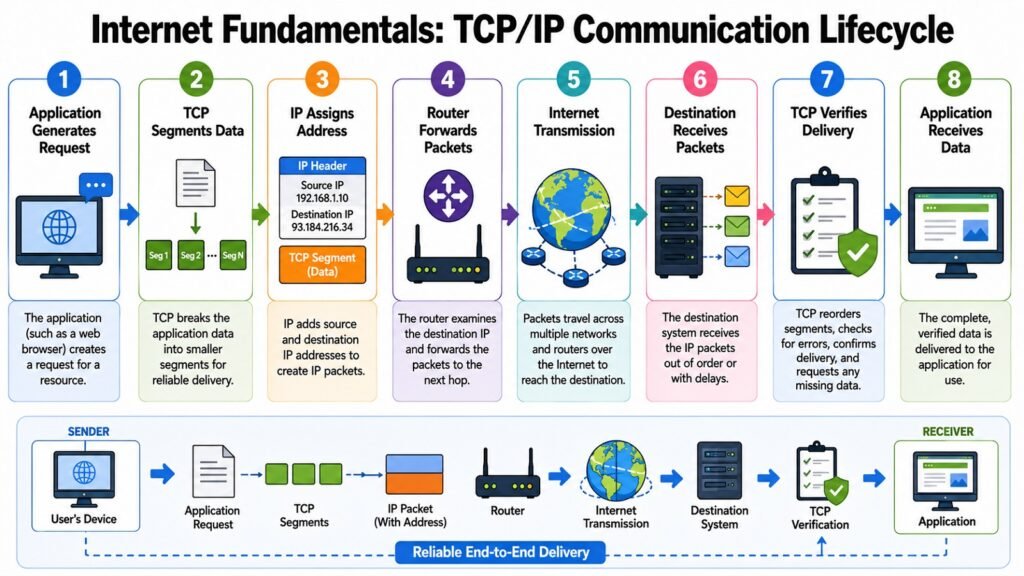
The internet connects an extraordinary variety of devices. Smartphones, laptops, servers, routers, smart home systems, industrial sensors, and medical equipment all exchange data across the same global network. They come from different manufacturers, run different operating systems, and serve completely different purposes. What allows them to communicate successfully is a shared set of rules called protocols.
TCP/IP refers to the combination of two essential protocols that regulate internet communication. The Internet Protocol (IP) is responsible for addressing and routing, specifying how packets are tagged with source and destination addresses and how they are transmitted across networks. The Transmission Control Protocol (TCP) functions atop IP, ensuring reliable delivery. It oversees the connection between two communicating devices, organizes packets for proper reassembly, requests the retransmission of any lost packets, and manages data flow to prevent overwhelming the receiver.
The evolution of TCP/IP is closely linked to the development of the internet. In the late 1960s, the US Defense Advanced Research Projects Agency financed ARPANET, an early network that showcased large-scale packet switching. In the 1970s, Vint Cerf and Bob Kahn developed TCP/IP to establish a unified communication framework for connecting various networks. The official adoption of TCP/IP by ARPANET on January 1, 1983, is widely regarded as the formal inception of the modern internet.
The decision to make TCP/IP an open standard was consequential. Any device manufacturer, software developer, or network operator could implement the protocols without licensing fees. This openness allowed the internet to grow rapidly across national borders and organizational boundaries.
Web browsing, email, cloud storage, file transfers, and video streaming all rely on TCP/IP. Even as newer protocols emerge for specific applications, the underlying TCP/IP framework continues to support the vast majority of internet traffic. Understanding TCP/IP is central to understanding how Internet Connectivity functions at every level.
Table: Internet Fundamentals — Key TCP/IP Concepts
| Concept | Description |
| Internet Protocol (IP) | Handles addressing and routes packets across interconnected networks |
| Transmission Control Protocol | Manages reliable, ordered delivery of data between communicating devices |
| ARPANET Origin | TCP/IP was developed to interconnect multiple different research networks in the 1970s |
| Open Standard | Published freely without licensing, enabling universal adoption across all devices |
| Packet Sequencing | TCP numbers packets so they can be reassembled in the correct order at the destination |
| Error Recovery | TCP detects lost packets and requests retransmission to ensure complete delivery |
| Flow Control | TCP adjusts transmission rate to prevent overwhelming the receiver’s capacity |
| Application Protocols | Higher-level protocols like HTTP and SMTP operate on top of the TCP/IP foundation |
8. Internet Fundamentals: Understanding Last Mile Connectivity
Credit: iken3
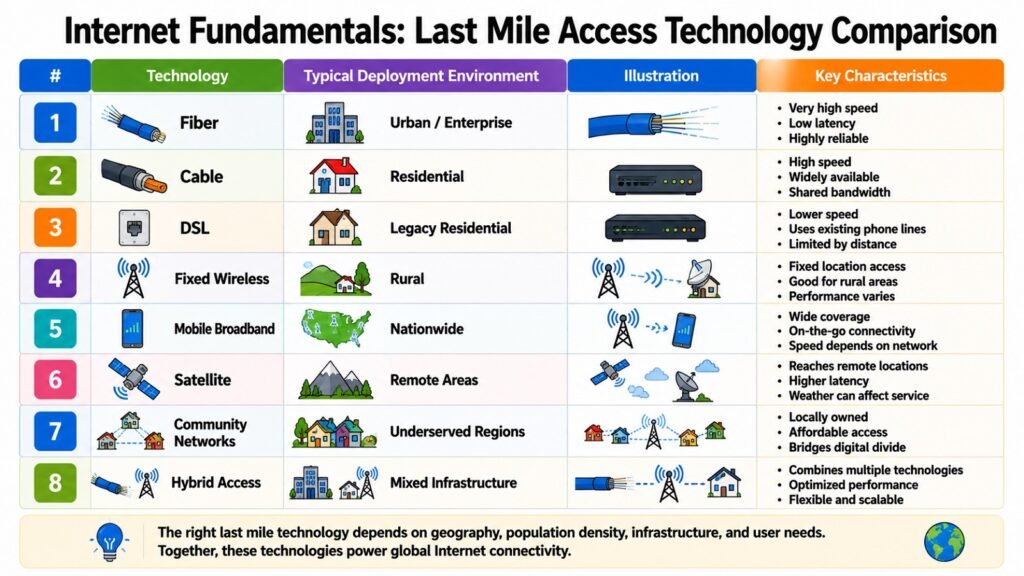
The phrase last mile refers to the final segment of a network that connects the operator’s infrastructure to the end user’s location. It is the link that delivers Internet Connectivity directly to homes, offices, schools, and businesses. Despite the name, this segment is often the most technically challenging and economically costly part of the entire network.
Major backbone networks span continents and carry enormous volumes of traffic at very high speeds and relatively low cost per bit. The infrastructure challenge becomes considerably harder at the local level, where service must reach each individual address. Running cables or deploying wireless access points to every building in a neighborhood requires significant capital investment for a comparatively small number of customers. This economic reality is the primary reason last-mile infrastructure has historically lagged behind improvements in backbone networks.
Several technologies serve the last-mile market. Fiber optic connections deliver the highest bandwidth and lowest latency, making them the preferred solution where the investment is feasible. Cable networks use hybrid fiber-coaxial systems that deliver good speeds over existing television cable infrastructure. Digital subscriber line technology transmits data over telephone copper wiring, though performance declines with distance from the exchange. Fixed wireless access uses radio signals between towers and customer antennas, making it viable where laying physical cables is impractical. Mobile broadband through 4G and 5G networks serves users through cellular infrastructure, providing flexible access without requiring a fixed connection.
The quality of last-mile connectivity directly affects the digital experience of millions of people. Reliable last-mile service is a prerequisite for remote work, online education, telemedicine, and digital commerce. Urban areas tend to have competitive and well-developed infrastructure. Rural and remote regions often face significant coverage gaps. Closing that gap has become a priority for governments and development organizations worldwide because internet access has become closely linked to economic participation and social opportunity.
Table: Internet Fundamentals — Last Mile Connectivity Comparison
| Technology | Key Characteristic |
| Fiber Optic | Delivers the highest bandwidth and lowest latency of any last-mile technology |
| Cable Broadband | Uses existing coaxial TV infrastructure to provide reliable broadband access |
| DSL | Transmits internet data over copper telephone lines with distance-limited performance |
| Fixed Wireless | Connects users via radio signals, useful where physical cabling is not practical |
| 4G Mobile Broadband | Delivers flexible wireless internet access through existing cellular networks |
| 5G Mobile Broadband | Offers higher speeds and lower latency than 4G for urban and suburban last-mile delivery |
| Satellite Internet | Provides coverage in remote areas where ground-based infrastructure does not exist |
| Infrastructure Cost | The economic challenge of reaching each individual address limits last-mile investment |
Conclusion: Internet Fundamentals as the Building Blocks of Internet Connectivity
Credit: iken3
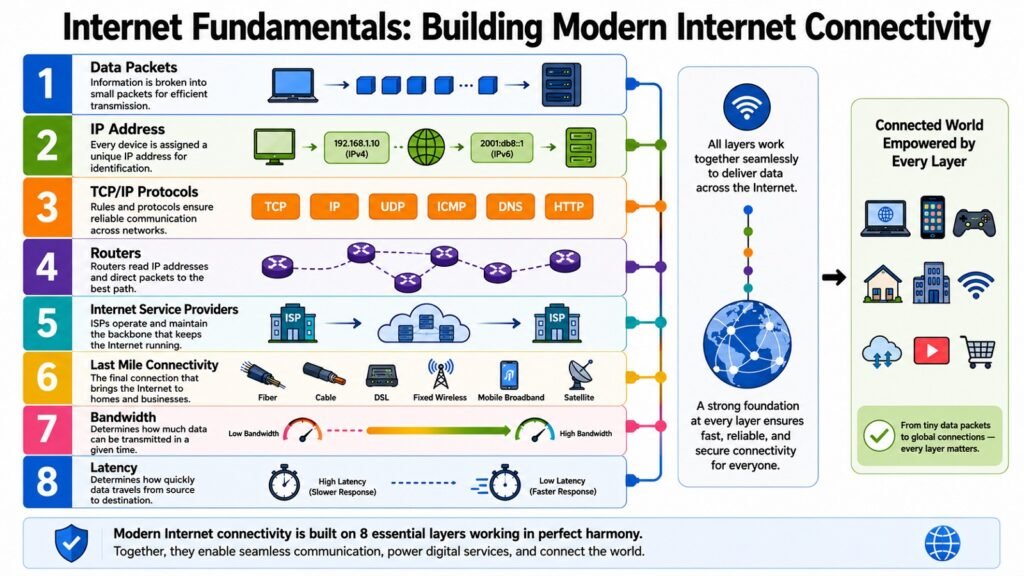
Learning how the internet works is not an abstract exercise. It is a practical foundation for understanding the direction that technology is heading and for making better decisions in a world where digital infrastructure is as essential as electricity or roads. The eight concepts covered in this article work together as a system. No single concept operates independently, and understanding them in relation to each other produces insights that none of them alone can offer.
Data packets are the unit of transmission, and IP addresses are the labels that direct those packets to the right destination. Routers make use of both to move data across networks. Bandwidth determines how much data can flow through any given segment of that path. Latency determines how quickly the journey can be completed. TCP/IP protocols provide the shared language that makes all of these processes interoperable across every device and network on earth. Internet Service Providers supply the infrastructure that links users to this global system. Last-mile connectivity delivers that system to the user’s front door.
When any one of these elements performs poorly, the effects ripple through the rest. High latency makes a high-bandwidth connection feel slow. Limited last-mile infrastructure prevents users from accessing the backbone capacity that exists further up the network. IP address exhaustion forces workarounds that add complexity. Understanding these relationships gives readers a framework for diagnosing problems, evaluating services, and following developments in network technology.
That framework becomes increasingly valuable as new technologies mature. Wi-Fi 7 promises to increase local network throughput significantly. 5G networks are expanding low-latency mobile connectivity to more regions. Fiber deployments are reaching more communities. Edge computing is reshaping where data processing happens and how traffic flows across networks. AI workloads are placing new demands on bandwidth and latency at a scale the internet has not previously experienced. Each of these developments is easier to understand through the lens of Internet Fundamentals.
The internet will continue to evolve. Its architecture will adapt to new applications, new devices, and new expectations. The foundational concepts introduced in this article will remain relevant regardless of how the technology changes at the surface level, because they describe the principles that govern how data moves across any connected network.
Table: Internet Fundamentals — Key Takeaways
| Internet Fundamentals | Key Takeaway |
| Data Packets | Packet switching enables scalable, resilient data transmission across shared networks |
| IP Addresses | Unique addressing is essential for routing data to the correct device on any network |
| Bandwidth | Network capacity determines the volume of data that can flow through a connection |
| Latency | Transmission delay is distinct from bandwidth and critical for real-time applications |
| Routers | Intelligent forwarding devices make large-scale Internet Connectivity navigable and reliable |
| Internet Service Providers | ISPs are the gateway organizations linking users to the global internet infrastructure |
| TCP/IP Protocols | Open communication standards enable universal interoperability across all internet-connected devices |
| Last Mile Connectivity | The final network link determines whether users can access available internet capacity |