Table of Contents
Introduction — Internet of Things: Connecting the Physical and Digital Worlds
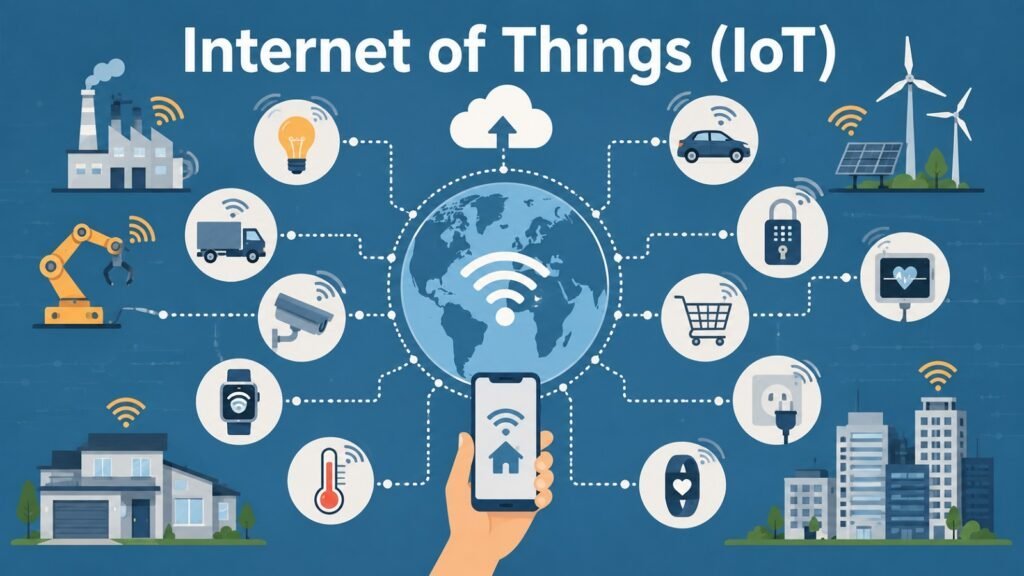
The Internet of Things is one of the most consequential emerging computing technologies of this era. It refers to the network of physical objects — devices, machines, infrastructure, and environments — embedded with electronics, software, sensors, and connectivity to exchange data with other systems and with humans. Gartner, IEEE, and ISO/IEC standards bodies have characterized IoT not merely as connected devices but as a computing paradigm that extends digital intelligence into the physical world.
What distinguishes the Internet of Things from earlier networking concepts is its ability to allow physical things to sense conditions, generate data, communicate information, process observations, produce intelligence, support decisions, and trigger physical actions. A temperature sensor in a hospital ward, a pressure valve in an oil pipeline, a traffic signal in a smart city, and a soil moisture probe in an agricultural field can all participate in real-time digital intelligence systems through IoT architecture.
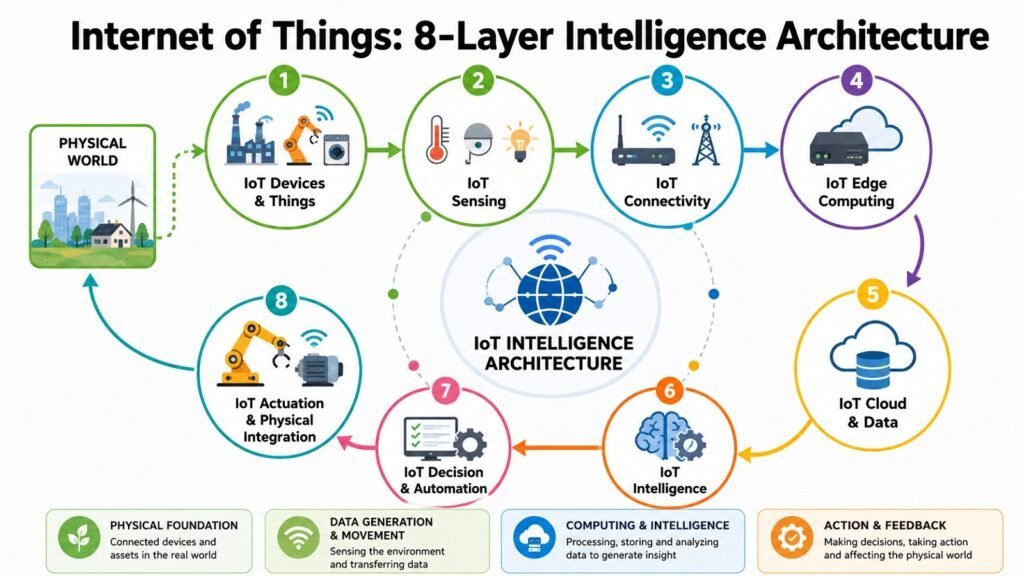
The central argument of this article is that the Internet of Things should be understood as a connected physical-digital intelligence architecture rather than a collection of smart devices. An eight-layer framework traces this architecture: physical things, sensing, connectivity, edge computing, cloud and data, intelligence, decision-making and automation, and actuation. Together, these layers form a continuous physical-to-digital-to-physical loop. The article combines theoretical concepts, research-based knowledge, real-world applications, and practical evaluation principles to build a coherent understanding of how modern IoT systems actually work.
Table 1: Internet of Things Intelligence Architecture — Eight-Layer Overview
| Internet of Things Layer | Role in the IoT Intelligence Architecture |
| 1. Devices & Things | Physical objects with embedded computing and communication capability |
| 2. Sensing | Converts physical conditions into machine-readable digital measurements |
| 3. Connectivity | Transmits data between devices, gateways, edge nodes, and cloud systems |
| 4. Edge Computing | Processes data locally near the source to reduce latency and bandwidth |
| 5. Cloud & Data | Provides scalable storage, processing, and integration of IoT data |
| 6. Intelligence | Applies analytics and AI to extract patterns, insights, and predictions |
| 7. Decision & Automation | Converts insights into rules, decisions, and automated control responses |
| 8. Actuation & Physical Integration | Executes digital decisions through physical mechanisms, closing the loop |
1. Internet of Things Devices & Things: The Physical Foundation
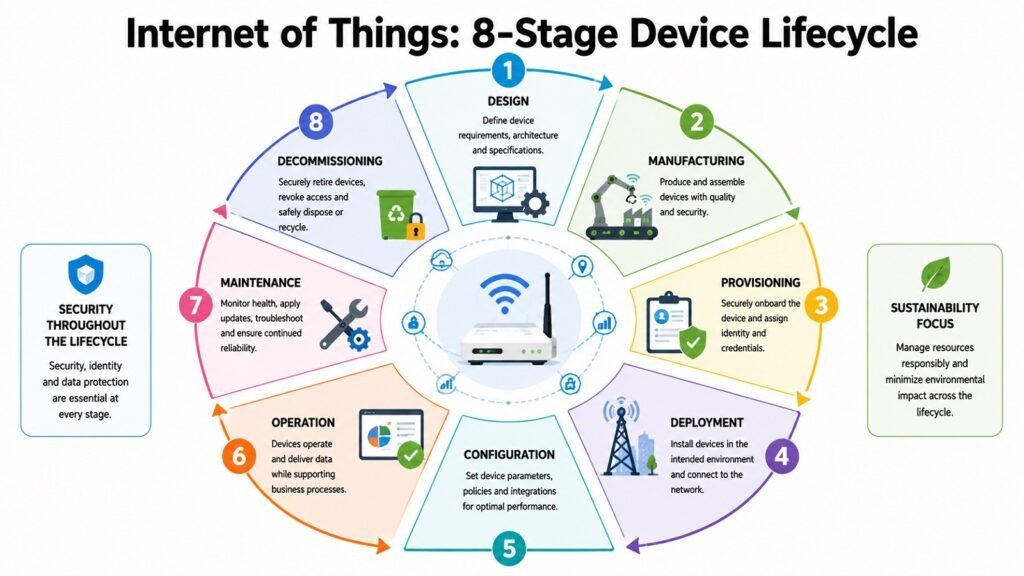
Every Internet of Things system begins with a physical thing. But not every physical object qualifies as an IoT device. An ordinary object simply exists in the environment. A digitally connected device can communicate with a network. An IoT-enabled thing can sense conditions, process information, identify itself uniquely, and interact with the broader architecture. This distinction matters because a device’s capabilities determine what the system can observe and what constraints the rest of the architecture must accommodate.
What gives a physical thing digital capabilities is embedded computing combined with communication hardware. A typical IoT device contains a microcontroller or processor, memory, firmware, one or more sensors or actuators, and a communication module. These components allow the device to collect data, run local logic, and transmit information to other system layers. IEEE 802.15.4 and IETF RFC 7228 formalise the concept of constrained devices, distinguishing them by memory, processing, and power characteristics. Some devices operate with plentiful compute resources; others run on coin-cell batteries for years, communicating in narrow bursts.
Device identity is a foundational security requirement. Each IoT device carries a unique identifier for authentication, management, and data provenance. Without reliable identity, security becomes difficult to enforce and the source of a reading becomes impossible to verify. In industrial IoT systems, a mislabelled sensor reading can propagate errors through the entire architecture and drive incorrect decisions downstream. Lifecycle management also matters: devices need secure update mechanisms to address firmware vulnerabilities after deployment, a challenge that scales quickly across thousands of endpoints.
Real-world examples illustrate IoT device diversity. A connected insulin pump demands strict reliability and safety certification. An industrial vibration sensor on a rotating motor operates continuously in harsh conditions. A smart electricity meter transmits consumption data over a low-power network at defined intervals. Each operates under different constraints but follows the same principle: a physical thing enters the IoT architecture when it can generate data and communicate it to the wider system.
Table 2: Internet of Things Device Types — Key Characteristics
| Internet of Things Device Category / Characteristic | Description or Consideration |
| Constrained devices (Class 0–2) | Limited RAM, flash, and power; defined by IETF RFC 7228 |
| Microcontroller-based devices | Low-cost, low-power processors suited to sensing and simple local logic |
| Gateway devices | Bridge constrained devices to wider networks; handle protocol translation |
| Industrial IoT sensors | Ruggedised for harsh environments; may operate continuously for years |
| Device identity | Unique identifiers enable authentication, management, and data provenance |
| Firmware and lifecycle | Devices need secure update mechanisms to address vulnerabilities over time |
| Actuator-equipped devices | Can receive commands and produce physical effects, not just transmit data |
| Energy constraints | Battery-powered devices require power-efficient protocols and duty cycling |
2. Internet of Things Sensing: Capturing the Physical World
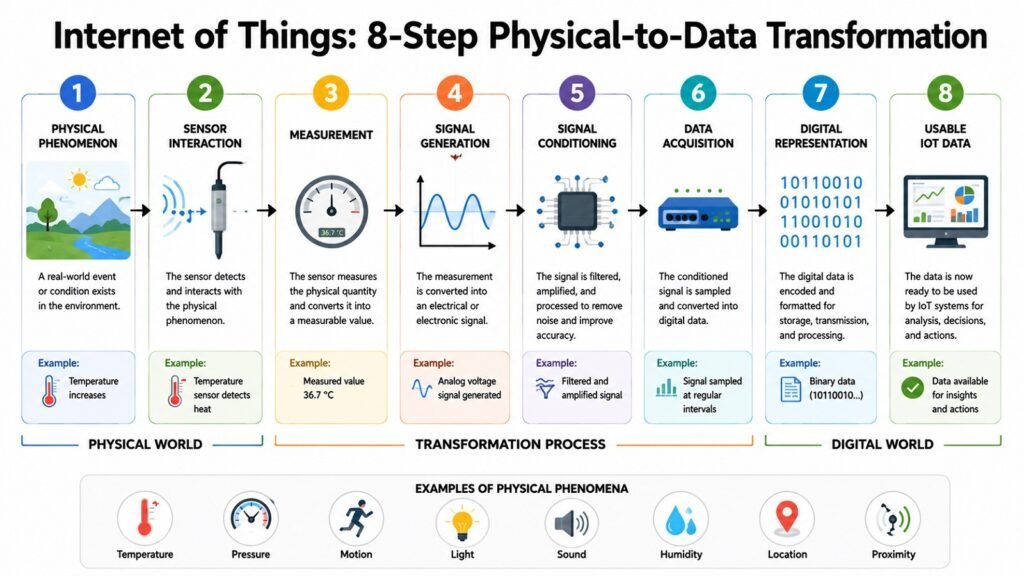
Sensing is the mechanism through which the Internet of Things observes and measures the physical world. It converts physical phenomena into machine-readable data, forming the origin point of every insight, decision, and action in the IoT architecture. A sensor converts a quantity — temperature, pressure, motion, light, sound, humidity, or proximity — into an electrical signal that is then digitised and encoded. This conversion involves detection, transduction, signal conditioning, and analog-to-digital conversion, each step introducing potential sources of error.
Calibration determines how accurately a measurement reflects the true physical value. Sampling frequency determines how much temporal detail is captured. Sensor drift, noise, and environmental interference can corrupt measurements, and missing readings create gaps in the data record that affect downstream analytics. Research consistently shows that data quality problems at the sensing layer propagate through the entire architecture. Poor calibration produces systematically biased data. Insufficient sampling misses rapid physical changes. In safety-critical applications such as remote patient monitoring or industrial process control, inaccurate sensing can drive inappropriate automated responses with serious consequences.
What distinguishes effective sensing from mere data collection is context. A temperature reading of 78 degrees Celsius means something entirely different inside a server room than inside an industrial furnace. IoT sensing systems must be designed with the physical environment, the expected range of conditions, the required precision, and the downstream use of data all taken into account. A sensor designed for laboratory conditions will often fail quickly in an outdoor industrial installation.
Trade-offs between accuracy, cost, power consumption, and sampling frequency are consequential design decisions. Higher sampling rates capture rapid changes but increase data volume and energy use. More precise sensors cost more and may require frequent recalibration. These choices must match what the application actually requires. Sensing connects directly to connectivity and computing stages: the quality of measurements shapes the reliability and usefulness of everything that follows in the architecture.
Table 3: Internet of Things Sensing — Types, Conditions, and Practical Considerations
| Sensing Type / Characteristic | Measured Condition or Consideration |
| Temperature sensors | Measure thermal conditions; require calibration to prevent drift over time |
| Pressure sensors | Monitor fluid or gas pressure in industrial and environmental applications |
| Motion and vibration sensors | Detect movement, acceleration, or mechanical anomalies in equipment |
| Humidity sensors | Measure moisture levels in air or materials; sensitive to contamination |
| Optical and light sensors | Detect luminosity, presence, or reflectance in varied environments |
| Location sensors (GPS/GNSS) | Provide geographic coordinates; accuracy varies with environment and signal |
| Sensor calibration | Essential for accuracy; drift over time requires periodic recalibration |
| Sampling frequency | Higher rates capture rapid changes but increase data volume and power use |
3. Internet of Things Connectivity: Moving Data Across Systems
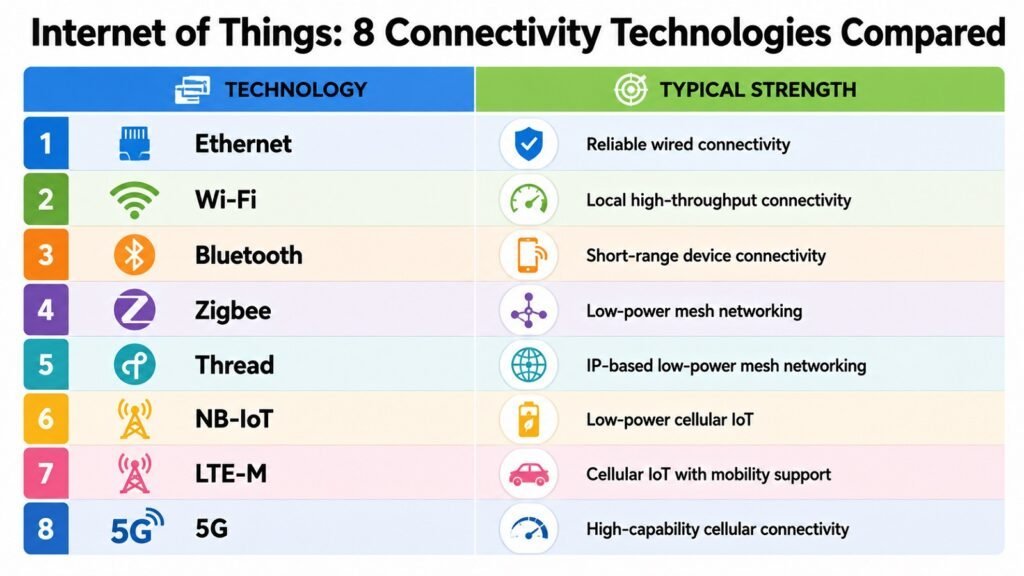
Connectivity enables IoT devices, gateways, edge nodes, and cloud platforms to exchange information. Without it, sensing produces isolated data that can never contribute to a larger system. Connectivity in the Internet of Things is not simply about having an Internet connection. It requires selecting a communication approach that suits the physical environment, the operational requirements, and the constraints of the devices involved, because different IoT applications demand very different connectivity characteristics.
A security camera streaming high-definition video requires high bandwidth and a stable connection. A soil moisture sensor in a remote agricultural field needs long range, low power, and tolerance for intermittent coverage, even if bandwidth is minimal. A factory automation system requires very low latency for real-time control. Wi-Fi suits high-bandwidth, infrastructure-rich environments. Bluetooth Low Energy serves short-range, low-power applications. Cellular standards such as LTE-M and NB-IoT extend coverage to wide areas. LoRaWAN is designed for long-range, low-data-rate, battery-powered deployments.
Gateways play a critical role in many IoT architectures by bridging constrained devices to wider networks. A gateway aggregates data from many local sensors, translates between communication protocols, and handles authentication functions that individual devices cannot manage. Interoperability between devices, gateways, and cloud platforms remains a significant challenge, and industry bodies such as the Open Connectivity Foundation and the Matter protocol initiative have developed standards to address this across diverse device ecosystems.
Connectivity choices introduce meaningful failure modes. Network interruptions leave IoT systems without the data they need. Coverage gaps in rural or underground environments make certain technologies impractical. Radio frequency congestion in dense urban deployments degrades reliability. These challenges reinforce the importance of treating connectivity as a deliberate design decision rather than a background assumption. It serves as the bridge between sensing and computing and determines how effectively information can move through the system architecture.
Table 4: Internet of Things Connectivity Technologies — Comparative Characteristics
| Connectivity Technology | Key Characteristic or Typical IoT Use Case |
| Wi-Fi (IEEE 802.11) | High bandwidth, short-to-medium range; suited to cameras and indoor devices |
| Bluetooth Low Energy (BLE) | Short range, very low power; used in wearables and asset tracking |
| Zigbee (IEEE 802.15.4) | Mesh networking, low power; common in smart home and building automation |
| LoRaWAN | Long range, low data rate, low power; suited to rural and remote sensor networks |
| NB-IoT (Narrowband IoT) | Cellular standard for low-power, wide-area IoT over licensed spectrum |
| LTE-M (LTE Cat-M1) | Cellular IoT with mobility support; suited to vehicles and mobile assets |
| Ethernet (IEEE 802.3) | Wired, reliable, high bandwidth; used in industrial and infrastructure IoT |
| IoT Gateway | Bridges local device networks to wider IP networks; handles protocol translation |
4. Internet of Things Edge Computing: Processing Data Closer to Devices
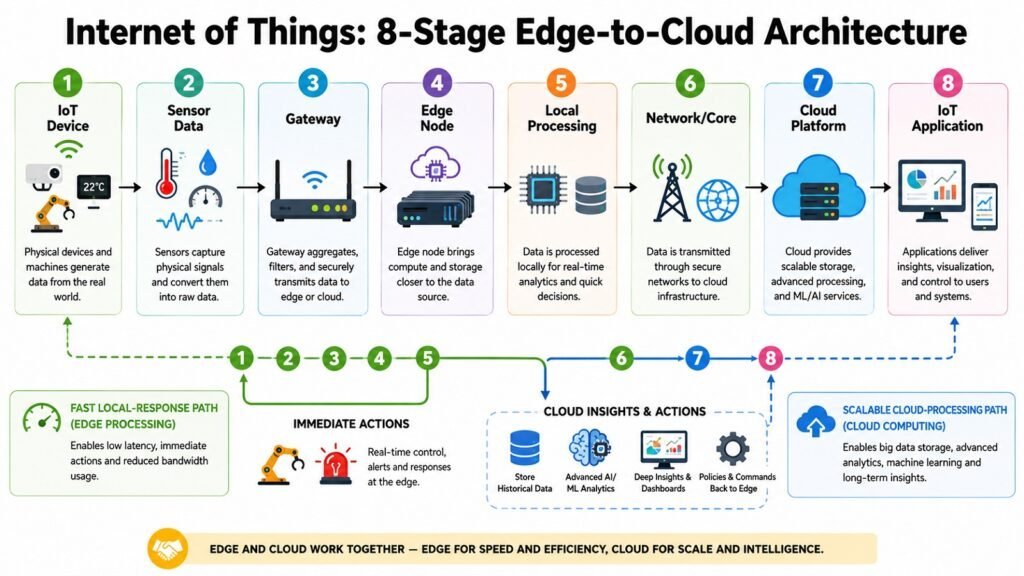
As IoT deployments grow in scale, the limitations of sending all device data to centralised cloud infrastructure become increasingly clear. Transmitting raw sensor data from thousands of devices over constrained networks creates bandwidth pressure, introduces latency, and raises operating costs. Edge computing addresses these limitations by distributing processing capability to locations closer to where data is generated, allowing IoT systems to act on information without waiting for a round trip to a remote data centre.
In the IoT architecture, edge computing can occur at different levels: on the device itself, at a local gateway or edge server, or at a regional computing node near the network edge. A device might filter noisy readings before transmitting anything. A gateway might aggregate data from many sensors, run a simple anomaly detection algorithm, and send only summary statistics to the cloud. An edge server at a manufacturing plant might run a real-time control loop that cannot tolerate cloud latency. The OpenFog Consortium, now absorbed into IEEE, formalised this distributed processing model as fog computing.
Edge computing offers concrete advantages for specific scenarios. Real-time industrial control systems require decisions in milliseconds, a requirement that cloud latency cannot satisfy. Remote monitoring systems in locations with limited connectivity must operate independently during network outages. Privacy-sensitive applications can process data locally and transmit only anonymised results. These scenarios illustrate why edge computing has become an integral part of modern IoT architecture rather than an optional enhancement.
Edge computing also introduces trade-offs. Edge nodes have limited computational resources compared to cloud infrastructure. Managing, updating, and securing a distributed fleet of edge devices is more complex than managing centralised systems. In most practical IoT deployments, edge and cloud computing are complementary: edge handles time-sensitive and bandwidth-intensive tasks, while the cloud handles large-scale analysis, long-term storage, and system-wide coordination. The balance between local autonomy and centralised control requires deliberate architectural design.
Table 5: Internet of Things Edge Computing — Characteristics, Use Cases, and Trade-offs
| Aspect | Description or Consideration |
| Local processing | Runs analytics or control logic on edge nodes without requiring cloud connectivity |
| Latency reduction | Enables real-time responses by eliminating cloud round-trip delays |
| Bandwidth efficiency | Filters and aggregates data locally, reducing the volume sent to the cloud |
| Offline resilience | Maintains local operations during network interruptions or outages |
| Privacy and data localisation | Processes sensitive data locally, reducing exposure through transmission |
| Edge resource constraints | Edge nodes have limited CPU, memory, and storage compared to cloud infrastructure |
| Distributed security | Each edge node requires independent security management and firmware updates |
| Edge-cloud complementarity | Edge handles real-time tasks; cloud handles large-scale analysis and storage |
5. Internet of Things Cloud & Data: The Computing Backbone
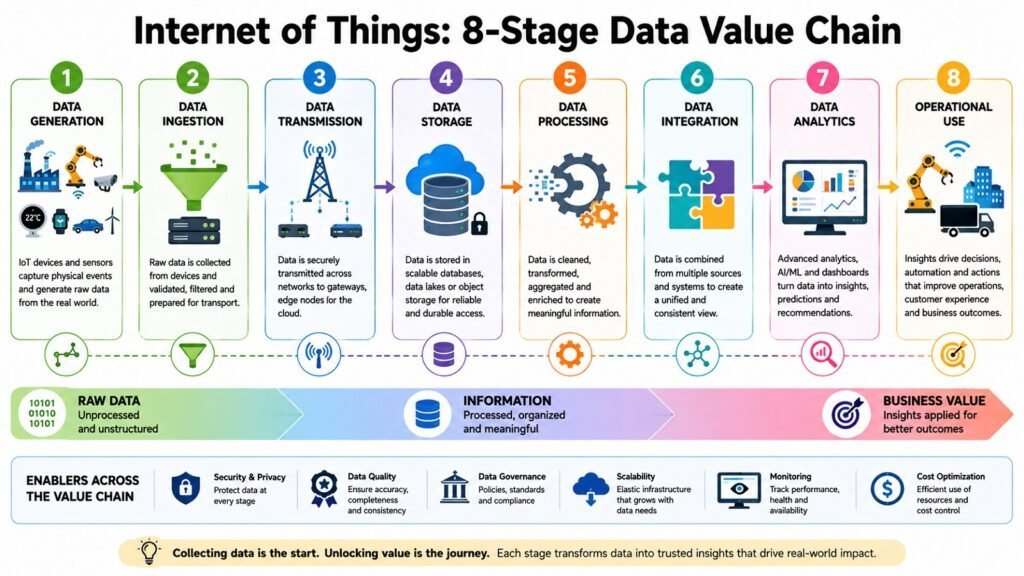
Cloud infrastructure provides the scalable computing, storage, and integration layer that holds larger Internet of Things deployments together. While edge computing handles time-sensitive local tasks, the cloud absorbs the volume and variety of data generated by IoT systems at scale, supports long-term storage, enables cross-system integration, and provides the processing power required for sophisticated analytics and machine learning. For most IoT deployments of significant scale, cloud infrastructure is foundational.
Data flows from IoT devices and edge systems into the cloud through ingestion pipelines designed to handle high message volumes reliably. Message brokers such as MQTT and AMQP, along with cloud-native event streaming platforms, receive and route IoT data at scale. Once ingested, data is stored in appropriate formats — time-series databases for sensor readings, relational databases for structured operational data, and object storage for large unstructured files. Managed IoT platform services from AWS IoT Core, Microsoft Azure IoT Hub, and Google Cloud integrate device management, ingestion, and analytics into unified environments.
A critical insight is that large data volumes do not automatically create value. Data quality, consistency, context, and governance determine whether stored information is actually useful. Raw sensor data without metadata about the device, its location, or calibration status is difficult to interpret reliably. Data pipelines that silently drop records, introduce duplicates, or fail to handle out-of-sequence messages corrupt downstream analytics. Treating data management as a serious engineering discipline — not a background concern — is essential for any IoT system intended to support meaningful decisions.
The cloud also serves as the integration layer connecting IoT systems to enterprise applications, digital twins, business intelligence platforms, and external services through APIs and data pipelines. This integration transforms a standalone IoT monitoring deployment into a source of operational intelligence that influences real business processes. The cloud layer establishes the foundation from which data becomes intelligence in the next stage of the architecture.
Table 6: Internet of Things Cloud & Data — Functions, Concepts, and Considerations
| Cloud / Data Function or Concept | Role or Consideration in IoT Systems |
| Data ingestion pipelines | Receive high-volume IoT messages reliably; MQTT and AMQP are common protocols |
| Time-series databases | Store sequential sensor readings efficiently for monitoring and trend analysis |
| IoT platform services | Managed environments combining device management, ingestion, and analytics |
| Data quality and governance | Essential for ensuring stored data is accurate, consistent, and interpretable |
| Metadata and context | Device identity, location, and calibration status make raw data meaningful |
| Object and blob storage | Handles unstructured IoT data such as images, video, and audio streams |
| API and enterprise integration | Connects IoT data to ERP, BI, and digital twin systems |
| Scalability | Cloud infrastructure scales dynamically to accommodate growing IoT deployments |
6. Internet of Things Intelligence: Turning Data into Insight
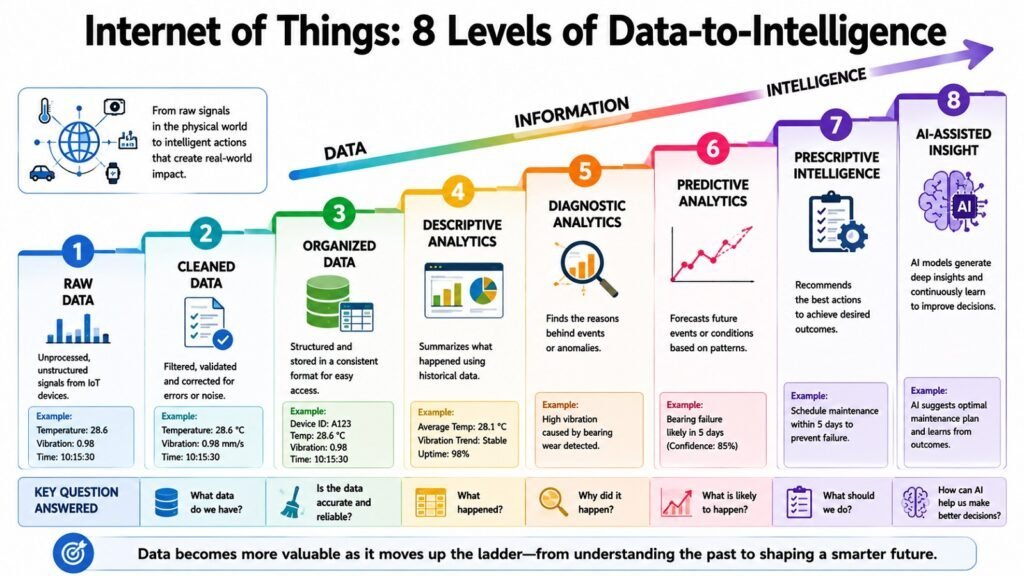
Data gathered by IoT systems gains significance only when it is converted into valuable patterns, insights, and forecasts that can guide decision-making.
Intelligence signifies a significant shift in the development of IoT systems, evolving from mere monitoring to advanced analytical capabilities.
The transition from data to intelligence encompasses various forms, each contributing a unique aspect of comprehension: descriptive, diagnostic, predictive, and prescriptive analytics explain what occurred, the reasons behind it, what is likely to occur next, and the recommended actions to take.
Descriptive analytics summarises historical data: average energy consumption over a week, peak traffic volumes at an intersection, or machine uptime over a production quarter. Diagnostic analytics identifies correlations and root causes. Predictive analytics uses historical patterns and machine learning to forecast future conditions, such as estimating when a component will fail or when electricity demand will peak. Machine learning has expanded IoT intelligence further: anomaly detection algorithms identify deviations from expected patterns without requiring explicit rules, and computer vision applied to IoT camera feeds can detect manufacturing defects or unsafe conditions in real time.
Research from McKinsey, Deloitte, and IEEE confirms that predictive maintenance enabled by IoT intelligence has reduced unplanned downtime in industrial environments, with measurable improvements in asset utilisation and operational cost. However, intelligence comes with important limitations. Machine learning models require representative training data, and a model trained on normal operating conditions may fail when conditions change. False positives in anomaly detection can generate alert fatigue, leading operators to dismiss warnings they should act on.
More sophisticated AI is not always the right choice. A well-designed threshold rule may be more transparent and appropriate for many IoT applications than a complex neural network whose decisions are difficult to explain or audit. The practical question for any deployment is what level of intelligence the application actually requires. Intelligence produces operational value only when it connects to the next layer: decision-making and automated response.
Table 7: Internet of Things Intelligence — Forms, Applications, and Considerations
| Intelligence Form or Aspect | Description or Practical Consideration |
| Descriptive analytics | Summarises historical IoT data to show what has happened over a period |
| Diagnostic analytics | Identifies correlations and root causes of observed conditions or anomalies |
| Predictive analytics | Forecasts future conditions using statistical models and historical patterns |
| Prescriptive analytics | Recommends specific actions to achieve defined outcomes based on analysis |
| Anomaly detection | Identifies deviations from expected patterns without explicit rule programming |
| Machine learning in IoT | Enables pattern recognition and adaptive responses beyond fixed thresholds |
| Model reliability | Depends on data quality, training representativeness, and operating conditions |
| False positive risk | Excessive incorrect alerts can erode operator trust and lead to ignored warnings |
7. Internet of Things Decision & Automation: Turning Intelligence into Action
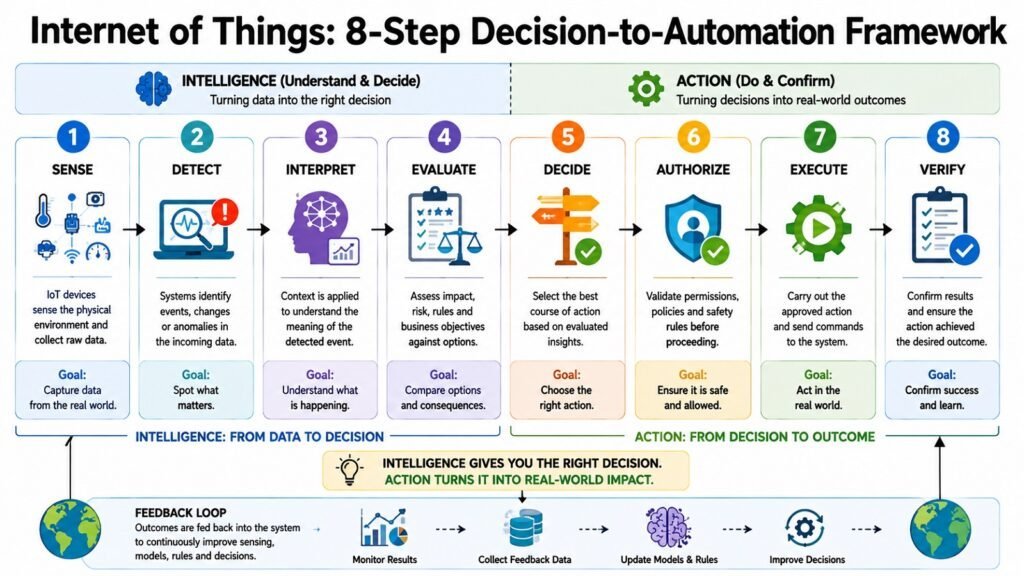
Intelligence becomes operationally useful only when it informs a decision and triggers a response. In many IoT systems, this step is automated: the system detects a condition, evaluates it against defined criteria, and executes an action without waiting for human intervention. The transition from insight to action transforms an IoT system from a passive monitoring tool into an active participant in physical and operational processes, and it is where the architecture delivers its most tangible value.
Decision mechanisms range from simple to sophisticated. At the simplest level, a threshold rule states that if a temperature reading exceeds a defined value, an alert should be sent or a valve should close. Event-driven processing triggers responses based on combinations of conditions across multiple data streams. Decision engines evaluate more complex logical rules and route outcomes to different actions depending on context. As systems mature, predictive models feed into automated workflows that anticipate conditions rather than simply reacting to readings. Industrial IoT platforms such as PTC ThingWorx and Siemens MindSphere incorporate orchestration capabilities that coordinate responses across multiple devices and systems.
The appropriate level of automation depends on the risk, reversibility, and complexity of the decision. A low-risk, easily reversible action such as adjusting a thermostat setting can be safely automated with minimal oversight. A high-stakes action such as shutting down a production line or initiating a safety isolation procedure typically requires human authorisation. Research in human factors and automation reliability consistently shows that poorly designed automation introduces new failure modes, particularly when systems encounter conditions outside the parameters for which they were designed.
Failure considerations are essential. A rule based on incorrect thresholds can trigger unnecessary shutdowns. A predictive model that overfits to historical data generates confident but wrong predictions under new conditions. Automation dependency, where operators lose situational awareness because systems normally handle everything, becomes a risk when automated systems fail unexpectedly. These trade-offs reinforce the importance of validation, testing, and accountability structures wherever automated decisions affect physical processes. Decision-making is the architectural bridge between digital intelligence and physical actuation.
Table 8: Internet of Things Decision & Automation — Mechanisms, Approaches, and Considerations
| Decision Mechanism or Aspect | Description or Practical Consideration |
| Threshold-based rules | Trigger actions when a measured value crosses a predefined boundary |
| Event-driven processing | Responds to combinations of conditions across multiple IoT data streams |
| Decision engines | Evaluate complex logical rules and route outcomes to appropriate responses |
| Automated workflows | Coordinate multi-step responses across systems, devices, or platforms |
| Predictive decision-making | Anticipates conditions using forecasting models rather than reacting to readings |
| Human-in-the-loop design | Retains human authorisation for high-risk or difficult-to-reverse actions |
| False alarm consequences | Incorrect triggers can cause unnecessary shutdowns or erode operator trust |
| Automation dependency risk | Operators may lose situational awareness when systems routinely handle everything |
8. Internet of Things Actuation & Physical Integration: Closing the Loop
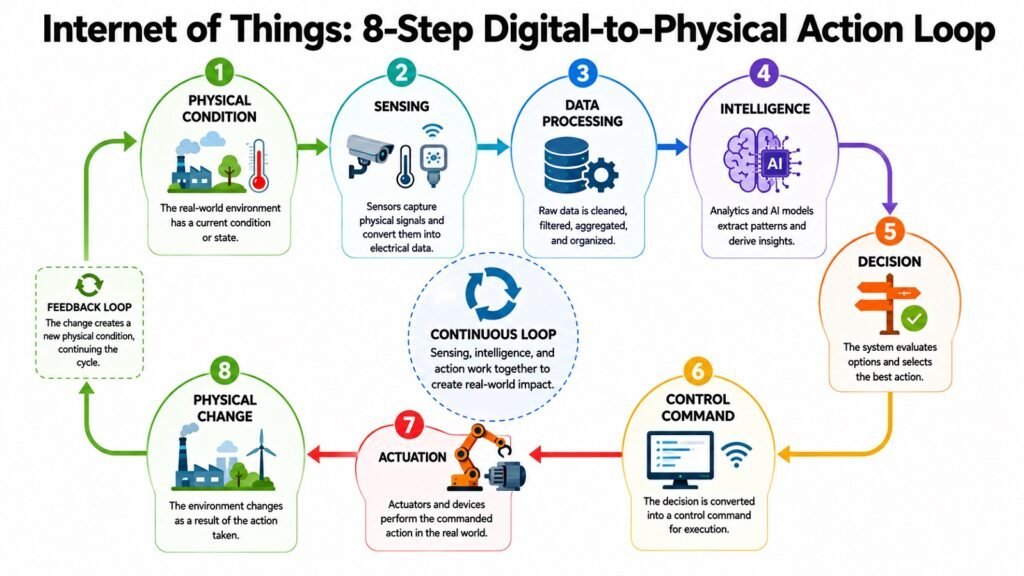
Actuation is the layer at which the Internet of Things crosses back from the digital world into the physical one. A decision, however intelligent, remains theoretical until something in the physical environment actually changes. Actuators translate digital commands into physical effects: motors that move components, valves that control fluid flow, relays that switch electrical circuits, pumps that deliver precise volumes, and robotic arms that perform assembly operations. Together, they give IoT systems the ability to do things rather than merely observe them.
The theoretical importance of actuation lies in the closed-loop model. The IoT architecture follows a progression: physical conditions are sensed, data is transmitted and processed, intelligence produces insights, decisions are made, and actuators execute commands that change the physical environment. Those changes alter the conditions that sensors will observe in the next cycle. This continuous loop of observation, computation, decision, and physical action makes the Internet of Things fundamentally different from earlier remote monitoring systems. It is the foundation of adaptive, autonomous, and responsive physical environments.
The application of IoT actuation in the real world encompasses a wide array of uses. In building management systems, actuators regulate heating, ventilation, lighting, and access control based on occupancy and environmental data. In the realm of precision agriculture, irrigation actuators react to soil moisture levels, thereby conserving water while ensuring the health of crops. In the context of energy distribution, smart grid actuators oversee load balancing and demand response. Research conducted by the International Energy Agency indicates that IoT-enabled actuation in building and energy systems significantly lowers energy consumption, while industrial applications have shown enhancements in output quality and process efficiency.
Reliability, response time, control authority, and fail-safe behaviour are the critical practical considerations for IoT actuation. A valve that fails to close when commanded could cause a spill. An industrial robot executing an incorrect command could damage a product or injure a worker. Fail-safe design requires that actuators default to a safe state when power is lost or communication fails.
The actuation layer is where errors in sensing, data, intelligence, or decision-making become most tangible, which is precisely why it demands the same engineering rigour applied to every earlier layer. Closing this physical loop well is what determines whether an IoT system can be trusted to operate in the real world — and it returns to the article’s central thesis that the Internet of Things connects physical and digital worlds through a continuous cycle of observation, computation, intelligence, decision, and action.
Table 9: Internet of Things Actuation — Types, Applications, and Practical Considerations
| Actuator Type or Aspect | Application or Practical Consideration |
| Electric motors and servo motors | Control mechanical movement in robotics, conveyors, and precision positioning |
| Pneumatic and hydraulic actuators | Deliver high-force actions in industrial manufacturing and process control |
| Solenoid valves | Control fluid or gas flow in irrigation, HVAC, and industrial pipelines |
| Relay and switching actuators | Switch electrical circuits in smart grid and building automation systems |
| Response time requirements | Safety-critical applications require actuator response within strict time limits |
| Fail-safe design | Actuators should default to a safe state when power or communication is lost |
| Control authority and authorisation | High-impact actuators require validated commands and appropriate access controls |
| Closed-loop feedback | New sensor readings after actuation confirm whether the intended effect was achieved |
Conclusion — Internet of Things: The Future of Connected Intelligence
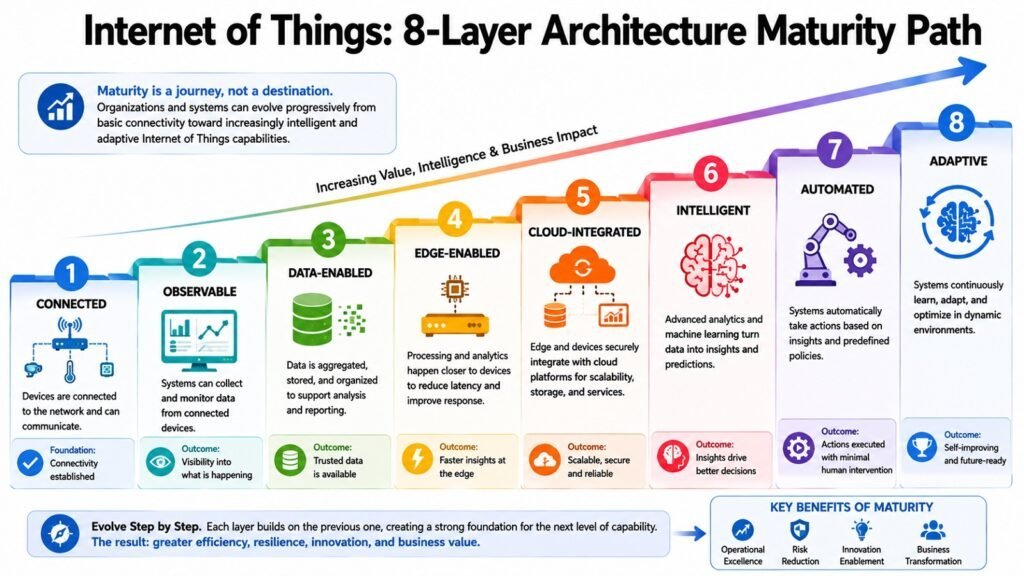
The eight layers examined in this article form a continuous architecture: physical things sense conditions, transmit data through appropriate connectivity, process information at the edge and in the cloud, extract intelligence through analytics and AI, convert insights into decisions and automated responses, and then influence the physical environment through actuation. This physical-to-digital-to-physical loop defines the Internet of Things as a computing paradigm rather than a product category, and understanding it as such provides a more durable foundation for working with these systems.
A key practical insight from this framework is that an IoT system is only as strong as its weakest layer. Poor sensing undermines data quality. Unreliable connectivity disrupts the data flow. Inadequate computing limits analytical capability. Weak intelligence produces unreliable insights. Poorly designed decision logic generates inappropriate responses. And actuation that fails safely or lacks sufficient control authority leaves the intelligence loop incomplete. Evaluating an IoT system therefore requires examining the architecture as an integrated whole, not just its most visible or technologically exciting components.
The Internet of Things continues to converge with artificial intelligence, edge computing, cloud platforms, digital twins, automation, and robotics. This convergence extends the role of connected systems well beyond original applications, enabling environments that can observe themselves, learn from operational experience, and respond with increasing precision and autonomy. Understanding the Internet of Things as a layered intelligence architecture gives practitioners, researchers, and decision-makers the most useful framework for designing, evaluating, and improving connected systems that are reshaping how the physical world is observed, managed, and controlled.
Table 10: Internet of Things Intelligence Architecture — Final Layer Reference
| Internet of Things Architecture Layer | Key Role in the Complete Intelligence Loop |
| 1. Devices & Things | Provide the physical foundation with embedded sensing and communication capability |
| 2. Sensing | Convert physical conditions into reliable, machine-readable digital measurements |
| 3. Connectivity | Transmit data between devices, edge systems, and cloud infrastructure |
| 4. Edge Computing | Process data locally for real-time response and reduced bandwidth demand |
| 5. Cloud & Data | Enable scalable storage, processing, integration, and governance of IoT data |
| 6. Intelligence | Transform data into patterns, predictions, and operationally useful insight |
| 7. Decision & Automation | Convert intelligence into defined responses, control logic, and automated action |
| 8. Actuation & Physical Integration | Execute digital decisions through physical mechanisms, closing the intelligence loop |