Table of Contents
Introduction: Internet Technology Framework and the Core Principles Behind the Modern Internet
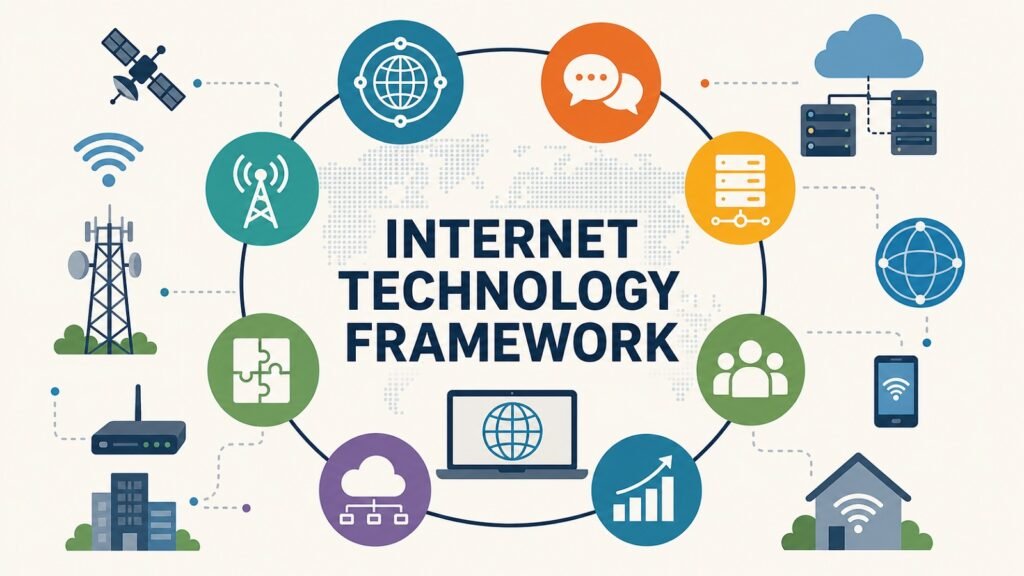
Most people associate Internet Technology with things they interact with every day. Websites, mobile apps, cloud storage, social media, and high-speed broadband. These experiences matter, but they represent only the visible surface of a far larger digital ecosystem. The infrastructure, engineering decisions, and foundational principles that make these experiences possible rarely receive the attention they deserve.
Internet Technology is not a single technology. It is a combination of interconnected systems, agreed-upon standards, distributed infrastructure, and carefully designed engineering principles. Together, these elements allow billions of people, organizations, devices, and digital services to communicate and collaborate across the world. A person sending a message from Kenya can reach a colleague in Singapore within fractions of a second. That connection is the outcome of decades of deliberate design and international cooperation.
The Internet Technology Framework is a research-based conceptual model that reveals the underlying principles responsible for global connectivity. Rather than examining individual technologies such as routers, fiber-optic cables, or cloud servers, the framework focuses on the deeper principles that make every internet-based technology possible. It presents Internet Technology as a coherent system built on ideas that reinforce one another.
This framework draws its foundations from knowledge developed by organizations such as the Internet Society, the Internet Engineering Task Force, the World Wide Web Consortium, and the Internet Corporation for Assigned Names and Numbers. The framework is an interpretation of that established body of knowledge, offering a broader conceptual perspective on how the internet works.
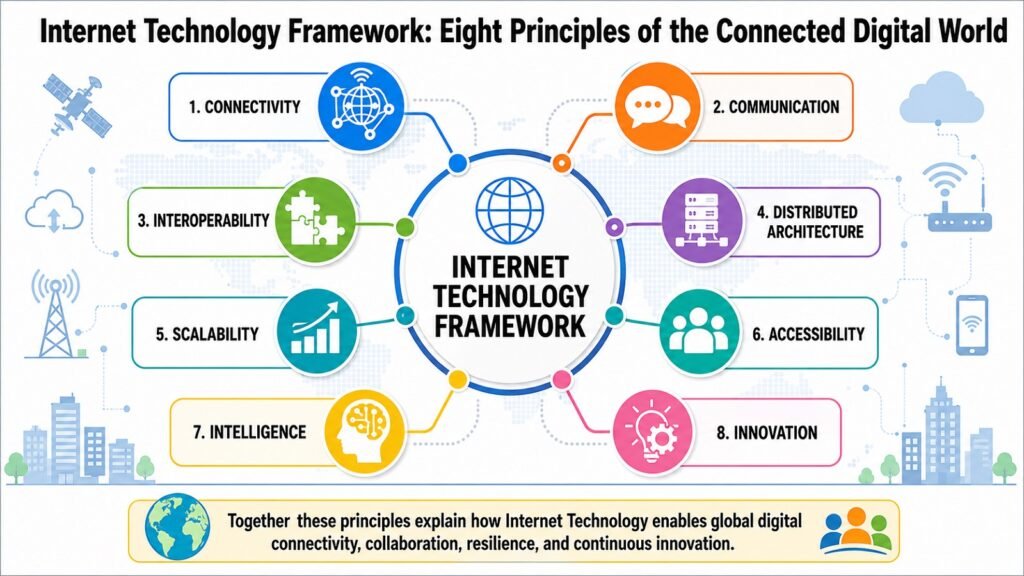
The article explores eight core principles: Connectivity, Communication, Interoperability, Distributed Architecture, Scalability, Accessibility, Intelligence, and Innovation. Each builds upon the one before it, collectively explaining how Internet Technology enables the modern digital economy.
Table: Internet Technology Framework — Eight Core Principles at a Glance
| Principle | Role Within the Internet Technology Framework |
| Connectivity | Establishes the foundational links between devices, networks, and digital systems |
| Communication | Enables reliable and standardized exchange of information across connected systems |
| Interoperability | Allows diverse technologies and platforms to work together without friction |
| Distributed Architecture | Provides resilience and fault tolerance through decentralized system design |
| Scalability | Supports continuous growth in users, devices, and data without structural breakdown |
| Accessibility | Ensures Internet Technology remains available to individuals and organizations globally |
| Intelligence | Transforms connected networks into adaptive, data-driven digital ecosystems |
| Innovation | Drives the continuous evolution of Internet Technology beyond its existing boundaries |
1. Internet Technology Framework: Connectivity as the Foundation of Digital Networks
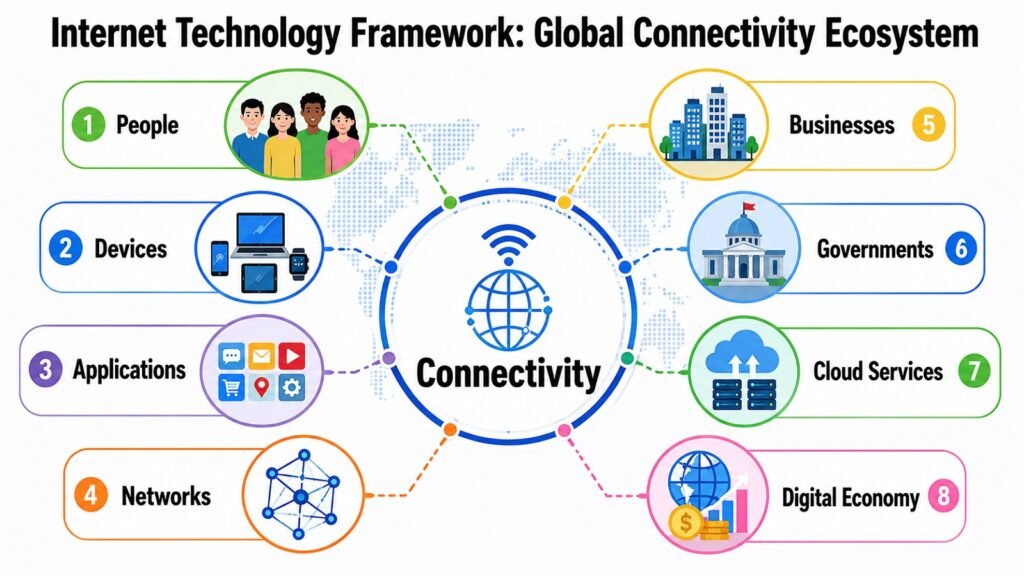
Connectivity is the first and most fundamental principle of the Internet Technology Framework. Without it, no digital interaction can occur. Before devices can exchange data, before applications can function, and before businesses can operate digitally, a reliable connection must exist. Connectivity is not simply about having an internet signal. It is about the ability of people, devices, networks, and systems to establish stable and consistent links with one another across the world.
The internet grew out of a modest experiment in connecting isolated computer networks. What began as ARPANET in the late 1960s gradually evolved into a system now reaching more than five billion users. That transformation happened because connectivity became a strategic priority. Governments, corporations, research institutions, and international organizations all invested in expanding digital connections across continents, oceans, and remote communities.
Connectivity supports digital transformation in ways that extend far beyond personal internet access. Businesses use connectivity to link global supply chains and serve customers across time zones. Hospitals in underserved regions access telemedicine platforms through connected networks. Financial institutions process millions of transactions every second over reliable connections. Without connectivity, none of these systems could operate at the scale the modern world demands.
From the perspective of the Internet Technology Framework, connectivity is the building block upon which every subsequent principle rests. The Internet Society has consistently identified connectivity as a foundational prerequisite for digital inclusion and economic participation. But connectivity alone is not enough. A connected device that cannot exchange information remains limited in its usefulness, which leads naturally to the second principle, Communication.
Table: Internet Technology Framework — Connectivity Across Industries and Digital Ecosystems
| Industry or Ecosystem | How Connectivity Supports It |
| Healthcare | Enables remote diagnostics, telemedicine platforms, and connected medical devices |
| Education | Supports online learning platforms, virtual classrooms, and digital resources |
| Finance | Powers real-time transaction processing, banking apps, and global payment networks |
| Manufacturing | Links production systems, supply chains, and industrial IoT sensors |
| Retail and E-Commerce | Connects inventory systems, payment gateways, and customer-facing platforms |
| Government Services | Enables digital public services, e-governance platforms, and citizen portals |
| Agriculture | Supports precision farming tools, connected sensors, and remote monitoring |
| Transportation | Connects navigation systems, logistics networks, and fleet management platforms |
2. Internet Technology Framework: Communication That Enables Global Information Exchange
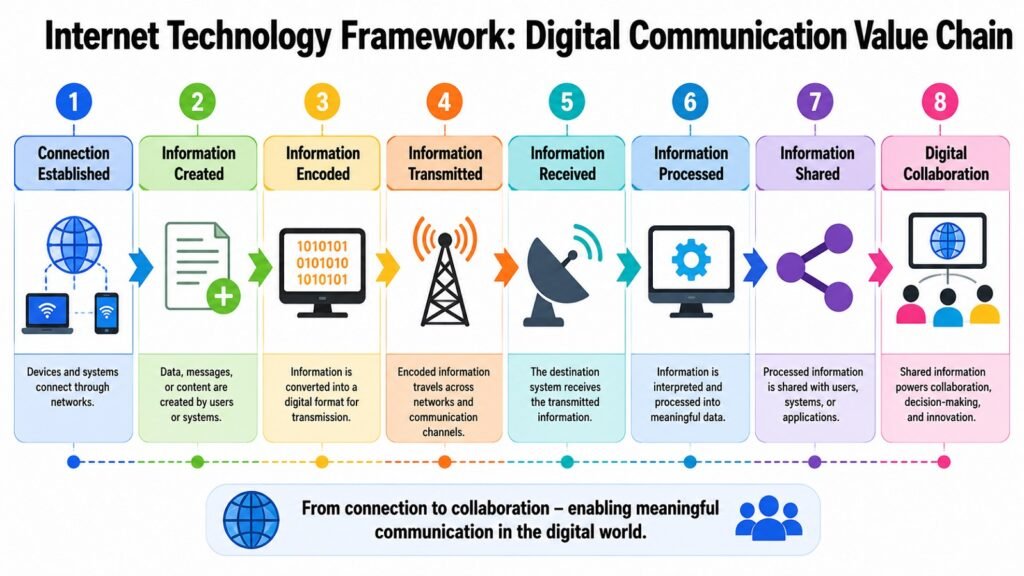
Connected systems only become valuable when they can exchange information efficiently and consistently. That is the purpose of Communication, the second principle of the Internet Technology Framework. Connectivity provides the pathways, but communication gives those pathways meaning. Without standardized methods of exchanging information, even a perfectly connected network remains little more than a collection of isolated machines.
The value of communication in Internet Technology extends well beyond simple data transfer. When communication works reliably, it enables real-time collaboration between teams in different countries. It powers financial systems that process cross-border payments in seconds. It sustains streaming platforms that deliver video to hundreds of millions of viewers. Every one of these outcomes depends on communication systems that are fast, dependable, and consistent.
Standardized communication has been a central concern of Internet Technology governance since the earliest days of the Internet. The Internet Engineering Task Force has spent decades developing technical standards governing how information travels across networks. These standards make it possible for a web browser developed by one company to communicate seamlessly with a server in a different country. That kind of exchange does not happen without deliberate standardization.
Communication facilitates the emergence of new types of digital services. Platforms for remote work, advanced customer service systems, and real-time healthcare monitoring rely on communication frameworks capable of managing substantial data volumes without latency. In the context of the Internet Technology Framework, communication is founded on connectivity and progresses towards the third principle, which is Interoperability.
Table: Internet Technology Framework — Real-World Applications Dependent on Digital Communication
| Application | Communication Requirement |
| Video Conferencing Platforms | Low-latency, high-bandwidth real-time data exchange between distributed users |
| Online Banking and Payments | Secure, fast, and verified data transfer across financial networks |
| Cloud-Based Productivity Tools | Continuous synchronization of documents and data between users and servers |
| Streaming Media Services | High-speed delivery of audio and video content to global audiences |
| E-Commerce Platforms | Reliable exchange between payment systems, inventory databases, and storefronts |
| Remote Patient Monitoring | Continuous transmission of health data from devices to clinical platforms |
| Logistics and Supply Chain Systems | Real-time data sharing between warehouses, carriers, and procurement systems |
| Smart City Infrastructure | Constant communication between sensors, control systems, and city management platforms |
3. Internet Technology Framework: Interoperability That Connects Diverse Technologies
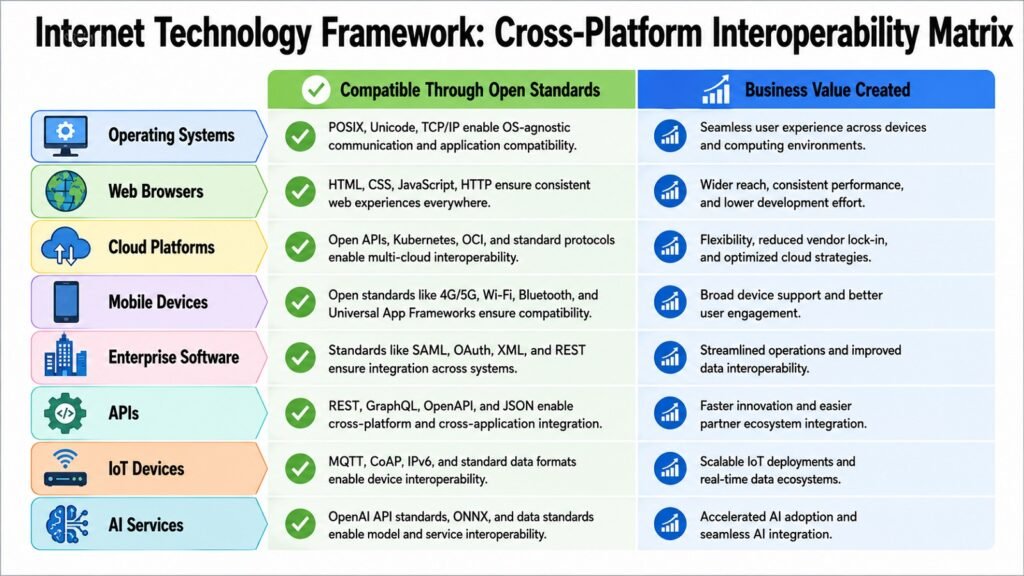
One of the most underappreciated characteristics of Internet Technology is its ability to bring together devices, platforms, systems, and applications developed independently by different organizations and make them work together as if designed as a single system. That capability is what the Internet Technology Framework identifies as Interoperability. Without it, the internet would be a fragmented collection of isolated technologies rather than the integrated global ecosystem it has become.
Interoperability matters in both practical and strategic terms. A smartphone manufactured in South Korea can access a website hosted in Germany through a browser built in the United States, and all these systems communicate seamlessly. Strategically, interoperability allows organizations to adopt new technologies without abandoning existing systems, reducing the cost of digital transformation considerably.
Open standards have been the primary mechanism through which interoperability has been achieved. The World Wide Web Consortium has developed standards governing how web content is created and delivered, ensuring that a webpage built by one developer displays consistently across different browsers. Without such standards, the web would quickly fragment into incompatible silos that serve nobody well.
Interoperability also matters in enterprise environments. Large organizations depend on systems spanning multiple vendors, cloud platforms, and data formats. The ability of these systems to share data and coordinate workflows without requiring custom integration for every connection is essential. Industries such as healthcare, logistics, and financial services have invested heavily in interoperability standards because the cost of fragmentation is too high. Interoperability becomes possible because communication already exists, and it leads naturally to the fourth principle, Distributed Architecture.
Table: Internet Technology Framework — Interoperability Across Technologies and Industries
| Technology or Industry | Interoperability Example |
| Web Browsers and Servers | Open web standards allow any browser to access any compliant website |
| Healthcare Systems | Clinical data standards allow patient records to move across different providers |
| Cloud Computing Platforms | APIs enable applications to operate across multiple cloud environments |
| Enterprise Software | Integration middleware connects ERP, CRM, and SCM systems across vendors |
| Financial Services | Payment protocols enable transactions across different banking institutions |
| Internet of Things | Shared connectivity standards allow devices from different makers to communicate |
| Mobile Applications | Cross-platform development tools allow apps to run on different operating systems |
| Smart Manufacturing | Industrial communication standards connect machines from different manufacturers |
4. Internet Technology Framework: Distributed Architecture for a Resilient Digital Ecosystem
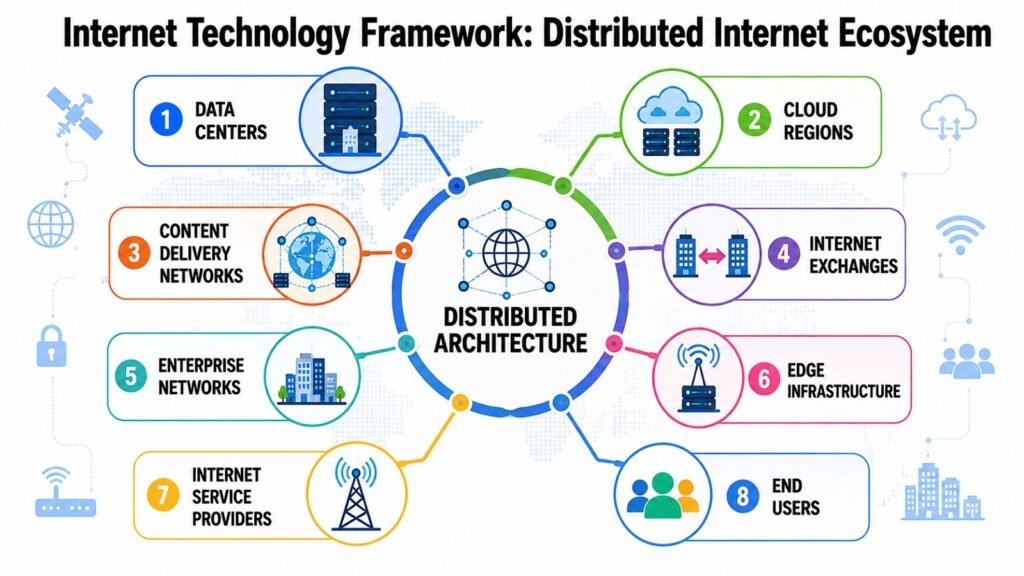
The internet was not designed to operate from a single central location. From its earliest days, the architecture of Internet Technology was deliberately decentralized. This design philosophy is what the Internet Technology Framework recognizes as Distributed Architecture, and it remains one of the most important structural principles underlying the modern Internet.
Distributed architecture means that rather than depending on a single server, data center, or control point, the internet functions as a network of interconnected and independent systems. If one part of the network fails, traffic is automatically rerouted through other available paths. This creates resilience and fault tolerance that centralized systems cannot match. The original ARPANET was built partly with this principle in mind, because its creators wanted a network that could survive disruptions to individual nodes.
Today, distributed architecture appears throughout Internet Technology. The Domain Name System operates through a distributed hierarchy of servers maintained across dozens of countries. Content delivery networks used by companies such as Akamai, Cloudflare, and Amazon Web Services place web content close to end users around the world, reducing delays and improving reliability.
The business case for distributed architecture is compelling. Organizations that rely on centralized infrastructure face significant risks, including geographic bottlenecks and catastrophic single points of failure. Distributed systems spread these risks across multiple locations, making digital services more reliable and easier to scale. Industry analysts consistently note that outages in centralized systems can cost large enterprises millions of dollars per hour. Within the Internet Technology Framework, distributed architecture provides the structural foundation for the fifth principle, Scalability.
Table: Internet Technology Framework — Benefits of Distributed Architecture in Modern Internet Technology
| Benefit | How Distributed Architecture Delivers It |
| Fault Tolerance | Routes traffic around failed nodes, preventing total system outages |
| Geographic Redundancy | Maintains service availability even when regional infrastructure is disrupted |
| Reduced Latency | Serves content from servers that are physically close to end users |
| Load Distribution | Spreads traffic across multiple systems to prevent overloading any single resource |
| Data Sovereignty | Enables organizations to store data in specific geographic jurisdictions |
| Disaster Recovery | Allows systems to restore operations quickly using distributed backups |
| Horizontal Scaling | Adds new nodes to expand capacity without redesigning the entire system |
| Security Isolation | Limits the impact of a security breach by separating system components |
5. Internet Technology Framework: Scalability That Supports Global Digital Growth
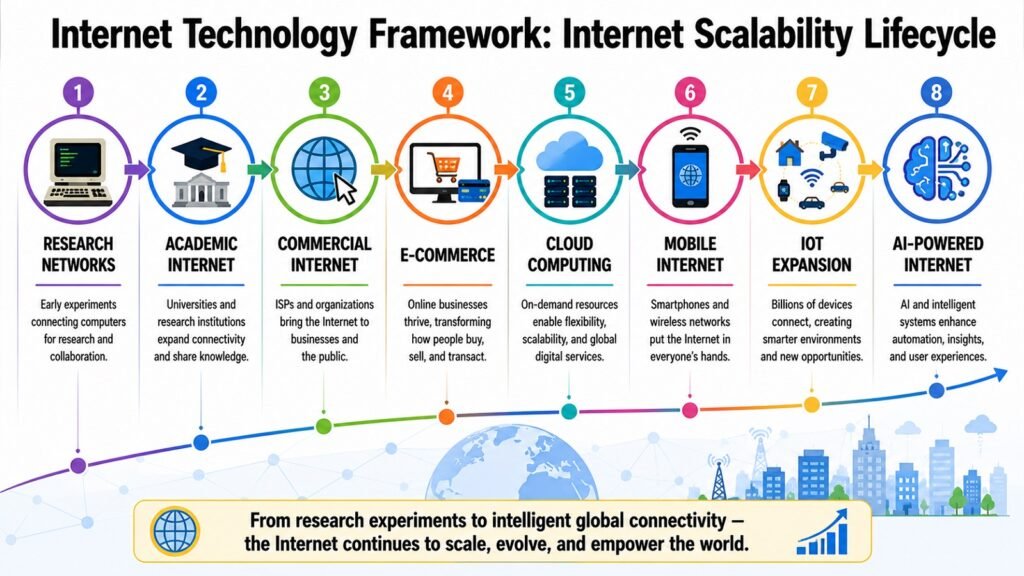
When the internet was first established, it connected a handful of research institutions. Today it supports more than five billion users and an estimated fifteen to twenty billion connected devices. That transformation happened because the Internet Technology Framework was built around Scalability, which allows the Internet to grow continuously without requiring fundamental changes to its structure.
Scalability means that a system can accommodate increasing workloads, users, and data volumes without collapsing under pressure. In Internet Technology, this operates at multiple levels. Cloud computing platforms allow organizations to increase or decrease computational resources on demand. Internet service providers continuously add network capacity to support growing traffic. Modern software architectures handle millions of concurrent users without significant degradation in performance.
The commercial internet depends on scalability in ways that are difficult to overstate. When a global sporting event draws a billion viewers to a streaming platform, that platform must serve content reliably under extreme demand. Cloud providers such as Amazon Web Services, Microsoft Azure, and Google Cloud have built their business models around delivering elastic, on-demand scalability to organizations of every size.
Scalability also matters for emerging technologies. As artificial intelligence, the Internet of Things, and smart city infrastructure generate increasingly large volumes of data, the Internet must accommodate that growth without structural failure. Within the Internet Technology Framework, large-scale growth creates the need for the sixth principle, Accessibility. As capacity expands, the question of who can actually participate in that ecosystem becomes central.
Table: Internet Technology Framework — Real-World Scalability Across Industries and Digital Services
| Service or Industry | Example of Scalability in Action |
| Cloud Computing | Elastic resource provisioning allows workloads to scale up or down on demand |
| Streaming Platforms | Infrastructure scales dynamically to serve millions of simultaneous viewers |
| E-Commerce | Systems absorb sudden traffic surges during sales events without downtime |
| Financial Services | Payment networks handle billions of transactions daily across global markets |
| Social Media | Platforms support billions of active users generating continuous data streams |
| Telecommunications | Network capacity expands continuously to meet growing data consumption |
| Healthcare Technology | Telehealth platforms scale to serve millions of patients during peak demand |
| Smart City Systems | Connected infrastructure grows to incorporate new sensors and data sources |
6. Internet Technology Framework: Accessibility That Expands Digital Inclusion
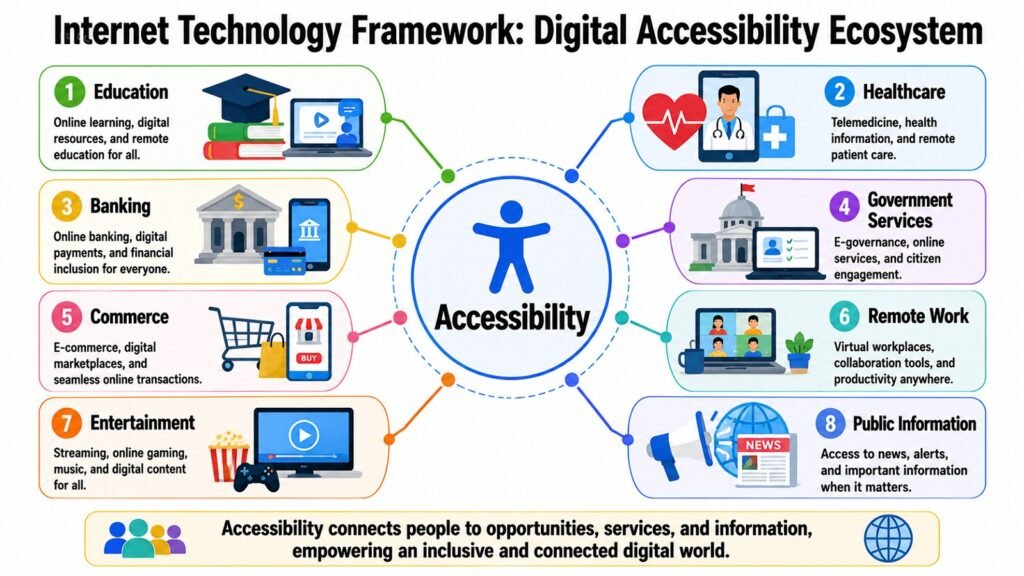
Scalability ensures that Internet Technology can grow to serve more people, but it does not guarantee that those people can actually participate. That is the role of Accessibility, the sixth principle of the Internet Technology Framework. Accessibility ensures that Internet Technology remains available and usable for individuals, businesses, governments, and communities regardless of their location, income level, or device type.
True accessibility means that a student in a rural community can access the same quality of content as a student in a major city. It means that a small business owner in a developing economy can use the same e-commerce tools as a larger competitor. It means that a person with a disability can navigate digital platforms as effectively as anyone else. Each of these outcomes requires deliberate investment in technology and design.
The growth of internet access has emerged as one of the most important advancements over the last thirty years. The International Telecommunication Union has recorded the correlation between internet availability and factors such as economic growth, educational success, and healthcare results. Nations that have committed resources to broadband development have experienced significant gains in productivity. Conversely, communities lacking dependable internet access are encountering increasing challenges in a progressively digital economy.
Accessibility also encompasses the design of digital platforms. The World Wide Web Consortium (W3C) has developed web accessibility guidelines encouraging developers to create content usable by people with different abilities, including those who rely on screen readers or voice navigation. Within the Internet Technology Framework, accessibility transforms Internet Technology into a genuinely global platform, leading to the seventh principle, Intelligence.
Table: Internet Technology Framework — Accessibility Benefits Across Sectors and User Groups
| Sector or User Group | How Accessibility Expands Digital Inclusion |
| Rural Communities | Broadband expansion connects remote populations to education and commerce |
| Small and Medium Businesses | Low-cost cloud tools give smaller organizations enterprise-grade capabilities |
| People With Disabilities | Web accessibility standards ensure digital platforms are navigable for all users |
| Students and Educators | Online learning platforms make quality education available beyond physical schools |
| Elderly Populations | Simplified digital interfaces and voice tools improve technology adoption |
| Developing Economies | Mobile internet access expands financial inclusion and e-commerce participation |
| Public Health Services | Digital platforms extend the reach of healthcare to underserved communities |
| Government and Citizens | E-government platforms make public services accessible without physical visits |
7. Internet Technology Framework: Intelligence Driving Smarter Digital Ecosystems
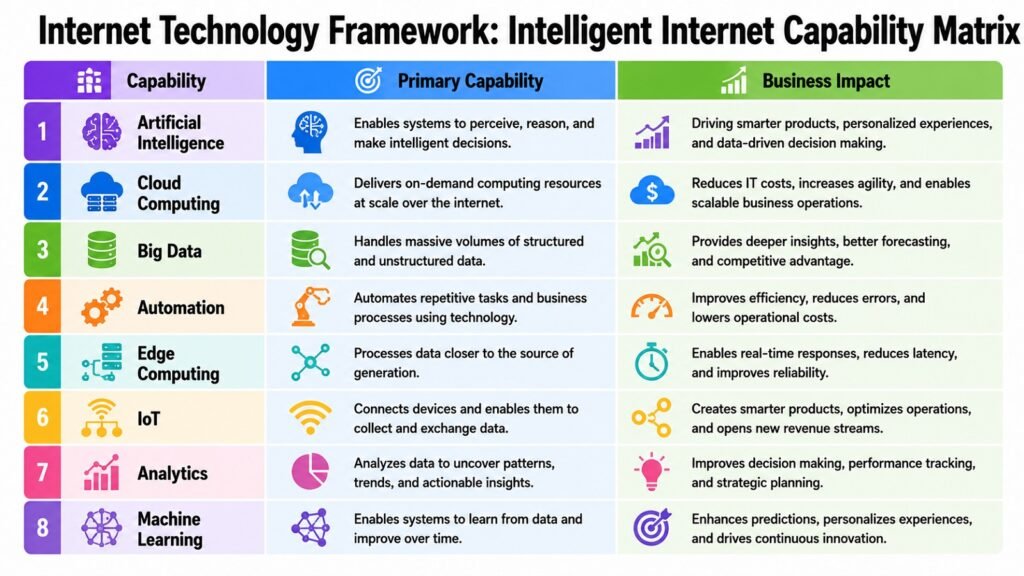
The internet began as a tool for sharing information between machines. Over time, it evolved into something considerably more sophisticated. The modern internet does not simply transmit data. It analyzes that data, learns from it, and uses it to support better decisions in real time. That evolution is what the Internet Technology Framework calls Intelligence.
Intelligence refers to the integration of artificial intelligence, machine learning, automation, data analytics, and edge computing into the fabric of Internet Technology. These capabilities allow digital systems to move beyond passive data transfer toward active interpretation and decision-making. A recommendation algorithm that suggests a relevant product to a shopper is intelligence in action. So is a fraud detection system that flags a suspicious transaction within milliseconds, or a predictive maintenance platform that alerts a manufacturer before equipment fails.
Cloud computing has been the primary enabler of intelligence at scale. Platforms such as Amazon Web Services, Google Cloud, and Microsoft Azure provide the computational power that allows organizations of every size to deploy intelligent applications. Analyzing large datasets and delivering intelligent outcomes through internet-connected services has transformed what is possible across every industry.
Edge computing has extended intelligence further by moving data processing closer to where data is generated. Rather than sending information to a distant data center, edge computing allows analysis to happen locally, reducing latency. This enables intelligence in environments where speed matters most, including autonomous vehicles and real-time medical monitoring. Within the Internet Technology Framework, intelligence continuously generates new opportunities and leads naturally to the final principle, Innovation.
Table: Internet Technology Framework — Intelligent Technologies and Services in the Modern Internet
| Technology or Service | Role of Intelligence Within Internet Technology |
| Recommendation Engines | Analyze user behavior to deliver personalized content and product suggestions |
| Fraud Detection Systems | Use machine learning to identify unusual patterns in financial transactions |
| Predictive Maintenance | Monitor equipment data to anticipate failures before they cause disruptions |
| Natural Language Processing | Powers chatbots, virtual assistants, and automated content analysis |
| Smart Traffic Management | Uses real-time data to optimize traffic flow and reduce urban congestion |
| Healthcare Diagnostics | Applies AI to imaging and patient data for faster and more accurate diagnoses |
| Automated Customer Service | Handles routine customer interactions through intelligent virtual agents |
| Energy Grid Optimization | Uses data analytics to balance electricity supply and demand in real time |
8. Internet Technology Framework: Innovation That Shapes the Future of the Internet
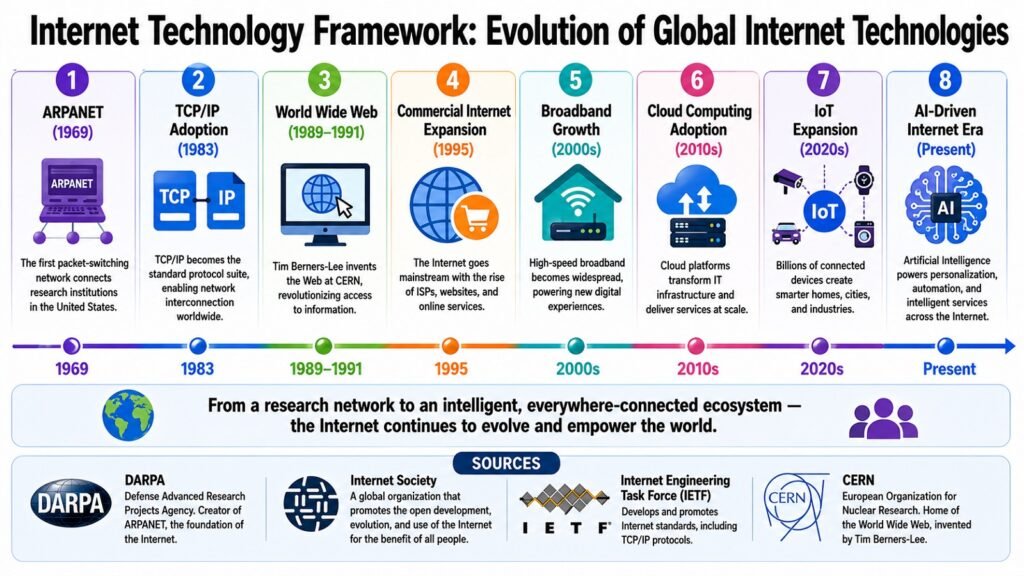
The Internet Technology Framework is not a static model. It is a living system of principles that continues to evolve as new technologies emerge and as the global digital economy expands. The force that sustains this evolution is Innovation, the eighth and final principle of the Internet Technology Framework.
Innovation in Internet Technology does not replace the principles that came before it. It builds upon them. The advances in cloud computing that transformed how businesses operate were made possible by distributed architecture and scalability principles that preceded them. The breakthroughs in artificial intelligence reshaping industries depend on the connectivity, communication, and intelligence principles that created the conditions for those breakthroughs. Every wave of innovation extends the framework rather than abandoning it.
The areas reshaping Internet Technology today are numerous. The global rollout of fifth-generation wireless networks is dramatically expanding connectivity speed and capacity. Quantum computing research may eventually transform how encryption and data processing work. The continued maturation of artificial intelligence is creating new possibilities for automation and decision-making across virtually every sector. Cybersecurity innovation is developing new approaches to protecting digital systems against increasingly sophisticated threats.
Edge computing, digital twin technology, expanding Internet of Things, and blockchain-based systems for secure data management are all active areas of innovation. These are not isolated experiments. They are extensions of the same foundational principles that have guided Internet Technology since its earliest days, demonstrating that the eight principles form a reinforcing cycle in which each strengthens the others.
Table: Internet Technology Framework — Examples of Ongoing Innovation in Internet Technology
| Innovation Area | How It Extends the Internet Technology Framework |
| Fifth-Generation Wireless Networks | Dramatically increases connectivity speed and reduces network latency |
| Quantum Computing Research | Explores new approaches to encryption, processing, and data security |
| Artificial Intelligence Integration | Expands the intelligent capabilities of internet-connected systems and services |
| Edge Computing Deployment | Moves data processing closer to end users for faster and more localized responses |
| Blockchain Technology | Provides decentralized and transparent frameworks for secure data management |
| Digital Twin Technology | Creates virtual replicas of physical systems for monitoring and optimization |
| Extended Reality Platforms | Develops new immersive digital environments built on internet infrastructure |
| Green Internet Initiatives | Innovates toward more energy-efficient data centers and network operations |
Conclusion: Internet Technology Framework as the Blueprint for the Connected Digital World
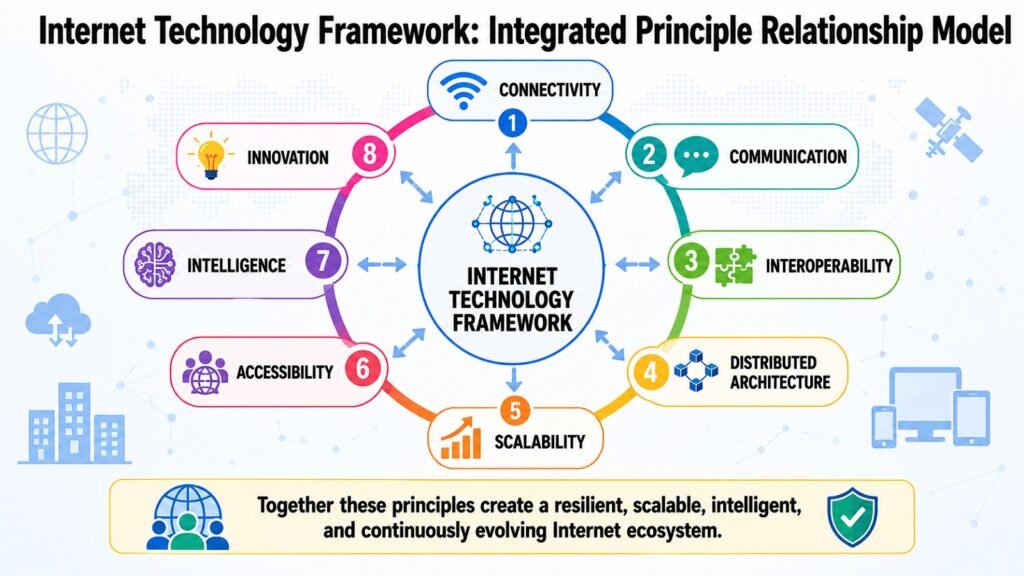
The Internet Technology Framework offers a way of understanding Internet Technology that goes beyond the hardware and software most people encounter every day. By focusing on eight interconnected principles, the framework reveals the deeper logic that holds the modern internet together and explains why it continues to evolve even as specific technologies change.
Connectivity establishes the links that make everything else possible. Communication transforms those links into productive information exchange. Interoperability ensures that diverse technologies can participate in that exchange. Distributed architecture makes the system resilient. Scalability allows it to grow without breaking. Accessibility ensures that growth reaches communities everywhere. Intelligence makes the system adaptive. Innovation keeps the framework moving forward without abandoning the principles that gave it strength.
These eight principles are not independent features. They are deeply interconnected, and each one depends on the others. Removing or weakening any single principle reduces the effectiveness of all the rest. That interdependence is precisely what makes the framework meaningful as a model for understanding the modern internet.
The world will keep changing. New technologies will emerge, and new challenges will surface. But this framework provides a stable foundation for understanding those changes, grounded in principles that have guided the Internet since its inception.
Table: Internet Technology Framework — Contribution of Each Principle to the Framework
| Principle | Contribution to the Internet Technology Framework |
| Connectivity | Provides the foundational links that enable all other principles to function |
| Communication | Enables meaningful and standardized information exchange across connected systems |
| Interoperability | Allows independently developed technologies to work together as a unified ecosystem |
| Distributed Architecture | Ensures the system remains resilient, fault-tolerant, and geographically adaptable |
| Scalability | Allows continuous growth in users, data, and services without structural collapse |
| Accessibility | Expands participation in Internet Technology across all regions and user groups |
| Intelligence | Transforms passive data networks into adaptive, decision-capable digital ecosystems |
| Innovation | Continuously extends the capabilities and relevance of the Internet Technology Framework |