Table of Contents
Introduction: Understanding Lead Generation as a Core Marketing Discipline
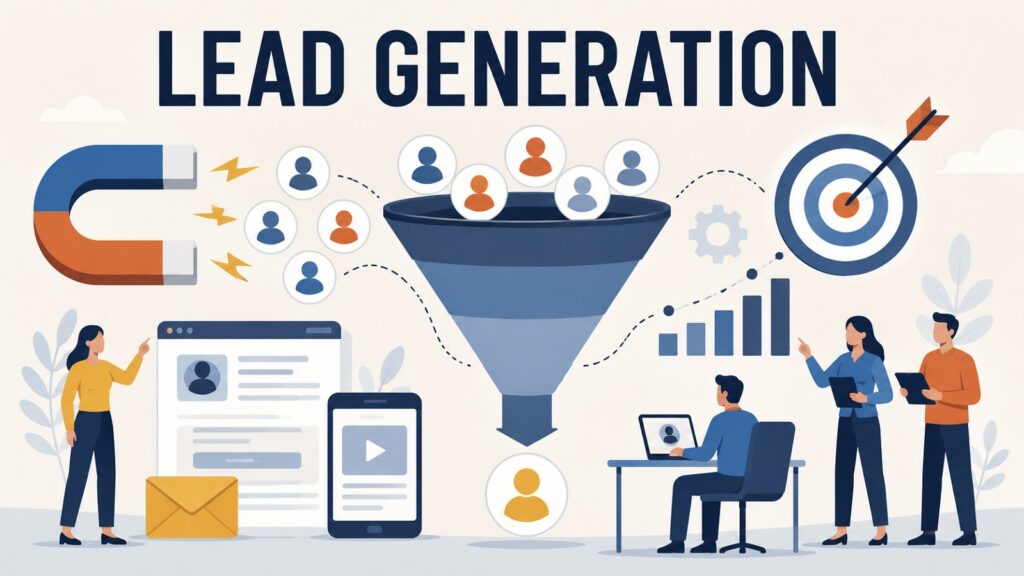
Every business faces the same fundamental challenge: how do you turn a stranger into a customer? The answer starts with lead generation, and it sits at the heart of modern marketing. Lead generation is an important aspect of marketing because it acts as the engine that converts awareness and interest into qualified business opportunities. Without it, marketing builds recognition but no pipeline. Sales teams stay busy without direction. Revenue stalls.
Marketing creates visibility. It attracts audiences and earns attention across channels. But attention alone does not pay salaries. Lead generation is the bridge between a curious visitor and a genuine business conversation. It identifies who is interested, captures their information, qualifies their intent, and prepares them for the sales process.
The customer acquisition journey follows a clear progression. Visitors arrive without declaring any intention. Some become prospects once they show behavioral interest. A prospect becomes a lead when they share contact details. A lead becomes a marketing-qualified lead when their profile suggests a reasonable fit with the offer. That lead becomes a sales-qualified lead when timing, authority, and budget are confirmed. The resulting customer then generates long-term revenue.
Organizations across industries invest heavily in structured lead generation systems because growth cannot rely on chance encounters. The global lead generation market is projected to reach $15.55 billion by 2031, growing at around 17.5 percent annually. More than half of all marketers allocate at least half their budget to lead generation. These numbers reflect the commercial weight this discipline carries.
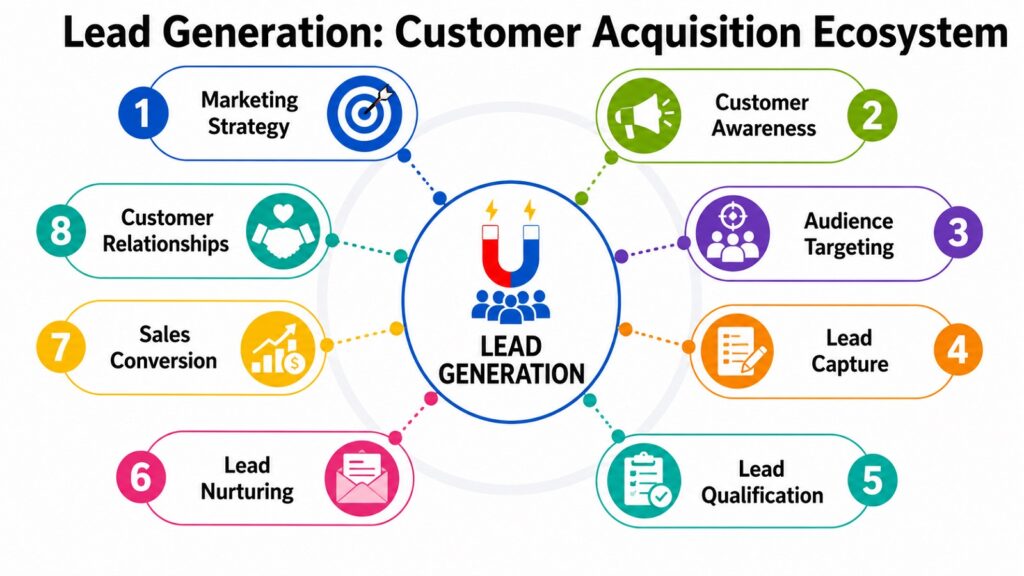
This article explores eight foundations of effective lead generation: strategy, channels, capture techniques, qualification, nurturing, performance measurement, common challenges, and how different business models apply these principles in different ways.
Table: Eight Foundations of Lead Generation at a Glance
| Foundations | Core Purpose |
| Lead Generation Strategy | Establishing direction for sustainable customer acquisition |
| Lead Generation Channels | Reaching qualified prospects across multiple platforms |
| Lead Capture Techniques | Converting visitor interest into identifiable contacts |
| Lead Qualification and Scoring | Prioritizing leads with the highest conversion potential |
| Lead Nurturing and Relationship Development | Building trust and guiding prospects toward purchase decisions |
| Measuring Lead Generation Performance | Evaluating marketing effectiveness with meaningful metrics |
| Challenges and Best Practices | Addressing common obstacles that reduce lead quality |
| Across Different Business Models | Adapting proven principles to diverse market environments |
1. Lead Generation Strategy: Building the Foundation for Customer Acquisition
Most organizations treat lead generation as a set of tactics. They run a campaign, collect some names, and pass them to sales. When results disappoint, they run another campaign. The ones that break free from that cycle almost always share one trait: they start with a strategy.
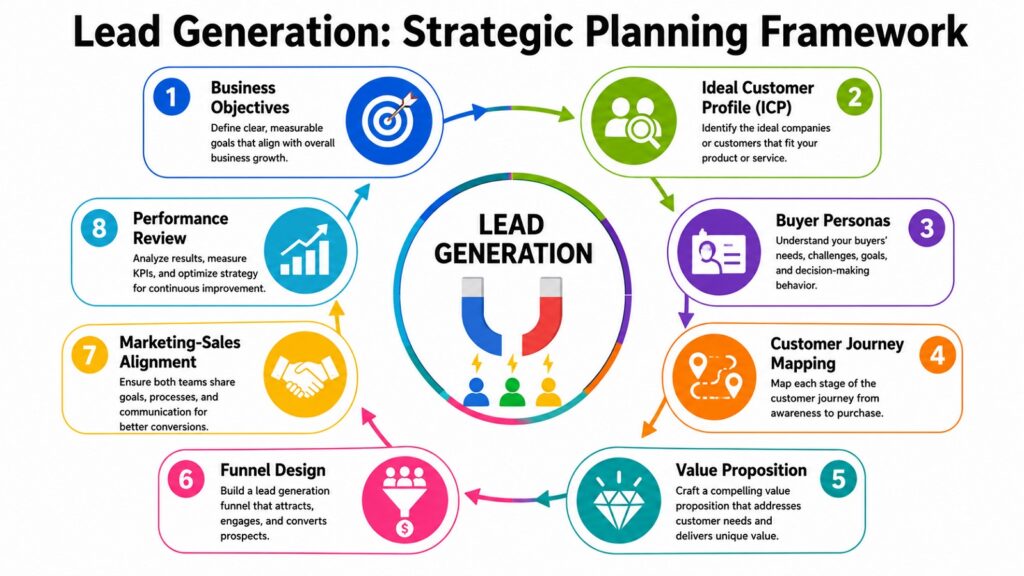
A lead generation strategy establishes the long-term direction for acquiring qualified customers. It begins with concrete business objectives. Not aspirations like generating more leads but specific targets such as reducing cost per lead by 20 percent within two quarters or raising the proportion of marketing-qualified leads to 40 percent of all contacts captured. Without that clarity, there is no way to measure progress or adjust course.
From there, strategy focuses on defining the Ideal Customer Profile. An ICP describes the type of organization or individual most likely to benefit from the product and become a profitable, loyal customer. Alongside the ICP, buyer personas capture the human dimension: the decision-maker’s role, concerns, and information habits. These tools prevent the common mistake of targeting everyone instead of the right people.
Customer journey mapping connects ICP knowledge to marketing execution. It traces the stages a buyer passes through from first recognizing a problem to making a purchase, identifying what information and reassurance they need at each step. A value proposition must address each of those stages rather than delivering a single generic pitch.
Research from SiriusDecisions found that organizations with tightly aligned marketing and sales strategies achieve up to 24 percent faster revenue growth over three years. A mid-sized software company that shifted from broad digital advertising to account-based marketing built around a narrow ICP saw its lead-to-opportunity conversion rate rise from 8 percent to 19 percent within twelve months. The change was not in the budget. It was in strategic clarity about who they were actually trying to reach.
Before choosing any channel or building any landing page, answer three foundational questions: who is the ideal customer, what problem does the business solve for them, and what does a qualified lead look like in specific terms? Those answers make every subsequent decision more precise.
Table: Lead Generation Strategy — Key Planning Elements
| Planning Element | Business Purpose |
| Business Objectives | Define specific, measurable lead generation targets |
| Ideal Customer Profile (ICP) | Identify the customer type most likely to convert and retain |
| Buyer Personas | Capture decision-maker motivations and information needs |
| Customer Journey Mapping | Trace buyer stages from awareness to purchase decision |
| Value Proposition | Articulate why the offer matters to each target segment |
| Marketing-Sales Alignment | Ensure shared definition of lead quality and handoff process |
| Funnel Planning | Design acquisition steps from top-of-funnel to close |
| Budget Allocation | Distribute resources based on channel performance and priorities |
2. Lead Generation Channels: Reaching the Right Audience Effectively
Choosing the right lead generation channels is not about being everywhere. It is about being where your buyers actually look when they have a problem worth solving. Many organizations waste significant budget by choosing channels based on popularity rather than audience behavior.
Search engines remain one of the most powerful lead generation channels because they capture demand rather than create it. A prospect typing a specific query has already identified a need. According to industry research, leads generated through organic search close at a rate of 14.6 percent, compared to 1.7 percent for outbound methods. In 2023, 61 percent of marketers identified SEO as their most effective lead generation channel.
Content marketing works alongside search. Companies that maintain active blogs generate up to 13 times more leads than those that do not, according to HubSpot research. Email marketing delivers the strongest return of any channel, averaging $36 returned for every dollar spent. It remains the most widely used channel for lead generation, with 78 percent of companies relying on it.
Social media channels require more nuance. LinkedIn generates 80 percent of B2B leads sourced through social media, making it indispensable for professional services and enterprise markets. Facebook and Instagram serve B2C markets more effectively, particularly with precise audience targeting. Webinars are especially productive in B2B contexts. Around 73 percent of B2B marketers say webinars are among the most effective tools for generating quality leads.
Paid advertising allows faster results at a higher cost. The average B2B inbound cost per lead sits around $205, compared to $450 for outbound channels, making channel mix decisions financially significant.
The channel selection decision should always begin with audience behavior and work backward to execution. A manufacturing buyer reads trade publications and attends industry exhibitions. A software buyer searches comparison sites online. Neither audience responds well to the other’s preferred channel.
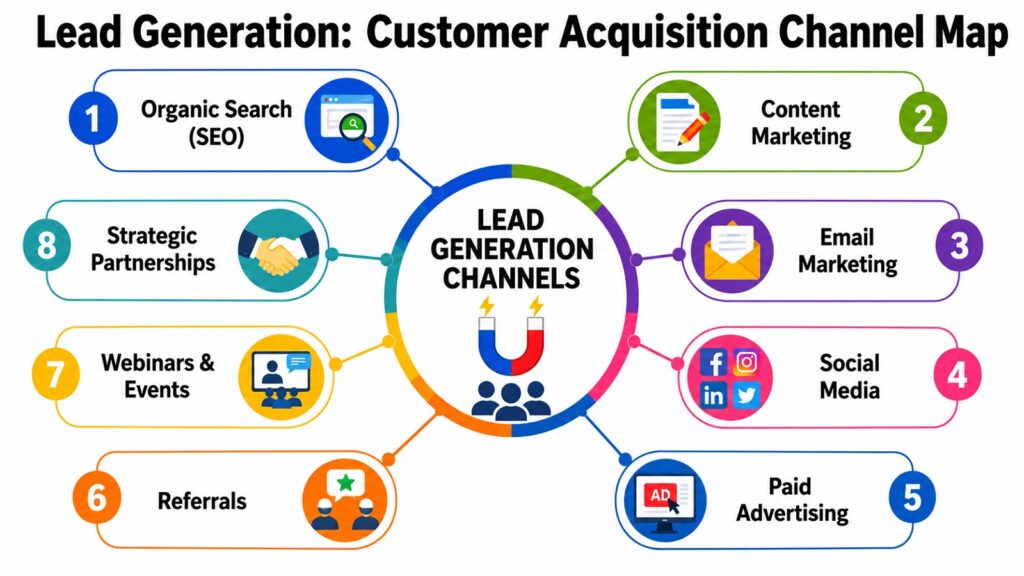
Table: Lead Generation Channels and Their Primary Purpose
| Channel | Primary Lead Generation Purpose |
| Organic Search (SEO) | Attract prospects actively searching for relevant solutions |
| Content Marketing | Build trust and draw qualified audiences through educational resources |
| Email Marketing | Nurture prospects and convert engaged contacts into leads |
| Generate professional and B2B leads through targeted outreach | |
| Paid Search (PPC) | Capture high-intent buyers with measurable spend control |
| Webinars and Events | Engage prospects with valuable knowledge and qualify by attendance |
| Referral Programs | Acquire high-trust leads through existing customer networks |
| Social Media Advertising | Reach targeted consumer segments with visual and direct-response content |
3. Lead Capture Techniques: Converting Interest into Qualified Leads
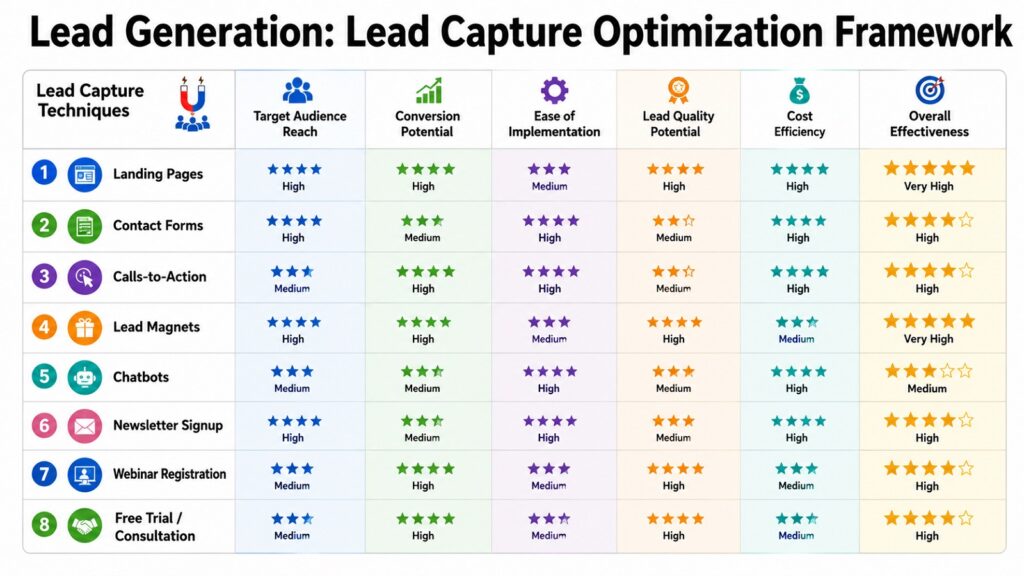
Attracting traffic solves only part of the lead generation problem. The harder challenge is whether that traffic does something useful once it arrives. Lead capture techniques transform anonymous visitors into identifiable prospects, and this transition is one of the most critical steps in the entire process.
A landing page dedicated to a single offer consistently outperforms a general homepage for capture purposes. Unlike a homepage that serves many audiences and intentions, a landing page focuses everything on one action. Pages with a single clear call-to-action outperform those with multiple competing options. The design, headline, and form all work toward one goal.
The length of a form has a considerable impact on completion rates. A form that requests only a name and email address yields much higher completion rates compared to one that asks for company size, revenue, role, and phone number. The key principle is to request only the information that is truly necessary at that particular stage. Additional information can be collected later through the method of progressive profiling.
Lead magnets are among the most reliable capture tools. A lead magnet offers valuable content in exchange for contact information: industry reports, templates, checklists, calculators, or webinar access. The exchange works when the perceived value of the resource matches the perceived cost of sharing personal information.
Chatbots have grown significantly as capture tools. A chatbot that asks qualifying questions and routes visitors to the right resource can capture leads around the clock without human involvement. Conversion rates through chat interactions tend to be higher because the experience feels immediate and personal compared to filling out a static form.
Free trials serve as capture mechanisms in software and service markets. Companies using free trials report significantly higher close rates because starting a trial reveals genuine purchase intent. The psychological principle behind effective capture is reciprocity. When an organization provides something useful without asking for payment, prospects feel a natural inclination to engage further.
Table: Lead Capture Techniques and Their Primary Purpose
| Technique | Primary Purpose |
| Dedicated Landing Pages | Focus visitor attention on a single conversion action |
| Lead Magnets | Offer valuable resources in exchange for contact information |
| Web Forms | Collect visitor details with minimal friction |
| Free Trials | Demonstrate product value while capturing high-intent leads |
| Chatbots and Live Chat | Engage visitors in real time and qualify them immediately |
| Webinar Registration | Capture engaged leads willing to invest time in learning |
| Newsletter Subscriptions | Build long-term contact lists from interested audiences |
| Consultation Offers | Convert research-stage visitors into qualified appointments |
4. Lead Qualification and Scoring: Prioritizing High-Value Lead Generation Opportunities
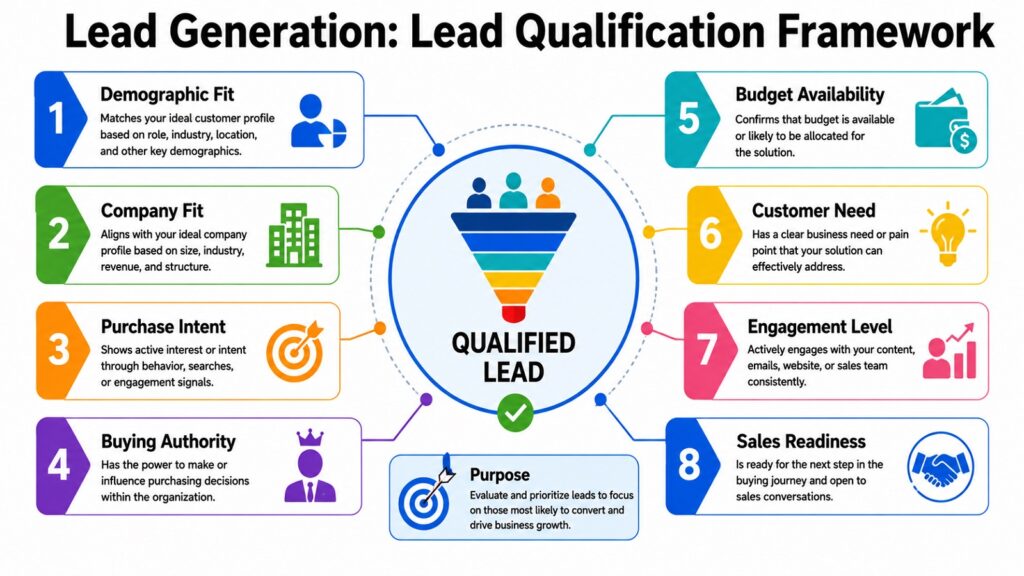
Not every lead deserves equal attention. This is one of the most important and most overlooked realities in lead generation. Organizations that treat every contact as equally valuable end up overwhelming sales teams with low-potential names while genuine opportunities age without follow-up. Lead qualification and scoring exist to solve that problem.
Qualification separates contacts into meaningful categories. A marketing-qualified lead meets behavioral and demographic criteria suggesting readiness for deeper engagement. A sales-qualified lead has been evaluated by a salesperson who confirms that timing, authority, and budget align. A product-qualified lead has taken a specific product action, such as reaching a usage threshold in a free trial, that signals real purchase intent.
Lead scoring assigns numerical values to behaviors and attributes. Behavioral indicators include downloading a resource, attending a webinar, visiting a pricing page, or opening a series of emails. Demographic indicators include job title, company size, and industry. A prospect who is a VP of operations at a mid-sized company and has visited the pricing page three times in one week scores higher than someone who downloaded a general guide with no return activity.
Qualification frameworks like BANT (Budget, Authority, Need, Timing) and CHAMP (Challenges, Authority, Money, Prioritization) provide structured criteria for sales teams to evaluate leads in conversation. BANT was originally developed by IBM. CHAMP reflects a buyer-centric approach that starts with the customer’s challenge rather than the seller’s checklist.
Research from Forrester found that organizations with mature lead management processes achieve 50 percent more sales-ready leads at 33 percent lower cost. A technology firm that shifted from volume-based collection to a scoring model found that its close rate on qualified meetings nearly doubled. By focusing on leads above a defined score threshold, the team spent less time on calls that went nowhere.
The broader lesson is that lead generation success depends not just on volume but on the quality of evaluation that follows. A thousand poorly qualified leads cost more to process than a hundred well-qualified ones and produce far less revenue.
Table: Lead Qualification Criteria and Their Scoring Relevance
| Qualification Factor | What It Reveals About Lead Quality |
| Job Title and Authority | Whether the contact has decision-making power |
| Company Size and Industry | Fit with the Ideal Customer Profile |
| Budget Indicators | Financial capacity to make a purchasing decision |
| Behavioral Engagement | Level of genuine interest shown through digital actions |
| Timing and Purchase Intent | Whether a buying decision is actively being considered |
| Product or Trial Usage | Depth of engagement that predicts purchase likelihood |
| Geographic Fit | Alignment with service delivery or regulatory requirements |
| Content Consumption Pattern | Stage in the buying journey based on resource types accessed |
5. Lead Nurturing and Relationship Development: Strengthening Lead Generation Success
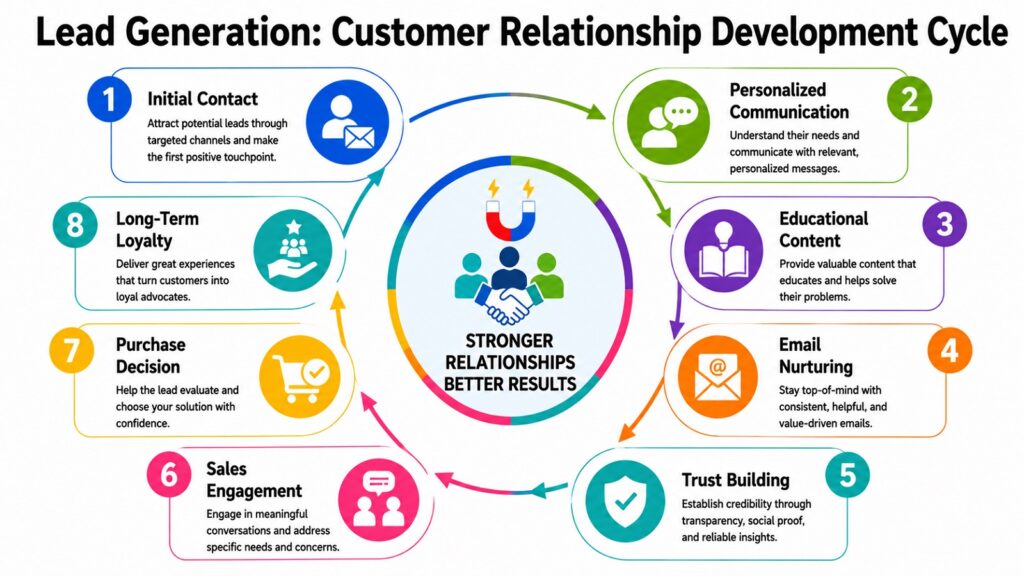
Most buyers are not ready to purchase the moment they first appear in a funnel. Only 27 percent of B2B leads are sales-ready at the time of generation. The rest require continued engagement and education before making a commitment. Lead nurturing is the discipline that manages this period productively rather than letting those prospects go cold.
Nurturing begins with understanding where a prospect sits in their journey. Someone who just downloaded an introductory guide needs different communication than someone who has attended two webinars and visited a pricing page. Personalized emails convert 29 percent more leads into customers than untargeted alternatives. The difference is relevance.
Email sequences built around educational content represent the backbone of most nurturing programs. A well-structured sequence might start with a welcome message, follow with a case study showing how similar organizations solved the same problem, and then offer a demonstration once sufficient engagement has been recorded. The goal is to deliver value before asking for a commitment.
Marketing automation platforms make this practical at scale. Tools like HubSpot, Marketo, and Salesforce Marketing Cloud trigger personalized sequences based on specific behaviors rather than time alone. If a prospect revisits a pricing page, the automation fires a different message than if they simply opened an email. Companies using marketing automation have reported a 451 percent increase in qualified leads over time.
CRM systems play a parallel role by ensuring that a prospect’s history is visible to both marketing and sales teams. Without a shared record, sales representatives repeat conversations prospects have already had, which erodes trust and wastes time.
Marketo’s own growth demonstrated this principle. By educating marketers about automation concepts before promoting its platform, it converted a broad audience of curious practitioners into qualified buyers who already understood the product’s value. The longer the buying cycle, the more important nurturing becomes. Customer lifetime value rises significantly when relationships are built on genuine helpfulness rather than transactional pressure.
Table: Lead Nurturing Practices and Their Business Objective
| Nurturing Practice | Business Objective |
| Personalized Email Sequences | Deliver relevant content based on buyer stage and behavior |
| Educational Content Delivery | Build authority and trust before making a sales request |
| Marketing Automation Workflows | Scale personalized engagement across large contact volumes |
| CRM Integration | Maintain a complete prospect history visible to all teams |
| Behavioral Trigger Responses | React to specific actions with timely, relevant follow-up |
| Sales and Marketing Alignment | Ensure consistent messaging across the entire buyer journey |
| Re-engagement Campaigns | Reactivate dormant leads with updated value propositions |
| Multi-touch Communication | Maintain visibility across email, social, and direct outreach |
6. Measuring Lead Generation Performance: Evaluating Marketing Success
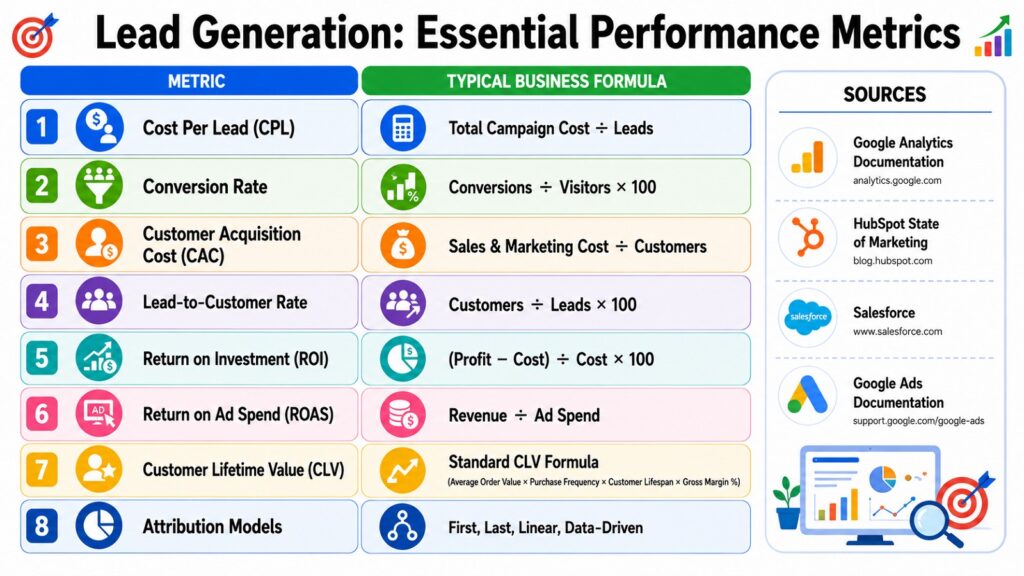
Generating leads without measuring results is like navigating without a compass. Organizations that rely on instinct rather than data tend to repeat the same mistakes, overspend on underperforming channels, and miss the signals that indicate where real opportunity lies. Measurement transforms lead generation from guesswork into a managed process.
Cost per lead calculates total marketing spend divided by the number of leads generated over the same period. A rising cost per lead without a corresponding rise in lead quality suggests either wasted spend or declining channel effectiveness. The average B2B inbound cost per lead sits around $205, while outbound methods average closer to $450.
Conversion rate measures the percentage of visitors, prospects, or leads who complete a desired action at each stage of the funnel. A low landing page conversion rate reveals a disconnect between incoming traffic and the offer. A low lead-to-Marketing Qualified Lead (MQL) rate suggests targeting is too broad or qualification criteria are too loose.
Customer acquisition cost measures the total cost of converting a prospect into a paying customer. It must be evaluated against customer lifetime value. A business spending $800 to acquire a customer worth $600 over their lifetime is not building a sustainable model.
Return on investment and return on ad spend measure revenue generated relative to what was spent. Email consistently delivers around $36 for every dollar invested. Attribution models distribute conversion credit across the multiple touchpoints a prospect experienced. Multi-touch models reveal channels that contribute to deals without receiving direct last-click credit.
A logistics company that switched from last-click to data-driven attribution discovered its webinar program was contributing significantly to deals that paid search had been claiming full credit for. Reallocating a portion of the budget improved total pipeline contribution without increasing overall spend.
According to industry data, 78.1 percent of marketers use leads generated as their primary success metric. But tracking volume alone creates incentives to prioritize quantity over quality. Organizations that also track conversion rates, acquisition cost, and pipeline contribution make better resource allocation decisions.
Table: Lead Generation Metrics and What Each Metric Evaluates
| Metric | What It Evaluates |
| Cost Per Lead (CPL) | Efficiency of marketing spend in generating each new contact |
| Conversion Rate | Percentage of visitors or leads progressing through funnel stages |
| Customer Acquisition Cost (CAC) | Total cost of converting a prospect into a paying customer |
| Lead-to-Customer Rate | Effectiveness of the full funnel from initial contact to closed deal |
| Return on Investment (ROI) | Revenue generated relative to total marketing expenditure |
| Return on Ad Spend (ROAS) | Revenue attributed to paid advertising relative to its cost |
| Pipeline Contribution | Volume and value of leads progressing to active sales opportunities |
| Customer Lifetime Value (CLV) | Long-term revenue potential per acquired customer |
7. Lead Generation Challenges and Best Practices: Improving Long-Term Marketing Results
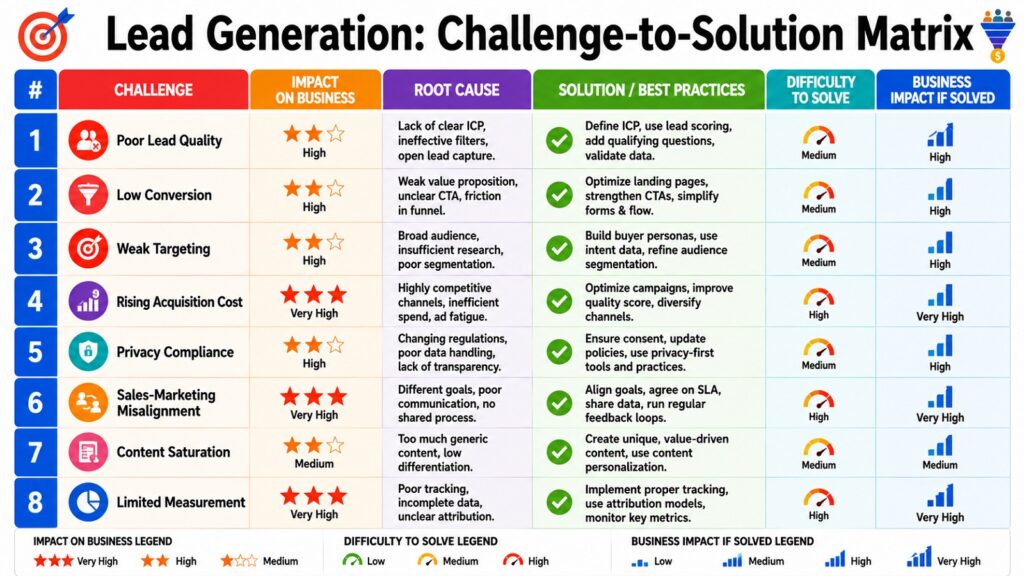
Lead generation is not a solved problem. Organizations at every stage of growth encounter obstacles that erode performance, strain budgets, and create friction between marketing and sales teams. Understanding why these challenges arise matters more than simply recognizing that they exist.
Declining lead quality is one of the most common complaints from sales teams. It usually traces back to marketing teams being measured on volume rather than quality. When the incentive is to generate as many contacts as possible, the natural response is to lower the qualification bar. The fix is a shared definition of what a qualified lead looks like, agreed upon by both teams before any campaign begins.
Rising acquisition costs have affected nearly every industry. Customer acquisition costs have increased by approximately 60 percent across industries over the past five years, driven by greater competition for digital attention and more restrictive privacy regulations. Organizations responding most effectively have invested in first-party data, referral programs, and organic content that generates interest over time.
Privacy regulations have reshaped what marketers can and cannot do. GDPR and similar legislation have raised the bar for consent-based marketing. Organizations that treated these changes as an opportunity have built smaller but more intentional contact lists that convert at higher rates. Research shows that high-growth companies are 73 percent more likely to prioritize first-party data strategies.
Marketing and sales misalignment remains a persistent source of wasted effort. Prospects who receive conflicting messages from marketing emails and sales calls lose confidence quickly. Regular structured communication between teams, shared metrics, and clearly owned handoff processes reduce this friction significantly.
Content saturation makes it harder to earn sustained attention. Every topic relevant to modern business is covered by thousands of existing resources. Organizations that stand out invest in original research, proprietary data, and formats that competitors have not explored.
Table: Lead Generation Challenges and Corresponding Best Practices
| Challenge | Best Practice Response |
| Declining lead quality | Define shared MQL and SQL criteria agreed on by marketing and sales |
| Rising acquisition costs | Invest in first-party data and organic content to reduce paid dependency |
| Privacy regulations | Build consent-based marketing programs around first-party audience data |
| Marketing-sales misalignment | Establish shared metrics, regular alignment meetings, and joint handoff processes |
| Ineffective audience targeting | Use behavioral and firmographic data to narrow ICP definition |
| Content saturation | Invest in original research, proprietary data, and differentiated formats |
| Long and complex sales cycles | Build nurturing programs that sustain engagement across extended decision periods |
| Measurement complexity | Adopt multi-touch attribution models that reflect actual buyer journeys |
8. Lead Generation Across Different Business Models: Adapting Marketing to Diverse Markets
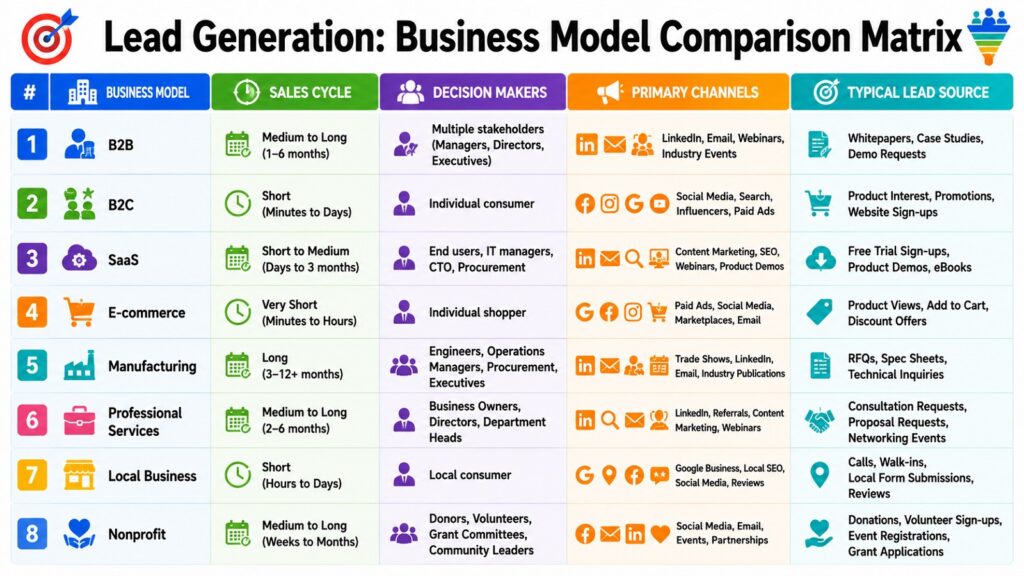
The principles of lead generation stay consistent across business models. The goal is always to identify interested prospects, qualify their fit, and guide them toward a buying decision. But the way those principles translate into practice varies enormously depending on who the customer is and how they make decisions.
In B2B markets, buying decisions involve multiple stakeholders and extended evaluation periods. A single deal might take six to eighteen months to close and require input from procurement, department heads, and legal. Lead generation here focuses heavily on building trust through thought leadership, account-based approaches, and direct engagement with specific organizations. LinkedIn plays a dominant role, and webinars serve as both qualification and relationship-building tools.
B2C markets operate at higher volumes with faster decision cycles and more emotional purchase triggers. Lead generation shifts toward broad reach, compelling offers, and seamless digital experiences that reduce friction between interest and conversion. Volume, cost per acquisition, and customer lifetime value carry more weight than individual relationship metrics.
SaaS companies often use a product-led growth model where the product itself generates leads. Free trials, freemium tiers, and interactive demos allow prospects to experience value before speaking with a salesperson. Dropbox scaled to tens of millions of users with minimal traditional marketing spend by relying on a referral model where existing users invited new ones in exchange for additional storage.
E-commerce businesses generate leads through abandoned cart capture, loyalty programs, and email subscription incentives. A customer who added items to a cart without purchasing is a high-intent lead. Retargeting and personalized email sequences aimed at cart abandoners consistently recover meaningful revenue.
Local businesses and professional services firms depend on referrals, community relationships, and local search visibility. Google Business Profile optimization, local SEO, and review management often outperform broad digital advertising for these markets. Manufacturing companies typically rely on trade shows, industry publications, and distributor networks. Each business model demands a lead generation approach built around actual buyer behavior rather than borrowed assumptions.
Table: Business Models and Their Primary Lead Generation Focus
| Business Model | Primary Lead Generation Focus |
| B2B Enterprise | Account-based marketing, thought leadership, and long-cycle nurturing |
| B2C Retail | High-volume campaigns, promotional offers, and seamless digital capture |
| SaaS | Free trials, freemium models, and product-qualified lead development |
| E-commerce | Cart abandonment recovery, loyalty programs, and email retargeting |
| Local Business | Local SEO, referrals, Google Business Profile, and community engagement |
| Professional Services | Referral networks, content authority, and consultation-based capture |
| Manufacturing | Trade shows, distributor networks, and industry publication presence |
| Nonprofit | Cause-aligned content, event participation, and partner audience access |
Conclusion: The Future of Lead Generation in Modern Marketing
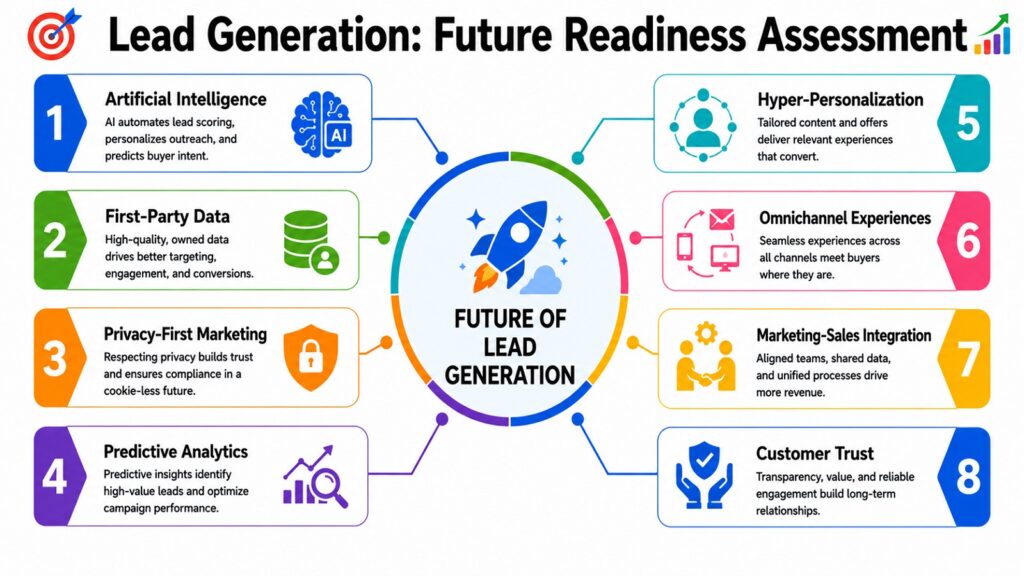
Lead generation has traveled a long way from cold calling lists and trade show badge scans. The eight foundations explored in this article form a disciplined framework that organizations can apply regardless of industry, size, or business model. Strategy sets the direction. Channels create reach. Capture techniques convert interest into identifiable contacts. Qualification focuses energy on the most promising prospects. Nurturing builds the relationships that carry leads to a decision. Measurement ensures the process improves over time. Understanding challenges prevents avoidable setbacks. And adapting to the specific business model turns principles into practical results.
Artificial intelligence is accelerating personalization, predicting buyer intent, and automating qualification tasks that once demanded significant human time. AI-powered lead scoring adoption rose 45 percent in 2023 alone. Privacy-focused marketing is reshaping data strategy. First-party data collected with genuine consent consistently outperforms purchased lists. Omnichannel engagement, where messaging stays consistent across email, social, web, and direct outreach, lifts engagement by as much as 250 percent compared to disconnected single-channel approaches.
What will not change is the underlying logic. Someone has a problem. A business can solve it. Lead generation is the discipline that connects those two realities in a structured, measurable, and repeatable way. Organizations that treat it as a long-term organizational capability rather than a short-term campaign will consistently outperform those that treat each quarter as a fresh start.
Table: Eight Future Trends Shaping Lead Generation
| Future Trend | Business Impact |
| AI-Powered Lead Scoring | Prioritizes high-potential leads with greater speed and accuracy |
| First-Party Data Strategies | Builds qualified audiences based on genuine consent and intent |
| Omnichannel Engagement | Creates consistent buyer experiences across every touchpoint |
| Predictive Analytics | Identifies likely buyers before they actively enter the market |
| Conversational Marketing | Uses chatbots and live dialogue to qualify leads in real time |
| Privacy-First Marketing | Builds trust by prioritizing transparency in data collection |
| Marketing-Sales Integration | Aligns both teams around shared pipeline and revenue metrics |
| Personalization at Scale | Delivers tailored messaging to large audiences through automation |